
Showing 4 items matching "long wool lincoln"
-
 Warrnambool and District Historical Society Inc.
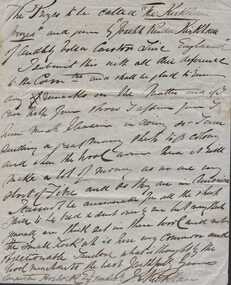
Document, Letter J Kirkham, 1873
... ...long wool lincoln sheep...From other correspondence in this collection of letters we have established that Mr Kirkham is a breeder of long wool Lincoln sheep who was eager to establish the breed in Australia and New Zealand. ...From other correspondence in this collection of letters we have established that Mr Kirkham is a breeder of long wool Lincoln sheep who was eager to establish the breed in Australia and New Zealand. ...From other correspondence in this collection of letters we have established that Mr Kirkham is a breeder of long wool Lincoln sheep who was eager to establish the breed in Australia and New Zealand. Augustus Bostock is mentioned at the bottom of this letter To that end, he speaks of establishing a number of prizes called the Kirkham prizes with the emphasis being on the quality of the wool. He states as an aside at the end of the letter,” I have now determined to export my best sheep leaving the home ** to my father and nephew, I would like to number ** amongst my customersThis letter shows the link between wool breeders in England and their efforts to establish connections and supplies in Australia.Large cream sheet of paper with black ink hand writing .Back of sheet is blank. Folded in half.Signed Kirkham.warrnambool, j kirkham, augustus bostock, long wool lincoln sheep, long wool lincoln -
 Warrnambool and District Historical Society Inc.
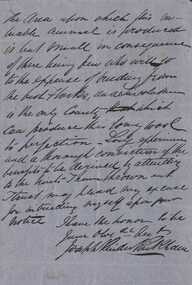
Document:, Letter from Joseph Kirkham 1872, 1872
... ...Lincoln long wool...This letter refers to the production of long wool and sourcing the fleece and breeding stock of the Lincoln long wool breed. ...This letter refers to the production of long wool and sourcing the fleece and breeding stock of the Lincoln long wool breed. ...This letter refers to the production of long wool and sourcing the fleece and breeding stock of the Lincoln long wool breed. He writes from Lincolnshire and is looking at developing opportunities in Australia and New Zealand. The breed became popular in the latter part of the 19th century and large prices were paid for stock particularly rams. They were bred for wool as well as meat. The breed had declined in popularity in the later part of the 20th century. This letter is part of the Bostock collectionA handwritten letter documenting the link between English markets and Australian sheep farmers.Pale blue paper, lightweight, handwritten in black ink.Joseph* Kirkhamwarrnambool, lincoln long wool, joseph kirkham lincolnshire, 1872, bostock -
 Bacchus Marsh & District Historical Society
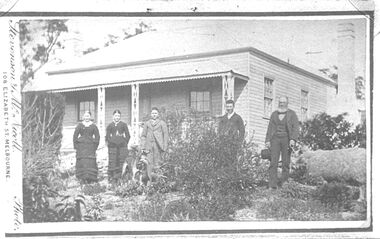
Photograph, Jeffrey family and farmhouse Coimadai 1883
... Jeffrey appears to be a Lincoln Long- woolled sheep. The unusual lead, which has a handle, suggests that this sheep was often exhibited at Agricultural Shows and may have won prizes in its class. ...Jeffrey appears to be a Lincoln Long- woolled sheep. The unusual lead, which has a handle, suggests that this sheep was often exhibited at Agricultural Shows and may have won prizes in its class. ...This photograph is believed to be of the farm "Glencairn" at Coimadai near Bacchus Marsh. The family includes Mrs Alice Jeffrey (nee Dickson), Mr. William Jeffrey, daughter Annie and two sons. Mr William Jeffrey died at "Glencairn", Coimadai, in 1906, at the age of 80. His homestead and farm were known as a model of neatness and planning. The sheep held by Mr. Jeffrey appears to be a Lincoln Long- woolled sheep. The unusual lead, which has a handle, suggests that this sheep was often exhibited at Agricultural Shows and may have won prizes in its class. Mr Jeffrey was a frequent exhibitor and prize-winner at the Bacchus Marsh Agricultural Society.Small photographic copy of an original Carte de Visite picture. Housed in the album, 'Photographs of Bacchus Marsh and District in 1883 by Stevenson and McNicoll'. The image shows a family group. They are standing in the garden in front of a farm house. The group comprises two women and three men. The older man on the right of the picture is believed to be William Jeffrey who is holding a sheep on a lead with a handle. A dog stands in front of a younger man in the centre of the picture. In the background is the weatherboard farm house, a simple construction with two large chimneys and a skillion extension.On the front: Stevenson & McNicoll. Photo. 108 Elizabeth St. Melbourne. COPIES CAN BE OBTAINED AT ANY TIME. On the back: LIGHT & TRUTH inscribed on a banner surmounted by a representation of the rising sun. Copies of this Portrait can be had at any time by sending the Name and Post Office Money Order or Stamps for the amount of order to STEVENSON & McNICOLL LATE BENSON & STEVENSON, Photographers. 108 Elizabeth Street, MELBOURNE. N.B. The above inscription would have appeared on the original of this photo.stevenson and mcnicoll 1883 photographs of bacchus marsh and district, farmers, jeffrey family, glencairn, farms, long woolled sheep -
 National Wool Museum
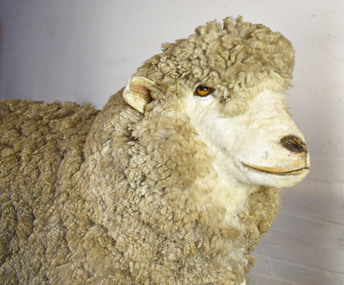
Taxidermy Sheep, Stanbury Jacko, c1980
... The Corriedale was developed both in Australia and New Zealand in the late 1800s and, after the Merino, is Australia’s second most prolific breed. 50% Merino and 50% Lincoln, the breed produces thick, stapled wool which is ideal for hand spun items. Its crimped fleece is long, medium fine and high yielding. ...The Corriedale was developed both in Australia and New Zealand in the late 1800s and, after the Merino, is Australia’s second most prolific breed. 50% Merino and 50% Lincoln, the breed produces thick, stapled wool which is ideal for hand spun items. Its crimped fleece is long, medium fine and high yielding. ...The Corriedale was developed both in Australia and New Zealand in the late 1800s and, after the Merino, is Australia’s second most prolific breed. 50% Merino and 50% Lincoln, the breed produces thick, stapled wool which is ideal for hand spun items. Its crimped fleece is long, medium fine and high yielding. Preferring colder, high rainfall climates, the Corriedale’s black feet provide some protection against footrot in damp conditions. Australasia’s largest breed, mature ewes generally weigh between 59 to 82 kg, while a mature ram like Stanbury Jacko may typically weigh between 79 to 125 kg. This breed has approximately 7.7kg of fleece per animal, averaging 24 to 32 microns.Corriedale ram. Medium size body and short legs with white fleece. sheep, south australia, corriedale
