
Showing 31 items matching "long woolled sheep"
-
 Bacchus Marsh & District Historical Society
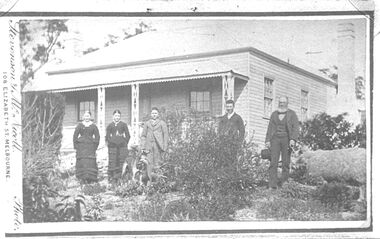
Photograph, Jeffrey family and farmhouse Coimadai 1883
... ...Long Woolled Sheep...Jeffrey appears to be a Lincoln Long- woolled sheep. The unusual lead, which has a handle, suggests that this sheep was often exhibited at Agricultural Shows and may have won prizes in its class. ...Jeffrey appears to be a Lincoln Long- woolled sheep. The unusual lead, which has a handle, suggests that this sheep was often exhibited at Agricultural Shows and may have won prizes in its class. ...This photograph is believed to be of the farm "Glencairn" at Coimadai near Bacchus Marsh. The family includes Mrs Alice Jeffrey (nee Dickson), Mr. William Jeffrey, daughter Annie and two sons. Mr William Jeffrey died at "Glencairn", Coimadai, in 1906, at the age of 80. His homestead and farm were known as a model of neatness and planning. The sheep held by Mr. Jeffrey appears to be a Lincoln Long- woolled sheep. The unusual lead, which has a handle, suggests that this sheep was often exhibited at Agricultural Shows and may have won prizes in its class. Mr Jeffrey was a frequent exhibitor and prize-winner at the Bacchus Marsh Agricultural Society.Small photographic copy of an original Carte de Visite picture. Housed in the album, 'Photographs of Bacchus Marsh and District in 1883 by Stevenson and McNicoll'. The image shows a family group. They are standing in the garden in front of a farm house. The group comprises two women and three men. The older man on the right of the picture is believed to be William Jeffrey who is holding a sheep on a lead with a handle. A dog stands in front of a younger man in the centre of the picture. In the background is the weatherboard farm house, a simple construction with two large chimneys and a skillion extension.On the front: Stevenson & McNicoll. Photo. 108 Elizabeth St. Melbourne. COPIES CAN BE OBTAINED AT ANY TIME. On the back: LIGHT & TRUTH inscribed on a banner surmounted by a representation of the rising sun. Copies of this Portrait can be had at any time by sending the Name and Post Office Money Order or Stamps for the amount of order to STEVENSON & McNICOLL LATE BENSON & STEVENSON, Photographers. 108 Elizabeth Street, MELBOURNE. N.B. The above inscription would have appeared on the original of this photo.stevenson and mcnicoll 1883 photographs of bacchus marsh and district, farmers, jeffrey family, glencairn, farms, long woolled sheep -
 Warrnambool and District Historical Society Inc.
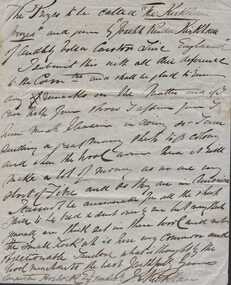
Document, Letter J Kirkham, 1873
... ...long wool lincoln sheep...From other correspondence in this collection of letters we have established that Mr Kirkham is a breeder of long wool Lincoln sheep who was eager to establish the breed in Australia and New Zealand. ...wool. He states as an aside at the end of the letter,” I have now determined to export my best sheep leaving the home ** to my father and nephew, I would like to number ** amongst my customers This letter shows the link between wool breeders in England and their efforts to establish connections and supplies in Australia. warrnambool j kirkham augustus bostock long wool lincoln sheep long wool lincoln Signed Kirkham. ...From other correspondence in this collection of letters we have established that Mr Kirkham is a breeder of long wool Lincoln sheep who was eager to establish the breed in Australia and New Zealand. Augustus Bostock is mentioned at the bottom of this letter To that end, he speaks of establishing a number of prizes called the Kirkham prizes with the emphasis being on the quality of the wool. He states as an aside at the end of the letter,” I have now determined to export my best sheep leaving the home ** to my father and nephew, I would like to number ** amongst my customersThis letter shows the link between wool breeders in England and their efforts to establish connections and supplies in Australia.Large cream sheet of paper with black ink hand writing .Back of sheet is blank. Folded in half.Signed Kirkham.warrnambool, j kirkham, augustus bostock, long wool lincoln sheep, long wool lincoln -
 Warrnambool and District Historical Society Inc.
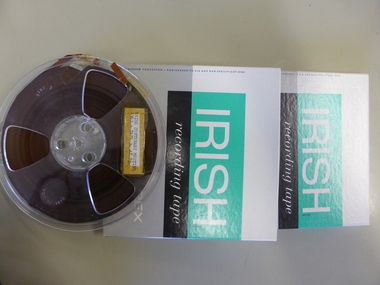
Audio - Audio tapes, Shire Centenary meeting 1963, Circa 1963
... wool growing, sheep and cattle raising. There are more than 20 parishes and more than 29 small townships in the area The industries, agriculture, and people of the Warrnambool Shire provided substantial support to the city of Warrnambool over a long period of time. warrnambool warrnambool shire council warrnambool shire centenary Shire Centenary meeting 1963 tape1, 2, 3. depth. ...The Warrnambool Shire commenced in 1863 and was 613 square miles in area and had a population of about 8000. It was divided into three ridings each with three councillors. Its industries were dairying, general farming, cheese and butter making, wool growing, sheep and cattle raising. There are more than 20 parishes and more than 29 small townships in the area The industries, agriculture, and people of the Warrnambool Shire provided substantial support to the city of Warrnambool over a long period of time. Three audio reel to reel tapes two in green and white boxesShire Centenary meeting 1963 tape1, 2, 3. depth. Two tapes stored in grey and white cardboard box, Irish recording tape, a product of AMPEXwarrnambool, warrnambool shire council, warrnambool shire centenary -
 Wycheproof & District Historical Society Inc.
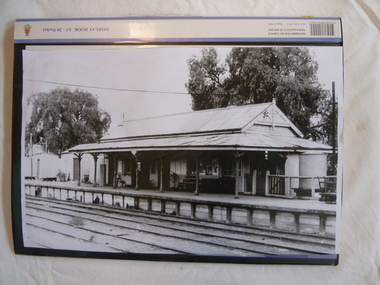
Railway Book, Wycheproof Railway, 2004
... long-awaited official opening of the railway. It was recorded that no less than 23 parishes would act as feeder to the rail line. The Railway Station closed in December 1990 but the building was renovated in 2010 with plans for a community focus and cultural events. The arrival of rail opened up the Mallee. Local farmers began sending wheat, sheep and wool ...Friday, September 28, 1883 was a memorable date for Wycheproof as on that day was the long-awaited official opening of the railway. It was recorded that no less than 23 parishes would act as feeder to the rail line. The Railway Station closed in December 1990 but the building was renovated in 2010 with plans for a community focus and cultural events.The arrival of rail opened up the Mallee. Local farmers began sending wheat, sheep and wool by rail. Improvements to transport stock was ongoing and the eventual rail extension north of the town, resulted in a well patronised passenger service for years. Railway families and workers added to the culture of the town.Display Book of A3 size with 20 pockets of Wycheproof Rail information. It includes a collection of newspaper and magazine articles, photos, rail drawings, train calendar, paint colour legend and other rail references.sea lake, railway, rail-drawing, last-passenger- train, centenary- train, train - calendar, steaming- up- broadway, wycheproof - rail -
 Victorian Interpretive Projects Inc.
photograph - Colour, Viewing the National Wool Museum's auction room
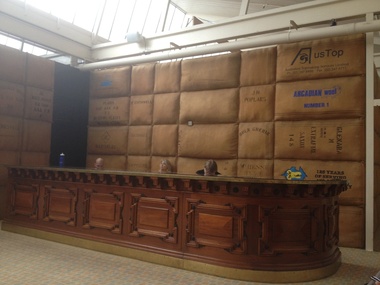
... wool industry – sheep farming began here in 1835 and the first of many woollen mills opened here in 1868. For many years the city was known as the 'wool centre of the world'. Two hundred years later, in 1988, the National Wool Museum was established as Australia’s only comprehensive museum of wool. (http://www.geelongaustralia.com.au/nwm/about/article/item/8cbcc313afa77a5.aspx) Wool Geelong wool bail Auction Room National Wool Museum display of wool ales at the National Wool Museum. Steel girders holding up the roof were made by Dorman Long ...This photograph on an iPhone 4 during the Museums Australia (Vic) Conference at the National Wool Museum, Geelong. Since the arrival of sheep with the First Fleet in 1788, the wool industry has dominated our economy, our agriculture and our reputation as a quality wool-growing nation throughout the world. Geelong is a city synonymous with wool and the wool industry – sheep farming began here in 1835 and the first of many woollen mills opened here in 1868. For many years the city was known as the 'wool centre of the world'. Two hundred years later, in 1988, the National Wool Museum was established as Australia’s only comprehensive museum of wool. (Since the arrival of sheep with the First Fleet in 1788, the wool industry has dominated our economy, our agriculture and our reputation as a quality wool-growing nation throughout the world. Geelong is a city synonymous with wool and the wool industry – sheep farming began here in 1835 and the first of many woollen mills opened here in 1868. For many years the city was known as the 'wool centre of the world'. Two hundred years later, in 1988, the National Wool Museum was established as Australia’s only comprehensive museum of wool. (Since the arrival of sheep with the First Fleet in 1788, the wool industry has dominated our economy, our agriculture and our reputation as a quality wool-growing nation throughout the world. Geelong is a city synonymous with wool and the wool industry – sheep farming began here in 1835 and the first of many woollen mills opened here in 1868. For many years the city was known as the 'wool centre of the world'. Two hundred years later, in 1988, the National Wool Museum was established as Australia’s only comprehensive museum of wool. (http://www.geelongaustralia.com.au/nwm/about/article/item/8cbcc313afa77a5.aspx)display of wool ales at the National Wool Museum. Steel girders holding up the roof were made by Dorman Long & Co. Middlesborough, England. In the foreground is a timber counter with brass kick rail and upper edge. Names on wool bales include Austop, Arcadian Wool, Buln Gherin, Mt Hesse, Melrose, Avondale Hills, Kerrsville, Kooringa, Merryville Yass, Sherra Park, Wurrock, Hazeldean, Buanogor Parkwool, geelong, wool bail, auction room, national wool museum -
 Warrnambool and District Historical Society Inc.
Document:, Letter from Joseph Kirkham 1872, 1872
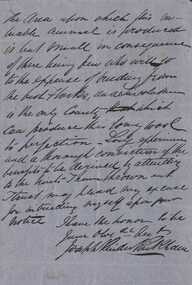
... long wool and sourcing the fleece and breeding stock of the Lincoln long wool breed. He writes from Lincolnshire and is looking at developing opportunities in Australia and New Zealand. The breed became popular in the latter part of the 19th century and large prices were paid for stock particularly rams. They were bred for wool as well as meat. The breed had declined in popularity in the later part of the 20th century. This letter is part of the Bostock collection A handwritten letter documenting the link between English markets and Australian sheep ...This letter refers to the production of long wool and sourcing the fleece and breeding stock of the Lincoln long wool breed. He writes from Lincolnshire and is looking at developing opportunities in Australia and New Zealand. The breed became popular in the latter part of the 19th century and large prices were paid for stock particularly rams. They were bred for wool as well as meat. The breed had declined in popularity in the later part of the 20th century. This letter is part of the Bostock collectionA handwritten letter documenting the link between English markets and Australian sheep farmers.Pale blue paper, lightweight, handwritten in black ink.Joseph* Kirkhamwarrnambool, lincoln long wool, joseph kirkham lincolnshire, 1872, bostock -
 Port of Echuca
Instrument - Steering Wheel, PS Success, 1877
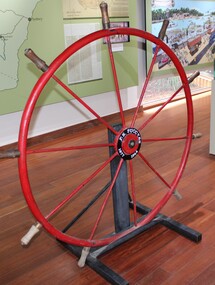
... She had a long, colourful history towing barges on the Murray River and in particular in the Mildura, Wentworth and Ned's Corner regions. Importantly, the Success was the last paddlesteamer to be working on the river system right up until the 1956 floods rescuing sheep and wool. ...This steering wheel is from the PS Success. The PS Success was built in Moama in 1877 by GB Air for Westwood & Air. The Success towed barges of sawn red gum, wool & other cargo along the Darling and Murray Rivers as well as running as a passenger boat from Swan Hill to Mildura during 1915-16. The Success ended her working life in 1957 and was put up on the bank at Neds Corner, 80kms west of Mildura. The PS Success was donated to the Riverboat Historical and Preservation Society of Mildura with plans for full restoration but with funds becoming extremely difficult to secure, the Shire of Campaspe was approached to take ownership in 2009 to enable further restoration when possible. The Riverboat Preservation Society also donated this original steering wheel.The PS Success was an important vessel built in the Echuca area during the height of the Riverboat trade in the 1870s. She had a long, colourful history towing barges on the Murray River and in particular in the Mildura, Wentworth and Ned's Corner regions. Importantly, the Success was the last paddlesteamer to be working on the river system right up until the 1956 floods rescuing sheep and wool. The steering wheel is an important original element of the PS Success and her hopes for restoration one day. Red metal steering wheel with 10 spokes sitting on a heavy iron wheel stand. -
 National Wool Museum
Poster
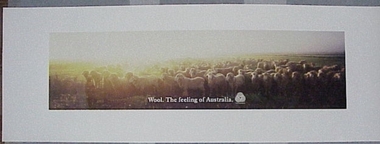
... Long, landscape orientation illlustrating flock of sheep with text in white below: "Wool. ...Long, landscape orientation illlustrating flock of sheep with text in white below: "Wool. ...Colour poster for the Woolmark Company. Long, landscape orientation illlustrating flock of sheep with text in white below: "Wool. The feeling of Australia" with Woolmark logo.One of several posters donated by Woolmark.sheep - australian, woolmark company australian wool corporation -
 National Wool Museum
Poster
... Long, landscape orientation illlustrating flock of sheep with text in white below: "Wool. ...Long, landscape orientation illlustrating flock of sheep with text in white below: "Wool. ...Colour poster for the Woolmark Company. Long, landscape orientation illlustrating flock of sheep with text in white below: "Wool. The feeling of Australia" with Woolmark logo.sheep - australian wool marketing, sheep - australian, wool marketing -
 National Wool Museum
Shirt
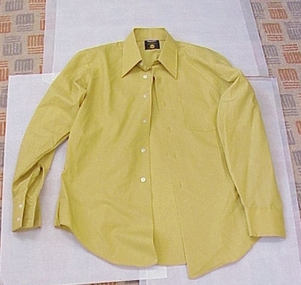
... long sleeves and cuffs. Part of the outfit to go with the "Sheep to Suit" record attempt, 1982. Textile Production Fashion Shearing Weaving Sewing Melbourne College of Textiles Highlights of the National Wool Museum: from Sheep to Suit - Exhibition (22/09/2001 - 02/12/2001) Textile Production Fashion Shearing Weaving Sewing sheraton/ styled in/ Permanent Press/ KORATRON/ 65% polyester/ 35% cotton /15 1/2 Part of the 'Sheep to Suit' event outfit. ...Business shirt, gold with collar, long sleeves and cuffs. Part of the outfit to go with the "Sheep to Suit" record attempt, 1982.Part of the 'Sheep to Suit' event outfit.sheraton/ styled in/ Permanent Press/ KORATRON/ 65% polyester/ 35% cotton /15 1/2textile production fashion shearing weaving sewing, melbourne college of textiles, highlights of the national wool museum: from sheep to suit - exhibition (22/09/2001 - 02/12/2001), textile production, fashion, shearing, weaving, sewing -
 National Wool Museum
Tool - Pullover
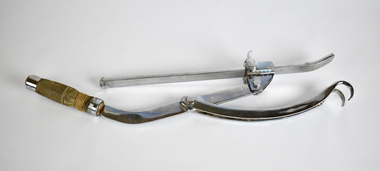
... wool bales. In early use at Strachans (a lighter, simple long handled hook was used later). chrome baling hook pullover tool sheep wool industry Chrome plated tool with wood handle. ...Chrome plated pullover used to close wool bales. In early use at Strachans (a lighter, simple long handled hook was used later). Chrome plated tool with wood handle. Tool pivots at two points and has hooks on the end. The wood handle also has string binding. chrome, baling hook, pullover, tool, sheep, wool, industry -
 National Wool Museum
Film - Sportwool, c.2000
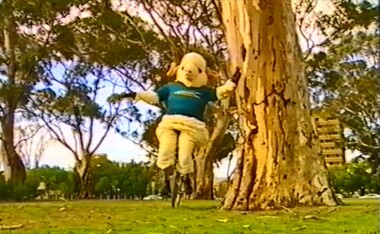
... long form advertisement for Sportwool, featuring national and international sports athletes. Film Textile Industry Sheep Training Fitness Sport Athletes Uniforms Pat Farmer Sportwool Label on tape: THE WOOLMARK COMPANY / SPORTS WOOL / Duration: 4 min 38 sec Black VHS tape with white stickers and hand written and printed text. ...Tape shows a long form advertisement for Sportwool, featuring national and international sports athletes.Black VHS tape with white stickers and hand written and printed text. Tape is housed in a white plastic case. Film includes colour footage and audio. 00:06 - titles 'Sportwool' 00:11 - line of cold looking people and sheep mascot 00:21 - sheep mascot and basketball players on indoor court 00:42 - sheep mascot on unicycle 00:54 - various scenes of Australian athletes 01:37 - Manchester United, various scenes 01:56 - basketball 02:16 - cyclists 02:32 - hockey 02:53 - Pat Farmer, ultramarathon athlete, running through outback landscape 03:03 - skiing 03:14 - netball 03:27 - australian football league 04:42 - end credits 04:45 - endLabel on tape: THE WOOLMARK COMPANY / SPORTS WOOL / Duration: 4 min 38 secfilm, textile industry, sheep, training, fitness, sport, athletes, uniforms, pat farmer, sportwool -
 National Wool Museum
Book - Wool Classing Note Books, John Griffin, 1941-1943
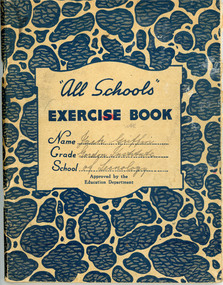
... sheep, such as the heart. Another book is on Wool Classing with topics such as wool scouring, dipping, shearing and micron counts. The third book is on general shearing shed knowledge. This includes a diagram for rolling a fleece, correct method for stamping a wool bale and branding abbreviations. The final book is on the History the Merino Sheep. It is a long...sheep, such as the heart. Another book is on Wool Classing with topics such as wool scouring, dipping, shearing and micron counts. The third book is on general shearing shed knowledge. This includes a diagram for rolling a fleece, correct method for stamping a wool bale and branding abbreviations. The final book is on the History the Merino Sheep. It is a long ...John Griffin’s wool classing exercise books from 1941-1943 when he was a student at the Gordon Institute in Geelong. John and his father John Henry Griffin owned a farm in Dunkeld and bred fine merino wool. One year they topped the wool sales figures for the area, in the late 1940s. There are four books in total. One book is on the topic of Veterinary Science and is from 1941. It contains information on topics such as birth and early lamb life, bone structure and other internal organisms of a sheep, such as the heart. Another book is on Wool Classing with topics such as wool scouring, dipping, shearing and micron counts. The third book is on general shearing shed knowledge. This includes a diagram for rolling a fleece, correct method for stamping a wool bale and branding abbreviations. The final book is on the History the Merino Sheep. It is a long form essay answer booklet. The Gordon institute and wool are synonymous with one another, the first class in wool sorting was offered at the Gordon in 1891. With much of the wool clip sent directly to England at this time, The Gordon's focus soon shifted to wool classing and marketing. By the 1930s, The Gordon's wool school was renowned as the state's wool industry training centre. Early specialist short courses were offered around Victoria to assist wool growers in preparing their clip for market, with modules on sheep breeding and pasture development included in the programs. Anne Griffin’s, John’s daughter, donated the exercise books to the National Wool Museum in 2021. Book 1 is predominately blue circular cover with cream background. Middle of book has pink highlighter mark. Reverse of book has an Arithmetical Table and a Multiplication Table in a blue ink on cream paper. It also has four black ink markings Book 2 is predominately blue circular cover with cream background. Book has red tape across the spine. Reverse of book has an Arithmetical Table and a Multiplication Table in a blue ink on cream paper. Book 3 is predominately blue plaid cover with cream background. Middle of book has pink highlighter handwriting which has been crossed with the same colour, leaving the text unreadable. Reverse of book has an Arithmetical Table and a Multiplication Table in a blue ink on cream paper. Book 4 is predominately blue diagonal striped book with cream background. Middle of book has small picture of Australia. Reverse of book has an Arithmetical Table and a Multiplication Table in a blue ink on cream paper. Book 1. Front cover: “All Schools” / EXERCISE BOOK / NAME Jack Griffin Grade Gordon Institute School of Technology(?) / Approved by the / Education Department Back cover. Reverse. ARTHMETICAL TABLES / (Numerous, see media) Book 2. Front cover: 2nd & 3rd / “All Schools” / EXERCISE BOOK / Name Jack Griffin / Grade 2 / School the Gordon / Approved by the / Education Department Back cover. Reverse. ARTHMETICAL TABLES / (Numerous, see media) Book 3. Front cover: Embassy / EXERCUSE BOOK / Name John Griffin / Grade 1 / School (?) / APPROVED BY THE EDUCATION DEPARTMENT / Back cover. Reverse. ARTHMETICAL TABLES / (Numerous, see media) Book 4. Front cover: EXERCISE / APPROVED BY EDUCATION DEPT. / BOOK / NAME Jack Griffin / GRADE 3 / SCHOOL Gordon Back cover. Reverse. ARTHMETICAL TABLES / (Numerous, see media) gordon institute geelong, wool classing, 1940s sheep farming, note book, study, student -
 National Wool Museum
Tool - Stencil, c.2018
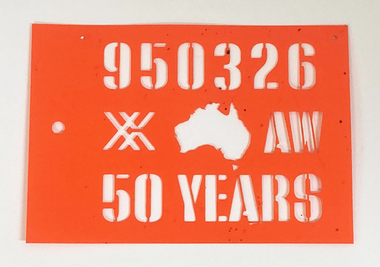
... sheep. It was not all smooth sailing for Denis however, and he soon learnt an important lesson. Class wool the way you’re taught, don’t listen to the owner standing over your shoulder. At a clip of Corriedales near Casterton, Denis was pushing too many fleeces into the line of fine wool. This resulted in a notice from the Australian Wool Exchange (AWEX) “mixing counts too much, submit three clips for inspection”. Denis was able to submit 3 clips with no further complaints, however, this proved a valuable lesson he would never forget over his long...sheep. It was not all smooth sailing for Denis however, and he soon learnt an important lesson. Class wool the way you’re taught, don’t listen to the owner standing over your shoulder. At a clip of Corriedales near Casterton, Denis was pushing too many fleeces into the line of fine wool. This resulted in a notice from the Australian Wool Exchange (AWEX) “mixing counts too much, submit three clips for inspection”. Denis was able to submit 3 clips with no further complaints, however, this proved a valuable lesson he would never forget over his long ...The story of 90 years of wool classing between father & son begins in 1936, when a young boy by the name of Stanley James Hucker walked through the doors of the Gordon Technical School in Geelong. Born in 1921, Stanley was 15 years of age when he began his 3-year course in Wool Classing. 30 years later, Stanley’s second son Denis completed the same 3-year wool classing course. Beginning in 1966, Denis attended the same Gordon Technical School and walked the same halls as his father before him. Stanley finished his course in 1938. He went back to the family farm in Lake Bolac for a brief period before enrolling in the Second World War. At the completion of the war, Stanley returned home and married before gaining a soldier settler allotment, north of Willaura. This enabled Stan to use his wool classing knowledge. He ran between 1,500 and 2,000 sheep for many years, while his wool classer stencil also allowed him to go out and class at various sheds around the area. He held his stencil from 1938 until he retired at the age of 60 in 1981. On retirement, his second son Denis was working in the district, managing a local property while also leasing land himself. Upon his father’s retirement, Denis had the opportunity to lease his father’s farm, an opportunity he could not refuse. Denis had finished his wool classing course at the Gordon Technical School in 1968, graduating dux of his class. He began working with a local contractor and started classing wool in his team. Denis gained a great deal of experience working as part of this team in big sheds of up to 8 stands servicing between 10 & 20,000 sheep. It was not all smooth sailing for Denis however, and he soon learnt an important lesson. Class wool the way you’re taught, don’t listen to the owner standing over your shoulder. At a clip of Corriedales near Casterton, Denis was pushing too many fleeces into the line of fine wool. This resulted in a notice from the Australian Wool Exchange (AWEX) “mixing counts too much, submit three clips for inspection”. Denis was able to submit 3 clips with no further complaints, however, this proved a valuable lesson he would never forget over his long career classing wool. In the early 1980s, when Denis was leasing two properties including his father’s, things were going well until drought struck. February 1983 was the date of the Ash Wednesday bushfires, and saw Melbourne have three days over 40 °C for only the second time on record. This period saw Denis give away farming, turning towards contracting work instead. After the difficult times of the early 1980s, the next two decades were a good time for the sheep industry. 15 micron wool was selling for prices between 4 to 5,000 cents per kilo, double what you’d expect for the same wool in 2022. In 1995 a single bale of wool sold for a million dollars. This was a good time for Denis too. His contracting work saw him employing local shearers and shed staff. His team was involved with the shearing and classing of more than 130,000 sheep. After 20 years of contracting, it was time for Denis to transition into the next phase of his life. He gave up independent contracting, preferring instead to return to being a member of someone else’s team. In 2018, having completed 50 years of wool classing, it was time to call it a day and retire completely. At the annual Gordon Wool School Old Students Association dinner held in 2018, Denis was presented with his 50 years as a registered wool classer stencil awarded by the Australian Wool Exchange (AWEX). This is a rare honour achieved by few. As of February 2020, a total of 430 wool classers had achieved this 50-year milestone. For Denis however, his proudest achievement is achieving 90 years of wool classing with his father. The National Wool Museum is proud to share the collection of objects gained from 90 years in the wool classing industry by Stanley and Denis. This ranges from Stanley’s first stencil and Wool Sample book, started when he first attended the Gordon in 1936. The collection concludes 90 years later with Denis’ 50 years of wool classing Stencil. The collection contains many more objects, all telling the story of these 90 years, and the hard work invested by this dedicated father and son duo. Thin sheet of orange plastic with letters and numbers moulded to produce a consistent pattern for the surface below through the application of ink. This wool classing stencil once belonged to Denis Hucker. The top number is Denis’ Wool Classing Stencil Number. On the next line is the emblem of the Australian Wool Exchange, followed by an image of Australia, and finally the letters AW. The final line reads 50 years, indicating Denis’ experience in the profession of wool classing. This stencil is reserved for wool classers who have held their stencil and been actively classing wool in Australia for more than 50 years. Wool classers sort, classify, and grade wool into various lines so that it can be sold at best market price. They also manage and supervise wool-handling teams. The stencil is used in the final step of preparing a bale of wool for sale. It is branded across the front of a wool bale to indicate the quality of the wool, with the classers number used as a seal of approval. Accompanying the stencil are two sheets of white A4 paper with printing in gold and black ink. The first sheet was presented by the Australian Council of Wool Exporters & Processors to Denis Hucker for achieving 50 years of wool classing. Surrounded by a thin gold boarder, the page is made up of black text with gold headings. In the top right corner, an image of a sheep with an outline of Australia is found. The second piece of paper was presented by the Australian Wool Exchange to Denis Hucker for achieving 50 years of wool classing. Two thirds of the page is made up of a gold stencil which reads “50 years”. Accompanying the stencil is black text. Moulded letters, numbers, emblem, and imagery. “950326 / (emblem AWEX) (Image Australia) AW / 50 Years” A4 Paper. Printed. See Multimedia A4 Paper. Printed See Multimedia wool classing, stencil, 90 years wool classing between father & son -
 National Wool Museum
Tool - Stencil, 1983
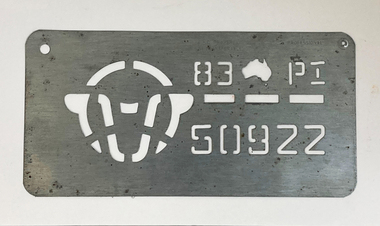
... sheep. It was not all smooth sailing for Denis however, and he soon learnt an important lesson. Class wool the way you’re taught, don’t listen to the owner standing over your shoulder. At a clip of Corriedales near Casterton, Denis was pushing too many fleeces into the line of fine wool. This resulted in a notice from the Australian Wool Exchange (AWEX) “mixing counts too much, submit three clips for inspection”. Denis was able to submit 3 clips with no further complaints, however, this proved a valuable lesson he would never forget over his long...sheep. It was not all smooth sailing for Denis however, and he soon learnt an important lesson. Class wool the way you’re taught, don’t listen to the owner standing over your shoulder. At a clip of Corriedales near Casterton, Denis was pushing too many fleeces into the line of fine wool. This resulted in a notice from the Australian Wool Exchange (AWEX) “mixing counts too much, submit three clips for inspection”. Denis was able to submit 3 clips with no further complaints, however, this proved a valuable lesson he would never forget over his long ...The story of 90 years of wool classing between father & son begins in 1936, when a young boy by the name of Stanley James Hucker walked through the doors of the Gordon Technical School in Geelong. Born in 1921, Stanley was 15 years of age when he began his 3-year course in Wool Classing. 30 years later, Stanley’s second son Denis completed the same 3-year wool classing course. Beginning in 1966, Denis attended the same Gordon Technical School and walked the same halls as his father before him. Stanley finished his course in 1938. He went back to the family farm in Lake Bolac for a brief period before enrolling in the Second World War. At the completion of the war, Stanley returned home and married before gaining a soldier settler allotment, north of Willaura. This enabled Stan to use his wool classing knowledge. He ran between 1,500 and 2,000 sheep for many years, while his wool classer stencil also allowed him to go out and class at various sheds around the area. He held his stencil from 1938 until he retired at the age of 60 in 1981. On retirement, his second son Denis was working in the district, managing a local property while also leasing land himself. Upon his father’s retirement, Denis had the opportunity to lease his father’s farm, an opportunity he could not refuse. Denis had finished his wool classing course at the Gordon Technical School in 1968, graduating dux of his class. He began working with a local contractor and started classing wool in his team. Denis gained a great deal of experience working as part of this team in big sheds of up to 8 stands servicing between 10 & 20,000 sheep. It was not all smooth sailing for Denis however, and he soon learnt an important lesson. Class wool the way you’re taught, don’t listen to the owner standing over your shoulder. At a clip of Corriedales near Casterton, Denis was pushing too many fleeces into the line of fine wool. This resulted in a notice from the Australian Wool Exchange (AWEX) “mixing counts too much, submit three clips for inspection”. Denis was able to submit 3 clips with no further complaints, however, this proved a valuable lesson he would never forget over his long career classing wool. In the early 1980s, when Denis was leasing two properties including his father’s, things were going well until drought struck. February 1983 was the date of the Ash Wednesday bushfires, and saw Melbourne have three days over 40 °C for only the second time on record. This period saw Denis give away farming, turning towards contracting work instead. After the difficult times of the early 1980s, the next two decades were a good time for the sheep industry. 15 micron wool was selling for prices between 4 to 5,000 cents per kilo, double what you’d expect for the same wool in 2022. In 1995 a single bale of wool sold for a million dollars. This was a good time for Denis too. His contracting work saw him employing local shearers and shed staff. His team was involved with the shearing and classing of more than 130,000 sheep. After 20 years of contracting, it was time for Denis to transition into the next phase of his life. He gave up independent contracting, preferring instead to return to being a member of someone else’s team. In 2018, having completed 50 years of wool classing, it was time to call it a day and retire completely. At the annual Gordon Wool School Old Students Association dinner held in 2018, Denis was presented with his 50 years as a registered wool classer stencil awarded by the Australian Wool Exchange (AWEX). This is a rare honour achieved by few. As of February 2020, a total of 430 wool classers had achieved this 50-year milestone. For Denis however, his proudest achievement is achieving 90 years of wool classing with his father. The National Wool Museum is proud to share the collection of objects gained from 90 years in the wool classing industry by Stanley and Denis. This ranges from Stanley’s first stencil and Wool Sample book, started when he first attended the Gordon in 1936. The collection concludes 90 years later with Denis’ 50 years of wool classing Stencil. The collection contains many more objects, all telling the story of these 90 years, and the hard work invested by this dedicated father and son duo. Thin sheet of metal with letters and numbers cut to produce a consistent pattern for the surface below through the application of ink. In small text on the top edge of the stencil two separate phrases are engraved.” A.W.C. PROPERTY NOT TRANSFERABLE” and “PROFESSIONAL“. This wool classing stencil belonged to Stanley Hucker. It was his last Wool Classing Stencil. Dated to 1983, it is 45 years older than his first stencil. The role of a Wool Classer is to sort, classify, and grade wool into various ‘lines’ so that it can be sold for best market price. Wool Classers are typically also tasked with the managing and supervising of wool-handling teams. The stencil is used in the final step of preparing a bale of wool for sale. It is branded across the front of a wool bale to indicate the quality of the wool, with the classers number used as a seal of guarantee.Engraved letters. “A.W.C. PROPERTY / NOT TRANSFERABLE” Engraved letters. “PROFESSIONAL“. Cut imagery. Sheep’s head Cut letters, numbers, and imagery. “83 (Image Australia) P I / 50922”wool classing, stencil, 90 years wool classing between father & son -
 National Wool Museum
Book - Wool Classing Exercise Book, 1936-38
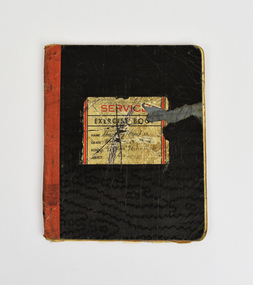
... sheep. It was not all smooth sailing for Denis however, and he soon learnt an important lesson. Class wool the way you’re taught, don’t listen to the owner standing over your shoulder. At a clip of Corriedales near Casterton, Denis was pushing too many fleeces into the line of fine wool. This resulted in a notice from the Australian Wool Exchange (AWEX) “mixing counts too much, submit three clips for inspection”. Denis was able to submit 3 clips with no further complaints, however, this proved a valuable lesson he would never forget over his long...sheep. It was not all smooth sailing for Denis however, and he soon learnt an important lesson. Class wool the way you’re taught, don’t listen to the owner standing over your shoulder. At a clip of Corriedales near Casterton, Denis was pushing too many fleeces into the line of fine wool. This resulted in a notice from the Australian Wool Exchange (AWEX) “mixing counts too much, submit three clips for inspection”. Denis was able to submit 3 clips with no further complaints, however, this proved a valuable lesson he would never forget over his long ...The story of 90 years of wool classing between father & son begins in 1936, when a young boy by the name of Stanley James Hucker walked through the doors of the Gordon Technical School in Geelong. Born in 1921, Stanley was 15 years of age when he began his 3-year course in Wool Classing. 30 years later, Stanley’s second son Denis completed the same 3-year wool classing course. Beginning in 1966, Denis attended the same Gordon Technical School and walked the same halls as his father before him. Stanley finished his course in 1938. He went back to the family farm in Lake Bolac for a brief period before enrolling in the Second World War. At the completion of the war, Stanley returned home and married before gaining a soldier settler allotment, north of Willaura. This enabled Stan to use his wool classing knowledge. He ran between 1,500 and 2,000 sheep for many years, while his wool classer stencil also allowed him to go out and class at various sheds around the area. He held his stencil from 1938 until he retired at the age of 60 in 1981. On retirement, his second son Denis was working in the district, managing a local property while also leasing land himself. Upon his father’s retirement, Denis had the opportunity to lease his father’s farm, an opportunity he could not refuse. Denis had finished his wool classing course at the Gordon Technical School in 1968, graduating dux of his class. He began working with a local contractor and started classing wool in his team. Denis gained a great deal of experience working as part of this team in big sheds of up to 8 stands servicing between 10 & 20,000 sheep. It was not all smooth sailing for Denis however, and he soon learnt an important lesson. Class wool the way you’re taught, don’t listen to the owner standing over your shoulder. At a clip of Corriedales near Casterton, Denis was pushing too many fleeces into the line of fine wool. This resulted in a notice from the Australian Wool Exchange (AWEX) “mixing counts too much, submit three clips for inspection”. Denis was able to submit 3 clips with no further complaints, however, this proved a valuable lesson he would never forget over his long career classing wool. In the early 1980s, when Denis was leasing two properties including his father’s, things were going well until drought struck. February 1983 was the date of the Ash Wednesday bushfires, and saw Melbourne have three days over 40 °C for only the second time on record. This period saw Denis give away farming, turning towards contracting work instead. After the difficult times of the early 1980s, the next two decades were a good time for the sheep industry. 15 micron wool was selling for prices between 4 to 5,000 cents per kilo, double what you’d expect for the same wool in 2022. In 1995 a single bale of wool sold for a million dollars. This was a good time for Denis too. His contracting work saw him employing local shearers and shed staff. His team was involved with the shearing and classing of more than 130,000 sheep. After 20 years of contracting, it was time for Denis to transition into the next phase of his life. He gave up independent contracting, preferring instead to return to being a member of someone else’s team. In 2018, having completed 50 years of wool classing, it was time to call it a day and retire completely. At the annual Gordon Wool School Old Students Association dinner held in 2018, Denis was presented with his 50 years as a registered wool classer stencil awarded by the Australian Wool Exchange (AWEX). This is a rare honour achieved by few. As of February 2020, a total of 430 wool classers had achieved this 50-year milestone. For Denis however, his proudest achievement is achieving 90 years of wool classing with his father. The National Wool Museum is proud to share the collection of objects gained from 90 years in the wool classing industry by Stanley and Denis. This ranges from Stanley’s first stencil and Wool Sample book, started when he first attended the Gordon in 1936. The collection concludes 90 years later with Denis’ 50 years of wool classing Stencil. The collection contains many more objects, all telling the story of these 90 years, and the hard work invested by this dedicated father and son duo. This is the first in a series of 5 wool classing exercise books. They were written by Stanley Hucker in his time at the Gordon Technical College from 1936-1938. This book begins in a cover of black vinyl with a strip of red tape on the spine to give added support. Some of the vinyl has been removed on the cover, revealing blue card beneath. A sticker label is also found on the front cover. It has been damaged. Part of the sticker has been removed, while blue ink can also be found obscuring the text below. Internally, the book is handwritten on yellowed pages with blue lines for the assistance in clarity of handwriting. The pages are also surrounded by a margin of red pen. The exercise book’s content is about veterinary studies relating to the diseases, injuries, and treatment of sheep. It is handwritten and accompanied by an occasional hand drawn diagram. A selection of pages have been photographed to give an impression of the information taught in classes, 90 years ago. This includes information about a sheep’s heart, hind limbs, and reproduction system in ewes. Front Cover. Wording, printed and handwritten “SERVICE / EXERCISE BOOK / NAME Stanley Hucker / GRADE wool classing / SCHOOL Gordon Technical / SUBJECT Veterinary”gordon institute geelong, wool classing, 1930s sheep farming, 90 years wool classing between father & son -
 National Wool Museum
Book - Wool Classing Exercise Book, 1936-38
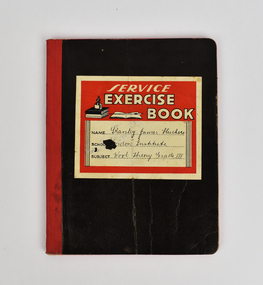
... sheep. It was not all smooth sailing for Denis however, and he soon learnt an important lesson. Class wool the way you’re taught, don’t listen to the owner standing over your shoulder. At a clip of Corriedales near Casterton, Denis was pushing too many fleeces into the line of fine wool. This resulted in a notice from the Australian Wool Exchange (AWEX) “mixing counts too much, submit three clips for inspection”. Denis was able to submit 3 clips with no further complaints, however, this proved a valuable lesson he would never forget over his long...sheep. It was not all smooth sailing for Denis however, and he soon learnt an important lesson. Class wool the way you’re taught, don’t listen to the owner standing over your shoulder. At a clip of Corriedales near Casterton, Denis was pushing too many fleeces into the line of fine wool. This resulted in a notice from the Australian Wool Exchange (AWEX) “mixing counts too much, submit three clips for inspection”. Denis was able to submit 3 clips with no further complaints, however, this proved a valuable lesson he would never forget over his long ...The story of 90 years of wool classing between father & son begins in 1936, when a young boy by the name of Stanley James Hucker walked through the doors of the Gordon Technical School in Geelong. Born in 1921, Stanley was 15 years of age when he began his 3-year course in Wool Classing. 30 years later, Stanley’s second son Denis completed the same 3-year wool classing course. Beginning in 1966, Denis attended the same Gordon Technical School and walked the same halls as his father before him. Stanley finished his course in 1938. He went back to the family farm in Lake Bolac for a brief period before enrolling in the Second World War. At the completion of the war, Stanley returned home and married before gaining a soldier settler allotment, north of Willaura. This enabled Stan to use his wool classing knowledge. He ran between 1,500 and 2,000 sheep for many years, while his wool classer stencil also allowed him to go out and class at various sheds around the area. He held his stencil from 1938 until he retired at the age of 60 in 1981. On retirement, his second son Denis was working in the district, managing a local property while also leasing land himself. Upon his father’s retirement, Denis had the opportunity to lease his father’s farm, an opportunity he could not refuse. Denis had finished his wool classing course at the Gordon Technical School in 1968, graduating dux of his class. He began working with a local contractor and started classing wool in his team. Denis gained a great deal of experience working as part of this team in big sheds of up to 8 stands servicing between 10 & 20,000 sheep. It was not all smooth sailing for Denis however, and he soon learnt an important lesson. Class wool the way you’re taught, don’t listen to the owner standing over your shoulder. At a clip of Corriedales near Casterton, Denis was pushing too many fleeces into the line of fine wool. This resulted in a notice from the Australian Wool Exchange (AWEX) “mixing counts too much, submit three clips for inspection”. Denis was able to submit 3 clips with no further complaints, however, this proved a valuable lesson he would never forget over his long career classing wool. In the early 1980s, when Denis was leasing two properties including his father’s, things were going well until drought struck. February 1983 was the date of the Ash Wednesday bushfires, and saw Melbourne have three days over 40 °C for only the second time on record. This period saw Denis give away farming, turning towards contracting work instead. After the difficult times of the early 1980s, the next two decades were a good time for the sheep industry. 15 micron wool was selling for prices between 4 to 5,000 cents per kilo, double what you’d expect for the same wool in 2022. In 1995 a single bale of wool sold for a million dollars. This was a good time for Denis too. His contracting work saw him employing local shearers and shed staff. His team was involved with the shearing and classing of more than 130,000 sheep. After 20 years of contracting, it was time for Denis to transition into the next phase of his life. He gave up independent contracting, preferring instead to return to being a member of someone else’s team. In 2018, having completed 50 years of wool classing, it was time to call it a day and retire completely. At the annual Gordon Wool School Old Students Association dinner held in 2018, Denis was presented with his 50 years as a registered wool classer stencil awarded by the Australian Wool Exchange (AWEX). This is a rare honour achieved by few. As of February 2020, a total of 430 wool classers had achieved this 50-year milestone. For Denis however, his proudest achievement is achieving 90 years of wool classing with his father. The National Wool Museum is proud to share the collection of objects gained from 90 years in the wool classing industry by Stanley and Denis. This ranges from Stanley’s first stencil and Wool Sample book, started when he first attended the Gordon in 1936. The collection concludes 90 years later with Denis’ 50 years of wool classing Stencil. The collection contains many more objects, all telling the story of these 90 years, and the hard work invested by this dedicated father and son duo. This is the second in a series of 5 wool classing exercise books. They were written by Stanley Hucker in his time at the Gordon Technical College from 1936-1938. This book begins in a cover of black vinyl with a strip of red tape on the spine. A sticker label is also found on the front cover. It has been damaged with part of the sticker removed. Internally, the book is handwritten on yellowed pages with blue lines for the assistance in clarity of handwriting. The pages are also surrounded by a margin of red pen. The exercise book’s content is about the wool industry. It is handwritten and accompanied by an occasional hand drawn table. A selection of pages have been photographed to give an impression of the information taught in classes, 90 years ago. This includes information about: - Matching wool terminologies in different countries i.e. England, USA, France, and Germany - Charges deducted in the selling of wool i.e. insurance & commission - The duties of a Wool Classer - The history of Merino Sheep - Wool Selling figures from 1925-1932 - Statistics on the breed of sheep in Australia (as of 31st December 1929) - Australia’s portion of the global wool clip in 1934 gordon institute geelong, wool classing, 1930s sheep farming, 90 years wool classing between father & son -
 National Wool Museum
Book - Wool Classing Exercise Book, 1936-38
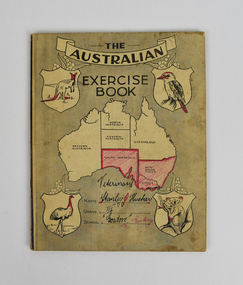
... sheep. It was not all smooth sailing for Denis however, and he soon learnt an important lesson. Class wool the way you’re taught, don’t listen to the owner standing over your shoulder. At a clip of Corriedales near Casterton, Denis was pushing too many fleeces into the line of fine wool. This resulted in a notice from the Australian Wool Exchange (AWEX) “mixing counts too much, submit three clips for inspection”. Denis was able to submit 3 clips with no further complaints, however, this proved a valuable lesson he would never forget over his long...sheep. It was not all smooth sailing for Denis however, and he soon learnt an important lesson. Class wool the way you’re taught, don’t listen to the owner standing over your shoulder. At a clip of Corriedales near Casterton, Denis was pushing too many fleeces into the line of fine wool. This resulted in a notice from the Australian Wool Exchange (AWEX) “mixing counts too much, submit three clips for inspection”. Denis was able to submit 3 clips with no further complaints, however, this proved a valuable lesson he would never forget over his long ...The story of 90 years of wool classing between father & son begins in 1936, when a young boy by the name of Stanley James Hucker walked through the doors of the Gordon Technical School in Geelong. Born in 1921, Stanley was 15 years of age when he began his 3-year course in Wool Classing. 30 years later, Stanley’s second son Denis completed the same 3-year wool classing course. Beginning in 1966, Denis attended the same Gordon Technical School and walked the same halls as his father before him. Stanley finished his course in 1938. He went back to the family farm in Lake Bolac for a brief period before enrolling in the Second World War. At the completion of the war, Stanley returned home and married before gaining a soldier settler allotment, north of Willaura. This enabled Stan to use his wool classing knowledge. He ran between 1,500 and 2,000 sheep for many years, while his wool classer stencil also allowed him to go out and class at various sheds around the area. He held his stencil from 1938 until he retired at the age of 60 in 1981. On retirement, his second son Denis was working in the district, managing a local property while also leasing land himself. Upon his father’s retirement, Denis had the opportunity to lease his father’s farm, an opportunity he could not refuse. Denis had finished his wool classing course at the Gordon Technical School in 1968, graduating dux of his class. He began working with a local contractor and started classing wool in his team. Denis gained a great deal of experience working as part of this team in big sheds of up to 8 stands servicing between 10 & 20,000 sheep. It was not all smooth sailing for Denis however, and he soon learnt an important lesson. Class wool the way you’re taught, don’t listen to the owner standing over your shoulder. At a clip of Corriedales near Casterton, Denis was pushing too many fleeces into the line of fine wool. This resulted in a notice from the Australian Wool Exchange (AWEX) “mixing counts too much, submit three clips for inspection”. Denis was able to submit 3 clips with no further complaints, however, this proved a valuable lesson he would never forget over his long career classing wool. In the early 1980s, when Denis was leasing two properties including his father’s, things were going well until drought struck. February 1983 was the date of the Ash Wednesday bushfires, and saw Melbourne have three days over 40 °C for only the second time on record. This period saw Denis give away farming, turning towards contracting work instead. After the difficult times of the early 1980s, the next two decades were a good time for the sheep industry. 15 micron wool was selling for prices between 4 to 5,000 cents per kilo, double what you’d expect for the same wool in 2022. In 1995 a single bale of wool sold for a million dollars. This was a good time for Denis too. His contracting work saw him employing local shearers and shed staff. His team was involved with the shearing and classing of more than 130,000 sheep. After 20 years of contracting, it was time for Denis to transition into the next phase of his life. He gave up independent contracting, preferring instead to return to being a member of someone else’s team. In 2018, having completed 50 years of wool classing, it was time to call it a day and retire completely. At the annual Gordon Wool School Old Students Association dinner held in 2018, Denis was presented with his 50 years as a registered wool classer stencil awarded by the Australian Wool Exchange (AWEX). This is a rare honour achieved by few. As of February 2020, a total of 430 wool classers had achieved this 50-year milestone. For Denis however, his proudest achievement is achieving 90 years of wool classing with his father. The National Wool Museum is proud to share the collection of objects gained from 90 years in the wool classing industry by Stanley and Denis. This ranges from Stanley’s first stencil and Wool Sample book, started when he first attended the Gordon in 1936. The collection concludes 90 years later with Denis’ 50 years of wool classing Stencil. The collection contains many more objects, all telling the story of these 90 years, and the hard work invested by this dedicated father and son duo. This is the third in a series of 5 wool classing exercise books. They were written by Stanley Hucker in his time at the Gordon Technical College from 1936-1938. This book begins in a white cover with black ink illustrations and writing. These illustrations have been added to with Pink ink. Internally, the book is handwritten on yellowed pages with blue lines for the assistance in clarity of handwriting. The pages are also surrounded by a margin of red pen. The exercise book’s content is about veterinary studies relating to the diseases, injuries, and treatment of sheep. It is handwritten. A selection of pages have been photographed to give an impression of the information taught in classes, 90 years ago. This includes information about blow fly and bacterial diseases.Front Cover. Wording, printed and handwritten “THE / AUSTRALIAN / EXERCISE / BOOK / Veterinary / NAME Stanley J Hucker / GRADE III / School “Gordon” Geelong” Front Cover. Illustrations, printed. Kangaroo, kookaburra / Map of Australia with state names / Emu, Koalagordon institute geelong, wool classing, 1930s sheep farming, 90 years wool classing between father & son -
 National Wool Museum
Book - Wool Classing Exercise Book, 1937-38
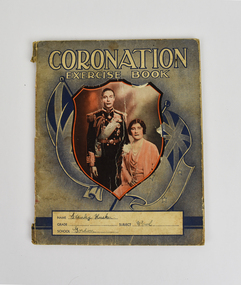
... sheep. It was not all smooth sailing for Denis however, and he soon learnt an important lesson. Class wool the way you’re taught, don’t listen to the owner standing over your shoulder. At a clip of Corriedales near Casterton, Denis was pushing too many fleeces into the line of fine wool. This resulted in a notice from the Australian Wool Exchange (AWEX) “mixing counts too much, submit three clips for inspection”. Denis was able to submit 3 clips with no further complaints, however, this proved a valuable lesson he would never forget over his long...sheep. It was not all smooth sailing for Denis however, and he soon learnt an important lesson. Class wool the way you’re taught, don’t listen to the owner standing over your shoulder. At a clip of Corriedales near Casterton, Denis was pushing too many fleeces into the line of fine wool. This resulted in a notice from the Australian Wool Exchange (AWEX) “mixing counts too much, submit three clips for inspection”. Denis was able to submit 3 clips with no further complaints, however, this proved a valuable lesson he would never forget over his long ...The story of 90 years of wool classing between father & son begins in 1936, when a young boy by the name of Stanley James Hucker walked through the doors of the Gordon Technical School in Geelong. Born in 1921, Stanley was 15 years of age when he began his 3-year course in Wool Classing. 30 years later, Stanley’s second son Denis completed the same 3-year wool classing course. Beginning in 1966, Denis attended the same Gordon Technical School and walked the same halls as his father before him. Stanley finished his course in 1938. He went back to the family farm in Lake Bolac for a brief period before enrolling in the Second World War. At the completion of the war, Stanley returned home and married before gaining a soldier settler allotment, north of Willaura. This enabled Stan to use his wool classing knowledge. He ran between 1,500 and 2,000 sheep for many years, while his wool classer stencil also allowed him to go out and class at various sheds around the area. He held his stencil from 1938 until he retired at the age of 60 in 1981. On retirement, his second son Denis was working in the district, managing a local property while also leasing land himself. Upon his father’s retirement, Denis had the opportunity to lease his father’s farm, an opportunity he could not refuse. Denis had finished his wool classing course at the Gordon Technical School in 1968, graduating dux of his class. He began working with a local contractor and started classing wool in his team. Denis gained a great deal of experience working as part of this team in big sheds of up to 8 stands servicing between 10 & 20,000 sheep. It was not all smooth sailing for Denis however, and he soon learnt an important lesson. Class wool the way you’re taught, don’t listen to the owner standing over your shoulder. At a clip of Corriedales near Casterton, Denis was pushing too many fleeces into the line of fine wool. This resulted in a notice from the Australian Wool Exchange (AWEX) “mixing counts too much, submit three clips for inspection”. Denis was able to submit 3 clips with no further complaints, however, this proved a valuable lesson he would never forget over his long career classing wool. In the early 1980s, when Denis was leasing two properties including his father’s, things were going well until drought struck. February 1983 was the date of the Ash Wednesday bushfires, and saw Melbourne have three days over 40 °C for only the second time on record. This period saw Denis give away farming, turning towards contracting work instead. After the difficult times of the early 1980s, the next two decades were a good time for the sheep industry. 15 micron wool was selling for prices between 4 to 5,000 cents per kilo, double what you’d expect for the same wool in 2022. In 1995 a single bale of wool sold for a million dollars. This was a good time for Denis too. His contracting work saw him employing local shearers and shed staff. His team was involved with the shearing and classing of more than 130,000 sheep. After 20 years of contracting, it was time for Denis to transition into the next phase of his life. He gave up independent contracting, preferring instead to return to being a member of someone else’s team. In 2018, having completed 50 years of wool classing, it was time to call it a day and retire completely. At the annual Gordon Wool School Old Students Association dinner held in 2018, Denis was presented with his 50 years as a registered wool classer stencil awarded by the Australian Wool Exchange (AWEX). This is a rare honour achieved by few. As of February 2020, a total of 430 wool classers had achieved this 50-year milestone. For Denis however, his proudest achievement is achieving 90 years of wool classing with his father. The National Wool Museum is proud to share the collection of objects gained from 90 years in the wool classing industry by Stanley and Denis. This ranges from Stanley’s first stencil and Wool Sample book, started when he first attended the Gordon in 1936. The collection concludes 90 years later with Denis’ 50 years of wool classing Stencil. The collection contains many more objects, all telling the story of these 90 years, and the hard work invested by this dedicated father and son duo. This is the fourth in a series of 5 wool classing exercise books. They were written by Stanley Hucker in his time at the Gordon Technical College from 1936-1938. This book begins in a white cover with blue ink illustrations and writing. It has a centrepiece-coloured emblem of King George VI & Queen Elizabeth with flags of the Union Jack & Australia in background. Internally, the book is handwritten on yellowed pages with blue lines for the assistance in clarity of handwriting. The pages are also surrounded by a margin of red pen. The exercise book’s content is about wool studies relating to the health and productivity of wool sheep. It is handwritten. A selection of pages have been photographed to give an impression of the information taught in classes, 90 years ago. This includes information about: - Wool scouring - Shearing - Lamb marking - Breeding - Fellmongering - Comparison between wool and artificial fibres - Characteristics of good wool - Wool selling methods - Established studs in Victoria - Award rates (1937-38)Front Cover. Wording, printed and handwritten. “CORONATION / EXERCISE BOOK / NAME Stanley Hucker / GRADE SUBJECT Wool / SCHOOL Gordon Front Cover. Illustration’s colour, printed. King George VI & Queen Elizabeth with flags of the Union Jack & Australia in background.gordon institute geelong, wool classing, 1930s sheep farming, 90 years wool classing between father & son -
 National Wool Museum
Book - Wool Classing Exercise Book, 1936-38
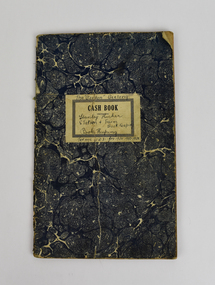
... sheep. It was not all smooth sailing for Denis however, and he soon learnt an important lesson. Class wool the way you’re taught, don’t listen to the owner standing over your shoulder. At a clip of Corriedales near Casterton, Denis was pushing too many fleeces into the line of fine wool. This resulted in a notice from the Australian Wool Exchange (AWEX) “mixing counts too much, submit three clips for inspection”. Denis was able to submit 3 clips with no further complaints, however, this proved a valuable lesson he would never forget over his long...sheep. It was not all smooth sailing for Denis however, and he soon learnt an important lesson. Class wool the way you’re taught, don’t listen to the owner standing over your shoulder. At a clip of Corriedales near Casterton, Denis was pushing too many fleeces into the line of fine wool. This resulted in a notice from the Australian Wool Exchange (AWEX) “mixing counts too much, submit three clips for inspection”. Denis was able to submit 3 clips with no further complaints, however, this proved a valuable lesson he would never forget over his long ...The story of 90 years of wool classing between father & son begins in 1936, when a young boy by the name of Stanley James Hucker walked through the doors of the Gordon Technical School in Geelong. Born in 1921, Stanley was 15 years of age when he began his 3-year course in Wool Classing. 30 years later, Stanley’s second son Denis completed the same 3-year wool classing course. Beginning in 1966, Denis attended the same Gordon Technical School and walked the same halls as his father before him. Stanley finished his course in 1938. He went back to the family farm in Lake Bolac for a brief period before enrolling in the Second World War. At the completion of the war, Stanley returned home and married before gaining a soldier settler allotment, north of Willaura. This enabled Stan to use his wool classing knowledge. He ran between 1,500 and 2,000 sheep for many years, while his wool classer stencil also allowed him to go out and class at various sheds around the area. He held his stencil from 1938 until he retired at the age of 60 in 1981. On retirement, his second son Denis was working in the district, managing a local property while also leasing land himself. Upon his father’s retirement, Denis had the opportunity to lease his father’s farm, an opportunity he could not refuse. Denis had finished his wool classing course at the Gordon Technical School in 1968, graduating dux of his class. He began working with a local contractor and started classing wool in his team. Denis gained a great deal of experience working as part of this team in big sheds of up to 8 stands servicing between 10 & 20,000 sheep. It was not all smooth sailing for Denis however, and he soon learnt an important lesson. Class wool the way you’re taught, don’t listen to the owner standing over your shoulder. At a clip of Corriedales near Casterton, Denis was pushing too many fleeces into the line of fine wool. This resulted in a notice from the Australian Wool Exchange (AWEX) “mixing counts too much, submit three clips for inspection”. Denis was able to submit 3 clips with no further complaints, however, this proved a valuable lesson he would never forget over his long career classing wool. In the early 1980s, when Denis was leasing two properties including his father’s, things were going well until drought struck. February 1983 was the date of the Ash Wednesday bushfires, and saw Melbourne have three days over 40 °C for only the second time on record. This period saw Denis give away farming, turning towards contracting work instead. After the difficult times of the early 1980s, the next two decades were a good time for the sheep industry. 15 micron wool was selling for prices between 4 to 5,000 cents per kilo, double what you’d expect for the same wool in 2022. In 1995 a single bale of wool sold for a million dollars. This was a good time for Denis too. His contracting work saw him employing local shearers and shed staff. His team was involved with the shearing and classing of more than 130,000 sheep. After 20 years of contracting, it was time for Denis to transition into the next phase of his life. He gave up independent contracting, preferring instead to return to being a member of someone else’s team. In 2018, having completed 50 years of wool classing, it was time to call it a day and retire completely. At the annual Gordon Wool School Old Students Association dinner held in 2018, Denis was presented with his 50 years as a registered wool classer stencil awarded by the Australian Wool Exchange (AWEX). This is a rare honour achieved by few. As of February 2020, a total of 430 wool classers had achieved this 50-year milestone. For Denis however, his proudest achievement is achieving 90 years of wool classing with his father. The National Wool Museum is proud to share the collection of objects gained from 90 years in the wool classing industry by Stanley and Denis. This ranges from Stanley’s first stencil and Wool Sample book, started when he first attended the Gordon in 1936. The collection concludes 90 years later with Denis’ 50 years of wool classing Stencil. The collection contains many more objects, all telling the story of these 90 years, and the hard work invested by this dedicated father and son duo. This is the fifth in a series of 5 wool classing exercise books. They were written by Stanley Hucker in his time at the Gordon Technical College from 1936-1938. This book begins in a white cover with blue ink swirls covering its entirety. It has a central sticker label. Internally, the book is handwritten on yellowed pages with blue lines for the assistance in clarity of handwriting. The pages are also surrounded by a margin of red pen. The exercise book’s content is about recording and tracking the financial transactions of Sheep Stations and Wool Classers. It is handwritten. A selection of pages have been photographed to give an impression of the information taught in classes, 90 years ago. This includes information about: - General bookkeeping terms and definitions - Practise invoices - Larger multiple page definition of bookkeeping - Assets liabilities - Practise bale bookFront Cover. Wording, printed and handwritten. “The “Gordon Geelong / CASH BOOK / Stanley Hucker / Station + Farm / Bookkeeping / Bookkeeping / Terms 1.2.3 for 1936. 1937. 1938”gordon institute geelong, wool classing, 1930s sheep farming, 90 years wool classing between father & son -
 National Wool Museum
Tool - Stencil, 1938
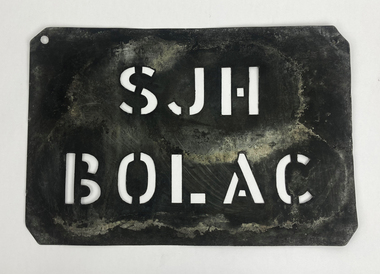
... sheep. It was not all smooth sailing for Denis however, and he soon learnt an important lesson. Class wool the way you’re taught, don’t listen to the owner standing over your shoulder. At a clip of Corriedales near Casterton, Denis was pushing too many fleeces into the line of fine wool. This resulted in a notice from the Australian Wool Exchange (AWEX) “mixing counts too much, submit three clips for inspection”. Denis was able to submit 3 clips with no further complaints, however, this proved a valuable lesson he would never forget over his long...sheep. It was not all smooth sailing for Denis however, and he soon learnt an important lesson. Class wool the way you’re taught, don’t listen to the owner standing over your shoulder. At a clip of Corriedales near Casterton, Denis was pushing too many fleeces into the line of fine wool. This resulted in a notice from the Australian Wool Exchange (AWEX) “mixing counts too much, submit three clips for inspection”. Denis was able to submit 3 clips with no further complaints, however, this proved a valuable lesson he would never forget over his long ...The story of 90 years of wool classing between father & son begins in 1936, when a young boy by the name of Stanley James Hucker walked through the doors of the Gordon Technical School in Geelong. Born in 1921, Stanley was 15 years of age when he began his 3-year course in Wool Classing. 30 years later, Stanley’s second son Denis completed the same 3-year wool classing course. Beginning in 1966, Denis attended the same Gordon Technical School and walked the same halls as his father before him. Stanley finished his course in 1938. He went back to the family farm in Lake Bolac for a brief period before enrolling in the Second World War. At the completion of the war, Stanley returned home and married before gaining a soldier settler allotment, north of Willaura. This enabled Stan to use his wool classing knowledge. He ran between 1,500 and 2,000 sheep for many years, while his wool classer stencil also allowed him to go out and class at various sheds around the area. He held his stencil from 1938 until he retired at the age of 60 in 1981. On retirement, his second son Denis was working in the district, managing a local property while also leasing land himself. Upon his father’s retirement, Denis had the opportunity to lease his father’s farm, an opportunity he could not refuse. Denis had finished his wool classing course at the Gordon Technical School in 1968, graduating dux of his class. He began working with a local contractor and started classing wool in his team. Denis gained a great deal of experience working as part of this team in big sheds of up to 8 stands servicing between 10 & 20,000 sheep. It was not all smooth sailing for Denis however, and he soon learnt an important lesson. Class wool the way you’re taught, don’t listen to the owner standing over your shoulder. At a clip of Corriedales near Casterton, Denis was pushing too many fleeces into the line of fine wool. This resulted in a notice from the Australian Wool Exchange (AWEX) “mixing counts too much, submit three clips for inspection”. Denis was able to submit 3 clips with no further complaints, however, this proved a valuable lesson he would never forget over his long career classing wool. In the early 1980s, when Denis was leasing two properties including his father’s, things were going well until drought struck. February 1983 was the date of the Ash Wednesday bushfires, and saw Melbourne have three days over 40 °C for only the second time on record. This period saw Denis give away farming, turning towards contracting work instead. After the difficult times of the early 1980s, the next two decades were a good time for the sheep industry. 15 micron wool was selling for prices between 4 to 5,000 cents per kilo, double what you’d expect for the same wool in 2022. In 1995 a single bale of wool sold for a million dollars. This was a good time for Denis too. His contracting work saw him employing local shearers and shed staff. His team was involved with the shearing and classing of more than 130,000 sheep. After 20 years of contracting, it was time for Denis to transition into the next phase of his life. He gave up independent contracting, preferring instead to return to being a member of someone else’s team. In 2018, having completed 50 years of wool classing, it was time to call it a day and retire completely. At the annual Gordon Wool School Old Students Association dinner held in 2018, Denis was presented with his 50 years as a registered wool classer stencil awarded by the Australian Wool Exchange (AWEX). This is a rare honour achieved by few. As of February 2020, a total of 430 wool classers had achieved this 50-year milestone. For Denis however, his proudest achievement is achieving 90 years of wool classing with his father. The National Wool Museum is proud to share the collection of objects gained from 90 years in the wool classing industry by Stanley and Denis. This ranges from Stanley’s first stencil and Wool Sample book, started when he first attended the Gordon in 1936. The collection concludes 90 years later with Denis’ 50 years of wool classing Stencil. The collection contains many more objects, all telling the story of these 90 years, and the hard work invested by this dedicated father and son duo. Thin sheet of metal with letters cut to produce a consistent pattern for the surface below through the application of ink. This wool classing stencil belonged to Stanley Hucker. It was his first Wool Classing Stencil. It was used on Stanley’s property named “Yohhatnbu” in Willaura. Stanley gained the property as part of the Returned Soldiers Settlement Scheme for his service in World War 2. The role of a Wool Classer is to sort, classify, and grade wool into various ‘lines’ so that it can be sold for best market price. Wool Classers are typically also tasked with the managing and supervising of wool-handling teams. The stencil is used in the final step of preparing a bale of wool for sale. It is branded across the front of a wool bale to indicate the quality of the wool, with the classers number used as a seal of guarantee.Cut letters. “SJH / BOLAC ”wool classing, stencil, 90 years wool classing between father & son -
 National Wool Museum
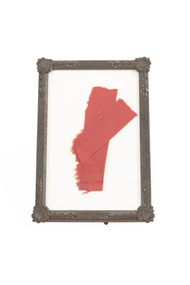
Textile - Opera Cloak Cloth Sample, Macarthur Wool, John Macarthur, 1816-1821
... wool clipped from Macarthur's merino sheep in 1816. Macarthur is recognised as the pioneer of the wool industry that was to boom in Australia in the early 19th century and become a trademark of the nation. Macarthur was responsible for the first bale of Australian wool to be exported. The British woollen mills were desperate for wool at the time because of the Napoleonic blockade, and the Australian bale sold for a record price. Australia needed a product to sell in European markets which did not perish during long...wool clipped from Macarthur's merino sheep in 1816. Macarthur is recognised as the pioneer of the wool industry that was to boom in Australia in the early 19th century and become a trademark of the nation. Macarthur was responsible for the first bale of Australian wool to be exported. The British woollen mills were desperate for wool at the time because of the Napoleonic blockade, and the Australian bale sold for a record price. Australia needed a product to sell in European markets which did not perish during long ...Textile sample from an opera cloak made in England c.1820 from wool clipped from Macarthur's merino sheep in 1816. Macarthur is recognised as the pioneer of the wool industry that was to boom in Australia in the early 19th century and become a trademark of the nation. Macarthur was responsible for the first bale of Australian wool to be exported. The British woollen mills were desperate for wool at the time because of the Napoleonic blockade, and the Australian bale sold for a record price. Australia needed a product to sell in European markets which did not perish during long sea-voyages and which offered high value per unit of weight. Wool also had a ready market in England because the Napoleonic Wars had increased demand and cut English cloth-makers off from their traditional source of quality wool, Spain. Australia's first $2 banknote featured John Macarthur thanks largely to his establishment of wool as the backbone of the early Australian economy. The cloak was passed down through the family to Harold Lethbridge with whom the main part of the cloak resides, in Narrandera. The fragment was passed to Lethbridge's niece who gave it to the donor's mother who passed it onto him and then it was donated to the National Wool Museum. The cloth fragment was tested by Gordon Institute of Technology in 1974 showing the wool to be very fine (15-16 microns) which is consistent with the pure lineage of Macarthur's sheep. The cloth fragment was framed in 1952 and remains in the original frame to this day. Red fabric sample folded in half and mounted in the centre of a brown metal frame.'ARCO' MADE IN ENGLANDmacarthur, wool industry, australian economy, opera, cloak, textile, textile industry, 19th century, merino sheep, woollen mills, new south wales -
 National Wool Museum
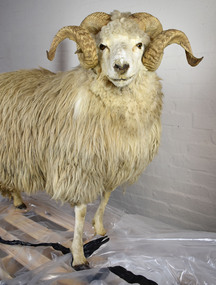
Taxidermy Sheep, Bilby Bill, c1980
... long staple fleece. This same gene also gives them their horns, something that generally does not occur in the parent breeds. Their fleece grows very fast, up to 25cm every six months; as such shearing is carried out twice a year. The coarse and hard wearing wool is mostly used for the manufacture of carpets. The Drysdale is a medium to large stocky sheep...long staple fleece. This same gene also gives them their horns, something that generally does not occur in the parent breeds. Their fleece grows very fast, up to 25cm every six months; as such shearing is carried out twice a year. The coarse and hard wearing wool is mostly used for the manufacture of carpets. The Drysdale is a medium to large stocky sheep ...Originating in New Zealand, the Drysdale, represented by Bilby Bill, was developed in the 1930s at Massey University (Canterbury) by crossing a coarse haired Romney and the hardy Cheviot breed. First imported to Australia in 1975, the Drysdale, due to a genetic abnormality, produces coarse, long staple fleece. This same gene also gives them their horns, something that generally does not occur in the parent breeds. Their fleece grows very fast, up to 25cm every six months; as such shearing is carried out twice a year. The coarse and hard wearing wool is mostly used for the manufacture of carpets. The Drysdale is a medium to large stocky sheep, weighing approximately 55kg and produces about 6 to 8kg of fleece per animal annually, which is 35 to 45 microns in diameter. The yarn used on the National Wool Museum’s Axminster Gripper Loom to make the Manor House Rug is spun from the wool of Drysdale sheep.Taxidermied male Drysdale sheep. Medium sized animal with white body coloration. Large horns protruding from the top of the skull. drysdale, sheep, new zealand -
 National Wool Museum
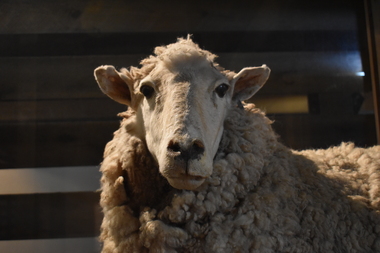
Taxidermy Sheep, Blossom, c1980
... sheep, such as Dorsets to produce hybrids that pass on quality wool characteristics to their offspring. The Border Leicester/Merino crosses produce good quantities of wool which, despite being of stronger micron than most Merino fleece wool (34 to 38 microns), is still in demand in the marketplace. The Border Leicester sheep takes its name from the border country between England and Scotland, the area in which the breed was first developed in the late 18th century. drysdale sheep new zealand Border Leicester/Merino Cross ewe. Long ...The success of any flock is through the strength of its females and Blossom, a Border Leicester/Merino Cross ewe is an excellent example. Border Leicester rams are mated with Merino ewes to produce fat lamb mothers. These first cross ewes are mated with meat sheep, such as Dorsets to produce hybrids that pass on quality wool characteristics to their offspring. The Border Leicester/Merino crosses produce good quantities of wool which, despite being of stronger micron than most Merino fleece wool (34 to 38 microns), is still in demand in the marketplace. The Border Leicester sheep takes its name from the border country between England and Scotland, the area in which the breed was first developed in the late 18th century.Border Leicester/Merino Cross ewe. Long body with white fleece. The nose is black and she has large ears, upright and alert. The head and legs are free of wool.drysdale, sheep, new zealand -
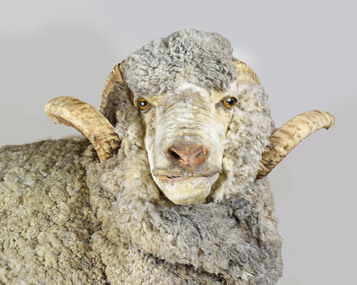 National Wool Museum
Taxidermy Sheep, Booka, c1980
... wool. Fred Peppin said [of the sheep breed] "We were satisfied with the type of wool that the country would grow, instead of endeavouring to produce what the climate and soil continually fight against. Thus we developed all its good natural tendencies and after that the flock had a character of its own.” sheep wanganella Peppin merino stud. Has a large body and long ...The ‘Wanganella’ merino sheep stud was established by the Peppin brothers in the Riverina in 1861. The introduction of a single French ‘Rambouillet’ Merino ram, called Emperor, is now widely acknowledged as one of the most important events in the development of the Peppin stud. As many as 70% of today’s Australian Merinos are said to be directly descended from the Peppin-developed sheep. Its heavy fleece falls in the mid-range of Merino wool qualities (20 to 23 microns) and is protected from the excesses of the environment by a comparatively high content of natural wool grease, which can be seen in the creamy colour of Booka’s wool. Fred Peppin said [of the sheep breed] "We were satisfied with the type of wool that the country would grow, instead of endeavouring to produce what the climate and soil continually fight against. Thus we developed all its good natural tendencies and after that the flock had a character of its own.”Peppin merino stud. Has a large body and long legs. Two horns protruding from its skull.sheep, wanganella -
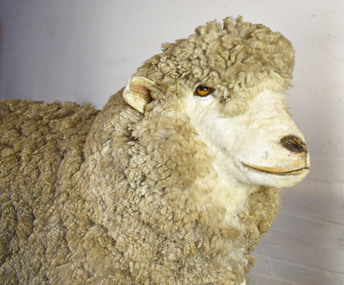 National Wool Museum
Taxidermy Sheep, Stanbury Jacko, c1980
... wool which is ideal for hand spun items. Its crimped fleece is long, medium fine and high yielding. Preferring colder, high rainfall climates, the Corriedale’s black feet provide some protection against footrot in damp conditions. Australasia’s largest breed, mature ewes generally weigh between 59 to 82 kg, while a mature ram like Stanbury Jacko may typically weigh between 79 to 125 kg. This breed has approximately 7.7kg of fleece per animal, averaging 24 to 32 microns. sheep ...The Corriedale was developed both in Australia and New Zealand in the late 1800s and, after the Merino, is Australia’s second most prolific breed. 50% Merino and 50% Lincoln, the breed produces thick, stapled wool which is ideal for hand spun items. Its crimped fleece is long, medium fine and high yielding. Preferring colder, high rainfall climates, the Corriedale’s black feet provide some protection against footrot in damp conditions. Australasia’s largest breed, mature ewes generally weigh between 59 to 82 kg, while a mature ram like Stanbury Jacko may typically weigh between 79 to 125 kg. This breed has approximately 7.7kg of fleece per animal, averaging 24 to 32 microns.Corriedale ram. Medium size body and short legs with white fleece. sheep, south australia, corriedale -
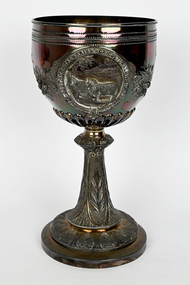 National Wool Museum
Award - Southern Tasmanian Agricultural & Pastoral Society Trophy, Edward Fisher, 1875
... At its height in the late nineteenth century, Mona Vale was regarded as "... one of Tasmania's leading and parent studs, producing robust fine-wool sheep with quality, long-stapled and dense wool." ...At its height in the late nineteenth century, Mona Vale was regarded as "... one of Tasmania's leading and parent studs, producing robust fine-wool sheep with quality, long-stapled and dense wool." ...This trophy was awarded to William Kermode of Mona Vale for the best pair of Merino ewes exhibited at the Southern Tasmanian Agricultural and Pastoral Society in October, 1879. William Kermode formed the Mona Vale flock in 1829 with VDL C. Saxons. In the early 1870s under Kermode, Ercildoun rams were tried, as was a St Johnstone ram. It is well documented that the famous Steiger-blood ram, Sir Robert (out of a Mona Vale ewe), had considerable impact on a number of Tasmania's influential studs. At its height in the late nineteenth century, Mona Vale was regarded as "... one of Tasmania's leading and parent studs, producing robust fine-wool sheep with quality, long-stapled and dense wool." (Massy 1990: p.406). The first agricultural society in Australia was formed in Hobart on 1 Jan. 1822. The trophy was retailed by Walsh Brothers, Melbourne in c.1875. The cup has no makers marks, but has been attributed by Christie's to Edward Fischer, a local Geelong silversmith. This attribution is based upon stylistic criteria. However, Ms Veronica Filmer of the Geelong Art Gallery (curator of "Geelong's Colonial Silversmiths", Geelong Art Gallery, 1988), has suggested that the lack of stamps is unusual (most of Fishcher's work was stamped) and also that it is somewhat heavy for Fischer's work. The trophy originated from the collection of Edward Clark, an antique dealer. Prior ownership of the trophy is uncertain, but it is believed that Clark purchased it in the mid 1990s from descendants of the original prize recipients.Trophy, sterling silver. Circular, stepped base and tapering stem decorated with cartouches of leaves on a matt background. The bowl of the trophy has an applied belt cartouche with an inscription. Within the belt cartouche is an engraved and embossed panel of two sheep with a cottage in the background. There are ribbon tied floral swags on either side of the cartouche, and a presentation inscription with a beaded border on the reverse of the bowl.SOUTHERN TASMANIAN AGRICULTURAL & PASTORAL SOCIETY Presented / to / Joseph Clarke Esq / and awarded to / W.A. Kermode Esq / of Mona Vale / for Best Pair Merino Ewes, / October 1879southern tasmanian agricultural and pastoral society, logo merino: sheep in australian art and design - exhibition (29/07/2000 - 04/02/2001), fischer, mr edward - silversmiths and jewellers kermode, mr william - mona vale stud clarke, mr joseph, mona vale stud, tasmania, awards, trophy -
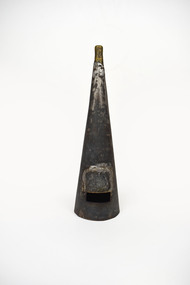 National Wool Museum
Tool - Drench Funnel, c.1890
... Drenching Tool Funnel Agriculture Sheep Farming Wool Industry Drench Long cone shaped metal object with a rectangular hole at one end. ...Simple funnel type drenching was used by dunking base into saucepan containing drench. Funnel was then held upright and current dosage was retained in the funnel. With the drenchers finger covering the filling opening the pointed end of the funnel was then placed sufficiently far into the sheeps mouth to release dose into throat.Long cone shaped metal object with a rectangular hole at one end. drenching tool, funnel, agriculture, sheep farming, wool industry, drench -
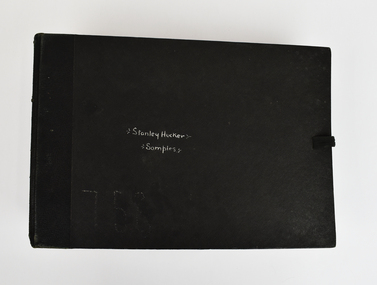 National Wool Museum
Book, Wool Sample, 1936-8
... sheep. It was not all smooth sailing for Denis however, and he soon learnt an important lesson. Class wool the way you’re taught, don’t listen to the owner standing over your shoulder. At a clip of Corriedales near Casterton, Denis was pushing too many fleeces into the line of fine wool. This resulted in a notice from the Australian Wool Exchange (AWEX) “mixing counts too much, submit three clips for inspection”. Denis was able to submit 3 clips with no further complaints, however, this proved a valuable lesson he would never forget over his long...sheep. It was not all smooth sailing for Denis however, and he soon learnt an important lesson. Class wool the way you’re taught, don’t listen to the owner standing over your shoulder. At a clip of Corriedales near Casterton, Denis was pushing too many fleeces into the line of fine wool. This resulted in a notice from the Australian Wool Exchange (AWEX) “mixing counts too much, submit three clips for inspection”. Denis was able to submit 3 clips with no further complaints, however, this proved a valuable lesson he would never forget over his long ...The story of 90 years of wool classing between father & son begins in 1936, when a young boy by the name of Stanley James Hucker walked through the doors of the Gordon Technical School in Geelong. Born in 1921, Stanley was 15 years of age when he began his 3-year course in Wool Classing. 30 years later, Stanley’s second son Denis completed the same 3-year wool classing course. Beginning in 1966, Denis attended the same Gordon Technical School and walked the same halls as his father before him. Stanley finished his course in 1938. He went back to the family farm in Lake Bolac for a brief period before enrolling in the Second World War. At the completion of the war, Stanley returned home and married before gaining a soldier settler allotment, north of Willaura. This enabled Stan to use his wool classing knowledge. He ran between 1,500 and 2,000 sheep for many years, while his wool classer stencil also allowed him to go out and class at various sheds around the area. He held his stencil from 1938 until he retired at the age of 60 in 1981. On retirement, his second son Denis was working in the district, managing a local property while also leasing land himself. Upon his father’s retirement, Denis had the opportunity to lease his father’s farm, an opportunity he could not refuse. Denis had finished his wool classing course at the Gordon Technical School in 1968, graduating dux of his class. He began working with a local contractor and started classing wool in his team. Denis gained a great deal of experience working as part of this team in big sheds of up to 8 stands servicing between 10 & 20,000 sheep. It was not all smooth sailing for Denis however, and he soon learnt an important lesson. Class wool the way you’re taught, don’t listen to the owner standing over your shoulder. At a clip of Corriedales near Casterton, Denis was pushing too many fleeces into the line of fine wool. This resulted in a notice from the Australian Wool Exchange (AWEX) “mixing counts too much, submit three clips for inspection”. Denis was able to submit 3 clips with no further complaints, however, this proved a valuable lesson he would never forget over his long career classing wool. In the early 1980s, when Denis was leasing two properties including his father’s, things were going well until drought struck. February 1983 was the date of the Ash Wednesday bushfires, and saw Melbourne have three days over 40 °C for only the second time on record. This period saw Denis give away farming, turning towards contracting work instead. After the difficult times of the early 1980s, the next two decades were a good time for the sheep industry. 15 micron wool was selling for prices between 4 to 5,000 cents per kilo, double what you’d expect for the same wool in 2022. In 1995 a single bale of wool sold for a million dollars. This was a good time for Denis too. His contracting work saw him employing local shearers and shed staff. His team was involved with the shearing and classing of more than 130,000 sheep. After 20 years of contracting, it was time for Denis to transition into the next phase of his life. He gave up independent contracting, preferring instead to return to being a member of someone else’s team. In 2018, having completed 50 years of wool classing, it was time to call it a day and retire completely. At the annual Gordon Wool School Old Students Association dinner held in 2018, Denis was presented with his 50 years as a registered wool classer stencil awarded by the Australian Wool Exchange (AWEX). This is a rare honour achieved by few. As of February 2020, a total of 430 wool classers had achieved this 50-year milestone. For Denis however, his proudest achievement is achieving 90 years of wool classing with his father. The National Wool Museum is proud to share the collection of objects gained from 90 years in the wool classing industry by Stanley and Denis. This ranges from Stanley’s first stencil and Wool Sample book, started when he first attended the Gordon in 1936. The collection concludes 90 years later with Denis’ 50 years of wool classing Stencil. The collection contains many more objects, all telling the story of these 90 years, and the hard work invested by this dedicated father and son duo.Large black bound book with ribbon for fastening containing 12 double-sided blue pages. Pages have several samples of shorn wool mounted and annotated to include information such as specific breeding, shearing faults, and geographical area. The book concludes with four pages without wool samples. Two of these pages relate to plans for a shearing shed and other industry related structures. The final two-pages relate to the anatomy of a sheep. Wool sample books were constructed by Wool Classing students at the Gordon Technical School as examples of what to look for when classing wool. The students were tasked with constructing these books with samples they retrieved themselves from several different farms and animals. The book would serve as a reference point for the wool classers throughout their years in the field, it was always on hand to refresh knowledge. This book was constructed by Stanley Hucker over his schooling at the Gordon between 1936 and 1938Front Cover. Handwritten, White Ink "Stanley Hucker / Samples"90 years wool classing between father & son, wool classing, gordon technical school -
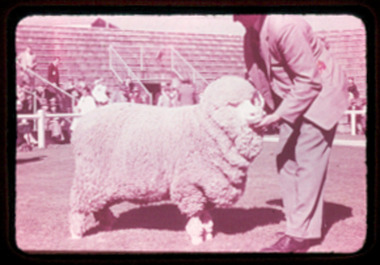 National Wool Museum
Slide, Fine Merino Ewes
... longer and stronger wool than the super fine, but are found in the same higher rainfall areas ie. Western District of Victoria, the midlands district of Tasmania, New England and Yass districts of NSW. Formerly stored in presentation folder as part of "Merino & Australasian Breeds of Sheep...longer and stronger wool than the super fine, but are found in the same higher rainfall areas ie. Western District of Victoria, the midlands district of Tasmania, New England and Yass districts of NSW. Formerly stored in presentation folder as part of "Merino & Australasian Breeds of Sheep ...Slide of a fine Merino ewe. Fine merinos produce slightly longer and stronger wool than the super fine, but are found in the same higher rainfall areas ie. Western District of Victoria, the midlands district of Tasmania, New England and Yass districts of NSW. Formerly stored in presentation folder as part of "Merino & Australasian Breeds of Sheep Set No. A866" series by the Audio Visual Education Centre, Education Department of Victoria.Slide of a fine Merino ewe.Merino & Australasian Breeds / of Sheep / Set No. A866 / No. 2 / Fine Merino Ewes VISUAL EDUCATION CENTRE / EDUCATION DEPT. OF VICTORIAmerino sheep, slide
