
Showing 2 items matching "loom technician"
-
 National Wool Museum
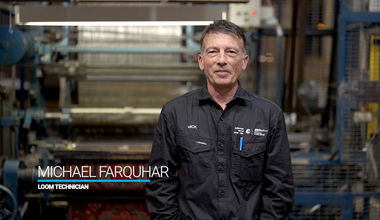
Film - Axminster Carpet Loom with Michael Farquhar, Streamline Media and Communications Group Pty Ltd, 2025
... ...Loom Technician...This film features Loom Technician Michael Farquhar demonstrating how the Axminster Carpet Loom works, at the National Wool Museum. ...This film features Loom Technician Michael Farquhar demonstrating how the Axminster Carpet Loom works, at the National Wool Museum. ...This film features Loom Technician Michael Farquhar demonstrating how the Axminster Carpet Loom works, at the National Wool Museum. The Axminster Carpet Loom has been set up as a focal point in the centre of the National Wool Museum. The loom was originally built by Brintons in England around 1910 and was initially operating in Geelong in 1960. Brintons designed and built most of their own looms and ancillary equipment. When superseded in 1975 the loom was donated to the Melbourne College of Textiles for weaving training. The College has now donated the loom to the National Wool Museum and Brintons engineering staff has restored it to full working condition. This loom is known as an Axminster gripper loom. The gripper system was invented by Brintons in 1890 and operates using a gripper shaped like a bird's beak. This grips the yarn, the yarn is then cut and the gripper swings down to place the tuft into the woven backing. This particular loom also uses a jacquard system for weaving colours. In jacquard weaving, punched cards are used to instruct the loom as to which colour to use. The system was invented by Joseph Jacquard, a silk weaver from Lyon, and was introduced in 1804. It revolutionised pattern weaving as it had the capacity to create intricate patterns through the use of the cards. By 1833 there were approximately 100,000 power-looms used in Great Britain that had been influenced by Jacquard's invention. Joseph Jacquard died in 1834. Charles Babbage was later to adapt Jacquard's punch-card system to produce a calculator that was the forerunner of todays methods of computer programming.Digital film featuring colour footage, audio and animated graphics. michael farquhar, loom technician, axminster carpet loom, brintons, geelong, textile industry, machinery, weaving, restoration, gripper, jacquard, punch cards -
 National Wool Museum
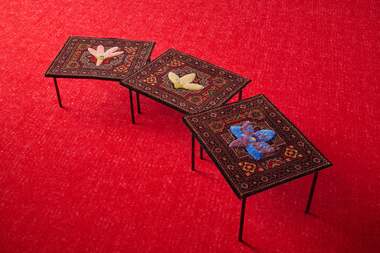
Textile - Orchid Tables, Dowel Jones, 2024
... Based on earlier designs from Brintons UK Persian Rug Archive Library, the museum continues to make this rug through the expertise of Loom Technician Michael Farquhar. The Manor House Rug features a central medallion with floral pattern. ...Based on earlier designs from Brintons UK Persian Rug Archive Library, the museum continues to make this rug through the expertise of Loom Technician Michael Farquhar. The Manor House Rug features a central medallion with floral pattern. ...The Orchid Tables were on display as part of the Ten Years of Dowel Jones exhibition at the National Wool Museum in 2024. The exhibition label reads: Sitting just outside this exhibition in the National Wool Museum is a 1910 Axminster Jacquard Carpet Loom. This loom was operating at Brintons factory in Geelong from 1960 to 1975, and then at the Melbourne College of Textiles, until it was donated to the museum. In the 1990's the museum commissioned an exclusive pattern called the Manor House Rug. Based on earlier designs from Brintons UK Persian Rug Archive Library, the museum continues to make this rug through the expertise of Loom Technician Michael Farquhar. The Manor House Rug features a central medallion with floral pattern. Working with illustrator Beci Orpin, and referencing Margaret MacDonald & Angair's book 'Orchids of the Anglesea District', we identified regional orchids. By a process of removal and addition, the original floral medallion was replaced with local species as decorative motif. Ten Year of Dowel Jones presents three altered Manor House Rugs, each with different orchids tufted in wool and placed in the centre of each rug. The rugs have been attached by cotton thread to three table frames at different heights to create the Orchid Tables.Three tables consisting of powder coated steel frames, with a woven carpet top. The table tops are made from wool with a jute backing, and feature a red, green, blue, black and cream floral design with an orchid in the centre. Each table is a different height.dowel jones, ten years of dowel jones, national wool museum, axminster loom, carpet, manor house rug, orchids, anglesea, design, art, furniture, beci orpin, brintons, geelong, melbourne college of textiles
