
Showing 7 items matching "lutheran section"
-
 Bendigo Historical Society Inc.
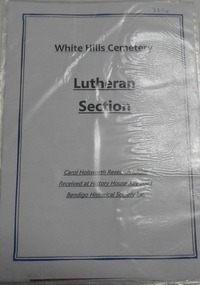
Document - RESEARCH FOLDER COLLECTION: WHITE HILLS CEMETERY LUTHERAN SECTION, 1990 - 2015
... RESEARCH FOLDER COLLECTION: WHITE HILLS CEMETERY LUTHERAN SECTION......lutheran section...White Hills Cemetery Lutheran Section Includes information on family history, graves, plaques and inscriptions relating to people of who are buried in the Lutheran Section of the White Hills Cemetery in Bendigo....BENDIGO Cemetery lutheran section Carol Holsworth Folder of research material compiled by Carol Holsworth. ...Folder of research material compiled by Carol Holsworth. Received at History House in July 2023. White Hills Cemetery Lutheran Section Includes information on family history, graves, plaques and inscriptions relating to people of who are buried in the Lutheran Section of the White Hills Cemetery in Bendigo.Carol Holsworthbendigo, cemetery, lutheran section -
 Bendigo Historical Society Inc.
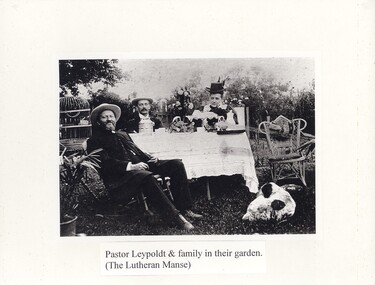
Photograph - STRAUCH COLLECTION: LEYPOLDT FAMILY
... He died 1/1/1932 and is buried in the Lutheran section of the White Hills Cemetery, Bendigo....He died 1/1/1932 and is buried in the Lutheran section of the White Hills Cemetery, Bendigo. ...Historical information 1. Pastor Friedrich Leypoldt was born in Stuttgart, Germany in 1844 and came to Australia in 1869 and became pastor of the Bendigo Lutheran church. He married Elise Julia Buddee in 1870. He served as pastor for 60 years. On the occasion of his 25th anniversary he was presented with 80 sovereigns raised by donations from the German community and other Bendigo citizens. He died 1/1/1932 and is buried in the Lutheran section of the White Hills Cemetery, Bendigo.Copy of photograph of Pastor Leypoldt & family in their garden. The Lutheran Manse.photograph, person, leypoldt, genealogy-leypoldt-german -
 Bendigo Historical Society Inc.
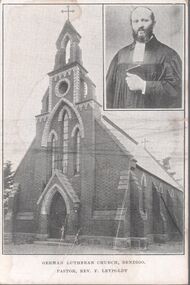
Postcard - German Lutheran Church
... He died 1/1/1932 and is buried in the Lutheran section of the White Hills Cemetery. 2. ...He died 1/1/1932 and is buried in the Lutheran section of the White Hills Cemetery. 2. ...1. PAstor Friedrich Leypoldt was born in Stuttgart, Germany in 1844 and came to Australia in 1869 and became pastor of the Bendigo Lutheran church. He married Elise Julia Buddee in 1870. He served as pastor for 60 years. On the occasion of his 25th anniversary he was presented with 80 sovereigns raised by donations from the German community and other Bendigo citizens. He died 1/1/1932 and is buried in the Lutheran section of the White Hills Cemetery. 2. Mr Henry Iser was born in Hamburg, Germany in 1854 and emigrated to Australia in the late 1880's. He had various positions before travelling to Sydney to take up a position on the island of Yap in the Carolina group, Micronesia. Ill health caused his return to Bendigo where he was an accountant, firstly for Lyceum Grocery Store and then Cohn Brothers Brewery. He brought his fiancée, Caroline Collen from Germany and they married in 1888.When his brother-in-law Willem Humme became ill, Henry joined him at his timber yard and ironmongery, eventually being made a partner. Thus, today's Hume and Iser was born. Henry Iser died in 1932.Black and white postcard of the German Lutheran Church in Bendigo with a photo of pastor Rev. F. Leypoldt. The postcard is addressed to Mrs. H. Iser, Linetta Bramble St. Bendigo from Alise Leypoldt 1905. The writing is in German. Part of the Barker's family collection.german lutheran, rev. leypoldt -
 Hamilton Pastoral Museum
Hymn Number Board, 1861 approx
... Lukes from 1862- 1966. lutheran church Numbers 0 - 9 Hardwood board Painted / stained Black Six sections to hold painted numbers (72) in total. ...Part of Church fittings and furniture.Used by the congregation of St. Lukes from 1862- 1966.Hardwood board Painted / stained Black Six sections to hold painted numbers (72) in total. Numbers 0 - 9lutheran church -
 Sunbury Family History and Heritage Society Inc.
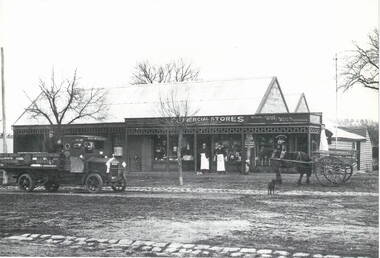
Photograph, Commercial Stores
... The Eadie family's stately home, 'Dunblane', was on the corner of Brook and Jackson Street.A Lutheran Church now occupies the lower section of the land fronting Brook Street, but the home has a local heritage listing. ...The Eadie family's stately home, 'Dunblane', was on the corner of Brook and Jackson Street.A Lutheran Church now occupies the lower section of the land fronting Brook Street, but the home has a local heritage listing. ...Commercial Stores was owned and run by Peter Eadie from Perthshire in Scotland, whose brothers were John and Robert. Peter and Robert arrived in Sunbury in 1864 to help their brother John with his milling enterprise. In 1866, Peter purchased the blue stone general store in Macedon Street near the bridge. He later built the Commercial Hotel also in Macedon Street and near the Ballcourt Hotel.Before the railway arrived in Sunbury, Macedon Street was Sunbury's main commercial centre. After the establishment of the railway, the commercial centre shifted close to the railway station. The Eadie family's stately home, 'Dunblane', was on the corner of Brook and Jackson Street.A Lutheran Church now occupies the lower section of the land fronting Brook Street, but the home has a local heritage listing. Peter Eadie became a Shire of Bulla councillor and President in 1880. Dunblane is from the Scots Gaelic -'dun' is a fortified hill and 'Blane' a missionary.The Eadie Family established one of Sunbury's general stores in the town and were involved in many other commercial activities.A print of a non-digital black and white photograph of a country general store. A medium sized vintage open tray truck is parked in front of the shop on the LHSand a horse-drawn open cart is on the RHS of the image.eadie family, peter eadie, commercial stores, macedon street, businesses -
 Friends of Westgarthtown
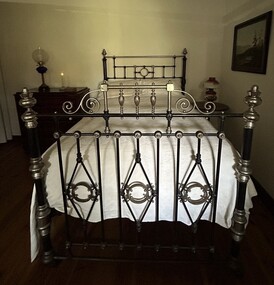
Furniture - Bed, double, Late 1800s
... Lutheran Cemetery adjacent to Ziebell’s Farmhouse, the bed also strengthens the site’s tangible connection to the family’s multi-generational presence in Westgarthtown. The piece is significant for its rarity, its association with an identified maker within the Ziebell lineage, and its ability to illuminate the lived experience, creativity, and craftsmanship of the early community. furniture domestic double bed bedstead nickel-plated steel turned Nickel plated and painted tubular steel bedstead with double bed mattress and spreads. On four castor wheels, ornate decoration on both ends. Turned sections ...This object is of primary significance. The nickel plated brass bedstead was made by Carl Alfred Ziebell for his wife Dorothea. Carl Alfred Ziebell ( 23.08.1867 - 26.10. 1940) was the third generation grandson of Christian Ziebell. Dorothea remained proud of her bed throughout her long life. (14.7.1873 - 14.12.1969) The bed linen and quilts remain traditionally dressed as they were in 1850. This ornate iron bed holds strong historical and cultural significance as a rare surviving example of craftsmanship by Carl Heinrich Alfred “Carl Alfred” Ziebell (1867–1940), grandson of Christian and Sophia Ziebell, early German-Wendish settlers of Westgarthtown. A skilled wheelwright by trade, Carl Alfred possessed deep technical knowledge of metalworking, timber precision, and traditional fabrication techniques required for constructing and repairing wagon wheels. These same skills are reflected in the bed’s carefully forged ironwork and its distinctive circular decorative motifs. Carl Alfred crafted this bed for his wife, Dorothea, who, as family accounts recall, “remained proud of her bed throughout her long life.” The linens displayed on the bed are traditional cotton fabrics with intricate lace detailing, donated to the museum by Sylvia Ziebell. These textiles closely resemble the types of linens that would originally have dressed the bed, helping to evoke its historic domestic context. The bed represents both the material resourcefulness and artisanal expertise present within the second generation of the Ziebell family. Its construction demonstrates a blending of practical skill with aesthetic ambition, illustrating how tradespeople adapted their craft to create durable and decorative domestic furnishings. As Carl Alfred and Dorothea are buried in the Lutheran Cemetery adjacent to Ziebell’s Farmhouse, the bed also strengthens the site’s tangible connection to the family’s multi-generational presence in Westgarthtown. The piece is significant for its rarity, its association with an identified maker within the Ziebell lineage, and its ability to illuminate the lived experience, creativity, and craftsmanship of the early community. Nickel plated and painted tubular steel bedstead with double bed mattress and spreads. On four castor wheels, ornate decoration on both ends. Turned sections on each corner post, four on the bottom ends, only caps on the top ends. Spring wire mattress base.furniture, domestic, double bed, bedstead, nickel-plated, steel, turned -
 Friends of Westgarthtown
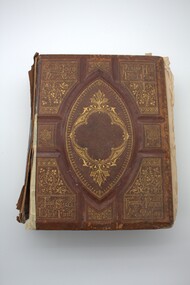
Book - Seeber Family Bible, 1871
... section for family photographs. The volume is richly illustrated throughout and reflects the importance of religion and family record keeping within German Lutheran communities of the nineteenth century. ...section for family photographs. The volume is richly illustrated throughout and reflects the importance of religion and family record keeping within German Lutheran communities of the nineteenth century. ...Large leather-bound illustrated family Bible published in the United States c.1871 and printed in the German language. The Bible contains a family register section recording births and deaths, as well as a dedicated section for family photographs. The volume is richly illustrated throughout and reflects the importance of religion and family record keeping within German Lutheran communities of the nineteenth century. The Bible belonged to the Seeber family of Westgarthtown. The Seeber family lived in a house on High Street, opposite the present-day Lalor Railway Station, for almost one hundred years. Family patriarch John Seeber worked as a shoemaker and operated his business from the family home. Many members of the Seeber family are buried in the Westgarthtown Lutheran Cemetery. The Bible was retained within the Seeber family for generations and was donated to Ziebell's Farmhouse Museum by Helen Pearce, granddaughter of Agnes Seeber, the youngest child of John and Johanna Seeber.
