
Showing 8 items matching "lyrebird gully"
-
 Mt Dandenong & District Historical Society Inc.
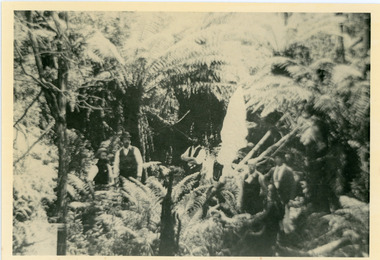
Photograph, Lyrebird Gully 1909
... Lyrebird Gully 1909...Lyrebird Gully...Group of 5 men standing in Lyrebird Gully 1909...Lyrebird Gully...Lyrebird Gully Lyrebird Gully Group of 5 men standing in Lyrebird Gully 1909 Lyrebird Gully 1909 Photograph ...Group of 5 men standing in Lyrebird Gully 1909Lyrebird Gullylyrebird gully -
 Mt Dandenong & District Historical Society Inc.
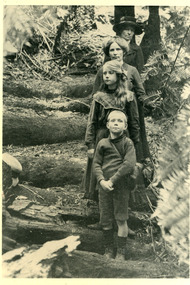
Photograph, Miss Stewart With Sister Mrs Devine and Family, 1911
... ...Lyrebird Gully...Photograph taken in LyreBird Gully of Miss Stewart (top) and her sister Mrs Devine with the Devine children Vera and Stewart. 1911...1911 From top Miss Stewart and her sister Mrs Devine Vera (Mrs Alan Dodd) Stewart. In Lyrebird Gully Mrs Dodd’s collection. Copied by J.L.C. 1974. ...In Lyrebird Gully Mrs Dodd’s collection. Copied by J.L.C. 1974. ...Photograph taken in LyreBird Gully of Miss Stewart (top) and her sister Mrs Devine with the Devine children Vera and Stewart. 19111911 From top Miss Stewart and her sister Mrs Devine Vera (Mrs Alan Dodd) Stewart. In Lyrebird Gully Mrs Dodd’s collection. Copied by J.L.C. 1974. miss stewart, mrs devine, vera devine, stewart devine, olinda, lyrebird gully -
 Mt Dandenong & District Historical Society Inc.
Photograph
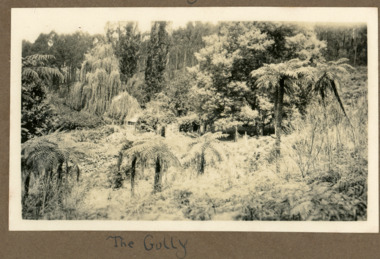
... Lyrebird Gully...The photograph is from the album of Ivy Child and shows a scene from Lyrebird gully that runs alongside the Olinda Falls. ...The photograph is from the album of Ivy Child and shows a scene from Lyrebird gully that runs alongside the Olinda Falls. ...The photograph is from the album of Ivy Child and shows a scene from Lyrebird gully that runs alongside the Olinda Falls. This has been a popular tourist area from the 1900s onwards. Ivy May Child (1910 – 1989) was the daughter of Arthur Edward (Ted) Child (1878 – 1964) and Ethel May Madden (1888 – 1970). Ted Child was the son of Matthew Francis Child (1839 – 1933) and Martha Jeeves (1857 – 1926). He was the grandson of one of the early pioneers Francis Child. Ivy grew up on the family property on Childs Road and took many photographs. Most of these are glued into her photo album. The album covered the years from c1927 – 1932. Ivy married Henry William Burgess (1906 – 1968) in 1944. The photographs remain in their original state in the album with individual copies made. Black and white photograph showing a bush setting with tree ferns and other trees.Written below the photograph in the album: THE GULLYlyrebird gully, tree ferns, bush, olinda falls -
 Mt Dandenong & District Historical Society Inc.
Photograph
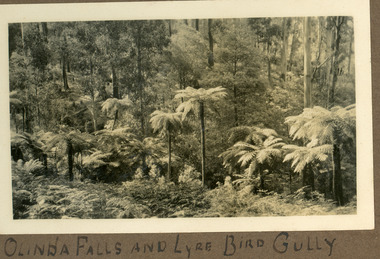
... ...Lyrebird Gully...Olinda Falls Falls Lyrebird Lyrebird Gully Lyrebird Track Written below photograph in album: OLINDA FALLS AND LYRE BIRD GULLY Black and white photograph showing a row of tree ferns in the foreground with bush behind. ...Lyre Bird Gully and Lyre Bird Gully Track run alongside the Olinda Falls. The area has been a popular walking track in the from the 1920s onwards. The photograph is from the album of Ivy Child. Ivy May Child (1910 – 1989) was the daughter of Arthur Edward (Ted) Child (1878 – 1964) and Ethel May Madden (1888 – 1970). Ted Child was the son of Matthew Francis Child (1839 – 1933) and Martha Jeeves (1857 – 1926). He was the grandson of one of the early pioneers Francis Child. Ivy grew up on the family property on Childs Road and took many photographs. Most of these are glued into her photo album. The album covered the years from c1927 – 1932. Ivy married Henry William Burgess (1906 – 1968) in 1944. The photographs remain in their original state in the album with individual copies made. Black and white photograph showing a row of tree ferns in the foreground with bush behind.Written below photograph in album: OLINDA FALLS AND LYRE BIRD GULLYolinda falls, falls, lyrebird, lyrebird gully, lyrebird track -
 Eltham District Historical Society Inc
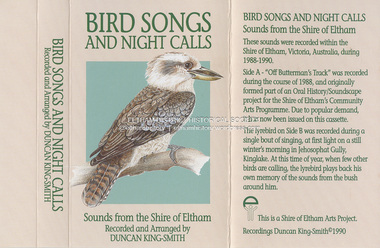
Audio - Audio Compact Cassette Tape, Shire of Eltham, Audio Recording; Bird Songs and Night Calls; Sounds from the Shire of Eltham, 1988-1990
... Side B - The lyrebird was recoded during a single bout of singing, at first light on a still winter's morning in Jehosophat Gully, Kinglake. ...Audio Compact Cassette Bird Songs And Night Calls Side A - "Off Butterman's Track" (1988); 22:00, 22.1 MB Side B - Jehosophat Gully Lyrebird (August 1990); 31:32, 29.9 MB...lyrebird plays back his own memory of the sounds from the bush around him. Audio Cassette Audio Recording Duncan King-Smith Eltham Shire of Eltham Archives Series 45 Butterman Butterman's Track Jehosaphat Gully Kinglake Bird Songs Sounds of the Shire of Eltham Audio Compact Cassette Bird Songs And Night Calls Side A - "Off Butterman's Track" (1988); 22:00, 22.1 MB Side B - Jehosophat Gully Lyrebird (August 1990); 31:32, 29.9 MB Audio Recording; Bird Songs and Night Calls; Sounds from the Shire of Eltham Audio Audio Compact Cassette Tape Duncan King-Smith Shire of Eltham ...Sounds from the Shire of Eltham sound tapes (4 copies) recorded and copyright held by Duncan King-Smith. Liner notes included with each cassette. These sounds were recorded within the Shire of Eltham, Victoria, Australia during 1988-1990. Side A - "Off Butterman's Track" was recorded during the course of 1988 and originally formed part of an Oral History/Soundscape project for the Shire of Eltham's Community Arts Programme (Listening to trhe Landscape (1988). Side B - The lyrebird was recoded during a single bout of singing, at first light on a still winter's morning in Jehosophat Gully, Kinglake. At this time of the year, when few other birds are calling, the lyrebird plays back his own memory of the sounds from the bush around him. Audio Compact Cassette Bird Songs And Night Calls Side A - "Off Butterman's Track" (1988); 22:00, 22.1 MB Side B - Jehosophat Gully Lyrebird (August 1990); 31:32, 29.9 MBaudio cassette, audio recording, duncan king-smith, eltham, shire of eltham archives, series 45, butterman, butterman's track, jehosaphat gully, kinglake, bird songs, sounds of the shire of eltham -
 Eltham District Historical Society Inc
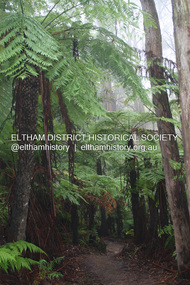
Photograph - Digital Photograph, Alan King, Kinglake National Park, 27 March 2008
... gullies and banksia. Animal life includes wallabies, kangaroos, koalas, echidnas, possums, gliders and bandicoots. Male lyrebirds...gullies and banksia. Animal life includes wallabies, kangaroos, koalas, echidnas, possums, gliders and bandicoots. Male lyrebirds ...Fern gullies around Jehosaphat Gully Covered under National Estate. Published: Nillumbik Now and Then / Marguerite Marshall 2008; photographs Alan King with Marguerite Marshall.; p125 The magnificent Kinglake National Park, fringing Nillumbik’s north, is the largest national park close to Melbourne. Thanks to the vision and hard work of a band of local people, the park was created from what was rapidly becoming degraded land. Seeing a threat to Kinglake’s indigenous flora and fauna, several prominent local people campaigned for a national park, which was established in 1928.1 Since then, the park has grown through donations and acquisitions of land, from around 13,800 acres of land (5585ha) to 22,360 hectares. The Sugarloaf and Everard Blocks – of almost 8000 hectares – stand in Nillumbik and the park extends into Mitchell and Murrundindi Shires and the City of Whittlesea. Mt Everard commemorates William Hugh Everard, State member for Evelyn when the park was established. Before 1928, European settlers had degraded the Kinglake area, which was named after the celebrated English author and lawyer, Alexander William Kinglake. Remains of gold shafts and diggings in the park are reminders of Kinglake’s first settlers, who hoped to strike it rich at the gold diggings. But like other gold fields in this shire, they proved not very lucrative and soon timber cutting replaced mining in importance. However, before long, the accessible timber supply ran out, so in the 1920s agriculture took over – particularly potatoes and berry fruits – which involved large-scale clearing.2 The park’s instigator was retired Melbourne University Professor of Music, William Laver.3 As chair of the Kinglake Progress Association he began negotiations to have crown lands on the southern scarp of the Great Dividing Range reserved as a national park. Even before the park was proclaimed, from 1927, KPA members cut tracks to the major scenic points. Professor Laver was one of several people who gave land for the park, donating around 50 acres (20ha), including the Jehosaphat Gully.4 Laver chaired the park’s first Committee of Management, which raised money to employ a ranger and provide facilities, including tracks and roads for fire protection vehicles, toilets and shelters. The committee charged fees for firewood collection, some grazing of livestock, and visitor entrance, and obtained small State Government and Eltham Shire grants. In 1957 the State Government provided revenue for national parks. Then, in 1975, the State Government took over the management and the Committee of Management became an advisory committee, which disbanded in 1978. Originally, the park covered crown land in the Shires of Eltham and Whittlesea; then Wombelano Falls in Yea and other areas were added. In 1970 the park extended into the Shires of Eltham, Healesville, Whittlesea and Yea.5 Bush fires have been an ongoing problem. In 1939 hundreds of eucalypts and acacias had to be sown around the Jehosaphat Gully to rejuvenate the forest. To manage bushfires, the Committee of Management, then the State Government, worked closely with the Forestry Commission, shire councils and local fire brigades. Early national parks focussed on recreation. But by the 1980s, conservation, education and scientific research became more important, playing a vital role in preserving representative samples of the natural environment. Each year many thousands of people use the park’s extensive network of walking tracks amongst the protected plant and animal life as well as camping, cycling and horse riding. The park, along the slopes of the Great Dividing Range, has lookouts revealing magnificent views of the Melbourne skyline, Port Phillip Bay, the Yarra Valley and the You Yangs. Vegetation in the Masons Falls area includes messmate forest, Austral grass-trees, ferns and Hazel Pomaderris. In spring, orchids, lilies, everlasting daisies, correas, grevillea and heath appear. Around Jehosaphat Gully are wet and dry forest, fern gullies and banksia. Animal life includes wallabies, kangaroos, koalas, echidnas, possums, gliders and bandicoots. Male lyrebirds can be heard mimicking in the Jehosaphat Gully, particularly in the Everard Block in winter.This collection of almost 130 photos about places and people within the Shire of Nillumbik, an urban and rural municipality in Melbourne's north, contributes to an understanding of the history of the Shire. Published in 2008 immediately prior to the Black Saturday bushfires of February 7, 2009, it documents sites that were impacted, and in some cases destroyed by the fires. It includes photographs taken especially for the publication, creating a unique time capsule representing the Shire in the early 21st century. It remains the most recent comprehenesive publication devoted to the Shire's history connecting local residents to the past. nillumbik now and then (marshall-king) collection, kinglake national park, jehosaphat gully -
 Mont De Lancey
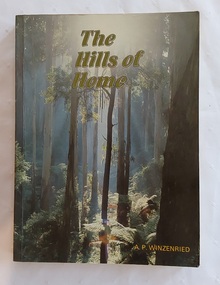
Book, Arthur Paul Wizenreid et al, The Hills of Home: A Bicentennial History of the Shire of Sherbrooke, 1988
... Famous for its towering Mountain Ash trees and dense fern gullies, it is a premier location for spotting wild lyrebirds, wallabies, and cockatoos. ...This 374-page work traces the history of the Shire of Sherbrooke in Victoria, Australia. It covers the region's development from before European colonisation up to the bicentennial year. Sherbrooke Forest is a prominent 800+ hectare section of the Dandenong Ranges National Park, located about 40 km east of Melbourne. Famous for its towering Mountain Ash trees and dense fern gullies, it is a premier location for spotting wild lyrebirds, wallabies, and cockatoos. The forest offers popular hiking trails, including the walk to Sherbrooke Falls, and multiple picnic areas like Grants Picnic Ground.This is a local history of the Shire of Sherbrooke in Victoria, Australia, documenting its development. The cover front has a beautiful green toned scene of the forest trees with the title printed at the top in pale green lettering outlined in black. The author is printed in yellow at the bottom. The title page lists the publishing details with Original pen and ink drawings by Jillienne Winzenried printed at the bottom. There is an Acknowledgements page, Foreword, Contents and Introduction. At the back, Chapter 18 is a Prologue, followed by three Appendices, Endnotes and an Index. Throughout the book are black and white photos as well as coloured ones, maps, illustrations, lists, advertisements. The back cover has a photograph with a black surround depicting a woman seated looking at autumn leaves. Pp. 374 non-fictionThis 374-page work traces the history of the Shire of Sherbrooke in Victoria, Australia. It covers the region's development from before European colonisation up to the bicentennial year. Sherbrooke Forest is a prominent 800+ hectare section of the Dandenong Ranges National Park, located about 40 km east of Melbourne. Famous for its towering Mountain Ash trees and dense fern gullies, it is a premier location for spotting wild lyrebirds, wallabies, and cockatoos. The forest offers popular hiking trails, including the walk to Sherbrooke Falls, and multiple picnic areas like Grants Picnic Ground. australian history, dandenong ranges - history, dandenong ranges - tourism and travel, tourism - victoria, sherbrooke forest - victoria -
 Emerald Museum & Nobelius Heritage Park
Photograph - Group portrait, Unknown photographer, 1990s
... lyrebird. One woman at the front of the photograph is seated in a wheeled office chair, the other people in the photograph are standing. An Honours board with the partial heading 'Tree Gully...Gully / Black and white rectangular photograph printed on photographic paper. The photograph depicts seven older people (five women and two men) standing in front of a brick wall on which is hung a painting or photograph of a lyrebird. ...Museum records indicate that the people in the photograph may include Gus Ryberg, Margaret Lecte, R. Tindale and R. Marsden (seated). Gus Ryberg was a prominent citizen of the Emerald region; receiving an Order of Australia medal for services to the local community in 1996. Early in his career he worked for the Gembrook Nurseries, which after his retirement led him to lobby for the last section of the land occupied by the nurseries to be formed into a public park with a purpose-built museum. Ryberg was responsible for many of the plantings in the resulting Nobelius Heritage Estate. After his death a Canadian Maple was planted in his honour with an accompanying memorial plaque. The records also indicate the photograph may relate to the Shire of Sherbrooke Community Awards. The Shire of Sherbrooke existed from 1964 to 1994. Prior to 1964 it was part of Fern Tree Gully Shire (an Honours board from this period is visible in the photograph) and after 1994 it became part of the Shire of Yarra Ranges.This photograph is significant as it may depict people attending a Community Awards ceremony at the Shire of Sherbrooke offices prior to the Shire's amalgamation into the Shire of Yarra Ranges in 1994.Black and white rectangular photograph printed on photographic paper. The photograph depicts seven older people (five women and two men) standing in front of a brick wall on which is hung a painting or photograph of a lyrebird. One woman at the front of the photograph is seated in a wheeled office chair, the other people in the photograph are standing. An Honours board with the partial heading 'Tree Gully' can be discerned in the rear of the photograph.Obverse: Tree Gully /gus ryberg, emerald, victoria, australia, shire of sherbrooke, shire of ferntree gully, shire of fern tree gully, shire of yarra ranges, community awards, margaret lecte r tindale, r marsden, emerald museum, nobelius heritage estate, order of australia
