
Showing 64 items matching "m. younger"
-
 University of Melbourne, Burnley Campus Archives
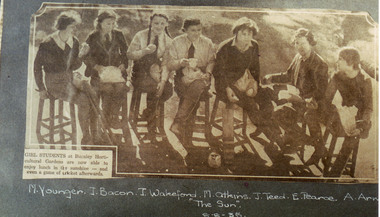
Photograph - black and white print, A.P. Winzenried, Girl Students at Burnley Horticultural Gardens, 1935-1990
... ...m. younger...Kneen 18 March 1992, "Query: date recorded on photo 8 March 1935. M. Younger is recorded as graduating 1938 in, "Green Grows Our Garden" and was probably a student in 1936 & 1937. ...Underneath the photograph handwritten, "M. Younger, J. Bacon, J. Wakeford, M. Atkins, J. ...Pearce & Wakeford are recorded in 1937 Class List." female students m. younger j. bacon j. wakeford m. atkins j. teed e. pearce a.p. winzenried green grows our garden a. armstrong cricket recreation Underneath the photograph handwritten, "M. ...This photograph was made by A.P. Winzenried in 1990 as a possible illustration in, "Green Grows Our Garden." Note by T.H. Kneen 18 March 1992, "Query: date recorded on photo 8 March 1935. M. Younger is recorded as graduating 1938 in, "Green Grows Our Garden" and was probably a student in 1936 & 1937. Similarly for M. Atkins. Pearce & Wakeford are recorded in 1937 Class List." 2 copies of a black and white photograph of a newspaper cutting. The caption reads, "Girl students at Burnley Horticultural Gardens are now able to enjoy lunch in the sunshine-and even a game of cricket afterwards." Seven female students seated on stools outside eating lunch.Underneath the photograph handwritten, "M. Younger, J. Bacon, J. Wakeford, M. Atkins, J. Teed, E. Pearce, A. Arw? "The Sun". 8-8-35.female students, m. younger, j. bacon, j. wakeford, m. atkins, j. teed, e. pearce, a.p. winzenried, green grows our garden, a. armstrong, cricket, recreation -
 Kew Historical Society Inc
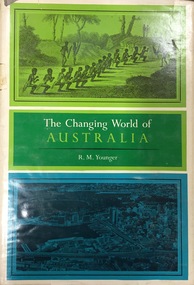
Book, Franklin Watts, The Changing World of Australia, 1963
... ...Ronald M Younger...The Changing World of Australia Book Franklin Watts Ronald M Younger ...General history with very brief mention of Aborigines.New York : Franklin Watts, 1963 vii, 253 p. ; 25 cm. non-fictionGeneral history with very brief mention of Aborigines.settlement and contacts - colonisation., settlement and contacts - ancient and early historical., politics and government - sovereignty, economic sectors - agriculture and horticulture - pastoral industry., settlement and contacts - government settlements, history - political. | settlement and contacts - settlers., australia -- history. -
 University of Melbourne, Burnley Campus Archives
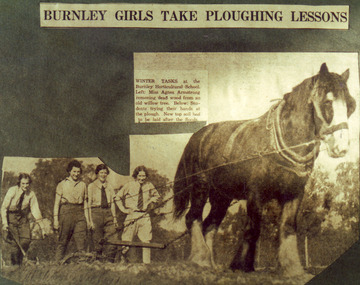
Photograph - Colour print, The Sun, Burnley Girls Take Ploughing Lessons, 1935
... ...m. younger...Handwritten underneath, "R.Weber, E. Pearce, M. Younger, W. Wittakers. "The Sun" 12-6-35."...Pearce, M. Younger, W. Wittakers. "The Sun" 12-6-35." 2 copies colour print.. ...Photograph made by A.P. Winzenried as a possible illustration for, "Green Grows Our Garden." There was a severe flood in December 1934.2 copies colour print.. Copy of a newspaper article made by A.P. Winzenried. Caption reads, "Burnley Girls Take Ploughing Lessons. Winter tasks at the Burnley Horticultural School. Students trying their hands at the plough. New top soil had to be laid after the floods." 4 female students working with a horse drawn plough in the Orchard.Handwritten underneath, "R.Weber, E. Pearce, M. Younger, W. Wittakers. "The Sun" 12-6-35."a.p. winzenried, green grows our garden, ploughing lesson, female students, r.weber, e. pearce, m. younger, w. wittakers, orchard, 1934 flood, horse, working outside -
 University of Melbourne, Burnley Campus Archives
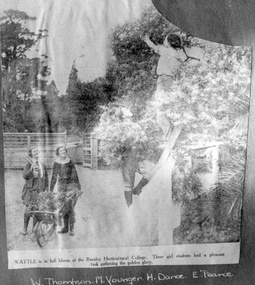
Photograph - Black and white print, The Argus, Wattle is in Full Bloom at the Burnley Horticultural College, 1935-1990
... ...m. younger...Handwritten underneath, "W. Thompson, M. Younger, H. Dance, E. Pearce, The Argus 13-8-35."...Thompson, M. Younger, H. Dance, E. Pearce, The Argus 13-8-35." ...Photograph taken by A.P. Winzenried for consideration as an illustration in, "Green Grows Our Garden." The caption reads, "Wattle is in full bloom at the Burnley Horticultural College. These girl students had a pleasant task gathering the golden glory."Black and white photograph. Copy of a newspaper article taken by A.P. Winzenried. 4 students collecting branches of wattle at the entrance to the Gardens. 2 standing on wooden ladders and 2 holding toolss next to a wooden wheelbarrow.Handwritten underneath, "W. Thompson, M. Younger, H. Dance, E. Pearce, The Argus 13-8-35."a.p. winzenried, green grows our garden, wattle, female student, w. thompson, m. younger, h. dance, e. pearce, students working outside, wooden ladders, wooden wheelbarrow, tools, entrance gate -
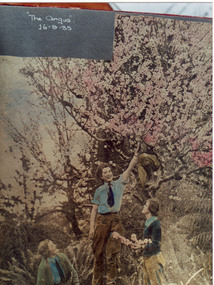 University of Melbourne, Burnley Campus Archives
Photograph - Black and white and colour prints, The Argus, Flowering Almond Trees at Burnley Horticultural College are in Full Bloom, 1935-1990
... ...m. younger...Thompson, E. Pearce, M. Younger, H. Dance (in tree.)'...Thompson, E. Pearce, M. Younger, H. Dance (in tree.)' 3 copies colour photograph. ...Photograph made by A.P. Winzenried as a possible illustration for, "Green Grows Our Garden."3 copies colour photograph. Copy of a newspaper article made by A.P. Winzenried. Caption reads, "Flowering almond trees at the Burnley Horticultural College are in full bloom." Original b/w, copies hand coloured. 4 female students beside and in an almond tree in blossom in the Ornamental Garden.Handwritten, ' "The Argus". 18-8-35. W. Thompson, E. Pearce, M. Younger, H. Dance (in tree.)'a.p. winzenried, green grows our garden, almond trees, w. thompson, e. pearce, m. younger, h. dance, student group, newspaper cutting -
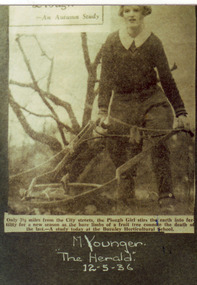 University of Melbourne, Burnley Campus Archives
Photograph - Colour print, The Herald, An Autumn Study, 1936
... ...m. younger...Handwritten, "M. Younger. "The Herald." 12-5-36. Bottom, handwritten, "J. ...Winzenried as possible illustrations in, "Green Grows Our Garden." a.p. winzenried green grows our garden plough female students fruit trees j. wakeford m. younger students working outside horse-drawn plough bull orchard vida's boy Handwritten, "M. ...Photograph made by A.P. Winzenried as possible illustrations in, "Green Grows Our Garden." Colour prints. Copy of 2 newspaper articles made by A.P. Winzenried. 1. Top, "- An Autumn Study. Only 3⅟₂ miles from the City streets, the Plough Girl stirs the earth into fertility for a new season as the bare limbs of a fruit tree connote the death of the last - A study today at the Burnley Horticultural School." Female student using a horsedrawn plough in the Orchard. 2. A female student holding a bull wearing a head stall and a rope attached to a ring in its nose.Handwritten, "M. Younger. "The Herald." 12-5-36. Bottom, handwritten, "J. Wakeford & Vida's Boy. "The Herald." 12-5-36."a.p. winzenried, green grows our garden, plough, female students, fruit trees, j. wakeford, m. younger, students working outside, horse-drawn plough, bull, orchard, vida's boy -
 University of Melbourne, Burnley Campus Archives
Album - Black and white prints, newspaper cuttings, Mabel E. Younger, Garden Girls at Burnley - M. E. Younger, 1933 - 1947
... Garden Girls at Burnley - M. E. Younger...younger...female students...newspaper cuttings...students...students working outside...staff...flowers...plants...cartoon...phyllis laing...lily ponds...thrips...horses...ploughing...luffmann ponds...orchard...draught horse...pears...m...Garden Girls at Burnley - M. E. Younger Album Black and white prints, newspaper cuttings Mabel E. ...Mabs Younger graduated 1938.1. Post Card Album with slits on each page to fit postcards containing newspaper cuttings (NC) and black and white photographs (not all taken at Burnley). Provenance and date of newspaper cuttings not generally known. See B09.0007B for 20 envelopes containing 35mm colour slides. Photographs taken Dec 1949. Labelled. Most images annotatedmabs younger, female students, newspaper cuttings, students, students working outside, staff, flowers, plants, cartoon, phyllis laing, lily ponds, thrips, horses, ploughing, luffmann ponds, orchard, draught horse, pears, m atkins, j wakeford, m smith, p wilson, t baghel, carol scott, d johnston, e m jelbart, nancy canpbell, gwynneth crouch, alison wilson, bonnie campbell, louise harris, kath pullar, thelma johnson, d barker, agnes armstrong, dahlias, melons, j bacon, a w jessep, f j rae, hay, b levick, brook gipps, graham grant, j leitch, h kirkhope, garden views, royal horticultural society show, uniform, wattle, women gardeners, soldiewr farmers -
 University of Melbourne, Burnley Campus Archives
Newspaper - Newspaper cutting, The Sun News-Pictorial, 15, 1936
... m. atkins...j. bacon...mabs younger...Photograph from the Sun News-Pictorial June 5th, 1936 p.24. (M. Younger.)...Atkins, J. Bacon and M. Younger....(M. Younger.) 15 Newspaper Newspaper cutting The Sun News-Pictorial ...Photograph from the Sun News-Pictorial June 5th, 1936 p.24. (M. Younger.)Melon Masacre at Burnley. Getting the pip is a common occurrence these days at Burnley Horticulture College while melons are being cut for jam. These students who have just begun the new term, are (from left): Misses A. Armstrong, J. Wakeford, M. Atkins, J. Bacon and M. Younger.sun news-pictorial, burnley horticulture college, a. armstrong, j. wakeford, m. atkins, j. bacon, mabs younger, female students -
University of Melbourne, Burnley Campus Archives
Newspaper - Newspaper cutting, 12, 1933-1947
... Not at Burnley. (M. Younger.)...Not at Burnley. (M. Younger.) 12 Newspaper Newspaper cutting ...Not at Burnley. (M. Younger.)A week of glorious freedom from lessons.mabs younger, female students -
University of Melbourne, Burnley Campus Archives
Newspaper - Newspaper cutting, 6, 1933-1947
... Female student - M. Younger?...mabs younger female students Female student - M. Younger? 6 Newspaper Newspaper cutting ...Female student - M. Younger?mabs younger, female students -
University of Melbourne, Burnley Campus Archives
Photograph - Black and white print, 29, 1933-1947
... M. Younger....mabs younger female students M. Younger. 29 Photograph Black and white print ...M. Younger.mabs younger, female students -
University of Melbourne, Burnley Campus Archives
Photograph - Black and white print, 24, 1933-1947
... Handwritten names. (M. Younger.)...mabs younger female students lawns Handwritten names. (M. Younger.) 4 students having lunch on the lawn. 24 Photograph Black and white print ...4 students having lunch on the lawn. Handwritten names. (M. Younger.)mabs younger, female students, lawns -
University of Melbourne, Burnley Campus Archives
Photograph - Black and white print, 26, 1933-1947
... Handwritten names. (M. Younger.)...mabs younger female students staff mt. evelyn excursion Handwritten names. (M. Younger.) 4 students, Mt. Evelyn, Excursion? ...4 students, Mt. Evelyn, Excursion?Handwritten names. (M. Younger.)mabs younger, female students, staff, mt. evelyn, excursion -
University of Melbourne, Burnley Campus Archives
Newspaper - Newspaper cutting, 7, 1933-1947
... Golden reward for labor. (M. Younger.)...mabs younger female students reward Golden reward for labor. (M. Younger.) 7 Newspaper Newspaper cutting ...Golden reward for labor. (M. Younger.)mabs younger, female students, reward -
University of Melbourne, Burnley Campus Archives
Photograph - Black and white print, 23, 1933-1947
... Handwritten names, Packenham. (M. Younger.)...mabs younger female students horse Handwritten names, Packenham. (M. Younger.) 4 students on a horse. 23 Photograph Black and white print ...4 students on a horse. Handwritten names, Packenham. (M. Younger.)mabs younger, female students, horse -
University of Melbourne, Burnley Campus Archives
Photograph - Black and white print, 28, 1933-1947
... Handwritten names, Shoreham. (M. Younger.)...mabs younger female students horse Handwritten names, Shoreham. (M. Younger.) 4 students with a horse. 28 Photograph Black and white print ...4 students with a horse. Handwritten names, Shoreham. (M. Younger.)mabs younger, female students, horse -
University of Melbourne, Burnley Campus Archives
Photograph - Black and white print, 37, 1933-1947
... Handwritten names.(M. Younger.) Clematis....mabs younger female students clematis Handwritten names.(M. Younger.) Clematis. 3 female students. 37 Photograph Black and white print ...3 female students. Handwritten names.(M. Younger.) Clematis.mabs younger, female students, clematis -
University of Melbourne, Burnley Campus Archives
Photograph - Black and white print, 36, 1933-1947
... Handwritten names.(M. Younger.) Mt. Evelyn....mabs younger female students mt. evelyn Handwritten names.(M. Younger.) Mt. Evelyn. 4 female students. 36 Photograph Black and white print ...4 female students. Handwritten names.(M. Younger.) Mt. Evelyn.mabs younger, female students, mt. evelyn -
University of Melbourne, Burnley Campus Archives
Newspaper - Newspaper cutting, 14, 1933-1947
... Names handwritten. (M. Younger.)...Names handwritten. (M. Younger.) 14 Newspaper Newspaper cutting ...3 girls standing beside the Lily Ponds. Names handwritten. (M. Younger.)lily ponds, mabs younger, female students -
University of Melbourne, Burnley Campus Archives
Newspaper - Newspaper cutting, 19c, 1933-1947
... Handwritten names. (M. Younger.)...Handwritten names. (M. Younger.) 19c Newspaper Newspaper cutting ...These cheerful girls and their horse. Handwritten names. (M. Younger.)mabs younger, female students, horse -
University of Melbourne, Burnley Campus Archives
Newspaper - Newspaper cutting, 42, 1933-1947
... Handwritten names (M. Younger.)...Handwritten names (M. Younger.) 42 Newspaper Newspaper cutting ...Dobbin, the Burnley Horticultural School draught horse. Handwritten names (M. Younger.)dobbin, burnley horticultural school, draught horse, mabs younger, female students -
Glen Eira Historical Society
Document - FAIRFIELD HALL, NORTH ROAD, 225, CAULFIELD SOUTH
... M... Younger John...Fairfield Hall North Road Caulfield Caulfield South Elsternwick Station Gardenvale Station Lantana Street Begonia Street Magnolia Street Younger family Younger Alex Norris William Landells Rosalind Leadlights Curwen Frederick W Hawthorn black brick Architectural features Tuck pointing Tessellated tiles Verandah Towers Rudd E W Hurley Knight C P Manala Wall Harry Warrein Road Wall Hounsell Younger A M Younger John Kenya Younger A M Mrs Campbell H A Mrs Campbell Hugh Younger Jeanne Gardenvale Younger Avenue Younger’s Avenue Fairfield Grove Document FAIRFIELD HALL, NORTH ROAD, 225, CAULFIELD SOUTH ...A two page document, dated 31/05/1981, from the Brighton Historical Society, written by Rosalind Landells, about Fairfield Hall. The document provides a brief history on Fairfield Hall, describes the surrounding area, provides details of buildings architectural features, and gives information about the house’s occupants and additional details about the occupants the Younger family.fairfield hall, north road, caulfield, caulfield south, elsternwick station, gardenvale station, lantana street, begonia street, magnolia street, younger family, younger alex, norris william, landells rosalind, leadlights, curwen frederick w, hawthorn black brick, architectural features, tuck pointing, tessellated tiles, verandah, towers, rudd e w, hurley, knight c p, manala, wall harry, warrein road, wall hounsell, younger a m, younger john, kenya, younger a m mrs, campbell h a mrs, campbell hugh, younger jeanne, gardenvale, younger avenue, younger’s avenue, fairfield grove -
University of Melbourne, Burnley Campus Archives
Newspaper - Newspaper cutting, 48, 1933-1947
... Handwritten names (M. Younger.)...Handwritten names (M. Younger.) 48 Newspaper Newspaper cutting ...Girl students at Burnley Horticultural Gardens are now able to enjoy lunch in the sunshine - and even a game of cricket afterwards. Handwritten names (M. Younger.)burnley horticultural gardens, mabs younger, female students -
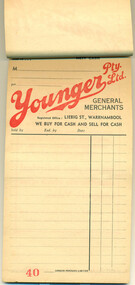 Warrnambool and District Historical Society Inc.
Document - Younger Pty Ltd docket book, 1950s
... Docket front: ‘Phone 21, Terms, Nett Cash, M……………., Younger Pty Ltd, General Merchants, Registered Office, Liebig St., Warrnambool, We Buy for Cash and Sell for Cash, Sold by, Exd. ...It is of particular interest coming from Youngers Stores, a major retailer in Warrnambool for over 90 years. docket book younger pty ltd general merchants department stores liebig street warrnambool Docket front: ‘Phone 21, Terms, Nett Cash, M……………., Younger Pty Ltd, General Merchants, Registered Office, Liebig St., Warrnambool, We Buy for Cash and Sell for Cash, Sold by, Exd. ...This booklet of sales dockets came from the Youngers Stores in Warrnambool. John Younger came to Warrnambool from Beechworth in 1888 and established a general store in Liebig Street and quickly built up a thriving business. His store was one of the main reasons why Liebig Street became the main shopping precinct in Warrnambool by the beginning of the 20th century. John Younger was active in community affairs and was a Town Councillor from 1902 to 1918 and Mayor of the Town. He died in the 1930s and his store was continued by family members but taken over by Charles Moore in 1958. It closed in the 1980s. The maker of the docket book, Lamson Paragon Limited, was a British firm with factories and offices in Australia and it initially specialized in making sales docket books using a carbon paper process. The original founder of the firm, William Lamson of Massachusetts, U.S.A., was the first to introduce the system of paying for goods in a store using cash balls on tracks. This pad is of some interest as it shows the system of receipts issued by a Warrnambool firm in the 1950s. It is of particular interest coming from Youngers Stores, a major retailer in Warrnambool for over 90 years. This is a pad of dockets stapled together 30 pages). The pages are buff-coloured with red and black printing on every second page. Every second page has been left blank so that a second copy could be kept of every transaction using carbon paper. The pad originally had dockets for 50 transactions for Youngers Stores in Liebig Street, Warrnambool. The first three pages are badly torn. The back of every docket has an advertisement for Youngers stores.Docket front: ‘Phone 21, Terms, Nett Cash, M……………., Younger Pty Ltd, General Merchants, Registered Office, Liebig St., Warrnambool, We Buy for Cash and Sell for Cash, Sold by, Exd. By, Date, Lamson Paragon Limited.’docket book, younger pty ltd, general merchants, department stores, liebig street, warrnambool -
 Bacchus Marsh & District Historical Society
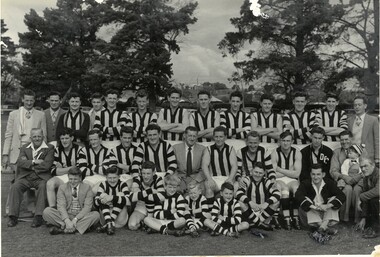
Photograph, Darley Football Team 1954
... The names given in Moore and Oomes are: Back Row: l-r: M.Cook, B.Skinner, J.Cook, C.Reddrop, L.Holt, J.Cook, M.Carr, J.Carr, M. Younger, B.Carr, R.Stevens, W.Richardson, B.Giani. ...The names given in Moore and Oomes are: Back Row: l-r: M.Cook, B.Skinner, J.Cook, C.Reddrop, L.Holt, J.Cook, M.Carr, J.Carr, M. Younger, B.Carr, R.Stevens, W.Richardson, B.Giani. ...Darley Football club contested the 1954 Bacchus Marsh District Football Association Grand Final against Maddingley Football Club. This photograph is thought to have been taken in 1954. It is cited in some sources as the Premiership winning team of 1954. This is incorrect as Maddingley Football club were the premiers in this year. It is possibly a photo taken at the time of the Grand Final of 1954 and subsequently misidentified. Or, it may be a photo from another year in the 1950s.A black and white photograph print on a mounting board in a display folder, showing a group 30 men, 3 boys and one younger child seated on the knee of a man probably his father. The group is arranged in three rows, 10 in civilian clothes, the rest in vertically-striped guernseys and white shorts. In the front row, seated in the middle, are three boys, club mascots , dressed in uniform guernseys and shorts. Two of the men have towels slung over their shoulder, indicating that they were club trainers. The photo is taken in an outdoor setting, probably Maddingley Park. There are no names on the mounting board, but from information taken from "Bacchus Marsh. A Pictorial Chronicle", 1986, by Gwyn Moore and Jean Oomes. This source incorrectly identifies this team as Premiers 1954. Bacchus Marsh Express of Saturday 18 September 1954 reported "Decisive Win by Maddingley." The score was recorded as Maddingley 17.11 Darley 12.15. The names given in Moore and Oomes are: Back Row: l-r: M.Cook, B.Skinner, J.Cook, C.Reddrop, L.Holt, J.Cook, M.Carr, J.Carr, M. Younger, B.Carr, R.Stevens, W.Richardson, B.Giani. Middle Row: C.Casey, N.Thomson, N.Holt, G.Tudball, J.Ashby, L.Carr, L.Carr jnr., M.Younger, J.Moore, T.Densley, L.McKenzie Front Row: H.Cairns, P.Shea, L.Kight, M.Shea, R.Closter, A.Franklin, with mascots.darley football club, australian rules football -
 Wangaratta High School
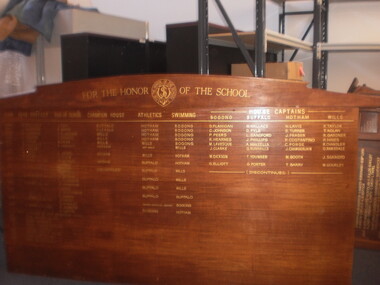
WTS Honour Board, 1966-1985
... M. BOOTH, C* STONE L. JACKEL *J. KLEIN HOTHAM WILLS HOTHAM W. DICKSON, T. YOUNGER, M. ...M. BOOTH, C* STONE L. JACKEL *J. KLEIN HOTHAM WILLS HOTHAM W. DICKSON, T. YOUNGER, M. ...Large wooden rectangular honour board with gold text and protruding sections along the top, in in the top middle accommodating for the WTS symbol.FOR THE HONOUR OF THE SCHOOL YEAR HEAD PREFECT DUX OF SCHOOL CHAMPION HOUSE ATHLETICS SWIMMING HOUSE CAPTAINS (BOGONG, BUFFALO, HOTHAM, WILLS) 1966 W. WALLACE J. DASH BUFFALO HOTHAM BOGONG D. FLANIGAN, W. WALLACE, N. LAVIS K. TAYLOR 1967 J. CANNING R. GARTH BUFFALO HOTHAM BOGONG C. JOHNSON, D. PYLE, D. TURNER T. NOLAN 1968 C. JOHNSON T. GLANIGAN WILLS HOTHAM BOGONG P. PEERS, L. SANDFORD, J. FRAZER, R. GARDINER 1969 L. GRAHAM H. DINNING WILLS HOTHAM BOGONG R. HEARNES, J. PHILLIPS, P. CONSTANTINO P. HINES 1970 C. FORGE M. COOK WILLS WILLS BOGONG M. LAVESQUE A. MANZELLA C, FORGE R. CHANDLER 1971 R. CROCKET, *L. HANLON R. CROCKETT HOTHAM (NOT HELD) WILLS J. CLARKE, G. RUNNALS, J. CHAMBERLAIN, G. RAMSDALE 1972 M. BOOTH, C* STONE L. JACKEL *J. KLEIN HOTHAM WILLS HOTHAM W. DICKSON, T. YOUNGER, M. BOOTH, J. SGARIOTO 1973 T. BARRY (S.R.C.PRES.) W. GOURNEY, *J. AMERY HOTHAM BUFFALO HOTHAM G. ELLIOT, G. PORTER, T. BARRY, W. GOURLEY 1974 R. COMENSOLI (S.R.C. PRES.) M. AMERY, B. SAMMON (DISCONTINUED) BUFFALO WILLS (DISCONTINUED) 1975 *G. McGREGOR (S.R.C. PRES.) R. WATSON, *L. FLANIGAN BUFFALO WILLS 1976 A. ADAMO (S.R.C. PRES.) R. JOHNSTONE, *J. COLE BUFFALO WILLS 1977 K. SOUTHGATE, *L. AMERY BUFFALO BUFFALO 1978 S. BISINELLA (S.R.C. PRES.) G. MINNEY, * S, SHANLEY (SPORTS CANCELLED- WEATHER) BOGONG 1979 R. NEWTH (S.R.C. PRES.) R. JOHNSON, *M. KEENAN BOGONG HOTHAM ---W.T.C. & COLLEGE OF T.A.F.E. SEPERATION--- 1981 MARK BRAMBLE (S.R.C. PRES.) 1982 BELINDA MATHERSON (S.R.C. PRES.), CARMEL ANDERSON (S.R.C. PRES.) , ANGELA VERMONT (S.R.C. PRES.) 1983 ELIZABETH FREEMAN (S.R.C. PRES.) 1984 JODIE BLAIR (S.R.C. PRES.) 1985 ROSS MILLER (S.R.C. PRES.) * GIRL -
 Ballarat Clarendon College
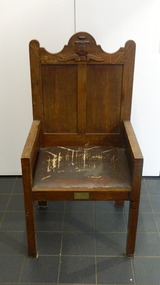
Furniture, Chair
... These included blackwood shelves, tables and chairs and a new set of Encycopedia Britannica supplied by the Parents and Friend's Association, a grooved periodical table given by Old Collegians Younger Set, a librarian's desk supplied by the E M Bell estate and more than 200 books supplied by the Old Collegians. ...These included blackwood shelves, tables and chairs and a new set of Encycopedia Britannica supplied by the Parents and Friend's Association, a grooved periodical table given by Old Collegians Younger Set, a librarian's desk supplied by the E M Bell estate and more than 200 books supplied by the Old Collegians. ...This librarian's chair was given to the school by the family of Joy Chapman who had died during 1948. The chair was part of a number of furnishings supplied by donation for the new library which was opened in 1949. These included blackwood shelves, tables and chairs and a new set of Encycopedia Britannica supplied by the Parents and Friend's Association, a grooved periodical table given by Old Collegians Younger Set, a librarian's desk supplied by the E M Bell estate and more than 200 books supplied by the Old Collegians. (see 'A lamp burns brightly' p. 61). This item is a significant example of the degree to which the school relied on donations from the community to develop the school during the post-war years. Solid wood chair with high solid back and solid arm rests. Carved CPLC crest attached to neck rest. Padded seat. Bronze plaque at front of seat. Plaque: In memory of / JOY CHAPMAN / 1947 - 1948 - The Gift of Her / Father, Mother & Ruthc-p-l-c, younger-set, parents-and-friends-association, clarendon-presbyterian-ladies-college, library, joy-chapman -
 Flagstaff Hill Maritime Museum and Village
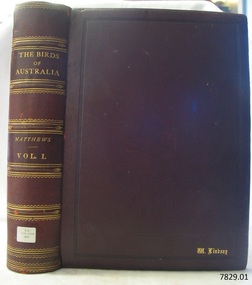
Book - Reference, The Birds of Australia Vol 1
... younger generation. This was an instant success. In the 1950’s he had the honour of being appointed to the Victorian Library Board and received more inspiration from the monthly conferences in Melbourne. He was sadly retired in 1959 after over 23 years of service, due to the fact that he had gone over the working age of council officers. However, he continued to take a very keen interest in the continual development of the Library until his death in 1969. The Birds of Australia by Gregory M ...The Birds of Australia is a 12 volume work, in a total of 14 books. The books were used as an ornithological handbook. They contain scientific text as well as over 600 hand-coloured lithographed plates by J.G. Keulemans, H. Grönvold, Roland Green, H. Goodchild and G.E. Lodge. The work was written, sponsored and organised by Gregory M. Matthews, F.R.S.C. Erc. who were a wealthy Australian and an amateur ornithologist? His titles included – -Fellow of the Linnean and Zoological Societies of London -Member of the British Ornithologists’ Union -Corresponding Fellow of the American Ornithologists’ Union The volumes in our collection were originally donated to the Warrnambool Mechanics’ Institute and Free Library by William Lindsay. THE LINDSAYS (quoted from the book Of Many Things – A History of Warrnambool Shire by C.E. Sayers) The Lindsays were amongst the most prominent families in the Shire of Warrnambool, as pastoralists, sportsmen, municipal councillors, community leaders. The first of the family William arrived in Melbourne in 1841 and started a business as a livestock agent. The gold rushes sent him to the central Victoria diggings dealing in cattle. This was a business that boomed in the early 1850s, and he prospered. In 1859 he took over the Quamby run near Woolsthrope from Paul de Castella, the Yarra Valley Swiss vigneron who had brought the leasehold and improvements in 1853 from George You, who had pioneered the run. Quamby was originally 25,000 acres. It was heavily timbered, rough country, much of it swampy, a characteristic of the district. Lindsay used it to fatten cattle which gave large returns with the booming gold diggings towns paying high prices for beef. In 1862 purchases at auction made Quamby a freehold. In the next six years, a further 20,000 acres of Crown land were brought at auction to make the run one of the largest in the south-west district. The great profits from his cattle trading enabled Lindsay to make improvements to the holding, and to Union which was added in 1864. Much of the thick timber was cleared and the worst of the swamps drained. Union was 15,000 acres of freehold land when Kennedy sold it to Lindsay. It was heavily timbered, mostly blackwood, with large belts of wattle and honeysuckle. Much of the heavy native was ringbarked and cleared; much more was swept away by bushfire. It was expensive work, but Lindsay’s bank passbook was heavy with credit, and he did not spare money to make both Quamby and Union heavily developed stock runs. He was as lavish in social living; the bluestone Quamby homestead was one of the most hospitable in the district when William Lindsay was host there; its paddocks carried high-quality thoroughbreds: its stables housed steeplechasers and flat racers which won many races on Warrnambool and other courses; its coach houses were filled with carriages which took his guests to the great racing carnivals of the district. After William Lindsay died in 1897, in his eighty-fifth year, his two sons, William and James, managed Union and Quamby as a joint venture. This partnership ended in 1906 when William took over Union and James kept Quamby. The following year 10,000 acres of Union was subdivided and sold in lots of 100 acres to 700 acres for dairying and general farming. It was well-improved country, much of it alluvial flats. By then many of the paddocks were sheltered with blue gum belts, and they carried good pastures. The three Lindsays, father and two sons, gave many years of service to the Shire, and to many charitable, sporting, social and community organisations in the Warrnambool district. William Lindsay senior, was a Shire councillor for 15 years, and President several times. James Lindsay followed his father as a north riding councillor. He served nineteen years, from 1887 until his death in March 1908. He was President four times. Jimmy Lindsay was one of the most popular men in the south-west of Victoria. He was a fine sportsman: horse breeder, owner and a dashing amateur rider. He lived lavishly and played hard. For many years he guarded a herd of kangaroos, as many as 100 head, at Quamby. Descendants of the Lindsay kangaroos are still in the district. James Lindsay’s wife, Margaret Esther was a daughter of Samuel Shaw Parker, the first engineer of the Shire. Nell Lindsay, a daughter, lives in the Bluestone Quamby homestead. Only a little more than 60 acres of the original run still belongs to the property. William Lindsay junior succeeded his brother as a Shire councillor. He served for 25 years from 1908 until his death in 1934. So, the Lindsays, father and two sons, served as Shite councillors for an unbroken period of sixth-five years. William Lindsay junior had a life-long interest in horse racing, as breeder, owner and enthusiastic amateur steeplechase rider. He was elected a member of the Warrnambool racing club in 1901 and was president of the club for thirty-two years. He raced and rode horses for the love of the sport. He won the Villiers and Heytesbury Hunt Cup in the 1870s on his own horse, Ventura. In the year he died his horse Flavedo won the Warrnambool Grand Annual steeplechase. It was a sensational race. All of the contestants fell or lost their riders. When Flavedo baulked at a jump, its jockey R. Sweetman, remounted and completed the course to win the race. All of the Lindsays were passionately fond of the thoroughbred horse. Nell Lindsay talking to the author in the drawing-room of Quamby homestead - with many memories for her of its lavish years – said of a brother that he was put on a horse when he was two years old and never got off. William Lindsay junior made Union into a fine, high-producing property, breeding cattle and horses. He added to the bluestone house that David Kennedy started, established plantations of pines and gums, and made an attractive garden. WARRNAMBOOL MECHANICS’ INSTITUTE Warrnambool's Mechanics' Institute (or Institution as it was sometimes called) was one of the earliest in Victoria. On 17th October 1853, a meeting was held where it was resolved to request the Lieutenant Governor of the Colony to grant land for the erection of a Mechanics' Institutes building. A committee was formed at the meeting and Richard Osburne chaired the first meeting of this committee. The land on the North West corner of Banyan and Merri Streets was granted but there were no funds to erect the building. The Formal Rights of the Warrnambool Mechanics' Institute's encompassed its aims and these were officially adopted in1859; "This Institution has for its object the diffusion of literary, scientific, and other useful knowledge amongst its members, excluding all controversial subjects, religious or political. These objects are sought to be obtained by means of a circulating library, a reading room, the establishment of classes, debates, and the occasional delivery of lectures on natural and experimental philosophy, mechanics, astronomy, chemistry, natural history, literature, and the useful and ornamental arts, particularly those which have a more immediate reference to the colony." The Warrnambool Mechanics' Institute opened its first meeting room in November 1854 in the National School building at the corner of Banyan and Timor Streets. The Institute was funded by member subscription, payable on a quarterly, half-yearly or yearly basis. Samuel Hannaford, the Manager of the Warrnambool Bank of Australasia, was the first Honorary Secretary of the Mechanics' Institutes, and an early President and Vice-President. He also gave several of the early lectures in the Reading Room. Another early Secretary, Librarian and lecturer was Marmaduke Fisher, the teacher at the National School. Lecture topics included The Poets and Poetry of Ireland', 'The Birth and Development of the Earth', 'The Vertebrae - with Remarks on the pleasures resulting from the study of Natural History' and 'Architecture'. In 1856 the Reading Room was moved to James Hider's shop in Timor Street, and by 1864 it was located in the bookshop of Davies and Read. In the 1860's the Mechanics' Institute struggled as membership waned but in 1866, after a series of fund raising efforts, the committee was able to purchase land in Liebig Street, on a site then called Market Square, between the weighbridge and the fire station. A Mechanics' Institute building was opened at this site in August 1871. The following year four more rooms were added to the main Reading Room and in 1873 the Artisan School of Design was incorporated into the Institute. The same year Joseph Archibald established a Museum; however, it deteriorated when he was transferred to Bendigo in 1877. In 1880, with Archibald's return to Warrnambool, the Museum was re-established, and in 1885 a new building was built at the back of the Institute to accommodate the re-created School of Design, the Art Gallery and the Museum. In 1887 the Museum section was moved to the former court house in Timor Street (for some time the walls of the building formed part of the TAFE cafeteria but all is now demolished)). In 1911 the Museum was transferred back to the original building and the management of the Mechanics' Institute was handed over to the Warrnambool City Council. The Museum and Art Gallery became one and housed many fine works of art, and the Library continued to grow. The building was well patronised, with records showing that at the beginning of the 20th century there were between 500 and 800 visitors. During World War One the monthly figures were in the thousands, with 3,400 people visiting in January 1915. The Museum was a much-loved Institution in Warrnambool until the contents of the Museum and Art Gallery were removed to make room for the Warrnambool City Council Engineers' Department. The contents were stored but many of the items were scattered or lost. When the original building was demolished the site became occupied by the Civic Centre, which included the new City Library. (The library was temporarily located in the old Palais building in Koroit Street.) In the process of reorganisation the Collection was distributed amongst the community groups: -The new City Library took some of the historic books and some important documents, historic photographs and newspapers. -The Art Gallery kept the 19th Century art collection and some of the artefacts from the museum. -The Historic Society has some items -The State Museum has some items -Some items were destroyed -Flagstaff Hill Maritime Village has old newspapers, Government Gazettes, most of the Mechanics' Institute Library, ledgers and documents connected to the Mechanics' Institute Library, some framed and unframed artworks and some photographs. The Warrnambool Mechanics' Institute Library book collection is deemed to be of great importance because it is one of the few collections in an almost intact state, and many of the books are now very rare and of great value. THE PATTISON COLLECTION This book is also part of the ‘Pattison Collection’, a collection of books and records that was originally owned by the Warrnambool Mechanics’ Institute, which was founded in Warrnambool in 1853. In 1935 Ralph Pattison was appointed as City Librarian to establish and organise the Warrnambool Library, as the Warrnambool Mechanics’ Institute was then called. When the Warrnambool Mechanics’ Institute building was pulled down in 1963 a new civic building was erected on the site and the new Warrnambool Library, on behalf of the City Council, took over all the holdings of the Warrnambool Mechanics’ Institute. At this time some of the items were separated and identified as the ‘Pattison Collection’, named after Ralph Pattison. Eventually, the components of the Warrnambool Mechanics’ Institute were distributed from the Warrnambool Library to various places, including the Art Gallery, Historical Society and Flagstaff Hill. Later some were even distributed to other regional branches of Corangamite Regional Library and passed to and fro. It is difficult now to trace just where all of the items have ended up. The books at Flagstaff Hill Maritime Village generally display stamps and markings from Pattison as well as a variety of other institutions including the Mechanics’ Institute itself. RALPH ERIC PATTISON Ralph Eric Pattison was born in Rockhampton, Queensland, in 1891. He married Maude Swan from Warrnambool in 1920 and they set up home in Warrnambool. In 1935 Pattison accepted a position as City Librarian for the Warrnambool City Council. His huge challenge was to make a functional library within two rooms of the Mechanics’ Institute. He tirelessly cleaned, cleared and sorted a disarrayed collection of old books, jars of preserved specimens and other items reserved for exhibition in the city’s museum. He developed and updated the library with a wide variety of books for all tastes, including reference books for students; a difficult task to fulfil during the years following the Depression. He converted all of the lower areas of the building into a library, reference room and reading room for members and the public. The books were sorted and stored using a cataloguing and card index system that he had developed himself. He also prepared the upper floor of the building and established the Art Gallery and later the Museum, a place to exhibit the many old relics that had been stored for years for this purpose. One of the treasures he found was a beautiful ancient clock, which he repaired, restored and enjoyed using in his office during the years of his service there. Ralph Pattison was described as “a meticulous gentleman whose punctuality, floorless courtesy and distinctive neat dress were hallmarks of his character, and ‘his’ clock controlled his daily routine and his opening and closing of the library’s large heavy doors to the minute.” Pattison took leave from 1942 to 1945 to serve in the Royal Australian Navy, Volunteer Reserve as Lieutenant. A few years later he converted one of the Museum’s rooms into a Children’s Library, stocking it with suitable books for the younger generation. This was an instant success. In the 1950’s he had the honour of being appointed to the Victorian Library Board and received more inspiration from the monthly conferences in Melbourne. He was sadly retired in 1959 after over 23 years of service, due to the fact that he had gone over the working age of council officers. However, he continued to take a very keen interest in the continual development of the Library until his death in 1969. The Birds of Australia by Gregory M. Matthews is now considered a rare and valuable scientific and historic work on its own. These 12 volumes were donated in 1934 to The Warrnambool Mechanics’ Institute and were included as part of the Pattison Collection. The Warrnambool Mechanics’ Institute Collection is primarily significant in its totality, rather than for the individual objects it contains. Its contents are highly representative of the development of Mechanics' Institute libraries across Australia, particularly Victoria. A diversity of publications and themes has been amassed, and these provide clues to our understanding of the nature of and changes in the reading habits of Victorians from the 1850s to the middle of the 20th century. The collection also highlights the Warrnambool community’s commitment to the Mechanics’ Institute, reading, literacy and learning in the regions, and proves that access to knowledge was not impeded by distance. These items help to provide a more complete picture of our community’s ideals and aspirations. The Warrnambool Mechanics Institute book collection has historical and social significance for its strong association with the Mechanics Institute movement and the important role it played in the intellectual, cultural and social development of people throughout the latter part of the nineteenth century and the early twentieth century. The collection of books is a rare example of an early lending library and its significance is enhanced by the survival of an original collection of many volumes. The Warrnambool Mechanics' Institute’s publication collection is of both local and state significance. The Birds of Australia Vol 1 Author: Gregory M Mathews Publisher: Witherby & Co, 326 HIGH HOLBORN LONDON Date: 1910-1911 Tan, leather bound illustrated workLabel on spine cover with typed text RA 598.2994 MAT Pastedown front endpaper has sticker from Warrnambool Mechanics Institute that reads Presented by W Lindsay Esq, “Union”, Woolsthorpe. Accession Number 15232 Date Received: 3-34 “W. Lindsay” embossed in gold on front cover, bottom right of bookflagstaff hill, warrnambool, shipwrecked coast, flagstaff hill maritime museum, maritime museum, shipwreck coast, flagstaff hill maritime village, great ocean road, the birds of australia, gregory m. matthews, witherby & co., h.f. & g. witherby, w lindsay, william lindsay, pattison collection, the birds of australia vol 1, union station, woolsthrope, quamby station, warrnambool mechanics’ institute and free library -
 Flagstaff Hill Maritime Museum and Village
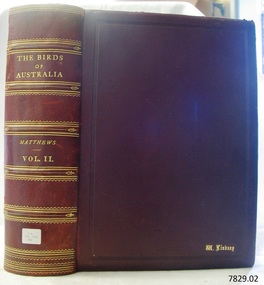
Book - Reference, The Birds of Australia Vol 2
... younger generation. This was an instant success. In the 1950’s he had the honour of being appointed to the Victorian Library Board and received more inspiration from the monthly conferences in Melbourne. He was sadly retired in 1959 after over 23 years of service, due to the fact that he had gone over the working age of council officers. However he continued to take a very keen interest in the continual development of the Library until his death in 1969. The Birds of Australia by Gregory M ...The Birds of Australia is a 12 volume work, in a total of 14 books. The books were used as an ornithological handbook. They contain scientific text as well as over 600 hand-coloured lithographed plates by J.G. Keulemans, H. Grönvold, Roland Green, H. Goodchild and G.E. Lodge. The work was written, sponsored and organised by Gregory M. Matthews, F.R.S.C. Erc. who was a wealthy Australian and an amateur ornithologist. His titles included – -Fellow of the Linnean and Zoological Societies of London -Member of the British Ornithologists’ Union -Corresponding Fellow of the American Ornithologists’ Union The volumes in our collection were originally donated to the Warrnambool Mechanics’ Institute and Free Library by William Lindsay. THE LINDSAYS (quoted from the book Of Many Things – A History of Warrnambool Shire by C.E. Sayers) The Lindsays were amongst the most prominent families in the Shire of Warrnambool, as pastoralists, sportsmen, municipal councillors, community leaders. The first of the family William arrived in Melbourne in 1841 and started business as a livestock agent. The gold rushes sent him to the central Victoria diggings dealing in cattle. This was a business that boomed in the early 1850s, and he prospered. In 1859 he took over the Quamby run near Woolsthrope from Paul de Castella, the Yarra Valley Swiss vigneron who had brought the leasehold and improvements in 1853 from George Youl, who had pioneered the run. Quamby was originally 25,000 acres. It was heavily timbered, rough country, much of it swampy, a characteristic of the district. Lindsay used it to fatten cattle which gave large returns with the booming gold diggings towns paying high prices for beef. In 1862 purchases at auction made Quamby a freehold. In the next six years a further 20,000 acres of Crown land were brought at auction to make the run one of the largest in the south-west district. The great profits from his cattle trading enabled Lindsay to make improvements to the holding, and to Union which was added in 1864. Much of the thick timber was cleared and the worst of the swamps drained. Union was 15,000 acres of freehold when Kennedy sold it to Lindsay. It was heavily timbered, mostly blackwood, with large belts of wattle and honeysuckle. Much of the heavy native was ringbarked and cleared; much more was swept away by bushfire. It was expensive work, but Lindsay’s bank passbook was heavy with credit, and he did not spare money to make both Quamby and Union heavily developed stock runs. He was as lavish in social living; the bluestone Quamby homestead was one of the most hospitable in the district when William Lindsay was host there; its paddocks carried high quality thoroughbreds: its stables housed steeplechasers and flat racers which won many races on Warrnambool and other courses; its coach houses were filled with carriages which took his guests to the great racing carnivals of the district. After William Lindsay died in 1897, in his eighty-fifth year, his two sons, William and James, managed Union and Quamby as a joint venture. This partnership ended in 1906 when William took over Union and James kept Quamby. The following year 10,000 acres of Union were subdivided and sold in lots of 100 acres to 700 acres for dairying and general farming. It was well improved country, much of it alluvial flats. By then many of the paddocks were sheltered with blue gum belts, and they carried good pastures. The three Lindsays, father and two sons, gave many years of service to the Shire, and to many charitable, sporting, social and community organisations in the Warrnambool district. William Lindsay senior, was a Shire councillor for 15 years, and President several times. James Lindsay followed his father as a north riding councillor. He served nineteen years, from 1887 until his death in March 1908. He was President four times. Jimmy Lindsay was one of the most popular men in the south-west of Victoria. He was a fine sportsman: horse breeder, owner and a dashing amateur rider. He lived lavishly and played hard. For many years he guarded a herd of kangaroos, as many as 100 head, at Quamby. Descendants of the Lindsay kangaroos are still in the district. James Lindsay’s wife, Margaret Esther was a daughter of Samuel Shaw Parker, the first engineer of the Shire. Nell Lindsay, a daughter, lives in the Bluestone Quamby homestead. Only a little more than 60 acres of the original run still belongs to the property. William Lindsay junior succeeded his brother as a Shire councillor. He served for 25 years from 1908 until his death in 1934. So, the Lindsays, father and two sons, served as Shite councillors for an unbroken period of sixth-five years. William Lindsay junior had a life-long interest in horse racing, as breeder, owner and enthusiastic amateur steeplechase rider. He was elected a member of the Warrnambool racing club in 1901 and was president of the club for thirty-two years. He raced and rode horses for the love of the sport. He won the Villiers and Heytesbury Hunt Cup in the 1870s on his own horse, Ventura. In the year he died his horse Flavedo won the Warrnambool Grand Annual steeplechase. It was a sensational race. All of the contestants fell, or lost their riders. When Flavedo baulked at a jump, its jockey R. Sweetman, remounted and completed the course to win the race. All of the Lindsays were passionately fond of the thoroughbred horse. Nell Lindsay talking to the author in the drawing room of Quamby homestead - with many memories for her of its lavish years – said of a brother that he was put on a horse when he was two years old and never got off. William Lindsay junior made Union into a fine, high-producing property, breeding cattle and horses. He added to the bluestone house that David Kennedy started, established plantations of pines and gums, and made an attractive garden. WARRNAMBOOL MECHANICS’ INSTITUTE Warrnambool's Mechanics' Institute (or Institution as it was sometimes called) was one of the earliest in Victoria. On 17th October 1853 a meeting was held where it was resolved to request the Lieutenant Governor of the Colony to grant land for the erection of a Mechanics' Institutes building. A committee was formed at the meeting and Richard Osburne chaired the first meeting of this committee. The land on the North West corner of Banyan and Merri Streets was granted but there were no funds to erect the building. The Formal Rights of the Warrnambool Mechanics' Institute's encompassed its aims and these were officially adopted in1859; "This Institution has for its object the diffusion of literary, scientific, and other useful knowledge amongst its members, excluding all controversial subjects, religious or political. These objects are sought to be obtained by means of a circulating library, a reading room, the establishment of classes, debates, and the occasional delivery of lectures on natural and experimental philosophy, mechanics, astronomy, chemistry, natural history, literature, and the useful and ornamental arts, particularly those which have a more immediate reference to the colony." The Warrnambool Mechanics' Institute opened its first meeting room in November1854 in the National School building at the corner of Banyan and Timor Streets. The Institute was funded by member subscription, payable on a quarterly, half yearly or yearly basis. Samuel Hannaford, the Manager of the Warrnambool Bank of Australasia, was the first Honorary Secretary of the Mechanics' Institutes, and an early President and Vice-President. He also gave several of the early lectures in the Reading Room. Another early Secretary, Librarian and lecturer was Marmaduke Fisher, the teacher at the National School. Lecture topics included The Poets and Poetry of Ireland', 'The Birth and Development of the Earth', 'The Vertebrae - with Remarks on the pleasures resulting from the study of Natural History' and 'Architecture'. In 1856 the Reading Room was moved to James Hider's shop in Timor Street, and by 1864 it was located in the bookshop of Davies and Read. In the 1860's the Mechanics' Institute struggled as membership waned but in 1866, after a series of fund raising efforts, the committee was able to purchase land in Liebig Street, on a site then called Market Square, between the weighbridge and the fire station. A Mechanics' Institute building was opened at this site in August 1871. The following year four more rooms were added to the main Reading Room and in 1873 the Artisan School of Design was incorporated into the Institute. The same year Joseph Archibald established a Museum; however it deteriorated when he was transferred to Bendigo in 1877. In 1880, with Archibald's return to Warrnambool, the Museum was re-established, and in 1885 a new building was built at the back of the Institute to accommodate the re-created School of Design, the Art Gallery and the Museum. In 1887 the Museum section was moved to the former court house in Timor Street (for some time the walls of the building formed part of the TAFE cafeteria but all is now demolished)). In 1911 the Museum was transferred back to the original building and the management of the Mechanics' Institute was handed over to the Warrnambool City Council. The Museum and Art Gallery became one and housed many fine works of art, and the Library continued to grow. The building was well patronised, with records showing that at the beginning of the 20th century there were between 500 and 800 visitors. During World War One the monthly figures were in the thousands, with 3,400 people visiting in January 1915. The Museum was a much loved Institution in Warrnambool until the contents of the Museum and Art Gallery were removed to make room for the Warrnambool City Council Engineers' Department. The contents were stored but many of the items were scattered or lost. When the original building was demolished the site became occupied by the Civic Centre, which included the new City Library. (The library was temporarily located in the old Palais building in Koroit Street.) In the process of reorganisation the Collection was distributed amongst the community groups: -The new City Library took some of the historic books and some important documents, historic photographs and newspapers. -The Art Gallery kept the 19th Century art collection and some of the artefacts from the museum. -The Historic Society has some items -The State Museum has some items -Some items were destroyed -Flagstaff Hill Maritime Village has old newspapers, Government Gazettes, most of the Mechanics' Institute Library, ledgers and documents connected to the Mechanics' Institute Library, some framed and unframed art works and some photographs. The Warrnambool Mechanics' Institute Library book collection is deemed to be of great importance because it is one of the few collections in an almost intact state, and many of the books are now very rare and of great value. THE PATTISON COLLECTION This book is also part of the ‘Pattison Collection’, a collection of books and records that was originally owned by the Warrnambool Mechanics’ Institute, which was founded in Warrnambool in 1853. In 1935 Ralph Pattison was appointed as City Librarian to establish and organise the Warrnambool Library, as the Warrnambool Mechanics’ Institute was then called. When the Warrnambool Mechanics’ Institute building was pulled down in 1963 a new civic building was erected on the site and the new Warrnambool Library, on behalf of the City Council, took over all the holdings of the Warrnambool Mechanics’ Institute. At this time some of the items were separated and identified as the ‘Pattison Collection’, named after Ralph Pattison. Eventually the components of the Warrnambool Mechanics’ Institute were distributed from the Warrnambool Library to various places, including the Art Gallery, Historical Society and Flagstaff Hill. Later some were even distributed to other regional branches of Corangamite Regional Library and passed to and fro. It is difficult now to trace just where all of the items have ended up. The books at Flagstaff Hill Maritime Village generally display stamps and markings from Pattison as well as a variety of other institutions including the Mechanics’ Institute itself. RALPH ERIC PATTISON Ralph Eric Pattison was born in Rockhampton, Queensland, in 1891. He married Maude Swan from Warrnambool in 1920 and they set up home in Warrnambool. In 1935 Pattison accepted a position as City Librarian for the Warrnambool City Council. His huge challenge was to make a functional library within two rooms of the Mechanics’ Institute. He tirelessly cleaned, cleared and sorted a disarrayed collection of old books, jars of preserved specimens and other items reserved for exhibition in the city’s museum. He developed and updated the library with a wide variety of books for all tastes, including reference books for students; a difficult task to fulfil during the years following the Depression. He converted all of the lower area of the building into a library, reference room and reading room for members and the public. The books were sorted and stored using a cataloguing and card index system that he had developed himself. He also prepared the upper floor of the building and established the Art Gallery and later the Museum, a place to exhibit the many old relics that had been stored for years for this purpose. One of the treasures he found was a beautiful ancient clock, which he repaired, restored and enjoyed using in his office during the years of his service there. Ralph Pattison was described as “a meticulous gentleman whose punctuality, floorless courtesy and distinctive neat dress were hallmarks of his character, and ‘his’ clock controlled his daily routine, and his opening and closing of the library’s large heavy doors to the minute.” Pattison took leave during 1942 to 1945 to serve in the Royal Australian Navy, Volunteer Reserve as Lieutenant. A few years later he converted one of the Museum’s rooms into a Children’s Library, stocking it with suitable books for the younger generation. This was an instant success. In the 1950’s he had the honour of being appointed to the Victorian Library Board and received more inspiration from the monthly conferences in Melbourne. He was sadly retired in 1959 after over 23 years of service, due to the fact that he had gone over the working age of council officers. However he continued to take a very keen interest in the continual development of the Library until his death in 1969.The Birds of Australia by Gregory M. Matthews is now considered a rare and valuable scientific and historic work on its own. These 12 volumes were donated in 1934 to The Warrnambool Mechanics’ Institute and were included as part of the Pattison Collection. The Warrnambool Mechanics’ Institute Collection is primarily significant in its totality, rather than for the individual objects it contains. Its contents are highly representative of the development of Mechanics' Institute libraries across Australia, particularly Victoria. A diversity of publications and themes has been amassed, and these provide clues to our understanding of the nature of and changes in the reading habits of Victorians from the 1850s to the middle of the 20th century. The collection also highlights the Warrnambool community’s commitment to the Mechanics’ Institute, reading, literacy and learning in the regions, and proves that access to knowledge was not impeded by distance. These items help to provide a more complete picture of our community’s ideals and aspirations. The Warrnambool Mechanics Institute book collection has historical and social significance for its strong association with the Mechanics Institute movement and the important role it played in the intellectual, cultural and social development of people throughout the latter part of the nineteenth century and the early twentieth century. The collection of books is a rare example of an early lending library and its significance is enhanced by the survival of an original collection of many volumes. The Warrnambool Mechanics' Institute’s publication collection is of both local and state significance. The Birds of Australia Vol 2 Author: Gregory M Mathews Publisher: Witherby & Co 326 HIGH HOLBORN LONDON Date: 1912-1913 Tan leather bound illustrated work. Label on spine cover with typed text RA 598.2994 MAT Pastedown front endpaper has sticker from Warrnambool Mechanics Institute and Free Library that reads “Presented by W. Lindsay Esq. ‘Union’ Woolsthrope” Accession Number: 15233 Date Received: 3-34 “W. Lindsay” embossed in gold on front cover, bottom right of book flagstaff hill, warrnambool, shipwrecked coast, flagstaff hill maritime museum, maritime museum, shipwreck coast, flagstaff hill maritime village, great ocean road, the birds of australia, gregory m. matthews, witherby & co., h.f. & g. witherby, w lindsay, william lindsay, quamby woolsthorpe, union woolsthorpe, pattison collection, warrnambool library, warrnambool art gallery, joseph archibald, warrnambool mechanics’ institute and free library, ralph eric pattison, warrnambool city librarian, mechanics’ institute library, victorian library board, warrnambool books and records, warrnambool children’s library, the birds of australia vol 2, quamby station, union station, woolsthrope -
 Flagstaff Hill Maritime Museum and Village
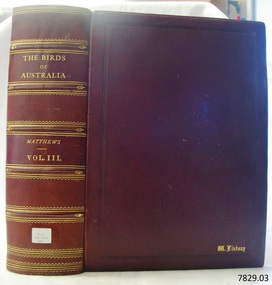
Book - Reference, The Birds of Australia Vol 3
... younger generation. This was an instant success. In the 1950’s he had the honour of being appointed to the Victorian Library Board and received more inspiration from the monthly conferences in Melbourne. He was sadly retired in 1959 after over 23 years of service, due to the fact that he had gone over the working age of council officers. However he continued to take a very keen interest in the continual development of the Library until his death in 1969. The Birds of Australia by Gregory M ...The Birds of Australia is a 12 volume work, in a total of 14 books. The books were used as an ornithological handbook. They contain scientific text as well as over 600 hand-coloured lithographed plates by J.G. Keulemans, H. Grönvold, Roland Green, H. Goodchild and G.E. Lodge. The work was written, sponsored and organised by Gregory M. Matthews, F.R.S.C. Erc. who was a wealthy Australian and an amateur ornithologist. His titles included – -Fellow of the Linnean and Zoological Societies of London -Member of the British Ornithologists’ Union -Corresponding Fellow of the American Ornithologists’ Union The volumes in our collection were originally donated to the Warrnambool Mechanics’ Institute and Free Library by William Lindsay. THE LINDSAYS (quoted from the book Of Many Things – A History of Warrnambool Shire by C.E. Sayers) The Lindsays were amongst the most prominent families in the Shire of Warrnambool, as pastoralists, sportsmen, municipal councillors, community leaders. The first of the family William arrived in Melbourne in 1841 and started business as a livestock agent. The gold rushes sent him to the central Victoria diggings dealing in cattle. This was a business that boomed in the early 1850s, and he prospered. In 1859 he took over the Quamby run near Woolsthrope from Paul de Castella, the Yarra Valley Swiss vigneron who had brought the leasehold and improvements in 1853 from George Youl, who had pioneered the run. Quamby was originally 25,000 acres. It was heavily timbered, rough country, much of it swampy, a characteristic of the district. Lindsay used it to fatten cattle which gave large returns with the booming gold diggings towns paying high prices for beef. In 1862 purchases at auction made Quamby a freehold. In the next six years a further 20,000 acres of Crown land were brought at auction to make the run one of the largest in the south-west district. The great profits from his cattle trading enabled Lindsay to make improvements to the holding, and to Union which was added in 1864. Much of the thick timber was cleared and the worst of the swamps drained. Union was 15,000 acres of freehold when Kennedy sold it to Lindsay. It was heavily timbered, mostly blackwood, with large belts of wattle and honeysuckle. Much of the heavy native was ringbarked and cleared; much more was swept away by bushfire. It was expensive work, but Lindsay’s bank passbook was heavy with credit, and he did not spare money to make both Quamby and Union heavily developed stock runs. He was as lavish in social living; the bluestone Quamby homestead was one of the most hospitable in the district when William Lindsay was host there; its paddocks carried high quality thoroughbreds: its stables housed steeplechasers and flat racers which won many races on Warrnambool and other courses; its coach houses were filled with carriages which took his guests to the great racing carnivals of the district. After William Lindsay died in 1897, in his eighty-fifth year, his two sons, William and James, managed Union and Quamby as a joint venture. This partnership ended in 1906 when William took over Union and James kept Quamby. The following year 10,000 acres of Union were subdivided and sold in lots of 100 acres to 700 acres for dairying and general farming. It was well improved country, much of it alluvial flats. By then many of the paddocks were sheltered with blue gum belts, and they carried good pastures. The three Lindsays, father and two sons, gave many years of service to the Shire, and to many charitable, sporting, social and community organisations in the Warrnambool district. William Lindsay senior, was a Shire councillor for 15 years, and President several times. James Lindsay followed his father as a north riding councillor. He served nineteen years, from 1887 until his death in March 1908. He was President four times. Jimmy Lindsay was one of the most popular men in the south-west of Victoria. He was a fine sportsman: horse breeder, owner and a dashing amateur rider. He lived lavishly and played hard. For many years he guarded a herd of kangaroos, as many as 100 head, at Quamby. Descendants of the Lindsay kangaroos are still in the district. James Lindsay’s wife, Margaret Esther was a daughter of Samuel Shaw Parker, the first engineer of the Shire. Nell Lindsay, a daughter, lives in the Bluestone Quamby homestead. Only a little more than 60 acres of the original run still belongs to the property. William Lindsay junior succeeded his brother as a Shire councillor. He served for 25 years from 1908 until his death in 1934. So, the Lindsays, father and two sons, served as Shite councillors for an unbroken period of sixth-five years. William Lindsay junior had a life-long interest in horse racing, as breeder, owner and enthusiastic amateur steeplechase rider. He was elected a member of the Warrnambool racing club in 1901 and was president of the club for thirty-two years. He raced and rode horses for the love of the sport. He won the Villiers and Heytesbury Hunt Cup in the 1870s on his own horse, Ventura. In the year he died his horse Flavedo won the Warrnambool Grand Annual steeplechase. It was a sensational race. All of the contestants fell, or lost their riders. When Flavedo baulked at a jump, its jockey R. Sweetman, remounted and completed the course to win the race. All of the Lindsays were passionately fond of the thoroughbred horse. Nell Lindsay talking to the author in the drawing room of Quamby homestead - with many memories for her of its lavish years – said of a brother that he was put on a horse when he was two years old and never got off. William Lindsay junior made Union into a fine, high-producing property, breeding cattle and horses. He added to the bluestone house that David Kennedy started, established plantations of pines and gums, and made an attractive garden. WARRNAMBOOL MECHANICS’ INSTITUTE Warrnambool's Mechanics' Institute (or Institution as it was sometimes called) was one of the earliest in Victoria. On 17th October 1853 a meeting was held where it was resolved to request the Lieutenant Governor of the Colony to grant land for the erection of a Mechanics' Institutes building. A committee was formed at the meeting and Richard Osburne chaired the first meeting of this committee. The land on the North West corner of Banyan and Merri Streets was granted but there were no funds to erect the building. The Formal Rights of the Warrnambool Mechanics' Institute's encompassed its aims and these were officially adopted in1859; "This Institution has for its object the diffusion of literary, scientific, and other useful knowledge amongst its members, excluding all controversial subjects, religious or political. These objects are sought to be obtained by means of a circulating library, a reading room, the establishment of classes, debates, and the occasional delivery of lectures on natural and experimental philosophy, mechanics, astronomy, chemistry, natural history, literature, and the useful and ornamental arts, particularly those which have a more immediate reference to the colony." The Warrnambool Mechanics' Institute opened its first meeting room in November1854 in the National School building at the corner of Banyan and Timor Streets. The Institute was funded by member subscription, payable on a quarterly, half yearly or yearly basis. Samuel Hannaford, the Manager of the Warrnambool Bank of Australasia, was the first Honorary Secretary of the Mechanics' Institutes, and an early President and Vice-President. He also gave several of the early lectures in the Reading Room. Another early Secretary, Librarian and lecturer was Marmaduke Fisher, the teacher at the National School. Lecture topics included The Poets and Poetry of Ireland', 'The Birth and Development of the Earth', 'The Vertebrae - with Remarks on the pleasures resulting from the study of Natural History' and 'Architecture'. In 1856 the Reading Room was moved to James Hider's shop in Timor Street, and by 1864 it was located in the bookshop of Davies and Read. In the 1860's the Mechanics' Institute struggled as membership waned but in 1866, after a series of fund raising efforts, the committee was able to purchase land in Liebig Street, on a site then called Market Square, between the weighbridge and the fire station. A Mechanics' Institute building was opened at this site in August 1871. The following year four more rooms were added to the main Reading Room and in 1873 the Artisan School of Design was incorporated into the Institute. The same year Joseph Archibald established a Museum; however it deteriorated when he was transferred to Bendigo in 1877. In 1880, with Archibald's return to Warrnambool, the Museum was re-established, and in 1885 a new building was built at the back of the Institute to accommodate the re-created School of Design, the Art Gallery and the Museum. In 1887 the Museum section was moved to the former court house in Timor Street (for some time the walls of the building formed part of the TAFE cafeteria but all is now demolished)). In 1911 the Museum was transferred back to the original building and the management of the Mechanics' Institute was handed over to the Warrnambool City Council. The Museum and Art Gallery became one and housed many fine works of art, and the Library continued to grow. The building was well patronised, with records showing that at the beginning of the 20th century there were between 500 and 800 visitors. During World War One the monthly figures were in the thousands, with 3,400 people visiting in January 1915. The Museum was a much loved Institution in Warrnambool until the contents of the Museum and Art Gallery were removed to make room for the Warrnambool City Council Engineers' Department. The contents were stored but many of the items were scattered or lost. When the original building was demolished the site became occupied by the Civic Centre, which included the new City Library. (The library was temporarily located in the old Palais building in Koroit Street.) In the process of reorganisation the Collection was distributed amongst the community groups: -The new City Library took some of the historic books and some important documents, historic photographs and newspapers. -The Art Gallery kept the 19th Century art collection and some of the artefacts from the museum. -The Historic Society has some items -The State Museum has some items -Some items were destroyed -Flagstaff Hill Maritime Village has old newspapers, Government Gazettes, most of the Mechanics' Institute Library, ledgers and documents connected to the Mechanics' Institute Library, some framed and unframed art works and some photographs. The Warrnambool Mechanics' Institute Library book collection is deemed to be of great importance because it is one of the few collections in an almost intact state, and many of the books are now very rare and of great value. THE PATTISON COLLECTION This book is also part of the ‘Pattison Collection’, a collection of books and records that was originally owned by the Warrnambool Mechanics’ Institute, which was founded in Warrnambool in 1853. In 1935 Ralph Pattison was appointed as City Librarian to establish and organise the Warrnambool Library, as the Warrnambool Mechanics’ Institute was then called. When the Warrnambool Mechanics’ Institute building was pulled down in 1963 a new civic building was erected on the site and the new Warrnambool Library, on behalf of the City Council, took over all the holdings of the Warrnambool Mechanics’ Institute. At this time some of the items were separated and identified as the ‘Pattison Collection’, named after Ralph Pattison. Eventually the components of the Warrnambool Mechanics’ Institute were distributed from the Warrnambool Library to various places, including the Art Gallery, Historical Society and Flagstaff Hill. Later some were even distributed to other regional branches of Corangamite Regional Library and passed to and fro. It is difficult now to trace just where all of the items have ended up. The books at Flagstaff Hill Maritime Village generally display stamps and markings from Pattison as well as a variety of other institutions including the Mechanics’ Institute itself. RALPH ERIC PATTISON Ralph Eric Pattison was born in Rockhampton, Queensland, in 1891. He married Maude Swan from Warrnambool in 1920 and they set up home in Warrnambool. In 1935 Pattison accepted a position as City Librarian for the Warrnambool City Council. His huge challenge was to make a functional library within two rooms of the Mechanics’ Institute. He tirelessly cleaned, cleared and sorted a disarrayed collection of old books, jars of preserved specimens and other items reserved for exhibition in the city’s museum. He developed and updated the library with a wide variety of books for all tastes, including reference books for students; a difficult task to fulfil during the years following the Depression. He converted all of the lower area of the building into a library, reference room and reading room for members and the public. The books were sorted and stored using a cataloguing and card index system that he had developed himself. He also prepared the upper floor of the building and established the Art Gallery and later the Museum, a place to exhibit the many old relics that had been stored for years for this purpose. One of the treasures he found was a beautiful ancient clock, which he repaired, restored and enjoyed using in his office during the years of his service there. Ralph Pattison was described as “a meticulous gentleman whose punctuality, floorless courtesy and distinctive neat dress were hallmarks of his character, and ‘his’ clock controlled his daily routine, and his opening and closing of the library’s large heavy doors to the minute.” Pattison took leave during 1942 to 1945 to serve in the Royal Australian Navy, Volunteer Reserve as Lieutenant. A few years later he converted one of the Museum’s rooms into a Children’s Library, stocking it with suitable books for the younger generation. This was an instant success. In the 1950’s he had the honour of being appointed to the Victorian Library Board and received more inspiration from the monthly conferences in Melbourne. He was sadly retired in 1959 after over 23 years of service, due to the fact that he had gone over the working age of council officers. However he continued to take a very keen interest in the continual development of the Library until his death in 1969. The Birds of Australia by Gregory M. Matthews is now considered a rare and valuable scientific and historic work on its own. These 12 volumes were donated in 1934 to The Warrnambool Mechanics’ Institute and were included as part of the Pattison Collection. The Warrnambool Mechanics’ Institute Collection is primarily significant in its totality, rather than for the individual objects it contains. Its contents are highly representative of the development of Mechanics' Institute libraries across Australia, particularly Victoria. A diversity of publications and themes has been amassed, and these provide clues to our understanding of the nature of and changes in the reading habits of Victorians from the 1850s to the middle of the 20th century. The collection also highlights the Warrnambool community’s commitment to the Mechanics’ Institute, reading, literacy and learning in the regions, and proves that access to knowledge was not impeded by distance. These items help to provide a more complete picture of our community’s ideals and aspirations. The Warrnambool Mechanics Institute book collection has historical and social significance for its strong association with the Mechanics Institute movement and the important role it played in the intellectual, cultural and social development of people throughout the latter part of the nineteenth century and the early twentieth century. The collection of books is a rare example of an early lending library and its significance is enhanced by the survival of an original collection of many volumes. The Warrnambool Mechanics' Institute’s publication collection is of both local and state significance. The Birds of Australia Vol 3 Author: Gregory M Mathews Publisher: Witherby & Co 326 HIGH HOLBORN LONDON Date: 1913-1914 Label on spine cover with typed text RA 598.2994 MAT Pastedown front endpaper has sticker from Warrnambool Mechanics Institute and Free Library that reads “Presented by W. Lindsay Esq. ‘Union’ Woolsthrope” Accession Number: 15234 Date Received: 3-34 “W. Lindsay” embossed in gold on front cover, bottom right of book flagstaff hill, warrnambool, shipwrecked coast, flagstaff hill maritime museum, maritime museum, shipwreck coast, flagstaff hill maritime village, great ocean road, the birds of australia, gregory m. matthews, witherby & co., h.f. & g. witherby, w lindsay, william lindsay, quamby woolsthorpe, union woolsthorpe, pattison collection, warrnambool library, warrnambool art gallery, joseph archibald, warrnambool mechanics’ institute and free library, ralph eric pattison, warrnambool city librarian, mechanics’ institute library, victorian library board, warrnambool books and records, warrnambool children’s library, the birds of australia vol 3, quamby station, union station, woolsthrope
