
Showing 9 items matching "machine gun carriers - australia"
-
 Monbulk RSL Sub Branch
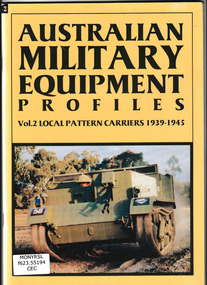
Book, Michael K Cecil, Australian Military Equipment Profiles: Local pattern carriers 1939-1945, 1992
... ...Machine gun carriers - Australia...Monbulk RSL Sub Branch 48 Main Road Monbulk yarra-valley-and-the-dandenong-ranges Military weapons - Australia Machine gun carriers - Australia Illustrative and textual description of Australian local pattern carriers 1939-1945 Ill, p.48 Australian Military Equipment Profiles: Local pattern carriers 1939-1945 Book Michael K Cecil Michael K Cecil ...Illustrative and textual description of Australian local pattern carriers 1939-1945Ill, p.48non-fictionIllustrative and textual description of Australian local pattern carriers 1939-1945military weapons - australia, machine gun carriers - australia -
 Bendigo Military Museum
Photograph - PHOTOGRAPHS WW2, Possibly 1945
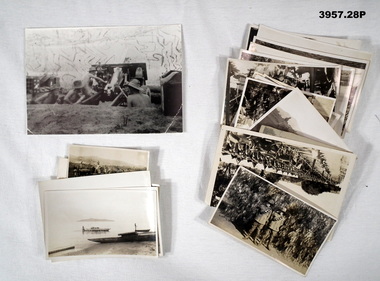
... Australia re Light Horse pre war. Most are presumably taken in New Britain up to & at wars end in 1945. One photo is in New Guinea. Many have been written on the back in pen. Photos are various sizes. Average noted. .16) Men & Bren gun carriers .17) Men & bulldozer .18) 7 men with machine...Australia re Light Horse pre war. Most are presumably taken in New Britain up to & at wars end in 1945. One photo is in New Guinea. Many have been written on the back in pen. Photos are various sizes. Average noted. .16) Men & Bren gun carriers .17) Men & bulldozer .18) 7 men with machine ...Photos labelled Jack are John Alfred TAYLOR NX102933 21st Guard Battalion. .28) This is Roy TAYLOR NX 94268 21st Field Regiment. Roy is on the left of photos. These men were brothers.Collection of photos, black / white & sepia. Some in Australia re Light Horse pre war. Most are presumably taken in New Britain up to & at wars end in 1945. One photo is in New Guinea. Many have been written on the back in pen. Photos are various sizes. Average noted. .16) Men & Bren gun carriers .17) Men & bulldozer .18) 7 men with machine gun .19) Native boats .20) Soldier & natives with canoe .21) Soldier & natives with canoe .22) 2 soldiers with POW .23) Soldier with plane wreckage .24) 3 soldiers with natives .25) 8 soldiers in group .26) Soldier sitting in plane wreck .27) Soldier in native canoe .28) Artillery unit in position firing, 4 men Handwritten on the back in pen: .1) “Jack Taylor” .2) “Jap Prisoners” .3) “After surrender, jap prisoners on New Britain” .4) “Camp on New Britain” .5) “Jap prisoners of war” .6) Jacks collection of photos New Britain .7) Jack New Britain 1945 .8) Jap Working Party New Britain .9) Camp probably New Britain .10) Wrecked jap planes on New Britain .11) Jack & mates with Jap Sword (Jack centre) .12) More japs .13) Jack & group, probably some of 21st Guard Battalion .14) 21st Light Horse Regt in Camp Wagga? .15) Two Light Horsemen, Jacks matesphotographs, japs, new britain, native -
 Orbost & District Historical Society
sprockets and ring gear, 1941
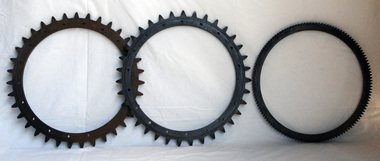
... machined the driving sprockets for Bren Gun Carriers which were sent to North Africa. The Rats of Tobruk, the Egypt and Rommell campaign used these munitions. He boarded at Orbost House while doing 12 hour day shifts. During WW11 munitions and defence equipment were manufactured by state government and private engineering firms, co-ordinated by the Commonwealth government. They worked together to meet Australia’s ...Ron Peck machined the driving sprockets for Bren Gun Carriers which were sent to North Africa. The Rats of Tobruk, the Egypt and Rommell campaign used these munitions. He boarded at Orbost House while doing 12 hour day shifts.During WW11 munitions and defence equipment were manufactured by state government and private engineering firms, co-ordinated by the Commonwealth government. They worked together to meet Australia’s defence needs and create ‘mass production, on a nation-wide scale, of materials and articles of a higher degree of complexity and accuracy than had before been attempted in Australia. These sprockets were manufactured locally.Two metal sprockets for a Bren Gun carrier. One metal ring gear.munitions sprockets bren-gun-carrier peck-james-ronald orbost-motor-works -
 Australian Commando Association - Victoria
Book - 6th Div, Shawn OLeary, To The Green Fields Beyond:The story of the 6th Division Cavalry Commandos
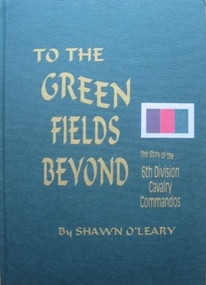
... Australian War Memorial. The 6th Division Cavalry Regiment was formed in November 1939 and, just two months later, was sent overseas to the Middle East in January 1940. Arriving in Egypt, the regiment immediately went to Palestine, where it joined the rest of the 6th Division and trained using machine-gun carriers and, from October, six old Vickers light tanks. ...The comprehensive history of the 6th Australian Division Cavalry Commandos – a (now out of print) reprint of one of the rarer Armoured unit history books. This is the story of one of Australia’s most famous fighting regiments during World War II. As an armoured cavalry unit it fought the Italians and Germans in the sands of the African desert and the Vichy French in the mountains of Syria. Later as a dismounted commando unit it fought the Japanese in the terrifying jungles of New Guinea. The heroism of the men in its ranks and the actions in which they engaged are portrayed in a way which makes battle deeds leap realistically from the pages. “To The Green Fields Beyond” is a documented and detailed book which is of value to everyone who is interested in Australia’s story. Seldom before has such a contribution been made to record of our national history. The book has been approved and sponsored by the Australian War Memorial. The 6th Division Cavalry Regiment was formed in November 1939 and, just two months later, was sent overseas to the Middle East in January 1940. Arriving in Egypt, the regiment immediately went to Palestine, where it joined the rest of the 6th Division and trained using machine-gun carriers and, from October, six old Vickers light tanks. At the end of the year the regiment moved into the Western Desert, where it joined British forces ready for the major offensive to commence on 9 December. Two days later the regiment became the first unit of the 2nd Australian Imperial Force (AIF) to go into action when one of its squadron fought a sharp action against the Italians holding Garn el Grein and Fort Maddalina on 11 and 12 December. By 21 December British forces had captured Sidi Barrrani and the desert was now open for the 6th Division’s advance along the Libyan coast. On 3 January 1941 the division attacked and captured the Italian fort of Bardia. The regiment’s A Squadron, under the command of Major Denzil Macarthur-Onslow, who went on to command the 4th Armoured Brigade, supported the attack. Tobruk was the next Italian fort to be captured, with the regiment again in support and covering the 19th Brigade’s advance. The regiment, though, was under-equipped and without its full compliment of vehicles, using only machine gun carriers. To compensate for this, A Squadron was parity re-equipped with captured Italian light tanks, which had large kangaroos painted on the hulls and turrets to distinguish them from enemy vehicles. After Tobruk, the regiment was used as part of the advance guard in the capture of Derna and then Benghazi. In April the unit moved to Helwan, where it was equipped with Vickers light tanks and machine-gun carriers, and operated with British troops in capturing Sollum. Towards the end of May the regiment moved to Palestine, where it came under the command of the 7th Division for the imminent invasion of Syria. The regiment experienced its heaviest fighting during the Syrian campaign, which began on 7 June. A Squadron was attached to the 21st Brigade and advanced along the coast, where the rugged hills made it difficult to manoeuvre the tanks and carriers. The squadron was relieved by one of the 9th Division Cavalry Regiment’s squadrons on 13 and 14 June. C Squadron, meanwhile, was with the 25th Brigade, and advanced along the Rosh Pinna road, engaging strong enemy defences at Fort Khirbe. C Squadron was relieved by B Squadron, which was later attacked by Vichy French tanks that were supported by heavy artillery and machine-gun fire, which forced the Australians to withdrawal. Always willing or needing to improvise during the campaign, A and B Squadrons both operated three captured French R35 Renault light tanks, while C Squadron provided personnel for a horse troop, quickly nicknamed the “Kelly Gang”, to patrol the high, rugged hills near the Mardjayoun–Banis Road. The regiment remained in Syria as part of the occupation force and returned to Australia in March 1942. It was sent to the Adelaide River, in the Northern Territory, and then later to Murgon, in Queensland. In 1943 and 1944 divisional cavalry regiments were reorganised into cavalry (commando) regiments. In January 1944 the 6th Division Cavalry Regiment became the 2/6th Cavalry (Commando) Regiment. The regiment lost its vehicles and became the administrative headquarters for the 2/7th, 2/9th, and 2/10th Commando Squadrons. The regiment remained with the 6th Division and participated in the Aitpae–Wewak campaign, in New Guinea, during 1945. Includes Nominal Rollnon-fictionThe comprehensive history of the 6th Australian Division Cavalry Commandos – a (now out of print) reprint of one of the rarer Armoured unit history books. This is the story of one of Australia’s most famous fighting regiments during World War II. As an armoured cavalry unit it fought the Italians and Germans in the sands of the African desert and the Vichy French in the mountains of Syria. Later as a dismounted commando unit it fought the Japanese in the terrifying jungles of New Guinea. The heroism of the men in its ranks and the actions in which they engaged are portrayed in a way which makes battle deeds leap realistically from the pages. “To The Green Fields Beyond” is a documented and detailed book which is of value to everyone who is interested in Australia’s story. Seldom before has such a contribution been made to record of our national history. The book has been approved and sponsored by the Australian War Memorial. The 6th Division Cavalry Regiment was formed in November 1939 and, just two months later, was sent overseas to the Middle East in January 1940. Arriving in Egypt, the regiment immediately went to Palestine, where it joined the rest of the 6th Division and trained using machine-gun carriers and, from October, six old Vickers light tanks. At the end of the year the regiment moved into the Western Desert, where it joined British forces ready for the major offensive to commence on 9 December. Two days later the regiment became the first unit of the 2nd Australian Imperial Force (AIF) to go into action when one of its squadron fought a sharp action against the Italians holding Garn el Grein and Fort Maddalina on 11 and 12 December. By 21 December British forces had captured Sidi Barrrani and the desert was now open for the 6th Division’s advance along the Libyan coast. On 3 January 1941 the division attacked and captured the Italian fort of Bardia. The regiment’s A Squadron, under the command of Major Denzil Macarthur-Onslow, who went on to command the 4th Armoured Brigade, supported the attack. Tobruk was the next Italian fort to be captured, with the regiment again in support and covering the 19th Brigade’s advance. The regiment, though, was under-equipped and without its full compliment of vehicles, using only machine gun carriers. To compensate for this, A Squadron was parity re-equipped with captured Italian light tanks, which had large kangaroos painted on the hulls and turrets to distinguish them from enemy vehicles. After Tobruk, the regiment was used as part of the advance guard in the capture of Derna and then Benghazi. In April the unit moved to Helwan, where it was equipped with Vickers light tanks and machine-gun carriers, and operated with British troops in capturing Sollum. Towards the end of May the regiment moved to Palestine, where it came under the command of the 7th Division for the imminent invasion of Syria. The regiment experienced its heaviest fighting during the Syrian campaign, which began on 7 June. A Squadron was attached to the 21st Brigade and advanced along the coast, where the rugged hills made it difficult to manoeuvre the tanks and carriers. The squadron was relieved by one of the 9th Division Cavalry Regiment’s squadrons on 13 and 14 June. C Squadron, meanwhile, was with the 25th Brigade, and advanced along the Rosh Pinna road, engaging strong enemy defences at Fort Khirbe. C Squadron was relieved by B Squadron, which was later attacked by Vichy French tanks that were supported by heavy artillery and machine-gun fire, which forced the Australians to withdrawal. Always willing or needing to improvise during the campaign, A and B Squadrons both operated three captured French R35 Renault light tanks, while C Squadron provided personnel for a horse troop, quickly nicknamed the “Kelly Gang”, to patrol the high, rugged hills near the Mardjayoun–Banis Road. The regiment remained in Syria as part of the occupation force and returned to Australia in March 1942. It was sent to the Adelaide River, in the Northern Territory, and then later to Murgon, in Queensland. In 1943 and 1944 divisional cavalry regiments were reorganised into cavalry (commando) regiments. In January 1944 the 6th Division Cavalry Regiment became the 2/6th Cavalry (Commando) Regiment. The regiment lost its vehicles and became the administrative headquarters for the 2/7th, 2/9th, and 2/10th Commando Squadrons. The regiment remained with the 6th Division and participated in the Aitpae–Wewak campaign, in New Guinea, during 1945. Includes Nominal Rollww2, australian commandos, australian special forces, world war 2 -
 National Vietnam Veterans Museum (NVVM)
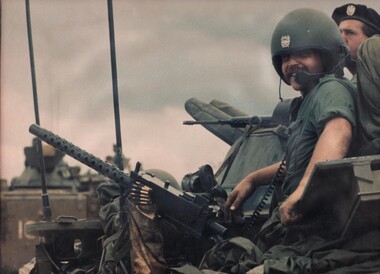
Photograph, Gibbons, Denis, Manning a 30 Cal
... Australian infantry battalions, posting compelling war images from within many combat zones before being flown out in late November 1970 after sustaining injuries. The images held within the National Vietnam Veterans Museum make up the Gibbons Collection. Photograph Normie Rowe L/Cpl Normie Rowe APC Trooper Normie Rowe Gibbons Collection Catalogue Armoured Personnel Carrier Entertainer Cavalry Regiment A coloured photograph of L/Cpl Normie Rowe, one of Australia's top rock stars serving with the Cavalry in Vietnam. Normie is manning a 30 claibre machine gun ...Denis Gibbons (1937 – 2011) Trained with the Australian Army, before travelling to Vietnam in January 1966, Denis stayed with the 1st Australian Task Force in Nui Dat working as a photographer. For almost five years Gibbons toured with nine Australian infantry battalions, posting compelling war images from within many combat zones before being flown out in late November 1970 after sustaining injuries. The images held within the National Vietnam Veterans Museum make up the Gibbons Collection.A coloured photograph of L/Cpl Normie Rowe, one of Australia's top rock stars serving with the Cavalry in Vietnam. Normie is manning a 30 claibre machine gun. His suggestion to upgrade the firepower of Australian APC's in the warzone. For this he was promoted from trooper to L/Cpl.photograph, normie rowe, l/cpl normie rowe, apc, trooper normie rowe, gibbons collection catalogue, armoured personnel carrier, entertainer, cavalry regiment -
 National Vietnam Veterans Museum (NVVM)
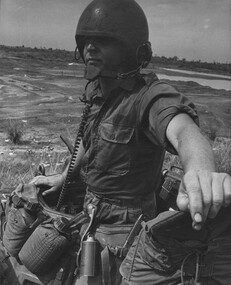
Photograph, Gibbons, Denis, Cpl Normie Rowe
... Australian infantry battalions, posting compelling war images from within many combat zones before being flown out in late November 1970 after sustaining injuries. The images held within the National Vietnam Veterans Museum make up the Gibbons Collection. Photograph APC Cpl Normie Rowe Gibbons Collection Catalogue Troop Driver Normie Rowe Trooper Normie Rowe Armoured Personnel Carrier Machine Gun ...Denis Gibbons (1937 – 2011) Trained with the Australian Army, before travelling to Vietnam in January 1966, Denis stayed with the 1st Australian Task Force in Nui Dat working as a photographer. For almost five years Gibbons toured with nine Australian infantry battalions, posting compelling war images from within many combat zones before being flown out in late November 1970 after sustaining injuries. The images held within the National Vietnam Veterans Museum make up the Gibbons Collection.A black and white photograph of Cpl Normie Rowe peers pensively from the turret of his APC.By this time of his active service Normie had risen through the ranks from a Trooper Driver to L/Cpl 30 Calibre machine gun operator to command of his own APC within his troop.photograph, apc, cpl normie rowe, gibbons collection catalogue, troop driver, normie rowe, trooper normie rowe, armoured personnel carrier, machine gun, denis gibbons -
 National Vietnam Veterans Museum (NVVM)
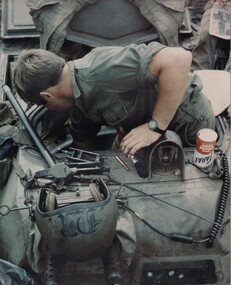
Photograph, Gibbons, Denis, Orange Tarax Lemonade
... Australian infantry battalions, posting compelling war images from within many combat zones before being flown out in late November 1970 after sustaining injuries. The images held within the National Vietnam Veterans Museum make up the Gibbons Collection. Photograph Cpl Normie Rowe APC 3rd Cavalry Regiment Gibbons Collection Catalogue Armoured Personnel Carrier Machine Gun ...Denis Gibbons (1937 – 2011) Trained with the Australian Army, before travelling to Vietnam in January 1966, Denis stayed with the 1st Australian Task Force in Nui Dat working as a photographer. For almost five years Gibbons toured with nine Australian infantry battalions, posting compelling war images from within many combat zones before being flown out in late November 1970 after sustaining injuries. The images held within the National Vietnam Veterans Museum make up the Gibbons Collection. A coloured photograph of Cpl Normie Rowe strips, cleans and services the twin 30 calibre machine gun on his APC. Whenever one arrived at Normie's APC you were almost always assured of a reasonably cold can of tarax orange drink. APC crews knew how to look after themselves.photograph, cpl normie rowe, apc, 3rd cavalry regiment, gibbons collection catalogue, armoured personnel carrier, machine gun, trooper normie rowe, tarax orange drink, denis gibbons -
 National Vietnam Veterans Museum (NVVM)
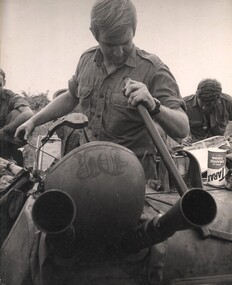
Photograph, Gibbons, Denis, 30 Cal Servicing
... Australian infantry battalions, posting compelling war images from within many combat zones before being flown out in late November 1970 after sustaining injuries. The images held within the National Vietnam Veterans Museum make up the Gibbons Collection. Photograph Cpl Normie Rowe APC 3rd Cavalry Regiment Gibbons Collection Catalogue Trooper Normie Rowe Armoured Personnel Carrier Machine Gun ...Denis Gibbons (1937 – 2011) Trained with the Australian Army, before travelling to Vietnam in January 1966, Denis stayed with the 1st Australian Task Force in Nui Dat working as a photographer. For almost five years Gibbons toured with nine Australian infantry battalions, posting compelling war images from within many combat zones before being flown out in late November 1970 after sustaining injuries. The images held within the National Vietnam Veterans Museum make up the Gibbons Collection.A black and white photograph of Cpl Normie Rowe, promoted to crew commander of an APC, cleans and services the twin 30 calibre machine gun on his APC, while his driver catches up on the latest comic strip to arrive in the mail from home. Note the distinctive initials on his helmet.photograph, cpl normie rowe, apc, 3rd cavalry regiment, gibbons collection catalogue, trooper normie rowe, armoured personnel carrier, machine gun, denis gibbons -
 8th/13th Victorian Mounted Rifles Regimental Collection
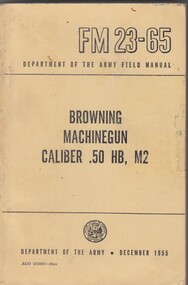
Booklet, 1955
... Us manufactured Browning machine guns were introduced to Australian Army in 1950s.The. 30 calibre replaced 7.92 mm Besa in Centurion tanks equipping 8/13 VMR in 1957. The. 50 calibre was mounted on some M113 carriers...8th/13th Victorian Mounted Rifles Regimental Collection 4/19 Prince of Wales's Light Horse Simpson Barracks McLeod melbourne Us manufactured Browning machine guns were introduced to Australian Army in 1950s.The. 30 calibre replaced 7.92 mm Besa in Centurion tanks equipping 8/13 VMR in 1957. The. 50 calibre was mounted on some M113 carriers ...Us manufactured Browning machine guns were introduced to Australian Army in 1950s.The. 30 calibre replaced 7.92 mm Besa in Centurion tanks equipping 8/13 VMR in 1957. The. 50 calibre was mounted on some M113 carriers as Commanders MG. Representative of Training booklets issued to CMF units in the 1960sLightbrown covered booklet Browning Machine Gun Caliber .50HB, M2. Department of the Army Field Manual FM 23 - 65. December 1955
