Wodonga & District Historical Society Inc
Sign - Andrews Liver Salt
... The powder contained sugar; an antacid, sodium bicarbonate (22.6% w/w); citric acid (to provide effervescence) (19.5% w/w); and a laxative, magnesium sulphate (17.4% w/w).
Andrews Liver Salts was first sold from 1894, by William Henry Scott and William Murdoch Turner. ...The powder contained sugar; an antacid, sodium bicarbonate (22.6% w/w); citric acid (to provide effervescence) (19.5% w/w); and a laxative, magnesium sulphate (17.4% w/w).
Andrews Liver Salts was first sold from 1894, by William Henry Scott and William Murdoch Turner. ...
Andrews Liver Salts was a laxative and antacid for mild stomach complaints. It was sold as a powder which was added to water and mixed, creating effervescence, before being swallowed.
The powder contained sugar; an antacid, sodium bicarbonate (22.6% w/w); citric acid (to provide effervescence) (19.5% w/w); and a laxative, magnesium sulphate (17.4% w/w).
Andrews Liver Salts was first sold from 1894, by William Henry Scott and William Murdoch Turner. Their business in the north-east of England originally imported margarine in the 1870s and 1880s. Their offices were in Gallowgate, Newcastle upon Tyne, and the product was named after St Andrew's church nearby. The trademark "Andrews Liver Salt" was registered in 1909. From the 1930s, promotional materials recommended taking the salts for "inner cleanliness".
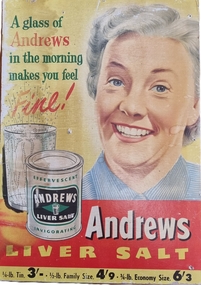
The company was acquired by Frederick Stearns & Co, a subsidiary of Sterling Drug, in 1923, and acquired by SmithKline Beecham in 1995. Haleon, the successor to SmithKline Beecham, ceased production of Andrews Liver Salts in November 2023. This item is significant because it represents a popular health product used throughout Australia from 1894 to 2023.A coloured advertising sign featuring a smiling woman and text in colours of red, yellow and white. It features two cans of Andrew Liver Saltandrews liver salt, advertising 1940s

 Ballarat Base Hospital Trained Nurses League
 Kiewa Valley Historical Society
 Wodonga & District Historical Society Inc