
Showing 2 items matching "mahogany chair"
-
 Flagstaff Hill Maritime Museum and Village
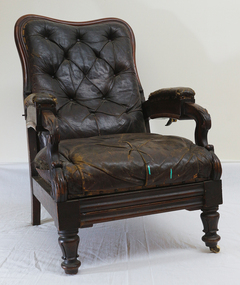
Furniture - Chair, Haberfield Chair, Michael Bradshaw, Circa 1860s-1890s
... ...Mahogany chair...The origin of the chair's timber has been lost through the generations, but some have named the armchair the 'Mahogany Chair' after the legendary Mahogany Ship. ...The origin of the chair's timber has been lost through the generations, but some have named the armchair the 'Mahogany Chair' after the legendary Mahogany Ship. ...This elegant reclining armchair is generously on loan from the local Haberfield family. Mrs Haberfield is a member of the Anderson family from the Tower Hill region, and the chair was handed down to her from them. When it arrived at Flagstaff Hill in 2009, it was at least 100 years old. The maker, Michael Bradshaw, is currently unknown. The origin of the chair's timber has been lost through the generations, but some have named the armchair the 'Mahogany Chair' after the legendary Mahogany Ship. In August 2009, the wood was expertly examined. The structure of the wood specimens was found to be consistent with: • Pale coloured carcass timber - Fagus sylvatica – Beech (European) • Pale coloured frame timber - Agathis sp – NZ Kauri • Dark coloured timber chair legs (solid) - Swietenia sp. – True Mahogany • Dark coloured timber veneer - Swietenia sp. – True Mahogany • Repair fill-in piece – Quercus sp. – White Oak ( Northern hemisphere) • Repair fill-in piece (fine textured) – Populus sp. – Poplar • Runner wood - Eucalyptus sp – Pale coloured ash group, or messmate The chair is significant for its local origin and history, being connected to generations of the Anderson and Haberfield families. It is also significant for its elaborate and unusual design, the quality of its workmanship and materials. It is a fine example of good quality furniture of the late 19th century.The Haberfield Chair is a reclining armchair that includes a footrest and a detachable book rest. The chair features a dark timber frame and dark burgundy (now dark brown), Morocco goat skin leather upholstery. The backrest is finished with button detailing, and its frame is distinguished by gracefully curved corners, lending the chair an elegant appearance. The chair’s padded leather armrests have attractive, crafted carvings at each end. A lever located below the armrest operates the recliner’s ratchet mechanism, which also causes a footrest to slide forward for greater comfort. The turned and carved front legs are equipped with wheels, allowing for easy movement. The removable book rest is mounted on a brass pedestal. Its angle can be conveniently adjusted using a screw to move the ball and socket joint, ensuring personalised reading comfort. There is a handwritten inscription on the underside of the back rail. The chair is kindly on loan from the local Haberfield family. In pen and ink: “Made from Mahogany Ship wrecked near Tower Hill, July 3, 1835: made by Michael Bradshaw 18-2-“ [originally thought to read 1842]flagstaff hill maritime museum and village, great ocean road, shipwreck coast, armchair, reclining armchair, reading board, mahogany chair, haberfield chair, furniture, living room furniture, domestic furniture, 19th century, luxury, morroco leather, book stand, book rest, side table, music stand, reading stand, reading rest, foot rest, reading table -
 Flagstaff Hill Maritime Museum and Village
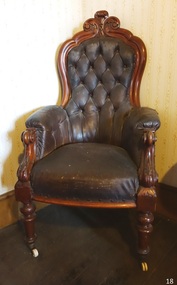
Furniture - Armchair, 1870
... The chair generally stood on short cabriole legs and had a 'spoon' or a wide balloon back. The 'show wood', that is, the polished frame, was usually mahogany or walnut, although many examples in Australian red cedar have survived. ...The chair generally stood on short cabriole legs and had a 'spoon' or a wide balloon back. The 'show wood', that is, the polished frame, was usually mahogany or walnut, although many examples in Australian red cedar have survived. ...A gentleman's chair, gent's chair or grandfather chair is a term usually applied in Australia to a deep upholstered Victorian easy chair, often button-backed and with upholstered arms. The chair generally stood on short cabriole legs and had a 'spoon' or a wide balloon back. The 'show wood', that is, the polished frame, was usually mahogany or walnut, although many examples in Australian red cedar have survived. There are Australian versions of the gentleman's chair, lady's chair and matching settees, usually made from cedar, and occasionally from blackwood. As cedar is a softer timber than walnut, mahogany and rosewood, from which the English versions were made, the carving is usually not as crisp as in the imported version. However, the Australian blackwood gentleman's chair is often difficult to distinguish from a good-quality English walnut example. The Edwardian form of the gentleman's chair is much squarer in outline, with short turned legs and the arms are often supported by spindles. There was sometimes a row of spindles, like a gallery, beneath the top rail. The chairs were frequently upholstered in leather.An item probably made in Australia during the latter half of the Victorian era and is significant as it was made in Australia at a time when furniture and many other household items were imported from either America or England.Armchair: gentleman's armchair of Cedar wood with brown leather upholstery, tacked and buttoned in a crocodile-skin-like effect. The wood is scalloped and carved with a Prince of Wales Feather on the back. The arms are scrolled and carved with an Acanthus leaf design, finished on tulip turned legs. All four legs have brass and porcelain castors. circa 1870, Australian-made. flagstaff hill, warrnambool, shipwrecked coast, flagstaff hill maritime museum, maritime museum, shipwreck coast, flagstaff hill maritime village, great ocean road, furniture, chair, armchair, gentleman's chair, lady's chair, leather upholstery, buttoned upholstery, living room furniture, lounge room furniture, formal furniture, domestic
