
Showing 27 items matching "making ready"
-
 Moorabbin Air Museum
Book - Avro Lancaster, The Lancaster At War
... ...Making ready...Avro Lancaster Early days In production Entry in to service Making ready Bombing up 20 Lancasters Fuelling Dispersal Briefings Interiors Start up First flight on ops Taxying & marshalling Take off En route On target The way back Safely home After the raid Battle damage Prangs Under repair Insignia Mercy missions Canadian Lancasters Graveyards The Dam Busters Historical overview of Avro Lancaster at war, circa 1972 The Lancaster At War Book Avro Lancaster ...Historical overview of Avro Lancaster at war, circa 1972non-fictionHistorical overview of Avro Lancaster at war, circa 1972early days, in production, entry in to service, making ready, bombing up, 20 lancasters, fuelling, dispersal, briefings, interiors, start up, first flight on ops, taxying & marshalling, take off, en route, on target, the way back, safely home, after the raid, battle damage, prangs, under repair, insignia, mercy missions, canadian lancasters, graveyards, the dam busters -
 Melbourne Tram Museum
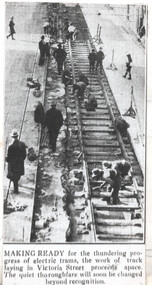
Photograph - Newspaper clipping - Victoria St Richmond conversion, The Sun News Pictorial, 24/7/1929
... Shows workmen working laying track and the caption "Making Ready for the thundering progress of electric trams, the work of track laying in Victoria St proceeds apace. ...Shows workmen working laying track and the caption "Making Ready for the thundering progress of electric trams, the work of track laying in Victoria St proceeds apace. ...Reports using a photo on the conversion of Victoria St Richmond from cable to electric trams. Shows workmen working laying track and the caption "Making Ready for the thundering progress of electric trams, the work of track laying in Victoria St proceeds apace. The quiet thoroughfare will soon be changed beyond recognition"Demonstrates a Sun photo and story about cable tram conversion.Photograph of part of page 21, The Sun News Pictorial 24/7/1929tramways, cable trams, conversion, cable conversion, victoria st, track laying -
 Melbourne Tram Museum
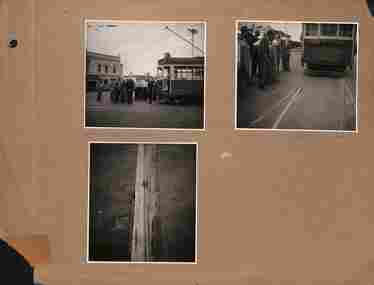
Photograph - Personel Photographs - MMTB, "The Perway stages a derailment", 1953
... Photos taken at the same time as item 8972. Top left - Making ready to continue Top right - Now watch it do it again! ...Photos taken at the same time as item 8972. Top left - Making ready to continue Top right - Now watch it do it again! ...Sheet titled "The Perway stages a derailment" , shows a group of the staff of the Chief Engineer's Department standing at the back of the tram. Photos taken at the same time as item 8972. Top left - Making ready to continue Top right - Now watch it do it again! Tram does it. (photo shows the tour tram number - 892) Bottom left - Cause - the defective mate.Yields information about the staff of the MMTB Chief Engineer's Department and tour of the system and a derailment while touring.Brown cardboard sheet with two punch holes on the left side and three photographs.mmtb, tramways, personnel, chief engineer, tram 892, derailment -
![Front view of butterpats [ca.1870's] showing ridging](/media/collectors/50187a8f023fd7201471f198/items/68882065993e6fa536dcdee6/item-media/6888608f993e6fa536eb5306/item-fit-380x285.jpg?cb=6) Alfred Hospital Nurses League - Nursing History Collection
Alfred Hospital Nurses League - Nursing History CollectionFunctional object - pair of butter pats, pair of wooden butter pats, [ca.1870's]
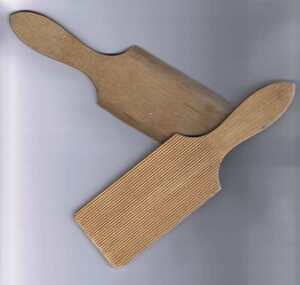
... These wooden butter pats were used to shape butter into bricks; making butter ready for use. The excess moisture would be squeezed out of the butter; which was then transferred to a wooden board. ...These wooden butter pats were used to shape butter into bricks; making butter ready for use. The excess moisture would be squeezed out of the butter; which was then transferred to a wooden board. ...These wooden butter pats were used to shape butter into bricks; making butter ready for use. The excess moisture would be squeezed out of the butter; which was then transferred to a wooden board. The butter maker would hold one of these pats in each hand and work the butter into shape. These wooden pats are thin; light and easy to hold. The inside face is ribbed to grip the butter and squeeze out any further water. It was also used to make patterns on the finished butter.of significance to the AHNL as an item of kitchen equipmentpair of wooden butter pats with handles, main rectangular body of each is ribbed on one side. Small hole at top of each pat ? for hanging 0n the side of each handle the number 96.23 is written. Sticker with previous catalogue number written on it is fixed to one handlekitchen utensil, alfred hospital -
 Greensborough Historical Society
Butter Pats, Unknown, Pair of butter pats, 1920-1930
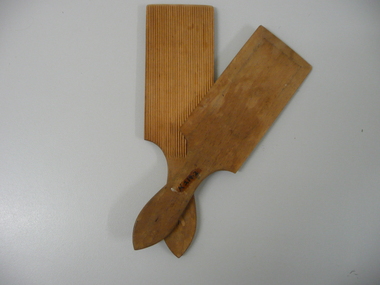
... These wooden butter pats were used to shape butter into bricks; making butter ready for sale and use. The excess moisture would be squeezed out of the butter; which was then transferred to a wooden board. ...These wooden butter pats were used to shape butter into bricks; making butter ready for sale and use. The excess moisture would be squeezed out of the butter; which was then transferred to a wooden board. ...These wooden butter pats were used to shape butter into bricks; making butter ready for sale and use. The excess moisture would be squeezed out of the butter; which was then transferred to a wooden board. The butter maker would hold one of these pats in each hand and work the butter into shape. These wooden pats are thin; light and easy to hold. The inside face is serrated to grip the butter and squeeze out any further water. It was also used to make patterns on the finished butter. An original pair of butter pats. Given to a Greensborough local in 1975, but used by the previous owner and her mother.Wooden butter pats with handle. One side is ribbed, the other smooth.butter pats, butter making, nancy fowkes -
Broadmeadows Historical Society & Museum
Tool - Butter Pats
... These wooden butter pats were used to shape butter into bricks; making butter ready for sale and use. The excess moisture would be squeezed out of the butter; which was then transferred to a wooden board. ...These wooden butter pats were used to shape butter into bricks; making butter ready for sale and use. The excess moisture would be squeezed out of the butter; which was then transferred to a wooden board. ...These wooden butter pats were used to shape butter into bricks; making butter ready for sale and use. The excess moisture would be squeezed out of the butter; which was then transferred to a wooden board. The butter maker would hold one of these pats in each hand and work the butter into shape. These wooden pats are thin; light and easy to hold. The inside face is serrated to grip the butter and squeeze out any further water. It was also used to make patterns on the finished butter.Wooden butter pats with handle. One side is rubbed, the other smoothbutter pats, butter making -
 Bendigo Historical Society Inc.
Domestic Object - PAIR WOODEN BUTTER PATS, unknown
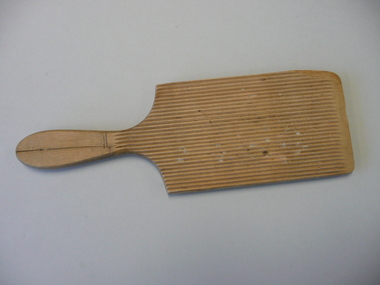
... In the 19th century butter pats were used to shape butter into bricks, making butter ready for sale and use. The excess moisture would be squeezed out of the butter which was then transferred to a wooden board. ...In the 19th century butter pats were used to shape butter into bricks, making butter ready for sale and use. The excess moisture would be squeezed out of the butter which was then transferred to a wooden board. ...In the 19th century butter pats were used to shape butter into bricks, making butter ready for sale and use. The excess moisture would be squeezed out of the butter which was then transferred to a wooden board. The butter maker would hold one of these pats in each hand and work the butter into shape. The inside of the pat was usually serrated to grip the butter and squeeze out any further water. The butter was often stamped with a wooden stamp or print. Butter was sold from a number of commercial premises in Bendigo, however it was also common for families to produce their own butter. In 1895, Mr. Mark Twain visited Australia. The New South Wales Government 'engaged him to lecture through the provinces on How to Make Butter for export' (Weekly Times, 28 February, 1895). Fifty nine tons of butter were exported on the S.S. Orient in 1895, being the first consignment for the years 1895/6. (Kyneton Observor, 17th October, 1895)Pair of wooden pats for forming butter, rectangular with handles and grooved insides, bevelled edges.domestic equipment, food preparation, butter pats -
 Bendigo Historical Society Inc.
Domestic Object - BUTTER PAT
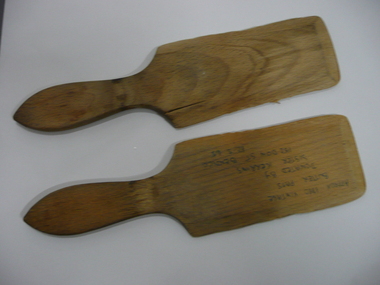
... In the 19th century butter pats were used to shape butter into bricks, making butter ready for sale and use. The excess moisture would be squeezed out of the butter which was then transferred to a wooden board. ...In the 19th century butter pats were used to shape butter into bricks, making butter ready for sale and use. The excess moisture would be squeezed out of the butter which was then transferred to a wooden board. ...In the 19th century butter pats were used to shape butter into bricks, making butter ready for sale and use. The excess moisture would be squeezed out of the butter which was then transferred to a wooden board. The butter maker would hold one of these pats in each hand and work the butter into shape. The inside of the pat was usually serrated to grip the butter and squeeze out any further water. The butter was often stamped with a wooden stamp or print. Butter was sold from a number of commercial premises in Bendigo, however it was also common for families to produce their own butter. In 1895, Mr. Mark Twain visited Australia. The New South Wales Government 'engaged him to lecture through the provinces on How to Make Butter for export' (Weekly Times, 28 February, 1895). Fifty nine tons of butter were exported on the S.S. Orient in 1895, being the first consignment for the years 1895/6. (Kyneton Observor, 17th October, 1895)Wooden butter pat for patting butter into shape. Rectangular with handle and grooves on one side.domestic equipment, food preparation, butter pats -
 Bendigo Historical Society Inc.
Domestic Object - BUTTER PATS
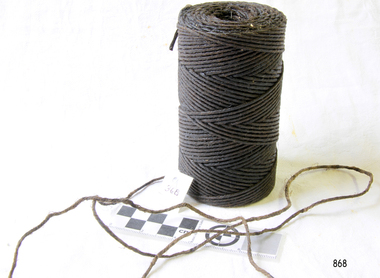
... In the 19th century butter pats were used to shape butter into bricks, making butter ready for sale and use. The excess moisture would be squeezed out of the butter which was then transferred to a wooden board. ...In the 19th century butter pats were used to shape butter into bricks, making butter ready for sale and use. The excess moisture would be squeezed out of the butter which was then transferred to a wooden board. ...In the 19th century butter pats were used to shape butter into bricks, making butter ready for sale and use. The excess moisture would be squeezed out of the butter which was then transferred to a wooden board. The butter maker would hold one of these pats in each hand and work the butter into shape. The inside of the pat was usually serrated to grip the butter and squeeze out any further water. The butter was often stamped with a wooden stamp or print. Butter was sold from a number of commercial premises in Bendigo, however it was also common for families to produce their own butter. In 1895, Mr. Mark Twain visited Australia. The New South Wales Government 'engaged him to lecture through the provinces on How to Make Butter for export' (Weekly Times, 28 February, 1895). Fifty nine tons of butter were exported on the S.S. Orient in 1895, being the first consignment for the years 1895/6. (Kyneton Observor, 17th October, 1895)Two wooden butter pats, one marked in ink, approx 1880 vintage butter pats donated by Sister Kerrins 154 Don St Bendigo 12.3.65domestic equipment, food preparation, kitchen -
 Flagstaff Hill Maritime Museum and Village
Textile - Twine, 20th century
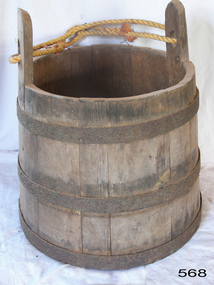
... ready to use. The twine is made from strands of fibres that are plied together. The wax waterproofs the twine and smooths out the fine hairs of the fibres, making it easier to work with. ...ready to use. The twine is made from strands of fibres that are plied together. The wax waterproofs the twine and smooths out the fine hairs of the fibres, making it easier to work with. ...Sailmaker's twine is usually stored on a reel. It is wax coated and ready to use. The twine is made from strands of fibres that are plied together. The wax waterproofs the twine and smooths out the fine hairs of the fibres, making it easier to work with. The waxed twine helps prevent the ends of the rope work from fraying. Sailmakers use twine and needles to sew sails and many other canvas items such as bags and covers. Special tools, equipment, benches and seats are needed to work with the large heavy and thick pieces of canvas. Sometimes the sailmaker with have special-purpose tools made for his unique work. The place of work on shore is often called a sailmaker's loft. However, sailmakers also work on the job, on sailing ships and boats. This twine is an example imperative equipment for sailmakers. Sailmaking was an essential trade in the shipping industry of the 17th to 19th and early 20th centuries. Sailmakers were often part of a ship's crew, making repairs as needed and using their skills for other work such as net making.Twine; reel of brown waxed sailmaker's twine.warrnambool, shipwreck coast, flagstaff hill, flagstaff hill maritime museum, flagstaff hill maritime village, twine, waxed twine, sailmaker's twine, sailmaker's equipment, sailmaking, canvas work -
 Flagstaff Hill Maritime Museum and Village
Domestic object - Coopered Bucket, 1960 to 1980
... making wooden barrels. Wood or animal skin was used to make buckets in colonial times when other materials were unavailable. Buckets had many uses in domestic and agricultural life including carrying, measuring and storing. Cooper tradesmen used carpentry and blacksmithing skills to make a wide range of wooden containers and other objects. They sometimes used water or steam to bend and mould the timber. The bucket is an example of a product made from wood and iron by an experienced Cooper. In early colonial timeswhen ready ...This bucket was made from vertical planks of wood with bands of metal around it for strength. Buckets such as this were made by coopers, who had expertise in making wooden barrels. Wood or animal skin was used to make buckets in colonial times when other materials were unavailable. Buckets had many uses in domestic and agricultural life including carrying, measuring and storing. Cooper tradesmen used carpentry and blacksmithing skills to make a wide range of wooden containers and other objects. They sometimes used water or steam to bend and mould the timber.The bucket is an example of a product made from wood and iron by an experienced Cooper. In early colonial timeswhen ready-made products were scarce so the trades of coopers, blacksmiths, metal smiths, carpenters, builders and others were necessary for domestic, commercial and industrial establishment.Wooden coopered bucket; three metal bands around vertical wooden planks that form the body of the bucket. Two lugs extend higher than the planks and have a rope joined between them.warrnambool, shipwreck coast, flagstaff hill, flagstaff hill maritime museum, flagstaff hill maritime village, bucket, wooden bucket, container, domestic bucket, cooper, cooper trade, coopered bucket -
Marysville & District Historical Society
THE TRIANGLE NEWS-VOL 39 NO 33-AUGUST 31 2012
... making workshop...marysville community centre...after fire revegetation work continues...triangle community dancers...social dance buxton hall...buxton cfa...close fire call at buxton...alexandra library september events...real estate...don giovanni opera comes to marysville...black spur inn...marysville villains...2012 presentation night...golfers appreciate the daffodils...bush dance buxton hotel...toboggan race day...lake mountain cup...murrindindi shire council...draft municipal fire management plan ready...marysville victoria australia goulburn broken catchment management authority opportunity to comment on draft regional catchment strategy marysville & district lions club what's on when in august the committee of management of the gallipoli park precinct maryville community market intrepid triangle bushwalkers creative triangle marysville cricket club registration day advertisements breakfast for men saladin lodge church notices upper goulburn food wine & cultural group triangle community dinner marysville golf club castella central park project control group councillor passes on leadership life skills buxton primary school complimentary therapist team lantern making workshop marysville community centre after fire revegetation work continues triangle community dancers social dance buxton hall buxton cfa close fire call at buxton alexandra library september events real estate don giovanni opera comes to marysville black spur inn marysville villains 2012 presentation night golfers appreciate the daffodils bush dance buxton hotel toboggan race day lake mountain cup murrindindi shire council draft municipal fire management plan ready for public comment local government elections call for women candidates THE TRIANGLE NEWS-VOL 39 NO 33-AUGUST 31 2012 ...marysville, victoria, australia, goulburn broken catchment management authority, opportunity to comment on draft regional catchment strategy, marysville & district lions club, what's on when in august, the committee of management of the gallipoli park precinct, maryville community market, intrepid triangle bushwalkers, creative triangle, marysville cricket club registration day, advertisements, breakfast for men, saladin lodge, church notices, upper goulburn food wine & cultural group, triangle community dinner, marysville golf club, castella central park project control group, councillor passes on leadership life skills, buxton primary school, complimentary therapist team, lantern making workshop, marysville community centre, after fire revegetation work continues, triangle community dancers, social dance buxton hall, buxton cfa, close fire call at buxton, alexandra library september events, real estate, don giovanni opera comes to marysville, black spur inn, marysville villains, 2012 presentation night, golfers appreciate the daffodils, bush dance buxton hotel, toboggan race day, lake mountain cup, murrindindi shire council, draft municipal fire management plan ready for public comment, local government elections call for women candidates -
 Flagstaff Hill Maritime Museum and Village
Weapon - Historic Rifles, Royal Small Arms Factory, 1877-1900
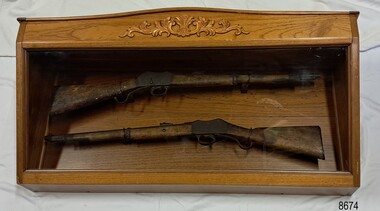
... ready to be shot. In 1877, the shorter, lighter-weight Carbine version of the firearm was produced for mounted troops and artillery. Its official name was “Carbine, B.L., Rifled, Martini-Henry.” The bullets were slightly lighter in weight than those used for the longer rifle. The sight position was adjusted for the shorter gun, and wings were added to the sight on the tip, making...ready to be shot. In 1877, the shorter, lighter-weight Carbine version of the firearm was produced for mounted troops and artillery. Its official name was “Carbine, B.L., Rifled, Martini-Henry.” The bullets were slightly lighter in weight than those used for the longer rifle. The sight position was adjusted for the shorter gun, and wings were added to the sight on the tip, making ...Martini-Henry Artillery Carbin rifles were made by the Royal Small Arms Factory at Enfield, Britain, from 1877 until 1900. Many were distributed to the British Colonies, including this pair, which was allocated to the Woodford Police, Victoria Police District of Warrnambool, Southwest Victoria. The Carbine model rifles were shorter than the standard rifles and more suited to mounted police and troopers. It is likely that in the early 20th century, Victoria Police replaced the two carbines with more modern firearms, and the outdated guns were stored in the stables. The rifles were left there and likely forgotten about due to changes in police staff. In 1915, police authorities announced that they would be replacing patrol horses with bicycles and would also close some smaller police stations. This affected Woodford Police Station, which closed in 1917. The forgotten firearms remained in the stables and were noticed by schoolboy Robert Jellie in 1940 and seen again in 1946. In 1995, the property was sold by the Education Department to a private owner. The Woodford Community donated the pair of Martini-Henry Carbines to the Victoria Police Museum in the late 1990s for mounting and display, which was funded by the Victoria Police Historical Society Inc. The decorative wood and glass display case and frame were designed to preserve the significant history of the guns. On November 1st 1999, the display was presented to Warrnambool Police and the local community due to the historical significance of the Woodford Police Station. In 2025, these items were formally deaccessioned by the Victoria Police Museum, and ownership was transferred to the Warrnambool Police Station. On March 10th, 2025, the display was transferred to Flagstaff Hill Maritime Museum and Village, where the historical story of the Martini-Henry Carbines could continue to be preserved and accessed by local families, the community, visitors to the area, and online visitors. WOODFORD POLICE: - The small settlement at Woodford was established in the 1840s around the Merri River where there was a ford across the water and a bridge from 1848 to 1851. The area was settled very early in Victoria’s history, and the river crossing provided travellers with access to the early route between Port Fairy (named Belfast at that time), Warrnambool and Melbourne. Occasionally, a Warrnambool police trooper would ride through Woodford and the district. In December 1854, Woodford Police barracks and stables were built on the hill by the Merri River on Bridge Road east, where Jubilee Park now stands. A local mounted trooper kept law and order in the area. In 1856, a lock-up was installed, and the first Woodford Police Station was in action in 1857. By 1871, the police station had been moved from the hill to land across the Merri River bridge, on the southern side of Bridge Road west, near Mill Street. In 1890, the police residence there was replaced by a stone Edwardian-style building with the stables and lock-up behind it and the old police station at the rear. The police continued to have a presence in Woodford until it was closed by the Police Commissioner in July 1917 for economic reasons. The residence was used for government housing until 1923, when it was taken over by the Education Department for the school teacher’s home. In 1995, it became privately owned. THE MARTINI-HENRY ARTILLERY CARBINE: - The Martini-Henry rifles were made in Britain from 1871 at the Royal Small Arms factory at Enfield and were stamped with the symbol of the Royal Cipher (Crown over VR) over ENFIELD to identify their origin. They were named after two of several people who helped design this method: Swiss Friederich von Martini and Scotsman Alexander Henry. The design was breech-loaded, and the inner barrel was rifled. A thumb rest was incorporated into the top right of the bullet receiver’s chamber. The small teardrop lever on the right side of the rifle showed whether the rifle was ready to be shot. In 1877, the shorter, lighter-weight Carbine version of the firearm was produced for mounted troops and artillery. Its official name was “Carbine, B.L., Rifled, Martini-Henry.” The bullets were slightly lighter in weight than those used for the longer rifle. The sight position was adjusted for the shorter gun, and wings were added to the sight on the tip, making it easier to slide the rifle back into a saddle bag. Some of the later Carbines also had leather sight covers screwed to the stock to prevent them from catching on the saddle bags. The Carbines had accessories available, such as barrel extensions with bayonets and swivels for adding slings. The Martini-Henry Carbine designs were later modified to fire the British .303 ammunition. Eventually, by 1900, the Martini-Henry Carbines were replaced by the Lee Enfield gun design. The pair of Martini-Henry Carbine firearms represents policing in the early pre-1900 days of colonial settlement; Woodford was one of the first townships settled in Victoria, and it had a police presence from 1854 until 1917. The rifles and display provide a historic connection between the location of Woodford and relatives and associates. The carbine rifles show a stage in the evolution of weapon design, adapted to suit mounted troops, and adding features to streamline use and storage. The ammunition was also improved during this progression. The carbines are important for their connection to policing law and order in a remote area. They are significant for their association with the township of Woodford, which was important to travel in the southwest Victoria district, providing access across a river for a road between Port Fairy and Melbourne, and later Warrnambool, and supplying food, goods and accommodation for the travellers. A pair of mounted rifles is mounted behind glass in a timer case, accompanied by a framed display of two photographs and an account of the rifles’ history. The case and display each have a horizontal board with a gently curved edge and carved decorations added. The identical firearms are British-made Martini Henry Carbine breach-loaded rifled guns, supplied by Britain to its Colonial troops from around 1877. The rifles are lever-action, single-shot .500 calibre weapons. They have a teardrop lever on their right side. They were used by Victoria Police mounted troops at the Woodford Police Station, Victoria. The black and white photographs were taken in 1946. The left photograph has a circled area; the right photograph is an enlarged view of the circled area, showing the Woodford Police Station in detail. The printed text is on textured paper with the Victoria Police watermark. It gives a summary of the rifle’s history. There is an inscription on the left photograph. Left photograph, handwritten in white pen: “WOODFORD” Document’s print: “During the late 1840s the small town of Woodford grew around the crossing of the Merri River on the Melbourne/Port Fairy Rad. Woodford was proclaimed a township in 1854 and a police quarters was established there in 1857. The police station remained until 1917 when it was closed and police service from then on was provided from Warrnambool. The building was then used as a school residence and is now privately owned. In !940 Robert JELLIE, then a schoolboy, observed two rifles mounted on the wall of the disused stable at the rear of the old police building. Following the devastating flood of 1946 (see photograph above) the rifles were again seen in the room next to the stable but were not seen again until the building was sold by the Education Department many years later. It was a recognition of the historical value of the rifles which led to their donation to the Warrnambool Police Complex. The rifles have been authenticated by the Victoria Police Armoury as being Victoria Police issue some time before 1900. The rifles are an identical pair of the famous British-made Martini Henry, a .500 inch calibre military weapon widely used by British Colonial troops. Victoria Police and the wider community of Warrnambool are indebted to the members of the Woodford community for their fine gesture in donating the rifles for mounting so that their historical importance can be preserved and they can be displayed for generations to come. This display was funded by the Victoria Police Historical Society Incorporated, and presented on the first day of November, 1999.”flagstaff hill maritime museum and village, great ocean road, shipwreck coast, martini henry, victoria police, woodford police station, rifle, carbine, display case, british, martini henry carbine, breech-loaded, rifled, colonial, single-shot, .500 calibre, weapon, gun, 1877, troops, mounted troops, merri river, victoria police woodford, victoria police warrnambool, victoria police melbourne, police quarters, robert jellie, school residence, stable, 1946 flood, victoria police armoury, identical pair, british colonial troops, victoria police historical society incorporated, woodford, bicycles, found by a schoolboy, edwardian-style building, victoria police museum, warrnambool police station -
 City of Moorabbin Historical Society (Operating the Box Cottage Museum)
Personal Effects, cut-throat razor “Kings Crown’, 20thC
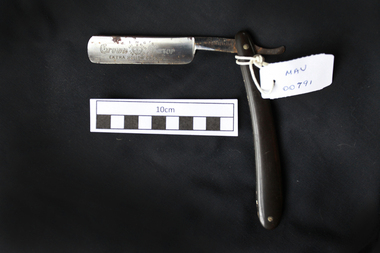
... making cut throat razors. The Greb. Weyersberg™ family business.continue to place our mark on each and every product sold as we have done since first being able to register it in 1774. For over a 100 years, the straight razors continue to be produced in Solingen (Germany). King's Crown™ cut-throat razors, straight razors, shaving equipment, steel blades, swords, weyersberg family, king crown pty ltd., solingen, germany, early settlers, market gardeners, moorabbin, bentleigh, cheltenham, on blade ; KING'S / CROWN 'a crown trademark' RAZOR / EXTRA HOLLOW GROUND around 'trademark' ; SET READY FOR USE on steel handle; MADE IN GERMANY A folding cut-throat razor Personal Effects, cut-throat razor “Kings Crown’ Kings Crown Manufacturing Company ...KING RAZOR MFG. CO.Pittsburgh, Pennsylvania; moved to Indiana, Pennsylvania in 1911.ca. 1904 - 1919 Marked "Made in Germany", although the company's offices were located at 118 E. 28th Street, New York City. ca. 1934-1943 Used the "THE KING OF RAZORS REGISTERED TRADEMARK" trademark. 47-1/2 and Trademark: Crown and Wolf. For 500 years the Weyersberg family has been producing the finest blades in the world. For centuries the King’s Crown™ mark has been synonymous with exacting precision, hand-craftsmanship and quality. For the first few hundred years the blades, made in Solingen, Germany (the “City of Blades”), were for swords. As times changed, the Weyersberg family transitioned into making cut throat razors. The Greb. Weyersberg™ family business.continue to place our mark on each and every product sold as we have done since first being able to register it in 1774. For over a 100 years, the straight razors continue to be produced in Solingen (Germany). King's Crown™A folding cut-throat razoron blade ; KING'S / CROWN 'a crown trademark' RAZOR / EXTRA HOLLOW GROUND around 'trademark' ; SET READY FOR USE on steel handle; MADE IN GERMANYcut-throat razors, straight razors, shaving equipment, steel blades, swords, weyersberg family, king crown pty ltd., solingen, germany, early settlers, market gardeners, moorabbin, bentleigh, cheltenham, -
 Bendigo Historical Society Inc.
Decorative object - Tui Mitchell Collection: Epergne
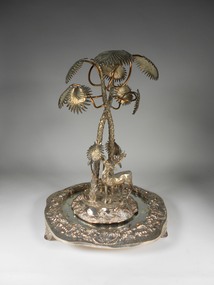
... You were ever ready to appreciate and acknowledge our efforts in carrying out your orders, thus making it a pleasure for us to possess your confidence and to give satisfaction to our employers. ...You were ever ready to appreciate and acknowledge our efforts in carrying out your orders, thus making it a pleasure for us to possess your confidence and to give satisfaction to our employers. ...A cut glass and embossed sterling silver serving dish (known as an epergne) presented to Mrs. Mary Williams at a banquet held at Knuckey's California Gully Hotel in October 1889. The banquet was held to honour Mr. Richard Williams, who had been the Mine Manager of the Johnson's Reef Gold Mines for the past 24 years. Mrs. Mary Williams (nee Thomas) was born in St. Austell, Cornwall in 1830. She migrated to Australia with her husband in two children in 1857, arriving on the 21st December on the 'Shakespeare'. The family lived in California Gully. Richard Williams was a mine manager, firstly for George Lansell and then for thirty seven years at the Johnson's Reef Gold Mines. Mary received the epergne at a presentation banquet for her husband in October 1889. She received the accolade as 'she was a kind and charitable lady, a genuine wife and a good mother'. Transcript of address presented to Mr. R. Williams, Mine Manager, Johnson’s Reef Gold Mines, Bendigo at a banquet held at Knuckey’s California Gully Hotel, California Gully, Bendigo. Description of presentation of epergne to Mrs. Mary Williams at the same function. “To Richard Williams, Esq., J.P., Fenton Gove, California Gully. Dear Sir, We, the undersigned, on behalf of the employees of the Johnson's Reef Gold Mines Company, California Gully, Bendigo, desire to place on record the very high esteem which we have always entertained for you in your responsible position of General Manager of the above company for the past 24 years. During the whole of that time the relations which have existed between you and those under your supervision have been of the harmonious kind. You were ever ready to appreciate and acknowledge our efforts in carrying out your orders, thus making it a pleasure for us to possess your confidence and to give satisfaction to our employers. We trust that you may long continue to maintain the position which you now occupy, feeling assured that in the future, as in the past, you will render faithful service to the company whom your instructions represent, and that we, by our efforts in following your instructions may succeed in retaining the good feeling which has hitherto existed between us. In presenting you with this small token of our esteem, we sincerely trust that Mrs. Willliams and yourself may be long spared amongst us to continue in the good works in which you are so thoroughly appreciated by those with whom you are intimately connected. With every feeling of respect to yourself and family, we subscribe ourselves, George Roberts, Andrew Leahy, Robt. Thomas, Geo. Smith, John Holt, Henry Tonkin, and 220 others. The chairman then presented Mr. Williams with a very handsome diamond locket, manufactured at the establishment of Mr. J. Moody. The large gathering of employees that night showed a genuine feeling of gratitude for past kindness, and was a means of keeping up the kindly feelings which always ought to exist between employers and employees. Much what is said with regard to there being no gratitude among workmen was false, as gratitude will be shown where fair play is given, which could always be relied on from a large-hearted man like Mr. Williams, was received with loud applause”. ‘Banquet to a Mining Manager’ Bendigo Advertiser (Vic. : 1855 - 1918), Tuesday 29 October 1889, page 3 The epergne comprises of a silver and mirrored glass base, a decorative silver centrepiece, a cut glass bowl with a conical base, and a small silver plaque. The silver centrepiece features two twining palm trees with a stag deer at the base. Epergne is from the Tui Mitchell Collection. Separate shield shaped silver coloured plaque.Presented to Mrs. R Williams By Her Friends As a slight token of esteem California Gully. October 28/89epergne, tui mitchell collection, richard williams, mary williams, california gully, knuckey's california gully hotel, johnson's reef gold mines -
 Royal Australian and New Zealand College of Obstetricians & Gynaecologists (RANZCOG)
Equipment - Prolene Ethicon suture associated with Dr Lachlan Hardy-Wilson, Ethnor Pty Ltd
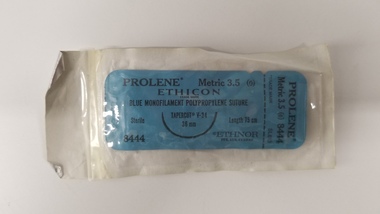
... The suture is dyed blue to enhance visibility and does not adhere to tissue, making it more easily removable when ready. It is considered to be relatively biologically inert....The suture is dyed blue to enhance visibility and does not adhere to tissue, making it more easily removable when ready. It is considered to be relatively biologically inert. ...Used for surgery. The suture is dyed blue to enhance visibility and does not adhere to tissue, making it more easily removable when ready. It is considered to be relatively biologically inert.This is one of a collection of items received from the practice of Dr Lachlan Hardy-Wilson, FRCOG, Launceston, Tasmania.Sterile suture in packaging. Labelling on packaging reads 'PROLENE Metric 3.5 (0)/ETHICON/TRADE MARK/BLUE MONOFILAMENT POLYPROPYLENE SUTURE/TAPERCUT* V-34/Sterile 36mm Length 75 cm/8444 ETHNOR/PTY LTD SYDNEY'.surgery -
 Victorian Aboriginal Corporation for Languages
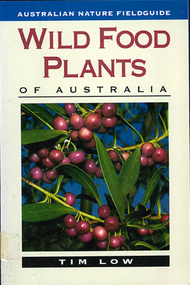
Book, Tim Low, Wild food plants of Australia, 2001
... ready reference in the field. Tim Low has provided a truly reliable guide to our edible flora, making identification easy. ...ready reference in the field. Tim Low has provided a truly reliable guide to our edible flora, making identification easy. ...The fieldguide edition of Wild Food Plants of Australia. It is presented in a concise, convenient form to facilitate quick and ready reference in the field. Tim Low has provided a truly reliable guide to our edible flora, making identification easy. Thus it is a perfect companion for bushwalkers, naturalists, scientists and, with emphasis on wild food cuisine, gourmets. Low describes more than 180 plants - from the most tasty and significant plant foods of southern and eastern Australia to the more important and spectacular inland and tropical foods.Maps, colour photographs, b&w illustrationsedible wild plants, cooking, flora, cuisine, bush tucker -
 National Wool Museum
Clothing - 1984 Los Angeles Olympics Men's Opening Ceremony Shirt, c. 1984
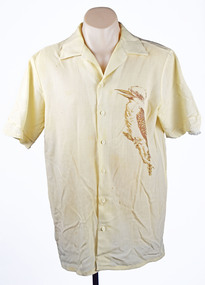
... making the final choice of uniform design concept. 5. Decided the date for distribution of the design brief to selected designers. These five steps were spread out over a two year period. The Commonwealth Games occur midway between each Olympic Games, work on the Olympic uniform commences the week after the Commonwealth Games closing ceremony and MUST be ready by the prescribed day two years hence. ...making the final choice of uniform design concept. 5. Decided the date for distribution of the design brief to selected designers. These five steps were spread out over a two year period. The Commonwealth Games occur midway between each Olympic Games, work on the Olympic uniform commences the week after the Commonwealth Games closing ceremony and MUST be ready by the prescribed day two years hence. ...On the 1984 Los Angeles Olympic Uniforms donator Doug wrote- During the 1980s the Australian wool industry was at its most prosperous times with record numbers of sheep producing wool receiving ever increasing values due to the success of the Reserve Price Scheme, and the overall guidance of the Australian Wool Corporation (AWC). As a humble technician, my role was a low profile newly created position of “Controller, Technical Marketing” where wool was to be marketed on its technical properties, as distinct from the “Product Marketing Group” which exploited trhe traditional high profile approach of marketing wool;s superior fashion attributes. The Woolmark was the tool central to this approach. When the forthcoming Los Angeles Olympic Games was announced, the Product Marketing Group seized upon the chance to show the world that we could make top fashion garments and display them on our elite athletes on the world stage. A concept was launched using a contemporary top designer, Adel Weiss, with the most exclusive fabrics and knits available, and all with a lot of hype. This launch failed dismally for the following reasons- - The designer did a wonderful job presenting an excellent fashion range on perfect skinny models. The AOC however wanted a uniform which had an obvious Australian appearance when fitted to elite, and frequently muscular, athletes. - The fabrics chosen did not reflect the performance required by travelling athletes, there was no recognition of the need for ‘easy care.’ - There was no recognition given to the problem of measuring, manufacturing and distribution of a range of articles when the selected athlete could be domiciled anywhere in Australia. - There was no appreciation of such historical facts as Fletcher Jones, who had been unofficial suppliers dating back to the 1954 Olympics in Melbourne, and the Fletcher Jones board member, who was also an AWC board member, and was not in favour of the change. The project passed from Product Marketing to Public Relations, a big spending off-shoot of the AWC Chairman David Asimus, and due to the day to day operations of the project was passed to me and PR took care of the financial matters. The first task was to meet with the AOC and find out exactly their requirements. This lead to the production of a design and manufacturing brief, cointaining exact time lines for each event required to ensure an appropriate uniform on every athlete chosen to represent his/her country on the date given for the Opening Ceremony in Los Angeles. Working backwards the timeline becomes- 1. Noted the exact date of the Opening Ceremony. 2. Estimated the date for distributing completed garments to each athlete. 3. Estimated the time span available for measuring each athlete and commence making each component of the ensemble to the individual measurements of each athlete. 4. Decided the date for making the final choice of uniform design concept. 5. Decided the date for distribution of the design brief to selected designers. These five steps were spread out over a two year period. The Commonwealth Games occur midway between each Olympic Games, work on the Olympic uniform commences the week after the Commonwealth Games closing ceremony and MUST be ready by the prescribed day two years hence. The project also had to remain cognisant of trade politics existing within the span of the task, as well as the temperament of designers in general. It is no overstatement to say that in the past every designer in Australia believed they could, and should, be chosen to design the Australian Uniform. The final choice of designer almost always faced criticism from the fashion press and any designer who had been overlooked. However, with the contenders receiving an exacting brief the numbers of serious contenders greatly reduced. The Los Angeles Olympic Uniforms. A further reason for the AWC bid failure to design the LA uniform was that the AOC had already chosen Prue Acton to design it. This was based on her proven performance during previous games as she had a talent for creating good taste Australiana. Her design concepts also considered the effect when they were viewed on a single athlete as well as the impact when viewed on a 400 strong team coming on to the arena. A blazer trouser/skirt uniform in bright gold was chosen for the formal uniform. It was my task to select a pure wool faille fabric from Foster Valley weaving mill and have sufficient woven and ready within the prescribed timeline. The trouser/skirt fabric selected was a 60/40 wool polyester plain weave fabric from Macquarie Worsted. This fabric had a small effect thread of linen that was most attractive when dyed to match some eucalyptus bark Prue had brought back from central Australia. For the Opening Ceremony uniform, Prue designed a series of native fauna, a kookaburra for the men’s shirt and a pleated skirt with a rural scene of kangaroos, hills and plants. This presented an insurmountable printing challenge to the local printing industry as it had an unacceptably large repeat size and the number required (50) was also commercially unacceptable. The solution was a DIY mock up at RMIT and the employment of four student designers. The fabric selected for this garment was a light weight 19 micron, pure wool with a very high twist yarn in alternating S and Z twist, warp and weft. This fabric proved to be the solution to a very difficult problem, finding a wool product which is universally acceptable when worn next to the sin by young athletes competing in the heat of a Los Angeles summer. Modifications to this fabric were developed to exploit its success when facing the same problem in future games. Garment Making- The most exacting garment in the ensemble is the tailored blazer, plus the related trouser/skirt. Unfortunately tailoring athletes that come in various shapes and sizes such as; - Weight lifters develop an enormous chest, arms and neck size. A shirt made to a neck size of 52 would produce a shirt with cuffs extending well beyond the wearer’s hands. - Basketball players are up to 7 feet tall and garments relying ona chest measurement grading would produce a shirt with cuffs extending only to elbow length. - Swimmers develop enormous shoulders and slim hips, cyclists by contrast develop thighs I liken to tree trunks and a uniform featuring tight trousers must be avoided at all cost. Suffice to say many ensembles require specialist ‘one off’ treatment for many athletes. Meanwhile there is a comfortable in between group who can accept regular sizes so you can cater for these by having back up stock with plenty of built in contingencies. Athletes may be domiciled anywhere in Australia, this creates a fundamental problem of taking their measurements. The Fletcher Jones organisation was key to answering this problem due to their presence in every capital city, as well as many provincial towns around Australia. Each athlete on being selected for the Olympic Team was simultaneously requested to visit their nearest Fletcher Jones shop. The standardised measurement data collected was shared with the other manufacturers, e.g. Pelaco Shirts, Holeproof Socks and Knitwear, Maddison Belts, and even Hush Puppy Shoes. As the time for the Games approached the AOC made arrangements for combining meeting of all. Selected available athletes at the Australian Institute of Sport, Canberra, where, among other things, they were fitted and supplied with their uniform. The method evolved as follows.Men’s cream coloured button up, collared shirt. Images of a kookaburra have been printed onto the shirt, a single kookaburra on the left breast and a pair of kookaburras on the reverse of the shirt. The kookaburras are printed in a brown tone to complement the cream colour of the fabric.On tag - FMaustralian wool corporation, 1984 los angeles olympics, olympic uniforms, men's uniforms, sport, athletes -
 Stawell Historical Society Inc
Photograph, Bests Vineyard Great Western, early 1900's
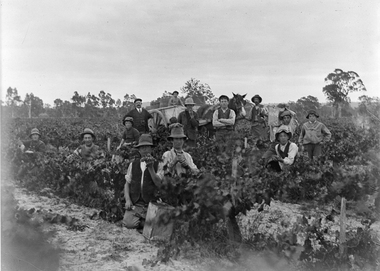
... Digital Photo taken from glass slide by Geoff McMillan, Cooper Street Stawell and reproduced as a photo - printed at Stawell Historical Society 2019 winery wine making Black & White Photo showing a group of men and boys picking grapes at Best's Vineyard, Great Western. All with hats or caps, some kneeling, some standing. Horse and cart behind the group ready ...Digital Photo taken from glass slide by Geoff McMillan, Cooper Street Stawell and reproduced as a photo - printed at Stawell Historical Society 2019Black & White Photo showing a group of men and boys picking grapes at Best's Vineyard, Great Western. All with hats or caps, some kneeling, some standing. Horse and cart behind the group ready to take the grapes to the cellars. winery, wine making -
 Vision Australia
Functional object - Object, PSB Engineering, Yellow liquid sensor
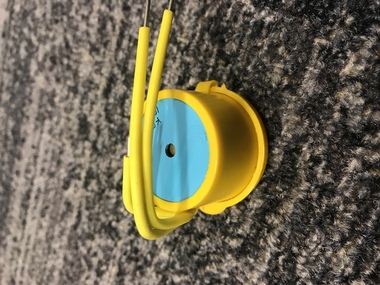
... making a cup of tea or coffee with milk. Simply pour in your hot water stopping when a pulsating tone is heard. Pour in milk stopping when a continuous tone is heard. Your cup is now filled to approximately 15mm from the top and ready...making a cup of tea or coffee with milk. Simply pour in your hot water stopping when a pulsating tone is heard. Pour in milk stopping when a continuous tone is heard. Your cup is now filled to approximately 15mm from the top and ready ...The Liquid 2 Level Sensor is an aid for people with vision impairment to fill cups and glasses with 2 levels of liquid. The unit simply hangs over the side of a cup or glass with the probes on the inside. Ideal for making a cup of tea or coffee with milk. Simply pour in your hot water stopping when a pulsating tone is heard. Pour in milk stopping when a continuous tone is heard. Your cup is now filled to approximately 15mm from the top and ready to drink. Can also be used as a single level sensor such as for non-mixed drinks. Handy magnets on the back of the unit allow for easy storage on fridge or other metal object.Yellow plastic round container with blue base and four yellow wiresassistive devices, equipment -
 Mt Dandenong & District Historical Society Inc.
Photograph, "Shiloah" 1913
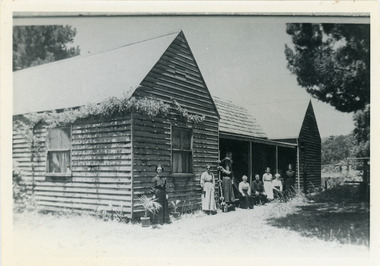
... ready for his marriage to Selina Leach of Bayswater in 1886. ‘Shiloah' was enlarged to take guests in the early 1900s. It was situated close to a beautiful fern gully and Isaac and his family capitalised on this by setting out walking tracks through the ferns. They charged 1/- to walk through and this included afternoon tea in a garden setting. ‘Shiloah’ was a popular tourist attraction but the making...ready for his marriage to Selina Leach of Bayswater in 1886. ‘Shiloah' was enlarged to take guests in the early 1900s. It was situated close to a beautiful fern gully and Isaac and his family capitalised on this by setting out walking tracks through the ferns. They charged 1/- to walk through and this included afternoon tea in a garden setting. ‘Shiloah’ was a popular tourist attraction but the making ...'Shiloah' was the home of Isaac Jeeves the younger - son of Isaac Jeeves the Valley Pioneer and brother of Ellis Jeeves. Isaac built this house himself using local timber he cut and split. It was ready for his marriage to Selina Leach of Bayswater in 1886. ‘Shiloah' was enlarged to take guests in the early 1900s. It was situated close to a beautiful fern gully and Isaac and his family capitalised on this by setting out walking tracks through the ferns. They charged 1/- to walk through and this included afternoon tea in a garden setting. ‘Shiloah’ was a popular tourist attraction but the making of the Olinda Creek Road destroyed the fern gullies and, by the 1930s, it was all finished.Black and white photograph of wooden structure with two wings and a central verandah. Eight adults sitting or standing at the front.Handwritten on back by John Lundy-Clarke "Shiloah" 1913.isaac jeeves, isaac jeeves the younger, ellis jeeves, shiloah, guest house, guesthouse, selina leach, selina jeeves, olinda creek road -
Kew Historical Society Inc
Journal, Kewriosity : September 1988
... ready to expand / p8. Kewriosity was a local newsletter combining Kew Council and community news. It was published between November 1983 and June 1994, replacing an earlier Kewriosity [broad] Sheet (1979-84). In producing Kewriosity, Council aimed to provide a range of interesting and informative articles covering its deliberations and decision making, together with items of general interest and importance to the Kew community and information not generally available through daily media outlets. ...Council urges 'YES' vote on September 3 [Constitutional recognition for local government]/ p1-2. Meet the Mayor [Cr Allen Martin] / p1. Dates for September / p2. Kew Living launch [Bicentennial project] / p2. Commentary / Cr Allen Martin p3. Amnesty on dogs [registration] / p3. Election results / p3. Former Kew Councillor for County Court [Judge Chester Keon-Cohen] / p3. Willsmere Forum / p3. Notices [North Kew Tennis Club] / p4. Community clean up [Boroondara Bushwalkers] / p4. Pregnancy support / p4. Teenage Disco [Youth Resource Centre] / p4. Friendship and fun at playgroup [Highbury Grove Playgroup]/ p4. Friends of Kew Library / p4. Christmas cards for Kew / p4. Kew group to perform at Spoleto Festival [Elysium Ensemble] / p5. Community celebrations at Kew High School [State Education Week] / p5. Kew Community House / Judy Price p6. Student help / p6. Used furniture - can you help? [Belford Oaks Full Day Care Centre] / p6. Keeping you informed [Kew Citizens’ Advice Bureau] / p6. [Kew] Community Directory [1989] p6. Fun, fitness and family [Kew Little Athletics Centre] / p7. Community recreation for disabled [ Kew Recreation Integration Support Group] / p7. Footy News [Kew Football Club] / p8. Bowls season starts soon [Kew Bowling Club] / p8. Cricket Club invites new members [Deepdene Uniting Cricket Club] / p8. Spring into Spring with volleyball [Kew High School Sports Centre] / p8. 1st Kew Scouts ready to expand / p8.Kewriosity was a local newsletter combining Kew Council and community news. It was published between November 1983 and June 1994, replacing an earlier Kewriosity [broad] Sheet (1979-84). In producing Kewriosity, Council aimed to provide a range of interesting and informative articles covering its deliberations and decision making, together with items of general interest and importance to the Kew community and information not generally available through daily media outlets.non-fictionCouncil urges 'YES' vote on September 3 [Constitutional recognition for local government]/ p1-2. Meet the Mayor [Cr Allen Martin] / p1. Dates for September / p2. Kew Living launch [Bicentennial project] / p2. Commentary / Cr Allen Martin p3. Amnesty on dogs [registration] / p3. Election results / p3. Former Kew Councillor for County Court [Judge Chester Keon-Cohen] / p3. Willsmere Forum / p3. Notices [North Kew Tennis Club] / p4. Community clean up [Boroondara Bushwalkers] / p4. Pregnancy support / p4. Teenage Disco [Youth Resource Centre] / p4. Friendship and fun at playgroup [Highbury Grove Playgroup]/ p4. Friends of Kew Library / p4. Christmas cards for Kew / p4. Kew group to perform at Spoleto Festival [Elysium Ensemble] / p5. Community celebrations at Kew High School [State Education Week] / p5. Kew Community House / Judy Price p6. Student help / p6. Used furniture - can you help? [Belford Oaks Full Day Care Centre] / p6. Keeping you informed [Kew Citizens’ Advice Bureau] / p6. [Kew] Community Directory [1989] p6. Fun, fitness and family [Kew Little Athletics Centre] / p7. Community recreation for disabled [ Kew Recreation Integration Support Group] / p7. Footy News [Kew Football Club] / p8. Bowls season starts soon [Kew Bowling Club] / p8. Cricket Club invites new members [Deepdene Uniting Cricket Club] / p8. Spring into Spring with volleyball [Kew High School Sports Centre] / p8. 1st Kew Scouts ready to expand / p8. publications -- city of kew (vic.), kewriosity, council newsletters, community newsletters -
Vision Australia
Audio (item) - Sound recording, Royal Victorian Institute for the Blind, Around the Institute: June 25, 2002
... June 25: World Record Cyclist - Christine Fisher, Making realistic job choices and being job ready - Robyn McKenzie. ...June 25: World Record Cyclist - Christine Fisher, Making realistic job choices and being job ready - Robyn McKenzie. ...Around the Institute was a weekly program designed to keep clients and staff informed of events, activities and thoughts relating to low vision and blindness. It consisted of interviews undertaken by Jo Matthews-Lamb, Susan Thompson, Janet Cronin and Corey Nassau, with sound engineer Ed Gamble, designed to inform, educate and explore on a variety of topics. June 25: World Record Cyclist - Christine Fisher, Making realistic job choices and being job ready - Robyn McKenzie. royal victorian institute for the blind, radio shows -
 Linton and District Historical Society Inc
Tobacco tin, Capstan Tobacco Tin
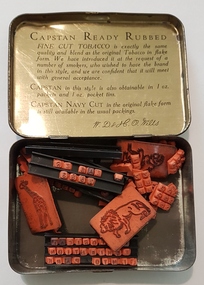
... Blue and gold tobacco tin which originally contained "Capstan" ready-rubbed tobacco. Inside the tin are pieces of a stamp-making set. Some pieces depict animals, others are letters which can be combined on a plastic backing piece to form a custom-made stamp. ...Tobacco tins Capstan tobacco Rubber stamp making set Linton Park Historical Exhibition 1983 On tin: "Medium "Capstan" ready rubbed fine cut tobacco, 2oz. net weight when packed. ...Blue and gold tobacco tin which originally contained "Capstan" ready-rubbed tobacco. Inside the tin are pieces of a stamp-making set. Some pieces depict animals, others are letters which can be combined on a plastic backing piece to form a custom-made stamp. One stamp reads "Historical Exhibition Linton Park", another "Easter 1983".On tin: "Medium "Capstan" ready rubbed fine cut tobacco, 2oz. net weight when packed. W. D. and H. O. Wills (Australia) Ltd. Sydney".tobacco tins, capstan tobacco, rubber stamp making set, linton park historical exhibition 1983 -
 Royal District Nursing Service (now known as Bolton Clarke)
Photograph - Photograph, black and white, 1905
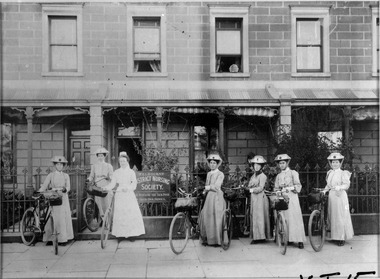
... making 17,954 visits during the year. The Society had a set of bye-laws which outlined the work conditions for the Nurses. Section 111.1 states ‘Each nurse shall be ready to go to her district at 9 am. ...This photograph is a record of Head Nurse, Sister Lee-Archer, and her staff of six Trained nurses, 'Nurses', of the Melbourne District Nursing Society (MDNS) outside their new Nurse’s Home and Headquarters rented at 5 Royal Terrace, Nicholson Street, Fitzroy. The bicycles seen were the first mode of transport purchased by MDNS and allowed these Nurses to extend the nursing visits they made into more Melbourne suburbs.The Melbourne District Nursing Society (MDNS) moved into larger premises at No. 5 Royal Terrace, Nicholson Street, Fitzroy in May 1904. Head trained Nurse, Lee-Archer and her staff of six Trained nurses pose outside the new ‘Nurse’s Home’ at 5 Royal Terrace, Nicholson Street, Fitzroy. The Nurses worked in the districts of North and West Melbourne, the City Proper, Carlton, Richmond, South Melbourne, Fitzroy and Collingwood making 17,954 visits during the year. The Society had a set of bye-laws which outlined the work conditions for the Nurses. Section 111.1 states ‘Each nurse shall be ready to go to her district at 9 am. She will be expected to visit urgent cases on Sundays, and will be required to work eight hours on each week day, to wear the special uniform, and live in the Home of the Society’. In February 1885, only 50 years after Melbourne was founded, it was recognized that nursing care was needed for the sick poor in inner Melbourne. The Melbourne District Nursing Society (MDNS), the first Society of its kind in Australia, was founded with one Trained nurse, known as 'Nurse' in those days, and a second employed six months later. They liaised with Doctors and worked in the now CBD, ie from Spencer Street to Spring Street and from Victoria Parade to Flinders Street. From its inception the Society was at the forefront of health care. They provided high quality nursing care; educated their patients in the curing and prevention of disease; teaching the importance of cleanliness, fresh air and good nutrition, both by verbal instruction and demonstration, even supplying soup and milk when needed. At that time they walked the streets and lane ways amid the slums of inner Melbourne carrying their nursing bag containing lotion, ointments, powders, liniment, bandages, dressings, a case of spirits, and the Nurse's own clean apron, soap and small towel for her use. They loaned equipment, such as earthenware hot water bottles, splints, urinals, bed pans, bed cradles, feeding mugs, and air-cushions as well as providing clean bed linen and nightdresses as necessary. Trained Midwives began home births in late 1893 taking midwifery bundles and providing clothes for the babe and mother as needed. This was arduous work, particularly in the heat of summer. As the work increased a third Nurse was employed but due to this arduous work many Nurses only remained with the Society for several months. Permission to use bicycles was given to the Nurses in 1898 and the Society decided to purchase their own in 1903. A business man offered ‘new free wheel’ bicycles at £13 each which included maintenance for one year. Bells and wooden frames were added, at a cost of £5 per frame, so the Nurses could carry extra equipment. Nurses’ bags were strapped to the handlebars. Soup was made for those in need 2-3 times a week and if patients could not arrange to have it collected the soup was delivered by the Nurses on their bicycles. The use of bicycles caused a change in uniform, with white pith helmets, and veils covering them and tied under their chin, now being used. They provided high quality nursing care to a range of people, often in destitute situations, some lying on rags on the floor as they had no bed, others with just a bed and maybe a thin blanket, a chair and nothing else. Their ages ranged from babes, children, adults to the elderly. The Nurses gave medications as ordered by a Doctor, dressed wounds e.g. to the injured, and surgical cases, and to those with leg ulcers; attended to patients with ‘surgical ailments’ such as ‘hip disease’; gave care to those with acute illnesses such as bronchitis, pleurisy, pneumonia, measles, and scarlet fever, as well as those with chronic illnesses such as consumption (tuberculosis), heart disease, arthritis, cancer, debility, neuritis and paralysis. In 1913 a Nurse had her Board and residence, uniforms, bicycle and laundry expenses provided and was paid £50 a year for her first six months. At the end of a year her salary was increased by £5, and later she earns £60 a year. Over the years the nurses complained that their veils became wet in the rain and asked for a change of uniform but this did not occur until 1921. Bicycles continued to be used in inner areas until 1945. Black and white photograph of six Trained nurses and their Matron, who has her hair swept up, and is wearing a long white uniform with belt, and white cap; part of her veil is seen hanging down her back, outside their Nurses Home The trained. nurses are holding their two wheeled bicycles, and are wearing long grey frocks, white collars and belts and straw hats with a Maltese cross in the centre of headband, this is held in place with scarves over the hat and tied under their chins. Their nursing bags are strapped to the handlebars of the bicycles. A black sign with the white capital letters 'Melbourne District Nursing Society. ....nursing the sick poor in their own homes' is on the metal spiked fence. The building is made of brick and five long sash windows are seen in the upper section. A metal roofed veranda, held up with four posts and two brick columns, divides the upper and lower section. A door and three long windows are seen which are partly obscured by several bushes behind the fence.melbourne district nursing society, 5 royal terrace, nicholson st carlton, nurses home, bicycles, mdns transport, royal district nursing service, rdns, mdns trained nurses, sister florence lee-archer -
 Kew Historical Society Inc
Photograph - Victorian Canoe Club, Built-up ends & deck frames, 1920-30
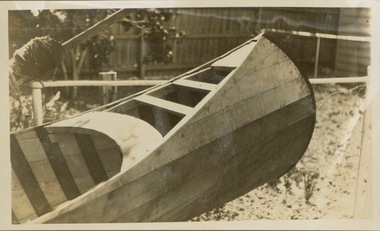
... Victorian Canoe Club Canoe making River Yarra Burke Road Mornington Studley park Kew steaming gear canoe construction "Built-up ends & deck frames" One of 24 labelled photos in part album, originating from the Victorian Canoe Club, which had its headquarters in Studley Park, Kew. The album includes a photographic record of canoe construction and also locations in Studley Park and Kew where the canoes were used. The subject of this photograph is identified as 'Built-up ends & deck frames' where the canoe its completed and ready ...Canoeing on the River Yarra at Melbourne was an important and widespread recreational pursuit for Melbournians, especially in the first half of the twentieth century. The Victorian Canoe Club was formed in 1912 at a meeting in Melbourne and its first committee elected in the same year. Records indicate that the Club continued into at least the 1950s .The album has historic and social significance as a record of recreational activities (as well as canoe making) in the early years of the twentieth century. It has local significance as the site of the headquarters of the Club was in Studley park. A number of photographs in the album provide vistas of Kew on the Yarra that are otherwise unavailable.One of 24 labelled photos in part album, originating from the Victorian Canoe Club, which had its headquarters in Studley Park, Kew. The album includes a photographic record of canoe construction and also locations in Studley Park and Kew where the canoes were used. The subject of this photograph is identified as 'Built-up ends & deck frames' where the canoe its completed and ready for testing."Built-up ends & deck frames"victorian canoe club, canoe making, river yarra, burke road, mornington, studley park, kew, steaming gear, canoe construction -
 City of Greater Bendigo - Civic Collection
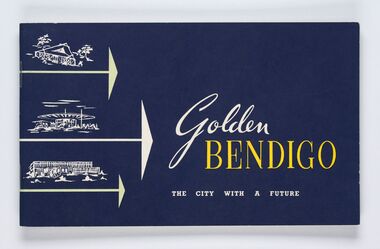
Booklet, City of Bendigo, Golden Bendigo, 1950's
... ready to make a newcomer at home'. Councillor Alec Craig City of Greater Bendigo Tourism Mayor W Cambridge Cambridge Press Making a Nation exhibition Bendigo Strategic Plan Booklet promoting the climate, character and industries of the City of Bendigo and surrounding districts. ...Partly promotional publication and vision plan designed to attract new residents and businesses and encourage tourism to the district. This publication outlines the many attractions and benefits of life in Bendigo 'In the restful atmosphere of a provincial city Bendigo's 40,000 inhabitants are contented and friendly, ever ready to make a newcomer at home'. Booklet promoting the climate, character and industries of the City of Bendigo and surrounding districts. Includes black and white and colour photographs, drawings, and text describing various facets of life in regional Victoria. Publication art work and design are particularly striking. councillor alec craig, city of greater bendigo tourism, mayor w cambridge, cambridge press, making a nation exhibition, bendigo strategic plan
