
Showing 7 items matching "male underwear"
-
 Bendigo Military Museum
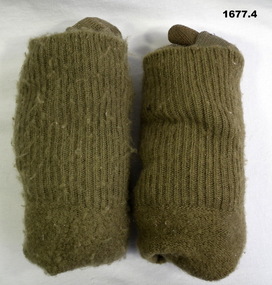
Footwear - SOCKS, ARMY, C.1960’s
... ...costume male underwear / footwear...uniforms - army costume male underwear / footwear Socks Two pairs of khaki Army issue socks - wool. ...Two pairs of khaki Army issue socks - wool.uniforms - army, costume male underwear / footwear, socks -
 Bendigo Military Museum
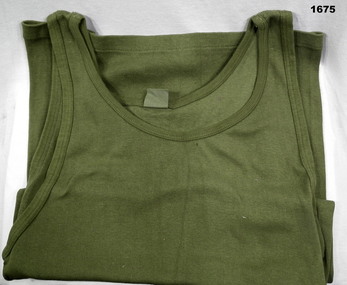
Uniform - SINGLET, ARMY, 1968
... ...costume - male underwear...Item issued to “Maj Andrew John BALSILLIE MBE” Refer Cat No 118.5 for his service details, RSL and Council history. uniforms - army costume - male underwear Singlet material "44" “1968, J Balsillie” Green Army issue singlet 1968 jungle green colour cotton fabric. ...Item issued to “Maj Andrew John BALSILLIE MBE” Refer Cat No 118.5 for his service details, RSL and Council history.Green Army issue singlet 1968 jungle green colour cotton fabric.material "44" “1968, J Balsillie”uniforms - army, costume - male underwear, singlet -
 Whitehorse Historical Society Inc.
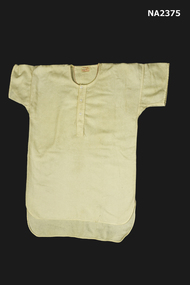
Clothing - Under shirt
... ...Male Underwear...COSTUME Male Underwear All wool Physician registration Chill proof Unshrinkable. ...Man's flannel undershirt with short sleeves and three buttons in front.All wool Physician registration Chill proof Unshrinkable.costume, male underwear -
 Royal Australian and New Zealand College of Obstetricians & Gynaecologists (RANZCOG)
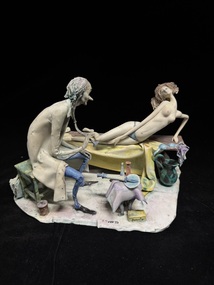
Artwork, other - Porcelain Sculpture by Toni Moretto
... underwear. There are some books surrounding them, there is one book on the bench labelled 'La Pillola' which translates from Italian to an oral contraceptive pill. The woman figure's bra is located in one corner of the bench, and below this there is a green jug located on the floor. There is a small table in front of the male...underwear. There are some books surrounding them, there is one book on the bench labelled 'La Pillola' which translates from Italian to an oral contraceptive pill. The woman figure's bra is located in one corner of the bench, and below this there is a green jug located on the floor. There is a small table in front of the male ...Sculpture depicts a figure in a white coat sitting on a stool, holding a stethoscope. He is sitting in front of a woman on a bench who is topless and in her underwear. There are some books surrounding them, there is one book on the bench labelled 'La Pillola' which translates from Italian to an oral contraceptive pill. The woman figure's bra is located in one corner of the bench, and below this there is a green jug located on the floor. There is a small table in front of the male figure with a syringe and vials on it. On the floor of the sculpture, 'Lo Scricciolo' inscribed.T.MORETTO is painted onto the sculpture, also there is one book on the bench labelled 'La Pillola', On the floor of the sculpture, 'Lo Scricciolo' inscribed which is the same as the sticker that is located on the underside of the base of the sculpture (Lo Scricciolo/ITALY) -
 Kew Historical Society Inc
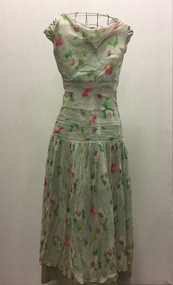
Clothing - Floral Summer Dress, 1930s
... underwear and costume accessories. The V&A's history of fashion describes 1930s dresses as characterised by '... a slinky femininity... Parisian couturiers introduced the bias-cut into their designs, which caused the fabric to skim over the body's curves. Long, simple and clinging evening gowns, made of satin were popular. Often the dresses had low scooping backs'. This dress was made for an aunt of the donor, who was the daughter and sister of well-known male...underwear and costume accessories. The V&A's history of fashion describes 1930s dresses as characterised by '... a slinky femininity... Parisian couturiers introduced the bias-cut into their designs, which caused the fabric to skim over the body's curves. Long, simple and clinging evening gowns, made of satin were popular. Often the dresses had low scooping backs'. This dress was made for an aunt of the donor, who was the daughter and sister of well-known male ...The Fashion & Design collection of the Kew Historical Society includes examples of women’s, men’s, children’s and infants’ clothing from the 18th, 19th and 20th centuries. Items in the collection were largely produced for, or purchased by women in Melbourne, and includes examples of outerwear, protective wear, nightwear, underwear and costume accessories. The V&A's history of fashion describes 1930s dresses as characterised by '... a slinky femininity... Parisian couturiers introduced the bias-cut into their designs, which caused the fabric to skim over the body's curves. Long, simple and clinging evening gowns, made of satin were popular. Often the dresses had low scooping backs'. This dress was made for an aunt of the donor, who was the daughter and sister of well-known male Melbourne architects in the Smart family. Long floral green crepe georgette dress.women's clothing, dresses, australian fashion - 1930s -
 Kew Historical Society Inc
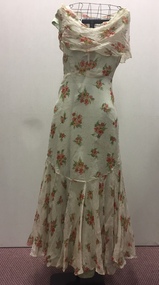
Clothing, Floral Crepe Georgette Summer Dress, 1930s
... underwear and costume accessories.The V&A's history of fashion describes 1930s dresses as characterised by '... a slinky femininity... Parisian couturiers introduced the bias-cut into their designs, which caused the fabric to skim over the body's curves. Long, simple and clinging evening gowns, made of satin were popular. Often the dresses had low scooping backs'. This dress was made for an aunt of the donor, who was the daughter and sister of well-known male...underwear and costume accessories.The V&A's history of fashion describes 1930s dresses as characterised by '... a slinky femininity... Parisian couturiers introduced the bias-cut into their designs, which caused the fabric to skim over the body's curves. Long, simple and clinging evening gowns, made of satin were popular. Often the dresses had low scooping backs'. This dress was made for an aunt of the donor, who was the daughter and sister of well-known male ...The Fashion & Design collection of the Kew Historical Society includes examples of women’s, men’s, children’s and infants’ clothing from the 18th, 19th and 20th centuries. Items in the collection were largely produced for, or purchased by women in Melbourne, and includes examples of outerwear, protective wear, nightwear, underwear and costume accessories.The V&A's history of fashion describes 1930s dresses as characterised by '... a slinky femininity... Parisian couturiers introduced the bias-cut into their designs, which caused the fabric to skim over the body's curves. Long, simple and clinging evening gowns, made of satin were popular. Often the dresses had low scooping backs'. This dress was made for an aunt of the donor, who was the daughter and sister of well-known male Melbourne architects in the Smart family.Long cream and orange floral crepe georgette evening dresswomen's clothing, australian fashion - 1930s, fashion and textiles collection, rosemary smart -
 City of Melbourne Libraries
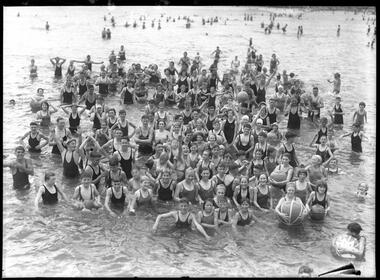
Photograph, Bull, Hugh Jones, 1897-1993, "On Christmas morning -- Bathing at St Kilda", 1933
... underwear, was developed and would change little for a century. By the second half of the 19th century, in France, the sleeves started to vanish, the bottom became shorter to reach only the knees and the top became hip-length and both became more form fitting. In the 1900s women wore wool dresses on the beach that were In the Victorian era, Western cultures deplored nudity of any degree, and people took great pains to cover themselves, even bare chested male swimmers at ocean beaches. ...underwear, was developed and would change little for a century. By the second half of the 19th century, in France, the sleeves started to vanish, the bottom became shorter to reach only the knees and the top became hip-length and both became more form fitting. In the 1900s women wore wool dresses on the beach that were In the Victorian era, Western cultures deplored nudity of any degree, and people took great pains to cover themselves, even bare chested male swimmers at ocean beaches. ...Published: 26 Dec 1933 The Age p9 Published title: "ON CHRISTMAS MORNING--BATHING AT ST. KILDA." Published caption: "Yesterday morning everyone who was near the bay seized the opportunity for a cooling dip. St. Kilda foreshore was particularly well patronised, as this picture shows." Trove article identifier: http://nla.gov.au/nla.news-article203364944 Description: Large group of swimmers at St Kilda Beach on Christmas morning. Research by project volunteer, Louise McKenzie: Approximately 150 men, women and children grouped in front of the photographer in the shallows of St Kilda Beach on Christmas morning 1933. All are wearing one piece bathing suits, some have bathing caps, some hold beach balls, and one boy has a model boat. They are happy and exuberant. Their swimming attire is traditional and conservative for the time. However at this time the bathing attire was undergoing a substantial change, as Wikipedia’s History of Swimwear attests. The English practice of men swimming in the nude was banned in the United Kingdom in 1860. In the first half of the 19th century the top became knee-length while an ankle-length drawer was added as a bottom. By the second half of the 19th century, in France, the sleeves started to vanish, the bottom became shorter to reach only the knees and the top became hip-length and both became more form fitting. In the West, in the 19th century women wore a bathing gown in the water. These were loose ankle-length full-sleeve chemise-type gown made of wool or flannel, so that modesty or decency was not threatened. They were long dresses of fabrics that would not become transparent when wet, with weights sewn into the hems so that they would not rise up in the water. The men's swim suit, a rather form-fitting wool garment with long sleeves and legs similar to long underwear, was developed and would change little for a century. By the second half of the 19th century, in France, the sleeves started to vanish, the bottom became shorter to reach only the knees and the top became hip-length and both became more form fitting. In the 1900s women wore wool dresses on the beach that were In the Victorian era, Western cultures deplored nudity of any degree, and people took great pains to cover themselves, even bare chested male swimmers at ocean beaches. In the 1910s despite opposition from some groups, the form-fitting style proved popular. It was not long before swimwear started to shrink further. At first arms were exposed and then legs up to mid-thigh. Necklines receded from around the neck down to around the top of the bosom. The development of new fabrics allowed for new varieties of more comfortable and practical swimwear. The name "swim suit" was coined in 1915 by Jantzen Knitting Mills, a sweater manufacturer who launched a swimwear brand named the "Red Diving Girl”. During the 1920s and 1930s, people began to shift from "taking in the water" to "taking in the sun", at bathhouses and spas, and swimsuit designs shifted from functional considerations to incorporate more decorative features. By the 1930s men began to go without shirts for swimming and barechestedness in male swimwear became the norm by the end of the 1940s, including in competitive swimming events. Following a fire in 1925, the nearby St Kilda Baths were reopened in 1931 – with separate “enclosures” for men and women. But here in the Bay just a few years later, everyone is happily enjoying the refreshing seaside event. References: History of Swimwear, Wikipedia, https://en.wikipedia.org/wiki/History_of_swimwear Jantzen Red Diving Girl, Oregon History Project, https://www.oregonhistoryproject.org/articles/historical-records/jantzen-red-diving-girl/ European History 1900-1950, St Kilda Historical Society, https://stkildahistory.org.au/about/timeline-1900-1950Photographer notations on slide: "Christmas morning St Kilda Age B9".
