
Showing 7 items matching "manchuria"
-
 Creswick Campus Historical Collection - University of Melbourne
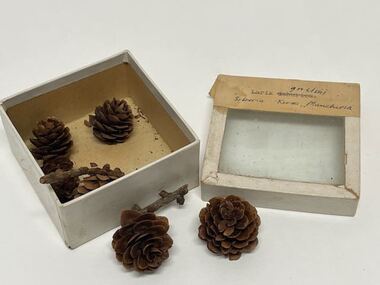
Plant specimen - Plant Specimen from the VSF Herbarium, Larix gruelini, Siberia, Korea, Manchuria
... Larix gruelini, Siberia, Korea, Manchuria...Box: Larix gruelini, Siberia, Korea, Manchuria...Box: Larix gruelini, Siberia, Korea, Manchuria Plant Specimen from the VSF Herbarium - seeds in a cardboard box with a glass lid Larix gruelini, Siberia, Korea, Manchuria Plant specimen Plant Specimen from the VSF Herbarium ...Plant Specimen from the VSF Herbarium - seeds in a cardboard box with a glass lidBox: Larix gruelini, Siberia, Korea, Manchuria -
 Bendigo Historical Society Inc.
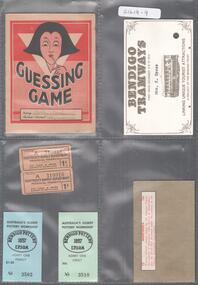
Ephemera - KEN HESSE COLLECTION: TRAM TICKETS, ENTRY TICKETS, INVITATION, GAME
... 3) Two tickets Electricity supply department provincial tramways, this ticket is issued subject to the by-laws, price 1 penny. 4) Two entry tickets to Bendigo pottery Australia's oldest pottery workshop, one family for $1.40 and one adult for 50centts. 5) Brown paper rectangular box in the middle: Manchuria, twelve different stamps issued by the Japanese puppet government of Manchuria and the north-east provinces under the control of the Chinese Nationalist Government....3) Two tickets Electricity supply department provincial tramways, this ticket is issued subject to the by-laws, price 1 penny. 4) Two entry tickets to Bendigo pottery Australia's oldest pottery workshop, one family for $1.40 and one adult for 50centts. 5) Brown paper rectangular box in the middle: Manchuria, twelve different stamps issued by the Japanese puppet government of Manchuria and the north-east provinces under the control of the Chinese Nationalist Government. ...1) Red and white guessing game card in the name of Betty Nankervis giving the correct number of answers:11. When opened there are 20 questions on parts of the human anatomy with space for answers. 2) Bendigo Tramways card first issued December 9 & 10 1972 the name Mrs. K. Hesse typed above the picture of a tram. Linking unique tourist attractions, a project of the Bendigo Trust. On the back a signature R.F. Lamb(?) 3) Two tickets Electricity supply department provincial tramways, this ticket is issued subject to the by-laws, price 1 penny. 4) Two entry tickets to Bendigo pottery Australia's oldest pottery workshop, one family for $1.40 and one adult for 50centts. 5) Brown paper rectangular box in the middle: Manchuria, twelve different stamps issued by the Japanese puppet government of Manchuria and the north-east provinces under the control of the Chinese Nationalist Government.ken hesse, tram tickets -
 Ballarat Clarendon College
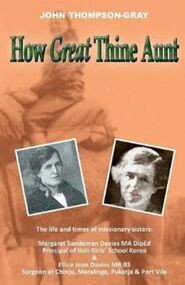
Book, How great thine aunt, 2018
... During the Mansei Uprising, Japanese police arrested her for inciting to riot and drove Kim Il-Sung into Manchuria where he founded Korean Communism. ...During the Mansei Uprising, Japanese police arrested her for inciting to riot and drove Kim Il-Sung into Manchuria where he founded Korean Communism. ...This is the untold story of Margaret (1904) and Jean (1906) Davies and their uncompromising faith, amazing courage and endless endurance. Margaret was called to Korea as an educator from 1910 to 1940. During the Mansei Uprising, Japanese police arrested her for inciting to riot and drove Kim Il-Sung into Manchuria where he founded Korean Communism. Jean gave up a promising career in surgery at the Women's Hospital in Melbourne to practise at a mission hospital in Chinju, Korea. Sent home as a foreign alien before the attack on Pearl Harbor she practised at outback mission stations in Australia, doubling as the Flying Doctor. She medically examined the population of the New Hebrides (Vanuatu) as a first step to rid the country of leprosy. Jean returned to Pukatja in South Australia during British nuclear bomb testing at Maralinga.Small paperback bookmargaret davies, ellice jean davies, clarendon-presbyterian-ladies-college, 1900s, korea, missionary, surgeon, maralinga, vanuatu -
 Bendigo Historical Society Inc.
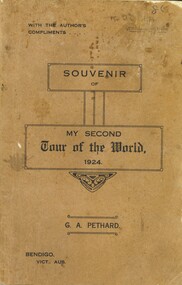
Book - SOUVENIR OF MY SECOND TOUR OF THE WORLD 1924, 1925
... Travel book to "...afford much information on subjects and places not generally known and help readers to better appreciate the marvels of other lands'' (taken from the preface) Countries visited: Ceylon (Sri Lanka) India Malaya (Malaysia) Batavia, Java (Indonesia) China Hong Kong Japan Manchuria (China and Russia) Siberia (Russia) Russia Finland Sweden Norway England (England and Scotland and Wales) Tenerife (Canary Islands, Spain) South Africa (South Africa and Zimbabwe) Item note: With the author's compliments... ...Travel book to "...afford much information on subjects and places not generally known and help readers to better appreciate the marvels of other lands'' (taken from the preface) Countries visited: Ceylon (Sri Lanka) India Malaya (Malaysia) Batavia, Java (Indonesia) China Hong Kong Japan Manchuria (China and Russia) Siberia (Russia) Russia Finland Sweden Norway England (England and Scotland and Wales) Tenerife (Canary Islands, Spain) South Africa (South Africa and Zimbabwe) Item note: With the author's compliments... ...My Second Tour of the World. 1924. By G.A. Pethard Printed by The Cambridge Press, Bendigo. 1925. Includes b/w photographs and a hand drawn map. Travel book to "...afford much information on subjects and places not generally known and help readers to better appreciate the marvels of other lands'' (taken from the preface) Countries visited: Ceylon (Sri Lanka) India Malaya (Malaysia) Batavia, Java (Indonesia) China Hong Kong Japan Manchuria (China and Russia) Siberia (Russia) Russia Finland Sweden Norway England (England and Scotland and Wales) Tenerife (Canary Islands, Spain) South Africa (South Africa and Zimbabwe) Item note: With the author's compliments... [handwritten] Mr. J. Thomas, Golden Square As the pages are not numbered, it is uncertain if any pages are missing from the front of the book. The first page talks about Ceylon. It makes no mention of Fremantle. However, Fremantle is noted on the map. 3 copiesG. A. Pethardbiography, highlights of a world tour. -
 Returned Nurses RSL Sub-branch
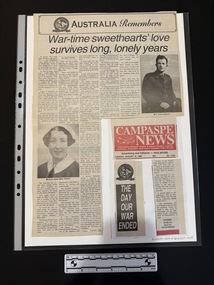
Newspaper - Newspaper clipping, [Campaspe News], War-time sweethearts' love survives long, lonely years, [c1995]
... ...Manchuria...WWII WW2 World War Two Prisoner of war Mary Gibson Gaza Middle East Sydney Concorde Army Hospital Brisbane Hughenden Darwin Atherton Tablelands Java Dutch Cycle Camp Singapore Japan Formosa Taiwan Nagasaki American Korean Manchuria Ransom Camp Govenor of Singapore Russian Manila Red Cross Vatican Nanneella A large newspaper clipping featuring a large title, five columns of text and two black and white photos. ...Mary Everard met Lance Gibson met in South Australia when Lance and a mate rang the local hospital to see if there were any off duty nurses who would go to the pictures with them. After several other outings the pair both ended up travelling on the Queen Elizabeth I to Egypt, Mary as nurse in the Australian Army Nursing Service and Lance as a lieutenant in the 2/3rd Australian Machine Gun Battalion. After spending much of the three week journey together, they continued to spend what free time they had together. When Lance found out he was to ship out to Indonesia in January 1942 the couple came to an understanding that they would marry after war. Several weeks after Lance's departure, Mary's unit returned to Australia on the Strathallen, where they nursed in hospitals in Queensland. Lance became a POW of the Japanese, one of the lucky 72 out of 257 Australians in his group to survive the war. Mary and Lance were married in November 1946 and now have three children and eight grandchildren.A large newspaper clipping featuring a large title, five columns of text and two black and white photos. One photo is of the face of a nurse in uniform, while the other photo is of a man in uniform.wwii, ww2, world war two, prisoner of war, mary gibson, gaza, middle east, sydney, concorde army hospital, brisbane, hughenden, darwin, atherton tablelands, java, dutch, cycle camp, singapore, japan, formosa, taiwan, nagasaki, american, korean, manchuria, ransom camp, govenor of singapore, russian, manila, red cross, vatican, nanneella -
 Returned Nurses RSL Sub-branch
Newspaper - Newspaper clipping, [Campaspe News], War-time sweethearts' love survives long, lonely years, [c1995]
... ...Manchuria...WWII WW2 World War Two Prisoner of war Mary Gibson Gaza Middle East Sydney Concorde Army Hospital Brisbane Hughenden Darwin Atherton Tablelands Java Dutch Cycle Camp Singapore Japan Formosa Taiwan Nagasaki American Korean Manchuria Ransom Camp Govenor of Singapore Russian Manila Red Cross Vatican Nanneella A large newspaper clipping featuring a large title, five columns of text and two black and white photos. ...Mary Everard met Lance Gibson met in South Australia when Lance and a mate rang the local hospital to see if there were any off duty nurses who would go to the pictures with them. After several other outings the pair both ended up travelling on the Queen Elizabeth I to Egypt, Mary as nurse in the Australian Army Nursing Service and Lance as a lieutenant in the 2/3rd Australian Machine Gun Battalion. After spending much of the three week journey together, they continued to spend what free time they had together. When Lance found out he was to ship out to Indonesia in January 1942 the couple came to an understanding that they would marry after war. Several weeks after Lance's departure, Mary's unit returned to Australia on the Strathallen, where they nursed in hospitals in Queensland. Lance became a POW of the Japanese, one of the lucky 72 out of 257 Australians in his group to survive the war. Mary and Lance were married in November 1946 and now have three children and eight grandchildren.A large newspaper clipping featuring a large title, five columns of text and two black and white photos. One photo is of the face of a nurse in uniform, while the other photo is of a man in uniform.wwii, ww2, world war two, prisoner of war, mary gibson, gaza, middle east, sydney, concorde army hospital, brisbane, hughenden, darwin, atherton tablelands, java, dutch, cycle camp, singapore, japan, formosa, taiwan, nagasaki, american, korean, manchuria, ransom camp, govenor of singapore, russian, manila, red cross, vatican, nanneella -
 Monbulk RSL Sub Branch
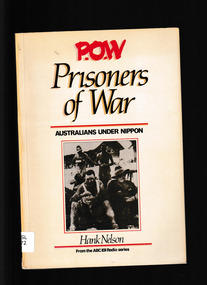
Book, Australian Broadcasting Corporation, P.O.W. : prisoners of war, 1985
... Later most of the prisoners were to be shifted further north into South-east Asia, Formosa, Korea, Manchuria and Japan itself. They were captives within lands and cultures and to experiences alien to those known to all other Australians. ...Within three months of the Japanese entering World War II on December 8, 1941 over 22 000 Australians had become prisoners-of-war. They went into camps in Timor, Ambon, New Britain, Java, Sumatra, Borneo, Singapore and Malaya, and a few were scattered to other points in what was briefly part of the Japanese empire. Later most of the prisoners were to be shifted further north into South-east Asia, Formosa, Korea, Manchuria and Japan itself. They were captives within lands and cultures and to experiences alien to those known to all other Australians. At the end of the war in August 1945, 14315 servicemen and thirty service women were alive to put on new, loose-fitting uniforms and go home. One in three of the prisoners had died. That is, nearly half of the deaths suffered by Australians in the war in the Pacific were among men and women who had surrendered. Another 8174 Australians had been captured in the fighting in Europe, the Middle East and North Africa: but of these men only 265 died as a result of wounds, disease or execution.By any quantitative measure the imprisonment of so many Australians is a major event in Australian history. For many soldiers it was living --and dying --in captivity which made World War II different from that of World War I. But the prisoners have received no permanent place in Australian history. Their story is not immediately recalled on celebratory occasions. In a general history of the nation in which a chapter is given to the war the prisoners might be mentioned in a sentence, or part of a sentence. Where the horror, stoicism and gallantry of Gallipoli have become part of a common tradition shared by all Australians, the ex-prisoners are granted just the horror. The public may be sympathetic; but the horror is for the prisoners alone. To make another comparison: in five months of fighting on the Kokoda Trail in 1942 the Australians lost 625 dead, less than the number who died on Ambon. Yet the events on Ambon are unknown to most Australians. There were no reporters or cameramen on Ambon and, for the 309 who defended Ambon's Laha airfield, no survivors. How many of them died in battle or died as prisoners will never be known. But there are more than just practical reasons why the record of the prisoners of war is so slight and uneven in the general knowledge of Australians. They have not tried to find out. No historian has written a book to cover the range of camps and experiences, and only in specialist medical publications has anyone investigated the impact of prison life on subsequent physical and mental health. The complexity of the experience and its impact on particular lives have not been expressed in a way to give them significance for other Australians.Index, bib, ill, maps, p.224.Within three months of the Japanese entering World War II on December 8, 1941 over 22 000 Australians had become prisoners-of-war. They went into camps in Timor, Ambon, New Britain, Java, Sumatra, Borneo, Singapore and Malaya, and a few were scattered to other points in what was briefly part of the Japanese empire. Later most of the prisoners were to be shifted further north into South-east Asia, Formosa, Korea, Manchuria and Japan itself. They were captives within lands and cultures and to experiences alien to those known to all other Australians. At the end of the war in August 1945, 14315 servicemen and thirty service women were alive to put on new, loose-fitting uniforms and go home. One in three of the prisoners had died. That is, nearly half of the deaths suffered by Australians in the war in the Pacific were among men and women who had surrendered. Another 8174 Australians had been captured in the fighting in Europe, the Middle East and North Africa: but of these men only 265 died as a result of wounds, disease or execution.By any quantitative measure the imprisonment of so many Australians is a major event in Australian history. For many soldiers it was living --and dying --in captivity which made World War II different from that of World War I. But the prisoners have received no permanent place in Australian history. Their story is not immediately recalled on celebratory occasions. In a general history of the nation in which a chapter is given to the war the prisoners might be mentioned in a sentence, or part of a sentence. Where the horror, stoicism and gallantry of Gallipoli have become part of a common tradition shared by all Australians, the ex-prisoners are granted just the horror. The public may be sympathetic; but the horror is for the prisoners alone. To make another comparison: in five months of fighting on the Kokoda Trail in 1942 the Australians lost 625 dead, less than the number who died on Ambon. Yet the events on Ambon are unknown to most Australians. There were no reporters or cameramen on Ambon and, for the 309 who defended Ambon's Laha airfield, no survivors. How many of them died in battle or died as prisoners will never be known. But there are more than just practical reasons why the record of the prisoners of war is so slight and uneven in the general knowledge of Australians. They have not tried to find out. No historian has written a book to cover the range of camps and experiences, and only in specialist medical publications has anyone investigated the impact of prison life on subsequent physical and mental health. The complexity of the experience and its impact on particular lives have not been expressed in a way to give them significance for other Australians.world war 1939 – 1945 - prisons and prisoners – japanese, world war 1939-1945 - personal narrativies - australia
