
Showing 13 items matching "manfred mueller"
-
 Tatura Irrigation & Wartime Camps Museum
Photograph - copy, Manfred Mueller, Original 1942, copy 1989
... Manfred Mueller......manfred mueller...ID photo of German POW, Manfred Mueller, artist, in profile. Number PWG41595...Prisoners of war. pow german pow pwg41595 manfred mueller ID photo of German POW, Manfred Mueller, artist, in profile. ...WW2 internment camp Tatura. Prisoners of war.ID photo of German POW, Manfred Mueller, artist, in profile. Number PWG41595pow, german pow, pwg41595, manfred mueller -
Tatura Irrigation & Wartime Camps Museum
Photograph - copy, Manfred Mueller, Original 1942, copy 1989
... Manfred Mueller......manfred mueller...Id photograph front view of German POW Manfred Mueller, number PWG41595, artist....Manfred Mueller Photograph - copy ...WW2 Internment Camp Tatura, Prisoners of WarId photograph front view of German POW Manfred Mueller, number PWG41595, artist.pow, german pow, manfred mueller, pwg41595, internment camps, tatura -
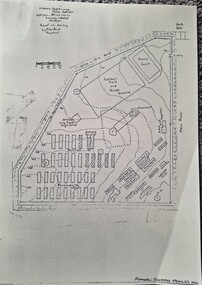 Tatura Irrigation & Wartime Camps Museum
Photograph, Camp 3 Compound B Survey Map, 1942
... ...manfred mueller...Detailed sketch of Compound B Camp 3 based on survey by Manfred Mueller...Detailed sketch of Compound B Camp 13 based on survey by Manfred Mueller September 1942. On cream paper, laminated....Detailed sketch of Compound B Camp 3 based on survey by Manfred Mueller camp 13 camp sketches manfred mueller survey map compound b camp 3 Detailed sketch of Compound B Camp 13 based on survey by Manfred Mueller September 1942. ...Gives an interesting and definitive idea of circumstances and life in the POW camps of Australia. Detailed sketch of Compound B Camp 3 based on survey by Manfred MuellerDetailed sketch of Compound B Camp 13 based on survey by Manfred Mueller September 1942. On cream paper, laminated.camp 13, camp sketches, manfred mueller, survey map, compound b camp 3 -
Tatura Irrigation & Wartime Camps Museum
Photograph, Relaxation
... ...Manfred Mueller...drawing called "relaxation" by artist Manfred Mueller during his internment as a POW at Camp 13 Tatura....drawing called "relaxation" by artist Manfred Mueller during his internment as a POW at Camp 13 Tatura. ww2 artists camp 13 tatura Manfred Mueller Pohlig Relaxation cartoon Photograph of coloured cartoon caricature of a man (possibly Gustav Pohlig) seated on wooden box. ...drawing called "relaxation" by artist Manfred Mueller during his internment as a POW at Camp 13 Tatura.Photograph of coloured cartoon caricature of a man (possibly Gustav Pohlig) seated on wooden box. Man is dress in a a blue short sleeved shirt and shorts. Barefoot. A gramophone is on a small table beside him.. ww2 artists, camp 13 tatura, manfred mueller, pohlig, relaxation, cartoon -
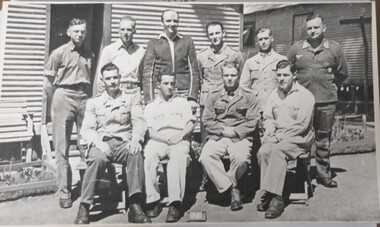 Tatura Irrigation & Wartime Camps Museum
Photograph, German POW's
... ...Manfred Mueller...Front row - l-r - Manfred Mueller, Herbert Morr, Wolfgang Neugebauer and Gustav Pohlig....Front row - l-r - Manfred Mueller, Herbert Morr, Wolfgang Neugebauer and Gustav Pohlig. ...German POW's: Back row - Gerhard Zirkler, Kurt Zimmermann, Adolf Wilkie, Helmut Hempel, Siegfried Scheffzouk, Ludwig Gernoth. Front row - l-r - Manfred Mueller, Herbert Morr, Wolfgang Neugebauer and Gustav Pohlig.Black and white photograph of 6 stand and 4 seated POW's in front of hut they are in. The number 171 centre frontkurt zimmermann, gerhard zirkler, adolf wilkie, helmut hempel, siegfried scheffzouk, ludwig gernoth, manfred mueller, herbert morr, wolfgang neugebauer, gustav pohlig, camp 13, internees -
Tatura Irrigation & Wartime Camps Museum
Photo album, 1942
... ...manfred mueller...Military and nursing staff - WW2 - 1942-43 - original photographs borrowed from Sister Beatrice Moore - Camp 4 commandant Major Scurry - Captain Hendy with Sisters Tootell and Elliott - 1942 - Captain Llewellyn on "Tony" and daughter Jacqueline on "Darkie" - Manfred Mueller POW artist....Military and nursing staff from Camp 4. sister beatrice moore sister tootell sister elliott captain llewellyn major scurry manfred mueller WW2 internees POW's Sky blue photo album. ...Military and nursing staff from Camp 4.Sky blue photo album. Superimposed on front cover Camp 1 Tatura. Military and nursing staff - WW2 - 1942-43 - original photographs borrowed from Sister Beatrice Moore - Camp 4 commandant Major Scurry - Captain Hendy with Sisters Tootell and Elliott - 1942 - Captain Llewellyn on "Tony" and daughter Jacqueline on "Darkie" - Manfred Mueller POW artist.WW2 internees POW'ssister beatrice moore, sister tootell, sister elliott, captain llewellyn, major scurry, manfred mueller -
Tatura Irrigation & Wartime Camps Museum
Photograph
... ...Manfred Mueller...Front row l - r: Manfred Mueller. Herbert Morr, Wolfgang Nuegebauer, Gustav Pohlig. ...Front row l - r: Manfred Mueller. Herbert Morr, Wolfgang Nuegebauer, Gustav Pohlig. ...Black and white photograph of 6 men standing, one on right Ludwig Gerndth in Luftwaffe uniform and iron cross. Others from left: Gerhard Zirkler, Kurt Zimmermann, Adolf Wilkie, Helmut Hempel, Siegfried Scheffzcyk, Ludwig Gerndth. Front row l - r: Manfred Mueller. Herbert Morr, Wolfgang Nuegebauer, Gustav Pohlig. In front of hut on ground centre front is the number 171171camp 13, ludwig gerndth, gerhard zirkler, kurt zimmermann, adolf wilkie, helmut hempel, siegfried scheffzcyk, manfred mueller, herbert morr, wolfgang neugebauer -
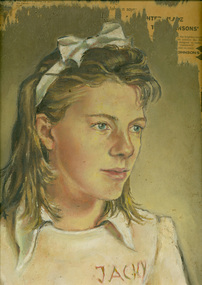 Tatura Irrigation & Wartime Camps Museum
Painting - Portrait - Oil Painting, Jacky, 1946
... ...manfred mueller...|Jacqui did not like the portrait and pasted newspaper over it, since partially removed. tatura camp 13 manfred mueller german pow Seal M. Mueller 1946. ...Jacqui Seal was the daughter of the Australian Army Intelligence Officer in Camp 13, Captain Stanley L. Seal. and sometimes visited her father in camp. Mueller asked to paint Jacky her father agreed, and Mueller presented the final work to her.|Jacqui did not like the portrait and pasted newspaper over it, since partially removed.Portrait of a young girl with bow in her hair and the name "Jacky" on her jumper. Portrait on brown paper in plain varnished wooden frame. Partially covered by newspaper.M. Mueller 1946.tatura, camp 13, manfred mueller, german pow, seal -
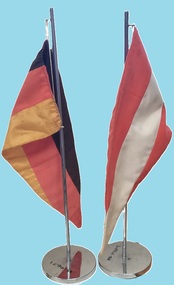 Wodonga & District Historical Society Inc
Memorabilia - German and Austrian miniature flags, Unknown
... They were Kurt Mueller, Willi Klimt, Toni Krischa and Erwin Klein from Germany and Manfred Teissl from Austria. ...They were Kurt Mueller, Willi Klimt, Toni Krischa and Erwin Klein from Germany and Manfred Teissl from Austria. ...Thousands of German migrants started a new life at Bonegilla, Victoria in the 1950s. Among them were five men who met each other in Wodonga, became friends and decided to form a German Austrian Club, where they could enjoy the company of likeminded individuals. They were Kurt Mueller, Willi Klimt, Toni Krischa and Erwin Klein from Germany and Manfred Teissl from Austria. On the 16th July 1960, after advertising in the Border Morning Mail, the German Austrian Club in Wodonga was born. Office bearers were Paul Peters as President. Gerhard Ziermann as Secretary and Günter Schmehl as Treasurer. Their aim was "To promote the upkeep of the German language in written and spoken form and to promote good German fellowship, while enjoying functions of a cultural and entertaining nature". By 1963 the Club boasted 40 members, holding meetings at the RSL Clubrooms and other suitable locations before they found a house in Hovell Street, Wodonga. It was used for meetings, Skat meetings, film nights and "Sonnabendschule” or Saturday school where children of members could continue to learn German. The Committee organised a wide range of activities and functions in their small rooms but dreamed of having a bigger home. This became reality in July 1979, when the Committee purchased land from the Albury Wodonga Development Corporation at 5 McFarland Road, Wodonga. The first brick was laid on the Club's land in May 1980, and the double-storey brick building was completed within 12 months voluntarily by Club members. At the same time members supported other organisations and charities in the Wodonga and wider community. The first Oktoberfest in Wodonga was held in 1975, drawing 4,000 attendees. The event was organized to promote German culture, and the profits from the first year were donated to the Wodonga District Hospital, raising $20,000. In 2001 the German Austrian Club was presented with the Certificate of Meritorious Service by the Government of Victoria for Community Works in Wodonga and district. The Club raised $23,000 for the Wodonga Hospital, had numerous fundraisers to assist in bushfires and drought situations and was involved in the Red Cross Calling campaign for many years. After much fundraising, hard work and making their way through extensive government red tape, the Club moved to its new premises in McFarland Road on 1st August 1981. The members continued to make necessary internal adjustments and sought an alcohol licence. The building was officially opened in May 1983. The Club prospered and had 300 members, making it necessary for new applicants to be put on a waiting list to be accepted as members. Interest groups consisted of Competition Air Rifle Shooting Group, a Skat (German Card game) Group, Folk Dancing Group, Ladies Group, Table Tennis Group, Darts Group, Chess Group and the Billiard Group. In later years, as so many Australians became members, the Club’s name was changed to the German Austrian Australian Club. Over recent years patronage and interest in the Club and its activities changed. Children of the original members had become “real Aussies” and did not always want to carry on traditions. Aging membership and lack of volunteers forced the Club to disband in 2025. The Club building has been gifted to the Albury Wodonga Theatre Company.These items are significant because they are representative of an important cultural organisation which operated in Wodonga for over 60 years.Two small flags of Germany and Austria attached to metal stands with string. Each stand has a metal circular base. "Lufthansa" is inscribed on the base.On base: Lufthansagerman austrian australian club, german austrian club -
 Wodonga & District Historical Society Inc
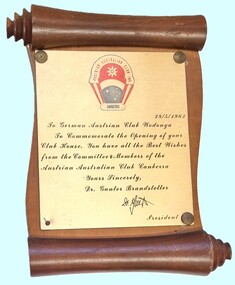
Plaque - German-Austrian Club Wodonga Opening, 1983
... They were Kurt Mueller, Willi Klimt, Toni Krischa and Erwin Klein from Germany and Manfred Teissl from Austria. ...They were Kurt Mueller, Willi Klimt, Toni Krischa and Erwin Klein from Germany and Manfred Teissl from Austria. ...Thousands of German migrants started a new life at Bonegilla, Victoria in the 1950s. Among them were five men who met each other in Wodonga, became friends and decided to form a German Austrian Club, where they could enjoy the company of likeminded individuals. They were Kurt Mueller, Willi Klimt, Toni Krischa and Erwin Klein from Germany and Manfred Teissl from Austria. On the 16th July 1960, after advertising in the Border Morning Mail the German Austrian Club in Wodonga was born. Office bearers were Paul Peters as President. Gerhard Ziermann as Secretary and Günter Schmehl as Treasurer. Their aim was "To promote the upkeep of the German language in written and spoken form and to promote good German fellowship, while enjoying functions of a cultural and entertaining nature". By 1963 the Club boasted 40 members, holding meetings at the RSL Clubrooms and other suitable locations before they found a house in Hovell Street, Wodonga. It was used for meetings, Skat meetings, film nights and Sonnabendschule” or Saturday school where children of members could continue to learn German. The Committee organised a wide range of activities and functions in their small rooms but dreamed of having a bigger home. This became reality in July 1979, when the Committee purchased land from the Albury Wodonga Development Corporation at 5 McFarland Road, Wodonga. The first brick was laid on the Club's land in May 1980, and the double-story brick building was completed within 12 months voluntarily by Club members. At the same time members supported other organisations and charities in the Wodonga and wider community. The first Oktoberfest in Wodonga was held in 1975, drawing 4,000 attendees. The event was organized to promote German culture, and the profits from the first year were donated to the Wodonga District Hospital, raising $20,000. In 2001 the German Austrian Club was presented with the Certificate of Meritorious Service by the Government of Victoria for Community Works in Wodonga and district. The Club raised $23,000 for the Wodonga Hospital, had numerous fundraisers to assist in bushfires and drought situations and was involved in the Red Cross Calling campaign for many years. After much fundraising, hard work and making their way through extensive government red tape, the Club moved to its new premises in McFarland Road on 1st August 1981. The members continued to make necessary internal adjustments and sought an alcohol licence. The building was officially opened in May 1983. The Club prospered and had 300 members, making it necessary for new applicants to be put on a waiting list to be accepted as members. Interest groups formed consisted of Competition Air Rifle Shooting Group, a Skat (German Card game) Group, Folk Dancing Group, Ladies Group, Table Tennis Group, Darts Group, Chess Group and the Billiard Group. In later years, as so many Australians became members, the Club’s name was changed to the German Austrian Australian Club. Over recent years patronage and interest in the Club and its activities changed. Children of the original members had become “real Aussies” and did not always want to carry on traditions. Aging membership and lack of volunteers forced the Club to disband in 2025. The Club building has been gifted to the Albury Wodonga Theatre Company. These items are significant because they are representative of an important cultural organisation which operated in Wodonga for over 60 years.A metal plaque attached to a wooden backing shaped like a scroll. The text is in the form of a letter.Emblem of the Austrian - Australian Clubs Inc. Canberra 28/5/1983 To German Austrian Club Wodonga To Commemorate the Opening of your Club House. You have all the Best Wishes from the Committee & Members of the Austrian Australian Club Canberra Yours Sincerely, Dr. Gunter Brandstetter Presidentgerman austrian australian club, german migrants wodonga -
 Wodonga & District Historical Society Inc
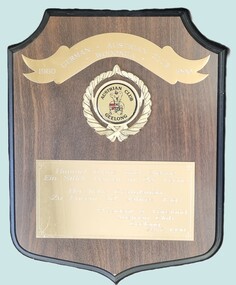
Plaque - German-Austrian Club Wodonga 30th Anniversary, 1990
... They were Kurt Mueller, Willi Klimt, Toni Krischa and Erwin Klein from Germany and Manfred Teissl from Austria. ...They were Kurt Mueller, Willi Klimt, Toni Krischa and Erwin Klein from Germany and Manfred Teissl from Austria. ...Thousands of German migrants started a new life at Bonegilla, Victoria in the 1950s. Among them were five men who met each other in Wodonga, became friends and decided to form a German Austrian Club, where they could enjoy the company of likeminded individuals. They were Kurt Mueller, Willi Klimt, Toni Krischa and Erwin Klein from Germany and Manfred Teissl from Austria. On the 16th July 1960, after advertising in the Border Morning Mail the German Austrian Club in Wodonga was born. Office bearers were Paul Peters as President. Gerhard Ziermann as Secretary and Günter Schmehl as Treasurer. Their aim was "To promote the upkeep of the German language in written and spoken form and to promote good German fellowship, while enjoying functions of a cultural and entertaining nature". By 1963 the Club boasted 40 members, holding meetings at the RSL Clubrooms and other suitable locations before they found a house in Hovell Street, Wodonga. It was used for meetings, Skat meetings, film nights and Sonnabendschule” or Saturday school where children of members could continue to learn German. The Committee organised a wide range of activities and functions in their small rooms but dreamed of having a bigger home. This became reality in July 1979, when the Committee purchased land from the Albury Wodonga Development Corporation at 5 McFarland Road, Wodonga. The first brick was laid on the Club's land in May 1980, and the double-story brick building was completed within 12 months voluntarily by Club members. At the same time members supported other organisations and charities in the Wodonga and wider community. The first Oktoberfest in Wodonga was held in 1975, drawing 4,000 attendees. The event was organized to promote German culture, and the profits from the first year were donated to the Wodonga District Hospital, raising $20,000. In 2001 the German Austrian Club was presented with the Certificate of Meritorious Service by the Government of Victoria for Community Works in Wodonga and district. The Club raised $23,000 for the Wodonga Hospital, had numerous fundraisers to assist in bushfires and drought situations and was involved in the Red Cross Calling campaign for many years. After much fundraising, hard work and making their way through extensive government red tape, the Club moved to its new premises in McFarland Road on 1st August 1981. The members continued to make necessary internal adjustments and sought an alcohol licence. The building was officially opened in May 1983. The Club prospered and had 300 members, making it necessary for new applicants to be put on a waiting list to be accepted as members. Interest groups formed consisted of Competition Air Rifle Shooting Group, a Skat (German Card game) Group, Folk Dancing Group, Ladies Group, Table Tennis Group, Darts Group, Chess Group and the Billiard Group. In later years, as so many Australians became members, the Club’s name was changed to the German Austrian Australian Club. Over recent years patronage and interest in the Club and its activities changed. Children of the original members had become “real Aussies” and did not always want to carry on traditions. Aging membership and lack of volunteers forced the Club to disband in 2025. The Club building has been gifted to the Albury Wodonga Theatre Company.This item is significant because it is representative of an important cultural organisation which operated in Wodonga for over 60 years.A wooden plaque with metal insignia and a plate with text in German. This plaque was presented by the German Austrian Club of Geelong on the occasion of the 30th Anniversary of the Wodonga Club and bears its insignia.Himmel Glanz und Sterne Ein Stuck Heimat in Der Fern Herzliche Gratulation Zu Eurem 30 Jahres Tag President and Vorstand Translation Sky, splendour and stars A piece of home away from home Congratulations On your 30th anniversary President and Board of Directorsgerman austrian australian club, german migrants wodonga -
 Wodonga & District Historical Society Inc
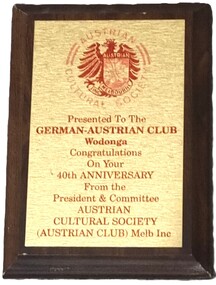
Plaque - German-Austrian Club Wodonga 40th Anniversary, 2000
... They were Kurt Mueller, Willi Klimt, Toni Krischa and Erwin Klein from Germany and Manfred Teissl from Austria. ...They were Kurt Mueller, Willi Klimt, Toni Krischa and Erwin Klein from Germany and Manfred Teissl from Austria. ...Thousands of German migrants started a new life at Bonegilla, Victoria in the 1950s. Among them were five men who met each other in Wodonga, became friends and decided to form a German Austrian Club, where they could enjoy the company of likeminded individuals. They were Kurt Mueller, Willi Klimt, Toni Krischa and Erwin Klein from Germany and Manfred Teissl from Austria. On the 16th July 1960, after advertising in the Border Morning Mail the German Austrian Club in Wodonga was born. Office bearers were Paul Peters as President. Gerhard Ziermann as Secretary and Günter Schmehl as Treasurer. Their aim was "To promote the upkeep of the German language in written and spoken form and to promote good German fellowship, while enjoying functions of a cultural and entertaining nature". By 1963 the Club boasted 40 members, holding meetings at the RSL Clubrooms and other suitable locations before they found a house in Hovell Street, Wodonga. It was used for meetings, Skat meetings, film nights and Sonnabendschule” or Saturday school where children of members could continue to learn German. The Committee organised a wide range of activities and functions in their small rooms but dreamed of having a bigger home. This became reality in July 1979, when the Committee purchased land from the Albury Wodonga Development Corporation at 5 McFarland Road, Wodonga. The first brick was laid on the Club's land in May 1980, and the double-story brick building was completed within 12 months voluntarily by Club members. At the same time members supported other organisations and charities in the Wodonga and wider community. The first Oktoberfest in Wodonga was held in 1975, drawing 4,000 attendees. The event was organized to promote German culture, and the profits from the first year were donated to the Wodonga District Hospital, raising $20,000. In 2001 the German Austrian Club was presented with the Certificate of Meritorious Service by the Government of Victoria for Community Works in Wodonga and district. The Club raised $23,000 for the Wodonga Hospital, had numerous fundraisers to assist in bushfires and drought situations and was involved in the Red Cross Calling campaign for many years. After much fundraising, hard work and making their way through extensive government red tape, the Club moved to its new premises in McFarland Road on 1st August 1981. The members continued to make necessary internal adjustments and sought an alcohol licence. The building was officially opened in May 1983. The Club prospered and had 300 members, making it necessary for new applicants to be put on a waiting list to be accepted as members. Interest groups formed consisted of Competition Air Rifle Shooting Group, a Skat (German Card game) Group, Folk Dancing Group, Ladies Group, Table Tennis Group, Darts Group, Chess Group and the Billiard Group. In later years, as so many Australians became members, the Club’s name was changed to the German Austrian Australian Club. Over recent years patronage and interest in the Club and its activities changed. Children of the original members had become “real Aussies” and did not always want to carry on traditions. Aging membership and lack of volunteers forced the Club to disband in 2025. The Club building has been gifted to the Albury Wodonga Theatre Company.This item is significant because it is representative of an important cultural organisation which operated in Wodonga for over 60 years.A small metal plaque on a wooden backing with red text. It includes the insignia of the Austrian Cultural Society of Melbourne.Presented To The GERMAN-AUSTRIAN CLUB Wodonga Congratulations On Your 40th ANNIVERSARY From the President & Committee AUSTRIAN CULTURAL SOCIETY (AUSTRIAN CLUB) Melb Incgerman austrian australian club, german migrants wodonga -
 Wodonga & District Historical Society Inc
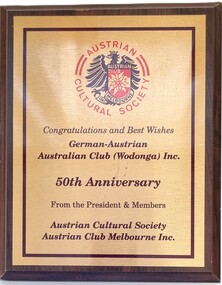
Plaque - German-Austrian Club Wodonga 50th Anniversary, 2010
... They were Kurt Mueller, Willi Klimt, Toni Krischa and Erwin Klein from Germany and Manfred Teissl from Austria. ...They were Kurt Mueller, Willi Klimt, Toni Krischa and Erwin Klein from Germany and Manfred Teissl from Austria. ...Thousands of German migrants started a new life at Bonegilla, Victoria in the 1950s. Among them were five men who met each other in Wodonga, became friends and decided to form a German Austrian Club, where they could enjoy the company of likeminded individuals. They were Kurt Mueller, Willi Klimt, Toni Krischa and Erwin Klein from Germany and Manfred Teissl from Austria. On the 16th July 1960, after advertising in the Border Morning Mail the German Austrian Club in Wodonga was born. Office bearers were Paul Peters as President. Gerhard Ziermann as Secretary and Günter Schmehl as Treasurer. Their aim was "To promote the upkeep of the German language in written and spoken form and to promote good German fellowship, while enjoying functions of a cultural and entertaining nature". By 1963 the Club boasted 40 members, holding meetings at the RSL Clubrooms and other suitable locations before they found a house in Hovell Street, Wodonga. It was used for meetings, Skat meetings, film nights and Sonnabendschule” or Saturday school where children of members could continue to learn German. The Committee organised a wide range of activities and functions in their small rooms but dreamed of having a bigger home. This became reality in July 1979, when the Committee purchased land from the Albury Wodonga Development Corporation at 5 McFarland Road, Wodonga. The first brick was laid on the Club's land in May 1980, and the double-story brick building was completed within 12 months voluntarily by Club members. At the same time members supported other organisations and charities in the Wodonga and wider community. The first Oktoberfest in Wodonga was held in 1975, drawing 4,000 attendees. The event was organized to promote German culture, and the profits from the first year were donated to the Wodonga District Hospital, raising $20,000. In 2001 the German Austrian Club was presented with the Certificate of Meritorious Service by the Government of Victoria for Community Works in Wodonga and district. The Club raised $23,000 for the Wodonga Hospital, had numerous fundraisers to assist in bushfires and drought situations and was involved in the Red Cross Calling campaign for many years. After much fundraising, hard work and making their way through extensive government red tape, the Club moved to its new premises in McFarland Road on 1st August 1981. The members continued to make necessary internal adjustments and sought an alcohol licence. The building was officially opened in May 1983. The Club prospered and had 300 members, making it necessary for new applicants to be put on a waiting list to be accepted as members. Interest groups formed consisted of Competition Air Rifle Shooting Group, a Skat (German Card game) Group, Folk Dancing Group, Ladies Group, Table Tennis Group, Darts Group, Chess Group and the Billiard Group. In later years, as so many Australians became members, the Club’s name was changed to the German Austrian Australian Club. Over recent years patronage and interest in the Club and its activities changed. Children of the original members had become “real Aussies” and did not always want to carry on traditions. Aging membership and lack of volunteers forced the Club to disband in 2025. The Club building has been gifted to the Albury Wodonga Theatre Company.This item is significant because it is representative of an important cultural organisation which operated in Wodonga for over 60 years.A small metal plaque on a wooden backing with red text. It includes the insignia of the Austrian Cultural Society of Melbourne.Congratulations and Best Wishes German-Austrian Australian Club (Wodonga) Inc. 50th Anniversary From the President & Members Austrian Cultural Society Austrian Club Melbourne Inc.german austrian australian club, german migrants wodonga
