Bendigo Historical Society Inc.
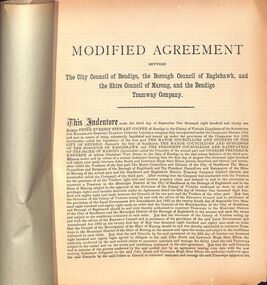
Booklet - Bendigo Tramways Agreement between City of Bendigo, Borough of Eaglehawk, Shire of Marong and Bendigo Tramway Company
... Additionally, shortages in manpower and materials due to wartime economies caused difficulties. As a result, the SEC made several attempts at closing the tramways and handing over the passenger services to private bus operators. ...Additionally, shortages in manpower and materials due to wartime economies caused difficulties. As a result, the SEC made several attempts at closing the tramways and handing over the passenger services to private bus operators. ...
The Sandhurst and Electric Tramway Company was the first to blaze a trail when it introduced battery trams to Bendigo in June 1890. Unfortunately they had made a serious miscalculation, as the batteries quickly proved inadequate for the hilly terrain of Bendigo. After a couple of months battery trams ceased running and were later replaced by steam trams in February 1892. Steam trams were a reliable means of transport and successfully moved Bendigonians around for ten years, but the onset of the recession forced the Bendigo Tramways Company to sell up in 1899 to the Electric Supply Company of Victoria (ESCo) who continued to run steam trams until 1902.
This turn-of-the-century sale led to the introduction of electric trams to Bendigo in April 1903. These were a success from the very beginning. During peak hour people would be standing in the aisles, in the doorways, even on the running boards on the outside of the tram. In addition, the trams were also the first option for deliveries. Parcels, newspapers, movie reels for the picture theatres and even mail bags found their way onto the trams; sent from outlying post offices to the GPO in the city centre.
At the end of World War I the Victorian Government constituted the new semi-government instrumentality, the State Electricity Commission of Victoria (SEC). The SEC was to take over all privately owned power generating companies in Victoria and operate as a state owned monopoly ... Bendigo's tramway system was an integral part of the deal.
The outbreak of World War II was a testing time. Revenue and passenger numbers were declining as automobiles became more popular. Additionally, shortages in manpower and materials due to wartime economies caused difficulties. As a result, the SEC made several attempts at closing the tramways and handing over the passenger services to private bus operators. It took some time, but in July 1970 the Victorian Parliament finally granted the SEC's application for abandonment of the tramways.
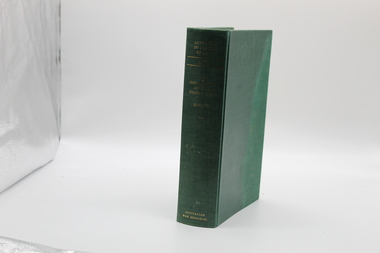
April 1972 marked the closure of the Bendigo Tramways as a commuter service and an estimated 20,000 people gathered to say an emotional farewell.Booklet concerning Modified Agreement between City of Bendigo, Borough of Eaglehawk, Shire of Marong and Bendigo Tramway Company. Lime green paper cover without any text. Five pages. Agreement made September, 1891. Stapled at the spine to join cover and pages together. marong shire, city council of bendigo, council of bendigo, bendigo tramway company

 Lara RSL Sub Branch
 Bendigo Historical Society Inc.