
Showing 12 items matching "marghab"
-
 Embroiderers Guild, Victoria
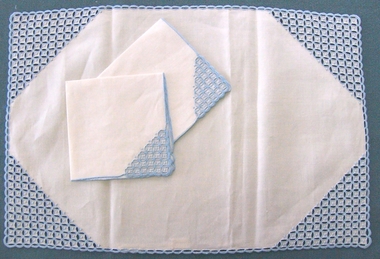
Textile - Tray Cloth and Napkins, Marghab, Late 20th century
... Marghab Linens Ltd. was a company specialising in table linens founded on Madeira in 1933 by British Cypriot Emile Marghab and his South Dakotan wife Vera (née Way); and disestablished in 1980.The company was also known as Emile Marghab Inc. ...Marghab...Marghab Linens Ltd. was a company specialising in table linens founded on Madeira in 1933 by British Cypriot Emile Marghab and his South Dakotan wife Vera (née Way); and disestablished in 1980.The company was also known as Emile Marghab Inc. ...Marghab Linens Ltd. was a company specialising in table linens founded on Madeira in 1933 by British Cypriot Emile Marghab and his South Dakotan wife Vera (née Way); and disestablished in 1980.The company was also known as Emile Marghab Inc. Since 1850, when Madeiran natives were introduced to hand embroidery as a means of industry, the islands had been renowned for their needlework. The Marghabs took advantage of this reputation, producing textiles that were skilfully hand-embroidered on the highest quality Irish linen and a form of organdie called Margandie, made in Switzerland, and harder wearing than usual organdie. The linens were designed by Vera, and hand-embroidered as a home industry by the women on Madeira, who Vera insisted received payment per stitch - which for a single place mat could amount to seventy thousand stitches. Made by Marghab, and sold at Georges store, Collins St., Melbourne.Cream linen with diagonal designs of flower heads in one corner of napkins and four corners of tray cloth. All edged in buttonhole stitch. Flower centres are dots of satin stitch.embroidery, mats, madeira work, madeira, 1960-80 -
 Embroiderers Guild, Victoria
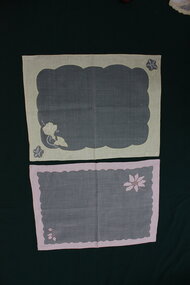
Textile - Marghab Madeira Embroidery Mats, 20thC
... ... Marghab...Marghab Linens Ltd. was a company specialising in table linens founded on Madeira in 1933 by British Cypriot Emile Marghab and his South Dakotan wife Vera (née Way); and disestablished in 1980. ...Part of 6 pieces Marghab/Madeira embroidery. Pink organdie mat with flowers in opposite corners....Marghab Linens Ltd. was a company specialising in table linens founded on Madeira in 1933 by British Cypriot Emile Marghab and his South Dakotan wife Vera (née Way); and disestablished in 1980. ...Marghab Linens Ltd. was a company specialising in table linens founded on Madeira in 1933 by British Cypriot Emile Marghab and his South Dakotan wife Vera (née Way); and disestablished in 1980. The company was also known as Emile Marghab Inc. Since 1850, when Madeiran natives were introduced to hand embroidery as a means of industry, the islands had been renowned for their needlework. The Marghabs took advantage of this reputation, producing textiles that were skilfully hand-embroidered on the highest quality Irish linen and a form of organdy called Margandie, made in Switzerland, and harder wearing than usual organdy. The linens were designed by Vera, and hand-embroidered as a home industry by the women on Madeira, who Vera insisted received payment per stitch - which for a single place mat could amount to seventy thousand stitches. Marghab linens were retailed through leading American department stores such as Lord & Taylor, Marshall Field's, and Neiman Marcus. In 1945 Vera Marghab was awarded the Neiman Marcus Fashion Award. Emile died in 1947, and his wife took charge of the business until its disestablishment in 1980. She died in 1995. While linens have continued to be produced by Madeira since Marghab closed in 1980, as of 2015 the quality and workmanship in Marghab's output remains highly regarded. In 1970, the South Dakota Art Museum were gifted nearly eight hundred examples of Marghab linens, followed by many gifts from Vera and her trustees. The Marghab Gallery was dedicated in 1970. As of 2015, the museum's holdings are described as the world's most complete collection of Marghab linens, with over three hundred patterns and almost 2800 objects. The museum holds at least one example of almost every design produced, but deaccessioned and sold off all the duplicates at auction in 2005 in order to raise money for building work. At the time of the auction, it was noted that Marghab linens had previously sold for hundreds of dollars over their reserve prices, and that it was extremely difficult to find matched sets.Part of 6 pieces Marghab/Madeira embroidery. Pink organdie mat with flowers in opposite corners.embroidery, madeira, marghab, mats, madeira embroidery -
 Embroiderers Guild, Victoria
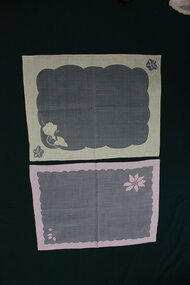
Textile - Marghab Madeira Embroidery Mats, 20thC
... ... Marghab...Marghab Linens Ltd. was a company specialising in table linens founded on Madeira in 1933 by British Cypriot Emile Marghab and his South Dakotan wife Vera (née Way); and disestablished in 1980. ...Part of 6 pieces Marghab/Madeira embroidery. Pink organdie mat with flowers in opposite corners ...Marghab Linens Ltd. was a company specialising in table linens founded on Madeira in 1933 by British Cypriot Emile Marghab and his South Dakotan wife Vera (née Way); and disestablished in 1980. ...Marghab Linens Ltd. was a company specialising in table linens founded on Madeira in 1933 by British Cypriot Emile Marghab and his South Dakotan wife Vera (née Way); and disestablished in 1980. The company was also known as Emile Marghab Inc. Since 1850, when Madeiran natives were introduced to hand embroidery as a means of industry, the islands had been renowned for their needlework. The Marghabs took advantage of this reputation, producing textiles that were skilfully hand-embroidered on the highest quality Irish linen and a form of organdy called Margandie, made in Switzerland, and harder wearing than usual organdy. The linens were designed by Vera, and hand-embroidered as a home industry by the women on Madeira, who Vera insisted received payment per stitch - which for a single place mat could amount to seventy thousand stitches. Marghab linens were retailed through leading American department stores such as Lord & Taylor, Marshall Field's, and Neiman Marcus. In 1945 Vera Marghab was awarded the Neiman Marcus Fashion Award. Emile died in 1947, and his wife took charge of the business until its disestablishment in 1980. She died in 1995. While linens have continued to be produced by Madeira since Marghab closed in 1980, as of 2015 the quality and workmanship in Marghab's output remains highly regarded. In 1970, the South Dakota Art Museum were gifted nearly eight hundred examples of Marghab linens, followed by many gifts from Vera and her trustees. The Marghab Gallery was dedicated in 1970. As of 2015, the museum's holdings are described as the world's most complete collection of Marghab linens, with over three hundred patterns and almost 2800 objects. The museum holds at least one example of almost every design produced, but deaccessioned and sold off all the duplicates at auction in 2005 in order to raise money for building work. At the time of the auction, it was noted that Marghab linens had previously sold for hundreds of dollars over their reserve prices, and that it was extremely difficult to find matched sets.Part of 6 pieces Marghab/Madeira embroidery. Pink organdie mat with flowers in opposite corners embroidery, madeira, marghab, mats, madeira embroidery -
 Embroiderers Guild, Victoria
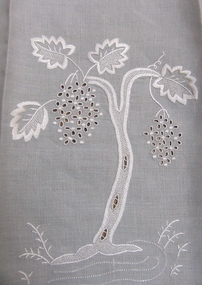
Textile - Marghab Madeira Hand towel, Marghab Company
... Marghab Linens Ltd. was a company specialising in table linens founded on Madeira in 1933 by British Cypriot Emile Marghab and his South Dakotan wife Vera (née Way); and disestablished in 1980.The company was also known as Emile Marghab Inc. ...Marghab Company...Marghab Linens Ltd. was a company specialising in table linens founded on Madeira in 1933 by British Cypriot Emile Marghab and his South Dakotan wife Vera (née Way); and disestablished in 1980.The company was also known as Emile Marghab Inc. ...Marghab Linens Ltd. was a company specialising in table linens founded on Madeira in 1933 by British Cypriot Emile Marghab and his South Dakotan wife Vera (née Way); and disestablished in 1980.The company was also known as Emile Marghab Inc. Since 1850, when Madeiran natives were introduced to hand embroidery as a means of industry, the islands had been renowned for their needlework. The Marghabs took advantage of this reputation, producing textiles that were skilfully hand-embroidered on the highest quality Irish linen and a form of organdie called Margandie, made in Switzerland, and harder wearing than usual organdie. The linens were designed by Vera, and hand-embroidered as a home industry by the women on Madeira, who Vera insisted received payment per stitch - which for a single place mat could amount to seventy thousand stitches.Pale grey linen hand towel with white embroidery, cutwork and applique. The design is of a tree with blossoms.madeira work, surface stitchery, hand towel -
 Embroiderers Guild, Victoria
Textile - Marghab Madeira Embroidery Mat, 20thC
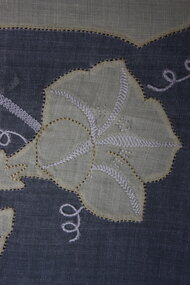
... ... Marghab...Marghab Linens Ltd. was a company specialising in table linens founded on Madeira in 1933 by British Cypriot Emile Marghab and his South Dakotan wife Vera (née Way); and disestablished in 1980. ...Part of 6 pieces Marghab/Madeira embroidery. a) Yellow and white organdie mat with convolvulus in 2 corners....Marghab Linens Ltd. was a company specialising in table linens founded on Madeira in 1933 by British Cypriot Emile Marghab and his South Dakotan wife Vera (née Way); and disestablished in 1980. ...Marghab Linens Ltd. was a company specialising in table linens founded on Madeira in 1933 by British Cypriot Emile Marghab and his South Dakotan wife Vera (née Way); and disestablished in 1980. The company was also known as Emile Marghab Inc. Since 1850, when Madeiran natives were introduced to hand embroidery as a means of industry, the islands had been renowned for their needlework. The Marghabs took advantage of this reputation, producing textiles that were skilfully hand-embroidered on the highest quality Irish linen and a form of organdy called Margandie, made in Switzerland, and harder wearing than usual organdy. The linens were designed by Vera, and hand-embroidered as a home industry by the women on Madeira, who Vera insisted received payment per stitch - which for a single place mat could amount to seventy thousand stitches. Marghab linens were retailed through leading American department stores such as Lord & Taylor, Marshall Field's, and Neiman Marcus. In 1945 Vera Marghab was awarded the Neiman Marcus Fashion Award. Emile died in 1947, and his wife took charge of the business until its disestablishment in 1980. She died in 1995. While linens have continued to be produced by Madeira since Marghab closed in 1980, as of 2015 the quality and workmanship in Marghab's output remains highly regarded. In 1970, the South Dakota Art Museum were gifted nearly eight hundred examples of Marghab linens, followed by many gifts from Vera and her trustees. The Marghab Gallery was dedicated in 1970. As of 2015, the museum's holdings are described as the world's most complete collection of Marghab linens, with over three hundred patterns and almost 2800 objects. The museum holds at least one example of almost every design produced, but deaccessioned and sold off all the duplicates at auction in 2005 in order to raise money for building work. At the time of the auction, it was noted that Marghab linens had previously sold for hundreds of dollars over their reserve prices, and that it was extremely difficult to find matched sets.Part of 6 pieces Marghab/Madeira embroidery. a) Yellow and white organdie mat with convolvulus in 2 corners.embroidery, madeira, marghab, mats, madeira embroidery -
 Embroiderers Guild, Victoria
Textile - Marghab Madeira Embroidery Mats, 20thC
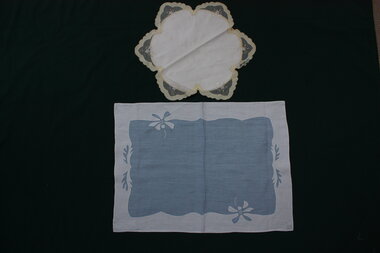
... ... Marghab...Marghab Linens Ltd. was a company specialising in table linens founded on Madeira in 1933 by British Cypriot Emile Marghab and his South Dakotan wife Vera (née Way); and disestablished in 1980. ...Part of 6 pieces Marghab/Madeira embroidery. f) Yellow and white scone holder with shadow embroidery...Marghab Linens Ltd. was a company specialising in table linens founded on Madeira in 1933 by British Cypriot Emile Marghab and his South Dakotan wife Vera (née Way); and disestablished in 1980. ...Marghab Linens Ltd. was a company specialising in table linens founded on Madeira in 1933 by British Cypriot Emile Marghab and his South Dakotan wife Vera (née Way); and disestablished in 1980. The company was also known as Emile Marghab Inc. Since 1850, when Madeiran natives were introduced to hand embroidery as a means of industry, the islands had been renowned for their needlework. The Marghabs took advantage of this reputation, producing textiles that were skilfully hand-embroidered on the highest quality Irish linen and a form of organdy called Margandie, made in Switzerland, and harder wearing than usual organdy. The linens were designed by Vera, and hand-embroidered as a home industry by the women on Madeira, who Vera insisted received payment per stitch - which for a single place mat could amount to seventy thousand stitches. Marghab linens were retailed through leading American department stores such as Lord & Taylor, Marshall Field's, and Neiman Marcus. In 1945 Vera Marghab was awarded the Neiman Marcus Fashion Award. Emile died in 1947, and his wife took charge of the business until its disestablishment in 1980. She died in 1995. While linens have continued to be produced by Madeira since Marghab closed in 1980, as of 2015 the quality and workmanship in Marghab's output remains highly regarded. In 1970, the South Dakota Art Museum were gifted nearly eight hundred examples of Marghab linens, followed by many gifts from Vera and her trustees. The Marghab Gallery was dedicated in 1970. As of 2015, the museum's holdings are described as the world's most complete collection of Marghab linens, with over three hundred patterns and almost 2800 objects. The museum holds at least one example of almost every design produced, but deaccessioned and sold off all the duplicates at auction in 2005 in order to raise money for building work. At the time of the auction, it was noted that Marghab linens had previously sold for hundreds of dollars over their reserve prices, and that it was extremely difficult to find matched sets.Part of 6 pieces Marghab/Madeira embroidery. f) Yellow and white scone holder with shadow embroideryembroidery, madeira, marghab, mats, madeira embroidery -
 Embroiderers Guild, Victoria
Textile - Marghab Madeira Embroidery Mats, 20thC
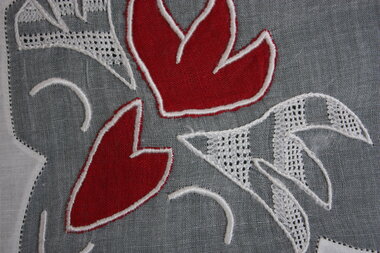
... ... Marghab...Marghab Linens Ltd. was a company specialising in table linens founded on Madeira in 1933 by British Cypriot Emile Marghab and his South Dakotan wife Vera (née Way); and disestablished in 1980. ...Part of 6 pieces Marghab/Madeira embroidery. d) White organdie mat with red and white spray. ...Marghab Linens Ltd. was a company specialising in table linens founded on Madeira in 1933 by British Cypriot Emile Marghab and his South Dakotan wife Vera (née Way); and disestablished in 1980. ...Marghab Linens Ltd. was a company specialising in table linens founded on Madeira in 1933 by British Cypriot Emile Marghab and his South Dakotan wife Vera (née Way); and disestablished in 1980. The company was also known as Emile Marghab Inc. Since 1850, when Madeiran natives were introduced to hand embroidery as a means of industry, the islands had been renowned for their needlework. The Marghabs took advantage of this reputation, producing textiles that were skilfully hand-embroidered on the highest quality Irish linen and a form of organdy called Margandie, made in Switzerland, and harder wearing than usual organdy. The linens were designed by Vera, and hand-embroidered as a home industry by the women on Madeira, who Vera insisted received payment per stitch - which for a single place mat could amount to seventy thousand stitches. Marghab linens were retailed through leading American department stores such as Lord & Taylor, Marshall Field's, and Neiman Marcus. In 1945 Vera Marghab was awarded the Neiman Marcus Fashion Award. Emile died in 1947, and his wife took charge of the business until its disestablishment in 1980. She died in 1995. While linens have continued to be produced by Madeira since Marghab closed in 1980, as of 2015 the quality and workmanship in Marghab's output remains highly regarded. In 1970, the South Dakota Art Museum were gifted nearly eight hundred examples of Marghab linens, followed by many gifts from Vera and her trustees. The Marghab Gallery was dedicated in 1970. As of 2015, the museum's holdings are described as the world's most complete collection of Marghab linens, with over three hundred patterns and almost 2800 objects. The museum holds at least one example of almost every design produced, but deaccessioned and sold off all the duplicates at auction in 2005 in order to raise money for building work. At the time of the auction, it was noted that Marghab linens had previously sold for hundreds of dollars over their reserve prices, and that it was extremely difficult to find matched sets.Part of 6 pieces Marghab/Madeira embroidery. d) White organdie mat with red and white spray. embroidery, madeira, marghab, mats, madeira embroidery -
 Embroiderers Guild, Victoria
Textile - Marghab Madeira Embroidery Mats, 20thC
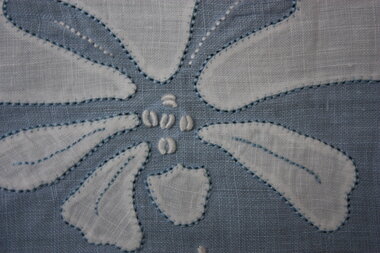
... ... Marghab...Marghab Linens Ltd. was a company specialising in table linens founded on Madeira in 1933 by British Cypriot Emile Marghab and his South Dakotan wife Vera (née Way); and disestablished in 1980. ...Part of 6 pieces Marghab/Madeira embroidery. e) Blue and white cotton mat with applique flowers in border....Marghab Linens Ltd. was a company specialising in table linens founded on Madeira in 1933 by British Cypriot Emile Marghab and his South Dakotan wife Vera (née Way); and disestablished in 1980. ...Marghab Linens Ltd. was a company specialising in table linens founded on Madeira in 1933 by British Cypriot Emile Marghab and his South Dakotan wife Vera (née Way); and disestablished in 1980. The company was also known as Emile Marghab Inc. Since 1850, when Madeiran natives were introduced to hand embroidery as a means of industry, the islands had been renowned for their needlework. The Marghabs took advantage of this reputation, producing textiles that were skilfully hand-embroidered on the highest quality Irish linen and a form of organdy called Margandie, made in Switzerland, and harder wearing than usual organdy. The linens were designed by Vera, and hand-embroidered as a home industry by the women on Madeira, who Vera insisted received payment per stitch - which for a single place mat could amount to seventy thousand stitches. Marghab linens were retailed through leading American department stores such as Lord & Taylor, Marshall Field's, and Neiman Marcus. In 1945 Vera Marghab was awarded the Neiman Marcus Fashion Award. Emile died in 1947, and his wife took charge of the business until its disestablishment in 1980. She died in 1995. While linens have continued to be produced by Madeira since Marghab closed in 1980, as of 2015 the quality and workmanship in Marghab's output remains highly regarded. In 1970, the South Dakota Art Museum were gifted nearly eight hundred examples of Marghab linens, followed by many gifts from Vera and her trustees. The Marghab Gallery was dedicated in 1970. As of 2015, the museum's holdings are described as the world's most complete collection of Marghab linens, with over three hundred patterns and almost 2800 objects. The museum holds at least one example of almost every design produced, but deaccessioned and sold off all the duplicates at auction in 2005 in order to raise money for building work. At the time of the auction, it was noted that Marghab linens had previously sold for hundreds of dollars over their reserve prices, and that it was extremely difficult to find matched sets.Part of 6 pieces Marghab/Madeira embroidery. e) Blue and white cotton mat with applique flowers in border.embroidery, madeira, marghab, mats, madeira embroidery -
 Embroiderers Guild, Victoria
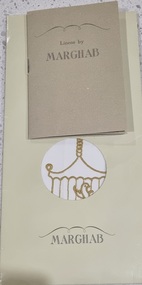
Textile - Marghab Linen Hand Towel
... Marghab Linens Ltd. was a company specialising in table linens founded on Madeira in 1933 by British Cypriot Emile Marghab and his South Dakotan wife Vera (née Way); and disestablished in 1980.The company was also known as Emile Marghab Inc. ...Marghab linen hand towel in original card envelope with accompanying description....Marghab Linens Ltd. was a company specialising in table linens founded on Madeira in 1933 by British Cypriot Emile Marghab and his South Dakotan wife Vera (née Way); and disestablished in 1980.The company was also known as Emile Marghab Inc. ...Marghab Linens Ltd. was a company specialising in table linens founded on Madeira in 1933 by British Cypriot Emile Marghab and his South Dakotan wife Vera (née Way); and disestablished in 1980.The company was also known as Emile Marghab Inc. Since 1850, when Madeiran natives were introduced to hand embroidery as a means of industry, the islands had been renowned for their needlework. The Marghabs took advantage of this reputation, producing textiles that were skilfully hand-embroidered on the highest quality Irish linen and a form of organdie called Margandie, made in Switzerland, and harder wearing than usual organdie. The linens were designed by Vera, and hand-embroidered as a home industry by the women on Madeira, who Vera insisted received payment per stitch - which for a single place mat could amount to seventy thousand stitches.Marghab linen hand towel in original card envelope with accompanying description. -
 Embroiderers Guild, Victoria
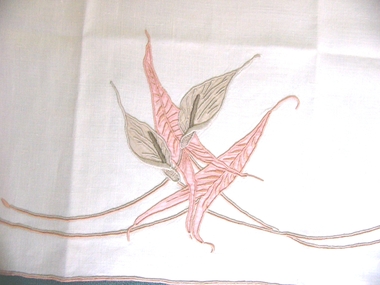
Textile - Embroidered Hand Towel, Mid 20th century
... Marghab Linens Ltd. was a company specialising in table linens founded on Madeira in 1933 by British Cypriot Emile Marghab and his South Dakotan wife Vera (née Way); and disestablished in 1980.The company was also known as Emile Marghab Inc. ...lilies and leaves in applique, satin stitch and couching. Marghab....Marghab Linens Ltd. was a company specialising in table linens founded on Madeira in 1933 by British Cypriot Emile Marghab and his South Dakotan wife Vera (née Way); and disestablished in 1980.The company was also known as Emile Marghab Inc. ...Marghab Linens Ltd. was a company specialising in table linens founded on Madeira in 1933 by British Cypriot Emile Marghab and his South Dakotan wife Vera (née Way); and disestablished in 1980.The company was also known as Emile Marghab Inc. Since 1850, when Madeiran natives were introduced to hand embroidery as a means of industry, the islands had been renowned for their needlework. The Marghabs took advantage of this reputation, producing textiles that were skilfully hand-embroidered on the highest quality Irish linen and a form of organdie called Margandie, made in Switzerland, and harder wearing than usual organdie. The linens were designed by Vera, and hand-embroidered as a home industry by the women on Madeira, who Vera insisted received payment per stitch - which for a single place mat could amount to seventy thousand stitches.Cream linen with a design of pink and brown. lilies and leaves in applique, satin stitch and couching. Marghab.embroidery, towels, surface stitchery, madeira, 1940-60 -
 Embroiderers Guild, Victoria
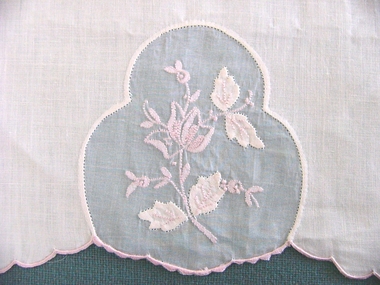
Textile - Marghab Shadow Work Mat, mid 20th century
... Marghab Linens Ltd. was a company specialising in table linens founded on Madeira in 1933 by British Cypriot Emile Marghab and his South Dakotan wife Vera (née Way); and disestablished in 1980.The company was also known as Emile Marghab Inc. ...Fine padded and scalloped buttonhole edge. Marghab....Marghab Linens Ltd. was a company specialising in table linens founded on Madeira in 1933 by British Cypriot Emile Marghab and his South Dakotan wife Vera (née Way); and disestablished in 1980.The company was also known as Emile Marghab Inc. ...Marghab Linens Ltd. was a company specialising in table linens founded on Madeira in 1933 by British Cypriot Emile Marghab and his South Dakotan wife Vera (née Way); and disestablished in 1980.The company was also known as Emile Marghab Inc. Since 1850, when Madeiran natives were introduced to hand embroidery as a means of industry, the islands had been renowned for their needlework. The Marghabs took advantage of this reputation, producing textiles that were skilfully hand-embroidered on the highest quality Irish linen and a form of organdie called Margandie, made in Switzerland, and harder wearing than usual organdie. The linens were designed by Vera, and hand-embroidered as a home industry by the women on Madeira, who Vera insisted received payment per stitch - which for a single place mat could amount to seventy thousand stitches.Fine pale pink linen with an inset panel in organza, featuring a spray of flowers in shadow work. Fine padded and scalloped buttonhole edge. Marghab.embroidery, shadow work, towels, madeira, 1940-60 -
 Embroiderers Guild, Victoria
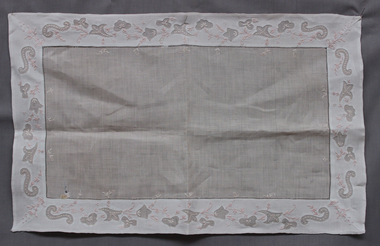
Textile - Madeira Work Embroidered Mat, 20 th C
... ...Marghab...Marghab Linens Ltd. was a company specialising in table linens founded on Madeira in 1933 by British Cypriot Emile Marghab and his South Dakotan wife Vera (née Way); and disestablished in 1980.The company was also known as Emile Marghab Inc. ...Marghab Linens Ltd. was a company specialising in table linens founded on Madeira in 1933 by British Cypriot Emile Marghab and his South Dakotan wife Vera (née Way); and disestablished in 1980.The company was also known as Emile Marghab Inc. ...Marghab Linens Ltd. was a company specialising in table linens founded on Madeira in 1933 by British Cypriot Emile Marghab and his South Dakotan wife Vera (née Way); and disestablished in 1980.The company was also known as Emile Marghab Inc. Since 1850, when Madeiran natives were introduced to hand embroidery as a means of industry, the islands had been renowned for their needlework. The Marghabs took advantage of this reputation, producing textiles that were skilfully hand-embroidered on the highest quality Irish linen and a form of organdie called Margandie, made in Switzerland, and harder wearing than usual organdie. The linens were designed by Vera, and hand-embroidered as a home industry by the women on Madeira, who Vera insisted received payment per stitch - which for a single place mat could amount to seventy thousand stitches.Pale peach mat with white border with Madeira work and embroidery in a pattern of scrolls and flowersembroidery, madeira, marghab, mats
