
Showing 81 items matching "maritime union of australia"
-
 Greensborough Historical Society
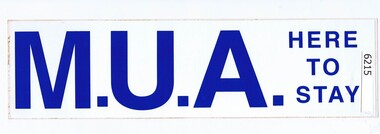
Bumper sticker, M.U.A. here to stay, 1998_
... maritime union of australia...Issued by the Maritime Union of Australia, in support of the wharf workers locked out by Patrick corporation, with the support of the Federal government of the time....Maritime Union of Australia...Issued by the Maritime Union of Australia, in support of the wharf workers locked out by Patrick corporation, with the support of the Federal government of the time. maritime union of australia australian waterfront dispute Bumper sticker, adhesive on backing material, printed in blue on white M.U.A. here to stay Bumper sticker Maritime Union of Australia ...Issued by the Maritime Union of Australia, in support of the wharf workers locked out by Patrick corporation, with the support of the Federal government of the time.Bumper sticker, adhesive on backing material, printed in blue on whitemaritime union of australia, australian waterfront dispute -
 Port Melbourne Historical & Preservation Society
Badge - MUA Here to Stay, Maritime Union of Australia (MUA), May 1998
... ...Maritime Union of Australia...Maritime Union of Australia (MUA)...Blue with white letters, damaged Badge MUA Here to Stay Maritime Union of Australia (MUA) ...On a visit to the picket at Swanson Dock in May 1998 there were no badges left to sell. This one, being faulty, was given to donor by a wharfie. Needs a cover.M.U.A. Here to Stay badge from the 1998 Patrick Stevedores lockout of the MUA wharfies. Blue with white letters, damagedpiers and wharves - waterside workers, societies clubs unions and other organisations, public action campaigns, transport - shipping, maritime union of australia, mua -
Port Melbourne Historical & Preservation Society
Audio - PMHPS Meeting, Mick Cottrell, Maritime Union of Australia, Glen Stuart, 26 Oct 1998
... PMHPS Meeting, Mick Cottrell, Maritime Union of Australia...Speaker was Mick Cottrell of the Maritime Union of Australia on the work of waterside workers and industrial disputes. ...Speaker was Mick Cottrell of the Maritime Union of Australia on the work of waterside workers and industrial disputes. ...Recording of PMHPS Meeting on 26.10.1998. Recording done by Glen Stuart at Port Town Hall. Speaker was Mick Cottrell of the Maritime Union of Australia on the work of waterside workers and industrial disputes. Recording duration 51:50piers and wharves - station pier, piers and wharves - waterside workers, transport - shipping, business and traders, edward j (ted) rohan, thirst-aid kiosk -
Port Melbourne Historical & Preservation Society
Document - Invitation, Tom Hills' 90th birthday party, Maritime Union of Australia (MUA), Tom Hills Archive, Jan 1994
... Maritime Union of Australia (MUA)...celebrations fetes and exhibitions tom hills lexie bown david graham Invitation to Tom Hills' 90th birthday party at PortMelbourne Town Hall 18 February 1994; blue A4, with drawing of wharfie from ''Under the Hook" Tom Hills Archive Document Invitation, Tom Hills' 90th birthday party Maritime Union of Australia (MUA) ...Invitation to Tom Hills' 90th birthday party at PortMelbourne Town Hall 18 February 1994; blue A4, with drawing of wharfie from ''Under the Hook"celebrations fetes and exhibitions, tom hills, lexie bown, david graham -
 Port Melbourne Historical & Preservation Society
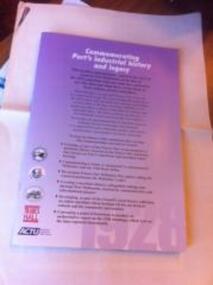
Booklet, Commemorating Port's Industrial History and Legacy, Feb 2011
... ...Maritime Union of Australia...Maritime Union of Australia (MUA)...Back cover has map of "historic watersiders Port Melbourne walk" Commemorating Port's Industrial History and Legacy Booklet Maritime Union of Australia (MUA) ...Published to commemorate the anniversary of the 1928 waterfont lockout.Booklet with mauve background and black and white and dark red text. Back cover has map of "historic watersiders Port Melbourne walk"built environment, piers and wharves - princes pier, industrial disputes, allan whittaker, piers and wharves - waterside workers, maritime union of australia, mua, hogan's flat, beacon cove, james laurence murphy, george sangster -
Port Melbourne Historical & Preservation Society
Document - Eulogy, MUA president, Reg SIMS, for Tom HILLS, Reg Sims, Tom Hills Archive, 5 Jun 1995
... Facsimile sent to Jerry McASEY in Sydney by Lexie BOWN of the Maritime Union of Australia after the death of Tom HILLS. ...Maritime Union of Australia (MUA)...Deaths and Funerals Piers and Wharves - Waterside Workers Tom HILLS Reg SIMS Lexie BOWN Wendy LOWENSTEIN Eulogy annotated first page Facsimile sent to Jerry McASEY in Sydney by Lexie BOWN of the Maritime Union of Australia after the death of Tom HILLS. ...Facsimile sent to Jerry McASEY in Sydney by Lexie BOWN of the Maritime Union of Australia after the death of Tom HILLS. Contains eulogy given by MUA president Reg SIMS (4 pages) and several items copied from "Under the Hook" 5 June 1995Eulogy annotated first pagedeaths and funerals, piers and wharves - waterside workers, tom hills, reg sims, lexie bown, wendy lowenstein -
 Mission to Seafarers Victoria
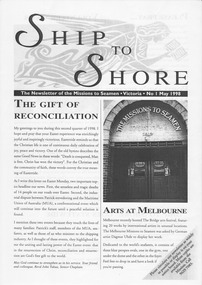
Magazine (item) - Newsletter, Mission to Seafarers Victoria, Ship to Shore , Issue 1 1998, May 1998
... ...maritime union of australia...Ship to Shore is a valable source of information ship to shore mission to seamen mission to seafarers flinders street melbourne victoria news events seafaring life shipping sailors seamen sponsors marketing flying angel staff chaplains community welfare board members 1998 ridley college dagmar udhe portland mission hastings mission patrick s.s. co mua maritime union of australia stevedoring easter arts A4 size one page newsletter Ship to Shore , Issue 1 1998 Magazine Newsletter Mission to Seafarers Victoria ...Ship to Shore was first printed in 1997. Inspired by the Jottings From Our Log, this modern version is generally published quarterly (Summer, Autumn, Winter, Spring) Articles are written by the mission's staff and give updates about shipping and seafaring news, staff, events, board Committee, heritage. It is sent by post or email to supporters, members, volunteers and friends of the mission. It is also available to the public in the Flying Angel club and online on the website.Ship to Shore is a valable source of informationship to shore, mission to seamen, mission to seafarers, flinders street, melbourne, victoria, news, events, seafaring life, shipping, sailors, seamen, sponsors, marketing, flying angel, staff, chaplains, community, welfare, board members, 1998, ridley college, dagmar udhe, portland mission, hastings mission, patrick s.s. co, mua, maritime union of australia, stevedoring, easter, arts -
Port Melbourne Historical & Preservation Society
Book - Maritime history, Wendy Lowenstein et al, Under the Hook, 1998
... ...maritime union of australia...As original plates and artwork were no longer in existence, this edition was shot dot for dot from the pages of the original edition (ref 169.01) piers and wharves - waterside workers depression industrial disputes transport - shipping tom hills wendy lowenstein manny calleja jack marotte charlie morgan henry briggs mick fisher sol green tippo hayes al greenwood ernie briggs bert king henry hall harry saunders maritime union of australia mua george chumbley hubbard leigh john higgins mick cottrell lenny meager mick o'leary gerry harant john dickson terry russell leigh snelling molly hadfield jessie smith dave cushion mick ryan matt purcell jim mcnamara peter keunan paul amos fred broch manfred noa john coombs greg combet patrick stevedores peter reith Softcover 1998 edition, black cloth-bound with black/blue/white dust jacket titled "Under the Hook - Melbourne Waterside Workers Remember 1906 - 1998". ...Wendy revised the book by adding a new section after the Patrick's dispute of 1998. As original plates and artwork were no longer in existence, this edition was shot dot for dot from the pages of the original edition (ref 169.01)Softcover 1998 edition, black cloth-bound with black/blue/white dust jacket titled "Under the Hook - Melbourne Waterside Workers Remember 1906 - 1998". This edition contains added 1998 material on the Patrick's lock-out dispute at Webb Dock and Swanson Dockpiers and wharves - waterside workers, depression, industrial disputes, transport - shipping, tom hills, wendy lowenstein, manny calleja, jack marotte, charlie morgan, henry briggs, mick fisher, sol green, tippo hayes, al greenwood, ernie briggs, bert king, henry hall, harry saunders, maritime union of australia, mua, george chumbley, hubbard, leigh, john higgins, mick cottrell, lenny meager, mick o'leary, gerry harant, john dickson, terry russell, leigh snelling, molly hadfield, jessie smith, dave cushion, mick ryan, matt purcell, jim mcnamara, peter keunan, paul amos, fred broch, manfred noa, john coombs, greg combet, patrick stevedores, peter reith -
Port Melbourne Historical & Preservation Society
Book, Jim Beggs, "Proud to be a wharfie", 2014
... ...Maritime Union of Australia...Piers and Wharves - Waterside Workers State Government Victoria Commonwealth Government Piers and Wharves Jim BEGGS Waterside Workers Federation Maritime Union of Australia MUA Missions to Seamen Victorian Trades Hall "Best wishes Jim Beggs" "Proud to be a wharfie" by Jim Beggs. ..."Proud to be a wharfie" by Jim Beggs. Paperback book of 260 pages second edition 2014"Best wishes Jim Beggs"piers and wharves - waterside workers, state government victoria, commonwealth government, piers and wharves, jim beggs, waterside workers federation, maritime union of australia, mua, missions to seamen, victorian trades hall -
Port Melbourne Historical & Preservation Society
Archive - Binder, Zetta Florence, Tom Hills Archive
... ...Maritime Union of Australia...Tom Hills Wendy Lowenstein Wendy Morris Lexie Bown Maritime Union of Australia MUA Retired Waterside Workers Unemployed Workers Union Large blue binder with slipcover containing photos and documents from or about waterside worker Tom Hills 1904-1995, including items 2525.02 to 2525.19, plus 169.02, 262.01-.06, 466, 508,01 -.02, 852 and 1062. ...Large blue binder with slipcover containing photos and documents from or about waterside worker Tom Hills 1904-1995, including items 2525.02 to 2525.19, plus 169.02, 262.01-.06, 466, 508,01 -.02, 852 and 1062.piers and wharves - waterside workers, arts and entertainment - literature, celebrations fetes and exhibitions, awards and presentations, oral history, memorials, deaths and funerals, social activities, societies clubs unions and other organisations., tom hills, wendy lowenstein, wendy morris, lexie bown, maritime union of australia, mua, retired waterside workers, unemployed workers union -
Port Melbourne Historical & Preservation Society
Book - Reference, Helen Trinca et al, Waterfront - The Battle that Changed Australia, 2000
... ...Maritime Union of Australia...Was purchased on eBay as a pair with "Ship to Shore" Societies Clubs Unions and other Organisations Transport - Shipping Piers and Wharves - Waterside Workers Piers and Wharves - Webb Dock Maritime Union of Australia MUA Anne DAVIES Helen TRINCA Pencil, end paper "sale $8" "Waterfront - The Battle that Changed Australia" by journalists Helen TRINCA and Anne DAVIES - 317 pp paperback on the 1998 Patrick conspiracy. ...Was purchased on eBay as a pair with "Ship to Shore""Waterfront - The Battle that Changed Australia" by journalists Helen TRINCA and Anne DAVIES - 317 pp paperback on the 1998 Patrick conspiracy. Doubleday 2000 illustrated, end notes, indexed, with chronologyPencil, end paper "sale $8"societies clubs unions and other organisations, transport - shipping, piers and wharves - waterside workers, piers and wharves - webb dock, maritime union of australia, mua, anne davies, helen trinca -
Port Melbourne Historical & Preservation Society
Photograph - Maritime Union Australia President, Reg SIMS, giving the eulogy for Tom HILLS, Reg Sims, Tom Hills Archive, 5 Jun 1995
... Maritime Union Australia President, Reg SIMS, giving the eulogy for Tom HILLS...Photo of Maritime Union Australia President Reg SIMS giving the Eulogy for Tom HILLS 5 June 1995...Deaths and Funerals Piers and Wharves - Waterside Workers Tom HILLS Reg SIMS Lexie BOWN Wendy LOWENSTEIN Photo of Maritime Union Australia President Reg SIMS giving the Eulogy for Tom HILLS 5 June 1995 Tom Hills Archive Photograph Maritime Union Australia President, Reg SIMS, giving the eulogy for Tom HILLS Reg Sims ...Photo of Maritime Union Australia President Reg SIMS giving the Eulogy for Tom HILLS 5 June 1995deaths and funerals, piers and wharves - waterside workers, tom hills, reg sims, lexie bown, wendy lowenstein -
Unions Ballarat
Waterfront : the battle that changed Australia, Trinca, Helen et al, 2000
... ...maritime union australia...The background story of the 1998 industrial dispute between Patrick's stevedoring company and the Maritime Union of Australia. The dispute was triggered by Patrick's restructure of their company and subsequent lock out and dismissal of unionised workers. ...The background story of the 1998 industrial dispute between Patrick's stevedoring company and the Maritime Union of Australia. The dispute was triggered by Patrick's restructure of their company and subsequent lock out and dismissal of unionised workers. ...The background story of the 1998 industrial dispute between Patrick's stevedoring company and the Maritime Union of Australia. The dispute was triggered by Patrick's restructure of their company and subsequent lock out and dismissal of unionised workers. Non-union labour was deployed in an attempt to break the MUA.Relevance to the Waterfront dispute of 1998, the history of trade unions and, particularly, the MUA.Paper; book. Front cover: colour photographs; black, blue and white text. Front cover: author's name and title; quotation from Philip Adams.btlc, ballarat trades hall, ballarat trades and labour council, waterfront dispute 1998, maritime union australia, mua, unions, industrial action, strikes, lock outs, unfair dismissal, patrick's stevedoring, non-union labour -
 Glenelg Shire Council Cultural Collection
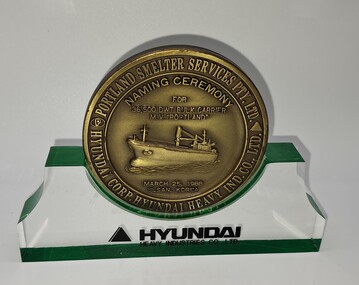
Medal - Naming Ceremony for M.V Portland - Medallion, 1988
... From the Maritime Union of Australia: In December 2015 the crew of the MV Portland heard about their sacking by newspaper article. ...From the Maritime Union of Australia: In December 2015 the crew of the MV Portland heard about their sacking by newspaper article. ...From the Maritime Union of Australia: In December 2015 the crew of the MV Portland heard about their sacking by newspaper article. What ensued was a 60 day sit in by the crew to fight for their jobs. The crew were threatened with legal action but they stood firm because they believed that their ship was purely cabotage trade taking Australian resources from one Australian port to another Australian port as it had done for 27 years without incident and it should have an Australia Crew. On January 13 2016, at 1am the five remaining crewmembers aboard the Alcoa-owned vessel were woken by up to 30 security guards and intimidated into leaving the vessel. A foreign crew had been flown in and it crewed the ship and it sailed off the Australian Coast. This documentary was produced one year after the dispute but since then the Australian Industrial Relations commission was attempting to prosecute the union and the crew. They failed.Bronze coloured medallion. One side has an image of a vessel with writing around the circumference of the object. The reverse of the objects has a list of vessel specifications. with plastic stand - acrylicPortland Smelter Services Pty. Ltd / Hyundai Corp. Hyundai Heavy Ind Co Ltd / Naming Ceremony / For / 36500 DWT Bulk Carrier / MV Portland / March 25, 1988 / Ulsan / Koreavessels, vessel, container, maritime union -
 Flagstaff Hill Maritime Museum and Village
Instrument - Clock
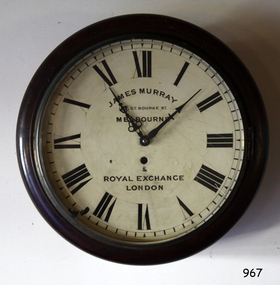
... Maritime Village...Great Ocean Road...Bank of Australasia...BoA...Union Bank...Australia...Flagstaff Hill Warrnambool Shipwrecked coast Flagstaff Hill Maritime Museum Maritime Museum Shipwreck coast Flagstaff Hill Maritime Village Great Ocean Road Bank of Australasia BoA Union Bank Australia & New Zealand Bank ANZ Bank James Murray clock wall clock Great Bourke Street Melbourne Royal Exchange London William Kerr turret clock Old Model School National Model & Training School access door winding key Face: "JAMES MURRAY / - GT. ...This wall clock originated from the Bank of Australasia. The label on the base matches other items from the same donor. It was spring powered by winding the key mechanism with the clock's key through the hole in the clock face. The hinged door on the base of the clock's case allows access to the clock's working mechanism. James Murray (son of James Murray 1780-1847) was a maker of clocks and chronometers. He worked at No. 1, Royal Exchange, London and from 1861 at 107 Great Bourke Street, Melbourne. In 1854 William Kerr ordered a clock from James Murray and erected it on the Albert Street frontage of the National Model & Training School in Spring Street Melbourne. It was Melbourne's first turret clock and remained there for 80 years before it was transferred to the Public Library in Melbourne in 1934 (now Museum Victoria). The Bank of Australasia was incorporated by Royal Charter of England in March 1834. It had its Australian beginning on 14th December 1835, opening in Sydney. The Acting Superintendent of the bank at that time was David Charters McArthur. He was Superintendent from 1867-to 1876. The Melbourne branch opened on 28th August 1838 in a two-roomed brick cottage on the north side of Little Collins Street, where two huge mastiff dogs were used at night to guard the bank. The government also provided an armed military sentinel. Due to the bank's rapid growth, a new building for the Melbourne branch was opened in 1840 at 75 Collins Street West. By 1879 the bank had been upgraded to a magnificent two-storey building on the corners of Collins and Queens Streets, with the entry on Collins Street. In 1951 the Bank of Australasia amalgamated with the Union Bank to form the Australia and New Zealand Bank, now known as the ANZ. Then in 1970, the ANZ merged with both the ES&A and the London Bank of Australia to form the ANZ Banking Group Limited. The ANZ Banking Group Ltd kindly donated a variety of historic items from the Bank of Australasia. BANK of AUSTRALASIA, WARRNAMBOOL – In 1854 Warrnambool had two banks, the Union Bank and the Bank of Australasia. Later, completely different bank businesses opened; in 1867 the National Bank of Australasia, then in 1875 the Colonial Bank of Australasia. The original Warrnambool branch of the Bank of Australasia was established in July 1854, and operated from a leased cottage on Merri Street, close to Liebig Street. The bank next bought a stone building previously erected by drapers Cramond & Dickson on the corner of Timor and Gibson Streets. Samuel Hannaford was a teller and then Manager at the Warrnambool branch from 1855 to 1856 and the Warrnambool Council chose that bank for its dealings during 1856-57. In 1859 Roberts & Co. was awarded the contract to build the new Bank of Australasia branch for the sum of £3,000. The land was on a sand hill on the northeast corner of Timor and Kepler Streets and had been bought in 1855 from investor James Cust. The new building opened on May 21, 1860. The bank continued to operate there until 1951 when it merged with the Union Bank to form the ANZ Bank, which continued operating from its Liebig Street building. Warrnambool City Council purchased the former Bank of Australasia building in 1971 and renovated it, then on 3rd December 1973 it was officially opened as the Art Gallery by Cr. Harold Stephenson and Gallery Director John Welsh. The Gallery transferred to the purpose-built building in Liebig Street in 1986 and the old bank building is now the Gallery club. Staff at the Bank of Australasia in Warrnambool included the following men but others were also involved: Samuel Hannaford, Teller then Manager from 1855-1856; W H Palmer, Manager from January 1857 until November 1869 when the Teller Basil Spence was promoted to Manager; H B Chomley, Manager from April 1873 and still there in 1886; A Butt, Manager in 1895-1904; J R McCleary Accountant and Acting Manager for 12 months, until 1900; A Kirk, Manager 1904; J Moore, staff until his transfer to Bendigo in December 1908; J S Bath was Manager until 1915; C C Cox, Manager until April 1923; Richard C Stanley, Manager 1923 to April 1928. The clock has significance through its association with the Bank of Australasia. The early Australian bank was established in 1834 by Royal Charter and opened in Sydney, Australia, in Sydney in 1835. The bank had many Australian offices in November 1877, particularly on the east and south coasts. Victoria had 45 percent of all Offices. The clock is significant for its connection with the quality clockmaker James Murray, originally from Royal Exchange London with a branch that opened in Melbourne in 1861. James Murray is renown for making the first turret clock to be installed in Melbourne. The clock is locally significant for its association with the Warrnambool Bank of Australasia, which was established in 1854. It was Warrnambool Council’s first bank. The bank continued to operate until the organisation's merger in 1951 when it became the ANZ Bank Group today. The Bank was an integral part of the growth of local commerce and the community.Wall clock with a round face behind glass in a wooden case. The painted brass face has Roman numerals, two decorative hands, divisions for minutes and a keyhole. The curved base of the case has a hinged access door with a keyhole and adhesive label. The back of the clock's case has metal mounting brackets. Inscriptions on the rectangular white label. Made by James Murray, Melbourne.Face: "JAMES MURRAY / - GT. BOURKE ST. / MELBOURNE / & / ROYAL EXCHANGE / LONEON" Label: "A M / 40"flagstaff hill, warrnambool, shipwrecked coast, flagstaff hill maritime museum, maritime museum, shipwreck coast, flagstaff hill maritime village, great ocean road, bank of australasia, boa, union bank, australia & new zealand bank, anz bank, james murray, clock, wall clock, great bourke street melbourne, royal exchange london, william kerr, turret clock, old model school, national model & training school, access door, winding key -
 Flagstaff Hill Maritime Museum and Village
Plaque - Insignia, Bank of Australasia, 16-10-1980
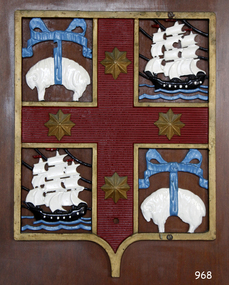
... Maritime Village...Great Ocean Road...Bank of Australasia...BoA...Union Bank...Australia...Flagstaff Hill Warrnambool Shipwrecked coast Flagstaff Hill Maritime Museum Maritime Museum Shipwreck coast Flagstaff Hill Maritime Village Great Ocean Road Bank of Australasia BoA Union Bank Australia & New Zealand Bank ANZ Bank David Charters McArthur D C McArthur Currency Banknote Commerce Banking Heraldic Shield Insignia Samuel Hannaford Decals; ships, sheep, stars Insignia of the Bank of Australasia. ...This plaque displays the Bank of Australia's Coat of Arms and is significant because is ts the symbol printed on the Bank Notes of the Bank of Australasia. The bank of Australasia was incorporated by Royal Charter of England in March 1834. It had its Australian beginning on 14th December 1835, opening in Sydney. The Acting Superintendent of the bank at that time was David Charters McArthur. He was Superintendent from 1867-to 1876. The Melbourne branch opened on 28th August 1838 in a two-roomed brick cottage on the north side of Little Collins Street, where two huge mastiff dogs were used at night to guard the bank. The government also provided an armed military sentinel. Due to the bank's rapid growth, a new building for the Melbourne branch was opened in 1840 at 75 Collins Street West. By 1879 the bank had been upgraded to a magnificent two-storey building on the corners of Collins and Queens Streets, with the entry on Collins Street. In 1951 the Bank of Australasia amalgamated with the Union Bank to form the Australia and New Zealand Bank, now known as the ANZ. Then in 1970, the ANZ merged with both the ES&A and the London Bank of Australia to form the ANZ Banking Group Limited. The ANZ Banking Group Ltd kindly donated a variety of historic items from the Bank of Australasia. BANK of AUSTRALASIA, WARRNAMBOOL – In 1854 Warrnambool had two banks, the Union Bank and the Bank of Australasia. Later, completely different bank businesses opened; in 1867 the National Bank of Australasia, then in 1875 the Colonial Bank of Australasia. The original Warrnambool branch of the Bank of Australasia was established in July 1854, and operated from a leased cottage on Merri Street, close to Liebig Street. The bank next bought a stone building previously erected by drapers Cramond & Dickson on the corner of Timor and Gibson Streets. Samuel Hannaford was a teller and then Manager at the Warrnambool branch from 1855 to 1856 and the Warrnambool Council chose that bank for its dealings during 1856-57. In 1859 Roberts & Co. was awarded the contract to build the new Bank of Australasia branch for the sum of £3,000; the firm built the Warrnambool Post Office in 1856 and purchased land in Timor Street in 1858. The land was on a sand hill on the northeast corner of Timor and Kepler Streets and had been bought in 1855 from investor James Cust. The new building opened on May 21, 1860. The bank continued to operate there until 1951 when it merged with the Union Bank to form the ANZ Bank, which continued operating from its Liebig Street building. Warrnambool City Council purchased the former Bank of Australasia building in 1971 and renovated it, then on 3rd December 1973 it was officially opened as the Art Gallery by Cr. Harold Stephenson and Gallery Director John Welsh. The Gallery transferred to the purpose-built building in Liebig Street in 1986 and the old bank building is now the Gallery club. Staff at the Bank of Australasia in Warrnambool included the following men but others were also involved: Samuel Hannaford, Teller then Manager from 1855-1856; Hawkins, Manager in 1856, W H Palmer, Manager from January 1857 until November 1869 when the Teller Basil Spence was promoted to Manager; H B Chomley, Manager from April 1873 and still there in 1886; A Butt, Manager in 1895-1904; J R McCleary Accountant and Acting Manager for 12 months, until 1900; A Kirk, Manager 1904; J Moore, staff until his transfer to Bendigo in December 1908; J S Bath was Manager until 1915; C C Cox, Manager until April 1923; Richard C Stanley, Manager 1923 to April 1928. The plaque with the insignia has significance through its association with the Bank of Australasia. The early Australian bank was established in 1834 by Royal Charter and opened in Sydney, Australia, in Sydney in 1835. The bank had many Australian offices in November 1877, particularly on the east and south coasts. Victoria had 45 per cent of all Offices. The plaque is locally significant for its association with the Warrnambool Bank of Australasia, which was established in 1854. It was Warrnambool Council’s first bank. The bank continued to operate until the organisation's merger in 1951 when it became the ANZ Bank Group today. The Bank was an integral part of the growth of local commerce and the community.Insignia of the Bank of Australasia. Cast metal coat of arms within a gold, shield-shaped border, painted gold and red, with blue, black and white details. Decals in each corner; upper left and lower right have a white sheep suspended by a blue ribbon, upper right and lower left have a 3-masted, square-rigged sailing ship with a black hull and red flags flying on each mast, sailing on waves with storm clouds in the sky. Between the emblems are gold stars.Decals; ships, sheep, starsflagstaff hill, warrnambool, shipwrecked coast, flagstaff hill maritime museum, maritime museum, shipwreck coast, flagstaff hill maritime village, great ocean road, bank of australasia, boa, union bank, australia & new zealand bank, anz bank, david charters mcarthur, d c mcarthur, currency, banknote, commerce, banking, heraldic shield, insignia, samuel hannaford -
 Flagstaff Hill Maritime Museum and Village
Photograph - Portrait, David Charles McArthur, Superintendent, Bank of Australasia 1867-1876
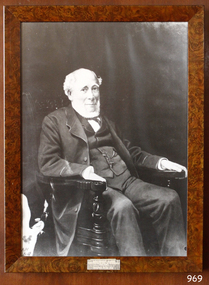
... Maritime Village...Great Ocean Road...BoA...Union Bank...Australia...This period is symbolised by a photograph of McArthur, which represents the origins of Warrnambool's commercial history and its early financial infrastructure. flagstaff hill warrnambool shipwrecked-coast flagstaff-hill flagstaff-hill-maritime-museum maritime-museum shipwreck-coast flagstaff-hill-maritime-village bank of australasia david charteris mcarthur superintendent bank of australasia colonial commerce manager bank of australasia melbourne colonial bank warrnambool bank of australasia Shipwrecked coast Flagstaff Hill Maritime Museum Maritime Museum Shipwreck coast Flagstaff Hill Maritime Village Great Ocean Road BoA Union Bank Australia & New Zealand Bank ANZ Bank David Charters McArthur D C McArthur Lower left corner "A-H 1-9". ...The subject of this photograph, David Charteris McArthur, was the founding manager of the Bank of Australasia in Port Phillip (Melbourne). McArthur was born in 1808 in Gloucester, England, and educated in Scotland. He worked for an insurance firm in Edinburgh, where in 1835 he married Caroline, nee Wright. McArthur and his family party sailed from the U.K. to arrive in Sydney in October 1835, where he joined the Bank of Australasia when it opened in Sydney in December. McArthur sailed to Melbourne in August 1838 with 3000 pounds in coins, protected by armed guards and two bulldogs, to open the Melbourne branch of the Bank of Australasia. The branch grew quickly, servicing both private and government customers. He opened many branches in the goldfields during the 1850s. In 1862, he was appointed as general inspector of branches. He spent time with the bank in New Zealand. On his return to Melbourne, at age 57, he was put in charge of the entire bank. McArthur lived in the hills of Heidelberg, Melbourne. He was the first chairman of Associated Banks and was an advisor to politicians and merchants. He was retired in October 1876 by the London directors and given a free trip to London, an annuity and a seat on the bank’s Advisory Board. McArthur was active in the community, being a member of the Mechanics’ Institute, on the committee that advised Governor Hotham on the Colony’s finances, chairman of the Heidelberg Road Board, one of the original trustees of the Library of Victoria in 1853 and president of the trustees of the Public Library, Museums and National Gallery of Victoria in 1880-83. He was also on many other community organisations. He died in his home “Charterisville” in East Ivanhoe in 1887. He and Caroline had no children. The Melbourne branch of Australia and New Zealand Bank has a portrait of McArthur in its boardroom. St John's Church, Heidelberg, commemorates him with a stained-glass window entitled 'King David'. The McArthur Gallery in the National Gallery of Victoria is also named after him. (David's brother, Donald, moved from Sydney to Melbourne in 1836 with the first government survey team.) ABOUT THE BANK OF AUSTRALASIA In 1836 the Bank of Australasia was established in London by Royal Charter. In 1951 the bank merged with the Union Bank of Australia, to form ANZ Bank Limited. In 1970 it merged with the English, Scottish and Australian Bank to become Australia and New Zealand Banking Group Limited. Since that time the ANZ has acquired other banks and introduced Internet banking and mobile banking. BANK OF AUSTRALASIA IN WARRNAMBOOL The Bank of Australasia first opened in Warrnambool in July 1854 in a building on Merri Street. The manager was Mr Samuel Hannaford. The bank then purchased and moved to a stone building on the corner of Timor and Gibson Streets, previously owned by Cramond and Dickson and almost opposite the Examiner’s office. In January 1957 Mr W.H. Palmer became the new manager and was there until November 1869. The bank then built its own building on the corner of Timor and Kepler Streets in 1859. Mr Basil Spence, the teller, was appointed acting manager in 1869 and Mr H.B. Chomley was the next appointed manager, in April 1873 and was still manager in 1886. The municipality of Warrnambool first banked with the Bank of Australasia from 1856 to April 1857. David Charteris McArthur served as the founding manager of the Bank of Australasia. His leadership marked a significant chapter in Warrnambool's early commercial development. The municipality of Warrnambool relied on the Bank of Australasia as its official bank from 1856 until April 1857. This period is symbolised by a photograph of McArthur, which represents the origins of Warrnambool's commercial history and its early financial infrastructure.Photograph; portrait of David Charteris McArthur. Heavily retouched black and white print in plain brown varnished frame, behind glass, with plaque on lower edge and inscription lower left corner.Lower left corner "A-H 1-9". Engraved on plaque "DAVID CHARTERS MCARTHUR \ SUPERINTENDENT \ BANK OF AUSTRALASIA \ 1867-1876"flagstaff hill, warrnambool, shipwrecked-coast, flagstaff-hill, flagstaff-hill-maritime-museum, maritime-museum, shipwreck-coast, flagstaff-hill-maritime-village, bank of australasia, david charteris mcarthur, superintendent bank of australasia, colonial commerce, manager bank of australasia melbourne, colonial bank, warrnambool bank of australasia, shipwrecked coast, flagstaff hill maritime museum, maritime museum, shipwreck coast, flagstaff hill maritime village, great ocean road, boa, union bank, australia & new zealand bank, anz bank, david charters mcarthur, d c mcarthur -
 Flagstaff Hill Maritime Museum and Village
Plaque - Insignia, Bank of Australasia, 19th Century
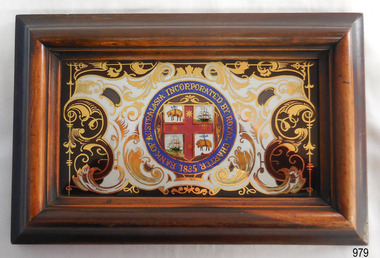
... Maritime Village...Great Ocean Road...commerce...banking...plaque...insignia...Bank of Australasia...insignia on glass...Union Bank...Australia...Australia. Flagstaff Hill Warrnambool Shipwrecked coast Flagstaff Hill Maritime Museum Maritime Museum Shipwreck coast Flagstaff Hill Maritime Village Great Ocean Road commerce banking plaque insignia Bank of Australasia insignia on glass Union Bank Australia & New Zealand Bank ANZ Bank David Charters McArthur D C McArthur Sydney New South Wales Currency Banknote Legal tender Insignia: "BANK OF AUSTRALASIA INCORPORATED BY ROYAL CHARTER 1835" Label's red oval stamp with "AUSTRALIA AND NEW ZEALAND BANK UNITED ARCHIVES" Label's handwritten black letters "AM1" Plaque with insignia on glass in a rectangular varnished wooden frame. ...This decorative plaque displays the insignia of the Bank of Australasia, which was incorporated by the Royal Charter of England in March 1834. The bank began in Australia on 14th December 1835, opening in Sydney. The Acting Superintendent of the bank at that time was David Charters McArthur. He was Superintendent from 1867-to 1876. The Melbourne branch opened on 28th August 1838 in a two-roomed brick cottage on the north side of Little Collins Street, where two huge mastiff dogs were used at night to guard the bank. The government also provided an armed military sentinel. Due to the bank's rapid growth, a new building for the Melbourne branch was opened in 1840 at 75 Collins Street West. By 1879 the bank had been upgraded to a magnificent two-storey building on the corners of Collins and Queens Streets, with the entry on Collins Street. In 1951 the Bank of Australasia amalgamated with the Union Bank to form the Australia and New Zealand Bank, now known as the ANZ. Then in 1970, the ANZ merged with both the ES&A and the London Bank of Australia to form the ANZ Banking Group Limited. The ANZ Banking Group Ltd kindly donated a variety of historic items from the Bank of Australasia. BANK of AUSTRALASIA, WARRNAMBOOL – In 1854 Warrnambool had two banks, the Union Bank and the Bank of Australasia. Later, completely different bank businesses opened; in 1867 the National Bank of Australasia, then in 1875 the Colonial Bank of Australasia. The original Warrnambool branch of the Bank of Australasia was established in July 1854, and operated from a leased cottage on Merri Street, close to Liebig Street. The bank later bought a stone building previously erected by drapers Cramond & Dickson on the corner of Timor and Gibson Streets. Samuel Hannaford was a teller and then Manager at the Warrnambool branch from 1855 to 1856 and the Warrnambool Council chose that bank for its dealings during 1856-57. In 1859 Roberts & Co. was awarded the contract to build the new Bank of Australasia branch for the sum of £3,000. The land was on a sand hill on the northeast corner of Timor and Kepler Streets and had been bought in 1855 from investor James Cust. The new building opened on May 21, 1860. The bank continued to operate there until 1951 when it merged with the Union Bank to form the ANZ Bank, which continued operating from its Liebig Street building. Warrnambool City Council purchased the former Bank of Australasia building in 1971 and renovated it, then on 3rd December 1973 it was officially opened as the Art Gallery by Cr. Harold Stephenson and Gallery Director John Welsh. The Gallery transferred to the purpose-built building in Liebig Street in 1986 and the old bank building is now the Gallery club. Staff at the Bank of Australasia in Warrnambool included the following men but others were also involved: Samuel Hannaford, Teller then Manager from 1855-1856; W H Palmer, Manager from January 1857 until November 1869 when the Teller Basil Spence was promoted to Manager; H B Chomley, Manager from April 1873 and still there in 1886; A Butt, Manager in 1895-1904; J R McCleary Accountant and Acting Manager for 12 months, until 1900; A Kirk, Manager 1904; J Moore, staff until his transfer to Bendigo in December 1908; J S Bath was Manager until 1915; C C Cox, Manager until April 1923; Richard C Stanley, Manager 1923 to April 1928. The plaque has historical significance as it belonged to the Bank of Australasia which was established in Australia in 1835 by Royal Charter. The plaque is significant for its association with the Bank of Australasia in Warrnambool, the first bank in Warrnambool, established in 1854. The bank continued to operate until its merger in 1951 when it became the ANZ Bank, which is still in operation today. The Bank was an integral part of the establishment and growth of commerce in Colonial Warrnambool and throughout Australia.Plaque with insignia on glass in a rectangular varnished wooden frame. Insignia of the Bank of Australasia has been painted onto the glass in a mirror-like fashion. Insignia depicts a heraldic shield with sheep hung up by their waists and ships in full sail. Inscription on insignia. Stamp and handwritten inscription on the rectangular label with a blue border on the reverse.Insignia: "BANK OF AUSTRALASIA INCORPORATED BY ROYAL CHARTER 1835" Label's red oval stamp with "AUSTRALIA AND NEW ZEALAND BANK UNITED ARCHIVES" Label's handwritten black letters "AM1" flagstaff hill, warrnambool, shipwrecked coast, flagstaff hill maritime museum, maritime museum, shipwreck coast, flagstaff hill maritime village, great ocean road, commerce, banking, plaque, insignia, bank of australasia, insignia on glass, union bank, australia & new zealand bank, anz bank, david charters mcarthur, d c mcarthur, sydney, new south wales, currency, banknote, legal tender -
 Flagstaff Hill Maritime Museum and Village
Currency - Bank exchange note, Perkins, Bacon and Perch, 14-10--1847
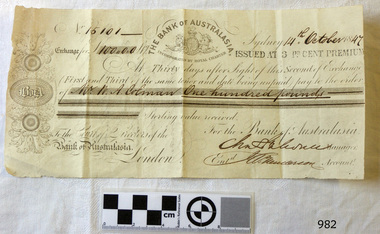
... Maritime Village...Great Ocean Road...BoA...Union Bank...Australia...Flagstaff Hill Warrnambool Shipwrecked-coast Flagstaff-Hill Flagstaff-Hill-Maritime-Museum Maritime-Museum Shipwreck-coast Flagstaff-Hill-Maritime-Village banknote currency exchange note commerce banking finances Bank of Australasia N A Coleman 1847 Shipwrecked coast Flagstaff Hill Maritime Museum Maritime Museum Shipwreck coast Flagstaff Hill Maritime Village Great Ocean Road BoA Union Bank Australia & New Zealand Bank ANZ Bank David Charters McArthur D C McArthur Sydney New South Wales Legal tender Handwritten number "15101" "One hundred pounds" "14th October [18] 47" "Mr N A Coleman" Black stamp "ISSUED AT 3 PR CENT PREMIUM" Signatures of [Manager] and [Accountant]. ...This exchange note was issued by the Bank of Australasia to Mr N A Coleman for one hundred pounds paid n 14th October 1847 at the Sydney branch. The interest rate was three per cent. This exchange note displays the insignia of the Bank of Australasia, which was incorporated by Royal Charter of England in March 1834. The bank began in Australia on 14th December 1835, opening in Sydney. The Acting Superintendent of the bank at that time was David Charters McArthur. He was Superintendent from 1867-to 1876. The Melbourne branch opened on 28th August 1838 in a two-roomed brick cottage on the north side of Little Collins Street, where two huge mastiff dogs were used at night to guard the bank. The government also provided an armed military sentinel. Due to the bank's rapid growth, a new building for the Melbourne branch was opened in 1840 at 75 Collins Street West. By 1879 the bank had been upgraded to a magnificent two-storey building on the corners of Collins and Queens Streets, with the entry on Collins Street. In 1951 the Bank of Australasia amalgamated with the Union Bank to form the Australia and New Zealand Bank, now known as the ANZ. Then in 1970, the ANZ merged with both the ES&A and the London Bank of Australia to form the ANZ Banking Group Limited. The ANZ Banking Group Ltd kindly donated a variety of historic items from the Bank of Australasia. BANK of AUSTRALASIA, WARRNAMBOOL – In 1854 Warrnambool had two banks, the Union Bank and the Bank of Australasia. Later, completely different bank businesses opened; in 1867 the National Bank of Australasia, then in 1875 the Colonial Bank of Australasia. The original Warrnambool branch of the Bank of Australasia was established in July 1854, and operated from a leased cottage on Merri Street, close to Liebig Street. The bank next bought a stone building previously erected by drapers Cramond & Dickson on the corner of Timor and Gibson Streets. Samuel Hannaford was a teller and then Manager at the Warrnambool branch from 1855 to 1856 and the Warrnambool Council chose that bank for its dealings during 1856-57. In 1859 Roberts & Co. was awarded the contract to build the new Bank of Australasia branch for the sum of £3,000. The land was on a sand hill on the northeast corner of Timor and Kepler Streets and had been bought in 1855 from investor James Cust. The new building opened on May 21, 1860. The bank continued to operate there until 1951 when it merged with the Union Bank to form the ANZ Bank, which continued operating from its Liebig Street building. Warrnambool City Council purchased the former Bank of Australasia building in 1971 and renovated it, then on 3rd December 1973 it was officially opened as the Art Gallery by Cr. Harold Stephenson and Gallery Director John Welsh. The Gallery transferred to the purpose-built building in Liebig Street in 1986 and the old bank building is now the Gallery club. Staff at the Bank of Australasia in Warrnambool included the following men but others were also involved: Samuel Hannaford, Teller then Manager from 1855-1856; W H Palmer, Manager from January 1857 until November 1869 when the Teller Basil Spence was promoted to Manager; H B Chomley, Manager from April 1873 and still there in 1886; A Butt, Manager in 1895-1904; J R McCleary Accountant and Acting Manager for 12 months, until 1900; A Kirk, Manager 1904; J Moore, staff until his transfer to Bendigo in December 1908; J S Bath was Manager until 1915; C C Cox, Manager until April 1923; Richard C Stanley, Manager 1923 to April 1928. The bank exchange note has significance through its association with the Bank of Australasia. The early Australian bank was established in 1834 by Royal Charter and opened in Sydney, Australia, in Sydney in 1835. The bank had many Australian offices in November 1877, particularly on the east and south coasts. Victoria had 45 percent of all Offices. The object is locally significant for its association with the Warrnambool Bank of Australasia, which was established in 1854. It was Warrnambool Council’s first bank. The bank continued to operate until the organisation's merger in 1951 when it became the ANZ Bank Group today. The Bank was an integral part of the growth of local commerce and the community.Bank exchange note for the Bank of Australasia, Sydney, manufactured by Perkins, Bacon and Perch, printed in brown. Insignia depicts a heraldic shield with a lion and unicorn on either side and another insignia with "B of A". Exchange note paid on 14th October 1847. Issued for one hundred pounds and paid to Mr N A Coleman.. Inscriptions include the document number, the date, the amount paid, the receiving person, signatures and a stamp with the interest rate.Handwritten number "15101" "One hundred pounds" "14th October [18] 47" "Mr N A Coleman" Black stamp "ISSUED AT 3 PR CENT PREMIUM" Signatures of [Manager] and [Accountant].flagstaff hill, warrnambool, shipwrecked-coast, flagstaff-hill, flagstaff-hill-maritime-museum, maritime-museum, shipwreck-coast, flagstaff-hill-maritime-village, banknote, currency, exchange note, commerce, banking, finances, bank of australasia, n a coleman, 1847, shipwrecked coast, flagstaff hill maritime museum, maritime museum, shipwreck coast, flagstaff hill maritime village, great ocean road, boa, union bank, australia & new zealand bank, anz bank, david charters mcarthur, d c mcarthur, sydney, new south wales, legal tender -
 Flagstaff Hill Maritime Museum and Village
Financial record - Passbook, Bank of Australasia, 1880
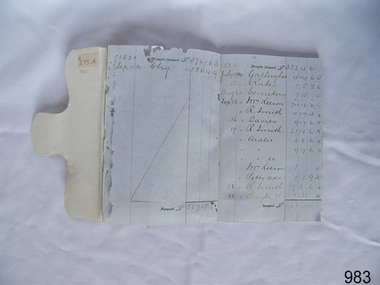
... Maritime Village...Great Ocean Road...Bank of Australasia...BoA...Union Bank...Australia...Australian Blondin', L' Estrange. Flagstaff Hill Warrnambool Shipwrecked coast Flagstaff Hill Maritime Museum Maritime Museum Shipwreck coast Flagstaff Hill Maritime Village Great Ocean Road Bank of Australasia BoA Union Bank Australia & New Zealand Bank ANZ Bank David Charters McArthur D C McArthur bank book pass book financial record commerce Thomas Smith Thos. ...This bank passbook originated from the Warrnambool branch of the Bank of Australasia with handwritten entries dating from 1880. Names written in the passbook are likely to be people local to Warrnambool. The book belonged to Thomas Smith and was handed over to his Executors. Thomas Smith operated his Gas Printers Works from Koroit Street, Warrnambool, and was a member of the Odd Fellows. In 1878, his son, aged about 12 years old, was carried across a tightrope forward and backwards, on the shoulders of the "Australian Blondon" Mr. L' Estrange, at a performance in Warrnambool. Royal Charter of England incorporated the Bank of Australasia in March 1834. It had its Australian beginning on 14th December 1835, opening in Sydney. The Acting Superintendent of the bank at that time was David Charters McArthur. He was Superintendent from 1867 to 1876. The Melbourne branch opened on 28th August 1838 in a two-roomed brick cottage on the north side of Little Collins Street, where two huge mastiff dogs were used at night to guard the bank. The government also provided an armed military sentinel. Due to the bank's rapid growth, a new building for the Melbourne branch was opened in 1840 at 75 Collins Street West. By 1879, the bank had been upgraded to a magnificent two-storey building on the corners of Collins and Queens Streets, with the entry on Collins Street. In 1951, the Bank of Australasia amalgamated with the Union Bank to form the Australia and New Zealand Bank, now known as the ANZ. Then in 1970, the ANZ merged with both the ES&A and the London Bank of Australia to form the ANZ Banking Group Limited. The ANZ Banking Group Ltd kindly donated a variety of historic items from the Bank of Australasia. BANK of AUSTRALASIA, WARRNAMBOOL – In 1854, Warrnambool had two banks, the Union Bank and the Bank of Australasia. Later, completely different bank businesses opened; in 1867, the National Bank of Australasia, and then in 1875, the Colonial Bank of Australasia. The original Warrnambool branch of the Bank of Australasia was established in July 1854 and operated from a leased cottage on Merri Street, close to Liebig Street. The bank next bought a stone building previously erected by drapers Cramond & Dickson on the corner of Timor and Gibson Streets. Samuel Hannaford was a teller and then Manager at the Warrnambool branch from 1855 to 1856, and the Warrnambool Council chose that bank for its dealings during 1856-57. In 1859, Roberts & Co. was awarded the contract to build the new Bank of Australasia branch for the sum of £3,000; the firm built the Warrnambool Post Office in 1856 and purchased land in Timor Street in 1858. The land was on a sand hill on the northeast corner of Timor and Kepler Streets and had been bought in 1855 from investor James Cust. The new building opened on May 21, 1860. The bank continued to operate there until 1951, when it merged with the Union Bank to form the ANZ Bank, which continued operating from its Liebig Street building. Warrnambool City Council purchased the former Bank of Australasia building in 1971 and renovated it, then on 3rd December 1973, it was officially opened as the Art Gallery by Cr. Harold Stephenson and Gallery Director John Welsh. The Gallery transferred to the purpose-built building in Liebig Street in 1986, and the old bank building is now the Gallery club. Staff at the Bank of Australasia in Warrnambool included the following men but others were also involved: Samuel Hannaford, Teller then Manager from 1855-1856; Hawkins, Manager in 1856, W H Palmer, Manager from January 1857 until November 1869 when the Teller Basil Spence was promoted to Manager; H B Chomley, Manager from April 1873 and still there in 1886; A Butt, Manager in 1895-1904; J R McCleary Accountant and Acting Manager for 12 months, until 1900; A Kirk, Manager 1904; J Moore, staff until his transfer to Bendigo in December 1908; J S Bath was Manager until 1915; C C Cox, Manager until April 1923; Richard C Stanley, Manager 1923 to April 1928. The bank passbook has significance through its association with the Bank of Australasia. The early Australian bank was established in 1834 by Royal Charter and opened in Sydney, Australia, in Sydney in 1835. The bank had many Australian offices in November 1877, particularly on the east and south coasts. Victoria had 45 per cent of all Offices. The passbook is locally significant for its association with the Warrnambool Bank of Australasia, which was established in 1854. It was Warrnambool Council’s first bank. The bank continued to operate until the organisation's merger in 1951 when it became the ANZ Bank Group today. The Bank was an integral part of the growth of local commerce and the community. It has local significance for its association with commercial Warrnambool in 1880, belonging to Thomas Smith, a prominent businessman with a printing works whose son of about 12 years age crossed a tightrope with the 'Australian Blondin', L' Estrange. Bank passbook, Bank of Australasia, Warrnambool branch. Bound with waxed, cream-coloured cardboard cover and tab closure. Pages have blue horizontal lines and red vertical lines. Black ink handwritten entries, with Date, Name and amount. Inscription was written inside and on a sticker inside the front cover. Passbook is dated 1880 and belonged to Thomas Smith.Marked "The Executors of the late Thomas Smith" "Stamped inside "Bank of Australasia, Warrnambool" Handwritten on sticker " R. 273 A" Sample of handwritten entries include "1880" Callaghan" "Rates" A Linch" "Davies" Bottom of page, balance "529 10 21" [529 pounds 10 shillings 21 pence]flagstaff hill, warrnambool, shipwrecked coast, flagstaff hill maritime museum, maritime museum, shipwreck coast, flagstaff hill maritime village, great ocean road, bank of australasia, boa, union bank, australia & new zealand bank, anz bank, david charters mcarthur, d c mcarthur, bank book, pass book, financial record, commerce, thomas smith, thos. smith, gas printing works, australian blondin, thomas smith's son, tightrope walker, odd fellows, l' estrange, passbook, bank passbook -
 Flagstaff Hill Maritime Museum and Village
Currency - Bank cheque, Sands & McDougall Limited, 03-12-1885
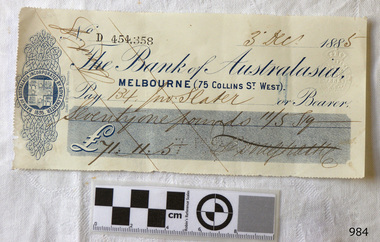
... Maritime Village...Great Ocean Road...Bank of Australasia...BoA...Union Bank...Australia...Australian offices in November 1877, particularly on the east and south coasts. Victoria had 45 percent of all Offices. The bank cheque is significant as an early example of financial management of money and money exchange or transfer. Flagstaff Hill Warrnambool Shipwrecked-coast Flagstaff-Hill Flagstaff-Hill-Maritime-Museum Maritime-Museum Shipwreck-coast Flagstaff-Hill-Maritime-Village bank cheque Shipwrecked coast Flagstaff Hill Maritime Museum Maritime Museum Shipwreck coast Flagstaff Hill Maritime Village Great Ocean Road Bank of Australasia BoA Union Bank Australia & New Zealand Bank ANZ Bank bank note Melbourne Slater Sands & McDougall chrssed cheque embossed dots paid cheque banknote Printed: "Bank of Australasia, MELBOURNE (75 COLLINS ST. ...This bank cheque originated from the Bank of Australasia, Melbourne branch. It was issued on 3rd December 1885 to a person surnamed Slater for £71.11.5 (seventy-one pounds, eleven shillings and five pence). The parallel lines are called Cheque Crossed and mean that only Slater and no one else could receive the payment and that it would have been paid into Slater's bank account, not exchanged for cash. The embossed dots signify that the cheque amount was also paid to be the bearer of the cheque. Slater would have visited the bank to deposit the money into his or her own account. The cheque was printed by Sands & McDougall, a long-standing Melbourne printing and stationery company. It was then Stamped at the bank with its own unique number before it was issued to the customer. From its previously perforated edges, it is presumed that the cheque was part of a page of cheques, likely to be contained within a book of similar cheques ready for use. The Bank of Australia was incorporated by Royal Charter of England in March 1834. It had its Australian beginnings on 14th December 1835, opening in Sydney. The Acting Superintendent of the bank at that time was David Charters McArthur. He was Superintendent from 1867-to 1876. The Melbourne branch opened on 28th August 1838 in a two-roomed brick cottage on the north side of Little Collins Street, where two huge mastiff dogs were used at night to guard the bank. The government also provided an armed military sentinel. Due to the bank's rapid growth, a new building for the Melbourne branch was opened in 1840 at 75 Collins Street West. By 1879 the bank had been upgraded to a magnificent two-storey building on the corners of Collins and Queens Streets, with the entry on Collins Street. In 1951 the Bank of Australasia amalgamated with the Union Bank to form the Australia and New Zealand Bank, now known as the ANZ. Then in 1970, the ANZ merged with both the ES&A and the London Bank of Australia to form the ANZ Banking Group Limited. The ANZ Banking Group Ltd kindly donated a variety of historic items from the Bank of Australasia. BANK of AUSTRALASIA, WARRNAMBOOL – In 1854 Warrnambool had two banks, the Union Bank and the Bank of Australasia. Later, completely different bank businesses opened; in 1867 the National Bank of Australasia, then in 1875 the Colonial Bank of Australasia. The original Warrnambool branch of the Bank of Australasia was established in July 1854, and operated from a leased cottage on Merri Street, close to Liebig Street. The bank next bought a stone building previously erected by drapers Cramond & Dickson on the corner of Timor and Gibson Streets. Samuel Hannaford was a teller and then Manager at the Warrnambool branch from 1855 to 1856 and the Warrnambool Council chose that bank for its dealings during 1856-57. In 1859 Roberts & Co. was awarded the contract to build the new Bank of Australasia branch for the sum of £3,000. The land was on a sand hill on the northeast corner of Timor and Kepler Streets and had been bought in 1855 from investor James Cust. The new building opened on May 21, 1860. The bank continued to operate there until 1951 when it merged with the Union Bank to form the ANZ Bank, which continued operating from its Liebig Street building. Warrnambool City Council purchased the former Bank of Australasia building in 1971 and renovated it, then on 3rd December 1973 it was officially opened as the Art Gallery by Cr. Harold Stephenson and Gallery Director John Welsh. The Gallery transferred to the purpose-built building in Liebig Street in 1986 and the old bank building is now the Gallery club. Staff at the Bank of Australasia in Warrnambool included the following men but others were also involved: Samuel Hannaford, Teller then Manager from 1855-1856; W H Palmer, Manager from January 1857 until November 1869 when the Teller Basil Spence was promoted to Manager; H B Chomley, Manager from April 1873 and still there in 1886; A Butt, Manager in 1895-1904; J R McCleary Accountant and Acting Manager for 12 months, until 1900; A Kirk, Manager 1904; J Moore, staff until his transfer to Bendigo in December 1908; J S Bath was Manager until 1915; C C Cox, Manager until April 1923; Richard C Stanley, Manager 1923 to April 1928. The bank cheque has significance through its association with the Bank of Australasia. The early Australian bank was established in 1834 by Royal Charter and opened in Sydney, Australia, in Sydney in 1835. The bank had many Australian offices in November 1877, particularly on the east and south coasts. Victoria had 45 percent of all Offices. The bank cheque is significant as an early example of financial management of money and money exchange or transfer.Bank cheque of the Bank of Australasia, Melbourne branch. The rectangular paper has three sides that have been perforated. It is printed in blue with bank's Insignia of a heraldic shield of sheep hung by their waists and ships in full sail. Embossed Stamp Duty mark. Embossed dots. Handwritten black ink details Dated 3rd Dec 1885. Printed in Melbourne by Sands & McDougall. Diagonal parallel lines are across the cheque. Printed: "Bank of Australasia, MELBOURNE (75 COLLINS ST. WEST)." "454,358" "Sands & McDougall, Melbourne" Embossed stamp: Symbol of Crown above double oval lines " - STAMP DUTY" "ONE PENNY" Embossed dots forming test "7 PAID T2" Handwritten: "3rd Dec. [188] 5" "134 - Slater" "Seventy one pounds 11/S 5p" "£71.11.5" Signature: (undecipherable) flagstaff hill, warrnambool, shipwrecked-coast, flagstaff-hill, flagstaff-hill-maritime-museum, maritime-museum, shipwreck-coast, flagstaff-hill-maritime-village, bank cheque, shipwrecked coast, flagstaff hill maritime museum, maritime museum, shipwreck coast, flagstaff hill maritime village, great ocean road, bank of australasia, boa, union bank, australia & new zealand bank, anz bank, bank note, melbourne, slater, sands & mcdougall, chrssed cheque, embossed dots, paid cheque, banknote -
 Flagstaff Hill Maritime Museum and Village
Document - Bank notice, List of Offices, ca Nov. 1877
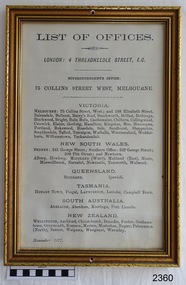
... Australia 1877...Commerce 1877...shipwreck-coast...document...bank document...Flagstaff Hill Maritime Museum & Village...Bank of Australasia...1877...Branches in Australia...Bank of London...Offices in Australia...Offices in New Zealand...Commerce...Banking...Finance...Shipwrecked coast...Flagstaff Hill Maritime Museum...Maritime Museum...Shipwreck coast...Flagstaff Hill Maritime Village...Great Ocean Road...BoA...Union...The Bank was an integral part of the establishment and growth of commerce in Colonial Warrnambool and throughout Australia. flagstaff hill warrnambool Bank of Australasia 1877 Branches of Bank of Australasia 1877 Banks in Australia 1877 Commerce 1877 shipwreck-coast document bank document Flagstaff Hill Maritime Museum & Village Bank of Australasia 1877 Branches in Australia Bank of London Offices in Australia Offices in New Zealand Commerce Banking Finance Shipwrecked coast Flagstaff Hill Maritime Museum Maritime Museum Shipwreck coast Flagstaff Hill Maritime Village Great Ocean Road BoA Union Bank Australia & New Zealand Bank ANZ Bank David Charters McArthur D C McArthur Sydney New South Wales Currency Banknote Legal tender List of bank offices Text includes: "LONDON: 4 THREADNEEDLE STREET, E.C." ...The addresses given on the List for the London and Melbourne offices have connected the document to the Bank of Australasia. The List is dated November 1877 and shows the number and the location of all of the branches of the Bank at that point in time., a total of 77. - Victoria 35, New South Wales 14, Queensland 2, Tasmania 5, South Australia 5, New Zealand 16 Copies of the notice would have been displayed in all branches of the bank in both Australia and New Zealand to inform customers and perhaps impress them too with a large number of locations and the reference to the bank's connection with London. This document gives information on all bank offices throughout Australia and New Zealand. It refers to the Superintendent's Office address at 75 Collins Street West, Melbourne and is dated November 1877. This places the document at the time just before the new Melbourne office opened on the corner of Collins Street and Queen's Street in 1879. The Bank of Australasia was incorporated by Royal Charter of England in March 1834. It came to Australia on 14th December 1835, opening in Sydney. The Acting Superintendent of the Bank of Australasia in Sydney at that time was David Charters McArthur. He was Superintendent from 1867-to 1876. The Melbourne branch of the Bank of Australasia opened on 28th August 1838 in a two-roomed brick cottage on the north side of Little Collins Street. Two huge mastiff dogs were kept in the backyard and let loose at night to guard the bank. The government also provided an armed military sentinel. Due to the bank's rapid growth, a new building for the Melbourne branch was opened in 1840 at 75 Collins Street West. By 1879 the bank had been upgraded to a magnificent two-storey building on the corners of Collins and Queens Streets, with the entry on Collins Street. In 1951 the Bank of Australasia amalgamated with the Union Bank to form the Australia and New Zealand Bank, now known as the ANZ. Then in 1970, the ANZ merged with both the ES&A and the London Bank of Australia to form the ANZ Banking Group Limited. The ANZ Banking Group Ltd kindly donated a variety of historic items from the Bank of Australasia. BANK of AUSTRALASIA, WARRNAMBOOL – In 1854 Warrnambool had two banks, the Union Back and the Bank of Australasia. Later, completely different bank businesses opened; in 1867 the National Bank of Australasia, then in 1875 the Colonial Bank of Australasia. The original Bank of Australasia was established in Warrnambool in July 1854, and operated from a leased cottage on Merri Street, close to Liebig Street. The bank bought a stone building previously erected by drapers Cramond & Dickson on the corner of Timor and Gibson Streets. Samuel Hannaford was a teller and then Manager at the Warrnambool branch from 1855 to 1856. Warrnambool’s Council chose the Bank of Australasia as its bank 1856-57. In 1859 Roberts & Co. was awarded the contract to build the new Bank of Australasia branch for the sum of £3,000. The land was on a sand hill on the northeast corner of Timor and Kepler Streets and had been bought in 1855 from investor James Cust. The new building opened on May 21, 1860. The bank continued to operate there until 1951 when it merged with the Union Bank to form the ANZ Bank, which continued operating from its Liebig Street building. Warrnambool City Council purchased the former Bank of Australasia building in 1971 and renovated it, then on 3rd December 1973 it was officially opened as the Art Gallery by Cr. Harold Stephenson and Gallery Director John Welsh. The Gallery transferred to the purpose-built building in Liebig Street in 1986 and the old bank building is now the Gallery club. The List of Offices of the Bank of Australasia has early Australian historical significance through its association with the Bank, which was established in 1834 by Royal Charter and opened in Sydney, Australia, in Sydney in 1835. The List is significant for showing the number and location of all of the Offices of the Bank of Australia in November 1877. This shows that Victoria had 45 percent of all Offices. The framed document is locally significant for its association with the Bank of Australasia, Warrnambool's first bank, established in 1854. The bank continued to operate until the organisation's merger in 1951. It became the ANZ Bank, which is still in operation today. The Bank was an integral part of the establishment and growth of commerce in Colonial Warrnambool and throughout Australia.Document in a decorative gilt frame. Titled List of Bank Offices and dated November 1877, facsimile. Offices include London, and a variety of offices in Victoria, New South Wales, Queensland, Tasmania, South Australia and New Zealand. Round holes in the centre top and bottom of the frame. Text includes: "LONDON: 4 THREADNEEDLE STREET, E.C." "SUPERINTENDENT'S OFFICE: / 75 COLLINS STREET WEST, MELBOURNE" "Warrnambool" " November 1877" flagstaff hill, warrnambool, bank of australasia 1877, branches of bank of australasia 1877, banks in australia 1877, commerce 1877, shipwreck-coast, document, bank document, flagstaff hill maritime museum & village, bank of australasia, 1877, branches in australia, bank of london, offices in australia, offices in new zealand, commerce, banking, finance, shipwrecked coast, flagstaff hill maritime museum, maritime museum, shipwreck coast, flagstaff hill maritime village, great ocean road, boa, union bank, australia & new zealand bank, anz bank, david charters mcarthur, d c mcarthur, sydney, new south wales, currency, banknote, legal tender, list of bank offices -
 Flagstaff Hill Maritime Museum and Village
Decorative object - Bookends
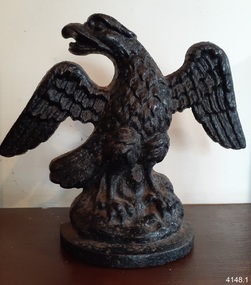
... Maritime Museum and Village...Warrnambool...Great Ocean Road...Shipwreck Coast...bookends...eagle bookends...Napoleonic Eagles...Tamar Bank...Launceston Bank...Bank of Australasia...Eagle symbol...1834-1838...commerce...financial institution...Colonial bank...Lewis Gilles...M. Connolly...F. D. Wickham...and P. Oakden....T. Williams...ANZ Bank...Australia and New Zealand Bank...Union...The Tamar bank was taken over by the Australia-wide Union Bank in 1838, which later merged with the Bank of Australasia, which had a branch in Warrnambool. In 1851 it became the Australia and New Zealand Bank, which is still active in Warrnambool in 2023. Flagstaff Hill Maritime ...The individual eagles in this pair of Napoleonic Eagle bookends are made so that each eagle faces the opposite direction to the other, one left and one right. The Napoleonic Eagle is the name given to the eagle symbol used by Napoleon Bonaparte 1799-1815 and the French Regiments, mounted on a standard to represent the honour and pride of fighting French men. It is believed that the Napoleonic Eagle was chosen as a symbol for the Tamar Bank in Launceston, Tasmania, established in 1834. The bank was formed after the separation of one of the branches of the Bank of Van Diemen’s Land. The Managing Director in 1834 was Lewis Gilles, previously a naval officer. Other directors were T. Williams, M. Connolly, F. D. Wickham, and P. Oakden. The bank was dissolved in 1838 and became the basis of the Launceston branch of the British-founded Union Bank of Australia Limited, established in 1837 and had its own emblem. The Union Bank of Australia merged with the Bank of Australasia in 1951 and went on to eventually become part of the Australia and New Zealand (ANZ) Banking Group. The Bank of Australasia was incorporated by Royal Charter of England in March 1834. It had its Australian beginning on 14th December 1835, opening in Sydney. The Acting Superintendent of the bank at that time was David Charters McArthur. He was Superintendent from 1867 to 1876. The Melbourne branch opened on 28th August 1838 in a two-roomed brick cottage on the north side of Little Collins Street. By 1879 the bank had been upgraded to a magnificent two-storey building on the corners of Collins and Queens Streets, with the entry on Collins Street. In 1951 the Bank of Australasia amalgamated with the Union Bank to form the Australia and New Zealand Bank, now known as the ANZ. Then in 1970, the ANZ merged with the ES&A and the London Bank of Australia to form the ANZ Banking Group Limited. The ANZ Banking Group Ltd kindly donated to Flagstaff Hill various historic items from the Bank of Australasia. BANK of AUSTRALASIA, WARRNAMBOOL – In 1854 Warrnambool had two banks, the Union Bank and the Bank of Australasia. Later, completely different bank businesses opened; in 1867 the National Bank of Australasia, then in 1875 the Colonial Bank of Australasia. The original Warrnambool branch of the Bank of Australasia was established in July 1854, and operated from a leased cottage on Merri Street, close to Liebig Street. The bank next bought a stone building previously erected by drapers Cramond & Dickson on the corner of Timor and Gibson Streets. Samuel Hannaford was a teller and then Manager at the Warrnambool branch from 1855 to 1856 and the Warrnambool Council chose that bank for its dealings during 1856-57. In 1859 Roberts & Co. was awarded the contract to build the new Bank of Australasia branch for the sum of £3,000; the firm built the Warrnambool Post Office in 1856 and purchased land in Timor Street in 1858. The land was on a sand hill on the northeast corner of Timor and Kepler Streets and had been bought in 1855 by investor James Cust. The new building opened on May 21, 1860. The bank continued to operate there until 1951 when it merged with the Union Bank to form the ANZ Bank, which continued operating from its Liebig Street building. Warrnambool City Council purchased the former Bank of Australasia building in 1971 and renovated it, then on 3rd December 1973 it was officially opened as the Art Gallery by Cr. Harold Stephenson and Gallery Director John Welsh. The Gallery transferred to the purpose-built building on Liebig Street in 1986 and the old bank building is now the Gallery Club. Staff at the Bank of Australasia in Warrnambool included the following men but others were also involved: Samuel Hannaford, Teller then Manager from 1855-1856; Hawkins, Manager in 1856, W H Palmer, Manager from January 1857 until November 1869 when the Teller Basil Spence was promoted to Manager; H B Chomley, Manager from April 1873 and still there in 1886; A Butt, Manager in 1895-1904; J R McCleary Accountant and Acting Manager for 12 months, until 1900; A Kirk, Manager 1904; J Moore, staff until his transfer to Bendigo in December 1908; J S Bath was Manager until 1915; C C Cox, Manager until April 1923; Richard C Stanley, Manager 1923 to April 1928. This pair of Napoleonic Eagle bookends represents the type of ornaments appropriate for 19th and 20th-century business associated with finance and commerce. They symbolise strength, reliability and power. It is believed that the Napoleonic Eagle was the seal of the Tamar Bank, established in 1834 in Launceston, Tasmania. The Tamar bank was taken over by the Australia-wide Union Bank in 1838, which later merged with the Bank of Australasia, which had a branch in Warrnambool. In 1851 it became the Australia and New Zealand Bank, which is still active in Warrnambool in 2023. Bookends; two (2) black metal eagles, standing, beaks open, tail to the side, wings spread, claws open. The black figures are cast metal and the backs are hollow, with flat even edges. The front is textured and shiny. The eagles are facing opposite directions; one left, one right. The figures are commonly known as Napoleonic eagles.flagstaff hill maritime museum and village, warrnambool, great ocean road, shipwreck coast, bookends, eagle bookends, napoleonic eagles, tamar bank, launceston bank, bank of australasia, eagle symbol, 1834-1838, commerce, financial institution, colonial bank, lewis gilles, m. connolly, f. d. wickham, and p. oakden., t. williams, anz bank, australia and new zealand bank, union bank of australia -
 Flagstaff Hill Maritime Museum and Village
Medal - Commemorative Medal, Stokes & Sons, 1937
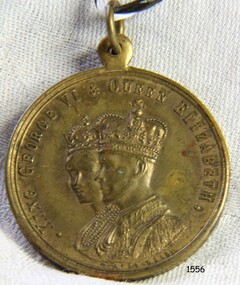
... Union Jack and Southern Cross, and sang Australila's then National Anthem "God Save the King", which today is sung as the Royal Anthem. The medal is significant for connecting Victoria, and Australia, to the British Commonwealth and the sovereignty of the British throne, in Australia's post-Federation years. It shows the importance placed by the Government of Australia in educating the generation of students in 1937 about Australia's place in the Commonwealth and the history of Australia. The history of the medal is socially and politically significant, reflecting the evolution of changes in Australian society. Flagstaff Hill Flagstaff Hill Maritime ...This medal commemorates the coronation of King George VI and Elizabeth as monarchs on the British throne, to be held on May 12th, 1937. The medal is one of over 300,000 distributed to school children as a memento of the occasion. The obverse shows the busts of King George VI and Elizabeth facing left. The reverse shows Victoria's Coat of Arms, the official heraldic symbol, with the Southern Cross on a shield, above it is a kangaroo facing left and holding a crown. The supporting figure on the left holds an olive branch of 'peace' and the supporter on the right holds a cornucopia horn of 'plenty', together representing the text on the ribbon between them 'Peace & Planty' symbol of 'prosperity'. On May 7th, 1937 each school child in Victoria, Australia, received a medal commemorating the upcoming coronation of King George VI and Elizabeth, to be held on May 12th, 1937. medals totalling 318,200 were distributed to scholars in 2,781 Victorian schools. Each school received a letter from the Governor, Lord Humingfield, detailing the significance of the occasion. Lessons on the day focused on the meaning behind the medal, and children recited their Allegiance to the King, saluted the flag bearing the Union Jack and Southern Cross, and sang Australila's then National Anthem "God Save the King", which today is sung as the Royal Anthem. The medal is significant for connecting Victoria, and Australia, to the British Commonwealth and the sovereignty of the British throne, in Australia's post-Federation years. It shows the importance placed by the Government of Australia in educating the generation of students in 1937 about Australia's place in the Commonwealth and the history of Australia. The history of the medal is socially and politically significant, reflecting the evolution of changes in Australian society.Medal or medallion, bgilt rass, with claw and ring on top. The obverse has the bust of a female and male, co-joined, and the reverse has the Coat of arms of the State of Victoria, which includes a kangaroo above a shield and a supporting figure on either side of the shield. Inscriptions are on both sides of the medal. The medal commemorates the coronation of their Majesties, King George VI and Queen Elizabeth, on May 12th 1937.Obverse, around the circle: "KING GEORGE VI & QUEEN ELIZABETH" Reverse, around the circle: "TO COMMEMORATE THEIR MAJESTIES' CORONATION / MAY 12TH 1937" Reverse, within the Coat of Arms: "VICTORIA" "PEACE & PROSPERITY" flagstaff hill, flagstaff hill maritime museum and village, warrnambool, maritime museum, maritime village, great ocean road, shipwreck coast, medallion, medal, commemorative, king george vi and elizabeth, 1937, 12-05-1937, students in victoria, schools in victoria, 7-5-1937, victoria's coat of arms, peace & prosperity, british monarch, british throne, british commonwealth, numesmatics, coil, student, victorian student -
 Mission to Seafarers Victoria
Programme - Service, Seafarers Service - Choral Mattins, 2017
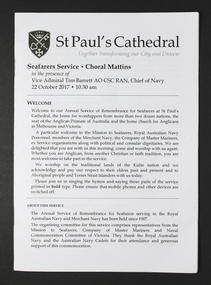
... maritime activities in Australia. Representatives come from the Royal and Merchant Navies, the commercial world, shipping companies, mission and philanthropic societies, veterans’ associations, labour unions, youth and leisure organisations, but anyone is welcome to attend. seafarers service 2017 st paul's cathedral melbourne battle of trafalgar trafalgar day horatio nelson Two fold paper booklet printed in black ink Seafarers Service - Choral Mattins Programme Service ...Seafarers Service 22 October 2017 The first Seafarers Service was held on 23 October 1905 in the St Paul's Cathedral in London to celebrate the Centenary of the Battle of Trafalgar and the death of Vice-Admiral Horatio Nelson on 21 October 1805. Reverend Alfred Gurney Goldsmith launched the first Seafarers Service two years later and the first service was held on Sunday 10 November 1907. The service continues to reflect the full range of the maritime activities in Australia. Representatives come from the Royal and Merchant Navies, the commercial world, shipping companies, mission and philanthropic societies, veterans’ associations, labour unions, youth and leisure organisations, but anyone is welcome to attend.Two fold paper booklet printed in black inkseafarers service, 2017, st paul's cathedral, melbourne, battle of trafalgar, trafalgar day, horatio nelson -
 Flagstaff Hill Maritime Museum and Village
Book, Home Cookery for Australia
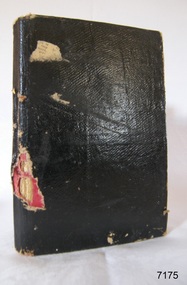
... maritime-village...shipwrecked-artefact...book...cook book...home cookery for australia...presbyterian women's missionary union...warrnambool shipwrecked-coast flagstaff-hill flagstaff-hill-maritime-museum maritime-museum shipwreck-coast flagstaff-hill-maritime-village shipwrecked-artefact book cook book home cookery for australia presbyterian women's missionary union of victoria pwmu Home Cookery for Australia compiled and issued under auspices of the Presbyterian Women's Missionary Union of Victoria Publisher: Gordon & Gotch Date: 1904 Home Cookery for Australia Book ...Home Cookery for Australia compiled and issued under auspices of the Presbyterian Women's Missionary Union of Victoria Publisher: Gordon & Gotch Date: 1904 warrnambool, shipwrecked-coast, flagstaff-hill, flagstaff-hill-maritime-museum, maritime-museum, shipwreck-coast, flagstaff-hill-maritime-village, shipwrecked-artefact, book, cook book, home cookery for australia, presbyterian women's missionary union of victoria, pwmu -
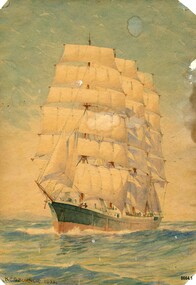 Flagstaff Hill Maritime Museum and Village
Painting - Watercolour painting, Beni Carr Glyn Burnett, Magdalene Vinnen, 1933
... Union as war compensation and renamed "STS Sedov". This painting (one of a set of 3 small artworks) is significant as an example of shipping (particularly the use of sailing ships) that were still being used as late as the 1930's in Australia. It is also important because its creator (B. C. G. Burnett) went on to become a well-known public figure in the Northern Territory in the late 1930's due to his innovative approach to designing homes for the tropical climate. Flagstaff Hill Maritime ...Beni Carr Glyn Burnett (also known as B. C. G. Burnett or Beni Burnett) was born in 1889 to missionary parents in Mongolia. When he was 15 years old he began training as an architect with a firm in Shanghai. He worked in Singapore, Japan and China before moving to Australia around 1933. In 1937 he was appointed as the Commonwealth principal architect in the Northern Territory. He went on to design a series of houses for senior public servants and military personnel which became very popular as they were specifically designed for the tropics - incorporating louvres, high ceilings and good ventilation. When Darwin was bombed in February 1942, he was evacuated to Alice Springs where he continued to work as an architect. He also became a Magistrate and Coroner in Alice Springs. In later life he was well known for sketching clientele in public bars. He died in 1955. Beni Burnett was living in Sydney in 1933 when he produced these three artworks. There were several photography firms operating in Sydney at this time who specialised in photographing ships and the shipping trade (e.g. Samuel J. Hood and William James Hall) and whose photographs were used by artists to produce ship portraits. Both of these photographers took photographs of the two ships in B. C. G. Burnett's watercolours. The "Magdalene Vinnen" was photographed by Samuel J Hood in a series of photos taken in March 1933. It was a 4 masted steel barque, built in 1921 in Kiel, Germany and for almost 80 years was the largest traditional sailing ship in operation. She was used extensively as a cargo ship. She sailed into Sydney Harbour on 27th Feb 1933, loaded with almost 16,000 bales of wool destined for Falmouth, England. In March 1933 (whilst in Sydney) the German Republic flag (on orders from Adolph Hitler) was lowered and replaced with the old monarchist flag which was then to be the official flag and beside it the Nazi flag was to be flown on all ceremonial occasions. It visited Australia again in 1935 with its cargo being wheat from Port Broughton, S. A. In 1936 it was renamed "Kommodore Johnsen" and in 1945 (after WW2) the ship was awarded to the Soviet Union as war compensation and renamed "STS Sedov". This painting (one of a set of 3 small artworks) is significant as an example of shipping (particularly the use of sailing ships) that were still being used as late as the 1930's in Australia. It is also important because its creator (B. C. G. Burnett) went on to become a well-known public figure in the Northern Territory in the late 1930's due to his innovative approach to designing homes for the tropical climate. A watercolour painting of a sailing ship called "Magdalene Vinnen". It shows a 4 masted barque with a blue and red steel hull in full sail heading towards the viewer. The painter's name (B. C. G. Burnett) and date (1933) are written on the bottom left-hand corner of the painting. The location and name of the ship is written in ink on the back of the painting.front - "B. C. G. BURNETT. 1933 back - "off Sydney" / "Magdalene Vinnen"flagstaff hill maritime museum and village, warrnambool, great ocean road, sailing ships, ships, barque, magdalene vinnen, beni carr glyn burnett, b. c. g. burnett, beni burnett, painting, watercolour painting, sketch, sydney harbour, architect, darwin, burnett house, photography, samuel j. hood, william james hall, sedov, kommodore johnsen -
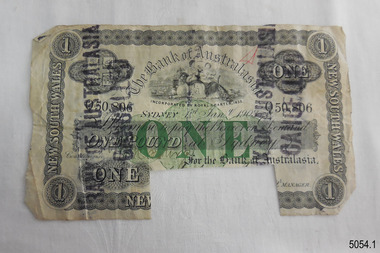 Flagstaff Hill Maritime Museum and Village
Currency - Banknote, Bank of Australasia, One-pound, 1st July 1903
... Maritime Village...Great Ocean Road...Union Bank...Australia...The banknotes also have a significant place in Australia’s history as two notes are just prior to Federation and two notes just after Federation. flagstaff hill warrnambool one pound note Bank of Australasia legal tender £1 banknote banknotes Flagstaff Hill Maritime Museum & Village Shipwreck Coast five poind note Australian currency Shipwrecked coast Flagstaff Hill Maritime Museum Maritime Museum Flagstaff Hill Maritime Village Great Ocean Road Union Bank Australia & New Zealand Bank ANZ Bank David Charters McArthur D C McArthur One-pound note Five-pound note £5 Sydney New South Wales Pre-Federation Post-Federation Currency banknote set Printed: (Serial Number) "Q50,806" "ONE POUND" "NEW SOUTH WALES" "1st July 1903" Stamped: "BANK OF AUSTRALASIA / CANCELLED" Handwritten in red pen: "undecipherable [initials]" Text in pencil "L24" One-pound note, one of a set of four (4) notes published by The Bank of Australasia, Sydney, New South Wales. ...This one-pound banknote is one of a set of four banknotes issued by the Bank of Australasia's Head Office in Sydney, New South Wales. Two banknotes are dated before the Federation of Australia on 1st January 1901 and two are dated just two years after Federation. Each of the banknotes in this set has a rectangular piece cut from it. This indicates that the banknote was cancelled when the note was exchanged for Australian dollars after Decimal Currency was introduced on 14th February 1966. The Bank of Australasia was established under the Royal Charter of England. It first came to Australia in 1835, opening in Sydney. The Bank of Australasia was the first bank in Warrnambool. It was established in 1854 and operated from leased buildings on Merri Street and then Timor Street. The bank opened its own building on May 21, 1860, on the northeast corner of Timor and Kepler Streets. In that year, the Acting Superintendent of the Bank of Australasia in Sydney was David Charters McArthur. He went on to become the Superintendent from 1867-to 1876. In 1951 the Bank of Australasia amalgamated with the Union Bank to form the Australia and New Zealand Bank, now known as the ANZ. Then in 1970 the ANZ merged with both the ES&A and the London Bank of Australia to form the ANZ Banking Group Limited. The ANZ Banking Group Ltd kindly donated a variety of historic items from the Bank of Australasia. This set of banknotes has historical significance as it was used by the Bank of Australasia, the first bank in Warrnambool. The bank was established in 1854 and continued until its merger, when it became the ANZ Bank in 1951 and is still in operation today. The bank was an integral part of the establishment and growth of commerce in Colonial Warrnambool, Victoria, and Australia. The banknotes also have a significant place in Australia’s history as two notes are just prior to Federation and two notes just after Federation.One-pound note, one of a set of four (4) notes published by The Bank of Australasia, Sydney, New South Wales. The obverse of the note is printed in black ink with the denomination and its round pound-coin symbol printed in green ink. There is no printing on the reverse. A black ink stamp is impressed twice on each side of the note, stating that the note is cancelled. Handwritten red ink text is on the note's obverse and pencil text on the reverse. A unique Serial number is printed twice on the obverse. The banknote has a rectangular cut-out notch on the lower edge. Printed: (Serial Number) "Q50,806" "ONE POUND" "NEW SOUTH WALES" "1st July 1903" Stamped: "BANK OF AUSTRALASIA / CANCELLED" Handwritten in red pen: "undecipherable [initials]" Text in pencil "L24"flagstaff hill, warrnambool, one pound note, bank of australasia, legal tender, £1, banknote, banknotes, flagstaff hill maritime museum & village, shipwreck coast, five poind note, australian currency, shipwrecked coast, flagstaff hill maritime museum, maritime museum, flagstaff hill maritime village, great ocean road, union bank, australia & new zealand bank, anz bank, david charters mcarthur, d c mcarthur, one-pound note, five-pound note, £5, sydney, new south wales, pre-federation, post-federation, currency, banknote set -
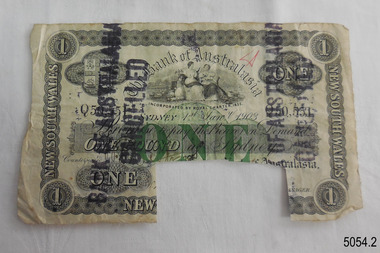 Flagstaff Hill Maritime Museum and Village
Currency - Banknote, Bank of Australasia, One-pound, 1st July 1903
... Maritime Village...Great Ocean Road...Union Bank...Australia...The banknotes also have a significant place in Australia’s history as two notes are just prior to the Federation of Australia and two notes just after. flagstaff hill warrnambool one pound note Bank of Australasia legal tender £1 banknote banknotes Flagstaff Hill Maritime Museum & Village Shipwreck Coast five poind note Australian currency Shipwrecked coast Flagstaff Hill Maritime Museum Maritime Museum Flagstaff Hill Maritime Village Great Ocean Road Union Bank Australia & New Zealand Bank ANZ Bank David Charters McArthur D C McArthur One-pound note Five-pound note £5 Sydney New South Wales Pre-Federation Post-Federation Currency Set of banknotes banknote set Printed (Serial Number) "O50 551" "ONE POUND" "NEW SOUTH WALES" "1st July 1903" Stamp "BANK OF AUSTRALASIA / CANCELLED" Handwritten in red pen: "undecipherable [initials]" Text in pencil "L24" One-pound note, one of a set of four (4) notes published by The Bank of Australasia, Sydney, New South Wales. ...One-pound note, one of a set of four (4) notes published by The Bank of Australasia, Sydney, New South Wales. The obverse of the note is printed in black ink with the denomination and its round pound-coin symbol printed in green ink. There is no printing on the reverse. A black ink stamp is impressed twice on each side of the note, stating that the note is cancelled. Handwritten red ink text is on the note's obverse and pencil text on the reverse. A unique Serial number is printed twice on the obverse. The banknote has a rectangular cut-out notch on the lower edge. The Bank of Australasia was established under the Royal Charter of England. It first came to Australia in 1835, opening in Sydney. The Bank of Australasia was the first bank in Warrnambool. It was established in 1854 and operated from leased buildings in Merri Street then Timor Street. The bank opened its own building on May 21, 1860, on the north-east corner of Timor and Kepler Streets. In that year, the Acting Superintendent of the Bank of Australasia in Sydney was David Charters McArthur. He went on to become the Superintendent 1867-1876. In 1951 the Bank of Australasia amalgamated with the Union Bank to form the Australia and New Zealand Bank, now known as the ANZ. Then in 1970 the ANZ merged with both the ES&A and the London Bank of Australia to form the ANZ Banking Group Limited. The ANZ Banking Group Ltd kindly donated a variety of historic items from the Bank of Australasia. This set of banknotes has historical significance as it was issued by the Bank of Australasia. The Bank of Australasia was the first bank in Warrnambool, established in 1854. The bank continued to operate until its merger in 1951 when it became the ANZ Bank, which is still in operation today. The Bank was an integral part of the establishment and growth of commerce in Colonial Warrnambool and throughout Australia. The banknotes also have a significant place in Australia’s history as two notes are just prior to the Federation of Australia and two notes just after.One-pound note, one of a set of four (4) notes published by The Bank of Australasia, Sydney, New South Wales. The obverse of the note is printed in black ink with the denomination and its round pound-coin symbol printed in green ink. There is no printing on the reverse. A black ink stamp is impressed twice on each side of the note, stating that the note is cancelled. Handwritten red ink text is on the note's obverse and pencil text on the reverse. A unique Serial number is printed twice on the obverse. The banknote has a rectangular cut-out notch on the lower edge.Printed (Serial Number) "O50 551" "ONE POUND" "NEW SOUTH WALES" "1st July 1903" Stamp "BANK OF AUSTRALASIA / CANCELLED" Handwritten in red pen: "undecipherable [initials]" Text in pencil "L24"flagstaff hill, warrnambool, one pound note, bank of australasia, legal tender, £1, banknote, banknotes, flagstaff hill maritime museum & village, shipwreck coast, five poind note, australian currency, shipwrecked coast, flagstaff hill maritime museum, maritime museum, flagstaff hill maritime village, great ocean road, union bank, australia & new zealand bank, anz bank, david charters mcarthur, d c mcarthur, one-pound note, five-pound note, £5, sydney, new south wales, pre-federation, post-federation, currency, set of banknotes, banknote set -
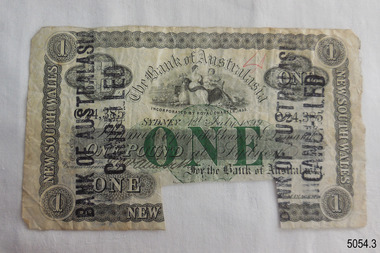 Flagstaff Hill Maritime Museum and Village
Currency - Banknote, Bank of Australasia, One-pound, 1st July 1899
... Maritime Village...Great Ocean Road...Union Bank...Australia...The banknotes also have a significant place in Australia’s history as two notes are just prior to the Federation of Australia and two notes just after. flagstaff hill warrnambool one pound note Bank of Australasia legal tender £1 banknote banknotes Flagstaff Hill Maritime Museum & Village Shipwreck Coast five poind note Australian currency Shipwrecked coast Flagstaff Hill Maritime Museum Maritime Museum Flagstaff Hill Maritime Village Great Ocean Road Union Bank Australia & New Zealand Bank ANZ Bank David Charters McArthur D C McArthur One-pound note Five-pound note £5 Sydney New South Wales Pre-Federation Post-Federation Currency Banknote set Printed: (Serial Number) "O24,385" "ONE POUND" "NEW SOUTH WALES" "1st July 1899" Stamp "BANK OF AUSTRALASIA / CANCELLED" Handwritten in red pen: "undecipherable [initials]" Text in pencil "L24" One-pound note, one of a set of four (4) notes published by The Bank of Australasia, Sydney, New South Wales. ...This set of banknotes was issued by the Bank of Australasia's Head Office in Sydney, New South Wales. Two banknotes are dated before the Federation of Australia on 1st January 1901 and two are dated just two years after Federation. Each of the banknotes in this set has a rectangular piece cut from it. This indicates that the banknote was cancelled when the note was exchanged for Australian dollars after Decimal Currency was introduced on 14th February 1966. The Bank of Australasia was established under the Royal Charter of England. It first came to Australia in 1835, opening in Sydney. The Bank of Australasia was the first bank in Warrnambool. It was established in 1854 and operated from leased buildings in Merri Street then Timor Street. The bank opened its own building on May 21, 1860, on the north-east corner of Timor and Kepler Streets. In that year, the Acting Superintendent of the Bank of Australasia in Sydney was David Charters McArthur. He went on to become the Superintendent 1867-1876. In 1951 the Bank of Australasia amalgamated with the Union Bank to form the Australia and New Zealand Bank, now known as the ANZ. Then in 1970 the ANZ merged with both the ES&A and the London Bank of Australia to form the ANZ Banking Group Limited. The ANZ Banking Group Ltd kindly donated a variety of historic items from the Bank of Australasia. This set of banknotes has historical significance as it was issued by the Bank of Australasia. The Bank of Australasia was the first bank in Warrnambool, established in 1854. The bank continued to operate until its merger in 1951 when it became the ANZ Bank, which is still in operation today. The Bank was an integral part of the establishment and growth of commerce in Colonial Warrnambool and throughout Australia. The banknotes also have a significant place in Australia’s history as two notes are just prior to the Federation of Australia and two notes just after.One-pound note, one of a set of four (4) notes published by The Bank of Australasia, Sydney, New South Wales. The obverse of the note is printed in black ink with the denomination and its round pound-coin symbol printed in green ink. There is no printing on the reverse. A black ink stamp is impressed twice on each side of the note, stating that the note is cancelled. Handwritten red ink text is on the note's obverse and pencil text on the reverse. A unique Serial number is printed twice on the obverse. The banknote has a rectangular cut-out notch on the lower edge.Printed: (Serial Number) "O24,385" "ONE POUND" "NEW SOUTH WALES" "1st July 1899" Stamp "BANK OF AUSTRALASIA / CANCELLED" Handwritten in red pen: "undecipherable [initials]" Text in pencil "L24"flagstaff hill, warrnambool, one pound note, bank of australasia, legal tender, £1, banknote, banknotes, flagstaff hill maritime museum & village, shipwreck coast, five poind note, australian currency, shipwrecked coast, flagstaff hill maritime museum, maritime museum, flagstaff hill maritime village, great ocean road, union bank, australia & new zealand bank, anz bank, david charters mcarthur, d c mcarthur, one-pound note, five-pound note, £5, sydney, new south wales, pre-federation, post-federation, currency, banknote set
