
Showing 623 items matching "mark b."
-
 Moorabbin Air Museum
Booklet (item) - GAF Collection - Project "B" Mark I Flight & Maintenance Instruction Manual
... GAF Collection - Project "B" Mark I Flight & Maintenance Instruction Manual...GAF Collection - Project "B" Mark I Flight & Maintenance Instruction Manual...Issued by GAF July 1952 GAF Collection - Project "B" Mark I Flight & Maintenance Instruction Manual Booklet GAF Collection - Project "B" Mark I Flight & Maintenance Instruction Manual ...Issued by GAF July 1952 -
Moorabbin Air Museum
Poster (Item) - Canberra B Mark 2 Hydraulic Setup MI 13:2
... Canberra B Mark 2 Hydraulic Setup MI 13:2...Canberra B Mark 2 Hydraulic Setup MI 13:2...Canberra B Mark 2 Hydraulic Setup MI 13:2 Poster Canberra B Mark 2 Hydraulic Setup MI 13:2 ... -
 Nillumbik Shire Council
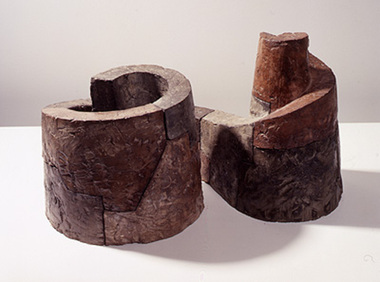
Sculpture: Mark STONER (b.1951 UK, arrived 1957 AUS), Untitled Spiral, 1991
... Sculpture: Mark STONER (b.1951 UK, arrived 1957 AUS)...Untitled Spiral Sculpture: Mark STONER (b.1951 UK, arrived 1957 AUS) ...A small scale concrete work that can be imagined as an ancient monolithic fortress or religious edifice. It suggests ideas like perpetuity, worship, preservation and history. Untitled Spiral is made up of three spirals, the first is constructed as a closed form, the second is open and the third is the space created within the second. The sense of enclosure is powerful but this is offset by the ledge which traces the top edge of the spiral shapes. This pathway leads from a precarious position to the highest point of sanctuary, or to what Stoner refers to as Nirvana. The structure is built of masonry-like units which "suggest a material presence and earthiness". Stoner is absorbed by how we define landscape and what is meant by natural. He is interested in the notion that ancient man-made structures such as stone walls, which are intrinsic to many landscapes, can now be accepted as being natural, organic forms. -
Moorabbin Air Museum
Booklet - The Sperry Gyroscope Compass A gyro-Magnetic Compass for Aircraft Type C.L.1 Mark 4.F Type C.L.2 Mark 4.B, The Sperry Gyroscope Company
... The Sperry Gyroscope Compass A gyro-Magnetic Compass for Aircraft Type C.L.1 Mark 4.F Type C.L.2 Mark 4.B...The Sperry Gyroscope Company Booklet The Sperry Gyroscope Compass A gyro-Magnetic Compass for Aircraft Type C.L.1 Mark 4.F Type C.L.2 Mark 4.B ... -
Moorabbin Air Museum
Manual (Item) - CAC Canberra B Mark 2 General and Technical Information Manuals, Canberra B Mk. 2 Aircraft General and Technical Information
... CAC Canberra B Mark 2 General and Technical Information Manuals...Two red-pink rope-bound hard-cover folders Canberra B Mk. 2 Aircraft General and Technical Information Manual CAC Canberra B Mark 2 General and Technical Information Manuals ... -
 Kadimah Jewish Cultural Centre and National Library
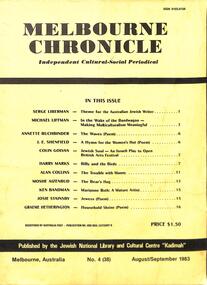
Journal, Kadimah Jewish Cultural Centre and National Library, Melbourner Bleter / Melbourne Chronicle August/September 1983
... ...Mark B....Verstandik Hershl Bachrach Mark B. I. Kape Yoni Fein Dr. Ezriel Naks Moishe Knapheit I. ...Journal published by the Kadimah Jewish Cultural Centre and National Library, Melbourne. Contains essays, reviews, fiction and poetry in both English and Yiddish.40 pages, A4, Softbound, Paper covers. non-fictionJournal published by the Kadimah Jewish Cultural Centre and National Library, Melbourne. Contains essays, reviews, fiction and poetry in both English and Yiddish.moshe ajzenbud, michael liffman, annette buchbinder, j.e. shenfield, colin golvan, harry marks, alan collins, ken bandman, josie stainsby, graeme hetherington, serge liberman, dr. m. verstandik, hershl bachrach, mark b., i. kape, yoni fein, dr. ezriel naks, moishe knapheit, i. m. lewin, melech radziner, mes, sh. bennett -
 Kadimah Jewish Cultural Centre and National Library
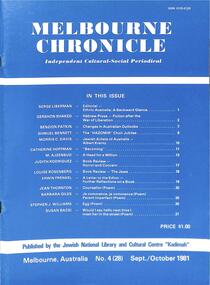
Journal, Kadimah Jewish Cultural Centre and National Library, Melbourner Bleter / Melbourne Chronicle September/October 1981
... ...Mark B....Williams Susan Bacsi Sholem Singer Mark B. I. Orbach V. Yablonski Levi Shalit B. ...Journal published by the Kadimah Jewish Cultural Centre and National Library, Melbourne. Contains essays, reviews, fiction and poetry in both English and Yiddish.64 pages, A4, Softbound, Paper covers. non-fictionJournal published by the Kadimah Jewish Cultural Centre and National Library, Melbourne. Contains essays, reviews, fiction and poetry in both English and Yiddish.moshe ajzenbud, serge liberman, judith rodriquez, gershon shaked, benzion patkin, shmuel bennett, morris c. davis, catherine hoffman, m. ajzenbud, louise rosenberg, erwin frenkel, jean thornton, barbara giles, stephen j. williams, susan bacsi, sholem singer, mark b., i. orbach, v. yablonski, levi shalit, b. ts. patkin, sh. vin, b. varshavski, l. friedman, p. kristal, h. babrach, i. m. lewin, i. rosenberg, leah zilber -
 Kadimah Jewish Cultural Centre and National Library
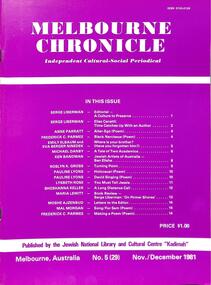
Journal, Kadimah Jewish Cultural Centre and National Library, Melbourner Bleter / Melbourne Chronicle November/December 1981
... ...Mark B....Bennett V. Yablonski Mark B. Journal published by the Kadimah Jewish Cultural Centre and National Library, Melbourne. ...Journal published by the Kadimah Jewish Cultural Centre and National Library, Melbourne. Contains essays, reviews, fiction and poetry in both English and Yiddish.44 pages, A4, Softbound, Paper covers. non-fictionJournal published by the Kadimah Jewish Cultural Centre and National Library, Melbourne. Contains essays, reviews, fiction and poetry in both English and Yiddish.moshe ajzenbud, serge liberman, m. ajzenbud, anne parratt, frederick c. parmee, emily elbaum, eva berger ninedek, michael danby, ken bandman, roslyn k. gross, pauline lyons, lysbeth rose, shoshana keller, maria lewitt, mal morgan, dr. m. fershtendik, i. orbach, a. zilber, i. rosenberg, a. tsikert, i. m. lewin, dr. sholem cholavsky, m. eysenbud, sh. bennett, v. yablonski, mark b. -
 Kadimah Jewish Cultural Centre and National Library
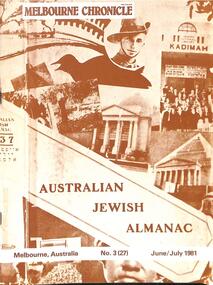
Journal, Kadimah Jewish Cultural Centre and National Library, Melbourner Bleter / Melbourne Chronicle June/July 1981
... ...Mark B....Moshe Ajzenbud Serge Liberman Susan Ivany Shirley Thomas Felix Rosenbloom Michael Small Lysbeth Cohen Judith Rodriquez Yvonne Fein Roslyn Kopel Gross Mal Morgan Dr. M. Fershtendik Mark B. B. Ts. Patkin M. Eysenbud I. Orbach I. ...Journal published by the Kadimah Jewish Cultural Centre and National Library, Melbourne. Contains essays, reviews, fiction and poetry in both English and Yiddish.100 pages, A4, Softbound, Paper covers. non-fictionJournal published by the Kadimah Jewish Cultural Centre and National Library, Melbourne. Contains essays, reviews, fiction and poetry in both English and Yiddish.moshe ajzenbud, serge liberman, susan ivany, shirley thomas, felix rosenbloom, michael small, lysbeth cohen, judith rodriquez, yvonne fein, roslyn kopel gross, mal morgan, dr. m. fershtendik, mark b., b. ts. patkin, m. eysenbud, i. orbach, i. m. lewin, i. rosenberg, l. sh., b. varshavski, v. yablonski, sh. bennett, meir zeybl -
 Bendigo Historical Society Inc.
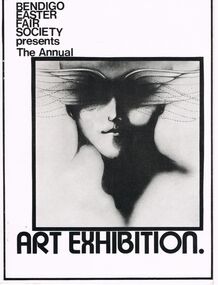
Document - ART EXHIBITION, BENDIGO, c1972
... ... Lillian B Mark...Artists: Gordon Allen, Mrs D Allender, 'April', Bruce Barklamb, Thomas R W Benkendorff, Christine Berkman, Mrs J A Blakey, James E Bowman, Darryl Brown, Malcolm H Cannon, R L Carless, Pamela Caswell, Bett Cheek, Mrs Betty Cooper, Peter Costello, Jennifer Cottrell, Stephanie Cottrell, Dorothy Dempsey, Noelene Edmunds, Emma J., Ruth Epps, Mrs Jean Ferguson, Mrs Margot Flood, Lorraine Fraser, Maureen French, Neil Friswell, Ian Glanville, Sheryl Gregory, Mrs Valmai Hill, Mr A B Hocking, Ivy Jeffrey, George Kendall, Mrs Joan Kerr, Miss Jillian Locket, R McKenzie, Mrs J E McLean, Mrs Coral Manfield, Meenah Marchbank, Lillian B Mark, Ian John Mark, T Matthews, Mrs Judy Maxwell, Margaret Metcalf, Jean Morrissey, Mrs E Noble, I Osborne, Max Paull, R Paynter, Anthony N Penno, Norman William Penrose, Mark Phillips, Janice Pinder, Yvonne Pocock, Jennifer Reilly, Mrs S Reed, R J Ritter, Roma Robbins, Faye Roberts, Frank S Saunders, Jeanette Skrokov, Mrs C A Slootjes, John Spink, Ruth E Stewart, Mrs W Tebb, Gerard Terpstra, Stan Thomas, Pat Frewin, Dominic Tuohy, Peter Tyndall, Neil G West, Tony Wilson, Wilma Wilson, Pam Wright, A McGregor and R Pearce, T A Solbig. ...Ruth Epps Mrs Jean Ferguson Mrs Margot Flood Lorraine Fraser Maureen French Neil Friswell Ian Glanville Sheryl Gregory Mrs Valmai Hill Mr A B Hocking Ivy Jeffrey George Kendall Mrs Joan Kerr Miss Jillian Locket R McKenzie Mrs J E McLean Mrs Coral Manfield Meenah Marchbank Lillian B Mark Ian John Mark T Matthews Mrs Judy Maxwell Margaret Metcalf Jean Morrissey Mrs E Noble I Osborne Max Paull R Paynter Anthony N Penno Norman William Penrose Mark Phillips Janice Pinder Yvonne Pocock Jennifer Reilly Mrs S Reed R J Ritter Roma Robbins Faye Roberts Frank S Saunders Jeanette Skrokov Mrs C A Slootjes John Spink Ruth E Stewart Mrs W Tebb Gerard Terpstra Stan Thomas Pat Frewin Dominic Tuohy Peter Tyndall Neil G West Tony Wilson Wilma Wilson Pam Wright A McGregor and R Pearce T A Solbig. ...Art Exhibition, Bendigo Easter Fair Society presents The Annual Art Exhibition. Painting Section. Artists: Gordon Allen, Mrs D Allender, 'April', Bruce Barklamb, Thomas R W Benkendorff, Christine Berkman, Mrs J A Blakey, James E Bowman, Darryl Brown, Malcolm H Cannon, R L Carless, Pamela Caswell, Bett Cheek, Mrs Betty Cooper, Peter Costello, Jennifer Cottrell, Stephanie Cottrell, Dorothy Dempsey, Noelene Edmunds, Emma J., Ruth Epps, Mrs Jean Ferguson, Mrs Margot Flood, Lorraine Fraser, Maureen French, Neil Friswell, Ian Glanville, Sheryl Gregory, Mrs Valmai Hill, Mr A B Hocking, Ivy Jeffrey, George Kendall, Mrs Joan Kerr, Miss Jillian Locket, R McKenzie, Mrs J E McLean, Mrs Coral Manfield, Meenah Marchbank, Lillian B Mark, Ian John Mark, T Matthews, Mrs Judy Maxwell, Margaret Metcalf, Jean Morrissey, Mrs E Noble, I Osborne, Max Paull, R Paynter, Anthony N Penno, Norman William Penrose, Mark Phillips, Janice Pinder, Yvonne Pocock, Jennifer Reilly, Mrs S Reed, R J Ritter, Roma Robbins, Faye Roberts, Frank S Saunders, Jeanette Skrokov, Mrs C A Slootjes, John Spink, Ruth E Stewart, Mrs W Tebb, Gerard Terpstra, Stan Thomas, Pat Frewin, Dominic Tuohy, Peter Tyndall, Neil G West, Tony Wilson, Wilma Wilson, Pam Wright, A McGregor and R Pearce, T A Solbig. World Prints. List of various world print available for sale and prices, for the first time in Australia. World Prints Pty. Ltd. Copyright. Aztec Graphics, Moorabbin.- Design R H Bultows 72Aztec Graphics, Moorabbinevent, easter fair, bendigo easter fair society, art exhibition, bendigo easter fair society annual art exhibition. artists: gordon allen, mrs d allender, 'april', bruce barklamb, thomas r w benkendorff, christine berkman, mrs j a blakey, james e bowman, darryl brown, malcolm h cannon, r l carless, pamela caswell, bett cheek, mrs betty cooper, peter costello, jennifer cottrell, stephanie cottrell, dorothy dempsey, noelene edmunds, emma j., ruth epps, mrs jean ferguson, mrs margot flood, lorraine fraser, maureen french, neil friswell, ian glanville, sheryl gregory, mrs valmai hill, mr a b hocking, ivy jeffrey, george kendall, mrs joan kerr, miss jillian locket, r mckenzie, mrs j e mclean, mrs coral manfield, meenah marchbank, lillian b mark, ian john mark, t matthews, mrs judy maxwell, margaret metcalf, jean morrissey, mrs e noble, i osborne, max paull, r paynter, anthony n penno, norman william penrose, mark phillips, janice pinder, yvonne pocock, jennifer reilly, mrs s reed, r j ritter, roma robbins, faye roberts, frank s saunders, jeanette skrokov, mrs c a slootjes, john spink, ruth e stewart, mrs w tebb, gerard terpstra, stan thomas, pat frewin, dominic tuohy, peter tyndall, neil g west, tony wilson, wilma wilson, pam wright, a mcgregor and r pearce, t a solbig. world prints. list of various world print available for sale and prices, for the first time in australia. world prints pty. ltd. copyright. aztec graphics, moorabbin.- design r h bultows 72 -
 Sunshine and District Historical Society Incorporated
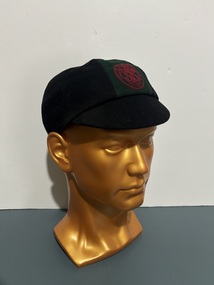
Headwear - Sunshine Technical School - Boy's Hat
... Worn by a Sunshine Technical Student named B. Mark...The Green Crescent Cap|Manufactured by Philip Joseph & Son Melbourne|Name B. Mark|Size 6 5/8|Guarenteed Quality|Perfect Fitting|Unbreakable Peak|Pure Wool...Worn by a Sunshine Technical Student named B. Mark Sunshine Technical School Technical School Clothing The Green Crescent Cap|Manufactured by Philip Joseph & Son Melbourne|Name B. ...Worn by a Sunshine Technical Student named B. MarkThe Green Crescent Cap|Manufactured by Philip Joseph & Son Melbourne|Name B. Mark|Size 6 5/8|Guarenteed Quality|Perfect Fitting|Unbreakable Peak|Pure Woolsunshine technical school, technical school, clothing -
 Broadmeadows Historical Society & Museum
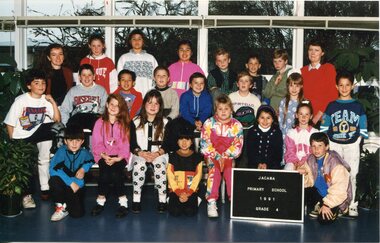
Photograph - Class Photograph, Jacana Primary School: Grade 4, 1991, 1991
... ...Mark Bamfield...Mr. B...Jacana Primary School Education Photograph Group Photograph Kelly Kenna Belinda Cilia Brigitte Paco Lindsay Norman Peter Massari Kristopher Andree-Jansz Omar Houssein Reece Lee My Nguyen Yavuz Cavyarli William Warke Darryl King Candice Blaney Said El Halabi Jade Goudge Bridie Hogan Belinda Hutchinson Tuba Sahan Tracey Phillips Bradley Hooke Janine So Mark Bamfield Mr. B. O'Dea Sue Bourchier Yvonne McBain Back; See attached for list of Names (White label): PH-5006 (Blue Label): PH-5593 Colour Photograph on Satin Finish Paper Jacana Primary School: Grade 4, 1991 Photograph Class Photograph ...This 1991 group photograph of Grade 4 students and their teacher at Jacana Primary School offers a valuable window into the everyday experiences of school life in Melbourne’s northern suburbs during the late 20th century. Established in 1959, Jacana Primary served the local community for over four decades before its closure in the early 2000s. More than just a place of learning, the school was a cornerstone of community life—bringing together children, families, and educators in a shared environment of growth and connection. The photograph reflects the school’s emphasis on inclusivity, friendship, and a strong sense of belonging. It also provides insight into the demographic and cultural diversity of Jacana at the time, a period marked by suburban development and shifting social dynamics. As part of the school’s visual archive, this image helps document the role of public education in shaping local identity and fostering intergenerational community ties.This 1991 group photograph of Grade 4 students and their teacher at Jacana Primary School is a culturally and historically significant artifact that reflects the role of public education in shaping community identity in Melbourne’s northern suburbs. Established in 1959, Jacana Primary operated for over four decades, serving as a vital hub for learning, social connection, and community engagement until its closure in the early 2000s. The image captures more than a moment in time—it embodies the school’s enduring values of inclusivity, camaraderie, and belonging. It also offers insight into the demographic and social landscape of Jacana during a period of suburban expansion and cultural change. As part of the school’s visual legacy, this photograph contributes to a deeper understanding of how educational institutions foster intergenerational ties and strengthen the social fabric of their communities.Colour Photograph on Satin Finish PaperBack; See attached for list of Names (White label): PH-5006 (Blue Label): PH-5593jacana primary school, education, photograph, group photograph, kelly kenna, belinda cilia, brigitte paco, lindsay norman, peter massari, kristopher andree-jansz, omar houssein, reece lee, my nguyen, yavuz cavyarli, william warke, darryl king, candice blaney, said el halabi, jade goudge, bridie hogan, belinda hutchinson, tuba sahan, tracey phillips, bradley hooke, janine so, mark bamfield, mr. b. o'dea, sue bourchier, yvonne mcbain -
 Orbost & District Historical Society
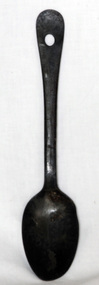
spoon
... Some indecipherable marks W B V1 or W1...utensil spoon food Some indecipherable marks W B V1 or W1 A large metal spoon which has a hanging hole in the top of the handle. spoon ...A large metal spoon which has a hanging hole in the top of the handle.Some indecipherable marks W B V1 or W1utensil spoon food -
 Benalla Art Gallery
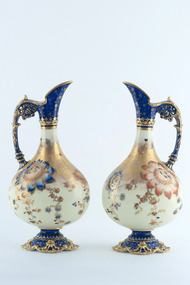
Ceramic, ROYAL CROWN DERBY, Pair of urns, 1889
... Verso: A: "ROYAL CROWN DERBY" above ROYAL CROWN DERBY maker's mark right of hole in centre; "ENGLAND" vertical to right of maker's mark in red underglaze; "1134/2553" in orange underglaze above maker's mark. B: "ROYAL CROWN DERBY" above ROYAL CROWN DERBY maker's mark right of hole in centre; "ENGLAND" vertical to right ofmaker's mark in red underglaze; "1134/2553" in orange underglaze above maker's mark. ...Victorian Ceramic Urns Decorated Gilded Floral Royal Crown Derby Verso: A: "ROYAL CROWN DERBY" above ROYAL CROWN DERBY maker's mark right of hole in centre; "ENGLAND" vertical to right of maker's mark in red underglaze; "1134/2553" in orange underglaze above maker's mark. B: "ROYAL CROWN DERBY" above ROYAL CROWN DERBY maker's mark right of hole in centre; "ENGLAND" vertical to right ofmaker's mark in red underglaze; "1134/2553" in orange underglaze above maker's mark. ...Established: Derby, Derbyshire, England in 1750 by Andrew PlancheVictorianLedger Bequest, 1993Urns in traditional Royal Crown Derby pattern of blues, flowers and gilded decoration.Verso: A: "ROYAL CROWN DERBY" above ROYAL CROWN DERBY maker's mark right of hole in centre; "ENGLAND" vertical to right of maker's mark in red underglaze; "1134/2553" in orange underglaze above maker's mark. B: "ROYAL CROWN DERBY" above ROYAL CROWN DERBY maker's mark right of hole in centre; "ENGLAND" vertical to right ofmaker's mark in red underglaze; "1134/2553" in orange underglaze above maker's mark. "B" in orange underglaze to the far left of makers mark.ceramic, urns, decorated, gilded, floral, royal crown derby -
 Linton and District Historical Society Inc
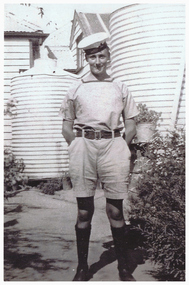
Photograph, Gordon Mark, circa 1947
... "Gordon Mark/historical/from/B Grigg". "possibly/taken/at Sandows/or the hotel"....Gordon Mark "Gordon Mark/historical/from/B Grigg". "possibly/taken/at Sandows/or the hotel". ...Gordon Mark joined the RAN in October 1946. He was discharged in 1949 as he received head injuries in an accident. Original photograph taken c.1947, copy made in 2010.Copy of black and white photograph of Gordon Mark in naval uniform."Gordon Mark/historical/from/B Grigg". "possibly/taken/at Sandows/or the hotel".gordon mark -
 Woodend RSL
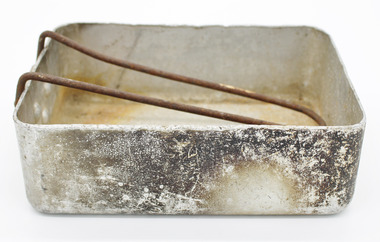
Mess Tin, Corfield & Buckle, Limited - Trafalgar Works, 1939
... Inscribed to metal loop fastening flip over handle to tin is the maker’s mark ‘C&B Ltd. 1939’ and arrow insignia for ‘Department of Defence’....Representative of an army issued accoutrement from the Mid 20th Century which may have been used during the Korean War. cooking hexamine stove canteen mess tin Inscribed to metal loop fastening flip over handle to tin is the maker’s mark ‘C&B Ltd. 1939’ and arrow insignia for ‘Department of Defence’. ...Although manufactured in 1939 it may be possible that it was issued later during the Korean War (1950-1953) as the burn marks on the exterior sides may indicate the use of a hexamine stove which came into use by the Australian Army in the 1950's.Representative of an army issued accoutrement from the Mid 20th Century which may have been used during the Korean War.Well used military mess tin (aluminium), larger one of nest of two (smaller one missing) with flip over metal (carbon?) handle secured to short end by metal loop and rivets.Inscribed to metal loop fastening flip over handle to tin is the maker’s mark ‘C&B Ltd. 1939’ and arrow insignia for ‘Department of Defence’.cooking, hexamine stove, canteen, mess tin -
 Bendigo Military Museum
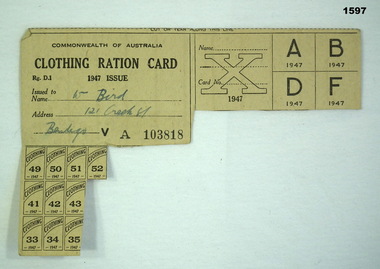
Card - CARDS, RATION, 1947
... Clothing Ration Card. 10 x Little coupons "clothing 1947 " Nos 23-52 4 x Middle size coupons Mark A,B D,F all 1947 1 x Large coupon with "X" 1947 ...Refer Cat No 1601 for service details. documents ration cards Clothing "W Bird 121 Creek St Bendigo" Clothing Ration Card. 10 x Little coupons "clothing 1947 " Nos 23-52 4 x Middle size coupons Mark A,B D,F all 1947 1 x Large coupon with "X" 1947 Card CARDS, RATION ...Issued to Billy Bird VX113169 2/14 Batt AIF. Refer Cat No 1601 for service details.Clothing Ration Card. 10 x Little coupons "clothing 1947 " Nos 23-52 4 x Middle size coupons Mark A,B D,F all 1947 1 x Large coupon with "X" 1947 "W Bird 121 Creek St Bendigo"documents, ration cards, clothing -
 Bendigo Historical Society Inc.
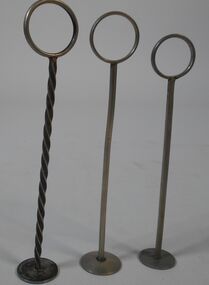
Tool - Muddlers
... The one with the twisted handle is a copy of the Christophe muddler. The makers mark WP B tells us that this was made in Birmingham, England but a fire destroyed many of the makers marks information so it is not possible to identify the actual maker....The one with the twisted handle is a copy of the Christophe muddler. The makers mark WP B tells us that this was made in Birmingham, England but a fire destroyed many of the makers marks information so it is not possible to identify the actual maker. ...These were used for pressing the fruit in cocktails. The one with the twisted handle is a copy of the Christophe muddler. The makers mark WP B tells us that this was made in Birmingham, England but a fire destroyed many of the makers marks information so it is not possible to identify the actual maker.3 metal muddlers. Largest has a twisted stem with a ring at the top and a flat circular bottom. 2nd has a circular stem with ring at the top and a circular bottom that is indented at the bottom hallmarked WP B. 3rd has a square stem with a circle at the top and a flat circular bottom 5 hallmarks on the base.Hallmarksmuddler, fruit press -
 Heidelberg Golf Club
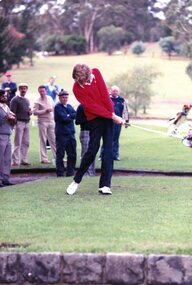
Photograph, Heidelberg Golf Club, Men's Pennant, Division 3 1980: Heidelberg players on course, 1980
... Men's Pennant, Division 3 1980: Pennant players on course: Photo A: Mark Smyth, photo B John Cole, photo C Ted Johnson...Men's Pennant, Division 3 1980: Pennant players on course: Photo A: Mark Smyth, photo B John Cole, photo C Ted Johnson Heidelberg Golf Club Men's Pennant pennant Colour photograph of pennant players on course Men's Pennant, Division 3 1980: Heidelberg players on course Photograph Photograph Heidelberg Golf Club ...Men's Pennant, Division 3 1980: Pennant players on course: Photo A: Mark Smyth, photo B John Cole, photo C Ted JohnsonColour photograph of pennant players on courseheidelberg golf club, men's pennant, pennant -
 Ballarat Clarendon College
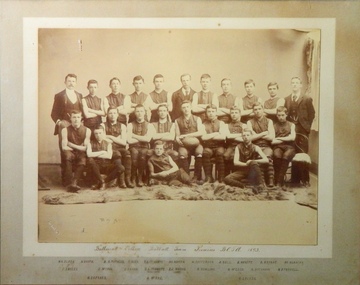
Framed photograph, Ballarat College Football Team Premiers B.C.F.A. 1893
... Names on mount: Mr Olden, N Booth, A G Tuthill, F Weir, T A Uthwatt, Mr Alston, W Patterson, A Bell, A Nevitt, E Bryant, Mr Clanchy, / S Davies, J McCook, S Swann, E A Uthwatt (Vice Captain), L J Marks (Captain), B Dowling, N McLeod, R Buchanan, H O'Farrell, N Sherard, A McRae, R Leckie...Names on mount: Mr Olden, N Booth, A G Tuthill, F Weir, T A Uthwatt, Mr Alston, W Patterson, A Bell, A Nevitt, E Bryant, Mr Clanchy, / S Davies, J McCook, S Swann, E A Uthwatt (Vice Captain), L J Marks (Captain), B Dowling, N McLeod, R Buchanan, H O'Farrell, N Sherard, A McRae, R Leckie ballarat college football 1893 Medium size photograph with mount, frame and glass. ...Names on mount: Mr Olden, N Booth, A G Tuthill, F Weir, T A Uthwatt, Mr Alston, W Patterson, A Bell, A Nevitt, E Bryant, Mr Clanchy, / S Davies, J McCook, S Swann, E A Uthwatt (Vice Captain), L J Marks (Captain), B Dowling, N McLeod, R Buchanan, H O'Farrell, N Sherard, A McRae, R LeckieMedium size photograph with mount, frame and glass. ballarat college, football, 1893 -
National Vietnam Veterans Museum (NVVM)
Document, Memorabilia of Jason Cowland
... Contains 4 AATTV book marks; 1x AP BAC b/w drawing; 5 Unites States Armed Forces Vietnam envelopes....AATTV United States Armed Forces - Stationery Contains 4 AATTV book marks; 1x AP BAC b/w drawing; 5 Unites States Armed Forces Vietnam envelopes. ...Contains 4 AATTV book marks; 1x AP BAC b/w drawing; 5 Unites States Armed Forces Vietnam envelopes.aattv, united states armed forces - stationery -
 Bendigo Historical Society Inc.
Document - COHN BROTHERS COLLECTION: BUNDLE OF 111 LETTERS DATED FROM 1891-1893
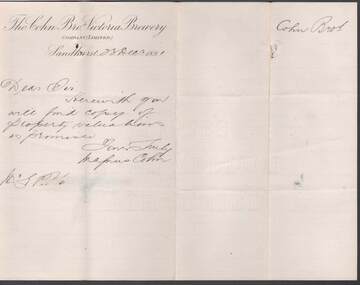
... Other letters include the names of : Clarke, J, Cohen E, Cohen Miriam, Commercial Bank, Roschert Cohn, Cohen Charles, Drake E, Dobie J, Fitzgerald I H, Fink A, Frey Hans, Gibson R G, Greenwood A, Galdwin M B, Iser Henry, Kennons J S K, Lawrence M B , Landeshut Elle, London Chartered Bank Melbourne, London Chartered Bank Ararat, Levy W, Lehmann M J, Meudell G D, Matteran Hyett, Marks B, McWhae & Co, Fryer S, Nomen's & Scheel, National Trustees, Queally Ino, Robertson Geo, Registrar General, Marcus Sievwright, Somerton C F & Co, Scheel C, Smith B D , Tankard M, Trustees Executors, Wyman S...Other letters include the names of : Clarke, J, Cohen E, Cohen Miriam, Commercial Bank, Roschert Cohn, Cohen Charles, Drake E, Dobie J, Fitzgerald I H, Fink A, Frey Hans, Gibson R G, Greenwood A, Galdwin M B, Iser Henry, Kennons J S K, Lawrence M B , Landeshut Elle, London Chartered Bank Melbourne, London Chartered Bank Ararat, Levy W, Lehmann M J, Meudell G D, Matteran Hyett, Marks B, McWhae & Co, Fryer S, Nomen's & Scheel, National Trustees, Queally Ino, Robertson Geo, Registrar General, Marcus Sievwright, Somerton C F & Co, Scheel C, Smith B D , Tankard M, Trustees Executors, Wyman S Document COHN BROTHERS COLLECTION: BUNDLE OF 111 LETTERS DATED FROM 1891-1893 ...Bundle of one hundred and eleven letters from period 1891 - 1893, outward and inward correspondence mostly addressed to E.P. Hastings, Cohn Bros., signed by Magnus Cohn. Other letters include the names of : Clarke, J, Cohen E, Cohen Miriam, Commercial Bank, Roschert Cohn, Cohen Charles, Drake E, Dobie J, Fitzgerald I H, Fink A, Frey Hans, Gibson R G, Greenwood A, Galdwin M B, Iser Henry, Kennons J S K, Lawrence M B , Landeshut Elle, London Chartered Bank Melbourne, London Chartered Bank Ararat, Levy W, Lehmann M J, Meudell G D, Matteran Hyett, Marks B, McWhae & Co, Fryer S, Nomen's & Scheel, National Trustees, Queally Ino, Robertson Geo, Registrar General, Marcus Sievwright, Somerton C F & Co, Scheel C, Smith B D , Tankard M, Trustees Executors, Wyman Sbendigo, industry, cohn bros brewery -
 Bellarine Historical Society Museum
Ceramic - Brown and Cream Stoneware Jar, mid Nineteenth Century
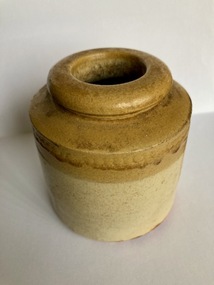
... Some of the crockery jars they made have a triangular C & B mark. Crosse & Blackwell were a food production company that needed jars for their products....Trademark C & B below a triangular mark topped by a small diamond shape at its apex....Some of the crockery jars they made have a triangular C & B mark. Crosse & Blackwell were a food production company that needed jars for their products. ...George Tamworth had invested in some mines near Tamworth, and realised there was a potential there for extracting clay suitable for pottery use. The pottery opened in 1862. In 1864, it was called 'Wilnecote Company Limited'. Later it became George Skey and Co. Limited. Some of the crockery jars they made have a triangular C & B mark. Crosse & Blackwell were a food production company that needed jars for their products.Good example of a pottery jar used in food production in nineteenth century England. Possibly shows evidence of stains from original food container use. Antique jar. Small circular stoneware and salt glazed bi-coloured jar in mid 19th century style. Top section light or ochre brown with a patterned freize of inlaid small dots. Top opening measures 3 cm and is indented with overlapping rolled lid. Bottom section cream and undecorated. Some reddish or orange coloured stains on side and base. Darker coloured stain marks below most of frieze. Trademark impression on lower section just above base.Trademark C & B below a triangular mark topped by a small diamond shape at its apex.food storage jars, antique pottery -
 Flagstaff Hill Maritime Museum and Village
Domestic object - Spoon, c.1878
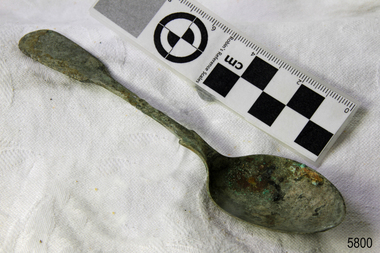
... marks are clearly visible in 66 instances, while the same sequence of general outlines, or depression shapes, is discernible in another 166 examples. 1. A recessed Crown containing a raised Diamond outline and the initials “W” and “P” (the recognised trademark of William Page & Co) 2. An impressed Ellipse containing a raised, pivoted, Triangle in its lower part and bearing a Resurrection Cross on its upper section (a possible dissenting church symbol reflecting religious affiliation); OR a rounded Square impression containing a raised, ‘lazy’, letter “B” (possibly mimicking sterling silver hallmark signifying city of manufacture i.e. ...Four of five makers marks are legible: (1) Trade Mark (2) Lazy "B" (3) Maltese Cross (5) Register Stamp....Four of five makers marks are legible: (1) Trade Mark (2) Lazy "B" (3) Maltese Cross (5) Register Stamp. ...This tea spoon is from the wreck of the LOCH ARD, a Loch Line ship of 1,693 tons which sailed from Gravesend, London, on 2 March 1878 with 17 passengers and a crew of 36 under Captain George Gibbs. “The intention was to discharge cargo in Melbourne, before returning to London via the Horn with wool and wheat”. Instead, on 1 June 1878, after 90 days at sea, she struck the sandstone cliffs of Mutton Bird Island on the south west coast of Victoria, and sank with the loss of 52 lives and all her cargo. The manifest of the LOCH ARD listed an array of manufactured goods and bulk metals being exported to the Colony of Victoria, with a declared value of £53,700. (202 bills of lading show an actual invoice value of £68, 456, with insurance underwriting to £30,000 of all cargo). Included in the manifest is the item of “Tin hardware & cutlery £7,530”. This teaspoon is one of 482 similar items of electro-plated cutlery from the LOCH ARD site, comprising spoons and forks of various sizes but all sharing the same general shape or design and metallic composition. 49 of these pieces display a legible makers’ mark — the initials “W” and “P” placed within a raised diamond outline, which is in turn contained within a sunken crown shape — identifying the manufacturer as William Page & Co of Birmingham. An electroplater’s makers’ marks, unlike sterling silver hallmarks, are not consistent identifiers of quality or date and place of manufacture. A similar line of five impressions was usually made to impress the consumer with an implication of industry standards, but what each one actually signified was not regulated and so they varied according to the whim of the individual foundry. In this case, the maker’s marks are often obscured by sedimentary accretion or removed by corrosion after a century of submersion in the ocean. However sufficient detail has survived to indicate that these samples of electro-plated cutlery probably originated from the same consignment in the LOCH ARD’s cargo. The following descriptions of maker’s marks are drawn from 255 tea spoons, 125 dessert spoons, and 99 table forks. These marks are clearly visible in 66 instances, while the same sequence of general outlines, or depression shapes, is discernible in another 166 examples. 1. A recessed Crown containing a raised Diamond outline and the initials “W” and “P” (the recognised trademark of William Page & Co) 2. An impressed Ellipse containing a raised, pivoted, Triangle in its lower part and bearing a Resurrection Cross on its upper section (a possible dissenting church symbol reflecting religious affiliation); OR a rounded Square impression containing a raised, ‘lazy’, letter “B” (possibly mimicking sterling silver hallmark signifying city of manufacture i.e. Birmingham) 3. An impressed rounded Square filled with a raised Maltese Cross (the base metal composite of nickel silver was also known as ‘German silver’ after its Berlin inventors in 1823) 4. A recessed Circle containing a Crab or Scarab Beetle image; OR a recessed Circle containing a rotated ‘fleur de lys’ or ‘fasces’ design 5. A depressed Diamond shape enclosing a large raised letter “R” and a small raised letter “D” (mimicking the U.K. Patent Office stamp which abbreviated the term ‘registered’ to “RD”, but also included date and class of patent) Suggested trade names for William Page & Co’s particular blend of brass plating are ‘roman silver’ or ‘silverite’. This copper alloy polishes to a lustrous gold when new, discolouring to a murky grey with greenish hue when neglected. HISTORY OF THE LOCH ARD The LOCH ARD belonged to the famous Loch Line which sailed many ships from England to Australia. Built in Glasgow by Barclay, Curdle and Co. in 1873, the LOCH ARD was a three-masted square rigged iron sailing ship. The ship measured 262ft 7" (79.87m) in length, 38ft (11.58m) in width, 23ft (7m) in depth and had a gross tonnage of 1693 tons. The LOCH ARD's main mast measured a massive 150ft (45.7m) in height. LOCH ARD made three trips to Australia and one trip to Calcutta before its final voyage. LOCH ARD left England on March 2, 1878, under the command of Captain Gibbs, a newly married, 29 year old. She was bound for Melbourne with a crew of 37, plus 17 passengers and a load of cargo. The general cargo reflected the affluence of Melbourne at the time. On board were straw hats, umbrella, perfumes, clay pipes, pianos, clocks, confectionary, linen and candles, as well as a heavier load of railway irons, cement, lead and copper. There were items included that intended for display in the Melbourne International Exhibition in 1880. The voyage to Port Phillip was long but uneventful. At 3am on June 1, 1878, Captain Gibbs was expecting to see land and the passengers were becoming excited as they prepared to view their new homeland in the early morning. But LOCH ARD was running into a fog which greatly reduced visibility. Captain Gibbs was becoming anxious as there was no sign of land or the Cape Otway lighthouse. At 4am the fog lifted. A man aloft announced that he could see breakers. The sheer cliffs of Victoria's west coast came into view, and Captain Gibbs realised that the ship was much closer to them than expected. He ordered as much sail to be set as time would permit and then attempted to steer the vessel out to sea. On coming head on into the wind, the ship lost momentum, the sails fell limp and LOCH ARD's bow swung back. Gibbs then ordered the anchors to be released in an attempt to hold its position. The anchors sank some 50 fathoms - but did not hold. By this time LOCH ARD was among the breakers and the tall cliffs of Mutton Bird Island rose behind the ship. Just half a mile from the coast, the ship's bow was suddenly pulled around by the anchor. The captain tried to tack out to sea, but the ship struck a reef at the base of Mutton Bird Island, near Port Campbell. Waves broke over the ship and the top deck was loosened from the hull. The masts and rigging came crashing down knocking passengers and crew overboard. When a lifeboat was finally launched, it crashed into the side of LOCH ARD and capsized. Tom Pearce, who had launched the boat, managed to cling to its overturned hull and shelter beneath it. He drifted out to sea and then on the flood tide came into what is now known as LOCH ARD Gorge. He swam to shore, bruised and dazed, and found a cave in which to shelter. Some of the crew stayed below deck to shelter from the falling rigging but drowned when the ship slipped off the reef into deeper water. Eva Carmichael had raced onto deck to find out what was happening only to be confronted by towering cliffs looming above the stricken ship. In all the chaos, Captain Gibbs grabbed Eva and said, "If you are saved Eva, let my dear wife know that I died like a sailor". That was the last Eva Carmichael saw of the captain. She was swept off the ship by a huge wave. Eva saw Tom Pearce on a small rocky beach and yelled to attract his attention. He dived in and swam to the exhausted woman and dragged her to shore. He took her to the cave and broke open case of brandy which had washed up on the beach. He opened a bottle to revive the unconscious woman. A few hours later Tom scaled a cliff in search of help. He followed hoof prints and came by chance upon two men from nearby Glenample Station three and a half miles away. In a state of exhaustion, he told the men of the tragedy. Tom returned to the gorge while the two men rode back to the station to get help. By the time they reached LOCH ARD Gorge, it was cold and dark. The two shipwreck survivors were taken to Glenample Station to recover. Eva stayed at the station for six weeks before returning to Ireland, this time by steamship. In Melbourne, Tom Pearce received a hero's welcome. He was presented with the first gold medal of the Royal Humane Society of Victoria and a £1000 cheque from the Victorian Government. Concerts were performed to honour the young man's bravery and to raise money for those who lost family in the LOCH ARD disaster. Of the 54 crew members and passengers on board, only two survived: the apprentice, Tom Pearce and the young woman passenger, Eva Carmichael, who lost all of her family in the tragedy. Ten days after the LOCH ARD tragedy, salvage rights to the wreck were sold at auction for £2,120. Cargo valued at £3,000 was salvaged and placed on the beach, but most washed back into the sea when another storm developed. The wreck of LOCH ARD still lies at the base of Mutton Bird Island. Much of the cargo has now been salvaged and some was washed up into what is now known as LOCH ARD Gorge. Cargo and artefacts have also been illegally salvaged over many years before protective legislation was introduced. One of the most unlikely pieces of cargo to have survived the shipwreck was a Minton porcelain peacock - one of only seven in the world. The peacock was destined for the Melbourne International Exhibition in 1880. It had been well packed, which gave it adequate protection during the violent storm. Today, the Minton peacock can be seen at the Flagstaff Hill Maritime Museum in Warrnambool. From Australia's most dramatic shipwreck it has now become Australia's most valuable shipwreck artefact and is one of very few 'objects' on the Victorian State Heritage Register. The LOCH ARD shipwreck is of State significance – Victorian Heritage Register S 417. Flagstaff Hill’s collection of artefacts from LOCH ARD is significant for being one of the largest collections of artefacts from this shipwreck in Victoria. It is significant for its association with the shipwreck, which is on the Victorian Heritage Register (VHR S417). The collection is significant because of the relationship between the objects, as together they have a high potential to interpret the story of the LOCH ARD. The LOCH ARD collection is archaeologically significant as the remains of a large international passenger and cargo ship. The LOCH ARD collection is historically significant for representing aspects of Victoria’s shipping history and its potential to interpret sub-theme 1.5 of Victoria’s Framework of Historical Themes (living with natural processes). The collection is also historically significant for its association with the LOCH ARD, which was one of the worst and best known shipwrecks in Victoria’s history. Unrestored tea spoon from the wreck of the LOCH ARD. The spoon design has a flattened fiddle-back handle, with a thin stem or shank, flared collar, and elongated bowl. The spoons metallic composition is a thin layer of brass alloy which has partially corroded back to a nickel-silver base metal. Four of five makers marks are legible: (1) Trade Mark (2) Lazy "B" (3) Maltese Cross (5) Register Stamp.flagstaff hill maritime museum, shipwreck coast, great ocean road, loch line, loch ard, electroplated cutlery, loch ard, william page and company, birmingham brass plating, makers marks, nickel silver -
 Flagstaff Hill Maritime Museum and Village
Spoon, circa 1878
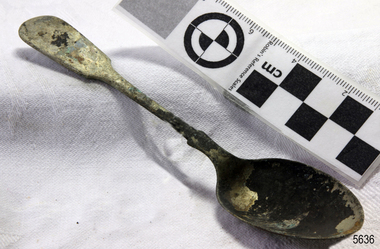
... marks are clearly visible in 66 instances, while the same sequence of general outlines, or depression shapes, is discernible in another 166 examples. 1. A recessed Crown containing a raised Diamond outline and the initials “W” and “P” (the recognised trademark of William Page & Co) 2. An impressed Ellipse containing a raised, pivoted, Triangle in its lower part and bearing a Resurrection Cross on its upper section (a possible dissenting church symbol reflecting religious affiliation); OR a rounded Square impression containing a raised, ‘lazy’, letter “B” (possibly mimicking sterling silver hallmark signifying city of manufacture i.e. ...Three of five makers marks on back of handle are legible: (1) Trade Mark (2) Lazy 'B' (3) Maltese Cross....Three of five makers marks on back of handle are legible: (1) Trade Mark (2) Lazy 'B' (3) Maltese Cross. Spoon William Page & Co. ...This tea spoon is from the wreck of the LOCH ARD, a Loch Line ship of 1,693 tons which sailed from Gravesend, London, on 2 March 1878 with 17 passengers and a crew of 36 under Captain George Gibbs. “The intention was to discharge cargo in Melbourne, before returning to London via the Horn with wool and wheat”. Instead, on 1 June 1878, after 90 days at sea, she struck the sandstone cliffs of Mutton Bird Island on the south west coast of Victoria, and sank with the loss of 52 lives and all her cargo. The manifest of the LOCH ARD listed an array of manufactured goods and bulk metals being exported to the Colony of Victoria, with a declared value of £53,700. (202 bills of lading show an actual invoice value of £68, 456, with insurance underwriting to £30,000 of all cargo). Included in the manifest is the item of “Tin hardware & cutlery £7,530”. This teaspoon is one of 482 similar items of electro-plated cutlery from the LOCH ARD site, comprising spoons and forks of various sizes but all sharing the same general shape or design and metallic composition. 49 of these pieces display a legible makers’ mark — the initials “W” and “P” placed within a raised diamond outline, which is in turn contained within a sunken crown shape — identifying the manufacturer as William Page & Co of Birmingham. An electroplater’s makers’ marks, unlike sterling silver hallmarks, are not consistent identifiers of quality or date and place of manufacture. A similar line of five impressions was usually made to impress the consumer with an implication of industry standards, but what each one actually signified was not regulated and so they varied according to the whim of the individual foundry. In this case, the maker’s marks are often obscured by sedimentary accretion or removed by corrosion after a century of submersion in the ocean. However sufficient detail has survived to indicate that these samples of electro-plated cutlery probably originated from the same consignment in the LOCH ARD’s cargo. The following descriptions of maker’s marks are drawn from 255 tea spoons, 125 dessert spoons, and 99 table forks. These marks are clearly visible in 66 instances, while the same sequence of general outlines, or depression shapes, is discernible in another 166 examples. 1. A recessed Crown containing a raised Diamond outline and the initials “W” and “P” (the recognised trademark of William Page & Co) 2. An impressed Ellipse containing a raised, pivoted, Triangle in its lower part and bearing a Resurrection Cross on its upper section (a possible dissenting church symbol reflecting religious affiliation); OR a rounded Square impression containing a raised, ‘lazy’, letter “B” (possibly mimicking sterling silver hallmark signifying city of manufacture i.e. Birmingham) 3. An impressed rounded Square filled with a raised Maltese Cross (the base metal composite of nickel silver was also known as ‘German silver’ after its Berlin inventors in 1823) 4. A recessed Circle containing a Crab or Scarab Beetle image; OR a recessed Circle containing a rotated ‘fleur de lys’ or ‘fasces’ design 5. A depressed Diamond shape enclosing a large raised letter “R” and a small raised letter “D” (mimicking the U.K. Patent Office stamp which abbreviated the term ‘registered’ to “RD”, but also included date and class of patent) Suggested trade names for William Page & Co’s particular blend of brass plating are ‘roman silver’ or ‘silverite’. This copper alloy polishes to a lustrous gold when new, discolouring to a murky grey with greenish hue when neglected. HISTORY OF THE LOCH ARD The LOCH ARD belonged to the famous Loch Line which sailed many ships from England to Australia. Built in Glasgow by Barclay, Curdle and Co. in 1873, the LOCH ARD was a three-masted square rigged iron sailing ship. The ship measured 262ft 7" (79.87m) in length, 38ft (11.58m) in width, 23ft (7m) in depth and had a gross tonnage of 1693 tons. The LOCH ARD's main mast measured a massive 150ft (45.7m) in height. LOCH ARD made three trips to Australia and one trip to Calcutta before its final voyage. LOCH ARD left England on March 2, 1878, under the command of Captain Gibbs, a newly married, 29 year old. She was bound for Melbourne with a crew of 37, plus 17 passengers and a load of cargo. The general cargo reflected the affluence of Melbourne at the time. On board were straw hats, umbrella, perfumes, clay pipes, pianos, clocks, confectionary, linen and candles, as well as a heavier load of railway irons, cement, lead and copper. There were items included that intended for display in the Melbourne International Exhibition in 1880. The voyage to Port Phillip was long but uneventful. At 3am on June 1, 1878, Captain Gibbs was expecting to see land and the passengers were becoming excited as they prepared to view their new homeland in the early morning. But LOCH ARD was running into a fog which greatly reduced visibility. Captain Gibbs was becoming anxious as there was no sign of land or the Cape Otway lighthouse. At 4am the fog lifted. A man aloft announced that he could see breakers. The sheer cliffs of Victoria's west coast came into view, and Captain Gibbs realised that the ship was much closer to them than expected. He ordered as much sail to be set as time would permit and then attempted to steer the vessel out to sea. On coming head on into the wind, the ship lost momentum, the sails fell limp and LOCH ARD's bow swung back. Gibbs then ordered the anchors to be released in an attempt to hold its position. The anchors sank some 50 fathoms - but did not hold. By this time LOCH ARD was among the breakers and the tall cliffs of Mutton Bird Island rose behind the ship. Just half a mile from the coast, the ship's bow was suddenly pulled around by the anchor. The captain tried to tack out to sea, but the ship struck a reef at the base of Mutton Bird Island, near Port Campbell. Waves broke over the ship and the top deck was loosened from the hull. The masts and rigging came crashing down knocking passengers and crew overboard. When a lifeboat was finally launched, it crashed into the side of LOCH ARD and capsized. Tom Pearce, who had launched the boat, managed to cling to its overturned hull and shelter beneath it. He drifted out to sea and then on the flood tide came into what is now known as LOCH ARD Gorge. He swam to shore, bruised and dazed, and found a cave in which to shelter. Some of the crew stayed below deck to shelter from the falling rigging but drowned when the ship slipped off the reef into deeper water. Eva Carmichael had raced onto deck to find out what was happening only to be confronted by towering cliffs looming above the stricken ship. In all the chaos, Captain Gibbs grabbed Eva and said, "If you are saved Eva, let my dear wife know that I died like a sailor". That was the last Eva Carmichael saw of the captain. She was swept off the ship by a huge wave. Eva saw Tom Pearce on a small rocky beach and yelled to attract his attention. He dived in and swam to the exhausted woman and dragged her to shore. He took her to the cave and broke open case of brandy which had washed up on the beach. He opened a bottle to revive the unconscious woman. A few hours later Tom scaled a cliff in search of help. He followed hoof prints and came by chance upon two men from nearby Glenample Station three and a half miles away. In a state of exhaustion, he told the men of the tragedy. Tom returned to the gorge while the two men rode back to the station to get help. By the time they reached LOCH ARD Gorge, it was cold and dark. The two shipwreck survivors were taken to Glenample Station to recover. Eva stayed at the station for six weeks before returning to Ireland, this time by steamship. In Melbourne, Tom Pearce received a hero's welcome. He was presented with the first gold medal of the Royal Humane Society of Victoria and a £1000 cheque from the Victorian Government. Concerts were performed to honour the young man's bravery and to raise money for those who lost family in the LOCH ARD disaster. Of the 54 crew members and passengers on board, only two survived: the apprentice, Tom Pearce and the young woman passenger, Eva Carmichael, who lost all of her family in the tragedy. Ten days after the LOCH ARD tragedy, salvage rights to the wreck were sold at auction for £2,120. Cargo valued at £3,000 was salvaged and placed on the beach, but most washed back into the sea when another storm developed. The wreck of LOCH ARD still lies at the base of Mutton Bird Island. Much of the cargo has now been salvaged and some was washed up into what is now known as LOCH ARD Gorge. Cargo and artefacts have also been illegally salvaged over many years before protective legislation was introduced. One of the most unlikely pieces of cargo to have survived the shipwreck was a Minton porcelain peacock - one of only nine in the world. The peacock was destined for the Melbourne International Exhibition in 1880. It had been well packed, which gave it adequate protection during the violent storm. Today, the Minton peacock can be seen at the Flagstaff Hill Maritime Museum in Warrnambool. From Australia's most dramatic shipwreck it has now become Australia's most valuable shipwreck artefact and is one of very few 'objects' on the Victorian State Heritage Register. The LOCH ARD shipwreck is of State significance – Victorian Heritage Register S 417. Flagstaff Hill’s collection of artefacts from LOCH ARD is significant for being one of the largest collections of artefacts from this shipwreck in Victoria. It is significant for its association with the shipwreck, which is on the Victorian Heritage Register (VHR S417). The collection is significant because of the relationship between the objects, as together they have a high potential to interpret the story of the LOCH ARD. The LOCH ARD collection is archaeologically significant as the remains of a large international passenger and cargo ship. The LOCH ARD collection is historically significant for representing aspects of Victoria’s shipping history and its potential to interpret sub-theme 1.5 of Victoria’s Framework of Historical Themes (living with natural processes). The collection is also historically significant for its association with the LOCH ARD, which was one of the worst and best known shipwrecks in Victoria’s history. Unrestored tea spoon from the wreck of the LOCH ARD. The spoon design has a flattened fiddle-back handle, with a thin stem or shank, flared collar, and elongated bowl. The spoons metallic composition is a thin layer of brass alloy which has partially corroded back to a nickel-silver base metal. 60% of plate remains. Plain heraldic shield on rear of spoon bowl. Three of five makers marks on back of handle are legible: (1) Trade Mark (2) Lazy 'B' (3) Maltese Cross.flagstaff hill, warrnambool, shipwrecked coast, flagstaff hill maritime museum, maritime museum, shipwreck coast, flagstaff hill maritime village, great ocean road, loch line, loch ard, captain gibbs, eva carmichael, tom pearce, glenample station, mutton bird island, loch ard gorge, electroplated cutlery, loch ard shipwreck, nickel silver, william page & co, birmingham, brass plating, makers marks -
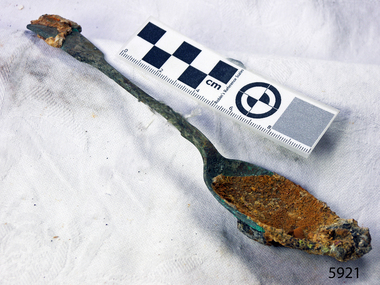 Flagstaff Hill Maritime Museum and Village
Spoon, circa 1878
... Four of five makers marks are clear - "B" in rounded circle, Fleur de Lys, Crab design, "Rd" in diamond....Four of five makers marks are clear - "B" in rounded circle, Fleur de Lys, Crab design, "Rd" in diamond. ...This medium-sized dessert spoon is from the wreck of the LOCH ARD, a Loch Line ship of 1,693 tons which sailed from Gravesend, London, on 2 March 1878 with 17 passengers and a crew of 36 under Captain George Gibbs. “The intention was to discharge cargo in Melbourne, before returning to London via the Horn with wool and wheat”. Instead, on 1 June 1878, after 90 days at sea, she struck the sandstone cliffs of Mutton Bird Island on the south west coast of Victoria, and sank with the loss of 52 lives and all her cargo. The manifest of the LOCH ARD listed an array of manufactured goods and bulk metals being exported to the Colony of Victoria, with a declared value of £53,700. (202 bills of lading show an actual invoice value of £68, 456, with insurance underwriting to £30,000 of all cargo). Included in the manifest is the item of “Tin hardware & cutlery £7,530”. This dessert spoon is one of 482 similar items of electro-plated cutlery from the LOCH ARD site, comprising spoons and forks of various sizes but all sharing the same general shape or design and metallic composition. 49 of these pieces display a legible makers’ mark — the initials “W” and “P” placed within a raised diamond outline, which is in turn contained within a sunken crown shape — identifying the manufacturer as William Page & Co of Birmingham. An electroplater’s makers’ marks, unlike sterling silver hallmarks, are not consistent identifiers of quality or date and place of manufacture. A similar line of five impressions was usually made to impress the consumer with an implication of industry standards, but what each one actually signified was not regulated and so they varied according to the whim of the individual foundry. In this case, the maker’s marks are often obscured by sedimentary accretion or removed by corrosion after a century of submersion in the ocean. However sufficient detail has survived to indicate that these samples of electro-plated cutlery probably originated from the same consignment in the LOCH ARD’s cargo. The generally common range of marks are drawn from 255 tea spoons, 125 dessert spoons, and 99 table forks. These marks are clearly visible in 66 instances, while the same sequence of general outlines, or depression shapes, is discernible in another 166 examples. Suggested trade names for William Page & Co’s particular blend of brass plating are ‘roman silver’ or ‘silverite’. This copper alloy polishes to a lustrous gold when new, discolouring to a murky grey with greenish hue when neglected. HISTORY OF THE LOCH ARD The LOCH ARD belonged to the famous Loch Line which sailed many ships from England to Australia. Built in Glasgow by Barclay, Curdle and Co. in 1873, the LOCH ARD was a three-masted square rigged iron sailing ship. The ship measured 262ft 7" (79.87m) in length, 38ft (11.58m) in width, 23ft (7m) in depth and had a gross tonnage of 1693 tons. The LOCH ARD's main mast measured a massive 150ft (45.7m) in height. LOCH ARD made three trips to Australia and one trip to Calcutta before its final voyage. LOCH ARD left England on March 2, 1878, under the command of Captain Gibbs, a newly married, 29 year old. She was bound for Melbourne with a crew of 37, plus 17 passengers and a load of cargo. The general cargo reflected the affluence of Melbourne at the time. On board were straw hats, umbrella, perfumes, clay pipes, pianos, clocks, confectionary, linen and candles, as well as a heavier load of railway irons, cement, lead and copper. There were items included that intended for display in the Melbourne International Exhibition in 1880. The voyage to Port Phillip was long but uneventful. At 3am on June 1, 1878, Captain Gibbs was expecting to see land and the passengers were becoming excited as they prepared to view their new homeland in the early morning. But LOCH ARD was running into a fog which greatly reduced visibility. Captain Gibbs was becoming anxious as there was no sign of land or the Cape Otway lighthouse. At 4am the fog lifted. A man aloft announced that he could see breakers. The sheer cliffs of Victoria's west coast came into view, and Captain Gibbs realised that the ship was much closer to them than expected. He ordered as much sail to be set as time would permit and then attempted to steer the vessel out to sea. On coming head on into the wind, the ship lost momentum, the sails fell limp and LOCH ARD's bow swung back. Gibbs then ordered the anchors to be released in an attempt to hold its position. The anchors sank some 50 fathoms - but did not hold. By this time LOCH ARD was among the breakers and the tall cliffs of Mutton Bird Island rose behind the ship. Just half a mile from the coast, the ship's bow was suddenly pulled around by the anchor. The captain tried to tack out to sea, but the ship struck a reef at the base of Mutton Bird Island, near Port Campbell. Waves broke over the ship and the top deck was loosened from the hull. The masts and rigging came crashing down knocking passengers and crew overboard. When a lifeboat was finally launched, it crashed into the side of LOCH ARD and capsized. Tom Pearce, who had launched the boat, managed to cling to its overturned hull and shelter beneath it. He drifted out to sea and then on the flood tide came into what is now known as LOCH ARD Gorge. He swam to shore, bruised and dazed, and found a cave in which to shelter. Some of the crew stayed below deck to shelter from the falling rigging but drowned when the ship slipped off the reef into deeper water. Eva Carmichael had raced onto deck to find out what was happening only to be confronted by towering cliffs looming above the stricken ship. In all the chaos, Captain Gibbs grabbed Eva and said, "If you are saved Eva, let my dear wife know that I died like a sailor". That was the last Eva Carmichael saw of the captain. She was swept off the ship by a huge wave. Eva saw Tom Pearce on a small rocky beach and yelled to attract his attention. He dived in and swam to the exhausted woman and dragged her to shore. He took her to the cave and broke open case of brandy which had washed up on the beach. He opened a bottle to revive the unconscious woman. A few hours later Tom scaled a cliff in search of help. He followed hoof prints and came by chance upon two men from nearby Glenample Station three and a half miles away. In a state of exhaustion, he told the men of the tragedy. Tom returned to the gorge while the two men rode back to the station to get help. By the time they reached LOCH ARD Gorge, it was cold and dark. The two shipwreck survivors were taken to Glenample Station to recover. Eva stayed at the station for six weeks before returning to Ireland, this time by steamship. In Melbourne, Tom Pearce received a hero's welcome. He was presented with the first gold medal of the Royal Humane Society of Victoria and a £1000 cheque from the Victorian Government. Concerts were performed to honour the young man's bravery and to raise money for those who lost family in the LOCH ARD disaster. Of the 54 crew members and passengers on board, only two survived: the apprentice, Tom Pearce and the young woman passenger, Eva Carmichael, who lost all of her family in the tragedy. Ten days after the LOCH ARD tragedy, salvage rights to the wreck were sold at auction for £2,120. Cargo valued at £3,000 was salvaged and placed on the beach, but most washed back into the sea when another storm developed. The wreck of LOCH ARD still lies at the base of Mutton Bird Island. Much of the cargo has now been salvaged and some was washed up into what is now known as LOCH ARD Gorge. Cargo and artefacts have also been illegally salvaged over many years before protective legislation was introduced. One of the most unlikely pieces of cargo to have survived the shipwreck was a Minton porcelain peacock - one of only seven in the world. The peacock was destined for the Melbourne International Exhibition in 1880. It had been well packed, which gave it adequate protection during the violent storm. Today, the Minton peacock can be seen at the Flagstaff Hill Maritime Museum in Warrnambool. From Australia's most dramatic shipwreck it has now become Australia's shipwreck artefact and is one of very few 'objects' on the Victorian State Heritage Register most valuable. The LOCH ARD shipwreck is of State significance – Victorian Heritage Register S 417. Flagstaff Hill’s collection of artefacts from LOCH ARD is significant for being one of the largest collections of artefacts from this shipwreck in Victoria. It is significant for its association with the shipwreck, which is on the Victorian Heritage Register (VHR S417). The collection is significant because of the relationship between the objects, as together they have a high potential to interpret the story of the LOCH ARD. The LOCH ARD collection is archaeologically significant as the remains of a large international passenger and cargo ship. The LOCH ARD collection is historically significant for representing aspects of Victoria’s shipping history and its potential to interpret sub-theme 1.5 of Victoria’s Framework of Historical Themes (living with natural processes). The collection is also historically significant for its association with the LOCH ARD, which was one of the worst and best known shipwrecks in Victoria’s history. Unrestored dessert spoon from the wreck of the LOCH ARD. The spoon design has a flattened fiddle-back handle, with a thin stem or shank, flared collar, and a shallow rounded bowl. The spoons metallic composition is a thin layer of brass alloy which has partially corroded back to a nickel-silver base metal. 60% concretion on top of bowl and handle, 20% original plate remains, and some verdigris is evident. Spoon stem is bent. Four of five makers marks are clear - "B" in rounded circle, Fleur de Lys, Crab design, "Rd" in diamond.flagstaff hill, warrnambool, shipwrecked coast, flagstaff hill maritime museum, maritime museum, shipwreck coast, flagstaff hill maritime village, great ocean road, loch line, loch ard, captain gibbs, eva carmichael, tom pearce, glenample station, mutton bird island, loch ard gorge, electroplated cutlery, loch ard shipwreck, william page and co, birmingham brass plating, dessert spoons -
 Eltham District Historical Society Inc
Document - Series Listing, Fraser Faithfull et al, Series 52: Ari in Public Places Awards 1992 & 1994, photographs, 2000
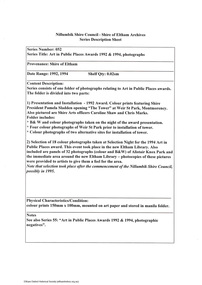
... Also pictured are Shire Arts officers Caroline Shaw and Chris Marks. Folder includes: * B& W and colour photographs taken on the night of the award presentation. * Four colour photographs of Weir St Park prior to installation of tower. * Colour photographs of two alternative sites for installation of tower. 2) Selection of 18 colour photographs taken at Selection Night for the 1994 Art in Public Places award. ...Also pictured are Shire Arts officers Caroline Shaw and Chris Marks. Folder includes: * B& W and colour photographs taken on the night of the award presentation. * Four colour photographs of Weir St Park prior to installation of tower. * Colour photographs of two alternative sites for installation of tower. 2) Selection of 18 colour photographs taken at Selection Night for the 1994 Art in Public Places award. ...Series consists of one folder of photographs relating to Art in Public Places awards. The folder is divided into two parts: I) Presentation and Installation - 1992 Award. Colour prints featuring Shire President Pamela Sladden opening "The Tower" at Weir St Park, Montmorency. Also pictured are Shire Arts officers Caroline Shaw and Chris Marks. Folder includes: * B& W and colour photographs taken on the night of the award presentation. * Four colour photographs of Weir St Park prior to installation of tower. * Colour photographs of two alternative sites for installation of tower. 2) Selection of 18 colour photographs taken at Selection Night for the 1994 Art in Public Places award. This event took place in the new Eltham Library. Also included arc panels of32 photographs (colour and B&W) of Alistair Knox Park and the immediate area around the new Eltham Library - photocopies of these pictures were provided to artists to give them a feel for the area. Note that selection took place after the commencement of the Nillumbik Shire Council, possibly in 1995.shire of eltham archives, series listing -
 Flagstaff Hill Maritime Museum and Village
Functional object - Cow Bell, James Barwell, 1860s-1878
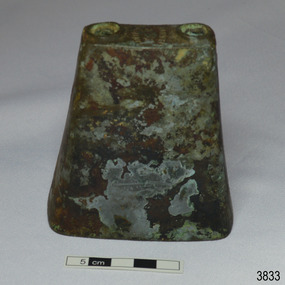
... Some of Barwell’s products were stamped with his maker’s mark (his initials J. B. either side of a cross entwined with a ‘B’ in an oval of oak leaves (for Birmingham)). ...Some of Barwell’s products were stamped with his maker’s mark (his initials J. B. either side of a cross entwined with a ‘B’ in an oval of oak leaves (for Birmingham)). ...This brass cow bell was recovered from the wreck of the sailing ship ‘Loch Ard’ at Mutton Bird Island, near Port Campbell, Victoria, from late 1960s to early 1970s. Cow bells were listed as part of the cargo on board the Loch Ard. This bell is now part of the John Chance collection. Flagstaff Hill Maritime Village’s divers also recovered similar bells from the Loch Ard wreck in 1973. One of them was found in a sandy hole in the centre of the wreck site. All of the recovered cow bells are without their hangers. A bell of this size could have been used by horse or cattle teams. Cow bells were a common Colonial item. They were hung around the necks of grazing domestic cows and goats, bullock and horse teams, even camel teams so that they could be found again. Sheep and cattle drovers used them as a warning for night time disturbances such as wild animals. The maker of the cow bell, James Barwell, was a bell founder established in Birmingham, England, from 1784. In 1842 he acquired Fiddian’s firm of ‘Steam and Water’, keeping its name and stamping it on some of his products. According to his advertisement in the Exhibitors guide for the Church Congress of 1887, he made bells and fittings for churches and schools. He also made bells for cloches and chimes, and made tuned musical handbells. He repaired and reproduced bells, and he had a team of experienced ringers to “inspect towers and report upon the tone and condition of bells and fittings.” In 1903 he became incorporated as a Limited Company, ‘engineers’ and plumbers’ brasswork, and bell founders.’ In 1914 he advertised as ‘Cock and Bell Founders’, specialising in plumbing and engineering fittings, church bells, and “every description of hanging and hand bells.” Some of Barwell’s products were stamped with his maker’s mark (his initials J. B. either side of a cross entwined with a ‘B’ in an oval of oak leaves (for Birmingham)). James Barwell bells were no longer made after 1920. James Barwell was among makers who exported bells to the Australian colony from the 1860s. Early Australian iron animal bells were also made from the 1860s by blacksmiths such as Anthony Morgan from 1861, August Menneke from 1867, and Samuel Jones from 1868. Few brass bells were produced here in those times. This bell is historically significant as typical of a cow bell used by farmers and herdsmen in Colonial Victoria. Its significance is increased by being an artefact recovered by John Chance, a diver from the wreck of the Loch Ard and other wrecks in the late 1960s to early 1970s. Items that come from several wrecks along Victoria's coast have since been donated to the Flagstaff Hill Maritime Village’s museum collection by his family, illustrating this item’s level of historical value. The cow bell is also significant for being part of Flagstaff Hill’s collection of artefacts from LOCH ARD, which is significant for being one of the largest collections of artefacts from this shipwreck in Victoria. It is significant for its association with the shipwreck, which is on the Victorian Heritage Register (VHR S417). The collection is significant because of the relationship between the objects, as together they have a high potential to interpret the story of the LOCH ARD. The LOCH ARD collection is archaeologically significant as the remains of a large international passenger and cargo ship. The LOCH ARD collection is historically significant for representing aspects of Victoria’s shipping history and its potential to interpret sub-theme 1.5 of Victoria’s Framework of Historical Themes (living with natural processes). The collection is also historically significant for its association with the LOCH ARD, which was one of the worst and best known shipwrecks in Victoria’s history. Cow bell; heavy brass, flat top, pyramid shape, rectangular head, shoulders flare out to rectangular mouth. The head has two same-sized tooled holes for adding the hanging yoke. Inscription on top and one side. Encrustations are on the metal in places. The hanger and clapper are missing. Made by James Barwell of Birmingham.Stamped on the head "BARWELL / - - - / - - -- ING" [Perhaps BARWELL - - - BIRMING. Could size be in centre? 3 3/4 IN?] Stamped on side [motif] (undecipherable) flagstaff hill, warrnambool, flagstaff hill maritime museum, maritime museum, shipwreck coast, flagstaff hill maritime village, great ocean road, john chance, loch ard, mutton bird island, glenample, eva carmichael, tom pearce, james barwell, cow bell, horse bell, bell founder, bell smith, vintage bell, birmingham bell foundry, farmer, shepherd, drover, stock bell -
 Federation University Historical Collection
Photograph - Black and White, Ballarat Soldiers Memorial Band, 1932
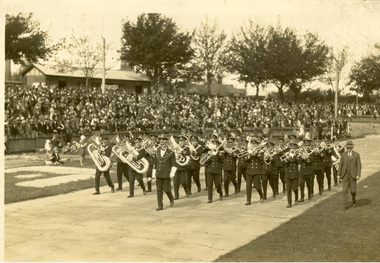
... This mark was added to the band's music score and drill score to give a band's total Quickstep result. Ballarat Soldiers Memorial Band winning both the B Grade selection and Quickstep and came 2nd in the A grade selection. ...Ballarat Soldiers Memorial Band competing in the 1932 South Street Competitions in Ballarat. .2) shows the the band being inspected as part of the Marching Contest Points (20) were allotted for such things as cleanliness of uniforms and boots missing buttons, messy hair, unshaven, etc. This mark was added to the band's music score and drill score to give a band's total Quickstep result.Ballarat Soldiers Memorial Band winning both the B Grade selection and Quickstep and came 2nd in the A grade selection. Overall coming 1st in the B grade aggregate and 2nd in the A grade aggragate 1932.1 - Ballarat Soldiers Memorial Band playing and marching . .2 - Ballarat Soldiers Memorial Band standing at attention on an oval.1 - Ballarat Soldiers Memorial Band ( Frank Wright - Conductor). Winners B Grade selection, B grade Quickstep, 2nd A grade selection. 1st B grade aggregate, 2nd A Grade aggragate South St. 1932 .2 Ballarat Soldiers Memorial Band 1st B Grade Selection & quickstep, 2nd A grade quickstep. Frank Wright - Conductor South St. 1932ballarat soldiers memorial band, 1932, south street, frank wright, entertainment, quickstep, uniform -
 Federation University Historical Collection
Photograph - Photograph - Colour, Ballarat School of Mines Herald Shield Football Squad, 1982, 1982
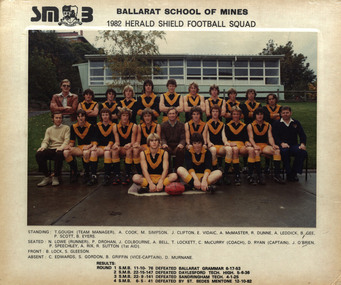
... Mark Simpson...John Clifton...E. Vidaic...Andrew McMaster...R. Dunne...A. Leddick...Bruce Gee...P. Scott...B...Gough (Team Manager), Anthony Cook, Mark Simpson, John Clifton, E. Vidaic, Andrew McMaster, R. Dunne, A. Leddick, Bruce Gee, P. Scott, B...Gough Anthony Cook Mark Simpson John Clifton E. Vidaic Andrew McMaster R. Dunne A. Leddick Bruce Gee P. Scott B. ...The Ballarat School of Mines traditionally had a strong Australian Rules Football team. The 1982 team included Tony Lockett who went on to play at the highest level becoming the highest goal scorer in the history of the VFL/AFL with 1,360 goals in a career of 281 games, that commenced in 1983 with the St Kilda Football Club, and finished in 2002 with the Sydney Swans. Lockett is the only full-forward ever to win the coveted Brownlow Medal, in 1987, a season in which he was decorated with several honours. He is a four-time Coleman Medallist, kicked more than 100 goals in a season on six occasions (an AFL record), and is a member of the Australian Football Hall of Fame. (Wikipedia) In 2015 Tony Lockett was elevated to the state of Legend in the Australian Football League Hall of Fame.Photograph of the Ballarat School of Mines Australian Rules Football team taken at the Ballarat School of Mines. The football team wears the gold and green colours of the school team. Standing left to right: T. Gough (Team Manager), Anthony Cook, Mark Simpson, John Clifton, E. Vidaic, Andrew McMaster, R. Dunne, A. Leddick, Bruce Gee, P. Scott, B. Eyers. Sitting left to right: N. Rowe (Runner), Paul Drohan, Jeff Colbourne, A. Bell, Tony Lockett, Colin McCurry (Coach), Damian Ryan (Captain), J. O'Brien. Front left to right: Barrie Lock, S. Gleeson. Absent: C. Edwards, S. Gordon, B. Griffin (Vice-Captain), Damien Murnane. ballarat school of mines, football, australian rules footballl, herald shield, mccurry, lockett, tony lockett, t. gough, anthony cook, mark simpson, john clifton, e. vidaic, andrew mcmaster, r. dunne, a. leddick, bruce gee, p. scott, b. eyers., n. rowe, paul drohan, jeff colbourne, a. bell, colin mccurry, damian ryan, j. o'brien., barrie lock, s. gleeson., c. edwards, s. gordon, b. griffin, damien murnane., afl, vfl
