
Showing 16 items matching "marksmanship"
-
 4th/19th Prince of Wales's Light Horse Regiment Unit History Room
Booklet, Australian Government Printing Service, Australian Army Manual of Land Warfare Part 2 Infantry Vol 9 Pam 4 Marksmanship 1995, 1995
... Australian Army Manual of Land Warfare Part 2 Infantry Vol 9 Pam 4 Marksmanship 1995...Marksmanship...A hard covered plastic covered loose leaf booklet providing instructors, coaches and firers in all corps with the practical and theoretical information applicable to marksmanship with infantry weapons....4th/19th Prince of Wales's Light Horse Regiment Unit History Room 4/19 PWLH Regiment, Building 78 Simpson Barracks Macleod melbourne Marksmanship 7610-66-136-4218 A hard covered plastic covered loose leaf booklet providing instructors, coaches and firers in all corps with the practical and theoretical information applicable to marksmanship with infantry weapons. ...A hard covered plastic covered loose leaf booklet providing instructors, coaches and firers in all corps with the practical and theoretical information applicable to marksmanship with infantry weapons.7610-66-136-4218marksmanship -
 Ringwood RSL Sub-Branch
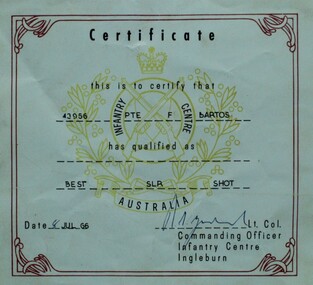
Certificate, Marksmanship, 1966
... Marksmanship...Certificate of marksmanship for best SLR shot. 8th July 1966. ...Printed paper. Marksmanship Certificate ...Printed paper.Certificate of marksmanship for best SLR shot. 8th July 1966. Infantry Centre, Ingleburn. -
 National Vietnam Veterans Museum (NVVM)
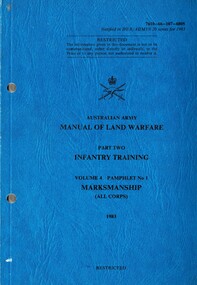
Manual, Australian Army, Australian Army: Manual of Land Warfare, Part Two: Infantry Training. Volume 4 Pamphlet No. 1, Marksmanship (All Corps) 1983, 1983
... Volume 4 Pamphlet No. 1, Marksmanship (All Corps) 1983......Marksmanship...Volume 4 Pamphlet No. 1, Marksmanship (All Corps) 1983 Manual Australian Army ...A blue coloured cardboard cover with black informaion on the front cover. Top right hand corner reads 7610-66-107-6805. Under the Australian Army insignia are the details fo the booklet. There are two punch holes down the left haqnd side of the manual.australia - armed forces - service manuals, land warfare, infantry training, marksmanship -
 8th/13th Victorian Mounted Rifles Regimental Collection
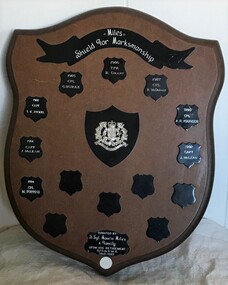
Memorabilia - shooting trophy, Miles Shield for Marksmanship
... Miles Shield for Marksmanship......marksmanship...Miles Shield for Marksmanship Memorabilia shooting trophy ...Maurice Miles served in the Australian Army in World War Two and was present at Cowra when the Japanese POW breakout occurred. He joined Citizien Military Forces in 1965, serving with 8/13 Victorian Mounted Rifles till 1985. He was a keen rifle shot and this shield was a way of fostering the skill within the regiment.Representative of community efforts to foster military skills in citizen soldiers.Wooden shield with 8/13 Victorian Mounted Rifles badge at centre and plaques arranged around edges recording winners of competition.Donated by / S Sgt Maurie Miles / & Family / upon his retirement / 8/13 VMR / 1965-1985cowra, cmf, vmr, military, world war two, marksmanship -
 Monbulk RSL Sub Branch
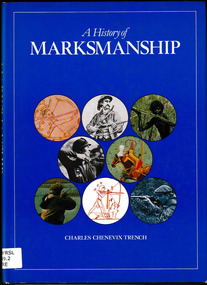
Book, Exeter Books, A history of marksmanship, 1972
... A history of marksmanship...Ill, p.319. A history of marksmanship Book Exeter Books Charles Chenevix Trench. ...An illustrated survey of man's use of missile weapons since the Stone Age.Ill, p.319.non-fictionAn illustrated survey of man's use of missile weapons since the Stone Age. firearms - history, shooting - history -
 Clunes Museum
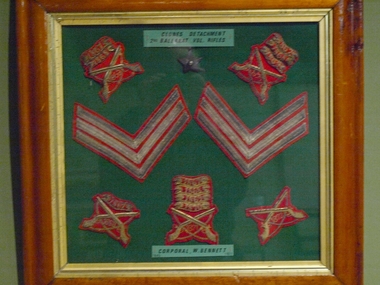
Award - MARKSMANSHIP AWARD
... AWARD WON FOR MARKSMANSHIP 1867,1867,1869,1870,,1871,1872...AN AWARD FOR MARKSMANSHIP WON BY CORPORAL WILLIAM BENNETT OF THE CLUNES DETACHMENT 2ND BALLARAT VOLUNTEER RIFLES, AWARD PATCHES FOR 1868 TO 1872 MOUNTED AND FRAMED. ...ALSO HIS CORPORAL STRIPES. Award MARKSMANSHIP AWARD ...AWARD WON FOR MARKSMANSHIP 1867,1867,1869,1870,,1871,1872AN AWARD FOR MARKSMANSHIP WON BY CORPORAL WILLIAM BENNETT OF THE CLUNES DETACHMENT 2ND BALLARAT VOLUNTEER RIFLES, AWARD PATCHES FOR 1868 TO 1872 MOUNTED AND FRAMED. ALSO HIS CORPORAL STRIPES. CLUNES DETACHMENT 2ND BALLARAT VOL. RIFLES. CORPORAL, W. BENNETT 1845-1927.local history, 2nd ballarat volunteer rifles, william bennett -
 Running Rabbits Military Museum operated by the Upwey Belgrave RSL Sub Branch
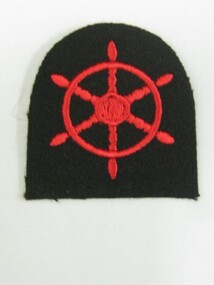
Badge
... USA Marines Marksmanship Badge...Running Rabbits Military Museum operated by the Upwey Belgrave RSL Sub Branch 1 Mast Gully Road Upwey melbourne Badge/Buttons Vietnam General USA Marines Marksmanship Badge Badge ...USA Marines Marksmanship Badgebadge/buttons, vietnam, general -
 Bendigo Military Museum
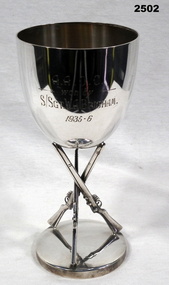
Souvenir - TROPHY, 1936
... AAOC (Aust Army Ordnance Corp) Trophy probably awarded for a marksmanship competition...Bendigo Military Museum 37 - 39 Pall Mall Bendigo goldfields AAOC (Aust Army Ordnance Corp) Trophy probably awarded for a marksmanship competition military history - army military history - trophies AAOC Won by S.SGT W A BRIGHAM 1935-36” “LEWBURY EPNS” Trophy, silver, consists of round base with 3 crossed rifles facing upwards & a cup attached. ...AAOC (Aust Army Ordnance Corp) Trophy probably awarded for a marksmanship competitionTrophy, silver, consists of round base with 3 crossed rifles facing upwards & a cup attached. The cup is engraved.AAOC Won by S.SGT W A BRIGHAM 1935-36” “LEWBURY EPNS”military history - army, military history - trophies -
 Beechworth RSL Sub-Branch
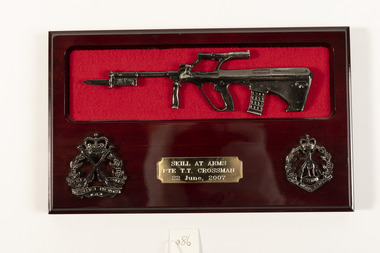
Plaque - Plaque - Skill at Arms - Royal Australian Regiment, Skill at Arms, 2007
... Crossman for his skills and marksmanship with the F88 AuSteyr rifle on 22 June 2007 ...Crossman for his skills and marksmanship with the F88 AuSteyr rifle on 22 June 2007 Plaque Skill at Arms Engraving - SKILL AT ARMS / PTE T.T Crossman / 22 June 2007 / Royal Australian Infantry Corps badge - Engraving: ROYAL AUSTRALIAN INFANTRY CORPS / Royal Australian Regiment Badge - Engraving: ROYAL AUSTRALIAN REGIMENT / A lacquered wooden plaque featuring a small model of the F88 Austeyr rifle on a red felt inlay above a gold plaque engraving. ...Presented to Private T.T. Crossman for his skills and marksmanship with the F88 AuSteyr rifle on 22 June 2007 A lacquered wooden plaque featuring a small model of the F88 Austeyr rifle on a red felt inlay above a gold plaque engraving. The left side features the Royal Australian Infantry Corps badge and the right side features the Royal Australian Regiment Badge. Engraving - SKILL AT ARMS / PTE T.T Crossman / 22 June 2007 / Royal Australian Infantry Corps badge - Engraving: ROYAL AUSTRALIAN INFANTRY CORPS / Royal Australian Regiment Badge - Engraving: ROYAL AUSTRALIAN REGIMENT /plaque, skill at arms -
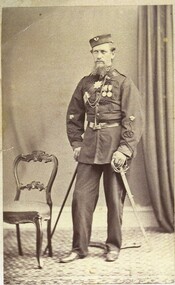 Clunes Museum
Photograph
... William Bennett (Corporal) served in the Ballarat Volunteer Rifle Rangers 2nd Battalion Ballarat, Clunes detachment, he won marksmanship awards in 1867, 1968, 1869, 1871. ...Clunes Museum 36 Fraser Street enter building through Collins Place Clunes goldfields William Bennett (Corporal) served in the Ballarat Volunteer Rifle Rangers 2nd Battalion Ballarat, Clunes detachment, he won marksmanship awards in 1867, 1968, 1869, 1871. william bennett r k paull j r tanner photographer .1 On reverse; J R Tanner Clunes, William Bennett .2 R K Paul March 12th 1865 , to his sincere friend W Bennett .1 Black and white photograph of William Bennett in army uniform, sabre in left hand, walking stick in right. .2 Black and white photograph of R K Paul, seated Photograph PHOTOGRAPH ...William Bennett (Corporal) served in the Ballarat Volunteer Rifle Rangers 2nd Battalion Ballarat, Clunes detachment, he won marksmanship awards in 1867, 1968, 1869, 1871. .1 Black and white photograph of William Bennett in army uniform, sabre in left hand, walking stick in right. .2 Black and white photograph of R K Paul, seated.1 On reverse; J R Tanner Clunes, William Bennett .2 R K Paul March 12th 1865 , to his sincere friend W Bennettwilliam bennett, r k paull, j r tanner photographer -
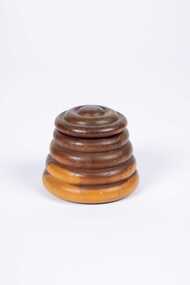 Bacchus Marsh & District Historical Society
Decorative object, Wooden bowl made from Osage Orange tree timber
... This small bowl was won by Alex Todd for marksmanship at the Holy Trinity Anglican Church Bazaar in Bacchus Marsh in 1935. ...Bacchus Marsh & District Historical Society Lerderderg Library Main Street Bacchus Marsh This small bowl was won by Alex Todd for marksmanship at the Holy Trinity Anglican Church Bazaar in Bacchus Marsh in 1935. ...This small bowl was won by Alex Todd for marksmanship at the Holy Trinity Anglican Church Bazaar in Bacchus Marsh in 1935. It was described in the Bacchus Marsh Express newspaper as a piece of Local Objet d'Art. The Express noted that it was 'made and donated to the Ladies' Guild by Mr. Walter Simon, of Bacchus Marsh. A local osage orange tree furnished the wood for the bowl, which was one of many articles that Mr. Simon's lathe has shaped from time to time, the grain of the osage timber being especially suitable for such work', Express, 25 May, 1935, p.2. A small polished wood bowl with unattached wooden lid. woodworking -
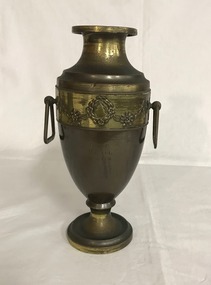 Orbost & District Historical Society
Award - Orbost Rifle Club trophy, 1931
... This trophy was won by Robert Call in 1931 for his excellent marksmanship shooter at the Orbost Rifle Club. ...This trophy was won by Robert Call in 1931 for his excellent marksmanship shooter at the Orbost Rifle Club. ...This trophy was won by Robert Call in 1931 for his excellent marksmanship shooter at the Orbost Rifle Club. Mr Gall won a number of trophies and was a crack shooter. Robert Gall married Annie Miller and they had 5 children. Unfortunately, Annie died from complications of childbirth. Later, Robert (Bob) married Amy Richardson of Bonang and they both contributed to many groups in Orbost including Bowls, Rotary, CWA, Croquet, Rifle Club, Masons and Fire Brigade. Bob won a coveted KING's Junior competing against contestants from all over Australia. Bob also did farming. This item is significant because it represents an important era of Orbost history (1900 to 1980's) when rifle shooting was an important sport.Brass trophy in the shape of an urn. Item has a gold coloured painted band with raised decorations across the wider part of the urn. Top of urn is open and has two attached handles.O.R.C. R.GALL Won 1931, inscription. robert gall, orbost rifle club, trophy -
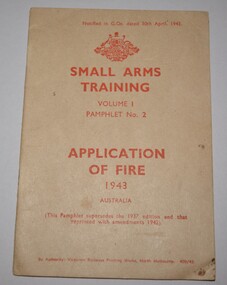 Wangaratta RSL Sub Branch
Pamphlet - Small Arms Training, Victorian Railways Printing Works, Application of Fire, 1943
... Covering essential skills such as estimating distance, assessing wind effects, and understanding angles, this pamphlet provided soldiers with the knowledge needed for accurate marksmanship in combat. Booklet belonged to Robert Francis ISKOV VX15237 born at Glenrowan served with the 59th Battalion CMF before joining the 2/14th Battalion at Caulfield in September 1940. ...Covering essential skills such as estimating distance, assessing wind effects, and understanding angles, this pamphlet provided soldiers with the knowledge needed for accurate marksmanship in combat. Booklet belonged to Robert Francis ISKOV VX15237 born at Glenrowan served with the 59th Battalion CMF before joining the 2/14th Battalion at Caulfield in September 1940. ...Australian Army manual focusing on the principles of effective rifle fire. Covering essential skills such as estimating distance, assessing wind effects, and understanding angles, this pamphlet provided soldiers with the knowledge needed for accurate marksmanship in combat. Booklet belonged to Robert Francis ISKOV VX15237 born at Glenrowan served with the 59th Battalion CMF before joining the 2/14th Battalion at Caulfield in September 1940. He disembarked for the Middle East in November, 1940 and fought in the Syrian campaign in 1941. In 1942 the 2/14th Battalion returned to Australia and sent to Papua where he fought at the Battle of Isurava before the battalion was sent to Gona. On 1943 Bob returned to Australia to undertake officer training and in 1945 with the 2/23rd Battalion sailed to Morotai and served with the battalion on Tarakan. He returned to Australia in November, 1945 and discharged a month later.Soft cover pamphlet with red lettering containing 31 pages and diagramsVolume 1 Pamphlet 2 Pamphlet supersedes the 1937 edition and that reprinted with amendments 1942.ww2, military training pamphlet, small arms training, 1943 -
 Bendigo Military Museum
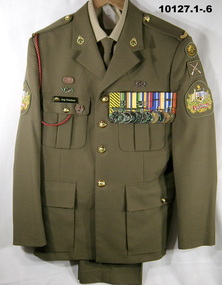
Uniform - SERVICE DRESS, ARMY, Australian Defence Industries, 2016
... Middle - silver and brown crossed rifles = Marksmanship Proficiency. Lower and right sleeves Rank Insignia Patch in colour. ...Middle - silver and brown crossed rifles = Marksmanship Proficiency. Lower and right sleeves Rank Insignia Patch in colour. ...Left side - Campaign and service medals = Left to Right. 1. Conspicuous Service Medal. 2. Australian Active Service Medal - 2 clasps - 1 RAQ 2003 - ICAT Afghanistan 2001. 3. Afghanistan Campaign Medal. 4. Iraq Campaign Medal. 5. Australian Service Medal - 2 clasps - Balkans 1997 - 2004, - Sinai - Egypt. 6. Defence Force Service Medal - 3 clasps (25 Years). 7. Australian Defence Medal. 8. North Atlantic Treaty Organisation medal (NATO) 9. British IRAQ Medal. 10. North Atlantic Treaty Organisation and clasp ISAF> 11. Multi National Force and Observers Medal - Sinai - Egypt (These are replica medals). Award badge - Crossed swords with Laurel wreath dark bronze colour = ARMY COMBAT BADGE. Right side - Top to Bottom. Award Badge = COMMANDER 2nd DIVISION COMMENDATION BRONZE 1998-99 Badge = STEYR INDIVIDUAL READINESS Badge Name Badge = Rising Sun Emblem with "GREG WESTHEAD"' Badge = RECENT INSTRUCTOR BADGE. Uniform Jacket, trousers, shirt, necktie, lanyard, medals, beret. 1. 2. & 4. Fabric outer - khaki colour wool and polyester. Lining - dark khaki polyester. 1. Jacket - Service dress style, shoulder epaulettes, four front patch pockets with button down flap. Gold colour plastic buttons with raised emblem - Rising Sun Badge. Army shoulder epaulettes - gold colour 'AUSTRALIA' badge. Cloth shoulder patches - eft sleeve top - gold, black and red. Rising Sun with Queen's Crown and lettering "THE AUSTRALIAN ARMY". Middle - silver and brown crossed rifles = Marksmanship Proficiency. Lower and right sleeves Rank Insignia Patch in colour. Australian Coat of Arms = Regimental Sergeant Major. Lapel Badges - gold colour plastic - Queens Crown above laurel wreath with centre crossed swords = Royal Australian Corps of Military Police. Front left side - Campaign and Service medals Mounted and Award badge. Right side - one award badge and three badges.(Fabric, metal and plastic). 2. Trousers - waistband, belt loops, fob pocket, two side pockets and one back pocket with button down flap. Bottom green plastic metal and nylon zipper fly. Fabric and lining as above. 3. Shirt - light khaki colour polyester/cotton fabric. Short sleeves, collar, shoulder epaulettes, two front patch pockets with button down flap. Buttons - beige plastic. Left and right shoulder and rank cloth patches as per jacket. 4. Necktie - fabric and lining as above. 'V' shape on ends. Two makers labels. 5. Lanyard - braided red and black colour cotton cord with knots. 6. Medals - mounted medals with ribbons. Metal pin on back. 7. Beret - red colour wool felt fabric with black colour polyester and plastic lining. Oval shape. Black colour vinyl trim with ribbon for size adjustment. Front - badge = Royal Australian Corps of Military Police - Queens Crown, Laurel wreath and crossed swords - gold colour plastic and metal.1. & 2. Manufacturers information on lining in black print on white colour fabric. "ADA/MADE IN CHINA/ AUG 2016/CC30BK or CC3087/ ^/ NSN 8405 66 162 6301 or 607?/ SIZE: 110R OR 85R/ NAME:/ PM KEYS NO:/ OUTER: 60% WOOL/40% POLYESTER/LINING: 100% POLYESTER/DRY CLEAN ONLY/ DO NOT WASH/ IRON UNDER DAMP CLOTH/ WARM IRON". 2. Handwritten black ink 'WESTHEAD/ 317595". 4. Tie - top label "ADAY" Lower label "ADAY"/ MADE IN CHINA/ MAY 2016/ 60% WOOL/ 40% POLYESTER/ DRY CLEAN ONLYuniform, army, military police, westhead -
 Melbourne Legacy
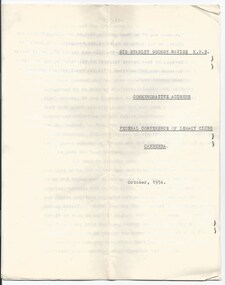
Document - Speech, Commemorative Address - Sir Stanley Savige K.B.E. Federal Conference of Legacy Clubs, Canberra, 10/1954
... Followed Gallipoli and Anzac where his marksmanship and bush craft stood him in good stead. ...Followed Gallipoli and Anzac where his marksmanship and bush craft stood him in good stead. ...After the death of Stan Savige this address was given at the Canberra Conference in October 1954. It is tribute to his life. Sir Stanley Savige KBE : Commemorative Address Federal Conference of Legacy Clubs, Canberra : October 1954. On the 15th of May this year Legacy learned to its enduring sorrow of the death of its Founder, Lieut. General Stanley George Savige KBE, CB, CBE, DSO, MC, ED, for more than 30 years affectionately known to us all as Legatee Stan Savige. He was the embodiment of all those things for which Legacy stands, and each one of us who knew him and worked with him feels a great and abiding sense of personal loss. It is proper, therefore, that those of us at this Conference, the first after his passing, representative of Legacy throughout the Commonwealth, and comprising so many who were his friends, so many who knew the depth of his love for Legacy, should acknowledge our debt to our Founder and ensure, so far as we may, that the inspiration of his life and work in this Cause shall not be lost to those who follow after. It was not ordained that Stanley George Savige - should enjoy a long life, but it was to prove a life of outstanding service. Born at Morwell in Victoria some 63 years ago, he received with his brothers and sisters such education as was then available to a lad in a mining district. He had no particular opportunities of advancement, but from his early days he cherished a strong ambition to make a success of his life, and with this in view he lost no opportunity of adding to his knowledge. Always a lover of the open country, a good bushman and a fine shot, he became as a young man, a Scoutmaster with a keen following of boys. Even in those early days he attracted youth and showed undoubted promise of the quality of leadership which later was to make him famous. Opportunity came with the first World War, and he took his place as a private soldier in the original 24th Battalion AIF. Followed Gallipoli and Anzac where his marksmanship and bush craft stood him in good stead. Conscious that his early training was not sufficient to secure the promotion he desired, he set himself to enlarge it. Only a man of fine fibre and rare determination could apply himself to study on that war torn Peninsula, where our men, hitherto untested, suffered every known hardship and no man knew, from hour to hour, whether he would survive. But Savige achieved it. Himself then a Corporal he found another Corporal who was a former Schoolmaster and learned from him all that he had to teach. Savige was on his way. He was commissioned on the Field and allotted the heroic task of leading the last party off that desperate coast during the famous evacuation. In France he became the Adjutant of his Battalion and one of the best known officers in the 6th Brigade. He won the Military Cross and was mentioned in despatches. Early in 1918 he received a signal distinction, He was included in a small but distinguished band of Officers and Non-Commissioned Officers from the British and Dominion Forces most carefully selected for individual courage and proved qualities of leadership, and was sent to Persia, under the command of Major-General Dunsterville, Kipling’s famous Stalky, to assist and mobilise the friendly tribes with a view to protecting the road to India, left wide open by the withdrawal of Russia. The story of the Dunsterforce, its suffering and achievements in the face of incredible hardships and difficulties, was later to be told by Savige in his book “Stalky’s Forlorn Hope”. He emerged, finally, unscathed, despite his active participation in several of the bloodiest battles of all time, with the rank of Captain and a DSO and MC to his credit, to say nothing of three mentions in despatches. In later years, further decorations were to be conferred upon him, but I believe he valued none of these so highly as his awards for outstanding personal bravery won in the Field when he was an Officer of comparatively junior rank. Such was the man who in August 1923, at the instance of his former Commander, Major-General Sir John Gellibrand, gathered around him a handful of men who had fought and laughed with him over four well remembered years. This small band adopted the name of “Legacy”, but its purpose then was, in the main, to assist in safeguarding the interests of ex-servicemen in this country. Worthy although the case undoubtedly was, the conception and ideal which was to distinguish Legacy from all kindred post-war movements did not emerge until two years later. The torch had not been lit. Legacy had not yet found its soul. What has been achieved since then is known to you all. The Legacy ideal, unique in its conception, with no known counterpart elsewhere, is now accepted, welcomed and honoured throughout the Commonwealth and abroad. But in those early days the achievements of our Founder in the face of all manner of difficulties and frustrations are worthy of our lasting memory and thankfulness. As the source of every river lies in the hills, so must the inspiration from which stems a great conceptions of service to one’s fellow men be lofty and above reproach. Savige was the embodiment of this new expression of comradeship, as he was the central figure and driving force of the little group that sponsored it. But for his zeal, his faith and determination, it is likely that the flame, newly kindled, might have flickered and died. The idea of men returned from active service pledging for the sake of their former comradeship, their personal assistance to the widows, and above all, to the children of those who had fought beside them and paid the full price of War, was so completely new and unexpected that it was by no means readily accepted. There were no funds, no precedents to guide the new adventurers, only the clear bright flame of an ideal just envisaged, and the conviction that the Cause was unassailable. Nor were there lacking many who said that the community held no place for Legacy, that it was born of sentiment only, and would quickly pass. The scoffers are gone and one since forgotten, but the torch remains and burns brighter than ever. Down the years of Legacy there are many names deserving of honour, men from all States and all stations of life, but no name stands out in such clear and bold relief as does the name of our Founder. By his works you shall know him. He was, in truth, the Soul of Legacy. He sought no office and preferred to work as one of the team. Six years went by before he accepted the Presidency of Melbourne Club, and then only because his fellows would book no further delay. “The Spirit of Legacy is Service” - so runs the Charter, and that was Savige’s Creed. By virtue of his attainments he was called upon to take a leading part in the administration of Legacy, first within his own club and later, as Chairman of the Co-ordinating Council of Legacy in Australia. But always it was the essentially human character of the work which enthralled and upheld him, and the tasks which gave him most joy were those which brought him into close personal contact with the youngsters and their home life. Like their elders they recognised his goodwill and his leadership and responded to it. It was Savige who made possible the first camps held for the boys and girls by Melbourne Club. These were erected on his own seaside property, and were originally conducted under his personal direction and largely with the aid of funds he had collected. There was hardly an important post in his own Club that Savige did not at some time occupy and adorn. He was happiest in the company of those men with whom he had served in the field, and cherished always the comradeship born of active service which is of the essence of Legacy. He was a man of strong convictions but attentive always to another’s point of view. As a Legatee he played a leading part in bringing hope and encouragement to many a mother on whom the whole responsibility of a young family had been suddenly and tragically laid; in the attainment of the ambitions of many an orphan child, which not so long since had seemed to him or her to be mere dreams, impossible of realisation. Comfort for the bereaved, new hope for the children’s physical and educational welfare, assistance with the home, aid for the sick, money for the needy and a new courage to face a future that hitherto had held no promise, all these facets of Legacy endeavour combine to present a living and enduring memorial to the man we honour as our Founder today. Between the two World Wars in addition to establishing himself successfully in civilian life and answering the constant calls of Legacy on his energy and time, Savige maintained an active association with the Army. He was convinced that a Second AIF would one day be urgently called upon, and as a Battalion Commander he spared no effort to train the Officers under his charge during the uneasy years of peace for the trial that he felt must come. These men have all subsequently had distinguished military careers, their names are well known and many of the serve in Legacy today. When the second crisis came, Savige himself was one of the first to offer, and although his youth was spent, he proudly carried the number VX13 throughout the terrible years that followed. This time he was to command, first the 17th Australian Infantry Brigade in the first action of the Second AIF against the enemy at Barida, and subsequently at Tobruk and Derna - all famous names now. It was his patrols which gave the warning - unheeded at the time - that Rommel’s reinforcements were reaching North Africa far earlier than was expected. Then followed the grim days of Greece and Crete when the fine qualities of his leadership were put to the utmost test. I have been told by those who were closest to him it was typical of Savige that when his convoys were on the move back and were being blasted from the air by the unopposed Luftwaffe, he should sit by the side of the open road, wearing his red banded cap, to steady the morale of men who had then no chance of hitting back at the enemy. Unorthodox no doubt, but here was a man indeed. Throughout the whole campaign and later when he commended the 3rd division in New Guinea and later still when with the rank of Lieutenant-General he became a Corps Commander in New Guinea and Bouganville, it was at all times characteristic of him that he should see for himself the situation in the forward areas. He dealt personally with his subordinate commanders whenever it was possible to do so. No one says his G.S.O. 1. understood better than he did the importance of front line troops seeing their G.O.C. frequently, and knowing that he was aware of and prepared to share their hardships and dangers. He took many risks that he should not have taken, exhausted himself physically and mentally times without number, and considered himself not at all in order to secure the success of his operations. Finally, in Bouganville, he brought his campaign to a victorious conclusion and accepted the personal surrender of the Japanese Commander. Savige is known as one of Australia’s most human military leaders, but let no one believe that he did not ask and receive the utmost of his men. He trained them in a hard school but he was ever conscious of their needs and observant and thoughtful of their welfare. Fearless and untiring under conditions which brought younger men down, he asked nothing that he was not himself prepared to give and do. The close of the Second World War left him with the same brave heart; but a vitality greatly impaired. He was called up again and again to perform important national tasks, notably that of Co-ordinator of Demobilisation and Dispersal. But his interest in Legacy never flagged it was in fact more personal than ever, for under his command many junior legatees, sons of former comrades had proved themselves worthy of their Fathers in war and in peace. In the bearing and achievements of the young men of the Second A.I.F. he took a particular and justifiable pride. He applied himself to the Extension of Legacy to areas where it had not previously been practicable to operate. His record of service and close personal contact with the men of both wars made him a most welcome pioneer and many new Clubs and Groups resulted from his efforts. He founded, and I doubt whether any one else could have done so, the Club in the great Capital of our Empire. His reputation and obvious sincerity surmounted obstacles that might well have daunted lesser man. Legacy’s debt to him visibly increased. But he was ever a simple man, with a great love and understanding of his fellow men and a true Legatee at heart. Much that he did will never be known or recognised, save by those who benefitted. His service in Legacy ranged from the humble kitchen of cottage and farm to our representation in Westminster Abbey itself. A knighthood set the seal upon an outstanding career. None the less when upon the death of Field Marshall Sir Thomas Blamey, Lieut. General Sir Stanley Savige became the Patron of the Melbourne Club, he retained at his own express desire, the title of Legatee Savige, and when on that final day we bade him farewell, when the Flags he had served so well were lowered and the guns which had formed a grim final salute, it was apparent to all who had eyes to see that this great and simple man had won such a place in the hearts and affection of his fellow country men as is given to few men indeed. From the packed Cathedral, escorted by his fellow Generals, followed by men of his own Units, by Legatees and a great company of others who had cause to honour and esteem him, he made his last journey. But that is not the end. His voice and presence are lost to us but his memory and inspiration must ever remain. As he has bequeathed to the National War Memorial yonder his diaries, records and battle plans, so he has bequeathed to us his fellow Legatees his greatest achievement and his trust, Legacy itself. Never was the Torch passed by worthier hands. Now it is ours to hold it high. Whatever material memorial the future many hold for him, Legacy owes its Founder a livelier recompense. It is within our power to implement what I believe to be his greatest wish, that Legacy and its ideal of comradeship and service shall flourish and endure. Let each one of us then resolve that we shall, within our Clubs, in all tasks to which we are assigned, both great and small, keep in our minds the life and spirit of Stanley George Savige, so that we may be proud at all times to say of Legacy to those who follow after - “If you would see his memorial - Look around you”.The tribute to Stanley Savige shows how greatly he was regarded by the Legatees.Off white quarto paper with black type, address given about Stan Savige to the Canberra Conference, x 12 pages.savige, speech, obituary -
Woodend RSL
Shirt
... Woodend RSL 32 Anslow Street Woodend daylesford-and-the-macedon-ranges The Skill at Arms Badge is awarded to members who achieve the appropriate marksman score during the conduct of the Applied Marksmanship Practice, IAW Khaki short sleeved shirt called “polyester” with rectangular embroidered rising sun patch and Skill at Arms badge (square crossed rifles patch) on left sleeve. ...The Skill at Arms Badge is awarded to members who achieve the appropriate marksman score during the conduct of the Applied Marksmanship Practice, IAWKhaki short sleeved shirt called “polyester” with rectangular embroidered rising sun patch and Skill at Arms badge (square crossed rifles patch) on left sleeve. Two front pockets
