
Showing 135 items matching "match book"
-
 Falls Creek Historical Society
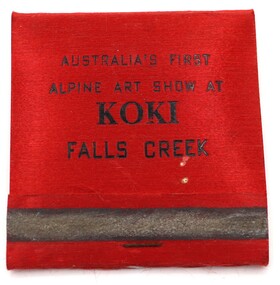
Souvenir - Australia's First Alpine Art Show at Koki Lodge, Match book
... Australia's First Alpine Art Show at Koki Lodge, Match book...Australia's First Alpine Art Show at Koki Lodge, Match book...Australia's First Alpine Art Show at Koki Lodge, Match book Souvenir Australia's First Alpine Art Show at Koki Lodge, Match book ...This item is from the private collection of George Shirling of Red Onion, Falls Creek. It is a souvenir from the First Alpine Art Show held at Koki Lodge in June 1967. The Art Show exhibited a collection of Australian painters including John Glover (1826), Louis Buvelot (1886) Hans Heyson (1902), Grace Cossington-Smith (1918), and William Dobell, Norman Lindsay, Donald Friend, Sali Herman, Sidney Nolan, John Olson, Charles Blackman, Arthur Boyd, and Pro Hart. George Shirling arrived in Falls Creek in 1962. He engaged Phil Nowell to build the original Koki Alpine Lodge which opened in 1965 with 14 beds. George operated the lodge with Michael “Baldy” Blackwell as manager. He also graduated in sport psychology in 1981 and was invited to become team psychologist for the Australian Winter Olympic team which went to Albertville, France, in 1992. He later owned the Red Onion Chalet. George credited the success of Koki to “Baldy” Blackwell. “Baldy” and Phil Nowell started the Trackers Mountain Lodge in partnership during the 1980s. In 1971 George sold Koki Lodge to Sigi Doerr. In 2024 the renamed Koki Alpine resort remains a highly popular destination in Falls Creek. George Shirling passed away on 27th February 2023. He had remained actively involved in Falls Creek and was generous with his time and knowledge, always an amazing supporter of The Falls Creek Museum and Falls Creek Village.This item is significant because shows early activities at Koko Lodge and Australia's First Alpine Art Show.A red souvenir matchbook with black text.AUSTRALIA'S FIRST ALPINE ART SHOW AT KOKI FALLS CREEKgeorge shirling, falls creek, australia's first alpine art show -
 Glenelg Shire Council Cultural Collection
Functional object - Match Book, n.d
... Match Book...Silver metal match book, containing black cardboard matches with green heads...matchbook accessory smoking Silver metal match book, containing black cardboard matches with green heads Functional object Match Book ...Silver metal match book, containing black cardboard matches with green headsmatchbook, accessory, smoking -
 Bendigo Historical Society Inc.
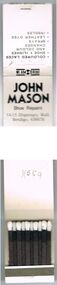
Memorabilia - JOHN MASON SHOE REPAIRS ADVERTISING MATCH BOOK
... JOHN MASON SHOE REPAIRS ADVERTISING MATCH BOOK...John Mason Shoe Repairs Advertising Match book: White card with black print with grey sandpaper at the bottom for striking the matches. ...Box 625 Memorabilia JOHN MASON SHOE REPAIRS ADVERTISING MATCH BOOK ...BHS CollectionJohn Mason Shoe Repairs Advertising Match book: White card with black print with grey sandpaper at the bottom for striking the matches. Printed on the front * John Mason Shoe Repairs, 14-15 Dispensary Walk Bendigo, 436676. At the top is * We aim to Please*. On the back * Coloured Laces * Shoe Polishes and colour changes * Sprays * Leather dyes * Insoles. A metal staple is used to attach. Box 625Contents 20 Made in Australia By Hanna Match.ephemera, mementoes, advertising, john mason shoe repairs. dispensary walk. -
 Bendigo Historical Society Inc.
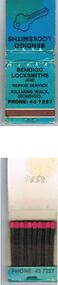
Memorabilia - BENDIGO LOCKSMITHS BOOK OF MATCHES
... ...match book...Bendigo Locksmiths Book of Matches: Blue Match Book printed with * Bendigo Locksmiths and a picture of a key, Phone: 437227. ...Bendigo Locksmiths Book of Matches: Blue Match Book printed with * Bendigo Locksmiths and a picture of a key, Phone: 437227. ...BHS CollectionBendigo Locksmiths Book of Matches: Blue Match Book printed with * Bendigo Locksmiths and a picture of a key, Phone: 437227. On the back is * Bendigo Locksmiths and Repair Service, Killians Walk, Bendigo. Phone: 437227. Sandpaper at the bottom for lighting matches, all printed in Black. Full book of matches. Metal Staple to secure. Box 625Australian made by Byrant and May Contents 20. For PPA Advg, Bris 2219955, Melb 6452814.ephemera, mementoes, match book, bendigo locksmiths, killians walk. -
Clunes Museum
Functional object - MATCH BOOK HOLDER
... MATCH BOOK HOLDER...Functional object MATCH BOOK HOLDER ...SMALL COVERED METAL CASE TO HOLD A BOX OF MATCHES. COVER HAS A PICTURE OF PHAR LAP AND AN ADVERTISEMENT FOR A DAIRY.local history, personal effects, smoking accessories -
Ringwood and District Historical Society
Book, Ringwood Rifle Club match record book 1965 - 1969, 1965 - 1969
... Ringwood Rifle Club match record book 1965 - 1969....Book - buff card cover with red cloth cover on spine. Printed on cover 'Ringwood Rifle Club'. Contains match records. 100 pp. ...Ringwood Rifle Club match record book 1965 - 1969. Book ...Used by the Ringwood Rifle Club for scoring at weekly meetings. The first meeting recorded is 7-Aug-1965Book - buff card cover with red cloth cover on spine. Printed on cover 'Ringwood Rifle Club'. Contains match records. 100 pp. (est.) during 1965 - 1969. -
 Orbost & District Historical Society
book, Orbost Rifle Club, Match Record Book, 5th January, 1974 ; 13th May, 1978
... Match Record Book...book with a bright red spine. It contains hand-written records of the shooters who were members of the Orbost Rifle Club. Inside are seven letter heads of CED. CURTIS - 9 LIND ST ORBOST and a newspaper cutting ( date unknown). Match ...Cec, Curtis was a member of the Orbost Rifle Club. He was a cycle trader with a business in Lind Lane, Orbost. The Orbost Rifle Club existed in the early 20th century. (There are records from 1900). It folded in the late 1970's.Target shooting is one of the oldest organised sports in Australia. Records date back to the British Marines at Sydney Cove in 1788. The Victorian Rifle Association (VRA) was formed in 1860. One of the most important adjuncts to the militia system from 1903 to the re-organisation of 1912 was the role played by the Rifle Club movement in Australia. At the time, these clubs were seen as the reservoir of manpower for a potential guerrilla force should any invasion occur. For Australia, the invasion fear was uppermost in the minds of the population. So important were the rifle clubs for the defence of Australia that the Commonwealth provided the training staff, rifles and ammunition so the clubs could function. Members were drilled, wore uniforms and practised all the basic skills of soldiering as well as target shooting. The Orbost Rifle Club was active during this period A light blue covered book with a bright red spine. It contains hand-written records of the shooters who were members of the Orbost Rifle Club. Inside are seven letter heads of CED. CURTIS - 9 LIND ST ORBOST and a newspaper cutting ( date unknown). orbost-rifle-club shooting -
 Orbost & District Historical Society
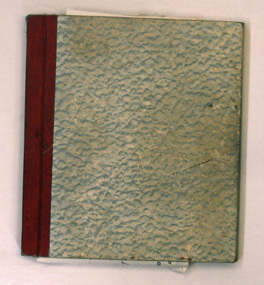
book, Match Record Book, 13.1.1965 - 12.5. 1973
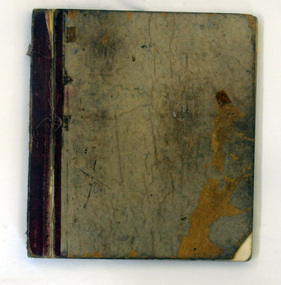
... Match Record Book...A grey cardboard covered book with a red spine. It contains hand-written match records of the members of the Orbost Rifle Club....Match Record Book book Orbost Rifle Club ...The Orbost Rifle Club existed in the early 20th century. (There are records from 1900). It folded in the late 1970's.Target shooting is one of the oldest organised sports in Australia. Records date back to the British Marines at Sydney Cove in 1788. The Victorian Rifle Association (VRA) was formed in 1860. One of the most important adjuncts to the militia system from 1903 to the re-organisation of 1912 was the role played by the Rifle Club movement in Australia. At the time, these clubs were seen as the reservoir of manpower for a potential guerrilla force should any invasion occur. For Australia, the invasion fear was uppermost in the minds of the population. So important were the rifle clubs for the defence of Australia that the Commonwealth provided the training staff, rifles and ammunition so the clubs could function. Members were drilled, wore uniforms and practised all the basic skills of soldiering as well as target shooting. The Orbost Rifle Club was active during this period A grey cardboard covered book with a red spine. It contains hand-written match records of the members of the Orbost Rifle Club.records orbost-rifle-club shooting -
 Charlton Golden Grains Museum Inc
Domestic object - Book of matches
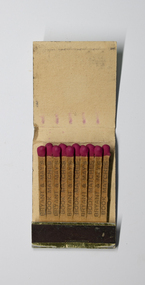
... Book of Matches Small Flip matches in book. Advertising seamless nylons...Bryant & May's Book Matches on actual matches Nightingale Seamless Nylons on cover/flap...Bryant & May Flip Matches matches Nightingale Seamless Nylons Advertisement Bryant & May's Book Matches on actual matches Nightingale Seamless Nylons on cover/flap Book of Matches Small Flip matches in book. ...Book of Matches Small Flip matches in book. Advertising seamless nylonsBryant & May's Book Matches on actual matches Nightingale Seamless Nylons on cover/flapbryant & may, flip matches, matches, nightingale, seamless nylons, advertisement -
 Wodonga & District Historical Society Inc
Functional object - Matchbook collection
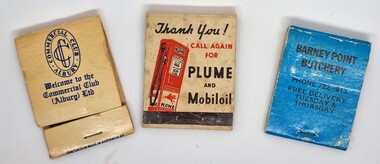
... Match book collection...Vacuum replaced the famous Plume brand name with Mobilgas in 1954. Match book collection Matches A collection of 3 different match books representing a variety of businesses. ...This item is from a collection donated by Les Cole of Wodonga, who among several occupations in his life time, drove buses around the Wodonga and district for the Mylon bus company. In March 1952, Transport Parks Pty Ltd. purchased 20 acres of land from the Kelly Estate on the outskirts of Wodonga. The land sold at the record urban price for Wodonga of £300 an acre. They had plans to establish a transport park advertised as the first of its kind in Australia at a cost of £50,000. The park was to have accommodation for up to 1000 transports, caravans and cars, as well as all amenities ranging from showers to a cafeteria. It was to be known as "Twenty Acre Service Station” When the park first came into operation it was to have accommodation for up to 200 transports. Wodonga had been chosen for the site of the company's first park because it was a ''half-way house" between Sydney and Melbourne, and because transports had to stop there to obtain permits to proceed on crossing the border. The service station section of the Transport Park began operation in June 1954, with other facilities following. The business operated profitably until at least 1971 as the Transport Park, but perhaps never reached its aims of providing for 1,000 transports at any given time. The Vacuum Oil Company was the first oil company established in Australia. In 1916, Vacuum introduced its "Plume" brand to the Australian market. Vacuum replaced the famous Plume brand name with Mobilgas in 1954.A collection of 3 different match books representing a variety of businesses.match book collection, matches -
Clunes Museum
Functional object - BOOK OF MATCHES
... BOOK OF MATCHES ISSUED BY T.J.ANNEAR WHO HAD A BUSINESS IN FRASER STREET, CLUNES....BOOK OF MATCHES IN GREEN CARDBOARD COVER....BOOK OF MATCHES IN GREEN CARDBOARD COVER. Functional object BOOK OF MATCHES ...BOOK OF MATCHES ISSUED BY T.J.ANNEAR WHO HAD A BUSINESS IN FRASER STREET, CLUNES.BOOK OF MATCHES IN GREEN CARDBOARD COVER.local history, personal effects, smoking accessories., personel effects. -
 Falls Creek Historical Society
Souvenir - Winterhaven Lodge Matchbook
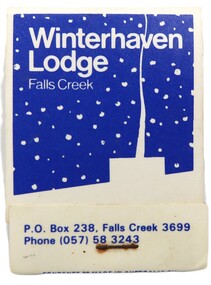
... A match book printed in blue and white for Winterhaven Lodge, Falls Creek. ...George Shirling Winterhaven Ski Lodge Orest Frueauf A match book printed in blue and white for Winterhaven Lodge, Falls Creek. ...This item is from the private collection of George Shirling of Red Onion, Falls Creek. In 1952 Orest “Ory” Frueauf entered into a business partnership with Cecil Dobson, running the general store “Whitehaven” and Post Office at Falls Creek. They extended their business by adding accommodation turning Whitehaven into one of the best commercial lodges at Falls Creek. Ory and Cecil dissolved their business partnership in 1963 and Ory went on to build a new lodge called “Snowhaven” at the site of the present day Frueauf Village, Falls Creek. Ory retired to Tawonga, Victoria in 1992 and passed away in 1999. George Shirling arrived in Falls Creek in 1962. He engaged Phil Nowell to build the original Koki Alpine Lodge which opened in 1965 with 14 beds. George operated the lodge with Michael “Baldy” Blackwell as manager. He also graduated in sport psychology in 1981 and was invited to become team psychologist for the Australian Winter Olympic team which went to Albertville, France, in 1992. He later owned the Red Onion Chalet. George credited the success of Koki to “Baldy” Blackwell. “Baldy” and Phil Nowell started the Trackers Mountain Lodge in partnership during the 1980s. In 1971 George sold Koki Lodge to Sigi Doerr. In 2024 the renamed Koki Alpine resort remains a highly popular destination in Falls Creek. George Shirling passed away on 27th February 2023. He had remained actively involved in Falls Creek and was generous with his time and knowledge, always an amazing supporter of The Falls Creek Museum and Falls Creek Village.This item is significant because it is linked In to an early lodge and to Orest Frueauf, a pioneer of Falls Creek.A match book printed in blue and white for Winterhaven Lodge, Falls Creek. It includes the postal address and telephone number. The back features an advertisement for Diners Club International.george shirling, winterhaven ski lodge, orest frueauf -
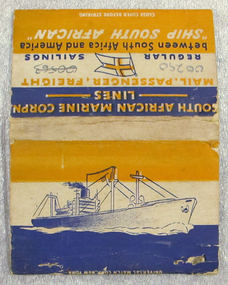 Mission to Seafarers Victoria
Functional object - Match box, South African Marine Corpn Lines, Unknown
... This match book was evidently a memento of a trip to South Africa....This match book was evidently a memento of a trip to South Africa. ...This match book was evidently a memento of a trip to South Africa.An example of how little objects could remind seafarers of the places they had visited. Small matchbox printed in orange, white and blue.Labelled: South African Marine Corpn Lines. Regular sailings between South Africa and America.matches, quinn, south africa -
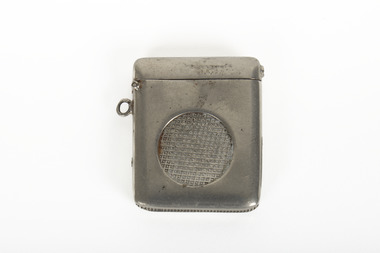 The Beechworth Burke Museum
Functional object - Vesta Case, Unknown
... A decorative silver coloured vesta or match book. It has a raised crosshatch pattern in a circular pattern on the obverse side. ...Burke Museum Vesta Case Vesta Matches Silver Social History A01199/ A decorative silver coloured vesta or match book. It has a raised crosshatch pattern in a circular pattern on the obverse side. ...Vestas are the historical name for what are now known as matches. They were named for the Roman goddess Vesta whose domain was the hearth and home. The Swan company began production of short matches, mostly useful for lighting pipes and cigarettes due to their deliberately short length. Due to their small size it became convenient to carry these Vestas within a Vesta Case kept somewhere on the person, large enough to contain enough matches for a days use. The cases prevented their contents from becoming damaged and damp while also stopping them from accidentally striking if held loose in a pocket. This is a simple example of a Vesta Case.The social history objects held in the Burke Museum's collection help to tell the stories of Beechworth's past by showing the social, cultural, and economic aspects of the town's history.A decorative silver coloured vesta or match book. It has a raised crosshatch pattern in a circular pattern on the obverse side. The vesta has a hinged top and side loop to allow for attachment.A01199/burke museum, vesta case, vesta, matches, silver, social history -
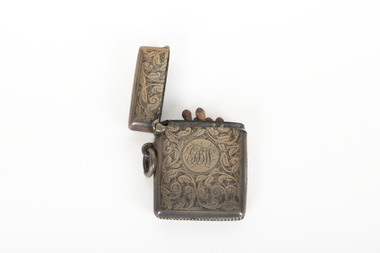 The Beechworth Burke Museum
Functional object - Vesta Case, Unknown
... A decorative silver coloured vesta or match book. It has detailed engraving across the obverse and reverse sides with delicate scrollwork and a monogram set in a circular setting in the centre. ...Burke Museum Vesta Case Vesta Matches Silver Social History Luxury GBW/ A01171/ A decorative silver coloured vesta or match book. It has detailed engraving across the obverse and reverse sides with delicate scrollwork and a monogram set in a circular setting in the centre. ...This detailed example of a match holding Vesta was owned by someone with the initials GBW but is otherwise difficult to identify ownership. Vestas are the historical name for what are now known as matches. They were named for the Roman goddess Vesta whose domain was the hearth and home. The Swan company began production of short matches, mostly useful for lighting pipes and cigarettes due to their deliberately short length. Due to their small size it became convenient to carry these Vestas within a Vesta Case kept somewhere on the person, large enough to contain enough matches for a days use. The cases prevented their contents from becoming damaged and damp while also stopping them from accidentally striking if held loose in a pocket. This example of a Vesta case is particularly ornate.The social history objects held in the Burke Museum's collection help to tell the stories of Beechworth's past by showing the social, cultural, and economic aspects of the town's history.A decorative silver coloured vesta or match book. It has detailed engraving across the obverse and reverse sides with delicate scrollwork and a monogram set in a circular setting in the centre. The vesta has a hinged top and side loop to allow for attachment.GBW/ A01171/burke museum, vesta case, vesta, matches, silver, social history, luxury -
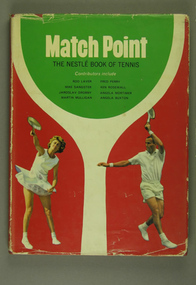 Tennis Australia
Book, Circa 1963
... Book: 'MATCH POINT: THE NESTLE BOOK OF TENNIS'. ...Tennis Book: 'MATCH POINT: THE NESTLE BOOK OF TENNIS'. ...Book: 'MATCH POINT: THE NESTLE BOOK OF TENNIS'. Hardcover with dustjacket. Copyrighted 1963. Materials: Ink, Paper, Cardboardtennis -
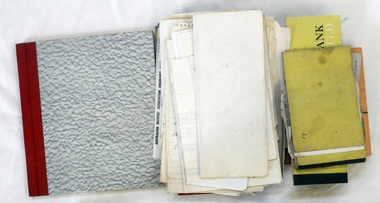 Orbost & District Historical Society
documents, 1950's -1970's
... Documents include receipts, cheque books, correspondence, cards, rules and an unused match record book....Documents include receipts, cheque books, correspondence, cards, rules and an unused match record book. documents ...These documents were used by the Orbost Rifle Club.The Orbost Rifle Club existed in the early 20th century. (There are records from 1900). It folded in the late 1970's. It had a substantial membership.A large plastic envelope containing miscellaneous documents and books from the Orbost Rifle Club. Documents include receipts, cheque books, correspondence, cards, rules and an unused match record book.documents orbost-rifle-club match-records -
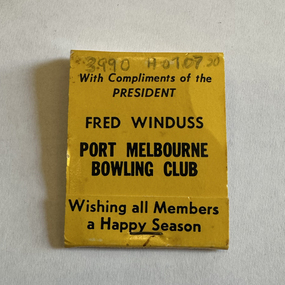 Port Melbourne Historical & Preservation Society
Domestic object - Matchbook, Fred WINDUSS, President, Port Melbourne Bowling CLub, 1980
... Small yellow covered book of matches. Sketch of lawn bowler on front...Small yellow covered book of matches. Sketch of lawn bowler on front Domestic object Matchbook, Fred WINDUSS, President, Port Melbourne Bowling CLub ...Small yellow covered book of matches. Sketch of lawn bowler on front"With the compliments of the President Fred WINDUSS, Port Melbourne Bowling Club. Wishing all members a happy season."domestic life, frederick robert winduss, sport - lawn bowls, port melbourne bowling club -
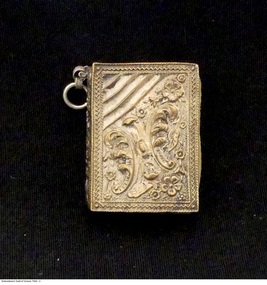 Embroiderers Guild, Victoria
Tool - Silver plated book pin cushion, pin cushion, late 19th cnetury
... Silver sewing chatelaines were a Victorian delight, an attractive matched silver pin book was very desirable....Silver sewing chatelaines were a Victorian delight, an attractive matched silver pin book was very desirable. An example of a silver gilt chatelaine which was donated to the Embroiderers Guild by Nerylla Taunton who was a significant Australian antique needlework tools authority and author. ...Silver sewing chatelaines were a Victorian delight, an attractive matched silver pin book was very desirable.An example of a silver gilt chatelaine which was donated to the Embroiderers Guild by Nerylla Taunton who was a significant Australian antique needlework tools authority and author.Silver gilt embossed rectangular pin cushionFloral style pattern with four lines to upper corner.chatelaine, victorian', nerylla taunton -
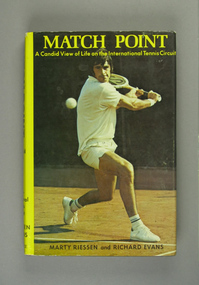 Tennis Australia
Book, 1973
... Book: 'MATCH POINT: A CANDID VIEW OF LIFE ON THE INTERNATIONAL TENNIS CIRCUIT'. ...Tennis Book: 'MATCH POINT: A CANDID VIEW OF LIFE ON THE INTERNATIONAL TENNIS CIRCUIT'. ...Book: 'MATCH POINT: A CANDID VIEW OF LIFE ON THE INTERNATIONAL TENNIS CIRCUIT'. Hardcover with dustjacket. First edition. Materials: Paper, Ink, Cardboardtennis -
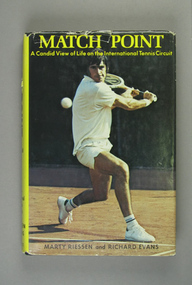 Tennis Australia
Book, 1973
... Book: 'MATCH POINT: A CANDID VIEW OF LIFE ON THE INTERNATIONAL TENNIS CIRCUIT'. ...Tennis Book: 'MATCH POINT: A CANDID VIEW OF LIFE ON THE INTERNATIONAL TENNIS CIRCUIT'. ...Book: 'MATCH POINT: A CANDID VIEW OF LIFE ON THE INTERNATIONAL TENNIS CIRCUIT'. Hardcover with dustjacket. First edition. Materials: Paper, Ink, Cardboardtennis -
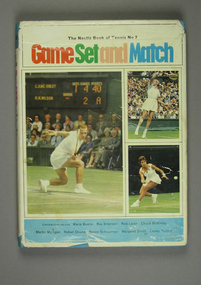 Tennis Australia
Book, Circa 1964
... Book: 'GAME, SET & MATCH: THE NESTLE BOOK OF TENNIS NO.2'. ...Tennis Book: 'GAME, SET & MATCH: THE NESTLE BOOK OF TENNIS NO.2'. ...Book: 'GAME, SET & MATCH: THE NESTLE BOOK OF TENNIS NO.2'. Hardcover with dust jacket. First published 1964. Materials: Ink, Paper, Cardboardtennis -
 Embroiderers Guild, Victoria
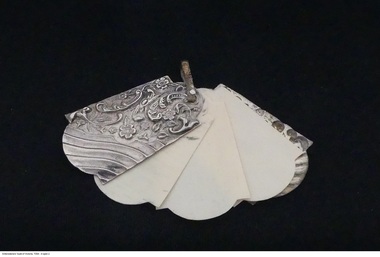
Tool - Silver plated covered note book with ivory leaves, note book, late 19th cnetury
... Silver sewing chatelaines were a Victorian delight, an attractive matched silver note book - not in itself a sewing tool but a frequent additional appendage...Silver sewing chatelaines were a Victorian delight, an attractive matched silver note book - not in itself a sewing tool but a frequent additional appendage An example of a silver gilt chatelaine which was donated to the Embroiderers Guild by Nerylla Taunton who was a significant Australian antique needlework tools authority and author. ...Silver sewing chatelaines were a Victorian delight, an attractive matched silver note book - not in itself a sewing tool but a frequent additional appendageAn example of a silver gilt chatelaine which was donated to the Embroiderers Guild by Nerylla Taunton who was a significant Australian antique needlework tools authority and author.Note book with three ivory 'pages' in silver gilt embossed covers with ring to attach to chatelaine chainFloral style pattern with four lines to lower edgechatelaine, victorian', nerylla taunton -
 Tennis Australia
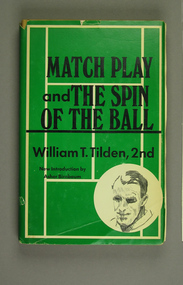
Book, 1975
... Book: 'Match Play and the Spin of the Ball'. 177 pages. ...Tennis Book: 'Match Play and the Spin of the Ball'. 177 pages. ...Book: 'Match Play and the Spin of the Ball'. 177 pages. Hardcover with dustjacket. 1975 reprint edition (first published 1925). Materials: Paper, Ink, Cardboardtennis -
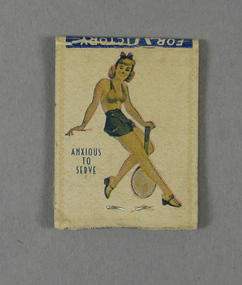 Tennis Australia
Advertising media, Circa 1950
... Book of matches printed with image of pinup girl with tennis racquet and caption 'ANXIOUS TO SERVE'. ...Tennis Book of matches printed with image of pinup girl with tennis racquet and caption 'ANXIOUS TO SERVE'. ...Book of matches printed with image of pinup girl with tennis racquet and caption 'ANXIOUS TO SERVE'. Materials: Paper, Inktennis -
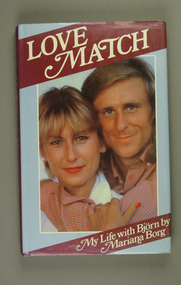 Tennis Australia
Book, Circa 1981
... Book: 'LOVE MATCH'. Hardcover with dustjacket. First reprint (August 1981); copyrighted 1981. ...Tennis Book: 'LOVE MATCH'. Hardcover with dustjacket. First reprint (August 1981); copyrighted 1981. ...Book: 'LOVE MATCH'. Hardcover with dustjacket. First reprint (August 1981); copyrighted 1981. Materials: Ink, Paper, Cardboardtennis -
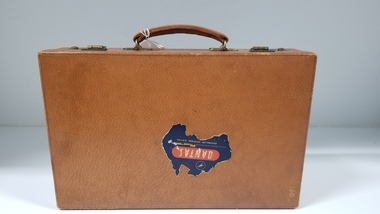 Royal Australian and New Zealand College of Obstetricians & Gynaecologists (RANZCOG)
Domestic object - Briefcase used by Dr Hannah June Pash
... Briefcase contains a sleeve for holding a British passport and a small address book, which match the suitcase. Suitcase also contains a set of four passport photographs of a woman....Briefcase contains a sleeve for holding a British passport and a small address book, which match the suitcase. Suitcase also contains a set of four passport photographs of a woman. ...Brown leather suitcase with metal clasps. Top of case carries a 'Qantas' sticker in the shape of mainland Australia. Briefcase contains a sleeve for holding a British passport and a small address book, which match the suitcase. Suitcase also contains a set of four passport photographs of a woman. -
 Bendigo Historical Society Inc.
Memorabilia - SANDHURST BUILDING SOCIETY BENDIGO BOOK OF MATCHES
... Sandhurst Building society Bendigo Book of Matches: Maroon in colour with the Sandhurst Building Society Logo in Gold in the shape of an S with *Est 1881. ...matches unused. Box 625 Memorabilia SANDHURST BUILDING SOCIETY BENDIGO BOOK OF MATCHES ...Initially established as Sandhurst Permanant Building Society in 1881.Sandhurst Building society Bendigo Book of Matches: Maroon in colour with the Sandhurst Building Society Logo in Gold in the shape of an S with *Est 1881. The same on the back adding the address at * 293 Williamson Street Bendigo* The phone number in gold print at the top * (054) 434393*. Sandpaper across the bottom front for lighting the matches. Metal staple to secure. 8 matches unused. Box 625Contents 20 Made in Australia. Hanna Match North Richmond N.S.W.ephemera, mementoes, sandhurst building society bendigo, the sandhurst building society bendigo -
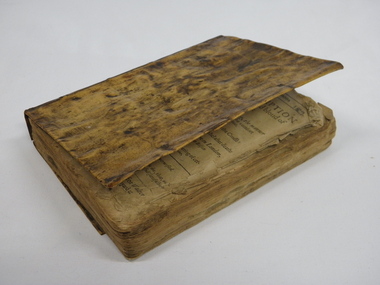 Federation University Historical Collection
Book, Touching the Full Redemption of Mankind by the Death and Blood of Christ Jesus (human skin cover), 1599
... book is covered with human skin. It was confirmed as such in 2014 with DNA testing undertaken by honours student Talanna Buckley at Federation University finding an 100% match to human DNA on the outside cover of the book. ...book is covered with human skin. It was confirmed as such in 2014 with DNA testing undertaken by honours student Talanna Buckley at Federation University finding an 100% match to human DNA on the outside cover of the book. ...Anthropodermic Bibliopegy is the name given to the use of human leather to bind books. The name stems from the combination of the Greek root words, human (Anthropos), skin (derma), book (biblion), and fasten (pegia). The practice of creating anthropodermic books was popular throughout the 17th and 18th centuries. Most commonly, anthropodermic books are medical tomes, with the human leather taken from medical cadavers. Others were produced after criminal trials, with the criminal’s skin used to enclose the record of their own death sentences, creating a form of punishment that would surpass death. Other anthropodermic books contain poems or are religious texts. This book was written and printed in 1599 but most probably was rebound later when creation of anthropodermic books became more predominant. The book is a small tome of a religious nature containing the work of Bishop Thomas Bilson, who in a puritanical voice states that the primary argument articulated in this book is that “the metaphorical Calvinist interpretation of Hell as an exclusion from God was accurate then Christ's descent into hell after his crucifixion must refer to an actual existent hell as Christ was neither subject to sin nor able to be separated from the Divine.” The unusual cover of the book has led to many questions, the main being whether the book is covered with human skin. It was confirmed as such in 2014 with DNA testing undertaken by honours student Talanna Buckley at Federation University finding an 100% match to human DNA on the outside cover of the book. This is one of only two confirmed anthropodermic books in Australia, the other is housed at the National Library of Australia. Other forms of testing the leather of books have been found to be more accurate than DNA testing. For example, before DNA testing or PMF (Peptide Mass Fingerprinting) are undertaken many books have been identified as made from human skin through the close examination of the skins patterning. Hair follicles are the focus of the examination as certain patterns and sizes lend themselves to being human. However, many of these books have been proven to not be bound in human skin, the same can be said of books with inscriptions claiming them as anthropodermic. Peptide Mass Fingerprinting (PMF) testing has been found to be the most reliable way of confirming a leather bindings origin. This process involves the sampling of collagen-based materials, cutting the protein to gain specific amino acid combinations which form individual peptide sequences. Each mammal has an individual amino acid sequence in its collagen therefore its peptide mass combination is unique. This form of test can provide a more accurate outcome as collagen will be preserved for longer after the tanning process and will not be damaged in the same way DNA can be by the tanning process. DNA testing can also provide false positives as trace DNA from someone touching the book could be amplified and provide the reading instead of that of the leather itself. However, this book was tested with many controls as well as specific decontamination procedures in order to ensure that it was not trace DNA being tested. This book is historically and spiritually significant because it is a rare example of an early printed English Christian religious tract produced in Old English and Latin.. Its association with Thomas Bilson, who oversaw the final printing and publication of the King James Bible, is important. The covering of this book has been tested for human dna. Findings prove the book is covered with human skin, increasing the rarity of the object.420 page book with unusual leather cover. The book is written in Old English with passages in latin. There is a pressed petal between p.68 and 69. The covering of this book is made of human skin. The practice of binding books in human skin, also known as anthropodermic bibliopegy.Inside cover - James Hendy No 17 (Fu)gends Road Palmers Village Westminster. The gift of his mother Mrs Thomas Hendy. Some notes made through text eg p.112, and a passage written on the last page.religion, bible, edward lowe, edward lotos, thomas bilson, anthropodermic bibliopegy, james hendy, full redemption, religious, leather, wilson, winchester, jesus, puritanical, puritans, bungey, bilson, human skin, skin, human skin cover, human skin binding -
Federation University Historical Collection
Book - Book - Prospectus, Working Men's College, Melbourne, Prospectus, 1899 twelfth edition, 1899
... The President of the Council was Professor W C Kernot. working mans college melbourne prospectus w.c. kernot c.s. paterson f.h. bromley j. nixon b. douglass w.e. murphy james smith thos smith robert hayes j.l. bagley w.h. embling john hancock rev. j. reid d. mcivor a.j.arnot c.e. oliver e. findley fred.a. campbell r l jellery president council of 1898 hon francis ormond philanthropist 5000 pounds melbourne trades hall matched donation patron right hon. lord brassey royal melbourne institute of technology rmit rmit university Orange soft covered book with assorted photographs and advertisements. ...Used at School of Mines Ballarat. The Working Men’s College was founded in 1881 by a prominent grazier and philanthropist, The Hon. Francis Ormond, who donated £5000 towards the establishment of the college. The Council of the Melbourne Trades Hall then matched Ormond's initial donation by rallying its members. On 4 June 1887, the college opened in its purpose-built building on the corners of Bowen Street and La Trobe Street in Melbourne, with a gala ceremony. It became the third official provider of higher education in the new Colony of Victoria (the Melbourne Athenaeum was founded in 1839 and the University of Melbourne in 1853). The college was the predecessor to the current-day Royal Melbourne Institute of Technology (RMIT University). Adjoining the college in the 1890s were the Supreme Court of Victoria (later the Melbourne Magistrates' Court) and the Melbourne Gaol - both which are now part of RMIT today. A list of Scholarship Governors and Life Governors is included. The former have donated 250 Pounds Sterling and upwards, the later have donated 20 Pounds and over but less than 250 Pounds Sterling. The Patron of The Working Men's College was His Excellency The Right Honourable Lord Brassey. The President of the Council was Professor W C Kernot. Orange soft covered book with assorted photographs and advertisements.working mans college, melbourne, prospectus, w.c. kernot, c.s. paterson, f.h. bromley, j. nixon, b. douglass, w.e. murphy, james smith, thos smith, robert hayes, j.l. bagley, w.h. embling, john hancock, rev. j. reid, d. mcivor, a.j.arnot, c.e. oliver, e. findley, fred.a. campbell, r l jellery, president, council of 1898, hon francis ormond, philanthropist, 5000 pounds, melbourne trades hall, matched donation, patron, right hon. lord brassey, royal melbourne institute of technology, rmit, rmit university
