
Showing 7 items matching "matchsticks"
-
 Warrnambool and District Historical Society Inc.
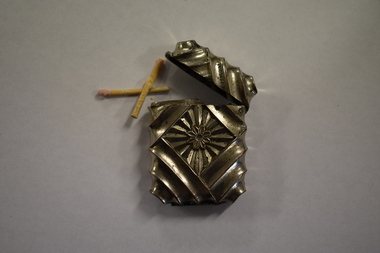
Container - Match Holder, Early 20th century
... Inside the container is part of an old matchstick....Inside the container is part of an old matchstick. Container Match Holder ...A match holder was a common item 100 years ago and more, as it was used by those who smoked and was often kept on the person for this purpose or as a handy object for lighting lamps etc. It has no known provenance. This container is of minor interest as an example of a household item of the past and is kept for display purposes.This is a small silver-coloured metal container with a lift-up lid. The metal is pressed into an ornamental pattern. Inside the container is part of an old matchstick.Rd. 168192warrnambool history, household items -
 Tatura Irrigation & Wartime Camps Museum
Model - hut, ablution block, 1940
... Wood & Cardboard Model of a shed from Camp 3 painted silver. A wood, matchstick, paper ablution block model from Camp 3. ...The frame is wood, the covering is made from matchsticks laid on paper and covered with paper and painted silver. ...Made by Internee at Camp 3a. Lother Streker.Wood & Cardboard Model of a shed from Camp 3 painted silver. A wood, matchstick, paper ablution block model from Camp 3. The frame is wood, the covering is made from matchsticks laid on paper and covered with paper and painted silver. The roof is done the same. The shed is divided into a hand wash room, 2 bathrooms, mixed shower rooms, wood heater room, another hand wash room and a laundry. There are lights, baths, showers, etc.tatura, handcrafts, model -
 Whitehorse Historical Society Inc.
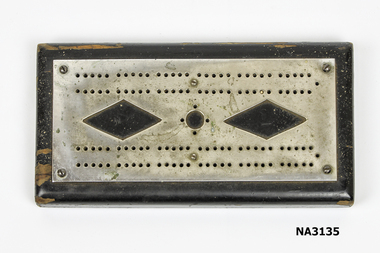
Leisure object - Crib Board
... Used in card game of Cribbage with money or small wooden sticks such as matchsticks....Used in card game of Cribbage with money or small wooden sticks such as matchsticks. recreations games Oblong of polished wood with silver metal plate attached to surface by screws. ...Used in card game of Cribbage with money or small wooden sticks such as matchsticks.Oblong of polished wood with silver metal plate attached to surface by screws. Plate has a series of holes and two diamond shapes. Holes are for scoring in the game of Cribbage. Base has four white button feet.recreations, games -
 Heidelberg Repatriation Hospital
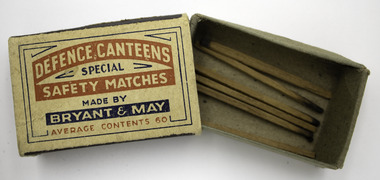
Memorabilia - Match box, Bryant & May, c. 1940s
... ...matchsticks...bryant and may safety matches matchsticks Label reads: DEFENCE CANTEENS / SPECIAL / SAFETY MATCHES / MADE BY / BRYANT & MAY / AVERAGE CONTENTS 60. ...Rectangular box and sliding lid with long narrow sides for striking matches. "Save Matches They're Scarce" Label reads: DEFENCE CANTEENS / SPECIAL / SAFETY MATCHES / MADE BY / BRYANT & MAY / AVERAGE CONTENTS 60. bryant and may, safety matches, matchsticks -
 Robin Boyd Foundation
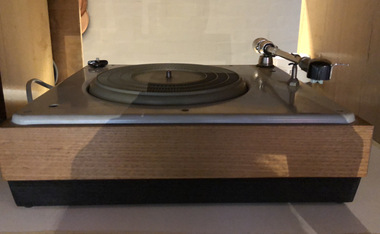
Functional object - Turntable
... Apparently one time some guest looked at the speaker holes (they had matchstick blind screening) and asked Robin what type of equipment he had. ...Apparently one time some guest looked at the speaker holes (they had matchstick blind screening) and asked Robin what type of equipment he had. ...Robin Boyd had the sound system put in by a friend who ran the iconic Thomas’ Music in the city of Melbourne. The Boyd family thinks that Robin designed the facade and logo for Thomas’ Music. Penleigh Boyd recalls "there was no 'hi-fi' record player in the living room until about 1963. Robin always had the speaker holes in the floating joinery unit but couldn’t afford the necessary equipment till years after we had moved into the house. Apparently one time some guest looked at the speaker holes (they had matchstick blind screening) and asked Robin what type of equipment he had. That was enough for Robin, and he immediately had a system installed - the one that is still there." (See also the amplifier item F030.)Turntable without lidthomas' music, sound system, walsh st house, ohm2022, ohm2022_8 -
 Robin Boyd Foundation
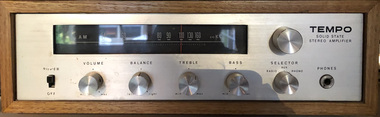
Functional object - Amplifier
... Apparently onetime some guest looked at the speaker holes (they had matchstick blind screening) and asked Robin what type of equipment he had? ...Apparently onetime some guest looked at the speaker holes (they had matchstick blind screening) and asked Robin what type of equipment he had? ...Robin Boyd had the sound system put in by a friend who ran the iconic Thomas’ Music in the city of Melbourne. The Boyd family think that Robin designed the facade and logo for Thomas’ Music. Penleigh Boyd's recalls " there was no “hi-fi” record player at the living room end till about 1963. Robin always had the speaker holes in the floating joinery unit but couldn’t afford the necessary equipment till years after we had moved into the house. Apparently onetime some guest looked at the speaker holes (they had matchstick blind screening) and asked Robin what type of equipment he had? That was enough for Robin, and he immediately had a system installed - the one that is still there." See also item F029.Tempo solid state stereo amplifier in timber surroundthomas' music, sound system, walsh st house, robin boyd, walsh st -
 Coal Creek Community Park & Museum
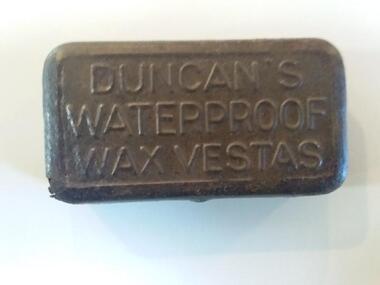
Domestic object - Tin Match Box
... In the 1880s workers in matchstick factories, predominantly women and young girls (4-16 years old) from working-class families could work up to 14 hours a day and were exposed to deadly phosphorous vapours on a daily basis. ...In the 1880s workers in matchstick factories, predominantly women and young girls (4-16 years old) from working-class families could work up to 14 hours a day and were exposed to deadly phosphorous vapours on a daily basis. ...By the close of the 19th century, colonial children in Australia (especially poorer ones) were expected to work by age 10 or 11. Boys could become apprentices or assistants to trades such as butchers, printers, carpenters, bakers, smiths or services such as delivering newspapers. Girls could work as domestic servants, seamstresses, or in large clothing factories or weaving mills. Girls as young as 6 could work in cities selling stationary or matches to passers-by. In the 1880s workers in matchstick factories, predominantly women and young girls (4-16 years old) from working-class families could work up to 14 hours a day and were exposed to deadly phosphorous vapours on a daily basis. This led to the devastating disease known as “phossy jaw” or “phosphorous necrosis of the jaw” which caused the jawbone to rot. This small rectangular tin matchbox with raised writing on top would once have been gold and brightly coloured. It has a metal striker on the inside as this type of match contains phosphorous which is volatile and can be lit by friction. Duncan's Waterproof Wax vestas
