
Showing 5 items matching "material defects "
-
 Moorabbin Air Museum
Book - Aeronautical Engineering, The Rigging Maintenance And Inspection Of Aircraft ("A" Licence)
... ...Material defects & deterioration...Aeronautical engineering Assembly & rigging Material defects & deterioration Hydraulics Seaplanes & flying boats Instrument testing Electrical systems Overview of aircraft rigging, maintenance & inspection for A licence applicants, circa 1941 May be duplicate item The Rigging Maintenance And Inspection Of Aircraft ("A" Licence) Book Aeronautical Engineering ...Overview of aircraft rigging, maintenance & inspection for A licence applicants, circa 1941May be duplicate item non-fictionOverview of aircraft rigging, maintenance & inspection for A licence applicants, circa 1941assembly & rigging, material defects & deterioration, hydraulics, seaplanes & flying boats, instrument testing, electrical systems -
 City of Moorabbin Historical Society (Operating the Box Cottage Museum)
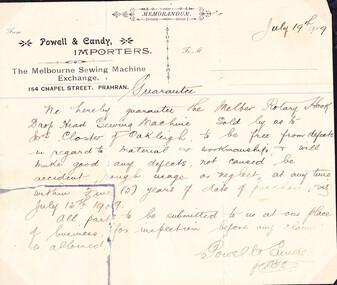
Document - Guarantee, c1900
... MEMORANDUM / From / Powell & Candy/ IMPORTERS / ‘ July 19th 1909 ‘ ( hand written) / To M / The Melbourne Sewing Machine / Exchange, / 154 CHAPEL STREET, PRAHRAN / Guarantee ( hand written) / “ We hereby guarantee the Melber Rotary Hook / Drop Head Sewing Machine Sold by us to / Mrs Closter of Oakleigh, to be free from defects / in regard to material & workmanship & will / make good any defects not caused “be” / accident, rough usage or neglect at any time / within Five (5) years of date of purchase . viz. / July 15th 1909. / All parts to be submitted to us at our place / of business for inspection before any claim / is allowed. / Powell & Candy / per ……...Their nephew Alonzo married Mary Kloster/ Closter in 1918 and she brought with her this 'Melber' sewing machine that she used to provide clothing for the family victoria melbourne clothing brighton moorabbin pioneers sewing box elizabeth box alonzo closter mary oakleigh kentucky early settlers america craftwork sewing machines melber company u s a prahran Kloster maria MEMORANDUM / From / Powell & Candy/ IMPORTERS / ‘ July 19th 1909 ‘ ( hand written) / To M / The Melbourne Sewing Machine / Exchange, / 154 CHAPEL STREET, PRAHRAN / Guarantee ( hand written) / “ We hereby guarantee the Melber Rotary Hook / Drop Head Sewing Machine Sold by us to / Mrs Closter of Oakleigh, to be free from defects / in regard to material & workmanship & will / make good any defects not caused “be” / accident, rough usage or neglect at any time / within Five (5) years of date of purchase . viz. / July 15th 1909. / All parts to be submitted to us at our place / of business for inspection before any claim / is allowed. / Powell & Candy / per ……..” ( all hand written ) The original, hand written, Guarantee for the Melber Sewing Machine purchased by Mrs Maria Closter of Oakleigh in July 15th 1909 at Powell & Candy, Importers of Chapel Street, Prahran, Melbourne. ...Mrs Maria Closter ( Kloster), of Oakleigh purchased the Melber Sewing Machine in 1909 and gave it to her daughter Mary when she and Alonzo Box married in 1918 and settled in Moorabbin Shire. This document was donated by a descendant of the Box family in 1985.William and Elizabeth Box purchased 'Box Cottage' in 1865 from a pioneer settler who had bought part of the land noted in Dendy's Special Survey 1841 Brighton. They raised their family there and established a market garden to supply produce to the population of Melbourne. Their nephew Alonzo married Mary Kloster/ Closter in 1918 and she brought with her this 'Melber' sewing machine that she used to provide clothing for the family The original, hand written, Guarantee for the Melber Sewing Machine purchased by Mrs Maria Closter of Oakleigh in July 15th 1909 at Powell & Candy, Importers of Chapel Street, Prahran, Melbourne. MEMORANDUM / From / Powell & Candy/ IMPORTERS / ‘ July 19th 1909 ‘ ( hand written) / To M / The Melbourne Sewing Machine / Exchange, / 154 CHAPEL STREET, PRAHRAN / Guarantee ( hand written) / “ We hereby guarantee the Melber Rotary Hook / Drop Head Sewing Machine Sold by us to / Mrs Closter of Oakleigh, to be free from defects / in regard to material & workmanship & will / make good any defects not caused “be” / accident, rough usage or neglect at any time / within Five (5) years of date of purchase . viz. / July 15th 1909. / All parts to be submitted to us at our place / of business for inspection before any claim / is allowed. / Powell & Candy / per ……..” ( all hand written ) victoria, melbourne, clothing, brighton, moorabbin, pioneers, sewing, box elizabeth, box alonzo, closter mary, oakleigh, kentucky, early settlers, america, craftwork, sewing machines, melber company, u s a, prahran, kloster maria -
 Melbourne Tram Museum
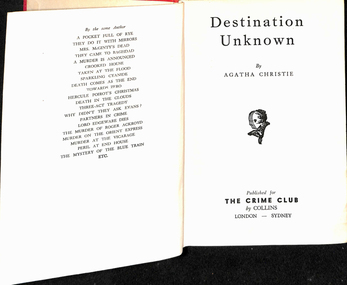
Book, Agatha Christie, "Destination unknown", 1954
... materials during broken shifts and to take home. From Wikipedia - accessed 26/12/2019: Plot summary Hilary Craven, a deserted wife and bereaved mother, is planning suicide in a Moroccan hotel, when she is asked by British secret agent Jessop to undertake a dangerous mission as an alternative to taking an overdose of sleeping pills. The task, which she accepts, is to impersonate the wife of Thomas Betterton, a nuclear scientist who has disappeared and may have defected...materials during broken shifts and to take home. From Wikipedia - accessed 26/12/2019: Plot summary Hilary Craven, a deserted wife and bereaved mother, is planning suicide in a Moroccan hotel, when she is asked by British secret agent Jessop to undertake a dangerous mission as an alternative to taking an overdose of sleeping pills. The task, which she accepts, is to impersonate the wife of Thomas Betterton, a nuclear scientist who has disappeared and may have defected ...Book, hard cover, 12 sections, sewn with end papers, 210 pages, titled "Destination unknown", written by Agatha Christie, published by The Crime Club, 1954. Has the stamp of the Footscray Tramway Library, asking it to be returned within 14 days inside the front cover and in many places throughout the book, along with Number "606" on the inside front cover and on the spine of the book. The book was part of a library run by the depot staff to provide materials during broken shifts and to take home. From Wikipedia - accessed 26/12/2019: Plot summary Hilary Craven, a deserted wife and bereaved mother, is planning suicide in a Moroccan hotel, when she is asked by British secret agent Jessop to undertake a dangerous mission as an alternative to taking an overdose of sleeping pills. The task, which she accepts, is to impersonate the wife of Thomas Betterton, a nuclear scientist who has disappeared and may have defected to the Soviet Union. Soon she finds herself in a group of oddly-assorted travellers being transported to the unknown destination of the title. The destination turns out to be a secret scientific research facility disguised as a modern leper colony and medical research center at a remote location in the Atlas Mountains. The scientists are well-treated, but they are not allowed to leave the facility, and they are locked in secret areas deep inside the mountain whenever government officials and other outsiders visit. Hilary Craven successfully passes herself as Betterton's wife Olive, because he is miserable and wants desperately to escape. Hilary discovers that the facility was built by the fabulously wealthy and somewhat villainous Mr Aristides, for financial rather than political ends. He has lured the world's best young scientists to it with various deceptions so that he can later sell their services back to the world's governments and corporations for a huge profit. She falls in love with Andrew Peters, a handsome young American who was in the group with her on their journey to the facility. With the help of clues she has left along the way, Jessop eventually locates and rescues her and the others held there. Peters turns out also to be on a mission, intent on bringing Betterton to justice for the murder of his first wife. Betterton, revealed to also be a scientific fraud who plagiarized his work, is arrested. Hilary no longer wants to die, and she and Peters are free to begin their life together.On the top of the first page "13/3" indicating the price, "m/arz"? on the bottom left hand corner and inside the front cover the label of "Robertson & Mullens Ltd" booksellers.trams, tramways, footscray depot, libraries, novels, personnel, crews, shifts -
 Bendigo Military Museum
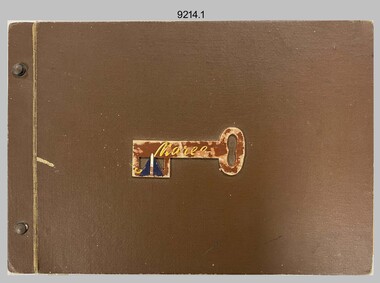
Card - LHQ Cartographic Company Publications, Fortuna, Bendigo, 1943 to 1945
... Other sections the AWAS worked in were the duffing section, where unwanted features were painted out of the negatives before reproduction, and the retouching section where any defects in the zinc plates were corrected. The AWAS also worked on creating Army posters and other publicity material in this section. ...Other sections the AWAS worked in were the duffing section, where unwanted features were painted out of the negatives before reproduction, and the retouching section where any defects in the zinc plates were corrected. The AWAS also worked on creating Army posters and other publicity material in this section. ...This is a collection of publications produced from 1943 to 1945, during Army’s early years of occupation at Fortuna, Bendigo in WW2. The first item is a colour photograph of a photo album cover. The remaining items are publications printed on manilla card. The items are from a photo album provided by the family of Rosemary (Atkinson) Bowman, who served in the Australian Women's Army Service (AWAS) and a former member of RA Svy. On 1 Feb 1941, a Cartographic Section was reformed as the Land Headquarters (LHQ) Cartographic Company. Deputy Chief of the General Staff, Major General Sidney Rowell instructed Its OC - Major William Sarll, in the interests of security of plant and to provide against possible damage of air attack, to investigate suitable safer inland accommodation for LHQ Cartographic Company. Major William Sarll inspected many properties before finding one that would meet the requirements of the Cartographic Company. In late 1941, he came to inspect Fortuna, a rambling old mansion dating back to the gold rush, with about fifteen acres of ground in central Bendigo. On 23 March 1942, the Commonwealth of Australia, under the provisions of the National Security Act of 1939, took possession of the house, the old battery buildings and the fifteen acres of grounds. LHQ Cartographic Company moved to Bendigo on 11 Jun 1942, from Mitchell House, Melbourne. The responsibilities of this unit were map compilation, fair drawing and lithographic reproduction, including printing the work of other Units as well as their own. Added to this unlikely mixture of permanent army officers, skilled tradesmen, artists and old soldiers were the women of the Company. A decision of War Cabinet on 13 August 1941 had authorised the formation of the Australian Women's Army Service (AWAS), in order to release men from certain military duties for employment with fighting units. Originally their employment was restricted to traditional female areas and numbers were strictly limited, but the outbreak of the Pacific War in 1942 led to a broadening of employment categories and an increase in numbers. The first AWAS arrived at Fortuna on 26 November 1942 and immediately became an integral part of the unit. Most of these women had artistic talent. Their work included fine drawing work, filling in all the topographical detail on fair copies of field sheets and pasting on names and figures, while others were drawing actual map outlines. Other sections the AWAS worked in were the duffing section, where unwanted features were painted out of the negatives before reproduction, and the retouching section where any defects in the zinc plates were corrected. The AWAS also worked on creating Army posters and other publicity material in this section. Sometimes the women were employed in particularly arduous jobs. With Lieutenant Goodrich in charge, approximately twenty AWAS worked in the folding section where they spent long and arduous hours folding, collating and stapling top secret cipher and code publications. Seventy-five AWAS served with the Cartographic Company during the war and Major Sarll paid them a special tribute for their 'untiring efforts' in the Company's war report. Refer to Item 6099.17P for photos taken in 1942, the first year of LHQ Cartographic Company’s occupation at Fortuna, Bendigo in WW2. The Survey Corps’ occupation of Fortuna during WW2 is covered in more detail with additional historic photographs, in pages 17 to 27 of Valerie Lovejoy’s book 'Mapmakers of Fortuna – A history of the Army Survey Regiment’ ISBN: 0-646-42120-4. Other items from Rosemary (Atkinson) Bowman are: 9209.12P, 9210.16P, 99211.6P, 9212.6P, and 9213.4P.This is a collection of publications produced during Army’s early years of occupation at Fortuna, Bendigo in WW2. The first item is a colour photograph of a photo album cover. The remaining items are publications printed on manilla card. The items are contained in a photo album provided by the family of Rosemary (Atkinson) Bowman, a former member of RA Svy. The photographs were scanned at 600 dpi and are part of the Army Survey Regiment’s Collection. .1) – photo of album cover, brown hard textured cardboard, brown wooden key and purple and white Aust Svy Corps 2nd AIF badge. .2) – LHQ Cartographic Company Christmas Card, colour, 1943. .3) & .4) – LHQ Cartographic Company SGTs Mess Christmas Card, colour, 1943. Folded and unfolded. .5) & .6) – LHQ Cartographic Company Christmas Card, colour, 1945. Front and back. Annotated ‘From Margie’ .7) – Church of England Active Service Memento Card, colour, signed, 1943. .8) – LHQ Cartographic Company AWAS Dance Invitation, colour, dated 15th Jun 1944. Annotated ‘SPR Atkinson.’ .9) & .10) – LHQ Cartographic Company Carto Capers Musical Review Programme, colour, c1944. Front and back. .11) & .12) – LHQ Cartographic Company Christmas Dinner Menu, colour, 1943. Folded and unfolded.There are no annotations.royal australian survey corps, rasvy, army survey regiment, asr, fortuna -
 Bendigo Military Museum
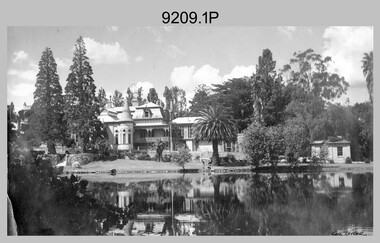
Photograph - LHQ Cartographic Company Personnel and Vehicles, Fortuna, Bendigo, 1943 to 1945
... Other sections the AWAS worked in were the duffing section, where unwanted features were painted out of the negatives before reproduction, and the retouching section where any defects in the zinc plates were corrected. The AWAS also worked on creating Army posters and other publicity material in this section. ...Other sections the AWAS worked in were the duffing section, where unwanted features were painted out of the negatives before reproduction, and the retouching section where any defects in the zinc plates were corrected. The AWAS also worked on creating Army posters and other publicity material in this section. ...This is a set of 12 photographs taken in 1943 and 1945, during Army’s early years of occupation at Fortuna, Bendigo in WW2. The black and white photographs are contained in a photo album provided by the family of Rosemary (Atkinson) Bowman, who served in the Australian Women's Army Service (AWAS) and a former member of RA Svy. On 1 Feb 1941, a Cartographic Section was reformed as the Land Headquarters (LHQ) Cartographic Company. Deputy Chief of the General Staff, Major General Sidney Rowell instructed Its OC - Major William Sarll, in the interests of security of plant and to provide against possible damage of air attack, to investigate suitable safer inland accommodation for LHQ Cartographic Company. Major William Sarll inspected many properties before finding one that would meet the requirements of the Cartographic Company. In late 1941, he came to inspect Fortuna, a rambling old mansion dating back to the gold rush, with about fifteen acres of ground in central Bendigo. On 23 March 1942, the Commonwealth of Australia, under the provisions of the National Security Act of 1939, took possession of the house, the old battery buildings and the fifteen acres of grounds. LHQ Cartographic Company moved to Bendigo on 11 Jun 1942, from Mitchell House, Melbourne. The responsibilities of this unit were map compilation, fair drawing and lithographic reproduction, including printing the work of other Units as well as their own. A decision of War Cabinet on 13 August 1941 had authorised the formation of the Australian Women's Army Service (AWAS), in order to release men from certain military duties for employment with fighting units. Originally their employment was restricted to traditional female areas and numbers were strictly limited, but the outbreak of the Pacific War in 1942 led to a broadening of employment categories and an increase in numbers. The first AWAS arrived at Fortuna on 26 November 1942 and immediately became an integral part of the unit. Most of these women had artistic talent. Their work included fine drawing work, filling in all the topographical detail on fair copies of field sheets and pasting on names and figures, while others were drawing actual map outlines. Other sections the AWAS worked in were the duffing section, where unwanted features were painted out of the negatives before reproduction, and the retouching section where any defects in the zinc plates were corrected. The AWAS also worked on creating Army posters and other publicity material in this section. Seventy-five AWAS served with the Cartographic Company during the war. Refer to Item 6099.17P for photos taken in 1942, the first year of LHQ Cartographic Company’s occupation at Fortuna, Bendigo in WW2. The Survey Corps’ occupation of Fortuna during WW2 is covered in more detail with additional historic photographs, in pages 17 to 27 of Valerie Lovejoy’s book 'Mapmakers of Fortuna – A history of the Army Survey Regiment’ ISBN: 0-646-42120-4. Other items from Rosemary (Atkinson) Bowman are: 9210.16P, 99211.6P, 9212.6P, 9213.4P and 9214.12 This is a set of 12 photographs taken in 1943 and 1945, during Army’s early years of occupation at Fortuna, Bendigo in WW2. The black and white photographs are printed on photographic paper are contained in a photo album provided by the family of Rosemary (Atkinson) Bowman, who served in the Australian Women's Army Service (AWAS) and a former member of RA Svy. The photographs were scanned at 600 dpi and are part of the Army Survey Regiment’s Collection. .1) - Photo, black & white, 1943. LHQ Cartographic Company, Fortuna Villa, Bendigo. .2) - Photo, black & white, 1943. Ronye Bond. .3) - Photo, black & white, 1943. Rosemary (Atkinson) Bowman. .4) - Photo, black & white, 1943. Billie Hyatt. .5) - Photo, black & white, 1943. Helen Morton. .6) - Photo, black & white, 1943. Wes Runting. .7) - Photo, black & white, 1943. Ronye Bond. .8) - Photo, black & white, 1943. Rosemary (Atkinson) Bowman. .9) - Photo, black & white, 1943. Accommodation Tents L to R: Norma Lewis, Billie Hyatt, Peggy Priest, Ken Taylor, Tiny Lewis, Norma Jeffrey. .10) - Photo, black & white, 1943. Marching Contest in Bendigo’s Charing Cross. .11) - Photo, black & white, 1945. In front of Regimental Office. .12) - Photo, black & white, 1945. Part of Drive.Some personnel are identified with dates in the photo album.royal australian survey corps, rasvy, army survey regiment, asr, fortuna
