
Showing 54 items matching "max meldrum school"
-
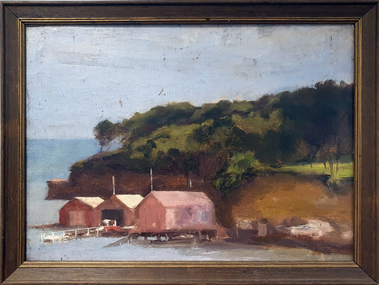 Federation University Art Collection
Painting - Oil on board, Robinson, John Braisted, 'Beaumaris' by John Braisted Robinson, 1929
... ...Max Meldrum School...ROBINSON (c1877 -25 May1935) Born Ballarat, Victoria A latecomer to painting, John Robinson was known to periodically attend the Max Meldrum School. He joined the administrative staff of the Ballarat School of Mines somewhere around 1902, obtaining the position of Registrar. ...ROBINSON (c1877 -25 May1935) Born Ballarat, Victoria A latecomer to painting, John Robinson was known to periodically attend the Max Meldrum School. He joined the administrative staff of the Ballarat School of Mines somewhere around 1902, obtaining the position of Registrar. ...John B. ROBINSON (c1877 -25 May1935) Born Ballarat, Victoria A latecomer to painting, John Robinson was known to periodically attend the Max Meldrum School. He joined the administrative staff of the Ballarat School of Mines somewhere around 1902, obtaining the position of Registrar. He stayed in the Schools employment for 35 years. His chief recreations were gardening and the study of art. "His many canvases reveal the sincerity of his work and represent a notable achievement from one who adopted art somewhat late in life. (Obituary, Ballarat School of Mines Students' Magazine, 1935) Robinson studied with Max Meldrum in Melbourne. This item is part of the Federation University Art Collection. The Art Collection features over 2000 works and was listed as a 'Ballarat Treasure' in 2007.Framed oil painting showing the coast and three boathouses.Verso underneath brown paper No 11 Beaumaris Artists Signation J.B. Robinsonart, artwork, john braisted robinson, beaumaris, seascape, max meldrum school, available -
 Federation University Historical Collection
Book, The Shepherd Press, The Science of Appearances as Formulated and Taught by Max Meldrum, 1950
... max meldrum school...Max Meldrum early 1900s. A review calls the book "the most outstanding book on the craft of painting yet published in any language. Max Meldrum was born in Edinburgh, Scotland on 03 December 1875. His family arrived in Australia and Max Meldrum attended the National Gallery School...It was deaccessioned and transferred from the Ballarat School of Mines library so would have been used by students and staff of the Ballarat Technical Art School, a division of the Ballarat School of Mines. max meldrum school max meldrum art science of appearances appearances color plates tonalism Ballarat School of Mines Library Ballarat Technical Art School A review has been pasted in the front.. ...This book could be described as the summing up of a theory of physical appearances, devised by a painter and demonstrated by paint. The foundation of this theory was laid down first in Paris by Max Meldrum early 1900s. A review calls the book "the most outstanding book on the craft of painting yet published in any language. Max Meldrum was born in Edinburgh, Scotland on 03 December 1875. His family arrived in Australia and Max Meldrum attended the National Gallery School, winning the Victorian Travelling Scholarship in 1899. It was deaccessioned and transferred from the Ballarat School of Mines library so would have been used by students and staff of the Ballarat Technical Art School, a division of the Ballarat School of Mines. Red fabric hard covered book of 298pp, includes colour plates that have been pasted into the book. The book inlcudes 11 colour prints and 11 line and tone diagrams. These diagrams in clude Major and Minor Dark and liLight Disturbances; Speed Values and Form; Complex Light Disturbance; Experiments in Definition and Inclination; Apparatus for the Analysus of Visual Phenomena by Distance; Set of Patches; Modern and Obsolete Methods of Approach, Tonal Analysis on "St John's Parad"'; Chromatic Analysis of "St John's Parade". This book was part of the Ballarat Technical Art School LibraryA review has been pasted in the front..max meldrum school, max meldrum, art, science of appearances, appearances, color plates, tonalism, ballarat school of mines library, ballarat technical art school -
 Federation University Historical Collection
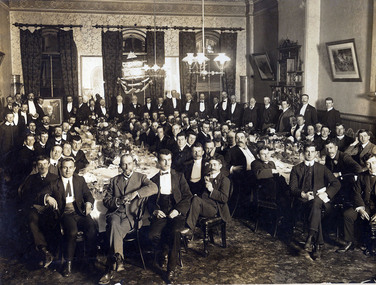
Photograph - Photograph (Black & White), Victa Studios, Presentation to Professor Alfred Mica Smith of the Ballarat School of Mines at Craig's Royal Hotel, c1924, c1924
... School of Mines. It is most probably also the unveiling of the Max Meldrum portrait of Smith. ...School of Mines. It is most probably also the unveiling of the Max Meldrum portrait of Smith. ...This photo is thought to have been taken at the time of Alfred Mica Smith's retirement from the Ballarat School of Mines. It is most probably also the unveiling of the Max Meldrum portrait of Smith. Alfred Mica Smith retired from the Ballarat School of Mines in 1922 after an association of 41 years and aged 78 years. At the August meeting of the Ballarat School of Mines Council in 1881 it was resolved that 'Alfred Mica Smith Esq., B.Sc., be appointed Professor in Chemistry and Metallurgy and be Superintendent of the Laboratories, for the period of twelve months at a stipend of five hundred pounds per annum, and to commence duty as soon as possible'. (signed: James Oddie, Vice-President) Smith played a major role in the years of 1887-1893 when SMB was affiliated with Melbourne University. In 1912 he became Professor of Metallurgy and received an annual salary of 250 pounds. Alfred Mica Smith presented many scholarly papers, gave evidence at government enquiries into the safety of mines and became an authority on mine safety and ventilation. He was on the Mines Ventilation Board. Professor Smith was the public analyst for the City of Ballarat and Town of Ballarat East, as well as to a number of other boroughs and shires. He was also Chief juror to the Adelaide International Exhibition, chemical section. He provided information to the Royal Commission on gold mining (1889, 1891), and was President to the chemistry section of Australian Association for the Advancement of Science, Associate of American and Australasian Institute of Mining Engineering, Member of the Science Faculty Melbourne University, and Hon. Life Member of the Miner Managers' Association of Australia. He also was involved in many educational and community affairs such as President of the SMB Students' Association, President of the Ballarat Science Society, first President of the Ballarat Camera Club, Vice President of the Field Naturalists' Club, and he presented Ballaarat Fine Art Gallery with his collection of paintings and porcelain ware. His legacies include the mutual regard between him and his students, the many tributes by former students, the Mica Smith scholarship (established in 1923) and now known as the Corbould-Mica Smith Travelling Scholarship, his portrait in oils by noted artist Max Meldrum, and the marble bust of Smith sculptured by Paul Montford. Money for a scholarship in sanitary science at the University of Manchester in the name of his uncle R. A. Smith was left being set up in 1928. Smith died of cancer on 14 May 1926 and his remains, cremated at Springvale, were interred in the Ballaarat New Cemetery. See http://guerin.ballarat.edu.au/curator/honour-roll/honourroll_Smith,%20Alfred%20Mica.shtml Black and white mounted photograph showing a number of men sitting around two dining tables at Craig's Royal Hotel in Ballarat. Professor Alfred Mica Smith of the Ballarat School of Mines is standing 15 from the left, and is the subject of the painting on an easel to the left. The painting was presented to the Ballarat Fine Art GalleryLower right of mount 'Victa Studios Ballarat' Verso (typed and glued on): Presentation to professor Mica Smith, Craig's Hotelballarat school of mines, craig's hotel, craig's royal hotel, alfred mica smith, art gallery of ballarat, ballarat fine art gallery, portrait, frederick martell, daniel walker -
 Federation University Historical Collection
Magazine - Booklet, Baxter & Stubbs, Print, Ballarat School of Mines Students' Magazine, 1923, 1923
... school...e. kift...ethel kift...r. t. crosthwaite...c. mcilvena...h. finlayson...e. mckissock...f. russell...c. s. hunt...j. r. pound...a. leask...m. timmings...professor alfred mica smith...robert james dowling...e. j. mcconnon...r. g. cox...edwin a. brophy...raymond fricke...nancy humphries...r. sage...Max Meldrum...Max Meldrum. This consists of painting in the orders of the impressions. This method is fully explained in his book, and will be found invaluable by the student desiring to work on sound lines. ... ballarat school of mines magazine hessie darby ballarat technical art school e. kift ethel kift r. t. crosthwaite c. mcilvena h. finlayson e. mckissock f. russell c. s. hunt j. r. pound a. leask m. timmings professor alfred mica smith robert james dowling e. j. mcconnon r. g. cox edwin a. brophy raymond fricke nancy humphries r. sage Max Meldrum .1) Stamped "Ballarat Technical Art School" .2) Written on front cover "Hessie Darby" Brown soft covered magazine. ...Editorial, In Memoriam: Robert James Dowling, Fumes from the Lab, A trip to America, Arts & Crafts Gossip, Echoes of the Past, Sport, The Junior Techs. Under Arts & Crafts Gossip the writer gives on overview on 'modern books on fine art'. "... In making this decision as to whether his tone values are correct or not the artist always studies his canvas from a distance of several yards. An excellent system of painting is being practised and taught by Max Meldrum. This consists of painting in the orders of the impressions. This method is fully explained in his book, and will be found invaluable by the student desiring to work on sound lines. ...Brown soft covered magazine..1) Stamped "Ballarat Technical Art School" .2) Written on front cover "Hessie Darby"ballarat school of mines, magazine, hessie darby, ballarat technical art school, e. kift, ethel kift, r. t. crosthwaite, c. mcilvena, h. finlayson, e. mckissock, f. russell, c. s. hunt, j. r. pound, a. leask, m. timmings, professor alfred mica smith, robert james dowling, e. j. mcconnon, r. g. cox, edwin a. brophy, raymond fricke, nancy humphries, r. sage, max meldrum -
 Federation University Historical Collection
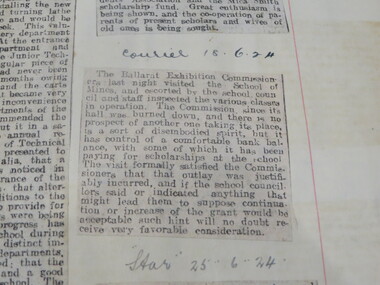
Book - Scrapbook, Ballarat School of Mines Scrapbook 1921-1924, 1921-1924
... School...J.S. Vickery...J.s. vickery obituary...Ida V. Johnson...John Rowell exhibition...MAx Meldrum...School J.S. Vickery J.s. vickery obituary Ida V. Johnson John Rowell exhibition MAx Meldrum W.G. ...The clippings in this book relate to the Ballarat School of Mines. Hard covered scrapbook with newspaper clippings relating to the Ballarat School of Mines.ballarat school of mines, scrapbook, ballarat technical art school, clay, ceramics, pottery, native clay, maurice copland, h.h. smith, c.h. beanland, technical schools, albert e. dowling, john dulfer, jenkin swimming shield, r.s. dale, j.y. mcdonald, a.f. heseltine, stained glass windows, amalie feild, richard dale, ballarat school of mines museum, ballarat junior secondary school, war criminal trials, j.f. crichton, repatriation department, w.o.f. close, soldiers vocational classes, world war one, alexander peacock, ballarat junior technical school opening, effie holmes, cornell chemist, w.k. moss, ken moss, obituary, j. vickery, w.d. hill, r.w. richards, shackelton, antarctic exploration, t.h. trengrove, samuel mayo, vera lindsay, bessie robertson, victor greenhalgh, repatriation classes closure, repatriation classes termination, university college, vocational training, arbor day, j.b. corbet, ballarat school of mines procession, ballarat junior technical school honour board, harold herbert, albert steane, a.w. steane, francis davis, tree planting, clyde lukeis, trade classes, old boys association, alfred james higgin, blackill color and oxide company, electric supply company, state school exhibition, state education jubilee, scholarships, clay deposits, james coad, t.a. williams, copland memorial, e.j. mcconnon, alfred mica smith, ponsonby carew smyth, d. maxwell, lena rutherford, dorothy whitehead, examination results, geoffrey nicholls, robert dowling, j.b. robinson, percy trompf, j.c. bush, white flat reserve, rubbish tip, sports ground, broken hill excursion, old boy's association, school of mines procession, white flat improvements, empire exhibition, ballarat school of mines literary society, school reunion, john rowell, d.e. mullins, g. renkin, t.m. shattock, new law courts, supreme court building transferred to ballarat school of mines, buildings, ballarat state offices, ballarat school of mines museum closed, ballarat school of mines and industries, k.b. brown, sir r. garran, alf hannah, macrobertson scholarship, simone fraser, violet hambley, alfred bayley, j. heriot, c.r. pittock, i.r. bradshaw, ballarat exhbition, e. parkin, c.m. harris, mica smith bust, william henry nicholls, daniel walker, paul montford, w.h. corbould, j.w. sutherland, technical training for girls, girls education, amalie colquhoun, ken moss obituary, opening of the ballarat junior technical school, j.s. vickery, j.s. vickery obituary, ida v. johnson, john rowell exhibition, max meldrum, w.g. coates, g.f. fitches, walter white, sewerage plumbing, villers brettonneux school -
 Federation University Historical Collection
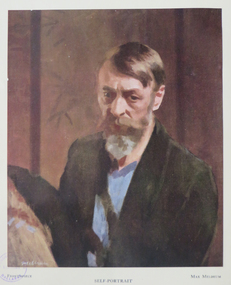
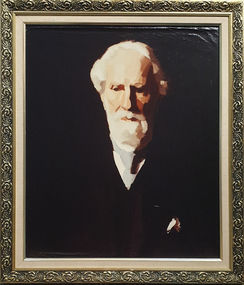
Print - Artwork - Portrait, Professor Alfred Mica Smith
... The original of this portrait was painted by Max Meldrum in 1926. In 1934 the Ballarat School of Mines sought donations to purchase the portrait for the Art Gallery of Ballarat, where it is held today. ...The original of this portrait was painted by Max Meldrum in 1926. In 1934 the Ballarat School of Mines sought donations to purchase the portrait for the Art Gallery of Ballarat, where it is held today. ...The original of this portrait was painted by Max Meldrum in 1926. In 1934 the Ballarat School of Mines sought donations to purchase the portrait for the Art Gallery of Ballarat, where it is held today. Donations were handed by the Balllarat School of Mines Registrar, John B. Robinson. Professor Alfred Mica Smith was a famed professor at the Ballarat School of MinesFramed reproduction of a painting of Alfred Mica Smith. available, alfred mica smith, max meldrum, john b. robinson -
 Eltham District Historical Society Inc
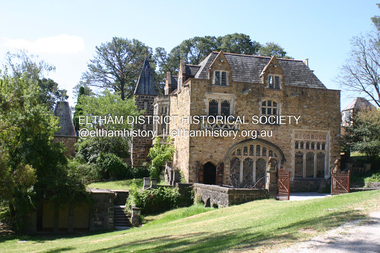
Photograph - Digital Photograph, Alan King, Great Hall, Montsalvat, 8 January 2008
... He later studied painting at the National Gallery School under artist, Frederick McCubbin, then joined the studio of artist Max Meldrum. ...He later studied painting at the National Gallery School under artist, Frederick McCubbin, then joined the studio of artist Max Meldrum. ...Great Hall at Montsalvat built 1938-52, designed by Justus Jorgensen Covered under National Estate, National Trust of Australia (Victoria) State Significance, Victorian Heritage and Heritage Overlay, Nillumbik Planning Scheme. Published: Nillumbik Now and Then / Marguerite Marshall 2008; photographs Alan King with Marguerite Marshall.; p129 At first glance, Montsalvat, the artists’ community at Hillcrest Avenue, Eltham, could belong to another time and place. The French provincial Gothic-style buildings blend picturesquely with the introduced and native trees and farm animals on the five hectare property. But Montsalvat belongs very much to today’s Eltham, having inspired much of its creative activity and style. The use of mud-brick and recycled building materials, for which Eltham is so well-known, was largely popularised by Montsalvat. Montsalvat – unique in Victoria and probably in Australia – is registered by the National Trust and National Estate.1 Montsalvat, named after the castle of the Knights of the Holy Grail, has attracted artists and intellectuals since it was founded in 1934. For years at weekends, artists, lawyers, philosophers, politicians and others, who shared a love for what Montsalvat stood for, gathered for a meal and stimulating discussion. The focus for this gathering of talent was Justus Jörgensen, an eccentric man with vision and charisma. It was Jörgensen’s foresight that saw the creation of Montsalvat, which in 1975 was formed into a trust to benefit the Victorian people. The property was then valued at about three million dollars. It is now visited by thousands of people annually. Born in 1894 and brought up a Catholic, Jörgensen had trained as an architect. He later studied painting at the National Gallery School under artist, Frederick McCubbin, then joined the studio of artist Max Meldrum. In 1924, Jörgensen married medical student Lillian Smith, and with artist friends they travelled to Europe to study the great masters. In London Jörgensen exhibited in several major galleries. One of his still life paintings was included in the book The Art of Still Life by Herbert Furst, which featured 100 of the greatest ever still life paintings.2 In 1929, Jörgensen returned to Melbourne where Lil, now qualified, worked as an anaesthetist at St Vincent’s Hospital. They bought a small house in Brighton and Jörgensen rented a large building in Queen Street for his studio until the Royal Automobile Club of Victoria bought it in 1955. While designing and overseeing the building of a studio for his friend the famous cartoonist Percy Leason, in Lavender Park Road, Jörgensen decided to buy land for a country retreat in Eltham. So the building of Montsalvat began. Jörgensen gathered around a dozen of his friends and students from his Queen Street studio. They set to work, first at weekends then some decided to live permanently on the site. Jörgensen had seen mud-brick buildings in Spain and recognised that Eltham’s clay soil was ideal for mud-bricks and although labour intensive, it was a very cheap way of building. Jörgensen’s students and friends worked under his direction with the help of local tradesmen, including carpenter, Len Jarrold and later stone mason, Horrie Judd. In return Jörgensen would give the students a painting lesson or two. It was the Great Depression when many were out of work. Jörgensen also inspired people to give generously of money and materials. With their help Jörgensen found second-hand materials for building. Friends donated slate for roofing, discarded firebricks were used for flooring and windows and doors and a cast-iron circular staircase came from a wrecker. The students’ day started at 7am with building and domestic chores, shared equally between the sexes. The first building was used by his friends at weekends and then became a home for his wife Lil. It consisted of three rooms and an attic under a high-pitched roof. Jörgensen then built a similar structure with the same high-pitched roof as a more permanent home for his students. The two buildings were joined together with a tower and a studio for Jörgensen. While excavating for the studio a reef of yellow mud-stone was found and then used in construction. The next building was the Great Hall, to be used for dining, exhibitions and meetings and completed in 1958, after a halt during the war. Whelan the Wrecker donated the stone-framed windows from the building that housed the Victorian Insurance Co. in Collins Street, which had been demolished in the 1930s. The swimming pool was donated and cubicles were built for the students with their initials marked in tiles on each doorstep.1 One of Jörgensen’s great abilities was to recognise how to use material which harmonised. He would comb through wreckers’ yards for what he needed. Regarding his buildings as sculptural pieces, his first consideration was for the aesthetic quality of a building and only then for its functionality.2 At Montsalvat, Jörgensen found he was able to put his ideas into practice without compromise and those who worked with him had to conform to his ideas. With the Jörgensens, the colony’s original nucleus consisted of the Skipper family – Mervyn and wife Lena, daughters Helen and Sonia and son Matcham,who was to become an eminent jeweller and sculptor represented in National Gallery collections throughout Australia and in European museums.3 Other members were Arthur Munday, Lesley Sinclair, Helen Lempriere, Ian Robertson, John Smith, George Chalmers, John Busst and Sue Van der Kellan; also Jörgensen’s three sons – Max, Sebastian and Sigmund – and Saskia, Sonia Skipper and Arthur Munday’s daughter. Montsalvat went through some hard times when local gossips spread rumours of sexual shenanigans at Montsalvat. However Montsalvat also had many local supporters – especially amongst the local tradespeople. The colony was certainly unconventional – with Jörgensen’s wife Lil (and son Max) and life-time partner Helen Skipper, (mother of Sebastian and Sigmund) living at Montsalvat. Sonia Skipper says in her biography that the group were ‘very conscious of their responsibilities to each other and a desire to make their relationships work’.4 By World War Two many buildings around the Great Hall were completed. Jörgensen was a pacifist, as were most of his students. Some of the Montsalvat community enlisted while others engaged in essential services like dairy farming and market gardening for the war effort. It was then that Jörgensen constructed farm buildings. After the war many well-known personalities such as Clifton Pugh, landscape gardener Gordon Ford, and builder Alistair Knox, were drawn to Montsalvat. They learnt that building was not a ‘sacred cow’ only for professionals, but that anyone who was willing to get their hands dirty could do it. The post-war shortage of materials also encouraged builders to follow Montsalvat’s lead in reusing materials. When Jörgensen died in 1975, his influence did not – thanks largely to the vigilance of his son, Sigmund, who became its administrator. The weekend dinners have gone, but in 2008 about 14 artists still work at Montsalvat – some living there – including a couple who have been there since its early days. Under Sigmund’s direction Montsalvat further expanded its activities which included festivals, art exhibitions, concerts and weddings. Sigmund completed the Chapel, then the Long Gallery next to the pool, After the barn burnt down, he replaced it in 1999 (the builder was Hamish Knox, Alistair’s son) with a new gallery and entrance and added a restaurant. Sigmund has been careful that any new building blends in with the character of Montsalvat. In 2006 Montsalvat was restructured for its continued financial viability and with the help of Arts Victoria a new executive officer was appointed. A representative board from the wider community was established, which includes members from the former Montsalvat Trust including Sigmund Jörgensen – who is now the heritage and arts adviser to the new company Montsalvat Ltd.5 Today, visiting Montsalvat one still sees artists, students and visitors enjoying the unique and beautiful surroundings.This collection of almost 130 photos about places and people within the Shire of Nillumbik, an urban and rural municipality in Melbourne's north, contributes to an understanding of the history of the Shire. Published in 2008 immediately prior to the Black Saturday bushfires of February 7, 2009, it documents sites that were impacted, and in some cases destroyed by the fires. It includes photographs taken especially for the publication, creating a unique time capsule representing the Shire in the early 21st century. It remains the most recent comprehenesive publication devoted to the Shire's history connecting local residents to the past. nillumbik now and then (marshall-king) collection, eltham, great hall, montsalvat -
 Eltham District Historical Society Inc
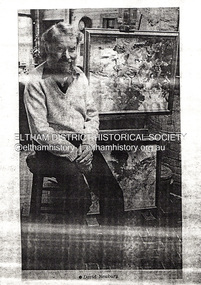
Document - Folder, Newbury, David
... Max Meldrum...Percy Leason...Botlon Street Eltham...Eltham Primary School...Max Meldrum. Contents Newspaper article: "Artist with a claim to fame", Diamond Valley News, 7 December 1982. Describes David Newbury's life and career. Pages 116-117 from "Pioneers & Painters" by Alan Marshall: Life of A E (Peter) Newbury and son David Newbury. David Newbury Peter Newbury Frederik McCubbin Walter Withers Max Meldrum Percy Leason Botlon Street Eltham Eltham Primary School ...David Newbury, artist of Eltham, son of artist Peter Newbury, is retiring from teaching at Melbourne State College. He remembered the Eltham of his childhood. A E (Peter) Newbury, artist of Eltham, influenced by Frederick McCubbin and Walter Withers, later by the work of Max Meldrum. Contents Newspaper article: "Artist with a claim to fame", Diamond Valley News, 7 December 1982. Describes David Newbury's life and career. Pages 116-117 from "Pioneers & Painters" by Alan Marshall: Life of A E (Peter) Newbury and son David Newbury.Newspaper clippings, A4 photocopies, etcdavid newbury, peter newbury, frederik mccubbin, walter withers, max meldrum, percy leason, botlon street eltham, eltham primary school, swinburn technical school, national gallery school, melbourne state college, royal melbourne institute of technology, clare newbury, a e (peter) newbury, richard mccann, eltham hotel, bill withers, walter dobson -
Glen Eira Historical Society
Article - Johnston, George
... School... Davison Frank Dalby... LABASSA... 2 Manor Grove... Caulfield... Liberman Serge... Elsternwick... Cambridge Ada... Barrett Charles... Meldrum Max...Johnston George Caulfield Primary School Davison Frank Dalby LABASSA 2 Manor Grove Caulfield Liberman Serge Elsternwick Cambridge Ada Barrett Charles Meldrum Max LOCHIED ONTARIO Robertson Alexander Koch Augustus Morrison John Caulfield Grammar School Brett Doris Phillips A. ...This file contains three items. Photocopies of brief articles from THE OXFORD LITERARY GUIDE TO AUSTRALIA identifying which literary figures lived in which Melbourne suburbs, includes Caulfield, Elsternwick, Ormond, includes George Johnston. Photocopy of four page article from AUSTRALIAN DICTIONARY OF BIOGRAPHY vol. 14, 1996 about George Johnston. Typed research note by Claire Barton dated 14/06/2013 about George Johnston from THE OXFORD LITERARY GUIDE OF AUSTRALIA by Peter Pierce.johnston george, caulfield primary school, davison frank dalby, labassa, 2 manor grove, caulfield, liberman serge, elsternwick, cambridge ada, barrett charles, meldrum max, lochied, ontario, robertson alexander, koch augustus, morrison john, caulfield grammar school, brett doris, phillips a. a., wannan bill, fearn-wannan william fielding, liberman serge, walstab george a, cox erle, maysbury avenue, kooyong road, buxton street, ormond, prichard katherine susannah, clareville, north road, authors, writers, journalists, literature, caulfield state school, johnston martin, johnston shane, johnston jason, avalon, lochiel, house names, lithographer, printmaking, art, johnston minnie riverina, wright minnie riverina, st mary’s anglican church, clift charmian, taylor elsie esme, world war 1939 to 1945, johnston gae -
 Nillumbik Shire Council
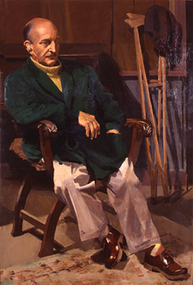
Painting - Alan MARTIN (b.1923 - d.1989 AUS), Portrait of Alan Marshall, 1956
... Alan Martin studied under Max Meldrum, at the National Gallery School and the Royal Melbourne Institute of Technology. ...Alan Martin studied under Max Meldrum, at the National Gallery School and the Royal Melbourne Institute of Technology. ...Alan Martin studied under Max Meldrum, at the National Gallery School and the Royal Melbourne Institute of Technology. He later established his own art school. He has won several prizes and is represented in several provincial collections. Alan Marshall was the author of more than fifteen books, and lived much of his life in Eltham. He became a central figure in the area's arts community of writers, artists, sculptors, film makers, actors and musicians. He contracted polio when he was young is considered one of Australia's most successful and loved authors. His most famous book, 'I Can Jump Puddles' is based on his life story and the obstacles he faced as a child in trying to overcome his disability. The portrait of Alan Marshall was exhibited as a finalist at the 1956 Archibald Prize. -
Kew Historical Society Inc
Archive (Sub-series) - Subject File, FIGUEROLA, Alma, 1970
... Later she attended the art school established by the Melbourne 'tonalist' [Duncan] Max Meldrum (1875-1955). ...Later she attended the art school established by the Melbourne 'tonalist' [Duncan] Max Meldrum (1875-1955). ...Various partiesReference, Research, InformationSecondary Values (KHS Imposed Order)Subject file containing materials relating to an early member of the Kew Historical Society, Alma Figuerola, a Victorian artist living in ‘D’Estaville’, Barry Street, Kew. A newspaper article with photographs, published in The Herald (1958) provides evidence for the dating of the press photographs of Alma Figuerola in the Society’s collection. The file contains dated correspondence between the Society and Alma Figuerola relating to her health and to the death of her mother. The file also contains a ‘Sincere Thanks’ card from Carmen and Silvia Figuerola to the Society following Alma Figuerola’s funeral, noting the date of her death on 8 December 1970. The card gives the address of the house, in 1970, as 4 Sir William Street. In the file there is a letter from 1971 pertaining to the return of wedding dresses and other materials stored at D’Estaville for the Society (which at that stage did not have its own archive). A solicitor’s note from 1973 to the Society contains a refutation of the information about the house contained in Dorothy Rogers’ A History of Kew.kew (vic) - history, artists - kew (vic), alma figuerola, d'estaville, 7 barry street (kew)kew (vic) - history, artists - kew (vic), alma figuerola, d'estaville, 7 barry street (kew) -
 Kew Historical Society Inc
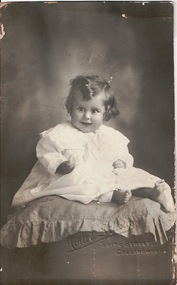
Photograph - Cousin Bert aged 12 months, Model Studios, 1920s
... Later she attended the art school established by the Melbourne 'tonalist' [Duncan] Max Meldrum (1875-1955). ...Later she attended the art school established by the Melbourne 'tonalist' [Duncan] Max Meldrum (1875-1955). ...The Melbourne artist Alma Agnes Marion Figuerola, was the daughter of Juan Pedro Narciso Figuerola (1869-1919) and Alice Lucinda Walker Hanson (1889-1969). Each of their three daughters grew up to be involved in the arts: Alma as a painter; Carmen Irene (1906-1993) as a short story writer, poet and teacher of dancing; and Sylvia (also Silvia) Lyla Alice (1911-1992) as a composer and cellist. The first art lessons Alma Figuerola received were with Oscar Binder. Later she attended the art school established by the Melbourne 'tonalist' [Duncan] Max Meldrum (1875-1955). She graduated from his school in 1920, participating in her first group exhibition in the same year. Solo exhibitions of her work were to be held in 1933 at the Meldrum Gallery in Elizabeth Street, in 1937 and 1945 at the Athenaeum Gallery at 188 Collins Street, and in 1951 at Georges Gallery in Collins Street. Throughout her extensive career she participated in group exhibitions, usually with artists of the Meldrum School, and as a member of the Twenty Melbourne Painters, of which she was invited to become an associate in 1935. In 1953, her portrait of Professor ES Hills was entered in the Archibald Prize Competition of the Art Gallery of New South Wales. A resident of Kew from the 1930s - 51 Studley Park Road, often with her mother, her sister Carmen, or both - from c.1942 until her death she lived at 'D’Estaville', 7 Barry Street. From the late 1930s she is recorded as actively contributing to the arts at a local level. In 1939 and 1940 she participated in art exhibitions at the Hawthorn Municipal Library organised by Jessie Carbines. From 1944 to 1951 she co-organised successive Kew Arts Festivals, initially in the Presbyterian Church Hall in Highbury Grove and later at the Recreation Hall in Wellington Street. A foundation member of the Kew Historical Society in 1958, Alma Figuerola remained an active member of the Society until her death on 8 December 1970. She predeceased her two sisters who both died in the 1990s and who are buried at Andersons' Creek Cemetery in Warrandyte.Studio photograph of Bert, a cousin of the Figuerola sisters. The photo was in the family photo album of the artist. "Cousin Bert age 12 mths"alma figuerola album, arists - kew (vic), artists - meldrum school, occupants - 7 barry street - kew (vic) -
 Kew Historical Society Inc
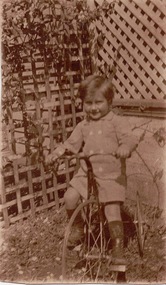
Photograph - Boy on a bike, 1930s
... Later she attended the art school established by the Melbourne 'tonalist' [Duncan] Max Meldrum (1875-1955). ...Later she attended the art school established by the Melbourne 'tonalist' [Duncan] Max Meldrum (1875-1955). ...The Melbourne artist Alma Agnes Marion Figuerola, the daughter of Juan Pedro Narciso Figuerola (1869-1919) and Alice Lucinda Walker Hanson (1889-1969) was born in Carlton in 1902. Alam and her two sisters grew up to be involved in the arts: Alma as a painter; Carmen Irene (1906-1993) as a short story writer, poet and teacher of dancing; and Sylvia (also Silvia) Lyla Alice (1911-1992) as a composer and cellist. The first art lessons Alma Figuerola received were with Oscar Binder. Later she attended the art school established by the Melbourne 'tonalist' [Duncan] Max Meldrum (1875-1955). She graduated from his school in 1920, participating in her first group exhibition in the same year. Solo exhibitions of her work were to be held in 1933 at the Meldrum Gallery in Elizabeth Street, in 1937 and 1945 at the Athenaeum Gallery at 188 Collins Street, and in 1951 at Georges Gallery in Collins Street. Throughout her extensive career she participated in group exhibitions, usually with artists of the Meldrum School, and as a member of the Twenty Melbourne Painters, of which she was invited to become an associate in 1935. In 1953, her portrait of Professor ES Hills was entered in the Archibald Prize Competition of the Art Gallery of New South Wales. A resident of Kew from the 1930s - at 'Mount Edgecombe' 51 Studley Park Road, often with her mother, her sister Carmen, or both - from 1939 until her death she lived at 'D’Estaville', 7 Barry Street. From the late 1930s she is recorded as actively contributing to the arts at a local level. In 1939 and 1940 she participated in art exhibitions at the Hawthorn Municipal Library organised by Jessie Carbines. From 1944 to 1951 she co-organised successive Kew Arts Festivals, initially in the Presbyterian Church Hall in Highbury Grove and later at the Recreation Hall in Wellington Street. A foundation member of the Kew Historical Society in 1958, Alma Figuerola remained an active member of the Society until her death on 8 December 1970. She predeceased her two sisters who both died in the 1990s and who are buried at Andersons' Creek Cemetery in Warrandyte.Undated photograph of a boy, possibly the Figuerola sisters' cousin 'Bert', astride a tricycle in a trellised yard. The photo is from the personal photo album of the artist. alma figuerola album, arists - kew (vic), artists - meldrum school, occupants - 7 barry street - kew (vic) -
 Kew Historical Society Inc
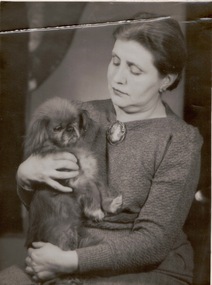
Photograph - Alma Figuerola and Rebecca, K Lerfiniere Ross
... Later she attended the art school established by the Melbourne 'tonalist' [Duncan] Max Meldrum (1875-1955). ...Later she attended the art school established by the Melbourne 'tonalist' [Duncan] Max Meldrum (1875-1955). ...The Melbourne artist Alma Agnes Marion Figuerola, was the daughter of Juan Pedro Narciso Figuerola (1869-1919) and Alice Lucinda Walker Hanson (1889-1969). Each of their three daughters grew up to be involved in the arts: Alma as a painter; Carmen Irene (1906-1993) as a short story writer, poet and teacher of dancing; and Sylvia (also Silvia) Lyla Alice (1911-1992) as a composer and cellist. The first art lessons Alma Figuerola received were with Oscar Binder. Later she attended the art school established by the Melbourne 'tonalist' [Duncan] Max Meldrum (1875-1955). She graduated from his school in 1920, participating in her first group exhibition in the same year. Solo exhibitions of her work were to be held in 1933 at the Meldrum Gallery in Elizabeth Street, in 1937 and 1945 at the Athenaeum Gallery at 188 Collins Street, and in 1951 at Georges Gallery in Collins Street. Throughout her extensive career she participated in group exhibitions, usually with artists of the Meldrum School, and as a member of the Twenty Melbourne Painters, of which she was invited to become an associate in 1935. In 1953, her portrait of Professor ES Hills was entered in the Archibald Prize Competition of the Art Gallery of New South Wales. A resident of Kew from the 1930s - 51 Studley Park Road, often with her mother, her sister Carmen, or both - from c.1942 until her death she lived at 'D’Estaville', 7 Barry Street. From the late 1930s she is recorded as actively contributing to the arts at a local level. In 1939 and 1940 she participated in art exhibitions at the Hawthorn Municipal Library organised by Jessie Carbines. From 1944 to 1951 she co-organised successive Kew Arts Festivals, initially in the Presbyterian Church Hall in Highbury Grove and later at the Recreation Hall in Wellington Street. A foundation member of the Kew Historical Society in 1958, Alma Figuerola remained an active member of the Society until her death on 8 December 1970. She predeceased her two sisters who both died in the 1990s and who are buried at Andersons' Creek Cemetery in Warrandyte.Professional photograph by K Lerfiniere Ross of the artist Alma Figuerola holding her pet pekingese dog, 'Rebecca'.alma figuerola album, arists - kew (vic), artists - meldrum school, occupants - 7 barry street - kew (vic) -
 Kew Historical Society Inc
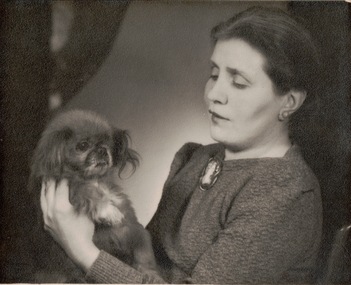
Photograph - Alma Figuerola, K Lerfiniere Ross, 1950-1965
... Later she attended the art school established by the Melbourne 'tonalist' [Duncan] Max Meldrum (1875-1955). ...Later she attended the art school established by the Melbourne 'tonalist' [Duncan] Max Meldrum (1875-1955). ...The Melbourne artist Alma Agnes Marion Figuerola, was the daughter of Juan Pedro Narciso Figuerola (1869-1919) and Alice Lucinda Walker Hanson (1889-1969). Each of their three daughters grew up to be involved in the arts: Alma as a painter; Carmen Irene (1906-1993) as a short story writer, poet and teacher of dancing; and Sylvia (also Silvia) Lyla Alice (1911-1992) as a composer and cellist. The first art lessons Alma Figuerola received were with Oscar Binder. Later she attended the art school established by the Melbourne 'tonalist' [Duncan] Max Meldrum (1875-1955). She graduated from his school in 1920, participating in her first group exhibition in the same year. Solo exhibitions of her work were to be held in 1933 at the Meldrum Gallery in Elizabeth Street, in 1937 and 1945 at the Athenaeum Gallery at 188 Collins Street, and in 1951 at Georges Gallery in Collins Street. Throughout her extensive career she participated in group exhibitions, usually with artists of the Meldrum School, and as a member of the Twenty Melbourne Painters, of which she was invited to become an associate in 1935. In 1953, her portrait of Professor ES Hills was entered in the Archibald Prize Competition of the Art Gallery of New South Wales. A resident of Kew from the 1930s - 51 Studley Park Road, often with her mother, her sister Carmen, or both - from c.1942 until her death she lived at 'D’Estaville', 7 Barry Street. From the late 1930s she is recorded as actively contributing to the arts at a local level. In 1939 and 1940 she participated in art exhibitions at the Hawthorn Municipal Library organised by Jessie Carbines. From 1944 to 1951 she co-organised successive Kew Arts Festivals, initially in the Presbyterian Church Hall in Highbury Grove and later at the Recreation Hall in Wellington Street. A foundation member of the Kew Historical Society in 1958, Alma Figuerola remained an active member of the Society until her death on 8 December 1970. She predeceased her two sisters who both died in the 1990s and who are buried at Andersons' Creek Cemetery in Warrandyte.Professional photograph by K Lerfiniere Ross of the artist Alma Figuerola holding her pet pekingese dog, 'Rebecca'. "Proof only. This proof remains the property of the photographer K Lerfiniere Ross and must be returned No 137-1"alma figuerola album, arists - kew (vic), artists - meldrum school, occupants - 7 barry street - kew (vic) -
 Kew Historical Society Inc
Photograph - Portrait, 1960s
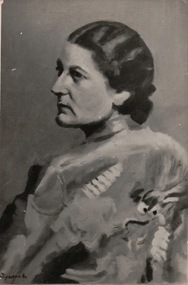
... Later she attended the art school established by the Melbourne 'tonalist' [Duncan] Max Meldrum (1875-1955). ...Later she attended the art school established by the Melbourne 'tonalist' [Duncan] Max Meldrum (1875-1955). ...The Melbourne artist Alma Agnes Marion Figuerola, was the daughter of Juan Pedro Narciso Figuerola (1869-1919) and Alice Lucinda Walker Hanson (1889-1969). Each of their three daughters grew up to be involved in the arts: Alma as a painter; Carmen Irene (1906-1993) as a short story writer, poet and teacher of dancing; and Sylvia (also Silvia) Lyla Alice (1911-1992) as a composer and cellist. The first art lessons Alma Figuerola received were with Oscar Binder. Later she attended the art school established by the Melbourne 'tonalist' [Duncan] Max Meldrum (1875-1955). She graduated from his school in 1920, participating in her first group exhibition in the same year. Solo exhibitions of her work were to be held in 1933 at the Meldrum Gallery in Elizabeth Street, in 1937 and 1945 at the Athenaeum Gallery at 188 Collins Street, and in 1951 at Georges Gallery in Collins Street. Throughout her extensive career she participated in group exhibitions, usually with artists of the Meldrum School, and as a member of the Twenty Melbourne Painters, of which she was invited to become an associate in 1935. In 1953, her portrait of Professor ES Hills was entered in the Archibald Prize Competition of the Art Gallery of New South Wales. A resident of Kew from the 1930s - 51 Studley Park Road, often with her mother, her sister Carmen, or both - from c.1942 until her death she lived at 'D’Estaville', 7 Barry Street. From the late 1930s she is recorded as actively contributing to the arts at a local level. In 1939 and 1940 she participated in art exhibitions at the Hawthorn Municipal Library organised by Jessie Carbines. From 1944 to 1951 she co-organised successive Kew Arts Festivals, initially in the Presbyterian Church Hall in Highbury Grove and later at the Recreation Hall in Wellington Street. A foundation member of the Kew Historical Society in 1958, Alma Figuerola remained an active member of the Society until her death on 8 December 1970. She predeceased her two sisters who both died in the 1990s and who are buried at Andersons' Creek Cemetery in Warrandyte.Photograph of an oil painting of a woman which may be of Alma Figuerola. The photo was in the personal photo album of the artist. alma figuerola album, arists - kew (vic), artists - meldrum school, occupants - 7 barry street - kew (vic) -
 Kew Historical Society Inc
Photograph - Alma Figuerola, 1940s
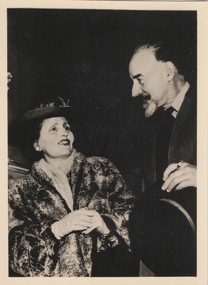
... Later she attended the art school established by the Melbourne 'tonalist' [Duncan] Max Meldrum (1875-1955). ...Later she attended the art school established by the Melbourne 'tonalist' [Duncan] Max Meldrum (1875-1955). ...The Melbourne artist Alma Agnes Marion Figuerola, was the daughter of Juan Pedro Narciso Figuerola (1869-1919) and Alice Lucinda Walker Hanson (1889-1969). Each of their three daughters grew up to be involved in the arts: Alma as a painter; Carmen Irene (1906-1993) as a short story writer, poet and teacher of dancing; and Sylvia (also Silvia) Lyla Alice (1911-1992) as a composer and cellist. The first art lessons Alma Figuerola received were with Oscar Binder. Later she attended the art school established by the Melbourne 'tonalist' [Duncan] Max Meldrum (1875-1955). She graduated from his school in 1920, participating in her first group exhibition in the same year. Solo exhibitions of her work were to be held in 1933 at the Meldrum Gallery in Elizabeth Street, in 1937 and 1945 at the Athenaeum Gallery at 188 Collins Street, and in 1951 at Georges Gallery in Collins Street. Throughout her extensive career she participated in group exhibitions, usually with artists of the Meldrum School, and as a member of the Twenty Melbourne Painters, of which she was invited to become an associate in 1935. In 1953, her portrait of Professor ES Hills was entered in the Archibald Prize Competition of the Art Gallery of New South Wales. A resident of Kew from the 1930s - 51 Studley Park Road, often with her mother, her sister Carmen, or both - from c.1942 until her death she lived at 'D’Estaville', 7 Barry Street. From the late 1930s she is recorded as actively contributing to the arts at a local level. In 1939 and 1940 she participated in art exhibitions at the Hawthorn Municipal Library organised by Jessie Carbines. From 1944 to 1951 she co-organised successive Kew Arts Festivals, initially in the Presbyterian Church Hall in Highbury Grove and later at the Recreation Hall in Wellington Street. A foundation member of the Kew Historical Society in 1958, Alma Figuerola remained an active member of the Society until her death on 8 December 1970. She predeceased her two sisters who both died in the 1990s and who are buried at Andersons' Creek Cemetery in Warrandyte.Cropped photo shot of Alma Figuerola at an art exhibition. The photo was in her personal photo album. alma figuerola album, arists - kew (vic), artists - meldrum school, occupants - 7 barry street - kew (vic) -
 Kew Historical Society Inc
Photograph - Rebecca and Alma Figuerola, 1950
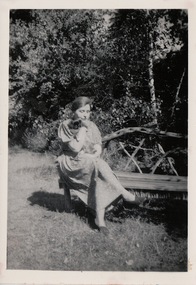
... Later she attended the art school established by the Melbourne 'tonalist' [Duncan] Max Meldrum (1875-1955). ...Later she attended the art school established by the Melbourne 'tonalist' [Duncan] Max Meldrum (1875-1955). ...The Melbourne artist Alma Agnes Marion Figuerola, was the daughter of Juan Pedro Narciso Figuerola (1869-1919) and Alice Lucinda Walker Hanson (1889-1969). Each of their three daughters grew up to be involved in the arts: Alma as a painter; Carmen Irene (1906-1993) as a short story writer, poet and teacher of dancing; and Sylvia (also Silvia) Lyla Alice (1911-1992) as a composer and cellist. The first art lessons Alma Figuerola received were with Oscar Binder. Later she attended the art school established by the Melbourne 'tonalist' [Duncan] Max Meldrum (1875-1955). She graduated from his school in 1920, participating in her first group exhibition in the same year. Solo exhibitions of her work were to be held in 1933 at the Meldrum Gallery in Elizabeth Street, in 1937 and 1945 at the Athenaeum Gallery at 188 Collins Street, and in 1951 at Georges Gallery in Collins Street. Throughout her extensive career she participated in group exhibitions, usually with artists of the Meldrum School, and as a member of the Twenty Melbourne Painters, of which she was invited to become an associate in 1935. In 1953, her portrait of Professor ES Hills was entered in the Archibald Prize Competition of the Art Gallery of New South Wales. A resident of Kew from the 1930s - 51 Studley Park Road, often with her mother, her sister Carmen, or both - from c.1942 until her death she lived at 'D’Estaville', 7 Barry Street. From the late 1930s she is recorded as actively contributing to the arts at a local level. In 1939 and 1940 she participated in art exhibitions at the Hawthorn Municipal Library organised by Jessie Carbines. From 1944 to 1951 she co-organised successive Kew Arts Festivals, initially in the Presbyterian Church Hall in Highbury Grove and later at the Recreation Hall in Wellington Street. A foundation member of the Kew Historical Society in 1958, Alma Figuerola remained an active member of the Society until her death on 8 December 1970. She predeceased her two sisters who both died in the 1990s and who are buried at Andersons' Creek Cemetery in Warrandyte.Alma Figuerola, sitting on a rustic seat in what is probably her garden at her home D'Estaville, in 1950. She is nursing her pet pekingese 'Rebecca'. The photo was included in her personal photo album. "Rebecca and Alma, 1950"alma figuerola album, arists - kew (vic), artists - meldrum school, occupants - 7 barry street - kew (vic) -
 Kew Historical Society Inc
Photograph, Rebecca and Alma, 1950
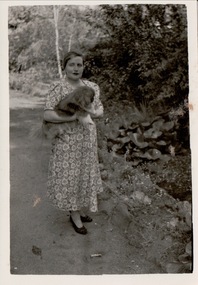
... Later she attended the art school established by the Melbourne 'tonalist' [Duncan] Max Meldrum (1875-1955). ...Later she attended the art school established by the Melbourne 'tonalist' [Duncan] Max Meldrum (1875-1955). ...The Melbourne artist Alma Agnes Marion Figuerola, was the daughter of Juan Pedro Narciso Figuerola (1869-1919) and Alice Lucinda Walker Hanson (1889-1969). Each of their three daughters grew up to be involved in the arts: Alma as a painter; Carmen Irene (1906-1993) as a short story writer, poet and teacher of dancing; and Sylvia (also Silvia) Lyla Alice (1911-1992) as a composer and cellist. The first art lessons Alma Figuerola received were with Oscar Binder. Later she attended the art school established by the Melbourne 'tonalist' [Duncan] Max Meldrum (1875-1955). She graduated from his school in 1920, participating in her first group exhibition in the same year. Solo exhibitions of her work were to be held in 1933 at the Meldrum Gallery in Elizabeth Street, in 1937 and 1945 at the Athenaeum Gallery at 188 Collins Street, and in 1951 at Georges Gallery in Collins Street. Throughout her extensive career she participated in group exhibitions, usually with artists of the Meldrum School, and as a member of the Twenty Melbourne Painters, of which she was invited to become an associate in 1935. In 1953, her portrait of Professor ES Hills was entered in the Archibald Prize Competition of the Art Gallery of New South Wales. A resident of Kew from the 1930s - 51 Studley Park Road, often with her mother, her sister Carmen, or both - from c.1942 until her death she lived at 'D’Estaville', 7 Barry Street. From the late 1930s she is recorded as actively contributing to the arts at a local level. In 1939 and 1940 she participated in art exhibitions at the Hawthorn Municipal Library organised by Jessie Carbines. From 1944 to 1951 she co-organised successive Kew Arts Festivals, initially in the Presbyterian Church Hall in Highbury Grove and later at the Recreation Hall in Wellington Street. A foundation member of the Kew Historical Society in 1958, Alma Figuerola remained an active member of the Society until her death on 8 December 1970. She predeceased her two sisters who both died in the 1990s and who are buried at Andersons' Creek Cemetery in Warrandyte.Alma Figuerola in the garden of what is probably her home D'Estaville, with her pet pekingese 'Rebecca'. The photo is from her personal photo album. alma figuerola album, arists - kew (vic), artists - meldrum school, occupants - 7 barry street - kew (vic) -
 Kew Historical Society Inc
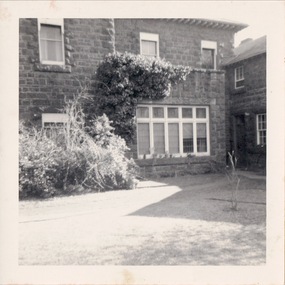
Photograph, 'D'Estaville', 7 Barry Street, c.1950
... Later she attended the art school established by the Melbourne 'tonalist' [Duncan] Max Meldrum (1875-1955). ...Later she attended the art school established by the Melbourne 'tonalist' [Duncan] Max Meldrum (1875-1955). ...The Melbourne artist Alma Agnes Marion Figuerola, was the daughter of Juan Pedro Narciso Figuerola (1869-1919) and Alice Lucinda Walker Hanson (1889-1969). Each of their three daughters grew up to be involved in the arts: Alma as a painter; Carmen Irene (1906-1993) as a short story writer, poet and teacher of dancing; and Sylvia (also Silvia) Lyla Alice (1911-1992) as a composer and cellist. The first art lessons Alma Figuerola received were with Oscar Binder. Later she attended the art school established by the Melbourne 'tonalist' [Duncan] Max Meldrum (1875-1955). She graduated from his school in 1920, participating in her first group exhibition in the same year. Solo exhibitions of her work were to be held in 1933 at the Meldrum Gallery in Elizabeth Street, in 1937 and 1945 at the Athenaeum Gallery at 188 Collins Street, and in 1951 at Georges Gallery in Collins Street. Throughout her extensive career she participated in group exhibitions, usually with artists of the Meldrum School, and as a member of the Twenty Melbourne Painters, of which she was invited to become an associate in 1935. In 1953, her portrait of Professor ES Hills was entered in the Archibald Prize Competition of the Art Gallery of New South Wales. A resident of Kew from the 1930s - 51 Studley Park Road, often with her mother, her sister Carmen, or both - from c.1942 until her death she lived at 'D’Estaville', 7 Barry Street. From the late 1930s she is recorded as actively contributing to the arts at a local level. In 1939 and 1940 she participated in art exhibitions at the Hawthorn Municipal Library organised by Jessie Carbines. From 1944 to 1951 she co-organised successive Kew Arts Festivals, initially in the Presbyterian Church Hall in Highbury Grove and later at the Recreation Hall in Wellington Street. A foundation member of the Kew Historical Society in 1958, Alma Figuerola remained an active member of the Society until her death on 8 December 1970. She predeceased her two sisters who both died in the 1990s and who are buried at Andersons' Creek Cemetery in Warrandyte.The east side of D'Estaville (built for Sir William Stawell). It was the home of the Figuerola sisters from the 1940s to the 1990s. The large ground floor room at centre was used by the artist as her studio. The photograph is from the Alma Figuerola photo album. alma figuerola album, arists - kew (vic), artists - meldrum school, occupants - 7 barry street - kew (vic) -
 Kew Historical Society Inc
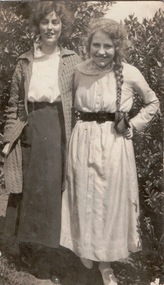
Photograph, The Figuerola Sisters, 1918-1925
... Later she attended the art school established by the Melbourne 'tonalist' [Duncan] Max Meldrum (1875-1955). ...Later she attended the art school established by the Melbourne 'tonalist' [Duncan] Max Meldrum (1875-1955). ...The Melbourne artist Alma Agnes Marion Figuerola, was the daughter of Juan Pedro Narciso Figuerola (1869-1919) and Alice Lucinda Walker Hanson (1889-1969). Each of their three daughters grew up to be involved in the arts: Alma as a painter; Carmen Irene (1906-1993) as a short story writer, poet and teacher of dancing; and Sylvia (also Silvia) Lyla Alice (1911-1992) as a composer and cellist. The first art lessons Alma Figuerola received were with Oscar Binder. Later she attended the art school established by the Melbourne 'tonalist' [Duncan] Max Meldrum (1875-1955). She graduated from his school in 1920, participating in her first group exhibition in the same year. Solo exhibitions of her work were to be held in 1933 at the Meldrum Gallery in Elizabeth Street, in 1937 and 1945 at the Athenaeum Gallery at 188 Collins Street, and in 1951 at Georges Gallery in Collins Street. Throughout her extensive career she participated in group exhibitions, usually with artists of the Meldrum School, and as a member of the Twenty Melbourne Painters, of which she was invited to become an associate in 1935. In 1953, her portrait of Professor ES Hills was entered in the Archibald Prize Competition of the Art Gallery of New South Wales. A resident of Kew from the 1930s - 51 Studley Park Road, often with her mother, her sister Carmen, or both - from c.1942 until her death she lived at 'D’Estaville', 7 Barry Street. From the late 1930s she is recorded as actively contributing to the arts at a local level. In 1939 and 1940 she participated in art exhibitions at the Hawthorn Municipal Library organised by Jessie Carbines. From 1944 to 1951 she co-organised successive Kew Arts Festivals, initially in the Presbyterian Church Hall in Highbury Grove and later at the Recreation Hall in Wellington Street. A foundation member of the Kew Historical Society in 1958, Alma Figuerola remained an active member of the Society until her death on 8 December 1970. She predeceased her two sisters who both died in the 1990s and who are buried at Andersons' Creek Cemetery in Warrandyte.Undated and unidentified photograph of two young women, who were probably two of the Figuerola sisters. The photograph is the Alma Figuerola photo album. alma figuerola album, arists - kew (vic), artists - meldrum school, occupants - 7 barry street - kew (vic) -
 Kew Historical Society Inc
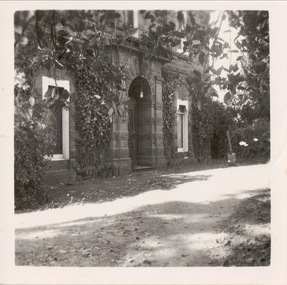
Photograph, Portico, D'Estaville, 7 Barry Street, 1050-1960
... Later she attended the art school established by the Melbourne 'tonalist' [Duncan] Max Meldrum (1875-1955). ...Later she attended the art school established by the Melbourne 'tonalist' [Duncan] Max Meldrum (1875-1955). ...The Melbourne artist Alma Agnes Marion Figuerola, was the daughter of Juan Pedro Narciso Figuerola (1869-1919) and Alice Lucinda Walker Hanson (1889-1969). Each of their three daughters grew up to be involved in the arts: Alma as a painter; Carmen Irene (1906-1993) as a short story writer, poet and teacher of dancing; and Sylvia (also Silvia) Lyla Alice (1911-1992) as a composer and cellist. The first art lessons Alma Figuerola received were with Oscar Binder. Later she attended the art school established by the Melbourne 'tonalist' [Duncan] Max Meldrum (1875-1955). She graduated from his school in 1920, participating in her first group exhibition in the same year. Solo exhibitions of her work were to be held in 1933 at the Meldrum Gallery in Elizabeth Street, in 1937 and 1945 at the Athenaeum Gallery at 188 Collins Street, and in 1951 at Georges Gallery in Collins Street. Throughout her extensive career she participated in group exhibitions, usually with artists of the Meldrum School, and as a member of the Twenty Melbourne Painters, of which she was invited to become an associate in 1935. In 1953, her portrait of Professor ES Hills was entered in the Archibald Prize Competition of the Art Gallery of New South Wales. A resident of Kew from the 1930s - 51 Studley Park Road, often with her mother, her sister Carmen, or both - from c.1942 until her death she lived at 'D’Estaville', 7 Barry Street. From the late 1930s she is recorded as actively contributing to the arts at a local level. In 1939 and 1940 she participated in art exhibitions at the Hawthorn Municipal Library organised by Jessie Carbines. From 1944 to 1951 she co-organised successive Kew Arts Festivals, initially in the Presbyterian Church Hall in Highbury Grove and later at the Recreation Hall in Wellington Street. A foundation member of the Kew Historical Society in 1958, Alma Figuerola remained an active member of the Society until her death on 8 December 1970. She predeceased her two sisters who both died in the 1990s and who are buried at Andersons' Creek Cemetery in Warrandyte.View of the entrance to D'Estaville on the south side of the house. D'Estaville, built for Sir William Stawell, was the home of the Figuerola sisters from the 1940s to the 1990s. The photograph is from the Alma Figuerola photograph album. alma figuerola album, arists - kew (vic), artists - meldrum school, occupants - 7 barry street - kew (vic) -
 Kew Historical Society Inc
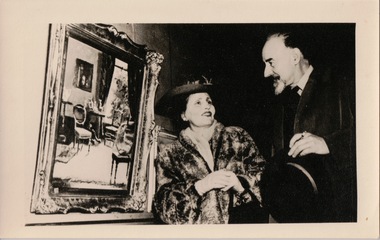
Photograph, Alma Figuerola and Max Meldrum, 1940s
... Later she attended the art school established by the Melbourne 'tonalist' [Duncan] Max Meldrum (1875-1955). ...Later she attended the art school established by the Melbourne 'tonalist' [Duncan] Max Meldrum (1875-1955). ...The Melbourne artist Alma Agnes Marion Figuerola, was the daughter of Juan Pedro Narciso Figuerola (1869-1919) and Alice Lucinda Walker Hanson (1889-1969). Each of their three daughters grew up to be involved in the arts: Alma as a painter; Carmen Irene (1906-1993) as a short story writer, poet and teacher of dancing; and Sylvia (also Silvia) Lyla Alice (1911-1992) as a composer and cellist. The first art lessons Alma Figuerola received were with Oscar Binder. Later she attended the art school established by the Melbourne 'tonalist' [Duncan] Max Meldrum (1875-1955). She graduated from his school in 1920, participating in her first group exhibition in the same year. Solo exhibitions of her work were to be held in 1933 at the Meldrum Gallery in Elizabeth Street, in 1937 and 1945 at the Athenaeum Gallery at 188 Collins Street, and in 1951 at Georges Gallery in Collins Street. Throughout her extensive career she participated in group exhibitions, usually with artists of the Meldrum School, and as a member of the Twenty Melbourne Painters, of which she was invited to become an associate in 1935. In 1953, her portrait of Professor ES Hills was entered in the Archibald Prize Competition of the Art Gallery of New South Wales. A resident of Kew from the 1930s - 51 Studley Park Road, often with her mother, her sister Carmen, or both - from c.1942 until her death she lived at 'D’Estaville', 7 Barry Street. From the late 1930s she is recorded as actively contributing to the arts at a local level. In 1939 and 1940 she participated in art exhibitions at the Hawthorn Municipal Library organised by Jessie Carbines. From 1944 to 1951 she co-organised successive Kew Arts Festivals, initially in the Presbyterian Church Hall in Highbury Grove and later at the Recreation Hall in Wellington Street. A foundation member of the Kew Historical Society in 1958, Alma Figuerola remained an active member of the Society until her death on 8 December 1970. She predeceased her two sisters who both died in the 1990s and who are buried at Andersons' Creek Cemetery in Warrandyte.Alma Figuerola and fellow artist John Farmer, admiring what may be Max Meldrum's painting 'Chair'. The photograph is from the Alma Figuerola photograph album. alma figuerola album, arists - kew (vic), artists - meldrum school, occupants - 7 barry street - kew (vic) -
 Kew Historical Society Inc
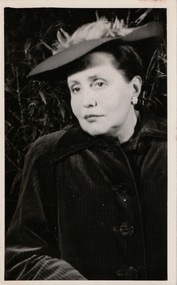
Photograph, Alma Figuerola, 1950-1959
... Later she attended the art school established by the Melbourne 'tonalist' [Duncan] Max Meldrum (1875-1955). ...Later she attended the art school established by the Melbourne 'tonalist' [Duncan] Max Meldrum (1875-1955). ...The Melbourne artist Alma Agnes Marion Figuerola, was the daughter of Juan Pedro Narciso Figuerola (1869-1919) and Alice Lucinda Walker Hanson (1889-1969). Each of their three daughters grew up to be involved in the arts: Alma as a painter; Carmen Irene (1906-1993) as a short story writer, poet and teacher of dancing; and Sylvia (also Silvia) Lyla Alice (1911-1992) as a composer and cellist. The first art lessons Alma Figuerola received were with Oscar Binder. Later she attended the art school established by the Melbourne 'tonalist' [Duncan] Max Meldrum (1875-1955). She graduated from his school in 1920, participating in her first group exhibition in the same year. Solo exhibitions of her work were to be held in 1933 at the Meldrum Gallery in Elizabeth Street, in 1937 and 1945 at the Athenaeum Gallery at 188 Collins Street, and in 1951 at Georges Gallery in Collins Street. Throughout her extensive career she participated in group exhibitions, usually with artists of the Meldrum School, and as a member of the Twenty Melbourne Painters, of which she was invited to become an associate in 1935. In 1953, her portrait of Professor ES Hills was entered in the Archibald Prize Competition of the Art Gallery of New South Wales. A resident of Kew from the 1930s - 51 Studley Park Road, often with her mother, her sister Carmen, or both - from c.1942 until her death she lived at 'D’Estaville', 7 Barry Street. From the late 1930s she is recorded as actively contributing to the arts at a local level. In 1939 and 1940 she participated in art exhibitions at the Hawthorn Municipal Library organised by Jessie Carbines. From 1944 to 1951 she co-organised successive Kew Arts Festivals, initially in the Presbyterian Church Hall in Highbury Grove and later at the Recreation Hall in Wellington Street. A foundation member of the Kew Historical Society in 1958, Alma Figuerola remained an active member of the Society until her death on 8 December 1970. She predeceased her two sisters who both died in the 1990s and who are buried at Andersons' Creek Cemetery in Warrandyte.Undated photograph of the artist Alma Figuerola from her photograph album. The photograph is one of a number taken from the same photograph in different sizes.alma figuerola album, arists - kew (vic), artists - meldrum school, occupants - 7 barry street - kew (vic) -
 Kew Historical Society Inc
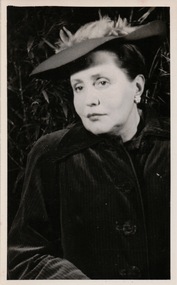
Photograph, Alma Figuerola, 1950-1959
... Later she attended the art school established by the Melbourne 'tonalist' [Duncan] Max Meldrum (1875-1955). ...Later she attended the art school established by the Melbourne 'tonalist' [Duncan] Max Meldrum (1875-1955). ...The Melbourne artist Alma Agnes Marion Figuerola, was the daughter of Juan Pedro Narciso Figuerola (1869-1919) and Alice Lucinda Walker Hanson (1889-1969). Each of their three daughters grew up to be involved in the arts: Alma as a painter; Carmen Irene (1906-1993) as a short story writer, poet and teacher of dancing; and Sylvia (also Silvia) Lyla Alice (1911-1992) as a composer and cellist. The first art lessons Alma Figuerola received were with Oscar Binder. Later she attended the art school established by the Melbourne 'tonalist' [Duncan] Max Meldrum (1875-1955). She graduated from his school in 1920, participating in her first group exhibition in the same year. Solo exhibitions of her work were to be held in 1933 at the Meldrum Gallery in Elizabeth Street, in 1937 and 1945 at the Athenaeum Gallery at 188 Collins Street, and in 1951 at Georges Gallery in Collins Street. Throughout her extensive career she participated in group exhibitions, usually with artists of the Meldrum School, and as a member of the Twenty Melbourne Painters, of which she was invited to become an associate in 1935. In 1953, her portrait of Professor ES Hills was entered in the Archibald Prize Competition of the Art Gallery of New South Wales. A resident of Kew from the 1930s - 51 Studley Park Road, often with her mother, her sister Carmen, or both - from c.1942 until her death she lived at 'D’Estaville', 7 Barry Street. From the late 1930s she is recorded as actively contributing to the arts at a local level. In 1939 and 1940 she participated in art exhibitions at the Hawthorn Municipal Library organised by Jessie Carbines. From 1944 to 1951 she co-organised successive Kew Arts Festivals, initially in the Presbyterian Church Hall in Highbury Grove and later at the Recreation Hall in Wellington Street. A foundation member of the Kew Historical Society in 1958, Alma Figuerola remained an active member of the Society until her death on 8 December 1970. She predeceased her two sisters who both died in the 1990s and who are buried at Andersons' Creek Cemetery in Warrandyte.Undated photograph of the artist Alma Figuerola from her photograph album. The photograph is one of a number taken from the same photograph in different sizes.alma figuerola album, arists - kew (vic), artists - meldrum school, occupants - 7 barry street - kew (vic) -
 Kew Historical Society Inc
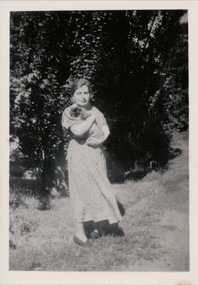
Photograph, Alma and Rebecca, 1950
... Later she attended the art school established by the Melbourne 'tonalist' [Duncan] Max Meldrum (1875-1955). ...Later she attended the art school established by the Melbourne 'tonalist' [Duncan] Max Meldrum (1875-1955). ...The Melbourne artist Alma Agnes Marion Figuerola, was the daughter of Juan Pedro Narciso Figuerola (1869-1919) and Alice Lucinda Walker Hanson (1889-1969). Each of their three daughters grew up to be involved in the arts: Alma as a painter; Carmen Irene (1906-1993) as a short story writer, poet and teacher of dancing; and Sylvia (also Silvia) Lyla Alice (1911-1992) as a composer and cellist. The first art lessons Alma Figuerola received were with Oscar Binder. Later she attended the art school established by the Melbourne 'tonalist' [Duncan] Max Meldrum (1875-1955). She graduated from his school in 1920, participating in her first group exhibition in the same year. Solo exhibitions of her work were to be held in 1933 at the Meldrum Gallery in Elizabeth Street, in 1937 and 1945 at the Athenaeum Gallery at 188 Collins Street, and in 1951 at Georges Gallery in Collins Street. Throughout her extensive career she participated in group exhibitions, usually with artists of the Meldrum School, and as a member of the Twenty Melbourne Painters, of which she was invited to become an associate in 1935. In 1953, her portrait of Professor ES Hills was entered in the Archibald Prize Competition of the Art Gallery of New South Wales. A resident of Kew from the 1930s - 51 Studley Park Road, often with her mother, her sister Carmen, or both - from c.1942 until her death she lived at 'D’Estaville', 7 Barry Street. From the late 1930s she is recorded as actively contributing to the arts at a local level. In 1939 and 1940 she participated in art exhibitions at the Hawthorn Municipal Library organised by Jessie Carbines. From 1944 to 1951 she co-organised successive Kew Arts Festivals, initially in the Presbyterian Church Hall in Highbury Grove and later at the Recreation Hall in Wellington Street. A foundation member of the Kew Historical Society in 1958, Alma Figuerola remained an active member of the Society until her death on 8 December 1970. She predeceased her two sisters who both died in the 1990s and who are buried at Andersons' Creek Cemetery in Warrandyte.Alma Figuerola and her pet pekingese dog 'Rebecca', circa 1950.alma figuerola album, arists - kew (vic), artists - meldrum school, occupants - 7 barry street - kew (vic) -
 Kew Historical Society Inc
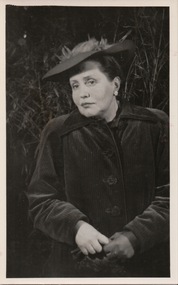
Photograph, Alma Figuerola, c.1950
... Later she attended the art school established by the Melbourne 'tonalist' [Duncan] Max Meldrum (1875-1955). ...Later she attended the art school established by the Melbourne 'tonalist' [Duncan] Max Meldrum (1875-1955). ...The Melbourne artist Alma Agnes Marion Figuerola, was the daughter of Juan Pedro Narciso Figuerola (1869-1919) and Alice Lucinda Walker Hanson (1889-1969). Each of their three daughters grew up to be involved in the arts: Alma as a painter; Carmen Irene (1906-1993) as a short story writer, poet and teacher of dancing; and Sylvia (also Silvia) Lyla Alice (1911-1992) as a composer and cellist. The first art lessons Alma Figuerola received were with Oscar Binder. Later she attended the art school established by the Melbourne 'tonalist' [Duncan] Max Meldrum (1875-1955). She graduated from his school in 1920, participating in her first group exhibition in the same year. Solo exhibitions of her work were to be held in 1933 at the Meldrum Gallery in Elizabeth Street, in 1937 and 1945 at the Athenaeum Gallery at 188 Collins Street, and in 1951 at Georges Gallery in Collins Street. Throughout her extensive career she participated in group exhibitions, usually with artists of the Meldrum School, and as a member of the Twenty Melbourne Painters, of which she was invited to become an associate in 1935. In 1953, her portrait of Professor ES Hills was entered in the Archibald Prize Competition of the Art Gallery of New South Wales. A resident of Kew from the 1930s - 51 Studley Park Road, often with her mother, her sister Carmen, or both - from c.1942 until her death she lived at 'D’Estaville', 7 Barry Street. From the late 1930s she is recorded as actively contributing to the arts at a local level. In 1939 and 1940 she participated in art exhibitions at the Hawthorn Municipal Library organised by Jessie Carbines. From 1944 to 1951 she co-organised successive Kew Arts Festivals, initially in the Presbyterian Church Hall in Highbury Grove and later at the Recreation Hall in Wellington Street. A foundation member of the Kew Historical Society in 1958, Alma Figuerola remained an active member of the Society until her death on 8 December 1970. She predeceased her two sisters who both died in the 1990s and who are buried at Andersons' Creek Cemetery in Warrandyte.Undated portrait photograph of Alma Figuerola."KO91/7 / Alma Figuerola / coat sea green, hat *** cerise with pink feathers"alma figuerola album, arists - kew (vic), artists - meldrum school, occupants - 7 barry street - kew (vic) -
 Kew Historical Society Inc
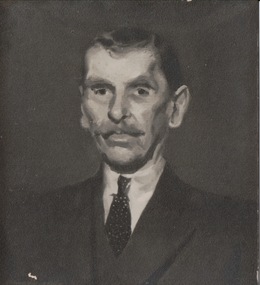
Photograph, Portrait of a Man, 1960s
... Later she attended the art school established by the Melbourne 'tonalist' [Duncan] Max Meldrum (1875-1955). ...Later she attended the art school established by the Melbourne 'tonalist' [Duncan] Max Meldrum (1875-1955). ...The Melbourne artist Alma Agnes Marion Figuerola, was the daughter of Juan Pedro Narciso Figuerola (1869-1919) and Alice Lucinda Walker Hanson (1889-1969). Each of their three daughters grew up to be involved in the arts: Alma as a painter; Carmen Irene (1906-1993) as a short story writer, poet and teacher of dancing; and Sylvia (also Silvia) Lyla Alice (1911-1992) as a composer and cellist. The first art lessons Alma Figuerola received were with Oscar Binder. Later she attended the art school established by the Melbourne 'tonalist' [Duncan] Max Meldrum (1875-1955). She graduated from his school in 1920, participating in her first group exhibition in the same year. Solo exhibitions of her work were to be held in 1933 at the Meldrum Gallery in Elizabeth Street, in 1937 and 1945 at the Athenaeum Gallery at 188 Collins Street, and in 1951 at Georges Gallery in Collins Street. Throughout her extensive career she participated in group exhibitions, usually with artists of the Meldrum School, and as a member of the Twenty Melbourne Painters, of which she was invited to become an associate in 1935. In 1953, her portrait of Professor ES Hills was entered in the Archibald Prize Competition of the Art Gallery of New South Wales. A resident of Kew from the 1930s - 51 Studley Park Road, often with her mother, her sister Carmen, or both - from c.1942 until her death she lived at 'D’Estaville', 7 Barry Street. From the late 1930s she is recorded as actively contributing to the arts at a local level. In 1939 and 1940 she participated in art exhibitions at the Hawthorn Municipal Library organised by Jessie Carbines. From 1944 to 1951 she co-organised successive Kew Arts Festivals, initially in the Presbyterian Church Hall in Highbury Grove and later at the Recreation Hall in Wellington Street. A foundation member of the Kew Historical Society in 1958, Alma Figuerola remained an active member of the Society until her death on 8 December 1970. She predeceased her two sisters who both died in the 1990s and who are buried at Andersons' Creek Cemetery in Warrandyte.Photograph of an oil painting of a man from the Alma Figuerola photograph album. alma figuerola album, arists - kew (vic), artists - meldrum school, occupants - 7 barry street - kew (vic) -
 Kew Historical Society Inc
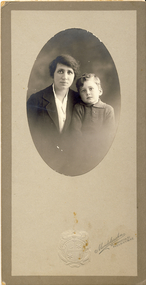
Photograph, Mendelssohn, Family Portrait : Mother and Son, c.1905
... Later she attended the art school established by the Melbourne 'tonalist' [Duncan] Max Meldrum (1875-1955). ...Later she attended the art school established by the Melbourne 'tonalist' [Duncan] Max Meldrum (1875-1955). ...The Melbourne artist Alma Agnes Marion Figuerola, was the daughter of Juan Pedro Narciso Figuerola (1869-1919) and Alice Lucinda Walker Hanson (1889-1969). Each of their three daughters grew up to be involved in the arts: Alma as a painter; Carmen Irene (1906-1993) as a short story writer, poet and teacher of dancing; and Sylvia (also Silvia) Lyla Alice (1911-1992) as a composer and cellist. The first art lessons Alma Figuerola received were with Oscar Binder. Later she attended the art school established by the Melbourne 'tonalist' [Duncan] Max Meldrum (1875-1955). She graduated from his school in 1920, participating in her first group exhibition in the same year. Solo exhibitions of her work were to be held in 1933 at the Meldrum Gallery in Elizabeth Street, in 1937 and 1945 at the Athenaeum Gallery at 188 Collins Street, and in 1951 at Georges Gallery in Collins Street. Throughout her extensive career she participated in group exhibitions, usually with artists of the Meldrum School, and as a member of the Twenty Melbourne Painters, of which she was invited to become an associate in 1935. In 1953, her portrait of Professor ES Hills was entered in the Archibald Prize Competition of the Art Gallery of New South Wales. A resident of Kew from the 1930s - 51 Studley Park Road, often with her mother, her sister Carmen, or both - from c.1942 until her death she lived at 'D’Estaville', 7 Barry Street. From the late 1930s she is recorded as actively contributing to the arts at a local level. In 1939 and 1940 she participated in art exhibitions at the Hawthorn Municipal Library organised by Jessie Carbines. From 1944 to 1951 she co-organised successive Kew Arts Festivals, initially in the Presbyterian Church Hall in Highbury Grove and later at the Recreation Hall in Wellington Street. A foundation member of the Kew Historical Society in 1958, Alma Figuerola remained an active member of the Society until her death on 8 December 1970. She predeceased her two sisters who both died in the 1990s and who are buried at Andersons' Creek Cemetery in Warrandyte.Photograph of an unidentified mother and son from the Alma Figuerola photograph album. alma figuerola album, mendelssohn - photographer -
 Kew Historical Society Inc
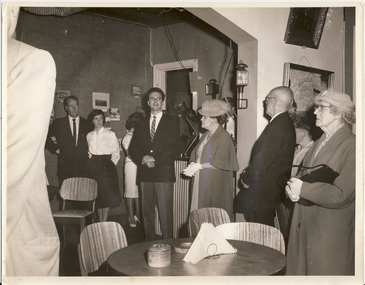
Photograph, Kew Historical Society, Historical Exhibition, Kew, 1964-1965
... Later she attended the art school established by the Melbourne 'tonalist' [Duncan] Max Meldrum (1875-1955). ...Later she attended the art school established by the Melbourne 'tonalist' [Duncan] Max Meldrum (1875-1955). ...The Melbourne artist Alma Agnes Marion Figuerola, was the daughter of Juan Pedro Narciso Figuerola (1869-1919) and Alice Lucinda Walker Hanson (1889-1969). Each of their three daughters grew up to be involved in the arts: Alma as a painter; Carmen Irene (1906-1993) as a short story writer, poet and teacher of dancing; and Sylvia (also Silvia) Lyla Alice (1911-1992) as a composer and cellist. The first art lessons Alma Figuerola received were with Oscar Binder. Later she attended the art school established by the Melbourne 'tonalist' [Duncan] Max Meldrum (1875-1955). She graduated from his school in 1920, participating in her first group exhibition in the same year. Solo exhibitions of her work were to be held in 1933 at the Meldrum Gallery in Elizabeth Street, in 1937 and 1945 at the Athenaeum Gallery at 188 Collins Street, and in 1951 at Georges Gallery in Collins Street. Throughout her extensive career she participated in group exhibitions, usually with artists of the Meldrum School, and as a member of the Twenty Melbourne Painters, of which she was invited to become an associate in 1935. In 1953, her portrait of Professor ES Hills was entered in the Archibald Prize Competition of the Art Gallery of New South Wales. A resident of Kew from the 1930s - 51 Studley Park Road, often with her mother, her sister Carmen, or both - from c.1942 until her death she lived at 'D’Estaville', 7 Barry Street. From the late 1930s she is recorded as actively contributing to the arts at a local level. In 1939 and 1940 she participated in art exhibitions at the Hawthorn Municipal Library organised by Jessie Carbines. From 1944 to 1951 she co-organised successive Kew Arts Festivals, initially in the Presbyterian Church Hall in Highbury Grove and later at the Recreation Hall in Wellington Street. A foundation member of the Kew Historical Society in 1958, Alma Figuerola remained an active member of the Society until her death on 8 December 1970. She predeceased her two sisters who both died in the 1990s and who are buried at Andersons' Creek Cemetery in Warrandyte.An undated photograph, one of two copies, of WHS Dickinson and Alma Figuerola at the opening of an exhibition in Kew in 1964/5."Artists of Kew Exhibition. Founder of KHS Cr Dickinson in dark suit. Miss Alma Figuerola to his left."arists - kew (vic), exhibitions -- kew (vic.), gordon greer
