
Showing 7 items matching "mayor william beebe"
-
 City of Greater Bendigo - Civic Collection
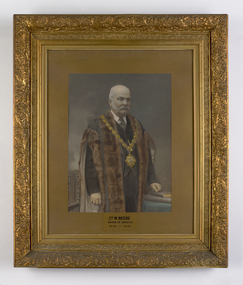
Photograph - Mayor Portrait Cr William Beebe (Jnr), Bartlett Bros, Cr W. Beebe, 1917
... Mayor Portrait Cr William Beebe (Jnr)...William Beebe served was elected to the Bendigo City Council in 1913, becoming Mayor twice. ...Three quarter standing portrait of Cr William Beebe in mayoral robes. Framed and mounted photograph with separate hand-inscribed title panel. ...Beebe Photograph Mayor Portrait Cr William Beebe (Jnr) Bartlett Bros ...William Beebe junior (1857-1920) was born in Bull Street Sandhurst. His father owned a stone and monument business in Mitchell Street and William commenced work with his father as a small boy. At age 19 William Snr took his into partnership and he continued to study architectural drawing at the School of Mines during this time. Beebe and Son designed and built several buildings during the 1880's to complement their main business which was stonemasonry. In 1892 Beebe decided to concentrate on his profession as an architect and was responsible for a large number of buildings and homes around Bendigo including the A.N.A Hall (now demolished), Fire Station on View Street (1898) and the Former Royal Bank at View Point (1908). Beebe employed a variation of the Arts and Crafts style popular in England and America from the 1870s and manifested in various forms including the Queen Anne revival style. William Beebe served was elected to the Bendigo City Council in 1913, becoming Mayor twice. He died of a heart attack while in office in 1920. Three quarter standing portrait of Cr William Beebe in mayoral robes. Framed and mounted photograph with separate hand-inscribed title panel. Ornamental frame with a gold window mount. Photograph has been hand coloured.Cr W Beebe / Mayor of Bendigo / 1915 - 16 -- 1916 - 17councilor beebe, mayor beebe -
 Bendigo Historical Society Inc.
Document - TALK BY GEOFF RUSSELL: 'FIXING BENDIGO'S BIG STINK'
... ... Mayor William Beebe...BENDIGO Utilities Bendigo Sewage Treatment Plant Bendigo Sewerage Sandhurst Municipal Council Mayor William Beebe night carts Bendigo Mayor Giudice Engineer S. ...Talk by Geoff Russell: 'Fixing Bendigo's Big Stink' - text of illustrated talk, 28/5/2005. Effluent and drainage problems of Bendigo in early days. Reference to the Bendigo Sewerage Authority (1917) and start of 15 year program to build reticulated sewerage system. Reference to Bendigo's second Royal Commission re investigating the affairs of the Bendigo Sewerage Authority (tendering; pricing; conditions at the works) and outcome of the enquiry. Extension of relevant history to 1992 (Coliban Region Water Authority). Mention of S Gordon Moore; A G Gutteridge; typhoid fever.Geoff Russellbendigo, utilities, bendigo sewage treatment plant, bendigo sewerage, sandhurst municipal council, mayor william beebe, night carts, bendigo mayor giudice, engineer s. gordon moore, cr curnow, bendigo creek. sewage treatment plant epsom. -
 City of Greater Bendigo - Civic Collection
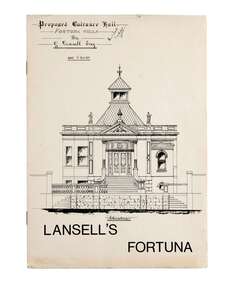
Booklet, Lansell's Fortuna, c 1980
... Mayor William Beebe...George Lansell was commonly known as 'Australia's Quartz-King' and director of thirty-eight mines with some link with almost every mine in Bendigo. Mayor William Beebe George Lansell A4 size tour booklet outlining the history, use and architectural features of Fortuna Villa which was purchased by George Lansell in 1860. ...Originally designed in 1857 and extended to the further designs by Bendigo Architects Vahland and Getzschmann, Emil Mauermann and William Beebe the original two story house expanded over time as Lansell's fortune increased and the subsequent mansion was built adjacent to the New Chum Reef and mine from which most of his wealth was yielded. Fortuna remained in the Lansell family for twenty nine years after George died and was sold by auction for demolition in 1934 only to be saved to become a reception house. In 1942 the Army acquired a lease for wartime mapping and occupied the site until 2008. It is now in private hands with the surrounding land being divided for housing. George Lansell was commonly known as 'Australia's Quartz-King' and director of thirty-eight mines with some link with almost every mine in Bendigo.A4 size tour booklet outlining the history, use and architectural features of Fortuna Villa which was purchased by George Lansell in 1860. mayor william beebe, george lansell -
 Bendigo Historical Society Inc.
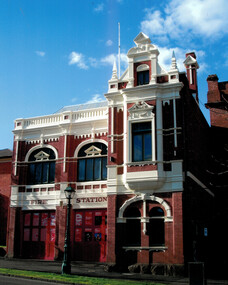
Document - National Trust Collection: Bendigo Fire Station View Street, 1960-1980s
... It was classified by the National Trust in June 1977 3084.44d National Trust of Victoria Data Survey Sheet and notes on the history of the Bendigo Fire Station, View Street, Bendigo 3084.44e This document is a 1977 media release from the National Trust of Australia (Victoria) announcing the classification of two historic buildings in Bendigo: Bendigo Fire Station (View Street)Designed by architect William Beebe in 1899.Features elaborate neo-classic rendered ornament.Former Butcher's Shop (Happy Valley Road & Wells Street) Front section dates from about 1872.Originally opened by Conrad Heinze (later Mayor of Bendigo) and his brothers.Weatherboard cottage with timber verandah and scrolled valance.Built in three stages, reflecting family growth. 3084.44f Letters re fittings in the former Bendigo Fire Station, View St Bendigo 1984...It was classified by the National Trust in June 1977 3084.44d National Trust of Victoria Data Survey Sheet and notes on the history of the Bendigo Fire Station, View Street, Bendigo 3084.44e This document is a 1977 media release from the National Trust of Australia (Victoria) announcing the classification of two historic buildings in Bendigo: Bendigo Fire Station (View Street)Designed by architect William Beebe in 1899.Features elaborate neo-classic rendered ornament.Former Butcher's Shop (Happy Valley Road & Wells Street) Front section dates from about 1872.Originally opened by Conrad Heinze (later Mayor of Bendigo) and his brothers.Weatherboard cottage with timber verandah and scrolled valance.Built in three stages, reflecting family growth. 3084.44f Letters re fittings in the former Bendigo Fire Station, View St Bendigo 1984 Document National Trust Collection: Bendigo Fire Station View Street ...In 1889 the three central fire brigades of Bendigo were amalgamated and a new fire station was erected in View Street (the third to be built on this site). This two storied brick building designed by Wm. Beebe forms an integral past of the View Street landscape. The red brick, white plaster relief trimmings and window frames with greenish lead-light decoration, all reflect the late Victorian style of the building. The ground floor contained an engine station and call room with stalls to accomodate three horses immediately behind. Upstairs in the main building is a handsome drill hall.Series of letters between Miss Starke and Miss Mathison re classification of the building by the National Trust; Letter to the Country Fire Authority (CFA) re classification; Media Release; National Trust data survey form; two photos of the fire station. This item contains the following six documents: 3084.44a Bendigo Fire Station View Street Bendigo Coloured Photo 3084.44b Bendigo Fire Station View Street black and white photo, street view, about 1960 3084.44c Letters related to the classification of the Bendigo Fire Station View Street Bendigo. It was classified by the National Trust in June 1977 3084.44d National Trust of Victoria Data Survey Sheet and notes on the history of the Bendigo Fire Station, View Street, Bendigo 3084.44e This document is a 1977 media release from the National Trust of Australia (Victoria) announcing the classification of two historic buildings in Bendigo: Bendigo Fire Station (View Street)Designed by architect William Beebe in 1899.Features elaborate neo-classic rendered ornament.Former Butcher's Shop (Happy Valley Road & Wells Street) Front section dates from about 1872.Originally opened by Conrad Heinze (later Mayor of Bendigo) and his brothers.Weatherboard cottage with timber verandah and scrolled valance.Built in three stages, reflecting family growth. 3084.44f Letters re fittings in the former Bendigo Fire Station, View St Bendigo 1984history, national trust bendigo collection, bendigo, bendigo fire station -
 Bendigo Historical Society Inc.
Document - Rocky Vale Beebe House, 2010 to 2015
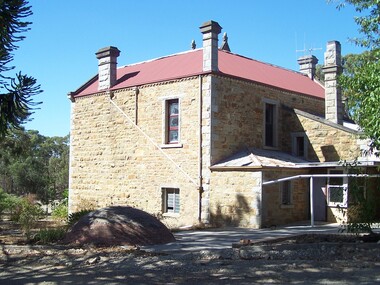
... The article is derived from a research project designed to establish a better understanding of the nature of professional architectural activity in the State of Victoria, Australia, in the second half of the 19th century. 8677v Official Rocky Vale Villa Significant Assessment by City of Greater Bendigo, Heritage Policy Citations Project Lovell Chen, 2010. 8677w Rocky Vale Villa Significance Assessment 8677x William Beebe Death Notice 8677y The Beebes of Bendigo Family History Notes (Contact the BHS for details) 8677z Newspaper Article Bendigo Advertiser 14 April 1900 - Bon Voyage to Mr Beebe 8677aa Death Notices 1891 of Mr W Beebe 8677bb Election Announcement The Argus 18 Mar 1913 8677cc Mr Beebe Newspaper mention of Influenza - The Bendigo Independant 18 Oct 1899 8677dd Historical Notes for Bendigo Advertiser on Bendigo by Carol Holdsworth (Contact the BHS for Details) 8677ee Mayoral Elections - The Bendigonian 2nd Sept 1915 8677ff The names of the Bendigo Cemetery 8677gg William Vahland and John Beebe 1904 Notes 8677hh City of Greater Bendigo, heritage Policy Citations Project Name Rocky Vale Villa Reference in 1998 study...The article is derived from a research project designed to establish a better understanding of the nature of professional architectural activity in the State of Victoria, Australia, in the second half of the 19th century. 8677v Official Rocky Vale Villa Significant Assessment by City of Greater Bendigo, Heritage Policy Citations Project Lovell Chen, 2010. 8677w Rocky Vale Villa Significance Assessment 8677x William Beebe Death Notice 8677y The Beebes of Bendigo Family History Notes (Contact the BHS for details) 8677z Newspaper Article Bendigo Advertiser 14 April 1900 - Bon Voyage to Mr Beebe 8677aa Death Notices 1891 of Mr W Beebe 8677bb Election Announcement The Argus 18 Mar 1913 8677cc Mr Beebe Newspaper mention of Influenza - The Bendigo Independant 18 Oct 1899 8677dd Historical Notes for Bendigo Advertiser on Bendigo by Carol Holdsworth (Contact the BHS for Details) 8677ee Mayoral Elections - The Bendigonian 2nd Sept 1915 8677ff The names of the Bendigo Cemetery 8677gg William Vahland and John Beebe 1904 Notes 8677hh City of Greater Bendigo, heritage Policy Citations Project Name Rocky Vale Villa Reference in 1998 study Document Rocky Vale Beebe House ...The Beebe name was well-known in Bendigo in the last quarter of the 19th and the early part of the 20th centuries. From 1875, William Beebe senior, monumental mason, occupied a site in the centre on the city, in Mitchell Street opposite King Street. Death was more part of life in those days, and the Beebes were there to provide the burial monuments. Later, he took his sons into the business, which grew as Beebe and Son. Many examples of their work can be found in the local cemeteries. William Beebe senior (1830-1891) was born in Rutland, the smallest English county in 1830, to stonemason Chamberlain Beebe and Susannah Clements. William emigrated to Victoria in 1854 and after engaging on unknown works in Port Fairy, Dunkeld, and Melbourne arrived in Bendigo. His obituary records that he commenced work here on the site of the Bank of Australasia (opposite the Shamrock Hotel), which would have been no later than 1856. He took up a 13 acre selection on the site of Rocky Vale Villa in 1864 and continued to select or purchase further parcels of adjoining land until he owned some 150 acres, much of it unfit for cultivation. He was a keen gardener and had a garden and orchard around the house. William took over 20 years to build the two-story sandstone and granite house "Rocky Vale Villa". The house was constructed from sandstone sourced "from an adjacent ridge of rocks" (Bendigo Advertiser 28/9/1891). Granite from Harcourt was used for lintels and quoins. Not long before he died, William was still adding to the house. In the Codicil to his will, he states that "I have just built and completed two additional rooms to my Dwelling house situe at Inglewood Road aforesaid" (dated 19/9/1891). William died one week later on the 26th September 1891.Photographs and Historical Documents relating to Rocky Vale Villa, 7 Wicks Road, Maiden Gully, Bendigo by the Bendigo Historical Society. This item contains the following 34 documents and photos: 8677a Colour Photo - Side and rear view of Rocky Vale 8677b Colour Photo - Side and rear view of Rocky Vale 8677c Colour Photo - Front view of Rocky Vale 8677d Colour Photo - Front view of Rocky Vale 8677e Colour Photo - Front view of Rocky Vale from a distance 8677f Colour photo of the doomed cover on the well 8677g Colour photo of shed and storage area 8677h Colour photo of shed and storage area 8677i Colour photo of a dam, a windmill, and possibly an old mining boiler 8677j Colour photo of and out-building (Shed, storage area) 8677k Colour photo of and out-building (Shed, storage area) 8677l Colour photo of and out-building (Shed, storage area) inside ceiling 8677m Black and white photo of the Villa and front garden - not long after building 8677n Black and white photo of a wedding group at the front of the house 8677o Black and white photo of the rear of the wedding photo showing names of people 8677p Colour photo of the inside showing damage around the top of a window and ceiling 8677q Colour photo of the inside showing damage around the ceiling plaster decoration 8677r Colour photo of the inside showing damage around the ceiling plaster decoration 8677s Colour photo of an outside window with a granite frame and the Stone walls 8677t Colour photo of an outside window with a granite frame and the Stone walls 8677u Architects Creating a Landscape by Ray Tonkin. The article is derived from a research project designed to establish a better understanding of the nature of professional architectural activity in the State of Victoria, Australia, in the second half of the 19th century. 8677v Official Rocky Vale Villa Significant Assessment by City of Greater Bendigo, Heritage Policy Citations Project Lovell Chen, 2010. 8677w Rocky Vale Villa Significance Assessment 8677x William Beebe Death Notice 8677y The Beebes of Bendigo Family History Notes (Contact the BHS for details) 8677z Newspaper Article Bendigo Advertiser 14 April 1900 - Bon Voyage to Mr Beebe 8677aa Death Notices 1891 of Mr W Beebe 8677bb Election Announcement The Argus 18 Mar 1913 8677cc Mr Beebe Newspaper mention of Influenza - The Bendigo Independant 18 Oct 1899 8677dd Historical Notes for Bendigo Advertiser on Bendigo by Carol Holdsworth (Contact the BHS for Details) 8677ee Mayoral Elections - The Bendigonian 2nd Sept 1915 8677ff The names of the Bendigo Cemetery 8677gg William Vahland and John Beebe 1904 Notes 8677hh City of Greater Bendigo, heritage Policy Citations Project Name Rocky Vale Villa Reference in 1998 studyhistory, bendigo, rocky vale villa maiden gully, william beebe stonemason bendigo -
 Bendigo Historical Society Inc.
Photograph - Home of Ambrose Dunstan
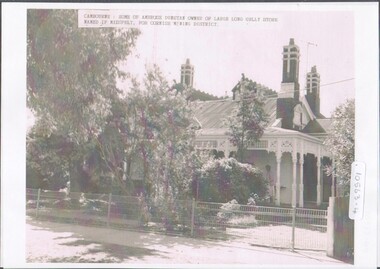
... This home "Crambourne" was designed by architect, Mr William Beebe and built around 1875 for Mr and Mrs Ambrose Dunstan, in Creeth Street, Long Gully. home and portrait of Ambrose Dunstan Ambrose Dunstan Mayor Cambourne Long Gully Cambourne, home of Ambrose Dunstan, who was owner of the Long Gully store. ...This home "Crambourne" was designed by architect, Mr William Beebe and built around 1875 for Mr and Mrs Ambrose Dunstan, in Creeth Street, Long Gully.Cambourne, home of Ambrose Dunstan, who was owner of the Long Gully store. The house is named after the Cornish Mining District. Poor photocopy of Mr. Ambrose Dunstan, taken when he was mayor (not dated). Photocopies of originals, undated photographs.home and portrait of ambrose dunstan, ambrose dunstan mayor, cambourne, long gully -
 Bendigo Historical Society Inc.
Financial record - INVOICE COLLECTION: J. H. Curnow & Son
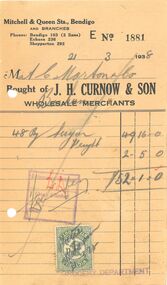
... It was during his second term as Mayor in 1904, that he had William Beebe design a home - Eumana in Flora Hill. ...It was during his second term as Mayor in 1904, that he had William Beebe design a home - Eumana in Flora Hill. ...See below for an article by Jim Evans of the Bendigo Historical Society: From the Bendigo Miner Number 9 - 1 March 2007 Cock-eyed Curnow - James Henry Curnow Cornishman and famous Bendigonian By Jim Evans Five-time Mayor of Bendigo, James Henry Curnow of Eumana , was for fifty years associated with almost every progressive movement in the life of the city. He was born in Ludgvan, Cornwall, in 1861, the son of Sampson Curnow, tin-miner and later mine-manager. His parents brought him to Bendigo when he was two years old and settled at Long Gully. He was educated at the state school and St Andrew s College. In 1883, he married Jane Corbel in the Congregational Church. Curnow joined the Post-Master-General s Department in 1881. Taking leave in 1887, he acted as secretary of the Australian Natives Association (ANA) exhibition at Geelong. He became a clerk with Connelly and Tatchell's, Bendigo solicitors, leaving in 1894 to establish an accountancy and real estate business. Considered shrewd and hard-working, Curnow prospered; he later added an auctioneering section and formed the company J.H. Curnow & Son (now Curnow & Dyett). The ANA provided the grounding for Curnow s public life. He joined the Sandhurst branch in 1881 and was secretary in 1883-1891. He helped form new branches in northern Victoria. With (Sir) John Quick, he set up the first Federation League in the colony in 1893. Curnow was secretary of the League in that year and again in 1898-99. He was elected to the Bendigo City Council in 1901 and, apart from 1906-09 remained a very energetic councillor. He was Mayor in 1902-03, 1903-04, 1912-13, 1919-20 and 1927-28. It was during his second term as Mayor in 1904, that he had William Beebe design a home - Eumana in Flora Hill. (Local historian Betty Jackman informs me that Curnow s house at 75 Wills Street where he lived before moving to Flora Hill, was also called Eumana ). He took a leading role in the installation of sewerage and was later Chairman of the city s Sewerage authority when that body was being subjected to a great deal of criticism. He was an executive member of The Municipal Association of Victoria and president in 1919. Curnow was very interested in politics, but his four attempts to enter parliament failed. He was Justice of the Peace for the states of New South Wales and Victoria, deputy coroner for the city of Bendigo, a guardian of minors and registrar of marriages. Curnow was managing director of the Bendigo Pottery, director of the Bendigo Gas Co. and the Bendigo and Eaglehawk Star Building Society and chairman of directors of the Bendigo Boot and Shoe factory. He was a life member of both the Bendigo Base Hospital and the Benevolent Asylum (Anne Caudle Centre). Curnow s family affairs were marred by tragedy. His father was killed in a mining accident in 1881; his first wife and three of their five children died in the measles epidemic of 1893. His second wife Mary Jordan died in 1909 after spilling carbolic acid on her hip, leaving three young children. He married Amy McLean in 1911and they had one daughter. When the Prince Edward visited Bendigo in 1920, Curnow made a speech, telling his audience: I will now merely ask you to drink his health as the Prince of Wales and also as the Duke of Cornwall. In this district there are a tremendous number of Cornishmen and I need not tell His Royal Highness that it was the Cousin Jacks who made Bendigo, who found the gold and developed the mines. They have added more to the riches of the Commonwealth than any other class of people. When he visits the mines today, he will find that ninety per cent of the miners are Cornishmen and descendants of Cornishmen. His remarks were greeted by loud applause. J.H. Curnow was known locally as Cock-eyed because of an eye defect. He died on Anzac Day 1932 at his then home, The Knoll in Wattle Street. He was 71. He was cremated at the new Fawkner Cemetery and his ashes were buried in the Bendigo Cemetery. His grave is close to that of another famous Cornishman and Bendigonian, Sir John Quick, who died in the same year. The Curnow memorial drinking fountain in Rosalind Park was unveiled in 1938 by Mayor Taylor. The distinguished Bendigo born sculptress Ola Cohn designed the memorial and made the bust and other plaques of terracotta. The plaques were damaged in the 1950s and a restoration program was undertaken, with bronze plaques replacing the original terracotta ones.10934.33a: A small, aged sheet of yellow paper with two clean punch holes on the left side and a perforated edge. The paper is thin, but sturdy. Printed in black ink is the business name and details: Bought of J.H. Curnow & Son Wholesale Merchants. The address: Mitchell & Queen Sts. Bendigo and branches. Phones: Bendigo 103. The receipt is handwritten in grey lead pencil. Dated 21 March 1938. Below the header is neat, ruled lines for listing items with prices listed in British Pounds, totaling 52 pounds 1 shillings. Receipt number 1881. There is also a Victorian 3 pence stamp duty stamp printed in green ink. 10934.33b: A small, aged sheet of yellow paper with two clean punch holes on the left side and a perforated edge. The paper is thin, but sturdy. Printed in black ink is the business name and details: Bought of J.H. Curnow & Son Wholesale Merchants. The address: Mitchell & Queen Sts. Bendigo and branches. Phones: Bendigo 103. The receipt is handwritten in grey lead pencil. Dated 25 May 1938. Below the header is neat, ruled lines for listing items. Receipt number 14291. The Receipt is crossed out in blye pencil. The top left corner is folded and slightly torn. 10934.33c: A small, aged sheet of yellow paper with two clean punch holes on the left side and a perforated edge. The paper is thin, but sturdy. Printed in black ink is the business name and details: Bought of J.H. Curnow & Son Wholesale Merchants. The address: Mitchell & Queen Sts. Bendigo and branches. Phones: Bendigo 103. The receipt is handwritten in grey lead pencil. Dated 27 June 1938. Below the header is neat, ruled lines for listing items with prices listed in British Pounds, totaling 2 pounds. Receipt number 1466. The receipt is crossed out in blue pencil and indicates and credit. 10934.33d: A small, aged sheet of yellow paper with two clean punch holes on the left side and a perforated edge. The paper is thin, but sturdy. Printed in black ink is the business name and details: Bought of J.H. Curnow & Son Wholesale Merchants. The address: Mitchell & Queen Sts. Bendigo and branches. Phones: Bendigo 103. The receipt is handwritten in grey lead pencil. Dated 7 March 1938. Below the header is neat, ruled lines for listing items with prices listed in British Pounds, totaling 34 pounds 14 shillings. Receipt number 1627. There is also a Victorian 3 pence stamp duty stamp printed in green ink.ac morton, jh curnow & son
