
Showing 20 items matching "mechanical signals"
-
 Melbourne Tram Museum
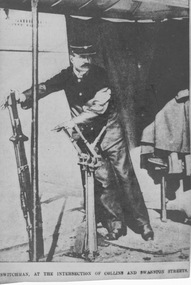
Photograph - Signalman at Collins and Swanton Streets, 1910s
... ...mechanical signals...The signalman's job was twofold: to directed which trams had right of way by use of mechanical signals and to depress the Collins Street cable so that the upward incline did not cause the cable to rise out of the slot onto the roadway. ...The signalman's job was twofold: to directed which trams had right of way by use of mechanical signals and to depress the Collins Street cable so that the upward incline did not cause the cable to rise out of the slot onto the roadway. ...Photograph shows uniformed MTOC signalman standing under a canopy operating two large levers (which may be the reason the newspaper mistakenly described him as a switchman). He stands under a canopy supported by poles with a partial curtain at the rear along with his overcoat. The canopy was located on the footpath on the southeast corner of the intersection of Collins and Swanston Streets. This was the busiest cable tramway intersection in Melbourne and one of the busiest for pedestrian and vehicle traffic. The tram tracks crossed each other at right angles with no curved tracks to permit turns. The signalman's job was twofold: to directed which trams had right of way by use of mechanical signals and to depress the Collins Street cable so that the upward incline did not cause the cable to rise out of the slot onto the roadway. The depression gear was located under both Collins Street tracks adjacent to the Town Hall and was only released momentarily to allow a Collins Street tram to pass over it. This was a demanding job requiring constant vigilance: working with the policeman controlling the intersection, trams approaching from four directions, horse and motor traffic and pedestrians. The signalman's rules provided a specific order of steps each time the signals and depression gear were reset, which occurred many times per hour. He was also authorised to stop trams with the use of his whistle and a red hand lamp and to report gripmen who disobey his directions. Traffic lights were gradually introduced to Melbourne from 1928 after cable trams were replaced in Swanston Street and just before they were replaced in Collins Street. This is a photograph taken of a newsprint photograph from an unnamed newspaper. Yields information about signalman's work. Black and white photograph with note below photograph. Printed below photograph: "Switchman [sic] at the intersection of Collins and Swanston Streets."newsprint, mtoc, switchman, canopy, levers, collins street, swanston street, busiest intersection, traffic lights, 1928, policeman, signalman, mechanical signals, right of way, depression gear, twon hall, slot, vigilance -
 Melbourne Tram Museum
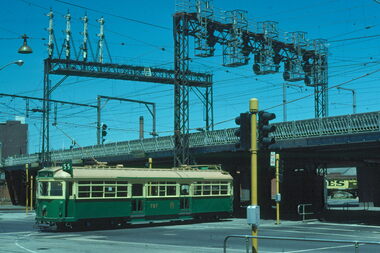
Slide - CBD tram operations - set of 4, Warren Doubleday, 26/12/1979
... Note that most of the mechanical signalling equipment on the gantry has been removed. 2 - Z3 117 running a route 88 service in Bourke St at Queen St. 3 - Z class 93 to Spencer St at Elizabeth St, with Parliament House in the far background. ...Note that most of the mechanical signalling equipment on the gantry has been removed. 2 - Z3 117 running a route 88 service in Bourke St at Queen St. 3 - Z class 93 to Spencer St at Elizabeth St, with Parliament House in the far background. ...Set of four colour slides of tram operations in the CBD area on 26/12/1979 1 - SW5 787 passing under the Flinders St railway viaduct, running a route 55 service. Note that most of the mechanical signalling equipment on the gantry has been removed. 2 - Z3 117 running a route 88 service in Bourke St at Queen St. 3 - Z class 93 to Spencer St at Elizabeth St, with Parliament House in the far background. Photo taken at Queen St. 4 - Z3 117 in Bourke St at Queen St running a route 88 East Preston service.Yields information about the operation of trams in the CBD area and the Flinders St viaduct.Kodak cardboard mount slides - set of fourHave photographer's reference number written on the slide.tramways, flinders st, bourke st, tram 787, railways, tram 117, sw5 class, z3 class, tram 93 -
 Melbourne Tram Museum
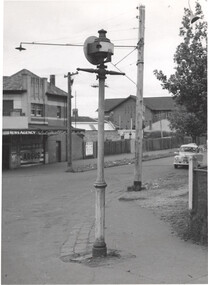
Photograph - Tramway / Railway disc signal at Elsternwick, late 1950s
... Photograph of one of the two mechanical disc signals that controlled tramway traffic at the Elsternwick Level Crossing or Railway Square in Glen Huntly Road. ...Photograph of one of the two mechanical disc signals that controlled tramway traffic at the Elsternwick Level Crossing or Railway Square in Glen Huntly Road. ...Photograph of one of the two mechanical disc signals that controlled tramway traffic at the Elsternwick Level Crossing or Railway Square in Glen Huntly Road. The building on the left appears in the St Kilda Historical Society photo on Victorian Collections - https://victoriancollections.net.au/items/603efb1a092fbbe37f3e96f6 - a newsagent. The level crossing was abolished in 1959/1960 over a number of months of work.Yields information about the type of disc signal that was installed at locations where railways and tramways crossed.Black and white print with notes on the rear."$15" and "Elwood Signal" in pencil on the rear.tramways, level crossings, signals, elsternwick, glen huntly road -
 Flagstaff Hill Maritime Museum and Village
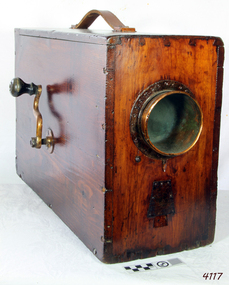
Instrument - Foghorn, Late 19th century
... This method of producing a low audible sound was further developed as a fog signal by John Northey of Toronto and these diaphones were powered by compressed air produced by an electric motor or other mechanical means that admitted extremely powerful low-frequency notes. ...This method of producing a low audible sound was further developed as a fog signal by John Northey of Toronto and these diaphones were powered by compressed air produced by an electric motor or other mechanical means that admitted extremely powerful low-frequency notes. ...A foghorn is a device that uses sound to warn of navigational hazards like rocky coastlines, or boats of the presence of other vessels, in foggy conditions. The term is most often used with marine transport. When visual navigation aids such as lighthouses are obscured, foghorns provide an audible warning of rocky outcrops, shoals, headlands, or other dangers to shipping. An early form of fog signal was to use a bell, gong, explosive signal or firing a cannon to alert shipping. From the early 20th century an improved device called the diaphone was used in place of these other devices, The diaphone horn was based directly on the organ stop of the same name invented by Robert Hope-Jones, creator of the Wurlitzer organ. Hope-Jones' design was based on a piston that was closed only at its bottom end and had slots, perpendicular to its axis, cut through its sides, the slotted piston moved within a similarly slotted cylinder. Outside of the cylinder was a reservoir of high-pressure air. Initially, this air would be admitted behind the piston, pushing it forward. When the slots of the piston aligned with those of the cylinder, air passed into the piston, making a sound and pushing the piston back to its starting position, whence the cycle would be repeated. This method of producing a low audible sound was further developed as a fog signal by John Northey of Toronto and these diaphones were powered by compressed air produced by an electric motor or other mechanical means that admitted extremely powerful low-frequency notes. The example in the Flagstaff collection is an early cased and portable diaphone used on pleasure or sailing craft. By manually turning the crank handle air is produced and fed into valves that direct air across vibrating metal reeds to produce the required sound. in foggy weather, fog horns are used to pinpoint a vessels position and to indicate how the vessel is sailing in foggy conditions. One blast, when sailing on starboard tack and two blasts, when sailing on a port tack and three dots, when with wind is behind the vessel. Since the automation of lighthouses became common in the 1960s and 1970s, most older foghorn marine installations have been removed to avoid the need to run the complex machinery associated with them, and have been replaced with an electrically powered diaphragm or compressed air horns. The example in the collection is significant as it was used in the early 19th century for sailing vessels was important but these portable crank fog horns have also been superseded by modern electric varieties. Therefore the item has a historical connection with sailing and maritime pursuits from our past.English Rotary Norwegian Pattern nautical foghorn within a boxed pine varnished case with exposed corner dovetailing, original leather carrying strap, brass side crank, and original copper trumped horn. Card accessory with Directions for Use in both English and French.Noneflagstaff hill, warrnambool, shipwrecked coast, flagstaff hill maritime museum, maritime museum, shipwreck coast, flagstaff hill maritime village, great ocean road, foghorn, maritime technology, maritime communication, marine warning signal, portable foghorn, bellows foghorn, crank handle, robert hope-jones, john northey -
 Flagstaff Hill Maritime Museum and Village
Functional object - Bell, Probably second half of 19th Century or first half of the 20th Century for this particular item
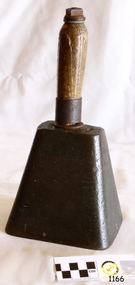
... signal to all classrooms. In North America it was more usual to find a large bell on a stand located in a central area of the school where it could be heard by everyone throughout the premises. More recently, the school bell has become wall located, and electrically activated, using a mechanical...signal to all classrooms. In North America it was more usual to find a large bell on a stand located in a central area of the school where it could be heard by everyone throughout the premises. More recently, the school bell has become wall located, and electrically activated, using a mechanical ...The school bell has been used in various forms for several centuries. In Australia and the UK it was often a hand bell, located on the teacher's desk in a small school. In larger schools it was positioned in a central area, and one bell was used to signal to all classrooms. In North America it was more usual to find a large bell on a stand located in a central area of the school where it could be heard by everyone throughout the premises. More recently, the school bell has become wall located, and electrically activated, using a mechanical timing apparatus. Now the same bell is computer programmed and activated, although there are many older bells still in operation. The school bell was rung at the beginning at the school day, often to summon students to the morning assembly in larger schools. It was then rung throughout the day to signal the start and end of specific lesson periods, the beginning and end of school morning and afternoon breaks, the lunch period, and the end of the school day, no doubt eagerly awaited by many students! The school bell was used as a timing device in schools to signal the start and end of specific activities.Bell brass with heavy metal square shaped base and wooden handle-hand held, Kel(?)her Melbourne on the topInscribed on the metal at the top of the bell are the letters "Kel(?)her Melbourne" flagstaff hill, warrnambool, shipwrecked-coast, flagstaff-hill, flagstaff-hill-maritime-museum, maritime-museum, shipwreck-coast, flagstaff-hill-maritime-village, bell, school, lessons -
 Flagstaff Hill Maritime Museum and Village
Instrument - Ship Log
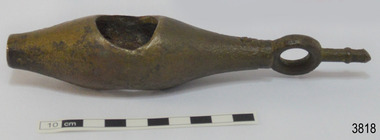
... On a given signal the log line was pulled back into the vessels, the knots counted until the log came up, then the figures were calculated by a navigator In 1802 the first successful mechanical log available for general use was invented by Edward Massey. ...On a given signal the log line was pulled back into the vessels, the knots counted until the log came up, then the figures were calculated by a navigator In 1802 the first successful mechanical log available for general use was invented by Edward Massey. ...The ship's log part, called a fish, is likely to be from a mechanical taffrail log system. It was recovered from the wreck site of the barque, the 1840-1852 Grange. There are no marks on the fish to identify its maker or model. It is part of the John Chance Collection. This ‘fish’ is part of an early to mid-1800s ship's log. It would likely have been part of a taffrail log connected to a rotor (also called propeller, spinner) by a strong line, and the other end connected by a line to a dial mounted on the taffrail, or stern rail, at the stern of the vessel. As the propeller rotated through the water it would spin the log, which in turn would cause a number to register on the dial, showing the current speed in knots; one knot equals one nautical mile per hour. TAFFRAIL LOGS A taffrail log is a nautical instrument used for measuring the speed of a vessel, providing vital navigational information to be calculated, such as location and direction. A log has been used to measure the speed of a vessel since the 1500s. A simple piece of wood was tied to a long line and thrown into sea at the back of the vessel. The rope was knotted all along at equal distances apart. On a given signal the log line was pulled back into the vessels, the knots counted until the log came up, then the figures were calculated by a navigator In 1802 the first successful mechanical log available for general use was invented by Edward Massey. It had a rotor 'V' section connected to a recording mechanism. The water’s movement rotated the rotor, which intern sent the movement to the recorder. There are examples of this invention available to see in some of the maritime museums. Thomas Walker, nephew of Edward Massey, improved on Massey’s design, and Walker and his son took out a patent on the A1 Harpoon Log. In 1861. Both Massey and Walker continued to improve the designs of the taffrail log. New designs were still being introduced, even up to the 1950s. THE GRANGE, 1840-1858- The wooden barque ’Grange’ was a three-masted ship built in Scotland in 1840 for international and coastal trade. On March 22, 1858, the Grange set sail from Melbourne under Captain A. Alexander, carrying a cargo of ballast. The barque had left the Heads of Phillip Bay and was heading west along the Victorian coast towards Cape Otway. The ship struck Little Haley’s Reef at Apollo Bay due to a navigational error and was stuck on the rocks. The crew left the ship carrying whatever they could onto the beach. Eventually, the remains of the hull, sails and fittings were salvaged before the wreck of the Grange broke up about a month later. About 110 years later, in 1968, the wreck of the Grange was found by divers from the Underwater Explorers Club of Victoria. They were amazed to find a unique, six to nine pound carronade (type of small cannon) and a cannonball on the site. There have been no other similar carronades recorded. In that same year the anchor of the Grange was recovered by diver John Chance and Mal Brown. The ship’s log is significant historically as an example of hardware used when building wooden ships in the early to mid-19th century. The ship’s log is historically significant as an example of the work and trade of blacksmith. The ship’s log also has significant as it was recovered by John Chance, a diver from the wreck of the Grange in the 1968. Items that come from several wrecks along Victoria's coast have since been donated to the Flagstaff Hill Maritime Village’s museum collection by his family, illustrating this item’s level of historical value. The ship’s log is historically significant for its association with the 1840s wooden barque, the Grange. The Grange is an historical example of a Scottish built vessel used for international and coastal trader of both cargo and passengers in the mid-19th century. The Grange is an example of an early ship, designed with a wooden hull. It is significant as a ship still available to divers along the south coast of Victoria, for research and education purposes. The Grange is an example of a mid-19th century vessel that carried a weapon of defence onboard. Ship log fitting, called a fish; part of a brass navigational instrument, likely to be from a taffrail log. The metal is a tan colour and has rough surface with a sheen, and discolouration in places. Its basic shape is a hollow cylinder with ends tapering to a smaller size. In the centre there are opposing openings cut out, showing a rough texture inside. One end on the cylinder is closed with a ring and shank installed, fixed by an embedded screw through the end of the cylinder. There are no inscriptions.flagstaff hill, warrnambool, flagstaff hill maritime museum, maritime museum, shipwreck coast, flagstaff hill maritime village, great ocean road, west coast trader, apollo bay, mid-19th century shipwreck, the grange, scottish barque, little henty reef, captain a alexander, underwater explorers club of victoria, vhr 5297, coastal trader, wooden shipwreck, john chance, wooden ship, taffrail log, marine instrument, marine technology, navigation, nautical instrument, mechanical log, nautical navigation, navigation equipment, scientific instrument, ship log, ship log register, ship speed, taff rail log, patent log, towed log, taffrail log fish, edward massey, thomas walker -
 The Beechworth Burke Museum
Photograph, Unknown
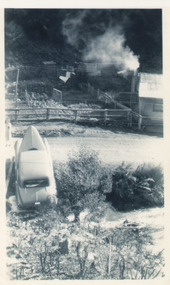
... Contemporary development of the 'Queens Lode' at the A1 mine signals a move from high-grade, narrow vein airleg mining into larger scale, mechanical mining designed to increase ore production volume. ...Contemporary development of the 'Queens Lode' at the A1 mine signals a move from high-grade, narrow vein airleg mining into larger scale, mechanical mining designed to increase ore production volume. ...The A1 Gold Mine is located north of Woods Point, near Jamieson, in the Upper Goulburn region of Victoria. Gold was discovered at the A1 site in 1861 and mining operations began in 1864. The A1 Mine Settlement refers to a small township known variously as Castle Reef, Castle Point, and Raspberry Creek, which developed in the 1860s around mining industry centred on a crushing machine that worked the three gold reefs in the area. Historically, the name "A1"referred to the high quality of gold found in the quartz reefs at depths of at least two thousand feet. Along with the Morning Star mine at Woods Point, the A1 gold mine produced almost sixty percent of Victoria's gold output in the 1950s to 1970s and continued operating until 1992 when it went into administration. Operations at the site were revived in 2016 and the A1 Mine is now considered one of Victoria's premier gold mines. The A1 mine is part of the extensive and prospective Lachlan Fold Belt, a north-west trending belt of tightly folded Early Devonian sedimentary rocks extending from New South Wales to Victoria. Mineralisation is hosted within or immediately adjacent to diorite dykes. Contemporary development of the 'Queens Lode' at the A1 mine signals a move from high-grade, narrow vein airleg mining into larger scale, mechanical mining designed to increase ore production volume. This original, undated photograph of the A1 Mine appears to depict an area or phase of disuse or abandonment. The aged and humble appearance of the cottage suggests association with the historical A1 Mine Settlement, therefore the image may have been taken prior to the 1950s-1970s revival period in which the A1 mine is known to have produced high gold yields. The photograph contributes to our understanding of the A1 Gold Mine's impact on the landscape and the social, environmental impacts of mining on communities and may be compared with others in the Burke Museum's extensive collection of mining photographs to deepen our understanding of mining in the Jamieson area.Black and white rectangular photograph printed on photographic paperReverse: 5577 / A1 Mine / Near Jamieson / Vic. /burke museum, beechworth museum, beechworth, gold fields, gold rush, victorian gold rush, mining tunnels, gold ming history, colonial australia, australian gold rushes, mining technology, beechworth historic district, indigo gold trail, indigo shire, upper goulburn shire, jamieson, woods point-walhalla goldfield, a1 gold mine, victorian high country, modern mining methods, orogenic gold province, gold mineralisation, devonian, dykes -
 Flagstaff Hill Maritime Museum and Village
Equipment - Foghorn, 20th century
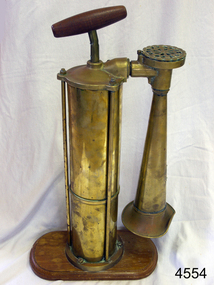
... Mechanical Werkstad, Ltd.), Malmo, Sweden. The company was established in 1840, became a Limited company in 1866, and established a shipyard at the Port of Malmo, Sweden, in 1870. The civilian ship production in Malmo ceased in 1987. As well as building ships the company built large industrial and agricultural machinery and maritime goods. this replica foghorn represents the design of a Swedish, Tyfon model 1910. It is an example of the type of safety equipment used on marine vessels to signal ...A marine foghorn gives an audible navigational signal to warn vessels of dangers, hazards and the presence of other vessels in fog conditions. The foghorn signal is a series of long and short sounds with short or long pauses between them. These common signals conform to a code called the International Regulations for Preventing Collisions at Sea and provide such information as whether the vessel is under sail or motor, large or small, aground or at anchor. The designs of foghorns vary but they all use a column of air to make a loud sound. Some use vibrating plates or metal reeds, others force air through holes in a revolving cylinder or disc, sounding like a siren, and some use a clockwork mechanism to open the valves that let the air into the horn. They are usually built to meet particular specifications e.g. U.S.C.G. (US Coast Guard). This Tyfon plunger foghorn has a horizontal handle attached to a vertical rod that moves up and down inside a cylinder. When the handle is plunged down, in a similar way to a bicycle pump, the air is forced out of the bottom of the cylinder into a pipe with a bell-shaped horn on the end, making a loud, low sound. The wider base of the cylinder helps to keep it stable. The original type Tyfon foghorns were manufactured in about 1910 by Kochums Mechanical Workshop (Kockums Mechanical Werkstad, Ltd.), Malmo, Sweden. The company was established in 1840, became a Limited company in 1866, and established a shipyard at the Port of Malmo, Sweden, in 1870. The civilian ship production in Malmo ceased in 1987. As well as building ships the company built large industrial and agricultural machinery and maritime goods.this replica foghorn represents the design of a Swedish, Tyfon model 1910. It is an example of the type of safety equipment used on marine vessels to signal other vessels and signal to land. Replica foghorn; portable marine, plunger operation. It has a brass cylinder and adjustable brass horn. The plunger handle and base are wooden. Inscriptions are on the plaque on the horn and moulded into the air intake. Facsimile of a Kockums of Malmo, Sweden, Tyfon model 1910 Fog Horn.Impressed into the attached plaque "KOCKUMS MLK. VERKSTAD / MALMO SWEDEN" and "TRADE TYFON MARK" Also added to the plaque individually "288938" Molded around the circumference of the air intake "TYFON PATENT"flagstaff hill, warrnambool, shipwrecked coast, flagstaff hill maritime museum, maritime museum, shipwreck coast, flagstaff hill maritime village, great ocean road, foghorn, fog horn, tyfon foghorn, kockums mlk verkstad, malmo sweden, replica, warning signal, safety equipment, ship's equipment -
 Bendigo Military Museum
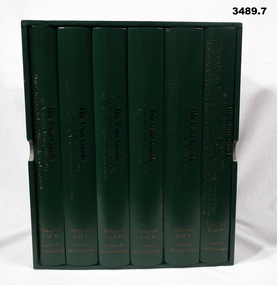
Book - BOOKS, BOXED SET, Graham R McKenzie - Smith, The Unit Guide, 2018
... Signal Units. Box of 6 books. The Unit Guide / The Australian Army / 1939 - 1945. 654 pages .6) Volume 5 of 6. Aust Army Service Corps, Aust Army Ordnance Corps and Aust Electrical & Mechanical Engineer Units. 706 pages. .7) Volume 6 of 6. ...Signal Units. Box of 6 books. The Unit Guide / The Australian Army / 1939 - 1945. 654 pages .6) Volume 5 of 6. Aust Army Service Corps, Aust Army Ordnance Corps and Aust Electrical & Mechanical Engineer Units. 706 pages. .7) Volume 6 of 6. ....1) Box open, cardboard, dark green buckram, white paper lining, gold print on sides. .2) - .7) Hard cover book, cardboard, dark green buckram with gold print on front cover & spine. Pages are plain, cut, white, black print, black & white illustrations. .2) Volume 1 of 6. Unit & Location Indexes / Bibliography, Orders of Battle. 483 pages. .3) Volume 2 of 6. Headquarters, Infantry, Cavalry / Armoured & Intelligence Units. 605 pages. .4) Volume 3 of 6. Artillery, Air Defence and Engineer Units. 626 pages. .5) Volume 4 of 6. Medical and Signal Units. Box of 6 books. The Unit Guide / The Australian Army / 1939 - 1945. 654 pages .6) Volume 5 of 6. Aust Army Service Corps, Aust Army Ordnance Corps and Aust Electrical & Mechanical Engineer Units. 706 pages. .7) Volume 6 of 6. Womens Services / Volunteer Defence Corps / War Graves, Survey, Labour, Salvage / Military Policing / Recruiting & Training / Dental, Bath & Laundry / Veterinary & Animal / Movements & Transit / Pay, Records & Printing, Postal / Amenities & Canteens Units. 568 pages. books- military history, unit guide -
 Bendigo Military Museum
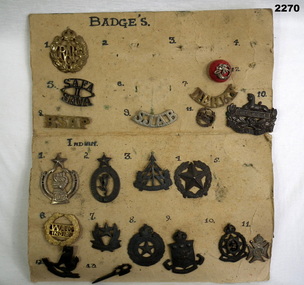
Badge - BADGE COLLECTION MOUNTED, C.WW2
... Panel One only, a lot of Indian badges. .1) RAF badge .2), .3), .4) .6) missing .5) SAFA 11 SAVA .7) Derby .8) RSAP .9) SJAB .10) Gloucestershire, Eygpt with Lion .11) Eygpt, Lion, Surronded by oak leaf cluster .12) Red button badge, with a bugle and K R motif over it Panel Two .1) Circular badge .2) Indian signals corps badge. oval shape surmounted with 5 pointed star .3) Indian reconaisance corp badge symbolic tree and arrow .4) Indian engineers badge. 5 point star surrounded by oak leaf cluster .5) Missing .6) WAC India .7) Indian intelligence corps. 5 pointed star .8) Indian electrical and mechanical engineers badge .9) Indian army ordinance badge .10) Indian army medical corps .11) Symbolic cross .12) Burma intelligence corps .13) Stylised trench raid weapon Panel Three .1) Crossed khukris .2) Cross khukris .3) Simple doughnut shaped ring .4) Doughnut shaped ring. surmounted by a crown in center is letters X1 .5) JAT Regiment badge large letters IX surmounted with a crown .6) Regiment cluster of leaves .7) Madras regiment badge .8) Unknown 4 sort of legs surrounded with a crown .9) Dogras Regt. ...Badges collection Indian Panel One only, a lot of Indian badges. .1) RAF badge .2), .3), .4) .6) missing .5) SAFA 11 SAVA .7) Derby .8) RSAP .9) SJAB .10) Gloucestershire, Eygpt with Lion .11) Eygpt, Lion, Surronded by oak leaf cluster .12) Red button badge, with a bugle and K R motif over it Panel Two .1) Circular badge .2) Indian signals corps badge. oval shape surmounted with 5 pointed star .3) Indian reconaisance corp badge symbolic tree and arrow .4) Indian engineers badge. 5 point star surrounded by oak leaf cluster .5) Missing .6) WAC India .7) Indian intelligence corps. 5 pointed star .8) Indian electrical and mechanical engineers badge .9) Indian army ordinance badge .10) Indian army medical corps .11) Symbolic cross .12) Burma intelligence corps .13) Stylised trench raid weapon Panel Three .1) Crossed khukris .2) Cross khukris .3) Simple doughnut shaped ring .4) Doughnut shaped ring. surmounted by a crown in center is letters X1 .5) JAT Regiment badge large letters IX surmounted with a crown .6) Regiment cluster of leaves .7) Madras regiment badge .8) Unknown 4 sort of legs surrounded with a crown .9) Dogras Regt. ...Items in the collection re Ian McLeod RWAFF, refer Cat No 2262.2 for service details.Panel One only, a lot of Indian badges. .1) RAF badge .2), .3), .4) .6) missing .5) SAFA 11 SAVA .7) Derby .8) RSAP .9) SJAB .10) Gloucestershire, Eygpt with Lion .11) Eygpt, Lion, Surronded by oak leaf cluster .12) Red button badge, with a bugle and K R motif over it Panel Two .1) Circular badge .2) Indian signals corps badge. oval shape surmounted with 5 pointed star .3) Indian reconaisance corp badge symbolic tree and arrow .4) Indian engineers badge. 5 point star surrounded by oak leaf cluster .5) Missing .6) WAC India .7) Indian intelligence corps. 5 pointed star .8) Indian electrical and mechanical engineers badge .9) Indian army ordinance badge .10) Indian army medical corps .11) Symbolic cross .12) Burma intelligence corps .13) Stylised trench raid weapon Panel Three .1) Crossed khukris .2) Cross khukris .3) Simple doughnut shaped ring .4) Doughnut shaped ring. surmounted by a crown in center is letters X1 .5) JAT Regiment badge large letters IX surmounted with a crown .6) Regiment cluster of leaves .7) Madras regiment badge .8) Unknown 4 sort of legs surrounded with a crown .9) Dogras Regt. In the centre are the number 17 surmounted with a crown .10) Punjab regt. Center is a 5 pointed star with numbers 14 surmounted with a crown .11) Missingbadges, collection, indian -
 Bendigo Military Museum
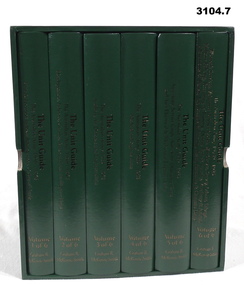
Book - BOOKS, BOXED SET OF 6, Graham R McKenzie - Smith, The Unit Guide, 2018
... Signals Units. .6) Volume 5 of 6. Aust Army Service Corp, Aust Army Ordnance Corp & Aust Electrical & Mechanical Engineer Units. .7) Volume 6 of 6. ...Signals Units. .6) Volume 5 of 6. Aust Army Service Corp, Aust Army Ordnance Corp & Aust Electrical & Mechanical Engineer Units. .7) Volume 6 of 6. ...Boxed set of 6 books. The Unit Guide, The Australian Army 1939 - 1945. .1) Box, open, cardboard, dark green buckram, white paper lining, gold print on sides. .2) - .7) Hard cover book, cardboard, dark green buckram with gold print on front cover & spine. Pages plain cut, black print, black & white illustrations. .2) 483 pages. .3) 605 pages. .4) 626 pages. .5) 654 pages. .6) 706 pages. .7) 568 pages..2) Volume 1 of 6. Unit & Location Indexes, Bibliography, Orders of Battle .3) Volume 2 of 6. Headquarters, Infantry, Cavalry, Armoured & Intelligence Units. .4) Volume 3 of 6. Artillery, Air Defence & Engineer Units. .5) Volume 4 of 6. Medical & Signals Units. .6) Volume 5 of 6. Aust Army Service Corp, Aust Army Ordnance Corp & Aust Electrical & Mechanical Engineer Units. .7) Volume 6 of 6. Women's Services, Volunteer Defence Corps, War Graves Survey, Labour Salvage, Military Policing, Recruiting & Training, Dental, Bath & Laundry, Veterinary & Animal, Movements & Transit, Pay, Records & Printing & Postal, Amenities & Canteens Units.books-military-history, units, 1939 - 45 -
 National Vietnam Veterans Museum (NVVM)
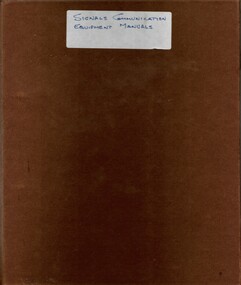
Manual, Signals Communication Equipment Manuals, 1960's
... Signals Communication Equipment Manuals Manual Manual Electrical & Mechanical Engineering ...A brown coloured cardboard cover with a white label at the top. Written on the label reads Signal Communication Equipment Manuals. The manual is held together with a metal slide on the inside.manual, signals, signal communications, equipment -
 National Vietnam Veterans Museum (NVVM)
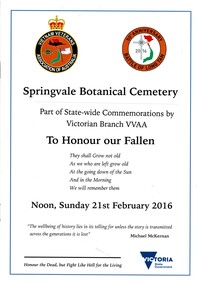
Booklet, Springvale Botanical Cemetery: Part of State-wide Commemorations by Victorian Branch VVAA , 50th Anniversary of Battle of Long Tan: Noon, Sunday 21st February, 2016, (Copy 1), 2016
... Signal Troop...Cpl John Hunter Whitton...311532...Pte Walter Johnston Davison...311546...Pte John Walter Desnoy...3791033...3rd Battalion...WO2 (Acting) Gilbert John Hartney...34854...Royal Corps of Australian Electrical and Mechanical...Battle of Long Tan Memorial Services Vietnam Veterans Association of Australia 50th Anniversary - Battle of Long Tan Killed in Action WO1 Raymond Kevin Nichols 1797 106 Field Workshop (RAEME) Pte Stephen James O'Dal 39016 Royal Australian Infantry Corps 8th Battalion The Royal Australian Regiment Pte Daryl Poulson 3795605 Australian National Serviceman Pte Terence Ronald Scott 38649 7th Battalion WO2 Terance Edward Lyon 52503 Royal Australian Army Ordnance Corps 2nd Advance Ordnance Depot Headquarters Australian Force Vietnam Sgt Noel Lowes 14574 Royal Australian Armoured Corps 1st Armoured Personnel Carrier Squadron A Squadron 3rd Cavalry Regiment 1st Armoured Regiment Leading Aircraftman Duncan Glen McNair A317006 Royal Australian Airforce No 9 Squadron Tpr Victor Ian Pomroy 3786644 1st Australian Reinforcement Unit Pte Richard Christopher Allan Watson 39403 1st Battalion Pte Geoffrey Lawrence Tweedie 3787416 1st Australian Task Force 6th Battalion L/Cpl John Francis Gillespie 3170244 Royal Australian Army Medical Corps 8th Field Ambulance Sgt William Francis Hacking 36448 Australian Army Training Team Vietnam (AATTV) Signalman Barry Arthur Logan 38324 Royal Australian Corps of Signals 709 Signal Troop 552 Signal Troop Cpl John Hunter Whitton 311532 Pte Walter Johnston Davison 311546 Pte John Walter Desnoy 3791033 3rd Battalion WO2 (Acting) Gilbert John Hartney 34854 Royal Corps of Australian Electrical and Mechanical Engineers. 102 Field Workshop Pte Douglas Brian Plain 3789448 Pte George Nagle 39565 9th Battalion Pte Paul Charles Sullivan 3786696 5th Battalion Pte Raymond John Moore 39923 Cpl (Temp) Noel Alan Smith 3797613 Royal Australian Engineers 21 Engineer Support Troop Lt Peter Robert Marks-Chapman 38801 L/Cpl Eric Halkyard 311620 Sapper Ronald Edward Davies 38530 1st Field Squadron Pte John Wallace Holloway 3794544 Pte Robert MacDonald Key 39493 L/Cpl John Noel McCarthy 3112702 1st Forward Delivery Troop B Squadron Sapper John Smith 3794831 Pte Allen Roy Brown 3794895 Pte Raymond Duncan Clark 3794556 Pte Barry John Munday 3795712 Sapper Dennis Lindsay Brooks 3787889 Pte Barleif Alfred Harstad 38939 Pte Garry Robert Polglase 38763 Pte Lawrence Rodney Sheppard 3790506 Pte John Richard Tinkham 3791207 WO2 (Temp) John Thomas Durrington 36485 An Order of Service for the Springvale Botanical Cemetery: Part of State-wide Commemorations by Victorian Branch VVAA , 50th Anniversary of Battle of Long Tan. ...An Order of Service for the Springvale Botanical Cemetery: Part of State-wide Commemorations by Victorian Branch VVAA , 50th Anniversary of Battle of Long Tan. See media file for more information. battle of long tan, memorial services, vietnam veterans association of australia, 50th anniversary - battle of long tan, killed in action, wo1 raymond kevin nichols, 1797, 106 field workshop (raeme), pte stephen james o'dal, 39016, royal australian infantry corps, 8th battalion, the royal australian regiment, pte daryl poulson, 3795605, australian national serviceman, pte terence ronald scott, 38649, 7th battalion, wo2 terance edward lyon, 52503, royal australian army ordnance corps, 2nd advance ordnance depot, headquarters, australian force vietnam, sgt noel lowes, 14574, royal australian armoured corps, 1st armoured personnel carrier squadron, a squadron, 3rd cavalry regiment, 1st armoured regiment, leading aircraftman duncan glen mcnair, a317006, royal australian airforce, no 9 squadron, tpr victor ian pomroy, 3786644, 1st australian reinforcement unit, pte richard christopher allan watson, 39403, 1st battalion, pte geoffrey lawrence tweedie, 3787416, 1st australian task force, 6th battalion, l/cpl john francis gillespie, 3170244, royal australian army medical corps, 8th field ambulance, sgt william francis hacking, 36448, australian army training team vietnam (aattv), signalman barry arthur logan, 38324, royal australian corps of signals, 709 signal troop, 552 signal troop, cpl john hunter whitton, 311532, pte walter johnston davison, 311546, pte john walter desnoy, 3791033, 3rd battalion, wo2 (acting) gilbert john hartney, 34854, royal corps of australian electrical and mechanical engineers., 102 field workshop, pte douglas brian plain, 3789448, pte george nagle, 39565, 9th battalion, pte paul charles sullivan, 3786696, 5th battalion, pte raymond john moore, 39923, cpl (temp) noel alan smith, 3797613, royal australian engineers, 21 engineer support troop, lt peter robert marks-chapman, 38801, l/cpl eric halkyard, 311620, sapper ronald edward davies, 38530, 1st field squadron, pte john wallace holloway, 3794544, pte robert macdonald key, 39493, l/cpl john noel mccarthy, 3112702, 1st forward delivery troop, b squadron, sapper john smith, 3794831, pte allen roy brown, 3794895, pte raymond duncan clark, 3794556, pte barry john munday, 3795712, sapper dennis lindsay brooks, 3787889, pte barleif alfred harstad, 38939, pte garry robert polglase, 38763, pte lawrence rodney sheppard, 3790506, pte john richard tinkham, 3791207, wo2 (temp) john thomas durrington, 36485 -
 National Vietnam Veterans Museum (NVVM)
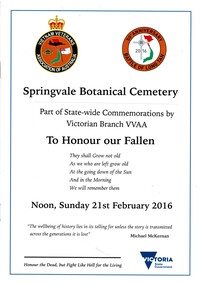
Booklet, Springvale Botanical Cemetery: Part of State-wide Commemorations by Victorian Branch VVAA , 50th Anniversary of Battle of Long Tan: Noon, Sunday 21st February, 2016, (Copy 2), 2016
... Signal Troop...Cpl John Hunter Whitton...311532...Pte Walter Johnston Davison...311546...Pte John Walter Desnoy...3791033...3rd Battalion...WO2 (Acting) Gilbert John Hartney...34854...Royal Corps of Australian Electrical and Mechanical...Battle of Long Tan Memorial Services Vietnam Veterans Association of Australia 50th Anniversary - Battle of Long Tan Killed in Action WO1 Raymond Kevin Nichols 1797 106 Field Workshop (RAEME) Pte Stephen James O'Dal 39016 Royal Australian Infantry Corps 8th Battalion The Royal Australian Regiment Pte Daryl Poulson 3795605 Australian National Serviceman Pte Terence Ronald Scott 38649 7th Battalion WO2 Terance Edward Lyon 52503 Royal Australian Army Ordnance Corps 2nd Advance Ordnance Depot Headquarters Australian Force Vietnam Sgt Noel Lowes 14574 Royal Australian Armoured Corps 1st Armoured Personnel Carrier Squadron A Squadron 3rd Cavalry Regiment 1st Armoured Regiment Leading Aircraftman Duncan Glen McNair A317006 Royal Australian Airforce No 9 Squadron Tpr Victor Ian Pomroy 3786644 1st Australian Reinforcement Unit Pte Richard Christopher Allan Watson 39403 1st Battalion Pte Geoffrey Lawrence Tweedie 3787416 1st Australian Task Force 6th Battalion L/Cpl John Francis Gillespie 3170244 Royal Australian Army Medical Corps 8th Field Ambulance Sgt William Francis Hacking 36448 Australian Army Training Team Vietnam (AATTV) Signalman Barry Arthur Logan 38324 Royal Australian Corps of Signals 709 Signal Troop 552 Signal Troop Cpl John Hunter Whitton 311532 Pte Walter Johnston Davison 311546 Pte John Walter Desnoy 3791033 3rd Battalion WO2 (Acting) Gilbert John Hartney 34854 Royal Corps of Australian Electrical and Mechanical Engineers. 102 Field Workshop Pte Douglas Brian Plain 3789448 Pte George Nagle 39565 9th Battalion Pte Paul Charles Sullivan 3786696 5th Battalion Pte Raymond John Moore 39923 Cpl (Temp) Noel Alan Smith 3797613 Royal Australian Engineers 21 Engineer Support Troop Lt Peter Robert Marks-Chapman 38801 L/Cpl Eric Halkyard 311620 Sapper Ronald Edward Davies 38530 1st Field Squadron Pte John Wallace Holloway 3794544 Pte Robert MacDonald Key 39493 L/Cpl John Noel McCarthy 3112702 1st Forward Delivery Troop B Squadron Sapper John Smith 3794831 Pte Allen Roy Brown 3794895 Pte Raymond Duncan Clark 3794556 Pte Barry John Munday 3795712 Sapper Dennis Lindsay Brooks 3787889 Pte Barleif Alfred Harstad 38939 Pte Garry Robert Polglase 38763 Pte Lawrence Rodney Sheppard 3790506 Pte John Richard Tinkham 3791207 WO2 (Temp) John Thomas Durrington 36485 An Order of Service for the Springvale Botanical Cemetery: Part of State-wide Commemorations by Victorian Branch VVAA , 50th Anniversary of Battle of Long Tan. ...An Order of Service for the Springvale Botanical Cemetery: Part of State-wide Commemorations by Victorian Branch VVAA , 50th Anniversary of Battle of Long Tan. See media file for more information.battle of long tan, memorial services, vietnam veterans association of australia, 50th anniversary - battle of long tan, killed in action, wo1 raymond kevin nichols, 1797, 106 field workshop (raeme), pte stephen james o'dal, 39016, royal australian infantry corps, 8th battalion, the royal australian regiment, pte daryl poulson, 3795605, australian national serviceman, pte terence ronald scott, 38649, 7th battalion, wo2 terance edward lyon, 52503, royal australian army ordnance corps, 2nd advance ordnance depot, headquarters, australian force vietnam, sgt noel lowes, 14574, royal australian armoured corps, 1st armoured personnel carrier squadron, a squadron, 3rd cavalry regiment, 1st armoured regiment, leading aircraftman duncan glen mcnair, a317006, royal australian airforce, no 9 squadron, tpr victor ian pomroy, 3786644, 1st australian reinforcement unit, pte richard christopher allan watson, 39403, 1st battalion, pte geoffrey lawrence tweedie, 3787416, 1st australian task force, 6th battalion, l/cpl john francis gillespie, 3170244, royal australian army medical corps, 8th field ambulance, sgt william francis hacking, 36448, australian army training team vietnam (aattv), signalman barry arthur logan, 38324, royal australian corps of signals, 709 signal troop, 552 signal troop, cpl john hunter whitton, 311532, pte walter johnston davison, 311546, pte john walter desnoy, 3791033, 3rd battalion, wo2 (acting) gilbert john hartney, 34854, royal corps of australian electrical and mechanical engineers., 102 field workshop, pte douglas brian plain, 3789448, pte george nagle, 39565, 9th battalion, pte paul charles sullivan, 3786696, 5th battalion, pte raymond john moore, 39923, cpl (temp) noel alan smith, 3797613, royal australian engineers, 21 engineer support troop, lt peter robert marks-chapman, 38801, l/cpl eric halkyard, 311620, sapper ronald edward davies, 38530, 1st field squadron, pte john wallace holloway, 3794544, pte robert macdonald key, 39493, l/cpl john noel mccarthy, 3112702, 1st forward delivery troop, b squadron, sapper john smith, 3794831, pte allen roy brown, 3794895, pte raymond duncan clark, 3794556, pte barry john munday, 3795712, sapper dennis lindsay brooks, 3787889, pte barleif alfred harstad, 38939, pte garry robert polglase, 38763, pte lawrence rodney sheppard, 3790506, pte john richard tinkham, 3791207, wo2 (temp) john thomas durrington, 36485 -
 Bendigo Military Museum
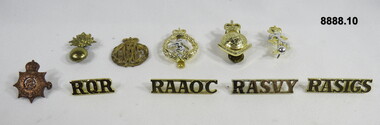
Badge - VARIOUS MILITARY BADGES, Unknown
... Mechanical and Engineers collar (ERII). 6. Army Service Corps collar. 7. Royal Queensland Regiment shoulder. 8. Royal Australian Army Ordnance Corps shoulder. 9. Royal Australian Survey Corps shoulder. 10. Royal Australian Signals...Mechanical and Engineers collar (ERII). 6. Army Service Corps collar. 7. Royal Queensland Regiment shoulder. 8. Royal Australian Army Ordnance Corps shoulder. 9. Royal Australian Survey Corps shoulder. 10. Royal Australian Signals ...Military badges either gold, silver or brass colour with or without a backing mounting plate, pins, sizes vary. 1. Royal Engineer Collar. 2. Women's Royal Australian Air Force hat (ERII). 3. Women's Royal Army Corp. 4. Royal Australian Survey Corps Hat (ERII). 5. Royal Australian Mechanical and Engineers collar (ERII). 6. Army Service Corps collar. 7. Royal Queensland Regiment shoulder. 8. Royal Australian Army Ordnance Corps shoulder. 9. Royal Australian Survey Corps shoulder. 10. Royal Australian Signals shoulder. passchendaele barracks trust, pbt431to440, badges -
 Ballarat Tramway Museum
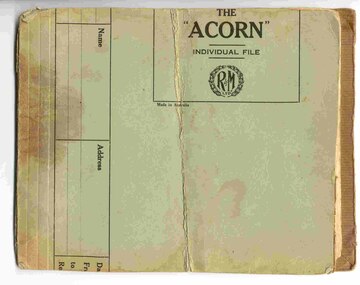
Book, State Electricity Commission of Victoria (SECV), Instructions or Rules to Motormen, post 1945
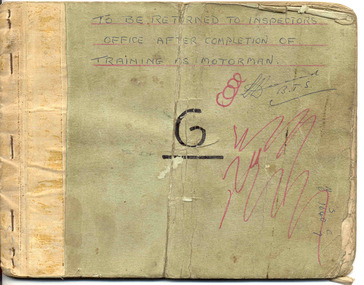
... Has five page index, then 34 pages, with 104 rules or instructions, covering Tramcar Equipment (electrical), location of faults, tramcar braking, failure of the mechanical brakes, tramcar emergency braking, automatic braking, automatic electric signals and general instructions for Ballarat. ...Has five page index, then 34 pages, with 104 rules or instructions, covering Tramcar Equipment (electrical), location of faults, tramcar braking, failure of the mechanical brakes, tramcar emergency braking, automatic braking, automatic electric signals and general instructions for Ballarat. ...Handmade book with light green covers made from a cut file holder with brown paper glued on the inside, containing 39 typed (original) sheets of paper giving Instructions or Rules to Motormen. Has five page index, then 34 pages, with 104 rules or instructions, covering Tramcar Equipment (electrical), location of faults, tramcar braking, failure of the mechanical brakes, tramcar emergency braking, automatic braking, automatic electric signals and general instructions for Ballarat. The brown paper appears to have been placed on the outside, as it is cut and glued on the inside of the book. Individual sheets held into the book with a metal clip. On the rear of the book, a small piece of cardboard has been glued over the back of the metal strip. Notes mentions bogie trams, so therefore post 1945. Gives details of route electric signals, use of doors on the trams relevant to the central median strip. On page 4, has hand drawn diagram showing the motors in series and parallel. On page 8 has a hand drawn diagram showing the car lighting circuit arrangements. Has been folded in the middle so as to store in pockets of a coat. Images show .1 - book, .2 - inside front cover and index sheet, .3 - hand made drawing - car lighting circuit. See Destination Eaglehawktrams, tramways, secv rules, rules, motormen, conductors -
 Ballarat Tramway Museum
Book, State Electricity Commission of Victoria (SECV), Ballarat Motorman (Driver) Training Manual or Guide - not a formal title, 1960's?, 1950's?
... On front cover is large letter "G" and words "To be returned to the inspectors office after completion of Training as Motorman" First four pages has index and covers: (A) Tramcar Equipment - electrical - items or clauses 1 to 28 (B) Location of Faults - items 29 - 41 (C) Tramcar Braking - items 42 to 59 (D) Failure of the Mechanical Brakes - items 60 to 67 (E) Tramcar Emergency Braking (Accident Prevention) - items 68 - 72 (F) Automatic Electric Signals - items 73 - 82 - gives locations of signals. ...On front cover is large letter "G" and words "To be returned to the inspectors office after completion of Training as Motorman" First four pages has index and covers: (A) Tramcar Equipment - electrical - items or clauses 1 to 28 (B) Location of Faults - items 29 - 41 (C) Tramcar Braking - items 42 to 59 (D) Failure of the Mechanical Brakes - items 60 to 67 (E) Tramcar Emergency Braking (Accident Prevention) - items 68 - 72 (F) Automatic Electric Signals - items 73 - 82 - gives locations of signals. ...Demonstrates aspects of the Ballarat Tramways system of training Motorman or drivers in the 1960's and the information there were given on driving trams. Shows the training methods of the time. 3486.1 - also details "Dead Man Brakes"Thirty Three page - carbon copy - within stapled light card covers - Ballarat Motorman (Driver) Training Manual or Guide - not a formal title. On front cover is large letter "G" and words "To be returned to the inspectors office after completion of Training as Motorman" First four pages has index and covers: (A) Tramcar Equipment - electrical - items or clauses 1 to 28 (B) Location of Faults - items 29 - 41 (C) Tramcar Braking - items 42 to 59 (D) Failure of the Mechanical Brakes - items 60 to 67 (E) Tramcar Emergency Braking (Accident Prevention) - items 68 - 72 (F) Automatic Electric Signals - items 73 - 82 - gives locations of signals. (G) General Instructions - items 83 to 98. See condition notes - not in the best condition - needs careful handling. 3486.4 - ditto - similar to above, but 34 pages through to instruction 104. Added section (F) after (E) - "Automatic Braking - clauses 72 - 79, possibly an earlier version of above when trams were fitted with dead man controls. Held within a cardboard folder with a metal binder. Cover has been covered with brown paper and adhesive tape, but only remains on the inside of the cover. Item added 3/10/2007. See Reg Item 8110i for a Bendigo, c1940 version.See above 3486.1 - has "Hall G - M.Cond" on front cover. Another name has been rubbed out.trams, tramways, driver training, sec, signals, braking, equipment, emergency, dead man controls -
 Wodonga & District Historical Society Inc
Photograph - Fred Rochow Railways Collection - Bicentennial Train Locomotive 3801 passing Wodonga Signal box, 29 October 1988
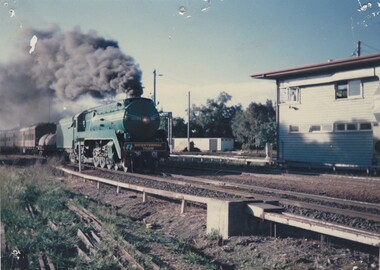
... Signal box. Locomotive 3801 was built by Sydney company The Clyde Engineering Co. Ltd., Granville in 1943 as the first of five streamlined (C) 38-class locomotives for the New South Wales Government Railways’ top-link express passenger duties. The delivery of 3801 was much delayed due to wartime labour & material shortages, together with competing wartime construction priorities. After many years of service, 3801 had been scheduled for withdrawal in 1962 due to deteriorating mechanical...Signal box. Locomotive 3801 was built by Sydney company The Clyde Engineering Co. Ltd., Granville in 1943 as the first of five streamlined (C) 38-class locomotives for the New South Wales Government Railways’ top-link express passenger duties. The delivery of 3801 was much delayed due to wartime labour & material shortages, together with competing wartime construction priorities. After many years of service, 3801 had been scheduled for withdrawal in 1962 due to deteriorating mechanical ...The Fred Rochow Railways Collection incorporates photos related to the operation of the Wodonga Railway Station including different types of trains and railways staff C. 1930 – 1990. It was donated to the Wodonga Historical Society by Fred Rochow, a railwayman who spent many years based in Wodonga. He joined the Victorian Railways on 17th June l947 and retired in 1988. For some time, he was a member of the Australian Federated Union of Locomotive Enginemen and served a term as a member of the Trades Hall Council. He had an extensive knowledge of the struggles that took place to achieve better conditions for railway workers. Fred worked for many years as a fireman and then worked his way up the ranks to driver, experiencing many changes from the days of steam locomotives through to diesel trains, locomotives and even the modern XPT train. He worked throughout Victoria at different stages of his career, with his final working years focused on the northeast of Victoria and the Albury to Melbourne line. After his retirement, Fred continued to share his love of steam miniature trains with the community.This collection has local and statewide significance as it captures images of trains, locomotives and personnel who operated the railway services in Wodonga and throughout Northeast Victoria. The railways played a critical role in opening up Victoria and connecting Australia for trade, business, social communication and transport.Bicentennial Train hauled by Locomotive 3801 passing the Wodonga Signal box. Locomotive 3801 was built by Sydney company The Clyde Engineering Co. Ltd., Granville in 1943 as the first of five streamlined (C) 38-class locomotives for the New South Wales Government Railways’ top-link express passenger duties. The delivery of 3801 was much delayed due to wartime labour & material shortages, together with competing wartime construction priorities. After many years of service, 3801 had been scheduled for withdrawal in 1962 due to deteriorating mechanical condition, but rail enthusiasts raised sufficient funds to cover the cost of its overhaul. 3801 joined the collection of the New South Wales Rail Transport Museum (NSWRTM), Enfield on withdrawal from NSWGR service and continued in operation as a tour locomotive. It hauled the “Western Endeavour” on the first crossing of the Australian continent by a standard gauge train from Sydney to Perth and return in August – September 1970. 3801 also stars in the railway film ‘A Steam Train Passes’ made by Film Australia in 1974 By 1976 had been withdrawn from service due to poor boiler condition and placed on static display by the Rail Transport Museum in Thirlmere, NSW. The Locomotive remained in Thirlmere until 1983 when it was decided it should be restored for the Australian Bicentenary in 1988. A new organisation was created specifically for the purpose of operating 3801, and thus 3801 Limited was incorporated on 5th June 1985. Work on the locomotive was completed after three years, with 3801 making its debut at a special Railway Ball hosted in its honour on 29th November 1986. During the Australian Bicentenary celebrations in 1988, it operated an extensive program across Australia visiting every mainland capital accessible by rail including an appearance at AusSteam ’88 in Melbourne in October 1988, stopping over in Wodonga on the way. After the company’s 20-year lease on the locomotive expired in 2006 Railcorp chose not to extend the agreement, and the locomotive returned to the Rail Transport Museum at Thirlmere (now the NSW Rail Museum). 3801 was withdrawn from service in 2007 for major boiler repairs. Locomotive 3801 was officially relaunched at Sydney's Central Station on Friday 12 March 2021 by Her Excellency, the Honourable Margaret Beazley AC QC, Governor of New South Wales.On front of locomotive Australia Bicentennial logo and sign "BICENTENNIAL TRAIN/3801" railways wodonga, fred rochow, locomotive r761, bicentennial train, locomotive 3801 -
 City of Melbourne Libraries
Photograph, Bull, Hugh Jones, 1897-1993, Miss Betty Sale
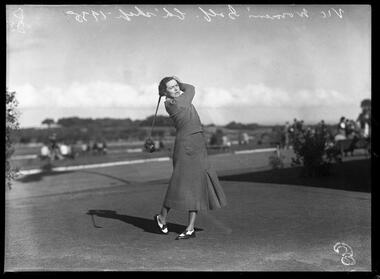
... Signal Station. In 1946, she married Lt-Col H. Henry O. Rigg of the Royal Artillery in Tasmania. The couple had first met in Algeria in 1943. The Australian press closely followed Betty’s wartime activities praising her courage, capability, driving and mechanical knowledge and of course Australian women’s hardiness. ...Signal Station. In 1946, she married Lt-Col H. Henry O. Rigg of the Royal Artillery in Tasmania. The couple had first met in Algeria in 1943. The Australian press closely followed Betty’s wartime activities praising her courage, capability, driving and mechanical knowledge and of course Australian women’s hardiness. ...Betty Sale (1905-1976) won the Tasmanian State Championship in 1934, 1935 and 1936. She also worked as a car saleswoman in Hobart. In 1939, London reported: “Betty Sale, pretty Tasmanian brunette, will soon leave England for Finland, where she will drive an ambulance behind the Mannerheim Line. With twenty-three English society girls, she volunteered for the job because she wanted to do something for the brave Finns.” Betty volunteered for First Aid Nursing Yeomanry Service (F.A.N.Y.), conveying refugees and casualties to hospitals by ambulance in Finland’s harsh weather. Back in England, as a corporal, she worked during bombings in Plymouth, writing to her brother: “Bombs were dropping all around us, fires are raging, debris everywhere and huge holes around us. When we had got all the live ones, we went and collected dead bodies.” Betty was awarded an MBE and the Winter War Medal for Civilians from Finland Government 1939-40. MCK142 Published The Age 29 August 1935 Featured in "Newsworthy: Melbourne in photographs 1933-1936" exhibition at East Melbourne Library, October to December 2023. Exhibition caption by project volunteer, Fiona Collyer. Photographer notations on slide: "Vic. Women's Golf Ch'ship 1935 B98" Published: The Age 29 August 1935 p. 11 Published title: SIX STATE CHAMPIONS IN NATIONAL GOLF CHAMPIONSHIP. Published caption: Six State champions for the first time in the history of women’s golf are competing in the matches for the Australian title. — 1. Miss B. Sale (Tas.). 2. Miss J. Hood-Hammond (N.S.W.). 3. Miss J. Gardiner (Qld,) 4. Miss K. Rymill (S.A.). 5. Mrs. O. J. Negus (W.A.). 6. Mrs. S. Morpeth (Vic.) RESEARCHER'S NOTE: The Age listed Golfer 1 as Miss B. Sale and Golfer 4 as Miss K. Rymill. We verified that these should in fact be the other way around: 1 is Miss K. Rymill, 4 is Miss B. Sale. Description: Action shot of woman driving golf ball Research by project volunteer, Fiona Collyer: MISS BETTY SALE Mrs Margaret Elizabeth Scott Rigg (1905-1976) MBE Betty Sale grew up in Hobart and attended St Michael’s Collegiate School. She was a champion Tasmania golfer and won the State Championship in 1934, 1935, 1936. Betty competed in the Australian Women’s Golf Championship at Royal Melbourne against the British Women’s Team in 1935. Betty worked as a car saleswoman at Robert Nettleford Pty Ltd at 113 Macquarie Street, Hobart. They were the agent for Austin, Buick, Chevrolet and Vauxhall. In April 1939, Betty sailed on the RMS Orford to London where she worked in sales for Henley’s, an exclusive motor sales firm. In November 1939 she volunteered for the Woman’s Transport Arm of the First Aid Nursing Yeomanry Service (F.A.N.Y.) and was part of the team delivering 10 ambulances to Finland, which had been invaded by the Soviet Union. Betty worked conveying refugees and military casualties to military hospitals, often over tracks with only sleigh marks to guide them. Despite contracting measles she continued to work tirelessly, often for 22-hour shifts. She was awarded the Finland Winter War medal 1939-1940 for civilians by Field-Marshall Mannerheim (later President of Finland). Betty was quoted in the Australian Women’s Weekly 17/1/1940: “I joined the ambulance corp for Finland because I was filled with admiration for the courage and determination of the Finns. I don’t think that there has ever been anything so dramatic in history as the manner in which Finland, a land of 4,000,000 people has resisted the aggression of the teeming millions of Russians.” After six months working in Finland, the FANYs found themselves held up unable to get aid from Britain to escape and they felt a burden on the Finns. Eventually money was sent privately from a neutral country and the 17 FANYs determined to get away. They set off from Helsinki with only the civilian clothes they were wearing and travelled by train and bus to a northern port where they boarded a cargo vessel. For a fortnight they did not change their clothes and slept under tarpaulins in the hatchway. The only choice of food was porridge or pea soup. After two weeks aboard the cargo vessel, a palatial liner approached the ship and in mid-ocean the FANYs were transhipped by rope ladders. The women enjoyed three course meals and other luxuries for three days before arriving back in England. Betty, now a corporal, worked for two years transporting civilian and military casualties during bombings in Plymouth. In a letter to her brother, Mr J Sale of Gerogery NSW, Betty wrote, “We have had a very lively time here as we have been blitzed for two nights. There is literally nothing of Plymouth left. We were out all the first night with the ambulance collecting casualties and have never seen such injuries. Bombs were dropping all around us, fires were raging, debris everywhere, and huge holes in the roads. When we had got all the live ones, we went and collected dead bodies. The people are marvellous.” “Next night, we had a worse blitz. We were not out so long but it was not a pleasant party. I didn’t know I was so brave but could not stand it too long. Mr Menzies was here for the second night’s blitz. We have adopted a homeless and hurt dog – a raid victim – and the poor fellow is completely exhausted.” In 1942, Betty worked in Algeria in charge of 100 specialists and technicians - the first servicewomen to arrive in North Africa. In 1945, she was awarded an MBE in recognition and on behalf of the work this unit was involved in. In 1945, Betty was promoted to Captain and posted to Australia to establish a Signal Station. In 1946, she married Lt-Col H. Henry O. Rigg of the Royal Artillery in Tasmania. The couple had first met in Algeria in 1943. The Australian press closely followed Betty’s wartime activities praising her courage, capability, driving and mechanical knowledge and of course Australian women’s hardiness. After the war, Betty lived in Sheffield, England with her husband, working as an office manager. She continued to play golf until her death aged 71 in 1976.Photographer notations on slide: "Vic. Women's Golf Ch'ship 1935 B98".golf, women golfers, royal melbourne golf club -
 Victorian Railway History Library
Book, Wilson, Raynar, Railway-Signalling: Mechanical, 1923
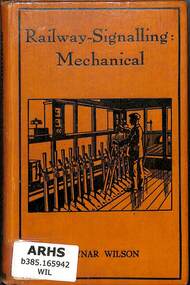
... Railway-Signalling: Mechanical Book Wilson, Raynar Pitman's Technical Primers ...A history of mechanical railway signalling.index, bib, ill, maps, p.123.non-fictionA history of mechanical railway signalling.railroads - great britain - history, railroad signalling - great britain - history
