
Showing 8 items matching "medical practioners"
-
 Clunes Museum
Administrative record - IMMUNISATION NOTICE, 1908
... DOCUMENT OF NOTICE FOR CHILD TO BE VACCINATED BY MEDICAL PRACTIONER OR PARENT WILL BE LIABLE TO A PENALTY OF TEN TO FORTY SHILLINGS....LOCAL HISTORY CERTIFICATE HEALTH DOCUMENT OF NOTICE FOR CHILD TO BE VACCINATED BY MEDICAL PRACTIONER OR PARENT WILL BE LIABLE TO A PENALTY OF TEN TO FORTY SHILLINGS. ...MR. LACHLAN McLENNAN OF GEORGE STREET CLUNES - GENTLEMAN TO ATTEND DOCTORS RESIDENCE FOR HIS CHILD WINIFRED MAUD MCLENNAN TO RECEIVE VACCINATION 21ST JULY 1908.DOCUMENT OF NOTICE FOR CHILD TO BE VACCINATED BY MEDICAL PRACTIONER OR PARENT WILL BE LIABLE TO A PENALTY OF TEN TO FORTY SHILLINGS.local history, certificate, health -
Emerald Museum & Nobelius Heritage Park
Equipment - Medical instruments, Various, C. 1930
... ...Medical practioners...Emerald Victoria Australia medical services Medical practioners doctors (medical) Dr Bottomley Medical instruments used by Dr Bottomley at his Emerald clinic. 1. ...Used by Dr Bottomley, medical practitioner, Emerald.Medical instruments used by Dr Bottomley at his Emerald clinic. 1. Milne Murray obstetrical forceps 2. Ditto (smaller size) 3. Vetinary syringes 4. Hellige haemometer 5. Hellige haemocytometer 6. "Klinostik" super diagnostic "AuroscSteel|Glassemerald, victoria, australia, medical services, medical practioners, doctors (medical), dr bottomley -
Tatura Irrigation & Wartime Camps Museum
Folio, Dr. James Park
... D.Tatura 1938. Medical Practioner in Tatura...D.Tatura 1938. Medical Practioner in Tatura documents biography Collection of Newspaper cuttings, Free Press reporting details of his life and death. ...Dr. James Park, B. Mangalore 1864. D.Tatura 1938. Medical Practioner in TaturaCollection of Newspaper cuttings, Free Press reporting details of his life and death. These include his playing days with Carlton Football Clubdocuments, biography -
 Flagstaff Hill Maritime Museum and Village
Document - Permit, Commonwealth of Australia, Permit to Board Ships, 1940
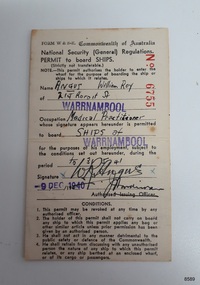
... Name etc: 'Angus, William Roy', 214 Koroit St, Warrnambool'. 'Medical Practioner'. Signature of Dr Angus. Signature of the Autorised Issuing Officer (undecipherable). ...Name etc: 'Angus, William Roy', 214 Koroit St, Warrnambool'. 'Medical Practioner'. Signature of Dr Angus. Signature of the Autorised Issuing Officer (undecipherable). ...This permit was donated to Flagstaff Hill Maritime Village by the family of Doctor William Roy Angus, Surgeon and Oculist. It is part of the “W.R. Angus Collection” that includes historical medical equipment, surgical instruments and material once belonging to Dr Edward Ryan and Dr Thomas Francis Ryan, (both of Nhill, Victoria) as well as Dr Angus’ own belongings. The Collection’s history spans the medical practices of the two Doctors Ryan, from 1885-1926 plus that of Dr Angus, up until 1969. ABOUT THE “W.R.ANGUS COLLECTION” Doctor William Roy Angus M.B., B.S., Adel., 1923, F.R.C.S. Edin.,1928 (also known as Dr Roy Angus) was born in Murrumbeena, Victoria in 1901 and lived until 1970. He qualified as a doctor in 1923 at University of Adelaide, was Resident Medical Officer at the Royal Adelaide Hospital in 1924 and for a period was house surgeon to Sir (then Mr.) Henry Simpson Newland. Dr Angus was briefly an Assistant to Dr Riddell of Kapunda, then commenced private practice at Curramulka, Yorke Peninsula, SA, where he was physician, surgeon and chemist. In 1926, he was appointed as new Medical Assistant to Dr Thomas Francis Ryan (T.F. Ryan, or Tom), in Nhill, Victoria, where his experiences included radiology and pharmacy. In 1927 he was Acting House Surgeon in Dr Tom Ryan’s absence. Dr Angus had become engaged to Gladys Forsyth and they decided he would take time to further his studies overseas in the UK in 1927. He studied at London University College Hospital and at Edinburgh Royal Infirmary and in 1928, was awarded FRCS (Fellow from the Royal College of Surgeons), Edinburgh. He worked his passage back to Australia as a Ship’s Surgeon on the on the Australian Commonwealth Line’s T.S.S. Largs Bay. Dr Angus married Gladys in 1929, in Ballarat. (They went on to have one son (Graham 1932, born in SA) and two daughters (Helen (died 12/07/1996) and Berenice (Berry), both born at Mira, Nhill ) Dr Angus was a ‘flying doctor’ for the A.I.M. (Australian Inland Ministry) Aerial Medical Service in 1928 . The organisation began in South Australia through the Presbyterian Church in that year, with its first station being in the remote town of Oodnadatta, where Dr Angus was stationed. He was locum tenens there on North-South Railway at 21 Mile Camp. He took up this ‘flying doctor’ position in response to a call from Dr John Flynn; the organisation was later known as the Flying Doctor Service, then the Royal Flying Doctor Service. A lot of his work during this time involved dental surgery also. Between 1928-1932 he was surgeon at the Curramulka Hospital, Yorke Peninsula, South Australia. In 1933 Dr Angus returned to Nhill where he’d previously worked as Medical Assistant and purchased a share of the Nelson Street practice and Mira hospital from Dr Les Middleton one of the Middleton Brothers, the current owners of what was once Dr Tom Ryan’s practice. Dr L Middleton was House Surgeon to the Nhill Hospital 1926-1933, when he resigned. [Dr Tom Ryan’s practice had originally belonged to his older brother Dr Edward Ryan, who came to Nhill in 1885. Dr Edward saw patients at his rooms, firstly in Victoria Street and in 1886 in Nelson Street, until 1901. The Nelson Street practice also had a 2 bed ward, called Mira Private Hospital ). Dr Edward Ryan was House Surgeon at the Nhill Hospital 1884-1902 . He also had occasions where he successfully performed veterinary surgery for the local farmers too. Dr Tom Ryan then purchased the practice from his brother in 1901. Both Dr Edward and Dr Tom Ryan work as surgeons included eye surgery. Dr Tom Ryan performed many of his operations in the Mira private hospital on his premises. He too was House Surgeon at the Nhill Hospital 1902-1926. Dr Tom Ryan had one of the only two pieces of radiology equipment in Victoria during his practicing years – The Royal Melbourne Hospital had the other one. Over the years Dr Tom Ryan gradually set up what was effectively a training school for country general-practitioner-surgeons. Each patient was carefully examined, including using the X-ray machine, and any surgery was discussed and planned with Dr Ryan’s assistants several days in advance. Dr Angus gained experience in using the X-ray machine there during his time as assistant to Dr Ryan. Dr Tom Ryan moved from Nhill in 1926. He became a Fellow of the Royal Australasian College of Surgeons in 1927, soon after its formation, a rare accolade for a doctor outside any of the major cities. He remained a bachelor and died suddenly on 7th Dec 1955, aged 91, at his home in Ararat. Scholarships and prizes are still awarded to medical students in the honour of Dr T.F. Ryan and his father, Dr Michael Ryan, and brother, John Patrick Ryan. ] When Dr Angus bought into the Nelson Street premises in Nhill he was also appointed as the Nhill Hospital’s Honorary House Surgeon 1933-1938. His practitioner’s plate from his Nhill surgery states “HOURS Daily, except Tuesdays, Fridays and Saturday afternoons, 9-10am, 2-4pm, 7-8pm. Sundays by appointment”. This plate is now mounted on the doorway to the Port Medical Office at Flagstaff Hill Maritime Village, Warrnambool. Dr Edward Ryan and Dr Tom Ryan had an extensive collection of historical medical equipment and materials spanning 1884-1926 and when Dr Angus took up practice in their old premises he obtained this collection, a large part of which is now on display at the Port Medical Office at Flagstaff Hill Maritime Village in Warrnambool. During his time in Nhill Dr Angus was involved in the merging of the Mira Hospital and Nhill Public Hospital into one public hospital and the property titles passed on to Nhill Hospital in 1939. In 1939 Dr Angus and his family moved to Warrnambool where he purchased “Birchwood,” the 1852 home and medical practice of Dr John Hunter Henderson, at 214 Koroit Street. (This property was sold in1965 to the State Government and is now the site of the Warrnambool Police Station. ). The Angus family was able to afford gardeners, cooks and maids; their home was a popular place for visiting dignitaries to stay whilst visiting Warrnambool. Dr Angus had his own silk worm farm at home in a Mulberry tree. His young daughter used his centrifuge for spinning the silk. Dr Angus was appointed on a part-time basis as Port Medical Officer (Health Officer) in Warrnambool and held this position until the 1940’s when the government no longer required the service of a Port Medical Officer in Warrnambool; he was thus Warrnambool’s last serving Port Medical Officer. (The duties of a Port Medical Officer were outlined by the Colonial Secretary on 21st June, 1839 under the terms of the Quarantine Act. Masters of immigrant ships arriving in port reported incidents of diseases, illness and death and the Port Medical Officer made a decision on whether the ship required Quarantine and for how long, in this way preventing contagious illness from spreading from new immigrants to the residents already in the colony.) Dr Angus was a member of the Australian Medical Association, for 35 years and surgeon at the Warrnambool Base Hospital 1939-1942, He served as a Surgeon Captain during WWII1942-45, in Ballarat, Victoria, and in Bonegilla, N.S.W., completing his service just before the end of the war due to suffering from a heart attack. During his convalescence he carved an intricate and ‘most artistic’ chess set from the material that dentures were made from. He then studied ophthalmology at the Royal Melbourne Eye and Ear Hospital and created cosmetically superior artificial eyes by pioneering using the intrascleral cartilage. Angus received accolades from the Ophthalmological Society of Australasia for this work. He returned to Warrnambool to commence practice as an ophthalmologist, pioneering in artificial eye improvements. He was Honorary Consultant Ophthalmologist to Warrnambool Base Hospital for 31 years. He made monthly visits to Portland as a visiting surgeon, to perform eye surgery. He represented the Victorian South-West subdivision of the Australian Medical Association as its secretary between 1949 and 1956 and as chairman from 1956 to 1958. In 1968 Dr Angus was elected member of Spain’s Barraquer Institute of Barcelona after his research work in Intrasclearal cartilage grafting, becoming one of the few Australian ophthalmologists to receive this honour, and in the following year presented his final paper on Living Intrasclearal Cartilage Implants at the Inaugural Meeting of the Australian College of Ophthalmologists in Melbourne In his personal life Dr Angus was a Presbyterian and treated Sunday as a Sabbath, a day of rest. He would visit 3 or 4 country patients on a Sunday, taking his children along ‘for the ride’ and to visit with him. Sunday evenings he would play the pianola and sing Scottish songs to his family. One of Dr Angus’ patients was Margaret MacKenzie, author of a book on local shipwrecks that she’d seen as an eye witness from the late 1880’s in Peterborough, Victoria. In the early 1950’s Dr Angus, painted a picture of a shipwreck for the cover jacket of Margaret’s book, Shipwrecks and More Shipwrecks. She was blind in later life and her daughter wrote the actual book for her. Dr Angus and his wife Gladys were very involved in Warrnambool’s society with a strong interest in civic affairs. Their interests included organisations such as Red Cross, Rostrum, Warrnambool and District Historical Society (founding members), Wine and Food Society, Steering Committee for Tertiary Education in Warrnambool, Local National Trust, Good Neighbour Council, Housing Commission Advisory Board, United Services Institute, Legion of Ex-Servicemen, Olympic Pool Committee, Food for Britain Organisation, Warrnambool Hospital, Anti-Cancer Council, Boys’ Club, Charitable Council, National Fitness Council and Air Raid Precautions Group. He was also a member of the Steam Preservation Society and derived much pleasure from a steam traction engine on his farm. He had an interest in people and the community He and his wife Gladys were both involved in the creation of Flagstaff Hill, including the layout of the gardens. After his death (28th March 1970) his family requested his practitioner’s plate, medical instruments and some personal belongings be displayed in the Port Medical Office surgery at Flagstaff Hill Maritime Village, and be called the “W. R. Angus Collection”.This Permit to Board Ships at Warrnambool is significant for connecting Doctor W.R. Angus to the maritime history of Warrnambool in the 1930s and 1940s, as the health and security of those on board arriving vessels and those of the community were his responsibility at that time. The W.R. Angus Collection is significant for still being located at the site it is connected with, Doctor Angus being the last Port Medical Officer in Warrnambool. The collection of medical instruments and other items and equipment is culturally significant, being an historical example of medicine from late 19th to mid-20th century. Dr Angus assisted Dr Tom Ryan, a pioneer in the use of X-rays and in ocular surgery.PERMIT to Board Ships. A thick white card with black print, stamps and signatures. Issued by the Commonwealth of Australia, National Security(General) Regulations. It includes the Conditions of use and is dated 9th December, 1940. The card permits the holder to board ships at Warrnambool and was issued to Dr William Roy Angus in his capacity as Port Medical Officer in Warrnambool. It is part of the W.R. Angus Collection.Various: Stamped 'Warrnambool' in two places; numbered 'No. 6755'. Name etc: 'Angus, William Roy', 214 Koroit St, Warrnambool'. 'Medical Practioner'. Signature of Dr Angus. Signature of the Autorised Issuing Officer (undecipherable). Issue date: '9 Dec 1940'.flagstaff hill maritime museum and village, great ocean road, shipwreck coast, world war ii, permit, quarantine, medical, permit to board ships, national security, port medical officer, last port medical officer, warrnambool harbour, ship quarrantine, 1900s, w.r. angus -
 Phillip Island and District Historical Society Inc.
Photograph
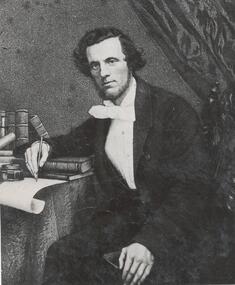
... Dr Louis Smith was born in London and died in East Melbourne. 15/5/1830 to 8/7/1910. He was a Medical Practioner and Politician. He migrated to Australia as ship's surgeon on the Oriental arriving in Melbourne 11th December 1852....Dr Louis Smith was born in London and died in East Melbourne. 15/5/1830 to 8/7/1910. He was a Medical Practioner and Politician. He migrated to Australia as ship's surgeon on the Oriental arriving in Melbourne 11th December 1852. ...One of a collection of over 400 photographs in an album commenced in 1960 and presented to the Phillip Island & Westernport Historical Society by the Shire of Phillip IslandPhotograph of a Portrait of Dr L. L. Smith seated at table with pen in hand painted by Henry Sadd. Dr Louis Smith was born in London and died in East Melbourne. 15/5/1830 to 8/7/1910. He was a Medical Practioner and Politician. He migrated to Australia as ship's surgeon on the Oriental arriving in Melbourne 11th December 1852.local history, photography, photographs, dr l l smith, black & white photograph, doctors, phillip island, early associates, john jenner, bryant west -
 Alfred Hospital Nurses League - Nursing History Collection
Document - Constitution & Rules, The Alfred Hospital, Constitution & Rules of the Alfred Hospital 1870, 1870
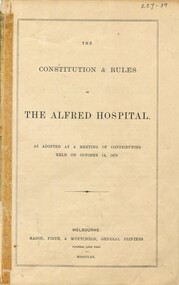
... People wanting to become outpatients had to have a recommendation from "a magistrate, minister of religion, medical practioner, business firm or some other respectable party" that will satisfy the Admissions Committee that the applicant requires the assistance of the charity...People wanting to become outpatients had to have a recommendation from "a magistrate, minister of religion, medical practioner, business firm or some other respectable party" that will satisfy the Admissions Committee that the applicant requires the assistance of the charity Impotant document in the History of the Alfred Hospital Alfred Hospital Hospitals - Victoria - History Hospital Constitution and Rules previous catalogue number handwritten [black ink] at top right of front cover. ...The Alfred Hospital was established aA chaityto erect and support a hospital in the city of Melboune. 'The Constitution and Rules of the Alfred Hospital' were adopted at a meeting of contributors held on October 14, 1870. The 'contributors' had donated at least 20 pounds sterling or more, in one sum, or one dollar or more as an annual subscrption "as long as they shall continue to pay it" A 25 member committee of management included the President of the Legeslative Assembly (Victoria), The Speaker of the Legaslitive Assembly, the Chancellor of the University of Melbourne, the Mayors of Melbourne, Prahan, St Kilda, Emerald Hill & Sandridge, the Chairman of the Chamber of Commerce, Melbourne and the President of the Royal Society, Melbourne. The remaining 15 members were to e elected. There were to be four sub committees :- finance, building admission and weekly. Details of appointment of medical staff are included, but no mention is made of nursing staff. Apart from accidents and emergengies, patients had to present for admission on Fridays between 1100 and 1200. "No lunatic, person having the small pox, or suffering from chronic epilepsy or from ulcerated lgs of longstanding or pregnant female for the purpose of confinement, or any case which might be equally relieved as an outpatient, shall be deemed a proper case for admission". People wanting to become outpatients had to have a recommendation from "a magistrate, minister of religion, medical practioner, business firm or some other respectable party" that will satisfy the Admissions Committee that the applicant requires the assistance of the charityImpotant document in the History of the Alfred HospitalUnbound booklet.Black print on cream paper, Front page has details of title, printer and year (MDCCCLXX) within a double line borderprevious catalogue number handwritten [black ink] at top right of front cover. Residue from wear tape has been,Annotations on page 3, 'FIRST' and "14-10-1870' [pencilalfred hospital, hospitals - victoria - history, hospital constitution and rules -
 Eltham District Historical Society Inc
Document, Appointment of New Trustees, Eltham Public Hall, Lot 20 Henry Street, Eltham, 1940
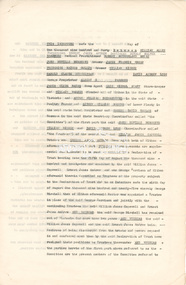
... Draft of Indenture made __ day of __ 1940 between William Allen, Nurseryman, Ernest James Andrew, Gentleman, Ronald Walter Bradbury, Medical Practioner, Robert Sutherland Bryan, John Neville Burgoyne, Grocer, James Francis Cresp, Frederick Haines Collis, Grocer, William Hickey, Harold Claude Hutchison, David Andrew Lyon, Garage Proprietior, Albert E. ...Draft of Indenture made __ day of __ 1940 between William Allen, Nurseryman, Ernest James Andrew, Gentleman, Ronald Walter Bradbury, Medical Practioner, Robert Sutherland Bryan, John Neville Burgoyne, Grocer, James Francis Cresp, Frederick Haines Collis, Grocer, William Hickey, Harold Claude Hutchison, David Andrew Lyon, Garage Proprietior, Albert E. ...Draft of Indenture made __ day of __ 1940 between William Allen, Nurseryman, Ernest James Andrew, Gentleman, Ronald Walter Bradbury, Medical Practioner, Robert Sutherland Bryan, John Neville Burgoyne, Grocer, James Francis Cresp, Frederick Haines Collis, Grocer, William Hickey, Harold Claude Hutchison, David Andrew Lyon, Garage Proprietior, Albert E. Parsons, James Clyde Rains, News Agent, Eric Nicholl Staff, Store-keeper and William Walker, Plumber all of Eltham in the State of Victoria and Anton William Brinkkotter, Poultry Farmer in the said State and Sidney William Browne, Hotel Proprietor of Lower Plenty and Robert David Taylor, Secretary of Rosanna (the Committee) to appoint John Neville Burgoyne, William Hickey and David Andrew Lyon as Trustees to replace William James Capewell, Ernest James Andrew and George Birchall. William James Capewell, Butcher and Ernest James Andrew, News Agent and both of Eltham and George Harrison were the original Trustees appointed in the Declaration of Trust dated 5 August 1922. George Birchall replaced George Harrison 6 August 1925 but after being absent from the State for more than two years and William James Capewell and Ernest James Andrew desirous of being discharged as Trustees, under the power of appointing new Trustees vested in the Committee, the Committee resolved on 14 November 1935 that Albert Henry Charles Price, Cecil Martin and Albert John Fahle should be Trustees in place of George Birchall, Ernest James Andrew and William James Capewell however the said resolution was never carried into effect and the said writing was never completed. Subsequently in 1940 Albert Henry Charles Price, Cecil Martin and Albert John Fahle each resigned in writing as Trustees even though never appointed and so the Committee appointed John Neville Burgoyne, William Hickey and David Andrew Lyon as Trustees in place of William James Capewell, Ernest James Andrew and George Birchall. Originally purchased in 1856 from Thomas Roberts, Yeoman of Little Eltham, for £10 for use by the Wesleyan Chapel, represented by indentured Trustees, Rev. Barnabas Shaw Walker, Minister of the Pentridge Circuit, Francis Thomas, Farmer of Keelbundora, William Harriman, Blacksmith of Nillumbik, Nicholas Rodda, Farmer of Nillumbik, Aaron Grimshaw, Farmer of Greensborough, Joseph Cooper, Gardener of Keelbundora, Peter Dredge, Scholmaster of Jika Jika and Samuel Jeffrey, Farmer of Jika Jika. Lot 20 of Subdivision of Portion 13, Section 4 of the Parish of Nillumbik in the County of Evelyn was located on the southern side of Henry street in Little Eltham North, where the current Our Lady Help of Christians Catholic Church is situated. It became the location of the Eltham Rechabite Hall. In 1893 a new hall was built and further enlarged in 1919. At the commencement of 1922, the property was purchased from the Independent Order of Rechabites with publicly subscribed funds and a new hall built at a cost of £750 and improved road access constructed to reduce the grade, running from Dudley Street to Henry Street. This hall was eventually replaced with the new Shire Offices and Hall built on the corner of Arthur Street and Main Road, which was opened in 1941. Traces the earliest history of the Eltham Public Hall in Henry Street and the various names, occupations and abodes of the Trustees associated with the propertyalbert e. parsons, albert henry charles price, albert john fahle, anton william brinkkotter, cecil martin, david andrew lyon, eltham public hall, eltham rechabite hall, eltham wesleyan chapel, eric nicholl staff, ernest james andrew, frederick haines collis, george birchall, grocer, harold claude hutchison, henry street, james clyde rains, james francis cresp, john neville burgoyne, robert david taylor, robert sutherland bryan, ronald walter bradbury, sidney william browne, trustee, william allen, william hickey, william james capewell, william walker -
 Orbost & District Historical Society
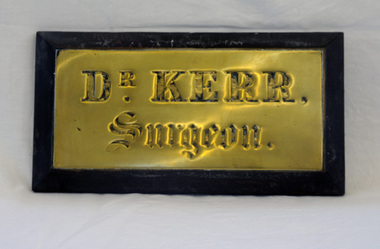
Functional object - brass plaque, name plaque, 1889
... ...medical practioner...Dr Kerr Orbost surgeon medical practioner regional doctor brass door plaque 1889-1928 Dr. ...Dr James Kerr practised medicine in Orbost from 1889 -1928. He was the first doctor to settle in Orbost. He served the Orbost community for 40 years travelling everywhere on horseback. He married Hilda Constance Temple in Orbost on November 30, 1893. On April 29th 1931, three glass windows were dedicated to "Dr James Kerr. Beloved Physician of Orbost" in St James Church of England , Orbost. ( Ref Orbost Hospital, History, Personalities and Stories by Margaret Hollands)Dr James Kerr was the first doctor to settle in Orbost. He was an integral part of the Orbost community for over 40 years. This plaque was at his house where he had his surgery. The house no longer exists. Large, brass rectangle housed in dark wooden frame. Deeply engraved and blackened writing filling almost entire plaque.Dr. KERR, / Surgeon.dr kerr, orbost surgeon, medical practioner, regional doctor, brass door plaque, 1889-1928
