
Showing 8 items matching "medicinal powders"
-
 Mont De Lancey
Domestic object - Foot Powder, Dr Harley, mid 20th Century
... Medicinal powders...It was widely known as a trusted, over-the-counter remedy to help manage foot odour, sweating, and minor fungal irritations in a time when specialized foot care became a household priority. Medicinal powders Medicinal containers Pharmacy products Directions are detailed on the wrapper. ...Dr. Harley’s Foot Powder was a popular pharmacy and chemist staple during the mid-20th century. It was widely known as a trusted, over-the-counter remedy to help manage foot odour, sweating, and minor fungal irritations in a time when specialized foot care became a household priority.A small cylindrical tin of Dr Harley's Reg. Foot Powder with a small screw top lid. The lid is removable to show five holes for the powder to be shaken out for use on feet or shoes. It has a white paper wrap-around label with a pale blue triangle and a black lined illustration of the powder being used on a foot. The name and directions for use are printed in black lettering.Recommended for use with Dr Harley's Foot Soap.Directions are detailed on the wrapper.medicinal powders, medicinal containers, pharmacy products -
 Geoffrey Kaye Museum of Anaesthetic History
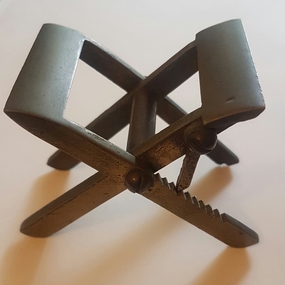
Functional object - Medicinal paper folder, 19th Century
... This item was used to fold paper for medicinal powder....This item was used to fold paper for medicinal powder. Functional object Medicinal paper folder ...Brass apparatus used for medicines, probably even patent medicines, concocted in the chemist's shop.The brass paper folder, when extended, sits in an "X" shaped position; the two 'sides' are held together with two central screws, one on each side. One of the legs is serrated to allow a support to sit on it, propping up the apparatus into an upright and open position. This item was used to fold paper for medicinal powder.medicine, patent medicine -
 Flagstaff Hill Maritime Museum and Village
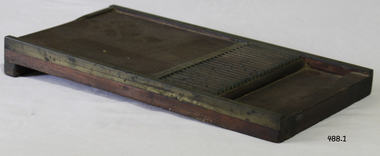
Equipment - Pill Maker Board
... A ‘pill mass’ of medicinal powders mixed with a binding agent would be hand-rolled into a pipe on the tile at the back of the machine. ...A ‘pill mass’ of medicinal powders mixed with a binding agent would be hand-rolled into a pipe on the tile at the back of the machine. ...Before factory production became commonplace in medicine, dispensing was considered an art and pill machines such as these were a vital component of any chemist’s collection. This machine dates back to the days when your local chemist or apothecary bought, sold, and manufactured all his own drugs and medicines to everybody who lived within the local community. In Victorian times, there was no such thing as off-the-shelf medicine. Every tablet, pill, suppository, ointment, potion, lotion, tincture and syrup to treat anything from a sore throat to fever, headaches or constipation, was made laboriously by hand, by the chemist. Pill machines such as these first appeared in the mid-1700s and quickly became a staple of the Victorian chemist’s shop. A ‘pill mass’ of medicinal powders mixed with a binding agent would be hand-rolled into a pipe on the tile at the back of the machine. This would then be placed across the grooved brass plate and cut into equal-sized pills using the corresponding side of the roller. Once all the necessary ingredients for the pills had been measured and ground with a pestle and mortar a final ingredient was poured in, syrup – this acted as a binding-agent. You could then roll it into a sausage shape. The largest part of the machine is the board. This is set at an angle and is comprised of the rolling surface, the cutting grooves, and the collection-tray. The large flat surface is for rolling out the pill-paste into the sausage shape. This is then rolled towards the brass cutting-grooves. The paddle (the second piece) is flipped over so that the grooves there line up with the grooves on the board. Rollers on the ends of the paddle roll against the brass edges of the board, and they guide the paddle straight across the grooves, taking the pill-mass with it. The grooves on the paddle and the board slice up the pill-mass and, after rolling the thing back and forth a couple of times like a rolling-pin, the circular pills roll off the grooves and into the tray at the bottom. https://galwaycitymuseum.ie/blog/collections-spotlight-victorian-pill-making-machine/?locale=en The collection of medical instruments and other equipment in the Port Medical Office is culturally significant, being an historical example of medicine from late 19th to mid-20th century. Pill making device including a grooved base board and grooved sliding board with two pill moulds.None.flagstaff hill, warrnambool, shipwrecked-coast, flagstaff-hill, flagstaff-hill-maritime-museum, maritime-museum, shipwreck-coast, flagstaff-hill-maritime-village, pills, pill maker, medicine, health -
 Flagstaff Hill Maritime Museum and Village
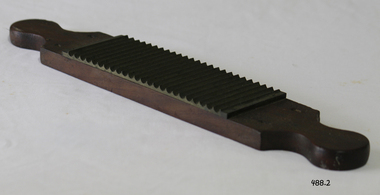
Equipment - Pill Rolling Pin
... A ‘pill mass’ of medicinal powders mixed with a binding agent would be hand-rolled into a pipe on the tile at the back of the machine. ...A ‘pill mass’ of medicinal powders mixed with a binding agent would be hand-rolled into a pipe on the tile at the back of the machine. ...Used as tBefore factory production became commonplace in medicine, dispensing was considered an art and pill machines such as these were a vital component of any chemist’s collection. This machine dates back to the days when your local chemist or apothecary bought, sold, and manufactured all his own drugs and medicines to everybody who lived within the local community. In Victorian times, there was no such thing as off-the-shelf medicine. Every tablet, pill, suppository, ointment, potion, lotion, tincture and syrup to treat anything from a sore throat to fever, headaches or constipation, was made laboriously by hand, by the chemist. Pill machines such as these first appeared in the mid-1700s and quickly became a staple of the Victorian chemist’s shop. A ‘pill mass’ of medicinal powders mixed with a binding agent would be hand-rolled into a pipe on the tile at the back of the machine. This would then be placed across the grooved brass plate and cut into equal-sized pills using the corresponding side of the roller. Once all the necessary ingredients for the pills had been measured and ground with a pestle and mortar a final ingredient was poured in, syrup – this acted as a binding-agent. You could then roll it into a sausage shape. The largest part of the machine is the board. This is set at an angle and is comprised of the rolling surface, the cutting grooves, and the collection-tray. The large flat surface is for rolling out the pill-paste into the sausage shape. This is then rolled towards the brass cutting-grooves. The paddle (the second piece) is flipped over so that the grooves there line up with the grooves on the board. Rollers on the ends of the paddle roll against the brass edges of the board, and they guide the paddle straight across the grooves, taking the pill-mass with it. The grooves on the paddle and the board slice up the pill-mass and, after rolling the thing back and forth a couple of times like a rolling-pin, the circular pills roll off the grooves and into the tray at the bottom. https://galwaycitymuseum.ie/blog/collections-spotlight-victorian-pill-making-machine/?locale=enhe companion item to pill-maker base, item 488.2The collection of medical instruments and other equipment in the Port Medical Office is culturally significant, being an historical example of medicine from late 19th to mid-20th century.Pill making device including a grooved base board and grooved sliding board with two pill mouldsNone.flagstaff hill, warrnambool, shipwrecked-coast, flagstaff-hill, flagstaff-hill-maritime-museum, maritime-museum, shipwreck-coast, flagstaff-hill-maritime-village, pill making, pill mould, medicine, health -
 City of Moorabbin Historical Society (Operating the Box Cottage Museum)
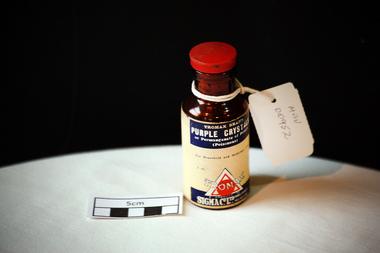
Manufactured Glass, brown bottle 'Tromax', 20thC
... powder'. Potassium permanganate was comparatively easy to manufacture. pharmacy medicines tromax purple crystals permaganate of potash disinfectants sigma co.ltd. melbourne athritis glassware bottles moorabbin bentleigh cheltenham TROMAX BRAND / PURPLE CRYSTALS/ or Permanganate of Potash / (Poisonous )/ For Household and Medicinal Uses / 2oz. / TROMAX / A PRODUCT OF/ SIGMA Co.Ltd. / MANF. ...Potassium permanganate is an inorganic chemical compound with the chemical formula KMnO4. Formerly known as permanganate of potash or Condy's crystals, it is a strong oxidizing agent. It dissolves in water to give intensely pink or purple solutions, the evaporation of which leaves prismatic purplish-black glistening crystals. c1859 London chemist Henry Bollmann Condy had an interest in disinfectants; he found that fusing pyrolusite with sodium hydroxide (NaOH) and dissolving it in water produced a solution with disinfectant properties. He patented this solution, and marketed it as 'Condy's Fluid'. Although effective, the solution was not very stable. This was overcome by using potassium hydroxide (KOH) rather than NaOH. This was more stable, and had the advantage of easy conversion to the equally effective potassium permanganate crystals. This crystalline material was known as 'Condy's crystals' or 'Condy's powder'. Potassium permanganate was comparatively easy to manufacture.A brown glass bottle with a red plastic topped cork stopper for 'Tromax' , 'Purple Crystals' ie Permanganate of Potash , that was used as an antiseptic and disimfectant.TROMAX BRAND / PURPLE CRYSTALS/ or Permanganate of Potash / (Poisonous )/ For Household and Medicinal Uses / 2oz. / TROMAX / A PRODUCT OF/ SIGMA Co.Ltd. / MANF. CHEMISTS / MELBOURNE. Directions for Use are on back of bottlepharmacy, medicines, tromax, purple crystals, permaganate of potash, disinfectants, sigma co.ltd. melbourne, athritis, glassware, bottles, moorabbin, bentleigh, cheltenham -
 Mont De Lancey
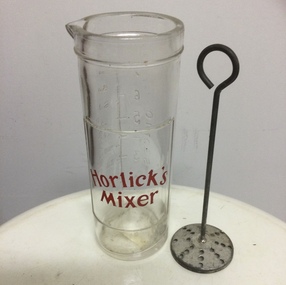
Functional object - Mixing jar, Horlick’s, Unknown
... medicinal purposes. One pours in hot or cold water into vessel, then add 3-4 headed teaspoons of Horlicks powder. ...medicinal purposes. One pours in hot or cold water into vessel, then add 3-4 headed teaspoons of Horlicks powder. ...Used for medicinal purposes. One pours in hot or cold water into vessel, then add 3-4 headed teaspoons of Horlicks powder. Agitate briskly with plunger. Horlicks glass mixer with metal plunger. Has iconic red logo of Horlicks on the side. Graduated measurements in ounces and grammes on the back. Has pouring spout. medicinal containers, glass -
 Mont De Lancey
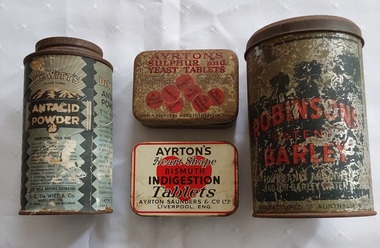
Domestic object - Medicinal Tins, Ayrton Saunder's & Co Ltd, 1900's
... Powder cardboard container with a rusted tin lid. Manufacturer details and usage are printed on a paper wrapper glued to the cylinder. Domestic object Medicinal ...These vintage tins contained medicinal products to help relieve illness symptoms for the family at home in the 1900's. Two were manufactured in Australia and the two Ayrton's products were made in England.Three vintage medicinal tins and cardboard container. 1. Small Ayrton's heart shape Bismuth Indigestion Tablets tin with the Manufacturer details printed at the bottom of the lift up lid. It has a large red heart shape on a white background. Approx. 2ozs. It has a gold base with information for use and recommended dosages. 2. A small badly rusted and worn tin Ayrton's Sulphur and Yeast Tablets with seven red dots showing usage features of these tablets. Manufacturer details are listed at the bottom of the front lift up lid and the back of the tin has further information. 3. A cylindrical green Robinson's Patent Barley tin with a patterned rusted lid. The manufacturer details and usage information are indecipherable due to wear and rust. 4. A cylindrical lidded De Witt's Antacid Powder cardboard container with a rusted tin lid. Manufacturer details and usage are printed on a paper wrapper glued to the cylinder.1. 'Ayrton's Heart Shape Bismuth Indigestion Tablets Ayrton Saunders & Co Ltd Liverpool. England.' 2. 'Ayrton's Sulphur and Yeast Tablets Ayrton, Saunders & Co. Ltd. Liverpool. Eng.' 3. Robinson's Patent Barley' (indecipherable details) On the bottom of the tin Robinson's "Patent" Barley Letters Patent Granted 1923 Now expired Packed March 1951. 4.De Witt's Trademark Antacid Powder 2/6 for Indigestion. Contents 4ozs. Approx. Lasting Action' Inside the Ayrton's Sulphur and Yeast Tablets tin is a sticker with 'M Burgi' handwritten on it in biro.medicinal containers, tins, medication, containers -
 Trafalgar Holden Museum
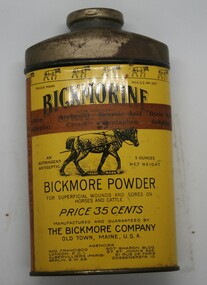
Container - Bickmore powder, Ca1900
... Powder...medicinal...Trafalgar Holden Museum 74 Waterloo Rd Trafalgar gippsland Powdered medicinal dressing for cattle and horses Ca1900 Imported and sold by Holden and Frost Powder medicinal Bickmore Bickmore powder for the treatment of superficial cuts and wounds on horses or cattle. ...Powdered medicinal dressing for cattle and horses Ca1900Imported and sold by Holden and FrostSquat tin flask with shaker on top of press lid yellow in colour, instructions printed thereon Bickmore powder for the treatment of superficial cuts and wounds on horses or cattle. Directions printed on the rear of the tin powder, medicinal, bickmore
