
Showing 2987 items matching "melbourne -- (vic.)"
-
 Friends of Ballarat Botanical Gardens History Group
Work on paper - Article: History and Philosophy Dept. University of Melbourne, Vic. Aus. 12/9/1991, Alpine Botanical Expeditions of Ferdinand Mueller. Linden Gillbank
... University of Melbourne, Vic. Aus. 12/9/1991....University of Melbourne, Vic. Aus. 12/9/1991....University of Melbourne, Vic. Aus. 12/9/1991. ...Alpine Botanical Expeditions of Ferdinand Mueller. Linden Gillbank. Article: History and Philosophy Dept. University of Melbourne, Vic. Aus. 12/9/1991.john garner collection, ballarat botanical gardens, mueller, alpine, expedition, gardens, ballarat -
 Melbourne Tram Museum
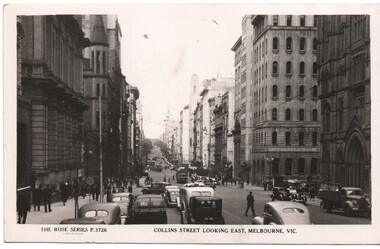
Postcard, Rose Stereograph Co, "Collins St Looking East, Melbourne Vic", late 1940's
... "Collins St Looking East, Melbourne Vic"...Postcard - Black and White - Rose Series P3726, titled "Collins St Looking East, Melbourne Vic", with the intersection of Market St and Collins St in the foreground. ..."Collins St Looking East, Melbourne Vic" Postcard Rose Stereograph Co. ...Postcard - Black and White - Rose Series P3726, titled "Collins St Looking East, Melbourne Vic", with the intersection of Market St and Collins St in the foreground. Photo possibly late 1940's. On the rear - has a divided back, and "A Real Photograph" " & Produced in Australia" and company address.On the rear has the stamp of Graeme S Breydon - see image i2.trams, tramways, collins st, market st, melbourne -
 Melbourne Tram Museum
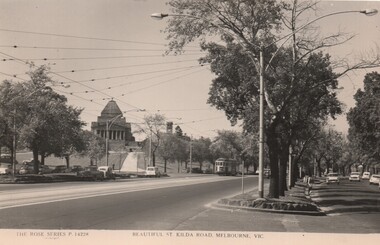
Postcard, Rose Stereograph Co, "Beautiful St Kilda Road, Melbourne Vic", c mid to late 1950s
... "Beautiful St Kilda Road, Melbourne Vic"...Postcard - Black and White - Rose Series P.14228, titled "Beautiful St Kilda Road, Melbourne Vic" - looking south with the Shrine of Remembrance in the background. ...Postcard - Black and White - Rose Series P.14228, titled "Beautiful St Kilda Road, Melbourne Vic" - looking south with the Shrine of Remembrance in the background. ...Postcard - Black and White - Rose Series P.14228, titled "Beautiful St Kilda Road, Melbourne Vic" - looking south with the Shrine of Remembrance in the background. Has a W2 sorthbound. Has a number of vehicles in the view - mid late 1950s Holden's. On the rear - has a divided back, and "A Real Photograph" " & Produced in Australia"On the rear has the stamp of Graeme S Breydon - see image i2.trams, tramways, shrine of remembrance, w2 class, rose series, st kilda road -
 Melbourne Tram Museum
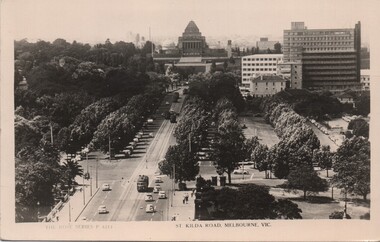
Postcard, Rose Stereograph Co, "St Kilda Road, Melbourne Vic", c late 1950s
... "St Kilda Road, Melbourne Vic"...Postcard - Black and White - Rose Series P4311, titled "St Kilda Road, Melbourne Vic" - looking south with the Shrine of Remembrance and Prince Henry Hospital in the background. ..."St Kilda Road, Melbourne Vic" Postcard Rose Stereograph Co. ...Postcard - Black and White - Rose Series P4311, titled "St Kilda Road, Melbourne Vic" - looking south with the Shrine of Remembrance and Prince Henry Hospital in the background. Has a number of trams in the view. Possibly taken from the clock tower at Flinders St station. On the rear - has a divided back, and "A Real Photograph" " & Produced in Australia" and the Rose logo and address details.On the rear has the stamp of Graeme S Breydon - see image i2.trams, tramways, melbourne, st kilda rd, shrine of remembrance -
 Mission to Seafarers Victoria
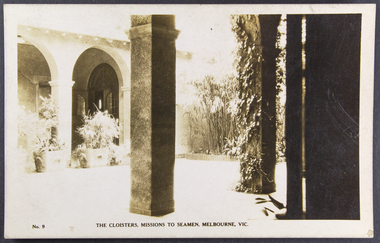
Postcard - Postcard, Sepia, Valentine & Sons Publishing Co. Ltd, The Cloisters, Missions to Seamen, Melbourne, Vic, c. 1920
... The Cloisters, Missions to Seamen, Melbourne, Vic....Label on front of postcard: "No. 9 THE CLOISTERS, MISSIONS TO SEAMEN, MELBOURNE, VIC." Reverse of postcard: "POST CARD/A Real Photograph Produced in Australia" There is also a divided line down the centre of the reverse for writing a message....The Cloisters, Missions to Seamen, Melbourne, Vic. Postcard Postcard, Sepia Valentine & Sons Publishing Co. ...The scene on the postcard depicts the Spanish courtyard (or Cloisters) as a space within the Mission to Seafarers Melbourne. The view to the courtyard is from the Celia Little Room. The Spanish mission design was inspired by a need to make the 1917 Mission complex at Flinders st extension distinctive and easily found. (ref Church and Sailor journal) This scene shows the way in which the courtyard leads into the Chapel and that it is a large space for varied uses.Sepia toned scene on front of postcard depicting "The Cloisters" or Spanish Courtyard at Mission to Seafarers Melbourne. There is ivy growing up the pillar to the right of the scene, tall plants in the garden bed in the corner of the courtyard and pots with plants placed between the archways to the rear of the photograph.Label on front of postcard: "No. 9 THE CLOISTERS, MISSIONS TO SEAMEN, MELBOURNE, VIC." Reverse of postcard: "POST CARD/A Real Photograph Produced in Australia" There is also a divided line down the centre of the reverse for writing a message.plants, cloisters, ivy, pillars, archways, seamen's mission, mission to seamen, mission to seafarers, st peter chapel, spanish courtyard, melbourne, flinders street, valentine's postcards, real photo series -
 Melbourne Tram Museum
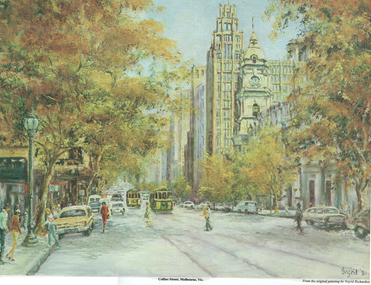
Artwork, other - Illustration, Ingrid Richardson, "Collins Street Melbourne Vic", 1981
... "Collins Street Melbourne Vic"...Reproduction of a painting titled "Collins Street Melbourne Vic" by Ingrid Richardson, 1981, looking west from near Russell St along Collins St Melbourne. ...Reproduction of a painting titled "Collins Street Melbourne Vic" by Ingrid Richardson, 1981, looking west from near Russell St along Collins St Melbourne. ...Reproduction of a painting titled "Collins Street Melbourne Vic" by Ingrid Richardson, 1981, looking west from near Russell St along Collins St Melbourne. Two W class trams are in the view, including the MLD building, and the Town Hall.Has a close association with the artist Ingrid Richardson.Illustration full colour, plain back.tramways, trams, collins st, art works -
 Melbourne Tram Museum
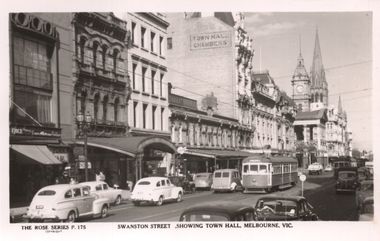
Postcard, Rose Stereograph Co, "Swanston Street, showing Town Hall, Melbourne Vic", c1954
... "Swanston Street, showing Town Hall, Melbourne Vic"...Rose Series postcard P.175, titled "Swanston Street, showing Town Hall, Melbourne Vic" looking south from near Bourke Street. ...Rose Series postcard P.175, titled "Swanston Street, showing Town Hall, Melbourne Vic" looking south from near Bourke Street. ...Rose Series postcard P.175, titled "Swanston Street, showing Town Hall, Melbourne Vic" looking south from near Bourke Street. Has SW6 class 920, (route 7) and another wide body tramcar in the view. Has the Town Hall Chambers building in the photograph.Yields information about Swanston St from Bourke St. C1954Postcard - printed real photograph with Rose Stereograph Co. name on the rear. UsedHas a letter to Ken from R Williams written on the rear.trams, tramways, swanston st, sw6 class, tram 920, rose series -
 Melbourne Tram Museum
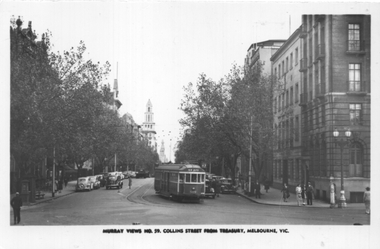
Postcard, Murray Views, "Collins Street Melbourne from Treasury, Melbourne Vic.", 1930s
... "Collins Street Melbourne from Treasury, Melbourne Vic."...Murray Views postcard No. 59, titled "Collins Street Melbourne from Treasury, Melbourne Vic." Has W2 class tram 509 route 47, Kew Depot turning from Collins St into Macarthur St. ..."Collins Street Melbourne from Treasury, Melbourne Vic." Postcard Murray Views ...Murray Views postcard No. 59, titled "Collins Street Melbourne from Treasury, Melbourne Vic." Has W2 class tram 509 route 47, Kew Depot turning from Collins St into Macarthur St. Thee is a lady waiting in the safety zone on the south side of the street. In the background is the T&G building.Yields information about Collins St, during the 1930s.Postcard - printed, unused, by Murray Views of Gympie Qld.trams, tramways, w2 class, collins st, tram 509 -
 Melbourne Tram Museum
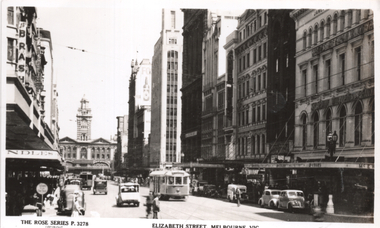
Postcard, Rose Stereograph Co, "Elizabeth Street, Melbourne, Vic", c1940's
... "Elizabeth Street, Melbourne, Vic"...Rose Series postcard P.3278, titled "Elizabeth Street, Melbourne, Vic", looking south from near Little Collins St. ...Rose Series postcard P.3278, titled "Elizabeth Street, Melbourne, Vic", looking south from near Little Collins St. ...Rose Series postcard P.3278, titled "Elizabeth Street, Melbourne, Vic", looking south from near Little Collins St. Has a W5 class tram northbound. On the left is Brashes, in the distance is Flinders Street Railway station, and on the right the London Hotel, James McEwan & Co. with a sign for Sherwin Williams Paint.Yields information about Elizabeth Street from near Little Collins St. late 1940sPostcard - printed real photograph with Rose Stereograph Co. name on the rear. UsedHas a letter to Ken from R Williams written on the rear, dated 3-7-51 about a friend who had visited Christchurch. Same handwriting as 8098.trams, tramways, w5 class, elizabeth st., rose series -
 Melbourne Tram Museum
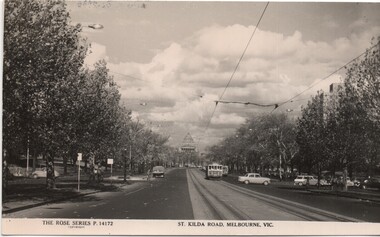
Postcard, Rose Stereograph Co, "St Kilda Road, Melbourne Vic", c late 1950s
... "St Kilda Road, Melbourne Vic"... Rose Series P.14172, titled "St Kilda Road, Melbourne Vic" - looking south with the Shrine of Remembrance in the background. ...Rose Series P.14172, titled "St Kilda Road, Melbourne Vic" - looking south with the Shrine of Remembrance in the background. ...Rose Series P.14172, titled "St Kilda Road, Melbourne Vic" - looking south with the Shrine of Remembrance in the background. W2 328 northbound. Has a number of vehicles in the view - late 1950 Holden station wagon. On the rear - has a divided back, and "A Real Photograph" " & Produced in Australia" and the Rose logo and address details.Yields information about St Kilda Road and demonstrates a coloured postcard produced by Rose.Postcard - Black and White and colour versions. Both unused.On the rear has the stamp of Graeme S Breydon - see image i2.trams, tramways, shrine of remembrance, tram 328, w2 class, st kilda road, rose series -
 Melbourne Tram Museum
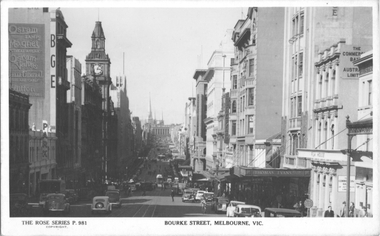
Postcard, Rose Stereograph Co, "Bourke Street Melbourne Vic", c1940
... "Bourke Street Melbourne Vic"...Rose Series postcard P.981, titled "Bourke Street Melbourne Vic,". The photo looks east from Queen St. ...Rose Series postcard P.981, titled "Bourke Street Melbourne Vic,". The photo looks east from Queen St. ...Rose Series postcard P.981, titled "Bourke Street Melbourne Vic,". The photo looks east from Queen St. Several cable trams are in the view. There are signs for Osram lamps and valves, a car park, BGE, Film House, Commercial Bank and Thomas Evans Pty Ltd. See item 8076 for a similar image.Yields information about Bourke St c1940.Postcard - printed real photograph with Rose Stereograph Co. name on the rear.trams, tramways, cable trams, bourke st, rose series -
 Melbourne Tram Museum
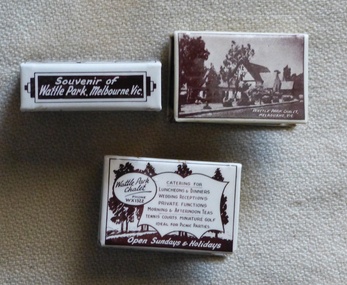
Domestic object - Match box holder, Souvenir of Wattle Park, Melbourne Vic.", 1950's?
... Souvenir of Wattle Park, Melbourne Vic.",...Metal based match box holder, formed from tin plated steel sheet, folded around all edges to include a printed plastic cover marked "Souvenir of Wattle Park, Melbourne Vic.", including on the sides an image of the Chalet and on reverse, contact phone number (WX1322), and what the venue would cater for. ...Souvenir of Wattle Park, Melbourne Vic.", Domestic object Match box holder ...Metal based match box holder, formed from tin plated steel sheet, folded around all edges to include a printed plastic cover marked "Souvenir of Wattle Park, Melbourne Vic.", including on the sides an image of the Chalet and on reverse, contact phone number (WX1322), and what the venue would cater for. Has a note that is was open on Sundays and Holidays as well. Not known when made or used or who by. Phone numbers with alphanumeric numbers phased out during the late 1950's. Three copies of the same item held.trams, tramways, mmtb, crockery, wattle park, souvenirs -
 Melbourne Tram Museum
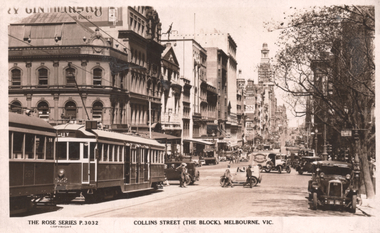
Postcard, Rose Stereograph Co, "Collins Street (The Block) Melbourne Vic.", c1929
... "Collins Street (The Block) Melbourne Vic."...Rose Series postcard P.3032, titled "Collins Street (The Block) Melbourne Vic.", looking west from near Swanston Street. ...Rose Series postcard P.3032, titled "Collins Street (The Block) Melbourne Vic.", looking west from near Swanston Street. ...Rose Series postcard P.3032, titled "Collins Street (The Block) Melbourne Vic.", looking west from near Swanston Street. Has W2 class 522 (City) and part of W class 267, minus route number boxes, in the view. Several motor cars are waiting to do a hook turn. The Australian Provincial Assurance (APA) Association Ltd tower is in the final stages of construction; completed in 1929. Yields information about Collins Street at Swanston Street 1929cPostcard - printed real photograph with Rose Stereograph Co. name on the rear. UsedHas a letter to "Aunty" from Carolyn in Albury, undated. Has the Ken Magor stamp on the top edge.trams, tramways, tram 522, tram 267, collins st, w class, w2 class, swanston st, rose series -
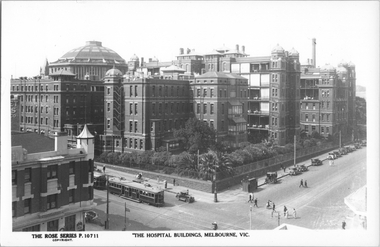 Melbourne Tram Museum
Postcard, Rose Stereograph Co, "The Hospital buildings, Melbourne Vic", c1930
... "The Hospital buildings, Melbourne Vic"...Rose Series postcard P.10711, titled "The Hospital buildings, Melbourne Vic" with W class 232 southbound in Swanston Street at Lonsdale Street. ...Rose Series postcard P.10711, titled "The Hospital buildings, Melbourne Vic" with W class 232 southbound in Swanston Street at Lonsdale Street. ...Rose Series postcard P.10711, titled "The Hospital buildings, Melbourne Vic" with W class 232 southbound in Swanston Street at Lonsdale Street. This tram was converted to a W2 class during Jan. 1932. Has another tram behind it. The Melbourne Hospital is in the background and nurses and patients can be seen on the balconies. There is one horse drawn cab parked in Lonsdale Street near the cast iron urinal structure along with a fruit vendor's carts by the hotel entry. In the background is the Britannia Hotel.Yields information Swanston St and the Melbourne Hospital c1930.Postcard - printed real photograph with Rose Stereograph Co. name on the rear. Two copies held.On rear of 2nd copy "Greetings from Katie Williams"tramways, trams, lonsdale st, hospital, w class, tram 232, swanston st, rose series -
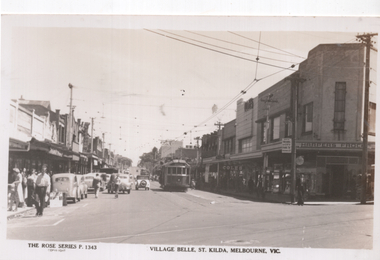 Melbourne Tram Museum
Postcard, Rose Stereograph Co, "Village Belle, St Kilda, Melbourne Vic", early 1950s
... "Village Belle, St Kilda, Melbourne Vic"...Rose Series postcard P.1343, titled "Village Belle, St Kilda, Melbourne Vic" showing W2 568 (Moreland Route 15) at the St Kilda Beach terminus in Acland St. ..."Village Belle, St Kilda, Melbourne Vic" Postcard Rose Stereograph Co. ...Rose Series postcard P.1343, titled "Village Belle, St Kilda, Melbourne Vic" showing W2 568 (Moreland Route 15) at the St Kilda Beach terminus in Acland St. Another W2 is further behind. A uniformed tramway employee is walking across the road, underneath a MMTB sign advising of Trams to the City and a Fare of 5d and child fares of 2d. In the background is the Coles store and Harpers Frocks. In the foreground are tram tracks for the Victorian Railways St. Kilda to Brighton Beach line in Barkly Street.Yields information about Acland St, St Kilda early 1950s.Postcard - printed real photograph with Rose Stereograph Co. name on the rear.trams, tramways, village belle, route 15, st kilda, w2 class, tram 568, acland st, barkly st, st kilda brighton tramway, rose series -
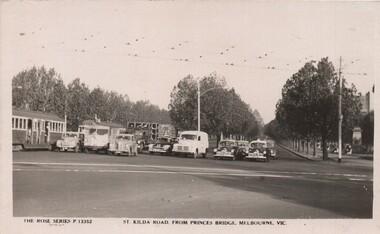 Melbourne Tram Museum
Postcard, Rose Stereograph Co, "St Kilda Road, from Princes Bridge Melbourne Vic", c1950
... "St Kilda Road, from Princes Bridge Melbourne Vic"...Postcard - Black and White - Rose Series P13352, titled "St Kilda Road, from Princes Bridge Melbourne Vic", featuring a traffic in St Kilda Road, all stopped (by a traffic policeman) at the intersection with City Road - has 7 motor vehicles all neatly stopped in a line and two tramcars (W2). ..."St Kilda Road, from Princes Bridge Melbourne Vic" Postcard Rose Stereograph Co. ...Postcard - Black and White - Rose Series P13352, titled "St Kilda Road, from Princes Bridge Melbourne Vic", featuring a traffic in St Kilda Road, all stopped (by a traffic policeman) at the intersection with City Road - has 7 motor vehicles all neatly stopped in a line and two tramcars (W2). Includes three black and white taxis - tow of the FJ Holden type. The City Road tram tracks are in the foreground. On the far right is Sloss Street. It ran between City Road and Maffra Street parallel to St. Kilda Road. Removed in the 1960’s as part of the Art Centre development. On the rear - has a divided back, and "A Real Photograph" " & Produced in Australia".On the rear has the stamp of Graeme S Breydon - see image i2.trams, tramways, princes bridge, city road, st kilda road, w2 class, rose series, sloss st -
Glenelg Shire Council Cultural Collection
Medal - Medallion - Portland 150th Anniversary, 1984
... Brim, Melbourne, Vic...Produced to commemorate the 150th anniversary of Portland, 1985 Medal Medallion - Portland 150th Anniversary Brim, Melbourne, Vic Brim, Melbourne Vic ...Belonging to Barry Payne. Medal struck to commemorate the 150th anniversary of Portland in 1984.Blue velvet case. Red inner - velvet. Lid lined with white satin. Polished brass medallion. Produced to commemorate the 150th anniversary of Portland, 1985Front: Portland 150th Anniversary 1984. Whale in triangle. Reverse: Pink Heath, Brim. Melb. Vic Pink Heath No. 125medal, medallion, 150th anniversary, celebration, portland, 1984 -
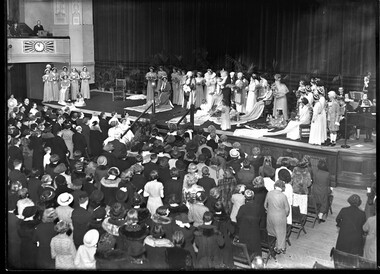 City of Melbourne Libraries
Photograph, Bull, Hugh Jones, 1897-1993, Girls' Friendly Society Concert, Melbourne Town Hall
... Reference: CROWNING THE PRINCESS OF LOVE ON SATURDAY. (1936, November 16). The Age (Melbourne, Vic. : 1854 - 1954), p. 18. Retrieved October 29, 2025, from http://nla.gov.au/nla.news-article205953075 Description: The photograph captures an elaborately staged coronation of a queen, on the stage of Melbourne Town Hall. 25 female attendants in long gowns are holding posies. ......The Age (Melbourne, Vic. : 1854 - 1954)...Glass plate negative Girls' Friendly Society Concert, Melbourne Town Hall Photograph Bull, Hugh Jones, 1897-1993 The Age (Melbourne, Vic. : 1854 - 1954) ...Photographer notations on slide: Town Hall Nov 1936 W.H. Everard [unknown] Friendly Society Concert B117 Published: The Age, Mon 16 Nov 1936 Published title and caption: CROWNING THE PRINCESS OF LOVE ON SATURDAY. Mr. W. H. Everard, M.L.A. , about to crown the winning Princess in the Girls' Friendly Society's competition at the Town Hall. Reference: CROWNING THE PRINCESS OF LOVE ON SATURDAY. (1936, November 16). The Age (Melbourne, Vic. : 1854 - 1954), p. 18. Retrieved October 29, 2025, from http://nla.gov.au/nla.news-article205953075 Description: The photograph captures an elaborately staged coronation of a queen, on the stage of Melbourne Town Hall. 25 female attendants in long gowns are holding posies. There are five flower girls and several wigged male attendants. An audience of mostly women and children is standing from their chairs to view the activities. The Age, Thursday 5 November 1936, page 6: "Princess" Coronation Ceremony. Thirty-eight branches of the Girls' Friendly Society are competing in the Princess competition, which will culmi nate in a coronation ceremony at Melbourne Town Hall, on the evening of Saturday, 14th inst. The princesses are Love, Joy. Youth, Beauty, Courage and Friendship. Mr. W. H. Everard, M.L.A., will crown the winning queen, and Mrs. F. W. Head, president of the G.F.S., will be the guest of honor. A programme of music and dances is being arranged. This is the first time that members of the G.F.S. have organised such a big effort to raise funds, and proceeds will be devoted to the building fund for the new hostel in Spring-street. Reference: "Princess" Coronation Ceremony. (1936, November 5). The Age (Melbourne, Vic. : 1854 - 1954), p. 6. Retrieved October 29, 2025, from http://nla.gov.au/nla.news-article205944373 GFS Australia Inc, https://gfsaustralia.org.au/ Girls' Friendly Society, https://en.wikipedia.org/wiki/Girls%27_Friendly_SocietyPhotographer notations on slide: "Town Hall Nov 1936 W.H. Everard [unknown] Friendly Society Concert B117".melbourne town hall, town halls, dances and balls, societies, 1930-1939, fundraising events, clothing and dress -
 City of Melbourne Libraries
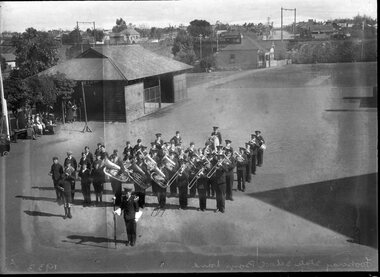
Photograph, Bull, Hugh Jones, 1897-1993, Footscray State School Boys Band
... The Sun News-Pictorial (Melbourne, Vic. : 1922 - 1954; 1956), p. 14-15. ......The Age (Melbourne, Vic. : 1854 - 1954)...The Sun News-Pictorial (Melbourne, Vic. : 1922 - 1954; 1956), p. 14-15. ...Photographer notations on slide: Footscray State School Boys Band 1933 B5 Published: JUNIOR BAND CHAMPIONS--BEFORE THE HOLIDAYS--BELGIAN CARNIVAL--A ROYAL YACHTSMAN. (1933, September 1). The Age (Melbourne, Vic. : 1854 - 1954), p. 3. Published caption: “Proud Champions.- The drum-major of the band of the Hyde-street State School, Footscray, leads his players in a march past for visitors during Music Week. Under Mr. Frank Johnston’s conductorship this band has held the championship for two years.” Trove article identifier: http://nla.gov.au/nla.news-article205116143 Scope and Content: Footscray’s Hyde Street State School Band, led by their drum major, prepare to march past a group of mothers while playing their instruments. The band held the record for winning the most Victorian State Schools Association Championships between 1931 and 1966. Research by project volunteer, Fiona Collyer: Description: A large group of boys, most of whom are dressed in long trousers and peaked band hats, led by their drum major, prepare to march past a group of women dressed in overcoats and hats and an infant in a pram. In the background is a school shelter shed, a railway line, houses and a netball ring on a wooden stand. The Hyde Street State School Band was formed in 1928 as the school band for Hyde Street State School No. 1912 at 10 Hyde Street Footscray (now Footscray City Primary School). Their bandmaster, Francis Charles Johnston,(1880-1953) nicknamed “Massa” as a boy for his love and admiration of southern American jazz music, also conducted the Victorian Police Band, Collingwood Citizens Band, and the Melbourne Metropolitan Fire Brigade Band, amongst others, leading to scores of wins in brass band competitions. Even into his sixties, “Massa” ran three laps around the South Melbourne Oval every morning in order to maintain fitness for his busy conducting schedule. He was a cornetist and horn player, and performed in and lead brass bands for more than fifty years including bands that farewelled Australian troops from the Boer War to the Second World War. The Argus 13 December 1947, described “Massa” - “Bandsmen say he is a genius in brass band music, and the best conductor in the Southern Hemisphere. He still retains the romance and Bohemianism of the old German bandsmen he played with in the streets of Melbourne 50 years ago.” In 1925, a bequest of £10,000 from the estate of the late writer, William Gillies was made to the Education Department of Victoria. It was devoted to three purposes - “1) The encouragement of instrumental music (school bands or orchestras) in the State schools of Victoria, leading, it is hoped, to an increase in the number of village bands and orchestras, and, most important of all, family orchestras; (2) The encouragement of the art of reading aloud, leading, it is hoped, to an increase of the admirable pastime of reading aloud in the family circle; and (3) The encouragement of any branch of nature study, the aim of all three being to make home life, especially in the country, more attractive.” The Director of Education, Mr. M.P. Hansen wrote in his book “Thoughts That Breathe” published in 1932, that, as a result of the Gillies Bequest- “£3,030 has already been made available for the purchase of band instruments, and thanks largely to the encouragement given by this fine bequest, there are now in State schools in Victoria, each under expert tuition, 31 brass bands, 9 orchestras, 13 fife bands and 23 violin classes. That the effect of such work has a significant bearing on the right use of leisure, is undeniable.” By 1937, at least 50 State school bands had been set up in Victoria and the Victorian State Schools Association Championships were hotly contested. Frank quickly and skilfully brought the inexperienced boys of the Hyde Street Brass Band to A grade level, winning their first Victorian State Schools Association Championships in 1931. The band went on to win multiple times, holding the record for winning the most Victorian State Schools Association Championships between 1931 and 1966. The band soon became an integral part of community events. Whenever the Footscray Football Team played a home game at the perpetually blustery Western Oval, (Whitten Oval since 1995) the band performed at half time, marching around the boundary line, belting out the Footscray Football Team theme song- “Sons of the ’Scray” played to the tune of “Sons of the Sea” by British music hall songwriter Felix McGlennon. Volunteers walked behind the band carrying a large tarpaulin to catch the shower of coins thrown by fans from both teams, which helped pay for new instruments, repairs and uniforms. The old footy joke goes- Q. Who played on the wing at the Western Oval for 20 years, but never kicked a goal? A. The Hyde Street Band. Now called the Hyde Street Youth Band Inc, it is a not-for-profit organisation, supported by the City of Maribyrnong. Their aim is to make brass music accessible to young people aged from 5-25 years, by supplying the instruments and lessons for a modest annual membership fee. The traditional British brass band comprises of three musical ensembles according to ability. The Hyde Street Youth Band Inc. play at community events including the AFL Grand Final Parade, ANZAC Day March at the Shrine of Remembrance, Moomba Parade and Yarraville Carols by Candlelight. Their repertoire includes classical, marches, hymns, contemporary music and movie themes. https://bandblastsfromthepast.blog/2018/04/08/victorian-state-school-brass-bands-their-legacy-lives-on/ Massa" and His Musical Firemen (1947, December 13). The Argus (Melbourne, Vic. : 1848 - 1957), p. 2 (The Argus Week-end Magazine). Retrieved May 5, 2025, from http://nla.gov.au/nla.news-article22532344 http://www.hydestreethistory.8m.net/photo2.html MUSIC AND MUSICIANS (1932, March 9). The Mercury (Hobart, Tas. : 1860 - 1954), p. 2. Retrieved May 8, 2025, from http://nla.gov.au/nla.news-article29946674 https://hsyb.org.au/about/history-2/ https://hsyb.org.au/about/ MUSIC AND READING ALOUD. (1925, June 1). The Argus (Melbourne, Vic. : 1848 - 1957), p. 10. Retrieved May 5, 2025, from http://nla.gov.au/nla.news-article2122525 Shake! Narrow Escape From Shark The Birdcage Walk Champion Schoolboy's Band (1931, December 24). The Sun News-Pictorial (Melbourne, Vic. : 1922 - 1954; 1956), p. 14-15. Retrieved April 8, 2025, from http://nla.gov.au/nla.news-article276259073 AROUND THE SCHOOLS: THE ARGUS JUNIOR (1947, September 23). The Argus (Melbourne, Vic. : 1848 - 1957), p. 6 (The Argus Super Comic). Retrieved April 20, 2025, from http://nla.gov.au/nla.news-article22509356 https://bandblastsfromthepast.blog/tag/hyde-street-youth-band/ THE GILLIES BEQUEST (1933, September 2). The Argus (Melbourne, Vic. : 1848 - 1957), p. 22. Retrieved May 5, 2025, from http://nla.gov.au/nla.news-article11688410 https://adb.anu.edu.au/biography/johnston-francis-charles-massa-13009 Hyde Street, Footscray, State School Children (1930, March 8). Weekly Times (Melbourne, Vic. : 1869 - 1954), p. 40. Retrieved May 8, 2025, from http://nla.gov.au/nla.news-article223899955Photographer notations on slide: Footscray State School Boys Band 1933 B5bands, 1930-1939, musical instruments, schools, state schools, uniforms, footscray -
 City of Melbourne Libraries
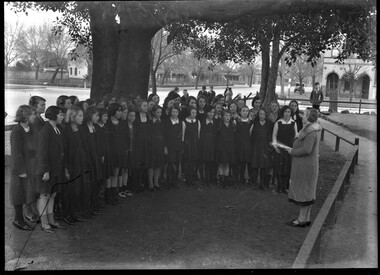
Photograph (item), Bull, Hugh Jones, 1897-1993, Miss Ida Park conducts the North Fitzroy State School Choir
... Table Talk (Melbourne, Vic. : 1885 - 1939), p. 12. Retrieved October 29, 2025, from http://nla.gov.au/nla.news-article149320966 SAVOY THEATRE (1939, June 1). ......The Age (Melbourne, Vic. : 1854 - 1954)...Table Talk (Melbourne, Vic. : 1885 - 1939), p. 12. Retrieved October 29, 2025, from http://nla.gov.au/nla.news-article149320966 SAVOY THEATRE (1939, June 1). ...The pupils of Falconer Street Central School No.3918 in North Fitzroy rehearse with conductress Miss Ida Park for their performance at the Temperance Hall, Russell Street Melbourne with proceeds going to the Lord Mayor’s Fund. The house on the right of the photograph is Jubilee House, 126 Michael Street North Fitzroy and is extant. Photographer notations on slide: Choir At Fitzroy State School 1933 B5 While this photograph appears not to have been published, a photograph taken from a different angle of the same event was published in The Age 21 July 1933. SCHOOL CHILDREN SING IN THE OPEN AIR. “A choir of children at North Fitzroy practise their songs for a Pantomime, to be given in the Temperance Hall for the Lord Mayor's Fund on Wednesday next. On the extreme left is the conductress of the Choir (Miss Ida Park).” Reference: http://nla.gov.au/nla.news-article204368572 Research by project volunteer, Fiona Collyer: Children of The Falconer Street Central School Choral Society, trained by conductress Miss Ida Park, along with dance and gymnastics pupils of Misses Dorothy Gibb and Inez Ellis, performed in the “Cinderella” pantomime at the Temperance Hall in Russell Street, Melbourne on 26 July, 1933. The proceeds went to the Lord Mayor’s Fund. Conductress Miss Ida Park (1904- 1952) lived in the North Fitzroy and Clifton Hill area all her life. She was immersed in the music world of Melbourne and was a member of the Musical Society of Victoria. Ida graduated from Melbourne University Conservatorium with a Bachelor of Music degree in 1929 before departing for London where she studied piano and organ at the Royal Academy of Music. Ida returned to Melbourne in 1931, and billed as “The Gifted Young Australian Pianist”, held pianoforte recitals of classical music at Assembly Hall, Collins Street. She also played the organ for services at St Paul’s Independent Church in Delbridge Street, North Fitzroy and later St Luke’s, North Fitzroy. Ida conducted the children of the Falconer Street Central School Choral Society as they competed in the State School Choral Championships and the 85 children of the Fitzroy City Centenary Choir who sang at Melbourne’s Centenary celebrations of 1934/35. In 1945, Ida married Charles Hazeldine, a tenor and returned digger who had served in two world wars. The pair performed together in many concerts over the years. Tragically, both Ida and Charles were badly injured when struck by a car while crossing Queens Parade Clifton Hill in June 1952, with Ida dying from head injuries at St Vincent’s Hospital soon after. She was 48 years old. Charles wrote on Ida’s death notice - “Called home.” The choir were pupils of Falconer Street Central School No. 3918 in North Fitzroy which was built in 1915 to provide upper primary education for grades 5 to 8 for the area. In 1957 it became Fitzroy High School. In 1992, the Kennett Government swept to power, embarking on a program of fiscal austerity and privatisation of government services. 390 government schools were closed, with the land proposed to be sold to developers. 7000 teachers were sacked: 10% of Victoria’s public school teachers. Auxiliary school staff also lost their jobs. Amongst the first to close was Fitzroy High School. Fearful that the land would be sold, hundreds of students, parents, teachers and local residents occupied the building around-the-clock in four hour shifts and overnight for 14 months, sleeping on gym mats in the principal’s office and administrators’ wing. The blockade was lifted when a arrangement was reached to allow Kangan Batman TAFE to use the school from 1993 until 1998. With the election of the Bracks Government in 1999, and construction of new buildings, Fitzroy High School was reopened in 2004 after a 12 year battle. Temperance Hall, at 172 Russell Street, where the children performed “Cinderella”, was built in 1872 by the Melbourne Total Abstinence Society as a venue for lectures, meetings and alcohol-free community concerts and events. From 1934, Temperance Hall was fitted out as a cinema and renamed the Imperial Theatre, showing popular Hollywood films, before closing in 1939 for renovations and reopening as the Savoy Theatre, Melbourne’s first “Continental” talkies cinema. At this time, Australian cinema programming was dominated by American and British films. The lessees, Continental Film Art Theatre began negotiating for theatre properties in Melbourne, Sydney, Adelaide, Brisbane, Perth and Auckland to screen foreign language films, hoping to present the finest productions from France, Germany, Holland and Italy. At the cost of £6000, the theatre was fitted with the latest Mirrophonic sound and projection system and enlarged to seat 800 patrons with luxurious, ultra modern fittings and furnishings in a colour palette of rust and beige. Instead of usherettes, General Manager Peter Dawson, hoping to bring a sophisticated European atmosphere to the theatre, employed attractive, multilingual “Continental hostesses” to assist guests (not patrons) and answer queries relating to the films. Collectively the hostesses spoke English, French, Dutch, German, Russian and Italian. The Age 20 May 1939- “Atmosphere is a very important part of the theatre's scheme. Ushers in the ordinary sense will not be employed; hostesses will look upon patrons as guests. They will be dressed in full evening dress, and the only indication that they are not guests is the little medallion pinned to their evening dress, on which their names are inscribed.” The hostesses were dressed in evening gowns of olive-green velvet, the full skirts embroidered with gold loops, wine velvet bolero jackets and long white kid gloves with silvery tiaras in their hair. For guests worried that they may not understand the plot, the management assured patrons that- “By means of superimposed English translations on the bottom of the screen, the dialogue is perfectly understandable and the whole witty story can be followed with ease.” The Gala opening of the Savoy Theatre, on 31 May 1939 was attended by a “who’s who” of Melbourne Society, the women wearing beautiful gowns, headdresses and furs. Amongst the guests were former premier Sir Stanley Argyle and Lady Argyle, former Lord Mayor Sir Harold Gengoult-Smith and his wife Cynthia, Field Marshall Thomas Blamey and Lady Blamey and Miss Jessie Brookes. The Vice Consul for France, Monsieur Frank Puaux and his wife attended, Madame Puaux dressed in a black satin gown and a musquash fur cape. She was presented with a beautiful bouquet of scarlet carnations and lily of the valley tied with the tricolour of France. In his speech Monsieur Puaux stated that “from the cultural, linguistic and artistic points of view it was excellent that the Australian public should have an opportunity to see foreign film in the original language.” “Letty” writing in Table Talk magazine described the atmosphere of “Continental” gaiety that had permeated Melbourne - “The Letters of Letty”, Table Talk 8 June 1939 “The “foreign influence” is definitely obtruding itself into the even tenor of Melbourne life these days…. but in the pleasantest manner possible! Included in the great number of Continental people who have recently made their homes here, we have stars of the Russian ballet settling in our midst…. and now… we have been presented with our own Continental picture theatre in the attractive shape of The Savoy, which opened its doors on Wednesday night for the exclusive release of foreign films. One could hardly recognise the old Temperance Hall in its adaptation to the smart, comfortable and thoroughly-intriguing Savoy Theatre. Where once this rather draughty old building stood in Russell Street there now greets us an unmistakable “Continental” edifice, living up to its exterior by sustaining within its walls its overseas’ atmosphere. Indeed, one feels as though one has crossed the threshold into a European city, stepping out of the unmistakably Australian street that is Russell into The Savoy lounge to be greeted by polite “messieurs” from the attractive, Continental-looking usherettes and to gaze upon a film as delightfully French in story and presentation as “La Kermesse Heroique.” But successful though “La Kermesse Heroique” proved on its initial presentation inside the theatre, the debut was no more triumphal than that made by the winning and pretty little French lass who had charge of the booking office outside in the foyer. With her attractive accent and Continental flair for making one “feel at home” she was undoubtedly one of the hits of the night-especially with the susceptible males, who spent very much longer in the lounge than is customary, racking their brains for excuses for making conversation with the attractive Parisienne! Those French girls certainly have a way with them!” The opening film, the 1935 French comedy “La Kermesse Heroique”, (The Heroic Sex) starring Francoise Rosay and Jean Murat (film now called “Carnival in Flanders”) was the winner of the Grand Prix du Cinema Francais as the finest picture of 1936 and described in the advertisement as “The Gay French Comedy of Laughter and Romance” The film is set during the 17th century Spanish occupation of Flanders in the Flemish town of Boom at the time of their annual festival. Hearing news of a pending visit to Boom by the commander, the Duke of Olivares and his army, and fearing rape and pillage, the boorish burgomaster feigns his own death, hoping the Spaniards will bypass the grieving town out of respect. The army arrives and the cowardly men of the town flee. The womenfolk decide on a different approach. Lead by the burgomaster’s beautiful wife Cornelia, they set out to to preserve the peace with grace and hospitality only to find the Spaniards attractive and virile, unlike their own husbands. The Sun newspaper described the film as “Mellow as a Stilton cheese, and as ripely suited to adult taste.” Preceding “La Kermesse Heroique” was a Gaumont British newsreel of King George VI and Queen Elizabeth departing for a tour of Canada and the Soviet documentary “Nine Months on a Drifting Ice Floe” During the war “Continental” films became difficult to source, so the Savoy screened Hollywood movies and held fund raisers for the war effort. After World War Two, the Savoy continued to screen “Continental” films, catering to post-war immigrants from Europe and bohemian Melburnians. In 1953, the Savoy had a wildly popular season with queues winding around the block to see Swedish summer romance “One Summer of Happiness” (Hon dansade en sommar) with its nude swimming scenes. The Chief Commonwealth Censor declined to cut the film on the grounds that although it displayed nudity, it was genuinely artistic. According to Wikipedia, film director Fred Schepisi was first exposed to European films such as “Bicycle Thieves”, “Rocco and His Brothers” and “The Wages of Fear” at the Savoy as a teenager, leading to his long career in filmmaking. In 1955, in response to the massive rise in car ownership, the Melbourne City Council recommended that parking stations be built on every block. The Savoy Theatre and adjacent buildings, which included the Golden Fleece Hotel were demolished in 1963 and replaced with Total House, a Brutalist commercial building consisting of a seven storey car park crowned by a four storey office block, shops at street level, and a basement theatre which housed the Lido Theatre Restaurant-Cabaret from 1965. The building was designed by architectural firm Bogle & Banfield Associates and named for the original tenant of the offices, French oil company, Total Oil Products P/L. The Lido Theatre Restaurant was managed by former Tivoli dancer and promoter David Hamilton McIlwraith, presenting dinner and a glamorous cabaret floor show of showgirls, (some topless) to accompany variety acts by local and international actors, singers, comedians and magicians. The interior of the Lido was opulently decorated in deep, lush green with old world gold trim and chandeliers. Handily, patrons could enter and leave via an elevator, straight from the building’s own car park! A four course gourmet dinner with show and dancing cost $8.00 in 1968. The Lido advertised in 1966 that “Every visitor to Melbourne soon discovers the brightest entertainment spot in the Southern Hemisphere with its million dollar decor, dining delights and spectacular stage productions.” Australian Jewish News - 21 April 1967 - “Superb decor and atmosphere, cuisine and service have been readily recognised as the contributing factors to the excellence of stage presentations, staging, costumes, decor and, of course, the actual choice of artists.” The bedazzling ensemble of 40 high-kicking, feathered and sequinned showgirls were advertised as the “Fabulous Lido girls and the controversial Baretop Lido Goddesses” who were described as “Statuesque Beauty as Nature intended” and “…a host of glamorous gals whose favourite shade is flesh pink.” Some of the acts who performed at the Lido were- -Broken Hill’s own - opera singer June Bronhill -1967. -Versatile singer Lovelace Watkins known as “Black Sinatra - 1967. -“Queen of the five-fingered boogie", honky-tonk and rollicking rag-time pianist, Winifred Atwell - 1967. -New Zealand pop duo, Bill and Boyd -1968. -American actress and soprano Kathryn Grayson -1968. -Denise Drysdale in “Say It With Music” -1968. -“Catwoman” Eartha Kitt -1969. -Internationally recognised female impersonator, Sydneysider Tracey Lee, (Maxwell Richie) billed as "controversial impressionist and singing personality from the famous Carousel Nightspot in Paris". -Frances Faye, American comedienne and show-tune singer and pianist-1969. -“Cry Guy” histrionic singer Johnnie Ray -1970. -Risqué revue “Oh Calcutta!” with some segments and the “four letter” words removed-1970. In 1970, under new management, the Lido was renovated with claret and gold wallpaper, midnight blue ceiling and a computerised fountain with fairy lights and relaunched by “The Tigress from Tiger Bay”, Shirley Bassey. The relaunch was short lived however, as later that year the venue became El Toro Espana, a Spanish restaurant and nightclub offering a four course meal for $4.50 while you watched the floorshow. The venue then briefly became the Red Garter Music Hall Theatre from 1972, then in 1974 the site became the 600 seat Total Theatre comprising of a cinema with a stage for live acts. There were also three bars to choose from - the Crush Bar, the Bleachers and the Snake Pit. Total Theatre had the unusual concept of a live music act, or plays, musicals and magicians followed by a film. In 1975 soprano Suzanne Steele featured, followed by the film “The Voyage” starring Sophia Loren and Richard Burton. In 1975, the Total held a rock film festival showing a Jimi Hendrix documentary, “Monterey Pop Festival”, “Pink Floyd in Pompeii” and more. In 1976, 17 year old Chrissy Amphlett, later of rock band Divinyls, played the role of Linda Lips for nine months in the Australian stage production of R-rated “sexual musical”, “Let My People Come” at the Total Theatre. The Total Theatre closed in 1979 and from 1980 to 2014 the venue became Billboard Nightclub, hosting local and international acts, including INXS, Tina Turner and John Farnham, and in 2009, 18 year old Taylor Swift. The venue is now called 170 Russell and presents hundreds of live local and international acts every year. In 2014, after being under threat of demolition, Total House was listed on the Victorian Heritage Register as “a landmark of post-World War II modernist design and…one of the earliest and best expressions of Brutalist architecture in Victoria”. References: RICHARD CROOKS ARRIVES SCHOOL AGAIN VENUE OF ROYAL VISIT (1939, May 31). The Age (Melbourne, Vic. : 1854 - 1954), p. 17. Retrieved November 21, 2025, from http://nla.gov.au/nla.news-article205629696 AMUSEMENTS. (1933, July 27). The Age (Melbourne, Vic. : 1854 - 1954), p. 12. Retrieved September 19, 2025, from http://nla.gov.au/nla.news-article204378853 https://larzra.wordpress.com/origins/ CONTINENTAL HOSTESSES, (1939, May 31). The Sun News-Pictorial (Melbourne, Vic. : 1922 - 1954; 1956), p. 27. Retrieved November 21, 2025, from http://nla.gov.au/nla.news-article278189387 The Letters of Letty (1939, June 8). Table Talk (Melbourne, Vic. : 1885 - 1939), p. 12. Retrieved October 29, 2025, from http://nla.gov.au/nla.news-article149320966 SAVOY THEATRE (1939, June 1). The Age (Melbourne, Vic. : 1854 - 1954), p. 7. Retrieved September 19, 2025, from http://nla.gov.au/nla.news-article205639035 NEW THEATRE OPENED (1939, June 1). The Argus (Melbourne, Vic. : 1848 - 1957), p. 8. Retrieved September 21, 2025, from http://nla.gov.au/nla.news-article12134234 https://en.wikipedia.org/wiki/Total_House Page [?] TOUCH OF SPAIN (1970, December 18). The Australian Jewish News (Melbourne, Vic. : 1935 - 1999), p. 35. Retrieved September 23, 2025, from http://nla.gov.au/nla.news-article262493757 No title (1935, June 11). The Herald (Melbourne, Vic. : 1861 - 1954), p. 27. Retrieved September 29, 2025, from http://nla.gov.au/nla.news-article244840169 Dine, wine, and watch a stage show (1966, November 16). The Australian Women's Weekly (1933 - 1982), p. 6. Retrieved November 9, 2025, from http://nla.gov.au/nla.news-article44025050 http://jonathanbollen.net/2011/02/26/tracey-lee/ LIDO ‘ART’ (1967, April 21). The Australian Jewish News (Melbourne, Vic. : 1935 - 1999), p. 8. Retrieved November 9, 2025, from http://nla.gov.au/nla.news-article263003136 THE FABULOUS LIDO (1965, October 22). The Australian Jewish News (Melbourne, Vic. : 1935 - 1999), p. 17. Retrieved November 9, 2025, from http://nla.gov.au/nla.news-article262983995 No title (1939, May 31). The Argus (Melbourne, Vic. : 1848 - 1957), p. 6. Retrieved November 21, 2025, from http://nla.gov.au/nla.news-article12134144 #NEW THEATRE OPENED (1939, June 1). The Argus (Melbourne, Vic. : 1848 - 1957), p. 8. Retrieved September 29, 2025, from http://nla.gov.au/nla.news-article12134234 https://en.wikipedia.org/wiki/Tracey_Lee_(female_impersonator) https://citycollection.melbourne.vic.gov.au/35b-40h-image-of-a-model-for-the-total-house-offices-and-car-park-on-russell-street/ https://www.theage.com.au/national/victoria/from-the-archives-1990-s-hundreds-of-school-closures-hit-victoria-20190801-p52cwj.html http://jonathanbollen.net/2011/05/29/the-lido-melbourne/Photographer notations on slide: primary schools, schools, music, education, choirs, fitzroy, cars, theatre restaurants, venues, films -
 City of Melbourne Libraries
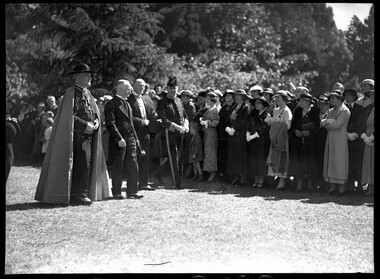
Photograph, Bull, Hugh Jones, 1897-1993, Cardinal MacRory meets "old girls" of Sacre Coeur Convent
... Reference: WOMAN'S INTERESTS (1934, December 6). The Age (Melbourne, Vic. : 1854 - 1954), p. 6. Retrieved January 23, 2024, from http://nla.gov.au/nla.news-article205082619 . ......The Age (Melbourne, Vic. : 1854 - 1954)...Reference: WOMAN'S INTERESTS (1934, December 6). The Age (Melbourne, Vic. : 1854 - 1954), p. 6. Retrieved January 23, 2024, from http://nla.gov.au/nla.news-article205082619 . ...Photographer notations on slide: Cardinal MacRory meets "old girls" of Sacre Coeur Convent Age Dec 6 34 B61 Published: The Age, 6 Dec 1934 Published title and caption: CARDINAL MACRORY MEETS OLD GIRLS OF SACRE COEUR CONVENT. The Papal Legate, Cardinal MacRory, accompanied by Mr. E. L. Kiernan, M.L.C., Mr. T. Gaffney and the Papal Chamberlain, Mr. E. Hollingdale, at the garden party at the Sacre Coeur Convent yesterday. The Cardinal’s sister was at one time Mother Superior of this Convent, and many of the girls she had taught were presented to him. Reference: WOMAN'S INTERESTS (1934, December 6). The Age (Melbourne, Vic. : 1854 - 1954), p. 6. Retrieved January 23, 2024, from http://nla.gov.au/nla.news-article205082619 . Description: The photograph shows Cardinal MacRory in full regalia accompanied by diginaries walking beside a crowd of mostly women in an open garden setting. This event was one of the many that took place during the National Eucharistic Congress which took place from Sunday 2 to Sunday 9 December 1934. An initiative of the Roman Catholic Church, it was their contribution to Melbourne’s Centenary Celebrations. 200,000 Catholics resided in Melbourne at this time – one quarter of the city’s population. While the Congress was aimed at Catholics, and acted as an opportunity to reinforce their living faith and homage, it contained a variety of events of splendour, solemnity and significance designed to appeal to Melbournians, and would additionally provide incentive for people to travel to Victoria, thereby creating an economic benefit to the state. Photographer notations on slide: "Cardinal MacRory meets "old girls" of Sacre Coeur Convent Age Dec 6 34 B61".catholic church, centenaries, 1930-1939, schools, clothing and dress, religious festivals -
 City of Melbourne Libraries
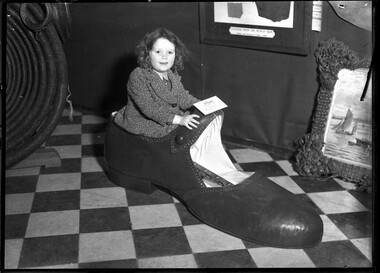
Photograph, Bull, Hugh Jones, 1897-1993, Leather Exhibition, Melbourne Town Hall
... Hall Melb 1933 Age Published: Age (Melbourne, Vic.: 1854- ), 1933 THE EXHIBITS. (1933, September 20). ......The Age (Melbourne, Vic. : 1854 - 1954)...Hall Melb 1933 Age Published: Age (Melbourne, Vic.: 1854- ), 1933 THE EXHIBITS. (1933, September 20). ...Photographer notations on slide: At the Leather Exhib. at T. Hall Melb 1933 Age Published: Age (Melbourne, Vic.: 1854- ), 1933 THE EXHIBITS. (1933, September 20). The Age (Melbourne, Vic. : 1854 - 1954), p. 16. Retrieved January 25, 2026, from http://nla.gov.au/nla.news-article205109730 Published title: THE EXHIBITS. A COMPREHENSIVE RANGE. Curios, Novelties, Working Displays Published Caption: ONE OF THE NOVELTIES – AN OUTSIZE IN SHOES Research by Project Volunteer, Louise McKenzie: Our photo is dated 20 September 1933, and shows a happy, chubby-faced young girl sitting in a very over-sized girl’s shoe. It is labelled – “Shoe, An Out Size, loaned by Messrs Blackman & Rose”. (1) It is an effective way to capture the attention of the readership and alert them to the Melbourne Leather Show 1933. This show was designed to be a drawcard of extraordinary proportion, and there is no doubt that this leather exhibition was a really big deal for Melbourne. It completely took over the Melbourne Town Hall, and was open from 10.30 am until 10.30 pm. It seemed to contain something for everyone – the military, the man about town, the home handyman, the housewife, the child, the sporting types, the domestic workers, the outdoor enthusiasts, the horseracing fans, car enthusiasts, those wishing to show off the latest fashion – both men and women - and those just intrigued by a lot of fascinating and wide ranging exhibits. One of the most comprehensive descriptions of the Exhibition accompanies the photograph, and is worth quoting in full: “PROMINENT among exhibits which first attract attention in the foyer of the Town Hall is a comprehensive display of leather articles used by the defence forces. A conspicuous legend states that leather plays an important part in national defence, being used for saddlery, tool containers, holdalls, range-finding, surveying and signalling equipment, explosives factories, harness accoutrement, bandsmen's equipment and clothing. Three models of horses and several figures of soldiers wearing leather equipment illustrate the lesson, and a great range of leather goods used in military training and work variegate the display. Nearby are Texas cowboy, buckjumping and breaking-in saddles; whips, a walking stick, made of leather and numerous other curios. The general exhibition occupies the whole floor space of the main Town Hall, and is subdivided by partitions running most of the length of the hall. A bewildering variety, of leather goods presses for close and leisured inspection. Here and there operatives in charge of working machinery give practical demonstrations of factory processes in the production of footwear. Polishing materials are well represented. One attractive exhibit includes two bush huts constructed of leather, with wattle bark for roofing. Opossums, rosellas and a kookaburra add touches of bush realism. Adjacent exhibits include bags, fishing boots, leggings, leather covers in all colours. Factory Processes. One exhibitor has installed an automatic cinema apparatus and screen, which projects various factory processes in making a shoe, the operator being shown at work. Elsewhere an interesting exhibit depicts the five stages in the manufacture of sole leather, and the tanning materials employed. "Very handsome effects are achieved in the interior appointments of motor cars, which are attended by figures of smart chauffeurs in leather coats. Motor-trimming leather is said to be more durable and hygienic than fabric materials, and cheaper. The neat finish of the material, its excellent appearance, certainly make a very favourable impression. It takes the hides of three beasts to cover the cushions, squabs and door panels of a full-sized sedan, while to finish the entire interior, including quarter-panels and head linings would take four or even five. Special Exhibits. Amongst the special sections the display arranged by the handicrafts and home industries- committee of the Country Women's Association of Victoria is a notable one. In all there are about 130 entries which are in four classifications, viz., hand-tooled or embossed leathers, suede, hand-made gloves and undecorated leather. The glove section attracted the most numerous entries, a number being the work of members and craft subscribers of the Country Women's Association. In the leathercraft competition, organised by the Country Women's Association, the judges yesterday awarded the first prize for bookbinding (the only prize given in this division) to Miss M. Alston, of South Yarra. There is also a creditable display of exhibits submitted by boys of the orthopaedic section of the Children's Hospital at Frankston. Amongst the novelties on view in other portions of the exhibition were the following: — Leather coats worn by Sir C. Kingsford Smith on his Atlantic flight. Model Wellington boot, Phar Lap's saddle. Melbourne Cup winner's saddle. Longest whip in world, 108 feet long. (33 metres) [See our photo, to left of Girl in Shoe] Diminutive shoes. Pair of shoes 65 years old. Pair of men's working boots 75 years old. Larwood's, Tate’s and Pataudi’s cricket boots. [Three internationally revered cricketers of the day] (2) Picture frame made of leather bought 63 years ago. [See our photo, to right of Girl in Shoe] Leather frame, powder bowl, &c. Saddle used by world's champion buckjumper in U.S.A. Mexican cowboy outfit. Miniature saddle and bridle. A fireman's helmet made of sole leather. (3) Sample of the leather hat worn by porters at the Billingsgate Fish Market, London. (4) From South Australia there have been obtained sets of harness for donkeys, goats and camels, the equipment being displayed to good advantage on stuffed representations of the animals mentioned. Close to the platform is a glass case containing snow shoes and coats which have been used in Antarctic exploration work. Trade Display. Amongst the trade exhibits may be seen in operation a slipper turn shoe sewing machine, with heeling and channelling facilities, and the various stages in the production of ladies' sandals are shown. There is a wide contrast between sole leather of varying degrees of thickness on view in one stall and the choice samples of ladies' footwear in another — footwear, by the way, which could almost be used as ornaments, so dainty in colour and production are they. Again, there are displays of upholstering leathers of such soft texture that they could he readily mistaken for some of the finest cloth. Those who may be particularly interested in the production of chamois leather may gain an insight into the materials and chemicals used in the "working up” of this variety of leather. Supplies of glace kid (5) are tastefully arranged, and there may also be seen bags of all shapes and sizes, including satchels, suit cases and "sporting" cases, and bags for tennis players and golfers. Further variety is given to the exhibition by the display of antique hides, brightly coloured, with punching balls, boxing gloves and batsman's pads. There are crocodile skins and snake skins so cleverly "Worked up" that one could be almost pardoned for betraying an affection for such unpopular creatures.” “ Another wonderful article on this Exhibition, published the same day in one of the opposition daily newspapers, The Argus, is in the weekly article “Women to Women”, entitled “A Great Victorian Industry: Many Uses for Leather”. This weekly column was penned by Vesta, and she writes, with much purpose: “Yesterday afternoon I paid a hurried visit to the Leather Exhibition now being held in the Melbourne Town Hall and I was disappointed to find that the early visitors to the main exhibition were almost all men. Women, I think, should make a point of seeing every exhibition of our great industries, for women are the buyers of household requisites and goods for their own use and their tastes, and opinion influence also, to a large extent, the purchases of men. So, the welfare of industries is more or less in their hands and it becomes a duty for them to inform themselves fully of the extent and the quality of the manufacturing that is done here. The value of the output of the Australian boot and shoe factories alone was in 1930-31, the latest year for which the figures are given, Stg 3,750,000. Fully two thirds of that amount must have been spent by women on boots and shoes for themselves and their children. In a host of other directions, in the purchase of handbags, travelling bags, belts and straps, cushions, furniture coverings, purses, notebooks, spectacle cases, their annual expenditure must be very high. Their interest, therefore, in this industry is practical, and their support of it should be governed by knowledge of comparable values and qualities of the goods they buy. From the point of view of women, however, the exhibition itself is rather disappointing. There is an amazing collection of good stuff on show, but most of it is not displayed in a fashion that attracts attention. I was surprised, for example, at the range and quality of the leathers displayed, the suppleness of the finer qualities, and the varied range of colours and designs. But they are shown in such a fashion that if one set out deliberately to look for them it would be quite easy to miss most of them.” …It was surprising, too, that no one seemed to have taken advantage of the present fashion of wearing coloured gloves, or the cult of glove making, which the Country Women’s Association has fostered so successfully. Outside the collection of chamois leathers I saw no skins which were suitable to glove making. (6) However, it is perhaps a little unfair to be highly critical of the exhibition, inasmuch as it is the first of its kind. The material is there, undoubtedly, for a splendid show of every phase of this enterprising industry, and I am confident that experience will prove to those concerned that it will be worth while next time to devote a great deal of attention of the method of display.” With further research, it transpires that “Vera” is in fact NZ born Stella May Allen (nee Henderson) (1871-1962), a journalist, the first woman in NZ to begin a law course, in 1890-91). She later worked at a law firm while she completed her degree. Study of the law had always been open to women in NZ, but its practice was still barred to them. Her case “…led to amending legislation in 1896 allowing women to practise as barristers or solicitors. However, on gaining her LL.B. in November 1897 she did not apply for admission to the Bar. Instead, she became the Wellington-based correspondent and leader-writer for the Lyttelton Times. Her appointment, the first for a woman, was not welcomed by the all-male Press Gallery, and special permission had to be obtained from a subcommittee of the House before her presence was accepted. In 1900 she married Edwin Allen, a senior leader-writer for the Wellington Evening Post, and they moved to Australia in 1903 when Edwin Allen took up the post of foreign affairs leader-writer and parliamentary man for the Melbourne Argus. As Patricia Keep notes in her excellent entry of Stella Allan in the Australian Dictionary of Biography: “In 1907 The Argus commissioned her to write a series of articles on the first Australian Women's Work Exhibition held in October. They aroused much interest and next year The Argus invited her to join its full-time staff and begin a weekly section on the particular interests of women. She adopted the nom de plume 'Vesta' and called the column 'Women to Women'. Her work was unique in an Australian daily paper at that time. Her pages extended to cover every aspect of women's affairs, children's interests and community welfare, and 'Vesta' became a household word for authoritative information and advice on such matters. An excellent needlewoman and first-rate cook herself, she thoroughly tutored her staff in the work and needs of women in both country and city, as well as providing the usual training for cadet journalists. She conducted interviews and also visited the country to see at first hand the results of bushfires, mouse plagues, droughts and floods. In 1910 she was one of three women foundation members of the Australian Journalists' Association. “…she found time to become deeply involved in community affairs. She was an original committee-member of the Victorian Association of Crèches and of the Free Kindergarten Union of Victoria, and had much to do with the early days of the Victorian Bush Nursing Association, the Baby Health Centres Association and the Queen Victoria Hospital. She was a member of the National Council of Women, first in New Zealand and then in Melbourne, and of the Country Women's Association from its inception. … in 1924 she was appointed substitute delegate for Australia to the fifth assembly of the League of Nations at Geneva and was a delegate to the second Pan Pacific Women's Conference in Hawaii in 1930. A meeting held in the Melbourne Town Hall in 1938 by representatives of all the main Victorian women's organizations paid special tribute to her work and influence. She retired next year to England where she continued to write for the Argus, contributing articles on the experiences of women and children in wartime.” It is little wonder that “Vesta” was unafraid to take to task both the women of Victoria, and those who created the exhibition! One item which appears to have gone unnoticed, or at least unreported, is a framed article in the background of the photo of the chubby girl in the shoe. The display frame is labelled “Leather from the Human Skin, Tanned and Dressed by French artists.” The exhibition was certainly a cabinet of curiosities! A charming article in The Argus is a nice note on which to end. It gives a quick history and overview of the Australian leather industry and its unprecedented, and possibly unexpected, development and success, and states with pride: “Though Victoria is the largest leather producer in the Commonwealth all tanners in the Commonwealth can look back with pride on the long march of progress.” Footnotes: (1) “Blackman and Rose”. Messrs Blackman and Rose were shoe manufacturers, from 1927 located at 200 Noone Street, Clifton Hill. The Melbourne Circle describes their building as a “fine-looking building in the Federation ‘blood and bandage’ style.” It was built around 1912 for Puttifoot and Bloom, boot manufacturers, and today the building is apartments. (2) These cricketers were household names in the day: Tate: Maurice Tate, “English cricketer of the 1920s and 1930s, and leader of England’s Test bowling attack for a long time during this period. The founder of modern seam bowling. “ Larwood: Harold Larwood, “English right-arm fast bowler and the main exponent of the bowling style known as “bodyline”. Used to considerable effect in the 1932-33 Test series in Australia. Pataudi: Iftikhar A K Pataudi, “an Indian prince who in the 1930s played Test cricket for England, and in the 1940s played Test cricket for India (as Captain) – the only test cricketer to have played for both India and England. (3) “sole” leather “… is the thickest and most resistant material existing in the tanning industry … made from vegetable tanned leathers, usually bovine butts, processed in a special way to make them the hardest type of leather in existence.” (4) The hats worn by porters at Billingsgate Fish Market were also known as a “Bobbin” and look quite squat and rather unsophisticated. They were made of wood and tarred leather, with a “flat, hardened top designed to support large rectangular boxes of fish. The upturned brim protected the porter’s head against fish juice draining from the boxes of fish which would be carried on top of the hat. Some hats featured a small drain hole at the rear to allow this collected juice to drain down the back of the carrier. The hats were made using the ‘cuir bouilli’ technique. The leather was immersed in water which was heated until the leather began to shrink. It was then removed and put on a wooden former. The leather was stitched together to make the hat while still wet, and then held in place until dry.” (See article and photo on the London Museum website) (5) Glace kid – described on the Boston Museum of Fine Arts’ Cameo database as “A smooth glossy leather originally prepared from goat or sheepskin. Early glace kid had a shiny surface that was originally prepared by tawing the skin in a mixture of alum, table salt, flour, and egg yolk. Today, glace kid is prepared from many types of vegetable or chrome tanned leathers. The smooth polished surface is obtained mechanically by shaving, glazing, ironing, and/or rolling the dry leather.” (6) In the 1930s, Melbourne’s glovemaking industry was characterised by local manufacturing, with key producers like Simpson’s Gloves Pty Ltd in Richmond and the Stagg Glove Company in Clifton Hill leading the market. These factories produced high-quality leather gloves, handbags, and specialty gear, often employing a clear gendered division of labour and training young, local women. Museum Victoria holds the Simpson’s Gloves Collection, comprising over 1200 items, and the University of Melbourne Archives holds the company’s business records. References: THE EXHIBITS. (1933, September 20). The Age (Melbourne, Vic. : 1854 - 1954), p. 16. Retrieved January 25, 2026, from http://nla.gov.au/nla.news-article205109730 EXPORT LEATHER. (1929, September 17). The Argus (Melbourne, Vic. : 1848 - 1957), p. 17. Retrieved January 19, 2026, from http://nla.gov.au/nla.news-article4037647 LEATHER EXHIBITION (1933, September 18). The Argus (Melbourne, Vic. : 1848 - 1957), p. 10. Retrieved January 19, 2026, from http://nla.gov.au/nla.news-article11693362 (1933, September 23). The Argus (Melbourne, Vic. : 1848 - 1957), p. 21. Retrieved January 19, 2026, from http://nla.gov.au/nla.news-page522766 WOMEN TO WOMEN (1933, September 20). The Argus (Melbourne, Vic. : 1848 - 1957), p. 13. Retrieved January 19, 2026, from http://nla.gov.au/nla.news-article11694034 Australian Dictionary of Biography, Stella May Allan (1871–1962) https://adb.anu.edu.au/biography/allan-stella-may-4998 WOMEN TO WOMEN (1930, January 22). The Argus (Melbourne, Vic. : 1848 - 1957), p. 13. Retrieved January 19, 2026, from http://nla.gov.au/nla.news-article4063888 Museums Victoria, Simpson’s Gloves, 486-496 Victoria Street, North Richmond, VIC, Australia https://collections.museumsvictoria.com.au/articles/2702 The Argus. (1927, October 31). The Argus (Melbourne, Vic. : 1848 - 1957), p. 20. Retrieved February 7, 2026, from http://nla.gov.au/nla.news-article3888451 Melbourne Circle: stories from the suburbs: “Boots and all in Clifton Hill” https://melbournecircle.net/2015/11/20/bootmakers-of-clifton-hill/ Wikipedia, Maurice Tate, https://en.wikipedia.org/wiki/Maurice_Tate Wikipedia, Harold Larwood, https://en.wikipedia.org/wiki/Harold_Larwood Wikipedia, Iftikhar Ali Khan Pataudi, https://en.wikipedia.org/wiki/Iftikhar_Ali_Khan_Pataudi Buy Leather Online Italy, Sole leather: https://buyleatheronline.com/en/blog/outsole-and-insole-leather-n7 London Museum, Porters hats, https://www.londonmuseum.org.uk/collections/v/object-731122/hat-porters-hat/ Cameo Database, Museum of Fine Arts, Boston, Glace Kid, https://cameo.mfa.org/wiki/Glac%C3%A9_kid VICTORIAN LEATHER HAS WON RENOWN (1937, September 22). The Argus (Melbourne, Vic. : 1848 - 1957), p. 31 (March of Progress Supplement). Retrieved February 7, 2026, from http://nla.gov.au/nla.news-article1108704 Photographer notations on slide: "At the Leather Exhib. at T. Hall Melb 1933 Age B5".displays, melbourne town hall, leather, children, shoes, 1930-1939, industry, hats, gloves -
City of Melbourne Libraries
Photograph, The Age (Melbourne, Vic. : 1854 - 1954), The Age, Tue 26 December 1933, 1933
... Published: The Age 26 December 1933, page 9 (1933, December 26). The Age (Melbourne, Vic. : 1854 - 1954), p. 9. Retrieved October 10, 2025, from http://nla.gov.au/nla.news-page19054271 Featured in "Newsworthy : Melbourne in photographs 1933-1936" exhibition held at East Melbourne Library from October to December 2023. ...The Age (Melbourne, Vic. : 1854 - 1954)...The Age newspaper photography 1930-1939 christmas Digital file The Age, Tue 26 December 1933 Photograph The Age (Melbourne, Vic. : 1854 - 1954) ...The Age: Christmas 1933 weather pictorial Three photographs from the McKenzie Collection appear in this Age Boxing Day pictorial, documenting the weather conditions in Melbourne on Christmas Day, 1933. In the morning, swimmers flocked to the St Kilda foreshore to cool off during a heatwave. By five o’clock, thunder and a hailstorm were breaking over the city, leaving the streets flooded. Also featured on this page: Important visitors at the Children’s Hospital and The Nurses’ Christmas. Large scale prints of all three images feature below. Discovering this page via the digitised newspapers on Trove was a crucial step in unlocking the provenance of the slides. Published: The Age 26 December 1933, page 9 (1933, December 26). The Age (Melbourne, Vic. : 1854 - 1954), p. 9. Retrieved October 10, 2025, from http://nla.gov.au/nla.news-page19054271 Featured in "Newsworthy : Melbourne in photographs 1933-1936" exhibition held at East Melbourne Library from October to December 2023. The Newsworthy exhibition developed out of a local history digitisation project. Fifty images from a collection of 240 glass plate negatives were selected and printed at large scale for public display at East Melbourne Library. The exhibition was very well-received. The McKenzie Collection of glass plate negatives unlocks glimpses of our city not seen for almost 100 years. In the 1990s, renowned architectural photographer Ian McKenzie (1939-2014) picked up 240 glass plate negatives at a local market. Believed to be from a Victorian news archive, they dated back to the 1930s. The slides lay dormant in a dusty garage until 2020 when Ian’s wife Louise decided it was time to bring them back into the light. Louise McKenzie, and two other history-lovers, Ernie Ward and Fiona Collyer, signed up as City of Melbourne volunteers and joined forces with City of Melbourne Libraries Community Heritage Team Leader, Linda Longley and Local History Librarian, Fiona Campbell. Together, the project team has devoted more than three years to unlocking the mysteries of the collection. What began as a simple digitization exercise swiftly morphed into a wild journey of discovery and kismet. Intensive detective sessions and discussions with fellow historical networks ensued, gradually unearthing our photojournalistic history and technologies, the merits of volunteer work, and astonishing stories from 1930s Victoria. From the domestic to the dramatic, the celebratory to the solemn, these fascinating images capture a fleeting yet significant period in Interwar, Depression-era Melbourne. Above all, the McKenzie Collection project has brought about a powerful and sustained sense of engagement, connection and celebration between people across decades and places.the age newspaper, photography, 1930-1939, christmas -
 Mission to Seafarers Victoria
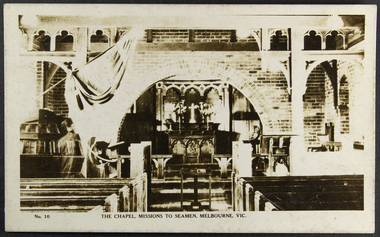
Postcard, A Real Photograph, The Chapel, Missions to Seamen Melbourne, Vic, c. 1917
... The Chapel, Missions to Seamen Melbourne, Vic....The Chapel, Missions to Seamen Melbourne, Vic. Postcard Postcard A Real Photograph ...The postcard depicts the St Peter chapel with its furnitshing and furniture gifted by suppoerters.Early photograph of the St Peter Chapel.Glossy sepia tone postcard depicting the interior of the St Peter chapel.Printed on verso: Postcard / A Real Photograph / Produced in Australiast peter chapel, seamen mission, mission to seamen, mission to seafarers, flinders street, melbourne, pulpit, prayer desk, altar, lectern, cross, credence, alm's dish -
 Mission to Seafarers Victoria
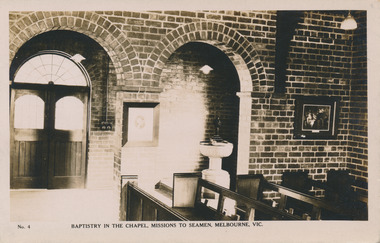
Postcard - Postcard, Black and white, Valentine & Sons Publishing Co. Ltd, Baptistry in the Chapel, Missions to Seamen, Melbourne, Vic, c. 1920
... Baptistry in the Chapel, Missions to Seamen, Melbourne, Vic...Baptistry in the Chapel, Missions to Seamen, Melbourne, Vic Postcard Postcard, Black and white Valentine & Sons Publishing Co. ...Possibly produced as one of a series of photographic post cards of various areas of the Mission especially of the Chapel in the pre-war WW2 period of the 20th century. There are several such cards in the MTSV Collection. The Chapel, opened in 1917, was a special fundraising project of the Ladies Harbour Light Guild and was originally dedicated as a Memorial Chapel in remembrance of those who served in the Merchant Navy of WWI. The Chapel is still used for marriages, baptisms,funerals and memorial services, and is often referred to as St Peter's, the Mariners' Chapel. Photographic postcards were produced soon after the new 1917 Mission to Seamen building was first opened. Available to supporters and visiting seafarers alike, effectively promoting the Mission and the role it played in ensuring both spiritual and pastoral care available to seamen and shipping to and from Australia. Black and white gloss print postcard featuring an interior view of St Peter's Chapel at the MTSV 717 Flinders St showing the baptismal font and front door.Pencil inscription " Ret to B. Kent" (see also gift comments below) ; Printed : "POST CARD / A Real Photograph Produced in Australia"mtsv, missions to seamen institute, baptism, merchant navy, st peter chapel, mission to seafarers, baptistry, baptismal font, seamen's mission, flinders street -
 Mission to Seafarers Victoria
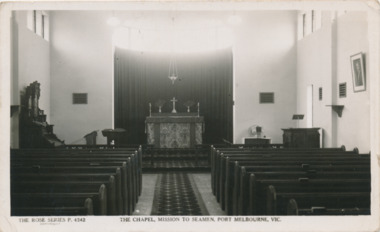
Postcard - Postcard, Black and white, Rose Stereograph, The Chapel, Mission To Seamen, Port Melbourne, Vic, c. 1937
... The Chapel, Mission To Seamen, Port Melbourne, Vic....The Chapel, Mission To Seamen, Port Melbourne, Vic. Postcard Postcard, Black and white Rose Stereograph ...This postcard is part of a series by Rose Stereograph and likely to be sold in the Mission to be used by seafarers.Black and white postcard depicting the inside of the chapel in the 1937 Port Melbourne Mission with pews, reed organ and altar.Written in blue ink by David Conolly: "Faded, which spoils it. Also it's bigger than in this picture."chairs, george v memorial institute, port melbourne, seamen's mission, reed organ, harry norris, st andrews chapel, altar, furnishing, marketing -
 Mission to Seafarers Victoria
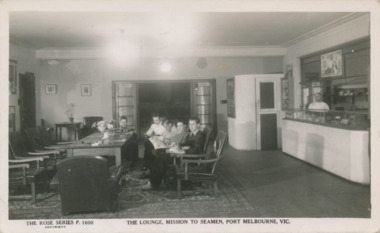
Postcard, Rose Stereograph, The lounge, Mission To Seamen, Port Melbourne, Vic, c. 1937
... The lounge, Mission To Seamen, Port Melbourne, Vic....chairs george v memorial institute port melbourne seamen's mission harry norris lounge magazines canteen caretaker The lounge, Mission To Seamen, Port Melbourne, Vic. Postcard Rose Stereograph ...chairs, george v memorial institute, port melbourne, seamen's mission, harry norris, lounge, magazines, canteen, caretaker -
 Mission to Seafarers Victoria
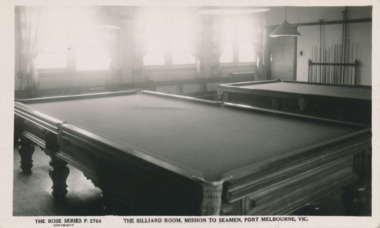
Postcard, Rose Stereograph, The Billiard room, Mission To Seamen, Port Melbourne, Vic, c. 1937
... The Billiard room, Mission To Seamen, Port Melbourne, Vic....george v memorial institute port melbourne seamen's mission harry norris billiard room Postcard of two full size billiard tables The Billiard room, Mission To Seamen, Port Melbourne, Vic. Postcard Rose Stereograph ...Postcard of two full size billiard tables george v memorial institute, port melbourne, seamen's mission, harry norris, billiard room -
 St Kilda Historical Society
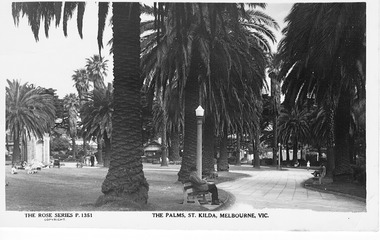
Photograph, The Palms, St Kilda, Melbourne Vic
... The Palms, St Kilda, Melbourne Vic...The "Rose" Series The Rose Series P1351 The Palms St Kilda Melbourne Victoria black and white postcard The Palms, St Kilda, Melbourne Vic Photograph Rose Series Stereograph Co ...The "Rose" Seriesblack and white postcardThe Rose Series P1351 The Palms St Kilda Melbourne Victoria -
 Melbourne Athenaeum Archives
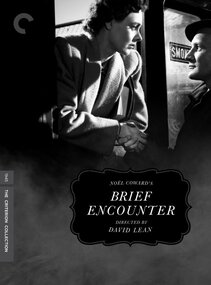
Newspaper Article, Brief Encounter (film) screened at Melbourne Athenaeum Theatre - Argus (Melbourne, Vic. : 1848 - 1957), Monday 7 April 1947
... Brief Encounter (film) screened at Melbourne Athenaeum Theatre - Argus (Melbourne, Vic. : 1848 - 1957), Monday 7 April 1947...Brief Encounter (film) screened at Melbourne Athenaeum Theatre - Argus (Melbourne, Vic. : 1848 - 1957), Monday 7 April 1947 Newspaper Article ...
