
Showing 10 items matching "melbourne aviation company"
-
 Port Melbourne Historical & Preservation Society
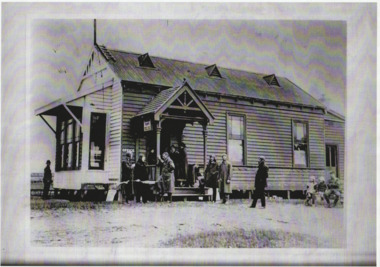
Photograph - Booking office, R Graham Carey's aerodrome, Fishermen's Bend
... ...melbourne aviation company...See photocopy with names of those pictured (item 1263.02) transport - aviation and aerodrome fishermans bend r graham carey bertha carey harvey melbourne aviation company edith carey howard carey graham melrose carey g r mcpherson Laser copy of photo of R. ...See photocopy with names of those pictured (item 1263.02)Laser copy of photo of R. Graham Carey's aerodrome booking office 1920s, a church hall transported to Fishermen's Bend from Brighton and used also as the family home. With Carey, his children and a number of others outside the hall.transport - aviation and aerodrome, fishermans bend, r graham carey, bertha carey harvey, melbourne aviation company, edith carey, howard carey, graham melrose carey, g r mcpherson -
 Port Melbourne Historical & Preservation Society
Photograph - Photocopy, R Graham Carey's aerodrome booking office, Fisherman's Bend
... ...melbourne aviation company...transport - aviation and aerodrome fishermans bend r graham carey bertha carey harvey melbourne aviation company edith carey howard carey graham melrose carey g r mcpherson Photocopy of photo of R. ...Photocopy of photo of R. Graham Carey's aerodrome booking office 1920s, with names of Carey, his children and a number of others outside the hall annotated by daughter Bertha Carey Harvey.transport - aviation and aerodrome, fishermans bend, r graham carey, bertha carey harvey, melbourne aviation company, edith carey, howard carey, graham melrose carey, g r mcpherson -
 Orbost & District Historical Society
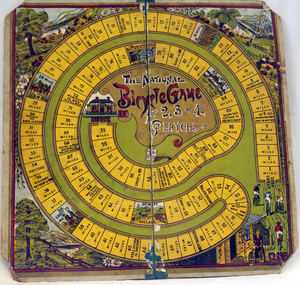
board game, 1930-1950
... Company of Ballarat and Melbourne between 1930 and 1950. The earliest board games date from the mid-18th century and were printed on copper or steel plates and coloured by hand. By 1839 lithography was first used, making it possible for publishers to produce larger quantities of all types of toys. By the 1890s the games were mounted on to a folded board. Popular subjects were of an historical or geographical nature, as well as transport including motoring, aviation...Company of Ballarat and Melbourne between 1930 and 1950. The earliest board games date from the mid-18th century and were printed on copper or steel plates and coloured by hand. By 1839 lithography was first used, making it possible for publishers to produce larger quantities of all types of toys. By the 1890s the games were mounted on to a folded board. Popular subjects were of an historical or geographical nature, as well as transport including motoring, aviation ...The National Bicycle Game is an Australian-made and designed board game for 2, 3 or 4 players made by The National Game Company of Ballarat and Melbourne between 1930 and 1950. The earliest board games date from the mid-18th century and were printed on copper or steel plates and coloured by hand. By 1839 lithography was first used, making it possible for publishers to produce larger quantities of all types of toys. By the 1890s the games were mounted on to a folded board. Popular subjects were of an historical or geographical nature, as well as transport including motoring, aviation and railways and various sports. The board game 'A Motor Ride' ,made by The National Game Company, was possibly the first large-scale manufacturer of locally-designed board games in Australia. The firm was established in Ballarat, Victoria, at the beginning of the twentieth century by W. Owen. Other board games made by National include the 'Victory-United Nations" game, 'Fairyland', 'Yacht Race', 'Golf Game', 'Bicycle Game', Steeple Chase', 'Our Great Game' about football, 'Courtship and Marriage', 'Around the Commonwealth by Aeroplane', and 'Dugouts and Trenches' as well as the more traditional games such as Ludo, Snakes and Ladders, and Noughts and Crosses. This game board has been well-used. The game is significant because it uses scenarios familiar to Australian children in the first half of the twentieth century. This game board reflects the experience of being a child in the twentieth century. Toys were how children were socialised and taught. Most toys mimic the adult world, and looking at them can tell us something about how the world has changed. A folding game board for The national Bicycle Game for 2,3 or 4 players. It has a yellow spiral track on which the player progresses at the throw of the die, starting at the clubhouse until reaching home. In the background are pictures of rural scenes.board-games recreation cycling national-game-company -
Glen Eira Historical Society
Document - Melbourne Aerodrome, Grange Road, Glen Huntly
... Melbourne Aerodrome. 2/A printout from the internet printed on 20/08/2010 on Essendon Airport with reference to aerodrome at Glen Huntly. Reid Athol Caulfield History Society Airports GlenHuntly Road Leman’s Swamp Larkin Aircraft Company Mernda Avenue Koornang Park Larkin J H RoxBurgh Miss Lord Reserve GlenHuntly Caulfield Carnegie Primary School Aviation Document Melbourne Aerodrome, Grange Road, Glen Huntly ...Two documents about this Aerodrome (1 page each):1/Photocopy From The First 100 years No 2897 Carnegie Primary School 1888 – 1988 edited by Isobel Couper And Deirdre Lynch on recollections of Athol Reid which include references to the Melbourne Aerodrome. 2/A printout from the internet printed on 20/08/2010 on Essendon Airport with reference to aerodrome at Glen Huntly.reid athol, caulfield history society, airports, glenhuntly road, leman’s swamp, larkin aircraft company, mernda avenue, koornang park, larkin j h, roxburgh miss, lord reserve, glenhuntly, caulfield, carnegie primary school, aviation -
Glen Eira Historical Society
Pamphlet - Melbourne Aerodrome, Grange Road, Glen Huntly
... Hawker Harry George Aviators Aviation Pilots Aircraft Sopwith Aviation Company Hawker Stanley Herbert Hawker George Hawker Mary Hawker Maude Hawker Ruby St John's Caulfield North Engineer Caulfield Army and Navy Club (RSL) Caulfield Repatriation Hospital Duke Street Caulfield South New Street Elsternwick Caulfield Racecourse Millen Senator Minister for Defence World War 1914-1918 "Death Spin" Sopwith Aircraft Co. Pamphlet Melbourne ...Three documents about the history of Harry G. Hawker who flew from this and other places: 1/A Pamphlet On Harry George Hawker 1889 – 1921 Published on 12 February 1989 For The Unveiling By Weston Bate of St Kilda Commemorative Plaque At 31 Gourlay Street East St Kilda, The Hawker Family Home. The Pamphlet Gives Biographical Information Based on Hawker’s Entry In The Australian Dictionary of Biography. Double- (CMHS) Newsletter of March 2015 on brothers Harry and Herbert Hawker. 3/Pamphlett "Harry Hawkder In Austrlaia 1914" announcing 2014 as the year to commemorate the centenary of his return to Austrlai in 1914. This includes a short history of Harry Hawker, records he set and 3 black and white photographs plus 1 sepia. Contact details included for Chris Hawker plus a Facebook page still current at 13/11/2017. Double-sided.hawker harry george, aviators, aviation, pilots, aircraft, sopwith aviation company, hawker stanley herbert, hawker george, hawker mary, hawker maude, hawker ruby, st john's caulfield north, engineer, caulfield army and navy club (rsl), caulfield repatriation hospital, duke street, caulfield south, new street, elsternwick, caulfield racecourse, millen senator minister for defence, world war 1914-1918, "death spin", sopwith aircraft co. -
 Bendigo Historical Society Inc.
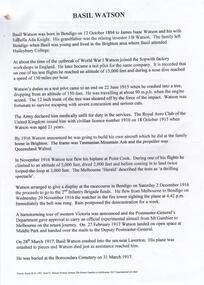
Document - BASIL WATSON
... aviation pioneer born in Bendigo 12/10/1893. The family moved to Melbourne when he was a child. In 1914 he went to England to work as an engineer for the Sopwith Aviation Company. ...aviation pioneer born in Bendigo 12/10/1893. The family moved to Melbourne when he was a child. In 1914 he went to England to work as an engineer for the Sopwith Aviation Company. ...Basil George Watson was an aviation pioneer born in Bendigo 12/10/1893. The family moved to Melbourne when he was a child. In 1914 he went to England to work as an engineer for the Sopwith Aviation Company. He also took flying lessons and received his licence in 1915. He now worked as a test pilot for Sopwith but when a crash rendered him unfit for military duty, he returned to Australia in late 1915. He designed and constructed his own biplane in the back yard of his Elsternwick home. At the end of 1916 he tested his plane by flying from Point Cook to Bendigo and then to Melbourne. This included an aviation display in Bendigo. He followed this by flying to Warnambool 25/1/1916. He then set up an experimental airmail flight from Melbourne to Mount Gambier. On 28th March 1917, Watson was demonstrating aerobatics for the entertainment of AIF servicemen at Point Cook, when his plane collapsed and fell into the ocean close to shore. Unfortunately, Watson was tangled in the plane's wires and died. On hearing of his death, the bells of St Pauls in Bendigo and the Bendigo fire bell tolled.A paper detailing the life of Bendigo pilot Basil Watson, one of the first Australian pilots. 4 pages.aviation, basil watson, sopwith -
Moorabbin Air Museum
Document (Item) - (SP) CAC History Boomerang Description WS Robinson File No 1 7.1.1935 to 18.8.1942 Various Correspondence R3
... Robinson was a strong believer in aviation and business and air transportation having backed the purchase of two DH.84 Dragons in 1933 by associate company Western Mining Corporation to carry out a 12-month aerial photographic survey. He promoted the formation of Commonwealth Aircraft Corporation at Fishermans Bend, Melbourne...Robinson was a strong believer in aviation and business and air transportation having backed the purchase of two DH.84 Dragons in 1933 by associate company Western Mining Corporation to carry out a 12-month aerial photographic survey. He promoted the formation of Commonwealth Aircraft Corporation at Fishermans Bend, Melbourne ...Correspondence Notes on the "Boomerang" Interceptor 18/8/42 Correspondence re setting up aircraft industry in Australia - between W S Robinson, A G Brown (CAC), S A Middleton (Austral Development Ltd London.), Douglas Aircraft Company, F Mitchell, BHP,, Essiungton Lewis BHP, Australian William S. Robinson had been Managing Director of Broken Hill Associated Smelters, based in London. He had played a key roll in negotiating the British Zinc Corporation’s investment in mining at Broken Hill NSW and formation of the resultant Australian business The Zinc Corporation. Returning to Australia, he was appointed to high levels of Australian Government during the Second World War to formulate policy on wartime demands for Australia's industrial and metals supply. Robinson was held in high regard by successive Prime Ministers and was a close associate of Essington Lewis, head of Broken Hill Pty Ltd (BHP). W.S. Robinson was a strong believer in aviation and business and air transportation having backed the purchase of two DH.84 Dragons in 1933 by associate company Western Mining Corporation to carry out a 12-month aerial photographic survey. He promoted the formation of Commonwealth Aircraft Corporation at Fishermans Bend, Melbourne to ensure Australian production of military aircraft. -
Moorabbin Air Museum
Document (Item) - (SP) CAC History Aviation Syndicate Minutes and Agenda
... Robinson was a strong believer in aviation and business and air transportation having backed the purchase of two DH.84 Dragons in 1933 by associate company Western Mining Corporation to carry out a 12-month aerial photographic survey. He promoted the formation of Commonwealth Aircraft Corporation at Fishermans Bend, Melbourne...Robinson was a strong believer in aviation and business and air transportation having backed the purchase of two DH.84 Dragons in 1933 by associate company Western Mining Corporation to carry out a 12-month aerial photographic survey. He promoted the formation of Commonwealth Aircraft Corporation at Fishermans Bend, Melbourne ...Correspondence Notes on the "Boomerang" Interceptor 18/8/42 Correspondence re setting up aircraft industry in Australia - between W S Robinson, A G Brown (CAC), S A Middleton (Austral Development Ltd London.), Douglas Aircraft Company, F Mitchell, BHP,, Essiungton Lewis BHP, Australian William S. Robinson had been Managing Director of Broken Hill Associated Smelters, based in London. He had played a key roll in negotiating the British Zinc Corporation’s investment in mining at Broken Hill NSW and formation of the resultant Australian business The Zinc Corporation. Returning to Australia, he was appointed to high levels of Australian Government during the Second World War to formulate policy on wartime demands for Australia's industrial and metals supply. Robinson was held in high regard by successive Prime Ministers and was a close associate of Essington Lewis, head of Broken Hill Pty Ltd (BHP). W.S. Robinson was a strong believer in aviation and business and air transportation having backed the purchase of two DH.84 Dragons in 1933 by associate company Western Mining Corporation to carry out a 12-month aerial photographic survey. He promoted the formation of Commonwealth Aircraft Corporation at Fishermans Bend, Melbourne to ensure Australian production of military aircraft. -
 Melton City Libraries
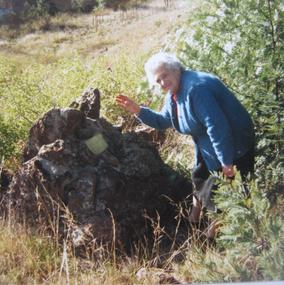
Photograph, The Cairn- Jimmy Melrose's plane crash site, 1988
... Aviation Company. The delivery flight was planned as a goodwill mission to publicise the forthcoming South Australian Centenary celebrations. Melrose left Dympne on the 9th April 1936, and flying via Marseilles, Naples, Athens, Baghdad, Basra, Karachi, Jodphur, Calcutta, Akyab, Penang, Singapore, Lombok, Darwin, Newcastle Waters and Alice Springs reached Adelaide on the 25th of April. Continuing the goodwill flight to other States, he visited Melbourne...Aviation Company. The delivery flight was planned as a goodwill mission to publicise the forthcoming South Australian Centenary celebrations. Melrose left Dympne on the 9th April 1936, and flying via Marseilles, Naples, Athens, Baghdad, Basra, Karachi, Jodphur, Calcutta, Akyab, Penang, Singapore, Lombok, Darwin, Newcastle Waters and Alice Springs reached Adelaide on the 25th of April. Continuing the goodwill flight to other States, he visited Melbourne ...Edna Barrie at the cairn, photo received from Graeme Minns in 1988. The cairn marks the site of Jimmy Melrose's plane crash in Melton South. The accident which happened on July 5th 1936. In 1934 Melrose made headlines with a series of spectacular flights. In July of that year, he set around Australia record and in that year established a new solo Australia England record when he flew to England to compete in the MacRoberston race with a De Havilland Puss Moth VH- YQO. The only Australian and the only solo pilot to complete the course within the time limit. He was seventh in finishing order and third in the handicap section making news again during the race with a dramatic landing in Darwin with empty fuel tanks. Late in 1935 Melrose imported the Phoenix for his “Adelaide to Anywhere” Charter Service. The previous year the Heston Aircraft Company had taken over the interests of the well known Comper Aircraft Company, and the first production of the new firm was the Phoenix, a single-engined all wooden five seater machine of sesquiplane configuration. The forward half of the fuselage was a streamlined rectangular section and the rear portion was a monocogue shell; the whole was of plywood fabric covered. The wing was built up of spruce box spars and lattice ribs, ply covered from the leading edge to the front spar and the fabric covered over the remainder. The tail surfaces were of similar construction. The most notable feature of the design was the lower stub wing which ran right across the fuselage embodying two box spars, plywood covered it housed the main undercarriage wheels when retracted and provided a substantial anchorage for the Nu form wing struts. The Dowty undercarriage retracted inwards, operated manually by hydraulic packs, Dual control fitted, with side by side seating for the pilots and three passenger seats behind. Power was a 200 h.p. De Havilland Gipsy VI 6 cylinder inverted in-line air-cooled engine. Six Phoenix were built; five of them registered in Great Britain and one of those was later sold abroad the remaining four were impressed into the R.A.F. in 1940. Specifications were: 40 feet 4 inches length 30 ft 2 ins height, 9ft 7ins, wing area 270 sq ft, Tare weight 2,600lbs loaded weight 3,300lbs; cruising speed 360 m.p.h. landing 50mph ceiling 14,000 ft range 700 miles. Melrose’s machine the first production aircraft was built early in 1936 and test flown of the 24th March. Painted green it carries the words “South Australian Centenary 1936” in silver of the fuselage and the name “Billing on the engine cowling in honor of Melrose’s uncle Noel Pemberton Billing, pioneer designer and founder of the Supermarine Aviation Company. The delivery flight was planned as a goodwill mission to publicise the forthcoming South Australian Centenary celebrations. Melrose left Dympne on the 9th April 1936, and flying via Marseilles, Naples, Athens, Baghdad, Basra, Karachi, Jodphur, Calcutta, Akyab, Penang, Singapore, Lombok, Darwin, Newcastle Waters and Alice Springs reached Adelaide on the 25th of April. Continuing the goodwill flight to other States, he visited Melbourne, Sydney, Newcastle, Grafton, Brisbane, Coff’s Harbour, Sydney again, Launceston, Hobart and Mount Gambier before returning to Adelaide on the 13th May. During June Jimmy made some charter flights and early in July was engaged by Mr. A.J. Campbell a director of several mining companies from Melbourne to Darwin to commence at Essendon on the4th July. However on that day low cloud and steady rain caused the postponement. There was little improvement and Melrose was advised to delay the departure again. However he wished to reach Oodnadatta that night, and when he observed the break in the clouds decided to leave. He planned to climb above the cloud and fly to Adelaide at 3,000 feet. The aircraft was airborne about 8.10 a.m. and was last seen from Essendon climbing above the clouds. At 8.45 people at Melton (30 miles West of Melbourne) heard an approaching aircraft. The engine noise increased abnormally and eye witnesses saw the machine fall out of control from the cloud base about 800 feet and then disintegrate, fragments were scattered for 1½ miles and both occupants were killed. Hand written carbon copy by Edna Barrie.Typed by Wendy Barrie March 2014 Last Flight of Jimmy Melrose by John Burke Parade Magazine July 1972 Page 2 –4 This article gives the take off time of 7.50 am from Essendon Airport Eyewitness account at the time Maisie Arthur’s description. Newspaper article. Edna Barrie at the site of the 'Cairn'local identities, local significant events -
 Port Melbourne Historical & Preservation Society
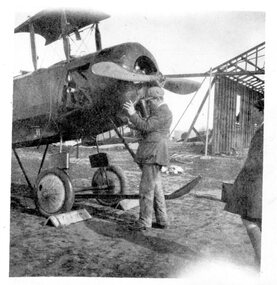
Photograph - Collection of Photos of the Shaw Ross Engineering and Aviation Company, 1920-24
... Port Melbourne Aerodrome and the Shaw Ross Engineering and Aviation Company....Photographs and contextual information regarding the Shaw Ross Engineering and Aviation Company at Port Melbourne....Port Melbourne Aerodrome and the Shaw Ross Engineering and Aviation Company. Victoria's first licensed aerodrome used by the Shaw Ross Engineering and Aviation Company. ...Port Melbourne Aerodrome and the Shaw Ross Engineering and Aviation Company.Victoria's first licensed aerodrome used by the Shaw Ross Engineering and Aviation Company.Photographs and contextual information regarding the Shaw Ross Engineering and Aviation Company at Port Melbourne.shaw-ross aviation, transport - aviation and aerodrome, harry shaw, fred huxley
