
Showing 40 items matching "melbourne college of textiles"
-
 National Wool Museum
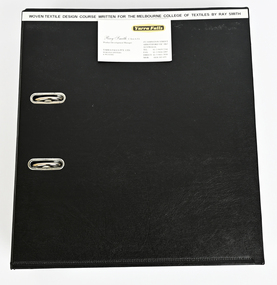
Document - Woven Textile Design Course for Melbourne College of Textiles, Ray Smith, 1996
... Woven Textile Design Course for Melbourne College of Textiles...Textile Design Course...Coursework...Melbourne College...I was commissioned by the Melbourne College of Textiles to write a Woven Textile Design Course to be taught under the outreach program. ...Front [printed label]: WOVEN TEXTILE DESIGN COURSE WRITTEN FOR THE MELBOURNE COLLEGE OF TEXTILES BY RAY SMITH...I was commissioned by the Melbourne College of Textiles to write a Woven Textile Design Course to be taught under the outreach program. ...Part of a collection of books, fabric samples and documents from the working life of Ray Smith. Ray began his career at the age of 15, working at the Albion Woollen Mills in Geelong in 1953. Over the next five decades, Ray furthered his education in textile design, weaving design, knitting and later computer aided design, including qualifications from Gordon Textile College, City and Guilds of London Institute, The Textile Institute, Melbourne Institute of Textiles and Royal Melbourne Institute of Technology (RMIT). After ten years at Albion Woollen Mills, Ray went on to hold fabric design positions at Prestige Fabrics and Yarra Falls, working up to management roles in both the Weaving and Fabric Design Divisions, and then as Product Development Manager at Yarra Falls until 2000. Ray shares some career highlights below: In 1977 and 1978 I won the Wool Corporation’s Celsius 30 Awards as Yarra Falls Designer. (See photos attached.) These awards came with study trips to the major Textile Centres and Trade Fairs around the world. This was proven to be beneficial and Yarra Falls sent me overseas every year for the next 22 years. On stopovers in Hong Kong we appointed an agent and took part in Textile Trade Fairs at Interstoff Asia and exhibited designs in 1991, 92, 93, 94. I created a pattern book for a chain of shops called “Kwun KeeTailors” for their customers to select our fabrics to be made up into suits for the tourists. I also had several trips to New York to try to export to America with some success. I was commissioned by the Melbourne College of Textiles to write a Woven Textile Design Course to be taught under the outreach program. This was eventually translated into Spanish to be used by developing textile industries in South America.Black two armed binder folder with over one hundred pages of typed paper in plastic sleeves. Documents contain details of sixty eight topics for Woven Textile Design Course. The folder has a label attached across the top edge, and a business card attached with tape to the front.Front [printed label]: WOVEN TEXTILE DESIGN COURSE WRITTEN FOR THE MELBOURNE COLLEGE OF TEXTILES BY RAY SMITHray smith, yarra falls, mills, textile design, fabric design, product development, wool corporation, textile design course, coursework, melbourne college of textiles, study, students -
 National Wool Museum
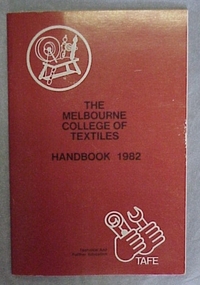
Booklet - Handbook, Melbourne College of Textiles, 1982
... Textile Industry - education...Melbourne College...Student handbook for the Melbourne College of Textiles, Pascoe Vale, 1982....Melbourne College of Textiles...Booklet Handbook Melbourne College of Textiles ...Student handbook for the Melbourne College of Textiles, Pascoe Vale, 1982.A5 size paper back book, red cover with black text and white logos. 46 pages.textile industry - education, melbourne college of textiles, tafe -
 National Wool Museum
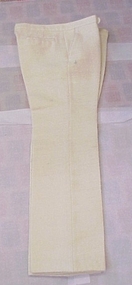
Trousers
... Textile Production Fashion Shearing Weaving Sewing...Melbourne College...Part of the three piece suit which set the "Sheep to suit" record by Melbourne College of Textiles in 1982...A product of the Clothing School, MELBOURNE COLLEGE OF TEXTILES/ PURE WOOL...Part of the three piece suit which set the "Sheep to suit" record by Melbourne College of Textiles in 1982 Textile Production Fashion Shearing Weaving Sewing Melbourne College of Textiles Australian Wool Corporation Sunbeam Corporation Limited Spinning Highlights of the National Wool Museum: from Sheep to Suit - Exhibition (22/09/2001 - 02/12/2001) Textile Production Fashion Shearing Weaving Sewing A product of the Clothing School, MELBOURNE COLLEGE OF TEXTILES/ PURE WOOL Part of the 'Sheep to Suit' event outfit. ...Suit pants, cream, natural, wool. Part of the three piece suit which set the "Sheep to suit" record by Melbourne College of Textiles in 1982Part of the 'Sheep to Suit' event outfit.A product of the Clothing School, MELBOURNE COLLEGE OF TEXTILES/ PURE WOOLtextile production fashion shearing weaving sewing, melbourne college of textiles australian wool corporation sunbeam corporation limited, spinning, highlights of the national wool museum: from sheep to suit - exhibition (22/09/2001 - 02/12/2001), textile production, fashion, shearing, weaving, sewing -
 National Wool Museum
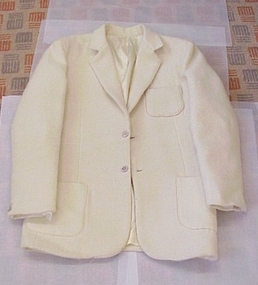
Jacket
... Textile Production Fashion Shearing Weaving Sewing...Melbourne College...Part of the three piece suit which set the "Sheep to suit" record by Melbourne College of Textiles in 1982...A product of the Clothing School, MELBOURNE COLLEGE OF TEXTILES/ PURE WOOL...Part of the three piece suit which set the "Sheep to suit" record by Melbourne College of Textiles in 1982 Textile Production Fashion Shearing Weaving Sewing Melbourne College of Textiles Australian Wool Corporation Sunbeam Corporation Limited Spinning Highlights of the National Wool Museum: from Sheep to Suit - Exhibition (22/09/2001 - 02/12/2001) Textile Production Fashion Shearing Weaving Sewing A product of the Clothing School, MELBOURNE COLLEGE OF TEXTILES/ PURE WOOL Part of the 'Sheep to Suit' event outfit. ...Suit jacket, cream, natural, wool and cream silk lining. Part of the three piece suit which set the "Sheep to suit" record by Melbourne College of Textiles in 1982Part of the 'Sheep to Suit' event outfit.A product of the Clothing School, MELBOURNE COLLEGE OF TEXTILES/ PURE WOOLtextile production fashion shearing weaving sewing, melbourne college of textiles australian wool corporation sunbeam corporation limited, spinning, highlights of the national wool museum: from sheep to suit - exhibition (22/09/2001 - 02/12/2001), textile production, fashion, shearing, weaving, sewing -
 National Wool Museum
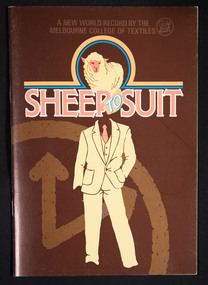
Booklet, Sheep to suit
... textile mills...melbourne college of textiles australian wool corporation sunbeam corporation limited..."Sheep to suit" -The Melbourne College of Textiles, 1984. The story of the Melbourne College of Textile's World Record of 1hr, 32 minutes, 33.52 sec on June 24, 1982, recorded by the Guinness Book of Records...This record was broken in 1987 by "The Melbourne College of Textiles" for the Japanese programme "These Wonderful People" Time 1 hour 27 Minutes 59.32 secs. ..."Sheep to suit" -The Melbourne College of Textiles, 1984. The story of the Melbourne College of Textile's World Record of 1hr, 32 minutes, 33.52 sec on June 24, 1982, recorded by the Guinness Book of Records textile production fashion shearing weaving sewing textile mills textile mills melbourne college of textiles australian wool corporation sunbeam corporation limited carding spinning highlights of the national wool museum: from sheep to suit - exhibition (22/09/2001 - 02/12/2001) textile production fashion shearing weaving sewing textile mills This record was broken in 1987 by "The Melbourne College of Textiles" for the Japanese programme "These Wonderful People" Time 1 hour 27 Minutes 59.32 secs. ..."Sheep to suit" -The Melbourne College of Textiles, 1984. The story of the Melbourne College of Textile's World Record of 1hr, 32 minutes, 33.52 sec on June 24, 1982, recorded by the Guinness Book of RecordsBooklet describing the 'Sheep to Suit' event for the Guiness Book of World Records.This record was broken in 1987 by "The Melbourne College of Textiles" for the Japanese programme "These Wonderful People" Time 1 hour 27 Minutes 59.32 secs. Time difference = 6 Minutes 04.13 secstextile production fashion shearing weaving sewing textile mills textile mills, melbourne college of textiles australian wool corporation sunbeam corporation limited, carding, spinning, highlights of the national wool museum: from sheep to suit - exhibition (22/09/2001 - 02/12/2001), textile production, fashion, shearing, weaving, sewing, textile mills -
 National Wool Museum
Certificate
... Textile Production Fashion Shearing Weaving Sewing...Melbourne College..."Record certificate" - Guinness Superlatives Limited, 1982 , awarded to the Melbourne College of Textiles for breaking the record for a "three piece suit from sheep to wearer"...GUINNESS SUPERLATIVES LIMITED/ RECORD CERTIFICATE/ This is to certify that...THE MELBOURNE COLLEGE OF TEXTILES/of...PASCOE VALE, MELBOUREN, VICTORIA, AUSTRALIA...did break the/...SHEEP TO SUIT...record this/24th day of...JUNE...1982/THREE PIECE SUIT FROM..."Record certificate" - Guinness Superlatives Limited, 1982 , awarded to the Melbourne College of Textiles for breaking the record for a "three piece suit from sheep to wearer" Textile Production Fashion Shearing Weaving Sewing Melbourne College of Textiles Australian Wool Corporation Sunbeam Corporation Limited Spinning Highlights of the National Wool Museum: from Sheep to Suit - Exhibition (22/09/2001 - 02/12/2001) Textile Production Fashion Shearing Weaving Sewing GUINNESS SUPERLATIVES LIMITED/ RECORD CERTIFICATE/ This is to certify that...THE MELBOURNE COLLEGE OF TEXTILES/of...PASCOE VALE, MELBOUREN, VICTORIA, AUSTRALIA...did break the/...SHEEP TO SUIT...record this/24th day of...JUNE...1982/THREE PIECE SUIT FROM Certificate ..."Record certificate" - Guinness Superlatives Limited, 1982 , awarded to the Melbourne College of Textiles for breaking the record for a "three piece suit from sheep to wearer"GUINNESS SUPERLATIVES LIMITED/ RECORD CERTIFICATE/ This is to certify that...THE MELBOURNE COLLEGE OF TEXTILES/of...PASCOE VALE, MELBOUREN, VICTORIA, AUSTRALIA...did break the/...SHEEP TO SUIT...record this/24th day of...JUNE...1982/THREE PIECE SUIT FROMtextile production fashion shearing weaving sewing, melbourne college of textiles australian wool corporation sunbeam corporation limited, spinning, highlights of the national wool museum: from sheep to suit - exhibition (22/09/2001 - 02/12/2001), textile production, fashion, shearing, weaving, sewing -
 National Wool Museum
Booklet, Sheep to suit
... Textile Production Fashion Shearing Weaving Sewing...Melbourne College..."Sheep to suit" -The Melbourne College of Textiles, 1984. The story of the Melbourne College of Textile's World Record of 1hr, 32 minutes, 33.52 sec on June 24, 1982, recorded by the Guinness Book of Records..."Sheep to suit" -The Melbourne College of Textiles, 1984. The story of the Melbourne College of Textile's World Record of 1hr, 32 minutes, 33.52 sec on June 24, 1982, recorded by the Guinness Book of Records Textile Production Fashion Shearing Weaving Sewing Melbourne College of Textiles Australian Wool Corporation Sunbeam Corporation Limited Carding Spinning Highlights of the National Wool Museum: from Sheep to Suit - Exhibition (22/09/2001 - 02/12/2001) Textile Production Fashion Shearing Weaving Sewing Booklet describing the 'Sheep to Suit' event for the Guiness Book of World Records. ..."Sheep to suit" -The Melbourne College of Textiles, 1984. The story of the Melbourne College of Textile's World Record of 1hr, 32 minutes, 33.52 sec on June 24, 1982, recorded by the Guinness Book of RecordsBooklet describing the 'Sheep to Suit' event for the Guiness Book of World Records.textile production fashion shearing weaving sewing, melbourne college of textiles australian wool corporation sunbeam corporation limited, carding, spinning, highlights of the national wool museum: from sheep to suit - exhibition (22/09/2001 - 02/12/2001), textile production, fashion, shearing, weaving, sewing -
 National Wool Museum
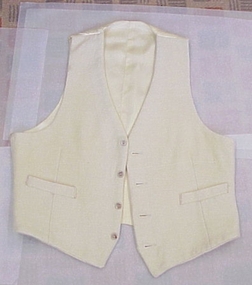
Vest
... Textile Production Fashion Shearing Weaving Sewing...Melbourne College...Part of the three piece suit which set the "Sheep to suit" record by Melbourne College of Textiles in 1982....Part of the three piece suit which set the "Sheep to suit" record by Melbourne College of Textiles in 1982. Textile Production Fashion Shearing Weaving Sewing Melbourne College of Textiles Australian Wool Corporation Sunbeam Corporation Limited Spinning Highlights of the National Wool Museum: from Sheep to Suit - Exhibition (22/09/2001 - 02/12/2001) Textile Production Fashion Shearing Weaving Sewing Part of the 'Sheep to Suit' event outfit. ...Suit vest, cream, natural, wool and cream silk. Part of the three piece suit which set the "Sheep to suit" record by Melbourne College of Textiles in 1982.Part of the 'Sheep to Suit' event outfit.textile production fashion shearing weaving sewing, melbourne college of textiles australian wool corporation sunbeam corporation limited, spinning, highlights of the national wool museum: from sheep to suit - exhibition (22/09/2001 - 02/12/2001), textile production, fashion, shearing, weaving, sewing -
 National Wool Museum
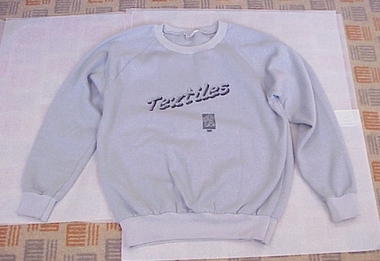
Jumper
... Textile Production Fashion Shearing Weaving Sewing...Melbourne College...Grey jumper, which formed part of the uniform for the 1987 Melbourne College of Textiles "Sheep to Suit" team and which was worn by John Hawthorne who took part in the event....Grey jumper, which formed part of the uniform for the 1987 Melbourne College of Textiles "Sheep to Suit" team and which was worn by John Hawthorne who took part in the event. ...Grey jumper, which formed part of the uniform for the 1987 Melbourne College of Textiles "Sheep to Suit" team and which was worn by John Hawthorne who took part in the event.Worn by participant in the 'Sheep to suit' event. Worn by participant in the 'Sheep to suit' event.Textiles/TAFE [Japanese characters]textile production fashion shearing weaving sewing, melbourne college of textiles, carding, spinning, highlights of the national wool museum: from sheep to suit - exhibition (22/09/2001 - 02/12/2001), textile production, fashion, shearing, weaving, sewing -
 National Wool Museum
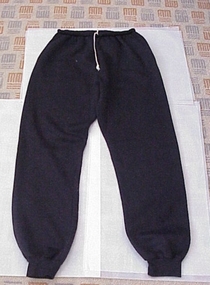
Pants
... Textile Production Fashion Shearing Weaving Sewing...Melbourne College...Black track pants, which formed part of the uniform for the 1987 Melbourne College of Textiles "Sheep to Suit" team and which were worn by John Hawthorne who took part in the event....Black track pants, which formed part of the uniform for the 1987 Melbourne College of Textiles "Sheep to Suit" team and which were worn by John Hawthorne who took part in the event. ...Black track pants, which formed part of the uniform for the 1987 Melbourne College of Textiles "Sheep to Suit" team and which were worn by John Hawthorne who took part in the event.Worn by participant in the 'Sheep to suit' event.textile production fashion shearing weaving sewing, melbourne college of textiles, carding, spinning, highlights of the national wool museum: from sheep to suit - exhibition (22/09/2001 - 02/12/2001), textile production, fashion, shearing, weaving, sewing -
National Wool Museum
T-shirt
... Textile Production Fashion Shearing Weaving Sewing...Melbourne College...White t-shirt, which formed part of the uniform for the 1982 Melbourne College of Textiles "Sheep to Suit" team and which was worn by Mr John Hawthorne who took part in the event....White t-shirt, which formed part of the uniform for the 1982 Melbourne College of Textiles "Sheep to Suit" team and which was worn by Mr John Hawthorne who took part in the event. ...White t-shirt, which formed part of the uniform for the 1982 Melbourne College of Textiles "Sheep to Suit" team and which was worn by Mr John Hawthorne who took part in the event.AUSTRALIA WORLD RECORD 1HR 34 MINS 33.42 SECS GUINNESS/ SHEEP/ TO/ SUIT/ 1982textile production fashion shearing weaving sewing, melbourne college of textiles, carding, spinning, highlights of the national wool museum: from sheep to suit - exhibition (22/09/2001 - 02/12/2001), textile production, fashion, shearing, weaving, sewing -
 National Wool Museum
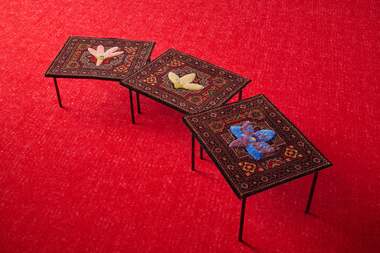
Textile - Orchid Tables, Dowel Jones, 2024
... ...Melbourne College of Textiles...This loom was operating at Brintons factory in Geelong from 1960 to 1975, and then at the Melbourne College of Textiles, until it was donated to the museum. ...This loom was operating at Brintons factory in Geelong from 1960 to 1975, and then at the Melbourne College of Textiles, until it was donated to the museum. ...The Orchid Tables were on display as part of the Ten Years of Dowel Jones exhibition at the National Wool Museum in 2024. The exhibition label reads: Sitting just outside this exhibition in the National Wool Museum is a 1910 Axminster Jacquard Carpet Loom. This loom was operating at Brintons factory in Geelong from 1960 to 1975, and then at the Melbourne College of Textiles, until it was donated to the museum. In the 1990's the museum commissioned an exclusive pattern called the Manor House Rug. Based on earlier designs from Brintons UK Persian Rug Archive Library, the museum continues to make this rug through the expertise of Loom Technician Michael Farquhar. The Manor House Rug features a central medallion with floral pattern. Working with illustrator Beci Orpin, and referencing Margaret MacDonald & Angair's book 'Orchids of the Anglesea District', we identified regional orchids. By a process of removal and addition, the original floral medallion was replaced with local species as decorative motif. Ten Year of Dowel Jones presents three altered Manor House Rugs, each with different orchids tufted in wool and placed in the centre of each rug. The rugs have been attached by cotton thread to three table frames at different heights to create the Orchid Tables.Three tables consisting of powder coated steel frames, with a woven carpet top. The table tops are made from wool with a jute backing, and feature a red, green, blue, black and cream floral design with an orchid in the centre. Each table is a different height.dowel jones, ten years of dowel jones, national wool museum, axminster loom, carpet, manor house rug, orchids, anglesea, design, art, furniture, beci orpin, brintons, geelong, melbourne college of textiles -
National Wool Museum
Program, Melbourne School of Textiles, Annual Awards, 1969
... ...Melbourne College of Textiles...Melbourne School of Textiles, Annual Awards, 1969 Woolclassing Education Wool - measurement Melbourne College of Textiles Galloway Mr Ken Woolclassing Education Wool - measurement Melbourne School of Textiles, Annual Awards, 1969 Program ...Melbourne School of Textiles, Annual Awards, 1969woolclassing education wool - measurement, melbourne college of textiles, galloway, mr ken, woolclassing, education, wool - measurement -
National Wool Museum
Photocopy, Melbourne School of Textiles - Shearing machine experting
... ...Melbourne College of Textiles...Melbourne School of Textiles - Shearing machine experting certificate awarded to K Galloway, 1969 Shearing Shearing machinery Melbourne College of Textiles Galloway Mr Ken Shearing Shearing machinery Melbourne School of Textiles - Shearing machine experting Photocopy ...Melbourne School of Textiles - Shearing machine experting certificate awarded to K Galloway, 1969shearing shearing machinery, melbourne college of textiles, galloway, mr ken, shearing, shearing machinery -
 National Wool Museum
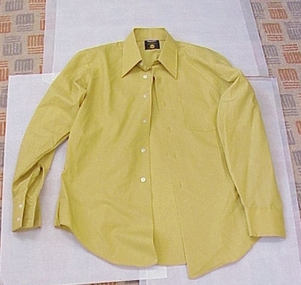
Shirt
... Textile Production Fashion Shearing Weaving Sewing...Melbourne College...Textile Production Fashion Shearing Weaving Sewing Melbourne College of Textiles Highlights of the National Wool Museum: from Sheep to Suit - Exhibition (22/09/2001 - 02/12/2001) Textile Production Fashion Shearing Weaving Sewing sheraton/ styled in/ Permanent Press/ KORATRON/ 65% polyester/ 35% cotton /15 1/2 Part of the 'Sheep to Suit' event outfit. ...Business shirt, gold with collar, long sleeves and cuffs. Part of the outfit to go with the "Sheep to Suit" record attempt, 1982.Part of the 'Sheep to Suit' event outfit.sheraton/ styled in/ Permanent Press/ KORATRON/ 65% polyester/ 35% cotton /15 1/2textile production fashion shearing weaving sewing, melbourne college of textiles, highlights of the national wool museum: from sheep to suit - exhibition (22/09/2001 - 02/12/2001), textile production, fashion, shearing, weaving, sewing -
 National Wool Museum
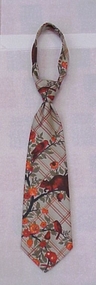
Tie
... Textile Production Fashion Shearing Weaving Sewing...Melbourne College...Neck tie, part of the outfit for the "Sheep to suit" record attempt, Melbourne School of Textiles,1982. Textile Production Fashion Shearing Weaving Sewing Melbourne College of Textiles Highlights of the National Wool Museum: from Sheep to Suit - Exhibition (22/09/2001 - 02/12/2001) Textile Production Fashion Shearing Weaving Sewing Gary David/ highest quality/MADE IN AUSTRALIA Part of the 'Sheep to Suit' event outfit. ...Neck tie, part of the outfit for the "Sheep to suit" record attempt, Melbourne School of Textiles,1982.Part of the 'Sheep to Suit' event outfit.Gary David/ highest quality/MADE IN AUSTRALIAtextile production fashion shearing weaving sewing, melbourne college of textiles, highlights of the national wool museum: from sheep to suit - exhibition (22/09/2001 - 02/12/2001), textile production, fashion, shearing, weaving, sewing -
 Ballarat Apron Festival
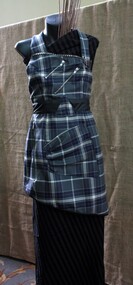
Apron, The Ballarat Apron, 2014
... Born in Ballarat, Schreenan attended Loreto College before studying fashion at Melbourne College of Textiles. She has worked extensively in Sydney, travelling to Paris, London and Los Angeles for work projects. ...Born in Ballarat, Schreenan attended Loreto College before studying fashion at Melbourne College of Textiles. She has worked extensively in Sydney, travelling to Paris, London and Los Angeles for work projects. ...This apron was designed for the Ballarat Apron Festival by local designer Clare Schreenan of Clasch Designs Ballarat. The tartan fabric was designed by Art Gallery of Ballarat for the 2014 exhibition “For Auld Lang Syne: Images of Scottish Australia, from the First Fleet to Federation”, and is officially registered with the Scottish Register of Tartans. The colours are highly significant: grey being chosen for the basalt plains on which Ballarat is built upon; Blue and white representing the Eureka Flag; and yellow for the gold that has made Ballarat so famous. Born in Ballarat, Schreenan attended Loreto College before studying fashion at Melbourne College of Textiles. She has worked extensively in Sydney, travelling to Paris, London and Los Angeles for work projects. She returned to Ballarat in 2006, launching Clash Design. Featuring the official, highly symbolic Ballarat tartan, and made by highly renowned local designer Clare Schreenan, this contemporary apron is of local significance to the Ballarat community. Grey, blue, white and yellow wool tartan fabric apron with asymmetrical design. Velco closures on back with zipper detailing. ballarat, tartan, apron -
 National Wool Museum
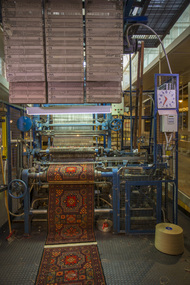
Machine - Axminster Carpet Loom, Brintons Ltd (UK), c. 1910
... When superseded in 1975 the loom was donated to the Melbourne College of Textiles for weaving training. The College has now donated the loom to the National Wool Museum and Brintons engineering staff has restored it to full working condition. ...When superseded in 1975 the loom was donated to the Melbourne College of Textiles for weaving training. The College has now donated the loom to the National Wool Museum and Brintons engineering staff has restored it to full working condition. ...The Axminster Carpet Loom has been set up as a focal point in the centre of the National Wool Museum. The loom was originally built by Brintons in England around 1910 and was initially operating in Geelong in 1960. Brintons designed and built most of their own looms and ancillary equipment. When superseded in 1975 the loom was donated to the Melbourne College of Textiles for weaving training. The College has now donated the loom to the National Wool Museum and Brintons engineering staff has restored it to full working condition. This loom is known as an Axminster gripper loom. The gripper system was invented by Brintons in 1890 and operates using a gripper shaped like a birds beak. This grips the yarn, the yarn is then cut and the gripper swings down to place the tuft into the woven backing. This particular loom also uses a jacquard system for weaving colours. In jacquard weaving, punched cards are used to instruct the loom as to which colour to use. The system was invented by Joseph Jacquard, a silk weaver from Lyon, and was introduced in 1804. It revolutionised pattern weaving as it had the capacity to create intricate patterns through the use of the cards. By 1833 there were approximately 100,000 power-looms used in Great Britain that had been influenced by Jacquards invention. Joseph Jacquard died in 1834. Charles Babbage was later to adapt Jacquards punch-card system to produce a calculator that was the forerunner of todays methods of computer programmingAxminster carpet loom featuring over 1000 Jacquard punch cards and over 100 bobbins of different colours of wool.loom carpet wool, geelong woolbrokers' association, geelong, auction -
 National Wool Museum
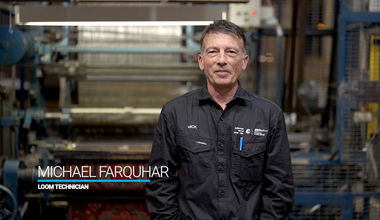
Film - Axminster Carpet Loom with Michael Farquhar, Streamline Media and Communications Group Pty Ltd, 2025
... When superseded in 1975 the loom was donated to the Melbourne College of Textiles for weaving training. The College has now donated the loom to the National Wool Museum and Brintons engineering staff has restored it to full working condition. ...When superseded in 1975 the loom was donated to the Melbourne College of Textiles for weaving training. The College has now donated the loom to the National Wool Museum and Brintons engineering staff has restored it to full working condition. ...This film features Loom Technician Michael Farquhar demonstrating how the Axminster Carpet Loom works, at the National Wool Museum. The Axminster Carpet Loom has been set up as a focal point in the centre of the National Wool Museum. The loom was originally built by Brintons in England around 1910 and was initially operating in Geelong in 1960. Brintons designed and built most of their own looms and ancillary equipment. When superseded in 1975 the loom was donated to the Melbourne College of Textiles for weaving training. The College has now donated the loom to the National Wool Museum and Brintons engineering staff has restored it to full working condition. This loom is known as an Axminster gripper loom. The gripper system was invented by Brintons in 1890 and operates using a gripper shaped like a bird's beak. This grips the yarn, the yarn is then cut and the gripper swings down to place the tuft into the woven backing. This particular loom also uses a jacquard system for weaving colours. In jacquard weaving, punched cards are used to instruct the loom as to which colour to use. The system was invented by Joseph Jacquard, a silk weaver from Lyon, and was introduced in 1804. It revolutionised pattern weaving as it had the capacity to create intricate patterns through the use of the cards. By 1833 there were approximately 100,000 power-looms used in Great Britain that had been influenced by Jacquard's invention. Joseph Jacquard died in 1834. Charles Babbage was later to adapt Jacquard's punch-card system to produce a calculator that was the forerunner of todays methods of computer programming.Digital film featuring colour footage, audio and animated graphics. michael farquhar, loom technician, axminster carpet loom, brintons, geelong, textile industry, machinery, weaving, restoration, gripper, jacquard, punch cards -
 National Wool Museum
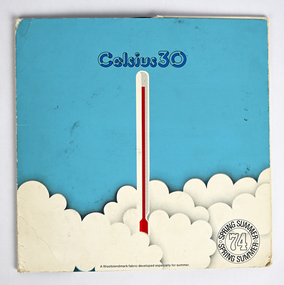
Booklet - Celsius 30, Spring Summer Fabric Samples, Australian Wool Corporation, 1974
... I was commissioned by the Melbourne College of Textiles to write a Woven Textile Design Course to be taught under the outreach program. ...I was commissioned by the Melbourne College of Textiles to write a Woven Textile Design Course to be taught under the outreach program. ...Part of a collection of books, fabric samples and documents from the working life of Ray Smith. Ray began his career at the age of 15, working at the Albion Woollen Mills in Geelong in 1953. Over the next five decades, Ray furthered his education in textile design, weaving design, knitting and later computer aided design, including qualifications from Gordon Textile College, City and Guilds of London Institute, The Textile Institute, Melbourne Institute of Textiles and Royal Melbourne Institute of Technology (RMIT). After ten years at Albion Woollen Mills, Ray went on to hold fabric design positions at Prestige Fabrics and Yarra Falls, working up to management roles in both the Weaving and Fabric Design Divisions, and then as Product Development Manager at Yarra Falls until 2000. Ray shares some career highlights below: In 1977 and 1978 I won the Wool Corporation’s Celsius 30 Awards as Yarra Falls Designer. (See photos attached.) These awards came with study trips to the major Textile Centres and Trade Fairs around the world. This was proven to be beneficial and Yarra Falls sent me overseas every year for the next 22 years. On stopovers in Hong Kong we appointed an agent and took part in Textile Trade Fairs at Interstoff Asia and exhibited designs in 1991, 92, 93, 94. I created a pattern book for a chain of shops called “Kwun KeeTailors” for their customers to select our fabrics to be made up into suits for the tourists. I also had several trips to New York to try to export to America with some success. I was commissioned by the Melbourne College of Textiles to write a Woven Textile Design Course to be taught under the outreach program. This was eventually translated into Spanish to be used by developing textile industries in South America.Card folder featuring pale blue and white clouds and sky motifs, with a thermometer on the cover. Folder holds eleven circular black cards, eight have wool fabric samples attached.Front [printed]: Celsius 30 / SPRING SUMMER / 74 / SPRING SUMMER / A Woolblendmark fabric developed especially for summer.ray smith, yarra falls, mills, textile design, fabric design, product development, wool corporation, fabric samples, 1970s fashion -
 National Wool Museum
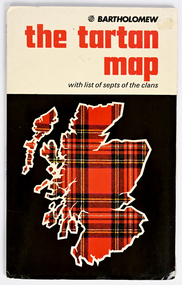
Map - The Tartan Map, John Bartholomew & Son Ltd, 1970s
... I was commissioned by the Melbourne College of Textiles to write a Woven Textile Design Course to be taught under the outreach program. ...I was commissioned by the Melbourne College of Textiles to write a Woven Textile Design Course to be taught under the outreach program. ...Part of a collection of books, fabric samples and documents from the working life of Ray Smith. Ray began his career at the age of 15, working at the Albion Woollen Mills in Geelong in 1953. Over the next five decades, Ray furthered his education in textile design, weaving design, knitting and later computer aided design, including qualifications from Gordon Textile College, City and Guilds of London Institute, The Textile Institute, Melbourne Institute of Textiles and Royal Melbourne Institute of Technology (RMIT). After ten years at Albion Woollen Mills, Ray went on to hold fabric design positions at Prestige Fabrics and Yarra Falls, working up to management roles in both the Weaving and Fabric Design Divisions, and then as Product Development Manager at Yarra Falls until 2000. Ray shares some career highlights below: In 1977 and 1978 I won the Wool Corporation’s Celsius 30 Awards as Yarra Falls Designer. (See photos attached.) These awards came with study trips to the major Textile Centres and Trade Fairs around the world. This was proven to be beneficial and Yarra Falls sent me overseas every year for the next 22 years. On stopovers in Hong Kong we appointed an agent and took part in Textile Trade Fairs at Interstoff Asia and exhibited designs in 1991, 92, 93, 94. I created a pattern book for a chain of shops called “Kwun KeeTailors” for their customers to select our fabrics to be made up into suits for the tourists. I also had several trips to New York to try to export to America with some success. I was commissioned by the Melbourne College of Textiles to write a Woven Textile Design Course to be taught under the outreach program. This was eventually translated into Spanish to be used by developing textile industries in South America.Folded map attached inside a card folder, featuring a map of Scotland with tartan design and red and black text on the cover.Front [printed]: BARTHOLOMEW / the tartan map / with list of septs of the clansray smith, yarra falls, mills, textile design, fabric design, product development, wool corporation, map, tartan, scotland -
 National Wool Museum
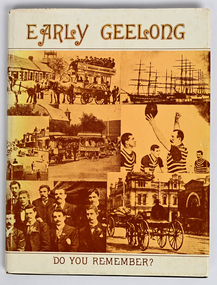
Book - Early Geelong, Do You Remember?, Solomons Pty Ltd, 1940s
... I was commissioned by the Melbourne College of Textiles to write a Woven Textile Design Course to be taught under the outreach program. ...I was commissioned by the Melbourne College of Textiles to write a Woven Textile Design Course to be taught under the outreach program. ...Part of a collection of books, fabric samples and documents from the working life of Ray Smith. Ray began his career at the age of 15, working at the Albion Woollen Mills in Geelong in 1953. Over the next five decades, Ray furthered his education in textile design, weaving design, knitting and later computer aided design, including qualifications from Gordon Textile College, City and Guilds of London Institute, The Textile Institute, Melbourne Institute of Textiles and Royal Melbourne Institute of Technology (RMIT). After ten years at Albion Woollen Mills, Ray went on to hold fabric design positions at Prestige Fabrics and Yarra Falls, working up to management roles in both the Weaving and Fabric Design Divisions, and then as Product Development Manager at Yarra Falls until 2000. Ray shares some career highlights below: In 1977 and 1978 I won the Wool Corporation’s Celsius 30 Awards as Yarra Falls Designer. (See photos attached.) These awards came with study trips to the major Textile Centres and Trade Fairs around the world. This was proven to be beneficial and Yarra Falls sent me overseas every year for the next 22 years. On stopovers in Hong Kong we appointed an agent and took part in Textile Trade Fairs at Interstoff Asia and exhibited designs in 1991, 92, 93, 94. I created a pattern book for a chain of shops called “Kwun KeeTailors” for their customers to select our fabrics to be made up into suits for the tourists. I also had several trips to New York to try to export to America with some success. I was commissioned by the Melbourne College of Textiles to write a Woven Textile Design Course to be taught under the outreach program. This was eventually translated into Spanish to be used by developing textile industries in South America.Fifty two page hard cover book featuring yellow and brown images and text on the front and back cover showing scenes from Geelong. The book features sepia toned printed photographs and brown text.Front [printed]: EARLY GEELONG / DO YOU REMEMBER?ray smith, yarra falls, mills, textile design, fabric design, geelong, geelong advertiser -
 National Wool Museum
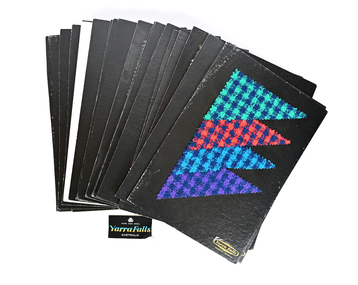
Textile - Fabric Samples, Yarra Falls Ltd, 1970s
... I was commissioned by the Melbourne College of Textiles to write a Woven Textile Design Course to be taught under the outreach program. ...I was commissioned by the Melbourne College of Textiles to write a Woven Textile Design Course to be taught under the outreach program. ...Part of a collection of books, fabric samples and documents from the working life of Ray Smith. Ray began his career at the age of 15, working at the Albion Woollen Mills in Geelong in 1953. Over the next five decades, Ray furthered his education in textile design, weaving design, knitting and later computer aided design, including qualifications from Gordon Textile College, City and Guilds of London Institute, The Textile Institute, Melbourne Institute of Textiles and Royal Melbourne Institute of Technology (RMIT). After ten years at Albion Woollen Mills, Ray went on to hold fabric design positions at Prestige Fabrics and Yarra Falls, working up to management roles in both the Weaving and Fabric Design Divisions, and then as Product Development Manager at Yarra Falls until 2000. Ray shares some career highlights below: In 1977 and 1978 I won the Wool Corporation’s Celsius 30 Awards as Yarra Falls Designer. (See photos attached.) These awards came with study trips to the major Textile Centres and Trade Fairs around the world. This was proven to be beneficial and Yarra Falls sent me overseas every year for the next 22 years. On stopovers in Hong Kong we appointed an agent and took part in Textile Trade Fairs at Interstoff Asia and exhibited designs in 1991, 92, 93, 94. I created a pattern book for a chain of shops called “Kwun KeeTailors” for their customers to select our fabrics to be made up into suits for the tourists. I also had several trips to New York to try to export to America with some success. I was commissioned by the Melbourne College of Textiles to write a Woven Textile Design Course to be taught under the outreach program. This was eventually translated into Spanish to be used by developing textile industries in South America.A collection of fabric samples from Yarra Falls, including twenty three sets of woollen fabric samples on black backing card, three sets of woollen fabric samples on white backing card and one Yarra Falls fabric label.PURE NEW WOOL / Yarra Falls / MELBOURNE AUSTRALIAray smith, yarra falls, mills, textile design, fabric design, geelong, geelong advertiser, fabric samples -
 Ballarat Clarendon College
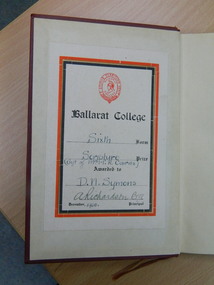
Book, Charles George Gordon
... College, Melbourne University. He became a Clothing industry leader and was Fletcher Jones' distinguished successor as chief executive of the FJ organisation, and a prominent advocate for the Australian textile and clothing industries, decentralised industry and government support of employee share ownership schemes. ...College, Melbourne University. He became a Clothing industry leader and was Fletcher Jones' distinguished successor as chief executive of the FJ organisation, and a prominent advocate for the Australian textile and clothing industries, decentralised industry and government support of employee share ownership schemes. donald-neil-symons fletcher-jones cairns Book plate inside front covers: school crest / Ballarat College / Sixth Form / Scripture Prize / (Gift of Mrs T R Cairns) / Awarded to / D N Symons / A Richardson, BA / December 1930 Principal Small, maroon leather-bound book with gold title and detailing on spine and gold school crest on front cover; plain endpapers; bookplate inside front cover. ...Awarded to Donald Neil Symons for excellence in Scripture during his final year at Ballarat College. Neil was educated at Ballarat College (Dux 1933) and Ormond College, Melbourne University. He became a Clothing industry leader and was Fletcher Jones' distinguished successor as chief executive of the FJ organisation, and a prominent advocate for the Australian textile and clothing industries, decentralised industry and government support of employee share ownership schemes. Small, maroon leather-bound book with gold title and detailing on spine and gold school crest on front cover; plain endpapers; bookplate inside front cover.Book plate inside front covers: school crest / Ballarat College / Sixth Form / Scripture Prize / (Gift of Mrs T R Cairns) / Awarded to / D N Symons / A Richardson, BA / December 1930 Principaldonald-neil-symons, fletcher-jones, cairns -
 Ballarat Clarendon College
Book, Paul the ambassador: the life story of the great apostle re-told for young people
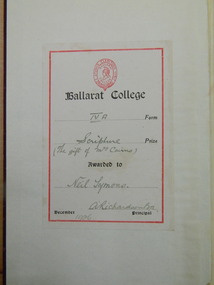
... College, Melbourne University. He became a Clothing industry leader and was Fletcher Jones' distinguished successor as chief executive of the FJ organisation, and a prominent advocate for the Australian textile and clothing industries, decentralised industry and government support of employee share ownership schemes....College, Melbourne University. He became a Clothing industry leader and was Fletcher Jones' distinguished successor as chief executive of the FJ organisation, and a prominent advocate for the Australian textile and clothing industries, decentralised industry and government support of employee share ownership schemes. donald-neil-symons cairns scripture book prize Bookplate inside front cover:School crest / Ballarat College / IVA Form / Scripture Prize / (The gift of Mrs Cairns) / Awarded to / Neil Symons / A Richardson BA / December 1926 Principal Thick, maroon leather-bound book with gold lettering on spine, black wording and detail and gold school crest on front cover; bookplate inside front cover Paul the ambassador: the life story of the great apostle re-told for young people Book ...Awarded to Donald Neil Symons for excellence in Scripture during 1926 at Ballarat College. Neil was educated at Ballarat College (Dux 1933) and Ormond College, Melbourne University. He became a Clothing industry leader and was Fletcher Jones' distinguished successor as chief executive of the FJ organisation, and a prominent advocate for the Australian textile and clothing industries, decentralised industry and government support of employee share ownership schemes.Thick, maroon leather-bound book with gold lettering on spine, black wording and detail and gold school crest on front cover; bookplate inside front coverBookplate inside front cover:School crest / Ballarat College / IVA Form / Scripture Prize / (The gift of Mrs Cairns) / Awarded to / Neil Symons / A Richardson BA / December 1926 Principaldonald-neil-symons, cairns, scripture, book prize -
 Ballarat Clarendon College
Book, The land that is desolate: an account of a tour in Palestine
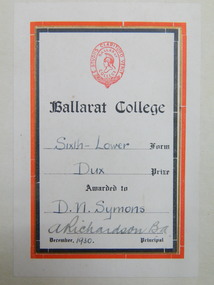
... College, Melbourne University. He became a Clothing industry leader and was Fletcher Jones' distinguished successor as chief executive of the FJ organisation, and a prominent advocate for the Australian textile and clothing industries, decentralised industry and government support of employee share ownership schemes....College, Melbourne University. He became a Clothing industry leader and was Fletcher Jones' distinguished successor as chief executive of the FJ organisation, and a prominent advocate for the Australian textile and clothing industries, decentralised industry and government support of employee share ownership schemes. donald-neil-symons dux 1930s fletcher jones Bookplate inside front cover: School crest / Ballarat College / Sixth-Lower Form / Dux Prize / Awarded to / D N Symons / A Richardson BA / December 1930 Principal Medium-sized, maroon, leather-bound book with gold-lettering and decoration on spine and gold school crest on front cover; bookplate inside front cover The land that is desolate: an account of a tour in Palestine Book ...Awarded to Donald Neil Symons for excellence in Scripture during 1926 at Ballarat College. Neil was educated at Ballarat College (Dux 1933) and Ormond College, Melbourne University. He became a Clothing industry leader and was Fletcher Jones' distinguished successor as chief executive of the FJ organisation, and a prominent advocate for the Australian textile and clothing industries, decentralised industry and government support of employee share ownership schemes.Medium-sized, maroon, leather-bound book with gold-lettering and decoration on spine and gold school crest on front cover; bookplate inside front coverBookplate inside front cover: School crest / Ballarat College / Sixth-Lower Form / Dux Prize / Awarded to / D N Symons / A Richardson BA / December 1930 Principaldonald-neil-symons, dux, 1930s, fletcher jones -
 Ballarat Clarendon College
Book, Redgauntlet
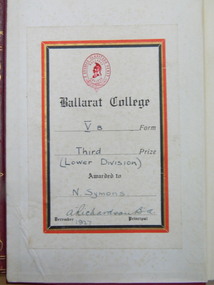
... College, Melbourne University. He became a Clothing industry leader and was Fletcher Jones' distinguished successor as chief executive of the FJ organisation, and a prominent advocate for the Australian textile and clothing industries, decentralised industry and government support of employee share ownership schemes....College, Melbourne University. He became a Clothing industry leader and was Fletcher Jones' distinguished successor as chief executive of the FJ organisation, and a prominent advocate for the Australian textile and clothing industries, decentralised industry and government support of employee share ownership schemes. donald-neil-symons fletcher jones 1920s book prize Book plate inside front cover: School crest / Ballarat College / Third Prize / (Lower division) / Awarded to / N Symons / A Richardson BA / December 1927 Principal Small, maroon, leather-bound book with gold lettering and detail on spine and gold crest on front cover; book plate inside front cover Redgauntlet Book ...Awarded to Donald Neil Symons for excellence in Scripture during 1926 at Ballarat College. Neil was educated at Ballarat College (Dux 1933) and Ormond College, Melbourne University. He became a Clothing industry leader and was Fletcher Jones' distinguished successor as chief executive of the FJ organisation, and a prominent advocate for the Australian textile and clothing industries, decentralised industry and government support of employee share ownership schemes.Small, maroon, leather-bound book with gold lettering and detail on spine and gold crest on front cover; book plate inside front coverBook plate inside front cover: School crest / Ballarat College / Third Prize / (Lower division) / Awarded to / N Symons / A Richardson BA / December 1927 Principaldonald-neil-symons, fletcher jones, 1920s, book prize -
 National Wool Museum
Archive - Letter of Recommendation, Charles Tansley, W. Angliss & Co. Pty. Ltd, 1 June 1923
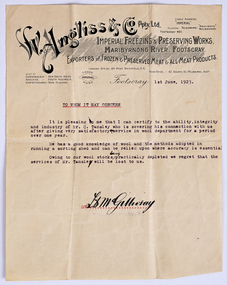
... Melbourne in 1898 and was educated in England at Bedford Modern College. He was sent home from England due to WW1 and was not enlisted due to health reasons. Charles married Mary Brownjohn in 1924, and together they moved to Geelong in the late 1920s. This letter, dated 1923, is a reference for Charles' work undertaken with W. Angliss & Co. Pty. Ltd in Footscray. Charles Tansley Woolclassing Wool Classer Farming Sheep Wool Agricultural Industry Estates Tasmania New South Wales Pastoral Industry Textile ...This letter is part of a collection of archival documents including letters and certificates that relate to Charles Tansley. Charles Tansley was a wool classer mainly in Victoria, but also worked in Tasmania and New South Wales. In his career, he also worked as a wool valuer with Elders in Geelong. Charles was born in Melbourne in 1898 and was educated in England at Bedford Modern College. He was sent home from England due to WW1 and was not enlisted due to health reasons. Charles married Mary Brownjohn in 1924, and together they moved to Geelong in the late 1920s. This letter, dated 1923, is a reference for Charles' work undertaken with W. Angliss & Co. Pty. Ltd in Footscray.Letter on cream paper with black printed text and handwritten black text.[printed] TO WHOM IT MAY CONCERN / It is pleasing to me that I can certify to the ability, integrity / and industry of Mr. C. Tansley who is serving his connection with us / after giving very satisfactory service in wool department for a period / over one year.charles tansley, woolclassing, wool classer, farming, sheep, wool, agricultural industry, estates, tasmania, new south wales, pastoral industry, textile industry, education, reference letters, working life, geelong, training, mary brownjohn -
 National Wool Museum
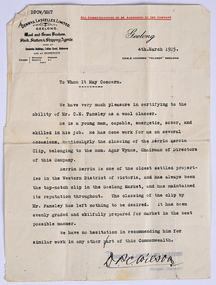
Archive - Letter of Recommendation, Charles Tansley, Dennys, Lascelles Limited, 4 March 1925
... Melbourne in 1898 and was educated in England at Bedford Modern College. He was sent home from England due to WW1 and was not enlisted due to health reasons. Charles married Mary Brownjohn in 1924, and together they moved to Geelong in the late 1920s. This letter, dated 1925, is a reference for Charles' wool classing work undertaken with Dennys, Lascelles Ltd, Geelong. Charles Tansley Woolclassing Wool Classer Farming Sheep Wool Agricultural Industry Estates Tasmania New South Wales Pastoral Industry Textile ...This letter is part of a collection of archival documents including letters and certificates that relate to Charles Tansley. Charles Tansley was a wool classer mainly in Victoria, but also worked in Tasmania and New South Wales. In his career, he also worked as a wool valuer with Elders in Geelong. Charles was born in Melbourne in 1898 and was educated in England at Bedford Modern College. He was sent home from England due to WW1 and was not enlisted due to health reasons. Charles married Mary Brownjohn in 1924, and together they moved to Geelong in the late 1920s. This letter, dated 1925, is a reference for Charles' wool classing work undertaken with Dennys, Lascelles Ltd, Geelong.Letter on cream paper with black and red printed text and handwritten black text.[printed] Geelong / 4th March 1925. / CABLE ADDRESS "YELKEER" GEELONG / To Whom It May Concern. / We have very much pleasure in certifying to the / ability of Mr. C. E. Tansley as a wool classer. / He is a young man, capable, energetic, sober, and / skilled in his job.charles tansley, woolclassing, wool classer, farming, sheep, wool, agricultural industry, estates, tasmania, new south wales, pastoral industry, textile industry, education, reference letters, working life, geelong, training, mary brownjohn -
 National Wool Museum
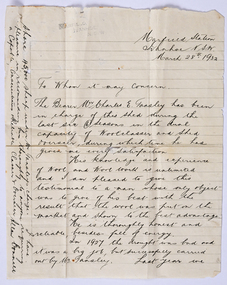
Archive - Letter of Recommendation, Charles Tansley, Marfield Station, 28 March 1932
... Melbourne in 1898 and was educated in England at Bedford Modern College. He was sent home from England due to WW1 and was not enlisted due to health reasons. Charles married Mary Brownjohn in 1924, and together they moved to Geelong in the late 1920s. This letter, dated 1932, is a reference for Charles' wool classing and shed overseer work undertaken at Marfield Station, Ivanhoe, New South Wales. Charles Tansley Woolclassing Wool Classer Farming Sheep Wool Agricultural Industry Estates Tasmania New South Wales Pastoral Industry Textile ...This letter is part of a collection of archival documents including letters and certificates that relate to Charles Tansley. Charles Tansley was a wool classer mainly in Victoria, but also worked in Tasmania and New South Wales. In his career, he also worked as a wool valuer with Elders in Geelong. Charles was born in Melbourne in 1898 and was educated in England at Bedford Modern College. He was sent home from England due to WW1 and was not enlisted due to health reasons. Charles married Mary Brownjohn in 1924, and together they moved to Geelong in the late 1920s. This letter, dated 1932, is a reference for Charles' wool classing and shed overseer work undertaken at Marfield Station, Ivanhoe, New South Wales.Letter on ruled paper with hand written black text and black stamped text.[handwritten] Marfield Station / Ivanhoe N.S.W. / March 28th 1932 / To Whom it may Concern. / The Bearer Mr Charles E. Tansley has been / in charge of this shed during the / last six 6 seasons in the dual / capacity of Woolclasser and Shed / Overseer, during which time he has / given me every satisfaction.charles tansley, woolclassing, wool classer, farming, sheep, wool, agricultural industry, estates, tasmania, new south wales, pastoral industry, textile industry, education, reference letters, working life, geelong, training, mary brownjohn
