
Showing 65 items matching "melbourne glass bottle company"
-
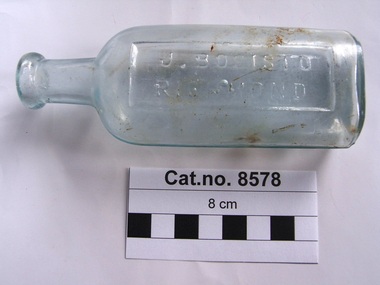 Coal Creek Community Park & Museum
Container - Bottle, glass
... 'M' monogram on the base of the glass bottle was used by the Melbourne Glass Bottle Company during 1900-1912.......Melbourne Glass Bottle Company...'M' monogram on the base of the glass bottle was used by the Melbourne Glass Bottle Company during 1900-1912. ...'M' monogram on the base of the glass bottle was used by the Melbourne Glass Bottle Company during 1900-1912.Clear aqua tinted, oval in section, glass bottle with text embossed on side and base.'J BOSISTOW RICHMOND' on side. 'M' on base.eucalyptus oil -
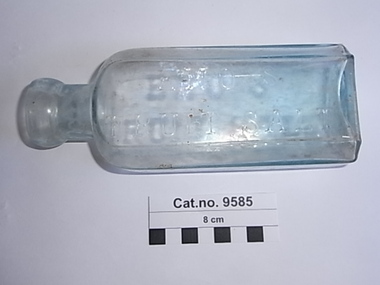 Coal Creek Community Park & Museum
Bottle, glass, c. 1900-1912. ref. glass makers mark on base
... Melbourne Glass Bottle Company...Rectangular aqua tinted clear glass bottle with angled corners for stopper seal with embossed text on side and base. Bottle, glass. Melbourne Glass Bottle Company ...Eno's Fruit Salts.Rectangular aqua tinted clear glass bottle with angled corners for stopper seal with embossed text on side and base.On side 'ENO'S FRUIT SALT'. On base 'M'.eno's fruit salts -
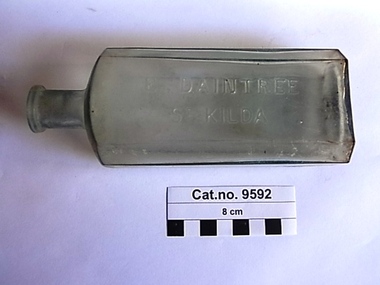 Coal Creek Community Park & Museum
Bottle, glass, c.1900 - c. 1912
... Melbourne Glass Bottle Company...Tall rectangular clear glass bottle with angled corners, for stopper seal. Text embossed on one side & logo on base. Bottle, glass. Melbourne Glass Bottle Company Ernest Daintree ...Trove : Leader, Saturday April 9th, 1892, page 24, 'Suicide in St. Kilda', mentions chemist Ernest Daintree in the report as selling the laudanum used in the suicide. Victorian Government Gazette, no.67, Friday May 4th, 1894, page 1841. : 'Trademarks, CLASS 47. 3833. A liquid detergent for general domestic cleaning purposes. Ernest Daintree of High-street, St. Kilda, Victoria, wholesale and retail druggist. 30 April 1894. (As a distinctive label.)' Victorian Government Gazettes, Pharmaceutical Registers, Ernest Daintree is listed at the address 102 High Street St Kilda from 1898 until at 523 Malvern Road, Toorak in 1903. He was first entered on the Pharmaceutical Register in Victoria on 11 April 1888 and his qualification was from Gt. Britain, Major Exam, No.2138.Tall rectangular clear glass bottle with angled corners, for stopper seal. Text embossed on one side & logo on base.Embossed on side 'E. DAINTREE ST KILDA'. On base : ' M' inside cartouche shaped impression.druggist, wholesale., druggist, retail, ernest daintree -
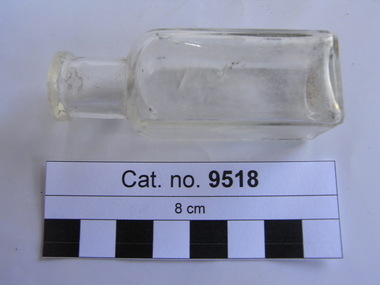 Coal Creek Community Park & Museum
Bottle, glass, 1900-1912
... Melbourne Glass Bottle Company...'M' Rectangular clear glass bottle with text embossed on base. Bottle, glass Melbourne Glass Bottle Company ...Rectangular clear glass bottle with text embossed on base.'M' -
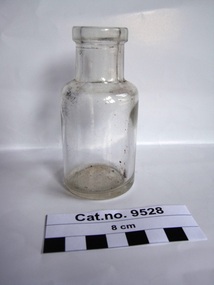 Coal Creek Community Park & Museum
Bottle, glass, c. 1900-1912
... Melbourne Glass Bottle Company...Clear glass bottle for stopper with embossed numerals and monogram on base Bottle, glass. Melbourne Glass Bottle Company ...Clear glass bottle for stopper with embossed numerals and monogram on baseOn base : 'S 800', 'M'. -
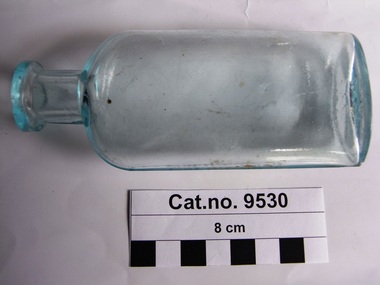 Coal Creek Community Park & Museum
Bottle, glass, c. 1900-1912
... Melbourne Glass Bottle Company...Aqua tinted clear glass bottle, oval in section with embossed initial on base. Bottle, glass. Melbourne Glass Bottle Company ...Aqua tinted clear glass bottle, oval in section with embossed initial on base.'M' on base. -
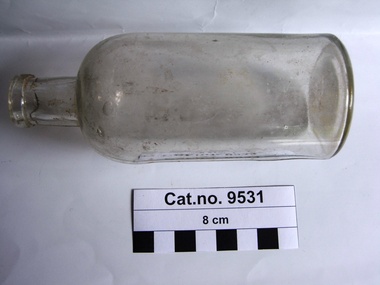 Coal Creek Community Park & Museum
Bottle, glass, c. 1900 - 1912
... Melbourne Glass Bottle Company...Clear round glass bottle for stopper, with embossed initial on base. Bottle, glass. Melbourne Glass Bottle Company ...Clear round glass bottle for stopper, with embossed initial on base.'M' on base. -
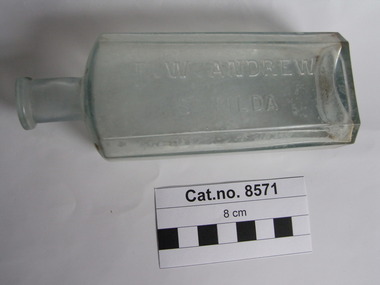 Coal Creek Community Park & Museum
Domestic object - Glass Bottle, Early 20th century
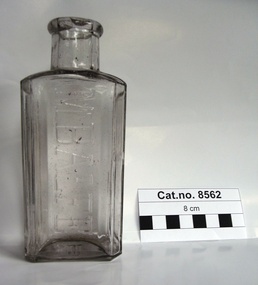
... Melbourne Glass Bottle Company...Clear, blue tinted glass rectangular shaped bottle with angled corners and text embossed on one side and the base. Domestic object Glass Bottle Melbourne Glass Bottle Company F. ...Clear, blue tinted glass rectangular shaped bottle with angled corners and text embossed on one side and the base.'F. W. ANDREW St KILDA' on the side. 'M' on the base. -
 Coal Creek Community Park & Museum
Domestic object - Glass Bottle, Between 1872-1916
... ...Melbourne Glass Bottle Company...Rectangular clear glass bottle with angular corners. Domestic object Glass Bottle M Balfe & Sons Melbourne Glass Bottle Company ...Rectangular clear glass bottle with angular corners.'M. BALFE' on side. 'M' on base.balfe -
 Coal Creek Community Park & Museum
Bottle glass, Between 1872-1916, reference : bottle manufacturers mark
... Melbourne Glass Bottle Company...Rectangular pale aqua tinted clear glass bottle with concave back, text on side and base. Bottle glass Melbourne Glass Bottle Company F.H Appleyard chemist and dentist ...Advertisement : Fitzroy City Press, Friday 29 January 1904, page 3, Fitzroy Post Office '...Lotherington's....Mr. F.H. Appleyard, chemist and dentist of 29 Best st, North Fitzroy (Fitzroy trams pass the door.- Telephone 3287) Source Trove.Rectangular pale aqua tinted clear glass bottle with concave back, text on side and base.'F.H. APPLEYARD NORTH FITZROY' on front. '3vii' with an acute over the three above text near neck of bottle. 'M' on base. -
Coal Creek Community Park & Museum
Bottle, glass, Between 1872-1916, reference : bottle manufacturers mark
... Melbourne Glass Bottle Company...Rectangular pale blue tinted clear glass bottle with angled corners, embossed text on side and base. Bottle, glass Melbourne Glass Bottle Company H. ...Oakleigh Leader, Saturday 8 September 1894, page 1,. Advertisement. 'Agents ......H. Davis, Chemist, 299 High Street, St. Kilda.....'. source : TroveRectangular pale blue tinted clear glass bottle with angled corners, embossed text on side and base.'H. DAVIS ST KILDA' on side. 'M' on base. -
Coal Creek Community Park & Museum
Bottle, glass, between 1872-1916 ref: bottle makers mark
... Melbourne Glass Bottle Company...Rectangular pale aqua tinted clear glass bottle, slightly concave on back, with text embossed in a cartouche on side and on base. Bottle, glass Melbourne Glass Bottle Company R Raffan, Chemist ...Advertisement in The Argus, Monday 23 August 1920, page 4. 'Manufacturer of Raffans' Catarrh Remedies, R. Raffan, 55 Elgin St., Carlton.' source TROVE.Rectangular pale aqua tinted clear glass bottle, slightly concave on back, with text embossed in a cartouche on side and on base.'3viii '(with acute above 3). 'CHEMIST R. RAFFAN CARLTON' on side. 'M' on base. -
Coal Creek Community Park & Museum
Bottle, glass, Between 1872 - 1916 ref: bottle makers mark
... Melbourne Glass Bottle Company...Rectangular pale blue tinted clear glass bottle with angled corners and embossed text on one side and base. Bottle, glass Melbourne Glass Bottle Company MAX PINCUS ...TROVE : The Australasian Saturday 8 September 1877, page 20, Town News. 'The first examination of candidates for registration under the Pharmacy Act was held at the Royal Society's Hall yesterday..........The following were passed..........Max Pincus,...........' TROVE : Leader Saturday 2 September 1893 p.4, In: THE LEADER SUPPLEMENT MAX PINCUS, A number of interested spectators are always collected round the stand at which the "Welgel Milk Tester Is being worked by Mr. Max Pincus, of St. Kilda. This milk tester is a little instrument designed for testing the quantity of butter fat In any given sample of milk. The whole manipulation takes only a few minutes, and is so very simple that anyone can work it. A table supplied with the instrument shows at a glance, not only the percentage of butter fat, but also the proportion of same per gallon, the quantity of the milk required to produce each pound of butter, &c., so that there is no calculation ' at all required. Mr. Max. Pincus, who Is tho maker of the "Weigel Tester, shows tho remarkable accuracy of tho instrument. By request he tested a sample of the milk about to be separated, and the result as given to the Government dairy expert showed that the quantity of butter from the churning should be 59 lb. The actual quantity of butter as weighed (after adding 2 lb, of salt) was 61 lb., thus showing that the test agreed perfectly with the churning. In his report to the Minister of Agriculture, the dairy expert expresses himself as very pleased with the working of the Weigel test. The tester has recently been improved so as to measure exactly to tho smallest decimal. Mr. Pincus also shows samples of his butter preservative, called "Salva." In: THE LEADER SUPPLEMENT MAX PINCUS. A number of interested spectators are always collected round the stand at which the Weigel Milk Tester is being worked by Mr. Max Pincus, of St Kilda. This milk tester is a little instru ment designed for testing the quantity of butter fat in any given sample of milk. The whole manipulation takes only a few minutes, and is so very simple that anyone can work it A table supplied with the instrument shows at a glance, not only the percentage of butter fat, hut also the proportion of same per gallon, the quautity of the milk required to produce each pound of butter, &c., so that there is no calculation at all required. Mr. Max Pincus, who is the maker of the Weigel Tester, shows the remarkable accuracy of the instru ment. By request he tested a sample of the milk about to be separated, and the result as given to the Government dairy expert showed that the quantity of butter from the churning should be 59 lb. The actual quantity of butter as weighed (after adding 2 lb. of salt) was 61 lb., thus showing that the test agreed perfectly with the churning. In his report to the Minister of Agriculture, the dairy expert expresses himself as very pleased with the working of the Weigel test. The tester has recently been improved so as to measure exactly to tho smallest decimal. Mr. Pincus also shows samples of his butter preservative, called "Salva." TROVE : MAX PINCUS. A number of interested spectators are always collected round the stand at which the Weigel Milk Tester is being worked by Mr. Max Pincus, of St Kilda. This milk tester is a little instru ment designed for testing the quantity of butter fat in any given sample of milk. The whole manipulation takes only a few minutes, and is so very simple that anyone can work it A table supplied with the instrument shows at a glance, not only the percentage of butter fat, hut also the proportion of same per gallon, the quautity of the milk required to produce each pound of butter, &c., so that there is no calculation at all required. Mr. Max Pincus, who is the maker of the Weigel Tester, shows the remarkable accuracy of the instru ment. By request he tested a sample of the milk about to be separated, and the result as given to the Government dairy expert showed that the quantity of butter from the churning should be 59 lb. The actual quantity of butter as weighed (after adding 2 lb. of salt) was 61 lb., thus showing that the test agreed perfectly with the churning. In his report to the Minister of Agriculture, the dairy expert expresses himself as very pleased with the working of the Weigel test. The tester has recently been improved so as to measure exactly to tho smallest decimal. Mr. Pincus also shows samples of his butter ✏Fix this text preservative, called "Salva."Rectangular pale blue tinted clear glass bottle with angled corners and embossed text on one side and base.'MAX PINCUS LATE JOHNSON ST KILDA' on side. 'M' on base. -
Coal Creek Community Park & Museum
Bottle, glass, Between 1872-1916 ref: bottle manufacturers mark
... Melbourne Glass Bottle Company...MELBOURNE' on side. 'M' on base. Rectangular pale blue tinted clear glass bottle with angled corners. Embossed text on one side and base. Bottle, glass Melbourne Glass Bottle Company ...Advertisement. 'The Argus' newspaper (Melbourne, Victoria 1848-1957) Saturday 4 November 1882, page 8. 'Simpson & Davenport Pharmaceutical Chemists, (14 years with Mr. W. Bowen, successors to Mr. John Ross, formerly the business of Mr. R Hill, 63 Collins Street, East.' source TROVE. Also at 228 Collins Street, Melbouren at some date ref: cream pot lids with Simpson & Davenport Chemists advertisement, offered for auction.Rectangular pale blue tinted clear glass bottle with angled corners. Embossed text on one side and base.'SIMPSON & DAVENPORT CHEMISTS MELBOURNE' on side. 'M' on base. -
 Port Melbourne Historical & Preservation Society
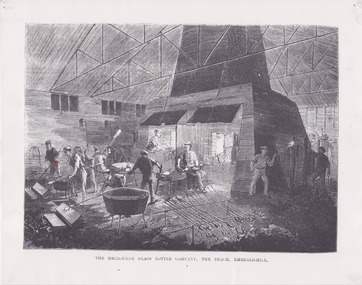
Photograph - Sketch, The Melbourne Glass Bottle Co, Emerald Hill, Illustrated Australian News, 1876
... ...melbourne glass bottle company...Material found in the collection when sorting out the Compactus Room May 1997 industry - manufacturing melbourne glass bottle company felton grimwade On read: IAN 12 June 1876 B&W photographic copy of sketch - The Melbourne Glass Bottle Co., the Beach, Emerald Hill (Illustrated Australian News 12 June 1876) Formerly Felton Grimwade Photograph Sketch, The Melbourne Glass Bottle Co, Emerald Hill, Illustrated Australian News ...Material found in the collection when sorting out the Compactus Room May 1997B&W photographic copy of sketch - The Melbourne Glass Bottle Co., the Beach, Emerald Hill (Illustrated Australian News 12 June 1876) Formerly Felton GrimwadeOn read: IAN 12 June 1876industry - manufacturing, melbourne glass bottle company, felton grimwade -
 Federation University Historical Collection
Letter - Correspondence, Inwards correspondence to the Ballarat School of Mines, 1908, 07/01908
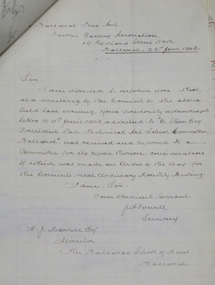
... melbourne...c. james...w. west...haddon...warragul...bakers reef gold mning company...letterhead...victorian portland cement works...d. mitchell...electric lighting and traction co. australia ltd...austral otis engineering comapny ltd...melbourne glass bottle...It is a predecessor institution of Federation University Australia. ballarat school of mines frederick martell ballarat fine art gallery j.a. powell art gallery of ballarat gallery association charles j. morris ballarat fine art public gallery association telegram c.h. clark l. ditchburn alumni examinations w.g. taylor london bank of australia limited bealiba thomas r. lyle jessie chalmers signor steffani arundel orchard w.f. coltman e.e. hobson j.t. mooney queanbeyan p.e. marmion willaim m. robertson assay e.e. brook lloyd copper mines h.b. silberberg & co. education department melbourne c. james w. west haddon warragul bakers reef gold mning company letterhead victorian portland cement works d. mitchell electric lighting and traction co. australia ltd austral otis engineering comapny ltd melbourne glass bottle works company cuming, smith & co. pty ltd excursions metropolitan gas company jaques bros manufacturing engineers victoria iron works a. victor leggo co leggo's metallurgical works melbourne hydraulic power company limited mount lyell mining and railway coy ltd victorian railways telegraph land surveying j. brittain g. fitzgerald hamilton cochran and co wynne-grant antimony reduction company mt egerton and gordons mining co e. hogan e.c. connell a.d. galoway metallurgy h.b. silberberg Specific Gravity Balance and Weights Union Bank of Australia (Ballarat) Bullarto Bush Inn, Bullarto W. ...The Ballarat School of Mines was the first school of Mines in Australasia, and was established in 1870. It is a predecessor institution of Federation University Australia.Correspondence to the Ballarat School of Mines for the month of July 1908. Letter 162 Ballarat Fine Art Public Gallery Association 19 Lydiard Street North Ballarat, 26th June 1908 Sir, I am directed to inform you that at a meeting of the Council of the above held last evening, your previously acknowledged letter of 11th June 1908, addressted to "E. [Stoer?] Esq, President Late Technical Art School Committee", was received and referred to a committee for its report thereon, cousi directions of which was made are the Order of the Day for the Councils next Ordinary Monthly Meeting. I am, Sir, Your Obedient Servant, J.A. Powell Secretary F.J. Martell Esq Director The Ballarat School of Mines Ballarat ballarat school of mines, frederick martell, ballarat fine art gallery, j.a. powell, art gallery of ballarat, gallery association, charles j. morris, ballarat fine art public gallery association, telegram, c.h. clark, l. ditchburn, alumni, examinations, w.g. taylor, london bank of australia limited, bealiba, thomas r. lyle, jessie chalmers, signor steffani, arundel orchard, w.f. coltman, e.e. hobson, j.t. mooney, queanbeyan, p.e. marmion, willaim m. robertson, assay, e.e. brook, lloyd copper mines, h.b. silberberg & co., education department melbourne, c. james, w. west, haddon, warragul, bakers reef gold mning company, letterhead, victorian portland cement works, d. mitchell, electric lighting and traction co. australia ltd, austral otis engineering comapny ltd, melbourne glass bottle works company, cuming, smith & co. pty ltd, excursions, metropolitan gas company, jaques bros manufacturing engineers, victoria iron works, a. victor leggo co, leggo's metallurgical works, melbourne hydraulic power company limited, mount lyell mining and railway coy ltd, victorian railways, telegraph, land surveying, j. brittain, g. fitzgerald, hamilton, cochran and co, wynne-grant antimony reduction company, mt egerton and gordons mining co, e. hogan, e.c. connell, a.d. galoway, metallurgy, h.b. silberberg, specific gravity balance and weights, union bank of australia (ballarat), bullarto, bush inn, bullarto, w. harrington, prospective student, book donaton from smithsonian institution, e. la t. armstrong, department of mines and forests, melbourne, snake valley, r. hall-jones, c. calaby, clementston, thomas ramsay, w.d. thompson, longmans, green and co, selwyn chase, missionary exhibition, aboriginal court of the missionary exhibition, examination results, leslie coulter, hnery j. saw, thomas ramsay, virgil tucker, leslie c. blick, thomas r. williams, oliver w. williams, thomas r. williams, leo m. seward, david w. bonar, louis w.g. buchner, leo m. seward, albert j. robin, james a. chambers, james d. brokenshire, william kingston, edgar c. hurdsfield, virgil tucker, oliver w. williams, william g. sides, herbert hawkesworth, colin c. corrie, henry j. saw, thomas h. trengrove, thomas r. prigdeon, harold b. herbert, viola p. jackson, lionel s. davies, stanley w. tompkins, arthur m. lilburne -
 Federation University Historical Collection
Book - Scrapbook, Ballarat School of Mines Invoices, 01/07/1895 - 05/05/1899
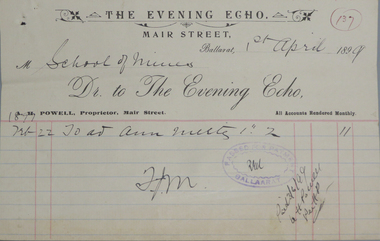
... company...r. collie & co....walter cornell...john fiscalini...mcvitty & co...j. miller & co...a.g. corbett...ben franklin printing works...middleton & morris...melbourne glass bottle...The invoices glued into the scrapbook relate to purchases from the Ballarat School of Mines invoices ballarat school of mines tunbridges pringle receipts w. hamer plumber eyres brothers j.h. trotman g. batchelor n. guthridge w. doepel frank fiscalini huddart, barker and co. a. gaunt h. wardle and son turron & mcgavin e.e. campbell g.f. hocking william sutherland f. vale victoria insurance company r. collie & co. walter cornell john fiscalini mcvitty & co j. miller & co a.g. corbett ben franklin printing works middleton & morris melbourne glass bottle works co eldon chambers e.l. stubbs j. jones firewood mrs soderstrom museum ballarat school of mines museum hill & paine h. hebestadt f.w. commons sculptor cherry & robins alex e. monsbourgh alex purdie andrew cant ballarat star frederick martell goodfellows evening echo a.h. powell Phillately A very large dark green hard covered volume with read leather face spine and corners. ...The invoices glued into the scrapbook relate to purchases from the Ballarat School of MinesA very large dark green hard covered volume with read leather face spine and corners. Black ornamental bands across the spine. Leather strap with buckle for securing covers when not in use. Plain pages of brown "wrapping paper". Receipts glued to pages, folded and then numbered consecutively by hand i blue pencil. First receipt No. 996 (01 July 1895), numbering restarts after 1000 (three times). Last receipt is No. 155 (05 May 1899).invoices, ballarat school of mines, tunbridges, pringle, receipts, w. hamer, plumber, eyres brothers, j.h. trotman, g. batchelor, n. guthridge, w. doepel, frank fiscalini, huddart, barker and co., a. gaunt, h. wardle and son, turron & mcgavin, e.e. campbell, g.f. hocking, william sutherland, f. vale, victoria insurance company, r. collie & co., walter cornell, john fiscalini, mcvitty & co, j. miller & co, a.g. corbett, ben franklin printing works, middleton & morris, melbourne glass bottle works co, eldon chambers, e.l. stubbs, j. jones, firewood, mrs soderstrom, museum, ballarat school of mines museum, hill & paine, h. hebestadt, f.w. commons, sculptor, cherry & robins, alex e. monsbourgh, alex purdie, andrew cant, ballarat star, frederick martell, goodfellows, evening echo, a.h. powell, phillately -
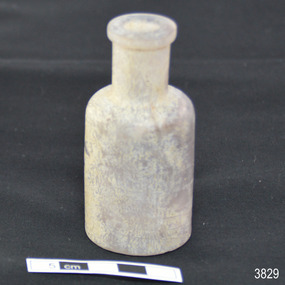 Flagstaff Hill Maritime Museum and Village
Container - Glass Bottle, mid-19th century to 1902
... melbourne tramway company...ingoldsby reef...handmade...glass bottle...This glass bottle is significant because of its historical connection to the barque Inverlochy, which is an example of a commercial international steel sailing barque and is listed on the Victorian Heritage Database VHR S338. The Inverlochy is significant for its cargo, which is a snapshot of the kind of goods imported into Australia at the turn of the 19th century, including cable for the Melbourne Tramway Company. ...This handmade glass bottle was recovered from the wreck of the 1895-1902 ship Inverlochy and is part of the John Chance Collection. The bottle has side seams that extend from base to mouth, indicating that it would have been made in a mould. The parallel, diagonal lines are likely to have been made by the molten glass being mouth-blown into the mould. The mould would have also had the pattern for the embossed numbers in the base. The seamless applied mouth would have been added after the bottle was removed from the two-piece mould. The even neck of the bottle would have probably been sealed with a cork or glass stopper. Bottles similar to this one were used for medical (apothecary) and cosmetic purposes. Bottles with these features date from around the late 19th to early 20th century. Bottles began to have embossed numbers on the bases from the late 19th century and the practice continues into modern times. The numbers may represent the date of manufacture i.e. “4188” may be 4th January 1888. It may instead be the date of the patent or design pattern number. This bottle may have been made around 1888 and the latest it could have been made was 1902, the year of the wreck of the Inverlochy. THE INVERLOCHY (1895-1902) - The Inverlochy was a steel sailing barque built in Scotland in 1895 for international trade. In 1902 the Inverlochy left Liverpool under the command of Captain E.R. Kendrick. There were 21 officers and crew and the captain’s wife Mrs Kendrick, on board, bound for Australia with cargo that included tools, chemicals, liquor (beer, whisky, stout, rum, and brandy), steel, iron, wire netting, hoop iron, tinplate and pig iron), and steel wire for the Melbourne Tramway Company, tiles, soap, soft goods and earthenware. On December 18 almost at their destination, the Inverlochy ran aground on Ingoldsby Reef at Point Addis, near Anglesea. The crew and passengers left the ship via lifeboat and landed at Thompson’s Creek, then walked about 20 kilometres to Barwon Heads. Salvagers were interested in the 10 miles of cable in the hold. Mrs Kendrick’s ‘high grade’ bicycle was amongst the items salvaged but she lost her jewellery and two pianos. By February 1903 the ship had broken up and objects such as bottles and casks of liquor were washed ashore. Bad weather shook the wreck in June 1903, causing the ship’s spars and figurehead to be washed ashore. This glass bottle is historically significant as it represents methods of storage and manufacture that were used from the 19th century and into the early-20th century, before machine made bottles were becoming common. The shape and size of the bottle are similar to bottles used for medical and cosmetic purposes in that period. The glass bottle also has significant as it was recovered by John Chance, a diver from the wreck of the Inverlochy in the late 1960s to early 1970s. Items that come from several wrecks along Victoria's coast have since been donated to the Flagstaff Hill Maritime Village’s museum collection by his family, illustrating this item’s level of historical value. This glass bottle is significant because of its historical connection to the barque Inverlochy, which is an example of a commercial international steel sailing barque and is listed on the Victorian Heritage Database VHR S338. The Inverlochy is significant for its cargo, which is a snapshot of the kind of goods imported into Australia at the turn of the 19th century, including cable for the Melbourne Tramway Company. The wreck of the Inverlochy is important as an accessible dive site that shows the remains of a large international trading vessel and its contents. It is valuable for an insight into Victorian era of shipping and maritime history. Bottle; clear glass, round, handmade. Narrow lip is flat across top and on side edge, neck is straight, about a third of the bottle’s height. The shoulder is rounded, and the body has straight sides with two side seams from below the lip to the base, which is shallow. Outer glass surface is rough, inner surface has areas of dried, light coloured substance. The body has several diagonal parallel lines and areas with opalescent shine. Base has embossed inscription. Embossed inscription on base "4188".flagstaff hill, warrnambool, flagstaff hill maritime museum, maritime museum, shipwreck coast, flagstaff hill maritime village, great ocean road, john chance, inverlochy, scotland, captain e.r. kendrick, melbourne tramway company, ingoldsby reef, handmade, glass bottle, apothecary, cosmetic, mould blown, vintage, two-piece bould, point addis, medicine -
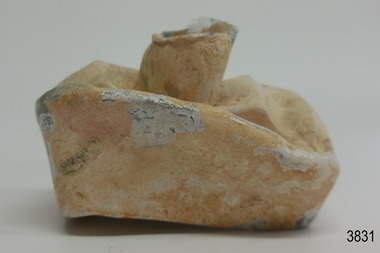 Flagstaff Hill Maritime Museum and Village
Container - Ink Bottle, from mid-19th century to 1902
... melbourne tramway company...tramway cable...ingoldsby reef...point addis...anglesea...thompson’s creek...barwon heads...boat ink bottle...cottage ink...penny ink...glass...It is valuable for an insight into Victorian era of shipping and maritime history. flagstaff hill warrnambool flagstaff hill maritime museum maritime museum shipwreck coast flagstaff hill maritime village great ocean road john chance inverlochy scotland captain e.r. kendrick melbourne tramway company tramway cable ingoldsby reef point addis anglesea thompson’s creek barwon heads boat ink bottle cottage ink penny ink glass ink bottle pen rest writing accessory victorian antique ink well sheer lip distorted body handmade mould blown statoionery Ink bottle, thick clear glass, rectangular base with small round mouth, long sides have have a U shaped groove along the shoulders (used for resting pen handles). ...This ink bottle is ‘boat’ shaped, which was a common design from the mid-1840s. It was crudely made; maybe it was rejected as a practice bottle or perhaps heat or pressure has distorted it. The bottle was recovered from the wreck of the Inverlochy and is part of the John Chance collection. Ink in the 1700s ink could be purchased in powdered or block form from apothecary shops, to be mixed with water as needed. Then in the mid-1800s chemists began selling ink in liquid form, in small, inexpensive and often attractive bottles. The small glass ink bottles were handmade, blown into a cup shaped mould, and sharply broken off from the blow-pipe at the neck, referred to as the English-made ‘burst-off’ finish. The neck was then filed, filled with liquid ink and sealed with a cork or wax. It was a quick, affordable container and made pen and ink writing available to the public. The name ‘penny ink’ bottles was a common title due to their low cost. INVERLOCHY 1895-1902 - The Inverlochy was a steel sailing barque built in Scotland in 1895 for international trade. In 1902 the Inverlochy left Liverpool under the command of Captain E.R. Kendrick. There were 21 officers and crew and the captain’s wife Mrs Kendrick, on board, bound for Australia with cargo that included tools, chemicals, liquor (beer, whisky, stout, rum, and brandy), steel, iron, wire netting, hoop iron, tinplate and pig iron), and steel wire for the Melbourne Tramway Company, tiles, soap, soft goods and earthenware. On December 18 almost at their destination, the Inverlochy ran aground on Ingoldsby Reef at Point Addis, near Anglesea. The crew and passengers left the ship via lifeboat and landed at Thompson’s Creek, then walked about 20 kilometres to Barwon Heads. Salvagers were interested in the 10 miles of cable in the hold. Mrs Kendrick’s ‘high grade’ bicycle was amongst the items salvaged but she lost her jewellery and two pianos. By February 1903 the ship had broken up and objects such as bottles and casks of liquor were washed ashore. Bad weather shook the wreck in June 1903, causing the ship’s spars and figurehead to be washed ashore. This boat shaped handmade ink bottle is historically significant for its association with communications and record keeping in the mid-to-late 19th century. The bottle is socially significant as an example of making a useful product affordable to every day people. This handmade glass ink bottle is significant for its connection with the John Chance Collection, which is historically significant as an example of artefacts from wrecks that had been lost in the coastal waters of Victoria from thirty to over one hundred years before John Chance and others discovered them. These artefacts are a sample of goods carried as cargo or personal possessions, and of ship hardware of that era. The ink bottle is significant through its connection with the barque, Inverlochy, The Inverlochy is significant for its cargo, which is a snapshot of the array of goods imported into Australia at the turn of the 19th century, including cable for the Melbourne Tramway Company. The Inverlochy is historically significant and is registered on the Victorian Heritage Database, VHR S338. The wreck of the Inverlochy is important as an accessible dive site that shows the remains of a large international trading vessel and its contents. It is valuable for an insight into Victorian era of shipping and maritime history.Ink bottle, thick clear glass, rectangular base with small round mouth, long sides have have a U shaped groove along the shoulders (used for resting pen handles). The outside surface has a white clay-type reside over it. Bottle is very bent and distorted. flagstaff hill, warrnambool, flagstaff hill maritime museum, maritime museum, shipwreck coast, flagstaff hill maritime village, great ocean road, john chance, inverlochy, scotland, captain e.r. kendrick, melbourne tramway company, tramway cable, ingoldsby reef, point addis, anglesea, thompson’s creek, barwon heads, boat ink bottle, cottage ink, penny ink, glass ink bottle, pen rest, writing accessory, victorian, antique, ink well, sheer lip, distorted body, handmade, mould blown, statoionery -
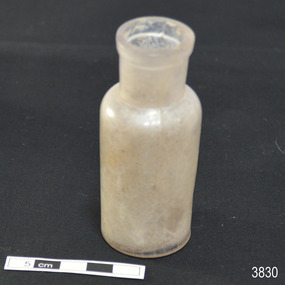 Flagstaff Hill Maritime Museum and Village
Container - Glass Bottle, mid-19th century to 1902
... melbourne tramway company...ingoldsby reef...handmade...glass bottle...This glass bottle is significant because of its historical connection to the barque Inverlochy, which is an example of a commercial international steel sailing barque and is listed on the Victorian Heritage Database VHR S338. The Inverlochy is significant for its cargo, which is a snapshot of the kind of goods imported into Australia at the turn of the 19th century, including cable for the Melbourne Tramway Company. ...This handmade glass bottle was recovered from the wreck of the 1895-1902 ship Inverlochy and is part of the John Chance Collection. The bottle has side seams that extend from base to mouth, indicating that it would have been made in a mould. The parallel, diagonal lines are likely to have been made by the molten glass being mouth-blown into the mould. The mould would have also had the pattern for the embossed numbers in the base. The seamless applied mouth would have been added after the bottle was removed from the two-piece mould. The even neck of the bottle would have probably been sealed with a cork or glass stopper. Bottles similar to this one were used for medical (apothecary) and cosmetic purposes. Bottles with these features date from around the late 19th to early 20th century. Bottles began to have embossed numbers on the bases from the late 19th century and the practice continues into modern times. The numbers may represent the date of manufacture i.e. “463” may be April 1863. It may instead be the date of the patent or design pattern number. This bottle may have been made around 1863 and the latest it could have been made was 1902, the year of the wreck of the Inverlochy. THE INVERLOCHY (1895-1902) - The Inverlochy was a steel sailing barque built in Scotland in 1895 for international trade. In 1902 the Inverlochy left Liverpool under the command of Captain E.R. Kendrick. There were 21 officers and crew and the captain’s wife Mrs Kendrick, on board, bound for Australia with cargo that included tools, chemicals, liquor (beer, whisky, stout, rum, and brandy), steel, iron, wire netting, hoop iron, tinplate and pig iron), and steel wire for the Melbourne Tramway Company, tiles, soap, soft goods and earthenware. On December 18 almost at their destination, the Inverlochy ran aground on Ingoldsby Reef at Point Addis, near Anglesea. The crew and passengers left the ship via lifeboat and landed at Thompson’s Creek, then walked about 20 kilometres to Barwon Heads. Salvagers were interested in the 10 miles of cable in the hold. Mrs Kendrick’s ‘high grade’ bicycle was amongst the items salvaged but she lost her jewellery and two pianos. By February 1903 the ship had broken up and objects such as bottles and casks of liquor were washed ashore. Bad weather shook the wreck in June 1903, causing the ship’s spars and figurehead to be washed ashore. This glass bottle is historically significant as it represents methods of storage and manufacture that were used from the 19th century and into the early-20th century, before machine made bottles were becoming common. The shape and size of the bottle are similar to bottles used for medical and cosmetic purposes in that period. The glass bottle also has significant as it was recovered by John Chance, a diver from the wreck of the Inverlochy in the late 1960s to early 1970s. Items that come from several wrecks along Victoria's coast have since been donated to the Flagstaff Hill Maritime Village’s museum collection by his family, illustrating this item’s level of historical value. This glass bottle is significant because of its historical connection to the barque Inverlochy, which is an example of a commercial international steel sailing barque and is listed on the Victorian Heritage Database VHR S338. The Inverlochy is significant for its cargo, which is a snapshot of the kind of goods imported into Australia at the turn of the 19th century, including cable for the Melbourne Tramway Company. The wreck of the Inverlochy is important as an accessible dive site that shows the remains of a large international trading vessel and its contents. It is valuable for an insight into Victorian era of shipping and maritime history. Bottle; clear glass with opalescent shine in places, round, handmade. Narrow lip is flat across top and on side edge, neck is straight, about a third of the bottle’s height. The shoulder is rounded, and the body has straight sides with two pronounced side seams from below the lip to the base, which is shallow. Outer glass surface is smooth, inner surface has areas of dried, light coloured substance. Base has embossed inscription. Embossed "463" and logo symbol [trident]flagstaff hill, warrnambool, flagstaff hill maritime museum, maritime museum, shipwreck coast, flagstaff hill maritime village, great ocean road, john chance, inverlochy, scotland, captain e.r. kendrick, melbourne tramway company, ingoldsby reef, handmade, glass bottle, apothecary, cosmetic, mould blown, vintage, two-piece bould, point addis, medicine -
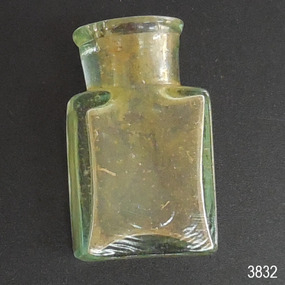 Flagstaff Hill Maritime Museum and Village
Container - Pill bottle, from mid-19th century to 1902
... melbourne tramway company...tramway cable...ingoldsby reef...point addis...anglesea...thompson’s creek...barwon heads...victorian...antique...handmade...mould blown...small glass bottle...It is valuable for an insight into Victorian era of shipping and maritime history. flagstaff hill warrnambool flagstaff hill maritime museum maritime museum shipwreck coast flagstaff hill maritime village great ocean road john chance inverlochy scotland captain e.r. kendrick melbourne tramway company tramway cable ingoldsby reef point addis anglesea thompson’s creek barwon heads victorian antique handmade mould blown small glass bottle rectangular glass bottle pill bottle Inscription embossed on sides [tear drop] logo. ...This small handmade bottle possibly dates from the mid-1840s. It may have been used as a traveller's ink bottle, due to its wide mouth. It was recovered from the wreck of the Inverlochy and is part of the John Chance collection. Small glass ink bottles similar to this one were handmade, blown into a cup shaped mould, and sharply broken off from the blow-pipe at the neck and sealed with a cork or wax. The mouth of this bottle appears to have been added after it was blown. INVERLOCHY 1895-1902 - The Inverlochy was a steel sailing barque built in Scotland in 1895 for international trade. In 1902 the Inverlochy left Liverpool under the command of Captain E.R. Kendrick. There were 21 officers and crew and the captain’s wife Mrs Kendrick, on board, bound for Australia with cargo that included tools, chemicals, liquor (beer, whisky, stout, rum, and brandy), steel, iron, wire netting, hoop iron, tinplate and pig iron), and steel wire for the Melbourne Tramway Company, tiles, soap, soft goods and earthenware. On December 18 almost at their destination, the Inverlochy ran aground on Ingoldsby Reef at Point Addis, near Anglesea. The crew and passengers left the ship via lifeboat and landed at Thompson’s Creek, then walked about 20 kilometres to Barwon Heads. Salvagers were interested in the 10 miles of cable in the hold. Mrs Kendrick’s ‘high grade’ bicycle was amongst the items salvaged but she lost her jewellery and two pianos. By February 1903 the ship had broken up and objects such as bottles and casks of liquor were washed ashore. Bad weather shook the wreck in June 1903, causing the ship’s spars and figurehead to be washed ashore. This handmade bottle is historically significant for its association with being made and used during the mid-to-late 19th century. This handmade glass bottle is significant for its connection with the John Chance Collection, which is historically significant as an example of artefacts from wrecks that had been lost in the coastal waters of Victoria from thirty to over one hundred years before John Chance and others discovered them. These artefacts are a sample of goods carried as cargo or personal possessions, and of ship hardware of that era. The bottle is significant through its connection with the barque, Inverlochy, The Inverlochy is significant for its cargo, which is a snapshot of the array of goods imported into Australia at the turn of the 19th century, including cable for the Melbourne Tramway Company. The Inverlochy is historically significant and is registered on the Victorian Heritage Database, VHR S338. The wreck of the Inverlochy is important as an accessible dive site that shows the remains of a large international trading vessel and its contents. It is valuable for an insight into Victorian era of shipping and maritime history.Bottle, clear glass, handmade, mould-blown. Small pill bottle has round mouth and neck, straight sides, rectangular base, no seams, shiny surface. Thickness of glass varies. Mouth is lop-sided and lip varies in width. Inscription of logo on both wide sides. Inscription embossed on sides [tear drop] logo. flagstaff hill, warrnambool, flagstaff hill maritime museum, maritime museum, shipwreck coast, flagstaff hill maritime village, great ocean road, john chance, inverlochy, scotland, captain e.r. kendrick, melbourne tramway company, tramway cable, ingoldsby reef, point addis, anglesea, thompson’s creek, barwon heads, victorian, antique, handmade, mould blown, small glass bottle, rectangular glass bottle, pill bottle -
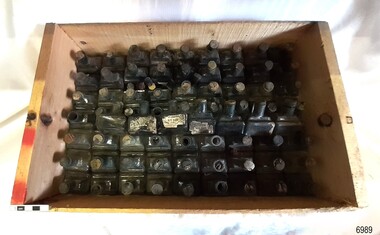 Flagstaff Hill Maritime Museum and Village
Container - Ink Bottles, Caldwell’s Ink Factory, Early 20th century
... Flagstaff Hill Warrnambool Maritime Village Maritime Museum Shipwreck coast Great Ocean Road Ink nib pen writing ink writing copying banks lawyers commerce student permanent ink Flo-Eesi blue black ink stationery record keeping handwriting writing equipment writing accessory office supply cottage bottle boat bottle mouth-blown bottle two-part mould sheer-lip bottle burst-lip cork seal F R Caldwell Caldwell’s Ink Company Albert Park South Melbourne inkstands stencil ink copy ink Quicksticker Zac cough mixture Printed on label; “CALDWELL FLO-EESI BLUE BLACK INK” “ - - - - “ Printed script signature “F.R. Caldwell” Ink bottles in a wooden crate; 70 rectangular, hand-blown clear glass ...This crate of bottles may have come from a wholesaler, business, stationer or school. The design of the bottles is sometimes called a ‘cottage’ or ‘boat’ shape. Each of the 70 Caldwell’s handmade glass ink bottles was mouth-blown into a two-piece mould, a method often used in the mid-to-late 19th century. The glass blower burst the bottle off the end of his blowpipe with a tool, leaving an uneven mouth and sharp edge on the bottle, which was usually filed. The bottle was then filled with ink and sealed with a cork. More expensive bottles would have a lip added, which was more time-consuming and costly to produce. The capacity for a bottle such as this was about 3 ½ oz (ounces) equal to about 100 ml. Pen and ink have been in use for handwriting since about the seventh century. A quill pen made from a bird’s feather was used up until around the mid-19th century. In the 1850s a steel point nib for the dip pen was invented and could be manufactured on machines in large quantities. The nis only held a small amount of ink so users had to frequently dip the nib into an ink well for more ink. Handwriting left wet ink on the paper, so the blotting paper was carefully used to absorb the excess ink and prevent smudging. Ink could be purchased as a ready-to-use liquid or in powdered form, which needed to be mixed with water. In the 1880s a successful, portable fountain pen gave smooth-flowing ink and was easy to use. In the mid-20th century, the modern ballpoint pen was readily available and inexpensive, so the fountain pen lost its popularity. However, artisans continue to use nib pens to create beautiful calligraphy. Caldwell’s Ink Co. – F.R. Caldwell established Caldwell’s Ink Company in Australia around 1902. In Victoria, he operated from a factory at Victoria Avenue, Albert Park, until about 1911, then from Yarra Bank Road in South Melbourne. Newspaper offices were appointed as agencies to sell his inks, for example, in 1904 the New Zealand Evening Star sold Caldwell’s Flo-Eesi blue black ink in various bottle sizes, and Murchison Advocate (Victoria) stocked Caldwell’s ink in crimson, green, blue black, violet, and blue. Caldwell’s ink was stated to be “non-corrosive and unaffected by steel pens”. A motto used in advertising in 1904-1908 reads ‘Makes Writing a Pleasure’. Stationers stocked Caldwell’s products and hawkers sold Caldwell’s ink stands from door to door in Sydney in the 1910s and 1920s. In 1911 Caldwell promised cash for returned ink bottles and warned of prosecution for anyone found refilling his bottles. Caldwell’s Ink Stands were given as gifts. The company encouraged all forms of writing with their Australian-made Flo-Eesi writing inks and bottles at their impressive booth in the ‘All Australian Exhibition’ in 1913. It advertised its other products, which included Caldwell’s Gum, Caldwell’s Stencil Ink (copy ink) and Caldwell’s Quicksticker as well as Caldwell’s ‘Zac’ Cough Mixture. Caldwell stated in a 1920 article that his inks were made from a formula that was over a century old, and were scientifically tested and quality controlled. The formula included gallic and tannic acids and high-quality dyes to ensure that they did not fade. They were “free from all injurious chemicals”. The permanent quality of the ink was important for legal reasons, particularly to banks, accountants, commerce, municipal councils and lawyers. The Caldwell’s Ink Company also exported crates of its ink bottles and ink stands overseas. Newspaper advertisements can be found for Caldwell’s Ink Company up until 1934 when the company said they were the Best in the business for 40 years.This large collection of similar ink bottles is of particular significance as the bottles have come from the same source, most have their original corks and some retain their original labels, which is rare. The method of manufacture of these bottles is also representative of a 19th-century handcraft industry that is now been largely replaced by mass production. The bottles and their contents are of state significance for being produced by an early Melbourne industry and exported overseas. This case of ink bottles is historically significant as it represents methods of handwritten communication that were still common up until the mid-20th century when fountain pens and modern ballpoint pens became popular and convenient and typewriters were becoming part of standard office equipment.Ink bottles in a wooden crate; 70 rectangular, hand-blown clear glass ink bottles. They have side seams, uneven thickness, especially at the bases, and rough, burst-off mouths. The shoulders on the long sides have horizontal grooves used for pen rests. The bottles vary; some have labels, some contain remnants of blue-black ink, and many have their original corks. The glass has bubbles and imperfections. The remnants of printed labels are on white paper with a swirly border and black text. The bottles contained Caldwell’s blend of blue black ‘Flo-Eesi’ ink.Printed on label; “CALDWELL FLO-EESI BLUE BLACK INK” “ - - - - “ Printed script signature “F.R. Caldwell”flagstaff hill, warrnambool, maritime village, maritime museum, shipwreck coast, great ocean road, ink, nib pen, writing ink, writing, copying, banks, lawyers, commerce, student, permanent ink, flo-eesi, blue black ink, stationery, record keeping, handwriting, writing equipment, writing accessory, office supply, cottage bottle, boat bottle, mouth-blown bottle, two-part mould, sheer-lip bottle, burst-lip, cork seal, f r caldwell, caldwell’s ink company, albert park, south melbourne, inkstands, stencil ink, copy ink, quicksticker, zac cough mixture -
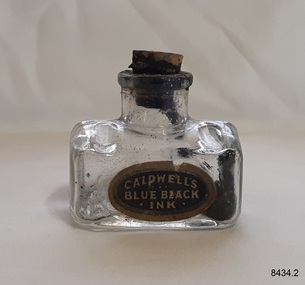 Flagstaff Hill Maritime Museum and Village
Container - Ink Bottle, Caldwell’s Ink Factory, Late 19th to early 20th centuries
... Flagstaff Hill Warrnambool Maritime Village Maritime Museum Shipwreck coast Great Ocean Road Ink nib pen writing ink writing copying banks lawyers commerce student permanent ink blue black ink stationery record keeping handwriting writing equipment writing accessory office supply cottage bottle boat bottle mouth-blown bottle cork seal F R Caldwell Caldwell’s Ink Company Albert Park South Melbourne inkstands stencil ink copy ink Quicksticker Zac cough mixture three part mould Cauldwells Cauldwell's Printed on label; “CALDWELL's BLUE BLACK INK” Embossed on the base "CALDWELLS" Ink bottle; rectangular base, hand-blown clear glass bottle with its own cork. ...This design of the bottle is sometimes called a ‘cottage’ or ‘boat’ shape. The Caldwell’s handmade glass ink bottle was mouth-blown into a three-piece mould, a method often used in the late 19th and early 20th centuries, with the maker's name engraved into the mould section for the base. The glass blower would cut the bottle off the end of his blowpipe with a tool and join a mouth onto the top, rolling the lip. The bottle was then filled with ink and sealed with a cork. This method of manufacture was more time-consuming and costly to produce than those made in a simple two-piece mould and 'cracked' off the blowpipe. The capacity for a bottle such as this was about 3 ½ oz (ounces) equal to about 100 ml. This particular bottle is unusual as it has four sloping indents at the corners of the shoulder, most likely for resting a pen with its nib upwards and the handle resting on a flat surface. Most of the bottles made during this era had horizontal pen rests that were indented into both of the long sides of the shoulder. Pen and ink have been in use for handwriting since about the seventh century. A quill pen made from a bird’s feather was used up until around the mid-19th century. In the 1850s a steel point nib for the dip pen was invented and could be manufactured on machines in large quantities. This only held a small amount of ink so users had to frequently dip the nib into an ink well for more ink. Handwriting left wet ink on the paper, so the blotting paper was carefully used to absorb the excess ink and prevent smudging. Ink could be purchased as a ready-to-use liquid or in powdered form, which needed to be mixed with water. In the 1880s a successful, portable fountain pen gave smooth-flowing ink and was easy to use. In the mid-20th century, the modern ballpoint pen was readily available and inexpensive, so the fountain pen lost its popularity. However, artisans continue to use nib pens to create beautiful calligraphy. Caldwell’s Ink Co. – F.R. Caldwell established Caldwell’s Ink Company in Australia around 1902. In Victoria, he operated from a factory at Victoria Avenue, Albert Park, until about 1911, then from Yarra Bank Road in South Melbourne. Newspaper offices were appointed as agencies to sell his inks, for example, in 1904 the New Zealand Evening Star sold Caldwell’s Flo-Eesi blue black ink in various bottle sizes, and Murchison Advocate (Victoria) stocked Caldwell’s ink in crimson, green, blue black, violet, and blue. Caldwell’s ink was stated to be “non-corrosive and unaffected by steel pens”. A motto used in advertising in 1904-1908 reads ‘Makes Writing a Pleasure’. Stationers stocked Caldwell’s products and hawkers sold Caldwell’s ink stands from door to door in Sydney in the 1910s and 1920s. In 1911 Caldwell promised cash for returned ink bottles and warned of prosecution for anyone found refilling his bottles. Caldwell’s Ink Stands were given as gifts. The company encouraged all forms of writing with their Australian-made Flo-Eesi writing inks and bottles at their impressive booth in the ‘All Australian Exhibition’ in 1913. It advertised its other products, which included Caldwell’s Gum, Caldwell’s Stencil Ink (copy ink) and Caldwell’s Quicksticker as well as Caldwell’s ‘Zac’ Cough Mixture. Caldwell stated in a 1920 article that his inks were made from a formula that was over a century old, and were scientifically tested and quality controlled. The formula included gallic and tannic acids and high-quality dyes to ensure that they did not fade. They were “free from all injurious chemicals”. The permanent quality of the ink was important for legal reasons, particularly to banks, accountants, commerce, municipal councils and lawyers. The Caldwell’s Ink Company also exported crates of its ink bottles and ink stands overseas. Newspaper advertisements can be found for Caldwell’s Ink Company up until 1934 when the company said they were the Best in the business for 40 years.This hand-blown bottle is significant for being the only bottle in our collection with the unusual sloping pen rests on its shoulder. It is also significant for being made in a less common three-piece mould. The method of manufacture is representative of a 19th-century handcraft industry that is now been largely replaced by mass production. The bottle is of state significance for being produced by an early Melbourne industry and exported overseas. This ink bottle is historically significant as it represents methods of handwritten communication that were still common up until the mid-20th century when fountain pens and modern ballpoint pens became popular and convenient and typewriters were becoming part of standard office equipment.Ink bottle; rectangular base, hand-blown clear glass bottle with its own cork. The bottle has side seams from the base to the mouth, an indented base and an applied lip. The corners of the shoulder sides have unusual diagonal grooves that slope down and outwards that may have been used as pen rests. Inside the bottle are remnants of dried blue-black ink. The glass has imperfections and some ripples on the surface. The bottle has an attached oval black label label with gold-brown printed text and border. The base has an embossed inscription. The bottles once contained Caldwell’s blend of blue black ink.Printed on label; “CALDWELL's BLUE BLACK INK” Embossed on the base "CALDWELLS"flagstaff hill, warrnambool, maritime village, maritime museum, shipwreck coast, great ocean road, ink, nib pen, writing ink, writing, copying, banks, lawyers, commerce, student, permanent ink, blue black ink, stationery, record keeping, handwriting, writing equipment, writing accessory, office supply, cottage bottle, boat bottle, mouth-blown bottle, cork seal, f r caldwell, caldwell’s ink company, albert park, south melbourne, inkstands, stencil ink, copy ink, quicksticker, zac cough mixture, three part mould, cauldwells, cauldwell's -
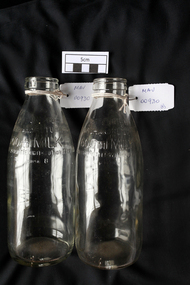 City of Moorabbin Historical Society (Operating the Box Cottage Museum)
Manufactured Glass, milk bottles 600ml, c1970
... glass milk bottles The first glass bottle packaging for milk was used in the 1870s. The first company to do so may have been the New York Dairy Company in 1877 with a small glass lid and a tin clip. Lewis P. Whiteman holds the first patent for a glass milk bottle c1884,which was sealed with a waxed paper disk. The Express Dairy Company in England began glass bottle production in 1880. Melbourne...glass milk bottles The first glass bottle packaging for milk was used in the 1870s. The first company to do so may have been the New York Dairy Company in 1877 with a small glass lid and a tin clip. Lewis P. Whiteman holds the first patent for a glass milk bottle c1884,which was sealed with a waxed paper disk. The Express Dairy Company in England began glass bottle production in 1880. Melbourne ...There are two distinct types of milk consumption: a natural source of nutrition for all infant mammals and a food product for humans of all ages that is derived from other animals. Milk is a key contributor to improving nutrition and food security particularly in developing countries. Improvements in livestock and dairy technology offer significant promise in reducing poverty and malnutrition in the world. Pasteurization is used to kill harmful micro-organisms by heating the milk for a short time and then immediately cooling it. In the past, milk was always packaged in glass milk bottles The first glass bottle packaging for milk was used in the 1870s. The first company to do so may have been the New York Dairy Company in 1877 with a small glass lid and a tin clip. Lewis P. Whiteman holds the first patent for a glass milk bottle c1884,which was sealed with a waxed paper disk. The Express Dairy Company in England began glass bottle production in 1880. Melbourne Glass Bottle Works Spotswood 1880 - 1990. Milk cartons first came to Australia in 1958, when the Model Dairy in Melbourne began packaging milk in 150 ml and 500 ml cartons. At the time, 160,000 new glass bottles were needed in Melbourne alone every week to keep up the delivery of 1.3 million bottles of milk a day c1970, the blow-moulded disposable plastic milk bottle was introduced. In 1987, only about 2% of milk was still being sold in glass bottles. Glass milk bottles are now rare. Metric measures were introduced throughout Australia with Decimalisation 14/2/1966.3 x clear glass milk bottles c 1970 600ml ( 2 shown in photograph)PASTEURISED / 600 ML MILKmelbourne glass bottle works, spotswood melbourne, milk, dairy, dairy produce, dairy farmers, market gardeners, pioneers, early settlers, moorabbin, cheltenham, pasteur louis, pasteurization -
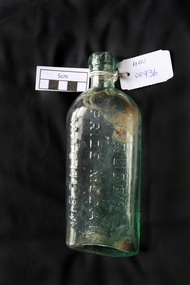 City of Moorabbin Historical Society (Operating the Box Cottage Museum)
Manufactured Glass, bottle 'Kruse's Magnesia', 20thC
... In 1878 Kruse established Victoria's first pharmacy training facility - the Melbourne School of Pharmacy, the forerunner of the Victorian College of Pharmacy, Monash University, which remains Victoria's only pharmacy training institute. glass works pharmaceutical glass pharmacy kruse johann august (john) dr weil s . victorian college of pharmacy monash university university of göttingen felton grimwade and company magnesium bicarbonate magnesium oxide KRUSE’S / PRIZE MEDAL / MAGNESIA/ K / FELTON-GRIMWADE & CO. MELBOURNE Directions for use ...... A glass bottle ...Johann August (John) Kruse was instrumental in the development of the pharmaceutical industry and pharmacy training in Victoria. He was a driving force behind the creation of the Pharmaceutical Society of Victoria and was appointed a founding member of the Society's inaugural council in 1857. He manufactured many pharmaceuticals and health products such as mineral waters and 'Kruse's Fluid Magnesia' (1863) which is still in use today. He later went on to produce insecticides and dynamite, then established his own analytical chemistry service. In 1878 Kruse established Victoria's first pharmacy training facility - the Melbourne School of Pharmacy. There pharmacy apprentices were taught chemistry, botany, materia medica and Latin, while country students could study by correspondence. The School was endorsed and monitored by the Pharmacy Board of Victoria to which Kruse was appointed in 1880. Kruse's pharmacy school was the forerunner of the Victorian College of Pharmacy, Monash University, which remains Victoria's only pharmacy training institute. In 1853, shortly after qualifying as pharmacist at the University of Göttingen, Johann August (John) Kruse, moved to London. The medical practitioner Dr S. Weil sent Kruse to Victoria, Australia to manage a new pharmacy and tobacconist's shop which he was having built at 136 Bridge Rd in Richmond. In 1856 Kruse opened a second pharmacy 'John Kruse and Company Chemists and Druggists' at 207 Bourke Street. 1857 the Richmond shop was destroyed by fire, so all pharmaceutical production was moved to the Bourke St premises and later to his new location at 184 Bourke St.. Kruse was forced to sell his business in 1868 to Felton Grimwade and Company and work for them as manager of their chemical works. By the early 1870s he had regained financial independence so left the company to establish his own businesses again. He opened up a pharmacy at 31 Swanston St and in c1874 leased Victoria's premier natural springs, Clifton Springs, on the northern side of the Bellarine Peninsula, where he established a bottling plant. Suspensions of magnesium hydroxide in water, often called Milk of Magnesia, are used as an antacid to neutralize stomach acid, and as a laxative. Milk of magnesia is sold for medical use as chewable tablets, capsules, and as liquids having various added flavours Kruses Fluid Magnesia 300ml Extralife Kruse’s Fluid Magnesia, Magnesium supplement. Rapidly absorbed, easily digested. Improves general well being, corrects magnesium deficiency. Helps relieve indigestion, when due to acidity. In 1878 Kruse established Victoria's first pharmacy training facility - the Melbourne School of Pharmacy, the forerunner of the Victorian College of Pharmacy, Monash University, which remains Victoria's only pharmacy training institute. A glass bottle containing ‘Kruse’s’ Magnesia’ medicineKRUSE’S / PRIZE MEDAL / MAGNESIA/ K / FELTON-GRIMWADE & CO. MELBOURNE Directions for use ......glass works, pharmaceutical glass, pharmacy, kruse johann august (john), dr weil s, ., victorian college of pharmacy, monash university, university of göttingen, felton grimwade and company, magnesium bicarbonate, magnesium oxide -
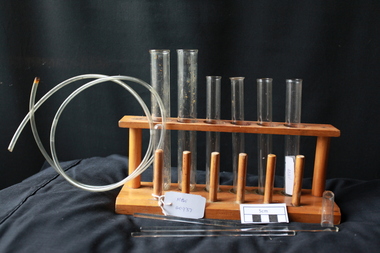 City of Moorabbin Historical Society (Operating the Box Cottage Museum)
Manufactured GLass, test tubes, mixers, 20thC
... glass...otto schlott...felton grimwade company...melbourne glass bottle...Tubes made from expansion-resistant glasses, such as borosilicate glass, can be placed directly over a Bunsen burner flame. glass manufacturers test tubes culture tubes sample tubes borosilicate glass otto schlott felton grimwade company melbourne glass bottle works laboratory glass pharmacy moorabbin bentleigh cheltenham spotswood melbourne 8 clear glass test tubes of varied capacity with 3 glass mixers sitting in a wooden stand. ...A test tube, also known as a culture tube or sample tube, is a common piece of laboratory glassware consisting of a finger-like length of glass or clear plastic tubing, open at the top, usually with a rounded U-shaped bottom. Test tubes are widely used by pharmacists to hold, mix, or heat small quantities of solid or liquid chemicals, especially for qualitative experiments and assays. Their round bottom and straight sides minimize mass loss when pouring, make them easier to clean, and allow convenient monitoring of the contents. The long, narrow neck slows down the spreading of vapours and gases to the environment. Test tubes are usually held in special-purpose racks, Test tubes for physics and chemistry are usually made of glass for better resistance to heat and corrosive chemicals and longer life. Tubes made from expansion-resistant glasses, such as borosilicate glass, can be placed directly over a Bunsen burner flame.8 clear glass test tubes of varied capacity with 3 glass mixers sitting in a wooden stand. A 1 metre length of clear plastic tubing is with this setglass manufacturers, test tubes, culture tubes, sample tubes, borosilicate glass, otto schlott, felton grimwade company, melbourne glass bottle works, laboratory glass, pharmacy, moorabbin, bentleigh, cheltenham, spotswood melbourne -
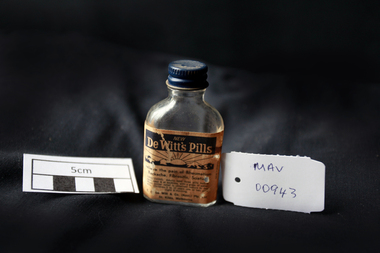 City of Moorabbin Historical Society (Operating the Box Cottage Museum)
Manufactured Glass, bottle of 'De Witts Pills', mid 20thC
... Aids in alleviating muscular aches and pains, restlessness, dizziness, backache, headache, getting up at nights, loss of energy if caused by sluggish kidneys. pharmacy medicines glassware bottles moorabbin bentleigh cheltenham de witt company ltd cheshire england cb fleet group ltd glass manufacturers Front Label : NEW / DE WITT'S PILLS / rising sun trade mark / Relieve the pain of Rheumatism / Backache, Fibrositis, Sciatica / DIRECTIONS ......../ R.C.De Witt & Co (Aust) Pty Ltd. / St. Kilda Melbourne ...De Witt's Kidney and Bladder Pills were produced by a firm founded in 1912 by E C De Witt, Cheshire UK, with branches in New Zealand, Chicago and New York. It became part of the CB Fleet Group in 1990, whose UK operation is currently based in Runcorn, Cheshire where they still manufacture toiletries, skin care products and pharmaceutical products. Aimed at adults and children above the age of eight, De Witt’s Kidney and Bladder Pills were intended to ease backache, aches and pains in the muscles, and kidney problems. They are typical of a huge range of treatments that were available ‘over the counter’ at pharmacists for many years. It is not known how effective the pills were but the label assures people not to be alarmed if their urine takes on a bluish colour after taking a dose. The indications or uses for this product as provided by the manufacturer are: A diuretic stimulant for the kidneys to promote the flow of urine, combined with analgesic action. Aids in alleviating muscular aches and pains, restlessness, dizziness, backache, headache, getting up at nights, loss of energy if caused by sluggish kidneys. An empty clear glass bottle with a metal screw top lid that contained De Witts Pills Front Label : NEW / DE WITT'S PILLS / rising sun trade mark / Relieve the pain of Rheumatism / Backache, Fibrositis, Sciatica / DIRECTIONS ......../ R.C.De Witt & Co (Aust) Pty Ltd. / St. Kilda Melbournepharmacy, medicines, glassware, bottles, moorabbin, bentleigh, cheltenham, de witt company ltd, cheshire england, cb fleet group ltd, glass manufacturers -
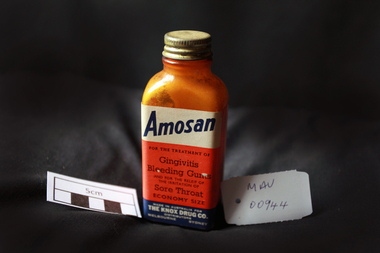 City of Moorabbin Historical Society (Operating the Box Cottage Museum)
Manufactured Glass, brown bottle 'AMOSAN', 20thC
... Active ingredient: Sodium perborate monohydrate 1.2 g Oral-B discontinued manufacture c 2011 pharmacy medicines gingivitis glassware bottles moorabbin bentleigh cheltenham belgium proctor & gamble ltd gillette ltd dentists orthodontics dentures Front label : AMOSAN / For the treatment of / GINGIVITIS / BLEEDING GUMS / AND FOR THE RELIEF OF / THE IRRITATION OF / SORE THROAT / ECONOMY SIZE / MADE IN AUSTRALIA FOR / THE KNOX DRUG COMPANY / DISTRIBUTORS / MELBOURNE SYDNEY A brown glass bottle with a metal screw top containing a small amount of powder. ...Amosan is an oral wound cleanser manufactured in Belgium and sold under the Oral-B brand, belonging to Procter & Gamble after its recent acquisition of Gillette (2005). It is used to aid in the prevention of as well as speed the recovery from canker sores, denture irritation, orthodontic irritation, and oral injuries or after dental procedures. It is distributed in a powdered form that requires reconstitution with warm water, after which it is used as a mouth rinse. It is customarily packaged in 1.7 g envelopes and sold in boxes of 20 packets each. Active ingredient: Sodium perborate monohydrate 1.2 g Oral-B discontinued manufacture c 2011 A brown glass bottle with a metal screw top containing a small amount of powder. 'AMOSAN'Front label : AMOSAN / For the treatment of / GINGIVITIS / BLEEDING GUMS / AND FOR THE RELIEF OF / THE IRRITATION OF / SORE THROAT / ECONOMY SIZE / MADE IN AUSTRALIA FOR / THE KNOX DRUG COMPANY / DISTRIBUTORS / MELBOURNE SYDNEY pharmacy, medicines, gingivitis, glassware, bottles, moorabbin, bentleigh, cheltenham, belgium, proctor & gamble ltd, gillette ltd, dentists, orthodontics, dentures -
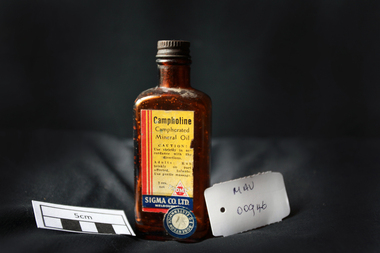 City of Moorabbin Historical Society (Operating the Box Cottage Museum)
Manufactured Glass, brown bottle 'Campholine', c1950
... bottles moorabbin bentleigh cheltenham melbourne tromax-sigma co ltd leete ernest church edwin sigma company pty ltd Front label : Campholine / Camphorated / Mineral Oil / CAUTION ! / Use strictly in accordance / with the directions / Adults : Rub briskly on parts affected . Infants ; Use gentle massage . / 20z. / TROMAX / SIGMA CO. Ltd. / MELBOURNE / Label Sticker : ROBERTSON OF ELSTERNWICK 1/ 8 A triangular shaped, brown glass ...Sigma was founded by two Melbourne pharmacists in 1912, it has grown to become one of the key players in Australia’s pharmacy industry .Edwin Thomas Church (1864 – 1947) and Ernest Holloway Leete a prominent chemist and a member of the College of Pharmacy who had established his own pharmacy in 1897. The entrepreneurial Leete had been part of a move in 1904 among a group of commercially-minded chemists to put up proprietary preparations. 1913 - 1927 Initially, the fortunes of the Sigma enterprise relied on E. H. Leete ‘working from home’, and even as late as 1915 company address was in Claremont Avenue Malvern. Following the establishment of the business in 1912, the Sigma Company Limited was located at Flinders Lane, Melbourne. Sigma – Tromax, 1928 E.H. Leete after sixteen years, said he would not stand again as a director of the company because interests were also turning elsewhere. He was assisting another company as its agent in the motor trade. 1938 to1953 was characterised by steady growth for Sigma, accelerated by manufacturing opportunities during World War Two. Between 1975 and 1996 the company was transformed as it entered a period of both consolidation and rapid growth. The appointment, in 1996, of new Managing Director, George Savvides, marked a break from the past. Today Sigma is a leading full line wholesale and distribution business to pharmacy. Sigma is also the owner of some of Australia’s best known pharmacy brands in Amcal, Guardian and Amcal MaxA triangular shaped, brown glass, bottle with a metal screw top containing ‘Campholine’Front label : Campholine / Camphorated / Mineral Oil / CAUTION ! / Use strictly in accordance / with the directions / Adults : Rub briskly on parts affected . Infants ; Use gentle massage . / 20z. / TROMAX / SIGMA CO. Ltd. / MELBOURNE / Label Sticker : ROBERTSON OF ELSTERNWICK 1/ 8 pharmacy, medicines, campholine, glassware, bottles, moorabbin, bentleigh, cheltenham, melbourne, tromax-sigma co ltd, leete ernest, church edwin, sigma company pty ltd -
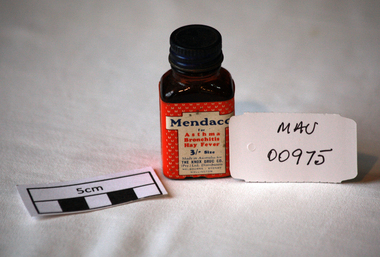 City of Moorabbin Historical Society (Operating the Box Cottage Museum)
Manufactured Glass, bottle 'Mendaco' tablets, mid 20thC
... Since 1989, we have grown into a large and successful pharmaceutical distribution company based in Ripon , UK pharmacy medicines the knox drug company pty ltd melbourne early settlers market gardeners moorabbin bentleigh cheltenham asthma mendaco Front ; MENDACO / for / Asthma / Bronchitis / Hay Fever / 3/- size / Made in Australia for / THE KNOX DRUG CO. /(Pty Ltd ) Distributors / Melbourne, Sydney, / Wellington. Left side ; Contains ……. Right side ; SAVE MONEY / ……….By purchasing the larger sizes……… Back; DIRECTIONS / Adult dose ….. Children dose ……..Base: A F583 M An empty brown glass bottle ...Knox Pharmaceuticals Ltd is a UK registered pharmaceutical wholesaler that offers a wide range of prescription, non-prescription and other pharmacy related items. Knox Ltd are licensed to supply pharmacies, hospitals, clinics and other healthcare providers; both in the UK and overseas. Since 1989, we have grown into a large and successful pharmaceutical distribution company based in Ripon , UKAn empty brown glass bottle that contained ;Mendaco' tablets used for treating Asthma, Bronchitis and Hay Fever.Front ; MENDACO / for / Asthma / Bronchitis / Hay Fever / 3/- size / Made in Australia for / THE KNOX DRUG CO. /(Pty Ltd ) Distributors / Melbourne, Sydney, / Wellington. Left side ; Contains ……. Right side ; SAVE MONEY / ……….By purchasing the larger sizes……… Back; DIRECTIONS / Adult dose ….. Children dose ……..Base: A F583 Mpharmacy, medicines, the knox drug company pty ltd, melbourne, early settlers, market gardeners, moorabbin, bentleigh, cheltenham, asthma, mendaco
