
Showing 4 items matching "men's and boys' outfitters"
-
 Federation University Historical Collection
Document - Document - Letter, Ballarat Junior Technical School: Letter from Messer & Opie Pty. Ltd. Ballarat, re Scholarship 1958
... ...men's and boys' outfitters...Messer and Opie were men's and boys' outfitters, tailors and sports' clothing specialists....Messer and Opie were men's and boys' outfitters, tailors and sports' clothing specialists. ballarat junior technical school head master l garner messer & opie annual scholarship secretary men's and boys' outfitters tailors sports' clothing 5 pounds Letterhead in green and red inks Signature of Secretary 1 beige coloured page, typed Ballarat Junior Technical School: Letter from Messer & Opie Pty. ...Notice from Messer & Opie Pty. Ltd. of Ballarat enclosing a cheque for 5 pounds for the Annual Scholarship, 1958. Signed by the Secretary. Messer and Opie were men's and boys' outfitters, tailors and sports' clothing specialists.1 beige coloured page, typedLetterhead in green and red inks Signature of Secretary ballarat junior technical school, head master, l garner, messer & opie, annual scholarship, secretary, men's and boys' outfitters, tailors, sports' clothing, 5 pounds -
 Bendigo Historical Society Inc.
Photograph - HILDA HILL COLLECTION: BLACK AND WHITE PHOTOS, 1920
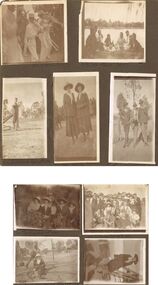
... Five boys all dressed in white and wearing white boaters playing instruments in a band, left foreground Tuba, two in centre playing trombones, man in background playing smaller tuba like instrument, Clem Easter Fair procession1920. Four young ladies and four young men sharing a picnic at the lake, (Weeroona?), ladies wearing white or light coloured outfits...Five boys all dressed in white and wearing white boaters playing instruments in a band, left foreground Tuba, two in centre playing trombones, man in background playing smaller tuba like instrument, Clem Easter Fair procession1920. Four young ladies and four young men sharing a picnic at the lake, (Weeroona?), ladies wearing white or light coloured outfits ...Hilda Hill collection. Combination of Sepia & Black & White Photos Total of 9. Photos. Five boys all dressed in white and wearing white boaters playing instruments in a band, left foreground Tuba, two in centre playing trombones, man in background playing smaller tuba like instrument, Clem Easter Fair procession1920. Four young ladies and four young men sharing a picnic at the lake, (Weeroona?), ladies wearing white or light coloured outfits and the men and boys all dressed in darker clothing, background left building on far side of the lake, at the lake 'Hungry' January 1920. Ken at Lockwood April 25th 1920, wearing white shirt dark waistcoat and trousers, left arm on top of gate post, two stays for the gate post and dry tree limb on ground, background open paddock with trees further in the background. Babe & Hilda at the Easter Fair 1920, Both wearing broad brimmed hats, one light the other dark, dark coat and skirt combinations with white accessories. 'the Three Graces' Queen street, April 25th 1920, 1 wearing dark suit and hat with white shirt and dark tie, centre wearing grey suit hat white shirt and dark tie also holding a ball his left hand round the shoulder of the man to his left, man on right wearing dark coat grey trousers white shirt and dark tie his left hand is holding round stick. Group of seated ladies, lady to left wearing light broad brimmed hat and white blouse holding bunch of leaves, next lady also wearing light broad brimmed hat dark dress white blouse with large collars folded over the coat lapel, and glasses, next at rear of group lady in hat white dress and dark coat left hand on shoulder of person left front of herself, This lady wearing dark wide broad brimmed hat dark coat and skirt with white blouse and also holding a bunch of leaves, last lady on right wearing a floppy brimmed hat with white blouse and dark coloured outfit with light coloured lapels, One Tree Hill April 18th 1920. Family group Lockwood April 25th 1920,some of the males are wearing hats others not, most are in dark coloured suits with or without coats, all of the ladies are wearing hats of varying kinds, all appear to have white blouses on with dark skirts or dresses, photo in open paddock with trees in the background. Girlie & Frank Queen street April 25th 1920, Girlie in foreground seated on rug of which more next to her is where Frank may sit, to her wearing glasses dark dress with white blouse and white hat, Frank wearing grey suit and hat is holding an object over the head of Girlie,background left a suitcase on the ground, centre background is a slim tree, right background house with gabled roof and bull nose verandah, high picket fence, trees on footpath. Left side buildings fronting the footpath. Babe seated on the hand rail at the bottom of wooden stair case, wearing broad brimmed hat dark dress and white blouse, shadow in foreground of the photographer and assistant, left is wire fence with wooden posts and top rail, April 1920.australia, history, post war life -
 Bendigo Historical Society Inc.
Photograph - CASLEY COLLECTION: EASTER FAIR FLOAT, BENDIGO, Circa 1900
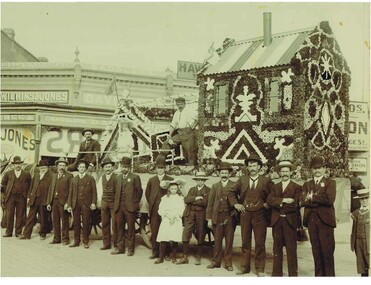
... Photo of an Easter Fair Float, 15 men/boys, 2 girls. Shops in background Tailors Outfitters. ...Photo of an Easter Fair Float, 15 men/boys, 2 girls. Shops in background Tailors Outfitters. ...Photograph - black and white. Photo of an Easter Fair Float, 15 men/boys, 2 girls. Shops in background Tailors Outfitters. Wilkins & Jones. Information received from Casley Family. In 1889 William Berryman CASLEY(1863-1909) went down a mine to retrieve body of mine manager Mr. Richards. The mine was Great Southern Lease (info. from Ralph Birrell - site of Bendigo Railway Station). He was awarded the Valor Medal and Royal Humane Society Certificate.E. Bond, King Street, West Bendigo.place, bendigo, easter, william berryman casley, easter fair bendigo. circa 1900. -
 National Wool Museum
Drawing - Illustration, Kathryn Knitwear, c.1961-1972
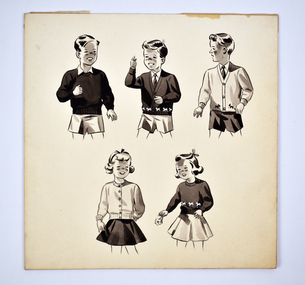
... The two other boys on the top row (at centre and right) are depicted in very similar outfits, though the shades of their clothing differ. ...Kathryn Knitwear, founded by Robert Blake, manufactured high quality children’s knitwear in Melbourne from the 1940s – 1980s. Robert Blake began manufacturing children’s knitwear in his bedroom in Strathmore using a hand powered machine in the late 1940s. The operation moved to Ascot Vale and Essendon, before eventually establishing a factory in Moonee Ponds in the early 1950s. The business continued to expand, necessitating a move to a new factory in Broadmeadows. By 1962, the Broadmeadows factory was producing an average of 20,000 garments per month, which increased to 24,000 by 1964. Robert Blake’s Son, Brendan recalls that “The Kathryn brand was famous around Australia, anywhere children needed to keep warm and dress smartly. It also won a number of wool fashion awards”, including the 1969 Wool Awards, which was held by the Australian Wool Bureau and published in Women’s Weekly. The Kathryn range was designed for durability, comfort and care, without sacrificing style. They used patterning techniques that increase stretchiness, comfort and fit, as well as integrating decorative elements into the fabric to prevent them from being bulky, uncomfortable or tight. Making longevity of style a priority, Brendan Blake remembers that “there was one particular garment that was in the range for at least thirty years”. He also recalls “In the past, when women have found out that I was associated with Kathryn Knitwear, they would often relate to me the story of a garment they had purchased or received as a gift and, when their child had grown out of it, they would hand it on to another child. Several ladies have told me of purchasing garments for their daughters’ glory box, or saving a particular garment after their daughter had grown out of it. Brendan Blake: “At the peak of their operation they employed approximately two hundred people, mainly women and girls. A family would often seek to send their daughter to work in this company because they knew they would be looked after and safe. One lady wrote to me telling me that working at the Moonee Ponds Factory prior to getting married was the happiest time of her life.” In 1963, workers at the Kathryn factory earned £13 per week, which was 8 shillings and 8 pence higher than the minimum weekly wage for female workers in the textile manufacturing industry (£12 11s 4d). By 1970, the Kathryn Knitwear brand expanded from children’s knitwear into womenswear under the brand name ‘Lady Kathryn’, and for boys and men under ‘Robert Blake’. Continuing to diversify their distribution, they also began exporting ‘Kathryn’ garments to New Zealand, the Pacific Islands, and Japan. ‘Kathryn Knitwear’ was well-known for their early adoption of modern materials and techniques that had broad appeal to their customer base. This is shown in their early use of the acrylic fibre ‘Orlon’ in the 50s and 60s and ‘Superwash’ wool in the 1970s. Many of Kathryn Knitwear’s styles, particularly those that were long running staples of the brand, were available in both wool and Orlon to suit the consumer’s preference. Far from the humble origins of one man in his bedroom with a hand-cranked machine; at its closure in 1980, the Broadmeadows factory of ‘Kathryn’ housed more than 100 machines, including 53 sewing machines and 45 knitting machines. Robert Blake was “a passionate advocate for wool and Australian Made” throughout his whole life. A strong thread that ties through the lifespan of Robert Blake and Kathryn Knitwear is a balance between adopting new innovations without sacrificing the core values of durability, comfort, care and style that had made the brand so well known. Their legacy forms an integral part of both Australian social and manufacturing history.Original illustration artwork on cream matboard/card inked in shades of grey and black. Used for marketing. Depicts Five figures of children in iconic Kathryn knitwear styles. The boy on the top left wears a dark crew neck jumper over a pale collared short with shorts. The two other boys on the top row (at centre and right) are depicted in very similar outfits, though the shades of their clothing differ. They are both shown in v-neck cardigans with three buttons and a colourwork animal motif at the hem over a pale suit with a dark tie. The figure at the centre has a dark cardigan and pale shorts, while the figure at the right has a light cardigan and dark shorts. The two figures on the bottom row are both girls wearing flared skirts with bows in their hair. They both wear crewnecks, the figure on the left wears a pale cardigan with six buttons down the front, while the right wears a dark jumper with two buttons on the shoulder and an animal motif at the hem. The jumper on the girl on the right is the same style as NWM-08893. There is tape still affixed to the back of the boardbusiness, business history, manufacturing, knitting machine, fashion textile production, business archives, manufacturing documents, textile industry - history wool marketing, wool marketing fashion textile industry
