
Showing 15 items matching "meritorious work"
-
 Federation University Historical Collection
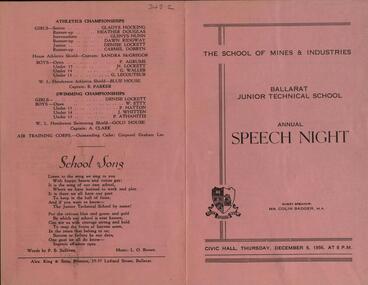
Programme - pink sheet folded in half, Alex. King & sons, Printer, Ballarat Junior Technical School - Speech Night Programme - 1956, 1956
... ...meritorious work...It catered for boys and girls to Form IV. Awards for Meritorious Work, Dux of Form, Athletics and Swimming and Magazine contributions were given. ...It catered for boys and girls to Form IV. Awards for Meritorious Work, Dux of Form, Athletics and Swimming and Magazine contributions were given. ...For a period of time the Ballarat Junior Technical School was co-educational. It catered for boys and girls to Form IV. Awards for Meritorious Work, Dux of Form, Athletics and Swimming and Magazine contributions were given. A strong musical programme was provided at the school and on show at Speech Night.Pink sheet of paper folded to allow 4 areas for printing. 1. Title page; 2. Programme for night; 3. Awards and recipients; 4. Continuation of awards and School Song. Title page includes names - The School of Mines & Industries; Ballarat Junior Technical School; Guest Speaker: Mr Colin Badger M.A.; Date, Time and Place of Speech Night.the ballarat junior technical school, co-educatioal, form iv, meritorious work, dux of form, athletics, swimming, musical, programme, speech night -
 Ballarat Tramway Museum
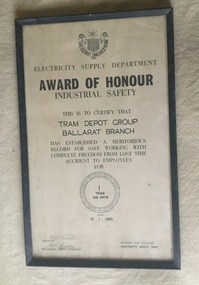
Certificate - Framed Certificate - set of 3, State Electricity Commission of Victoria (SECV), "Award of Honour - Industrial Safety", 1962 to 1964
... Set of three Timber framed certificates, glass front, black painted side timber with brown paper or card or Masonite backing and masking tape around the edges, titled "Award of Honour - Industrial Safety", that the Tram Depot Ballarat had established a meritorious record for safe work with no lost time. Gives the period and the date of the away. ...Trams tramways Depot Sec Safety Personnel Set of three Timber framed certificates, glass front, black painted side timber with brown paper or card or Masonite backing and masking tape around the edges, titled "Award of Honour - Industrial Safety", that the Tram Depot Ballarat had established a meritorious record for safe work with no lost time. Gives the period and the date of the away. ...The State Electricity Commission of Victoria 1921 to 1993 was responsible for electricity generation in Victoria and the operation of three Provincial Tramways. It had a strong safety focus for the time. These certificates show the safety focus and the reporting of safety performance to employees and visitors.Demonstrates the safety record of the SEC Ballarat depot, has a strong association with the workers and Yields information about their performance and dates.Set of three Timber framed certificates, glass front, black painted side timber with brown paper or card or Masonite backing and masking tape around the edges, titled "Award of Honour - Industrial Safety", that the Tram Depot Ballarat had established a meritorious record for safe work with no lost time. Gives the period and the date of the away. Signed by the Manager - A. W. Linaker? or F. White and the Chairman of the Safety Committee "Wm K. Trusler". Screw holes in the top and the bottom of the frame centrally. .1 - dated 12-1-1962 for 1 year and 103 days. .2 -dated 19-6-1963 for 1 year and 155 days. .3 - dated 19-6-1964 - for 1 year.trams, tramways, depot, sec, safety, personnel -
 Ballarat Clarendon College
Book, The watches of the trails
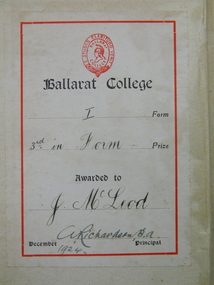
... meritorious performance in the intelligence area of operations. He served in North Africa, in Palestine, Egypt, Moratai, the Philippines, Java and New Guinea. He was awarded his Military MBE by King George VI for exceptional devotion to duty and for brilliant coordination work amongst the allied intelligence team. ...meritorious performance in the intelligence area of operations. He served in North Africa, in Palestine, Egypt, Moratai, the Philippines, Java and New Guinea. He was awarded his Military MBE by King George VI for exceptional devotion to duty and for brilliant coordination work amongst the allied intelligence team. ...John Anning MacLeod John was born in Ballarat as the second generation of Ballarat MacLeod’s, with his grandfather arriving in Geelong on the Hornet in 1857 as an 11 year old child with his 60 year old father John and mother Mary aged 37 years and 5 brothers and one sister. He grew up on the corner of Drummond Street and Mair Streets, opposite what became St John of God hospital, at his parents house of Dunvegan. John entered Ballarat College as a junior student in 1923. He received 3rd in Form prizes in both 1924 and 1925. His sister Margaret, attended Clarendon Ladies College. The household employed a chauffeur, a cook, a gardener and a ladies maid to care for them. In the 1930’s his father lost his fortune in the collapse of the jute future’s market so the staff were dismissed and he left Ballarat to go to Geelong College as a boarder. He was an officer in the Geelong College cadet corps and joined the Army as a private and rose to the permanent rank of Major after meritorious performance in the intelligence area of operations. He served in North Africa, in Palestine, Egypt, Moratai, the Philippines, Java and New Guinea. He was awarded his Military MBE by King George VI for exceptional devotion to duty and for brilliant coordination work amongst the allied intelligence team. During the war he met Mary Monica Carrol Bateman, a lietenant in the 2/4th Army General Hospital at a dinner party in Brisbane. The couple had four children, Hamish John Torquil born in 1945, Rory Hugh Alexander born in 1947 and twins Ian Donald and Katriona Margaret born in 1948. After the Second World War he worked for Lumley’s Insurance Brokers in London for a couple of years to follow up his accountancy training and then returned to Ballarat due to his father’s failing health and took over the management of John MacLeod and Co, Wholesale grocers and Merchants in Lydiard Street, Ballarat. The business had been started by his great grandfather and they produced the famous Sirdar brand of products and a special tea blend called Afternoon Cup. There was a spice mill in nearby Market Street and there they roasted peanuts, coffee and ground spices for packaging and distribution to the small corner shops who were the mainstay of commercial grocery. In the 1950’s John MacLeod and Co merged with James McKay and Sons to form McKay MacLeod Pty Ltd., wholesale tobacco, wine and spirits and grocery merchants who also manufactured the Sunny South brand of sweet mustard pickles, brewed vinegar and tomato sauce. He introduced the semi-automated system for extensions and financial records on the Bradma plates that saved staff the problems of sorting out the calculations for sales tax, miscellaneous charges etc. that greatly sped up the transactions at the checkout points. A new warehouse and office complex was built in Mair Street east up near Humffray Street, with the manufacturing factory on the opposite side of the street. They had a shop in St Arnaud and one in Geelong which was the local wholesaler for supplying to the corner shops of the greater Geelong area. With the development of supermarkets the demise of the corner store began and so the sales profiles began to diminish. He unsuccessfully stood for Liberal Party pre-selection for the seat of Ballarat in 1948 and served on the Liberal state finance and executive team for many years before resigning over the issue of conscripts being sent to Vietnam. He was instrumental in leading a group of Ballarat academics in opposition to the Vietnam war and publicly resigned from the Liberal Party over their foreign policy. John MacLeod saw the writing on the wall of the business in the early 1970’s and suggested that the firm restructured with focusing on tobacco, wine and spirits. His partners did not agree and so he sold out and retired to Barwon Heads. After a few years of golfing and surfing he became frustrated and joined SCORE, the Service Corp of Retired Executives. In this role he worked for ten years in the Geelong area solving accounting problems for Geelong small businesses and so helped Beaumont’s bakery back onto its feet. He worked gentlemen’s hours of 10 am to 3 pm which allowed him to have time for a round of 9 holes on the golf course at the end of the day and to have a surf before breakfast. He fully retired at the age of 65 and had ten years of voluminous reading of local library books before dying of burns at the age of 75. His war record has been documented in other archives at the College. He was a member of the Naval and Military Club and of the Barwon Heads Golf Club. He had good crafting skills and built a series of steam driven boats for his four children that used to be sailed at home on Lake Wendouree, Lake Learmonth and on the sheltered waters of the Barwon River. The boats are now being restored to operational order to be sailed by his great grandson Grayson Girardi. Red cloth bound book with title printed in gold lettering on spine, embossed publisher's mark centre of front cover and school crest in gold relief on front cover; book plate inside front cover. Book plate inside front cover: School crest / Ballarat College / I form / 3rd in form Prize / Awarded to / J MacLeod / December 1924 A Richardson B A Principaljohn-macleod, ballarat-college, book-prize, 1924 -
 Ballarat Clarendon College
Book, The school across the road
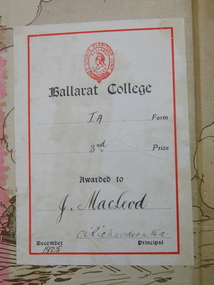
... meritorious performance in the intelligence area of operations. He served in North Africa, in Palestine, Egypt, Moratai, the Philippines, Java and New Guinea. He was awarded his Military MBE by King George VI for exceptional devotion to duty and for brilliant coordination work amongst the allied intelligence team. ...meritorious performance in the intelligence area of operations. He served in North Africa, in Palestine, Egypt, Moratai, the Philippines, Java and New Guinea. He was awarded his Military MBE by King George VI for exceptional devotion to duty and for brilliant coordination work amongst the allied intelligence team. ...John Anning MacLeod John was born in Ballarat as the second generation of Ballarat MacLeod’s, with his grandfather arriving in Geelong on the Hornet in 1857 as an 11 year old child with his 60 year old father John and mother Mary aged 37 years and 5 brothers and one sister. He grew up on the corner of Drummond Street and Mair Streets, opposite what became St John of God hospital, at his parents house of Dunvegan. John entered Ballarat College as a junior student in 1923. He received 3rd in Form prizes in both 1924 and 1925. His sister Margaret, attended Clarendon Ladies College. The household employed a chauffeur, a cook, a gardener and a ladies maid to care for them. In the 1930’s his father lost his fortune in the collapse of the jute future’s market so the staff were dismissed and he left Ballarat to go to Geelong College as a boarder. He was an officer in the Geelong College cadet corps and joined the Army as a private and rose to the permanent rank of Major after meritorious performance in the intelligence area of operations. He served in North Africa, in Palestine, Egypt, Moratai, the Philippines, Java and New Guinea. He was awarded his Military MBE by King George VI for exceptional devotion to duty and for brilliant coordination work amongst the allied intelligence team. During the war he met Mary Monica Carrol Bateman, a lietenant in the 2/4th Army General Hospital at a dinner party in Brisbane. The couple had four children, Hamish John Torquil born in 1945, Rory Hugh Alexander born in 1947 and twins Ian Donald and Katriona Margaret born in 1948. After the Second World War he worked for Lumley’s Insurance Brokers in London for a couple of years to follow up his accountancy training and then returned to Ballarat due to his father’s failing health and took over the management of John MacLeod and Co, Wholesale grocers and Merchants in Lydiard Street, Ballarat. The business had been started by his great grandfather and they produced the famous Sirdar brand of products and a special tea blend called Afternoon Cup. There was a spice mill in nearby Market Street and there they roasted peanuts, coffee and ground spices for packaging and distribution to the small corner shops who were the mainstay of commercial grocery. In the 1950’s John MacLeod and Co merged with James McKay and Sons to form McKay MacLeod Pty Ltd., wholesale tobacco, wine and spirits and grocery merchants who also manufactured the Sunny South brand of sweet mustard pickles, brewed vinegar and tomato sauce. He introduced the semi-automated system for extensions and financial records on the Bradma plates that saved staff the problems of sorting out the calculations for sales tax, miscellaneous charges etc. that greatly sped up the transactions at the checkout points. A new warehouse and office complex was built in Mair Street east up near Humffray Street, with the manufacturing factory on the opposite side of the street. They had a shop in St Arnaud and one in Geelong which was the local wholesaler for supplying to the corner shops of the greater Geelong area. With the development of supermarkets the demise of the corner store began and so the sales profiles began to diminish. He unsuccessfully stood for Liberal Party pre-selection for the seat of Ballarat in 1948 and served on the Liberal state finance and executive team for many years before resigning over the issue of conscripts being sent to Vietnam. He was instrumental in leading a group of Ballarat academics in opposition to the Vietnam war and publicly resigned from the Liberal Party over their foreign policy. John MacLeod saw the writing on the wall of the business in the early 1970’s and suggested that the firm restructured with focusing on tobacco, wine and spirits. His partners did not agree and so he sold out and retired to Barwon Heads. After a few years of golfing and surfing he became frustrated and joined SCORE, the Service Corp of Retired Executives. In this role he worked for ten years in the Geelong area solving accounting problems for Geelong small businesses and so helped Beaumont’s bakery back onto its feet. He worked gentlemen’s hours of 10 am to 3 pm which allowed him to have time for a round of 9 holes on the golf course at the end of the day and to have a surf before breakfast. He fully retired at the age of 65 and had ten years of voluminous reading of local library books before dying of burns at the age of 75. His war record has been documented in other archives at the College. He was a member of the Naval and Military Club and of the Barwon Heads Golf Club. He had good crafting skills and built a series of steam driven boats for his four children that used to be sailed at home on Lake Wendouree, Lake Learmonth and on the sheltered waters of the Barwon River. The boats are now being restored to operational order to be sailed by his great grandson Grayson Girardi. john-macleod, ballarat-college, 1925, book-prize -
 Bendigo Military Museum
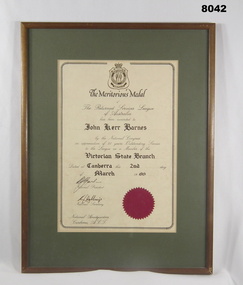
Certificate - MERITORIOUS SERVICE MEDAL 1989, National HQ of the RSL, 2.3.1989
... Refer Cat No 8040 for Jacks other awards, Committee/Volunteer work with the Bendigo Sub - Branch. brsl smirsl meritorious "Meritorious Medal - awarded to - John Kerr Barnes by the National Congress in appreciation of 25 years outstanding service" Dated "Canberra this 2nd day of March 1989" Signed "................." ...John Kerr Barnes. This is the highest award in the RSL for 25 years outstanding service. Refer Cat No 8040 for Jacks other awards, Committee/Volunteer work with the Bendigo Sub - Branch.Certificate framed, frame is timber, certificate backing is green, certificate yellow with an ornate edgeing, gold RSL Logo at the top followed by the wording "The Meritorious Medal" to "John Kerr Barnes", all print in black with red seal bottom RH corner, signed and dated."Meritorious Medal - awarded to - John Kerr Barnes by the National Congress in appreciation of 25 years outstanding service" Dated "Canberra this 2nd day of March 1989" Signed "................." National President Signed ".... Gollings" National Secretary. brsl, smirsl, meritorious -
 Bendigo Military Museum
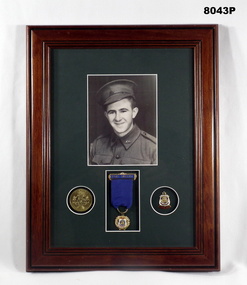
Award - MEDAL, BADGE, PHOTO FRAMED, WW2 to post 1989
... You have to be a Life Member to be awarded the "Meritorious Service Medal". Refer Cat No 8040 for Jacks other awards, Committee/Volunteer work for the Bendigo Sub Branch....You have to be a Life Member to be awarded the "Meritorious Service Medal". Refer Cat No 8040 for Jacks other awards, Committee/Volunteer work for the Bendigo Sub Branch. brsl smirsl meritorious On Medal, "For Merit", On Medallion, "World War11 - Service to Australia", On RSL badge, "Life Member" Framed Memorabilia, frame is brown timber, item backing green with 4 insets, top is a photo, under is a gold medallion, medal with ribbon, RSL badge. ...John Kerr Barnes. The items relate to "Jack" as he was known. The photo is Jack in uniform, the central Medal/Ribbon is the "Meritorious Service Medal", see Cat No 8042, The RSL Badge is a Life Members Badge. You have to be a Life Member to be awarded the "Meritorious Service Medal". Refer Cat No 8040 for Jacks other awards, Committee/Volunteer work for the Bendigo Sub Branch.Framed Memorabilia, frame is brown timber, item backing green with 4 insets, top is a photo, under is a gold medallion, medal with ribbon, RSL badge.On Medal, "For Merit", On Medallion, "World War11 - Service to Australia", On RSL badge, "Life Member"brsl, smirsl, meritorious, -
 Bendigo Military Museum
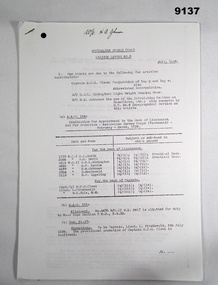
Administrative record - Australian Survey Corps - Liaison Letters 1936 - 1939, 1st, 2nd, 3rd and 4th Military Districts, Australia, July 1936 - June 1939
... Meritorious Service Medal -- W/O.H. Rossiter. .... Award of Aust. Medal for Long Service and Good Conduct -- W/O, A.L. Smith. Para 2. Progress of work...Meritorious Service Medal -- W/O.H. Rossiter. .... Award of Aust. Medal for Long Service and Good Conduct -- W/O, A.L. Smith. Para 2. Progress of work ...Liaison Letters details happenings within the various Sections of the Australian Survey Corps to inform all members of current information and practices. 9137.1 Liaison Letter No 1. 21 July 1937. Para 1. Object of Letter. See context section. Para 3. Progress of work. Incomplete, rest of Letter missing only 1 page. 9137.2 Liaison Letter No 2 Letter missing. 9137.3 Liaison Letter No 3. Jan 1937. Para 1. Our thanks are due to the following for articles contributed. .... W/O H. Rossiter. -- "Aerial Surveying". -- Article missing. .... W/O W. M. Sarll. -- "A day in the Draughting Office". -- Report on No 1 Field Sheet, Sale. -- Article missing. .... W/O H. A. Johnson. -- "Semigraphic methods of resection and intersection". -- Article missing. .... Capt. J.J. Raisbeck "Rapid production and reproduction of Military maps". Article missing. .... Lt. L. Fitzgerald. report "Survey Exercise at Sale". Article missing. .... W/O W. M. Sarll. report on No1. Field Sheet, Sale. Article missing. Para 3. Progress of work. .... "No1 Draughting Section". .... Printing. .... No1 Survey Section. .... No2 Survey Section. .... Pages 3 - 6 Missing. .... Article by W/O W. M. Sarll. "A day in the Draughting Office". Pages 7 - 10. 9137.4 Liaison Letter No 4. April 1937. Para 1. Our thanks are due to the following for articles contributed. .... Lieut. H. W. G. Clews. -- Notes on the non-ascertained Base problem. -- Article missing. .... W/O W. M. Sarll. -- Helpful hints on air photos. -- Article missing. .... Capt. T. H. B. Foott. .... & Capt. J.J. Raisbeck. -- A short history of the Military Survey of Australia. -- Article missing. .... W/O H. Rossiter. -- Notes on Aerial Surveying. -- Article missing. .... W/O H. A. Johnson. -- A type of Beacon. -- Article missing. Para 2. Progress of work. ..... No1 Draughting Section. ..... No1 Survey Section. ..... Pages missing. 9137.5 Liaison Letter No 5, July 1937. Para 1. Our thanks are due to the following for articles contributed .... Lt L. Fitzgerald -- A new section and its job. -- Article missing. .... WO G.R.L. Remington. .... & H. E. Eggeling. Azimuth of the Plane table. -- Article missing. .... W.O. B. M. Sarll. -- The Second Annual Smoke Night of the Members of the Aust.Survey Corps stationed in Victoria. .... Also included is a very interesting article on the United States Geological Survey by J. F. Staask, extracted from the Canadian Surveyor. February 1936. -- Article missing. Para 2. Progress of work. .... No1. Draughting Section. .... No 1 Topographical Section. No further articles till page 7. .... The Second Annual Smoke Night of the members of the Aust. Survey Corps. Stationed in Victoria. Pages 7 - 9. 9137.6 Liaison Letter No 6, September 1937. Para 1. Our thanks are due to the following for articles contributed .... Lt L. Fitzgerald. -- Geodetic Triangulation reconnaissance. Article missing. -- Article missing. .... Lt. R.F. Rule, M.M. -- A suggested Form for Field Book 3rd Order Traverses. -- Article missing. .... W/O. H. A. Johnson. -- A suggested Form for Quadrilateral Adjustments. -- Article missing. Para 2. Progress of work. .... No1. Draughting Section. .... No 1 Topographical Section. No further pages to letter 6. 9137.7 Liaison Letter No 7. January 1938. Para 1. Our thanks are due to the following for articles contributed. .... Major T. A. Vance. -- Report on the Survey of a Training Area in Tasmania. -- Article missing. .... W/O D. Macdonald. -- The naming of Trigonometrical Stations. -- Article missing. Para 2. Progress of work. .... No1 Draughting Section A.H.Q. .... No1 Topographical Section, 4 M.D. .... No2 Topographical Section 3 M.D. .... No3 Topographical Section 2 M.D. .... No4 Topographical Section A.H.Q. No further pages to letter 7. 9137.8 Liaison Letter No 8. April 1938. Para 1. Our thanks are due to the following for articles contributed .... Capt. H.P.G.Clews. -- A possible method of estimating Stereoscopic ability. -- Article missing. .... W/O. A.L.Smith. -- Hints to Topographers from a Draughtsman's point of view. .... W/O. W.W. Sarll. -- Seeing that which a Surveyor sees. Para 1.a. -- Relative to article on naming of trig stations which appeared in No7. This contribution has examples of naming. Para 1.d. Enlistment. -- George Gladstone Bolwell was enlisted as W/O.II. Draughtsman in the No. 1 Draughting Section A.H.Q. on the 26th April 1938. Mr. Bolwell was of the Victorian Lands Department. Para 1.e. Embarkation. -- Major T.A. Vance. O.C. Aust Survey Corps, embarked S.S. "Monterey". 28 Mar 1938 to undergo six months training in USA and Canada. Para 1.f. Promotions. -- To be Capt. (prov.) Lieut. H.P.G. Clews 9.11.1937. Para 1.g. Medals -- Award of Aust. Meritorious Service Medal -- W/O.H. Rossiter. .... Award of Aust. Medal for Long Service and Good Conduct -- W/O, A.L. Smith. Para 2. Progress of work. .... No.1 Draughting Section A.H.Q. .... No.1 Topographical Section, 4 M.D. .... No.2 Topographical Section 3 M.D. .... No.3 Topographical Section 2 M.D. .... No.4 Topographical Section A.H.Q. Article missing by Capt. H.P.G.Clews. -- A possible method of estimating Stereoscopic ability. Article by W/O. A.L.Smith. -- Hints to Topographers from a Draughtsman's point of view. Contains 3 pages. Article by W/O. W.W. Sarll. -- Seeing that which a Surveyor sees. Contains 3 pages. 9137.9 Liaison Letter No 9. July 1938. Para 1. Our thanks are due to the following for articles contributed .... Captain H.P.G.Clews -- Computation of log p and log v; also Abbreviated interpolation. .... W/O. G.R.L. Rimington. -- Light Weight Camping Gear. .... W/O. H.A. Johnson. -- The use of the Calculating Machine on Resections, etc,; also comments by O.C.No.4 Topographical Section on this article. Para 1.a. A.A.O. 104. Examination for Appointment to the Rank of Lieutenant. February - March,1938. .... W.O.I. A.L. Smith. .... W.O.I. W.M. Sarll. .... W/O. II. G.R.L. Rimington. .... W/O. II. A.F. Kurrle. .... W/O. II. H.A. Johnson. .... W/O. II. D. MacDonald. .... W/O. II. H.F.Eggeling. .... For Captain. .... Capt. (p) H.P.G. Clews. .... Lieut. L. FitzGerald. .... Lieut. R.K. Rule M.M. Para.1. b. A.A.O. 109. Allotment W/O. II. W.B. Relf to No.3 Topo Section 2 M.D., 5.4.38. Para.1. c. Gaz. No. 37 -- Promotions. -- To be Captain, Lieut. L FitzGerald. 5th July 1938. -- The provisional promotion of Captain H.P.G. Clews is confirmed. Para. 2. Progress of Work. .... No.1 Draughting Section A.H.Q. .... No.1 Topographical Section, 4 M.D. .... No.2 Topographical Section 3 M.D. .... No.3 Topographical Section 2 M.D. .... No.4 Topographical Section 2 M.D. 9137.10 Liaison Letter No 10. October 1938. Para 1. Our thanks are due to the following for articles contributed. .... Lieut. R.K. Rule M.M. -- Barometric levelling in Forest Areas. .... W/O. H.A. Roseblade -- Adjustment of principal points on master grid. .... W/O. II. A.F. Kurrle. -- The Hunter short base applied to photo control. .... W/O. W.B. Relf -- Reunion at Newcastle. .... The articles are all missing Para. 1. a. A.A.O. 184. Discharge -- W/O. II. G.G. Bolwell. 15th July 1938. Para. 1. b. A.A.O. 174-195, 31.8.38. Vacancy for Draughtsman. Para. 1. c. Obituary. -- Major John Lynch. 29th July 1938. Para. 2. Progress of Work. .... No.1 Draughting Section A.H.Q. .... No.1 Topographical Section, 4 M.D. .... No.2 Topographical Section 3 M.D. .... No.3 Topographical Section 2 M.D. .... No.4 Topographical Section A.H.Q. 9137.11 Liaison Letter No 11. January 1939. Para 1. Our thanks are due to the following for articles contributed. .... Major T.A. Vance. -- Training Abroad, Canada and U.S.A. .... Captain L. Fitzgerald -- Air Reconnaissance for 1st Order Triangulation. .... W/O C.E. Stewart. -- Reunion at Traralgon. Para 2. A.A.O. 301/38. .... a. Appointments. -- Royal Ormond Worcester, on enlistment in the Aust Permanent Military Forces is appointed W/O II. 30th November 1938. -- Thomas Micheal Connolly, on enlistment in the Aust Permanent Military Forces is appointed W/O II. 30th November 1938. .... b. Discharge. -- No. 3614 W/O II. G.R.L. Rimington. 30th November 1938. .... c. Awards of the Australian Military Medal for Long Service and Good Conduct (Military). -- No.1175, W/O I, E.T. Johnson. .... d. Return of Officers to Australia. -- Major T.A. Vance, having completed training in the United States of America, Canada and New Zealand, returned to Aust. on the S.S. "Awatea", disembarked Sydney on 3rd December 1938. .... e. Allotment. -- No.3689, W/O. II A.F. Kurrle, allotted to No. 4 Topographical Section, A.H.Q., 1 January 1939. Para. 2. Progress of Work. .... Cartographic Section, A.H.Q. .... Geodetic Section, A.H.Q. .... No.1 Survey Section, 4 M.D. .... No. 2 Survey Section, 3 M.D. .... No. 3 Survey Section, 2 M.D. 9137.12 Liaison Letter No 12. March 1939. Para 1. Our thanks are due to the following for articles contributed. .... W/O H.F. Eggeling -- Topographical Survey and Barometric Levelling. .... W/O G.T.P. Carter Methods of plotting from air photographs. .... Editor, Canadian Surveyor -- The Australian Survey Corps Para 2. A.A.O. 57 -- .... a. Promotion. -- No. 3577 S/Sgt G.T.P. Carter. appointed Topographer promoted to W/O II. 15th January 1939. .... b. Allotment -- The following are allotted to No. 3 Topographical Section 2 M.D. 1st February 1939. .... No, 171 W/O I B. Rossiter. .... No. 178 W/O. I V.W. Aldred. .... No. 150 W/O. I A.T. Smith. .... c. Transfer. -- No. 369 W.O. A.F.Kurrle. to No. 4 Topo Section A.H.Q. 1st January 1939. .... d. Promotions -- To be Major J.J. Raisbeck. and Lieut. W.M. Sarll as of 1st January 1939. Para. 3. Progress of Work. .... Cartographic Section, A.H.Q. .... No.4 Topographical Section, A.H.Q. .... No.2 Topographical Section, 3 M.D. .... No.3 Topographical Section, 2 M.D. .... Articles Missing -- W/O H.F. Eggeling -- Topographical Survey and Barometric Levelling. -- W/O G.T.P. Carter Methods of plotting from air photographs .... Article -- Editor, Extract from "The Canadian Surveyor" -- The Australian Survey Corps. 9137.13 Liaison Letter No 13. June 1939. Para 1. Our thanks are due to the following for articles contributed. .... Lieut. W.M. Sarll -- Meeting a crisis with maps and equipment; also comments by O.C. Cartographic Section. .... W/O H.F. Eggeling -- Design and description of an Epidiascope. -- Article missing. .... Editor, Melbourne Herald -- "They do a Vital Task". 6th July, 1939. .... Also enclosed is a Corps Seniority Roll. -- Article missing. Para 2. a. A.A.O. 118/39. -- Appointment to Lieutenant, February, March, 1939. .... 3572 W/O. I. H.C. Raisbeck. .... 3684 W/O. I.I. T.R. Westgarth. .... 3686 W/O. I.I. C.E.B. Stewart. .... 3702 W/O. I.I. C. S. Tyler. .... 4479 W/O. I.I. W.B. Relf. Para. 2. b. A.A.O. 127/39 -- Appointment to W/O. I.I. .... G. V. Brooke. 5.4.39. .... L. J. Lockwood. 5.4.39. .... J. P. Hanley. 17.4.39. .... W. J. Harrison. 24.4.39. .... J. K. C. Herridge. 1.5.39. Para 2. c Gaz. 26/39. Awards of the Aust. Medal for Long Service and Good Conduct Military. .... No. 1439 W/O. I. H. A. Roseblade. .... No. 1176 W/O. I. J. Cullen. Para. 3. Progress of Work. .... Cartographic Section, A.H.Q. .... Geodetic Section A.H.Q. .... No. 2 Survey Section, 3 M.D. .... No. 3 Survey Section, 2 M.D. .... Editor, Melbourne Herald -- "They do a Vital Task". 6th July, 1939. .... Lieut. W.M. Sarll -- Meeting a crisis with maps and equipment; also comments by O.C. Cartographic Section. 9137.1 Liaison Letter No 1. 21 July 1937. Para 1. Object of Letter. The object of these letters, which it is to be proposed quarterly, is to enable members of the Australian Survey Corps to stimulate interest in the progress of the work as a whole. It is also intended as a means to invite helpful criticism and suggestions for improvements in methods in any branch of the work. All members of the Corps are invited to contribute. Their suggestion should be forwarded to the O.C. section for transmission to O, C. Survey Corps and, if considered of sufficient merit, will be included in the next letter. It may often happen that a method, that may appear obvious and of little consequence to a member or Section using it, may not be followed by the others. In any case a discussion of detail in methods should be helpful to all.54 x A4 Photocopied pages of typed text. 9137.1 Liaison Letter No 1. 21 July 1937. 9137.2 Liaison Letter No 2 Letter missing. 9137.3 Liaison Letter No 3. Jan 1937. 9137.4 Liaison Letter No 4. April 1937. 9137.5 Liaison Letter No 5, July 1937. 9137.6 Liaison Letter No 6, September 1937. 9137.7 Liaison Letter No 7. January 1938. 9137.8 Liaison Letter No 8. April 1938. 9137.9 Liaison Letter No 9. July 1938. 9137.10 Liaison Letter No 10. October 1938. 9137.11 Liaison Letter No 11. January 1939. 9137.12 Liaison Letter No 12. March 1939. 9137.13 Liaison Letter No 13. June 1939. royal australian survey corps, army survey regiment, fortuna, rasvy, army svy regt, asr -
 Wodonga & District Historical Society Inc
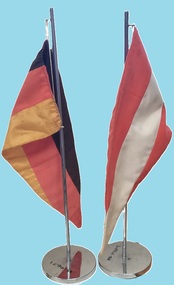
Memorabilia - German and Austrian miniature flags, Unknown
... Meritorious Service by the Government of Victoria for Community Works in Wodonga and district. The Club raised $23,000 for the Wodonga Hospital, had numerous fundraisers to assist in bushfires and drought situations and was involved in the Red Cross Calling campaign for many years. After much fundraising, hard work...Meritorious Service by the Government of Victoria for Community Works in Wodonga and district. The Club raised $23,000 for the Wodonga Hospital, had numerous fundraisers to assist in bushfires and drought situations and was involved in the Red Cross Calling campaign for many years. After much fundraising, hard work ...Thousands of German migrants started a new life at Bonegilla, Victoria in the 1950s. Among them were five men who met each other in Wodonga, became friends and decided to form a German Austrian Club, where they could enjoy the company of likeminded individuals. They were Kurt Mueller, Willi Klimt, Toni Krischa and Erwin Klein from Germany and Manfred Teissl from Austria. On the 16th July 1960, after advertising in the Border Morning Mail, the German Austrian Club in Wodonga was born. Office bearers were Paul Peters as President. Gerhard Ziermann as Secretary and Günter Schmehl as Treasurer. Their aim was "To promote the upkeep of the German language in written and spoken form and to promote good German fellowship, while enjoying functions of a cultural and entertaining nature". By 1963 the Club boasted 40 members, holding meetings at the RSL Clubrooms and other suitable locations before they found a house in Hovell Street, Wodonga. It was used for meetings, Skat meetings, film nights and "Sonnabendschule” or Saturday school where children of members could continue to learn German. The Committee organised a wide range of activities and functions in their small rooms but dreamed of having a bigger home. This became reality in July 1979, when the Committee purchased land from the Albury Wodonga Development Corporation at 5 McFarland Road, Wodonga. The first brick was laid on the Club's land in May 1980, and the double-storey brick building was completed within 12 months voluntarily by Club members. At the same time members supported other organisations and charities in the Wodonga and wider community. The first Oktoberfest in Wodonga was held in 1975, drawing 4,000 attendees. The event was organized to promote German culture, and the profits from the first year were donated to the Wodonga District Hospital, raising $20,000. In 2001 the German Austrian Club was presented with the Certificate of Meritorious Service by the Government of Victoria for Community Works in Wodonga and district. The Club raised $23,000 for the Wodonga Hospital, had numerous fundraisers to assist in bushfires and drought situations and was involved in the Red Cross Calling campaign for many years. After much fundraising, hard work and making their way through extensive government red tape, the Club moved to its new premises in McFarland Road on 1st August 1981. The members continued to make necessary internal adjustments and sought an alcohol licence. The building was officially opened in May 1983. The Club prospered and had 300 members, making it necessary for new applicants to be put on a waiting list to be accepted as members. Interest groups consisted of Competition Air Rifle Shooting Group, a Skat (German Card game) Group, Folk Dancing Group, Ladies Group, Table Tennis Group, Darts Group, Chess Group and the Billiard Group. In later years, as so many Australians became members, the Club’s name was changed to the German Austrian Australian Club. Over recent years patronage and interest in the Club and its activities changed. Children of the original members had become “real Aussies” and did not always want to carry on traditions. Aging membership and lack of volunteers forced the Club to disband in 2025. The Club building has been gifted to the Albury Wodonga Theatre Company.These items are significant because they are representative of an important cultural organisation which operated in Wodonga for over 60 years.Two small flags of Germany and Austria attached to metal stands with string. Each stand has a metal circular base. "Lufthansa" is inscribed on the base.On base: Lufthansagerman austrian australian club, german austrian club -
 Wodonga & District Historical Society Inc
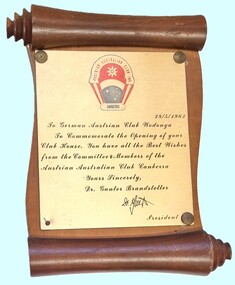
Plaque - German-Austrian Club Wodonga Opening, 1983
... Meritorious Service by the Government of Victoria for Community Works in Wodonga and district. The Club raised $23,000 for the Wodonga Hospital, had numerous fundraisers to assist in bushfires and drought situations and was involved in the Red Cross Calling campaign for many years. After much fundraising, hard work...Meritorious Service by the Government of Victoria for Community Works in Wodonga and district. The Club raised $23,000 for the Wodonga Hospital, had numerous fundraisers to assist in bushfires and drought situations and was involved in the Red Cross Calling campaign for many years. After much fundraising, hard work ...Thousands of German migrants started a new life at Bonegilla, Victoria in the 1950s. Among them were five men who met each other in Wodonga, became friends and decided to form a German Austrian Club, where they could enjoy the company of likeminded individuals. They were Kurt Mueller, Willi Klimt, Toni Krischa and Erwin Klein from Germany and Manfred Teissl from Austria. On the 16th July 1960, after advertising in the Border Morning Mail the German Austrian Club in Wodonga was born. Office bearers were Paul Peters as President. Gerhard Ziermann as Secretary and Günter Schmehl as Treasurer. Their aim was "To promote the upkeep of the German language in written and spoken form and to promote good German fellowship, while enjoying functions of a cultural and entertaining nature". By 1963 the Club boasted 40 members, holding meetings at the RSL Clubrooms and other suitable locations before they found a house in Hovell Street, Wodonga. It was used for meetings, Skat meetings, film nights and Sonnabendschule” or Saturday school where children of members could continue to learn German. The Committee organised a wide range of activities and functions in their small rooms but dreamed of having a bigger home. This became reality in July 1979, when the Committee purchased land from the Albury Wodonga Development Corporation at 5 McFarland Road, Wodonga. The first brick was laid on the Club's land in May 1980, and the double-story brick building was completed within 12 months voluntarily by Club members. At the same time members supported other organisations and charities in the Wodonga and wider community. The first Oktoberfest in Wodonga was held in 1975, drawing 4,000 attendees. The event was organized to promote German culture, and the profits from the first year were donated to the Wodonga District Hospital, raising $20,000. In 2001 the German Austrian Club was presented with the Certificate of Meritorious Service by the Government of Victoria for Community Works in Wodonga and district. The Club raised $23,000 for the Wodonga Hospital, had numerous fundraisers to assist in bushfires and drought situations and was involved in the Red Cross Calling campaign for many years. After much fundraising, hard work and making their way through extensive government red tape, the Club moved to its new premises in McFarland Road on 1st August 1981. The members continued to make necessary internal adjustments and sought an alcohol licence. The building was officially opened in May 1983. The Club prospered and had 300 members, making it necessary for new applicants to be put on a waiting list to be accepted as members. Interest groups formed consisted of Competition Air Rifle Shooting Group, a Skat (German Card game) Group, Folk Dancing Group, Ladies Group, Table Tennis Group, Darts Group, Chess Group and the Billiard Group. In later years, as so many Australians became members, the Club’s name was changed to the German Austrian Australian Club. Over recent years patronage and interest in the Club and its activities changed. Children of the original members had become “real Aussies” and did not always want to carry on traditions. Aging membership and lack of volunteers forced the Club to disband in 2025. The Club building has been gifted to the Albury Wodonga Theatre Company. These items are significant because they are representative of an important cultural organisation which operated in Wodonga for over 60 years.A metal plaque attached to a wooden backing shaped like a scroll. The text is in the form of a letter.Emblem of the Austrian - Australian Clubs Inc. Canberra 28/5/1983 To German Austrian Club Wodonga To Commemorate the Opening of your Club House. You have all the Best Wishes from the Committee & Members of the Austrian Australian Club Canberra Yours Sincerely, Dr. Gunter Brandstetter Presidentgerman austrian australian club, german migrants wodonga -
 Wodonga & District Historical Society Inc
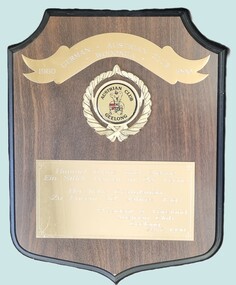
Plaque - German-Austrian Club Wodonga 30th Anniversary, 1990
... Meritorious Service by the Government of Victoria for Community Works in Wodonga and district. The Club raised $23,000 for the Wodonga Hospital, had numerous fundraisers to assist in bushfires and drought situations and was involved in the Red Cross Calling campaign for many years. After much fundraising, hard work...Meritorious Service by the Government of Victoria for Community Works in Wodonga and district. The Club raised $23,000 for the Wodonga Hospital, had numerous fundraisers to assist in bushfires and drought situations and was involved in the Red Cross Calling campaign for many years. After much fundraising, hard work ...Thousands of German migrants started a new life at Bonegilla, Victoria in the 1950s. Among them were five men who met each other in Wodonga, became friends and decided to form a German Austrian Club, where they could enjoy the company of likeminded individuals. They were Kurt Mueller, Willi Klimt, Toni Krischa and Erwin Klein from Germany and Manfred Teissl from Austria. On the 16th July 1960, after advertising in the Border Morning Mail the German Austrian Club in Wodonga was born. Office bearers were Paul Peters as President. Gerhard Ziermann as Secretary and Günter Schmehl as Treasurer. Their aim was "To promote the upkeep of the German language in written and spoken form and to promote good German fellowship, while enjoying functions of a cultural and entertaining nature". By 1963 the Club boasted 40 members, holding meetings at the RSL Clubrooms and other suitable locations before they found a house in Hovell Street, Wodonga. It was used for meetings, Skat meetings, film nights and Sonnabendschule” or Saturday school where children of members could continue to learn German. The Committee organised a wide range of activities and functions in their small rooms but dreamed of having a bigger home. This became reality in July 1979, when the Committee purchased land from the Albury Wodonga Development Corporation at 5 McFarland Road, Wodonga. The first brick was laid on the Club's land in May 1980, and the double-story brick building was completed within 12 months voluntarily by Club members. At the same time members supported other organisations and charities in the Wodonga and wider community. The first Oktoberfest in Wodonga was held in 1975, drawing 4,000 attendees. The event was organized to promote German culture, and the profits from the first year were donated to the Wodonga District Hospital, raising $20,000. In 2001 the German Austrian Club was presented with the Certificate of Meritorious Service by the Government of Victoria for Community Works in Wodonga and district. The Club raised $23,000 for the Wodonga Hospital, had numerous fundraisers to assist in bushfires and drought situations and was involved in the Red Cross Calling campaign for many years. After much fundraising, hard work and making their way through extensive government red tape, the Club moved to its new premises in McFarland Road on 1st August 1981. The members continued to make necessary internal adjustments and sought an alcohol licence. The building was officially opened in May 1983. The Club prospered and had 300 members, making it necessary for new applicants to be put on a waiting list to be accepted as members. Interest groups formed consisted of Competition Air Rifle Shooting Group, a Skat (German Card game) Group, Folk Dancing Group, Ladies Group, Table Tennis Group, Darts Group, Chess Group and the Billiard Group. In later years, as so many Australians became members, the Club’s name was changed to the German Austrian Australian Club. Over recent years patronage and interest in the Club and its activities changed. Children of the original members had become “real Aussies” and did not always want to carry on traditions. Aging membership and lack of volunteers forced the Club to disband in 2025. The Club building has been gifted to the Albury Wodonga Theatre Company.This item is significant because it is representative of an important cultural organisation which operated in Wodonga for over 60 years.A wooden plaque with metal insignia and a plate with text in German. This plaque was presented by the German Austrian Club of Geelong on the occasion of the 30th Anniversary of the Wodonga Club and bears its insignia.Himmel Glanz und Sterne Ein Stuck Heimat in Der Fern Herzliche Gratulation Zu Eurem 30 Jahres Tag President and Vorstand Translation Sky, splendour and stars A piece of home away from home Congratulations On your 30th anniversary President and Board of Directorsgerman austrian australian club, german migrants wodonga -
 Wodonga & District Historical Society Inc
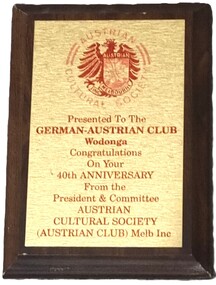
Plaque - German-Austrian Club Wodonga 40th Anniversary, 2000
... Meritorious Service by the Government of Victoria for Community Works in Wodonga and district. The Club raised $23,000 for the Wodonga Hospital, had numerous fundraisers to assist in bushfires and drought situations and was involved in the Red Cross Calling campaign for many years. After much fundraising, hard work...Meritorious Service by the Government of Victoria for Community Works in Wodonga and district. The Club raised $23,000 for the Wodonga Hospital, had numerous fundraisers to assist in bushfires and drought situations and was involved in the Red Cross Calling campaign for many years. After much fundraising, hard work ...Thousands of German migrants started a new life at Bonegilla, Victoria in the 1950s. Among them were five men who met each other in Wodonga, became friends and decided to form a German Austrian Club, where they could enjoy the company of likeminded individuals. They were Kurt Mueller, Willi Klimt, Toni Krischa and Erwin Klein from Germany and Manfred Teissl from Austria. On the 16th July 1960, after advertising in the Border Morning Mail the German Austrian Club in Wodonga was born. Office bearers were Paul Peters as President. Gerhard Ziermann as Secretary and Günter Schmehl as Treasurer. Their aim was "To promote the upkeep of the German language in written and spoken form and to promote good German fellowship, while enjoying functions of a cultural and entertaining nature". By 1963 the Club boasted 40 members, holding meetings at the RSL Clubrooms and other suitable locations before they found a house in Hovell Street, Wodonga. It was used for meetings, Skat meetings, film nights and Sonnabendschule” or Saturday school where children of members could continue to learn German. The Committee organised a wide range of activities and functions in their small rooms but dreamed of having a bigger home. This became reality in July 1979, when the Committee purchased land from the Albury Wodonga Development Corporation at 5 McFarland Road, Wodonga. The first brick was laid on the Club's land in May 1980, and the double-story brick building was completed within 12 months voluntarily by Club members. At the same time members supported other organisations and charities in the Wodonga and wider community. The first Oktoberfest in Wodonga was held in 1975, drawing 4,000 attendees. The event was organized to promote German culture, and the profits from the first year were donated to the Wodonga District Hospital, raising $20,000. In 2001 the German Austrian Club was presented with the Certificate of Meritorious Service by the Government of Victoria for Community Works in Wodonga and district. The Club raised $23,000 for the Wodonga Hospital, had numerous fundraisers to assist in bushfires and drought situations and was involved in the Red Cross Calling campaign for many years. After much fundraising, hard work and making their way through extensive government red tape, the Club moved to its new premises in McFarland Road on 1st August 1981. The members continued to make necessary internal adjustments and sought an alcohol licence. The building was officially opened in May 1983. The Club prospered and had 300 members, making it necessary for new applicants to be put on a waiting list to be accepted as members. Interest groups formed consisted of Competition Air Rifle Shooting Group, a Skat (German Card game) Group, Folk Dancing Group, Ladies Group, Table Tennis Group, Darts Group, Chess Group and the Billiard Group. In later years, as so many Australians became members, the Club’s name was changed to the German Austrian Australian Club. Over recent years patronage and interest in the Club and its activities changed. Children of the original members had become “real Aussies” and did not always want to carry on traditions. Aging membership and lack of volunteers forced the Club to disband in 2025. The Club building has been gifted to the Albury Wodonga Theatre Company.This item is significant because it is representative of an important cultural organisation which operated in Wodonga for over 60 years.A small metal plaque on a wooden backing with red text. It includes the insignia of the Austrian Cultural Society of Melbourne.Presented To The GERMAN-AUSTRIAN CLUB Wodonga Congratulations On Your 40th ANNIVERSARY From the President & Committee AUSTRIAN CULTURAL SOCIETY (AUSTRIAN CLUB) Melb Incgerman austrian australian club, german migrants wodonga -
 Wodonga & District Historical Society Inc
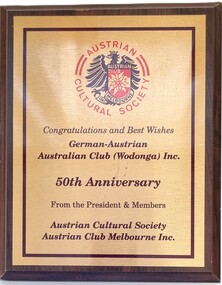
Plaque - German-Austrian Club Wodonga 50th Anniversary, 2010
... Meritorious Service by the Government of Victoria for Community Works in Wodonga and district. The Club raised $23,000 for the Wodonga Hospital, had numerous fundraisers to assist in bushfires and drought situations and was involved in the Red Cross Calling campaign for many years. After much fundraising, hard work...Meritorious Service by the Government of Victoria for Community Works in Wodonga and district. The Club raised $23,000 for the Wodonga Hospital, had numerous fundraisers to assist in bushfires and drought situations and was involved in the Red Cross Calling campaign for many years. After much fundraising, hard work ...Thousands of German migrants started a new life at Bonegilla, Victoria in the 1950s. Among them were five men who met each other in Wodonga, became friends and decided to form a German Austrian Club, where they could enjoy the company of likeminded individuals. They were Kurt Mueller, Willi Klimt, Toni Krischa and Erwin Klein from Germany and Manfred Teissl from Austria. On the 16th July 1960, after advertising in the Border Morning Mail the German Austrian Club in Wodonga was born. Office bearers were Paul Peters as President. Gerhard Ziermann as Secretary and Günter Schmehl as Treasurer. Their aim was "To promote the upkeep of the German language in written and spoken form and to promote good German fellowship, while enjoying functions of a cultural and entertaining nature". By 1963 the Club boasted 40 members, holding meetings at the RSL Clubrooms and other suitable locations before they found a house in Hovell Street, Wodonga. It was used for meetings, Skat meetings, film nights and Sonnabendschule” or Saturday school where children of members could continue to learn German. The Committee organised a wide range of activities and functions in their small rooms but dreamed of having a bigger home. This became reality in July 1979, when the Committee purchased land from the Albury Wodonga Development Corporation at 5 McFarland Road, Wodonga. The first brick was laid on the Club's land in May 1980, and the double-story brick building was completed within 12 months voluntarily by Club members. At the same time members supported other organisations and charities in the Wodonga and wider community. The first Oktoberfest in Wodonga was held in 1975, drawing 4,000 attendees. The event was organized to promote German culture, and the profits from the first year were donated to the Wodonga District Hospital, raising $20,000. In 2001 the German Austrian Club was presented with the Certificate of Meritorious Service by the Government of Victoria for Community Works in Wodonga and district. The Club raised $23,000 for the Wodonga Hospital, had numerous fundraisers to assist in bushfires and drought situations and was involved in the Red Cross Calling campaign for many years. After much fundraising, hard work and making their way through extensive government red tape, the Club moved to its new premises in McFarland Road on 1st August 1981. The members continued to make necessary internal adjustments and sought an alcohol licence. The building was officially opened in May 1983. The Club prospered and had 300 members, making it necessary for new applicants to be put on a waiting list to be accepted as members. Interest groups formed consisted of Competition Air Rifle Shooting Group, a Skat (German Card game) Group, Folk Dancing Group, Ladies Group, Table Tennis Group, Darts Group, Chess Group and the Billiard Group. In later years, as so many Australians became members, the Club’s name was changed to the German Austrian Australian Club. Over recent years patronage and interest in the Club and its activities changed. Children of the original members had become “real Aussies” and did not always want to carry on traditions. Aging membership and lack of volunteers forced the Club to disband in 2025. The Club building has been gifted to the Albury Wodonga Theatre Company.This item is significant because it is representative of an important cultural organisation which operated in Wodonga for over 60 years.A small metal plaque on a wooden backing with red text. It includes the insignia of the Austrian Cultural Society of Melbourne.Congratulations and Best Wishes German-Austrian Australian Club (Wodonga) Inc. 50th Anniversary From the President & Members Austrian Cultural Society Austrian Club Melbourne Inc.german austrian australian club, german migrants wodonga -
 Beechworth RSL Sub-Branch
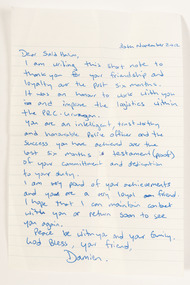
Letter, 30th November 2012
... worked with Said Haim on logistics for PRC (Provincial Response Company) Uruzgan. The Commandos took part in 20 rotations with the Special Operations Task Group (SOTG) between 2007 and 2012. During this time they undertook significant combat operations, and were awarded for its actions, the regiment was collectively awarded the Unit Citation for Gallantry and the Meritorious Unit Citation. ...worked with Said Haim on logistics for PRC (Provincial Response Company) Uruzgan. The Commandos took part in 20 rotations with the Special Operations Task Group (SOTG) between 2007 and 2012. During this time they undertook significant combat operations, and were awarded for its actions, the regiment was collectively awarded the Unit Citation for Gallantry and the Meritorious Unit Citation. ...Major Damien Batty served in Afghanistan in 2011-2012 with the Bravo Commando Company Group, 2nd Commando Regiment in Uruzgan. Major Batty served alongside Said Haim, an Afghan police officer. Australian forces were often involved in mentoring and training Afghan police and army units. According to the letter Major Batty worked with Said Haim on logistics for PRC (Provincial Response Company) Uruzgan. The Commandos took part in 20 rotations with the Special Operations Task Group (SOTG) between 2007 and 2012. During this time they undertook significant combat operations, and were awarded for its actions, the regiment was collectively awarded the Unit Citation for Gallantry and the Meritorious Unit Citation. This letter is a rare example of first-person correspondence between a member of Australia's Special Forces and a member of the Afghan police force. The letters, both in Arabic and English, are significant for their capacity to illustrate the personal face of the Australian mission in Afghanistan, and to signify the nature of individual relationships between Australian personnel and local reconstruction forces. Two letters, one in Arabic and the second translated into English. Arabic letter is photocopied; English letter is written in blue pen. major damien batty, uruzgan, afghanistan, letter, police, prc, commandos -
 Whitehorse Historical Society Inc.
Newspaper - Article, Bob's medal, 15/08/1990
... Meritorious Medal. He was Treasurer of Blackburn sub-branch for 21 years and has done voluntary community work for many years....Meritorious Medal. He was Treasurer of Blackburn sub-branch for 21 years and has done voluntary community work for many years. ...Article in Nunawading Gazette. Bob White, Blackburn resident has been awarded R.S.L.'s Meritorious Medal. He was Treasurer of Blackburn sub-branch for 21 years and has done voluntary community work for many years.white, bob, blackburn returned servicemens league., exservice organisations -
 Hymettus Cottage & Garden Ballarat
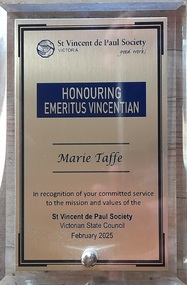
Plaque - Testamonial, Emeritus Vincentian Marie Taffe
... work with St Vincent de Paul Society over many years. Marie served as Ballarat Conference President, Regional Committee and was active in many charitable works. A recognition of meritorious ...Presented to Marie Taffe in February 2025 in recognition of her work with St Vincent de Paul Society over many years. Marie served as Ballarat Conference President, Regional Committee and was active in many charitable works.A recognition of meritorious service to the St Vincent De Paul Society at Ballarat.st vincent de paul society, charities, plaque
