
Showing 82 items matching "mess equipment"
-
 Bendigo Military Museum
Equipment - DIXIE, WW1 PATTERN, c.1910-1920
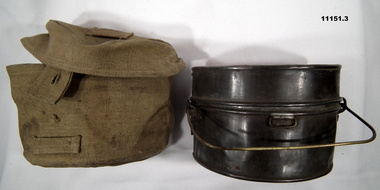
... ...Mess Equipment...WW1 Mess Equipment Dixie Cooking set 1, Stamped inside are; 395. ...1. Bag, Carrier, Dixie set. Khaki canvas, leather straps at back. Single ring on rear panel. The lid is held down with a signle strap. The mounting button is missing from the front panel. Shape is half circle. 2. Half circle Dixie Tin with soldered joints. It has 4 little buckles (front, back and sides). It has an "Ad Hoc" brass handle - looks like 1/8" welding rod. 3. Tin lid, rolled edges, Half circle, internal mounted that folds out.1, Stamped inside are; 395. AAO?V. 49.JNF 10-12.ww1, mess equipment, dixie cooking set -
 Bendigo Military Museum
Equipment - MESS KIT
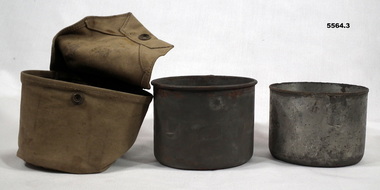
... Mess Kit...Equipment...Smaller bowl sits inside bigger bowl sitting in canvas container. Equipment MESS KIT ...Part of equipment issued to all soldiers on front line to be used for both serving food and drink. Belongs to Captain Brian Clerehan VX 91862 who enlisted 29/3/43 and was discharged 17/7/46 from 2nd New Guinea Infantry Batt.1. Light brown canvas carry bag for two metal bowls. Fold out piece with metal stud to open/close and metal hooks on back to attach to kit. 2. Silver metal bowl approx .6 litre capacity with metal folding handles - oval in shape. 3. Silver metal bowl approx 0.5 litre capacity with metal folding handles and oval in shape. Small folding ring attached to bottom. Smaller bowl sits inside bigger bowl sitting in canvas container.2. Has engraved between handles "D^D" & "VD".mess kit, equipment, ww2 -
 Bendigo Military Museum
Memorabilia - MESS TINS - DIXIES, Willow Co, c. 1939
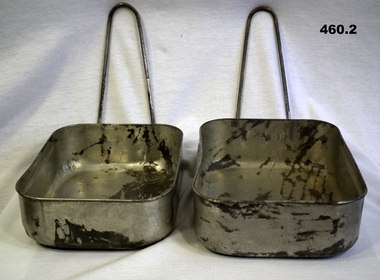
... military-equipment...Mess...Refer 1911P for his service history. military-equipment Mess Tins WWII World War Two Second World War Cooking D↑D Set of aluminium cooking tins. ...Belonged to Keith David Livingston VX136969 2nd AIF. Refer 1911P for his service history.Set of aluminium cooking tins. Dept of Defence stamp. .1) Has "c" with an arrow etched above, next to maker's name. Both have folding handles. .2) Fits inside .1)D↑Dmilitary-equipment, mess tins, wwii, world war two, second world war, cooking -
 Bendigo Military Museum
Equipment - MESS SET, DIXIES, C.1960’s
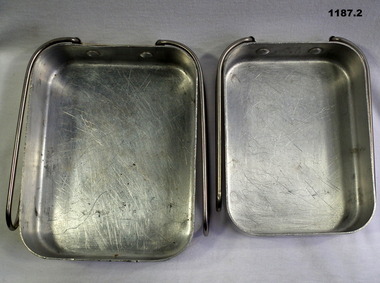
... military equipment - mess utensils...Equipment MESS SET, DIXIES ...Items issued to Malcolm Stuart Angus No 3112710.Two Aluminium Cooking Utensils with Handles, small utensil fitting inside larger utensil, both utensils have collapsible handles.military equipment - mess utensils, metalcraft - aliminium, dixies -
 Bendigo Historical Society Inc.
Document - IAN DYETT COLLECTION: AUCTION CATALOGUE - NEW CHUM GOLD MINES
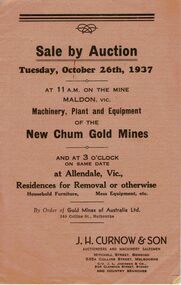
... Mustard coloured auction catalogue for a sale of Machinery, Plant and Equipment of the New Chum Gold Mines at Maldon on 26 October, 1937 and at 3.00 p.m. sale of Residences for Removal or otherwise, Household Furniture, Mess Equipment,etc. at Allendale. Sale by Order of Gold Mines of Australia Ltd. ...J H Curnow & Son J L Jamieson Bolton Bros Mustard coloured auction catalogue for a sale of Machinery, Plant and Equipment of the New Chum Gold Mines at Maldon on 26 October, 1937 and at 3.00 p.m. sale of Residences for Removal or otherwise, Household Furniture, Mess Equipment,etc. at Allendale. Sale by Order of Gold Mines of Australia Ltd. ...Mustard coloured auction catalogue for a sale of Machinery, Plant and Equipment of the New Chum Gold Mines at Maldon on 26 October, 1937 and at 3.00 p.m. sale of Residences for Removal or otherwise, Household Furniture, Mess Equipment,etc. at Allendale. Sale by Order of Gold Mines of Australia Ltd. Auctioneer was J. H. Curnow & Son. Catalogue has £, s. d. columns down the right side of the pages.business, auctioneers, j h curnow & son pty ltd, ian dyett collection - auction catalogue - new chum gold mines, gold mines of australia ltd., j h curnow & son, j l jamieson, bolton bros -
 Bendigo Historical Society Inc.
Document - IAN DYETT COLLECTION: AUCTION CATALOGUE - BIG EILDON PROJECT
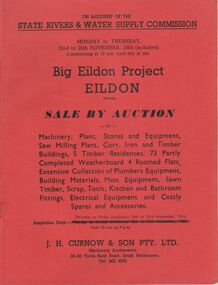
... Iron and timber buildings, 5 timber residences, 73 partly completed weatherboard 4 roomed flats, extensive collection of plumbers equipment, building materials, mess equipment, sawn timber, scrap, tools, kitchen and bathroom fittings, electrical equipment and costly spares and accessories. ...Iron and timber buildings, 5 timber residences, 73 partly completed weatherboard 4 roomed flats, extensive collection of plumbers equipment, building materials, mess equipment, sawn timber, scrap, tools, kitchen and bathroom fittings, electrical equipment and costly spares and accessories. ...Two red covered auction catalogues for an auction on account of the State Rivers & Water Supply Commission on the 22nd to 25th November, 1954 (inclusive) held at the Big Eildon Project, Eildon, Victoria. Lots sold include Machinery, plant, stores and equipment, Saw Milling Plant, corr. Iron and timber buildings, 5 timber residences, 73 partly completed weatherboard 4 roomed flats, extensive collection of plumbers equipment, building materials, mess equipment, sawn timber, scrap, tools, kitchen and bathroom fittings, electrical equipment and costly spares and accessories. Catalogue has a Locality Plan of Eildon, photo, locality and description of the Eildon Sawmill. Photos of completed houses, incomplete flats and plan showing layout of flat unit, photo of flat block (Completed). Also Building Kits - Designs and Component Lists.business, auctioneers, j h curnow & son pty ltd, ian dyett collection - auction catalogue - big eildon project, state rivers & water supply commission, j h curnow & son pty ltd, eildon sawmill, prahran telegraph printing co -
 Ballarat RSL Sub-Branch Inc.
Duffle bag, C. 1940
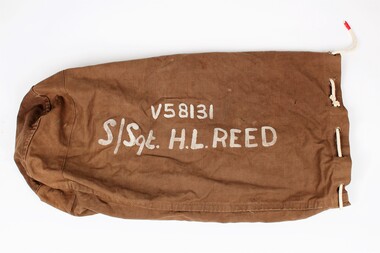
... Soldiers would fill their gear bags with essential equipment (mess tins, clothes, etc.) and carry them with them from post to post, or ship them to their destination ahead of time....Soldiers would fill their gear bags with essential equipment (mess tins, clothes, etc.) and carry them with them from post to post, or ship them to their destination ahead of time. military equipment duffle bag barracks bag kit bag WWII Second World War (WW2) V58131 / S/Sgt. ...This gear bag was issued to Sergent Harold Loraine Reed, who was born in 14 Aug 1889 in Portland, Victoria. Reed enlisted in the army in 1940 in Ballarat to serve in WWI, and was discharged from 8 Battalion in 1943. Gear bags such as this were standard issue to servicemen. Soldiers would fill their gear bags with essential equipment (mess tins, clothes, etc.) and carry them with them from post to post, or ship them to their destination ahead of time.Khaki coloured canvas bag that is cylindrical in shape with the owner's rank, name, and service number written on the front of the bag in white paint. The base of the bag is rounded, while the top is open with 11 eyelets (one missing) through which a cotton cord has been threaded. Each end of the cord has been wrapped with red tape.V58131 / S/Sgt. H.L. REEDmilitary equipment, duffle bag, barracks bag, kit bag, wwii, second world war (ww2) -
 Flagstaff Hill Maritime Museum and Village
Adding Machine
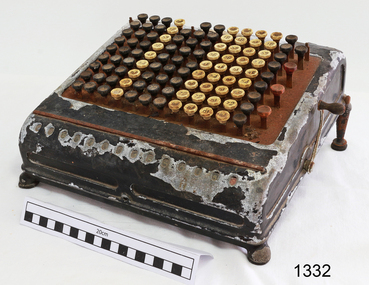
... flagstaff hill warrnambool shipwrecked-coast flagstaff-hill flagstaff-hill-maritime-museum maritime-museum shipwreck-coast flagstaff-hill-maritime-village adding machine calculator office equipment commerce business equipment Serial Number "5-891861" Paper label with "Sets Mess Property" on back of machine. ...Adding machine with thirteen vertical rows of keys with clearing handle on side. Fraction keys on right hand side, and three keys missing along top row. Lever on side of machine. Two short feet at front, two long feet at back, giving slope to machine for ease of use. Serial Number "5-891861" Paper label with "Sets Mess Property" on at back of machine. Serial Number "5-891861" Paper label with "Sets Mess Property" on back of machine. flagstaff hill, warrnambool, shipwrecked-coast, flagstaff-hill, flagstaff-hill-maritime-museum, maritime-museum, shipwreck-coast, flagstaff-hill-maritime-village, adding machine, calculator, office equipment, commerce, business equipment -
 Montmorency–Eltham RSL Sub Branch
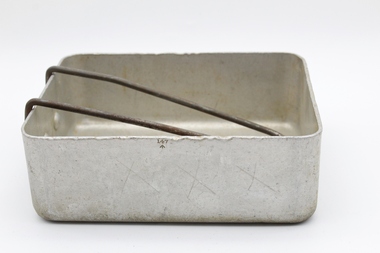
Equipment - Mess Tin, 1939
... Aluminium Mess Tin with metal movable steel handle attached to one end. Equipment Mess Tin C & B Ltd ...The Mess Box ( 0089.1 ) is one of two with the partnering box referenced at 0089.1Aluminium Mess Tin with metal movable steel handle attached to one end.Inscribed on aluminium plate affixing handle to box “ C & B. Ltd. 1939. “ with arrow pointing upwards. -
 Montmorency–Eltham RSL Sub Branch
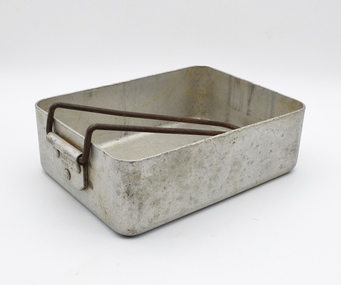
Equipment - Mess Tin, 1939
... Aluminium Mess Tin with metal movable handle attached to one end. Equipment Mess Tin C & B Ltd ...The mess box ( 0089.2 ) is one of two issued with the partnering box referenced at 0089.1Aluminium Mess Tin with metal movable handle attached to one end.Inscribed to aluminium plate affixing handle to box “ C & B 1939 “ with arrow pointing upwards. -
 Montmorency–Eltham RSL Sub Branch
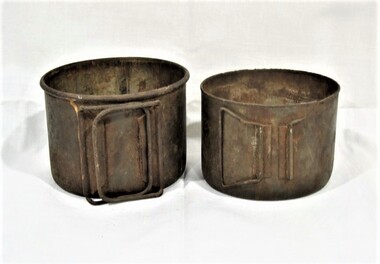
Equipment - Mess Tins
... tin mess tin Smaller tin - D(arrow)D, ID Two metal tins of which one fits into the other. Larger tin has two handles, smaller tin has only one handle as the other has broken off. Equipment ...Two metal tins of which one fits into the other. Larger tin has two handles, smaller tin has only one handle as the other has broken off.Smaller tin - D(arrow)D, IDtin, mess tin -
 Bendigo Military Museum
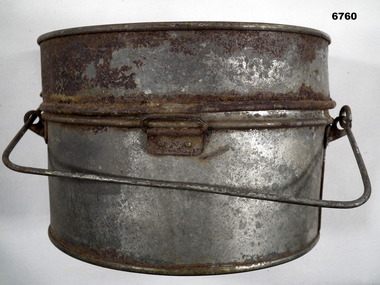
Equipment - MESS TIN, Unknown
... Mess tin in two parts. Silver metallic tin. lid also used as a plate and has a fold out metal handle. Base has a handle to carry assembled item. Equipment ...Mess tin issued to all active servicemen for purpose of food and drink on the front line.Mess tin in two parts. Silver metallic tin. lid also used as a plate and has a fold out metal handle. Base has a handle to carry assembled item.passchendaele barracks trust, mess tin -
 Bendigo Military Museum
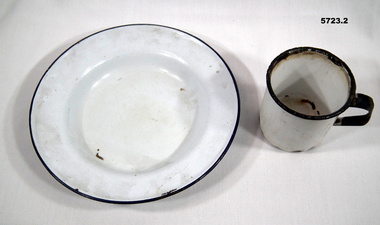
Equipment - MESS KIT, c1935 - 1940
... Mess kit 2. Stamped on back was makers name I. Feng Enamelling Co. Ltd 24 (?) Made in Hong Kong. 1. Mug - standard issue white enamel mug with handle. It originally had a black rim. 2. Plate - White enamel with dark blue rim. Equipment ...These were bought at "A. Jolly's" store, Darwin on 4 Aug 1939 by Cpl Truscott. Advance party No.12 G.P. Squadron Darwin. They were bought for personal use. A note was attached to this item which mentions two of his friends killed in aircraft crashes. CPL Harold William Johnson 1727 RAAF and SGT Walter James Cox 2403 RAAF. Refer to service of Lyle Truscott NR 1842 RAAF WW2. Cat 4040.8P.1. Mug - standard issue white enamel mug with handle. It originally had a black rim. 2. Plate - White enamel with dark blue rim.2. Stamped on back was makers name I. Feng Enamelling Co. Ltd 24 (?) Made in Hong Kong.ww2, raaf, no.12 sqn, mess kit -
 Bendigo Military Museum
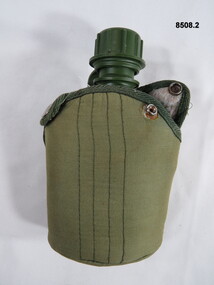
Equipment - WATER BOTTLE & CARRIER, ACMIL, 1981
... The water bottle has a secure screw lid, this combination is missing the universal mess canteen. Equipment WATER BOTTLE & CARRIER ACMIL ...The plastic green 1.5 litre water container is enclosed inside a fitted outer carrier. The water bottle has a secure screw lid, this combination is missing the universal mess canteen.1. Plastic bottle, “FOR WATER ONLY DO NOT APPLY CANTEEN TO OPEN FLAME OR BURNER PLATES” “HCMIL 1981^ 8465-66-086-8349” passchendaele barracks trust, water bottle, outer carrier -
 Bendigo Military Museum
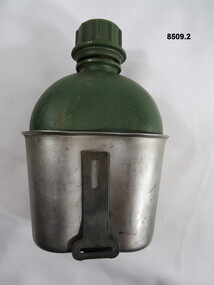
Equipment - WATER BOTTLE & CUP, STOKES, 1986
... mess canteen. The water bottle has a secure screw lid, this combination is missing the outer carrier. Equipment ...The plastic green 1,5 litre water container is enclosed inside the stainless steel universal mess canteen. The water bottle has a secure screw lid, this combination is missing the outer carrier.1. "FOR WATER ONLY DO NOT APPLY CANTEEN TO OPEN FLAME OR BURNER PLATES" “BMW 1989^ 8465-66-086-8349. RATGMFORD?” 2. “STOKES AUSTRALASIA 8465-66-068-5567 1986^”passchendaele barracks trust, water bottle, canteen -
 Bendigo Military Museum
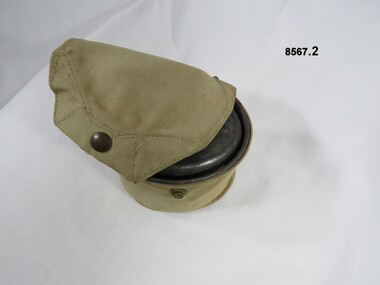
Equipment - MESS KIT, Unknown
... Compact two piece mess kit, one component slides inside the other with a lid on the top. Equipment MESS KIT ...1. Small oval shaped khaki mess kit carrier with open top flap fitted press stud closure. There are metal webbing belt attachments on the back of the carrier. 2. Compact two piece mess kit, one component slides inside the other with a lid on the top.On the inside top flap: “ ^ H.C”passchendaele barracks trust, kit, mess, carry case -
 Bendigo Military Museum
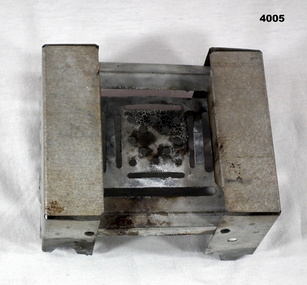
Equipment - HEXAMINE STOVE
... mess tins and at 45 deg for mug or small containers. Base is designed to accommodate Hexamine tablet. When closed, the cooker is designed to carry a packet of Hexamine tablets. Equipment ...Cooker is made of galvanised tin - hinged on both sides which can be set in two positions. Upright for mess tins and at 45 deg for mug or small containers. Base is designed to accommodate Hexamine tablet. When closed, the cooker is designed to carry a packet of Hexamine tablets.hexamine stove, mess tin -
 Bendigo Military Museum
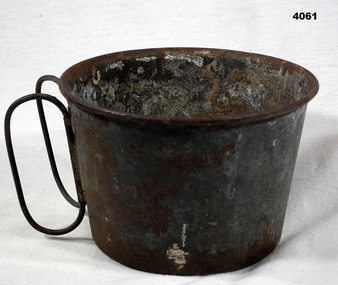
Equipment - PANNIKIN, Possibly post WW1
... mess containers. Pannikin accessory mug "WILLOW" stamped vertical on riveted metal handles attachment strip. Round metal mug shape with tapered sides & rolled edge top with wire handles. Riveted to one side. Handles fold out flat against side of vessel. Equipment ...Possibly military and part of a larger set of mess containers.Round metal mug shape with tapered sides & rolled edge top with wire handles. Riveted to one side. Handles fold out flat against side of vessel. "WILLOW" stamped vertical on riveted metal handles attachment strip. pannikin, accessory, mug -
 Bendigo Military Museum
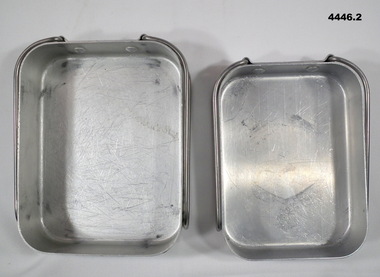
Equipment - MESS SET, DIXIES, Department of Defence, 1) June 1980. .2) may 1970
... Mess tins Dixies .1) Stamped on, “7350 - 66 - 014 - 5895 - SMP/Y 6/80” .2) Stamped on, “7350 - 66 - 014 - 5895 - SMP/Y 5/70” .1) Small oblong aluminium tray with folding handles. .2) Large oblong aluminium tray with folding handles. Equipment ...Australian Army Pattern issue Mess tins, one fits inside the other..1) Small oblong aluminium tray with folding handles. .2) Large oblong aluminium tray with folding handles..1) Stamped on, “7350 - 66 - 014 - 5895 - SMP/Y 6/80” .2) Stamped on, “7350 - 66 - 014 - 5895 - SMP/Y 5/70”mess tins, dixies -
 Bendigo Military Museum
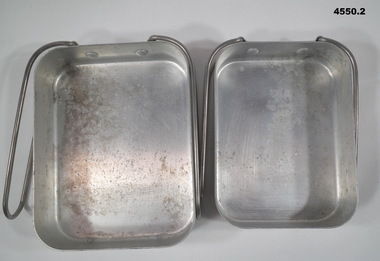
Equipment - MESS SET, DIXIES, Department of defence, June 1980
... Equipment MESS SET, DIXIES Department of defence ...Military issue as part of a soldiers kit and equipment.1) Dixie, large, aluminium, rectangular shape, two handles that swing around to store away, details stamped on one end. .2) Dixie, same as .1) but smaller and fits inside .1) for storage..1) Stamped on handle end, "7350 - 66 - 014 - 5895, SMP (over) V (arrow up) 6/80". .2) Same as .1)dixies, mess set -
 Bendigo Military Museum
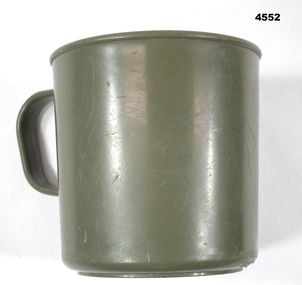
Equipment - MESS CUP, CANTEEN, Department of Defence, 1968
... Equipment MESS CUP, CANTEEN Department of Defence ...Item issued as part of a soldiers kit and equipment.Mess cup, plastic, olive green colour, round with handle, embossed on base are details.On base, " M.E. (over) 2 (arrow up) 1968, 7350 - 66 - 024 - 2278"mess, cups, canteen -
 Bendigo Military Museum
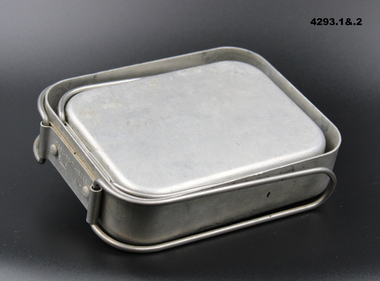
Equipment - MESS SET, DIXIES, 6/79 (6 Month 1979)
... Tin .2 fits inside Tin .1 mess tins dixies “7350-66-014-5895 smp/v 6/79” Two rectangular shaped mess tins trays with folding handles, one fits inside the other. Equipment MESS SET, DIXIES ...Mess tins for meals in the field either in camp or for cooking rations and eating in the field . Tin .2 fits inside Tin .1Two rectangular shaped mess tins trays with folding handles, one fits inside the other.“7350-66-014-5895 smp/v 6/79”mess, tins, dixies -
 Running Rabbits Military Museum operated by the Upwey Belgrave RSL Sub Branch
Mess Kit
... Equipment N/K Army Part of mess kit nationality Unknown Mess Kit ...Part of mess kit nationality Unknownequipment, n/k, army -
 Running Rabbits Military Museum operated by the Upwey Belgrave RSL Sub Branch
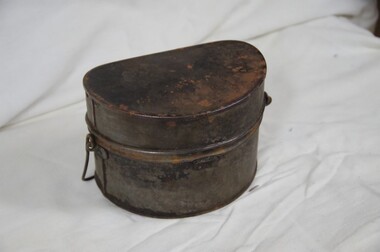
Mess Tin
... Equipment 1955 Army Officers mess tin Mess Tin ...Officers mess tinequipment, 1955, army -
 Bendigo Military Museum
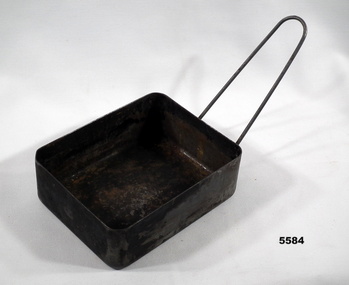
Equipment - DIXIE, c. 1939 -45
... item in the collection of George Lunn VX76842 2/9 Fld Coy, refer Cat No 5581 for his service history. dixies containers food Food "Dixie" as called, come as a Mess set, this is the larger of the set, rectangular shape with fold in handle. Equipment DIXIE ...item in the collection of George Lunn VX76842 2/9 Fld Coy, refer Cat No 5581 for his service history.Food "Dixie" as called, come as a Mess set, this is the larger of the set, rectangular shape with fold in handle.dixies, containers, food -
 Kiewa Valley Historical Society
Saucer Ceramic, circa 1940's to 1950's
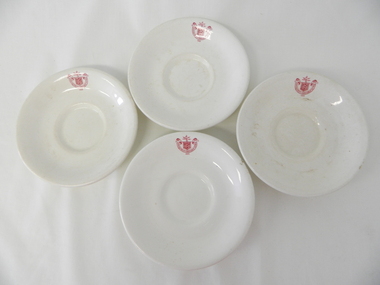
... equipment and machinery was either made in England or Europe. Local/European expertise in dam construction and water management in alpine terrain came from migrants or specially recruited English and Europe specialists. The quality of workmanship from big steel manufacturing plants in England and Europe could not be matched from anywhere else in the developed world. saucer plate secv state electricity commission of victoria crockery mt beauty chalet bogong mess hall The seal of the State Electricity Commission Of Victoria is imprinted on the top inside rim within a curved scroll. ...This item was used by the State Electricity Commission of Victoria in their mess rooms for their workers during the construction of the Kiewa Hydro Electricity Scheme. The imprint of the year "1921" was to identify the year that the SECV was formed and relieved the private VHEC (Victorian Hydro-Electric Company). As the scheme was of such a huge, isolated and time consuming nature the feeding of its workers was quite demanding of cutlery and crockery. The use of sturdy English cups and saucers was essential. The period of construction and the isolation of the Kiewa Valley area placed heavy demand for "solid" crockery that could wear abusive handling. This period in time was one when crockery, whether for domestic or commercial use, was imported from "mother" England. This scenario was more so for governmental bodies such as rail, jails and electricity providers than domestic users. The influx of cheaper Asian crockery had not yet begun.This type of crockery item was used by the thousands of SEC Victorian staff and construction workers involved in the building of the Kiewa Hydro Electricity Scheme, over the extensive period (1938 to 1961). This was a period when Government bodies and other semi- government organisations were still tied to the "establishments" of "mother" England. It was a period in Australia's development when the Asian influence was very weak and the established ties to England and Europe was still very strong. The majority of heavy equipment and machinery was either made in England or Europe. Local/European expertise in dam construction and water management in alpine terrain came from migrants or specially recruited English and Europe specialists. The quality of workmanship from big steel manufacturing plants in England and Europe could not be matched from anywhere else in the developed world.This item is a white ceramic State Electricity Commission Of Victoria saucer (tea /coffee). It is made in England and is of strong and durable ceramic. The bottom cup indent is for either tea or coffee cups of a similar ceramic structure. The 5mm thickness of the ceramic suggests this saucer belongs to a commercial kitchen environment and not domestic. The indent bottom of the saucer is 5mm deep with a side curvature ratio of 2:5. The ceramic is glazed to a commercial standard (worker's mess). See also KVHS 0128 (B to D)The seal of the State Electricity Commission Of Victoria is imprinted on the top inside rim within a curved scroll. Snuggled within the borders of the scroll is a banner with the five stars of the southern cross and an arm with a closed fist projecting from the top with five lightning bolts projecting outwards. On the underside "Vitrified sold by Cafe & Hotel Supplies Pty Ltd Dunn Bennett & Co. Ltd. Burslem Made in England"saucer, plate, secv, state electricity commission of victoria, crockery, mt beauty chalet, bogong mess hall -
 Kiewa Valley Historical Society
Saucer Ceramic, from 1921 to 1961
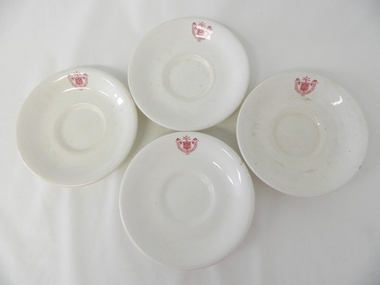
... equipment and machinery was either made in England or Europe. Local/European expertise in dam construction and water management in alpine terrain came from migrants or English and European specialist. The quality of workmanship from big steel manufacturing plants in England and Europe could not be matched from anywhere else in the developed world. saucer plate secv state electricity commission of victoria crockery mt beauty chalet bogong mess hall The seal of the State Electricity Commission Of Victoria is imprinted on the top inside rim within a curved scroll. ...This item was used by the State Electricity Commission of Victoria in their mess rooms for their workers during the construction of the Kiewa Hydro Electricity Scheme. The imprint of the year "1921" was to identify the year that the SECV was formed and relieved the private VHEC(Victorian Hydro-Electric Company). As the scheme was of such a huge, isolated and time consuming nature the feeding of its workers was quite demanding of cutlery and crockery. The use of sturdy English cups and saucers was essential. The period of construction and the isolation of the Kiewa Valley area placed heavy demand for "solid" crockery that could wear abusive handling. This period in time was one when crockery, whether for domestic or commercial use, was imported from "mother" England. This scenario was more so for governmental bodies such as rail, jails and electricity providers than domestic users. The influx of cheaper Asian crockery had not yet begun.This type of crockery item was used by the thousands of SEC Victorian staff and construction workers involved in the building of the Kiewa Hydro Electricity Scheme, over the extensive period (1938 to 1961). This was a period when Government bodies and other semi- government organisations were still tied to the "establishments" of "mother" England. It was a period in Australia's development when the Asian influence was very weak and the established ties to England and Europe was still very strong. The majority of heavy equipment and machinery was either made in England or Europe. Local/European expertise in dam construction and water management in alpine terrain came from migrants or English and European specialist. The quality of workmanship from big steel manufacturing plants in England and Europe could not be matched from anywhere else in the developed world.This item is a white ceramic saucer (tea /coffee). It is made in England and is of strong and durable ceramic. The bottom cup indent is for either tea or coffee cups of a similar ceramic structure. The 5mm thickness of the ceramic suggests this saucer belongs to a commercial kitchen environment and not domestic. The indent bottom of the saucer is 5mm deep with a side curvature ratio of 2:5. The ceramic is glazed to a commercial standard (worker's mess). See also KVHS 0128 (A,C and D) The seal of the State Electricity Commission Of Victoria is imprinted on the top inside rim within a curved scroll. Snuggled within the borders of the scroll is a banner with the five stars of the southern cross and an arm with a closed fist projecting from the top with five lightning bolts projecting outwards. On the underside "Vitrified sold by Cafe & Hotel Supplies Pty Ltd Dunn Bennett & Co. Ltd. Burslem Made in England"saucer, plate, secv, state electricity commission of victoria, crockery, mt beauty chalet, bogong mess hall -
 Kiewa Valley Historical Society
Saucer Ceramic, from 1921 to 1961
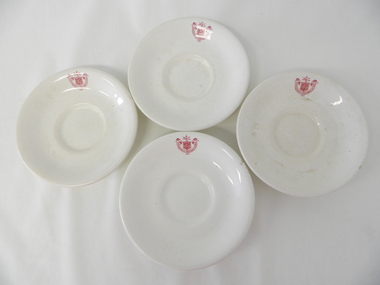
... equipment and machinery was either made in England or Europe. Local/European expertise in dam construction and water management in alpine terrain came from migrants and specialist recruited from England and Europe. The quality of workmanship from big steel manufacturing plants in England and Europe could not be matched from anywhere else in the developed world. saucer plate secv state electricity commission of victoria crockery mt beauty chalet bogong mess hall The seal of the State Electricity Commission Of Victoria is imprinted on the top inside rim within a curved scroll. ...This item was used by the State Electricity Commission of Victoria in their mess rooms for their workers during the construction of the Kiewa Hydro Electricity Scheme. The imprint of the year "1921" was to identify the year that the SECV was formed and relieved the private VHEC (Victorian Hydro-Electric Company). As the scheme was of such a huge, isolated and time consuming nature the feeding of its workers was quite demanding of cutlery and crockery. The use of sturdy English cups and saucers was essential. The period of construction and the isolation of the Kiewa Valley area placed heavy demand for "solid" crockery that could wear abusive handling. This period in time was one when crockery, whether for domestic or commercial use, was imported from "mother" England. This scenario was more so for governmental bodies such as rail, jails and electricity providers than domestic users. The influx of cheaper Asian crockery had not yet begun.This type of crockery item was used by the thousands of SEC Victorian staff and construction workers involved in the building of the Kiewa Hydro Electricity Scheme, over the extensive period (1938 to 1961). This was a period when Government bodies and other semi- government organisations were still tied to the "establishments" of "mother" England. It was a period in Australia's development when the Asian influence was very weak and the established ties to England and Europe was still very strong. The majority of heavy equipment and machinery was either made in England or Europe. Local/European expertise in dam construction and water management in alpine terrain came from migrants and specialist recruited from England and Europe. The quality of workmanship from big steel manufacturing plants in England and Europe could not be matched from anywhere else in the developed world.This item is a white ceramic saucer (tea /coffee). It is made in England and is of strong and durable ceramic. The bottom cup indent is for either tea or coffee cups of a similar ceramic structure. The 5mm thickness of the ceramic suggests this saucer belongs to a commercial kitchen environment and not domestic. The indent bottom of the saucer is 5mm deep with a side curvature ratio of 2:5. The ceramic is glazed to a commercial standard (worker's mess). See also KVHS 0128 ( A,B&D)The seal of the State Electricity Commission Of Victoria is imprinted on the top inside rim within a curved scroll. Snuggled within the borders of the scroll is a banner with the five stars of the southern cross and an arm with a closed fist projecting from the top with five lightning bolts projecting outwards. On the underside "Vitrified sold by Cafe & Hotel Supplies Pty Ltd Dunn Bennett & Co. Ltd. Burslem Made in England"saucer, plate, secv, state electricity commission of victoria, crockery, mt beauty chalet, bogong mess hall -
 Kiewa Valley Historical Society
Saucer Ceramic, Circa 1921
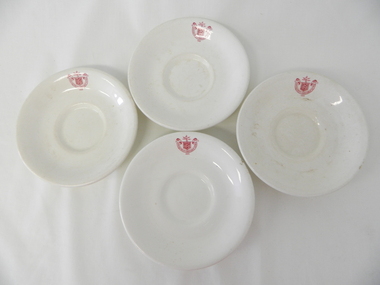
... equipment and machinery was either made in England or Europe. Local and European expertise in dam construction and water management in alpine terrain came from migrants for England and Europe. The quality of workmanship from big steel manufacturing plants in England and Europe could not be matched from anywhere else in the developed world. These saucers were used in the mess ...This item was used by the State Electricity Commission of Victoria in their mess huts/rooms for their workers during the construction of the Kiewa Hydro Electricity Scheme. The imprint of the year "1921" was to identify the year that the SECV was formed and relieved the private VHEC (Victorian Hydro-Electric Company). As the scheme was of such a huge, isolated and time consuming nature the feeding of its workers was quite demanding of cutlery and crockery. The use of sturdy English cups and saucers was essential. The period of construction and the isolation of the Kiewa Valley area placed heavy demand for "solid" crockery that could wear abusive handling. This period in time was one when crockery, whether for domestic or commercial use, was imported from "mother" England. This scenario was more so for governmental bodies such as rail, jails and electricity providers than domestic users. The influx of cheaper Asian crockery had not yet begun.This type of crockery item was used by the thousands of SEC Victorian staff and construction workers involved in the building of the Kiewa Hydro Electricity Scheme, over the extensive period (1938 to 1961). This was a period when Government bodies and other semi- government organisations were still tied to the "establishments" of "mother" England. It was a period in Australia's development when the Asian influence was very weak and the established ties to England and Europe was still very strong. The majority of heavy equipment and machinery was either made in England or Europe. Local and European expertise in dam construction and water management in alpine terrain came from migrants for England and Europe. The quality of workmanship from big steel manufacturing plants in England and Europe could not be matched from anywhere else in the developed world. These saucers were used in the mess huts including later in the Bogong mess hall and the Mount Beauty Chalet.This item is a white ceramic saucer (tea /coffee). It is made in England and is of strong and durable ceramic. The bottom cup indent is for either tea or coffee cups of a similar ceramic structure. The 5mm thickness of the ceramic suggests this saucer belongs to a commercial kitchen environment and not domestic. The indent bottom of the saucer is 5mm deep with a side curvature ratio of 2:5. The ceramic is glazed to a commercial standard (worker's mess). See also KVHS 0128 (A to C)The seal of the State Electricity Commission Of Victoria is imprinted on the top inside rim within a curved scroll. Snuggled within the borders of the scroll is a banner with the five stars of the southern cross and an arm with a closed fist projecting from the top with five lightning bolts projecting outwards. On the underside "Vitrified sold by Cafe & Hotel Supplies Pty Ltd Dunn Bennett & Co. Ltd. Burslem Made in England"saucer, plate, secv, state electricity commission of victoria, crockery, mt beauty chalet, bogong mess hall -
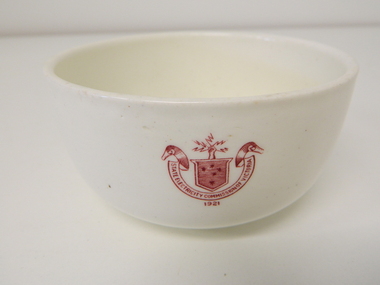 Kiewa Valley Historical Society
Bowl Ceramic, circa mid to late 1900's
... equipment and machinery was either made in England or Europe. Local/European expertise in dam construction and water management in alpine terrain came from migrants and specialist recruited from England and Europe. The quality of workmanship from big steel manufacturing plants in England and Europe could not be matched from anywhere else in the developed world. ceramic crockery plate secv state electricity commission of victoria crockery mt beauty chalet bogong mess hall The seal of the State Electricity Commission of Victoria is imprinted on the top outside rim within a curved scroll and a raised fist with electrical "charges" extending out.. ...This bowl was used by the State Electricity Commission of Victoria in their mess rooms for their workers during the construction of the Kiewa Hydro Electric Scheme. The imprint of the year "1921" was to identify the year that the SECV was formed which relieved the private VHEC (Victorian Hydro-Electric Company). As the scheme was of such a huge scope, isolated and time consuming nature, the feeding of its workers was quite demanding of cutlery and crockery. The use of sturdy English cups and saucers was essential. The period of construction and the isolation of the Kiewa Valley area placed heavy demand for "solid" crockery that could wear abusive handling. This period in time was one when crockery, whether for domestic or commercial use, was imported from "mother" England. This scenario was more so for governmental bodies such as rail, jails and electricity providers than domestic users. The influx of cheaper Asian crockery had not yet begun.This type of crockery item was used by the thousands of SEC Victorian staff and construction workers involved in the building of the Kiewa Hydro Electricity Scheme, over the extensive period (1938 to 1961). This was a period when Government bodies and other semi- government organisations were still tied to the "establishments" of "mother" England. It was a period in Australia's development when the Asian influence was very weak and the established ties to England and Europe was still very strong. The majority of heavy equipment and machinery was either made in England or Europe. Local/European expertise in dam construction and water management in alpine terrain came from migrants and specialist recruited from England and Europe. The quality of workmanship from big steel manufacturing plants in England and Europe could not be matched from anywhere else in the developed world.This item is a white ceramic State Electricity Commission of Victoria bowl. It is made in England and is of strong and durable ceramic. The 5mm thickness of the ceramic suggests this bowl (cereal/soup) belongs to a commercial kitchen environment and not domestic. The indent bottom of the bowl is 5mm deep with a side curvature ratio of 2:5. The ceramic is glazed to a commercial standard (worker's mess). See also KVHS 0128 (B to D) for other ceramic crockery. The seal of the State Electricity Commission of Victoria is imprinted on the top outside rim within a curved scroll and a raised fist with electrical "charges" extending out.. Snuggled within the borders of the scroll is a banner with the five stars of the Southern Cross . On the underside "Vitrified sold by Cafe & Hotel Supplies Pty Ltd Dunn Bennett & Co. Ltd. Burslem Made in England"ceramic crockery, plate, secv, state electricity commission of victoria, crockery, mt beauty chalet, bogong mess hall
