
Showing 136 items matching "mess plate"
-
 8th/13th Victorian Mounted Rifles Regimental Collection
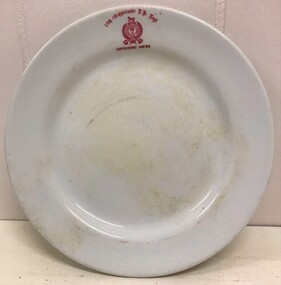
Functional object - monogrammed side plate
... ...mess plate...Set of one dozen white vitreous china side plates with a red monogram incorporating the regimental badge in the rim denoting the object was made specially for 13th Light Horse Officers' Mess. ..."13th (Gippsland) LH Regt" above regimental badge, and "Officers' Mess" below badge. Marked on base of plate " 'Duraline' Supervitrifies Grindley Hotelware Co England" and "Loftus Moran Pty Ltd Melbourne" ...It trained in Victoria and, as the Japanese threat to the mainland declined, was disbanded in October 1943 with men going to other units. 13th light horse gippsland monogram officer mess plate "13th (Gippsland) LH Regt" above regimental badge, and "Officers' Mess" below badge. ...The 10th Light Horse was raised in 1903 from Victorian Mounted Rifles companies in Gippsland. In 1912 the regiment was renumbered 13th Light Horse. In 1920 the regiment had the territorial title Gippsland Light Horse added. The regiment was raised as 13th Light Horse (Gippsland), a Citizen Forces unit. In 1940 the regiment converted from horse to mechanised, initially as 13th Motor Regiment then 13th Armoured Regiment. It trained in Victoria and, as the Japanese threat to the mainland declined, was disbanded in October 1943 with men going to other units.Set of one dozen white vitreous china side plates with a red monogram incorporating the regimental badge in the rim denoting the object was made specially for 13th Light Horse Officers' Mess. The red on white is the colour patch of the regiment."13th (Gippsland) LH Regt" above regimental badge, and "Officers' Mess" below badge. Marked on base of plate " 'Duraline' Supervitrifies Grindley Hotelware Co England" and "Loftus Moran Pty Ltd Melbourne" 13th, light horse, gippsland, monogram, officer, mess plate -
 The 5th/6th Battalion Royal Victoria Regiment Historical Collection
Container - Gravy Boat
... Ornate trimming around lip of boat, half round handle inscribed "6 BN RVR SGTS Mess". Plate- ornate trim around lip, inscribed "6 BN RVR SGTS Mess". ...Ornate trimming around lip of boat, half round handle inscribed "6 BN RVR SGTS Mess". Plate- ornate trim around lip, inscribed "6 BN RVR SGTS Mess". ...Used for functions Silverware used at function by predecessor unit2 piece - 3 legs on boat, lion like feet. Ornate trimming around lip of boat, half round handle inscribed "6 BN RVR SGTS Mess". Plate- ornate trim around lip, inscribed "6 BN RVR SGTS Mess". "6 BN RVR SGTS Mess" regimental property, 6rvr, mess functions, 5/6 rvr, gravy boat -
 Federation University Historical Collection
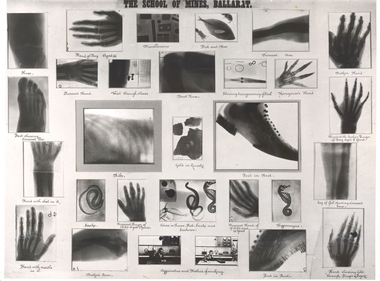
Photograph - Original x-rays, X-rays from pioneering Ballarat Demonstrations, 1896, 1896
... Messers F.J. Martell and D. McDougall, the assistance of Rontgen X-rays will soon be available, for the relief of suffering humanity, at this institution." Martell was an ardent amateur photographer, and Duncan McDougall's experience as an electrician has enabled the two gentlemen to carry their experiments on to a perfectly successful issue. At first these gentlemen, together with Professor Purdie and Mr W. Huey Steele, conducted a series of experiments by the aid of a Bonetti glass-plate...Messers F.J. Martell and D. McDougall, the assistance of Rontgen X-rays will soon be available, for the relief of suffering humanity, at this institution." Martell was an ardent amateur photographer, and Duncan McDougall's experience as an electrician has enabled the two gentlemen to carry their experiments on to a perfectly successful issue. At first these gentlemen, together with Professor Purdie and Mr W. Huey Steele, conducted a series of experiments by the aid of a Bonetti glass-plate ...X-Rays were first discovered on 08 November 1895. By 18 July 1896 staff members of the Ballarat School of Mines (SMB), were experimenting with the exciting new discovery. The history of x-rays began on 08 November 1895 at the University of Wurzburg in Bavaria. The discovery was officially announced on 25 December 1895. The first radiographs in Ballarat were taken at the School of Mines in July 1896 according to the Ballarat School of Mines (SMB) Annual Report. Frederick J. Martell, the Registrar of SMB arranged for the importation of tubes, while John M. Sutherland, an electrician, conducted most of the experiments giving 6 inch, 12 inch and 16 inch sparks respectively. In a short time brilliantly successful results were obtained, with some SMB Roentgen negatives taken at this time still in existence today. Samuel Ernest Figgis, H. R. W. Murphy, D. McDougall, and Frederick J. Martell carried out experiments at the SMB on Saturday evening 18 July 1896, producing 'perfect' negatives of a hand and wrist. A Roentgen Tube and an induction coil giving a two inch spark, the coil being sparked by the SMB's dynamo, were used to obtain these results. The Courier reported that 'the exposure of five minutes was ample' but concluded that 'the length of the exposure will be shortened as experiments proceed.' The Ballarat Courier reported on 20 July 1896 that: "Thanks to the energy of the staff of The School of Mines, Ballarat, and particularly to Messers F.J. Martell and D. McDougall, the assistance of Rontgen X-rays will soon be available, for the relief of suffering humanity, at this institution." Martell was an ardent amateur photographer, and Duncan McDougall's experience as an electrician has enabled the two gentlemen to carry their experiments on to a perfectly successful issue. At first these gentlemen, together with Professor Purdie and Mr W. Huey Steele, conducted a series of experiments by the aid of a Bonetti glass-plate induction machine which had been constructed by Mr McDougall. The results were very good, the various bones of the hand being distinctly visible. The following people were among those who witnessed the first X-ray experiments to be carried out in Ballarat. Andrew Anderson, President of the School of Mines, a large number of ladies and gentlemen, the medical profession Dr Edward Champion (1867-1929) Dr Gerald Eugene Cussen (1888-1943) Dr William Edward Davies (1868-1928) Dr Charles William Henry hardy (1861-1941) Dr Edward Kenneth Herring(1864-1922) Dr Joseph Lalor (1859-1907) Dr James Thomas Mitchell (1856-1945) Dr Edward Graham Ochiltree (1857-1896) Dr Robert Denham Pinnock (1849-1902) Dr Joseph Francis Usher (c1832-1909) Dr Grace Vale (nk-1933). The staff of SMB Professor Alfred Mica Smith Professor D. J. Dawbarn Mr. F. J. Martell. (http://guerin.ballarat.edu.au/aasp/is/library/collections/art_history/honour-roll/honourroll_X-Ray_pioneers.shtml) "Seven patients of the doctors who were present were treated. In each case the patient was suffering from the effects of an old wound or some other injury to other a hand or foot. One patient, a boy had a finger broken some years earlier and when xray plate of the injury was developed it indicated plainly the fracture on one of the joints of the third finger. In another case a woman had a foot had a foot X-rayed and the photograph revealed the seat of an earlier imjury to it. Likewise an injury to the bones of a hand of an elderly man was revealed by an x-ray photograph. Every X-ray photograph that evening showed the importance of this new development in electrical science and the doctors present agreed the "the results of the experiments on their patients, by showing the exact seat of the injury and its present condittion, would materially assist them iin supporting cures." (Warren Perry, The Ballarat School of Mines and Industries Ballarat, p 146.)A number of photographic xrays as taken by the Ballarat School of Mines in 1896. The xrays include bones, hands, feet, shoes and more. ballarat school of mines, scientific equipment, x-ray, xray, photography, foto, roentgen tube -
 Federation University Historical Collection
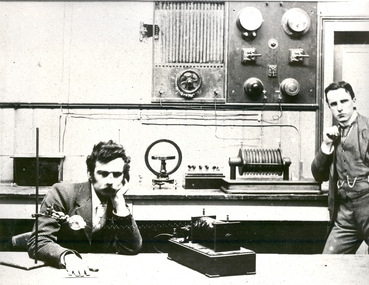
Photograph - Photograph - Black and White, X-Ray demonstration at the Ballarat School of Mines, 1896, 1896
... Messers F.J. Martell and D. McDougall, the assistance of Rontgen X-rays will soon be available, for the relief of suffering humanity, at this institution." Martell was an ardent amateur photographer, and Duncan McDougall's experience as an electrician has enabled the two gentlemen to carry their experiments on to a perfectly successful issue. At first these gentlemen, together with Professor Purdie and Mr W. Huey Steele, conducted a series of experiments by the aid of a Bonetti glass-plate...Messers F.J. Martell and D. McDougall, the assistance of Rontgen X-rays will soon be available, for the relief of suffering humanity, at this institution." Martell was an ardent amateur photographer, and Duncan McDougall's experience as an electrician has enabled the two gentlemen to carry their experiments on to a perfectly successful issue. At first these gentlemen, together with Professor Purdie and Mr W. Huey Steele, conducted a series of experiments by the aid of a Bonetti glass-plate ...X-Rays were first discovered on 8 November 1895. By 18 July 1896 staff members of the Ballarat School of Mines (SMB), were experimenting with the exciting new discovery. The history of x-rays began on 8 November 1895 at the University of Wurzburg in Bavaria. The discovery was officially announced on 25 December 1895. The first radiographs in Ballarat were taken at the School of Mines in July 1896 according to the Ballarat School of Mines (SMB) Annual Report. Frederick J. Martell, the Registrar of SMB arranged for the importation of tubes, while John M. Sutherland, an electrician, conducted most of the experiments giving 6 inch, 12 inch and 16 inch sparks respectively. In a short time brilliantly successful results were obtained, with some SMB Roentgen negatives taken at this time still in existence today. Samuel Ernest Figgis, H. R. W. Murphy, D. McDougall, and Frederick J. Martell carried out experiments at the SMB on Saturday evening 18 July 1896, producing 'perfect' negatives of a hand and wrist. A Roentgen Tube and an induction coil giving a two inch spark, the coil being sparked by the SMB's dynamo, were used to obtain these results. The Courier reported that 'the exposure of five minutes was ample' but concluded that 'the length of the exposure will be shortened as experiments proceed.' The Ballarat Courier reported on 20 July 1896 that: "Thanks to the energy of the staff of The School of Mines, Ballarat, and particularly to Messers F.J. Martell and D. McDougall, the assistance of Rontgen X-rays will soon be available, for the relief of suffering humanity, at this institution." Martell was an ardent amateur photographer, and Duncan McDougall's experience as an electrician has enabled the two gentlemen to carry their experiments on to a perfectly successful issue. At first these gentlemen, together with Professor Purdie and Mr W. Huey Steele, conducted a series of experiments by the aid of a Bonetti glass-plate induction machine which had been constructed by Mr McDougall. The results were very good, the various bones of the hand being distinctly visible. The following people were among those who witnessed the first X-ray experiments to be carried out in Ballarat. Andrew Anderson, President of the School of Mines, a large number of ladies and gentlemen, the medical profession Dr Edward Champion (1867-1929) Dr Gerald Eugene Cussen (1888-1943) Dr William Edward Davies (1868-1928) Dr Charles William Henry hardy (1861-1941) Dr Edward Kenneth Herring(1864-1922) Dr Joseph Lalor (1859-1907) Dr James Thomas Mitchell (1856-1945) Dr Edward Graham Ochiltree (1857-1896) Dr Robert Denham Pinnock (1849-1902) Dr Joseph Francis Usher (c1832-1909) Dr Grace Vale (nk-1933). The staff of SMB Professor Alfred Mica Smith Professor D. J. Dawbarn Mr. F. J. Martell. (http://guerin.ballarat.edu.au/aasp/is/library/collections/art_history/honour-roll/honourroll_X-Ray_pioneers.shtml)Two men, one seated, one standing standing in a room with early electrical equipment. They are conducting pioneer X-rays at the Ballarat School of Mines in 1896. Seated on the left is John Waters Sutherland.A bromide of this images states "Experimenting with X-rays, 1896"ballarat school of mines, x-ray, xray, john sutherland, sutherland, electricity, photography, foto, roentgen tube, medical -
 Flagstaff Hill Maritime Museum and Village
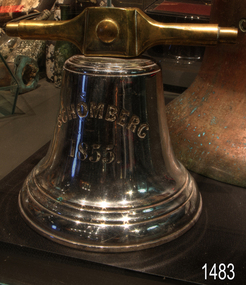
Functional object - Bell, Schomberg 1855, Before 1855
... Flagstaff Hill Flagstaff Hill Maritime Museum and Village Warrnambool Maritime Museum Maritime Village Great Ocean Road Shipwreck Coast Schomberg silver plated bell mess bell bell stands captain ‘bully’ Forbes alexander hall and son James Baines and company Liverpool’s black ball line bell Schomberg bell ship's bell small bell St Joseph's church Briggs Marine John Manning John Logan Warrnambool Museum Briggs Foundry silver bell Bell's front; “SCHOMBERG” with “1855” below. ...The Rescue and Journey of the Schomberg Bells: This bell was the smaller of two rescued by the crew of the Schomberg following the ship’s wreck in 1855. While the specific purpose of the smaller bell is unknown, it may have served to assemble the crew or signal mealtimes on board. After surviving the shipwreck, the crew carried both bells as they made their way along the coastline. Their journey eventually led them to the home of settler John Manning, located at Hopkins Point near Warrnambool. Manning took possession of the bells and subsequently presented them to two churches in Warrnambool. The smaller bell went to St Joseph’s Catholic Church, while the larger bell went to St John’s Presbyterian Church. After around a year, the small bell at St Joseph’s developed a crack and became unusable. Thomas Manifold imported a replacement bell for the church, and the damaged bell was stored at his farm. Years later, when the property was sold to John Logan, the discarded bell was donated to the old Warrnambool Museum upon its opening in 1886. The Curator, Joseph Archibald, placed the bell on display in the entry. In 1975, it was transferred from the Warrnambool Art Gallery to Flagstaff Hill. The ’Mystery’ of the small bell solved: Despite numerous attempts by the staff at Flagstaff Hill to restore the bell’s lustre, the bell remained dull and tarnished. In October 1986, Director Peter Ronald decided to send the bell for professional advice. The bell was entrusted to Briggs Marine Products, a renowned brass founder established in 1912. Upon examination, the specialists at Briggs discovered the reason behind the bell’s persistent lack of shine: it had originally been silver-plated, but most of the plating had worn away over time. The experts at Briggs then undertook the task of restoring the bell, successfully returning it to a gleaming silver surface. The Sailing Ship Schomberg: Launched in 1855, the Schomberg was regarded as the “Noblest” ship afloat at the time. Owned by the Black Ball Line, it was built for their passenger fleet by Alexander Hall of Aberdeen at a cost of £43,103. The construction featured three skins: one planked fore and aft and two diagonally planked, all fastened with screw-threaded trunnels (wooden rails). The ship’s First Class accommodation was luxurious, boasting velvet pile carpets, large mirrors, rosewood, birds-eye maple and mahogany timbers, satin damask soft furnishings, and an oak-lined library with a piano. Schomberg had a capacity for 1,000 passengers. The ship’s master, Captain James Nicol Forbes—also known as ‘Bully’ Forbes—was only 34 years old at the launch. He had a reputation for setting and breaking speed records on the Black Ball Line’s Marco Polo and Lightning. In 1852, Forbes completed the London to Melbourne journey on the Marco Polo in 68 days, a record at the time, though 53 passengers died during the voyage. In 1854, he sailed the Lightning to Melbourne in 76 days and returned in only 63 days—a record that stood among sailing ships. Forbes was known for driving his ship and crew to their limits, often prioritising speed over passenger comfort. Determined to set new records, he promised to reach Melbourne in sixty days, declaring he would do so “with or without the help of God.” The Maiden Voyage and the Wreck: Schomberg departed Liverpool on 6th October 1855, flying a banner that read “Sixty Days to Melbourne”. The vessel carried 430 passengers and 3,000 tons of cargo, including materials to build the Melbourne to Geelong Railway and a bridge over the Yarra River. Among the cargo were a cow for fresh milk, pens for fowls and pigs, and 90,000 gallons of water for drinking and washing. Additionally, it transported 17,000 letters and 31,800 newspapers. The ship and cargo were insured for $300,000, a considerable sum for the era. Poor winds while crossing the equator delayed Schomberg’s progress. Land was first sighted on Christmas Day at Cape Bridgewater near Portland. Captain Forbes followed the coastline towards Melbourne, but was reportedly playing cards when the third mate, Henry Keen, reported land only three miles away. The ship ran aground on a sand spit near Curdie’s Inlet (approximately 56 km west of Cape Otway) on 26th December 1855, after 78 days at sea. The sand spit and nearby currents were not marked on Forbes’s map. During the night, the crew launched a lifeboat to search for a safe landing spot for the passengers. The scouting party advised Forbes to wait until morning, as rough seas posed a danger to the lifeboats. At dawn, the ship’s Chief Officer spotted the SS Queen and signalled for help. The master of the Queen brought his vessel alongside, and all passengers and crew disembarked safely. The Black Ball Line’s Melbourne agent sent another steamer to collect the passengers’ baggage, and other steamers assisted with cargo salvage until worsening weather forced operations to cease. Notably, a plunderer later recovered a case of Wellington boots, but all were for the left foot. The wreck and its cargo were sold to local merchants Manifold & Bostock, who did not attempt further salvage. They later sold their interest to a Melbourne businessman and two seafarers. In 1864, after two men drowned in their attempt to reach the Schomberg, salvage efforts were abandoned. By 1870, parts of the ship had washed ashore on New Zealand’s South Island. Today, the wreck is about nine metres below the surface. Although most woodwork has disintegrated, the vessel’s shape remains discernible due to the railway irons, girders, and framework. Various goods and materials from the ship are scattered nearby. The bell is particularly significant in that along with other items from the wreck helped in part to having the legislation changed to protect shipwrecks, with far tighter controls being employed to oversee the salvaging of wreck sites. This bell forms part of the Schomberg collection at Flagstaff Hill maritime museum. The collection as a whole is of historical and archaeological significance at a State level. Flagstaff Hill’s collection of artefacts from the Schomberg is also significant for its association with the Victorian Heritage Registered Schomberg shipwreck (VHR S 612). The collection is of additional significance because of the relationship between the objects salvaged, as together they help us to interpret the story of the Schomberg. The collection as a whole is historically significant for representing aspects of Victoria's maritime history and its potential to interpret social and historical themes from society at the time of the wreck. A small ship’s bell. The silver-plated metal bell bears the ship’s name and year of construction on one side and the name and address of the ship’s builders on the other. These details are deeply engraved into the metal and formed in bold, upper-case lettering. The bell has two bell stands: the left and the right. Both stands have an Iron pipe bent into an inverted ‘Y’ shape, with a hole along its length and feet attached to a rectangular metal plate at the other two ends. Feet are bolted to a timber base that has a hole drilled through the centre for mounting. Bell's front; “SCHOMBERG” with “1855” below. Bell's back “HALL & SONS (crack splits letter “N”) / BUILDERS (in italics) / ABERDEEN” (crack splits letter “B”).flagstaff hill, flagstaff hill maritime museum and village, warrnambool, maritime museum, maritime village, great ocean road, shipwreck coast, schomberg, silver plated bell, mess bell, bell stands, captain ‘bully’ forbes, alexander hall and son, james baines and company, liverpool’s black ball line, bell, schomberg bell, ship's bell, small bell, st joseph's church, briggs marine, john manning, john logan, warrnambool museum, briggs foundry, silver bell -
 Frankston RSL Sub Branch
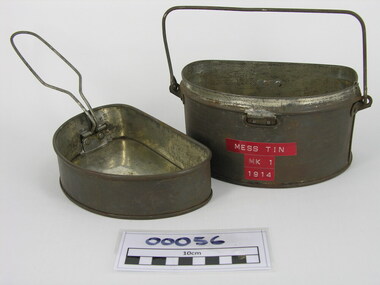
Mess Tin, c. 1914
... This mess tin is made of tin plated steel, has a carrying handle and clips for a shoulder strap. ...This mess tin is made of tin plated steel, has a carrying handle and clips for a shoulder strap. ...Type MK1 (ie mark 1) mess tin used as a food container by Australian military servicemen during WWI. This mess tin is made of tin plated steel, has a carrying handle and clips for a shoulder strap. There is a folding handle inside of the removable lid section.australian, australia, ww1, world war 1, mess tin, food container -
 Flagstaff Hill Maritime Museum and Village
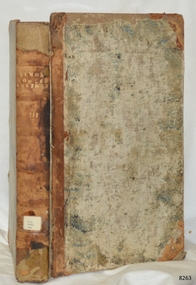
Book - Reference Fossils/Science, John Hill, A General Natural History, 1748
... mess of local names; Hill bridged the gap to modern scientific naming. The book also features early, highly detailed descriptions of microscopic life, and first editions of this book were printed in two formats: standard (with black-and-white plates) and "Large Paper" copies. ...A General Natural History is a massive, ambitious three-volume compendium written to survey the natural world. It is divided into three distinct parts, which were published sequentially between 1748 and 1752. Volume One contains The History of Fossils (1748). Despite the modern name, "fossils" back then referred to anything dug out of the earth. This volume focuses heavily on mineralogy, gemstones, rocks, and minerals, mapping them out based on a microscopic examination. In Volume Two, A History of Plants (1751), Hill covers botany, describing the appearance, geographic range, and medicinal uses of various native and exotic plants (like the coffee tree, cacti, and various herbs). Volume Three concentrates on various animals and is called An History of Animals (1752). It's a zoological survey that starts with microscopic organisms before moving on to insects, marine life, reptiles, birds, and mammals. The book focused not just on describing these specimens, but also on outlining their "virtues and uses" in medicine and mechanics.A General Natural History Author: John Hill Publisher: Thomas Osborne Date: 1748 Badly damaged light brown hardcover with a damaged spine and lettering in gold. The spine has a Library label with an inscription.non-fictionA General Natural History is a massive, ambitious three-volume compendium written to survey the natural world. It is divided into three distinct parts, which were published sequentially between 1748 and 1752. Volume One contains The History of Fossils (1748). Despite the modern name, "fossils" back then referred to anything dug out of the earth. This volume focuses heavily on mineralogy, gemstones, rocks, and minerals, mapping them out based on a microscopic examination. In Volume Two, A History of Plants (1751), Hill covers botany, describing the appearance, geographic range, and medicinal uses of various native and exotic plants (like the coffee tree, cacti, and various herbs). Volume Three concentrates on various animals and is called An History of Animals (1752). It's a zoological survey that starts with microscopic organisms before moving on to insects, marine life, reptiles, birds, and mammals. The book focused not just on describing these specimens, but also on outlining their "virtues and uses" in medicine and mechanics.flagstaff hill, warrnambool, shipwrecked coast, flagstaff hill maritime museum, maritime museum, shipwreck coast, flagstaff hill maritime village, great ocean road, book, pattison collection, warrnambool library, warrnambool mechanics’ institute, ralph eric pattison, corangamite regional library service, warrnambool city librarian, mechanics’ institute library, victorian library board, warrnambool books and records, warrnambool children’s library, a general natural history, john hill -
 Montmorency–Eltham RSL Sub Branch
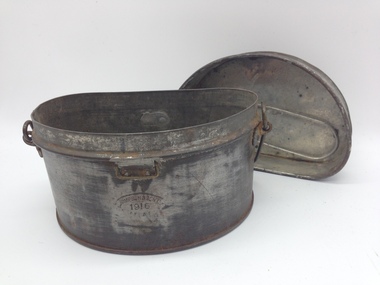
Functional object - Mess Tin WW1, WW1 Mess Tin, 1916
... mess tin and lid. Used by Australian military servicemen during WW1, it is believed to be based on a British design. Made of tin plated...mess tin and lid. Used by Australian military servicemen during WW1, it is believed to be based on a British design. Made of tin plated ...Mess tins were used to prepare or heat food, but thay were also used as a container from which to eat or drink. The tins are lightweight and sturdy but they became hot very quickly when heated.Used by Australian military servicemen during WW1Two piece "D" shaped silver coloured metal mess tin and lid. Used by Australian military servicemen during WW1, it is believed to be based on a British design. Made of tin plated steel, this mess tin has a wire rod carrying handle and rectangular metal wire clips for a shoulder strap, attached to the top section of the mess tin by metal rivets and straps. There is a metal wire rod folding handle mounted on the inside of the removable lid section. The mess tin has a folded seam on the bottom edge and along the left hand side. A wire rod is mounted around the top section of the mess tin as a base for the removable lid. The lid has a folded metal seam on the top edge and along the left hand side. The bottom edge of the lid is folded around a metal wire rod.A. SIMPSON & SON LTD 1916 ADELAIDEmess tin, ww1, australia, military, metal, two piece -
 Montmorency–Eltham RSL Sub Branch
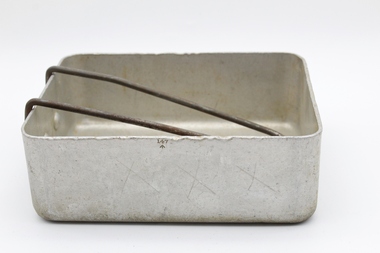
Equipment - Mess Tin, 1939
... The Mess Box ( 0089.1 ) is one of two with the partnering box referenced at 0089.1 Inscribed on aluminium plate affixing handle to box “ C & B. ...The Mess Box ( 0089.1 ) is one of two with the partnering box referenced at 0089.1Aluminium Mess Tin with metal movable steel handle attached to one end.Inscribed on aluminium plate affixing handle to box “ C & B. Ltd. 1939. “ with arrow pointing upwards. -
 Montmorency–Eltham RSL Sub Branch
Equipment - Mess Tin, 1939
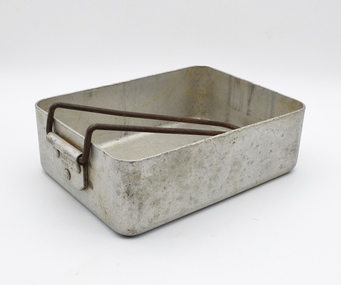
... The mess box ( 0089.2 ) is one of two issued with the partnering box referenced at 0089.1 Inscribed to aluminium plate affixing handle to box “ C & B 1939 “ with arrow pointing upwards. ...The mess box ( 0089.2 ) is one of two issued with the partnering box referenced at 0089.1Aluminium Mess Tin with metal movable handle attached to one end.Inscribed to aluminium plate affixing handle to box “ C & B 1939 “ with arrow pointing upwards. -
 Bendigo Military Museum
Equipment - MESS TIN, Unknown
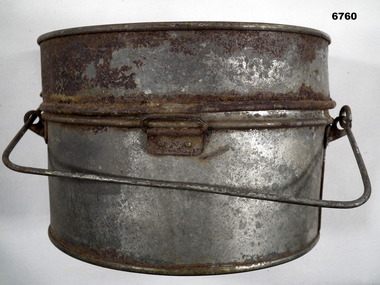
... Mess tin in two parts. Silver metallic tin. lid also used as a plate and has a fold out metal handle. ...Passchendaele Barracks Trust Mess Tin Mess tin in two parts. Silver metallic tin. lid also used as a plate and has a fold out metal handle. ...Mess tin issued to all active servicemen for purpose of food and drink on the front line.Mess tin in two parts. Silver metallic tin. lid also used as a plate and has a fold out metal handle. Base has a handle to carry assembled item.passchendaele barracks trust, mess tin -
 Bendigo Military Museum
Administrative record - FOLDER AND RECORDS
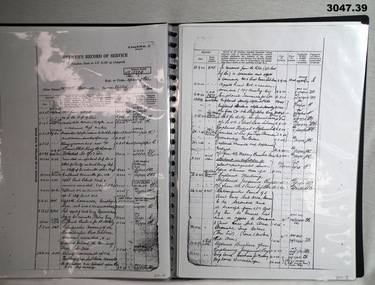
... Written on a note pad with British Aluminium stamped on it. .28) Typed sheet showing a brief (biography) story of the life of Herbert Trangmar ALLAN (Blue). .29) Colour top view photo on A4 paper showing a huge pair of Japanese binoculars mounted on a tripod. .30) Colour R side view photo on A4 paper of Japanese binoculars. .31) Colour rear view photo of huge Japanese binoculars. .32) Colour front view photo on A4 paper of huge Japanese binoculars mounted on a tripod. .33) Colour L side view photo of huge Japanese binoculars. .34) Colour photo of tripod with timber legs & brace to suit binoculars above. .35) Black & white photo of a manufacturers plate featuring Japanese writing & numbers. .36) Colour photo on A4 paper showing manufacturers plate on rear of support brace on the tripod head. .37) Copy of WM Collection photo number 058101 showing an Australian soldier looking into the binoculars, Finschafen New Guinea .38) Menu card. TobrukDay Dinner 2/17th Sgts Mess...Written on a note pad with British Aluminium stamped on it. .28) Typed sheet showing a brief (biography) story of the life of Herbert Trangmar ALLAN (Blue). .29) Colour top view photo on A4 paper showing a huge pair of Japanese binoculars mounted on a tripod. .30) Colour R side view photo on A4 paper of Japanese binoculars. .31) Colour rear view photo of huge Japanese binoculars. .32) Colour front view photo on A4 paper of huge Japanese binoculars mounted on a tripod. .33) Colour L side view photo of huge Japanese binoculars. .34) Colour photo of tripod with timber legs & brace to suit binoculars above. .35) Black & white photo of a manufacturers plate featuring Japanese writing & numbers. .36) Colour photo on A4 paper showing manufacturers plate on rear of support brace on the tripod head. .37) Copy of WM Collection photo number 058101 showing an Australian soldier looking into the binoculars, Finschafen New Guinea .38) Menu card. TobrukDay Dinner 2/17th Sgts Mess ...For historical information refer to notes attached to Cat No 2755.4 See attached sheets for the remainder of pages.Black plastic folder, ring binding with 20 clear plastic sleeves. .1) Photocopy of cover for personnel documents for Herbert Trangmar ALLAN, MC, NX12229, N60005, Captain 2nd Garrison Battalion. A4 page size. .2) Photocopy of WWII attestation form dated 2.5.1940 for NX12229, Herbert Trangmar ALLAN. .3) Photocopy of Medical Exam Section. .4) Photocopy of Medical Exam Section with black & white ID photo. .5) Enlarged photocopy of ID photos of Herbert Trangmar ALLAN. .6) Photocopy of Mobilization attestation form dated 6.10.39 for Herbert Trangmar ALLAN. .7) Photocopy of Termination of Officer's Appointment dated 2.4.1946 for Herbert Trangmar ALLAN, OBE, NX12229. .8) Photocopy of Officers Record of Service for Herbert Trangmar ALLAN. Address at time was Wali, New Guinea .9) Photocopy of Officers Record of Suc for Herbert Trangmar ALLAN OBE MC ED NX12229. Address at time was Wali, New Guinea. First entry: 16.6.1914. Last entry: 1.11.1945. .10) Photocopy of Officers Record of Service, dated 29.8.1950. For NX12229 Herbert Trangmar ALLAN MC OBE ED. Last address Watsons Bay NSW. .11) Photocopy of Determination of Demobilization Priority for NX12229 Herbert Trangmar ALLAN. Dated 5.10.1945. .12) Photocopy of sheet showing service early WWII for Herbert Trangmar ALLAN. .13) Photocopy of sheet showing early WWII service of N60005, Herbert Trangmar ALLAN. .14) Photocopy of Officer's Record of Service sheet for Herbert Trangmar ALLAN OBE MC NX12229. First entry: 17/2/1943. Last entry: 24.8.1944. .15) Photocopy of Record of Service sheet. First entry: 28.9.1944. Last entry: 25.5.1945. .16) Photocopy of Officer's Record of Service for Herbert Trangmar ALLAN OBE MC NX12229. First entry: 1.6.1945. Last entry: 14.3.1946. .17) Photocopy of Record of Service sheet. Mentions MID in SWPA & rank changes. First entry: 21.3.1946. Last entry: 30.9.1950. .18) Photocopy of Officer's Record of Service sheet for NX12229 Herbert Trangmar ALLAN 2nd Garrison Battalion. First entry: 6.9.1944. Last entry: 7.5.1946 .19) Photocopy of Recommendation for an OBE for NX12229 Herbert Trangmar ALLAN MC Major. Tobruk period April / October 1941. .20) Photocopy of a sheet showing medals & awards for N60005 NX12229 Herbert Trangmar ALLAN OBE MC ED MID. .21) Photocopy of a letter to Deputy Commissioner - Repatriation on AIF letterhead. Re: Captain ALLAN H T 17 Battalion. .22) Photocopy of an AIF letterhead Canberra dated 1.5.1950. To Secretary HQ Repat Commission. Re: Capt ALLAN H T 17 Battalion. .23) Photocopy of a sheet showing telephone note re awards, dated 2.7.1955. Re: ALLAN H T. Address Mullaway, Woolgoolga, NSW. .24) Photocopy of ranks & dates for ALLAN H T NX12229. DOB 5.1.1895. Served in 14-18 Yes. First entry: 16.6.1914. Last entry: 29.1.1944. .25) Photocopy of ranks & dates for above. First entry: 13.2.1942. Last entry: 1.4.1945. .26) Photocopy of ranks & dates for ALLAN H T NX12229. DOB 5.1.1895. OBE MC. First entry: 23.7.1945. Last entry: 15.8.1951. .27) Photocopy of a note showing Colonel H T ALLAN, address Mullaway, Woolgoolga, NSW. Written on a note pad with British Aluminium stamped on it. .28) Typed sheet showing a brief (biography) story of the life of Herbert Trangmar ALLAN (Blue). .29) Colour top view photo on A4 paper showing a huge pair of Japanese binoculars mounted on a tripod. .30) Colour R side view photo on A4 paper of Japanese binoculars. .31) Colour rear view photo of huge Japanese binoculars. .32) Colour front view photo on A4 paper of huge Japanese binoculars mounted on a tripod. .33) Colour L side view photo of huge Japanese binoculars. .34) Colour photo of tripod with timber legs & brace to suit binoculars above. .35) Black & white photo of a manufacturers plate featuring Japanese writing & numbers. .36) Colour photo on A4 paper showing manufacturers plate on rear of support brace on the tripod head. .37) Copy of WM Collection photo number 058101 showing an Australian soldier looking into the binoculars, Finschafen New Guinea .38) Menu card. TobrukDay Dinner 2/17th Sgts Mess. Dated Wed 19.11.1941. .39) Christmas card with red ribbon in its fold. Shows a signpost Syria - Australia - & a Rising Sun, a kangaroo with smoke & fire, a laughing kookaburra on a sign post. Stamp. HQ 20 Aust Inf Bde AIF. .38) On rear: Two autographs. .39) Inside: “Best wishes for year 1942-1943 from Brig W (T) V Windeyer and staff”recorrds, certificcats, folders -
 Bendigo Military Museum
Equipment - MESS KIT, c1935 - 1940
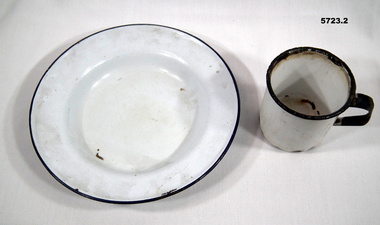
... Mess kit 2. Stamped on back was makers name I. Feng Enamelling Co. Ltd 24 (?) Made in Hong Kong. 1. Mug - standard issue white enamel mug with handle. It originally had a black rim. 2. Plate ...These were bought at "A. Jolly's" store, Darwin on 4 Aug 1939 by Cpl Truscott. Advance party No.12 G.P. Squadron Darwin. They were bought for personal use. A note was attached to this item which mentions two of his friends killed in aircraft crashes. CPL Harold William Johnson 1727 RAAF and SGT Walter James Cox 2403 RAAF. Refer to service of Lyle Truscott NR 1842 RAAF WW2. Cat 4040.8P.1. Mug - standard issue white enamel mug with handle. It originally had a black rim. 2. Plate - White enamel with dark blue rim.2. Stamped on back was makers name I. Feng Enamelling Co. Ltd 24 (?) Made in Hong Kong.ww2, raaf, no.12 sqn, mess kit -
 Bendigo Military Museum
Ceramic - TEA SET, MILITARY
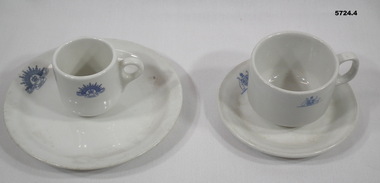
... mess of various units would have own issued crockery and cutlery sets for use by NCO's and Officers. Refer Cat 638P for service details of Geoff Murray No.3411521. Crockery China Tea set 1. Back says "Bristile Hotel China" - made for Australia. 2. Back says "Steelite" Made in England. 3. Bottom says "Bristile" 10/82 Made in Australia. 4. Bottom says "Bristile" Made in Australia - Hotel China 1. Small china side plate ...Army mess of various units would have own issued crockery and cutlery sets for use by NCO's and Officers. Refer Cat 638P for service details of Geoff Murray No.3411521.1. Small china side plate, white in colour with blue Rising Sun emblem. 2. Small china saucer, white in colour with small blue Commonwealth Govt emblem. 3. Small coffee cup with handle with blue Rising Sun emblem. 4. China teacup with handle with small blue Commonwealth Govt emblem.1. Back says "Bristile Hotel China" - made for Australia. 2. Back says "Steelite" Made in England. 3. Bottom says "Bristile" 10/82 Made in Australia. 4. Bottom says "Bristile" Made in Australia - Hotel Chinacrockery, china, tea set -
 Bendigo Military Museum
Uniform - JACKET, MESS DRESS, Quinter & Sons, 1951
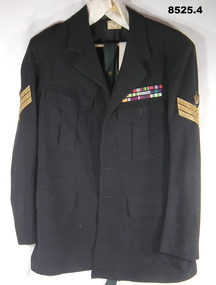
... Mess dress Uniform Post WW2 Passchendaele Barracks Trust 1. Jacket, black woollen, four front pockets. There are no buttons or corps badges. On the arms are the metallic gold badges of a Staff Sgt. On the chest are 12 ribbons. 2. Braces, trouser. Elastic white, gold plated ...The Medal ribbons are:- Top row - OBE Military Division 1939-45 Star, Pacific Star, War medal 1939-45. Middle row - Aust Service Medal. Korea Medal, Korea U.N. Medal, General Service Medal (Malaya). Bottom Row - Vietnam Medal. Long Service & Good Conduct Medal. Meritorious Service Medal. Sth. Vietnam Campaign Medal.1. Jacket, black woollen, four front pockets. There are no buttons or corps badges. On the arms are the metallic gold badges of a Staff Sgt. On the chest are 12 ribbons. 2. Braces, trouser. Elastic white, gold plated steel clips. 3. Necktie, Green. On the tie are repetitive patterns of the RA Inf badge. 4. Necktie.mess dress, uniform, post ww2, passchendaele barracks trust -
 Bendigo Military Museum
Equipment - WATER BOTTLE & CARRIER, ACMIL, 1981
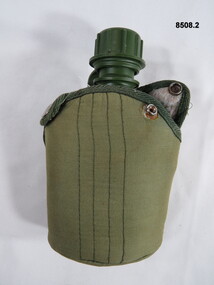
... Plastic bottle, “FOR WATER ONLY DO NOT APPLY CANTEEN TO OPEN FLAME OR BURNER PLATES” “HCMIL 1981^ 8465-66-086-8349” The plastic green 1.5 litre water container is enclosed inside a fitted outer carrier. The water bottle has a secure screw lid, this combination is missing the universal mess canteen. ...The plastic green 1.5 litre water container is enclosed inside a fitted outer carrier. The water bottle has a secure screw lid, this combination is missing the universal mess canteen.1. Plastic bottle, “FOR WATER ONLY DO NOT APPLY CANTEEN TO OPEN FLAME OR BURNER PLATES” “HCMIL 1981^ 8465-66-086-8349” passchendaele barracks trust, water bottle, outer carrier -
 Bendigo Military Museum
Equipment - WATER BOTTLE & CUP, STOKES, 1986
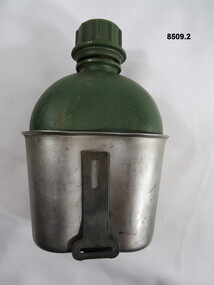
... PLATES" “BMW 1989^ 8465-66-086-8349. RATGMFORD?” 2. “STOKES AUSTRALASIA 8465-66-068-5567 1986^” The plastic green 1,5 litre water container is enclosed inside the stainless steel universal mess canteen. ...The plastic green 1,5 litre water container is enclosed inside the stainless steel universal mess canteen. The water bottle has a secure screw lid, this combination is missing the outer carrier.1. "FOR WATER ONLY DO NOT APPLY CANTEEN TO OPEN FLAME OR BURNER PLATES" “BMW 1989^ 8465-66-086-8349. RATGMFORD?” 2. “STOKES AUSTRALASIA 8465-66-068-5567 1986^”passchendaele barracks trust, water bottle, canteen -
 Bendigo Military Museum
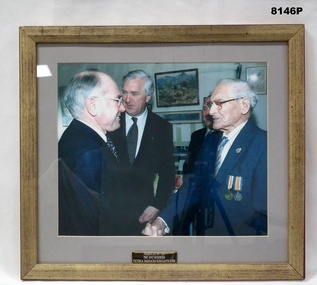
Photograph - PHOTOGRAPH, FRAMED, post 21.7.1998
... plate: engraved print. "PRESENTED BY THE / PMC AND MEMBERS/ VICTORIA BARRACKS SERGEANTS MESS" ...plate: engraved print. "PRESENTED BY THE / PMC AND MEMBERS/ VICTORIA BARRACKS SERGEANTS MESS" Framed photograph of Jack Lockett Aged 107 with the Australian Prime Minister Mr John Howard. ...Photo L to R/ John Howard Prime Minister of Australia shaking hands with John Henry Lockett, in the background is Mr Bruce Reid MHR and behind Jack is Kevin Lockett Jacks son. This photo was taken in the Billiard room of the Soldiers Memorial Institute Pall Mall Bendigo on 21 7.1998 when Jack was presented with the French Legion of Honour by the French Ambassador Dominique Giraud. Refer Cat No's 8143, 8144 & 8145.10PFramed photograph of Jack Lockett Aged 107 with the Australian Prime Minister Mr John Howard. Photograph: colour photograph of 2 persons shaking hands with 2 persons in background. Frame: timber with brushed gold coloured paint glass front. Mount: mid-grey colour cardboard. Label plate: gold colour metal bottom centre. Back of frame: Handwriting red ink.Label plate: engraved print. "PRESENTED BY THE / PMC AND MEMBERS/ VICTORIA BARRACKS SERGEANTS MESS" smi, smirsl, photograph, lockett -
 Waverley RSL Sub Branch
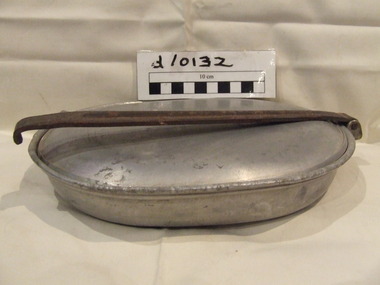
Mess kit
... Probably of US origin Can , Meat (Mess Kit), M-1910, M-1918 The older style mess kits had the flat lid that could also be used as a plate. The M-1932 (not unit in our collection) unit had the plate divided into two sections so food could be separated. ...Probably of US origin Can , Meat (Mess Kit), M-1910, M-1918 The older style mess kits had the flat lid that could also be used as a plate. The M-1932 (not unit in our collection) unit had the plate divided into two sections so food could be separated. ...Probably of US origin Can , Meat (Mess Kit), M-1910, M-1918 The older style mess kits had the flat lid that could also be used as a plate. The M-1932 (not unit in our collection) unit had the plate divided into two sections so food could be separated. The folding handle, when closed, fits into the groove formed by the divider. The ring on the plate was moved to the end of the groove so the lip of the handle fits right into it. The M-1932 Meat Can was made of "corrosion resistant" galvanized steel, not aluminium. It used the same WW I style narrow profile steel handle attached by a cast hinge.Oval aluminium mess kit with steel handle which acts as a lid lock when folded. Cover has a mounted bracket for a ring fitting for attachment to belt.Nilmess kit, m-1918, m-1910 -
 Bendigo Military Museum
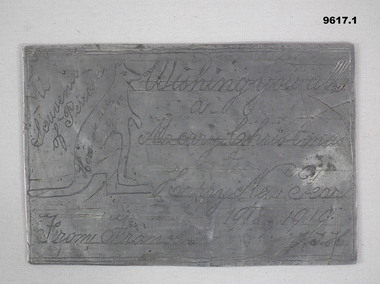
Memorabilia - TRENCH ART, CHRISTMAS CARD, James Thomas Holl, 1918-19
... These 'plates' were beaten out of "Fritz's" dixies. (Mess tin). These items could be classed as a type of trench art....These 'plates' were beaten out of "Fritz's" dixies. (Mess tin). These items could be classed as a type of trench art. ...Refers to the service of:- James Thomas Holl, No 2432. Enlisted 1/6/1916 age 39, in the 60 Bn, 5th Reinforcements. Embarked 25/8/1918, for England. Embarked 30/12/1918, for France. Hospital 17/6/1917, Influenza. Rejoined unit 8/3/1918. Hospital, Trench fever 29/4/1918. Rejoin unit 16/7/1918. Transfer to 59 Battn, 25/9/1918. Discharged 2/11/1919. These 'plates' were beaten out of "Fritz's" dixies. (Mess tin). These items could be classed as a type of trench art..1) This is a rectangular piece of flat aluminium. It is not perfectly square, it shows signs of having been panel beated. Words, drawings and numbers are hand engraved on both sides. The animal on this "card" is a kangaroo. .2) This is a flat rectangular plate of flat aluminium. It is not perfectly square, across the middle is a 'dint" that appears to have been a flattened out corner. Plate One: Side A. Kangaroo motif - engraved on this side: A souvenir of Peronne. Wishing you a Merry Christmas and Happy New Year 1918-1919. From France J.T.H. Side B - Engraved as per a postcard:- Carte postage France 14/10/18. Correspondence: Dearest Mother and Sisters, Just a card to say I am well. This is a bit of a xmas card. Love to all Jim. Addressee: Mrs Holl. "Holliston" Healesville, Victoria, Australia. Plate Two: Kookaburra Motif. Side A; Best wishes for Christmas and the New Year 1918-1919. A souvenir of Peronne, France - marked. (This side has the remains of some sort of official number - top right corner). Side B: Correspondence: My Dear wife and Family. A few lines to say I am well when writing this. This is a piece of Fritz's dixie. Love to all, Jim. Addressee: Mrs J.T. Holl, C/- Mrs Briggs, 103 Mollison Street, Bendigo, Victoria, Australia. Carte Postal - Stamp 6/10/18 France.christmas, aluminium, souvenirs -
 Bendigo Military Museum
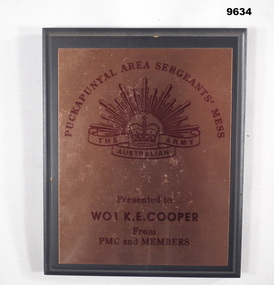
Plaque - PUCKAPUNYAL SERGEANT'S MESS PLAQUE
... Plate features Rising Sun Badge with lettering in an arc above lettering below the badge details the recipient. Plaque PUCKAPUNYAL SERGEANT'S MESS PLAQUE ...Part of the Cooper Collection. See Catalogue No. 9586.2 for details of his service "Keith Cooper" No. 3798359.Rectangular black coloured wooden plaque with rectangular copper coloured plate. Plate features Rising Sun Badge with lettering in an arc above lettering below the badge details the recipient.Printed on Copper plate: “Presented to WO1 K.E. COOPER, From PMC and MEMBERS”cooper collection, keith cooper, plaque, puckapunyal -
 Bendigo Military Museum
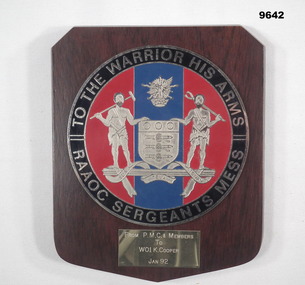
Plaque - PLAQUE, RAAOC SERGEANTS MESS, c. Jan 1992
... Recipient details engraved on plate. Plaque PLAQUE, RAAOC SERGEANTS MESS ...Part of the Cooper Collection, See Cataloque No. 9586.2 for details of Service, No. 3798359, "Keith Cooper".Shield shaped brown coloured wooden plaque. Central to the plaque is a circular plate. Plate features two figures holding weapons either side of a silver coloured shield featuring RAAOC insignia. Figures are on a red and blue background. Silver coloured lettering on a black background around the edge of the plate. Rectangular gold coloured plate at bottom of plaque. Recipient details engraved on plate.Engraved on gold coloured plate: "From P.M.C. and Members to WO1 K. Cooper, Jan 92"cooper collection, keith cooper, plaque, raaoc -
 Kiewa Valley Historical Society
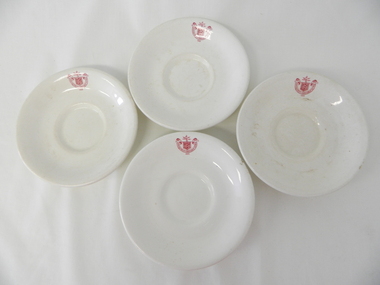
Saucer Ceramic, circa 1940's to 1950's
... plate...secv...state electricity commission of victoria...crockery...mt beauty chalet...bogong mess...The quality of workmanship from big steel manufacturing plants in England and Europe could not be matched from anywhere else in the developed world. saucer plate secv state electricity commission of victoria crockery mt beauty chalet bogong mess hall The seal of the State Electricity Commission Of Victoria is imprinted on the top inside rim within a curved scroll. ...This item was used by the State Electricity Commission of Victoria in their mess rooms for their workers during the construction of the Kiewa Hydro Electricity Scheme. The imprint of the year "1921" was to identify the year that the SECV was formed and relieved the private VHEC (Victorian Hydro-Electric Company). As the scheme was of such a huge, isolated and time consuming nature the feeding of its workers was quite demanding of cutlery and crockery. The use of sturdy English cups and saucers was essential. The period of construction and the isolation of the Kiewa Valley area placed heavy demand for "solid" crockery that could wear abusive handling. This period in time was one when crockery, whether for domestic or commercial use, was imported from "mother" England. This scenario was more so for governmental bodies such as rail, jails and electricity providers than domestic users. The influx of cheaper Asian crockery had not yet begun.This type of crockery item was used by the thousands of SEC Victorian staff and construction workers involved in the building of the Kiewa Hydro Electricity Scheme, over the extensive period (1938 to 1961). This was a period when Government bodies and other semi- government organisations were still tied to the "establishments" of "mother" England. It was a period in Australia's development when the Asian influence was very weak and the established ties to England and Europe was still very strong. The majority of heavy equipment and machinery was either made in England or Europe. Local/European expertise in dam construction and water management in alpine terrain came from migrants or specially recruited English and Europe specialists. The quality of workmanship from big steel manufacturing plants in England and Europe could not be matched from anywhere else in the developed world.This item is a white ceramic State Electricity Commission Of Victoria saucer (tea /coffee). It is made in England and is of strong and durable ceramic. The bottom cup indent is for either tea or coffee cups of a similar ceramic structure. The 5mm thickness of the ceramic suggests this saucer belongs to a commercial kitchen environment and not domestic. The indent bottom of the saucer is 5mm deep with a side curvature ratio of 2:5. The ceramic is glazed to a commercial standard (worker's mess). See also KVHS 0128 (B to D)The seal of the State Electricity Commission Of Victoria is imprinted on the top inside rim within a curved scroll. Snuggled within the borders of the scroll is a banner with the five stars of the southern cross and an arm with a closed fist projecting from the top with five lightning bolts projecting outwards. On the underside "Vitrified sold by Cafe & Hotel Supplies Pty Ltd Dunn Bennett & Co. Ltd. Burslem Made in England"saucer, plate, secv, state electricity commission of victoria, crockery, mt beauty chalet, bogong mess hall -
 Kiewa Valley Historical Society
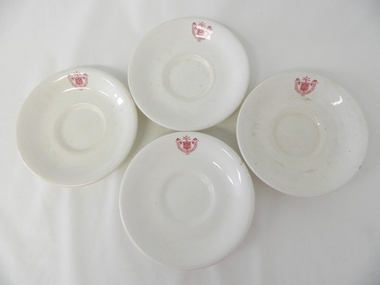
Saucer Ceramic, from 1921 to 1961
... plate...secv...state electricity commission of victoria...crockery...mt beauty chalet...bogong mess...The quality of workmanship from big steel manufacturing plants in England and Europe could not be matched from anywhere else in the developed world. saucer plate secv state electricity commission of victoria crockery mt beauty chalet bogong mess hall The seal of the State Electricity Commission Of Victoria is imprinted on the top inside rim within a curved scroll. ...This item was used by the State Electricity Commission of Victoria in their mess rooms for their workers during the construction of the Kiewa Hydro Electricity Scheme. The imprint of the year "1921" was to identify the year that the SECV was formed and relieved the private VHEC(Victorian Hydro-Electric Company). As the scheme was of such a huge, isolated and time consuming nature the feeding of its workers was quite demanding of cutlery and crockery. The use of sturdy English cups and saucers was essential. The period of construction and the isolation of the Kiewa Valley area placed heavy demand for "solid" crockery that could wear abusive handling. This period in time was one when crockery, whether for domestic or commercial use, was imported from "mother" England. This scenario was more so for governmental bodies such as rail, jails and electricity providers than domestic users. The influx of cheaper Asian crockery had not yet begun.This type of crockery item was used by the thousands of SEC Victorian staff and construction workers involved in the building of the Kiewa Hydro Electricity Scheme, over the extensive period (1938 to 1961). This was a period when Government bodies and other semi- government organisations were still tied to the "establishments" of "mother" England. It was a period in Australia's development when the Asian influence was very weak and the established ties to England and Europe was still very strong. The majority of heavy equipment and machinery was either made in England or Europe. Local/European expertise in dam construction and water management in alpine terrain came from migrants or English and European specialist. The quality of workmanship from big steel manufacturing plants in England and Europe could not be matched from anywhere else in the developed world.This item is a white ceramic saucer (tea /coffee). It is made in England and is of strong and durable ceramic. The bottom cup indent is for either tea or coffee cups of a similar ceramic structure. The 5mm thickness of the ceramic suggests this saucer belongs to a commercial kitchen environment and not domestic. The indent bottom of the saucer is 5mm deep with a side curvature ratio of 2:5. The ceramic is glazed to a commercial standard (worker's mess). See also KVHS 0128 (A,C and D) The seal of the State Electricity Commission Of Victoria is imprinted on the top inside rim within a curved scroll. Snuggled within the borders of the scroll is a banner with the five stars of the southern cross and an arm with a closed fist projecting from the top with five lightning bolts projecting outwards. On the underside "Vitrified sold by Cafe & Hotel Supplies Pty Ltd Dunn Bennett & Co. Ltd. Burslem Made in England"saucer, plate, secv, state electricity commission of victoria, crockery, mt beauty chalet, bogong mess hall -
 Kiewa Valley Historical Society
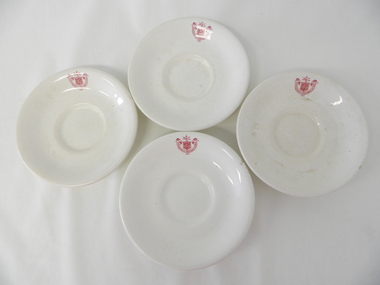
Saucer Ceramic, from 1921 to 1961
... plate...secv...state electricity commission of victoria...crockery...mt beauty chalet...bogong mess...The quality of workmanship from big steel manufacturing plants in England and Europe could not be matched from anywhere else in the developed world. saucer plate secv state electricity commission of victoria crockery mt beauty chalet bogong mess hall The seal of the State Electricity Commission Of Victoria is imprinted on the top inside rim within a curved scroll. ...This item was used by the State Electricity Commission of Victoria in their mess rooms for their workers during the construction of the Kiewa Hydro Electricity Scheme. The imprint of the year "1921" was to identify the year that the SECV was formed and relieved the private VHEC (Victorian Hydro-Electric Company). As the scheme was of such a huge, isolated and time consuming nature the feeding of its workers was quite demanding of cutlery and crockery. The use of sturdy English cups and saucers was essential. The period of construction and the isolation of the Kiewa Valley area placed heavy demand for "solid" crockery that could wear abusive handling. This period in time was one when crockery, whether for domestic or commercial use, was imported from "mother" England. This scenario was more so for governmental bodies such as rail, jails and electricity providers than domestic users. The influx of cheaper Asian crockery had not yet begun.This type of crockery item was used by the thousands of SEC Victorian staff and construction workers involved in the building of the Kiewa Hydro Electricity Scheme, over the extensive period (1938 to 1961). This was a period when Government bodies and other semi- government organisations were still tied to the "establishments" of "mother" England. It was a period in Australia's development when the Asian influence was very weak and the established ties to England and Europe was still very strong. The majority of heavy equipment and machinery was either made in England or Europe. Local/European expertise in dam construction and water management in alpine terrain came from migrants and specialist recruited from England and Europe. The quality of workmanship from big steel manufacturing plants in England and Europe could not be matched from anywhere else in the developed world.This item is a white ceramic saucer (tea /coffee). It is made in England and is of strong and durable ceramic. The bottom cup indent is for either tea or coffee cups of a similar ceramic structure. The 5mm thickness of the ceramic suggests this saucer belongs to a commercial kitchen environment and not domestic. The indent bottom of the saucer is 5mm deep with a side curvature ratio of 2:5. The ceramic is glazed to a commercial standard (worker's mess). See also KVHS 0128 ( A,B&D)The seal of the State Electricity Commission Of Victoria is imprinted on the top inside rim within a curved scroll. Snuggled within the borders of the scroll is a banner with the five stars of the southern cross and an arm with a closed fist projecting from the top with five lightning bolts projecting outwards. On the underside "Vitrified sold by Cafe & Hotel Supplies Pty Ltd Dunn Bennett & Co. Ltd. Burslem Made in England"saucer, plate, secv, state electricity commission of victoria, crockery, mt beauty chalet, bogong mess hall -
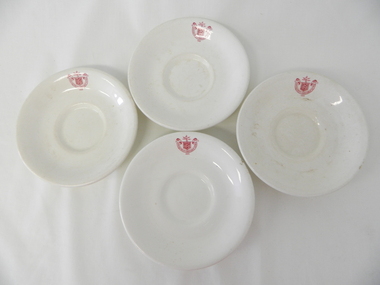 Kiewa Valley Historical Society
Saucer Ceramic, Circa 1921
... plate...secv...state electricity commission of victoria...crockery...mt beauty chalet...bogong mess...These saucers were used in the mess huts including later in the Bogong mess hall and the Mount Beauty Chalet. saucer plate secv state electricity commission of victoria crockery mt beauty chalet bogong mess hall The seal of the State Electricity Commission Of Victoria is imprinted on the top inside rim within a curved scroll. ...This item was used by the State Electricity Commission of Victoria in their mess huts/rooms for their workers during the construction of the Kiewa Hydro Electricity Scheme. The imprint of the year "1921" was to identify the year that the SECV was formed and relieved the private VHEC (Victorian Hydro-Electric Company). As the scheme was of such a huge, isolated and time consuming nature the feeding of its workers was quite demanding of cutlery and crockery. The use of sturdy English cups and saucers was essential. The period of construction and the isolation of the Kiewa Valley area placed heavy demand for "solid" crockery that could wear abusive handling. This period in time was one when crockery, whether for domestic or commercial use, was imported from "mother" England. This scenario was more so for governmental bodies such as rail, jails and electricity providers than domestic users. The influx of cheaper Asian crockery had not yet begun.This type of crockery item was used by the thousands of SEC Victorian staff and construction workers involved in the building of the Kiewa Hydro Electricity Scheme, over the extensive period (1938 to 1961). This was a period when Government bodies and other semi- government organisations were still tied to the "establishments" of "mother" England. It was a period in Australia's development when the Asian influence was very weak and the established ties to England and Europe was still very strong. The majority of heavy equipment and machinery was either made in England or Europe. Local and European expertise in dam construction and water management in alpine terrain came from migrants for England and Europe. The quality of workmanship from big steel manufacturing plants in England and Europe could not be matched from anywhere else in the developed world. These saucers were used in the mess huts including later in the Bogong mess hall and the Mount Beauty Chalet.This item is a white ceramic saucer (tea /coffee). It is made in England and is of strong and durable ceramic. The bottom cup indent is for either tea or coffee cups of a similar ceramic structure. The 5mm thickness of the ceramic suggests this saucer belongs to a commercial kitchen environment and not domestic. The indent bottom of the saucer is 5mm deep with a side curvature ratio of 2:5. The ceramic is glazed to a commercial standard (worker's mess). See also KVHS 0128 (A to C)The seal of the State Electricity Commission Of Victoria is imprinted on the top inside rim within a curved scroll. Snuggled within the borders of the scroll is a banner with the five stars of the southern cross and an arm with a closed fist projecting from the top with five lightning bolts projecting outwards. On the underside "Vitrified sold by Cafe & Hotel Supplies Pty Ltd Dunn Bennett & Co. Ltd. Burslem Made in England"saucer, plate, secv, state electricity commission of victoria, crockery, mt beauty chalet, bogong mess hall -
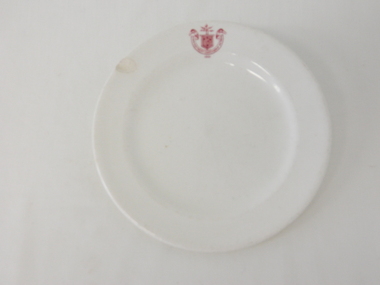 Kiewa Valley Historical Society
Plate Bread & Butter, Circa 1921
... The 5mm thickness of the ceramic suggests this plate belongs to a commercial kitchen/eating establishment (mess) and not a domestic dining room. ...The 5mm thickness of the ceramic suggests this plate belongs to a commercial kitchen/eating establishment (mess) and not a domestic dining room. ...This item was used by the State Electricity Commission of Victoria in their mess rooms for their workers during the construction of the Kiewa Hydro Electricity Scheme. The imprint of the year "1921" was to identify the year that the SECV was formed and relieved the private VHEC (Victorian Hydro-Electric Company). As the scheme was of such a huge, isolated and time consuming nature the feeding of its workers was quite demanding of cutlery and crockery. The use of sturdy English cups and saucers was essential. The period of construction and the isolation of the Kiewa Valley area placed heavy demand for "solid" crockery that could wear abusive handling. This period in time was one when crockery, whether for domestic or commercial use, was imported from "mother" England. This scenario was more so for governmental bodies such as rail, jails and electricity providers than domestic users. The influx of cheaper Asian crockery had not yet begun.This type of crockery item was used by the thousands of SEC Victorian staff and construction workers involved in the building of the Kiewa Hydro Electricity Scheme, over the extensive period (1938 to 1961). This was a period when Government bodies and other semi- government organisations were still tide to the "establishments" of "mother" England. It was a period in Australia's development when the Asian influence was very weak and the established ties to England and Europe was still very strong. The majority of heavy equipment and machinery was either made in England or Europe. Local expertise in dam construction and water management in alpine terrain came from migrants for England and Europe. The quality of workmanship from big steel manufacturing plants in England and Europe could not be matched from anywhere else in the developed world.This item is a white ceramic plate (bread & butter). It is made in England and is of strong and durable ceramic. The bottom of the plate is flat with edges sloping out (to position the bread) and the extended rim is to catch any spillages. The 5mm thickness of the ceramic suggests this plate belongs to a commercial kitchen/eating establishment (mess) and not a domestic dining room. The indent bottom of the plate is 5mm deep with a side curvature ratio of 2:5. The ceramic is glazed to a commercial standard (see KVHS 0128 for its saucer part of a dinner set.The seal of the State Electricity Commission Of Victoria is imprinted on the top inside rim within a curved scroll. Snuggled within the borders of the scroll is a banner with the five stars of the southern cross and an arm with a closed fist projecting from the top with five lightning bolts projecting outwards. On the underside "Vitrified sold by Cafe & Hotel Supplies Pty Ltd Dunn Bennett & Co. Ltd. Burslem Made in England"saucer, plate, secv, state electricity commission of victoria, crockery -
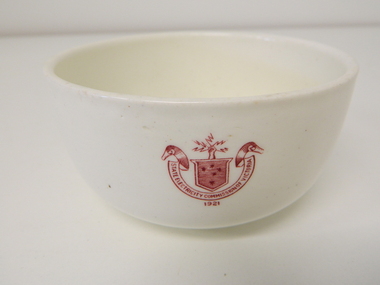 Kiewa Valley Historical Society
Bowl Ceramic, circa mid to late 1900's
... plate...secv...state electricity commission of victoria...crockery...mt beauty chalet...bogong mess...The quality of workmanship from big steel manufacturing plants in England and Europe could not be matched from anywhere else in the developed world. ceramic crockery plate secv state electricity commission of victoria crockery mt beauty chalet bogong mess hall The seal of the State Electricity Commission of Victoria is imprinted on the top outside rim within a curved scroll and a raised fist with electrical "charges" extending out.. ...This bowl was used by the State Electricity Commission of Victoria in their mess rooms for their workers during the construction of the Kiewa Hydro Electric Scheme. The imprint of the year "1921" was to identify the year that the SECV was formed which relieved the private VHEC (Victorian Hydro-Electric Company). As the scheme was of such a huge scope, isolated and time consuming nature, the feeding of its workers was quite demanding of cutlery and crockery. The use of sturdy English cups and saucers was essential. The period of construction and the isolation of the Kiewa Valley area placed heavy demand for "solid" crockery that could wear abusive handling. This period in time was one when crockery, whether for domestic or commercial use, was imported from "mother" England. This scenario was more so for governmental bodies such as rail, jails and electricity providers than domestic users. The influx of cheaper Asian crockery had not yet begun.This type of crockery item was used by the thousands of SEC Victorian staff and construction workers involved in the building of the Kiewa Hydro Electricity Scheme, over the extensive period (1938 to 1961). This was a period when Government bodies and other semi- government organisations were still tied to the "establishments" of "mother" England. It was a period in Australia's development when the Asian influence was very weak and the established ties to England and Europe was still very strong. The majority of heavy equipment and machinery was either made in England or Europe. Local/European expertise in dam construction and water management in alpine terrain came from migrants and specialist recruited from England and Europe. The quality of workmanship from big steel manufacturing plants in England and Europe could not be matched from anywhere else in the developed world.This item is a white ceramic State Electricity Commission of Victoria bowl. It is made in England and is of strong and durable ceramic. The 5mm thickness of the ceramic suggests this bowl (cereal/soup) belongs to a commercial kitchen environment and not domestic. The indent bottom of the bowl is 5mm deep with a side curvature ratio of 2:5. The ceramic is glazed to a commercial standard (worker's mess). See also KVHS 0128 (B to D) for other ceramic crockery. The seal of the State Electricity Commission of Victoria is imprinted on the top outside rim within a curved scroll and a raised fist with electrical "charges" extending out.. Snuggled within the borders of the scroll is a banner with the five stars of the Southern Cross . On the underside "Vitrified sold by Cafe & Hotel Supplies Pty Ltd Dunn Bennett & Co. Ltd. Burslem Made in England"ceramic crockery, plate, secv, state electricity commission of victoria, crockery, mt beauty chalet, bogong mess hall -
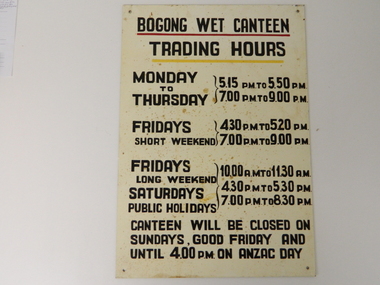 Kiewa Valley Historical Society
Sign Canteen Painted, Circa 1950
... plate...secv...state electricity commission of victoria...canteen...bogong mess...On site accommodation for the workforce is still a requirement for some mining areas but high market returns have produced fly in/out labour. saucer plate secv state electricity commission of victoria canteen bogong mess hall recreational amenities socialisation of sec vic kiewa hydro scheme labour force In black stenciled type "BOGONG WET CANTEEN" underneath this "TRADING HOURS" Below this "MONDAY TO THURSDAY 5.15 PM TO 5.50 PM, 7.00 PM TO 9.00 PM" "FRIDAYS SHORT WEEKEND 4.30 PM TO 5.20 PM 7.00 PM TO 9.00 PM" Below this "FRIDAYS LONG WEEKEND 10.00AM TO 11.30 AM" Below this "SATURDAYS PUBLIC HOLIDAYS 4.30 PM TO 5.30 PM 7.00 PM TO 8.30 PM" bELOW THIS "CANTEEN WILL BE CLOSED ON SUNDAYS, GOOD FRIDAY AND UNTIL 4.00 PM ON ANZAC DAY" This anodised metal sign has been "block" stenciled on. ...This sign is a part of the "human" factor required for remote and difficult, large impact (both labour and other resources) projects. It is one of the "human" factors which was clearly used in the big 1930's to the 1970's "landscape redevelopment" schemes which started in the early 1900's and is highly regarded as lifting the Australian psyche of only primary producers to an industrial level, equal to any in the world.This "Wet Canteen" sign was installed at the entrance of the Bogong "workers" village "provision's hut" detailing the operational times for the SEC Victorian staff and construction workers, involved in the building of the Kiewa Hydro Electricity Scheme to obtain alcoholic beverages. This facility lasted for over the extensive period (1938 to 1961) of the "Schemes" building phase. This large project was the forerunner when industrial legislation provided for the welfare of workers living in the Bogong Village. The provision of facilities such as a "wet canteen" was of the utmost importance not only to ensure that the long running project was both successful, production wise, but also that its employees were not only physically but also mentally healthy. This sign details that all aspects required for a fit and productive labour force were in place, in this remote and demanding work environment. The majority of heavy equipment and machinery used was either made in England or Europe. A section of the specialised workforce came from local and European expertise in dam construction and water management in alpine terrain. The majority of labour came from migrants and some specialists recruited from England and Europe. At this point in time, the quality of the machines used came from England, Europe and the USA and could not be matched from anywhere else in the developed world. With a specialised workforce came the responsibility of providing all the "comforts of home" including alcoholic beverages. On site accommodation for the workforce is still a requirement for some mining areas but high market returns have produced fly in/out labour.This anodised metal sign has been "block" stenciled on. Black lettering and numbers with the main headings underlined with a red and a yellow line(emphasising the headings)In black stenciled type "BOGONG WET CANTEEN" underneath this "TRADING HOURS" Below this "MONDAY TO THURSDAY 5.15 PM TO 5.50 PM, 7.00 PM TO 9.00 PM" "FRIDAYS SHORT WEEKEND 4.30 PM TO 5.20 PM 7.00 PM TO 9.00 PM" Below this "FRIDAYS LONG WEEKEND 10.00AM TO 11.30 AM" Below this "SATURDAYS PUBLIC HOLIDAYS 4.30 PM TO 5.30 PM 7.00 PM TO 8.30 PM" bELOW THIS "CANTEEN WILL BE CLOSED ON SUNDAYS, GOOD FRIDAY AND UNTIL 4.00 PM ON ANZAC DAY"saucer, plate, secv, state electricity commission of victoria, canteen, bogong mess hall, recreational amenities, socialisation of sec vic kiewa hydro scheme labour force -
4th/19th Prince of Wales's Light Horse Regiment Unit History Room
Trophy, abt 1960
... Presented to Sgt Max D'Atri, a former member of the Regiment Trophy Basket Ball D'Atri REGIMENTAL BASKETBALL TEAM Best and Fairest Summer 1961 SGT M D'ATRI On back of stand - 4/19 PWLH Sgts Mess 1997 Metal plate affixed to bakelite mount. Plate consists of 4.6 cm circle in which is 3 basket ball players. ...Presented to Sgt Max D'Atri, a former member of the RegimentMetal plate affixed to bakelite mount. Plate consists of 4.6 cm circle in which is 3 basket ball players. Columns at each side of circle. Laurel wreath under circle. Insciption plate under circle motif.REGIMENTAL BASKETBALL TEAM Best and Fairest Summer 1961 SGT M D'ATRI On back of stand - 4/19 PWLH Sgts Mess 1997trophy, basket ball, d'atri,
