
Showing 138 items matching "metal craft"
-
 Flagstaff Hill Maritime Museum and Village
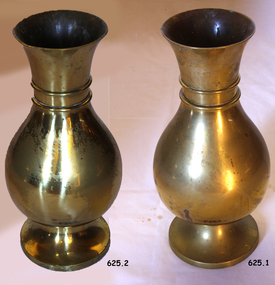
Functional object - Vase, T. Gaunt & Co, circa 1944
... ...metal craft...Flagstaff Hill Maritime Museum and Village Flagstaff Hill Warrnambool Maritime Museum Maritime Village Shipwreck Coast Great Ocean Road Religion Religious service St Nicholas Seamen’s Church Williamstown Missions to Seamen Victoria brass vases metal craft brassware altar vase church vase Mrs R Raybould Margaret R Pearson T Gaunt & Co church furnishing Engraved on the 625.1 "Presented By Margaret R. ...This pair of brass altar vases is from the St. Nicholas Seamen’s Church, 139 Nelson Place, Williamstown, Victoria, during religious services there. The Church was operated by the Mission to Seamen organisation. Each vase is inscribed with the donors' names and the year of presentation - Margaret R. Pearson 1944, Mrs B Raybould 1944, - and the maker's name T. Gaunt & Co. The two donors presented the vases to St Nicholas Seamen's Church in Williamstown as part of the furniture and furnishings for the new church that officially opened in 1944. T. Gaunt & Co. engraved on both vases. T. Gaunt & Co. of Melbourne, is a manufacturer, importer and retailer of a wide variety of goods including jewellery, clocks and watches, navigational and measuring instruments, dinnerware, glassware and ornaments. Thomas Gaunt's photograph was included in an album of security identity portraits of members of the Victorian Court, Centennial International Exhibition, Melbourne, 1888. THE MISSIONS TO SEAMEN (Brief History: for more, see our Reg. No. 611, Set of Pews) The Missions to Seamen, an Anglican charity, has served seafarers of the world since 1856 in Great Britain. It symbol is a Flying Angel, inspired by a Bible verse. Today there are centr4es in over 200 ports world-wide where seamen of all backgrounds are offered a warm welcome and provided with a wide range of facilities. In Victoria the orgainsation began in Williamstown in 1857. It was as a Sailors’ Church, also known as ‘Bethel’ or the ‘Floating Church’. Its location was an old hulk floating in Hobson’s Bay, Port of Melbourne. It soon became part of the Missions to Seamen, Victoria. In the year 2000 the organisation, now named Mission to Seafarers, still operated locally in Melbourne, Portland, Geelong and Hastings. The Ladies’ Harbour Lights Guild was formed in 1906 to support the Missions to Seamen in Melbourne and other centres such as Williamstown. Two of the most significant ladies of the Guild were founder Ethel Augusta Godfrey and foundation member Alice Sibthorpe Tracy (who established a branch of the Guild in Warrnambool in 1920). The Guild continued its work until the 1960s. In 1943 a former Williamstown bank was purchased for the Missions to Seaman Club. The chapel was named St Nicholas’ Seamen’s Church and was supported by the Ladies’ Harbour Lights Guild, the Williamstown Lightkeepers’ Auxiliary and the League of Soldiers’ and Sailors’ Friends. It ceased operation in 1966. A Missions to Seamen Chapel and Recreation Room was a significant feature of ports during the late 1800s and into the 1900s. It seemed appropriate for Flagstaff Hill to include such a representation within the new Maritime Village, so the Melbourne Board of Management of Missions to Seamen Victoria gave its permission on 21st May 1979 for the entire furnishings of the Williamstown chapel to be transferred to Flagstaff Hill. The St Nicholas Seamen’s Church was officially opened on October 11, 1981 and closely resembles the Williamstown chapel. This par of vases is significant historically for its origin in the St Nicholas Mission to Seamen's Church in Williamstown, established in 1857 to cater for the physical, social, and spiritual needs of seafarers. It originated in Bristol, England when a Seamen's Mission was formed in 1837. The connection of pair of vases to the original donation to the Mission to Seamen highlights the strong community awareness of the life of people at sea, their dangers and hardships, and their need for physical, financial, spiritual and moral support. Vase: pair of two polished brass altar vases, round, pear-shaped, bulbous body on a round pedestal, two neck rings and flared lips. Inscriptions on both vases in script around the base. Made by T. Gaunt & Co. One was presented to the church by Margaret R Pearson and the other presented by Mrs B. Raybould in 1944 The vases are part of the St Nicholas Seamen's Church Engraved on the 625.1 "Presented By Margaret R. Pearson 1944." Engraved on 625.2 "Presented By Mrs B. Raybould. 1944." Both engraved "T GAUNT & Co"flagstaff hill maritime museum and village, flagstaff hill, warrnambool, maritime museum, maritime village, shipwreck coast, great ocean road, religion, religious service, st nicholas seamen’s church, williamstown, missions to seamen victoria, brass vases, metal craft, brassware, altar vase, church vase, mrs r raybould, margaret r pearson, t gaunt & co, church furnishing -
 Flagstaff Hill Maritime Museum and Village
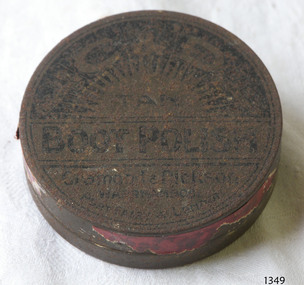
Container - Boot Polish Tin, Cramond and Dickson, 1855-1974
... ...metal craft...Flagstaff Hill Maritime Museum and Village Flagstaff Hill Maritime Village Maritime Museum Shipwreck Coast Great Ocean Road Warrnambool boot polish shoe cleaning grooming Cramond and Dickson Warrnambool business department store commerce Timor Street Liebig Street Port Fairy business metal craft tinware "C and D Tan Boot Polish" and "Cramond and Dickson, Warrnambool, Port Fairy & London" and "For best results, remove all dust and apply a little C and D Dressing, Brush Briskly" "Weight when packed 1 1/2 ozs net" Container: a tin of boot polish, with a small amount of light tan polish inside. ...This tin of boot polish was a product sold be Cramond and Dickson store, which traded in Warrnambool from 1855 - 1974. John Glass Cramond and James Dickson migrated from Scotland to Melbourne, where they opened a Cramond and Dickson store in St Kilda. They were inspired by the growth in Warrnambool after a visit and opened a second store there in 1855. The Cramond and Dickson store, grocers – drapery – ironmongery - chemist, was located on the corner of Liebig and Timor Streets, Warrnambool. Both Cramond and Dickson were involved in the business and social aspects of Warrnambool’s community. Cramond and Dickson closed in 1974. An advertisement placed by Cramond and Dickson in The Camperdown Chronicle, Saturday 6th April 1895, states them “showing the latest novelties for the coming winter season” … “import directly from English and Continental manufacturers” … “representatives in London … always in touch with the Newest Continental Fashions” ... “having been established for so many years we know the requirements of the Western District”… “allow 5 percent discount on goods paid for at the time of purchase”.The tin of boot polish is an example of the goods sold in Warrnambool in the 19th and early 20th century. It s significant for its association with Cramond and Dickson, a large retail store established in Warrnambool and operating from 1855 to 1974. Both partners were prominent figures in the community.Container: a tin of boot polish, with a small amount of light tan polish inside. Inscribed for the makers, Cramond and Dickson, Warrnambool, Port Fairy & Londo. Labelling is partly obscured by corrosion. Instructions for use are on the base of the tin. "C and D Tan Boot Polish" and "Cramond and Dickson, Warrnambool, Port Fairy & London" and "For best results, remove all dust and apply a little C and D Dressing, Brush Briskly" "Weight when packed 1 1/2 ozs net"flagstaff hill maritime museum and village, flagstaff hill, maritime village, maritime museum, shipwreck coast, great ocean road, warrnambool, boot polish, shoe cleaning, grooming, cramond and dickson, warrnambool business, department store, commerce, timor street, liebig street, port fairy business, metal craft, tinware -
 Flagstaff Hill Maritime Museum and Village
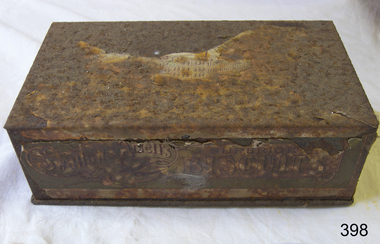
Container - Biscuit Tin, Swallow and Ariell Pty Ltd, Mid-19th to mid-20th century
... ...metal craft...Flagstaff Hill Warrnambool Shipwrecked-coast Flagstaff-Hill Flagstaff-Hill-Maritime-Museum Maritime-Museum Shipwreck-coast Flagstaff-Hill-Maritime-Village metal craft tin ware biscuit box biscuit tin food container melbourne biscuit maker swallow thomas swallow thomas ariell Ariell 'Swallow and Ariells Superior Melbourne Biscuits' Trademark: image [swallow] Rectangular tin container with attached lid. ...This tin was made in Melbourne and contained Swallows and Ariells biscuits. The label was written in four languages. The biscuits may have been made for export or perhaps for immigrants now living in Australia. Australia's first biscuit company was founded in 1854 by Thomas Swallow. Within five years he had taken in a partner, T.H. Ariell. After Ariell died in 1875, F.T. Derham was appointed partner and managing director in 1877, a position held by several generations of his descendants. By the early 1880s the Port Melbourne factory extended to 3 acres (1.2 ha), and the company owned flourmills and sugar plantations in the Goulburn Valley and Northern Queensland. With no equal outside Great Britain, Swallow & Ariell was the fifth largest biscuit company in the world, manufacturing over 100 varieties, including the common ship biscuit (an original product) and meat biscuits (apparently taken by Burke and Wills on their ill-fated expedition). The company also boasted popular sideline products, including cakes, plum puddings, ice-cream and dried fruit. Renowned for its patriotic fundraising campaigns during both world wars, it diverted most of its biscuits and plum puddings to the Australian and US services in World War II. Company employees were filmed leaving work in 1905 in the Salvation Army film unit's first sponsored industrial documentary film. The surviving opening sequences are held by ScreenSound Australia. The company was delisted on 5 August 1964 following acquisition of more than 95% of its capital by the Australian Biscuit Co. The factory was later registered by the National Trust and converted into units. https://www.emelbourne.net.au/biogs/EM01456b.htmThis biscuit tin is representative of local Melbourne and Victorian produce. The label was in four languages, perhaps for export or for local immigrants. The firm Swallow and Ariells Pty Ltd was a very early manufacture and was in business for over 100 years.Rectangular tin container with attached lid. Label advertises Swallow and Ariells biscuits. Made in Melbourne. The label is written in four languages. The trademark, a swallow, is on the tin. The tin is very badly corroded.'Swallow and Ariells Superior Melbourne Biscuits' Trademark: image [swallow]flagstaff hill, warrnambool, shipwrecked-coast, flagstaff-hill, flagstaff-hill-maritime-museum, maritime-museum, shipwreck-coast, flagstaff-hill-maritime-village, metal craft, tin ware, biscuit box, biscuit tin, food container, melbourne biscuit maker, swallow, thomas swallow, thomas ariell, ariell -
 Flagstaff Hill Maritime Museum and Village
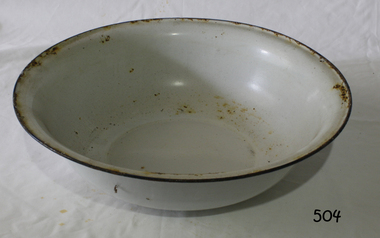
Domestic object - Enamel basin
... ...metal craft...Flagstaff Hill Flagstaff Hill Maritime Museum and Village Warrnambool Maritime Museum Maritime Village Great Ocean Road Shipwreck Coast enamel bowl enamel dish white enamel white with blue rim kitchenware household object 19th century 20th century cooking cleaning personal care basin enamel basin wash basin metal craft tinware Wash basin: white enamel bowl with blue rim. ...A mass-produced domestic item. The design was popular in the early to mid-20th century.The basin is an example of early to mid-20th-century kitchenware.Wash basin: white enamel bowl with blue rim. flagstaff hill, flagstaff hill maritime museum and village, warrnambool, maritime museum, maritime village, great ocean road, shipwreck coast, enamel bowl, enamel dish, white enamel, white with blue rim, kitchenware, household object, 19th century, 20th century, cooking, cleaning, personal care, basin, enamel basin, wash basin, metal craft, tinware -
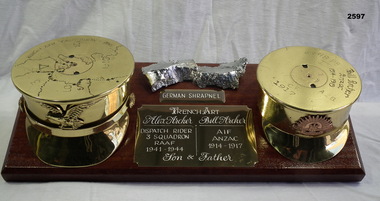 Bendigo Military Museum
Memorabilia - TRENCH ART, WW1, WW2, Post 1945 (estimated); Made in WWI and WWII and assembled upon return
... ...metal craft- brassware...In Australia he was re mustered as Office Orderly on 6.7.1944 and then discharged from the RAAF on 2.10.1944 Medically Unfit. handcrafts - trench art metal craft- brassware arms - ammunition military history - souvenirs Map - "North Africa, 1940", on left hand side, "18-Pounder, 1917, Bill Archer-Anzac, 1914-1919", on right hand side, "German shrapnel" Wooden base with brass shells either end resembling Officers caps,one being WWI, the other WWII, both inscribed. ...William John ARCHER (Bill) No 321 (born Castlemaine, enlisted Castlemaine) in B Coy 21st Batt AIF on 18.1.15. Embarked for Eygpt 8.5.15. Hospital 9.9.15 with Influenza. Hospital 24.11.15 with Gastric Enteritis. Hospital 2.1.16 with Otitis Media. Transfers to the 57th Batt and embarks for France. Hospital with Trench Fever 4.10.16. Promoted to Cpl 28.4.17. Hospital 19.3.18 with Scabies. WIA 18.4.18 GSW's to chest and leg severe. Discharged from the AIF medically unfit 9.1.19. Alexander William ARCHER No 40637 (born Castlemaine, enlisted Melbourne) in the RAAF on 16.5.41 age 18 years 8 months. He wanted to be a Mess Steward and was taken in as he had worked in similar work line. He then has 5 postings before embarking for Egypt on 2.4.1942 and was posted to No 3 SQD RAAF on 20.5.1942. Re mustered as a Motor Cyclist he became a Dispatch Rider on 8.9.1942 between the RAAF and the Army. Alex served in the Middle East and Italy with 3 SQD. He embarked from Egypt diagnosed with Kyphosis and Scoliosis on 5.2.1944. In Australia he was re mustered as Office Orderly on 6.7.1944 and then discharged from the RAAF on 2.10.1944 Medically Unfit. Wooden base with brass shells either end resembling Officers caps,one being WWI, the other WWII, both inscribed. Centre plaque inscribed Alex Archer and Bill Archer, father and son. Above the centre plaque is a piece of German shrapnel chrome plated Map - "North Africa, 1940", on left hand side, "18-Pounder, 1917, Bill Archer-Anzac, 1914-1919", on right hand side, "German shrapnel"handcrafts - trench art, metal craft- brassware, arms - ammunition, military history - souvenirs -
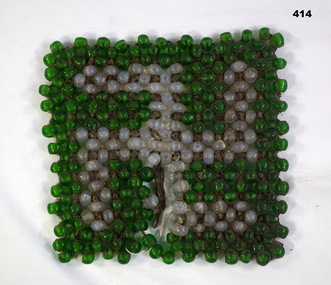 Bendigo Military Museum
Functional object - TRIVET, C. 1939 - 45
... ...metal craft?...Brought back to Australia by an AIF officer domestic items - cooking metal craft? Square trivet featuring swastika. ...Trivet - on which hot items could be placed. Brought back to Australia by an AIF officerSquare trivet featuring swastika. Made from green and purple beads joined with brown cord. Swastika is in purple beading.domestic items - cooking, metal craft? -
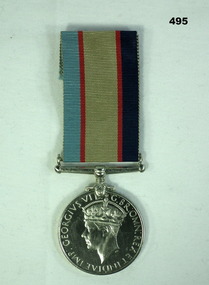 Bendigo Military Museum
Award - MEDAL WW2, Post 1945
... ...metal craft...Refer Caat No 475.10 for service details. numismatics - medals- military metal craft "VX148845 H.T. Ridge" Medal and ribbon, not mounted re H.T Ridge. 1. ...Henry Thomas Ridge V57996 and VX148845, CMF & 2nd AIF. Refer Caat No 475.10 for service details.Medal and ribbon, not mounted re H.T Ridge. 1. Australian Service Medal 1939 - 45"VX148845 H.T. Ridge"numismatics - medals- military, metal craft -
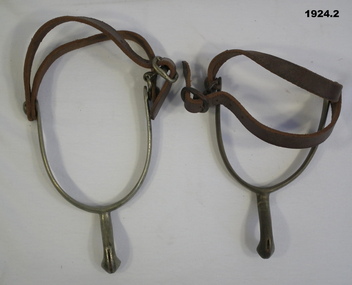 Bendigo Military Museum
Equipment - SPURS WW1, 1914-15 (estimated)
... ...metal craft - cast iron...Pre WW1 he had served in the 17th Light Horse from 1910 until he enlisted in the AIF with the rank of Lieut age 24 years 3 months with 14th reinforcements 8th L.Horse on 16.12.1915, embark for Egypt 27.1.1916, transfer to 12th FAB (Artillery) 6.4.1916, embark for France 2.6.1916, promoted Capt 21.1.1917, detached to Australian Artillery Reserve Brigade England 6.2.1918, rejoins unit 27.5.1918, transfer to 45th Battery to Command 8.9.1918, promoted Major 22.10.1918, hospital 19.6.1919 with Scabies, discharged from the AIF 23.12.1919. military history transport - horse metalcraft brassware metal craft - cast iron .1) Riding spurs, metal 'U' shape with 2 leather straps attached, one with adjustable strap & buckle. .2) Same as .1) Equipment SPURS WW1 ...The Spurs were issued to Frank Levy. Pre WW1 he had served in the 17th Light Horse from 1910 until he enlisted in the AIF with the rank of Lieut age 24 years 3 months with 14th reinforcements 8th L.Horse on 16.12.1915, embark for Egypt 27.1.1916, transfer to 12th FAB (Artillery) 6.4.1916, embark for France 2.6.1916, promoted Capt 21.1.1917, detached to Australian Artillery Reserve Brigade England 6.2.1918, rejoins unit 27.5.1918, transfer to 45th Battery to Command 8.9.1918, promoted Major 22.10.1918, hospital 19.6.1919 with Scabies, discharged from the AIF 23.12.1919..1) Riding spurs, metal 'U' shape with 2 leather straps attached, one with adjustable strap & buckle. .2) Same as .1)military history, transport - horse, metalcraft brassware, metal craft - cast iron -
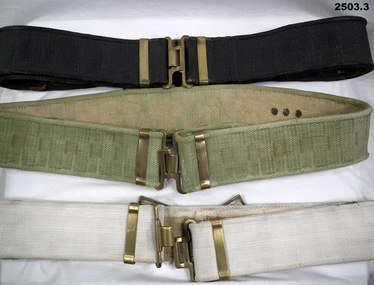 Bendigo Military Museum
Uniform - BELTS, c.1940 - 1960's
... ...metal craft- brassware...For example the black one is polished nugget. uniforms - army costume accessories - male metal craft- brassware .1) “J R Wright” .1) Webbing belt, adjustable, black with brass keepers & buckles. .2) Webbing belt, adjustable, green with brass keepers & buckles. ...Webbing belts were coloured for different purposes & different times in years. For example the black one is polished nugget..1) Webbing belt, adjustable, black with brass keepers & buckles. .2) Webbing belt, adjustable, green with brass keepers & buckles. Has 2 webbing & brass keepers on the rear. .3) Webbing belt, adjustable, white with brass keepers & buckles. Has 2 webbing & brass keepers on the rear..1) “J R Wright”uniforms - army, costume accessories - male, metal craft- brassware -
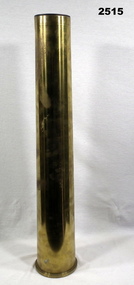 Bendigo Military Museum
Memorabilia - TRENCH ART, BRASS VASE, Post WW2
... ...metal craft- brassware...military history - souvenirs arms - ordnance metal craft- brassware “76 x 636 DM 30 LOT SM 104 0103” Shell casing brass, tapered, used as a tall vase. ...Shell casing brass, tapered, used as a tall vase. Item classed as trench art.“76 x 636 DM 30 LOT SM 104 0103”military history - souvenirs, arms - ordnance, metal craft- brassware -
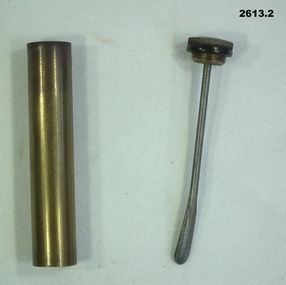 Bendigo Military Museum
Container - CONTAINER, OIL, Possibly WW1 - WW2 and on
... ...metal craft- brassware...containers - commercial metal craft- brassware military history - equipment Oil container OA stamped on screw top Tick (symbol) on side of cylinder Oil bottle for 303 Rifle. ...Oil bottle for 303 Rifle. Brass cylinder with screw out top with oil scoop. .1) Brass cylinder for oil with black sealing washer. .2) Brass screw top with oil scoop attached.OA stamped on screw top Tick (symbol) on side of cylindercontainers - commercial, metal craft- brassware, military history - equipment, oil container -
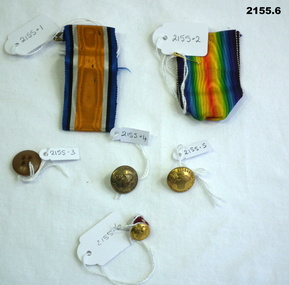 Bendigo Military Museum
Award - SERVICE RIBBONS WW1, BUTTONS, Post 1919, post 1945
... ...metal craft- brassware...John Stanistreet collection. uniforms - accessories metal craft- brassware manchester .4) - .5) - .6) ”Australian Military Forces” .1) Ribbon: British War Medal 1914-18 .2) Ribbon: Victory Medal 1914-19 .3) Button: Brown, plastic 4 hole .4) Button: Brass coloured Australia in centre Crown above .5) Button: Gold coloured Australia in centre Crown above .6) Button: Gold coloured Australia in centre Crown above, piece of fabric attached Award SERVICE RIBBONS WW1, BUTTONS ...John Stanistreet collection..1) Ribbon: British War Medal 1914-18 .2) Ribbon: Victory Medal 1914-19 .3) Button: Brown, plastic 4 hole .4) Button: Brass coloured Australia in centre Crown above .5) Button: Gold coloured Australia in centre Crown above .6) Button: Gold coloured Australia in centre Crown above, piece of fabric attached.4) - .5) - .6) ”Australian Military Forces”uniforms - accessories, metal craft- brassware, manchester -
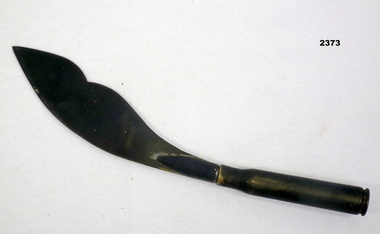 Bendigo Military Museum
Memorabilia - TRENCH ART, BUTTER KNIFE, C. 1940 - 45
... ...metal craft- brassware...Items in the collection re J.C.W LEDEUX, refer Cat No 2378 for his service details. domestic items-cutlery military history - souvenirs arms - ammunition metal craft- brassware Trench art Butter knife with handle made from cartridge case, item classed as trench art. ...Items in the collection re J.C.W LEDEUX, refer Cat No 2378 for his service details.Butter knife with handle made from cartridge case, item classed as trench art.domestic items-cutlery, military history - souvenirs, arms - ammunition, metal craft- brassware, trench art -
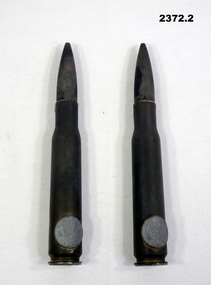 Bendigo Military Museum
Weapon - CARTRIDGES, C.1941 - 45
... ...metal craft- brassware...Items in the collection re J.C.W LEDEUX, refer Cat No 2378 for his service details. arms - ammunition numismatics - coins metal craft- brassware Makers marks on base “L/5/42” Two .50 Cartridges, brass each with Dutch 1/4 Gulden coins dated 1941 on side. ...Items in the collection re J.C.W LEDEUX, refer Cat No 2378 for his service details.Two .50 Cartridges, brass each with Dutch 1/4 Gulden coins dated 1941 on side. Vestiges of soldier near join.Makers marks on base “L/5/42”arms - ammunition, numismatics - coins, metal craft- brassware -
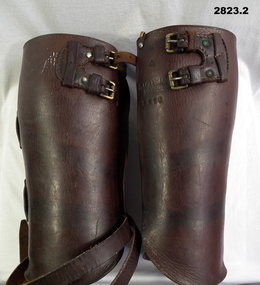 Bendigo Military Museum
Uniform - LEGGINGS, 1928
... ...metal craft- brassware...costume - male uniform trades-leatherworking metal craft- brassware military history - army Passchendaele barracks trust .1) & .2) Stamped into the leather near the buckles: “15 [up arrow] RG, A Joakman Maker 1928” .1) Handwritten in red ink: “A00” in black ink inside top area: “28” 1.) & .2) Pair of dark brown coloured leather leggings, rectangular shape used in a cylindrical shape with 2 straps & brass buckles. ...1.) & .2) Pair of dark brown coloured leather leggings, rectangular shape used in a cylindrical shape with 2 straps & brass buckles..1) & .2) Stamped into the leather near the buckles: “15 [up arrow] RG, A Joakman Maker 1928” .1) Handwritten in red ink: “A00” in black ink inside top area: “28”costume - male uniform, trades-leatherworking, metal craft- brassware, military history - army, passchendaele barracks trust -
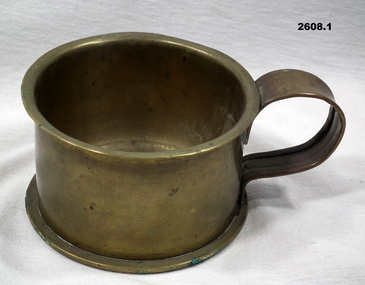 Bendigo Military Museum
Memorabilia - TRENCH ART, VARIOUS, c.WWI
... metal craft- brassware...Collection of ARTHUR CYRIL EBDON See also: 2605.2, 2606, 2607, 2608.3 metal craft- brassware handcrafts - trench art military history - souvenirs Passchendaele barracks trust .1) Stamped on base: “St / GFSP 289 / DE2 1916 / ?” ...Collection of ARTHUR CYRIL EBDON See also: 2605.2, 2606, 2607, 2608.3.1) Brass cup with handle (flattened brass) made from shell case. .2) Brass paper knife made from ammunition (rifle) blade flattened brass. .3) Brass frame (photo/picture) made from ammunition (rifle) & flattened brass, square shape..1) Stamped on base: “St / GFSP 289 / DE2 1916 / ?”metal craft- brassware, handcrafts - trench art, military history - souvenirs, passchendaele barracks trust -
 Clunes Museum
Equipment - NAILS
... ...metal craft...local history metal craft hand made nails HAND MADE CAST IRON / METAL NAILS. ...HAND MADE CAST IRON / METAL NAILS. DIFFERENT LENGTHSlocal history, metal craft, hand made nails -
Clunes Museum
Memorabilia - PACKET OF GOLD LEAF
... metal craft...metal craft gold mining SHEETS OF GOLD LEAF INTERLEAVED WITH ONION SKIN, PAPER ENCASED IN PAPER IN PAPER PACKAGE. ...SHEETS OF GOLD LEAF INTERLEAVED WITH ONION SKIN, PAPER ENCASED IN PAPER IN PAPER PACKAGE.metal craft, gold, mining -
Clunes Museum
Ceremonial object - GOLD HAND BELL, 1983
... ...metal craft...USED DURING MEETINGS local history metal craft societies clunes r.v.i.b auxiliary PRESENTED TO CLUNES R.V.I.B. ...GOLD BELL. 50TH ANNIVERSARY PRESENTATION TO CLUNES AUXILIARY FOR THE BLIND FROM ROYAL VICTORIAN INSTITUTE FOR THE BLIND. USED DURING MEETINGSSMALL GOLD PLATED HAND BELL USED AT MEETINGS OF CLUNES AUXILIARY VICTORIAN INSTITUTE FOR THE BLIND. (R.V.I.B)PRESENTED TO CLUNES R.V.I.B. AUXILIARY 50TH ANNIVERSARYlocal history, metal craft, societies, clunes r.v.i.b auxiliary -
Clunes Museum
Domestic object - LIGHTHOUSE PAPER WEIGHT
... ...metal craft...local history metal craft clunes blind auxiliary CHROME PLATED PAPER WEIGHT IN SHAPE OF LIGHTHOUSE. ...CHROME PLATED PAPER WEIGHT IN SHAPE OF LIGHTHOUSE. SYMBOL OF THE ROYAL VICTORIAN INSTITUTE FOR THE BLIND. ELECTROPLATED BRASS OR NICKEL SILVER, SYMBOL OF ROYAL VICTORIAN INSTITUTE FOR THE BLINDlocal history, metal craft, clunes blind auxiliary -
Clunes Museum
Functional object - DOOR KNOCKER
... ...METAL CRAFT...LOCAL HISTORY BUILDING METAL CRAFT CAST IRON MOULDED DOOR KNOCKER Functional object DOOR KNOCKER ...THIS DOOR KNOCKER WAS DUG UP IN A GARDEN BY DOUGLAS PATTEN 39 LESLIE STREET CLUNES IN YEAR 2000 WHO PRESENTED OBJECT TO CLUNES MUSEUM.CAST IRON MOULDED DOOR KNOCKERlocal history, building, metal craft, -
Clunes Museum
Article - BRASS CHAIN (SMALL PIECE)
... ...metal craft...SMALL SECTIONS OF CHAIN WAS COLLECTED FROM THE CHURCH SITE - POSSIBLY CLUNES CHURCH OF ENGLAND APPROX. 1887. local history metal craft brassware churches - st.pauls anglican TWO SMALL SECTIONS BRASS CHAIN COLLECTED FROM CLUNES CHURCH SITE - P0SSIBLY ST.PAULS CHURCH OF ENGLAND 1989. ...SMALL SECTIONS OF CHAIN WAS COLLECTED FROM THE CHURCH SITE - POSSIBLY CLUNES CHURCH OF ENGLAND APPROX. 1887.TWO SMALL SECTIONS BRASS CHAIN COLLECTED FROM CLUNES CHURCH SITE - P0SSIBLY ST.PAULS CHURCH OF ENGLAND 1989.local history, metal craft, brassware, churches - st.pauls anglican -
 Federation University Historical Collection
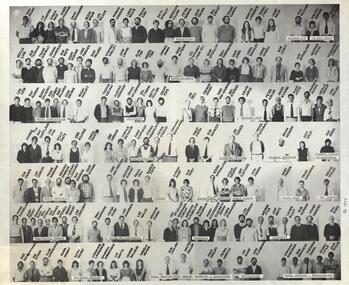
Poster - Poster - black and white, Ian Robinson (SMB Audio Visual), School of Mines, Ballarat: Staff images, c1979, c1979
... ...metal fabrication...art/craft...The Ballarat School of Mines is a predecessor institution of Federation University Austraila. humanities maths science metal fabrication art/craft machine shop administration planning student services co-ordinator motor mechanics library educational services audio visual print electrical trades plumbing sheetmetal remedial carpentry business studies panel beating body making painting and decorating bricklaying rural studies woolclassing barry firth librarian heather durant paula hall john van dreevan Frank Sheehan Ballarat School of Mines staffmembers poster staffmember poster Black and white poster of images of teaching staff at The School of Mines. ...The Ballarat School of Mines is a predecessor institution of Federation University Austraila.Black and white poster of images of teaching staff at The School of Mines. Images grouped into teaching areas/subjectshumanities, maths, science, metal fabrication, art/craft, machine shop, administration, planning, student services, co-ordinator, motor mechanics, library, educational services, audio visual, print, electrical trades, plumbing, sheetmetal, remedial, carpentry, business studies, panel beating, body making, painting and decorating, bricklaying, rural studies, woolclassing, barry firth, librarian, heather durant, paula hall, john van dreevan, frank sheehan, ballarat school of mines, staffmembers, poster, staffmember poster -
 Royal Australian and New Zealand College of Obstetricians & Gynaecologists (RANZCOG)
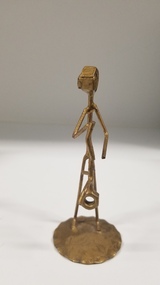
Sculpture - Metal sculpture of a figure holding a baby
... Sticker on underside of base of statue reads 'Handcrafted/By/ROCK CREEK/METAL CRAFT/P.O Box 39/Hansen, Idaho 83334/USA'. ...Sticker on underside of base of statue reads 'Handcrafted/By/ROCK CREEK/METAL CRAFT/P.O Box 39/Hansen, Idaho 83334/USA'. ...Metal statue of a figure holding a baby. Figure and baby take the form of stick figures, with thin metal bodies and hexagonal bolts for their heads. The larger figure is holding the baby by ankles in its right hand, dangling the baby head down in front of its torso. Sticker on underside of base of statue reads 'Handcrafted/By/ROCK CREEK/METAL CRAFT/P.O Box 39/Hansen, Idaho 83334/USA'. -
 Federation University Historical Collection
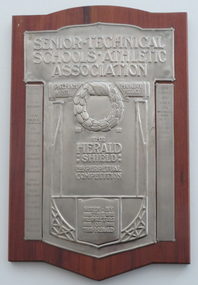
Award - Shield, Senior Technical Schools Athletics Association Herald Shield, 1918-1940, c1918
... During World War I, Kenneth oversaw the training of repatriated soldiers which catalysed into a new, a successful art metal business, the Decorative Metal Craft Company in Chancery Lane, Ballarat. ...During World War I, Kenneth oversaw the training of repatriated soldiers which catalysed into a new, a successful art metal business, the Decorative Metal Craft Company in Chancery Lane, Ballarat. ...The Senior Technical Schools Athletics Association ‘Herald Shield’ is one of many timber and metal repoussé commissions undertaken by students and staff at the Ballarat Technical Art School. The School was known for the quality of its art metal work which was applied to product, interior and commemorative designs. Between 1915 and 1936 Wilfred Kenneth (c1883-1957) taught boys and girls at preparatory and senior levels, including the ‘Art Metal Work and Repoussé’ industrial design specialisation. During World War I, Kenneth oversaw the training of repatriated soldiers which catalysed into a new, a successful art metal business, the Decorative Metal Craft Company in Chancery Lane, Ballarat. The shield was given by the proprietors of The Herald.Timber and metal repousse shield listing winning teams from 1918-1940. 1918 - Ballarat 1919 - Ballarat 1920 - Working Men's College Melbourne (now RMIT) 1921 - No contest 1922 - Swinburne 1923 - Ballarat 1924 - Ballarat 1925 - Ballarat 1926 - Ballarat 1927 - Geelong 1928 - Maryborough 1929 - Bendigo 1930 - Bendigo 1931 - Working Man's College 1932 - Wonthaggi 1933 - M.T.C. 1934 - Ballarat 1935 - Ballarat 1936 - Ballarat 1937 - No Contest 1938 - Ballarat 1939 - Ballarat 1940 - Geelong Above list engraved into metalherald shield, athletics, working mans college, rmit, ballarat school of mines, trophy, commission, art metal, repousse, ballarat technical art school, wilfred kenneth -
 Flagstaff Hill Maritime Museum and Village
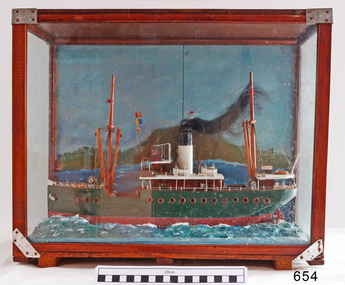
Craft - Ship Model, Eumeralla
... Case strengthened by metal brackets at top corners and bottom front corners. Eumeralla Craft Ship Model ...Ship model Eumeralla steamship with one funnel, two masts portholes in hull, set against a coastal scene with lighthouse. Ship is painted green. Model is in a wooden framed glass case. Split on background scene. Case strengthened by metal brackets at top corners and bottom front corners. flagstaff hill, warrnambool, shipwrecked-coast, flagstaff-hill, flagstaff-hill-maritime-museum, maritime-museum, shipwreck-coast, flagstaff-hill-maritime-village -
 Flagstaff Hill Maritime Museum and Village
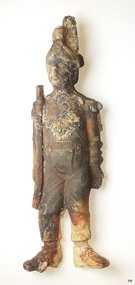
Leisure object - Toy Soldier, circa 1878
... metal (lead or tin) became popular during the 1800s. Heyde of Germany manufactured silhouette-shaped flat toy soldiers early in the century. Mignot of France released three-dimensional solid figures and later around 1893 W. Britain, a toy company became known for its die-cast lead toy soldiers. These innovations were designed to make sets of toy soldiers more affordable for middle and lower-class children, extending the market beyond the intricately made and hand-crafted...metal (lead or tin) became popular during the 1800s. Heyde of Germany manufactured silhouette-shaped flat toy soldiers early in the century. Mignot of France released three-dimensional solid figures and later around 1893 W. Britain, a toy company became known for its die-cast lead toy soldiers. These innovations were designed to make sets of toy soldiers more affordable for middle and lower-class children, extending the market beyond the intricately made and hand-crafted ...The toy soldier is a relic from the shipwreck of the LOCH ARD in 1878. It has a companion piece in the Flagstaff Hill collection. The toy soldier is unpainted, but the style of uniform, and the weapons carried (a musket and a basket-handled cutlass), indicate it is a representation of the Napoleonic Wars period from the beginning of the nineteenth century. Mass-produced toy soldiers made of cast metal (lead or tin) became popular during the 1800s. Heyde of Germany manufactured silhouette-shaped flat toy soldiers early in the century. Mignot of France released three-dimensional solid figures and later around 1893 W. Britain, a toy company became known for its die-cast lead toy soldiers. These innovations were designed to make sets of toy soldiers more affordable for middle and lower-class children, extending the market beyond the intricately made and hand-crafted replicas that were the preserve of the rich in the eighteenth century. Wooden military figures, specially carved and unpainted ones, were therefore not particularly common at the time when the Loch Ard foundered on Victoria’s southwest coast. Mignot was the first to sell unpainted soldiers, leaving their customers to fill in the colours according to their own patriotic preferences. It is, therefore, possible the two figures in the Flagstaff Hill collection were part of a new set intended for sale, rather than part of a passenger’s existing collection. Loch Ard History: The Loch Ard got its name from ”Loch Ard” a loch that lies to the west of Aberfoyle, and the east of Loch Lomond. It means "high lake" in Scottish Gaelic. The vessel belonged to the famous Loch Line which sailed many vessels from England to Australia. The Loch Ard was built in Glasgow by Barclay, Curle & Co. in 1873, the vessel was a three-masted square-rigged iron sailing ship that measured 79.87 meters in length, 11.58 m in width, and 7 m in depth with a gross tonnage of 1693 tons with a mainmast that measured a massive 45.7 m in height. Loch Ard made three trips to Australia and one trip to Calcutta before its fateful voyage. Loch Ard left England on March 2, 1878, under the command of 29-year-old Captain Gibbs, who was newly married. The ship was bound for Melbourne with a crew of 37, plus 17 passengers. The general cargo reflected the affluence of Melbourne at the time. Onboard were straw hats, umbrellas, perfumes, clay pipes, pianos, clocks, confectionery, linen and candles, as well as a heavier load of railway irons, cement, lead and copper. There were other items included that were intended for display in the Melbourne International Exhibition of 1880. The voyage to Port Phillip was long but uneventful. Then at 3 am on June 1, 1878, Captain Gibbs was expecting to see land. But the Loch Ard was running into a fog which greatly reduced visibility. Captain Gibbs was becoming anxious as there was no sign of land or the Cape Otway lighthouse. At 4 am the fog lifted and a lookout aloft announced that he could see breakers. The sheer cliffs of Victoria's west coast came into view, and Captain Gibbs realised that the ship was much closer to them than expected. He ordered as much sail to be set as time would permit and then attempted to steer the vessel out to sea. On coming head-on into the wind, the ship lost momentum, the sails fell limp and Loch Ard's bow swung back towards land. Gibbs then ordered the anchors to be released in an attempt to hold their position. The anchors sank some 50 fathoms - but did not hold. By this time the ship was among the breakers and the tall cliffs of Mutton Bird Island rose behind. Just half a mile from the coast, the ship's bow was suddenly pulled around by the anchor. The captain tried to tack out to sea, but the ship struck a reef at the base of Mutton Bird Island, near Port Campbell. Waves subsequently broke over the ship and the top deck became loosened from the hull. The masts and rigging came crashing down knocking passengers and crew overboard. When a lifeboat was finally launched, it crashed into the side of Loch Ard and capsized. Tom Pearce, who had launched the boat, managed to cling to its overturned hull and shelter beneath it. He drifted out to sea and then on the flood tide came into what is now known as Lochard Gorge. He swam to shore, bruised and dazed, and found a cave in which to shelter. Some of the crew stayed below deck to shelter from the falling rigging but drowned when the ship slipped off the reef into deeper water. Eva Carmichael a passenger had raced onto the deck to find out what was happening only to be confronted by towering cliffs looming above the stricken ship. In all the chaos, Captain Gibbs grabbed Eva and said, "If you are saved Eva, let my dear wife know that I died like a sailor". That was the last Eva Carmichael saw of the captain. She was swept off the ship by a huge wave. Eva saw Tom Pearce on a small rocky beach and yelled to attract his attention. He dived in and swam to the exhausted woman and dragged her to shore. He took her to the cave and broke the open case of brandy which had washed up on the beach. He opened a bottle to revive the unconscious woman. A few hours later Tom scaled a cliff in search of help. He followed hoof prints and came by chance upon two men from nearby Glenample Station three and a half miles away. In a complete state of exhaustion, he told the men of the tragedy. Tom then returned to the gorge while the two men rode back to the station to get help. By the time they reached Loch Ard Gorge, it was cold and dark. The two shipwreck survivors were taken to Glenample Station to recover. Eva stayed at the station for six weeks before returning to Ireland by steamship. In Melbourne, Tom Pearce received a hero's welcome. He was presented with the first gold medal of the Royal Humane Society of Victoria and a £1000 cheque from the Victorian Government. Concerts were performed to honour the young man's bravery and to raise money for those who lost family in the disaster. Of the 54 crew members and passengers on board, only two survived: the apprentice, Tom Pearce and the young woman passenger, Eva Carmichael, who lost her family in the tragedy. Ten days after the Lochard tragedy, salvage rights to the wreck were sold at auction for £2,120. Cargo valued at £3,000 was salvaged and placed on the beach, but most washed back into the sea when another storm developed. The wreck of Lochard still lies at the base of Mutton Bird Island. Much of the cargo has now been salvaged and some items were washed up into Lochard Gorge. Cargo and artefacts have also been illegally salvaged over many years before protective legislation was introduced in March 1982. One of the most unlikely pieces of cargo to have survived the shipwreck was a Minton majolica peacock- one of only nine in the world. The peacock was destined for the Melbourne 1880 International Exhibition. It had been well packed, which gave it adequate protection during the violent storm. Today the Minton peacock can be seen at the Flagstaff Hill Maritime Museum in Warrnambool. From Australia's most dramatic shipwreck, it has now become Australia's most valuable shipwreck artifact and is one of very few 'objects' on the Victorian State Heritage Register.The toy soldier represents a 19th-century child's interest in military history. The item is one of two toy soldiers recovered from the Loch Ard in Flagstaff Hill's collection. The shipwreck of the Loch Ard is of significance for Victoria and is registered on the Victorian Heritage Register ( S 417). Flagstaff Hill has a varied collection of artefacts from Loch Ard and its collection is significant for being one of the largest accumulations of artefacts from this notable Victorian shipwreck of which the subject items are a small part. The collections of objects give us a snapshot of how we can interpret the story of this tragic event. The collection is also archaeologically significant as it represents aspects of Victoria's shipping history, allowing us to interpret Victoria's social and historical themes. Through is associated with the worst and best-known shipwreck in Victoria's history.An unpainted, cream-coloured toy soldier, recovered from the Loch Ard. The figure wears a Napoleonic Wars-era uniform, a plumed helmet, a short jacket with tails, bib-front trousers with button closure, straps crossed at the front and back, and epaulettes. The figure is in marching posture with one foot extended forward, and is bearing a musket at the slope-arms position, with a sabre or cutlass slung behind. It is unable to stand on its own. There are reddish-brown and orange-brown stains on the head and body. The body has seams along both sides that are uneven at the lower leg. There is a hole in the back and the inside is hollow. The material has a rough texture.flagstaff hill, warrnambool, flagstaff hill maritime museum, shipwreck coast, flagstaff hill maritime village, great ocean road, loch ard, toy soldier, napoleonic uniforms, military toy, moulded soldier -
 Flagstaff Hill Maritime Museum and Village
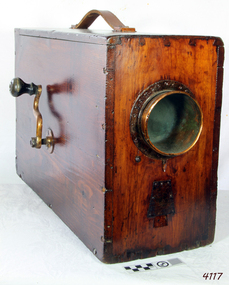
Instrument - Foghorn, Late 19th century
... craft. By manually turning the crank handle air is produced and fed into valves that direct air across vibrating metal reeds to produce the required sound. in foggy weather, fog horns are used to pinpoint a vessels position and to indicate how the vessel is sailing in foggy conditions. ...craft. By manually turning the crank handle air is produced and fed into valves that direct air across vibrating metal reeds to produce the required sound. in foggy weather, fog horns are used to pinpoint a vessels position and to indicate how the vessel is sailing in foggy conditions. ...A foghorn is a device that uses sound to warn of navigational hazards like rocky coastlines, or boats of the presence of other vessels, in foggy conditions. The term is most often used with marine transport. When visual navigation aids such as lighthouses are obscured, foghorns provide an audible warning of rocky outcrops, shoals, headlands, or other dangers to shipping. An early form of fog signal was to use a bell, gong, explosive signal or firing a cannon to alert shipping. From the early 20th century an improved device called the diaphone was used in place of these other devices, The diaphone horn was based directly on the organ stop of the same name invented by Robert Hope-Jones, creator of the Wurlitzer organ. Hope-Jones' design was based on a piston that was closed only at its bottom end and had slots, perpendicular to its axis, cut through its sides, the slotted piston moved within a similarly slotted cylinder. Outside of the cylinder was a reservoir of high-pressure air. Initially, this air would be admitted behind the piston, pushing it forward. When the slots of the piston aligned with those of the cylinder, air passed into the piston, making a sound and pushing the piston back to its starting position, whence the cycle would be repeated. This method of producing a low audible sound was further developed as a fog signal by John Northey of Toronto and these diaphones were powered by compressed air produced by an electric motor or other mechanical means that admitted extremely powerful low-frequency notes. The example in the Flagstaff collection is an early cased and portable diaphone used on pleasure or sailing craft. By manually turning the crank handle air is produced and fed into valves that direct air across vibrating metal reeds to produce the required sound. in foggy weather, fog horns are used to pinpoint a vessels position and to indicate how the vessel is sailing in foggy conditions. One blast, when sailing on starboard tack and two blasts, when sailing on a port tack and three dots, when with wind is behind the vessel. Since the automation of lighthouses became common in the 1960s and 1970s, most older foghorn marine installations have been removed to avoid the need to run the complex machinery associated with them, and have been replaced with an electrically powered diaphragm or compressed air horns. The example in the collection is significant as it was used in the early 19th century for sailing vessels was important but these portable crank fog horns have also been superseded by modern electric varieties. Therefore the item has a historical connection with sailing and maritime pursuits from our past.English Rotary Norwegian Pattern nautical foghorn within a boxed pine varnished case with exposed corner dovetailing, original leather carrying strap, brass side crank, and original copper trumped horn. Card accessory with Directions for Use in both English and French.Noneflagstaff hill, warrnambool, shipwrecked coast, flagstaff hill maritime museum, maritime museum, shipwreck coast, flagstaff hill maritime village, great ocean road, foghorn, maritime technology, maritime communication, marine warning signal, portable foghorn, bellows foghorn, crank handle, robert hope-jones, john northey -
 Flagstaff Hill Maritime Museum and Village
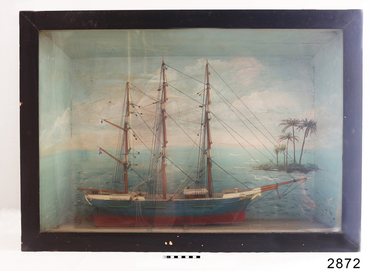
Craft - Ship Model, Auster
... Metal handle on top panel of case. Auster Craft Ship Model ...Ship model, Auster relief, 3 masted sailing ship, teal colour. Background of sea and sky, island with palm trees, seagulls. Front wood frame of case painted black, back and sides painted grey. Metal handle on top panel of case. "AUSTER" painted on side of bowflagstaff hill, warrnambool, shipwrecked-coast, flagstaff-hill, flagstaff-hill-maritime-museum, maritime-museum, shipwreck-coast, flagstaff-hill-maritime-village, ship mode., auster, sailing ship -
 Flagstaff Hill Maritime Museum and Village
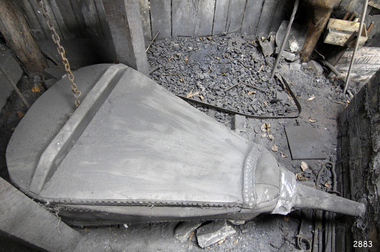
Functional object - Bellows, 1862-1875
... metal working smiths. The bellows is technologically significant as it shows the progress from simple bellows to the double-action bellows, a time saving and efficient improvement. The manufacturer John C. Onions is historically significant as a family business that began in the 1600s and continued up until the 1980s. flagstaff hill warrnambool shipwrecked-coast flagstaff-hill flagstaff-hill-maritime-museum maritime-museum shipwreck-coast flagstaff-hill-maritime-village john collingwood onions john c onions allday and onions bellows smith’s bellows 19th century bellows double-action bellows double-acting bellows double lung bellows double chamber bellows blacksmith tools blacksmith trade blacksmith craft blacksmith equipment forging equipment john c onions patented double-action bellows brian chapman warrnambool racecourse blacksmith shipsmith iron smith mechanical bellows Text impressed in the wooden upper paddle of the bellows has been assumed to read “JOHN C. ...This bellows was used at the Warrnambool Racecourse by Master Farrier, Brian Chapman (1931-2017), during the 1970s but its history before then is still being investigated. The bellows have continued to be used from 1978 at Flagstaff Hill's blacksmith's workshop. Even today, in 2021, this same bellows are used by a volunteer blacksmith as he demonstrate the skills and tells of the importance of the blacksmith trade to colonial Australia. This 1860s double-action bellows is a typical form of blacksmith's or shipsmith's bellows. The end is forge-fitted with an iron nozzle or tube, called a tuyere or Tue iron, which concentrates the air to fan the fire or furnace. Tuyeres were traditionally made of cow horn. The double-action design of this bellows efficiently moves air both in and out of the chambers in the one movement of the long handle. The bellows was manufactured by John C. Onions of Birmingham, England, between 1862 and 1875. The stamp with the text, Gold Medal 1862, was also used on the business’ advertising. In 1875 the company was registered and began using the name John C. Onions Limited. JOHN C. ONIONS - John C. (Collingwood) Onions (1841-1904) was the son of a bellows maker of the same name. Onions (born 1841) and his wife Helen married in 1867 and they named one of their children John Collingwood Onions (1868-1913), as was the family tradition. He was well known as a Birmingham manufacturer of patented bellows and other forge-related equipment. He sold to the wholesale and retail markets for both local and overseas customers, including the British colonies. An 1862 advertisement points out that John C. Onions was a “Bellows manufacturer and contractor to Her Majesty’s Honourable Board of Ordinance” and His Imperial Majesty the Emperor of the French [Napoleon Bonaparte]”. The advertisement includes a sketched portrait of the Emperor Napoleon III, and an Imperial Autograph Letter dated May 23, 1854, from Napoleon, Palace of the Tulleries to Mr J C Onions of Bradford Street, Birmingham. In 1863 the company registered a patent on portable forges. In 1871 there were eight employees. John C. Onions Limited became a registered company in 1875. In 1876 an advertisements included that the company were smiths for hearths and tools in general and showed a row of six medallions including one with “Napoleon III, Emperor” and his portrait, and another “ _ _ _ 1862 MEDAL”. Their advertising motto was “For Excellence of Quality”. In 1885 the company merged with William Allday and Sons to become Allday and Onions. This mid-19th century bellows has local historical significance as it were once used by blacksmiths at the Warrnambool Racecourse in the annual racing event that continues today. This bellows is significant as a working example of equipment used in the 1800 and 1900s in the trace of blacksmiths and other metal working smiths. The bellows is technologically significant as it shows the progress from simple bellows to the double-action bellows, a time saving and efficient improvement. The manufacturer John C. Onions is historically significant as a family business that began in the 1600s and continued up until the 1980s.Bellows; large, oval, mechanical double-action smith’s bellows, manually operated, in working condition. The paddles of wood that form the top, middle sections and base of the bellows have flexible leather pieces attached firmly between them, forming airtight double lungs. Cut-outs in the panels allow the bellows to fill with air then force it out. A long handle is connected to pump the bellows and control the quantity and force of the air. The blasts of air are forced through the metal nozzle or tuyere at the end of the bellows and into the forge’s fire. Inscriptions are impressed into the wood on the upper paddle or board of the bellows. There are three circular stamps containing text. Text impressed in the wooden upper paddle of the bellows has been assumed to read “JOHN C. ONIONS, PATENTEES & MANUFACTURERS, BIRMINGHAM””?” “EXTRA” “AWARDED FOR EXCELLENCE OF QUALITY”, made from the following readable text :- “JOHN C ONIONS“ “PATENT - - - & MAN - - - - - - - - -“, “BIR - - - - HAM“, “ _ ERA - - - - “- XTRA-“, “- - - - - - - FOR EXCELL-“ “OF - - - - ITY” Text in the stamp “ - - ECE - - “, “ - - - - - / 1862 / MEDAL”, “- ITY” flagstaff hill, warrnambool, shipwrecked-coast, flagstaff-hill, flagstaff-hill-maritime-museum, maritime-museum, shipwreck-coast, flagstaff-hill-maritime-village, john collingwood onions, john c onions, allday and onions, bellows, smith’s bellows, 19th century bellows, double-action bellows, double-acting bellows, double lung bellows, double chamber bellows, blacksmith tools, blacksmith trade, blacksmith craft, blacksmith equipment, forging equipment, john c onions patented double-action bellows, brian chapman, warrnambool racecourse, blacksmith, shipsmith, iron smith, mechanical bellows
