
Showing 14 items matching "methodist church, northcote"
-
 Glen Eira Historical Society
Document - Bambra Road Methodist Church, Northcote Avenue
... Bambra Road Methodist Church, Northcote Avenue...Methodist Church... Caulfield North... Everett L.D.... St Stephen’s Presbyterian Church Caulfield... Alday Thomas Rev... Everett Win... Bambra Road Trustees... Alday Thomas Mrs... Everett Keith... Caulfield Park... Caulfield Park Bowling Club... Heazlewood Vere... Goddard Sydney... Smith Ray J. M.... Hilton Della... Northcote...Caulfield North Religious Groups Methodist Church Uniting Church Clergy Sunday Schools Organs Church Furniture Stained Glass. Document Bambra Road Methodist Church, Northcote Avenue ...Photocopy Of A 2 Page Extract From A Coming Together Book Compiled By Gwenda Mann Describing The History Of Bambra Road Methodist Church. It Contains Information From 75 Years At St Stephen’s Caulfield, Including Union With Bambra Road Methodist Church By Della Hilton, 1985. A Photograph Of Several Small Extracts From This Publication Is Also Included. Also Brief Note By Claire Barton Dated 07/05/2010 With Street And Directory References.bambra road, bambra road methodist church, caulfield north, everett l.d., st stephen’s presbyterian church caulfield, alday thomas rev, everett win, bambra road trustees, alday thomas mrs, everett keith, caulfield park, caulfield park bowling club, heazlewood vere, goddard sydney, smith ray j. m., hilton della, northcote avenue, pask n. h., goff j. t. j, talbot n. e. g, lavender j. c., o’ connor t. m., smith r. j. m, selomb h. w., hawkins h. l, freeman j. t., mannering c. w. j., gray n. a., weatherlake r. c., croxford r. l. g., wilson g. rev., small h. rev., dunstan a. rev., caulfield methodist circuit, caulfield council, anderson mrs., caulfield north, religious groups, methodist church, uniting church, clergy, sunday schools, organs, church furniture, stained glass. -
 Uniting Church Archives - Synod of Victoria
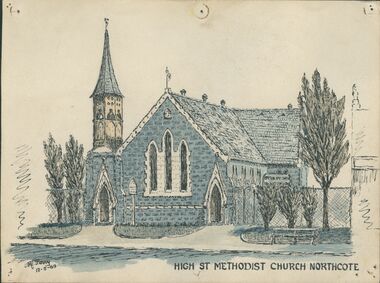
Pen and wash sketch, 1969
... Alf Perry, High St. Methodist Church Northcote...Pen and wash sketch on card of the High St. Methodist Church Northcote....Alf Perry, High St. Methodist Church Northcote "With the compliments of the artist". ...Artist: Alf Perry, 17/05/1969.Pen and wash sketch on card of the High St. Methodist Church Northcote."With the compliments of the artist".alf perry, high st. methodist church northcote -
 Uniting Church Archives - Synod of Victoria
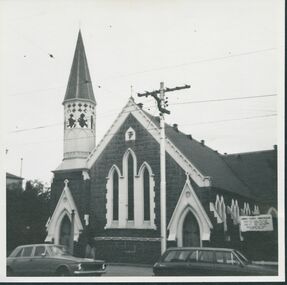
Photograph - B&W Photograph, June 1971
... Methodist Church, Northcote...Street view of the High St. Northcote Methodist Church....This church replaced the original Methodist Church, which was built in 1854. Methodist Church, Northcote B & W gloss photograph. ...This church replaced the original Methodist Church, which was built in 1854.B & W gloss photograph. Street view of the High St. Northcote Methodist Church.methodist church, northcote -
 Eltham District Historical Society Inc
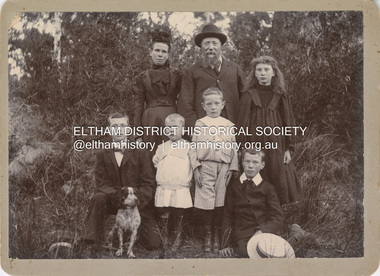
Photograph, Nicholes Photographers, Bird family, c.1905
... Northcote by Presbyterian minister, Duncan Fraser. The witnesses were daughters of the minister. George gave his profession as farmer. Around 1880 or possibly earlier he acquired the property known as View Hill at the top of Pitt Street, Eltham between Pitt Street and Mount Pleasant Road and what is now Eucalyptus Road. George and Janet developed an orchard and farm around the View Hill home and had 10 children, three of whom died young. George Bird is listed in the 1977 history of the Eltham Methodist Church...Northcote by Presbyterian minister, Duncan Fraser. The witnesses were daughters of the minister. George gave his profession as farmer. Around 1880 or possibly earlier he acquired the property known as View Hill at the top of Pitt Street, Eltham between Pitt Street and Mount Pleasant Road and what is now Eucalyptus Road. George and Janet developed an orchard and farm around the View Hill home and had 10 children, three of whom died young. George Bird is listed in the 1977 history of the Eltham Methodist Church ...Bird family, c.1905 Back row, L-R: Janet Bird (nee Kilpatrick), George Bird, Ellen May (Nell) Bird Front row L-R: George Hugh Bird, Ernest Reginald Bird, Arthur Andrew Bird, Edwin John Bird Nicholes Photographer, Alphington According to the Sands McDougall Melbourne Directory, George. Nicholes, Photographer was first listed on the north side of Heidelberg Road, Alphington in 1904 and again in 1905. By 1906 he was still listed but with no profession. From 1907 on he was listed as a bicycle agent. On July 23, 1878, George Bird married Janet Kilpatrick (born Ayrshire) at Northcote by Presbyterian minister, Duncan Fraser. The witnesses were daughters of the minister. George gave his profession as farmer. Around 1880 or possibly earlier he acquired the property known as View Hill at the top of Pitt Street, Eltham between Pitt Street and Mount Pleasant Road and what is now Eucalyptus Road. George and Janet developed an orchard and farm around the View Hill home and had 10 children, three of whom died young. George Bird is listed in the 1977 history of the Eltham Methodist Church as Steward and trustee in the early years. In the 1950 history he is mentioned as Sunday School Superintendent. In the early 1900s, Janet regularly went to the church by horse and jinker. Janet died September 2, 1915, age 60 of endocarditis and bronchial pneumonia. At about this time, three children had married (Sarah, George and Ada) and four were living at home. However, Edwin joined the AIF in August 1915 and Ellen married in 1916 leaving two sons, Arthur and Reg, to look after their father and the property although some of the married children may have lived at View Hill for some time. From Edwin's letters, Hilda Pepper, a cousin on their mother's side) stayed with the family for some time to help. In later years, George developed glaucoma and became blind. He died December 6, 1920, aged 75 years, of diabetes mellites. Both Janet and George are buried at Eltham Cemetery, but the gravestone incorrectly gives 1921 for the death of George. The estate was divided into equal portions and distributed to the surviving members with Arthur and Ted Pepper being Executors. Ada Janet Lowe received a portion above what is now Rockliffe Street and Sis Pepper (Sarah Ann nee Bird) the portion below Rockliffe Street. Ernest Pepper built in the 1930s on the Pepper block at the Pitt Street end. George's share was along Wattle Grove and Arthur received the portion at the eastern end. Presumably the other two received portions including the top of the hill and slopes down to Pitt Street, Mount Pleasant Road and Wattle Grove. Read's (at the corner of Pitt Street and View Hill Crescent) was the first additional house brought in on wheels by a Mr Walkenden. The View Hill house was occupied by the Johanssons in the 1930s and was later damaged by fire. Source: Info provided to Marg Ball by Neil and Lyn Pepper (both deceased) abt. 2018. PANEL 1875-1920 Panels began to be produced around 1875, and were particularly suited, because of their larger size, for capturing family, or even larger, groups. They measured 8.5 by 6.5 inches (22 cm x 16.5 cm). - Frost, Lenore; Dating Family Photos 1850-1920; Valiant Press Pty. Ltd., Berwick, Victoria 1991marg ball collection, 1905, arthur andrew bird, bird family, edwin john bird, ellen may (nell) bird, ernest reginald bird, george bird (1845-1921), george hugh bird, janet bird (nee kilpatrick), nicholes photographer alphington, straw boater -
 Uniting Church Archives - Synod of Victoria
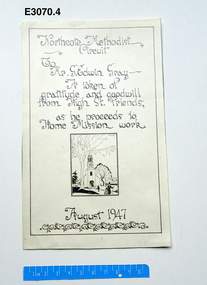
Brochure, Northcote Methodist Circuit
... Northcote Methodist Circuit: To Mr G Edwin Gray - A token of gratitude and goodwill from High St friends as he proceeds to Home Mission Work. August 1947. The paper has a small drawing of a church... Methodist Circuit G Edwin Gray Methodist Home Mission Northcote Methodist Circuit: To Mr G Edwin Gray - A token of gratitude and goodwill from High St friends as he proceeds to Home Mission Work. August 1947. The paper has a small drawing of a church ...The Methodist Home Missions was the department running the work of smaller churches and charitable institutions such as babies' homes, the Epworth Hospital, chaplaincies to hospitals and prisons, aged care homes, alcohol rehabilitation, local missions to depressed areas and the like. A minister was appointed each year by Conference, on deputation, to travel around Victoria to explain and encourage local congregations to support the work of the missions.Northcote Methodist Circuit: To Mr G Edwin Gray - A token of gratitude and goodwill from High St friends as he proceeds to Home Mission Work. August 1947. The paper has a small drawing of a church embedded in the hand written text.northcote methodist circuit, g edwin gray, methodist home mission -
 Uniting Church Archives - Synod of Victoria
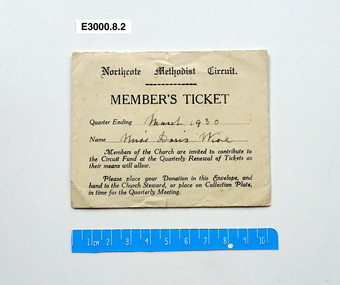
Card - Member's Ticket, Northcote Methodist Circuit member's ticket
... church. Tickets also became a way of offering admission to the love feast, or Agape, which was a service around a shared meal, but distinct from the Lord’s Supper. Quarterly tickets typically included the member’s name, the minister’s name, the date, as well as a Scriptural text. The practice of issuing quarterly tickets began in the mid-eighteenth century with John Wesley and continued in many Methodist organizations throughout the nineteenth century. Issuing tickets fell out of practice in the early twentieth century. https://findingaids.library.emory.edu/documents/P-MSS441/printable/ Northcote ...Methodist societies and churches issued quarterly tickets (or class tickets or love feast tickets) as a way to identify members of good standing in the society or church. Tickets also became a way of offering admission to the love feast, or Agape, which was a service around a shared meal, but distinct from the Lord’s Supper. Quarterly tickets typically included the member’s name, the minister’s name, the date, as well as a Scriptural text. The practice of issuing quarterly tickets began in the mid-eighteenth century with John Wesley and continued in many Methodist organizations throughout the nineteenth century. Issuing tickets fell out of practice in the early twentieth century. https://findingaids.library.emory.edu/documents/P-MSS441/printable/Printed envelope containing a Quarterly Ticket for March 1930. The card has the donor's name written on it together with the month and year."Doris Wise" "March 1930"northcote methodist circuit, methodist quarterly tickets -
 Uniting Church Archives - Synod of Victoria
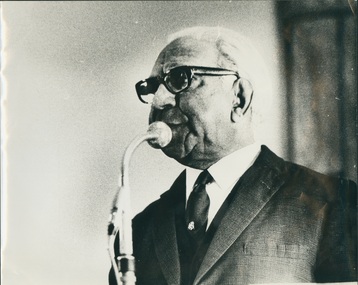
B&W photo of another photo or newspaper photograph of Pastor Sir Douglas Nicholls, Undated
... Methodist Church, New South Wales, Nicholls married her, a caring gesture which developed into a loving partnership. In January 1943 he initiated ‘Aboriginal Sunday’, featuring a gum leaf orchestra and choir. By 1955 this service had moved to July and later evolved into National Aborigines and Islanders Day Observance Committee (NAIDOC) week. Ordained a Churches of Christ pastor in 1945, Nicholls conducted a vigorous ministry from a chapel in Gore Street, Fitzroy. His work survived on donations, a small honorarium, and his employment as team coach (1947) and curator at the Northcote...Methodist Church, New South Wales, Nicholls married her, a caring gesture which developed into a loving partnership. In January 1943 he initiated ‘Aboriginal Sunday’, featuring a gum leaf orchestra and choir. By 1955 this service had moved to July and later evolved into National Aborigines and Islanders Day Observance Committee (NAIDOC) week. Ordained a Churches of Christ pastor in 1945, Nicholls conducted a vigorous ministry from a chapel in Gore Street, Fitzroy. His work survived on donations, a small honorarium, and his employment as team coach (1947) and curator at the Northcote ...Sir Douglas Ralph Nicholls (1906-1988), footballer, pastor, activist and governor, was born on 9 December 1906 at Cummeragunja Aboriginal mission, New South Wales, fifth child of Herbert Nicholls, seasonal worker, and his wife Florence, née Atkinson. Doug grew up at Cummeragunja, on the Murray River near Barmah, in its golden years of Aboriginal autonomy. Thomas Shadrach James gave him and other Yorta Yorta children a sound primary education, reinforcing the pride and self-assurance gained from their parents. As Doug grew, so too did the powers of the State’s Aboriginal Protection Board. Doug’s elder sister Hilda was removed about 1915. When Doug reached 14, he was moved off under the Aborigines Protection Act (1909) to find work. He took a job with dredging teams constructing levees on the Murray. Like other youths in the region Nicholls played Australian rules football, emulating kinsmen who had won local premierships since the 1890s. Doug and his brother Herbert (‘Dowie’) played with Tongala in the mid-1920s. Melbourne football beckoned, Doug trying out unsuccessfully for Carlton in 1927. He signed with the Northcote Victorian Football Association team, despite his nervousness about his Aboriginality, and was given a job with Northcote City Council. ‘Dowie’ joined him for a season. Doug was short at 5 ft 2 ins (158 cm), but muscular and lightning fast. He competed regularly during a boom in professional running, winning many heat and place prizes. In 1929 he won the Nyah and Warracknabeal gifts, earning a sash and £100 in each, together with a case of cutlery in the latter. Using his speed on the wing for Northcote, he produced great spring and agility from his compact body. The Sporting Globe reported in 1929 that ‘he flashes through packs of big men, whisks around small men . . . and attempts marks at the back of any six-footer’. In front-on clashes he was flattened only to rise again. The sole Aborigine in the VFA, he was known affectionately as the ‘flying Abo’ but called worse by his opponents’ barrackers. He competed for five seasons, being named ‘best and fairest’ twice, appearing in three association grand finals and winning in 1929. Keen to earn more than a seasonal wage, in 1931 Nicholls accepted a three-year contract with Jimmy Sharman’s travelling boxing show. The bouts matched opposites, local against tent boxer, white against black, and sometimes men of different sizes. He faced stiff competition from those who wanted to best the noted Melbourne black footballer, the crowd adding racial abuse. A far better footballer than boxer, he copped some punishment. Fighting in the Melbourne Stadium in December 1931, he was described by Truth as ‘slow and awkward’, but packing a ‘good wallop’. In 1932 Sharman, who treated his boxers fairly, released Nicholls to join the Fitzroy Victorian Football League team, which agreed to employ him as its groundsman. He played fifty-four games for Fitzroy over six seasons until knee trouble forced him out in 1937. Winning cups in 1934 and 1935, he played alongside Haydn Bunton and Wilfred (‘Chicken’) Smallhorn. Grand finals eluded him but he represented Victoria twice. Following his mother’s death, Nicholls revisited the Church of Christ chapel in Northcote, where they had worshipped together. On 17 July 1932 he experienced a conversion. He was soon baptised and witnessed openly, leading his fellow footballers to occasional church parades. Nicholls exhibited leadership qualities. William Cooper, founder of the Australian Aborigines’ League and Nicholls’ Yorta Yorta kinsman and fellow Christian, encouraged the young footballer. In February 1935 Cooper, Nicholls and others lobbied Thomas Paterson, the Commonwealth minister for the interior, over the need for Federal control of Aboriginal affairs. Nicholls attended the Day of Mourning protest for Aborigines held in Sydney on 26 January 1938, declaring: ‘after 150 years our people are still influenced and bossed by white people. I know we can proudly hold our own with others if given the chance’. When Cooper retired in November 1940 Nicholls became secretary of the AAL. On 2 June 1941 Nicholls enlisted in the Citizen Military Forces. He trained at Seymour and Bonegilla before being posted to the 29th Battalion. As Major Frank Corr’s batman, he was popular with other soldiers who tolerated his preaching and Bible reading. His army service was brief, however, and he was discharged in Melbourne on compassionate grounds on 22 January 1942. His biographer claimed that the Fitzroy police requested his return to mediate in the racial tensions developing between servicemen and the mostly respectable Aboriginal families living in crowded and dilapidated Fitzroy housing; Aboriginal people maintain that they requested his release. Nicholls began welfare work and religious services from an Aboriginal home in Gertrude Street, Fitzroy. In April 1942, ‘Dowie’ died of road accident trauma, leaving his wife, Gladys, née Bux, and three children. On 26 December 1942 at Moama Methodist Church, New South Wales, Nicholls married her, a caring gesture which developed into a loving partnership. In January 1943 he initiated ‘Aboriginal Sunday’, featuring a gum leaf orchestra and choir. By 1955 this service had moved to July and later evolved into National Aborigines and Islanders Day Observance Committee (NAIDOC) week. Ordained a Churches of Christ pastor in 1945, Nicholls conducted a vigorous ministry from a chapel in Gore Street, Fitzroy. His work survived on donations, a small honorarium, and his employment as team coach (1947) and curator at the Northcote Football Ground. In the 1950s Gladys established grocery and opportunity shops to earn income and provide services. Their house soon overflowed with people in need or visitors to Melbourne. Nicholls also hosted inspiring African American visitors such as the pianist Winifred Attwell and the singer Harry Belafonte. His ministry extended to Aboriginal country communities. Gladys taught Sunday school, undertook endless fund-raising and welfare work beside her husband, and became his greatest supporter and financial manager. They formed an Aboriginal Girls’ Hostel in 1956, for which they acted as house parents, and bought holiday units for Aborigines at Queenscliff. Persistently advocating Aboriginal rights, Nicholls protested about the impact of the Woomera rocket range on the people of the Warburton Ranges, co-ordinated the production of a concert, Out of the Dark, scripted by Jean Campbell, to rectify the omission of Aborigines from Victoria’s Commonwealth jubilee celebrations, and criticised the Victorian Aboriginal Protection Board. In 1957 when the board was transformed into the Aborigines’ Welfare Board, he and Harold Blair were appointed as Aboriginal representatives. Maintaining the stance of a political moderate, he did not bear grudges and sought to build bridges between black and white. He co-operated with any group that aided the cause, including the Council of Aboriginal Rights, whose executive were members of the Communist Party of Australia. This association attracted the attention of the Australian Security Intelligence Organization, which in 1957 began to keep a file on Nicholls. In May 1957 Nicholls formed the Victorian Aborigines Advancement League with Doris Blackburn and Gordon Bryant, a Federal parliamentarian. As its paid field officer and spokesman, Nicholls contested assimilation policies and used film to raise awareness of issues. When the Welfare Board attempted to close Lake Tyers reserve, Gippsland, he resigned in disgust and led a protest march on parliament in May 1963. The AAL also petitioned the United Nations on land rights in June, perhaps the first indigenous body to do so. He argued for new premises at 58 Cunningham Street, Northcote, opened in 1966 as the ‘Doug Nicholls Centre’. In 1958 Nicholls was a foundation member of the Federal Council for Aboriginal Advancement (Federal Council for the Advancement of Aboriginal and Torres Strait Islanders after 1964), which he served as national field officer (1961) and Victorian secretary (1962-63). While an innovator in tactics, he was alarmed by the influence of confrontational ‘black power’ politics in the AAL and resigned as a director amid turmoil on this issue in 1969, claiming the concept was a ‘bitter word’, not needed in Australia. Similar tensions in FCAATSI led him to join with Kath Walker (Oodgeroo Noonuccal) in establishing the short-lived National Tribal Council as an alternative forum. As the AAL leadership moderated their stance, he returned as president (1969-74) of the new all-Aboriginal organisation. He was also a keen patron of the National Aboriginal Sports Foundation, founded in 1969. Many honours were conferred on Nicholls: he was appointed MBE (1957) and OBE (1968) and knighted (1972). In 1962 he was named Victorian ‘Father of the Year’ and the State’s second Aboriginal justice of the peace. Crowned Melbourne’s 1973 King of Moomba, he was declared Bapu Mamus (a Torres Strait term for ‘headman’) by the NTC. On 1 December 1976 Sir Douglas was appointed Governor of South Australia, but his health deteriorated within weeks, making it difficult for him to perform his official duties. In March 1977 he hosted Queen Elizabeth during her royal tour and was appointed KCVO. He relinquished his governorship on 30 April 1977 following a stroke. Ill health continued to dog him during retirement, but he played his Nelson Eddy records, enjoyed his expanding family, and when able, ministered to the Aboriginal Church at the League’s premises. Sir Douglas Nicholls died on 4 June 1988 at Mooroopna, predeceased (1981) by his wife and survived by his five children. He was given a state funeral and buried in tribal ground at Cummeragunja cemetery. Among the many tributes to him are an oval at Northcote, handed to the AAL in 1982, a Canberra suburb gazetted in 1991, and a fellowship for Indigenous leadership established in 2003, all in his name, and a statue of Sir Doug and Lady Nicholls by Louis Laumen, unveiled in 2007 in Parliament Gardens, Melbourne. Sir Douglas Nicholls is shown speaking at a microphone; head and shoulders; dressed in a suit.Pastor Douglas Nicholls -
 Uniting Church Archives - Synod of Victoria
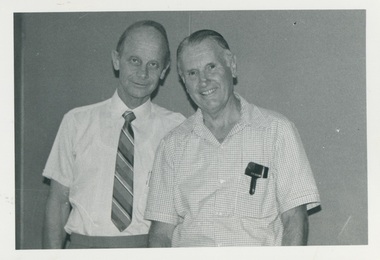
BW photo, March 1986
... John (Jock) Corben Lavender Jock was born in Ivanhoe, but spent most of his youth in Northcote where his father was a bank manager, and where he attended primary school, high school and the Methodist church in High Street which became a central point in his life. ...John (Jock) Corben Lavender Jock was born in Ivanhoe, but spent most of his youth in Northcote where his father was a bank manager, and where he attended primary school, high school and the Methodist church in High Street which became a central point in his life. ...John (Jock) Corben Lavender Jock was born in Ivanhoe, but spent most of his youth in Northcote where his father was a bank manager, and where he attended primary school, high school and the Methodist church in High Street which became a central point in his life. He took his first job in the dispatch office at McPhersons nut and bolt factory in North Richmond in 1935. After a short time at McPhersons he moved to the Trustees Executors and Agency Company in 1936. While working at the Trustees Jock developed the conviction that his vocation lay with the church. This necessitated studying Matriculation at night school for two years as well as working and studying to become a Local Preacher. The minister at Northcote at the time was the Rev.F.T.Cleverdon who helped him prepare to apply as a candidate for Ordination. Before going to university and Queen’s for his arts degree and theological training, Mr Cleverdon, who was now the minister at Neil Street, Ballarat, offered Jock the opportunity to minister to the small congregation at Brown Hill, Ballarat, which was in his Circuit, and to live with the Cleverdons. He spent a year in Ballarat under the tutelage of Rev.F.T Cleverdon in 1939. Jock was accepted by the 1940 Victorian Methodist Conference as a Candidate for the Ministry and started his studies for his theological training and an arts degree at Melbourne University that year. Because of a shortage of ministers, due to the war, Jock was taken out of Queen’s in 1943 to take charge of two fairly small churches in Caulfield - Hawthorn Road and Bambra Road. Jock was ordained in 1945 & married two days later to Elsie Chipperfield, with whom he had worked at the Trustees Executors and Agency. He had joined the RAAF as a chaplain and was sent to Borneo. Returning to Australia in early 1946, he was then appointed to Orbost for a year, Bracknell in Tasmania in 1948, followed by Reid in Canberra, 1951. The next move was to Portland in 1954. Unfortunately not long after this, Elsie was diagnosed with breast cancer. This necessitated a move back to Melbourne - to Mitcham in 1957. Elsie died in December 1957. This period was a very hard time as Jock had four young daughters but his mother helped out by living in for most of the week until Jock was married to Peg in 1959 and their son was born in 1961. In 1964 Jock was moved to Launceston, his first city church. These years were challenging for Jock as he felt compelled to speak out around social issues, such as the Vietnam War & Aboriginal rights, although many did not agree with his view. In 1969 Jock was moved to Horsham to take up the role of Separated Chairman of the North-Western District responsible for Circuits, ministers and families for policy issues and pastoral concerns over an area from the South Australian border, up to the Murray and over it to Wentworth and Dareton, up river to Swan Hill and south to Ballarat and Daylesford. It was a demanding job but richly rewarding in the relationships made with ministers and their families. In 1971 Jock was elected Secretary of the Methodist Conference and in 1972 was voted President of the Conference. He felt it an honour and a vote of confidence by clergy and lay people The final move was to Geelong in 1976 where Jock was the minister at Wesley until 1983.Jock found Geelong a very satisfying parish in which to finish his active ministry. It was while he was Minister of Wesley Church, Geelong, that the Uniting Church came into being and Jock became the first Chairman of the Barwon Presbytery. There were now two ministers at Wesley – Jock and Alex Peerman, whose joint congregation of St. Giles (Pres) and City Congregational now joined with Wesley to become the City Parish. Jock was very surprised to be elected as the third Moderator of the Uniting Church in Victoria, to take office in 1979/1980 1983 saw retirement to Portarlington several months’ locum in both Canada & Kununurra. When the property at Portarlington became too large to maintain, they moved in 1994 into the current house in Belmont & returned to the Wesley Church here. In the words of Rev. Prof. Norman Young and Rev. Peter Gador-Whyte at Jock’s funeral service: “We are here today to give thanks to God for Jock Lavender; a gentle man of great compassion, humour and humility. We gather to remember the love he shared so generously the faith he lived so graciously, and the hope he expressed both in his preaching and in his presence. As President of the Methodist Conference and Moderator of the Uniting Church Jock held significant leadership roles within the church and did so with great dignity and grace never lording it over people but leading by example with an inner strength and faith that won respect and trust. There was something really special about him that is hard to put your finger on. We have all been blessed by God through Jock. Mr Alexander Kilgour Alex Kilgour was for many years an active elder and layman in the Presbyterian and then Uniting Church. He was involved in many committees at Synod level for many years. He was a Moderator of the Synod of Victoria of the UCA—one of the first laypeople to take on the role in the early years of the UCA. He was for many years Executive Director of the Resources Commission of the Synod. He worked at Mitchell Brushes (the company owned by Ethel and John Mitchell. B&W photograph. The Rev. John C (Jock) Lavender and Mr Alex Kilgour, dressed in shirts, are standing shoulder to shoulder, facing the camera.C&N 19/3/1986rev. jock lavender; mr alex kilgour; methodist, presbyterian, uniting church; synod appointments; moderator -
 Uniting Church Archives - Synod of Victoria
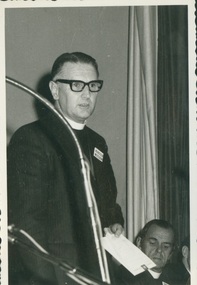
BW photo, Undated
... JOHN CORBEN LAVENDER (Jock) Jock was born in Ivanhoe, but spent most of his youth in Northcote where his father was a bank manager, and where he attended primary school, high school and the Methodist church in High Street which became a central point in his life. ...JOHN CORBEN LAVENDER (Jock) Jock was born in Ivanhoe, but spent most of his youth in Northcote where his father was a bank manager, and where he attended primary school, high school and the Methodist church in High Street which became a central point in his life. ...JOHN CORBEN LAVENDER (Jock) Jock was born in Ivanhoe, but spent most of his youth in Northcote where his father was a bank manager, and where he attended primary school, high school and the Methodist church in High Street which became a central point in his life. He took his first job in the dispatch office at McPhersons nut and bolt factory in North Richmond in 1935. After a short time at McPhersons he moved to the Trustees Executors and Agency Company in 1936. While working at the Trustees Jock developed the conviction that his vocation lay with the church. This necessitated studying Matriculation at night school for two years as well as working and studying to become a Local Preacher. The minister at Northcote at the time was the Rev.F.T.Cleverdon who helped him prepare to apply as a candidate for Ordination. Before going to university and Queen’s for his arts degree and theological training, Mr Cleverdon, who was now the minister at Neil Street, Ballarat, offered Jock the opportunity to minister to the small congregation at Brown Hill, Ballarat, which was in his Circuit, and to live with the Cleverdons. He spent a year in Ballarat under the tutelage of Rev.F.T Cleverdon in 1939. Jock was accepted by the 1940 Victorian Methodist Conference as a Candidate for the Ministry and started his studies for his theological training and an arts degree at Melbourne University that year. Because of a shortage of ministers, due to the war, Jock was taken out of Queen’s in 1943 to take charge of two fairly small churches in Caulfield - Hawthorn Road and Bambra Road. Jock was ordained in 1945 & married two days later to Elsie Chipperfield, with whom he had worked at the Trustees Executors and Agency. He had joined the RAAF as a chaplain and was sent to Borneo. Returning to Australia in early 1946, he was then appointed to Orbost for a year, Bracknell in Tasmania in 1948, followed by Reid in Canberra, 1951. The next move was to Portland in 1954. Unfortunately not long after this, Elsie was diagnosed with breast cancer. This necessitated a move back to Melbourne - to Mitcham in 1957. Elsie died in December 1957. This period was a very hard time as Jock had four young daughters but his mother helped out by living in for most of the week until Jock was married to Peg in 1959 and their son was born in 1961. In 1964 Jock was moved to Launceston, his first city church. These years were challenging for Jock as he felt compelled to speak out around social issues, such as the Vietnam War & Aboriginal rights, although many did not agree with his view. In 1969 Jock was moved to Horsham to take up the role of Separated Chairman of the North-Western District responsible for Circuits, ministers and families for policy issues and pastoral concerns over an area from the South Australian border, up to the Murray and over it to Wentworth and Dareton, up river to Swan Hill and south to Ballarat and Daylesford. It was a demanding job but richly rewarding in the relationships made with ministers and their families. In 1971 Jock was elected Secretary of the Methodist Conference and in 1972 was voted President of the Conference. He felt it an honour and a vote of confidence by clergy and lay people The final move was to Geelong in 1976 where Jock was the minister at Wesley until 1983.Jock found Geelong a very satisfying parish in which to finish his active ministry. It was while he was Minister of Wesley Church, Geelong, that the Uniting Church came into being and Jock became the first Chairman of the Barwon Presbytery. There were now two ministers at Wesley – Jock and Alex Peerman, whose joint congregation of St. Giles (Pres) and City Congregational now joined with Wesley to become the City Parish. Jock was very surprised to be elected as the third Moderator of the Uniting Church in Victoria, to take office in 1979/1980 1983 saw retirement to Portarlington several months’ locum in both Canada & Kununurra. When the property at Portarlington became too large to maintain, they moved in 1994 into the current house in Belmont & returned to the Wesley Church here. Deceased c.2015. Rev. John (Jock) Lavender is pictured standing at a microphone, wearing clerical clothingRev. J C Lavenderrev. john (jock) lavender; methodist minister; uniting church minister; -
 Uniting Church Archives - Synod of Victoria
BW photo, 1980s?
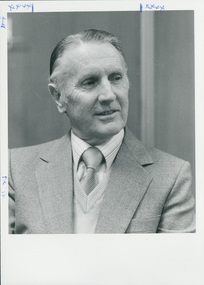
... JOHN CORBEN LAVENDER (Jock) Jock was born in Ivanhoe, but spent most of his youth in Northcote where his father was a bank manager, and where he attended primary school, high school and the Methodist church in High Street which became a central point in his life. ...JOHN CORBEN LAVENDER (Jock) Jock was born in Ivanhoe, but spent most of his youth in Northcote where his father was a bank manager, and where he attended primary school, high school and the Methodist church in High Street which became a central point in his life. ...JOHN CORBEN LAVENDER (Jock) Jock was born in Ivanhoe, but spent most of his youth in Northcote where his father was a bank manager, and where he attended primary school, high school and the Methodist church in High Street which became a central point in his life. He took his first job in the dispatch office at McPhersons nut and bolt factory in North Richmond in 1935. After a short time at McPhersons he moved to the Trustees Executors and Agency Company in 1936. While working at the Trustees Jock developed the conviction that his vocation lay with the church. This necessitated studying Matriculation at night school for two years as well as working and studying to become a Local Preacher. The minister at Northcote at the time was the Rev.F.T.Cleverdon who helped him prepare to apply as a candidate for Ordination. Before going to university and Queen’s for his arts degree and theological training, Mr Cleverdon, who was now the minister at Neil Street, Ballarat, offered Jock the opportunity to minister to the small congregation at Brown Hill, Ballarat, which was in his Circuit, and to live with the Cleverdons. He spent a year in Ballarat under the tutelage of Rev.F.T Cleverdon in 1939. Jock was accepted by the 1940 Victorian Methodist Conference as a Candidate for the Ministry and started his studies for his theological training and an arts degree at Melbourne University that year. Because of a shortage of ministers, due to the war, Jock was taken out of Queen’s in 1943 to take charge of two fairly small churches in Caulfield - Hawthorn Road and Bambra Road. Jock was ordained in 1945 & married two days later to Elsie Chipperfield, with whom he had worked at the Trustees Executors and Agency. He had joined the RAAF as a chaplain and was sent to Borneo. Returning to Australia in early 1946, he was then appointed to Orbost for a year, Bracknell in Tasmania in 1948, followed by Reid in Canberra, 1951. The next move was to Portland in 1954. Unfortunately not long after this, Elsie was diagnosed with breast cancer. This necessitated a move back to Melbourne - to Mitcham in 1957. Elsie died in December 1957. This period was a very hard time as Jock had four young daughters but his mother helped out by living in for most of the week until Jock was married to Peg in 1959 and their son was born in 1961. In 1964 Jock was moved to Launceston, his first city church. These years were challenging for Jock as he felt compelled to speak out around social issues, such as the Vietnam War & Aboriginal rights, although many did not agree with his view. In 1969 Jock was moved to Horsham to take up the role of Separated Chairman of the North-Western District responsible for Circuits, ministers and families for policy issues and pastoral concerns over an area from the South Australian border, up to the Murray and over it to Wentworth and Dareton, up river to Swan Hill and south to Ballarat and Daylesford. It was a demanding job but richly rewarding in the relationships made with ministers and their families. In 1971 Jock was elected Secretary of the Methodist Conference and in 1972 was voted President of the Conference. He felt it an honour and a vote of confidence by clergy and lay people The final move was to Geelong in 1976 where Jock was the minister at Wesley until 1983.Jock found Geelong a very satisfying parish in which to finish his active ministry. It was while he was Minister of Wesley Church, Geelong, that the Uniting Church came into being and Jock became the first Chairman of the Barwon Presbytery. There were now two ministers at Wesley – Jock and Alex Peerman, whose joint congregation of St. Giles (Pres) and City Congregational now joined with Wesley to become the City Parish. Jock was very surprised to be elected as the third Moderator of the Uniting Church in Victoria, to take office in 1979/1980 1983 saw retirement to Portarlington several months’ locum in both Canada & Kununurra. When the property at Portarlington became too large to maintain, they moved in 1994 into the current house in Belmont & returned to the Wesley Church Geelong.Head and shoulders portrait of the Rev. John (Jock) Lavender, wearing suit and tie.Jock Lavenderrev. john (jock) lavender; methodist minister; uniting church minister; -
 Uniting Church Archives - Synod of Victoria
BW photo, 1979
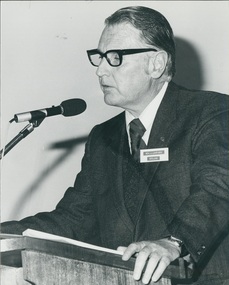
... JOHN CORBEN LAVENDER (Jock) Jock was born in Ivanhoe, but spent most of his youth in Northcote where his father was a bank manager, and where he attended primary school, high school and the Methodist church in High Street which became a central point in his life. ...JOHN CORBEN LAVENDER (Jock) Jock was born in Ivanhoe, but spent most of his youth in Northcote where his father was a bank manager, and where he attended primary school, high school and the Methodist church in High Street which became a central point in his life. ...JOHN CORBEN LAVENDER (Jock) Jock was born in Ivanhoe, but spent most of his youth in Northcote where his father was a bank manager, and where he attended primary school, high school and the Methodist church in High Street which became a central point in his life. He took his first job in the dispatch office at McPhersons nut and bolt factory in North Richmond in 1935. After a short time at McPhersons he moved to the Trustees Executors and Agency Company in 1936. While working at the Trustees Jock developed the conviction that his vocation lay with the church. This necessitated studying Matriculation at night school for two years as well as working and studying to become a Local Preacher. The minister at Northcote at the time was the Rev.F.T.Cleverdon who helped him prepare to apply as a candidate for Ordination. Before going to university and Queen’s for his arts degree and theological training, Mr Cleverdon, who was now the minister at Neil Street, Ballarat, offered Jock the opportunity to minister to the small congregation at Brown Hill, Ballarat, which was in his Circuit, and to live with the Cleverdons. He spent a year in Ballarat under the tutelage of Rev.F.T Cleverdon in 1939. Jock was accepted by the 1940 Victorian Methodist Conference as a Candidate for the Ministry and started his studies for his theological training and an arts degree at Melbourne University that year. Because of a shortage of ministers, due to the war, Jock was taken out of Queen’s in 1943 to take charge of two fairly small churches in Caulfield - Hawthorn Road and Bambra Road. Jock was ordained in 1945 & married two days later to Elsie Chipperfield, with whom he had worked at the Trustees Executors and Agency. He had joined the RAAF as a chaplain and was sent to Borneo. Returning to Australia in early 1946, he was then appointed to Orbost for a year, Bracknell in Tasmania in 1948, followed by Reid in Canberra, 1951. The next move was to Portland in 1954. Unfortunately not long after this, Elsie was diagnosed with breast cancer. This necessitated a move back to Melbourne - to Mitcham in 1957. Elsie died in December 1957. This period was a very hard time as Jock had four young daughters but his mother helped out by living in for most of the week until Jock was married to Peg in 1959 and their son was born in 1961. In 1964 Jock was moved to Launceston, his first city church. These years were challenging for Jock as he felt compelled to speak out around social issues, such as the Vietnam War & Aboriginal rights, although many did not agree with his view. In 1969 Jock was moved to Horsham to take up the role of Separated Chairman of the North-Western District responsible for Circuits, ministers and families for policy issues and pastoral concerns over an area from the South Australian border, up to the Murray and over it to Wentworth and Dareton, up river to Swan Hill and south to Ballarat and Daylesford. It was a demanding job but richly rewarding in the relationships made with ministers and their families. In 1971 Jock was elected Secretary of the Methodist Conference and in 1972 was voted President of the Conference. He felt it an honour and a vote of confidence by clergy and lay people The final move was to Geelong in 1976 where Jock was the minister at Wesley until 1983.Jock found Geelong a very satisfying parish in which to finish his active ministry. It was while he was Minister of Wesley Church, Geelong, that the Uniting Church came into being and Jock became the first Chairman of the Barwon Presbytery. There were now two ministers at Wesley – Jock and Alex Peerman, whose joint congregation of St. Giles (Pres) and City Congregational now joined with Wesley to become the City Parish. Jock was very surprised to be elected as the third Moderator of the Uniting Church in Victoria, to take office in 1979/1980 1983 saw retirement to Portarlington several months’ locum in both Canada & Kununurra. When the property at Portarlington became too large to maintain, they moved in 1994 into the current house in Belmont & returned to the Wesley Church Geelong.Upper body photo of Rev. John (Jock) Lavender (Geelong) speaking at a lectern.Church & Nation 23/5/79, p. 5; Rev. Lavenderrev. john (jock) lavender; methodist minister; uniting church minister; -
 Uniting Church Archives - Synod of Victoria
Photograph, Undated c.1962
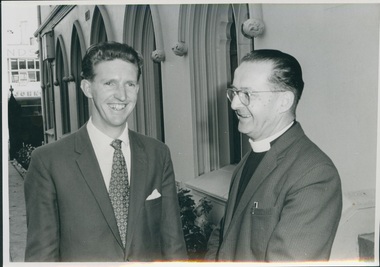
... Northcote (Croxton) 1949. Chaplain at Wesley College 1954 - 1967. Appointed Balwyn 1967, Elsternwick 1973. Supernumerary 1977. Rev Peter Swain B.A., B.D. Dip.Ed. 1960 Murrayville & Gowangie (Meth.-Pres. Co-op). Appointed as Associated Chaplain to Wesley College 1962 - 1969. Transferred to N.S.W. in 1969. rev vivian roberts, rev peter swain, methodist, minister, chaplain, a.i.f., wesley college B & W photograph of Rev Peter Swain (L) and Rev Vivian Roberts (R) standing outside a church building. ...Rev Vivian Roberts T.L., B.A., B.Ed., L.Th. Ordained 1939. On active service A.I.F. from 1940. Appointed Chaplain A.I.F. from 1943. Appointed Northcote (Croxton) 1949. Chaplain at Wesley College 1954 - 1967. Appointed Balwyn 1967, Elsternwick 1973. Supernumerary 1977. Rev Peter Swain B.A., B.D. Dip.Ed. 1960 Murrayville & Gowangie (Meth.-Pres. Co-op). Appointed as Associated Chaplain to Wesley College 1962 - 1969. Transferred to N.S.W. in 1969.B & W photograph of Rev Peter Swain (L) and Rev Vivian Roberts (R) standing outside a church building.rev vivian roberts, rev peter swain, methodist, minister, chaplain, a.i.f., wesley college -
 Uniting Church Archives - Synod of Victoria
Photograph, Undated c.1939
... Northcote, where he met his wife. Returned to England for two years, where he served as a probationer. Returned to Australia in 1937 and was ordained into the Methodist Church. ...Northcote, where he met his wife. Returned to England for two years, where he served as a probationer. Returned to Australia in 1937 and was ordained into the Methodist Church. ...John Blakemore (1908 - 2000). Born at Pelsall, Staffordshire. Became a local preacher at the age of 18. Arrived in Australia in 1926. Accepted as a Home Missionary and served at Ultima, Willaura, Piangil and Moulamein. Studied at Otira and at Queen's College. Whilst studying he was sent to St. George's Rd Northcote, where he met his wife. Returned to England for two years, where he served as a probationer. Returned to Australia in 1937 and was ordained into the Methodist Church. He served at Merbein, Shepparton, Newstead, Numurkah, Maffra, East Ivanhoe, Bentleigh, and Oakleigh. Between 1941 and 1944 he was a chaplain in the A.I.F.B & W head and shoulders studio portrait of the Rev. John Blakemore.john blakemore, local preacher, home missionary, otira, queen's college, chaplain a.i.f., methodist, minister. -
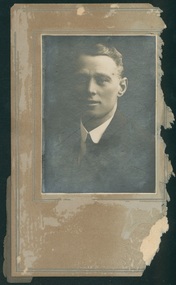 Uniting Church Archives - Synod of Victoria
Photograph, c1910
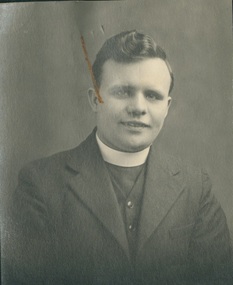
... Methodist Church, 1914 - 1918. Pastor J. W. Stares Methodist Prince of Wales Park Methodist Circuit Northcote (Prince of Wales Park) In pencil on the back: "MR STARES ? ...J. W. Stares was the pastor of the Prince of Wales Park Methodist Church, 1914 - 1918.Sepia toned studio head and shoulders portrait of Mr. Stares, aged between his late 20s and mid 30s. He is at a slight angle to the camera and is looking past it. His face is in half shadow.In pencil on the back: "MR STARES ?Prince of Wales Park"pastor j. w. stares methodist, prince of wales park methodist circuit, northcote (prince of wales park)
