
Showing 24 items matching "metric conversion"
-
![Functional object - Conversion Tables, [Metric conversion tables], 1960s](/media/collectors/4f729f5697f83e03086015b8/items/66c17f708454e1d95387f0cf/item-media/66c180598454e1d95387fafe/item-fit-380x285.jpg?cb=6) Greensborough Historical Society
Greensborough Historical SocietyFunctional object - Conversion Tables, [Metric conversion tables], 1960s
... [Metric conversion tables]......metric conversion...Conversion tables from the 1960s when Australia converted to metric. he card converts temperature from Fahrenheit to celsius (State Electricity Commission) and the magnet cooking measurements (Pyrex Corning)...2 Metric conversion tables, one printed on card, the second is a fridge magnet....Conversion tables from the 1960s when Australia converted to metric. he card converts temperature from Fahrenheit to celsius (State Electricity Commission) and the magnet cooking measurements (Pyrex Corning) conversion tables metric conversion metric measurement 2 Metric conversion tables, one printed on card, the second is a fridge magnet. ...Conversion tables from the 1960s when Australia converted to metric. he card converts temperature from Fahrenheit to celsius (State Electricity Commission) and the magnet cooking measurements (Pyrex Corning)2 Metric conversion tables, one printed on card, the second is a fridge magnet.conversion tables, metric conversion, metric measurement -
 Moorabbin Air Museum
Manual (item) - GAF Collection - GAF Engineering Dept. Engineering Manual - Volume IV Metric Conversion Data
... Engineering Manual - Volume IV Metric Conversion Data...Engineering Manual - Volume IV Metric Conversion Data...Engineering Manual - Volume IV Metric Conversion Data ...Ex Bob Nash Collection -
 Whitehorse Historical Society Inc.
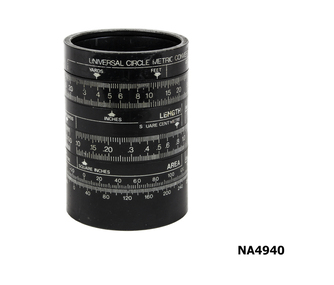
Functional object - Desk Pencil holder, mid 1970's
... Black cylindrical pencil holder with marking for metric conversion....Metric conversion tables...instruments general Metric conversion tables Black cylindrical pencil holder with marking for metric conversion. ...Black cylindrical pencil holder with marking for metric conversion.Metric conversion tablesinstruments, general -
Moorabbin Air Museum
Manual (Item) - TAA Trans Australia Airline Metric Practice for Metric Conversion
... TAA Trans Australia Airline Metric Practice for Metric Conversion...Manual TAA Trans Australia Airline Metric Practice for Metric Conversion ... -
 Greensborough Historical Society
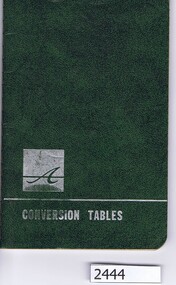
Booklet, Conversion tables, 1967_05
... ...metric conversion...Conversion, equivalents and weights and sizes charts for engineering applications. conversion tables metric conversion 64 p., tables Conversion tables Booklet Booklet ...Conversion, equivalents and weights and sizes charts for engineering applications.64 p., tablesconversion tables, metric conversion -
 Greensborough Historical Society
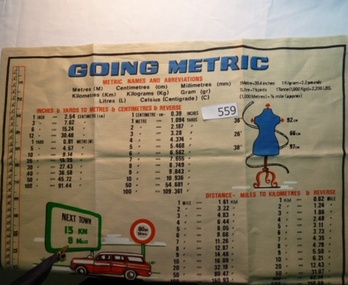
Functional object - Tea-towel, Going Metric, 1971c
... ...metric conversion...Conversion tables for metric stencilled on tea-towel....This item was designed to assist people to understand the conversion and as a reference to make conversions from imperial to metric. It is in mint condition (never used) imperial measurement metric measurement metric conversion tea-towels Conversion tables for metric stencilled on tea-towel. ...Metrication in Australia took place between 1970 and 1988. Before then, Australia mostly used the imperial system for measurement. This tea-towel is a handy reminder of conversions.This item was designed to assist people to understand the conversion and as a reference to make conversions from imperial to metric. It is in mint condition (never used)Linen tea-towel. Cream background with blue, red and black print.Conversion tables for metric stencilled on tea-towel.imperial measurement, metric measurement, metric conversion, tea-towels -
 Whitehorse Historical Society Inc.
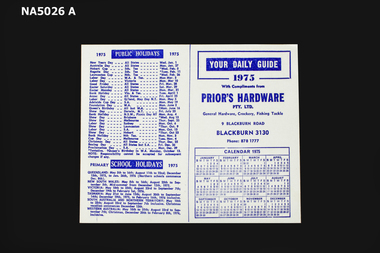
Souvenir - Calendar & Information Guide, 1975, 1975
... Includes 1975 calendar, public holidays 1975, school holidays 1975, postage rates, phases of the moon, child endowment, birthstone, flowers, wedding anniversaries, metric conversion tables, important phone numbers, birthday reminders....Includes 1975 calendar, public holidays 1975, school holidays 1975, postage rates, phases of the moon, child endowment, birthstone, flowers, wedding anniversaries, metric conversion tables, important phone numbers, birthday reminders. ...Produced by Prior's Hardware to advertise their business and assist customers. Used in 1975 in Blackburn, Victoria, Australia.Daily guide produced for Prior's Hardware Pty Ltd. Includes 1975 calendar, public holidays 1975, school holidays 1975, postage rates, phases of the moon, child endowment, birthstone, flowers, wedding anniversaries, metric conversion tables, important phone numbers, birthday reminders.Prior's Hardware Pty Ltd. General Hardware, crockery, fishing tackle. 9 Blackburn Road Blackburn 3130. Phone 8781777.shopping, prior's hardware, 9 blackburn road blackburn -
 Wodonga & District Historical Society Inc
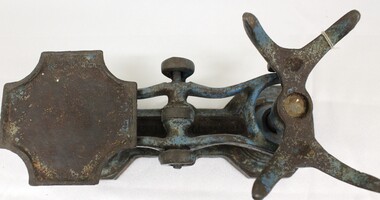
Functional object - Metal table balance scales, Pre 1970s
... In 1970 the Australian parliament passed the metric conversion act, and the Australian building trades made it the standard in 1974. ...In 1970 the Australian parliament passed the metric conversion act, and the Australian building trades made it the standard in 1974. ...Sets of scales similar to these were very common in households throughout Australia. Between 1960 and 1988 Australia gradually adopted the SI units (Standard International) or metric units. In 1970 the Australian parliament passed the metric conversion act, and the Australian building trades made it the standard in 1974. This information helps to date the set of weights to before the1970s.Domestic scales such as these were common throughout Australian homes. They are now primarily superceded by plastic items, often electronic.Metal table scales with 6 weights graduated in sizes including 1 oz., 2 oz, 4oz, 8oz, 1lb and 2 lbs. Each weight marked "MACK/ MADE IN AUSTRALIA"domestic appliances, weights and measures australia -
 Wodonga & District Historical Society Inc
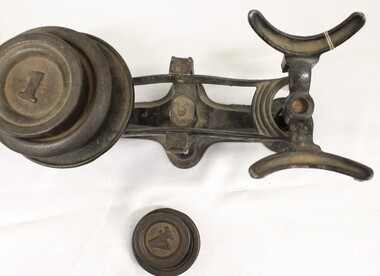
Functional object - Metal balance scales with weights, C. 1900
... In 1970 the Australian parliament passed the metric conversion act, and the Australian building trades made it the standard in 1974. ...In 1970 the Australian parliament passed the metric conversion act, and the Australian building trades made it the standard in 1974. ...Sets of scales similar to these were very common in households throughout Australia. Between 1960 and 1988 Australia gradually adopted the SI units (Standard International) or metric units. In 1970 the Australian parliament passed the metric conversion act, and the Australian building trades made it the standard in 1974. This information helps to date the set of weights to before the1970s.Domestic scales such as these were common throughout Australian homes. They are now primarily superceded by plastic items, often electronic. Metal table scales with imperial weights weights and measures australia, table scales, domestic appliances -
 Wodonga & District Historical Society Inc
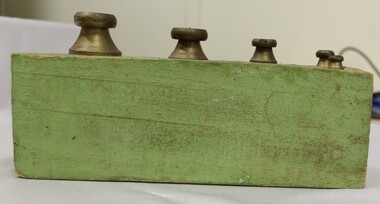
Functional object - Set of Weights in wooden holder, 1970s
... In 1970 the Australian parliament passed the metric conversion act, and the Australian building trades made it the standard in 1974. ...In 1970 the Australian parliament passed the metric conversion act, and the Australian building trades made it the standard in 1974. ...The green holder for the weights was hand made by cutting recesses out of a single piece of wood. The wood was painted green. Between 1960 and 1988 Australia gradually adopted the SI units (Standard International) or metric units. In 1970 the Australian parliament passed the metric conversion act, and the Australian building trades made it the standard in 1974. This information helps to date the set of weights to C. 1970s.These weights have local and social significance to indicate the weights used in many homes or small businesses in the 1970s.Set of 5 small metric weights in wooden holder. Measurements are difficult to decipher but "Gram" can be identified around the edge of some weights. Holder has been created by cutting round recesses into a block of wood.metric system, weights and measures australia -
 Whitehorse Historical Society Inc.
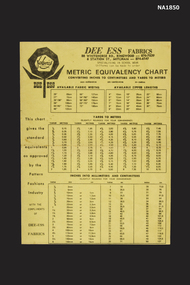
Poster - Metric Chart
... Metric equivalency chart explaining conversion from imperial measurement to metric as advertising material from Dee Ess Fabrics....commerce advertising Metric equivalency chart explaining conversion from imperial measurement to metric as advertising material from Dee Ess Fabrics. ...Metric equivalency chart explaining conversion from imperial measurement to metric as advertising material from Dee Ess Fabrics.commerce, advertising -
 Sunshine and District Historical Society Incorporated
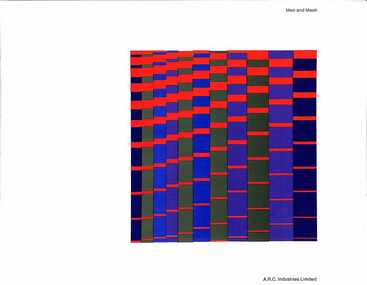
Booklet - Australian Reinforcing Company (ARC) Booklets, 1920 - 2010
... 2025.01 - ARC - Men And Mesh 2025.02 - ARC - BRC Fabric April 1977 2025.02 - ARC - BRC Fabric Dec 1976 2025.03 - ARC - 30th Annual Report And Notice Of Annual General Meeting 1980 2025.03 - ARC - 30th Annual Report And Notice Of Annual General Meeting 1981 2025.04 - ARC - OVAWELD Welded Reinforcing Fabric 2025.05 - ARC - Australian Military Forces ARC Mesh Technical Instructions 2025.06 - ARC - Smorgan ARC A Guide To Using Fabric Reinforcement 2025.07 - ARC - Smorgan ARC The Reinforcement Handbook 2025.08 - ARC - HUMES ARC Design Tables For One-way Suspended Slabs 2025.09 - ARC - CW 60 Reinforcing Bar 2025.10 - ARC - Manufacturers' Bulletin Special Edition Metric Conversion Tables 2025.11 - ARC - We Always Go To Extraordinary Lengths ARC 90th Anniversary...Australian Reinforcing Company ARC Ballarat Road Albion 2025.01 - ARC - Men And Mesh 2025.02 - ARC - BRC Fabric April 1977 2025.02 - ARC - BRC Fabric Dec 1976 2025.03 - ARC - 30th Annual Report And Notice Of Annual General Meeting 1980 2025.03 - ARC - 30th Annual Report And Notice Of Annual General Meeting 1981 2025.04 - ARC - OVAWELD Welded Reinforcing Fabric 2025.05 - ARC - Australian Military Forces ARC Mesh Technical Instructions 2025.06 - ARC - Smorgan ARC A Guide To Using Fabric Reinforcement 2025.07 - ARC - Smorgan ARC The Reinforcement Handbook 2025.08 - ARC - HUMES ARC Design Tables For One-way Suspended Slabs 2025.09 - ARC - CW 60 Reinforcing Bar 2025.10 - ARC - Manufacturers' Bulletin Special Edition Metric Conversion Tables 2025.11 - ARC - We Always Go To Extraordinary Lengths ARC 90th Anniversary Books and booklets pertaining to the ARC factory and its business; reinforcing. ...2025.01 - ARC - Men And Mesh 2025.02 - ARC - BRC Fabric April 1977 2025.02 - ARC - BRC Fabric Dec 1976 2025.03 - ARC - 30th Annual Report And Notice Of Annual General Meeting 1980 2025.03 - ARC - 30th Annual Report And Notice Of Annual General Meeting 1981 2025.04 - ARC - OVAWELD Welded Reinforcing Fabric 2025.05 - ARC - Australian Military Forces ARC Mesh Technical Instructions 2025.06 - ARC - Smorgan ARC A Guide To Using Fabric Reinforcement 2025.07 - ARC - Smorgan ARC The Reinforcement Handbook 2025.08 - ARC - HUMES ARC Design Tables For One-way Suspended Slabs 2025.09 - ARC - CW 60 Reinforcing Bar 2025.10 - ARC - Manufacturers' Bulletin Special Edition Metric Conversion Tables 2025.11 - ARC - We Always Go To Extraordinary Lengths ARC 90th Anniversaryaustralian reinforcing company, arc, ballarat road, albion -
 Department of Energy, Environment and Climate Action
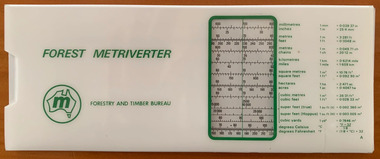
Forest Metriverter, Side Rule
... The Forest Metriverter slide-rule was issued by the Forestry and Timber Bureau to make metric conversions easier....The Forest Metriverter slide-rule was issued by the Forestry and Timber Bureau to make metric conversions easier. forest measurement Surveying Forests Commission Victoria (FCV) Ross Penny Forest Metriverter Side Rule Forest Metriverter ...Device to convert Imperial measurements of length, area, weight etc to the metric system. Decimal currency was spectacularly introduced in an overnight overthrow on 14 February 1966, but it took another 8 years before metrication finally arrived in the forest and timber industry. Eventually, the measurement of logs and sawn timber changed from imperial, and excruciating, measures such as super feet of sawn timber, billets and cunits (100 cubic feet) of stacked pulpwood and hoppus log volumes to simpler cubic metres. Measuring firewood was a particular nightmare. For example, there were standard chords, stove cords, kitchen cords, running cords, face cords, thrown chords, fencing cords, country cords, long cords, raummeter or steres (1m x 1m x 1m). A standard cord of firewood had a volume of 128 cubic feet, measured as a pile 8 feet long, 4 feet high and 4 feet wide (3.624 m3). And how about this for confusing…. in Victoria, an imperial or long ton (by measure) of green firewood was a stack 5 feet long billets (2 axelengths at 2′ 6″ each), one axelength high (2′ 6″) and two axelengths long (5 feet) equalling 62.5 cubic feet. For added befuddlement, there were three different sorts of tons: Imperial tons or long tons, American short tons and metric tonnes (spelled with two n’s). Not forgetting that a cubic imperial ton of firewood (40 cubic feet) which equalled 1.133 cubic metre. The metrication process began in 1974 and was completed by 1976 but the transition was not without its challenges along the supply chain for foresters, overseers, logging contractors, sawmillers, hardware stores and builders alike. Timber lengths changed from feet to metres but were still sold in multiples of one foot or 0.3 m (1.8, 2.1, 2.4, 2.7 etc) whereas a menacing lump of 4-Bee-2 transformed into a rather less colourful 100mm by 50mm. Measurement and calculations of area also became so much easier in hectares rather than complicated acres, roods and perches. The Forest Metriverter slide-rule was issued by the Forestry and Timber Bureau to make metric conversions easier.Forest MetriverterRoss Pennyforest measurement, surveying, forests commission victoria (fcv) -
 Sunshine and District Historical Society Incorporated
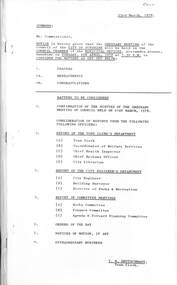
Administrative record - City of Sunshine - Commissioner Mr Alexander Alex George Gillon Collection 1976 - 1982 - Notice of ordinary meeting of the council 4th April 1978, City of Sunshine, 23rd March 1978
... Notice of Ordinary Meeting of the Council 4th April 1978 Report of the Town Clerk's Department Report of the Town Clerk Metropolitan Fire Brigades Board Report of Council Representative Proposed Abattoir Shire of Werribee Proposal to Vary Municipal Officers' (City of Sunshine) Award Report of the Co-Ordinator of Welfare Services Information & Co-Ordination Grant Family & Community Services Programme Proposal for Unemployment Relief Report of the Chief Health Inspector Health Act Registrations Prosecution Proceedings Sunshine Magistrate Court Noise By-Law Weights & Measures Report for the Tow Months Ending 28th February 1978 Sale of Liquor Metric Conversion Infant Welfare Sisters in Service Training Lectures Report of the City Engineer Land Use Permit Application Flats Dalton Street Land Use Permit Application Flats Rita Street & Vule Street Land Use Permit Application Scrap Metal Processing & Recycling Lot 3 Somerville Road Land Use Permit Application Flats Killara Street & Mernda Street Proposed Amendmet No 81 to the Melbourne Metropolitan Planning Scheme Land Acquisition Maribyrnong Valley Land Use Permit Application Tennis Pavilion Selwyn Park for Albion Tennis Club Land Use Permit Application Car Sales Yard & Office 236 Ballarat Road Braybrook Land Use Permit Application Service Premises Lots 347 & 349 Tamar Drive Land Use Permit Application Bulk Meat Warehouse, Sales & Service Rosamond Road Proposed Rezoning Bounded by Durham Road, Hampshire Road, Corio Street & Watt Street Land Use Permit Application Sign Lot 119 Station Road Land Use Permit Application Oakwood Road Subdivision and Detached Houses Land Use Permit Application Factory 172 McIntyre Road Plans of Transfer and Consolidation St. ...Albans Road Sydney Street Robinsons Road Neale Road Sunshine Tip Navigator Street Sunshine Post Office Dempster Street Tottenham Railway Station Duke Street Wright Street Bell Street Riverview Court Lindenow Street Maidstone Glengala Road Syon Close United Social Cricket Club Scovell Reserve Scovell Crescent Notice of Ordinary Meeting of the Council 4th April 1978 Report of the Town Clerk's Department Report of the Town Clerk Metropolitan Fire Brigades Board Report of Council Representative Proposed Abattoir Shire of Werribee Proposal to Vary Municipal Officers' (City of Sunshine) Award Report of the Co-Ordinator of Welfare Services Information & Co-Ordination Grant Family & Community Services Programme Proposal for Unemployment Relief Report of the Chief Health Inspector Health Act Registrations Prosecution Proceedings Sunshine Magistrate Court Noise By-Law Weights & Measures Report for the Tow Months Ending 28th February 1978 Sale of Liquor Metric Conversion Infant Welfare Sisters in Service Training Lectures Report of the City Engineer Land Use Permit Application Flats Dalton Street Land Use Permit Application Flats Rita Street & Vule Street Land Use Permit Application Scrap Metal Processing & Recycling Lot 3 Somerville Road Land Use Permit Application Flats Killara Street & Mernda Street Proposed Amendmet No 81 to the Melbourne Metropolitan Planning Scheme Land Acquisition Maribyrnong Valley Land Use Permit Application Tennis Pavilion Selwyn Park for Albion Tennis Club Land Use Permit Application Car Sales Yard & Office 236 Ballarat Road Braybrook Land Use Permit Application Service Premises Lots 347 & 349 Tamar Drive Land Use Permit Application Bulk Meat Warehouse, Sales & Service Rosamond Road Proposed Rezoning Bounded by Durham Road, Hampshire Road, Corio Street & Watt Street Land Use Permit Application Sign Lot 119 Station Road Land Use Permit Application Oakwood Road Subdivision and Detached Houses Land Use Permit Application Factory 172 McIntyre Road Plans of Transfer and Consolidation St. ...Notice of Ordinary Meeting of the Council 4th April 1978 Report of the Town Clerk's Department Report of the Town Clerk Metropolitan Fire Brigades Board Report of Council Representative Proposed Abattoir Shire of Werribee Proposal to Vary Municipal Officers' (City of Sunshine) Award Report of the Co-Ordinator of Welfare Services Information & Co-Ordination Grant Family & Community Services Programme Proposal for Unemployment Relief Report of the Chief Health Inspector Health Act Registrations Prosecution Proceedings Sunshine Magistrate Court Noise By-Law Weights & Measures Report for the Tow Months Ending 28th February 1978 Sale of Liquor Metric Conversion Infant Welfare Sisters in Service Training Lectures Report of the City Engineer Land Use Permit Application Flats Dalton Street Land Use Permit Application Flats Rita Street & Vule Street Land Use Permit Application Scrap Metal Processing & Recycling Lot 3 Somerville Road Land Use Permit Application Flats Killara Street & Mernda Street Proposed Amendmet No 81 to the Melbourne Metropolitan Planning Scheme Land Acquisition Maribyrnong Valley Land Use Permit Application Tennis Pavilion Selwyn Park for Albion Tennis Club Land Use Permit Application Car Sales Yard & Office 236 Ballarat Road Braybrook Land Use Permit Application Service Premises Lots 347 & 349 Tamar Drive Land Use Permit Application Bulk Meat Warehouse, Sales & Service Rosamond Road Proposed Rezoning Bounded by Durham Road, Hampshire Road, Corio Street & Watt Street Land Use Permit Application Sign Lot 119 Station Road Land Use Permit Application Oakwood Road Subdivision and Detached Houses Land Use Permit Application Factory 172 McIntyre Road Plans of Transfer and Consolidation St. Albans Road Vinidex Tubemakers Variations to Contract Sunshine View Estate Private Street Scheme Contract Reconstruction of Sydney Street Robinsons Road Subdivision Contract Neale Road Restoration of Sunshine Tip Site Albion Navigator Street Private Street Scheme Sale of Former Post Office Site Sunshine Traffic Circuit Dempster Street & Tottenham Railway Station Bank Guarantee for Drainage Report of the Building Surveyor Building Over Easements Installation of Underground Tank 359 Ballarat Road Corner Duke Street Braybrook Fence 170 Wright Street Sunshine Siting of House Lot 4 Bell Street Sunshine West Siting of House Lot 18 Riverview Court Maribyrnong Siting of Open Garage 29 Lindenow Street Maidstone Installation of Underground Tank 58 Glengala Road Sunshine West Siting of House Lot 260 Syon Close Deer Park Additions to Club Premises Scovell Reserve by the United Social Cricket Club Orders of the Day Accounts Submitted for Payment as at 15th March 1978 Proposal to Close Part of Selwyn Street Under the Provisions of Section 528 of the Local Government Act 1958 city of sunshine, alexander "alex" george gillon, dalton street, sunshine west, rita street, vule street, st. albans, somerville road, tottenham, killara street, mernda street, maribyrnong valley, albion tennis club, selwyn park, selwyn street, albion, ballarat road, braybrook, tamar drive, deer park, rosamond road, maribyrnong, durham road, hampshire road, corio street, watt street, sunshine, station road, oakwood road, albanvale, mcintyre road, sunshine north, vinidex tubemakers, st. albans road, sydney street, robinsons road, neale road, sunshine tip, navigator street, sunshine post office, dempster street, tottenham railway station, duke street, wright street, bell street, riverview court, lindenow street, maidstone, glengala road, syon close, united social cricket club, scovell reserve, scovell crescent -
 Flagstaff Hill Maritime Museum and Village
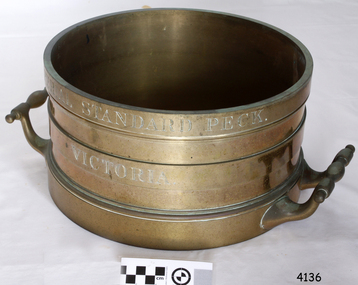
Functional object - Standard Measure, James McEwan & Co, 1860s-1900s
... On February 14th, 1966, Australia began its conversion to metric measures and currency, and a new set of Standard Measures was introduced; the conversion took place in stages. ...On February 14th, 1966, Australia began its conversion to metric measures and currency, and a new set of Standard Measures was introduced; the conversion took place in stages. ...This container is a pre-Decimal, Imperial Standard Peck, part of a three-piece set of Standard measures used in Victoria from around 1900 to 1940. The measures were made in Melbourne by J. McEwan & Co. These three measures were likely used by the local Melbourne authority that monitored weights and measures in the mid to late 19th century. . An Imperial Bushel was equal to 8 gallons, or 36.36872 litres . An Imperial Peck equals a quarter of a Bushel, or 9.09 litres Standards for weights and measures began in Victoria when the Melbourne Observatory received primary sets of Imperial Standard Weights and Measures from Britain. These were tested against the then British Imperial Standards to measure length, weight and currency. Administrative bodies in the Colony of Australia could then compare their weights and measures against these British Primary Standards and adjust their Measures accordingly, to maintain the Standards. The Weights and Measures Act of 1862 was passed in Victoria, and local inspectors were established throughout the colony. By the 1870s, local councils and shires in Victoria held a set of Standards used to test scales, weights, and measures used by manufacturers, wholesalers, and retailers. Every ten years, the councils’ Standards needed to be rechecked against the Victorian Standards. In the 19th Century, the Victorian Customs Department inspected and maintained the Standards. In 1901, the Customs Department was transferred to the Federal Government, but the Weights and Measures authority remained with the Victorian Government and relocated to the Melbourne Observatory. In 1904, the Standard weights and measures, and testing equipment, were installed in the room of a new building erected at the south end of the Great Melbourne Telescope House. The room became known as the Whirling Room, due to its large whirling apparatus that tested air meters. When the Melbourne Observatory closed in 1944, the Weights and Measures Branch was formed to continue maintaining the Standards. On February 14th, 1966, Australia began its conversion to metric measures and currency, and a new set of Standard Measures was introduced; the conversion took place in stages. The Weights and Measures Branch remained at the Observatory site until 1995. James McEwan & Co.: - The maker of this set of Standard Measures was James McEwan. His Melbourne business was established in 1852 and sold retail furniture and wholesale ironmongery. The firm’s warehouses were situated at the intersection of 81-83 Elizabeth and Little Collins Streets. Shortly afterwards, the firm partnered with William Kerr Thomson and Samuel Renwick. When McEwan died in 1868, his partners carried on and expanded the business under his name, J McEwan. The business was expanded to provide a retail shop, counting-house and private offices. Wholesale warehouses adjoined these premises at 4, 6 and 10 Little Collins Street, West. This company provided and sold a large and varied amount of imported goods into the colony; agricultural equipment, building materials, mining items, steam engines, tools of all types and marble fireplaces. The company grew to employ over 150 people in Melbourne and opened offices at 27 Lombard St, London, as well as in New Zealand and Fiji. It also serviced the Mauritius islands and the Pacific area with its steamship, the Suva, and a brig, the Shannon. The set of Imperial Standard Measures is an example of a bronze measure container made specifically for J. McEwan & Co. Today, it helps us to understand how imperial weights and measures were used, and how a standard of measurement for merchants was developed in the Australian colonies based on the Imperial British measurement system. The container has social significance as an item retailed by J McEwan, and used by Victoria’s authorities legally responsible for ensuring that dry goods sold in Victoria by wholesalers and retailers are correct. Imperial Standard Measure: a container to measure the volume of a Peck. It is part of a set of three precision measures - a Peck, a Half Bushel and a Bushel – used by government authorities in Victoria. The cast brass cylinder has straight sides and a flat base, and two handles are attached near the base by two posts on each handle. The wall inside is straight, and outside has grooves and horizontal bands. Inscriptions are engraved on the outside. The Measures were made for the retailer, J. McEwan & Co., London and Melbourne. Engraved on side: "IMPERIAL STANDARD PECK. / VICTORIA."flagstaff hill, flagstaff hill maritime museum and village, warrnambool, maritime museum, maritime village, great ocean road, shipwreck coast, weights and measurements, science, james mcewan & co., precision instrument, technology, melbourne observatory, british imperial standards, standard weights & measures, volume measure, dry measure, customs, commerce, victorian standard measure, pre-decimal measure, imperial standard, imperial bushel, imperial half bushel, imperial peck, peck measure, bronze container, brass container, cast container -
 Flagstaff Hill Maritime Museum and Village
Functional object - Standard Measure, James McEwan & Co, 1860s-1900s
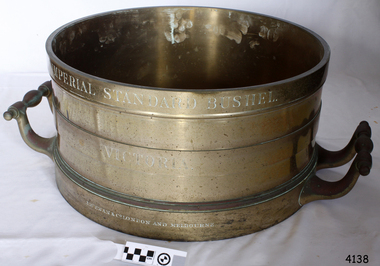
... On February 14th, 1966, Australia began its conversion to metric measures and currency, and a new set of Standard Measures was introduced; the conversion took place in stages. ...On February 14th, 1966, Australia began its conversion to metric measures and currency, and a new set of Standard Measures was introduced; the conversion took place in stages. ...This container is a pre-Decimal, Imperial Standard Bushel, part of a three-piece set of Standard measures used in Victoria from around 1900 to 1940. The measures were made in Melbourne by J. McEwan & Co. These three measures were likely used by the local Melbourne authority that monitored weights and measures in the mid to late 19th century. . An Imperial Bushel was equal to 8 gallons, or 36.36872 litres . An Imperial Peck equals a quarter of a Bushel, or 9.09 litres Standards for weights and measures began in Victoria when the Melbourne Observatory received primary sets of Imperial Standard Weights and Measures from Britain. These were tested against the then British Imperial Standards to measure length, weight and currency. Administrative bodies in the Colony of Australia could then compare their weights and measures against these British Primary Standards and adjust their Measures accordingly, to maintain the Standards. The Weights and Measures Act of 1862 was passed in Victoria, and local inspectors were established throughout the colony. By the 1870s, local councils and shires in Victoria held a set of Standards used to test scales, weights, and measures used by manufacturers, wholesalers, and retailers. Every ten years, the councils’ Standards needed to be rechecked against the Victorian Standards. In the 19th Century, the Victorian Customs Department inspected and maintained the Standards. In 1901, the Customs Department was transferred to the Federal Government, but the Weights and Measures authority remained with the Victorian Government and relocated to the Melbourne Observatory. In 1904, the Standard weights and measures, and testing equipment, were installed in the room of a new building erected at the south end of the Great Melbourne Telescope House. The room became known as the Whirling Room, due to its large whirling apparatus that tested air meters. When the Melbourne Observatory closed in 1944, the Weights and Measures Branch was formed to continue maintaining the Standards. On February 14th, 1966, Australia began its conversion to metric measures and currency, and a new set of Standard Measures was introduced; the conversion took place in stages. The Weights and Measures Branch remained at the Observatory site until 1995. James McEwan & Co.: - The maker of this set of Standard Measures was James McEwan. His Melbourne business was established in 1852 and sold retail furniture and wholesale ironmongery. The firm’s warehouses were situated at the intersection of 81-83 Elizabeth and Little Collins Streets. Shortly afterwards, the firm partnered with William Kerr Thomson and Samuel Renwick. When McEwan died in 1868, his partners carried on and expanded the business under his name, J McEwan. The business was expanded to provide a retail shop, counting-house and private offices. Wholesale warehouses adjoined these premises at 4, 6 and 10 Little Collins Street, West. This company provided and sold a large and varied amount of imported goods into the colony; agricultural equipment, building materials, mining items, steam engines, tools of all types and marble fireplaces. The company grew to employ over 150 people in Melbourne and opened offices at 27 Lombard St, London, as well as in New Zealand and Fiji. It also serviced the Mauritius islands and the Pacific area with its steamship, the Suva, and a brig, the ShannonThe set of Imperial Standard Measures is an example of a bronze measure container made specifically for J. McEwan & Co. Today, it helps us to understand how imperial weights and measures were used, and how a standard of measurement for merchants was developed in the Australian colonies based on the Imperial British measurement system. The container has social significance as an item retailed by J McEwan, and used by Victoria’s authorities legally responsible for ensuring that dry goods sold in Victoria by wholesalers and retailers are correct.Imperial Standard Measure: a container to measure the volume of a Busel. It is part of a set of three precision measures - a Peck, a Half Bushel and a Bushel – used by government authorities in Victoria. The cast brass cylinder has straight sides and a flat base, and two handles are attached near the base by two posts on each handle. The wall inside is straight, and outside has grooves and horizontal bands. Inscriptions are engraved on the outside. The Measures were made for the retailer, J. McEwan & Co., London and Melbourne.Engraved on side: "IMPERIAL STANDARD BUSHEL. / VICTORIA ./ J. MCEWAN & CO. LONDON AND MELBOURNE."flagstaff hill, flagstaff hill maritime museum and village, warrnambool, maritime museum, maritime village, great ocean road, shipwreck coast, weights and measurements, science, james mcewan & co., precision instrument, technology, melbourne observatory, british imperial standards, standard weights & measures, volume measure, dry measure, customs, commerce, victorian standard measure, pre-decimal measure, imperial standard, imperial bushel, peck measure, bronze container, brass container, cast container -
 Flagstaff Hill Maritime Museum and Village
Equipment - Standard Measure, James McEwan & Co, 1860s-1900s
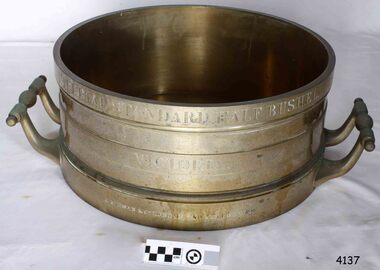
... On February 14th, 1966, Australia began its conversion to metric measures and currency, and a new set of Standard Measures was introduced; the conversion took place in stages. ...On February 14th, 1966, Australia began its conversion to metric measures and currency, and a new set of Standard Measures was introduced; the conversion took place in stages. ...This container is a pre-Decimal, Imperial Standard Half Bushel, part of a three-piece set of Standard measures used in Victoria from around 1900 to 1940. The measures were made in Melbourne by J. McEwan & Co. These three measures were likely used by the local Melbourne authority that monitored weights and measures in the mid to late 19th century. . An Imperial Bushel was equal to 8 gallons, or 36.36872 litres . An Imperial Peck equals a quarter of a Bushel, or 9.09 litres Standards for weights and measures began in Victoria when the Melbourne Observatory received primary sets of Imperial Standard Weights and Measures from Britain. These were tested against the then British Imperial Standards to measure length, weight and currency. Administrative bodies in the Colony of Australia could then compare their weights and measures against these British Primary Standards and adjust their Measures accordingly, to maintain the Standards. The Weights and Measures Act of 1862 was passed in Victoria, and local inspectors were established throughout the colony. By the 1870s, local councils and shires in Victoria held a set of Standards used to test scales, weights, and measures used by manufacturers, wholesalers, and retailers. Every ten years, the councils’ Standards needed to be rechecked against the Victorian Standards. In the 19th Century, the Victorian Customs Department inspected and maintained the Standards. In 1901, the Customs Department was transferred to the Federal Government, but the Weights and Measures authority remained with the Victorian Government and relocated to the Melbourne Observatory. In 1904, the Standard weights and measures, and testing equipment, were installed in the room of a new building erected at the south end of the Great Melbourne Telescope House. The room became known as the Whirling Room, due to its large whirling apparatus that tested air meters. When the Melbourne Observatory closed in 1944, the Weights and Measures Branch was formed to continue maintaining the Standards. On February 14th, 1966, Australia began its conversion to metric measures and currency, and a new set of Standard Measures was introduced; the conversion took place in stages. The Weights and Measures Branch remained at the Observatory site until 1995. James McEwan & Co.: - The maker of this set of Standard Measures was James McEwan. His Melbourne business was established in 1852 and sold retail furniture and wholesale ironmongery. The firm’s warehouses were situated at the intersection of 81-83 Elizabeth and Little Collins Streets. Shortly afterwards, the firm partnered with William Kerr Thomson and Samuel Renwick. When McEwan died in 1868, his partners carried on and expanded the business under his name, J McEwan. The business was expanded to provide a retail shop, counting-house and private offices. Wholesale warehouses adjoined these premises at 4, 6 and 10 Little Collins Street, West. This company provided and sold a large and varied amount of imported goods into the colony; agricultural equipment, building materials, mining items, steam engines, tools of all types and marble fireplaces. The company grew to employ over 150 people in Melbourne and opened offices at 27 Lombard St, London, as well as in New Zealand and Fiji. It also serviced the Mauritius islands and the Pacific area with its steamship, the Suva, and a brig, the Shannon.The set of Imperial Standard Measures is an example of a bronze measure container made specifically for J. McEwan & Co. Today, it helps us to understand how imperial weights and measures were used, and how a standard of measurement for merchants was developed in the Australian colonies based on the Imperial British measurement system. The container has social significance as an item retailed by J McEwan, and used by Victoria’s authorities legally responsible for ensuring that dry goods sold in Victoria by wholesalers and retailers are correct.Imperial Standard Measure: a container to measure the volume of a Half Bushel. It is part of a set of three precision measures - a Peck, a Half Bushel and a Bushel – used by government authorities in Victoria. The cast brass cylinder has straight sides and a flat base, and two handles are attached near the base by two posts on each handle. The wall inside is straight, and outside has grooves and horizontal bands. Inscriptions are engraved on the outside. The Measures were made for the retailer, J. McEwan & Co., London and Melbourne. Engraved test: "IMPERIAL STANDARD HALF BUSHEL. / VICTORIA / J. MCEWAN & O. LONDON AND MELBOURNE."flagstaff hill, flagstaff hill maritime museum and village, warrnambool, maritime museum, maritime village, great ocean road, shipwreck coast, weights and measurements, science, james mcewan & co., precision instrument, technology, melbourne observatory, british imperial standards, standard weights & measures, volume measure, dry measure, customs, commerce, victorian standard measure, pre-decimal measure, imperial standard, imperial half bushel, bronze container, brass container, cast container -
 Flagstaff Hill Maritime Museum and Village
Equipment - Weight
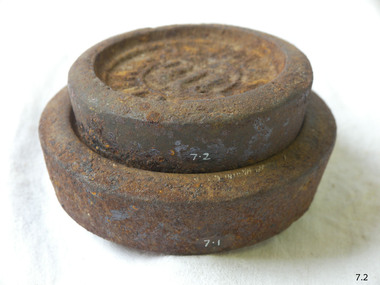
... Australia began converting to the metric system in the 1960s, beginning with its money. The conversion from imperial to metric units of measurement in Australia took place from 1970 and was completed in 1988 when metric units became the only legal unit of measurement. ...Australia began converting to the metric system in the 1960s, beginning with its money. The conversion from imperial to metric units of measurement in Australia took place from 1970 and was completed in 1988 when metric units became the only legal unit of measurement. warrnambool shipwrecked-coast flagstaff-hill flagstaff-hill-maritime-museum maritime-museum shipwreck-coast flagstaff-hill-maritime-village shipwrecked-artefact wieght weights and measures imperial standard weight "IMPERIAL STANDARD 1LB" [weight 1], "IMPERIAL STANDARD 2LB" [weight 2] Imperial Standard weights; set of two disc-shaped weights designed to stack one upon the other. ...The disc-shaped design of these 1LB and 2 LB metal weights enables them to be stacked one on top of the other. The weights are used with a balance scale to accurately weigh the mass of items such as grain, sugar, meat or potatoes. They could have been used in retail or wholesale businesses like a general store or a grain merchant’s premises. The user would place either one or both of these weights on one side of a balance scale. Goods would then be placed onto the other side of the scale until the beam between both sides of the scale was level, showing that the weight of the goods was as heavy as the weight or weights on the other side. These two weights are marked in Imperial units. An Imperial Standard 1LB is equal to 453.592grams. The British Weights and Measures Act of 1824 defined official standards for weights and measurements. This ensured that uniform measurements would be used for trade throughout the Empire. Towns and districts would have an official set of Imperial Standard Weights and Measures. Inspectors periodically used this official set to check the accuracy of traders’ own weights and measures. There would be penalties such as fines or imprisonment for people who broke these laws. The State of Victoria had its own Weight and Measures Act in 1862 and a decade later the inspectors in local councils used their local set of weights and measures to test the local businesses measuring equipment. In the nineteenth century the Victorian Customs Department carried out this role but this was handed over to the Melbourne Observatory at the beginning of the twentieth century. The Measures Branch then followed on with this task from the 1940s until 1995. Australia began converting to the metric system in the 1960s, beginning with its money. The conversion from imperial to metric units of measurement in Australia took place from 1970 and was completed in 1988 when metric units became the only legal unit of measurement. Imperial Standard weights; set of two disc-shaped weights designed to stack one upon the other. Inscriptions are marked in relief. "IMPERIAL STANDARD 1LB" [weight 1], "IMPERIAL STANDARD 2LB" [weight 2]warrnambool, shipwrecked-coast, flagstaff-hill, flagstaff-hill-maritime-museum, maritime-museum, shipwreck-coast, flagstaff-hill-maritime-village, shipwrecked-artefact, wieght, weights and measures, imperial standard weight -
 Flagstaff Hill Maritime Museum and Village
Equipment - Weight
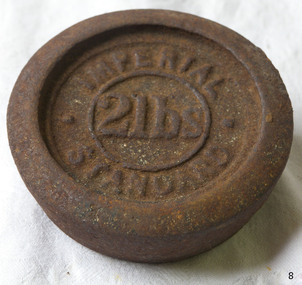
... Australia began converting to the metric system in the 1960s, beginning with its money. The conversion from imperial to metric units of measurement in Australia took place from 1970 and was completed in 1988 when metric units became the only legal unit of measurement....Australia began converting to the metric system in the 1960s, beginning with its money. The conversion from imperial to metric units of measurement in Australia took place from 1970 and was completed in 1988 when metric units became the only legal unit of measurement. flagstaff hill warrnambool shipwrecked coast flagstaff hill maritime museum maritime museum shipwreck coast flagstaff hill maritime village great ocean road standard measure imperial standard weight 2lb weight imperial standard weight "IMPERIAL STANDARD", "2lbs" Weight; 2 lbs. ...The disc-shaped design of this 2 LB metal weight enables it to be stacked on top of another similarly shaped weight. The weight is used with a balance scale to accurately weigh the mass of items such as grain, sugar, meat or potatoes. It could have been used in retail or wholesale businesses like a general store or a grain merchant’s premises. The user would place the weight on one side of a balance scale. Goods would then be placed onto the other side of the scale until the beam between both sides of the scale was level, showing that the weight of the goods was as heavy as the weight on the other side. This weight is marked in Imperial units. An Imperial Standard 1LB, or one pound, is equal to 453.592grams. The British Weights and Measures Act of 1824 defined official standards for weights and measurements. This ensured that uniform measurements would be used for trade throughout the Empire. Towns and districts would have an official set of Imperial Standard Weights and Measures. Inspectors periodically used this official set to check the accuracy of traders’ own weights and measures. There would be penalties such as fines or imprisonment for people who broke these laws. The State of Victoria had its own Weight and Measures Act in 1862 and a decade later the inspectors in local councils used their local set of weights and measures to test the local businesses measuring equipment. In the nineteenth century the Victorian Customs Department carried out this role but this was handed over to the Melbourne Observatory at the beginning of the twentieth century. The Measures Branch then followed on with this task from the 1940s until 1995. Australia began converting to the metric system in the 1960s, beginning with its money. The conversion from imperial to metric units of measurement in Australia took place from 1970 and was completed in 1988 when metric units became the only legal unit of measurement.Weight; 2 lbs. Metal disc designed for stacking. Inscription marked in relief. Imperial Standard weight, 2 pounds weight."IMPERIAL STANDARD", "2lbs"flagstaff hill, warrnambool, shipwrecked coast, flagstaff hill maritime museum, maritime museum, shipwreck coast, flagstaff hill maritime village, great ocean road, standard measure, imperial standard, weight, 2lb weight, imperial standard weight -
 Bendigo Historical Society Inc.
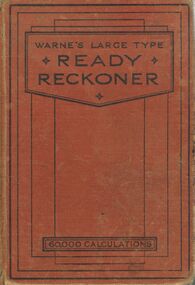
Book - BENDIGO SALEYARDS COLLECTION: WARNE'S LARGE TYPE READY RECKONER
... Contents include: Decimal Conversion Tables, General Information, Simple Fractions, Rates Exceeding £1, Trade Discount & Duty Tables, Commissioon & Discount Tables, Table of Dates, Hourly Wages Tables, Conversion Tables, Money Weights and Measures (Imperial), The Metric System, Electrical Measures and Simple Rules in Mental Arithmetic....Contents include: Decimal Conversion Tables, General Information, Simple Fractions, Rates Exceeding £1, Trade Discount & Duty Tables, Commissioon & Discount Tables, Table of Dates, Hourly Wages Tables, Conversion Tables, Money Weights and Measures (Imperial), The Metric System, Electrical Measures and Simple Rules in Mental Arithmetic. ...Red cloth covered titled Warne's Large Type Ready Reckoner Revised Edition 1943. Contents include: Decimal Conversion Tables, General Information, Simple Fractions, Rates Exceeding £1, Trade Discount & Duty Tables, Commissioon & Discount Tables, Table of Dates, Hourly Wages Tables, Conversion Tables, Money Weights and Measures (Imperial), The Metric System, Electrical Measures and Simple Rules in Mental Arithmetic.bendigo, council, cattle markets, bendigo saleyards collection - warne's large type ready reckoner, frederick warne & co., ltd -
 Sunshine and District Historical Society Incorporated
Booklet - The Sunshine Presbyterian Ladies Guild Cookery book
... 74 loose double sided pages from a two ringed binder containing recipes including conversion tables from imperial to metric - undated...Sunshine Presbyterian Ladies Guild Cooking savoury and snacks|fish, meat and poultry dishes|desserts|baked goods|sauces 74 loose double sided pages from a two ringed binder containing recipes including conversion tables from imperial to metric - undated Booklet The Sunshine Presbyterian Ladies Guild Cookery book ...savoury and snacks|fish, meat and poultry dishes|desserts|baked goods|saucessunshine presbyterian ladies guild, cooking -
 Sunshine and District Historical Society Incorporated
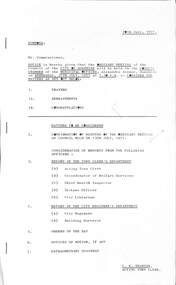
Administrative record - City of Sunshine - Commissioner Mr Alexander Alex George Gillon Collection 1976 - 1982 - Notice of ordinary meeting of the council of the City of Sunshine to be held on 27th July 1977, City of Sunshine, 20th July 1977
... Andrews Street Plan of Strata Subdivision 26 Ravenscourt Road Plan of Subdivision Hook Street and Vule Street Plan of Subdivision Rita Street Plan of Subdivision Geelong Road and Francis Street Brooklyn Continuance of Consultant Services National Safety Council of Australia Construction of Western Avenue Reconstruction of Ashley Street Savlage Deport of Wastepaper and Bottles at Garbage Tip Sunshine Tip Smorgan Consolidated Industries and Manufacturers Bottle Company of Victoria Pty Ltd Allocation of Funds 77/78 Joint Works Main and Unlcassified Road Proposed Land Acquisition Boundary Road and Fitzgerald Road Intersection Items for Consideration at 77/78 Estimates Metrication of City Plans & Conversion to Metric Scale of Detailed City Plans Harrison Street and Miles Street Private Street Scheme Report of Building Surveyor Fencing 83 Hall Street Sunshine West Australian Institiute of Steel Construction Seminar Installation of Underground Tanks Readymix 550 Geelong Road Brooklyn Installation of Underground Tanks Australian Cargo Enterprises Lot 2 Kalingra Road Installation of Underground Tank Esso Service Station Lots 39, 40 & 41 Ballarat Road Corner Northumberland Road Dangerous Building 5 Wattle Road Maidstone Loading Space Lot 80 Porter Road Deer Park Sewer Willis Street Pre-School Centre Tenders Willis Street Pre-School Centre Construction Major Repairs Central Library and Infant Welfare Centre W.C. ...Andrews Street Plan of Strata Subdivision 26 Ravenscourt Road Plan of Subdivision Hook Street and Vule Street Plan of Subdivision Rita Street Plan of Subdivision Geelong Road and Francis Street Brooklyn Continuance of Consultant Services National Safety Council of Australia Construction of Western Avenue Reconstruction of Ashley Street Savlage Deport of Wastepaper and Bottles at Garbage Tip Sunshine Tip Smorgan Consolidated Industries and Manufacturers Bottle Company of Victoria Pty Ltd Allocation of Funds 77/78 Joint Works Main and Unlcassified Road Proposed Land Acquisition Boundary Road and Fitzgerald Road Intersection Items for Consideration at 77/78 Estimates Metrication of City Plans & Conversion to Metric Scale of Detailed City Plans Harrison Street and Miles Street Private Street Scheme Report of Building Surveyor Fencing 83 Hall Street Sunshine West Australian Institiute of Steel Construction Seminar Installation of Underground Tanks Readymix 550 Geelong Road Brooklyn Installation of Underground Tanks Australian Cargo Enterprises Lot 2 Kalingra Road Installation of Underground Tank Esso Service Station Lots 39, 40 & 41 Ballarat Road Corner Northumberland Road Dangerous Building 5 Wattle Road Maidstone Loading Space Lot 80 Porter Road Deer Park Sewer Willis Street Pre-School Centre Tenders Willis Street Pre-School Centre Construction Major Repairs Central Library and Infant Welfare Centre W.C. ...Notice of Ordinary Meeting of the Council of the City of Sunshine to be held on 27th July 1977 Report of the Town Clerk's Department Report of the Town Clerk Building Highpoint West Agreement with Development Underwriting (Vic) Pty Ltd about Accommodation for Library, Infant Welfare and Child Care Services Infant Welfare Services Proposed Errington Reserve Committee of Management Financial Reports Rates, Sanitary and Interest Abandonments for 1976/1977 Melbourne Tourist Authority Reservation of Land for Facilities and Services for the Elderly Pound Keeper and Fees Valuations Site for Kindergarten for Physically Handicapped Children Rogers Reserve fronting Sonley Street and Babb Street Maidstone Australian - Britain Society Contribution Ambulance Service Melbourne Abandonment of Footpath Account Lot 94 Delmont Street Storage of Wastepaper at Sunshine Tip Site Hulett Street by Smorgan Consolidated Industries Interest on Rates Policy Rates Deferred Westerngate North Estate Report of the Co-Ordinator of Welfare Services Youth Outreach Project Closure of Access Radio Station 3ZZ Report of the Senior Health Inspector School Canteens Health Act Registrations Report of the By-Laws Officer Street Stall Rear of G. J. Coles in Clarke Street Victorian Railways and Community Services Programme Report of the City Engineer Land Use Permit and Land Use Permit Application Display Homes Centre Camelot Drive and Trafalgar Street Land Use Permit Application Subdivision Furlong Road Land Use Permit Application Sign 592 Ballarat Road Deer Park Land Use Permit Application Sales of Secondhand Motor Vehicles, Mechanical Work and Motor Vehicle Storage Lots 48 & 48 Cranwell Street and Lots 35 & 36 Gilbert Street Land Use Permit Application Subdivision Neale Road Land Use Permit Application Sky Sign 310 Ballarat Road Braybrook Land Use Permit Application Extension to Flats Lot 50 Oldfield Street Land Use Permit Application Extension to Our Lady of the Immaculate Conception Church 90 Monash Street Land Use Permit Application Factory Lot 43 Somers Street South West Corner of Grainger Street Sunshine North Plan of Subdivision Corner Rear of 17 Simmie Street and 1 St. Andrews Street Plan of Strata Subdivision 26 Ravenscourt Road Plan of Subdivision Hook Street and Vule Street Plan of Subdivision Rita Street Plan of Subdivision Geelong Road and Francis Street Brooklyn Continuance of Consultant Services National Safety Council of Australia Construction of Western Avenue Reconstruction of Ashley Street Savlage Deport of Wastepaper and Bottles at Garbage Tip Sunshine Tip Smorgan Consolidated Industries and Manufacturers Bottle Company of Victoria Pty Ltd Allocation of Funds 77/78 Joint Works Main and Unlcassified Road Proposed Land Acquisition Boundary Road and Fitzgerald Road Intersection Items for Consideration at 77/78 Estimates Metrication of City Plans & Conversion to Metric Scale of Detailed City Plans Harrison Street and Miles Street Private Street Scheme Report of Building Surveyor Fencing 83 Hall Street Sunshine West Australian Institiute of Steel Construction Seminar Installation of Underground Tanks Readymix 550 Geelong Road Brooklyn Installation of Underground Tanks Australian Cargo Enterprises Lot 2 Kalingra Road Installation of Underground Tank Esso Service Station Lots 39, 40 & 41 Ballarat Road Corner Northumberland Road Dangerous Building 5 Wattle Road Maidstone Loading Space Lot 80 Porter Road Deer Park Sewer Willis Street Pre-School Centre Tenders Willis Street Pre-School Centre Construction Major Repairs Central Library and Infant Welfare Centre W.C. Facilities Hampshire Road city of sunshine, alexander "alex" george gillon, highpoint west shopping centre, rosamond road, maribyrnong, rogers reserve, sonley street, babb street, maidstone, delmont street, albion, sunshine tip, smorgan consolidated industries, radio station 3zz, camelot drive, trafalgar street, st. albans, furlong road, ballarat road, deer park, cranwell street, gilbert street, braybrook, neale road, oldfield street, sunshine west, our lady of the immaculate conception church, monash street, sunshine, somers street, grainger street, sunshine north, simmie street, st. andrews street, ravenscourt road, tottenham, vule street, rita street, geelong road, francis street, brooklyn, western avenue, ashley street, boundary road, fitzgerald road, harrison street, miles street, hall street, kalingra road, northumberland road, wattle road, porter road, willis street pre-school centre, willis street, errington reserve committee of management, main road east, clarke street, coles, hulett street -
Maldon Vintage Machinery Museum Inc
Slide Rules
... .1 to .4)Two SAA Conversion Slides supplied by Standards Association of Australia for converting imperial measurements to metric. .5) Plastic sleeve. .6) instruction leaflet....Engineering .1 to .4)Two SAA Conversion Slides supplied by Standards Association of Australia for converting imperial measurements to metric. .5) Plastic sleeve. .6) instruction leaflet. ....1 to .4)Two SAA Conversion Slides supplied by Standards Association of Australia for converting imperial measurements to metric. .5) Plastic sleeve. .6) instruction leaflet.engineering -
 Sunshine and District Historical Society Incorporated
Administrative record - City of Sunshine - Commissioner Mr Alexander Alex George Gillon Collection 1976 - 1982 - Minutes of the ordinary meeting of council held on 27th July 1977, City of Sunshine, 27th July 1977
... Andrews Street Plan of Strata Subdivision 26 Ravenscourt Road Plan of Subdivision Hook Street and Vule Street Plan of Subdivision Rita Street Plan of Subdivision Geelong Road and Francis Street Brooklyn Continuance of Consultant Services National Safety Council of Australia Construction of Western Avenue Reconstruction of Ashley Street Savlage Deport of Wastepaper and Bottles at Garbage Tip Sunshine Tip Smorgan Consolidated Industries and Manufacturers Bottle Company of Victoria Pty Ltd Allocation of Funds 77/78 Joint Works Main and Unlcassified Road Proposed Land Acquisition Boundary Road and Fitzgerald Road Intersection Items for Consideration at 77/78 Estimates Metrication of City Plans & Conversion to Metric Scale of Detailed City Plans Harrison Street and Miles Street Private Street Scheme Report of Building Surveyor Fencing 83 Hall Street Sunshine West Australian Institiute of Steel Construction Seminar Installation of Underground Tanks Readymix 550 Geelong Road Brooklyn Installation of Underground Tanks Australian Cargo Enterprises Lot 2 Kalingra Road Installation of Underground Tank Esso Service Station Lots 39, 40 & 41 Ballarat Road Corner Northumberland Road Dangerous Building 5 Wattle Road Maidstone Loading Space Lot 80 Porter Road Deer Park Sewer Willis Street Pre-School Centre Tenders Willis Street Pre-School Centre Construction Major Repairs Central Library and Infant Welfare Centre W.C. ...Andrews Street Plan of Strata Subdivision 26 Ravenscourt Road Plan of Subdivision Hook Street and Vule Street Plan of Subdivision Rita Street Plan of Subdivision Geelong Road and Francis Street Brooklyn Continuance of Consultant Services National Safety Council of Australia Construction of Western Avenue Reconstruction of Ashley Street Savlage Deport of Wastepaper and Bottles at Garbage Tip Sunshine Tip Smorgan Consolidated Industries and Manufacturers Bottle Company of Victoria Pty Ltd Allocation of Funds 77/78 Joint Works Main and Unlcassified Road Proposed Land Acquisition Boundary Road and Fitzgerald Road Intersection Items for Consideration at 77/78 Estimates Metrication of City Plans & Conversion to Metric Scale of Detailed City Plans Harrison Street and Miles Street Private Street Scheme Report of Building Surveyor Fencing 83 Hall Street Sunshine West Australian Institiute of Steel Construction Seminar Installation of Underground Tanks Readymix 550 Geelong Road Brooklyn Installation of Underground Tanks Australian Cargo Enterprises Lot 2 Kalingra Road Installation of Underground Tank Esso Service Station Lots 39, 40 & 41 Ballarat Road Corner Northumberland Road Dangerous Building 5 Wattle Road Maidstone Loading Space Lot 80 Porter Road Deer Park Sewer Willis Street Pre-School Centre Tenders Willis Street Pre-School Centre Construction Major Repairs Central Library and Infant Welfare Centre W.C. ...Minutes of the Ordinary Meeting of Council held on 27th July 1977 Report of the Town Clerk's Department Report of the Town Clerk Building Highpoint West Agreement with Development Underwriting (Vic) Pty Ltd about Accommodation for Library, Infant Welfare and Child Care Services Infant Welfare Services Proposed Errington Reserve Committee of Management Financial Reports Rates, Sanitary and Interest Abandonments for 1976/1977 Melbourne Tourist Authority Reservation of Land for Facilities and Services for the Elderly Pound Keeper and Fees Valuations Site for Kindergarten for Physically Handicapped Children Rogers Reserve fronting Sonley Street and Babb Street Maidstone Australian - Britain Society Contribution Ambulance Service Melbourne Abandonment of Footpath Account Lot 94 Delmont Street Storage of Wastepaper at Sunshine Tip Site Hulett Street by Smorgan Consolidated Industries Interest on Rates Policy Rates Deferred Westerngate North Estate Report of the Co-Ordinator of Welfare Services Youth Outreach Project Closure of Access Radio Station 3ZZ Report of the Senior Health Inspector School Canteens Health Act Registrations Report of the By-Laws Officer Street Stall Rear of G. J. Coles in Clarke Street Victorian Railways and Community Services Programme Report of the City Engineer Land Use Permit and Land Use Permit Application Display Homes Centre Camelot Drive and Trafalgar Street Land Use Permit Application Subdivision Furlong Road Land Use Permit Application Sign 592 Ballarat Road Deer Park Land Use Permit Application Sales of Secondhand Motor Vehicles, Mechanical Work and Motor Vehicle Storage Lots 48 & 48 Cranwell Street and Lots 35 & 36 Gilbert Street Land Use Permit Application Subdivision Neale Road Land Use Permit Application Sky Sign 310 Ballarat Road Braybrook Land Use Permit Application Extension to Flats Lot 50 Oldfield Street Land Use Permit Application Extension to Our Lady of the Immaculate Conception Church 90 Monash Street Land Use Permit Application Factory Lot 43 Somers Street South West Corner of Grainger Street Sunshine North Plan of Subdivision Corner Rear of 17 Simmie Street and 1 St. Andrews Street Plan of Strata Subdivision 26 Ravenscourt Road Plan of Subdivision Hook Street and Vule Street Plan of Subdivision Rita Street Plan of Subdivision Geelong Road and Francis Street Brooklyn Continuance of Consultant Services National Safety Council of Australia Construction of Western Avenue Reconstruction of Ashley Street Savlage Deport of Wastepaper and Bottles at Garbage Tip Sunshine Tip Smorgan Consolidated Industries and Manufacturers Bottle Company of Victoria Pty Ltd Allocation of Funds 77/78 Joint Works Main and Unlcassified Road Proposed Land Acquisition Boundary Road and Fitzgerald Road Intersection Items for Consideration at 77/78 Estimates Metrication of City Plans & Conversion to Metric Scale of Detailed City Plans Harrison Street and Miles Street Private Street Scheme Report of Building Surveyor Fencing 83 Hall Street Sunshine West Australian Institiute of Steel Construction Seminar Installation of Underground Tanks Readymix 550 Geelong Road Brooklyn Installation of Underground Tanks Australian Cargo Enterprises Lot 2 Kalingra Road Installation of Underground Tank Esso Service Station Lots 39, 40 & 41 Ballarat Road Corner Northumberland Road Dangerous Building 5 Wattle Road Maidstone Loading Space Lot 80 Porter Road Deer Park Sewer Willis Street Pre-School Centre Tenders Willis Street Pre-School Centre Construction Major Repairs Central Library and Infant Welfare Centre W.C. Facilities Hampshire Road Orders of the Day Accounts Submitted for Payment as at 15th July 1977 Extraordinary Business Sealing of Fairbairn Road Quotation city of sunshine, alexander "alex" george gillon, highpoint west shopping centre, rosamond road, maribyrnong, errington reserve committee of management, errington reserve, main road east, st. albans, rogers reserve, sonley street, babb street, maidstone, delmont street, albion, sunshine tip, hulett street, smorgan consolidated industries, radio station 3zz, clarke street, sunshine, coles, camelot drive, trafalgar street, furlong road, ballarat road, cranwell street, braybrook, neale road, oldfield street, sunshine west, our lady of the immaculate conception church, monash street, somers street, sunshine north, grainger street, simmie street, st. andrews street, ravenscourt road, tottenham, hook street, vule street, rita street, geelong road, francis street, brooklyn, western avenue, ashley street, boundary road, fitzgerald road, harrison street, miles street, deer park, hall street, kalingra road, northumberland road, wattle road, porter road, willis street pre-school centre, willis street, gilbert street
