
Showing 9 items matching "mid 20th century daily life"
-
 Broadmeadows Historical Society & Museum
Document - Letter, Roby, 9 June 1964
... ...mid 20th century daily life...mid 20th century Australian social and family networks. This item is a well documented example of everyday Australian correspondence in the 1960s, notable for its clear geographic origin, personal engagement announcement, and references to international travel and civic identity, enhancing its social and historic interpretive value. Personal correspondence family relationships engagement announcements social customs mid 20th century daily life ...The letter was written from Mile End, South Australia, and references anticipated overseas travel to Japan and Hong Kong in July 1965, as well as civic roles (“Mayor & Mayoress”), situating the item in mid 20th century Australian social and family networks.This item is a well documented example of everyday Australian correspondence in the 1960s, notable for its clear geographic origin, personal engagement announcement, and references to international travel and civic identity, enhancing its social and historic interpretive value.Single page handwritten letter, ink on paper. Envelope Front / Address side: PLEASE POST EARLY AUSTRALIA BEFORE LUNCH BEFORE FOUR O'CLOCK/9 JUN 1964/Miss Kath Fletcher/14 Wembley Road/Fawkner / Vic Letter text: 64 Fisher Drive/Mile End/South Australia/9-6-1964/Dear Kath/Many thanks for your kind/ thoughts and the Ticket for my Birthday I/think Kath this ticket should show results/as the whole thing seems to be wrapped up/in such great occasions/ Vally & I was / terribly thrilled with the great news of your/engagement to Keith (ARC) I am sure that it/will mean great happiness to you both because/what we saw of ARC he is a very fine/gentleman and yourself you Know our/Thoughts so once again luck to you both/ also Mum:/ As you know we have our name down/for Japan & Hong Kong next July 1965 and passing/through Melbourne we will certainly look up the/ Mayor & Mayoress/ Will Vally is scribbling something/so will conclude this note with our Deepest & Sincere/wishes to you both and may God Grant you all the/happiness that is due to you/(A Kiss for / Kiss for Mum/ Roby)/Yours sweetly/Roby personal correspondence, family relationships, engagement announcements, social customs, mid 20th century daily life, suburban australia, international travel plans, japan travel, hong kong travel, civic roles, mayoral identity, handwritten letters, 1960s australia -
 National Wool Museum
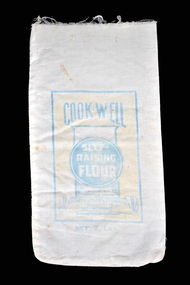
Textile - Cook Well Self Raising Flour Bag
... mid-20th century. They were used at home, usually by women, containing household items which would not spoil, such as flour, sugar, animal feed, seeds, and other commodities. In modern times a trip to the supermarket is a daily chore, in the past however, these trips happened far less often, with big sacks such as these a large reason why. In the rural US and Canada, Feed sack dresses and Flour sack dresses, were an iconic part of rural life...mid-20th century. They were used at home, usually by women, containing household items which would not spoil, such as flour, sugar, animal feed, seeds, and other commodities. In modern times a trip to the supermarket is a daily chore, in the past however, these trips happened far less often, with big sacks such as these a large reason why. In the rural US and Canada, Feed sack dresses and Flour sack dresses, were an iconic part of rural life ...These domestic kitchen bags were donated to the National Wool Museum by Lila Gore. Lila donated Children’s Clothing (RGE 8324) to the museum in 2022 and at her time of donating, inquired as to whether the museum would also be interested in these bags she had been collecting. Lila said there was no reason as to why she was saving the bags, other than she liked the art works and thought they were too good to end up in landfill. She had thought perhaps she would make something out of the bags, or perhaps give the bags to a friend to make something. When Lila was donating the Children’s Clothing to the museum, she thought that the National Wool Museum would be the perfect home for the bags. Domestic kitchen bags such as these date from the late 19th century through the mid-20th century. They were used at home, usually by women, containing household items which would not spoil, such as flour, sugar, animal feed, seeds, and other commodities. In modern times a trip to the supermarket is a daily chore, in the past however, these trips happened far less often, with big sacks such as these a large reason why. In the rural US and Canada, Feed sack dresses and Flour sack dresses, were an iconic part of rural life from the 1920s through the Great Depression, World War II, and post-World War II years. Australia also reused these sacks, typically for making wagga style blankets, but re-use for clothing was not unusual.Calico bag with yellow and blue graphic text on front.Front: COOK-WELL \ SELF- \ RAISING \ FLOUR \ PREPARED WITH \ PHOSHATE AERATOR \ HENRY BERRY & Co (A/S??Ltd) \ 568 580 COLLINS STREET \ MELBOURNE \ NET 7 LBSwagga, flour, oats, bag, calico, lila, gore, depression, war, kitchen -
 National Wool Museum
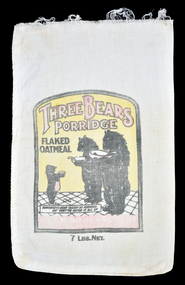
Textile - Three Bears Porridge Flaked Oatmeal Bag
... mid-20th century. They were used at home, usually by women, containing household items which would not spoil, such as flour, sugar, animal feed, seeds, and other commodities. In modern times a trip to the supermarket is a daily chore, in the past however, these trips happened far less often, with big sacks such as these a large reason why. In the rural US and Canada, Feed sack dresses and Flour sack dresses, were an iconic part of rural life...mid-20th century. They were used at home, usually by women, containing household items which would not spoil, such as flour, sugar, animal feed, seeds, and other commodities. In modern times a trip to the supermarket is a daily chore, in the past however, these trips happened far less often, with big sacks such as these a large reason why. In the rural US and Canada, Feed sack dresses and Flour sack dresses, were an iconic part of rural life ...These domestic kitchen bags were donated to the National Wool Museum by Lila Gore. Lila donated Children’s Clothing (RGE 8324) to the museum in 2022 and at her time of donating, inquired as to whether the museum would also be interested in these bags she had been collecting. Lila said there was no reason as to why she was saving the bags, other than she liked the art works and thought they were too good to end up in landfill. She had thought perhaps she would make something out of the bags, or perhaps give the bags to a friend to make something. When Lila was donating the Children’s Clothing to the museum, she thought that the National Wool Museum would be the perfect home for the bags. Domestic kitchen bags such as these date from the late 19th century through the mid-20th century. They were used at home, usually by women, containing household items which would not spoil, such as flour, sugar, animal feed, seeds, and other commodities. In modern times a trip to the supermarket is a daily chore, in the past however, these trips happened far less often, with big sacks such as these a large reason why. In the rural US and Canada, Feed sack dresses and Flour sack dresses, were an iconic part of rural life from the 1920s through the Great Depression, World War II, and post-World War II years. Australia also reused these sacks, typically for making wagga style blankets, but re-use for clothing was not unusual.Calico oat bag with graphic image on front showing three bears holding porridge bowls with yellow background and red, white and black text. Back of bag shows red and white graphic image of a woman wearing a dress and heeled shoes holding a coffee cup, with red and white text.Front: THREE BEARS \ PORRIDGE \ FLAKED \ OATMEAL \ SOMEBODYS BEEN TASTIN' MY PORRIDGE \ AN' THEY'VE EATEN IT ALL UP \ Jas. F. McKenzie & Co. Pty. Ltd. \ AUSTRALIA \ 7 LBS. NET. Back: MCKENZIES \ EXCELSIOR \ COFFEE \ ESSENCEwagga, flour, oats, bag, calico, lila, gore, depression, war, kitchen -
 National Wool Museum
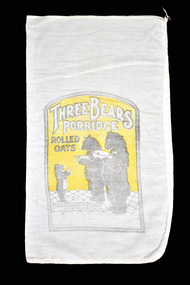
Textile - Three Bears Porridge Rolled Oats Bag
... mid-20th century. They were used at home, usually by women, containing household items which would not spoil, such as flour, sugar, animal feed, seeds, and other commodities. In modern times a trip to the supermarket is a daily chore, in the past however, these trips happened far less often, with big sacks such as these a large reason why. In the rural US and Canada, Feed sack dresses and Flour sack dresses, were an iconic part of rural life...mid-20th century. They were used at home, usually by women, containing household items which would not spoil, such as flour, sugar, animal feed, seeds, and other commodities. In modern times a trip to the supermarket is a daily chore, in the past however, these trips happened far less often, with big sacks such as these a large reason why. In the rural US and Canada, Feed sack dresses and Flour sack dresses, were an iconic part of rural life ...These domestic kitchen bags were donated to the National Wool Museum by Lila Gore. Lila donated Children’s Clothing (RGE 8324) to the museum in 2022 and at her time of donating, inquired as to whether the museum would also be interested in these bags she had been collecting. Lila said there was no reason as to why she was saving the bags, other than she liked the art works and thought they were too good to end up in landfill. She had thought perhaps she would make something out of the bags, or perhaps give the bags to a friend to make something. When Lila was donating the Children’s Clothing to the museum, she thought that the National Wool Museum would be the perfect home for the bags. Domestic kitchen bags such as these date from the late 19th century through the mid-20th century. They were used at home, usually by women, containing household items which would not spoil, such as flour, sugar, animal feed, seeds, and other commodities. In modern times a trip to the supermarket is a daily chore, in the past however, these trips happened far less often, with big sacks such as these a large reason why. In the rural US and Canada, Feed sack dresses and Flour sack dresses, were an iconic part of rural life from the 1920s through the Great Depression, World War II, and post-World War II years. Australia also reused these sacks, typically for making wagga style blankets, but re-use for clothing was not unusual.Calico oat bag with graphic image on front showing three bears holding porridge bowls with yellow background and white and black text.Front: THREE BEARS \ PORRIDGE \ ROLLED \ OATS \ SOMEBODYS BEEN TASTIN' MY PORRIDGE / AN' THEY'VE EATEN IT ALL UPwagga, flour, oats, bag, calico, lila, gore, depression, war, kitchen -
 National Wool Museum
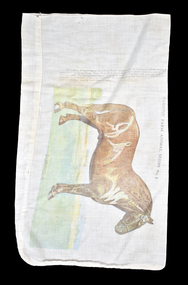
Textile - Parsons Rolled Oats Bag
... mid-20th century. They were used at home, usually by women, containing household items which would not spoil, such as flour, sugar, animal feed, seeds, and other commodities. In modern times a trip to the supermarket is a daily chore, in the past however, these trips happened far less often, with big sacks such as these a large reason why. In the rural US and Canada, Feed sack dresses and Flour sack dresses, were an iconic part of rural life...mid-20th century. They were used at home, usually by women, containing household items which would not spoil, such as flour, sugar, animal feed, seeds, and other commodities. In modern times a trip to the supermarket is a daily chore, in the past however, these trips happened far less often, with big sacks such as these a large reason why. In the rural US and Canada, Feed sack dresses and Flour sack dresses, were an iconic part of rural life ...These domestic kitchen bags were donated to the National Wool Museum by Lila Gore. Lila donated Children’s Clothing (RGE 8324) to the museum in 2022 and at her time of donating, inquired as to whether the museum would also be interested in these bags she had been collecting. Lila said there was no reason as to why she was saving the bags, other than she liked the art works and thought they were too good to end up in landfill. She had thought perhaps she would make something out of the bags, or perhaps give the bags to a friend to make something. When Lila was donating the Children’s Clothing to the museum, she thought that the National Wool Museum would be the perfect home for the bags. Domestic kitchen bags such as these date from the late 19th century through the mid-20th century. They were used at home, usually by women, containing household items which would not spoil, such as flour, sugar, animal feed, seeds, and other commodities. In modern times a trip to the supermarket is a daily chore, in the past however, these trips happened far less often, with big sacks such as these a large reason why. In the rural US and Canada, Feed sack dresses and Flour sack dresses, were an iconic part of rural life from the 1920s through the Great Depression, World War II, and post-World War II years. Australia also reused these sacks, typically for making wagga style blankets, but re-use for clothing was not unusual.Calico oat bag with colour image and black text. Image shows a full length brown horse with bridle.Front: PARSONS FARM ANIMAL SERIES No.3 \ SUFFOLK \ The Suffolk, often known as the Suffolk Punch, originated in the County of Suffolk, England \ and is noted for its hardiness. From 15 to 16 hands in height. The Suffolk in general is smaller than \ the Clydesdale. The head is rather coarse, with the neck short. The body long deep and wide with \ a round full appearance. The croup is straight and legs short and free from leather. The invariable \ colour is chestnut, varying from light to dark.wagga, flour, oats, bag, calico, lila, gore, depression, war, kitchen -
 National Wool Museum
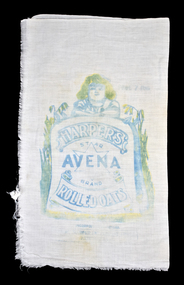
Textile - Harpers Star Avena Brand Rolled Oats Bag
... mid-20th century. They were used at home, usually by women, containing household items which would not spoil, such as flour, sugar, animal feed, seeds, and other commodities. In modern times a trip to the supermarket is a daily chore, in the past however, these trips happened far less often, with big sacks such as these a large reason why. In the rural US and Canada, Feed sack dresses and Flour sack dresses, were an iconic part of rural life...mid-20th century. They were used at home, usually by women, containing household items which would not spoil, such as flour, sugar, animal feed, seeds, and other commodities. In modern times a trip to the supermarket is a daily chore, in the past however, these trips happened far less often, with big sacks such as these a large reason why. In the rural US and Canada, Feed sack dresses and Flour sack dresses, were an iconic part of rural life ...These domestic kitchen bags were donated to the National Wool Museum by Lila Gore. Lila donated Children’s Clothing (RGE 8324) to the museum in 2022 and at her time of donating, inquired as to whether the museum would also be interested in these bags she had been collecting. Lila said there was no reason as to why she was saving the bags, other than she liked the art works and thought they were too good to end up in landfill. She had thought perhaps she would make something out of the bags, or perhaps give the bags to a friend to make something. When Lila was donating the Children’s Clothing to the museum, she thought that the National Wool Museum would be the perfect home for the bags. Domestic kitchen bags such as these date from the late 19th century through the mid-20th century. They were used at home, usually by women, containing household items which would not spoil, such as flour, sugar, animal feed, seeds, and other commodities. In modern times a trip to the supermarket is a daily chore, in the past however, these trips happened far less often, with big sacks such as these a large reason why. In the rural US and Canada, Feed sack dresses and Flour sack dresses, were an iconic part of rural life from the 1920s through the Great Depression, World War II, and post-World War II years. Australia also reused these sacks, typically for making wagga style blankets, but re-use for clothing was not unusual.Calico oat bag with graphic blue and yellow image and text on front. Image shows head and shoulders of person resting on forearms surrounded by flora. Back of bag shows blue and white image of a cube with text and star graphics.Front: HARPER'S \ STAR \ AVENA \ BRAND \ ROLLED OATS \ ??INCORPOR?? ??STORIA?? \ ????? \ AUSTRALIA Back: THE \ SILVER STAR \ RICE \ STARCH \ ROBERT HARPERS AND CO LIMITED \ AUSTRALIA \ THE \ BEST \ IN \ THE \ WORLD \ WONT \ STICK \ TO THE \ IRON \wagga, flour, oats, bag, calico, lila, gore, depression, war, kitchen -
 National Wool Museum
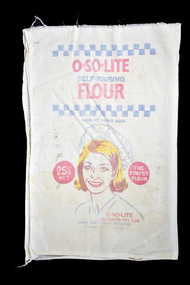
Textile - O*So*Lite Self-Raising Flour Bag
... mid-20th century. They were used at home, usually by women, containing household items which would not spoil, such as flour, sugar, animal feed, seeds, and other commodities. In modern times a trip to the supermarket is a daily chore, in the past however, these trips happened far less often, with big sacks such as these a large reason why. In the rural US and Canada, Feed sack dresses and Flour sack dresses, were an iconic part of rural life...mid-20th century. They were used at home, usually by women, containing household items which would not spoil, such as flour, sugar, animal feed, seeds, and other commodities. In modern times a trip to the supermarket is a daily chore, in the past however, these trips happened far less often, with big sacks such as these a large reason why. In the rural US and Canada, Feed sack dresses and Flour sack dresses, were an iconic part of rural life ...These domestic kitchen bags were donated to the National Wool Museum by Lila Gore. Lila donated Children’s Clothing (RGE 8324) to the museum in 2022 and at her time of donating, inquired as to whether the museum would also be interested in these bags she had been collecting. Lila said there was no reason as to why she was saving the bags, other than she liked the art works and thought they were too good to end up in landfill. She had thought perhaps she would make something out of the bags, or perhaps give the bags to a friend to make something. When Lila was donating the Children’s Clothing to the museum, she thought that the National Wool Museum would be the perfect home for the bags. Domestic kitchen bags such as these date from the late 19th century through the mid-20th century. They were used at home, usually by women, containing household items which would not spoil, such as flour, sugar, animal feed, seeds, and other commodities. In modern times a trip to the supermarket is a daily chore, in the past however, these trips happened far less often, with big sacks such as these a large reason why. In the rural US and Canada, Feed sack dresses and Flour sack dresses, were an iconic part of rural life from the 1920s through the Great Depression, World War II, and post-World War II years. Australia also reused these sacks, typically for making wagga style blankets, but re-use for clothing was not unusual.Calico flour bag with red, blue, white and yellow graphic image and text. Image shows head and shoulders of a woman wearing a bakers hat. Reverse side shows same image with slightly different text.Front: O*SO*LITE \ SELF-RAISING \ FLOUR \ 25lb \ NET \ THE \ FINEST \ FLOUR \ O-SO-LITE \ PRODUCTS PTY. LTD. \ LENNON STREET, SOUTH KENSINGTON \ VICTORIA 13 0261 \ SELF RAISING \ SELF RAISING \ SELF RAISING Back: O*SO*LITE \ SELF-RAISING \ FLOUR \ PREPARED WITH PROSPHATE AERATOR \ 25lb \ NET \ THE \ FINEST \ FLOUR \ O-SO-LITE \ PRODUCTS PTY. LTD. \ LENNON STREET, SOUTH KENSINGTON \ VICTORIA 13 0261wagga, flour, oats, bag, calico, lila, gore, depression, war, kitchen -
 Sunshine and District Historical Society Incorporated
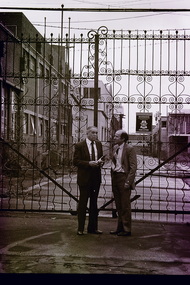
Photograph - Massey Ferguson Gates Devonshire Road Sunshine 1989 Photographs, Sharon Cavanagh, 7th February 1991
... 20th century. The gates were made by the factory's own blacksmith, Charlie Pippett, a Glasgow‑born blacksmith who migrated to Australia in 1912 and worked at the Harvester Works until 1947. The Massey Ferguson gates are historically significant because they represent Sunshine’s transition from Harvester Works to global tractor manufacturing, mid‑century industrial architecture, the daily rhythm of factory life, the identity of a working‑class suburb and the final chapter of Sunshine’s manufacturing golden age. ...The Massey Ferguson Gates are better known as the H.V. McKay Gates. The gates were the ceremonial and security entrance to one of the most important industrial sites in Melbourne’s west, the Sunshine Harvester Factory. They were not just gates; they were the symbolic front door to the Sunshine Harvester Works Factory and carried Sunshine’s industrial identity into the second half of the 20th century. The gates were made by the factory's own blacksmith, Charlie Pippett, a Glasgow‑born blacksmith who migrated to Australia in 1912 and worked at the Harvester Works until 1947.The Massey Ferguson gates are historically significant because they represent Sunshine’s transition from Harvester Works to global tractor manufacturing, mid‑century industrial architecture, the daily rhythm of factory life, the identity of a working‑class suburb and the final chapter of Sunshine’s manufacturing golden age. Today, they are one of Sunshine’s most important landmarks.Don McKay & Peter Westmore At Old Massey Ferguson Factorydon mckay, peter westmore, massey ferguson, devonshire road, sunshine, h.v. mckays, h.v. mays massey harris, charlie pippett -
 Emerald Museum & Nobelius Heritage Park
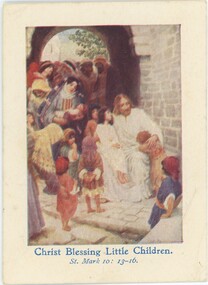
Postcard - Postcard of Christ Blessing Little Children, c. 1900s
... This postcard is part of an album of postcards which date from late 19th century to mid 20th century. Religion played a significant part in daily life at the time....This postcard is part of an album of postcards which date from late 19th century to mid 20th century. Religion played a significant part in daily life at the time. ...This postcard is part of an album of postcards which date from late 19th century to mid 20th century. Religion played a significant part in daily life at the time.This postcard is in an album of postcards dating from the late 19th century to mid 20th century and, as such, indicate the popularity of collecting postcards in Australia which reached a height in the early 1900s until around 1920.This postcard depicts the scene of Mark 10: 13-16 from the bible, where Christ meetings a group of children.On front, printed under image: 'Christ Blessing Little Children / St. Mark 10: 13-16' On back, printed above line: 'Christ Blessing Little Children' On back, printed below line: 'THEY brought young children to / Jesus, that He should touch them: / and His disciples rebuked those that / brought them. / But when Jesus saw it, He was much / displeased, and said unto them, "Suffer / the little children to come unto me, and / forbid them not; for of such is the / kingdom of God. Verily I say unto you, / Whosoever shall not receive the kingdom / of God as a little child, he shall not enter / therein." / And He took them up in His arms, / put His hands on them, and blessed / them. / So that day the mother helped the / disciples to learn about Jesus. The dis- / ciples thought the children would be a / trouble, but the mothers knew that Jesus / loved the little and helpless ones, and / would bless them, for one day He had / said, " All who seek to enter the kingdom / of heaven must become like little chil- / dren." So they were not afraid to draw / near.'postcard, 1900s, "green postcard album"
