
Showing 7 items matching "mid to late 19th century bendigo"
-
 Bendigo Historical Society Inc.
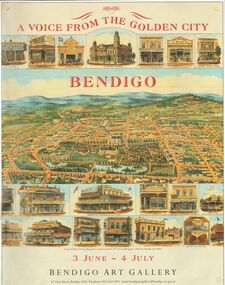
Document - BENDIGO ART GALLERY A VOICE FROM THE GOLDEN CITY EXHIBITION 2001, 1877
... ...mid to late 19th century bendigo...BENDIGO History mid to late 19th century bendigo Francis Williams Niven, Sandhurst. ...Chromolithograph Sandhurst in detail 1877 by Francis Williams Niven. View Point icons including George S. Bissett Draper, Clothing & Millinery, Manning & Co. Drapers, Milliners and Tailors; Pall Mall icons Bent Photographers, W. Lunn Painter and Decorator, J.B. Edwards Watchmakers, John Ingram Hatter and Lyceum Mutual Store & Co; High Street icons T.J. Connelly & Co. Ironmongers; McCrae Street icons Rea & Co Locksmiths and Gun Makers; Williamson Street icons Albert Bush Groicer and Tea Merchant; Bridge Street icons Cohn Brothers Soft Drink and Confectionery; Mitchell Street icons, MA Palk & Co Mourning Attire.Francis Williams Niven, Sandhurst.bendigo, history, mid to late 19th century bendigo -
 Flagstaff Hill Maritime Museum and Village
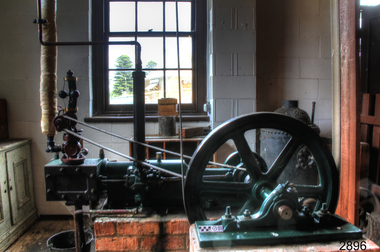
Machine - Steam Engine, Tangyes engineering, Mid-1880s
... mid-1880s. It was distributed by Melbourne machinery merchants Cameron & Sutherland, which also operated in Bendigo and Ballarat. A local cheese maker once used the engine to drive factory equipment. It was later donated to the Warrnambool Technical School, which then donated it to Flagstaff Hill to add to its historical steam engine collection. Between its manufacture and its donation to Flagstaff Hill, the governor had been replaced by the current Pickering governor. This engine design was very popular in the late 19th and early 20th centuries...mid-1880s. It was distributed by Melbourne machinery merchants Cameron & Sutherland, which also operated in Bendigo and Ballarat. A local cheese maker once used the engine to drive factory equipment. It was later donated to the Warrnambool Technical School, which then donated it to Flagstaff Hill to add to its historical steam engine collection. Between its manufacture and its donation to Flagstaff Hill, the governor had been replaced by the current Pickering governor. This engine design was very popular in the late 19th and early 20th centuries ...This Tangye B-size, single-cylinder, horizontal steam engine was likely manufactured in England around the mid-1880s. It was distributed by Melbourne machinery merchants Cameron & Sutherland, which also operated in Bendigo and Ballarat. A local cheese maker once used the engine to drive factory equipment. It was later donated to the Warrnambool Technical School, which then donated it to Flagstaff Hill to add to its historical steam engine collection. Between its manufacture and its donation to Flagstaff Hill, the governor had been replaced by the current Pickering governor. This engine design was very popular in the late 19th and early 20th centuries. When connected and powered up, the engine could drive an overhead line shaft via a flat belt off its flywheel. The line shaft would then drive the machinery via flat belts. It could drive virtually any type of machinery, such as water and sewerage pumps, mine elevators, winches, cranes, metal forges, air blowers, and marine machinery. This engine features a mechanical governor, which controls the speed of the engine regardless of whether it is under load. It also has a water pump built into the valve rod, which is used to supply the boiler with water. Steam enters the cylinder via a slide valve and applies pressure to the piston; it is like a modern internal combustion engine, but in the case of the steam engine, the pressure is exerted in turn on either side of the piston. In other words, the connecting rod is pushed by steam via the piston and piston rod and then pulled back again by steam pushing on the opposite side of the piston. Thus, power is exerted almost continuously, except at the end of each piston stroke, when it reverses direction. In the 1880s, many local butter and cheese manufacturers installed Tangye steam engines to power their machinery. A comprehensive article in the Gippsland Mercury in September 1889 extolled the magnificence of the Farnham Butter Factory in Dennington, Warrnambool, and described how one Tangye engine was used to drive several machines in the cheese- and butter-making processes. A report in the Warragul Guardian in December 1890 notes that the newly opened Warrnambool Butter Factory used a Tangye steam engine to pump water from a 60-foot well. Tangye: Richard Tangye (1833–1906) and four of his brothers—James, Joseph, Edward, and George—were the sons of Joseph Tangye, a Quaker Cornish miner. In 1857, they founded the engineering firm Richard Tangye & Brothers in Birmingham, UK. In 1860, the firm became Tangye Brothers and moved to Cornwall Works in Birmingham. The business encouraged inventors to join the company and develop their patents there, as happened with Weston’s differential pulley block, invented by the Englishman Thomas Aldridge Weston in 1854. Tangye bought the patent in 1858, giving the firm the sole right to manufacture it. The design received a medal for “original application, practical utility and success” at the 1862 International Exhibition in London. Also in 1858, the Tangye firm was commissioned by Brunel’s shipping company to manufacture hydraulic lifting jacks, or rams, to launch the steamship SS Great Eastern. The success of this project brought favourable attention to the firm, and it became involved in other notable projects, including the erection of Cleopatra’s Needle in London in 1878 and work on the Forth Road Bridge in Scotland. The firm underwent several name changes over the years, including James Tangye and Brothers (1857), Tangye Brothers and Price (1859), Tangye Brothers (1860), Tangye Brothers & Holman (1876), Tangye Brothers (by 1878), Tangye Ltd. (1881), and then simply Tangye. Its machinery and equipment were exported worldwide. In 1884, a branch with showrooms, offices, and a warehouse was opened in Melbourne at Cornwall House, Collins Street West. The firm was well known for producing high-quality machinery for agriculture and industry. Even today, new Tangye machinery is available for a subsidiary of Allspeeds. An extensive account of the firm’s history, names, inventions, and further references is available in Grace’s Guide, which also includes references to and diagrams of the Tangye horizontal steam engine. The horizontal steam engine was made by the well-known engineering firm Tangye, known for its high quality of manufacture. It was an important development in machinery because it helped improve productivity. Engines of this type are still used in some parts of the world today. This engine is a good example of a late 19th-century steam engine used in industry and agriculture and adapted for many different purposes. It is also important locally because it was connected to a local cheese making business and part of the thriving western district dairy industry. It may have been one of the Tangyes engines used at the Farnham butter factory or the Warrnambool Butter Factory, which was reported to be one of the most important in the Colony. It is also connected to the Warrnambool Technical School, established in 1968. Steam engine: stationary Tangye Size B, single-cylinder, horizontal Mill type steam engine. It has a 4-inch diameter cylinder with an 8-inch stroke. The body is painted green, and the Pickering governor is red. It was manufactured in Birmingham, England, in accordance with Tangye's Patent 238930, and distributed by Cameron and Sunderland, Melbourne, in the mid-1880s. TANGEYS PATENT BIRMINGHAM B SIZE 238930 CAMERON & SUTHERLAND MELBOURNE THE PICKERING PORTLAND . GOVERNOR . CONN. U.S.A.flagstaff hill, warrnambool, maritime village, maritime museum, flagstaff hill maritime museum and village, shipwreck coast, great ocean road, machine, invention, engine, steam, steam engine, horizontal steam engine, tangyes horizontal steam engine, stationary steam engine, single cylinder steam engine, manufacturing, farming, pumps, lifting equipment, engines, machine tools, hydraulic rams, hydraulic pumps, steam pumps, differential pulleys, mill type steam engine, 4 inch cylinder, weston’s differential pulley, thomas aldridge weston, 1862 international exhibition in london, brunel, ss great eastern, cleopatra’s needle, forth road bridge, cornwall house, collins street melbourne, agricultural machinery, industrial machinery, allspeeds, dairy, pump, richard tangye & brothers, james tangye and brothers, tangye brothers and price, tangye brothers, tangye brothers & holman, tangyes ltd., tangye, richard tangye, james tangye, joseph tangye, edward tangye, george tangye, cornwall works, birmingham, pickering governor, pickering portland connecticut usa, 19th century, dairy plant, steam power, tangye's patent 238930, tangye b size engine, cameron & sutherland, machine merchants, 1880s, mid-1880s, cheese manufacturer, butter manufacturer, diary industry, warrnambool technical school, belt driven machinery, agriculture, mechanical governor, farnham butter factory, warrnambool butter factory -
 Flagstaff Hill Maritime Museum and Village
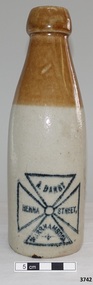
Bottle, circa 1899
... late 19th and early 20th century and of Australian made products. Bendigo Pottery is Australia’s oldest working pottery. The kilns at Bendigo Pottery are now on the Victorian Heritage Register. The W.R. Angus Collection is significant for still being located at the site it is connected with, Doctor Angus being the last Port Medical Officer in Warrnambool. The collection of medical instruments and other equipment is culturally significant, being an historical example of medicine, administration, household equipment and clothing from late 19th to mid ...This clay soft drink bottle was made by Bendigo Pottery circa 1899. It was badged for and sold by A. [Alfred] Darby of Henna Street Warrnambool, (between Raglan Pde and Lava St). The internal screw thread in the neck of this bottle allows for an applied ‘blob’ top stopper to be added. The company A. Darby bottled soda water, cordial, lemonade, ginger ale and ginger beer. Darby’s also made cider, lime juice, raspberry vinegar and other specialties. There was a branch of Darby’s cordial factory in Shepparton Victoria. The building has the year 1910 on it and is now the council office. The bottle’s manufacturer, Bendigo Pottery, was established in the 1858 during the gold rush era. The bottle is part of the “W.R. Angus Collection” that includes historical medical equipment, surgical instruments and material once belonging to Dr Edward Ryan and Dr Thomas Francis Ryan, (both of Nhill, Victoria) as well as Dr Angus’ own belongings. The Collection’s history spans the medical practices of the two Doctors Ryan, from 1885-1926 plus that of Dr Angus, up until 1969. ABOUT THE “W.R.ANGUS COLLECTION” Doctor William Roy Angus M.B., B.S., Adel., 1923, F.R.C.S. Edin.,1928 (also known as Dr Roy Angus) was born in Murrumbeena, Victoria in 1901 and lived until 1970. He qualified as a doctor in 1923 at University of Adelaide, was Resident Medical Officer at the Royal Adelaide Hospital in 1924 and for a period was house surgeon to Sir (then Mr.) Henry Simpson Newland. Dr Angus was briefly an Assistant to Dr Riddell of Kapunda, then commenced private practice at Curramulka, Yorke Peninsula, SA, where he was physician, surgeon and chemist. In 1926, he was appointed as new Medical Assistant to Dr Thomas Francis Ryan (T.F. Ryan, or Tom), in Nhill, Victoria, where his experiences included radiology and pharmacy. In 1927 he was Acting House Surgeon in Dr Tom Ryan’s absence. Dr Angus had become engaged to Gladys Forsyth and they decided he further his studies overseas in the UK in 1927. He studied at London University College Hospital and at Edinburgh Royal Infirmary and in 1928, was awarded FRCS (Fellow from the Royal College of Surgeons), Edinburgh. He worked his passage back to Australia as a Ship’s Surgeon on the on the Australian Commonwealth Line’s T.S.S. Largs Bay. Dr Angus married Gladys in 1929, in Ballarat. (They went on to have one son (Graham 1932, born in SA) and two daughters (Helen (died 12/07/1996) and Berenice (Berry), both born at Mira, Nhill According to Berry, her mother Gladys made a lot of their clothes. She was very talented and did some lovely embroidery including lingerie for her trousseau and beautifully handmade baby clothes. Dr Angus was a ‘flying doctor’ for the A.I.M. (Australian Inland Ministry) Aerial Medical Service in 1928. Its first station was in the remote town of Oodnadatta, where Dr Angus was stationed. He was locum tenens there on North-South Railway at 21 Mile Camp. He took up this ‘flying doctor’ position in response to a call from Dr John Flynn; the organisation was later known as the Flying Doctor Service, then the Royal Flying Doctor Service. A lot of his work during this time involved dental surgery also. Between 1928-1932 he was surgeon at the Curramulka Hospital, Yorke Peninsula, South Australia. In 1933 Dr Angus returned to Nhill and purchased a share of the Nelson Street practice and Mira hospital (a 2 bed ward at the Nelson Street Practice) from Dr Les Middleton one of the Middleton Brothers, the current owners of what previously once Dr Tom Ryan’s practice. Dr Tom and his brother had worked as surgeons included eye surgery. Dr Tom Ryan performed many of his operations in the Mira private hospital on his premises. He had been House Surgeon at the Nhill Hospital 1902-1926. Dr Tom Ryan had one of the only two pieces of radiology equipment in Victoria during his practicing years – The Royal Melbourne Hospital had the other one. Over the years Dr Tom Ryan had gradually set up what was effectively a training school for country general-practitioner-surgeons. Each patient was carefully examined, including using the X-ray machine, and any surgery was discussed and planned with Dr Ryan’s assistants several days in advance. Dr Angus gained experience in using the X-ray machine there during his time as assistant to Dr Ryan. When Dr Angus bought into the Nelson Street premises in Nhill he was also appointed as the Nhill Hospital’s Honorary House Surgeon 1933-1938. His practitioner’s plate from his Nhill surgery is now mounted on the doorway to the Port Medical Office at Flagstaff Hill Maritime Village, Warrnambool. When Dr Angus took up practice in the Dr Edward and Dr Tom Ryan’s old premises he obtained their extensive collection of historical medical equipment and materials spanning 1884-1926. A large part of this collection is now on display at the Port Medical Office at Flagstaff Hill Maritime Village in Warrnambool. In 1939 Dr Angus and his family moved to Warrnambool where he purchased “Birchwood,” the 1852 home and medical practice of Dr John Hunter Henderson, at 214 Koroit Street. (This property was sold in1965 to the State Government and is now the site of the Warrnambool Police Station and an ALDI sore is on the land that was once their tennis court). The Angus family was able to afford gardeners, cooks and maids; their home was a popular place for visiting dignitaries to stay whilst visiting Warrnambool. Dr Angus had his own silk worm farm at home in a Mulberry tree. His young daughter used his centrifuge for spinning the silk. Dr Angus was appointed on a part-time basis as Port Medical Officer (Health Officer) in Warrnambool and held this position until the 1940’s when the government no longer required the service of a Port Medical Officer in Warrnambool; he was thus Warrnambool’s last serving Port Medical Officer. (Masters of immigrant ships arriving in port reported incidents of diseases, illness and death and the Port Medical Officer made a decision on whether the ship required Quarantine and for how long, in this way preventing contagious illness from spreading from new immigrants to the residents already in the colony.) Dr Angus was a member of the Australian Medical Association, for 35 years and surgeon at the Warrnambool Base Hospital 1939-1942, He served with the Australian Department of Defence as a Surgeon Captain during WWII 1942-45, in Ballarat, Victoria, and in Bonegilla, N.S.W., completing his service just before the end of the war due to suffering from a heart attack. During his convalescence he carved an intricate and ‘most artistic’ chess set from the material that dentures were made from. He then studied ophthalmology at the Royal Melbourne Eye and Ear Hospital and created cosmetically superior artificial eyes by pioneering using the intrascleral cartilage. Angus received accolades from the Ophthalmological Society of Australasia for this work. He returned to Warrnambool to commence practice as an ophthalmologist, pioneering in artificial eye improvements. He was Honorary Consultant Ophthalmologist to Warrnambool Base Hospital for 31 years. He made monthly visits to Portland as a visiting surgeon, to perform eye surgery. He represented the Victorian South-West subdivision of the Australian Medical Association as its secretary between 1949 and 1956 and as chairman from 1956 to 1958. In 1968 Dr Angus was elected member of Spain’s Barraquer Institute of Barcelona after his research work in Intrasclearal cartilage grafting, becoming one of the few Australian ophthalmologists to receive this honour, and in the following year presented his final paper on Living Intrasclearal Cartilage Implants at the Inaugural Meeting of the Australian College of Ophthalmologists in Melbourne In his personal life Dr Angus was a Presbyterian and treated Sunday as a Sabbath, a day of rest. He would visit 3 or 4 country patients on a Sunday, taking his children along ‘for the ride’ and to visit with him. Sunday evenings he would play the pianola and sing Scottish songs to his family. One of Dr Angus’ patients was Margaret MacKenzie, author of a book on local shipwrecks that she’d seen as an eye witness from the late 1880’s in Peterborough, Victoria. In the early 1950’s Dr Angus, painted a picture of a shipwreck for the cover jacket of Margaret’s book, Shipwrecks and More Shipwrecks. She was blind in later life and her daughter wrote the actual book for her. Dr Angus and his wife Gladys were very involved in Warrnambool’s society with a strong interest in civic affairs. He had an interest in people and the community. They were both involved in the creation of Flagstaff Hill, including the layout of the gardens. After his death (28th March 1970) his family requested his practitioner’s plate, medical instruments and some personal belongings be displayed in the Port Medical Office surgery at Flagstaff Hill Maritime Village, and be called the “W. R. Angus Collection”. This glazed clay bottle represents early Warrnambool industry. It is also a good example of soft drink containers used in the late 19th and early 20th century and of Australian made products. Bendigo Pottery is Australia’s oldest working pottery. The kilns at Bendigo Pottery are now on the Victorian Heritage Register. The W.R. Angus Collection is significant for still being located at the site it is connected with, Doctor Angus being the last Port Medical Officer in Warrnambool. The collection of medical instruments and other equipment is culturally significant, being an historical example of medicine, administration, household equipment and clothing from late 19th to mid-20th century. Dr Angus assisted Dr Tom Ryan, a pioneer in the use of X-rays and in ocular surgery. Earthenware soft drink bottle, part of the W.R. Angus Collection. Glazed clay, 'champ' shape, two-toned colour; caramel from mouth to shoulder, beige on lower section. Inside of neck has an internal thread that could have been sealed with an applied internal ‘blob’ top stopper. Black stamped Maltese cross design emblem on front with each quarter containing text, black oval stamp on back with maker’s details. Bottle was made by Bendigo Pottery of Victoria circa 1899 and sold by A Darby of Henna Street Warrnambool.Maltese cross design, each quarter has text "A. DARBY", "HENNA", 'STREET,", WARRNAMBOOL" Oval stamp” - - - - - -RE BENDIGO POTTERY [EPSO] M - - - - - O” flagstaff hill, warrnambool, shipwrecked coast, flagstaff hill maritime museum, maritime museum, shipwreck coast, flagstaff hill maritime village, great ocean road, dr w r angus, dr ryan, nhill base hospital, mira hospital, flying doctor, department of defence australia, australian army, army uniform, bottle, earthernware soft drink bottle, earthernware bottle, a. darby, henna street warrnambool, soft drink industry warrnambool, bendigo pottery, 1899 soft drink bottle, champ shape soft drink bottle, ginger beer bottle, cordial bottle, blob top, blob stopper, internal stopper -
 Flagstaff Hill Maritime Museum and Village
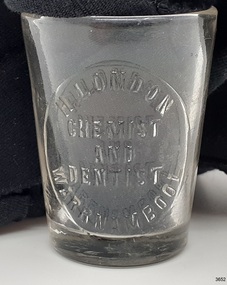
Container - Medicine Glass, W T & Co. (Whitall Tatum), late 19th Century to 1916
... late 19th and early 20th century. Mr H London was recorded in local newspaper articles from The Warrnambool Standard between 1885 to 1904. A further record in The Warrnambool Standard mentions Mr London, chemist, formerly of Warrnambool, as currently a chemist in Moore Street, Rochester. He was noted again in the Bendigo Advertiser in 1917. The maker, Whitall Tatum & Co, is clearly marked on the base of the bottle. The company was a well-known maker of prescription bottles. He used the brand "W. T. & Co". from Mid...late 19th and early 20th century. Mr H London was recorded in local newspaper articles from The Warrnambool Standard between 1885 to 1904. A further record in The Warrnambool Standard mentions Mr London, chemist, formerly of Warrnambool, as currently a chemist in Moore Street, Rochester. He was noted again in the Bendigo Advertiser in 1917. The maker, Whitall Tatum & Co, is clearly marked on the base of the bottle. The company was a well-known maker of prescription bottles. He used the brand "W. T. & Co". from Mid ...This medicine glass, or dose cup, was made for Mr. H. London, chemist and dentist, Warrnambool. His premises was at corner of Koroit and Liebig Streets, Warrnambool. The medicine glass has graduations on its side to measure doses of Teaspoon, Dessert Spoon and Tablespoon. It was donated by the family of Dr WR Angus of Warrnambool. The side seams and indented base of the glass, with the embossed lettering, show that it was produced in a three-piece mould, a method used in the late 19th and early 20th century. Mr H London was recorded in local newspaper articles from The Warrnambool Standard between 1885 to 1904. A further record in The Warrnambool Standard mentions Mr London, chemist, formerly of Warrnambool, as currently a chemist in Moore Street, Rochester. He was noted again in the Bendigo Advertiser in 1917. The maker, Whitall Tatum & Co, is clearly marked on the base of the bottle. The company was a well-known maker of prescription bottles. He used the brand "W. T. & Co". from Mid-1870's until the late 1880's, moulded into his glassware.This medicine glass is significant as an example of medical equipment that has a design still used today. It is also significant for its association with H London, a local Warrnambool chemist involved in the community and commerce of early 20th century in Warrnambool.Medicine glass or dose cup, c. 1916. Glass is a conical shape with inward sloping sides and a concave base. there are side seams and a concave base. Embossed inscriptions are on the glass, showing measurements in the imperial scale on one side , the owner's details are on the other side and the maker's details are on the base. Three horizontal lines are etched on the left of the measurements. The glass belonged to H. London, Chemist and Dentist, Warrnambool, and was made by Whitall Tatum & Co., U.S.A. The glass is part of the W R Angus Collection.On sides: "TABLE", "DESSERT", "TEA". "H LONDON / WARRNAMBOOL / CHEMIST AND DENTIST" On base: "W.T. & CO. / A.J. / U.S.A."flagstaff hill, warrnambool, shipwrecked coast, flagstaff hill maritime museum, maritime museum, shipwreck coast, flagstaff hill maritime village, great ocean road, dose cup, medicine glass, chemist, mdeical equipment, medicine, h. london, chemist and dentist, liegig st warrnambool, rochester, whitall tatum & co, w. t. & co., three-piece mould, w.r. angus -
 Bendigo Historical Society Inc.
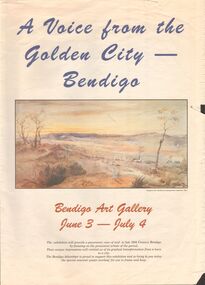
Document - BENDIGO ART GALLERY EXHIBITION A VOICE FROM THE GOLDEN CITY, 1852-1887
... Bendigo Art Gallery Mid to Late 19th Century exhibition on display June 3 to July 4 2001, celebrating the transformation of a town into a city. ...BENDIGO History 19th century bendigo George Rowe Bendigo Art Gallery Mid to Late 19th Century exhibition on display June 3 to July 4 2001, celebrating the transformation of a town into a city. ...Bendigo Art Gallery Mid to Late 19th Century exhibition on display June 3 to July 4 2001, celebrating the transformation of a town into a city. The Bendigo Advertiser is a proud sponsor of exhibition printing a souvenir poster for the occasion depicting a water colour of Kangaroo Flat Sandhurst in 1857 by George Rowe on the cover, a chromolithograph of Sandhurst in 1887 by Francis Niven overleaf and on the back a water colour of the Bendigo Goldfields C.A. Ross & Co. Derwent Store in 1852 by John Cater of Northcote.George Rowebendigo, history, 19th century bendigo -
 Bendigo Historical Society Inc.
Newspaper - Fortuna Articles - "Time to Honour Pioneers", May 01 2009
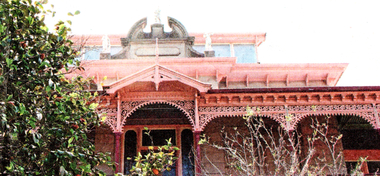
... Bendigo goldfields in the mid-19th century, numbering 2,000–3,000 by 1860. Many were experienced miners from the Harz mountains and led the development of quartz mining at Sandhurst. Christopher Ballerstedt, a German miner, established a successful quartz mining operation and built Fortuna Villa, later sold to George Lansell. ...Bendigo goldfields in the mid-19th century, numbering 2,000–3,000 by 1860. Many were experienced miners from the Harz mountains and led the development of quartz mining at Sandhurst. Christopher Ballerstedt, a German miner, established a successful quartz mining operation and built Fortuna Villa, later sold to George Lansell. ...Germans were the third largest ethnic group on the Bendigo goldfields in the mid-19th century, numbering 2,000–3,000 by 1860. Many were experienced miners from the Harz mountains and led the development of quartz mining at Sandhurst. Christopher Ballerstedt, a German miner, established a successful quartz mining operation and built Fortuna Villa, later sold to George Lansell. Other notable German names include Wittscheibe, Koch, Killian, Ketterer, Roeder, and Mueller, who contributed to mining and local society. German architects, especially William Vahland, played a major role in shaping Bendigo’s architecture, including work on Fortuna Villa. Germans contributed to Bendigo’s cultural life, with several daughters of German-born residents achieving international fame as opera singers. The community was active in commerce, wine production, trades, and professions (e.g., priests, chemists, mayors). Despite some families anglicizing their names during World War I, many German surnames remain prominent in Bendigo. The document advocates for greater recognition of German pioneers, suggesting Fortuna Villa as a venue for a museum or display to celebrate their legacy, inspired by the example of the Chinese Museum in Bendigo. The author urges the community to preserve and showcase the stories, artifacts, and memorabilia of all Bendigo’s pioneers, emphasizing the importance of remembering the city’s immigrant past. Beverley Carter is the author of the document and is introduced as a retired secondary school teacher, part-time journalist, reviewer, and editor. She is a member of Bendigo's Lansell family and is currently writing a comprehensive history of her family, covering their European and English origins and their role in Bendigo's development. Carter's 'Fortuna Glimpses' series focuses on the life of mining magnate George Lansell and his home, Fortuna Articles - "Time to Honour Pioneers" May 01 2009 The Bendigo Advertiser by Bevely Carter, picture by Julian Prowd This item contains the following: 11217.39a Colour Photo of Fortuna. 11217.39b Part of Page 17 - "Time to Honour Pioneers"non-fictionbendigo, fortuna, george lansell, beverley carter -
 Sunshine and District Historical Society Incorporated
Photograph - Albion Railway Stationmaster Residence Photograph
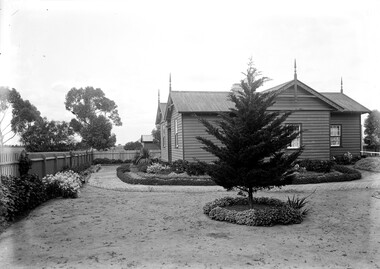
... Bendigo line in the late 19th century. The house was removed in the 1970's when the station car park was expanded. The removal was also during the time when the practice of the removal of redundant VR housing stock was occurring. No trace remains today. This building was used as the official home of the Stationmaster at Albion Railway Station. This was standard Victorian Railways practice from the late 1800s through the mid ...The Albion Stationmaster’s Residence stood on the east side of the railway line, immediately north of the original 1891 station building, on the corner of St. Albans Road and the station entrance reserve. It was positioned on what is now the eastern service road / station car park area, facing the tracks. This was the standard placement for VR residences on the Bendigo line in the late 19th century. The house was removed in the 1970's when the station car park was expanded. The removal was also during the time when the practice of the removal of redundant VR housing stock was occurring. No trace remains today.This building was used as the official home of the Stationmaster at Albion Railway Station. This was standard Victorian Railways practice from the late 1800s through the mid‑20th century. Its functions included housing the stationmaster and their family, providing 24‑hour on‑call presence for emergencies, allowing the Stationmaster to supervise the yard, signals, and level crossing and acted as a local administrative base for the station’s operations Because Albion was a junction‑adjacent station (close to the Sunshine triangle and the goods sidings), the Stationmaster’s role at this station was significant.albion railway station, railway, albion
