
Showing 231 items matching "military gun"
-
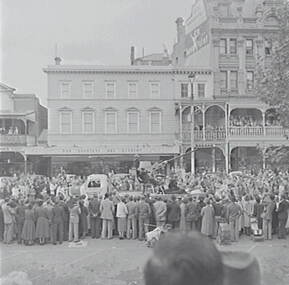 Allan Doney Collection, Bendigo Historical Society Inc.
Negative - Bendigo Easter Fair 1957 - Parade - Military Gun, Allan Doney, 1950 -1970
... Bendigo Easter Fair 1957 - Parade - Military Gun...Negative Bendigo Easter Fair 1957 - Parade - Military Gun Allan Doney ...In the years of Allan Doney’s photography, landmark buildings succumbed to fire, neglect and redevelopment. He photographed the grey sand hills from Bendigo’s mining past, the streetscapes, poppet heads, miners’ cottages, gracious homes with ornate verandahs, trams and much more. Above all, his photographs show how much of the city has survived from the 19th century – and how much has not. Through two decades of great change, Allan Doney was there to capture ways people interacted with it. Although he travelled to many other places in Northern Victoria and beyond in search of subjects for his art, he seemed to always return to Bendigo for inspiration. -
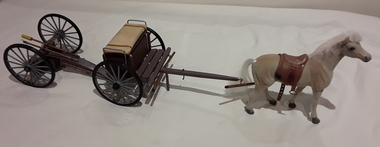 Mont De Lancey
Decorative object - Military Carriages, Chas W Davis, Unknown
... ...Military Models...Gun...These models are of single horse drawn military gun carriages and accessories....A brown four wheeled wooden model of a gun carriage for military use with a white horse. The carriage wheels have black rims with grey painted spokes. ...These models are of single horse drawn military gun carriages and accessories. Military Vehicles Military Models Gun Carriages Military Equipment 56 VIR (3rd VIR) Three gun carriages: 1. ...The collection of thirteen model horse drawn vehicles were carefully handmade by Mr Chas W Davis 1925 - 2002. He was a talented artist and saw doctor. These models are of single horse drawn military gun carriages and accessories.Three gun carriages: 1. A brown four wheeled wooden model of a gun carriage for military use with a white horse. The carriage wheels have black rims with grey painted spokes. There is a brown storage box at the front for the driver with a brown vinyl padded seat.Three wooden slats form the footrest. A gun cleaning rod and lighter rod are attached to the back of the narrow support tray towards the back wheels. The saddled horse is linked to the carriage by a wooden shaft. A gun carriage is a frame and mount that supports the gun barrel of an artillery piece allowing it to be maneuvered and fired. These platforms often had wheels so that the artillery pieces could be moved more easily. 2. A brown large two wheeled gun carriage with no horse. The wheels have grey painted spokes and black rims. There is a cleaning rod and a lighting rod attached to the carriage shaft near the wheels. An additional accessory is included of a black vinyl saddle with lambswool lining as well as clips for attaching to the horse tack. 3. A grey two large wheeled gun carriage with no horse. The wheels have grey painted spokes and black rims. There is a cleaning rod and a lighting rod attached to the carriage shaft near the wheels. There is a chain to attach the carriage to the horse tack.56 VIR (3rd VIR)military vehicles, military models, gun carriages, military equipment -
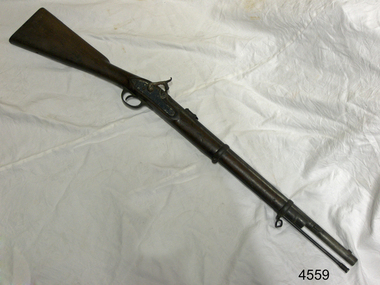 Flagstaff Hill Maritime Museum and Village
Weapon - Gun, ISAAC HOLLIS & SONS, Mid 19th Century
... ...Military gun...Flagstaff Hill Maritime Museum Maritime Village Warrnambool Great Ocean Road Shipwreck Coast Firearm gun percussion carbine .577 cal Colonial Tasmanian Issue Artillery Carbine Military gun Pattern 1861 muzzle-loading muzzle-loading musket cap and ball musket wood stock 1861 percussion breech-loading guns Richard and William Hillis Herbert & Co. ...The Hollis Brothers were first recorded as operating from 11 Weaman Row in 1840, although evidence suggests that the business may have commenced prior to this date. Over time, the firm evolved and became known as Isaac Hollis & Sons, with claims of its establishment dating back to 1814. This earlier date is supported by records of Richard and William Hollis trading in Bath Street, Birmingham, between 1814 and 1818, which raises the possibility that Isaac and Frederick Hollis were their descendants. The principal brothers involved in the business were Isaac Hollis, born in 1815, and Frederick Hollis, whose birth date remains unknown. Frederick’s life was cut short when he died on 20 December 1839. According to the 1841 census, Isaac Hollis resided in Weaman Row and was listed as a 25-year-old gun and pistol maker. He was married to Emma, who was born in 1821, and together they had two children: Isaac, born in 1837, and Henry, born in 1839. Following Frederick’s death, Isaac continued to operate under the name Hollis Brothers until 1845, after which he renamed the business Hollis Brothers & Co. This entity remained active up to 1848. In 1844, Isaac Hollis entered a brief partnership with William Tranter at 10 & 11 Weaman Row, likely to fulfil a specific contract or to supply particular parts. This partnership continued until 1849. In 1848, Isaac Hollis formed a partnership with Isaac Brentnall Sheath, establishing the firm of Hollis & Sheath and expanding their operations into 10 Weaman Row. The partnership saw Hollis & Sheath become licensed manufacturers of percussion breech-loading guns, positioning the company as a notable presence in the industry. In 1861, Sheath left the partnership and emigrated to New Zealand, where he conducted several enterprises and was elected as a provincial councillor. He died in Christchurch on 19th May 1897. Following the departure of Isaac Sheath in 1861, the business underwent a name change to Isaac Hollis & Sons. By approximately 1870, Isaac Hollis and Henry Hollis had assumed responsibility for the daily management of the firm, with Isaac overseeing the overall management and marketing of the company's products, while Henry managed the manufacturing processes. During this period, the company became known for producing large volumes of affordable trade guns and sporting guns, catering to customers in South Africa and the British colonies. In 1870, Isaac Hollis & Sons opened a retail location at 44a Cannon Street in London, subsequently relocating to 83 Cheapside in 1871. Isaac Hollis Jnr passed away in October 1875 in Birmingham at the age of 37, having never married. In 1876/1877, Henry Hollis registered a limited liability company under the name Isaac Hollis & Sons Ltd. However, by 1879, trading resumed under the name Isaac Hollis & Sons, and the London shop moved to 6 Great Winchester Street. From 1932 to 1933, the business operated in London as Hollis, Bentley & Playfair. The final closure of Hollis, Bentley & Playfair occurred in Birmingham in 1953. This firearm serves as an exemplary representation of the type of weapon distributed to the colony’s military forces in 1861. It was specifically manufactured by Isaac Hollis & Sons, a prominent gunmaker of the period, to meet the requirements of military use. Distribution was facilitated through Hebbert & Sons, an established military supplier based in London. Before it arrived in Tasmania, Australia, around 1861, the firearm was likely issued from the Hythe Armoury, which functioned as a British military training facility. Probably, the gun was originally allocated to British troops or police before being transferred for use in the colony. Gun: Percussion Carbine, .577 Cal. Colonial Tasmanian issue Artillery carbine, Pattern 1861. Muzzle-loading "Cap and Ball" musket. Wood stock and ramrod. Inscriptions are on the stock and breech. Gun was made for Herbert & Co., London, by Isaac Hollis & Sons, Birmingham.Stamped on stock "SOLD 95", " ISAAC HOLLIS & SONS" "GUN & PISTOL MANUFACTURES" "BIRMINGHAM" "J ASTON ARMOURER HYTHE" "MANUFACTURED EXPRESSLY FOR HEBBERT & CO LONDON". Stamped on breech "25", and "25C ---05"flagstaff hill, maritime museum, maritime village, warrnambool, great ocean road, shipwreck coast, firearm, gun, percussion, carbine, .577 cal, colonial tasmanian issue, artillery carbine, military gun, pattern 1861, muzzle-loading, muzzle-loading musket, cap and ball, musket, wood stock, 1861, percussion breech-loading guns, richard and william hillis, herbert & co., herbert & co. london, hollis & sons, isaac hollis & sons, isaac hillis & sons ltd., hollis bentley & playfair., isaac hollis, frederick hollis, isaac brentnall sheath, isaac sheath, william tranter, gun manufacturer, pistol manufacturer, gun and pistol maker, birmingham, j aston armourer, hythe, hythe armoury, military supplies -
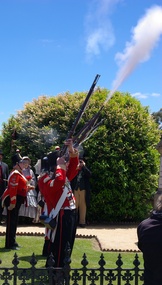 Ballarat Heritage Services
Photograph - Colour, 40th Regiment Reenactors at the Ballaarat Old Cemtery, Eureka Sunday, 2013, 30/11/2013
... ...military...gun...eureka sunday 40th regiment ballaarat old cemetery military gun blast eureka stockade Ballaarat Old Cemetery Colour photographs of re-enactors of the 40th regiment the Ballaarat Old Cemetery on Eureka Sunday. 40th Regiment Reenactors at the Ballaarat Old Cemtery, Eureka Sunday, 2013 Photograph - Colour Clare Gervasoni Clare Gervasoni ...Colour photographs of re-enactors of the 40th regiment the Ballaarat Old Cemetery on Eureka Sunday. eureka sunday, 40th regiment, ballaarat old cemetery, military, gun blast, eureka stockade, ballaarat old cemetery -
 Flagstaff Hill Maritime Museum and Village
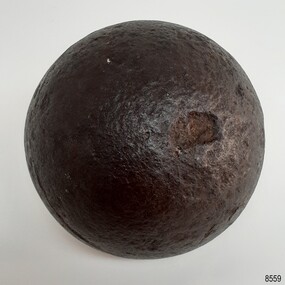
Weapon - Cannon Ball, Late 18th to 19th centuries
... military...cannon...gun...Flagstaff Hill Maritime Museum and Village Warrnambool Great Ocean Road Shipwreck Coast artillery ammunition cannon ball shot 24-pounder 24 pdr deck cannon ship cannon military cannon gun iron ball moulded ball naval gun deck gun navy Carronade war maritime weapon cast iron mould Cannon ball; a heavy black iron ball with a casting seam around its circumference. ...This cannon ball could have been made as ammunition to be shot from a 24-pounder gun, perhaps a deck cannon or Carronade on a sailing ship. It is similar to those used by both British and French navies from the late 18th and 19th centuries. The iron cannon ball shows the casting mark around its circumference made by the mould during the casting process. The cannon ball is an example of ammunition used during naval conflicts in the late 18th and 19th centuries. It was made for cannon or Carronade similar to those in the collection of cannon at Flagstaff Hill Maritime Museum.Cannon ball; a heavy black iron ball with a casting seam around its circumference. The surface is shiny with many pits and has slight corrosion. There are several chips including one large deep chip and a small, crescent shaped chip. The cannon ball’s size is similar to a cast iron 24-pounder shot.flagstaff hill maritime museum and village, warrnambool, great ocean road, shipwreck coast, artillery, ammunition, cannon ball, shot, 24-pounder, 24 pdr, deck cannon, ship cannon, military, cannon, gun, iron ball, moulded ball, naval gun, deck gun, navy, carronade, war, maritime weapon, cast iron, mould -
 Flagstaff Hill Maritime Museum and Village
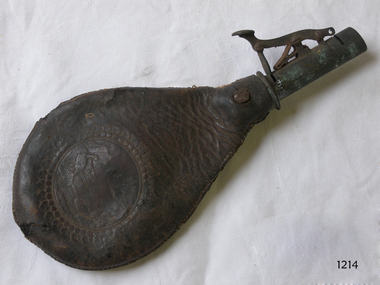
Weapon - Gunpowder Pouch, Early-to-mid 19th Century
... military...gunpowder...gun...Flagstaff Hill Flagstaff Hill Maritime Museum and Village Warrnambool Maritime Museum Maritime Village Great Ocean Road Shipwreck Coast firearms musket gunpowder flask gunpowder pouch flask pouch arms militaria leather flask gunpowder bag ammunition accessory weaponry shot pouch hunting military gunpowder gun powder hinting shot flask Gunpowder pouch or shot pouch, the two sides of the rounded leather body are hand-stitched together apart from a small opening for the fitted brass spout, which has a spring-operated mechanism. ...This type of gunpowder pouch was used in the first half of the 19th century. It stores gunpowder or gunshot for loading or charging firearms such as rifles and muskets. This one has a decorative design featuring birds, which may indicate that it was made for hunting rather than for military use.The shot pouch is an example of weaponry accessories in the early-to-mid 19th century for hunting and military purposes. It is a step in the evolution of firearms and weaponry.Gunpowder pouch or shot pouch, the two sides of the rounded leather body are hand-stitched together apart from a small opening for the fitted brass spout, which has a spring-operated mechanism. Both sides have a decorative centre medallion with a finely tooled design depicting a landscape behind two birds. The adjustable charger mechanism releases a measured amount of gunpowder or shot for rifles or muskets. flagstaff hill, flagstaff hill maritime museum and village, warrnambool, maritime museum, maritime village, great ocean road, shipwreck coast, firearms, musket, gunpowder flask, gunpowder pouch, flask pouch, arms, militaria, leather flask, gunpowder bag, ammunition accessory, weaponry, shot pouch, hunting, military, gunpowder, gun powder, hinting, shot flask -
 Trafalgar Holden Museum
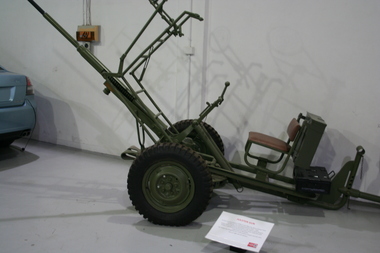
Functional object - Polson Gun, 1941
... military...polson gun...Manufactured in Australia by Holden weaponary military polson gun Mobile multi shot machine cannon, military green in colour., seat for operator at rear. ...Designed by a Czeck design team in London in 1941 after the Nazi's invaded their homeland.Manufactured in Australia by HoldenMobile multi shot machine cannon, military green in colour., seat for operator at rear.weaponary, military, polson gun -
 Flagstaff Hill Maritime Museum and Village
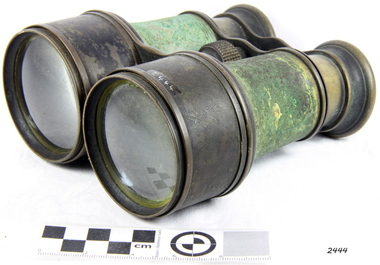
Instrument - Binoculars, Late 19th Century
... ...military maker...signaling...gun...The company produced a large range of items for military use and advertised in their catalogs that they produced instruments for ‘reconnoitering, sketching, night Marching, signaling and gun Laying’. ...An item that was produced in large quality by a well known maker who supplied the British military during the late 19th and early 20th century. flagstaff hill warrnambool flagstaff-hill-maritime-museum shipwreck-coast flagstaff-hill-maritime-village binoculars the duke binocular james henry steward military maker signaling gun laying optician Inscribed "The Duke Binocular" Binoculars solid brass black covered with Green fabric around cylinders binoculars are complete with geared focusing and pull out lens hoods. ...James Henry Steward (1817–1896) were opticians and scientific instrument makers and became established as J.H. Steward in London in 1852. He advertised himself as a “Head Optician” and on the 1st of February, 1913 became incorporated as J.H. Steward Limited. The company produced a large range of items for military use and advertised in their catalogs that they produced instruments for ‘reconnoitering, sketching, night Marching, signaling and gun Laying’. They were well thought of with their work to such a standard that they were made opticians to 'British & Foreign Governments, the National Rifle Associations of England, India, Canada & the Colonies and the National Artillery Association. An item that was produced in large quality by a well known maker who supplied the British military during the late 19th and early 20th century.Binoculars solid brass black covered with Green fabric around cylinders binoculars are complete with geared focusing and pull out lens hoods.Inscribed "The Duke Binocular"flagstaff hill, warrnambool, flagstaff-hill-maritime-museum, shipwreck-coast, flagstaff-hill-maritime-village, binoculars, the duke binocular, james henry steward, military maker, signaling, gun laying, optician -
 Bendigo Historical Society Inc.
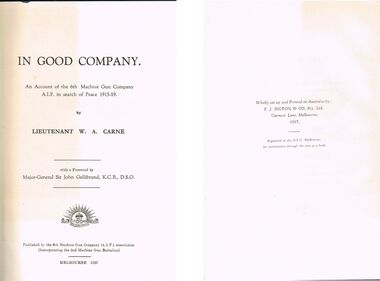
Book - LYDIA CHANCELLOR COLLECTION: IN GOOD COMPANY BY W.A. CARNE
... military... war... Machine Gun...BOOKS Military world war 2 Lydia Chancellor Collection collection -Book -'In Good Company ' by W.A. Carne / the 6th Machine Gun Company A.I.F / Major - General Sir John Gellibrand / F J Hilton & Co Melbourne 1937 military war Machine Gun Company 'Lydia Chancellor Collection ' signed copy of a -Book -'In Good Company ' by W.A. ...'Lydia Chancellor Collection ' signed copy of a -Book -'In Good Company ' by W.A. Carne Hard bound blue covered book with gold lettering - plain brown paper dust cover / 'an account of the 6th Machine Gun Company A.I.F. In search of Peace 1915-19 / forward by Major - General Sir John Gellibrand , published by the 6th Machine Gun Company A.I.F association Melbourne 1937 / Published by F J Hilton & Co Melbourne 1937 / includes newspaper clipping dated 14.8.1937 'Another War Book'.books, military, world war 2, lydia chancellor collection, collection, -book -'in good company ' by w.a. carne / the 6th machine gun company a.i.f / major - general sir john gellibrand / f j hilton & co melbourne 1937, military, war, machine gun company -
 Bayside Gallery - Bayside City Council Art & Heritage Collection
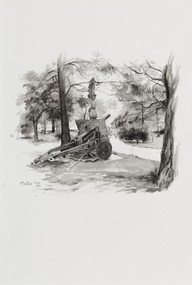
Work on paper - ink and watercolour, Annette Meikle, Beaumaris RSL, 1977
... gun...Military weapon...The Beaumaris RSL Club closed its doors on Balcombe Road in 2016 after the property was sold in 2013. annette meikle sandringham sketchbook elizabeth waters Beaumaris RSL 25-pounder Field gun Military weapon Langford-Jack Blamey House Balcombe Road Beaumaris Beaumaris RSL Work on paper ink and watercolour Annette Meikle ...In 1977, artist Annette Meikle undertook a commission to illustrate a book recording stories of places and people in the Bayside area. It was published in 1978 as Sandringham Sketchbook, with text by Elizabeth Waters. The sketches were intended to record remaining examples of Bayside’s early architecture and environment, as well as reflect newer architectural changes. Meikle went on to donate 22 of these sketches to Bayside City Council in 2003. This gun stood in the grounds of the Beaumaris RSL, located on the highest hill in Beaumaris – more than 300 metres above sea level. The ‘25-pounder’ was one of the best field guns of its day and was used by British and Commonwealth armies during the Second World War. The original ten-acre property, which was the former holiday home of wealthy Toorak resident Langford-Jack, was sold to the Legacy Club in 1942 and operated as a holiday home for Legacy children. Renamed Blamey House in honour of Field-Marshall Sir Thomas Blamey, it was purchased by the RSL in 1955. The Beaumaris RSL Club closed its doors on Balcombe Road in 2016 after the property was sold in 2013.Annette Meikle, Beaumaris RSL 1977, ink and watercolour, 33.8 x 23.5 cm. Bayside City Council Art and Heritage Collection. Donated by the artist, 2003annette meikle, sandringham sketchbook, elizabeth waters, beaumaris rsl, 25-pounder, field gun, military weapon, langford-jack, blamey house, balcombe road, beaumaris -
 Tatura Irrigation & Wartime Camps Museum
Booklet, Robertson & Mullers LTD, The Lewis Gun Simplified, 1940s
... gun...military...A pocket book and illustrated guide to the Lewis Gun lewis gun military J. J. Muir VDC Buff-coloured card covered booklet with black print. ...A pocket book and illustrated guide to the Lewis GunBuff-coloured card covered booklet with black print. Drawing of gun in centre of front cover, text hinged to cover, illustrated price: one shilling, fifth edition (enlarged) 10 pagesJ. J. Muir VDClewis gun, military -
 8th/13th Victorian Mounted Rifles Regimental Collection
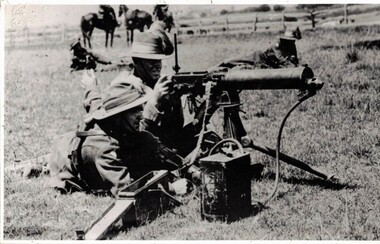
Photograph
... military...militia...machine gun...military militia machine gun light horse victoria Black aand white photograph of 13 Light Horse Machine Gun crew training c. 1938 Photograph ...Black aand white photograph of 13 Light Horse Machine Gun crew training c. 1938military, militia, machine gun, light horse, victoria -
 8th/13th Victorian Mounted Rifles Regimental Collection
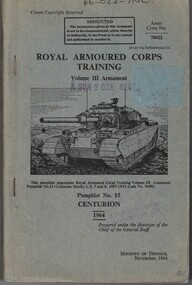
Booklet
... military...tank...centurion...gun...Representative of training pamphlets used when Australian Army received Centurion tanks Centurion gunnery intro - handling, servicing & mechanism military tank centurion gun VMR On front cover " 66-022-7190" and ink stamp " A Sqn 2 Cav Regt" Holsworthy 2173 and another very faint stamp Grey covered booklet" Royal Armoured Corps Training Volume III - Armament Pamphlet No. 15 Centurion 1964. " 286 pages, staple bound. ...8th/13th VMR was equipped with Centurion tanks 1955 - 1959 and 1966 - 1970. Provides information for gunnery crew commanders & gunnery instructors to train crews in tank gunnery.Representative of training pamphlets used when Australian Army received Centurion tanks Centurion gunnery intro - handling, servicing & mechanismGrey covered booklet" Royal Armoured Corps Training Volume III - Armament Pamphlet No. 15 Centurion 1964. " 286 pages, staple bound.On front cover " 66-022-7190" and ink stamp " A Sqn 2 Cav Regt" Holsworthy 2173 and another very faint stampmilitary, tank, centurion, gun, vmr -
 8th/13th Victorian Mounted Rifles Regimental Collection
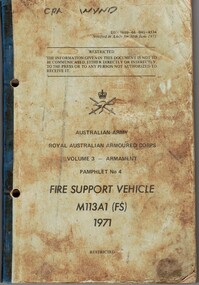
Booklet - FSV armament
... military...tank...FSV...gun...Cp.G.Wynd was a cadre staff member training armoured fighting vehicle ( AFV ) crewmen M113A1 Instruction handbook military tank FSV gun VMR " Cpl Wynd " on front cover Soft covered booklet with fabric binding strip " Royal Australian Armoured Corps Volume 3 - Armanent Pamphlet No.4 Fire Support Vehicle M113A1 ( FS ) 1971." ...8th/13th VMR was equipped with M113 family of vehicles in 1970s - 1990s. Cp.G.Wynd was a cadre staff member training armoured fighting vehicle ( AFV ) crewmen M113A1 Instruction handbookSoft covered booklet with fabric binding strip " Royal Australian Armoured Corps Volume 3 - Armanent Pamphlet No.4 Fire Support Vehicle M113A1 ( FS ) 1971."" Cpl Wynd " on front covermilitary, tank, fsv, gun, vmr -
Unions Ballarat
Power and terror : post 9/11 talks and interviews, Junkerman, John, 2003
... Front cover: colour photograph of a military officer with gun and children looking on; black and red lettering. ...Front cover: colour photograph of a military officer with gun and children looking on; black and red lettering. ...The book comes from public talks given by Chomsky in 2002 (as a follow up to 9/11) and a previously unpublished interview. Chomsky reflects upon terrorism, US foreign policy and offers different non-violent solutions. Contents: Part I: Interview with Noam Chomsky for the film Power and Terror Part II: U.S. arms, human rights, and social health Part III: Talks and conversations "Why do they hate us, when we're so good?" Visiting the West Bank with Azmi Bishara Media bias and Palenstine How should we respond? The United States and the world Part IV: More information Further reading: a selection of books by Noam Chomsky About the film Power and Terror: Noam Chomsky in our times About the author About the editor About the publishers. Relevant to 9/11 and to US foreign policy and terrorism.Paper; book. Front cover: colour photograph of a military officer with gun and children looking on; black and red lettering. Front cover: author's name and title.btlc, ballarat trades hall, ballarat trades and labour council, 9/11, terrorism, foreign policy - united states, chomsky, noam, interviews, violence, government -
 Bendigo Military Museum
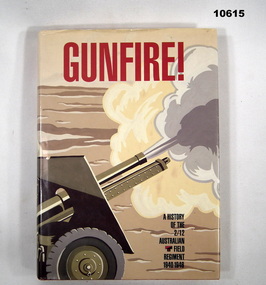
Book - REGIMENT HISTORY, WW2, Max Parsons, "GUNFIRE", 1991
... Dustcover, paper, red and black print on beige, brown, khaki, grey and black stylized art illustration depicting three gunners firing a military gun, full length of the dustcover. Flaps with printed information. 342 pages, cut, plain, white paper. ...Dustcover, paper, red and black print on beige, brown, khaki, grey and black stylized art illustration depicting three gunners firing a military gun, full length of the dustcover. Flaps with printed information. 342 pages, cut, plain, white paper. ...From Title Page: "GUNFIRE!/ A HISTORY OF THE 2/12 AUSTRALIAN FIELD REGIMENT 1940-1946",Hardcover book with Dust cover. Hardcover - cardboard with red colour buckram, gold colour print on spine. Dustcover, paper, red and black print on beige, brown, khaki, grey and black stylized art illustration depicting three gunners firing a military gun, full length of the dustcover. Flaps with printed information. 342 pages, cut, plain, white paper. Illustrated - black and white photographs, maps diagrams and artwork. Endpapers front and back - sepia tones - map of “TOBRUCK DEFENCES". Inscriptions noted front first page.Handwritten details - black ink pen. "DONATED BY BENDIGO YMCA 2009". Black ink stamp "BENDIGO DISTRICT RSL CLUB SUB BRANCH INC./ BOX 42/ LONG GULLY 3550".publication, book, military history, 2/12 australian field regiment, ww2 -
 Bendigo Military Museum
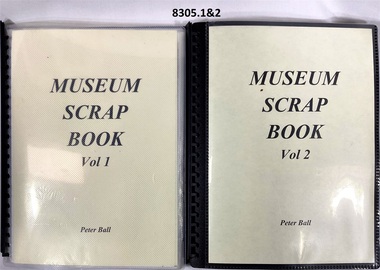
Literary work - SCRAP BOOKS 1998 - 2026
... The last item April 2013 relates to the search for the Military Gun War trophies allotted to Bendigo after WW1. .3) Vol 3. ...The last item April 2013 relates to the search for the Military Gun War trophies allotted to Bendigo after WW1. .3) Vol 3. ...Due to several name changes to the Bendigo RSL Museum it will be just referred to as the Museum. These Scrap books hold articles from local Bendigo newspapers, Melbourne newspapers, other publications including Mufti magazine, Victorian Collections, Australian War Memorial to name a few. General photographs of Museum Volunteers and their involvement, Renovations to the SMI Building, Funeral notice's and programs of past Museum Volunteers, exhibitions involved in to also name a few. The biggest collection of one item relates to the Grinton photographs. .1) Vol 1. The first article and also the first since the Museum opened in Feb 1998. Dated April 28th 1998 in the Local "Weekender" on page 2 with a full page, two articles and photographs. The final article was in the Bendigo Advertiser dated Aug 22nd 2009 regarding the mass graves at Fromelles and for families to come forward for DNA testing to identify remains. The photo included was T.W. Francis which the Museum holds. he was later identified as one of the Soldiers. (Refer Cat No 8015P) .2) Vol 2. The first two pages Sep 2009 relate to the Shrine of Remembrance Box - Outreach program and it's visit to Bendigo and other areas. This was part of their Education program which the Museum became involved in. The last item April 2013 relates to the search for the Military Gun War trophies allotted to Bendigo after WW1. .3) Vol 3. The first two pages are June 2013 "Mufti magazine" and items that the Museum put in their publication. "Mufti" is the newsletter of the Victorian State Branch of the RSL. The last item Nov 15th 2022 tells of the Post 75 Central Victorian Veterans Banner being donated to the Museum. The Association changed their name. (Refer Cat No 7420) .4) Vol 4. First item is a large photograph Sept 2023 advertising "Discover what's on inside the Museum. The final article in 2026 with photo's and heading "Military Museum considered amongst the States best". (Ongoing) Collection re Peter Ball, refer Cat No 4704 for service details & RSL service.Four scrapbooks plastic covers, with A4 plastic inserts, front cover sheets are all yellow with black text, the headings on each, "Museum Scrap book Vol 1 - 2 - 3 - 4". .1) Volume 1 has 33 inserts with 66 pages of articles. .2) Volume 2 has 34 inserts with 68 pages of articles. .3) Volume 3 has 35 inserts with 70 pages of articles .4) Volume 4 has 4 inserts with 8 pages of articles (ongoing)brsl, smirsl, scrapbooks, museum -
 Federation University Historical Collection
Book, Ballarat School of Mines Students' Magazine, 1907-1909, 1907-9
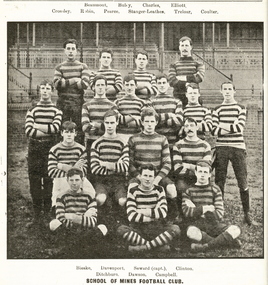
... . * Picture Making in Photography Composition * Mountains of Fire * A Walking Engine - New Military Machine - Guns into Action - Caterpillar No. 1. .... * Picture Making in Photography Composition * Mountains of Fire * A Walking Engine - New Military Machine - Guns into Action - Caterpillar No. 1. ...Bound volume of the Ballarat School of Mines Students' Magazine for 1907-1909. Articles include the location and pegging of a tramway Route, the transmission of Power by Rope Driving by A.E.C. Kerr, A visit to the Briseis Mine, and New Brothers' Home, Mining Engineers in Tasmania, Obituaries for David Ham and Matthew Lyndsay, Pioneer Mining at Leichhardt, Automatic Ore Feeders and Chacedony Park by J.H. Adams. Images include the Ballarat School of Mines Football Team and the Ballarat School of Mines Sports Committee. 1907 * Hubert Krause 1908 * The location and Pegging of a Tramway Route by Yamba * The Unity of things by John Brittain * The transmission of power by Rope Driving, by A.E.C. Kerr * A visit to the Briseis Mine, and New Brothers' Home (includes photographs) * Mining Engineers in Tasmania * Limericks Sluiced at Snake Valley * David Ham Obituary * Matthew Lyndsay Obituary * Some Bunsen Memories by Professor Alfred Mica Smith * Geological Camp to Daylesford * Practical Mathematics by Hubert F. Hall * Pioneer Mining - Leickhardt * Automatic Ore Feeders * A Unique Ore Deposit (Lucknow Goldfield, NSW) * A country Ramble * The Alkaline Titration for Zinc * Chalcedony Park, Arizona, United States of America by J.H. Adams * Notetaking at Lectures * Smelter Cost-Keeping by Oliver E. Jaeger * Benefits of Physical Culture * Mineral Tasmania and its Wonderful Resources by F.F. Bradford * A holiday Trip to Queensland * The Compression of Air as Applied to Mining * Machine V Hand Drilling * The mining in the Malay States * William Thomas Grownow Obituary (includes image) * Timbering Stopes (Includes images) * Trip to Melbourne * Two Problems of Alluvial Mining by Richard Hain * The Berry Leads (includes plan of mines) * Black Pudding Supper * Observations for Meridian * NOtes on Coking Plants (includes plan) * How Old is the Earth * Conglomerations * A Pat Formula * The making of a Suitable Muffle for General Assay Work * Reduction of Gold Chloride by Charcoal * Chemical Definitions * Old Boys (R.J. Allen, W.B. Blyth, F. Brinsden, Lindsay D. Cameron, George W. Cornwell, John M. Currie, C.M. Harris, T. Wighton-Hood, W. Lakeland, W.S. Macartney, Fred A. Marriott, Karl B. Moore, G.E. Sander, Sherb. H. Sheppard, Norman S. Stuckby, John Sutherland, Lewis A. Westcott, Walter White, O.C. Witherden, Gerald Young) 1909 * The Graduates Problem * An Interesting Nevada Cyanide Plant (Bamberger De Lamar Gold Mines) * Easter Geological Camp to Ingliston * New Methods for the Volumetric Estimation of Lead * William Charles Kernott Obituary * Mount Morgan Mine by G.W. Williams * Tin Dredging at Tingha, New South Wales * Notes on the Iodide estimation of Copper * Photograph of the Ballarat School of Mines Students' Association Committee * The Importance of Mine Ventilation to the Students by F. Howells * Life in Mining Camp * Wise Words to Mining School Students * Military Search Lights * Gleaning s on resistance * Ministerial Visit to the Ballarat School of Mines by the Hon. A.A. Billson, Minister of Education , accompanied by Frank Tate, Director of Education. * Picture Making in Photography Composition * Mountains of Fire * A Walking Engine - New Military Machine - Guns into Action - Caterpillar No. 1. (Tank) * Fireless Locomotives * Elmore Concentrating Process (includes plan of Elmore Concentrator) * Mount Pani Limited * Surveying for Irrigation * Weights and Measures * Carbon Monoxide * Joseph Francis Usher obituary * The Problem of the Metalliferous Veins * Ballarat School of Mines Ambulance Class * Treatment of Gold in a battery Without the Use of Copper Plates by E.C. Hurdsfield * Meteorites * Werribee Gorge * Dredging in the Ovens Valley * Electrical Chatter - Electrocution by an Imaginary Eye-Witness * The Electric Furnace in Iron Metallurgy ballarat school of mines, ballarat school of mines football team, football, sports, tramway, mining engineers, david ham, matthew lyndsay, jack adams, berry lead, hepburn consuls, madame berry, west ristori, ristori no 1, allendale, dyke's co, charleson's mill, australian extended, mining, r.j. allen,, w.b. blyth, f. brinsden, lindsay d. cameron, george w. cornwell, john m. currie, c.m. harris, t. wighton-hood, w. lakeland, w.s. macartney, fred a. marriott, karl b. moore, g.e. sander, sherb. h. sheppard, norman s. stuckby, john sutherland, lewis a. westcott, walter white, o.c. witherden, gerald young, ballarat school of mines students' association, hubert krause, krause, vfl, afl -
 Flagstaff Hill Maritime Museum and Village
Equipment - Wicker Basket
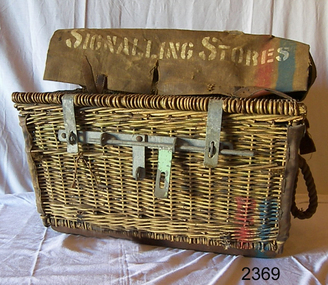
... The (Wu I Thu Phu Thung Chih or Illustrated Military Encyclopedia) written in 1791 depicts a signal gun in an illustration. ...The (Wu I Thu Phu Thung Chih or Illustrated Military Encyclopedia) written in 1791 depicts a signal gun in an illustration. ...A flare, also sometimes called a fusee, is a type of pyrotechnic that produces a bright light or intense heat without an explosion. Flares are used for distress signalling, illumination, communication or defensive countermeasures in civilian and military applications. Flares may be ground pyrotechnics, projectile pyrotechnics, or parachute-suspended to provide maximum illumination time over a large area. Projectile pyrotechnics may be dropped from aircraft, fired from rocket or artillery, or deployed by flare guns or hand held percussive tubes. Signalling flares have been in use by all branches of the military services since the 1920s also by the maritime services to signal other ships or for distress purposes. The earliest recorded use of gunpowder for signalling purposes was the 'signal bomb' used by the Chinese Song Dynasty as the Mongol-led Yuan Dynasty besieged Yangzhou in 1276. These soft-shelled bombs, timed to explode in mid-air, were used to send messages to a detachment of troops far in the distance. Another mention of the signal bomb appears in a text dating from 1293 requesting their collection from those still stored in Zhejiang. A signal gun appears in Korea by 1600. The (Wu I Thu Phu Thung Chih or Illustrated Military Encyclopedia) written in 1791 depicts a signal gun in an illustration. The item was used to carry and store flares for signalling use as the inscription on the canvas cover suggests. Given the method of storing flares is in a wicker basket that is non conducting of an electrical charge that may accidentally set of explosive materials. The writer assumes the basket was used from the early 20th century and most likely by maritime or military services to store it's flares.Basket cane square with metal locks & rope handles each end. Canvas reinforced on vertical sides with a canvas cover on top. Canvas cover has leather straps. Stencilled on canvas in white paint "SIGNALLING STORES" flagstaff hill, warrnambool, shipwrecked-coast, flagstaff-hill, flagstaff-hill-maritime-museum, maritime-museum, shipwreck-coast, flagstaff-hill-maritime-village, basket, cane basket, signalling stores -
 Flagstaff Hill Maritime Museum and Village
Weapon - Shotgun, Double Barrel, ISAAC HOLLIS & SONS, ca. 1904
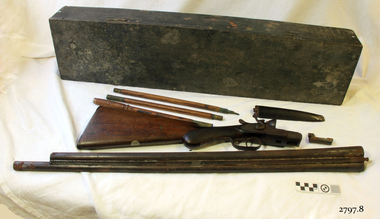
... ...gun and pistol maker...Birmingham...Military...Isaac Hollis Frederick Hollis Isaac Brentnall Sheath Isaac Sheath William Tranter gun manufacturer pistol manufacturer gun and pistol maker Birmingham Military supplies ENTERPRISE 1904 "I. ...The proof marks on the barrels (a crown and letters BV) denote that the shotgun design was made from the year 1904, and that it was nitro-proof tested in Birmingham, England. David Melville Carrison (1895 to 1960) of Port MacDonnell was the previous owner of this Isaac Hollis & Sons double-barrel shotgun. His grandfather, Adam Kerrison Carrison (1833-1903), was an early settler who worked as a fisherman in that once-bustling seaport. His uncle John was a a horse-breaker, a boat hand, and a member of the lifeboat crew, receiving a medal for his part in saving the crew of a French barque. Currently, no connection has been made between the gun, its owner, and the note with the word “Enterprise”: a New Zealand-built, two-masted schooner that was wrecked in Lady Bay, Warrnambool, in 1950. Gun makers, ISAAC HOLLIS & SONS: The Hollis Brothers were first recorded as operating from 11 Weaman Row in 1840, although evidence suggests the business may have commenced before then. Over time, the firm became known as Isaac Hollis & Sons, with claims of its establishment dating back to 1814. This earlier date is supported by records of Richard and William Hollis trading in Bath Street, Birmingham, between 1814 and 1818, which raises the possibility that Isaac and Frederick Hollis were their descendants. The principal brothers involved in the business were Isaac Hollis, born in 1815, and Frederick Hollis, whose birth date remains unknown. Frederick’s life was cut short when he died on 20 December 1839. According to the 1841 census, Isaac Hollis resided in Weaman Row and was listed as a 25-year-old gun and pistol maker. He was married to Emma, who was born in 1821, and together they had two children: Isaac, born in 1837, and Henry, born in 1839. Following Frederick’s death, Isaac continued to operate under the name Hollis Brothers until 1845, after which he renamed the business Hollis Brothers & Co. This entity remained active up to 1848. In 1844, Isaac Hollis entered a brief partnership with William Tranter at 10 & 11 Weaman Row, likely to fulfil a specific contract or to supply parts. This partnership continued until 1849. In 1848, Isaac Hollis formed a partnership with Isaac Brentnall Sheath, establishing the firm of Hollis & Sheath and expanding their operations into 10 Weaman Row. The partnership saw Hollis & Sheath become licensed manufacturers of percussion breech-loading guns, positioning the company as a notable presence in the industry. In 1861, Sheath left the partnership and emigrated to New Zealand, where he conducted several enterprises and was elected as a provincial councillor. He died in Christchurch on 19th May 1897. In 1861, after Isaac Sheath left, the business name became Isaac Hollis & Sons. By approximately 1870, Isaac Hollis and Henry Hollis had assumed responsibility for the daily management of the firm, with Isaac overseeing the overall management and marketing of the company's products, and Henry managing the manufacturing processes. During this period, the company became known for producing large volumes of affordable trade guns and sporting guns, catering to customers in South Africa and the British colonies. In 1870, Isaac Hollis & Sons opened a retail location at 44a Cannon Street in London, and in 1871, it operated at 83 Cheapside Street. Isaac Hollis Jnr passed away in October 1875 in Birmingham at the age of 37, having never married. In 1876/1877, Henry Hollis registered a limited liability company under the name Isaac Hollis & Sons Ltd. However, by 1879, trading resumed under the name Isaac Hollis & Sons, and the London shop moved to 6 Great Winchester Street. From 1932 to 1933, the business operated in London as Hollis, Bentley & Playfair. The final closure of Hollis, Bentley & Playfair occurred in Birmingham in 1953. The shotgun was manufactured by Isaac Hollis & Sons, a firm with a strong reputation for producing firearms. This early 1900s example represents a standard pattern that was produced in large quantities for everyday use. This double-barrel shotgun is 12-gauge, complete with a cleaning rod and a wooden storage box. The firearm has been altered from its original configuration: the right barrel has been cut shorter, resulting in sharp edges at the muzzle, and a metal extension has been fitted to the stock. The cleaning rod consists of three separate segments that screw together for use. The shotgun is housed in a black-painted wooden case with a hinged lid showing inscriptions for the maker and Serial Number. Maker was I. HOLLIS & SONS, Serial Number SN 84245. David Melville Carrison of Port MacDonnell was the previous owner. A handwritten note that had the word 'Enterprise' was with the gun. "I. HOLLIS & SONS". SN on stock “84245”. Badge on both sides “Crown [symbol] / BV”. “Crown [symbol] / NP”, “12G inside Diamond [symbol]”, “NITRO PROOF”, “STEEL 84245” Paper note included with gun, written in felt tip pen “ENTERPRISE”. flagstaff hill, maritime museum, maritime village, warrnambool, great ocean road, shipwreck coast, firearm, gun, double-barrel, shotgun, cleaning rod, gunsmith, smithed, 12 gauge, sn 84245, serial number 84245, david melville carrison, early 1900s, richard and william hillis, herbert & co., herbert & co. london, hollis & sons, isaac hollis & sons, isaac hillis & sons ltd., hollis bentley & playfair., isaac hollis, frederick hollis, isaac brentnall sheath, isaac sheath, william tranter, gun manufacturer, pistol manufacturer, gun and pistol maker, birmingham, military supplies, enterprise, 1904 -
 Flagstaff Hill Maritime Museum and Village
Nail, circa 1810
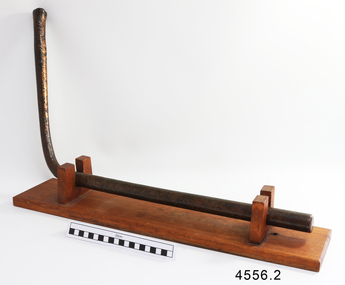
... Amongst the cargo were military stores including several copper drums of gun powder. On 27th January 1835 the “George III” was near the Equator, about half way into her journey. ...Amongst the cargo were military stores including several copper drums of gun powder. On 27th January 1835 the “George III” was near the Equator, about half way into her journey. ...This copper nail, sometimes known as a ‘Dumpy Bolt’ or spike, was salvaged from the hull of the wreck of the “George III”. It dates back to at least 1810. It was found by an abalone diver on the south east coast of Tasmania. The nail would have been used to hold the layers of the ship’s keel frame and the planking together. The nail has been passed from the abalone diver to an interested business man on a trip to the south of Hobart, on again to the business man’s close friend who then donated it to Flagstaff Hill Maritime Village. The metal of nails such as this one, after being in the sea for a long time, become affected by the natural reaction of the sea water, causing it to degenerate and thin, and the stress from the force of the sea over the years alters its shape. Iron nails had been used on ships previously, but they quickly corroded in the salt; ships needed regular, costly and time-consuming maintenance to replace the iron nails. Towards the end of the 18th century the British Navy trialled the use of copper nails, finding them to be very successful. Merchant ships began to adopt this process in the early 19th century, although it made ship building very expensive and was more often used for ships such as the “George III” that sailed on long voyages. The three masted sailing ship “George III” was a convict transport ship built in Deptford, England, in 1810. On 14th December 1834 she left Woolwich, England, bound for Hobart Town, Van Diemen’s Land (Tasmania), under Captain William Hall Moxey. She was carrying 220 male convicts plus crew, guards and their families, totalling 294 persons (another 2 were during the voyage). Amongst the cargo were military stores including several copper drums of gun powder. On 27th January 1835 the “George III” was near the Equator, about half way into her journey. A fire broke out and the gun powder was in danger of explosion, threatening the whole ship. Two convicts braved the heat and smoke, entered the store and seized the gun powder drums, suffering burns for their efforts but saving a probable disaster. The fire destroyed some of the provisions and food was scarce. Many became ill with scurvy and some died during the journey. Nearing the end of their journey on 10th April 1835 the “George III” was headed through the D'Entrecasteaux Channel, south east Tasmania, between the mainland and Bruny Island. She was sailing in the moonlit night to hasten her arrival in port due to the great number of sick on board. She struck uncharted rocks, known only to the local whalers, between Actaeon Reef and Southport Lagoon and within hours began to break up. The ship’s boats were used to first rescue the women and children. Firearms were used to help quell the panic of the convicts below decks and some were killed by the shots. Many convicts, including the sick, were drowned. In all, 133 lives were lost including 5 of the crew, guards and their families. It was the third worst shipping disaster in Tasmanian waters. A monument in honour of the prisoners who perished in the “George III” has been erected, noting the date of the wreck as “Friday 10th April 1835.” (NOTE: there are a few differences between sources regarding dates of the shipwreck, some saying March and others April 1835. There are also differences in the figures of those on board and the number of lives lost.) The copper nail is significant as an example of sailing ship construction; fasteners used in the early 19th century on ships carrying convicts to Australia. The nail is also significant for its association with the ship “George III”. The “George III” is registered on the Australian National Shipwreck Database, ID 7195 as an Historic Shipwreck. She is the third worst shipwreck in Tasmanian waters. She is also associated with Early Australian History and the transportation of convicts to Australia. The incident of the fire on board and the bravery of the convicts in making the gun powder safe is an example of the social character of the people in early Tasmanian colonisation. Copper nail (also called a Dumpy bolt or spike) from the convict ship George III, wrecked in 1835. Nail is long, bent in an ‘L’ shape about 3/5ths along, tapering from both ends to the bend. Both ends are flat and do not taper to a point, nor have a thread. The shorter end has been polished, showing bright copper. There is pitting along the nail and virdigris is evident on the longer, unpolished end. The nail is displayed with the longer section resting on a wooden board between two ‘U’ shaped uprights, the shorter section upright. flagstaff hill, warrnambool, shipwrecked coast, flagstaff hill maritime museum, maritime museum, shipwreck coast, flagstaff hill maritime village, great ocean road, george iii, ship construction, ship nail, 1835 shipwreck, 19th century shipwreck, william moxey, d'entrecasteaux channel, convict transportation, copper nail, dumpy bolt, spike, keel nail -
 Federation University Historical Collection
Postcard - Postcard - Black and white, Two World War One Soldiers, 1916, 28/08/1916
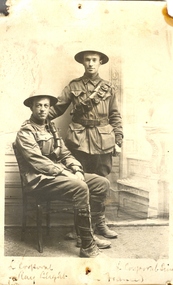
... guns, the other boy is L/Corp Sim, one time an old SMB and son of R. Sim, of Ballarat, we are wearing steel helmuts weight about 4lbs they are protection against shrapnel and steel splinters. We are doing well here, Les Coulter was wounded just near here but did not see him. Best wishes to all. Ray Blight. .2) Verso: Sitting, Ray Blight, from Ballarat, you will know his sister, she helps Miss Brazena a lot with the parcels. Standing, Les Sim, of Sim and co. wood merchants, Ballarat. Two World War One soldiers in military ...John Raymond (Ray) Blight enlisted on 19 July 1915. He was an electrical engineer, having studied at the Ballarat School of Mines. On 23 June 1916 Ray Blight disembarked at Marseilles. 3 February 1917 he was hospitalised with scabies. Ray Blight's next of kin was his mother, Mary Jane Blight of 116 Lyons Street South, Ballarat. James Leslie Sim enlisted on 13 July 1915, at which time he was an accountant. His next of kin was his father, Charles Robert Sim of Drummond Street North, Ballarat. On 23 June 1916 James Sim disembarked at Marseilles. A year later he received leave to the United Kingdom returning to France 2 weeks later. He received leave to Paris from 18 march 1918 to 4 April 1918. Sim was wounded on 1 June 1918.Two World War One soldiers in military uniform pose for a photograph. The two men are Lance Corporal Ray Blight and Lance Corporal Sim (both of Ballarat). On the back is a personal letter to Ballarat School of Mines Lecturer Daniel Walker. The pin holes in the postcard suggest it was displayed at the Ballarat School of Mines. .1) Verso: " France 25/8/16. Dear Mr Walker, Just a line in sending a photo we had taken in a small photographers, in a town within range of the evenings guns, the other boy is L/Corp Sim, one time an old SMB and son of R. Sim, of Ballarat, we are wearing steel helmuts weight about 4lbs they are protection against shrapnel and steel splinters. We are doing well here, Les Coulter was wounded just near here but did not see him. Best wishes to all. Ray Blight. .2) Verso: Sitting, Ray Blight, from Ballarat, you will know his sister, she helps Miss Brazena a lot with the parcels. Standing, Les Sim, of Sim and co. wood merchants, Ballarat.world war one, world war 1, james sim, ballarat school of mines, blight, james blight, sim, les sim, coulter, les coulter, world war, walker, wwi, great world war, france -
 Federation University Historical Collection
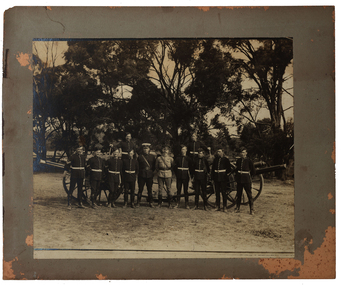
Photograph - black and white, Volunteer Force in a paddock, c1910
... volunteer artillery volunteer forces armed forced military artillery Twelve members of a volunteer artillery pose with two guns on wheels in a paddock. ...Twelve members of a volunteer artillery pose with two guns on wheels in a paddock.volunteer artillery, volunteer forces, armed forced, military, artillery -
 Flagstaff Hill Maritime Museum and Village
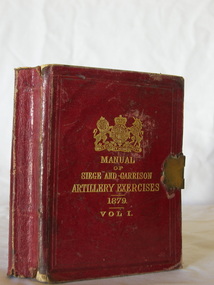
Book - Instruction Manual, British War Office, Manual of Siege and Garrison Artillery Exercises Vol 1, ca 24-06-1882
... military training...defense training...British Artillery...Royal Artillery...Gunnery...Gun...The four parts included in this Volume I are: - Part 1 - Gunnery Part 2 - Ammunition Part 3 - Siege Artillery Part 4 - Garrison Gun Drills The remaining six of then parts are: - Part 5 - Material and Appliances Part 6 - Elementary Instruction Part 7 - Machines Part 8 - Mounting and Dismounting Ordnance Part 9 - Sleighs Part 10 - Sheers and Derricks The book is significant to both British and Australian history, being issued for the training of the garrison defense of both countries in the late 10th Century. It is also significant for its connection with other historical military ...This little book has been designed to fit into a small space such as a pocket, backpack or trunk. The brass book lock helps keep the pages and covers together, preserving them from being bent, torn or damaged in handling.The book includes four of ten parts of the Manual, published for use in training the garrison troops, including the placement and firing of cannon. The four parts included in this Volume I are: - Part 1 - Gunnery Part 2 - Ammunition Part 3 - Siege Artillery Part 4 - Garrison Gun Drills The remaining six of then parts are: - Part 5 - Material and Appliances Part 6 - Elementary Instruction Part 7 - Machines Part 8 - Mounting and Dismounting Ordnance Part 9 - Sleighs Part 10 - Sheers and DerricksThe book is significant to both British and Australian history, being issued for the training of the garrison defense of both countries in the late 10th Century. It is also significant for its connection with other historical military items within the Collection at Flagstaff Hill Maritime Museum and Village.Manual of Siege and Garrison Artillery Exercises Vol 1 [Parts I, II, III, IV] Publisher Her Majestys Stationery Office Date 1879, Corrected June 24th 1882 Small, red, hard-cover book with embossed gold letters and British Coat of Arms on the front. The book has a brass closure or locking clip across the text block. There are diagrams and a foldout table within the text. flagstaff hill, flagstaff hill maritime museum and village, warrnambool, maritime museum, maritime village, great ocean road, shipwreck coast, training manual, book, british garrison, garrison artillery, siege exercises, british government training book, technical book, pocket book, manual of siege and garrison artillery exercises vol 1, garrison exercises, military training, defense training, british artillery, royal artillery, gunnery, gun drill, brass book lock, british war office, locking clip, reference book -
 Flagstaff Hill Maritime Museum and Village
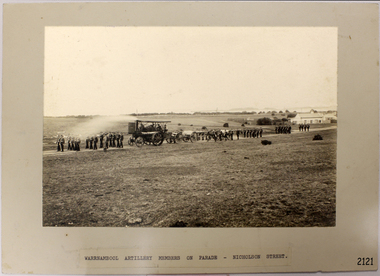
Photograph - Military group, Warrnambool Artillery Members on Parade - Nicholson Street [Warrnambool], Early 1900s
... gun carriages. A house is in the foreground and Lady Bay in the background. A typed label is attached to the bottom of the card. Warrnambool Artillery Members on Parade - Nicholson Street [Warrnambool] Photograph Military group ...Photograph is a point in time with local Militia parading in an area now filled with houses. It show the means by which the cannon carriages were moved between locations, the uniforms of the soldiers and the development of the Warrnambool location.Photograph, landscape, sepia, mounted on card. Image of the Warrnambool Artillery Members on parade in Nicholson Street, Warrnambool. Figures are marching in groups with a steam driven gun carriage pulling several other gun carriages. A house is in the foreground and Lady Bay in the background. A typed label is attached to the bottom of the card."WARRNAMBOOL ARTILLERY MEMBERS ON PARADE - NICHOLSON STREET'flagstaff hill, flagstaff hill maritime museum and village, warrnambool, maritime museum, maritime village, great ocean road, shipwreck coast, warrnambool location, militia, steam driven gun carriage, nicholson street warrnambool -
 Flagstaff Hill Maritime Museum and Village
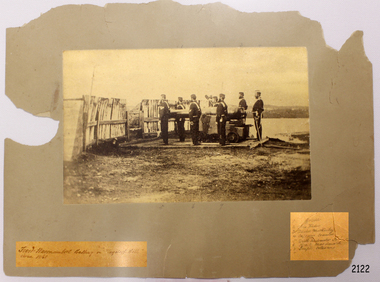
Photograph - Military, First Warrnambool Battery on Flagstaff Hill, ca. 1868
... military men on Flagstaff Hill ready for action. The names are listed on the card, handwritten in pencil: 1. Gorrie 2. Chris Hider 3. David McKinley 4. Captain Cramer 5. Drill Instructor (cannot read name) 6. R.A.C. Macdonald 7. Joseph Gladstone The militia played a significant role in being prepared to defend the Warrnambool district. flagstaff hill warrnambool Maritime Museum Maritime Village Shipwreck Coast Great Ocean Road militia volunteer corps cannon gun firearm first warrnambool battery Warrnambool Battery defence Gorrie Chris Hider David McKinley Captain Cramer Drill Instructor R.A.C. ...There was an active Volunteer Corps in Warrnambool in the 1800s. This photograph shows a group off military men on Flagstaff Hill ready for action. The names are listed on the card, handwritten in pencil: 1. Gorrie 2. Chris Hider 3. David McKinley 4. Captain Cramer 5. Drill Instructor (cannot read name) 6. R.A.C. Macdonald 7. Joseph GladstoneThe militia played a significant role in being prepared to defend the Warrnambool district.Photograph, sepia, mounted on brown card. Depicts the First Warrnambool Battery on Flagstaff Hill. Seven uniformed figures stand beside a cannon mounted on a wooden, waist high carriage. The cannon is aimed between a gap in a timber fence. The lower edge of the card has two labels with handwritten inscriptions; one is the photograph title, the other is a list of seven names written in pencil Photograph is dated ca. 1868. Left hand side: "First Warrnambool Battery on 'Flagstaff Hill'" Right hand side: list of names written in pencil: "1. Gorrie 2. Chris Hider 3. David McKinley 4. Captain Cramer 5. Drill Instructor (cannot read name) 6. R.A.C. Macdonald 7. Joseph Gladstone"flagstaff hill, warrnambool, maritime museum, maritime village, shipwreck coast, great ocean road, militia, volunteer corps, cannon, gun, firearm, first warrnambool battery, warrnambool battery, defence, gorrie, chris hider, david mckinley, captain cramer, drill instructor, r.a.c. macdonald, joseph gladstone -
 Flagstaff Hill Maritime Museum and Village
Weapon - Carronade
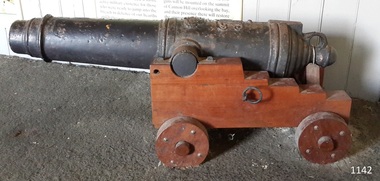
... The small bore replica carronade and carriage is part of a collection of nineteenth Century Flagstaff Hill Guns and cannons, and is a representation of carronades used from the early 18th up to the 1850s on merchant and military ships particularly the British Royal Navy until 1850. ...This deck cannon is believed to be a replica Carronade as it has no foundry mark, year of manufacture, proof marks or weight of carronade on it. However, its design matches the design of Carronades used in the early to mid 19th century. History: The carronade was designed as a short-range naval weapon with a low muzzle velocity for merchant ships, but it also found a niche role on warships. It was produced by the Carron iron works and was at first sold as a complete system with the gun, mounting, and shot altogether. Carronades initially became popular on British merchant ships during the American Revolutionary War. A lightweight gun that needed only a small gun crew and was devastating at short range was well suited to defending merchant ships against French and American privateers. Its invention is variously attributed to Lieutenant General Robert Melville in 1759, or to Charles Gascoigne, manager of the Carron Company from 1769 to 1779. In its early years, the weapon was sometimes called a "mellvinade" or a "gasconade". The carronade can be seen as the culmination of a development of naval guns reducing the barrel length and thereby the gunpowder charge. The Carron Company was already selling a "new light-constructed" gun, two-thirds of the weight of the standard naval gun and charged with one-sixth of the weight of the ball in powder before it introduced the carronade, which further halved the gunpowder charge. The theory of its design was to use less powder and had other advantages that were advertised in the company's sales pamphlet of the time, state. The smaller gunpowder charge reduced the barrel heating in action, also reduced the recoil. The mounting, attached to the side of the ship on a pivot, took the recoil on a slider, without altering the alignment of the gun. The pamphlet advocated the use of woolen cartridges, which eliminated the need for wadding and worming, although they were more expensive. Carronades also simplified gunnery for comparatively untrained merchant seamen in both aiming and reloading that was part of the rationale for adopting the gun. Other advantages promoted by the company were. The replacement of trunnions by a bolt underneath, to connect the gun to the mounting, reduced the width of the carriage that enhanced the wide angle of fire. A merchant ship would almost always be running away from an enemy, so a wide-angle of fire was much more important than on a warship. A carronade weighed a quarter as much as a standard cannon and used a quarter to a third of the gunpowder charge. This reduced charge allowed Carronades to have a shorter length and much lighter weight than long guns. Increasing the size of the bore and ball reduces the required length of the barrel. The force acting on the ball is proportional to the square of the diameter, while the mass of the ball rises by the cube, so acceleration is slower; thus, the barrel can be shorter and therefore lighter. Long guns were also much heavier than Carronades because they were over-specified to be capable of being double-shotted,(to load cannons with twice the shot, for increased damage at the expense of range). Whereas it was dangerous to do this in a carronade. A ship could carry more carronades, or carronades of a larger caliber, than long guns, and carronades could be mounted on the upper decks, where heavy long guns could cause the ship to be top-heavy and unstable. Carronades also required a smaller gun crew, which was very important for merchant ships, and they were faster to reload. Additional notes: Cannon cast in England, Wales and Scotland had their imperial weight chiselled or engraved in the format of 4-2-0 on the bottom of the cascabel, indicating the weight of the cannon as 4 hundredweight, 2 quarters and 0 pounds. Since a hundredweight equals 112 pounds and a quarter weight is 28 pounds the total weight is 504 pounds or about 228 kilograms. The small bore replica carronade and carriage is part of a collection of nineteenth Century Flagstaff Hill Guns and cannons, and is a representation of carronades used from the early 18th up to the 1850s on merchant and military ships particularly the British Royal Navy until 1850. This example is not significant in the historic sense but demonstrates the type of artillery used aboard vessels of the time for protection & offensive military actions. Cannon, cast iron, small smooth bore cannon on the stepped wooden carriage with wooden wheels. It appears to fire a 12-pound cannonball. The Cannon barrel can have its elevation adjusted via a sliding sloped block at the rear of the cannon. Gun carriage has loops for locating and holding the carriage in position with the use of ropes. It is believed this carronade is a replica of a mid-to-late 19th-century Carronade cannon.Cast into metal; [Royal emblem of Queen Victoria (VR "Victoria Regina")]warrnambool, flagstaff-hill, flagstaff-hill-maritime-museum, maritime-museum, shipwreck-coast, flagstaff-hill-maritime-village, cannon, naval cannon, cannon on carriage, 19th century cannon, fortifications, smooth bore cannon, 12 pounder, carronade, artillery, replica, deck cannon, cannon in carriage, ship cannon -
 Nhill Aviation Heritage Centre
Memorabilia - US Navy MK18 Aircraft Computing Turret Gunsight
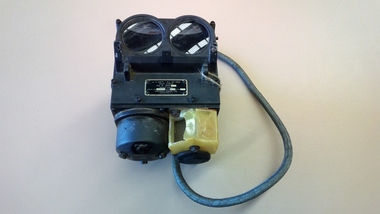
... Used in military aircraft by US Navy U.S. NAVY. B U of ORD. GUN SIGHT MK 18 Mod SIGHT UNIT SERIAL No 501 Eastman Kodak Co ROCHESTER NY Black metal box with lens sights, and steel braid cord and plug connections.. ...Used in military aircraft by US Navy Black metal box with lens sights, and steel braid cord and plug connections..U.S. NAVY. B U of ORD. GUN SIGHT MK 18 Mod SIGHT UNIT SERIAL No 501 Eastman Kodak Co ROCHESTER NY -
 Flagstaff Hill Maritime Museum and Village
Weapon - Carronade, 1840
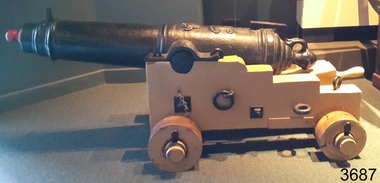
... The small bore carronade and carriage is part of a collection of nineteenth Century Flagstaff Hill Guns and Cannon, which is classified as being of significance and was made a few years after the beginning of Queen Victoria's reign in 1837 and fires a 6 lb pound cannon ball. This nineteenth century artillery piece is a rare and representative item of artillery of this era, used predominately on ships, both military and merchant. ...The carronade was designed as a short-range naval weapon with a low muzzle velocity for merchant ships, but it also found a niche role on warships. It was produced by the Carron Iron Works and was at first sold as a complete system with the gun, mounting, and shot altogether. Carronades initially became popular on British merchant ships during the American Revolutionary War. A lightweight gun that needed only a small gun crew and was devastating at short range was well suited to defending merchant ships against French and American privateers. The invention of the cannon is variously attributed to Lieutenant General Robert Melville in 1759, or to Charles Gascoigne, manager of the Carron Company from 1769 to 1779. In its early years, the weapon was sometimes called a "mellvinade" or a "gasconade". The carronade can be seen as the culmination of a development of naval guns reducing the barrel length and thereby the gunpowder charge. The Carron Company was already selling a "new light-constructed" gun, two-thirds of the weight of the standard naval gun and charged with one-sixth of the weight of the ball in powder before it introduced the carronade, which further halved the gunpowder charge. The theory of its design was to use less powder and had other advantages that were advertised in the company's sales pamphlet of the time, state. The smaller gunpowder charge reduced the barrel heating in action, also reduced the recoil. The mounting, attached to the side of the ship on a pivot, took the recoil on a slider, without altering the alignment of the gun. The pamphlet advocated the use of woollen cartridges, which eliminated the need for wadding and worming, although they were more expensive. Carronades also simplified gunnery for comparatively untrained merchant seamen in both aiming and reloading that was part of the rationale for adopting the gun. Other advantages promoted by the company were. The replacement of trunnions by a bolt underneath, to connect the gun to the mounting, reduced the width of the carriage that enhanced the wide angle of fire. A merchant ship would almost always be running away from an enemy, so a wide-angle of fire was much more important than on a warship. A carronade weighed a quarter as much as a standard cannon and used a quarter to a third of the gunpowder charge. This reduced charge allowed Carronades to have a shorter length and much lighter weight than long guns. Increasing the size of the bore and ball reduces the required length of the barrel. The force acting on the ball is proportional to the square of the diameter, while the mass of the ball rises by the cube, so acceleration is slower; thus, the barrel can be shorter and therefore lighter. Long guns were also much heavier than Carronades because they were over-specified to be capable of being double-shotted, (to load cannons with twice the shot, for increased damage at the expense of range), whereas it was dangerous to do this in a carronade. A ship could carry more carronades, or carronades of a larger calibre, than long guns, and carronades could be mounted on the upper decks, where heavy long guns could cause the ship to be top-heavy and unstable. Carronades also required a smaller gun crew, which was very important for merchant ships, and they were faster to reload. The small bore carronade and carriage is part of a collection of nineteenth Century Flagstaff Hill Guns and Cannon, which is classified as being of significance and was made a few years after the beginning of Queen Victoria's reign in 1837 and fires a 6 lb pound cannon ball. This nineteenth century artillery piece is a rare and representative item of artillery of this era, used predominately on ships, both military and merchant. The artillery piece, individually and as part of the collection, is highly significant for its historical, scientific and aesthetic reasons at the state, national and world level. This carronade represents the methods of artillery technology, its advancement and its modifications to suit dangerous situations that sailors encountered from attacks from free booters (pirates, living from plunder) or others at the time. Carronade firing a 6 lb cast iron ball, with a smooth bore barrel 6.5 cm in dia the item is mounted on stepped wooden carriage with wooden wheels. Cannon barrel can have its elevation adjusted via a wooden wedge. Gun carriage has loops for locating and holding in position to a deck by ropes. Carriage is a replica made 1982Cast into the barrel is the royal emblem of Queen Victoria (VR "Victoria Regina") indicating the carronade was cast during Queen Victoria's reign / 1840 & 4-2-0 denoting the weight of the barrel. Right hand trunnion has a serial number “8708”. Also on top of the barrel is the British "Board of Ordinance" identifying mark a broad arrow indicating the carronade was in military use. flagstaff hill, warrnambool, shipwrecked coast, flagstaff hill maritime museum, maritime museum, shipwreck coast, flagstaff hill maritime village, great ocean road, colonial defences, victoria’s coastal defences, warrnambool fortification, warrnambool garrison battery, warrnambool volunteer corps, ordinance, armaments, garrison gun, smooth bore cannon, carronade, black powder, 12 pounder, 1840, artillery, lieutenant general robert melville, charles gascoigne, carron company, mellvinade, gasconade -
 Flagstaff Hill Maritime Museum and Village
Uniform - Tunic, 1899-1903
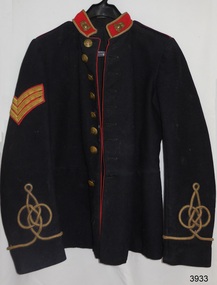
... military uniform...sergeant's uniform...jacket...militia...Victoria...victorian volunteer forces...victorian regiment...royal australian artillery...raa...field gun...The tunic has local significance in its connection with local social events. flagstaff hill warrnambool shipwrecked coast flagstaff hill maritime museum maritime museum shipwreck coast flagstaff hill maritime village great ocean road uniform jacket uniform tunic garrison volunteer uniform fortifications in victoria victorian permanent artillery pre-federation military uniform sergeant's uniform jacket militia Victoria victorian volunteer forces victorian regiment royal australian artillery raa field gun sergeant W. ...This original tunic or jacket is part of the full dress uniform of the pre-Federation Victorian Permanent Artillery regiment. Its owner had the rank of Sergeant, as indicated by the three inverted chevrons. The Artillery design of the badges and buttons indicate the date of the tunic to be from 1893 to 1903. However the maker of the tunic, W. Moncton, began manufacture in Melbourne in 1899, so this the tunic can be dated between 1899 and 1903. The donor's grandfather was given this tunic but not the name of the original owner. It has since been suggested to the family that the tunic was worn by a local Western District Light Horse member. This could very well have been the case because mounted troops were officially referred to as the Light Horse in the late 19th to early 20th century. Several local men were involved in the Light Horse during the First World War. The donor's grandfather wore this tunic in the local district when riding a penny farthing bicycle. The donor's father also wore the tunic when dressed as a 'Captain' hosting a local disco dance. BRIEF MILITARY HISTORY- The Crimean War began In 1854 and many people in colonial Australia were afraid of a Russian attack. Volunteer forces were established to strengthen the British Imperial troops posted here. A battery of artillery was raised in Victoria as well as in other Australian states. In 1870 Australia became responsible for its own naval and military defence. The Volunteer Corps and Victorian Navy shared the responsibility of defending the existing forts, assisted by volunteer coastal and mobile field batteries. The Permanent Victorian Artillery force was established. It was disbanded in 1880 then re-formed in 1882 as the Victorian Garrison Artillery Corps. In 1895 the Geelong, Warrnambool, Port Fairy and Portland Batteries became part of the Western District Garrison Artillery. Many of the volunteers who served in the Artillery were from rural areas. They belonged to rifle clubs and were experience horsemen as well. Australia's defence at this time relied on these mounted troops, or Light Horse men. In 1899 the Victorian Garrison Artillery Corps amalgamated with the New South Wales and Queensland Permanent Artillery to become the Victorian Regiment of the Royal Australian Artillery (RAA). Then prior to Federation, the RAA and the Permanent Artillery of South Australia, Western Australia and Tasmania all combined, becoming the Royal Australian Artillery Regiment with two Batteries of Field Artillery; Battery A from Sydney and Battery B from Melbourne.This original uniform tunic of the pre-Federation Victorian Permanent Artillery is significant for its association with Australia's military defence and the fortifications of our district, state and country. The tunic is also significant, representing part of the history and evolution of uniforms in the Australian military forces. The tunic is also significant in its representation of Australia's independence in forming its own defences. The tunic has local significance in its connection with local social events.Tunic or jacket, part of the full dress uniform of the pre-Federation Victorian Permanent Artillery operating from 1893 to 1903. Original, single-breasted tunic of dark blue wool, red piping trim, black cotton lining in body. Sleeves lined with blue striped, white cotton. Front closure has eight brass buttons. Red band-style collar with hook-and-eye closure has gold bullion braid trim and a brass badge pinned each side at the front. Upper right sleeve has three inverted chevrons on red fabric with gold bullion braid trim (rank of Sergeant). Both sleeves have gold bullion braid 'Austrian knot' emblems stitched onto lower arm, with ends finishing on the inner sleeve. Shoulder epaulettes have red piping and smaller brass buttons. Closed back vent has vertical scalloped design with six brass buttons, in two columns of three, and red piping trim. Brass belt hook is attached to the left back waist, close to the seam (right side has a mark indicating a previous similar clip). Inside left breast is a concealed pocket. Tunic has both machine and hand stitching. All brass shank-style buttons have matching Artillery emblems with inscriptions on the back. The two brass collar badges have additional artillery emblems of exploding grenade and star as well as an inscription. Buttons were made for W. Moncton, of Melbourne and marked with his name. He traded from 1899, dating the tunic to between 1899 and 1903.Button front: Artillery emblem on front (field cannon facing left, in front of a muzzle-loading ram rod). Button back: engraved "W. MONCTON . MELBOURNE ." Collar badges: Artillery emblem (field cannon facing right | stars | exploding grenade | "AUSTRALIA")flagstaff hill, warrnambool, shipwrecked coast, flagstaff hill maritime museum, maritime museum, shipwreck coast, flagstaff hill maritime village, great ocean road, uniform jacket, uniform tunic, garrison volunteer uniform, fortifications in victoria, victorian permanent artillery, pre-federation military uniform, sergeant's uniform, jacket, militia, victoria, victorian volunteer forces, victorian regiment, royal australian artillery, raa, field gun, sergeant, w. moncton, garrison, dress uniform, tunic, scarlet collar, red collar, scarlet piping, red piping, gold bullion, artillery emblem, light horse, artillery, mounted troops, victorian garrison artillery corps
