
Showing 13 items matching "military headgear"
-
 Warrnambool and District Historical Society Inc.
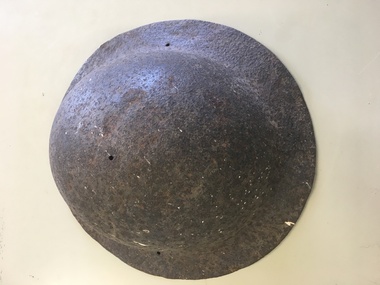
Helmet, Early to mid 20th century
... Military Headgear...This steel helmet is retained as a good example of the protective headwear worn by Australian military personnel in World Wars One or Two. Military Headgear History of Warrnambool The crown of his helmet or tin hat is of an oval shape and it has a short flattened brim. ...A steel helmet, popularly called a tin hat, is used as protective headwear by military personnel and civil workers in times of emergency and disasters. Steel helmets were first used in World War One, with the Allies troops using a design produced in London by John Brodie in 1915. This helmet was constructed in one piece pressed from a single thick sheet of steel and variants of this design have been used by military personnel ever since. It is not clear whether this particular item comes from World War One or World War Two. This steel helmet is retained as a good example of the protective headwear worn by Australian military personnel in World Wars One or Two.The crown of his helmet or tin hat is of an oval shape and it has a short flattened brim. There are three small holes for the insertion of a chin strap. The hat has some white paint marks and is very rusted.military headgear, history of warrnambool -
 Frankston RSL Sub Branch
Scrim, Camouflague
... Section of woven fabric netting or scrim, jungle green colour, used in the field by military personnel for camouflaguing headgear or small equipment items. ...Section of woven fabric netting or scrim, jungle green colour, used in the field by military personnel for camouflaguing headgear or small equipment items. ...Section of woven fabric netting or scrim, jungle green colour, used in the field by military personnel for camouflaguing headgear or small equipment items. -
 Lara RSL Sub Branch
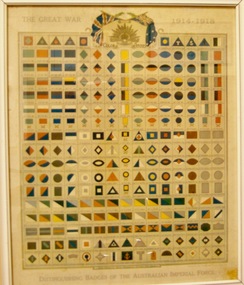
Distinguishing Badges of the Australian Forces, The Great War-1914/18 colour patches
... When the first Australian Imperial Force (AIF) set off for the Middle East in 1914, the only badge it wore was on headgear and jacket collars: the Australian "Rising Sun" emblem, inscribed with the words "Australian Commonwealth Military Forces" (ACMF). ...When the first Australian Imperial Force (AIF) set off for the Middle East in 1914, the only badge it wore was on headgear and jacket collars: the Australian "Rising Sun" emblem, inscribed with the words "Australian Commonwealth Military Forces" (ACMF). ...The Australian army's system of colour patches arose from the need to solve an immediate problem. When the first Australian Imperial Force (AIF) set off for the Middle East in 1914, the only badge it wore was on headgear and jacket collars: the Australian "Rising Sun" emblem, inscribed with the words "Australian Commonwealth Military Forces" (ACMF). Nothing distinguished one regiment from another. Divisional Order No. 81(A) Administration was issued at Mena, Egypt, on 8 March 1915 to overcome the problem:After the First World War the use of colour patches continued in the Citizens Military Forces (CMF), also known as militia. The CMF were reorganised into a divisional structure similar to that of the AIF. Units were generally renamed to provide a direct numerical association with AIF units raised from the same states and districts. Through their identification with AIF units came the authority for militia units to wear the colour patches of their associated AIF units; other colour patches were approved for units outside the AIF association.Rectangular shaped glass covered Picture Frame showing colour patches and badges of the Australian Imperial Forces.THE GREAT WAR-1914/18 Distinguishing Badges and Patches of the Australian Forces.ww1, the great war, middle east 1914/18, lara r.s.l., colour patches -
 Montmorency–Eltham RSL Sub Branch
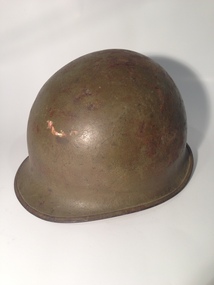
Uniform - Helmet, Steel US M-1, Vietnam era, Steel Helmet
... Vietnam era helmet Headgear On the inside of the helmet is written in black textra the name MORCOM, No 37019, and 1966-67. M1 steel helmet used by the United States military from WWII to 1985. ...Vietnam eraM1 steel helmet used by the United States military from WWII to 1985. Painted textured finish light olive green. The rim edge has a crimped metal band running around it, with a rear seam. Mounted on each side of the helmet there are D shaped swiveled metal loops for a chinstrap. The adjustable chinstrap is made of olive drap coloured nylon webbing with blackened metal clips. A two pice clip system metal fastener is used to connect the two pieces of the chinstrap.On the inside of the helmet is written in black textra the name MORCOM, No 37019, and 1966-67.helmet, headgear -
 Montmorency–Eltham RSL Sub Branch
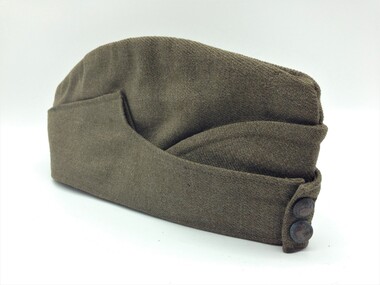
Uniform - Forage Cap, Australian Military Forces WW2
... Headgear Regimental No. VX21885 NAME L.C.CARROLL Stamp E 9or F, broad arrow, S Khaki serge forage cap with two 12mm diameter AMF metal buttons. No cap badge. Cotton khaki lining. Cotton off-white label sewn to lining Forage Cap, Australian Military ...Cap issued to WO2 Leonard Charles CARROLL VX21885 of West Heidelberg, Vic., born in Manchester UK on 01 JAN 1907. An X-ray technician, he enlisted on 07 JUN 1940 at Caulfield, Vic. and served in the Middle East, Ceylon and Australia mainly with 2/4th Aust. General Hospital. Discharged 20 MAY 1947. (Ref: NAA: B883, VX21885) The ownership of this cap is clear and the service of this local ex-serviceman can be established. The usage of this cap is unknown as there is no evidence that it has been worn with any kind of cap badge.Khaki serge forage cap with two 12mm diameter AMF metal buttons. No cap badge. Cotton khaki lining. Cotton off-white label sewn to liningRegimental No. VX21885 NAME L.C.CARROLL Stamp E 9or F, broad arrow, S headgear -
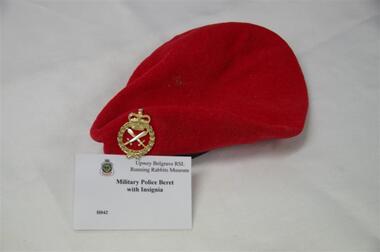 Running Rabbits Military Museum operated by the Upwey Belgrave RSL Sub Branch
Beret
... Headgear 1990 Army Red. Military Police with Insignia Beret ...Red. Military Police with Insigniaheadgear, 1990, army -
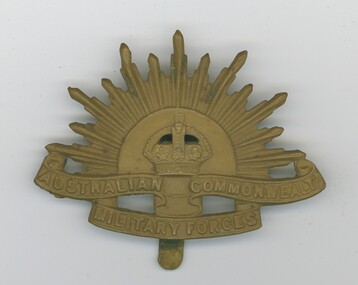 Bendigo Historical Society Inc.
Accessory - AUSTRALIAN ARMY HAT BADGE
... Cap/Hat badge in the form of a stylized rising sun, Kings crown in the lower centre, running across the bottom in a ribbon the words Australian Commonwealth Military Forces. Long flat pin on back to attach to headgear....ORGANIZATION Military army Cap/Hat badge in the form of a stylized rising sun, Kings crown in the lower centre, running across the bottom in a ribbon the words Australian Commonwealth Military Forces. Long flat pin on back to attach to headgear. Accessory AUSTRALIAN ARMY HAT BADGE ...Cap/Hat badge in the form of a stylized rising sun, Kings crown in the lower centre, running across the bottom in a ribbon the words Australian Commonwealth Military Forces. Long flat pin on back to attach to headgear.organization, military, army -
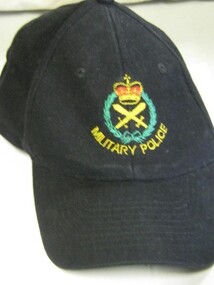 Running Rabbits Military Museum operated by the Upwey Belgrave RSL Sub Branch
Baseball Style Cap, Peaked
... Headgear 2000 Army Peaked cap blue, with Military Police insignia Baseball Style Cap, Peaked ...Peaked cap blue, with Military Police insigniaheadgear, 2000, army -
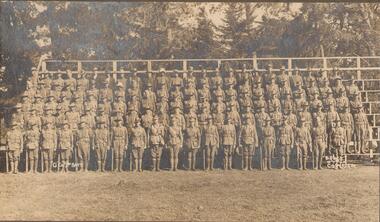 Bendigo Historical Society Inc.
Photograph - G'' CO. 7TH BATT
... Military g'' co. 7th batt. Darge, phone 4897, 175 Collins St Melbourne B + W photograph on grey board. Large group of soldiers in uniform. Back row shows men in assorted clothing and headgear ...B + W photograph on grey board. Large group of soldiers in uniform. Back row shows men in assorted clothing and headgear.Darge, phone 4897, 175 Collins St Melbourneorganization, military, g'' co. 7th batt. -
 Wangaratta RSL Sub Branch
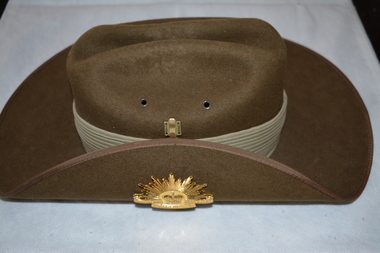
Headwear - Slouch Hat, September 2005
... military commanders of the then separate Australian Colonies prior to the Federation of Australia met to discuss the introduction of the khaki uniform throughout Australia. They agreed that all Australian Forces with the exception of the Artillery would wear the slouch hat. It was to be looped up on one side—Victoria and Tasmania on the right and the other colonies (later states) on the left. This was done so that rifles could be held at the slope without damaging the brim. After Federation, the slouch hat became standard Australian Army headgear...military commanders of the then separate Australian Colonies prior to the Federation of Australia met to discuss the introduction of the khaki uniform throughout Australia. They agreed that all Australian Forces with the exception of the Artillery would wear the slouch hat. It was to be looped up on one side—Victoria and Tasmania on the right and the other colonies (later states) on the left. This was done so that rifles could be held at the slope without damaging the brim. After Federation, the slouch hat became standard Australian Army headgear ...On 22 December 1890, the military commanders of the then separate Australian Colonies prior to the Federation of Australia met to discuss the introduction of the khaki uniform throughout Australia. They agreed that all Australian Forces with the exception of the Artillery would wear the slouch hat. It was to be looped up on one side—Victoria and Tasmania on the right and the other colonies (later states) on the left. This was done so that rifles could be held at the slope without damaging the brim. After Federation, the slouch hat became standard Australian Army headgear in 1903Today it is worn by military personnel from a number of countries, although it is primarily associated with Australia, where it is considered to be a national symbol.Slouch Hat - this broad brim hat is made of fur felt with an 8 fold hat band (puggaree) around the outside of the crown and attached to the inside of the crown is a brown leather chin strap. The left side of brim is held up by a gold colour metal rising sun badge.slouch hat, australian army, puggaree, rising sun badge, headgear -
 Ringwood RSL Sub-Branch
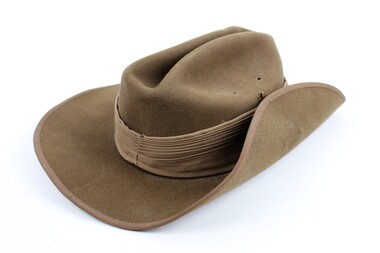
Uniform - Headgear Army Slouch Hat, pure rabbit fur, Mount Castle Hat Makers
... military hat. Pure rabbit fur felt. Size 60. Slouch style. Uniform Headgear Army Slouch Hat, pure rabbit fur. ...Commercially made military hat. Pure rabbit fur felt. Size 60. Slouch style. -
 8th/13th Victorian Mounted Rifles Regimental Collection
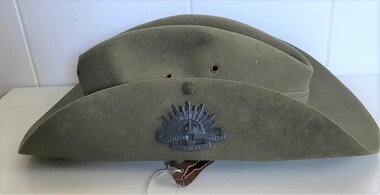
Headwear - slouch hat 26th Light Horse (Machine Gun)
... First tasked with coastal defence in south-western Victoria and later Western Australia. rare example of headgear of a CMF regiment from Victoria mobilised for defence of mainland Australia during World War Two. military slouch hat light horse machine gun world world war two wwii cmf Stamped inside band: V553 / 6 7/8 / 1942 Khaki slouch hat with colour patch on puggaree and rising Sun badge on turned up brim. ...Colour patch identifies the hat as belonging to a member of the 26th Light Horse (Machine Gun) Regiment, a CMF (militia) regiment raised around Geelong and western Victoria c.1939. First tasked with coastal defence in south-western Victoria and later Western Australia.rare example of headgear of a CMF regiment from Victoria mobilised for defence of mainland Australia during World War Two.Khaki slouch hat with colour patch on puggaree and rising Sun badge on turned up brim.Stamped inside band: V553 / 6 7/8 / 1942military, slouch hat, light horse, machine gun, world, world war two, wwii, cmf -
 Mont De Lancey
Clothing - Red Devils Beret and Belt, Kangol Wear Limited - Wartime textile and apparel contractors, WW2
... The maroon beret in a military configuration has been an international symbol of airborne forces since the Second World War. The beret was a practical headgear, for soldiers who needed a hat that could be worn in confined areas, slept in and could be stowed in a small space when they wore steel helmets. ...The maroon beret in a military configuration has been an international symbol of airborne forces since the Second World War. The beret was a practical headgear, for soldiers who needed a hat that could be worn in confined areas, slept in and could be stowed in a small space when they wore steel helmets. ...The maroon beret was adopted by the British paratroopers in July 1942. Initially it was adorned with an Army Air Corps badge. This was replaced with the Parachute Regiment badge in 1943. The maroon beret in a military configuration has been an international symbol of airborne forces since the Second World War. The beret was a practical headgear, for soldiers who needed a hat that could be worn in confined areas, slept in and could be stowed in a small space when they wore steel helmets. The "Red Devils" nickname and maroon beret were earned by the British 1st Parachute Brigade during World War II, though standard webbing belts rather than a specific "red devil belt" formed part of their gear. The Red Devils also flew into battle using military gliders rather than parachutes. This is a 'Red Devils' maroon felt beret and webbing belt worn by WW2 paratroopers. The beret has a black leather trim around the edges. It has a silver coated British Parachute Regiment badge on the front, which features a winged parachute, surrounded by a King's crown. The belt is made of red webbing with a closed sliver coated two piece clasp buckle, featuring the airborne parachute design. It has an adjustable slider.Inside the red beret is stitched a weathered marked plastic label holder with a piece of paper inserted - 'Hat size 7.1/8 0220. A/78/C.../DC...8(2) 'clothing, berets, headwear, ww2 paratroopers clothing
