Showing 15 items matching "military money belt"
-
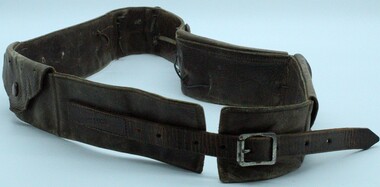
Flagstaff Hill Maritime Museum and VillageMoney Belt, c. 1942
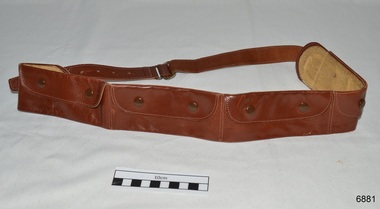
... ...military money belt...The collection of Army objects is an example of items issued to Doctors and Surgeons in the Medical Services of the Australian Army in World War 2. flagstaff hill warrnambool shipwrecked coast flagstaff hill maritime museum maritime museum shipwreck coast flagstaff hill maritime village great ocean road dr w r angus dr ryan military money belt surgeon captain royal australian army military service australian army wwii uniform world war 2 Gold embossed “GENUINE CALF” under silver coloured buckle. ...This money belt was issued to Dr W.R. Angus when he served in the Army 1942-1945 as a medical officer at Ballarat, Victoria, and Bonegilla, N.S.W.. (Surgeon Captain A.A.M.C., 108 A.G.H., and 106 A.G.H., Captain A.A.M.C. retired list.) The belt was donated to Flagstaff Hill Maritime Village by the family of Doctor William Roy Angus, Surgeon and Oculist. It is part of the “W.R. Angus Collection” that includes historical medical equipment, surgical instruments and material once belonging to Dr Edward Ryan and Dr Thomas Francis Ryan, (both of Nhill, Victoria) as well as Dr Angus’ own belongings. The Collection’s history spans the medical practices of the two Doctors Ryan, from 1885-1926 plus that of Dr Angus, up until 1969. ABOUT THE “W.R.ANGUS COLLECTION” Doctor William Roy Angus M.B., B.S., Adel., 1923, F.R.C.S. Edin.,1928 (also known as Dr Roy Angus) was born in Murrumbeena, Victoria in 1901 and lived until 1970. He qualified as a doctor in 1923 at University of Adelaide, was Resident Medical Officer at the Royal Adelaide Hospital in 1924 and for a period was house surgeon to Sir (then Mr.) Henry Simpson Newland. Dr Angus was briefly an Assistant to Dr Riddell of Kapunda, then commenced private practice at Curramulka, Yorke Peninsula, SA, where he was physician, surgeon and chemist. In 1926, he was appointed as new Medical Assistant to Dr Thomas Francis Ryan (T.F. Ryan, or Tom), in Nhill, Victoria, where his experiences included radiology and pharmacy. In 1927 he was Acting House Surgeon in Dr Tom Ryan’s absence. Dr Angus had become engaged to Gladys Forsyth and they decided he further his studies overseas in the UK in 1927. He studied at London University College Hospital and at Edinburgh Royal Infirmary and in 1928, was awarded FRCS (Fellow from the Royal College of Surgeons), Edinburgh. He worked his passage back to Australia as a Ship’s Surgeon on the on the Australian Commonwealth Line’s T.S.S. Largs Bay. Dr Angus married Gladys in 1929, in Ballarat. (They went on to have one son (Graham 1932, born in SA) and two daughters (Helen (died 12/07/1996) and Berenice (Berry), both born at Mira, Nhill ) According to Berry, her mother Gladys made a lot of their clothes. She was very talented and did some lovely embroidery including lingerie for her trousseau and beautifully handmade baby clothes. Dr Angus was a ‘flying doctor’ for the A.I.M. (Australian Inland Ministry) Aerial Medical Service in 1928 . Its first station was in the remote town of Oodnadatta, where Dr Angus was stationed. He was locum tenens there on North-South Railway at 21 Mile Camp. He took up this ‘flying doctor’ position in response to a call from Dr John Flynn; the organisation was later known as the Flying Doctor Service, then the Royal Flying Doctor Service. A lot of his work during this time involved dental surgery also. Between 1928-1932 he was surgeon at the Curramulka Hospital, Yorke Peninsula, South Australia. In 1933 Dr Angus returned to Nhill and purchased a share of the Nelson Street practice and Mira hospital (a 2 bed ward at the Nelson Street Practice) from Dr Les Middleton one of the Middleton Brothers, the current owners of what previously once Dr Tom Ryan’s practice. Dr Tom and his brother had worked as surgeons included eye surgery. Dr Tom Ryan performed many of his operations in the Mira private hospital on his premises. He had been House Surgeon at the Nhill Hospital 1902-1926. Dr Tom Ryan had one of the only two pieces of radiology equipment in Victoria during his practicing years – The Royal Melbourne Hospital had the other one. Over the years Dr Tom Ryan had gradually set up what was effectively a training school for country general-practitioner-surgeons. Each patient was carefully examined, including using the X-ray machine, and any surgery was discussed and planned with Dr Ryan’s assistants several days in advance. Dr Angus gained experience in using the X-ray machine there during his time as assistant to Dr Ryan. When Dr Angus bought into the Nelson Street premises in Nhill he was also appointed as the Nhill Hospital’s Honorary House Surgeon 1933-1938. His practitioner’s plate from his Nhill surgery is now mounted on the doorway to the Port Medical Office at Flagstaff Hill Maritime Village, Warrnambool. When Dr Angus took up practice in the Dr Edward and Dr Tom Ryan’s old premises he obtained their extensive collection of historical medical equipment and materials spanning 1884-1926. A large part of this collection is now on display at the Port Medical Office at Flagstaff Hill Maritime Village in Warrnambool. In 1939 Dr Angus and his family moved to Warrnambool where he purchased “Birchwood,” the 1852 home and medical practice of Dr John Hunter Henderson, at 214 Koroit Street. (This property was sold in1965 to the State Government and is now the site of the Warrnambool Police Station. and an ALDI sore is on the land that was once their tennis court). The Angus family was able to afford gardeners, cooks and maids; their home was a popular place for visiting dignitaries to stay whilst visiting Warrnambool. Dr Angus had his own silk worm farm at home in a Mulberry tree. His young daughter used his centrifuge for spinning the silk. Dr Angus was appointed on a part-time basis as Port Medical Officer (Health Officer) in Warrnambool and held this position until the 1940’s when the government no longer required the service of a Port Medical Officer in Warrnambool; he was thus Warrnambool’s last serving Port Medical Officer. (Masters of immigrant ships arriving in port reported incidents of diseases, illness and death and the Port Medical Officer made a decision on whether the ship required Quarantine and for how long, in this way preventing contagious illness from spreading from new immigrants to the residents already in the colony.) Dr Angus was a member of the Australian Medical Association, for 35 years and surgeon at the Warrnambool Base Hospital 1939-1942, He served as a Surgeon Captain during WWII1942-45, in Ballarat, Victoria, and in Bonegilla, N.S.W., completing his service just before the end of the war due to suffering from a heart attack. During his convalescence he carved an intricate and ‘most artistic’ chess set from the material that dentures were made from. He then studied ophthalmology at the Royal Melbourne Eye and Ear Hospital and created cosmetically superior artificial eyes by pioneering using the intrascleral cartilage. Angus received accolades from the Ophthalmological Society of Australasia for this work. He returned to Warrnambool to commence practice as an ophthalmologist, pioneering in artificial eye improvements. He was Honorary Consultant Ophthalmologist to Warrnambool Base Hospital for 31 years. He made monthly visits to Portland as a visiting surgeon, to perform eye surgery. He represented the Victorian South-West subdivision of the Australian Medical Association as its secretary between 1949 and 1956 and as chairman from 1956 to 1958. In 1968 Dr Angus was elected member of Spain’s Barraquer Institute of Barcelona after his research work in Intrasclearal cartilage grafting, becoming one of the few Australian ophthalmologists to receive this honour, and in the following year presented his final paper on Living Intrasclearal Cartilage Implants at the Inaugural Meeting of the Australian College of Ophthalmologists in Melbourne In his personal life Dr Angus was a Presbyterian and treated Sunday as a Sabbath, a day of rest. He would visit 3 or 4 country patients on a Sunday, taking his children along ‘for the ride’ and to visit with him. Sunday evenings he would play the pianola and sing Scottish songs to his family. One of Dr Angus’ patients was Margaret MacKenzie, author of a book on local shipwrecks that she’d seen as an eye witness from the late 1880’s in Peterborough, Victoria. In the early 1950’s Dr Angus, painted a picture of a shipwreck for the cover jacket of Margaret’s book, Shipwrecks and More Shipwrecks. She was blind in later life and her daughter wrote the actual book for her. Dr Angus and his wife Gladys were very involved in Warrnambool’s society with a strong interest in civic affairs. He had an interest in people and the community They were both involved in the creation of Flagstaff Hill, including the layout of the gardens. After his death (28th March 1970) his family requested his practitioner’s plate, medical instruments and some personal belongings be displayed in the Port Medical Office surgery at Flagstaff Hill Maritime Village, and be called the “W. R. Angus Collection”. The W.R. Angus Collection is significant for still being located at the site it is connected with, Doctor Angus being the last Port Medical Officer in Warrnambool. The collection of medical instruments and other equipment is culturally significant, being an historical example of medicine from late 19th to mid-20th century. Dr Angus assisted Dr Tom Ryan, a pioneer in the use of X-rays and in ocular surgery. The collection of Army objects is an example of items issued to Doctors and Surgeons in the Medical Services of the Australian Army in World War 2. Brown leather money belt, genuine calf, lined, 4 pouches with stud closure flaps included. Issued to W.R. Angus in WWII and part of the W.R. Angus Collection. Gold embossed label. Hand written inscription with name and serial number. Gold embossed “GENUINE CALF” under silver coloured buckle. Hand written inside of belt “W.R. ANGUS / 61-3 9803 5228”flagstaff hill, warrnambool, shipwrecked coast, flagstaff hill maritime museum, maritime museum, shipwreck coast, flagstaff hill maritime village, great ocean road, dr w r angus, dr ryan, military money belt, surgeon captain, royal australian army, military service australian army, wwii uniform, world war 2 -

Trafalgar Holden MuseumAccessory - Leather money belt
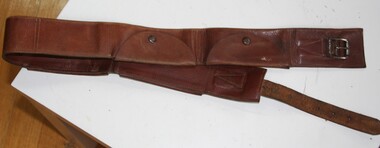
... military...money belt...Military issue waist belt with four pockets to carry money or other sundry items...Trafalgar Holden Museum 74 Waterloo Rd Trafalgar gippsland Military issue waist belt with four pockets to carry money or other sundry items Manufactured by HOLDEN military money belt Nil Leather waist belt with four pockets for carrying other sundry small items Accessory Leather money belt ...Military issue waist belt with four pockets to carry money or other sundry items Manufactured by HOLDEN Leather waist belt with four pockets for carrying other sundry small items Nilmilitary, money belt -
Bendigo Military MuseumUniform - BELT- MONEY
... Bendigo Military Museum 37 - 39 Pall Mall Bendigo goldfields Part of the collection of "William (Bill) THOMASON" Refer Cat No. 4136P. Uniform Belt Brown leather belt with four pockets with studs to close. Buckle at one end and small attached strap at other end. Uniform BELT- MONEY ...Part of the collection of "William (Bill) THOMASON" Refer Cat No. 4136P.Brown leather belt with four pockets with studs to close. Buckle at one end and small attached strap at other end.uniform, belt -
Bendigo Military MuseumUniform - MONEY BELTS
... Bendigo Military Museum 37 - 39 Pall Mall Bendigo goldfields WW2 money belts usually worn under shirts that were presented by the City of Prahran Council in 1941. ...WW2 money belts usually worn under shirts that were presented by the City of Prahran Council in 1941. Part of the collection of William (Bill) THOMASON. Refer Cat No. 4136P.Two brown leather money belts from WW2. Has four pockets with studs. Metal clip at one end and a small strap at other end.money belts, ww2 -
Bendigo Military MuseumAccessory - BELT, C.Pre WW1 possible
... Bendigo Military Museum 37 - 39 Pall Mall Bendigo goldfields uniform - army costume accessories - male trades-leatherworking Passchendaele barracks trust Anterior surface of belt: “VII DG [star of David] T00002 Williamson South Africa” Leather belt, brown, money pouch attached & 1 brass button, copper wire stitching, 2 brass buckles, 2 leather straps. ...Leather belt, brown, money pouch attached & 1 brass button, copper wire stitching, 2 brass buckles, 2 leather straps.Anterior surface of belt: “VII DG [star of David] T00002 Williamson South Africa”uniform - army, costume accessories - male, trades-leatherworking, passchendaele barracks trust -
Bendigo Military MuseumContainer - BELT, est WWI
... Military Museum 37 - 39 Pall Mall Bendigo goldfields The belt belonged to Jack Grinton No 1043, 38th Batt AIF. Part of the Grinton collection which included hundreds of negatives and developed photos taken by Jack Grinton during WW1. Refer Cat No 1280 for service details. Refer 1317P, 1320P. personal effects-money ...The belt belonged to Jack Grinton No 1043, 38th Batt AIF. Part of the Grinton collection which included hundreds of negatives and developed photos taken by Jack Grinton during WW1. Refer Cat No 1280 for service details. Refer 1317P, 1320P.Short, hollow black leather belt with brown leather fastening strap and metal buckle, possibly for storing coins securely.personal effects-money containers, handcrafts-leatherwork -
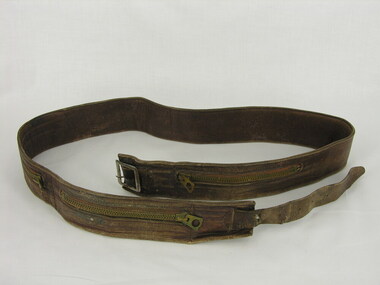
Frankston RSL Sub BranchBelt, Leather Money
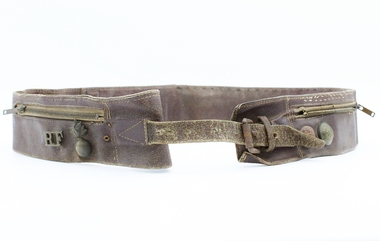
... Leather money belt worn during World War 2 military service by Frederick Henry Laurence Rankin, service number VX139086. ...He died on 27 July 1983 and buried at Fawkner Memorial Park. world war 2 ww2 Leather money belt worn during World War 2 military service by Frederick Henry Laurence Rankin, service number VX139086. ...Frederick Henry Laurence Rankin (Laurie) VX 139086 was an Australian Army cook who served from May 1943 to June 1945 within Australia (including Darwin). he was born 24/7/1914 at Jumburra, Victoria and enlisted on 27/5/1943 at Clifton Hill, Victoria. His "Next of Kin" was Eunice Rankin. He was discharged on 4 June, 1945 and he was then posted to 2 Australian Field Artillery Regiment. He died on 27 July 1983 and buried at Fawkner Memorial Park.Leather money belt worn during World War 2 military service by Frederick Henry Laurence Rankin, service number VX139086. This belt has three zippered pockets for carrying money or other valuables. One pocket contains a ration coupon for one packet of smokes (cigarettes). world war 2, ww2, -
Montmorency–Eltham RSL Sub BranchAccessory - Money Belt, AMF Money Belt
... Montmorency–Eltham RSL Sub Branch Petrie Park 16 Mountain View Road Montmorency melbourne harrison ww2 The inscription on the brass button nearest the buckle refers to “Australian Military Forces”; and the remaining brass button has inscription too small to decipher, with a rose imprint. Brown leather money belt ...Brown leather money belt with metal buckle and 3 pockets secured by metal zips. Affixed to the belt is a brass regimental shoulder badge, with the initials “ RF” ( Royal Fusiliers ) and brass flaming grenade with 7 points. Also affixed are 2 brass buttons.The inscription on the brass button nearest the buckle refers to “Australian Military Forces”; and the remaining brass button has inscription too small to decipher, with a rose imprint.harrison, ww2 -
Warrnambool RSL Sub BranchTROUSERS - RAAF (Blue Grey) Uniform, Military Uniform, 1988
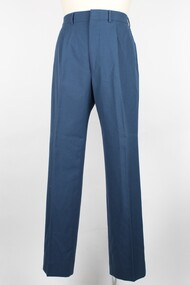
... The trousers have a belted waist and zip front, with two slant side pockets, money fob pocket below the waist on right side and two rear slit pockets. The trouser leg is pleated at the waist belt in the front. Military ...This item of military uniform was worn by Squadron Leader (SQNLDR) Bernard Farley during his period of Full Time service in the Royal Australian Air Force (RAAF) between 27 January 1976 and 02 March 1997. Bernard joined the RAAF as an Airmen was trained and employed as a Clerk Supply (CLKSPL) between 1996 - 1977. He undertook officer cadet training at the Army Officer Cadet School in 1978 and was commissioned into the Ground Defence Category on the 09 December 1978, where he served for 18 years and rose to the rank of SQNLDR. Royal Australian Air Force (RAAF) trousers- Blue Grey. This uniform was in the period 1966 - 2001 as the primary daily uniform in the office environment. Polyester working dress is approved for wear employed in office or business type environments. The trousers have a belted waist and zip front, with two slant side pockets, money fob pocket below the waist on right side and two rear slit pockets. The trouser leg is pleated at the waist belt in the front. Maker: Australian Government Clothing Factory -
Warrnambool RSL Sub BranchTROUSERS - RAAF (Blue Grey) Uniform, Military Uniform, 1995
... The trousers have a belted waist and zip front, with two slant side pockets, money fob pocket below the waist on right side and two rear slit pockets. The trouser leg is pleated at the waist belt in the front. Military ...This item of military uniform was worn by Squadron Leader (SQNLDR) Bernard Farley during his period of Full Time service in the Royal Australian Air Force (RAAF) between 27 January 1976 and 02 March 1997. Bernard joined the RAAF as an Airmen was trained and employed as a Clerk Supply (CLKSPL) between 1996 - 1977. He undertook officer cadet training at the Army Officer Cadet School in 1978 and was commissioned into the Ground Defence Category on the 09 December 1978, where he served for 18 years and rose to the rank of SQNLDR. Royal Australian Air Force (RAAF) trousers- Blue Grey. This uniform was in the period 1966 - 2001 as the primary daily uniform in the office environment. Polyester working dress is approved for wear employed in office or business type environments. The trousers have a belted waist and zip front, with two slant side pockets, money fob pocket below the waist on right side and two rear slit pockets. The trouser leg is pleated at the waist belt in the front. Maker: Australian Defence Industries -
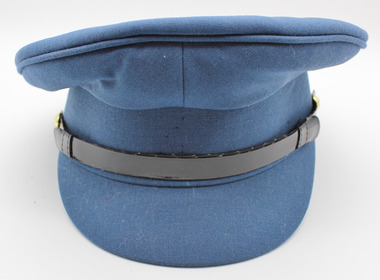
Warrnambool RSL Sub BranchPeaked Hat - RAAF (Blue Grey) Uniform, Military Uniform, Estimated early 1970's
... The trousers have a belted waist and zip front, with two slant side pockets, money fob pocket below the waist on right side and two rear slit pockets. The trouser leg is pleated at the waist belt in the front. Military ...Issued to Aircraftsman Bernard Farley in 1976 as part of his initial issue of uniform on joining the Permanent Air ForceThis item of military uniform was worn by Squadron Leader (SQNLDR) Bernard Farley during his period of Full Time service in the Royal Australian Air Force (RAAF) between 27 January 1976 and 02 March 1997. Bernard joined the RAAF as an Airmen was trained and employed as a Clerk Supply (CLKSPL) between 1996 - 1977. He undertook officer cadet training at the Army Officer Cadet School in 1978 and was commissioned into the Ground Defence Category on the 09 December 1978, where he served for 18 years and rose to the rank of SQNLDR. Royal Australian Air Force (RAAF) Peaked Hat - Blue Grey. This uniform was in the period 1966 - 2001 as the primary daily uniform in the office environment. Polyester working dress is approved for wear employed in office or business type environments. The trousers have a belted waist and zip front, with two slant side pockets, money fob pocket below the waist on right side and two rear slit pockets. The trouser leg is pleated at the waist belt in the front. Maker: Australian Government Clothing Factory -
Running Rabbits Military Museum operated by the Upwey Belgrave RSL Sub BranchMoney Belt
... Running Rabbits Military Museum operated by the Upwey Belgrave RSL Sub Branch 1 Mast Gully Road Upwey melbourne Miscellaneous c 1900 Army Belt Money brown Money Belt ...Belt Money brownmiscellaneous, c 1900, army -
Running Rabbits Military Museum operated by the Upwey Belgrave RSL Sub BranchBelt
... Running Rabbits Military Museum operated by the Upwey Belgrave RSL Sub Branch 1 Mast Gully Road Upwey melbourne Uniform RAN Belt Navy Blue (Money?) ...Belt Navy Blue (Money?)uniform, ran -
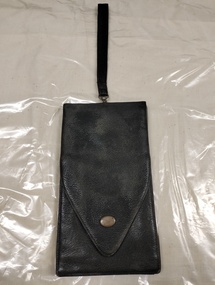
Mont De LanceyAccessory - Leather Wallet, 1913
... Design very similar to the sabretache, popularly hung from the belt by military personal from 18th to late 19th century. Very probably used, like sabretaches, to hold documents and notebooks in addition to money. ...Mont De Lancey 71 Wellington Road Wandin North yarra-valley-and-dandenong-ranges Design very similar to the sabretache, popularly hung from the belt by military personal from 18th to late 19th century. Very probably used, like sabretaches, to hold documents and notebooks in addition to money. ...Design very similar to the sabretache, popularly hung from the belt by military personal from 18th to late 19th century. Very probably used, like sabretaches, to hold documents and notebooks in addition to money. Handwritten notes on the wallet indicate that it was owned by a D. Clarke in South Melbourne, given to him in 1913 by a friend.Long black leather bag closed with envelope flap and push closure. Has a wrist strap handle attached to the centre with a circular d-ring. Lined with purple silk taffeta. Contains a small rectangular notes and coin purse attached to the top. Purse also closes with an envelope flap and push closure. Purse has two sections, one for note and one for coins, separated by a divider. Bottom has an open accordion pouch with two sections for a pocket book.Written on inside in pen: "From Link Fo-[?] // 1913" On the inside of the purse's flap: "D. Clarke // 94 Market St // South Melb"wallet, leather, 1910s, 1913, south melbourne, sabretache, mens bags, pocketbook, menswear -
Ringwood RSL Sub-BranchUniform - money belt, insignia, medal, Equipment, Circa 1940's
... belt. Attached are 2 British/Australian military badges, 7 buttons and one officers pip.00607.2 Assorted badges and coins.00607.3 Lapel badge Naval Assn of Australia engraved 561 on reverse. ASM 1939-1945 engraved PA2095 EJ Cope. Royal British Nursing Assn medal Wilhelmina Crosby 00607.4 12 Australian Army Medical Corps buttons Queens Crown Equipment Uniform money ...00607.1 Brown leather belt. Attached are 2 British/Australian military badges, 7 buttons and one officers pip.00607.2 Assorted badges and coins.00607.3 Lapel badge Naval Assn of Australia engraved 561 on reverse. ASM 1939-1945 engraved PA2095 EJ Cope. Royal British Nursing Assn medal Wilhelmina Crosby 00607.4 12 Australian Army Medical Corps buttons Queens Crown124world war two, ww2, wwii, badges, coins, royal british nursing association, naval association of australia, australian army medical corps