
Showing 478 items matching "military music"
-
 Federation University Historical Collection
Programme, A. Woods & Sons, The Military School of Music Summer Concert Season
... The Military School of Music Summer Concert Season...royal military school of music...Black print , with a photograph of the The Royal Military School of Music on the final page...Black print , with a photograph of the The Royal Military School of Music on the final page The Military School of Music Summer Concert Season Programme A. ...Folded and printed piece of cream paper, with Military Crest in centre of front page. Black print , with a photograph of the The Royal Military School of Music on the final pageroyal military school of music, frank wright -
 4th/19th Prince of Wales's Light Horse Regiment Unit History Room
Music Book, Band Music for Church Parades, Ceremonial and Other Occasions - Drums, 1930 (estimated)
... ...military music...drums ceremonial band music military music parades marches hymns songs c l riley h r shugg arthur gullidge Rubber stamp on title page: Wesley College 14 pp of music for drums. ...14 pp of music for drums. Band music for church parades, ceremonial and other occasions. Compiled by Senior Chaplain C L Riley (Bishop of Bendigo) and Captain H R Shugg (Southern Command Bandmaster). Music Arrangements and Production by Arthur GullidegeRubber stamp on title page: Wesley College drums, ceremonial, band music, military music, parades, marches, hymns, songs, c l riley, h r shugg, arthur gullidge -
 National Vietnam Veterans Museum (NVVM)
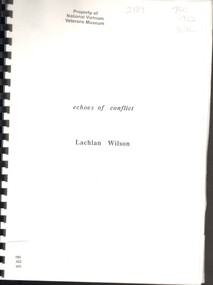
Document, Wilson, Lachlan, Echoes Of Conflict: Manuscript For Orchestra and Tape, 2011
... Military music - Australia...Military music - Australia Music - manuscripts Manuscript for playing Echoes of Conflict bound in plastic with black biding. ...Manuscript for playing Echoes of Conflict bound in plastic with black biding.military music - australia, music - manuscripts -
National Vietnam Veterans Museum (NVVM)
Audio - Audio, CD, Echoes of conflict: soldiers theme by Lachlan Wilson (2 copies)
... Military music - Australia...Military music - Australia Echoes of conflict: soldiers theme by Lachlan Wilson (2 copies) Audio Audio, CD Wilson, Lachlan ...military music - australia -
 8th/13th Victorian Mounted Rifles Regimental Collection
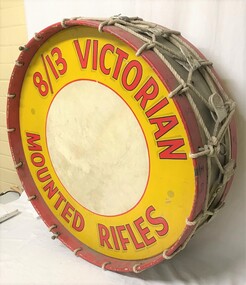
Ceremonial object - Base drum
... ...military...music...Possibly band members joined 4/19 Prince of Wales's Light Horse. band vmr military music drum Base drum with title around edge of skin "8/13 Victorian Mounted Rifles" Ceremonial object Base drum ...Early attempt to form regimental band took place in 1948, but it failed. This drum indicatesit was more successful later but it is not thought the band followed the regiment to NE Victoria in 1955. Possibly band members joined 4/19 Prince of Wales's Light Horse.Base drum with title around edge of skin "8/13 Victorian Mounted Rifles"band, vmr, military, music, drum -
 8th/13th Victorian Mounted Rifles Regimental Collection
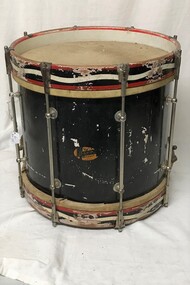
Ceremonial object - Side drum
... military...music...military music band regimental vmr Side drum painted in colours indication it is part of a set related to the base drum marked as 8/13 Victorian Mounted Rifles. ...Side drum painted in colours indication it is part of a set related to the base drum marked as 8/13 Victorian Mounted Rifles.military, music, band, regimental, vmr -
 8th/13th Victorian Mounted Rifles Regimental Collection
Work on paper - Programme
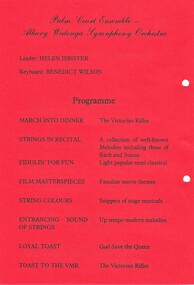
... military...music...After Federation the VMR was gathered up into the Australian Light Horse. military music dinner VMR centenary Printed card for VMR Centenary Dinner giving Wine List and music; contains significant dates for VMR; battle Honours; 100 years of VMR mobility. ...The Victorian Mounted Rifles was raised as the mounted arm of the Victorian Colonial defence force in 1885. It was under the command of Colonel Thomas Caradoc Rose (Tom) Price (1842-1911). Price was born in Tasmania, educated in Hobart Town and at Scotch College, Melbourne, before entering the East India Military College, Addiscombe, England. He was commissioned on 7 July 1861 in the Madras Infantry and began twenty years’ service in India with several regiments, retiring in April 1883. On his return to Victoria he was tasked with raising of a force of one thousand, to be known as the Victorian Mounted Rifles, and appointed a lieutenant-colonel in the Permanent Military Forces. Companies of the Victorian Mounted Rifles were raised in rural districts throughout Victoria. The soldiers were paid a small annual allowance and were required to provide their own horse. Many members served in contingent to the Boer War. After Federation the VMR was gathered up into the Australian Light Horse. Printed card for VMR Centenary Dinner giving Wine List and music; contains significant dates for VMR; battle Honours; 100 years of VMR mobility.military, music, dinner, vmr, centenary -
 Mrs Aeneas Gunn Memorial Library
Book, Hodder & Stoughton, A song of the English, 1912
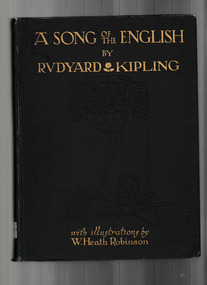
... Military music - Great Britain...Military music - Great Britain Poems - Great Britain A book of songs and poems by Rudyard Kipling Ill, p.123. ...A book of songs and poems by Rudyard KiplingIll, p.123.non-fictionA book of songs and poems by Rudyard Kiplingmilitary music - great britain, poems - great britain -
 Returned Nurses RSL Sub-branch
Book - Hardcover illustrated book, L.I. Terrett et al, Preserving our proud heritage: the customs and traditions of the Australian Army, 2015
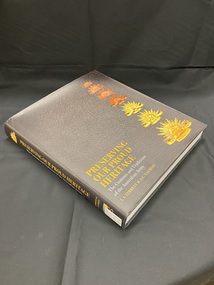
... ...Australian military music...Australian Army uniforms Australian Army military life Military honors Military ceremonies and salutes Australian military music Australian military history The Australian Army's customs and traditions represent the symbols and substance of much of our national character, adopted from Army's forebears and developed since 1901 to where we are today. ...The Australian Army's customs and traditions represent the symbols and substance of much of our national character, adopted from Army's forebears and developed since 1901 to where we are today. In the form of the 'Rising Sun', these traditions shape Army's institutional values and to an extent its collective personality, which provides - along with serving members both past and present - the Army's beating heart. Army's foundations, exhibited through its customs and traditions, will ensure it continues to draw the pride and respect of the nation. Much can be learnt from the past and Army constantly draws on the importance of its comparatively young but rich history. These origins have provided the forms for its badges, insignia and symbols of office; the way Army demonstrates respect for the past through formal functions and dinners, the way it addresses its people and the way they wear their uniform. These tangible links to Army's past, like the weft and warp of a rich historical tapestry, set it up well for its future. Just as Army respects its past, it and its people will respect it today and tomorrow. - From Trove.Black dustjacket on hardcover book. Front cover has images of seven different Australian military badges down the right hand side. Bottom left corner has the title printed in gold, followed by the sub-title in white, author's names in gold print. This information is repeated on the spine in the same colours.non-fictionThe Australian Army's customs and traditions represent the symbols and substance of much of our national character, adopted from Army's forebears and developed since 1901 to where we are today. In the form of the 'Rising Sun', these traditions shape Army's institutional values and to an extent its collective personality, which provides - along with serving members both past and present - the Army's beating heart. Army's foundations, exhibited through its customs and traditions, will ensure it continues to draw the pride and respect of the nation. Much can be learnt from the past and Army constantly draws on the importance of its comparatively young but rich history. These origins have provided the forms for its badges, insignia and symbols of office; the way Army demonstrates respect for the past through formal functions and dinners, the way it addresses its people and the way they wear their uniform. These tangible links to Army's past, like the weft and warp of a rich historical tapestry, set it up well for its future. Just as Army respects its past, it and its people will respect it today and tomorrow. - From Trove. australian army uniforms, australian army military life, military honors, military ceremonies and salutes, australian military music, australian military history -
 Federation University Historical Collection
Document - Menu, Kneller Hall Club Annual Dinner, 1965, 1963
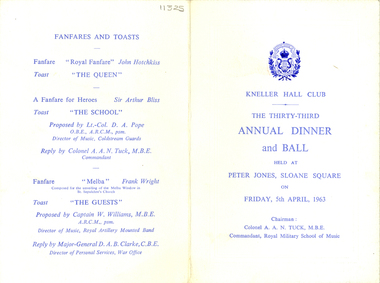
... royal military school of music...He was made Professor of Brass and Military Band Scoring and Conducting and was a Fellow of the Guildhall School of Music and Drama. ...music. On the front cover is the coat of arms of the Royal Military School of Music. ...On the front cover is the coat of arms of the Royal Military School of Music. It is to celebrate the thirty-third annual dinner and ball of the Kneller Hall Club. ...Frank Wright was a renown resident of Smeaton, where he was born. He lived at Laura Villa, and attended Smeaton State School. His father William was a gold miner and his mother's name was Sarah. Their family won many singing and instrumental awards. Frank was tutored by Percy Code and was awarded a gold medal for the highest marks in the ALCM examinations in the British Colonies at the age of seventeen years. He became the Australian Open Cornet Champion by the age of eighteen. A year later, Frank conducted the City of Ballarat Band, and later the Ballarat Soldiers’ Memorial Band. He formed the Frank Wright Frisco Band and Frank Wright and his Coliseum Orchestra. These bands won many South Street awards, and Frank as conductor won many awards in the Australian Band Championship contest. In 1933 Frank Wright sailed to England to conduct the famous St Hilda’s Band and was appointed in 1934 as the Musical Director of the London County Council (the GLC or Greater London Council), where he organized many amazing concerts in most of the 150 parks, in and around the London district. He was also responsible for some of London’s major concerts at Kenwood, the Crystal Palace and Holland Park. He was made Professor of Brass and Military Band Scoring and Conducting and was a Fellow of the Guildhall School of Music and Drama. Frank was often invited to adjudicate Brass Band Championships around Europe, in Australia, including South Street and in New Zealand. Frank was awarded an M.B.E. in 1967. The Frank Wright Medal at the Royal South Street competition is awarded to an individual recognized as making an outstanding contribution to brass music in Australia.This cream card with blue print folded in half, is both a menu and a programme of music. On the front cover is the coat of arms of the Royal Military School of Music. It is to celebrate the thirty-third annual dinner and ball of the Kneller Hall Club. On the back cover one of the fanfares is "Melba" by Frank Wright.Only printed informationroyal military school of music, frank wright, fanfare melba, kneller hall club -
 Bendigo Military Museum
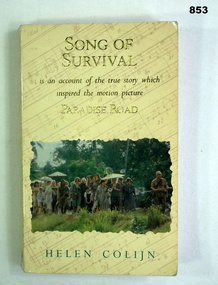
Book, Helen Colijn et al, Song of Survival, 1997
... military...history...music...books military history music Alan Holmes Soft paper cover. ...Soft paper cover. Author's name in green print, colour photo, title in gold print, black & white photos throughout, black print on white paper, 280 pages.Alan Holmesbooks, military, history, music -
 8th/13th Victorian Mounted Rifles Regimental Collection
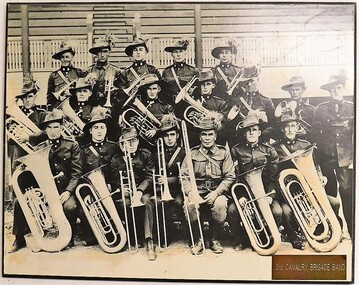
Photograph - 3rd Cav Band
... military...band...music...It consisted of 3rd Cavalry Brigade, 8th, 13th and 20th Light Horse Regiments, and 5th Cavalry Brigade, 4th, 17th and 19th Light Horse Regiments. military band music cavalry light horse Victoria 3rd Cavalry Brigade Band Black and white photograph of group of 19 bandsmen wearing light horse uniform and holding variety of musical instruments. ...The 2nd Cavalry Division, a part-time force, was raised in Victoria in 1920. It consisted of 3rd Cavalry Brigade, 8th, 13th and 20th Light Horse Regiments, and 5th Cavalry Brigade, 4th, 17th and 19th Light Horse Regiments. Black and white photograph of group of 19 bandsmen wearing light horse uniform and holding variety of musical instruments. Photo is mounted on chipboard backing. Engraved brass label in lower right corner.3rd Cavalry Brigade Bandmilitary, band, music, cavalry, light horse, victoria -
 Federation University Historical Collection
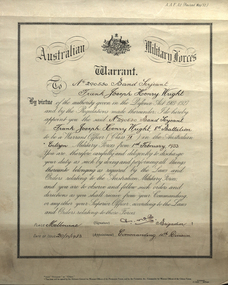
Certificate, Australian Military Forces Warrant (Frank Wright), 01/02/1933
... citizen military forces...warrant...music...Frank Wright was conductor of the Ballarat Soldiers' Memorial Band. frank wright 8th battalion citizen military forces warrant music band Paper warrant with printed and handwritten text. ...Frank Wright was conductor of the Ballarat Soldiers' Memorial Band. Paper warrant with printed and handwritten text. It is an Australian Military Forces Warrant made out to Frank Joseph Henry Wright (290530) Band Serjeant of the 8th Battalion. The warrant was for the Australian citizen Military Forces from 01 February 1933.frank wright, 8th battalion, citizen military forces, warrant, music, band -
 Flagstaff Hill Maritime Museum and Village
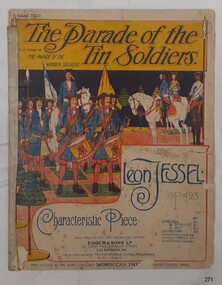
Document - Sheet Music, Enoch & Sons Ld., music publisher, The Parade of the Tin Soldiers, ca 1911
... The sheet music was published by Sole Publishers for the British Empire, Enoch & Sons Ld (1890-1927) of 58 Great Marlborough Street, London, W. Versions for all other countries were published by Neinrichshofen's, Verlag, Magdeburg. Orchestral and Military...The sheet music was published by Sole Publishers for the British Empire, Enoch & Sons Ld (1890-1927) of 58 Great Marlborough Street, London, W. Versions for all other countries were published by Neinrichshofen's, Verlag, Magdeburg. Orchestral and Military ...This sheet music is "The Parade of the Tin Soldiers', the original German title, composed by Leon Jessel as a solo piece for the piano in 1905. The work is also known as "The Parade of the Wooden Soldiers". In 1907 the orchestra version was published, Opus 123. (Op. 123, as written on the cover). The sheet music was published by Sole Publishers for the British Empire, Enoch & Sons Ld (1890-1927) of 58 Great Marlborough Street, London, W. Versions for all other countries were published by Neinrichshofen's, Verlag, Magdeburg. Orchestral and Military arrangements of the music were published by Hawkes & Son, Denman St, Piccadilly Circus, London, Leon Jessel (Jan. 22, 1821 to Jan. 4, 1942) was a German composer who was born a Jew and converted to Christianity in 1894. His works included a wide variety of music including 'The Parade of Tin Soldiers' (Die Parade der Zinnsoldaten). Jessel was also a music conductor and bandmaster. The instrumental piece 'Die Marokkanische Patrouille' (The Moroccan Patrol) was published in 1911, Opus 227. He was also known for his operettas 'Schwarzwaldmädel'(Black Forest Girl), presented in 1917, and 'Die Postmeisterin' (The Postmistress), presented in 1921. In December 1941 he was arrested and then tortured by the German Gestapo; he died in January 1942. In the early 1920s, The Parade of the Tin Soldiers became very popular; it was presented as part of a show and was re-titled The Parade of the Wooden Soldiers. It was also made into a film and its recording was a hit single record. The music continues to be played and presented and is a Christmas-time favourite.This music is significant for its connection with the German composer Leon Jessel, a victim of the Germans for being born a Jew, even though he converted to Christianity in his youth. It is also significant as a popular work of music composed in the early 1900s and later used for a variety show and a film. The music an example of entertainment in the early 20th century that has endured to current times and often played at Christmas celebrations.Book of sheet music for four tunes. The thin softcovered book has eight pages, with the front cover featuring colourful graphics of soldiers marching and others on horseback. The four tunes are: - The Parade of the Tin Soldiers, (piano solo), Composer: Leon Jessel. Ballade de la Lune, Enjolement, Lentement, document, tendrament, Publisher: for the British Empire, Hawkes & Son, Denman St, Piccadilly Circus, London, Sole Publishers for the British Empire, Printer: Enoch & Sons Ld. 58 Great Marlborough Street, London, W. Printer: Lowe & Brydone Printers Ltd. London N.W. 10 Publisher, for all other countries: Heinrichshofen's, Verlag, Magdeburg. Printed: in England by Heinrichshofen's Verlag Copyright: 1911 by Heinrichshofen's VerlagOther print on the cover includes: ALSO KNOWN AS "THE PARADE OF THE WOODEN SOLDIERS" "Op. 123" "Characteristic Piede" "SOLE PROPRIETORS FOR THE BRITISH EMPIRE" "NEW SUCCESS BY THE SAME COMPOSER 'MOROCCAN PAT(ROL) (CH)ARASTIC PIECE" "PIANO SOLO" "SIMPLIFIED" "DUET" "VIOLIN & PIANO" "Orchestral & Military Arrangements" On the bottom of pages: "E & S 4370" "Copyright 1911 by Heinrichshofen's Verlag" flagstaff hill, flagstaff hill maritime museum and village, warrnambool, maritime museum, maritime village, great ocean road, shipwreck coast, leon jessel, composer, operetta composer, the parade of the tin soldiers, the parade of the wooden soldiers, musical march, music conductor, music director, bandmaster, 19th-century classical composers, 19th-century german composers, 20th-century classical composers, 20th-century german composers, sheet music, music book, piano music, jewish composer, world war ii victim, composer: leon jessel., ballade de la lune, enjolement, lentement, hawkes & son, for all other countries: heinrichshofen's, verlag, magdeburg., book of sheet music, enoch & sons ltd london, lowe & brydone london, heinrichschofens verlag, marching music, 1911, early 20th century -
 Bendigo Military Museum
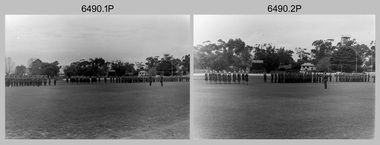
Photograph - Army Survey Regiment Freedom of Entry Parade, Queen Elizabeth Oval, Bendigo, 1980
... Squadrons formed up parade with 3rd Military District Band playing music. .12) to .14) - Photo, black & white, 1980. ...Squadrons formed up parade with 3rd Military District Band playing music. .12) to .14) - Photo, black & white, 1980. ...The Freedom of Entry to the City was an honour conferred by the Bendigo City Council to the Army Survey Regiment in 1970. 1980 was the third time the unit exercised its freedom of marching into the city with swords drawn, bayonets fixed and drums beating. The honour is usually bestowed upon local regiments, in recognition of their dedicated service, and it is common for military units to periodically exercise their freedom by arranging a parade through the city. Led by the Regiment’s CO – LTCOL Bob Skitch, the unit marched down View St in the CBD, along Pall Mall and up Gaol Rd to the Queen Elizabeth II Oval. The ceremonial parade followed with a march past the guests of honour, Mayor of Bendigo Councillor Paul Tomkinson and military dignitaries. The parade concluded after formal inspections of the troops. The Regiment also exercised its Freedom of Entry with anniversary parades in 1977, 1980, 1985, 1990, 1992 and 1996. Some photos in this set were also printed on photo paper and catalogued under item 6021.25P. Photos of the march are catalogued under item 6491.21P. Photos of the Freedom of Entry parade rehearsal are catalogued under item 6479.38P.These black and white photographs of the Army Survey Regiment were taken on the occasion of the Freedom of Entry parade to the City of Bendigo in 1980. The photographs are on 35mm negative film and scanned at 96 dpi. They are part of the Army Survey Regiment’s Collection. .1) to .7) - Photo, black & white, 1980. Squadrons formed up at beginning of parade. .8) & .9) - Photo, black & white, 1980. 3rd Military District Band marches to their parade position. .10) to .11) - Photo, black & white, 1980. Squadrons formed up parade with 3rd Military District Band playing music. .12) to .14) - Photo, black & white, 1980. Officers formed up before taking posts. L to R: MAJ Peter Eddy, LT Brendon Jaego-Banks, CAPT Peter Searle - UK Exchange, unidentified, ADJT CAPT John Harrison, MAJ Sam Schwartz US Exchange, unidentified, MAJ Robin Blackburn, remainder unidentified. .15) - Photo, black & white, 1980. Officers march to their posts. L to R: MAJ Peter Eddy, LT Brendon Jaego-Banks, CAPT Peter Searle - UK Exchange, unidentified, ADJT CAPT John Harrison, MAJ Sam Schwartz US Exchange, unidentified, MAJ Robin Blackburn, remainder unidentified. .16 - Photo, black & white, 1980. Officers march to their posts. .17 - Photo, black & white, 1980. Army Svy Regt awaits the arrival of the Mayor – Councillor Paul Tomkinson. .18 - Photo, black & white, 1980. CO LTCOL Bob Skitch escorts the Mayor – Councillor Paul Tomkinson and unidentified guest to the dais. .19) to .25) – Army Svy Regt salutes the Mayor – Councillor Paul Tomkinson. .26) - Photo, black & white, 1980. CO LTCOL Bob Skitch escorts the Mayor – Councillor Paul Tomkinson to Headquarters Squadron to inspect its personnel. .27) - Photo, black & white, 1980. Headquarters Squadron inspection. L to R: OC MAJ Paddy Strunks, RSM WO1 Aub Harvey, Mayor – Councillor Paul Tomkinson, SPR Chris ‘Charlie’ Brown, unidentified, SGT John Grove (orderly room), unidentified, SPR Jeff Ruiz, WO2 Max Neil, unidentified, SGT Alan Brown, SGT Tim Allanson. .28) - Photo, black & white, 1980. Headquarters Squadron inspection. L to R: OC MAJ Paddy Strunks, Mayor – Councillor Paul Tomkinson, unidentified, SGT Rick Warren, unidentified, CPL Andy Wilson, WO2 Ted Burgess. .29) - Photo, black & white, 1980. Headquarters Squadron inspection. L to R: OC MAJ Paddy Strunks, RSM WO1 Aub Harvey, unidentified civilian, Mayor – Councillor Paul Tomkinson, unidentified, SGT Rick Warren, unidentified, CPL Andy Wilson, WO2 Ted Burgess. .30) - Photo, black & white, 1980. Cartographic Squadron’s OC CAPT Bob Roche salutes the Mayor – Councillor Paul Tomkinson. L to R: unidentified civilian, CO LTCOL Bob Skitch. In background L to R: SSGT Bob Scaddan, unidentified, CPL John Tempest, CAPT Simon Lemon, SSGT Colin Cuskelly, CPL Trevor Bottomley, SPR Bob Sheppard, WO2 Bob ‘Stretch’ Hayden, unidentified, CPL Ian McKenzie, FLTLT Ron Aitken, SPR Ian Fitzgerald, SPR Greg Else. .31) - Photo, black & white, 1980. Cartographic Squadron’s OC CAPT Bob Roche salutes the Mayor – Councillor Paul Tomkinson. L to R: unidentified civilian, CO LTCOL Bob Skitch. In background L to R: CPL Terry Danger, SPR Rod Skidmore, SSGT Bob Scaddan, unidentified, CPL John Tempest, CAPT Simon Lemon, SSGT Colin Cuskelly, CPL Trevor Bottomley, SPR Bob Sheppard, WO2 Bob ‘Stretch’ Hayden, unidentified, CPL Ian McKenzie, FLTLT Ron Aitken, SPR Ian Fitzgerald, SPR Greg Else. .32) - Photo, black & white, 1980. Cartographic Squadron inspection. L to R: OC CAPT Bob Roche, Mayor – Councillor Paul Tomkinson. In background L to R: SGT Stu Thaxter, unidentified, SSGT John Barrie, CPL Roger Pearson, SGT Doug Carswell, SPR Peter Main, WO2 Bob ‘Stretch’ Hayden. .33) - Photo, black & white, 1980. Cartographic Squadron inspection. L to R: CO LTCOL Bob Skitch, OC CAPT Bob Roche, unidentified civilian, SGT Doug Carswell, Mayor – Councillor Paul Tomkinson, WO2 Bob ‘Stretch’ Hayden. .34) - Photo, black & white, 1980. Female Contigent inspection L to R: unidentified, SPR Gae (Amato) Robinson, SPR Scheryl Delforce, unidentified officer, unidentified civilian, Mayor – Councillor Paul Tomkinson, CPL Marrianne (Van De Zee) De Groot, SPR Cathy Regan, SPR Ginny (Turner) Rowe, SPR Ilen Isaac, SPR Penny Knott, SPR Santina (Argetto) Straube, SPR Gina (Coore) Neilson, WO2 Pat Lumsden. .35) - Photo, black & white, 1980. Female Contigent inspection L to R: SPR Scheryl Delforce, unidentified officer, CO LTCOL Bob Skitch, unidentified civilian, Mayor – Councillor Paul Tomkinson, SPR Ginny Turner, SPR Ilen Isaac, SPR Penny Knott, SPR Santina (Argetto) Straube, SPR Gina (Coore) Neilson, WO2 Pat Lumsden. .36) - Photo, black & white, 1980. Female Contigent inspection L to R: SPR Scheryl Delforce, unidentified officer, CO LTCOL Bob Skitch, unidentified civilian, Mayor – Councillor Paul Tomkinson, SPR Cathy Regan, SPR Ginny Turner, SPR Ilen Isaac, SPR Penny Knott, SPR Santina (Argetto) Straube, SPR Gina (Coore) Neilson, WO2 Pat Lumsden. .37) - Photo, black & white, 1980. Female Contigent inspection L to R: SPR Scheryl Delforce, unidentified officer, CO LTCOL Bob Skitch, CPL Marrianne (Van De Zee) De Groot, unidentified civilian, Mayor – Councillor Paul Tomkinson, SPR Ilen Isaac, SPR Penny Knott, SPR Santina (Argetto) Straube, SPR Gina (Coore) Neilson, WO2 Pat Lumsden. .38) - Photo, black & white, 1980. Air Survey Squadron’s OC MAJ Peter Eddy salutes the Mayor – Councillor Paul Tomkinson. L to R: unidentified civilian, CO LTCOL Bob Skitch. In background L to R: WO1 Jim ‘Triple J’ Jefferies, SPR Allan Choat, SPR Geoff Havelberg, CPL Alan Hawkins, CPL Dave Cook, LT Brendon Jaego-Banks, SGT Jim Beard, SSGT Russell ‘Rusty’ Williams, SGT Cam Chapman, SSGT Alan Derby, SSGT Greg Buckingham. .39) - Photo, black & white, 1980. Air Survey Squadron inspection. L to R: back of CAPT Kym Weston, OC MAJ Peter Eddy, Mayor – Councillor Paul Tomkinson, unidentified civilian. .40) - Photo, black & white, 1980. Air Survey Squadron inspection. L to R: CAPT Peter Searle - UK Exchange, unidentified officer, unidentified civilian, Mayor – Councillor Paul Tomkinson, unidentified, SSGT Alan Derby, LCPL Paul Hopes, SPR Peter Jones, SPR John Lane, WO2 Brian Meade, CPL Mick Hogan, CPL Greg Byers, SGT Cliff Webb. .41) - Photo, black & white, 1980. Air Survey Squadron inspection. Centre rank L to R: SGT Bruce ‘Stretch’ Gordon, WO2 Chris Parkinson. Rear rank L to R: SPR Allan Choat, unidentified, SPR Jamie McRae, SSGT Russell ‘Rusty’ Williams, SSGT Greg Buckingham, CPL Greg Byers, CPL Roger Rees, SPR Gary Ames, SGT Greg Gilbert, SSGT Peter Warwick, WO2 Mick Dempster. .42) - Photo, black & white, 1980. Air Survey Squadron inspection. Rear rank: SSGT Russell ‘Rusty’ Williams. Centre rank L to R: SPR Geoff Havelberg, CPL Peter Treble, SGT Jim Beard, SPR Peter Hardy, SPR Steve Hilton, SPR John Lane, CPL Mick Hogan, Mayor – Councillor Paul Tomkinson, OC MAJ Peter Eddy. .43) - Photo, black & white, 1980. Air Survey Squadron inspection. Centre rank L to R: SGT Bruce ‘Stretch’ Gordon, WO2 Chris Parkinson. Mayor – Councillor Paul Tomkinson, OC MAJ Peter Eddy. Rear rank L to R: SPR Allan Choat, unidentified, SPR Jamie McRae, SSGT Russell ‘Rusty’ Williams, SSGT Greg Buckingham, CPL Greg Byers, CPL Roger Rees, SPR Gary Ames, SGT Greg Gilbert, SSGT Peter Warwick, WO2 Mick Dempster. .44) - Photo, black & white, 1980. Lithographic Squadron’s OC MAJ Robin Blackburn salutes the Mayor – Councillor Paul Tomkinson. L to R: unidentified civilian, CO LTCOL Bob Skitch. In background L to R: WO1 Manfred Panknin, SSGT Peter Coombes, CPL Frank Lenane, SPR Per Andersen, CPL John ‘Flash’ Anderson, unidentified, MAJ Sam Schwartz US Exchange, CPL Warren ‘Waldo’ Shirley, SPR Warren ‘Wah’ Hall, unidentified, SPR Neville Carr, SPR Paul Davis, SPR Paul Baker, CPL Mick ‘Buddha’ Ellis, SPR Martin Van De Maele, CPL Bill Jones, SPR Greg Rowe. .45) - Photo, black & white, 1980. Lithographic Squadron inspection. L to R: RSM WO1 Aub Harvey, SPR Warren ‘Wah’ Hall, CO LTCOL Bob Skitch, SPR Paul Davis, unidentified civilian, unidentified, OC MAJ Robin Blackburn, CPL Lance Strudwick, Mayor – Councillor Paul Tomkinson, SPR Neville Carr, SPR Roy Hicks, SSGT Trevor Osborne, SPR Paul Baker, CAPT Stan Vote, CPL Bill Jones, SGT Greg Francis-Wright, SGT Ralph Chant, CPL Garry Drummond, WO2 Noel ‘Nesty’ Coulthard. .46) - Photo, black & white, 1980. Lithographic Squadron inspection. Front rank L to R: SGT Greig Kidman, SPR Garry Hudson, SPR Gary Tremain, CPL Steve Egan, SPR Greg Rowe, CPL Mick ‘Buddha’ Ellis, remainder unidentified. Centre rank: SSGT Kevin Macquire. Inspection party L to R: CO LTCOL Bob Skitch, OC MAJ Robin Blackburn, unidentified civilian, Mayor – Councillor Paul Tomkinson. Rear rank L to R: unidentified (x5), CPL Warren ‘Waldo’ Shirley, SPR Neville Carr, SPR Paul Baker, CPL Bill Jones, CPL Garry Drummond, SGT Graeme Jeffers, WO2 Tom Pattison. .47) - Photo, black & white, 1980. Lithographic Squadron inspection. Front rank L to R: SSGT Trevor Osborne, SGT Greig Kidman, SPR Garry Hudson, SPR Gary Tremain, CPL Steve Egan, SPR Greg Rowe, CPL Mick ‘Buddha’ Ellis, remainder unidentified. Centre rank: SSGT Kevin Macquire, SGT Ralph Chant. Inspection party L to R: OC MAJ Robin Blackburn, RSM WO1 Aub Harvey, unidentified civilian, Mayor – Councillor Paul Tomkinson. Rear rank L to R: SPR Paul Baker, CPL Bill Jones, CPL Garry Drummond, SGT Graeme Jeffers, WO2 Tom Pattison. 48) - Photo, black & white, 1980. Lithographic Squadron inspection. Inspection party L to R: OC MAJ Robin Blackburn, Mayor – Councillor Paul Tomkinson, CO LTCOL Bob Skitch, unidentified civilian. Rear rank L to R: WO2 Tom Pattison, SGT Graeme Jeffers, CPL Garry Drummond, CPL Bill Jones, CPL SPR Neville Carr, Warren ‘Waldo’ Shirley, unidentified. Rear supernumery: WO1 John McCulloch. 49) - Photo, black & white, 1980. Lithographic Squadron inspection. Inspection party L to R: OC MAJ Robin Blackburn, CO LTCOL Bob Skitch, Mayor – Councillor Paul Tomkinson, unidentified civilian, RSM WO1 Aub Harvey. Rear rank L to R: WO2 Tom Pattison, SGT Graeme Jeffers, remainer unidentified. 50) - Photo, black & white, 1980. 3rd Military District Band inspection. L to R: unidentified band master, CO LTCOL Bob Skitch, Mayor – Councillor Paul Tomkinson. 51) - Photo, black & white, 1980. CO LTCOL Bob Skitch delivers his speech. 52) & .53) - Photo, black & white, 1980. Army Svy Regt squadrons stand at ease during CO LTCOL Bob Skitch’s speech.There are no personnel identified. royal australian survey corps, rasvy, army survey regiment, army svy regt, fortuna, asr -
 Federation University Historical Collection
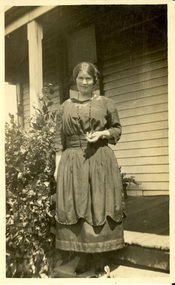
Photograph - Photograph - black and white, Kodak Australia, Sarah and Laura Wright at Laura Villa, Smeaton, 28/1/1922
... He was made Professor of Brass and Military Band Scoring and conducted at the Guildhall of Music and Drama. ...He was made Professor of Brass and Military Band Scoring and conducted at the Guildhall of Music and Drama. ...Frank Wright was a renown resident of Smeaton, where he was born. He lived at Laura Villa, and attended Smeaton State School. His father William was a gold miner and his mother's name was Sarah. Their family won many singing and instrumental awards. Frank was tutored by Percy Code and became the Australian Open Cornet Champion by the age of eighteen. A year later, Frank conducted the City of Ballarat Band, and later the Ballarat Soldiers’ Memorial Band. He formed the Frank Wright Frisco Band and Frank Wright and his Coliseum Orchestra. These bands won many South Street awards, and Frank as conductor won many awards in the Australian Band Championship contest. In 1933 Frank Wright sailed to England to conduct the famous St Hilda’s Band and was later appointed Musical Director of the London County Council, where he organized many amazing concerts in parks, in and around the London district. He was made Professor of Brass and Military Band Scoring and conducted at the Guildhall of Music and Drama. Frank was often invited to adjudicate Brass Band Championships around Europe, in Australia, including South Street and in New Zealand. The Frank Wright Medal at the Royal South Street competition is awarded to an individual recognized as making an outstanding contribution to brass music in Australia..1) black and white photograph of a woman dressed in a dark ankle length dress with a scalloped overskirt, wearing beads around her neck. She is standing on the steps of a cottage "Laura Villa" with a shrub to the left of her. The woman is Laura Wright. .2) black and white photograph of a woman wearing a long dark dress and a white cravat with a brooch, standing of the steps of a cottage. The woman is Sarah Wright and the cottage is "Laura Villa". .3) black and white photograph of a woman wearing a long dark dress and a white cravat with a brooch, standing of the steps of a cottage. The woman is Sarah Wright and the cottage is "Laura Villa"..1) Handwritten on back - Laura Wright, aged 25 years. Taken at Smeaton, January 28th 1922, by Frank Wright .2) Handwritten on back Mrs W. Wright, "Laura Villa" Smeaton. Taken by her son, Frank Wright on January 28th, 1922laura wright, sarah wright, laura villa, frank wright, smeaton -
 Federation University Historical Collection
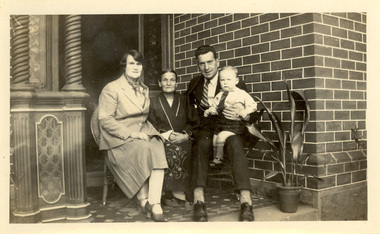
Photograph - Photograph - black and white, Sarah Wright and family, 1928?
... He was made Professor of Brass and Military Band Scoring and conducted at the Guildhall of Music and Drama. ...He was made Professor of Brass and Military Band Scoring and conducted at the Guildhall of Music and Drama. ...Frank Wright was a renown resident of Smeaton, where he was born. He lived at Laura Villa, and attended Smeaton State School. His father William was a gold miner and his mother's name was Sarah. Their family won many singing and instrumental awards. Frank was tutored by Percy Code and became the Australian Open Cornet Champion by the age of eighteen. A year later, Frank conducted the City of Ballarat Band, and later the Ballarat Soldiers’ Memorial Band. He formed the Frank Wright Frisco Band and Frank Wright and his Coliseum Orchestra. These bands won many South Street awards, and Frank as conductor won many awards in the Australian Band Championship contest. In 1933 Frank Wright sailed to England to conduct the famous St Hilda’s Band and was later appointed Musical Director of the London County Council, where he organized many amazing concerts in parks, in and around the London district. He was made Professor of Brass and Military Band Scoring and conducted at the Guildhall of Music and Drama. Frank was often invited to adjudicate Brass Band Championships around Europe, in Australia, including South Street and in New Zealand. The Frank Wright Medal at the Royal South Street competition is awarded to an individual recognized as making an outstanding contribution to brass music in Australia. As Sarah is in her dressing gown and slippers these photos could refer to a note on an envelope left by Frank which says 'Mother taken on the first day up out of bed - at Lauls on 13th May 1928'. .1) black and white photograph of a man and a woman sitting on a wicker chair which is on a tessellated floor of the front porch of a brick building. The woman is wearing a dressing gown and slippers. The man is Frank Wright and the woman is Sarah Wright, his mother. .2) black and white photograph of a woman sitting on a wicker armchair with a pillow behind her back. The chair is on a tessellated floor on the front porch of a brick building. The woman is Sarah Wright. .3) black and white photograph of a man, two women and a child sitting on a wicker chair which is on a tessellated floor on the front porch of a brick building. The man is Frank Wright and the older woman is his mother Sarah Wright. The younger woman is his sister Laura and her son, Frank Ritchie is sitting on Frank's lap.On the left hand side of the porch are ornate columns and on the right hand side is a potted plant.frank wright, sarah wright, laura wright, tessilated floor, wicker chair, ornate column, child -
 Federation University Historical Collection
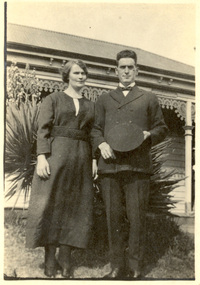
Photograph - Photograph - black and white, Vernon Holt, Laura and Frank Wright, 9/4/22
... He was made Professor of Brass and Military Band Scoring and conducted at the Guildhall of Music and Drama. ...He was made Professor of Brass and Military Band Scoring and conducted at the Guildhall of Music and Drama. ...Frank Wright was a renown resident of Smeaton, where he was born. He lived at Laura Villa, and attended Smeaton State School. His father William was a gold miner and his mother's name was Sarah. Their family won many singing and instrumental awards. Frank was tutored by Percy Code and became the Australian Open Cornet Champion by the age of eighteen. A year later, Frank conducted the City of Ballarat Band, and later the Ballarat Soldiers’ Memorial Band. He formed the Frank Wright Frisco Band and Frank Wright and his Coliseum Orchestra. These bands won many South Street awards, and Frank as conductor won many awards in the Australian Band Championship contest. In 1933 Frank Wright sailed to England to conduct the famous St Hilda’s Band and was later appointed Musical Director of the London County Council, where he organized many amazing concerts in parks, in and around the London district. He was made Professor of Brass and Military Band Scoring and conducted at the Guildhall of Music and Drama. Frank was often invited to adjudicate Brass Band Championships around Europe, in Australia, including South Street and in New Zealand. The Frank Wright Medal at the Royal South Street competition is awarded to an individual recognized as making an outstanding contribution to brass music in Australia.Black and white photograph of a man and a woman standing in front of a house. The man is dressed in a band uniform with hat and the woman is dressed in a dark above the ankle length dress. The woman is Laura Wright and the man is Frank Wright. The house is "Dalbrao" at Northcote Hand written on back - Laura Wright 25, Frank Wright 20, "Dalbrae", St Georges Road, Northcote, Melbourne, Taken by Vernon Holt, 9/4/22laura wright, frank wright, dalbrae, vernon holt, cornet, band -
 Federation University Historical Collection
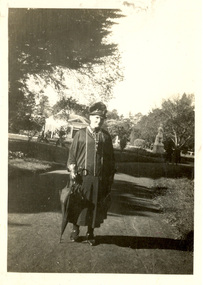
Photograph - black and white, Sarah Wright at the Ballarat Botanical Gardens
... He was made Professor of Brass and Military Band Scoring and conducted at the Guildhall of Music and Drama. ...He was made Professor of Brass and Military Band Scoring and conducted at the Guildhall of Music and Drama. ...Sarah Wright was the mother of Frank Wright who was a renown resident of Smeaton, where he was born. He lived at Laura Villa, and attended Smeaton State School. His father William was a gold miner. Their family won many singing and instrumental awards. Frank was tutored by Percy Code and became the Australian Open Cornet Champion by the age of eighteen. A year later, Frank conducted the City of Ballarat Band, and later the Ballarat Soldiers’ Memorial Band. He formed the Frank Wright Frisco Band and Frank Wright and his Coliseum Orchestra. These bands won many South Street awards, and Frank as conductor won many awards in the Australian Band Championship contest. In 1933 Frank Wright sailed to England to conduct the famous St Hilda’s Band and was later appointed Musical Director of the London County Council, where he organized many amazing concerts in parks, in and around the London district. He was made Professor of Brass and Military Band Scoring and conducted at the Guildhall of Music and Drama. Frank was often invited to adjudicate Brass Band Championships around Europe, in Australia, including South Street and in New Zealand. The Frank Wright Medal at the Royal South Street competition is awarded to an individual recognized as making an outstanding contribution to brass music in Australia.Black and white photograph of a woman in a dark dress and hat and carrying an umbrella. She is standing on a path set within the grounds of the Ballarat Botanical Gardens, with the Statue Pavillion, a statue, shrubs and large trees in the background. The woman is Sarah Wright.sarah wright, frank wright, ballarat botanical gardens, statue pavillion -
 Federation University Historical Collection
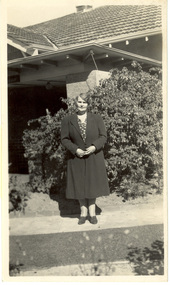
Photograph - Photograph - black and white, Laura Wright-Ritchie (probably)
... He was made Professor of Brass and Military Band Scoring and conducted at the Guildhall of Music and Drama. ...He was made Professor of Brass and Military Band Scoring and conducted at the Guildhall of Music and Drama. ...Laura Wright-Ritchie was gifted on the viola and was a music teacher. She was the sister of Frank Wright, who was a renown resident of Smeaton, where he was born. He lived at Laura Villa, and attended Smeaton State School. His father William was a gold miner and his mother's name was Sarah. Their family won many singing and instrumental awards. Frank was tutored by Percy Code and became the Australian Open Cornet Champion by the age of eighteen. A year later, Frank conducted the City of Ballarat Band, and later the Ballarat Soldiers’ Memorial Band. He formed the Frank Wright Frisco Band and Frank Wright and his Coliseum Orchestra. These bands won many South Street awards, and Frank as conductor won many awards in the Australian Band Championship contest. In 1933 Frank Wright sailed to England to conduct the famous St Hilda’s Band and was later appointed Musical Director of the London County Council, where he organized many amazing concerts in parks, in and around the London district. He was made Professor of Brass and Military Band Scoring and conducted at the Guildhall of Music and Drama. Frank was often invited to adjudicate Brass Band Championships around Europe, in Australia, including South Street and in New Zealand. The Frank Wright Medal at the Royal South Street competition is awarded to an individual recognized as making an outstanding contribution to brass music in Australia. Black and white photograph of a woman standing on the driveway in front of a house. Behind her is a flowering bush. She is dressed in a dress and overcoat. The woman is Laura Wright-Ritchie and the house is situated in Gregory Street, Wendouree.Printed - Selo; written in pencil on back - 694Blaura wright-ritchie, laura wright, viola, music teacher, frank wright, gregory street, -
 Federation University Historical Collection
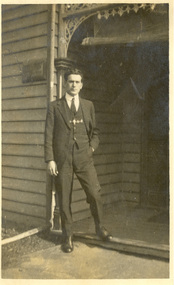
Photograph - Photograph - black and white, Lin Jenkins, Frank Wright at Doveton Street South, Ballarat, 23/07/1921
... He was made Professor of Brass and Military Band Scoring and conducted at the Guildhall of Music and Drama. ...He was made Professor of Brass and Military Band Scoring and conducted at the Guildhall of Music and Drama. ...Frank Wright was a renown resident of Smeaton, where he was born. He lived at Laura Villa, and attended Smeaton State School. His father William was a gold miner and his mother's name was Sarah. Their family won many singing and instrumental awards. Frank was tutored by Percy Code and became the Australian Open Cornet Champion by the age of eighteen. A year later, Frank conducted the City of Ballarat Band, and later the Ballarat Soldiers’ Memorial Band. He formed the Frank Wright Frisco Band and Frank Wright and his Coliseum Orchestra. These bands won many South Street awards, and Frank as conductor won many awards in the Australian Band Championship contest. In 1933 Frank Wright sailed to England to conduct the famous St Hilda’s Band and was later appointed Musical Director of the London County Council, where he organized many amazing concerts in parks, in and around the London district. He was made Professor of Brass and Military Band Scoring and conducted at the Guildhall of Music and Drama. Frank was often invited to adjudicate Brass Band Championships around Europe, in Australia, including South Street and in New Zealand. The Frank Wright Medal at the Royal South Street competition is awarded to an individual recognized as making an outstanding contribution to brass music in Australia.Black and white photograph of a man with one hand in the pocket of his suit trousers, standing before the front porch of a timber house. There is some wrought iron over the entrance to the porch. The man is Frank Wright and the house is at 118 Doveton Street South, Ballarat.Handwritten on the back - Frank Wright, at the age of 19 years taken at 118 Doveton St Sth, Ballarat, by Lin Jenkins, 23-7-1921frank wright, lin jenkins, timber house, wrought iron, ballarat -
 Federation University Historical Collection
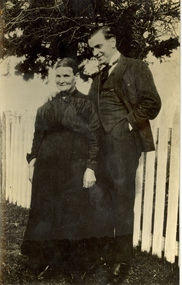
Photograph - Photograph - black and white, Kodak Australia, Sarah Wright and son Alex, circa mid - late 1920's
... He was made Professor of Brass and Military Band Scoring and conducted at the Guildhall of Music and Drama. ...He was made Professor of Brass and Military Band Scoring and conducted at the Guildhall of Music and Drama. ...Alex Wright was the brother ofFrank Wright who was a renown resident of Smeaton. He lived at Laura Villa, and attended Smeaton State School. His father William was a gold miner and his mother's name was Sarah. Their family won many singing and instrumental awards. Frank was tutored by Percy Code and became the Australian Open Cornet Champion by the age of eighteen. A year later, Frank conducted the City of Ballarat Band, and later the Ballarat Soldiers’ Memorial Band. He formed the Frank Wright Frisco Band and Frank Wright and his Coliseum Orchestra. These bands won many South Street awards, and Frank as conductor won many awards in the Australian Band Championship contest. In 1933 Frank Wright sailed to England to conduct the famous St Hilda’s Band and was later appointed Musical Director of the London County Council, where he organized many amazing concerts in parks, in and around the London district. He was made Professor of Brass and Military Band Scoring and conducted at the Guildhall of Music and Drama. Frank was often invited to adjudicate Brass Band Championships around Europe, in Australia, including South Street and in New Zealand. The Frank Wright Medal at the Royal South Street competition is awarded to an individual recognized as making an outstanding contribution to brass music in Australia..1) Black and white photograph of a man and a woman standing in front of a picket fence, with a large tree in the background. The man is wearing a suit and is Frank Wright. The woman is wearing a long dark skirt and long sleeved blouse with a brooch at the neckline. She is his mother Sarah Wright. The man is wearing a suit and is Sarah's son Alex. The picket fence surrounds "Laura Villa". .2) Glass plate for this photographPrinted on the back - Post Card, Kodak Australiafrank wright, sarah wright, picket fence, laura villa, smeaton, cornet -
 Federation University Historical Collection
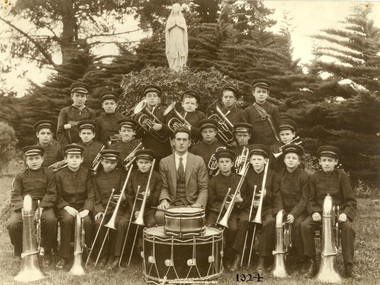
Photograph - Photograph - black and white, St Joseph's Orphanage Brass Band, 1924, 1924
... He was made Professor of Brass and Military Band Scoring and conducted at the Guildhall of Music and Drama. ...He was made Professor of Brass and Military Band Scoring and conducted at the Guildhall of Music and Drama. ...Frank Wright was a renown resident of Smeaton. He lived at Laura Villa, and attended Smeaton State School. His father William was a gold miner and his mother was Sarah Wright. Their family won many singing and instrumental awards. Frank was tutored by Percy Code and became the Australian Open Cornet Champion by the age of eighteen. A year later, Frank conducted the City of Ballarat Band, and later the Ballarat Soldiers’ Memorial Band. He formed the Frank Wright Frisco Band and Frank Wright and his Coliseum Orchestra. These bands won many South Street awards, and Frank as conductor won many awards in the Australian Band Championship contest. In 1933 Frank Wright sailed to England to conduct the famous St Hilda’s Band and was later appointed Musical Director of the London County Council, where he organized many amazing concerts in parks, in and around the London district. He was made Professor of Brass and Military Band Scoring and conducted at the Guildhall of Music and Drama. Frank was often invited to adjudicate Brass Band Championships around Europe, in Australia, including South Street and in New Zealand. The Frank Wright Medal at the Royal South Street competition is awarded to an individual recognized as making an outstanding contribution to brass music in Australia. St Joseph's home was later known as Nazareth House.Black and white photograph of a group of boys dressed in a band uniform all carrying brass instruments. The conductor is seated centre front with two drums, one on top of the other placed in front of him. The group is arranged in front of shrubbery and a statue of Mary. The conductor is Frank Wright and the grounds are the boys orphanage, St Joseph's Home - now Blythewood GrangeWritten in ink on front - '1924'frank wright, brass band, catholic, mary statue, orphanage, st joseph's home, sebastopol, st joseph's orphanage band -
 Federation University Historical Collection
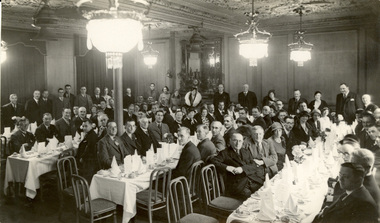
Photograph - Photograph - black and white, Press & Publicity, Photographic Co, Florence Restaurant, Piccadilly, London, 1933, 1933
... He was made Professor of Brass and Military Band Scoring and conducted at the Guildhall of Music and Drama. ...He was made Professor of Brass and Military Band Scoring and conducted at the Guildhall of Music and Drama. ...This photograph was one of Frank Wright's collection. Frank Wright was a renown resident of Smeaton, where he was born. He lived at Laura Villa, and attended Smeaton State School. His father William was a gold miner and his mother's name was Sarah. Their family won many singing and instrumental awards. Frank was tutored by Percy Code and became the Australian Open Cornet Champion by the age of eighteen. A year later, Frank conducted the City of Ballarat Band, and later the Ballarat Soldiers’ Memorial Band. He formed the Frank Wright Frisco Band and Frank Wright and his Coliseum Orchestra. These bands won many South Street awards, and Frank as conductor won many awards in the Australian Band Championship contest. In 1933 Frank Wright sailed to England to conduct the famous St Hilda’s Band and was later appointed Musical Director of the London County Council, where he organized many amazing concerts in parks, in and around the London district. He was made Professor of Brass and Military Band Scoring and conducted at the Guildhall of Music and Drama. Frank was often invited to adjudicate Brass Band Championships around Europe, in Australia, including South Street and in New Zealand. The Frank Wright Medal at the Royal South Street competition is awarded to an individual recognized as making an outstanding contribution to brass music in Australia.Black and white photograph of a large ornate room with men and women seated at four long tables, set with flatware, silverware and ornately folded napkins. Other men and women are standing around the edges of the room. They are all formally dressed. The room has ornate cornice, ceilings and light fixtures and a large mirror on the back wall. The place is the Florence Restaurant, Piccadilly London.Written in pencil on the back - 'Dinner at Florence Restaurant Piccadilly London after Crystal Palace 1933'frank wright, florence restaurant piccadilly london -
 Federation University Historical Collection
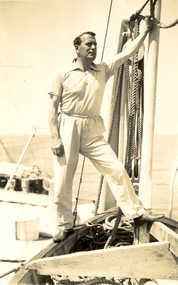
Photograph - Photograph, Black and White, Frank Wright Sails the Red Sea, 1940
... He was made Professor of Brass and Military Band Scoring and conducted at the Guildhall of Music and Drama. ...He was made Professor of Brass and Military Band Scoring and conducted at the Guildhall of Music and Drama. ...Frank Wright was a renown resident of Smeaton, where he was born. He lived at Laura Villa, and attended Smeaton State School. His father William was a gold miner and his mother's name was Sarah. Their family won many singing and instrumental awards. Frank was tutored by Percy Code and was awarded a gold medal for the highest marks in the ALCM examinations in the British Colonies at the age of seventeen years. He became the Australian Open Cornet Champion by the age of eighteen. A year later, Frank conducted the City of Ballarat Band, and later the Ballarat Soldiers’ Memorial Band. He formed the Frank Wright Frisco Band and Frank Wright and his Coliseum Orchestra. These bands won many South Street awards, and Frank as conductor won many awards in the Australian Band Championship contest. In 1933 Frank Wright sailed to England to conduct the famous St Hilda’s Band and was later appointed Musical Director of the London County Council, where he organized many amazing concerts in parks, in and around the London district. He was made Professor of Brass and Military Band Scoring and conducted at the Guildhall of Music and Drama. Frank was often invited to adjudicate Brass Band Championships around Europe, in Australia, including South Street and in New Zealand. The Frank Wright Medal at the Royal South Street competition is awarded to an individual recognized as making an outstanding contribution to brass music in Australia.Frank Wright Sails the Red Sea. Sepia photograph of a man dressed in whites standing aboard a boat, with his left arm outstretched and holding onto the mast. The man is Frank Wright. A further two photographs shows Frank Wright in a darker suit, on what is thought to be the same deck.Frank Wright on board "Remo", Red Sea, Jan 1940frank wright, ballarat, cornet, red sea, sailing boat -
 Federation University Historical Collection
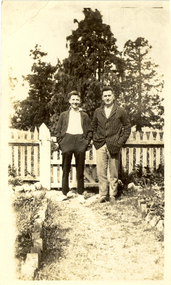
Photograph - Photograph - Black and White, Scotts Pharmacy, Frank Wright and Friend
... He was made Professor of Brass and Military Band Scoring and conducted at the Guildhall of Music and Drama. ...He was made Professor of Brass and Military Band Scoring and conducted at the Guildhall of Music and Drama. ...Frank Wright was a renown resident of Smeaton, where he was born. He lived at Laura Villa, and attended Smeaton State School. His father William was a gold miner and his mother's name was Sarah. Their family won many singing and instrumental awards. Frank was tutored by Percy Code and was awarded a gold medal for the highest marks in the ALCM examinations in the British Colonies at the age of seventeen years. He became the Australian Open Cornet Champion by the age of eighteen. A year later, Frank conducted the City of Ballarat Band, and later the Ballarat Soldiers’ Memorial Band. He formed the Frank Wright Frisco Band and Frank Wright and his Coliseum Orchestra. These bands won many South Street awards, and Frank as conductor won many awards in the Australian Band Championship contest. In 1933 Frank Wright sailed to England to conduct the famous St Hilda’s Band and was later appointed Musical Director of the London County Council, where he organized many amazing concerts in parks, in and around the London district. He was made Professor of Brass and Military Band Scoring and conducted at the Guildhall of Music and Drama. Frank was often invited to adjudicate Brass Band Championships around Europe, in Australia, including South Street and in New Zealand. The Frank Wright Medal at the Royal South Street competition is awarded to an individual recognized as making an outstanding contribution to brass music in Australia.Black and white photograph of two men standing on a path inside a fenced garden. There are tall trees in the background. The men are Frank Wright and a friend, possibly at "Laura Villa" Smeaton.Stamped on the back - Printed at Scott's Pharmacy, (143) Sturt Street Ballaratfrank wright, cornet, conductor, ballarat, laura villa -
 Federation University Historical Collection
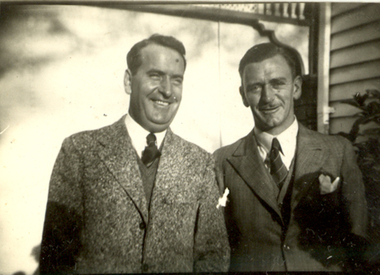
Photograph - Photograph - Black and White, Frank Wright and Friend, 03/1940
... He was made Professor of Brass and Military Band Scoring and conducted at the Guildhall of Music and Drama. ...He was made Professor of Brass and Military Band Scoring and conducted at the Guildhall of Music and Drama. ...Frank Wright was a renown resident of Smeaton, where he was born on 2 August 1901. He lived at Laura Villa, and attended Smeaton State School. His father William was a gold miner and his mother's name was Sarah. Their family won many singing and instrumental awards. Frank was tutored by Percy Code and was awarded a gold medal for the highest marks in the ALCM examinations in the British Colonies at the age of seventeen years. He became the Australian Open Cornet Champion by the age of eighteen. A year later, Frank conducted the City of Ballarat Band, and later the Ballarat Soldiers’ Memorial Band. He formed the Frank Wright Frisco Band and Frank Wright and his Coliseum Orchestra. These bands won many South Street awards, and Frank as conductor won many awards in the Australian Band Championship contest. In 1933 Frank Wright sailed to England to conduct the famous St Hilda’s Band and was later appointed Musical Director of the London County Council, where he organized many amazing concerts in parks, in and around the London district. He was made Professor of Brass and Military Band Scoring and conducted at the Guildhall of Music and Drama. Frank was often invited to adjudicate Brass Band Championships around Europe, in Australia, including South Street and in New Zealand. The Frank Wright Medal at the Royal South Street competition is awarded to an individual recognized as making an outstanding contribution to brass music in Australia.Small black and white photograph of the torsos of two men dressed in light suits. They are standing outside a weatherboard house. The man on the left is Frank Wright and the man on the right is possibly his friend Vernon Holt.Written in pencil on back - March 1940frank wright, vernon holt, conductor, brass band -
 Federation University Historical Collection
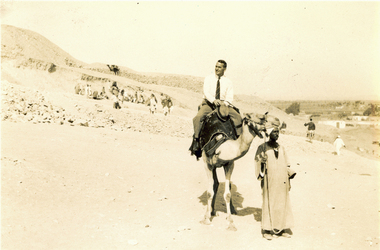
Photograph - Black and White, Frank Wright riding a camel, May 1940
... He was made Professor of Brass and Military Band Scoring and conducted at the Guildhall of Music and Drama. ...He was made Professor of Brass and Military Band Scoring and conducted at the Guildhall of Music and Drama. ...Frank Wright was a renown resident of Smeaton, where he was born. He lived at Laura Villa, and attended Smeaton State School. His father William was a gold miner and his mother's name was Sarah. Their family won many singing and instrumental awards. Frank was tutored by Percy Code and was awarded a gold medal for the highest marks in the ALCM examinations in the British Colonies at the age of seventeen years. He became the Australian Open Cornet Champion by the age of eighteen. A year later, Frank conducted the City of Ballarat Band, and later the Ballarat Soldiers’ Memorial Band. He formed the Frank Wright Frisco Band and Frank Wright and his Coliseum Orchestra. These bands won many South Street awards, and Frank as conductor won many awards in the Australian Band Championship contest. In 1933 Frank Wright sailed to England to conduct the famous St Hilda’s Band and was later appointed Musical Director of the London County Council, where he organized many amazing concerts in parks, in and around the London district. He was made Professor of Brass and Military Band Scoring and conducted at the Guildhall of Music and Drama. Frank was often invited to adjudicate Brass Band Championships around Europe, in Australia, including South Street and in New Zealand. The Frank Wright Medal at the Royal South Street competition is awarded to an individual recognized as making an outstanding contribution to brass music in Australia.Black and white photograph of a man riding a camel and being led by a dark skinned man in flowing robes.In the background are other more indistinct people and animals. The man is Frank Wright and the place is near the Pyramids in Egypt.Handwritten on back - Near Pyramids, May 1940frank wright, cornet, conductor, camel, pyramid, egypt -
 Federation University Historical Collection
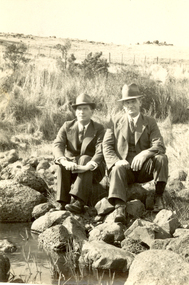
Photograph - Black and White, Frank Wright and Friend, circa late 1920's
... He was made Professor of Brass and Military Band Scoring and conducted at the Guildhall of Music and Drama. ...He was made Professor of Brass and Military Band Scoring and conducted at the Guildhall of Music and Drama. ...Frank Wright was a renown resident of Smeaton, where he was born. He lived at Laura Villa, and attended Smeaton State School. His father William was a gold miner and his mother's name was Sarah. Their family won many singing and instrumental awards. Frank was tutored by Percy Code and was awarded a gold medal for the highest marks in the ALCM examinations in the British Colonies at the age of seventeen years. He became the Australian Open Cornet Champion by the age of eighteen. A year later, Frank conducted the City of Ballarat Band, and later the Ballarat Soldiers’ Memorial Band. He formed the Frank Wright Frisco Band and Frank Wright and his Coliseum Orchestra. These bands won many South Street awards, and Frank as conductor won many awards in the Australian Band Championship contest. In 1933 Frank Wright sailed to England to conduct the famous St Hilda’s Band and was later appointed Musical Director of the London County Council, where he organized many amazing concerts in parks, in and around the London district. He was made Professor of Brass and Military Band Scoring and conducted at the Guildhall of Music and Drama. Frank was often invited to adjudicate Brass Band Championships around Europe, in Australia, including South Street and in New Zealand. The Frank Wright Medal at the Royal South Street competition is awarded to an individual recognized as making an outstanding contribution to brass music in Australia.Black and white photograph of two men dressed in suits and hats, sitting on rocks beside a creek in a grassy paddock, with a post a wire fence in the background. The man on the left is Frank Wright. The man on the right is unknown.Printed on back - SELOfrank wright, ballarat, cornet, conductor, smeaton -
 Federation University Historical Collection
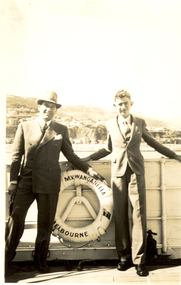
Photograph, Black and White, 13.2.1940
... He was made Professor of Brass and Military Band Scoring and conducted at the Guildhall of Music and Drama. ...He was made Professor of Brass and Military Band Scoring and conducted at the Guildhall of Music and Drama. ...Frank Wright was a renown resident of Smeaton, where he was born. He lived at Laura Villa, and attended Smeaton State School. His father William was a gold miner and his mother's name was Sarah. Their family won many singing and instrumental awards. Frank was tutored by Percy Code and was awarded a gold medal for the highest marks in the ALCM examinations in the British Colonies at the age of seventeen years. He became the Australian Open Cornet Champion by the age of eighteen. A year later, Frank conducted the City of Ballarat Band, and later the Ballarat Soldiers’ Memorial Band. He formed the Frank Wright Frisco Band and Frank Wright and his Coliseum Orchestra. These bands won many South Street awards, and Frank as conductor won many awards in the Australian Band Championship contest. In 1933 Frank Wright sailed to England to conduct the famous St Hilda’s Band and was later appointed Musical Director of the London County Council, where he organized many amazing concerts in parks, in and around the London district. He was made Professor of Brass and Military Band Scoring and conducted at the Guildhall of Music and Drama. Frank was often invited to adjudicate Brass Band Championships around Europe, in Australia, including South Street and in New Zealand. The Frank Wright Medal at the Royal South Street competition is awarded to an individual recognized as making an outstanding contribution to brass music in Australia.Frank Wright on the M.V. Wanganella .1) Black and white photograph of two men standing against the rails of a boat. In the background is the hilly shoreline of Wellington. the boat is the M.V.Wanganella and the man on the left is Frank Wright. .2) Frank Wright on the M.V. WanganellaHandwritten on back - On board Wanganella, Wellington 13-2-40; 15 B frank wright, cornet, conductor, wellington, m.v.wanganella, boat
