
Showing 153 items matching "military plaque"
-
 Wodonga & District Historical Society Inc
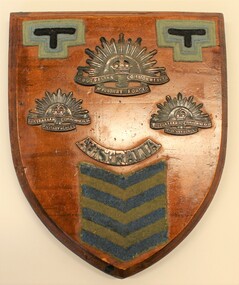
Plaque - Australian Commonwealth Military Forces Plaque
... Australian Commonwealth Military Forces Plaque...Australian Commonwealth Military Forces Plaque... A wooden plaque in the shape of a shield bearing insignia of the Australian Commonwealth Military Forces and the Tobuk colour patch....Australian Commonwealth Military Forces Plaque Plaque Australian Commonwealth Military Forces Plaque ...The Australian Commonwealth Military Forces (AMF) was the official name of the Australian Army from 1916 to 1980. The AMF included the full-time regular army and the part-time forces, which were also known as the Militia, the Citizen Military Forces (CMF), and the Australian Citizen Military Force (ACMF). The AMF was made up of conscripted and volunteer militiamen, as well as specialist permanent soldiers.This item is part of a collection of items owned by Arthur Lock, a member of the 2/23rd Battalion, an all-volunteer Second Australian Imperial Force which served as part of the garrison during the Siege of Tobruk, then at El Alamein, New Guinea and Borneo. It has particular local significance as the battalion was know as "Albury's Own" because a large majority of the battalion's initial intake of volunteers came from the Albury–Wodonga region. A wooden plaque in the shape of a shield bearing insignia of the Australian Commonwealth Military Forces and the Tobuk colour patch. 3 Australian Commonwealth Military Forces badges and metal badge engraved "AUSTRALIA"world war 11, tobruk, rats of tobruk, australian commonwealth military services, arthur lock -
 The 5th/6th Battalion Royal Victoria Regiment Historical Collection
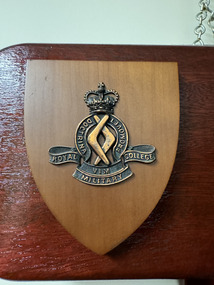
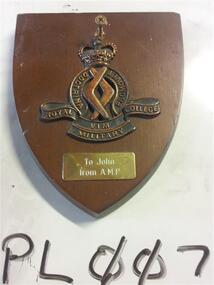
Plaque - RMC Plaque, The Royal Military College Plaque
... The Royal Military College Plaque...A plaque contains the metal RMC badge, the RMC badge contains "Royal Military College, Doctrine Vim Promote", the metal badge is on the light solid wood...A plaque contains the metal RMC badge, the RMC badge contains "Royal Military College, Doctrine Vim Promote", the metal badge is on the light solid wood The Royal Military College Plaque Plaque RMC Plaque ...A plaque contains the metal RMC badge, the RMC badge contains "Royal Military College, Doctrine Vim Promote", the metal badge is on the light solid wood -
 Warrnambool and District Historical Society Inc.
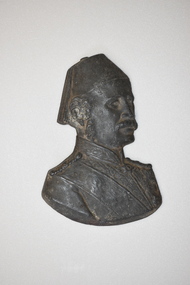
Plaque - Metal Plaque (man’s head)
... ...military plaque...plaque was dug up in a Warrnambool garden in the early 1980s. It appears to be an item that would have been attached to a wall or building and is possibly a representation of a British military figure involved in military campaigns or colonial administration in a British Empire outpost in the 19th century or early 20th century, perhaps in the Middle East or in north Africa. ...This is a metal plaque showing the head and shoulders of a man wearing a fez and a military uniform. ... military plaque This is a metal plaque showing the head and shoulders of a man wearing a fez and a military uniform. ...This metal plaque was dug up in a Warrnambool garden in the early 1980s. It appears to be an item that would have been attached to a wall or building and is possibly a representation of a British military figure involved in military campaigns or colonial administration in a British Empire outpost in the 19th century or early 20th century, perhaps in the Middle East or in north Africa. It could also be a non-British military figure from the same areas. This item is of minor interest as an object found in Warrnambool but with no known details of what it represents. . It is retained pending further research. This is a metal plaque showing the head and shoulders of a man wearing a fez and a military uniform. The back is slightly hollowed out.warrnambool, metal plaque, military plaque -
 8th/13th Victorian Mounted Rifles Regimental Collection
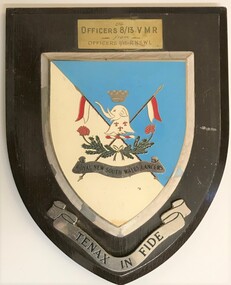
Plaque - 1/5/RNSWL plaque
... military...plaque...Military Forces, now Army Reserve, formed in 1948. Training and social contact between the regiments was frequent and gifts and presentations such as this plaque often occurred....Military Forces, now Army Reserve, formed in 1948. Training and social contact between the regiments was frequent and gifts and presentations such as this plaque often occurred. representative of social interaction between regiemtns of the Citizen Military Forces. military plaque lancers tenax in fide officer mess To / OFFICERS 8/13 VMR / from / OFFICERS 1/15 RNSWL [and on reverse of plaque in ink] Received Sep 81 Wooden plaque with badge and motto of 1st/15th Royal New South Wales Lancers Regiment at centre. ...The 1/15 Royal New South Lancers and 8/13 Victorian Mounted Rifles were sister armoured corps regiments of the Citizen Military Forces, now Army Reserve, formed in 1948. Training and social contact between the regiments was frequent and gifts and presentations such as this plaque often occurred.representative of social interaction between regiemtns of the Citizen Military Forces.Wooden plaque with badge and motto of 1st/15th Royal New South Wales Lancers Regiment at centre. Also plastic presentation plate attached. To / OFFICERS 8/13 VMR / from / OFFICERS 1/15 RNSWL [and on reverse of plaque in ink] Received Sep 81military, plaque, lancers, tenax in fide, officer, mess -
 Running Rabbits Military Museum operated by the Upwey Belgrave RSL Sub Branch
Plaque Royal Military College
... Plaque Royal Military College...Plaque General Royal Military College Plaque Royal Military College ...Royal Military Collegeplaque, general -
 Bendigo Military Museum
Memorabilia - MEMORIAL PLAQUE, c.1919 - 1920
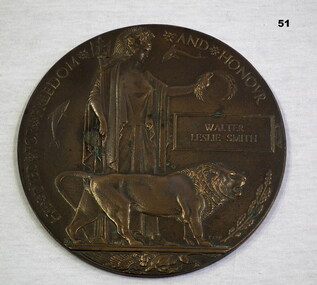
... military history...memorial...plaque...Commemorative Plaque, round, bronze commemorating the military service of Walter Leslie SMITH....Plaque was commonly called 'Dead Man's Penny. Walter Leslie SMITH enlisted No 3486 on 14.7.1915 in the 11th reinforcements to the 7th Batt AIF. He transferred to the 21st Batt on 4.3.1916 to be with his brothers. His Regt No is changed to 3486A. He DOW's on 31.7.1916. Refer 52.6 for photo and details of his brothers and cousins. military ...Plaque was commonly called 'Dead Man's Penny. Walter Leslie SMITH enlisted No 3486 on 14.7.1915 in the 11th reinforcements to the 7th Batt AIF. He transferred to the 21st Batt on 4.3.1916 to be with his brothers. His Regt No is changed to 3486A. He DOW's on 31.7.1916. Refer 52.6 for photo and details of his brothers and cousins.Commemorative Plaque, round, bronze commemorating the military service of Walter Leslie SMITH.“He died for Freedom and Honour” 'Walter Leslie Smith” military history, memorial, plaque -
 Running Rabbits Military Museum operated by the Upwey Belgrave RSL Sub Branch
Memorial, Commonwealh of Australia et al, Family Memorial case for deceased veteran son, post World War One
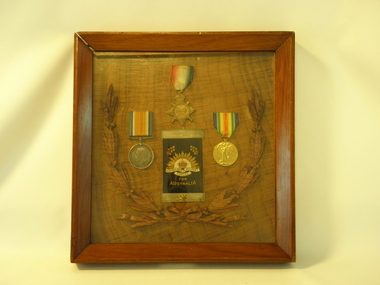
... military...ypres...badge...plaque...plaque from King George honouring the Service of L/Cpl Chester George Mather on the other. L/Cpl Mather enlisted on 8th of June 1915 and embarked for France on HMAT Anchises on the 26th Augest 1915. He was killed at Polygon Wood, Zillebrook near Ypres in Belgium on 4th October 1917 aged 25. world war one medal military ypres badge plaque polygon wood On one side are the Sons Medals (War Medal, 1914-1918 Medal and the Victory Medal), Mothers Badge (for being the mother of a deceased soldier) with a plaque from King Geaorge honouring the Service of "L/Cpl Chester George Mather of the 22nd Battalion AIF" on the other Double sided wooden and glass display case Family Memorial case for deceased veteran son Memorial Commonwealh of Australia King George ...The War Medal, 1914-1918 Medal and the Victory Medal, Mothers Badge (for being the mother of a deceased soldier) with a plaque from King George honouring the Service of L/Cpl Chester George Mather on the other. L/Cpl Mather enlisted on 8th of June 1915 and embarked for France on HMAT Anchises on the 26th Augest 1915. He was killed at Polygon Wood, Zillebrook near Ypres in Belgium on 4th October 1917 aged 25.Double sided wooden and glass display caseOn one side are the Sons Medals (War Medal, 1914-1918 Medal and the Victory Medal), Mothers Badge (for being the mother of a deceased soldier) with a plaque from King Geaorge honouring the Service of "L/Cpl Chester George Mather of the 22nd Battalion AIF" on the otherworld war one, medal, military, ypres, badge, plaque, polygon wood -
 Bendigo Military Museum
Memorabilia - MEMORIAL PLAQUE, Post WW1
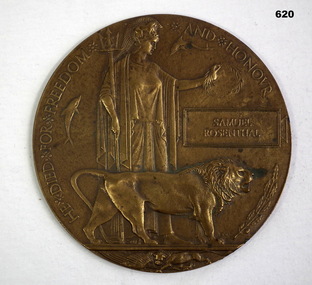
... plaque...military history...Refer 1019, 1020. death penny metalcraft bronzeware memorial plaque military history "Samuel Rosenthal" Commemorative Plaque, round, Bronze, has Brittanica with a lion with a rectangular space for a name. ...Samuel Rosenthal (Born Melbourne, enlisted Melbourne) Enlisted in the 6th reinforcements to the 58th Bn AIF on 20.7.15 age 33 years 8 months. Promoted to 2nd Lieutenant 17.1.16, embarked for England 2.10.16, hospital 27.1.17 serious, promoted Lietenant 15.7.17, KIA 25.9.17. Refer 1019, 1020.Commemorative Plaque, round, Bronze, has Brittanica with a lion with a rectangular space for a name. Around the outside of the plaque "He died for Freedom & Honour"."Samuel Rosenthal"death penny, metalcraft, bronzeware, memorial plaque, military history -
 Bendigo Military Museum
Memorabilia - MEMORIAL PLAQUE, MEDALLION, EPSOM WW1, 1) 1915, .2) post WW1
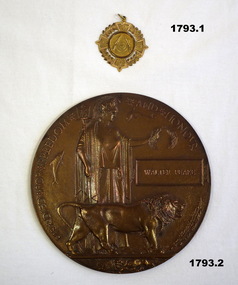
... ...military history...Memorial plaque...Refer Cat No’s 1794, 1791.3, 1792P. numismatics - medals - commemorative military history Memorial plaque .1) " W Peake jr /Epsom/15/11/15" .2) "WALTER PEAKE " HE DIED FOR FREEDOM AND HONOUR. .1) Gold coloured commemorative medallion for W. ....1) The medallion is believed to be for Rifle shooting. .2) Commonly called Dead Mans Penny. Issued to next of kin of a soldier who never returned. Walter Peake 6/1688 N.Z.E.F. Refer Cat No’s 1794, 1791.3, 1792P..1) Gold coloured commemorative medallion for W. Peake Jr dated 15/11/15, centre disc, target with rifle on maltese cross. .2) Memorial plaque, bronze with Brittania, lions and seals. A space is provided for individual names..1) " W Peake jr /Epsom/15/11/15" .2) "WALTER PEAKE " HE DIED FOR FREEDOM AND HONOUR.numismatics - medals - commemorative, military history, memorial plaque -
 Wangaratta RSL Sub Branch
Memorabilia - Framed cloth, NE Framing Studio
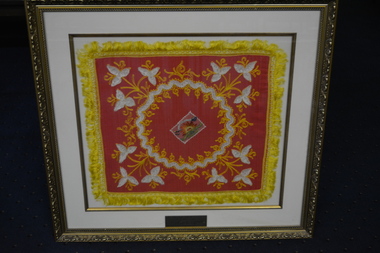
... Embroided - Happy Christmas Australian Commonwealth Military Forces Plaque -A Christmas Gift from Cairo World War 1 1916 ...He embarked on 10/11/1915 and served with the Camel Corp , 29th Battalion and 14th Light Horse. stanley grossman 246 ww1 29th battalion Embroided - Happy Christmas Australian Commonwealth Military Forces Plaque -A Christmas Gift from Cairo World War 1 1916 Ornate gold coloured plastic frame with cream mount containing a square pink cloth embossed in yellow and white thread and edged in yellow fringe. ...Stan Grossman sent this silk embroidery to his cousin Doris Grossman. Private Stanley GROSSMAN 246 from North Wangaratta enlisted on 15/7/1915 aged 19 years. He embarked on 10/11/1915 and served with the Camel Corp , 29th Battalion and 14th Light Horse.Ornate gold coloured plastic frame with cream mount containing a square pink cloth embossed in yellow and white thread and edged in yellow fringe. Embroided - Happy Christmas Australian Commonwealth Military Forces Plaque -A Christmas Gift from Cairo World War 1 1916 stanley grossman 246, ww1, 29th battalion -
 Wangaratta RSL Sub Branch
Medal - Medal and plaque, H P Prest MM
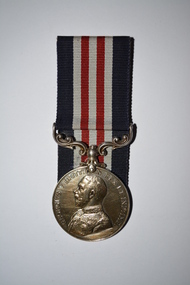
... Plaque -Military Medal awarded to 1334 Lance Corporal H P Prest 37/AUST INF For Bravery in the Field...The Military Medal (MM) was a military decoration awarded to personnel of the British Army and other arms of the armed forces, and to personnel of other Commonwealth countries, below commissioned rank, for bravery in battle on land. The award was established in 1916, with retrospective application to 1914, and was awarded to other ranks for "acts of gallantry and devotion to duty under fire" h p prest ww1 mm 37th infantry battalion Plaque -Military Medal awarded to 1334 Lance Corporal H P Prest 37/AUST INF For Bravery in the Field Blue velvet case with satin lining containing round metal medal with attached blue red and white striped ribbon and gold coloured plastic plaque H P Prest MM Medal Medal and plaque ...Original Military Medal awarded to Harold Pearson PREST Lance Corporal 1334 - 37th Australian Infantry Battalion On the 4th October 1917 East of Ypres, Belgium for conspicuous gallantry in action - After locating an enemy machine gun which was holding up the left flank, he single handed rushed the position from a flank and bombed and killed the crew of two men and captured the gun. His promptness and courage not only saved many casualties but enabled the advance to continue.The Military Medal (MM) was a military decoration awarded to personnel of the British Army and other arms of the armed forces, and to personnel of other Commonwealth countries, below commissioned rank, for bravery in battle on land. The award was established in 1916, with retrospective application to 1914, and was awarded to other ranks for "acts of gallantry and devotion to duty under fire"Blue velvet case with satin lining containing round metal medal with attached blue red and white striped ribbon and gold coloured plastic plaquePlaque -Military Medal awarded to 1334 Lance Corporal H P Prest 37/AUST INF For Bravery in the Fieldh p prest, ww1, mm, 37th infantry battalion -
 Bendigo Military Museum
Badge - BADGE COLLECTION MOUNTED, C.WW2
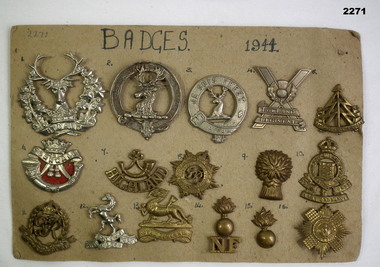
... Crown and GR .9) Unknown .10) Royal army ordance corp, Crown and Plaque .11) "Military Police", Crown GR, wreath .12) "Royal West Kent" horse. .13) "Royal Berkshire" dragon .14) "NF" .15) Unknown .16) Unknown...Crown and GR .9) Unknown .10) Royal army ordance corp, Crown and Plaque .11) "Military Police", Crown GR, wreath .12) "Royal West Kent" horse. .13) "Royal Berkshire" dragon .14) "NF" .15) Unknown .16) Unknown Badge BADGE COLLECTION MOUNTED ...Items in the collection re Ian McLeod RWAFF, refer Cat No 2262.2 for service details.Badges, metal. mounted on cardboard, 16 in total ,1) "Bydand",m buffalo over crown .2) Circle with Reindeer .3) :Je Suis Prest - Belt Reindeer .4 "Lowland" Regiment .5) Recconaisance Corps .6) "Cornwall" Crown - Trumpet .7) "Highland trumpet .8) Royal Army service corps. Crown and GR .9) Unknown .10) Royal army ordance corp, Crown and Plaque .11) "Military Police", Crown GR, wreath .12) "Royal West Kent" horse. .13) "Royal Berkshire" dragon .14) "NF" .15) Unknown .16) Unknownbadges, collection -
 Flagstaff Hill Maritime Museum and Village
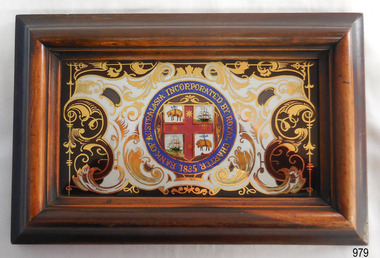
Plaque - Insignia, Bank of Australasia, 19th Century
... plaque displays the insignia of the Bank of Australasia, which was incorporated by the Royal Charter of England in March 1834. The bank began in Australia on 14th December 1835, opening in Sydney. The Acting Superintendent of the bank at that time was David Charters McArthur. He was Superintendent from 1867-to 1876. The Melbourne branch opened on 28th August 1838 in a two-roomed brick cottage on the north side of Little Collins Street, where two huge mastiff dogs were used at night to guard the bank. The government also provided an armed military...plaque displays the insignia of the Bank of Australasia, which was incorporated by the Royal Charter of England in March 1834. The bank began in Australia on 14th December 1835, opening in Sydney. The Acting Superintendent of the bank at that time was David Charters McArthur. He was Superintendent from 1867-to 1876. The Melbourne branch opened on 28th August 1838 in a two-roomed brick cottage on the north side of Little Collins Street, where two huge mastiff dogs were used at night to guard the bank. The government also provided an armed military ...This decorative plaque displays the insignia of the Bank of Australasia, which was incorporated by the Royal Charter of England in March 1834. The bank began in Australia on 14th December 1835, opening in Sydney. The Acting Superintendent of the bank at that time was David Charters McArthur. He was Superintendent from 1867-to 1876. The Melbourne branch opened on 28th August 1838 in a two-roomed brick cottage on the north side of Little Collins Street, where two huge mastiff dogs were used at night to guard the bank. The government also provided an armed military sentinel. Due to the bank's rapid growth, a new building for the Melbourne branch was opened in 1840 at 75 Collins Street West. By 1879 the bank had been upgraded to a magnificent two-storey building on the corners of Collins and Queens Streets, with the entry on Collins Street. In 1951 the Bank of Australasia amalgamated with the Union Bank to form the Australia and New Zealand Bank, now known as the ANZ. Then in 1970, the ANZ merged with both the ES&A and the London Bank of Australia to form the ANZ Banking Group Limited. The ANZ Banking Group Ltd kindly donated a variety of historic items from the Bank of Australasia. BANK of AUSTRALASIA, WARRNAMBOOL – In 1854 Warrnambool had two banks, the Union Bank and the Bank of Australasia. Later, completely different bank businesses opened; in 1867 the National Bank of Australasia, then in 1875 the Colonial Bank of Australasia. The original Warrnambool branch of the Bank of Australasia was established in July 1854, and operated from a leased cottage on Merri Street, close to Liebig Street. The bank later bought a stone building previously erected by drapers Cramond & Dickson on the corner of Timor and Gibson Streets. Samuel Hannaford was a teller and then Manager at the Warrnambool branch from 1855 to 1856 and the Warrnambool Council chose that bank for its dealings during 1856-57. In 1859 Roberts & Co. was awarded the contract to build the new Bank of Australasia branch for the sum of £3,000. The land was on a sand hill on the northeast corner of Timor and Kepler Streets and had been bought in 1855 from investor James Cust. The new building opened on May 21, 1860. The bank continued to operate there until 1951 when it merged with the Union Bank to form the ANZ Bank, which continued operating from its Liebig Street building. Warrnambool City Council purchased the former Bank of Australasia building in 1971 and renovated it, then on 3rd December 1973 it was officially opened as the Art Gallery by Cr. Harold Stephenson and Gallery Director John Welsh. The Gallery transferred to the purpose-built building in Liebig Street in 1986 and the old bank building is now the Gallery club. Staff at the Bank of Australasia in Warrnambool included the following men but others were also involved: Samuel Hannaford, Teller then Manager from 1855-1856; W H Palmer, Manager from January 1857 until November 1869 when the Teller Basil Spence was promoted to Manager; H B Chomley, Manager from April 1873 and still there in 1886; A Butt, Manager in 1895-1904; J R McCleary Accountant and Acting Manager for 12 months, until 1900; A Kirk, Manager 1904; J Moore, staff until his transfer to Bendigo in December 1908; J S Bath was Manager until 1915; C C Cox, Manager until April 1923; Richard C Stanley, Manager 1923 to April 1928. The plaque has historical significance as it belonged to the Bank of Australasia which was established in Australia in 1835 by Royal Charter. The plaque is significant for its association with the Bank of Australasia in Warrnambool, the first bank in Warrnambool, established in 1854. The bank continued to operate until its merger in 1951 when it became the ANZ Bank, which is still in operation today. The Bank was an integral part of the establishment and growth of commerce in Colonial Warrnambool and throughout Australia.Plaque with insignia on glass in a rectangular varnished wooden frame. Insignia of the Bank of Australasia has been painted onto the glass in a mirror-like fashion. Insignia depicts a heraldic shield with sheep hung up by their waists and ships in full sail. Inscription on insignia. Stamp and handwritten inscription on the rectangular label with a blue border on the reverse.Insignia: "BANK OF AUSTRALASIA INCORPORATED BY ROYAL CHARTER 1835" Label's red oval stamp with "AUSTRALIA AND NEW ZEALAND BANK UNITED ARCHIVES" Label's handwritten black letters "AM1" flagstaff hill, warrnambool, shipwrecked coast, flagstaff hill maritime museum, maritime museum, shipwreck coast, flagstaff hill maritime village, great ocean road, commerce, banking, plaque, insignia, bank of australasia, insignia on glass, union bank, australia & new zealand bank, anz bank, david charters mcarthur, d c mcarthur, sydney, new south wales, currency, banknote, legal tender -
 Royal Melbourne Yacht Squadron
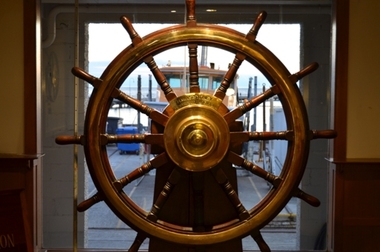
Memorabilia - Wheel of HMAS Sydney, Early 20th Century
... (Bert) Ferris Extremely significant as part of Australia's Naval and Military history. ww1 sydney german hmas raider emden cocos keeling islands HMAS Sydney wheel Plaque notifying that wheel donated by Commodore Joe White 1930 Ships wheel, timber, mounted on a timber plinth, wheel of ship first HMAS Sydney. ...THE WHEEL OF HMAS SYDNEY COMMEMORATING AUSTRALIA’S FIRST NAVAL ENGAGEMENT The historic wheel of HMAS Sydney commemorates the Royal Australian Navy’s first ship- to- ship naval engagement. It was purchased early in 1930 and later presented to the Royal St Kilda Yacht Club (now Royal Melbourne Yacht Squadron) by then Commodore Joe White, following HMAS Sydney being broken up at Cockatoo Dock, Sydney. On 1 November 1914, led by the flagship SS Orvieto, a large convoy of 28 Australian and 10 New Zealand transports escorted by the Light Cruisers HMAS Melbourne, HMAS Sydney, HMS Minotaur and the Japanese ship Ibuki, departed King George Sound, Albany Western Australia with a large contingent of Australian and New Zealand troops bound for Egypt, to become the original Anzac’s. As the convoy steamed northwest across the Indian Ocean, leaving Cocos-Keeling Islands well to the westward, Captain Karl von Muller in the German Light Cruiser Emden of 3,600 tons, after having wrought much havoc to allied shipping in the Indian Ocean, ignorant of the convoys presence, had in mind to destroy the Cocos Island Cable Station on Direction Island. In the early hours of the morning of Monday the 9 November, he anchored “Emden” off Direction Island to send a landing party ashore, In the meantime the Cable Station had sent out a Morse Code message ‘Strange ship approaching’, this was followed soon after by a ‘S.O.S.’ These messages were picked up by ships in the convoy and at 7.00 a.m., Captain J.C. Glossop of the 5,400 ton HMAS Sydney was directed to leave the convoy and proceed at full speed for Cocos Islands. Two hours later Cocos Island was on the horizon. Captain von Muller, with the boarding party ashore to destroy the Cable station, steamed out to intercept the intruder. Captain Glossop decided to close in to 9,500 yards ( 8686.8m) before delivering his first salvo. Emden on the other hand, opened fire at 10,500 yards (9601m), its ten, 4.1 inch (104mm) guns firing 38 pound (17.24 kg ) shells, some of which scored near misses. Emden was hit repeatedly by HMAS Sydney’s eight, 6 inch (152.4mm) guns firing 100 pound (45.36kg ) shells. Within two hours Captain von Muller had decided to run the badly damaged Emden aground on North Keeling Island. Captain Glossop then broke off the engagement to speed off to intercept Emden’s collier, “Buresk”, seen lurking in the distance, soon to overtake her. A boarding party from HMAS Sydney was too late to prevent Buresk from being scuttled but able to rescue her crew. Returning to finish off Emden, HMAS Sydney was again met by heavy gunfire. Sydney scored a number of direct hits to Emden and only after having suffered 134 killed and 65 wounded, did Captain von Muller finally decide to lower his Naval Ensign. He was among those captured and was allowed to retain his Naval sword. In the engagements HMAS Sydney only suffered four direct hits, 4 killed and 12 wounded. J.H.(Bert) Ferris Extremely significant as part of Australia's Naval and Military history.Ships wheel, timber, mounted on a timber plinth, wheel of ship first HMAS Sydney.Plaque notifying that wheel donated by Commodore Joe White 1930ww1, sydney, german, hmas, raider, emden, cocos keeling, islands, hmas sydney, wheel -
 Ballarat Clarendon College
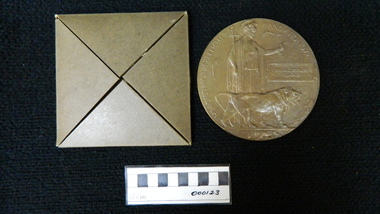
Memorial plaque
... Plaque (Dead Man's Penny) was issued to the next of kin of servicemen/women who had fallen in the Great War between 1914 and 1918.Edward S Holgate entered Ballarat College in 1894. On leaving school he became on auctioneer with the family firm S Holgate & Son, Ballarat. Before enlistment he was secretary of the Ballarat College Old Collegians Society. 'Ted' was killed at Villers-Bretonneux on 27 April 1918 two dats after his commendation in military...Plaque (Dead Man's Penny) was issued to the next of kin of servicemen/women who had fallen in the Great War between 1914 and 1918.Edward S Holgate entered Ballarat College in 1894. On leaving school he became on auctioneer with the family firm S Holgate & Son, Ballarat. Before enlistment he was secretary of the Ballarat College Old Collegians Society. 'Ted' was killed at Villers-Bretonneux on 27 April 1918 two dats after his commendation in military ...The WWI Death Plaque (Dead Man's Penny) was issued to the next of kin of servicemen/women who had fallen in the Great War between 1914 and 1918.Edward S Holgate entered Ballarat College in 1894. On leaving school he became on auctioneer with the family firm S Holgate & Son, Ballarat. Before enlistment he was secretary of the Ballarat College Old Collegians Society. 'Ted' was killed at Villers-Bretonneux on 27 April 1918 two dats after his commendation in military dispatches for 'gallantry in the field on 24-25 April 1918'. Edward's brother Harry Spencer Holgate also enlisted and was killed at Zonnebeke on 11 October 1917. Of the 305 Ballarat College old collegians who enlisted in WW1 65 gave their lives for their country. This 'death penny' is representative of the incredible sacrifice given by this huge percentage of the school's community. Round disk cast in bronze gunmetal, which incorporates the following; an image of Britannia holding an oak spray with leaves and acorns, an imperial lion, two dolphins representing Britain's sea power, the emblem of Imperial Germany's eagle being torn to pieces by another lion. The medallion is incased in a heavy card envelopeInscribed around face of medallion: He died for freedom and honour A rectangular tablet cast on front of medallion inscribed: Edward Spencer Holgate.edward-spencer-holgate, ballarat-college, world-war-one, death-penny, -
 Ballarat Clarendon College
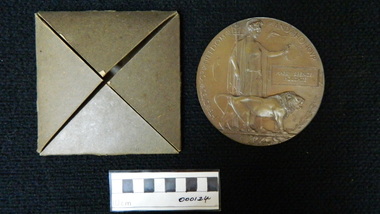
Memorial plaque
... The WWI Death Plaque (Dead Man's Penny) was issued to the next of kin of servicemen/women who had fallen in the Great War between 1914 and 1918.This plaque was given to honour the service of Ballarat College old collegian Harry Spencer Holgate who entered the school in 1894. On leaving school he became an auctioneer at Muswellbrook and Scone. He enlisted on 24 May 1916 and was awarded the Military...The WWI Death Plaque (Dead Man's Penny) was issued to the next of kin of servicemen/women who had fallen in the Great War between 1914 and 1918.This plaque was given to honour the service of Ballarat College old collegian Harry Spencer Holgate who entered the school in 1894. On leaving school he became an auctioneer at Muswellbrook and Scone. He enlisted on 24 May 1916 and was awarded the Military ...The WWI Death Plaque (Dead Man's Penny) was issued to the next of kin of servicemen/women who had fallen in the Great War between 1914 and 1918.This plaque was given to honour the service of Ballarat College old collegian Harry Spencer Holgate who entered the school in 1894. On leaving school he became an auctioneer at Muswellbrook and Scone. He enlisted on 24 May 1916 and was awarded the Military Medal at Polygon Wood in September 1917. He was killed at Zonnebeke on 11 October 1917. His brother Edward Spencer Holgate was also killed while serving his country during World War 1. Of the 305 Ballarat College old collegians who enlisted in WW1 65 gave their lives for their country. This 'death penny' is representative of the incredible sacrifice given by this huge percentage of the school's community. Round disk cast in bronze gunmetal, which incorporates the following; an image of Britannia holding an oak spray with leaves and acorns, an imperial lion, two dolphins representing Britain's sea power, the emblem of Imperial Germany's eagle being torn to pieces by another lion. The medallion is packaged in a heavy card envelope.Inscribed around face of medallion: He died for freedom and honour. A rectangular tablet cast on front of medallion inscribed 'Harry Edward Spencer'. harry-spencer-holgate, ballarat-college, world-war-one, death-penny, -
 Ballarat Clarendon College
Albert Telfer White (1918) collection
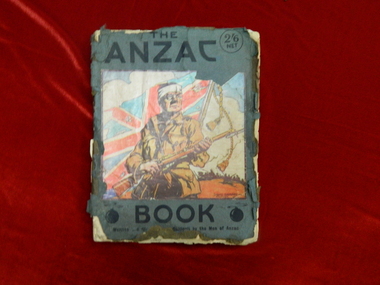
... Collections of items including: Bayonet, Carl Eickhorn, Solingen, (29.A.159 engraved on handle) Trench shovel The ANZAC book 1916 (flyleaf inscribed: No 2012 / Pte A T White / H Quarters / 22nd Battalion / 6th Inf Brigade / France) Gallipoli medal with documentation First World War Mothers’ and Widows’ Badge Next of Kin Memorial Plaque (Death Penny) and accompanying letter from King George V Imperial War Graves Commission documentation and photograph Australia Graves Services In Memory card and photograph Documentation relating to Australian War Memorial Roll of Honour, Learmonth Memorial Wall, Ballarat and Learmonth Avenues of Honours Documentation from the Australian Army Records office Documentation relating to Military Medal, 1914/15 Star, British War Medal and Victory Medal (whereabouts unknown, November 2016) Portraiture of Albert Telfer White as a child, as a young adult (civilian dress), in full kit (A I E F formal), and at camp 1915 Portraiture of sisters Cis, Addie, Bessie, Evelyn (with personal inscriptions) Four postcards (one with letter from Albert ‘at sea’ to his mother - undated) Death notice (unreferenced newspaper clipping) Biographical and family relationship details Photocopy of The White Family 1906 showing (standing) Adeline, Leslie, Harold (father), Muriel (mother), William; (seated) Albert, John (Grandfather), Elizabeth, Allan, Elizabeth (Grandmother), Evelyn (baby) and Benjamin ...Collections of items including: Bayonet, Carl Eickhorn, Solingen, (29.A.159 engraved on handle) Trench shovel The ANZAC book 1916 (flyleaf inscribed: No 2012 / Pte A T White / H Quarters / 22nd Battalion / 6th Inf Brigade / France) Gallipoli medal with documentation First World War Mothers’ and Widows’ Badge Next of Kin Memorial Plaque (Death Penny) and accompanying letter from King George V Imperial War Graves Commission documentation and photograph Australia Graves Services In Memory card and photograph Documentation relating to Australian War Memorial Roll of Honour, Learmonth Memorial Wall, Ballarat and Learmonth Avenues of Honours Documentation from the Australian Army Records office Documentation relating to Military Medal, 1914/15 Star, British War Medal and Victory Medal (whereabouts unknown, November 2016) Portraiture of Albert Telfer White as a child, as a young adult (civilian dress), in full kit (A I E F formal), and at camp 1915 Portraiture of sisters Cis, Addie, Bessie, Evelyn (with personal inscriptions) Four postcards (one with letter from Albert ‘at sea’ to his mother - undated) Death notice (unreferenced newspaper clipping) Biographical and family relationship details Photocopy of The White Family 1906 showing (standing) Adeline, Leslie, Harold (father), Muriel (mother), William; (seated) Albert, John (Grandfather), Elizabeth, Allan, Elizabeth (Grandmother), Evelyn (baby) and Benjamin Albert Telfer White (1918) collection ...Significant items relating to Albert Telfer White who entered Ballarat College April 1912 and left December 1918. Albert was born 29 June 1897 at his home 'Ashford Vale" farm, Cuthbert's Road, Cardigan. Albert, a second generation Australian, was the fourth son and sixth of eleven children born to dairy farmer John White and his wife Elizabeth, nee Douglas. Albert attended Bunker's Hill State School prior to enrolling at Ballarat College. After College he obtained employment with the engineering firm Ronaldson and Tippett in Ballarat. Following his eighteenth birthday Albert enlisted in the AIF in Ballarat with the rank of Private, No 2012. He embarked for the Middle East with 23rd Battalion on 26 August 1915 and was 'taken on strength at the Gallipoli Peninsular 25 October 1915". On 10 January 1916 Albert was posted to Alexandria, Egypt and during this time he was able to meet with his aunt Rose Douglas, an Australian Army Nursing Sister. This was a great comfort to his family. Albert was sent to France 19 March 1916 and transferred to the 22nd Battalion. He was mentioned in dispatches for 'good and gallant conduct' 5 August (1917?). Albert was hospitalised 30 March 1918, rejoined 22nd Battalion 3 June 1918, wounded in action 3 October 1918 but died of wounds at Rouen 10 October 1918. news of his death was received by his family n Australia just prior to the armistice. Albert Telfer White's sacrifice is commemorated at Ballarat College, Avenue of Honour Ballarat (Tree 1214), Ballarat Shire Honour Avenue Learmonth (Tree 163) and the Australian War Memorial Canberra. (These notes provided by family November 2016)Collections of items including: Bayonet, Carl Eickhorn, Solingen, (29.A.159 engraved on handle) Trench shovel The ANZAC book 1916 (flyleaf inscribed: No 2012 / Pte A T White / H Quarters / 22nd Battalion / 6th Inf Brigade / France) Gallipoli medal with documentation First World War Mothers’ and Widows’ Badge Next of Kin Memorial Plaque (Death Penny) and accompanying letter from King George V Imperial War Graves Commission documentation and photograph Australia Graves Services In Memory card and photograph Documentation relating to Australian War Memorial Roll of Honour, Learmonth Memorial Wall, Ballarat and Learmonth Avenues of Honours Documentation from the Australian Army Records office Documentation relating to Military Medal, 1914/15 Star, British War Medal and Victory Medal (whereabouts unknown, November 2016) Portraiture of Albert Telfer White as a child, as a young adult (civilian dress), in full kit (A I E F formal), and at camp 1915 Portraiture of sisters Cis, Addie, Bessie, Evelyn (with personal inscriptions) Four postcards (one with letter from Albert ‘at sea’ to his mother - undated) Death notice (unreferenced newspaper clipping) Biographical and family relationship details Photocopy of The White Family 1906 showing (standing) Adeline, Leslie, Harold (father), Muriel (mother), William; (seated) Albert, John (Grandfather), Elizabeth, Allan, Elizabeth (Grandmother), Evelyn (baby) and Benjamin The ANZAC book 1916 (flyleaf inscribed: No 2012 / Pte A T White / H Quarters / 22nd Battalion / 6th Inf Brigade / France) Gallipoli medal: engraved on reverse: A T WHITE Embossed lettering on death penny: ALBERT TELFER WHITE Handwritten on reverse of portraits: Lovingly yours / Cis / 21/11/17; your / loving sister / Addie; your loving / sister / Evelyn; Yours lovingly / Bessie Handwritten on back of postcard of ship H M A T 'Anchisis' 14.3.16: Dear Mother, I am sending you a card / of the boat we are on. Our deck is right / on the back. I have marked it with an X. / We are not allowed to put the date on or / where we are. I am sitting on the deck now / holding the card in my hand so it is hard / to write. We are together yet haven't been / separated Bill, Matt and myself. Haven't / had anything to do. I will write a couple / of letters now. Albert Handwritten on back of postcard photograph of Albert at camp: 30th September 1915 / Dear Mother / There is a studio at the / camp so Matt and I got our Photos / taken yesterday morning, & got them/ this morning. I am sending / Ciss one of Matt.albert-telfer-white, ballarat college, world-war-one, avenue-of-honour -
 Lara RSL Sub Branch
Plaque - RAEME Plaque
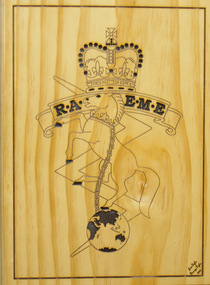
... military and civilian workforce. The Royal Australian Electrical and Mechanical Engineers corps motto is ‘Arte et Marte’, which is Latin for ‘With Skill and Fighting’. Ref: www.army.gov.au RAEME Badge Jan Zyla George Zyla 2020 Varnished Wooden Board Plaque ...RAEME Corps was first established in 1942 when the Ordnance Corps and the Service Corps were combined. The royal ascent was granted in 1948. Ref: www.raeme.org.au The Royal Australian Electrical and Mechanical Engineers (RAEME) is a technical corps tasked with the maintenance of the Army's modern hardware and equipment. RAEME personnel are represented in most Army units, with the representation varying in size from one or two tradespersons, to small groups of 20 to 30 tradespersons, to large maintenance units with over 150 personnel and a totally integrated military and civilian workforce. The Royal Australian Electrical and Mechanical Engineers corps motto is ‘Arte et Marte’, which is Latin for ‘With Skill and Fighting’. Ref: www.army.gov.auVarnished Wooden BoardRAEME Badge Jan Zyla George Zyla 2020 -
 Flagstaff Hill Maritime Museum and Village
Instrument - Bass Drum, Ludwig & Ludwig, Early 1920's
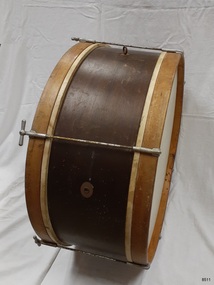
... Flagstaff Hill Warrnambool Maritime Village Maritime Museum Flagstaff Hill Maritime Museum and Village Shipwreck coast Great Ocean Road Shipwreck artefact marching drum bass drum marching bass drum pitched drum band drum drum mallet marching band military band percussion instrument calfskin shoulder harness Ludwig & Ludwig WFL Drum Company William F. Ludwig Chicago North Carolina The Beatles tension taps tension rods drum pedal Long Tube Tension Rods On brass plaque; “LUDWIG / TRADE MARK / LUDWIG & LUDWIG / CHICAGO” Marching Bass Drum; the polished shell around the body is one continuous sheet of timber that has been steamed, shaped into a cylinder and joined together. ...This Marching Bass Drum is mid-size at 68 cm; these drums can range from 35 to 81 cm (14 to 32 inches). A Marching Bass Drum is slightly smaller than a Concert Base Drum and larger than a Kit or Drum Set Bass Drum. The drum is supported by a shoulder harness with a pin that connects to the eyelet incorporated on the shell of the drum, which keeps the drumheads vertical. The drum is played with one or two felt-covered drum mallets. The six tension rods connected between the drumheads can be screwed tighter or looser to change the tension of the calfskins on the drumheads, which changes their tune. This Marching base drum was made in the early 1920s by the firm Ludwig & Ludwig of Chicago, Illinois, USA. LUDWIG & LUDWIG: - William F. Ludwig was a professional drummer. He and his brother Theobold established the Ludwig & Ludwig drum factory in Chicago in 1909. They became famous for their invention of a bass drum pedal that could play faster beats on the bass drum. Theobald passed away in 1918. By 1923 Ludwig was the biggest drum manufacturer in the world. William continued on when his business was bought by C.O. Conn, but in 1937 he left to begin his own company; the WFL Drum Company. William and his son Bill purchased the Ludwig & Ludwig name back from Conn, and the name William F. Ludwig II continued on. The brand was sold to the Selmer Company and moved to Monroe, North Carolina in 1998, at the time of the 75th anniversary of the Ludwig name. Ludwig drums are still being manufactured over 100 years later. Many famous musicians and bands played the Ludwig bass drum, including Ringo Star who was the drummer in the 1960’s group The Beatles.This marching bass drum is significant for its connection to Ludwig & Ludwig, a famous and popular drum manufacturer established in 1909. The firm was once the largest drum manufacturer in the world. It is known for supplying drummers of fame, such as Ringo Star of The Beatles. This is the only drum in our collection. It is also rare, having only six tension rods, where most have from eight to twelve.Marching Bass Drum; the polished shell around the body is one continuous sheet of timber that has been steamed, shaped into a cylinder and joined together. The drumheads on the sides of the shell are strong timber strips joined into hoops that hold stretched, hand-painted white calfskin. Six Long Tube threaded nickel-plated brass tension rods are evenly spaced around the drumheads between the drumheads. A brass eyelet is fitted into the shell halfway between each drumhead, providing a connection point for the drummer’s shoulder harness. The eyelet has an indecipherable inscription. An oval brass plaque with a central formed hole has a stamped inscription. The imperial size is 27 x 13 inches. The drum was made by Ludwig and Ludwig, Chicago, Illinois, in early 1920's. On brass plaque; “LUDWIG / TRADE MARK / LUDWIG & LUDWIG / CHICAGO”flagstaff hill, warrnambool, maritime village, maritime museum, flagstaff hill maritime museum and village, shipwreck coast, great ocean road, shipwreck artefact, marching drum, bass drum, marching bass drum, pitched drum, band drum, drum mallet, marching band, military band, percussion instrument, calfskin, shoulder harness, ludwig & ludwig, wfl drum company, william f. ludwig, chicago, north carolina, the beatles, tension taps, tension rods, drum pedal, long tube tension rods -
 Geelong RSL Sub Branch
Medals - Norman H V Powell, 20th Century
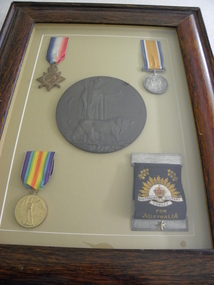
... Plaque is inscribed - He Died for Freedom and Honour - Norman Henry Victor Powell Cloth Scroll - Australian Military Forces - For Australia...Plaque is inscribed - He Died for Freedom and Honour - Norman Henry Victor Powell Cloth Scroll - Australian Military Forces - For Australia A collection of Medals and Memorial Plaque and cloth scroll in a wooden frame. ...The Medals, Plaque and Scroll are the original items presented to 2952 N H V Powell's Family. 2952 N H V Powell enlisted in the AMF on 12 October 1915 and was Killed in Action on 25 July 1916 in FranceThe items are the originals of 2952 N H V Powell as presented to his family.A collection of Medals and Memorial Plaque and cloth scroll in a wooden frame. Medals are - 1914-1915 Star, British War Medal, Victory Medal, Plaque, cloth scroll.The Medals are behind glass, inscriptions cannot be confirmed. Plaque is inscribed - He Died for Freedom and Honour - Norman Henry Victor Powell Cloth Scroll - Australian Military Forces - For Australiaww1, france, killed in action, 2952 n h v powell -
 Geelong RSL Sub Branch
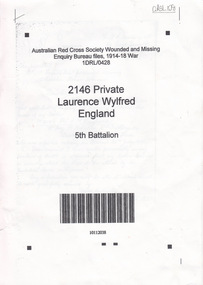
Documents - 2146 Pte L W England, Relating to the Plaque, there are no makers mark, Early 20 Century
... The pages are relating to enquiries from Pte England's family and the Military. There is also a plaque with the documents - In Loving Memory of our dear son and brother, Killed at Poziere July 1916 aged 19. ...The documents and the plaque relate to 2146 Pte L W England and provide information to his Service and being Killed in Action at Posieres. WW1 Posieres Killed in Aciion 2146 Pte L W England 5th Battalion The pages are relating to enquiries from Pte England's family and the Military. ...2146 Pte L W England was a member of the AIF and served during WW1 with 'A' Coy, 5 Battalion, 2nd Infantry Brigade. He was Lilled in Action of 25 July 1916 at Posieres.The documents and the plaque relate to 2146 Pte L W England and provide information to his Service and being Killed in Action at Posieres.Seven white photocoped foolscap pages relating to 2146 Pte L W England - missing in action/killed in action on 25 July 1916 at Pozieres. A metal plaque.The pages are relating to enquiries from Pte England's family and the Military. There is also a plaque with the documents - In Loving Memory of our dear son and brother, Killed at Poziere July 1916 aged 19. 'A' Company 5th Battalion, AIF. Presented by Mr and Mrs G England and Family.ww1, posieres, killed in aciion, 2146 pte l w england, 5th battalion -
 Orbost & District Historical Society
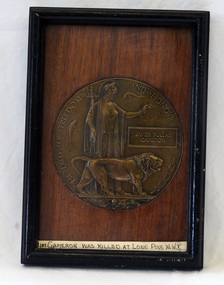
medallion, Memorial Plaque Factory, after WW1
... military hospital ‘Cootenara’ and after 10 days treatment, he re-embarked for Gallipoli aboard the HMT Southland on June 14, 1915. He returned to duty at Gallipoli on June 20, 1915. On August 7, 1915 he was killed in action. His body was not recovered. His name is on the memorial at Lone Pine. His memorial plaque...plaque was made at the Acton Factory, one of the later ones cast there. James Pullar Cameron was the son of Robert Cameron one of the earliest settlers on the Orbost flats. He was a trooper in the 8 Light Horse Regiment and died at Gallipoli on 7 August 1915. ww1 gallipoli cameron medallion military Around the picture- He died for freedom and honour. ...These medallions were issued after the First World war to the next-of-kin of all British and Commonwealth(Empire) service personnel who were killed as a result of the war. The plaques were made of bronze aand hence popularly known as the "Dead Man's Penny". James Pullar Cameron was killed at Lone Pine during WW1. James Pullar Cameron (Service No 605) enlisted in the 8th Light Horse at Orbost on September 11, 1914 aged 23 years 5 months. His medical was done by Dr James Kerr. He was 6 ft 1 in tall, 11 st 6 lbs, of dark complexion with dark eyes and hair and a chest measurement of 34 ½ / 38 inches. After training, he embarked the Armadale on February 12, 1915. He was shot in the chest at the Dardanelles on May 29, 1915 and taken aboard the HT Neuralia for transfer to Malta. He was admitted to the military hospital ‘Cootenara’ and after 10 days treatment, he re-embarked for Gallipoli aboard the HMT Southland on June 14, 1915. He returned to duty at Gallipoli on June 20, 1915. On August 7, 1915 he was killed in action. His body was not recovered. His name is on the memorial at Lone Pine. His memorial plaque has a wide H and a number behind the back paw of the lion, indicating that this plaque was made at the Acton Factory, one of the later ones cast there.James Pullar Cameron was the son of Robert Cameron one of the earliest settlers on the Orbost flats. He was a trooper in the 8 Light Horse Regiment and died at Gallipoli on 7 August 1915.A bronze commemorative medallion in a wooden frame. The token has an image of Britannia holding trident and standing with a lion. The designer's initials E.Cr.P appear above the front paw. In her left outstretched hand she holds an oak wreath with the name James Pullar Cameron in a rectangle. His memorial plaque has a wide H and a number behind the back paw of the lion, indicating that this plaque was made at the Acton Factory, one of the later ones cast there.Around the picture- He died for freedom and honour.ww1 gallipoli cameron medallion military -
 Mission to Seafarers Victoria
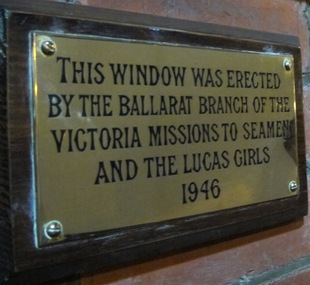
Plaque - Memorial Plaque, Ballarat Branch and Lucas Girls, 1946
... Military Naval services to the development of Australia. The cumulative local fundraising efforts helped maintain the work of the Coastal based Mission services to seafarers. ballarat lucas girls lucas & co. 1946 window plaque ww2 world war 2 textile company Lucas Clothing Factory This window was erected by the Ballarat Branch of the Victoria Missions to Seamen and the Lucas Girls 1946. ...The Ballarat Branch Committee and girls of Lucas & Co. raised the money for the memorial window in Good Chapel of Saint Peter which is dedicated to the men of the Jervis Bay and all Merchant seamen who gave their lives in the world wars. To see a picture of the actual window go to VC database Mtsv record 0035.Regionally based support across Victoria provided crucial funds to the Mission for Seafarer welfare, activities and operations. This support was very often sourced either through a country Auxiliary group based in places such as Ballarat, Camperdown, Hamilton, Bendigo and other similar towns or centres. Op shops and CWA, Church Auxiliaries and other similar charities mainly operated by the womenfolk of the respective communities, recognized the vital importance of 19th and 20th C Merchant and Military Naval services to the development of Australia. The cumulative local fundraising efforts helped maintain the work of the Coastal based Mission services to seafarers.Rectangular brass plaque mounted to wood board.This window was erected by the Ballarat Branch of the Victoria Missions to Seamen and the Lucas Girls 1946.ballarat, lucas girls, lucas & co., 1946, window, plaque, ww2, world war 2, textile company, lucas clothing factory -
 Montmorency–Eltham RSL Sub Branch
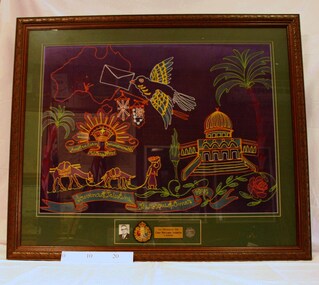
Souvenir - Framed World War 2 Embroidered Banner, WW2 Embroidered Souvenir, Estimated date 1941
... A multi-coloured map of Australia, a bird carrying a letter, an Australian military badge, camels and a mosque are depicted on a dark blue background. At the bottom there is a photo, a 1939 associate badge, a dog tag and a brass plaque. ...A multi-coloured map of Australia, a bird carrying a letter, an Australian military badge, camels and a mosque are depicted on a dark blue background. At the bottom there is a photo, a 1939 associate badge, a dog tag and a brass plaque. ...Framed embroidered banner – a souvenir of World War Two. A multi-coloured map of Australia, a bird carrying a letter, an Australian military badge, camels and a mosque are depicted on a dark blue background. At the bottom there is a photo, a 1939 associate badge, a dog tag and a brass plaque. 'In Honour of Corp Benjamin Ackroyd VX 5001. Souvenir of Palestine, The Mosque of Omar 1941.'world war two, embroidery, 1941, souvenir, palestine, mosque, omar -
 Montmorency–Eltham RSL Sub Branch
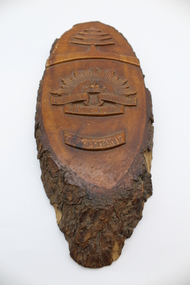
Plaque - Wooden wall-hanging, Cedar Wooden Wall Hanging, 1941
... Military Services half way down and Cedar of Lebanon across the bottom half. Stained with light brown varnish. Original bark of tree all the way around the edge. Cedar Wooden Wall Hanging Plaque ...Owned by William Albert HARRISON (Service Number VX41478; above Link ["WW2 Record"] Sent home to his mother from Liban on 25-10-41 Soldier's name known. Items donated (date unknown) by brother-in-law who was living in Montmorency and was a committee member of MERSL when item donated.Oval shaped slice of wood from the cedar tree in Lebanon. Carving of a cedar tree across top and emblem of Australian Commonwealth Military Services half way down and Cedar of Lebanon across the bottom half. Stained with light brown varnish. Original bark of tree all the way around the edge.Two stamps in French possibly where it was made, Artiols bois des cedres. Becharry Liban. Salim Kabalan. Hand written message;- Mother with all the best to you Bill. Dated 25-10-41 -
 Flagstaff Hill Maritime Museum and Village
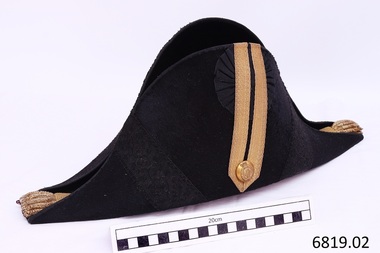
Uniform - Bicorn Hat and Hat Box, late 19th - early 20th century
... military heraldry w.r. angus collection. Australian Navy British Navy uniform The hat has no maker’s marks although there is a darker colour in the centre where there could have been a label. Inside the hat is taped a printed label; “Mc DADE 801 1032” Button’s emblem- a cross with five stars, under a crown, all within a buckled belt with the motto “AUT PACE AUT BELLO” [either in peace or in war] The plaque on the case has no legible marks. ...This hat and hat box was donated to Flagstaff Hill Maritime Village by the family of Doctor William Roy Angus, Surgeon and Oculist. It is part of the “W.R. Angus Collection” which includes historical medical equipment, surgical instruments and material once belonging to Dr Edward Ryan and Dr Thomas Francis Ryan, (both of Nhill, Victoria) as well as Dr Angus’ belongings. The Collection’s history spans the medical practices of the two Doctors Ryan, from 1885-1926 plus that of Dr Angus, up until 1969. McDade is the surname of Dr Angus’ daughter Berry (Berenice) McDade nee Angus. This had belonged to her father Dr William Roy Angus, Surgeon and Oculist (1901 –1970), who wore it on the ship T.S.S. LARGS BAY when travelling from Australia to Scotland for extended studies to be a “Fellow” of the Royal College of Surgeons in Edinburgh in 1929. This bicorn, cocked hat was worn with narrow points towards the front and back. It is decorated with flat gold braid or ‘lace’ with a geometrical design. Regimental lace was worn on the uniform and headdress of regimental officers in the 19th century. Gold lace chevrons were worn on coats to signify rank. Drummers and Foot Guards also wore regimental lace to distinguish them from other military personnel. In the late 19th century the English and Welsh infantry officers’ uniforms displayed a rose-pattern lace. The gold bullion and underlying crimson ‘eyes’ have been used to signify the rank of the owner. Crimson eyes were used for military personnel, and blue eyes were used for naval personnel. Different numbers and colours of the bullion and eyes may have been used to represent different military ranks. The Regulations specify nine tassels and eleven underlying eyes but there could have been variations. We have not yet identified the rank for this particular hat but hats such as this were part of the Australian and British naval uniforms in the early 20th century. The gold button’s emblem features a cross with five stars, a crown, and the motto “AUT PACE AUT BELLO,” which translates as “either in peace or in war.” Museum Victoria has a similar button and writes that buttons with this design were used by the Victorian Volunteers in the nineteenth century. The Australian War Memorial Curator of Military Heraldry advised Museum Victoria that these buttons dated from 1880 to 1892 and were worn by regular, unranked soldiers. Tasmanian Midshipman Alan Casey, who served the British and Australian Navy from 1919 to 1933 and retired as a Lieutenant Commander, owned a similar officer's bicorn hat. His hat and epaulettes are in the Tasmanian Maritime Museum's collection. The Australian War Memorial has a hat that is very similar in design, described as an “Artillery Staff Officer’s cocked had with plume, worn by Volunteer Artillery Staff in the Victorian Colonial Military Forces”. That hat is different in that it has a plume and the braid and button are silver. Berry MdDade, the donor, has used the hat many times as a dress-up hat but doesn’t know the origin of it. The hat seems to fit the design of the Staff Officers in Victorian Volunteers in Colonial times, but the button on this hat was used for unranked volunteers. Also, military uniforms usually have very clear manufacturer’s labels, as they are made by reputable companies under contract to the Defence Department. The manufacturer’s mark is not discernible on this hat. The origin, original wearer and use of this particular hat is unclear. The military bicorn cockade hat belonged to Dr William Roy Angus and is part of the W.R. Angus Collection. It is significant for still being located at the site connected to Doctor Angus being the last Port Medical Officer in Warrnambool. The collection of medical instruments and other equipment is culturally significant, as an historical example of medicine from late 19th to mid-20th century. Dr Angus assisted Dr Tom Ryan, a pioneer in the use of X-rays and in ocular surgery. Black bicorn cocked hat and case. It appears to be part of a 19th-century Colonial full-dress naval officer's uniform. The long, narrow crescent-shaped hat is made of beaver fabric and the crown is lined with crimson silk and finished with a hand-stitched leather sweatband. On one flat side is a pleated black silk, lace cockade woven in the pattern of oak leaves and acorns. The cockade is overlaid with a double row of gold lace braiding secure with a Victorian Volunteer’s gold button. Wide diagonal bands of black lace braid trim are on each side of the gold braiding. The other side of the hat is plain. The front and back points of the hat each have seven gold bullion tassels with nine underlying twists of crimson ‘eyes’. The fitted metal carry case has a catch and a plaque on one side. The button bears a crown and cross with five stars and a motto. Inside the hat is a white name tag with clear adhesive over it, with black printed text with the name “Mc Dade”. The hat is part of the W.R. Angus Collection.The hat has no maker’s marks although there is a darker colour in the centre where there could have been a label. Inside the hat is taped a printed label; “Mc DADE 801 1032” Button’s emblem- a cross with five stars, under a crown, all within a buckled belt with the motto “AUT PACE AUT BELLO” [either in peace or in war] The plaque on the case has no legible marks.flagstaff hill, warrnambool, shipwrecked coast, flagstaff hill maritime museum, maritime museum, shipwreck coast, flagstaff hill maritime village, great ocean road, dr w r angus, t.s.s. largs bay, berry mcdade, 19th century colonial military uniform, artillery staff officer’s cocked had, victorian volunteers, victorian colonial military forces, colonial militia, aut pace aut bello, cocked hat, cockade hat, bicorn hat, military bullion, oak leaves and acorns pattern, gold bullion tassels, military heraldry, w.r. angus collection., australian navy, british navy, uniform -
 Seaworks Maritime Museum
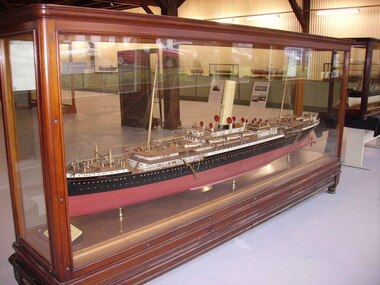
Shipbuilders Model, SS Omrah
... military operations. She was torpedoed and sunk by German submarine UB-52, 40 nautical miles (74km) off the coast of Sardinia in the 12 May 1918. She was on her return journey from Alexandria to Marseilles with six other transports, carrying troops of the 52nd and 74th divisions when she was lost, resulting in one casualty. Her maiden voyage brought her to Melbourne in 1899. The ship carried the first Australian troops from Brisbane to WWI in September 1914. 2 Plaques ...The original ship was built in Glasgow in 1899 by Fairfield Shipbuilding and Engineering Co for the Orient Line. It was the largest Orient Line passenger ship completed in the nineteenth century and was the third vessel of the Line to bear the famous “O” prefix, which was traditional through to the last ship, the mighty 'Oriana'. Her dimensions were 8,130 gross tons, length 490.6ft x beam 56.6ft (149.50 x 17.22m). She had one funnel, two masts, twin screw and a speed of 18½ knots. Her maiden voyage from London, via Suez, to Melbourne and Sydney commenced on 3rd February 1899. She was the largest British flag ship sailing to Australia at the time and continued to regularly sail between London, Melbourne and Sydney throughout her life. She last sailed as a passenger ship between Melbourne and Sydney on the 3rd November 1916. During World War I, she was converted to a troopship and was used to transport soldiers and assist with military operations. She was torpedoed and sunk by German submarine UB-52, 40 nautical miles (74km) off the coast of Sardinia in the 12 May 1918. She was on her return journey from Alexandria to Marseilles with six other transports, carrying troops of the 52nd and 74th divisions when she was lost, resulting in one casualty. Her maiden voyage brought her to Melbourne in 1899. The ship carried the first Australian troops from Brisbane to WWI in September 1914.A large ship builder's model of the 'SS Omrah' an Orient Line one funnel passenger steamer of 1899. The model is displayed in a large glass and polished timber case on legs.2 Plaques at foot of model: "MODEL/ OF TWIN SCREW STEAMER/ "OMRAH"/ BUILT FOR/ ORIENT STEAM NAVIGATION CO LTD/ BY/ THE FAIRFIELD SHIPBUILDING & engineering CO LTD/ DIMENSIONS/ 507-0X56-9X37-6MLD/ GROSS TONNAGE 8291 TONS SPEED 18 1/2 KNOTS on boat: "OMRAH" -
 Bendigo Military Museum
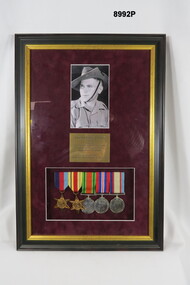
Award - MEDAL SET WW2, FRAMED, Unknown
... plaque, it is “VX554” Enlisted 20.10.1939, embark for the Middle East 14.4.1940, embark for Greece 31.3.1941, embark for Ceylon 10.3.1942, embark for Australia 7.7.1942, discharged from the AIF 11.9.1945. E.J. Condon Medal Set framed Photograph Awards Passchendaele Barracks Trust On Brass plate. “Edward James Condon VX664 Private, 2/2 Australian Field Regiment, 2 Australian Imperial Forces, 20/10/1939 - 11/9/1945” Enlisted 1939 in the first 500 draft in Australia. WW2 Framed medal set of Edward James Condon containing photograph of E.J. Condon and a record of his Military ..."Edward James Condon" (born Moonee Ponds, enlisted St Kilda) The Regimental No VX664 is wrong on the brass plaque, it is “VX554” Enlisted 20.10.1939, embark for the Middle East 14.4.1940, embark for Greece 31.3.1941, embark for Ceylon 10.3.1942, embark for Australia 7.7.1942, discharged from the AIF 11.9.1945. WW2 Framed medal set of Edward James Condon containing photograph of E.J. Condon and a record of his Military service and his service medals. 1939 - 45 Star. Africa Star. Defence Medal. British War Medal 1939 - 45. Australian Service medal 1939 - 45On Brass plate. “Edward James Condon VX664 Private, 2/2 Australian Field Regiment, 2 Australian Imperial Forces, 20/10/1939 - 11/9/1945” Enlisted 1939 in the first 500 draft in Australia. e.j. condon, medal set, framed photograph, awards, passchendaele barracks trust -
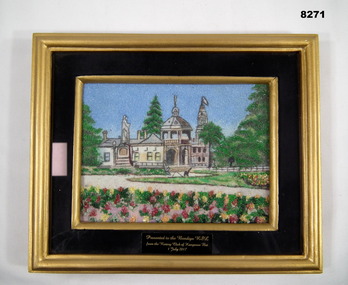 Bendigo Military Museum
Artwork, other - GEMSTONE CRAFT
... plaque adhered to glass front, bottom centre, gold engraving on black plastic. "Presented to the Bendigo RSL from the Rotary Club of Kangaroo Flat 1 July 2017" framed accessories rotary club smirsl brsl Information printed on paper on back of board, "Good/idea/ Ph 704973 o0 - 5005115/ Gem name and colour/ Ruby red/Spinel pink/ Sapphire blue/ Lapis La2uh blue/ Jade green, Tomaline black/ Apatite light green/ Peridot light green" The work depicts the Soldiers Memorial Institute Building (Bendigo Military Museum) using a number of coloured gemstone chips adhered to a support board, list of Gemstone chips listed on the back of frame, original hand made craft. ...Presentation plaque adhered to glass front, bottom centre, gold engraving on black plastic. "Presented to the Bendigo RSL from the Rotary Club of Kangaroo Flat 1 July 2017"The work depicts the Soldiers Memorial Institute Building (Bendigo Military Museum) using a number of coloured gemstone chips adhered to a support board, list of Gemstone chips listed on the back of frame, original hand made craft. Frame timber with gold paint, 3D look with black fabric mount, glass front and MDF board backing and MDF board stand.Information printed on paper on back of board, "Good/idea/ Ph 704973 o0 - 5005115/ Gem name and colour/ Ruby red/Spinel pink/ Sapphire blue/ Lapis La2uh blue/ Jade green, Tomaline black/ Apatite light green/ Peridot light green"framed accessories, rotary club, smirsl, brsl -
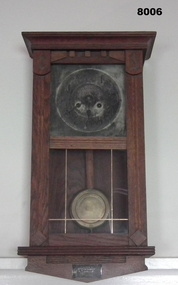 Bendigo Military Museum
Domestic object - CLOCK, WALL, PENDULUM, Prescott & Dawe Bendigo, possibly pre war
... Military service of F. Prescott. Frederick Napoli Prescott was a prominent Bendigo Optician and Jeweller at the corner of Mitchell and Hargreaves Street Bendigo. He was later in partnership with Mr C.M. Dawe trading as Prescott & Dawe. Mr Prescott died in 1913. After the renovations to the SMI 2016 - 18 this clock was placed in what is now called the "Building and RSL History Room" brsl smirsl Domestic On clock face, "Prescott & Dawe". On plaque ...This clock was placed originally in what was called the "Billiard Room" of the Soldiers Memorial Institute Bendigo. There is no apparent connection to the RSL or Military service of F. Prescott. Frederick Napoli Prescott was a prominent Bendigo Optician and Jeweller at the corner of Mitchell and Hargreaves Street Bendigo. He was later in partnership with Mr C.M. Dawe trading as Prescott & Dawe. Mr Prescott died in 1913. After the renovations to the SMI 2016 - 18 this clock was placed in what is now called the "Building and RSL History Room"Pendulum wall clock timber frame with door on front, door has glass inset, each side has a glass inset, clock numbered 1 - 12, wind up key is inside, a small silver plaque is on the bottom front face.On clock face, "Prescott & Dawe". On plaque, " Presented by Mrs F Prescott in memory of F Prescott"brsl, smirsl, domestic
