
Showing 9 items matching "milking bucket"
-
 Friends of Westgarthtown
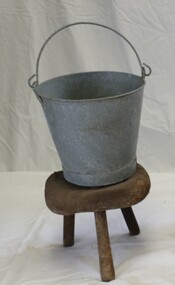
Functional object - Metal milking pale, c.1920
... Milking bucket...Milking buckets were essential equipment on dairy farms before the widespread introduction of mechanical milking systems. ...Metal milking bucket with a carrying handle, used for collecting fresh milk during the hand-milking of dairy cows. ...Metal milking bucket with a carrying handle, used for collecting fresh milk during the hand-milking of dairy cows. ...This metal milking bucket dates to approximately 1920–1930 and forms part of the Ziebell family collection associated with their farm at Westgarthtown, Thomastown, Victoria. Milking buckets were essential equipment on dairy farms before the widespread introduction of mechanical milking systems. Cows were milked by hand, with workers typically seated on low wooden stools beside the animals, collecting fresh milk directly into buckets before transferring it into larger milk cans for storage and transport. Henry Ziebell recalled that metal milking buckets were standard equipment on the family farm and remained in use until at least 1970, when the farm's clearing sale took place. His recollections demonstrate the continued use of traditional hand-milking equipment at Westgarthtown well into the twentieth century. The bucket provides a tangible connection to the dairy farming practices of the Ziebell family, reflecting the manual labour, daily routines and agricultural traditions maintained across generations at Westgarthtown. The bucket was donated to Ziebell's Farmhouse Museum by Lyn and James Ziebell.Metal milking bucket with a carrying handle, used for collecting fresh milk during the hand-milking of dairy cows. The bucket was designed to be positioned beneath the cow's udder, allowing milk to be collected directly during the milking process.milking bucket, hand milking, dairy farming, dairy equipment, agricultural history, milk production, westgarthtown, ziebell family. -
 Federation University Art Collection
Work on paper - Etching, Graeme Drendel, Etching by Graeme Drendel
... ...bucket...milk...An etching with a man carrying two milk buckets....In 2021 he received a Federation University Distinguished Alumni Award. graeme Drendel printmaking bucket milk farmer An etching with a man carrying two milk buckets. ...Graeme DRENDEL (1953- ) Born Ouyen, Victoria Graeme Drendel is a key Australian figurative painter and printmaker who believes you should paint what you know. He studied Art Teaching at the Ballarat Teacher' College and Ballarat School of Mines in 1971 and 1972 before completing a Diploma of Teaching Art and Craft at Melbourne State College in 1974. While studying in Ballarat Graeme lived in the student hostel 'Beaufort House'. After teaching for several years, Graeme undertook a life changing and extensive travelling tour throughout Italy, United Kingdom and United States at which time he decided he would always depict the human figure. Recognised for his intelligent observations of the human condition, Graeme’s art invites contemplation and reveals the humour of everyday life. The isolation he portrays through his characters may relate back to the isolation he felt on the wheat farm he grew up on. As a prolific user of sketchbooks Graeme Drendel records close observations, which can inform his paintings. Graeme Drendel is regularly a finalist in the Archibald Portrait Prize, Sulman Prize, Paul Guest Prize and in 2022 he won the prestigious Doug Moran National Portrait Prize with his portrait of fellow artist Lewis Miller. In 2021 he received a Federation University Distinguished Alumni Award. An etching with a man carrying two milk buckets.graeme drendel, printmaking, bucket, milk, farmer -
 University of Melbourne, Burnley Campus Archives
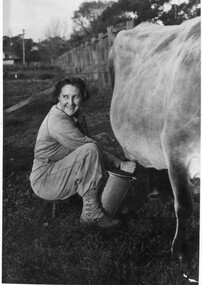
Photograph - Black and white print, Herald Feature Service, Mervyn Davis Milking, 1945
... Student, Mervyn Davis (1946), seated on a low stool with a metal bucket milking a Jersey cow by hand. Note she is wearing leather gaiters....crts students mervyn davis milking burnley horticultural school commonwealth reconstruction training scheme jersey cow gaiters On reverse, "Burnley Horticultural School Mervyn Davis milking - on the course. 1945," several signatures of fellow students and, "Copyright Not for Reproduction Herald Feature Service Melbourne, Australia." Black and white photograph. C.R.T.S. Student, Mervyn Davis (1946), seated on a low stool with a metal bucket ...Black and white photograph. C.R.T.S. Student, Mervyn Davis (1946), seated on a low stool with a metal bucket milking a Jersey cow by hand. Note she is wearing leather gaiters.On reverse, "Burnley Horticultural School Mervyn Davis milking - on the course. 1945," several signatures of fellow students and, "Copyright Not for Reproduction Herald Feature Service Melbourne, Australia."crts, students, mervyn davis, milking, burnley horticultural school, commonwealth reconstruction training scheme, jersey cow, gaiters -
 Dunkeld Museum Inc.
Yoke, Late 19th Century
... It was used for carrying buckets of milk, vegetables, water or other farm supplies. ...It was used for carrying buckets of milk, vegetables, water or other farm supplies. ...The yoke was made by a farmer in Silesia for his daughter to use on the family farm. When the family migrated to Australia the yoke was brought with them. It was used for carrying buckets of milk, vegetables, water or other farm supplies. It has been used by various family members until recent times.Woman's agricultural yoke. Timber body carved to fit the neck and shoulders of the wearer with round extensions either end. Leather straps are suspended from slots in these round extensions close to the end and are held into the timber with metal nails. One strap has been repaired and joined with brass rivets. A metal hook hangs on the bottom of each leather strap and these are held in place by a brass rivet.yoke, silesia, milking -
 Flagstaff Hill Maritime Museum and Village
Tool - Coopers Croze, Prior to 1950
... The cooper uses a Croze to cut a groove into either end of the inside of the staves of the bucket or barrel so the lid or bottom would fit securely against the wood. The cooper had to make sure the pieces of wood fit tightly together so none of the contents, such as beer, milk or grain, would seep out....The cooper uses a Croze to cut a groove into either end of the inside of the staves of the bucket or barrel so the lid or bottom would fit securely against the wood. The cooper had to make sure the pieces of wood fit tightly together so none of the contents, such as beer, milk or grain, would seep out. ...A Croze is a tool used by a cooper for cutting a groove of a barrel, cask, etc., into which the edge of both the heads of a barrel fits. The cooper uses a Croze to cut a groove into either end of the inside of the staves of the bucket or barrel so the lid or bottom would fit securely against the wood. The cooper had to make sure the pieces of wood fit tightly together so none of the contents, such as beer, milk or grain, would seep out.A tool of the cooper that is specific to his trade, this wood grooving plane has been in use since the making of barrels and wooden buckets for hundreds of years without much change to the design or how the tool is used.Croze, has 2 Lance teeth and 1 Hawk tooth.Noneflagstaff hill, warrnambool, flagstaff-hill-maritime-museum, maritime-museum, shipwreck-coast, flagstaff-hill-maritime-village, croze, coopers tools, barrel making -
 Flagstaff Hill Maritime Museum and Village
Tool - Coopers Croze, Prior to 1950
... The cooper uses a Croze to cut a groove into either end of the inside of the staves of the bucket or barrel so the lid or bottom would fit securely against the wood. The cooper had to make sure the pieces of wood fit tightly together so none of the contents, such as beer, milk or grain, would not seep out....The cooper uses a Croze to cut a groove into either end of the inside of the staves of the bucket or barrel so the lid or bottom would fit securely against the wood. The cooper had to make sure the pieces of wood fit tightly together so none of the contents, such as beer, milk or grain, would not seep out. ...A Croze is a tool used by a cooper for cutting a groove of a barrel, cask, etc., into which the edge of both the heads of a barrel fits. The cooper uses a Croze to cut a groove into either end of the inside of the staves of the bucket or barrel so the lid or bottom would fit securely against the wood. The cooper had to make sure the pieces of wood fit tightly together so none of the contents, such as beer, milk or grain, would not seep out.A tool of the cooper that is specific to his trade, this wood grooving plane has been in use since the making of barrels and wooden buckets for hundreds of years without much change to the design or how the tool is used.Coopers adjustable Croze, Noneflagstaff hill, warrnambool, flagstaff-hill-maritime-museum, maritime-museum, shipwreck-coast, flagstaff-hill-maritime-village, croze, coopers tools, barrel making -
 Flagstaff Hill Maritime Museum and Village
Tool - Croze, Prior to 1950
... The cooper uses a Croze to cut a groove into either end of the inside of the staves of the bucket or barrel so the lid or bottom would fit securely against the wood. The cooper had to make sure the pieces of wood fit tightly together so none of the contents, such as beer, milk or grain, would seep out....The cooper uses a Croze to cut a groove into either end of the inside of the staves of the bucket or barrel so the lid or bottom would fit securely against the wood. The cooper had to make sure the pieces of wood fit tightly together so none of the contents, such as beer, milk or grain, would seep out. ...A Croze is a tool used by a cooper for cutting a groove of a barrel, cask, etc., into which the edge of the head or bottom fits. The cooper uses a Croze to cut a groove into either end of the inside of the staves of the bucket or barrel so the lid or bottom would fit securely against the wood. The cooper had to make sure the pieces of wood fit tightly together so none of the contents, such as beer, milk or grain, would seep out.A tool of the cooper that has been in use since the making of barrels and wooden buckets. Item at this time cannot be associated with an historical event, person or place, provenance is unknown, item assessed as a collection asset as it is believed to have been produced before 1950.Coopers Croze wood with metal bladeNoneflagstaff hill, warrnambool, flagstaff-hill-maritime-museum, shipwreck-coast, flagstaff-hill-maritime-village, croze, cooper, barrel making, tool -
 Cheese World Museum
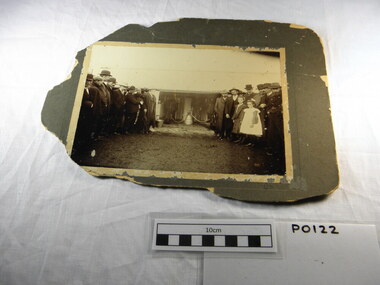
Photograph, Unknown photographer, The first mechanical milking machine public demonstration in Allansford district, 1905
... Reported in Warrnambool Standard 5 June 1905. uebergang dairy industry rural industry food manufacture machinery lkg cudgee briarwood milking machine children cows dignitories farmers bucket Written on back of photo 'LKG Milking Machine Lawrence Kennedy 1902/ Mr Ernst Uebergang inside shed.' ...The Percy Uebergang family lived at Tooram Park, Allansford from 1912 until 1992. Percy and Myrtle Uebergang's children were twins, Ray and Joyce born in 1926 who lived at Tooram Park until their deaths, Ray in 1986 and Joyce in 1992. Neither Ray nor Joyce married and following the death of her brother Joyce set up the Ray and Joyce Uebergang Foundation which supports the local community. This photograph is part of the collection of items given into the care of the Cheese World Museum. Uebergang catalogue No. Photograph tells the story of a special celebration marking the occssion of the demonstration of the first mechanical milking machine on the Ernst Uebergang property Briarwood at Cudgee Victoria. Ernst Uebergang is inside the shed. Reported in Warrnambool Standard 5 June 1905.Photo on badly damaged brown mount board. Image depicts LKG milking machine demonstration. Dignitories, farmers and children present. Two men are inside the shed with two cows. Written on back of photo 'LKG Milking Machine Lawrence Kennedy 1902/ Mr Ernst Uebergang inside shed.'uebergang, dairy industry, rural industry, food manufacture, machinery, lkg, cudgee, briarwood, milking machine, children, cows, dignitories, farmers, bucket -
 Warrnambool and District Historical Society Inc.
Functional object - bucket, c. 1950
... A small metal bucket such as this was a common item in a household, farm or factory, 20th century and earlier. It would have been used to carry liquids such as water, milk or cleaning fluids and small loads such as feed for animals or picked fruit and vegetables. ...A small metal bucket such as this was a common item in a household, farm or factory, 20th century and earlier. It would have been used to carry liquids such as water, milk or cleaning fluids and small loads such as feed for animals or picked fruit and vegetables. ...A small metal bucket such as this was a common item in a household, farm or factory, 20th century and earlier. It would have been used to carry liquids such as water, milk or cleaning fluids and small loads such as feed for animals or picked fruit and vegetables. Today iron buckets are still in use but have been largely replaced by plastic ones.This bucket is retained for display purposes, perhaps in a dairy farm display.This is a galvanised iron bucket. It has as circular base with a strengthening metal strip around the edge and a tapered body with a circular top. A metal handle is inserted into small metal loops on the sides. There is some rusting in the inside base area.household items, dairy farm implements
