
Showing 10 items matching "mills bomb"
-
 Montmorency–Eltham RSL Sub Branch
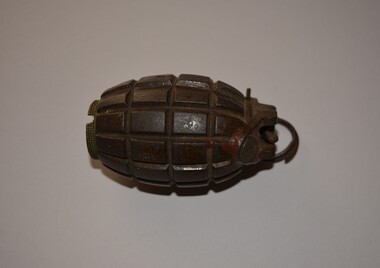
Weapon - Hand Grenade, Mills Bomb No. 36 (Inert), 1941
... Hand Grenade, Mills Bomb No. 36 (Inert) ...Patented by William Mills and known as 'Mills Bombs', these were first used in WW1 and were used by the British Army until 1972. ...Weapon Hand Grenade, Mills Bomb No. 36 (Inert) R B Davis & Co. ...Patented by William Mills and known as 'Mills Bombs', these were first used in WW1 and were used by the British Army until 1972. Three models were made - No. 5, No. 23 and No. 36. The latter two could be fired from a rifle (with suitable attachments). Note that the casing is grooved to assist fragmentation. These grenades had a time delay fuse of 7 seconds initially but later a 4 second fuse was introduced. Upon explosion, its lethal range was approx. 90m but on hard ground it could be double that. Over 75 million were produced.Cast-iron 'pineapple' shaped anti-personnel grenade. -
 Wangaratta RSL Sub Branch
Weapon - Hand Grenade, October 1916
... ...Mills Bomb...Patented by Sir William Mills the Mills Bomb Number 5 Mark I is a deeply segmented "pineapple" hand grenade introduced in 1915 and used heavily by Australian and British troops in the trenches of the Western Front Because it was made of cast iron, the manufacturer stamped the production details directly onto the removable brass or steel base plug on the bottom - this one was made in October 1916 with no further provenance known. ...WW1 1916 Mills Bomb Hand grenade Base - No5 10/16 QAV M Cast iron oval shaped with deep grooves resembling a pineapple with pin with loop attached at one end inserted through two lugs at top. ...Patented by Sir William Mills the Mills Bomb Number 5 Mark I is a deeply segmented "pineapple" hand grenade introduced in 1915 and used heavily by Australian and British troops in the trenches of the Western Front Because it was made of cast iron, the manufacturer stamped the production details directly onto the removable brass or steel base plug on the bottom - this one was made in October 1916 with no further provenance known. Cast iron oval shaped with deep grooves resembling a pineapple with pin with loop attached at one end inserted through two lugs at top.Base - No5 10/16 QAV Mww1, 1916, mills bomb, hand grenade -
 Dandenong/Cranbourne RSL Sub Branch
Weapon - Hand Grenade, Manufactured between 1917-1972
... Mills bomb...Mills bomb bomb grenade hand grenade World War Two Second World War WW2 No 36 M MK1 R.B.O 8-41 F.L.H Oval, black, metal, heavy, Red ring pull Weapon Hand Grenade ...Oval, black, metal, heavy, Red ring pullNo 36 M MK1 R.B.O 8-41 F.L.Hmills bomb, bomb, grenade, hand grenade, world war two, second world war, ww2 -
 Shepparton RSL Sub Branch
Grenade, World War Two period
... WW2 Mills Bomb (Hand Grenade M36....WW2 Mills Bomb (Hand Grenade M36. WW2 Hand Grenade used by Australia and Commonwealth Countries. ...WW2 Mills Bomb (Hand Grenade M36.WW2 Hand Grenade used by Australia and Commonwealth Countries.Segmented Cast Iron body with lever (now softened) and with Safety Pin and Ring. Firing Pin in position with heat softened firing pin spring. Non regulation filler screw fitted. The Grenade has been totally burnt out, there is no Base Plug and no Firing Pin/Fuse Holder assembly.The body is marked R B D which stands for R.B.Davies the lever is marked the same. -
 Bendigo Military Museum
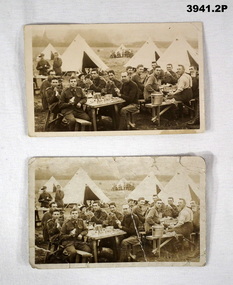
Postcard - POSTCARDS WW1, 1) & .2) 7.10.1917
... MILLS No 3441, 59th Battalion. James on on the first table left sitting at RHS of table on the left of 2 other men. Refer Cat No 169P for his service details. Postcards 59th .1) On rear in pencil: “The Hungry 59th Battalion at mess after a hard days work Hurdcott England 7.10.17” .2) On rear in pencil: “Hurdcott England Oct 7 1917 Taken about a week ago. Boys from the 59th Battalion messing one evening after doing a good days work at ____ ____ bayonet fighting, bombing ...Item relates to James Worland MILLS No 3441, 59th Battalion. James on on the first table left sitting at RHS of table on the left of 2 other men. Refer Cat No 169P for his service details..1) & .2) Post card photos, sepia, showing soldiers eating at 2 tables with tents in the background..1) On rear in pencil: “The Hungry 59th Battalion at mess after a hard days work Hurdcott England 7.10.17” .2) On rear in pencil: “Hurdcott England Oct 7 1917 Taken about a week ago. Boys from the 59th Battalion messing one evening after doing a good days work at ____ ____ bayonet fighting, bombing and other modes of modern warfare. Jimmy”postcards, 59th -
 Sunshine and District Historical Society Incorporated
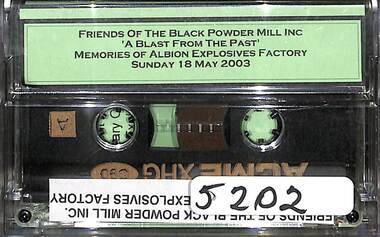
Audio - Friends of the Black Powder Mill A Blast From The Memories of Albion Explosives Factory Audio Tape
... The Black Powder Mill is the last remaining building from the Albion Explosives Factory and is located in the suburb of Cairnlea. It was used to grind gunpowder for bombs and shells in WW2. ...The Black Powder Mill is the last remaining building from the Albion Explosives Factory and is located in the suburb of Cairnlea. It was used to grind gunpowder for bombs and shells in WW2. ...The Black Powder Mill is the last remaining building from the Albion Explosives Factory and is located in the suburb of Cairnlea. It was used to grind gunpowder for bombs and shells in WW2. In 2001 the Black Powder Mill was included in the National Trust's Heritage Register due to its cultural heritage significance. Friends Of The Black Powder Mill A Blast From The Past Memories of Albion Explosives Factoryblack powder mill, albion explosive factory -
 Sunshine and District Historical Society Incorporated
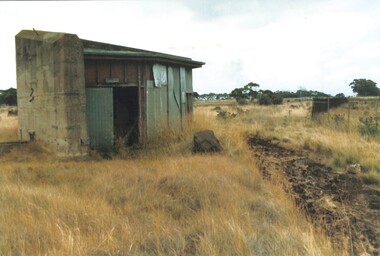
Photograph - Black Powder Mill
... Black Powder Mill (Building No. 745) - Built: 1942, to supplement output from the nearby ICIANZ plant (operating since 1935). - Function: Ground gunpowder for bombs and shells using an edge-runner mill—a technology dating back to the 16th century. - Design: - Two levels: milling equipment above, mechanical gear below. - Reinforced concrete walls and sacrificial wooden blast doors directed explosions safely toward Kororoit Creek. - Incident: In 1944, an explosion injured two workers; one later died from burns. ...This is an early photograph of the Black Powder Mill after the Explosive Factory was closed down, but before any restoration work took place and it was placed on the Voctorian Heritage List.Black Powder Mill (Building No. 745) - Built: 1942, to supplement output from the nearby ICIANZ plant (operating since 1935). - Function: Ground gunpowder for bombs and shells using an edge-runner mill—a technology dating back to the 16th century. - Design: - Two levels: milling equipment above, mechanical gear below. - Reinforced concrete walls and sacrificial wooden blast doors directed explosions safely toward Kororoit Creek. - Incident: In 1944, an explosion injured two workers; one later died from burns. Heritage and Preservation - Significance: - Only surviving building from the Albion Explosives Factory. - Possibly the last gunpowder production building erected for military use worldwide. - Recognized for its engineering, historical, and social importance. - Saved by Community: Initially slated for demolition, but preserved after strong local advocacy. - Restoration: Added to the National Trust Register in 2001; restored and reopened in 2003. - Today: - Hosts annual open days with machinery demonstrations and black powder firearm displays. - Managed by the Sunshine & District Historical Society since 2022. black powder mill, deer park, explosive factory, cairnlea, icianz, ici -
 Sunshine and District Historical Society Incorporated
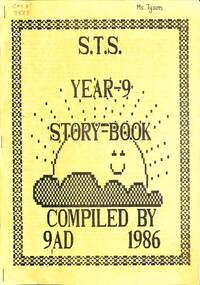
Memorabilia - Sunshine Technical School Memorabilia - Story Book S.T.S. Story Book 1986 Class 9AD
... The Stabbing by Tracey Mills|Ghost Town by Marion Walker|PEPE The Pigeon Who Ruled Sunshine by Anthony Micallef|The Phone Call by Kaelene Knott|Calder Park Finals Drag Racing March 1986 by Michelle Chatzidimitriou|My Dog Corky by Nicolle Meyers|The Day We Went Motor Bike Riding by Shane Hynds|The Mystery by Donna Tatlow|Annual Camp by David Shilling|Forces Vengeance by Jeff Ward|Sunshine Tech Bombed by Claudia Rundel|Mystery 2 by Donna Tatlow|Amazon Jungle by Barry Howard|An Experience Of My Own by Rodger Greaves|Best Friends by Vicki Psomiadis|The Book And Me by Amanda Alldis|Deadley Mistake by Corey Havarc|The Gate Of Imagination by Rachel Masuglia|The Picnic by Dion Beasley|The Magic Seeds by Tracey McDonagh|The Drowing by Mark Herrick|The Day I Wagged School by Michael Sammut|The Magic Seeds by Tracey McDonagh|The Ghost That Never Spooked by Chris MacDonald|Amusement Park By Tracey McDonagh|Lost Treasure by Allen Carrick|Ghost Train by Nikkie Potter...Was part of the Sunshine Technical School Collection Sunshine Technical School Technical School The Stabbing by Tracey Mills|Ghost Town by Marion Walker|PEPE The Pigeon Who Ruled Sunshine by Anthony Micallef|The Phone Call by Kaelene Knott|Calder Park Finals Drag Racing March 1986 by Michelle Chatzidimitriou|My Dog Corky by Nicolle Meyers|The Day We Went Motor Bike Riding by Shane Hynds|The Mystery by Donna Tatlow|Annual Camp by David Shilling|Forces Vengeance by Jeff Ward|Sunshine Tech Bombed by Claudia Rundel|Mystery 2 by Donna Tatlow|Amazon Jungle by Barry Howard|An Experience Of My Own by Rodger Greaves|Best Friends by Vicki Psomiadis|The Book And Me by Amanda Alldis|Deadley Mistake by Corey Havarc|The Gate Of Imagination by Rachel Masuglia|The Picnic by Dion Beasley|The Magic Seeds by Tracey McDonagh|The Drowing by Mark Herrick|The Day I Wagged School by Michael Sammut|The Magic Seeds by Tracey McDonagh|The Ghost That Never Spooked by Chris MacDonald|Amusement Park By Tracey McDonagh|Lost Treasure by Allen Carrick|Ghost Train by Nikkie Potter A stapled document containg various student's short stories Memorabilia Sunshine Technical School Memorabilia - Story Book S.T.S. ...Was part of the Sunshine Technical School CollectionThe Stabbing by Tracey Mills|Ghost Town by Marion Walker|PEPE The Pigeon Who Ruled Sunshine by Anthony Micallef|The Phone Call by Kaelene Knott|Calder Park Finals Drag Racing March 1986 by Michelle Chatzidimitriou|My Dog Corky by Nicolle Meyers|The Day We Went Motor Bike Riding by Shane Hynds|The Mystery by Donna Tatlow|Annual Camp by David Shilling|Forces Vengeance by Jeff Ward|Sunshine Tech Bombed by Claudia Rundel|Mystery 2 by Donna Tatlow|Amazon Jungle by Barry Howard|An Experience Of My Own by Rodger Greaves|Best Friends by Vicki Psomiadis|The Book And Me by Amanda Alldis|Deadley Mistake by Corey Havarc|The Gate Of Imagination by Rachel Masuglia|The Picnic by Dion Beasley|The Magic Seeds by Tracey McDonagh|The Drowing by Mark Herrick|The Day I Wagged School by Michael Sammut|The Magic Seeds by Tracey McDonagh|The Ghost That Never Spooked by Chris MacDonald|Amusement Park By Tracey McDonagh|Lost Treasure by Allen Carrick|Ghost Train by Nikkie Pottersunshine technical school, technical school -
 Sunshine and District Historical Society Incorporated
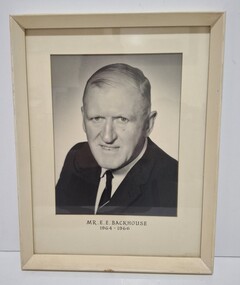
Photograph - Albion Explosive Factory Mr E.E. Backhouse 1964 - 1966 Site Manager Portrait Photograph, 1966
... bombs and the manufacture of cordite in the United Kingdom from 1948 to 1949. He was the manager of the Explosive Factory Mulwala from 1953 to 1955, manager at the Explosive Factory Maribyrnong 1956 to 1964 and manager at the Explosive Factory Albion from 1964 until his retirement in 1966. This item came from the Friends of the Black Powder Mill...bombs and the manufacture of cordite in the United Kingdom from 1948 to 1949. He was the manager of the Explosive Factory Mulwala from 1953 to 1955, manager at the Explosive Factory Maribyrnong 1956 to 1964 and manager at the Explosive Factory Albion from 1964 until his retirement in 1966. This item came from the Friends of the Black Powder Mill ...Mr E.E. Backhouse (F.R.A.C.I.) joined the Colonial Ammunition Company as a laboratory assistant in 1920. He worked as a chemist at the Munitions Supply Laboratories from 1923 to 1928, at the Ammunition Factory Footscray from 1923 to 1936 and at the Explosive Factory Maribyrnong from 1936. He became the assistant manager at the Explosive Factory Maribyrnong from 1943 to 1953. He studied production of rocket motors, filling of bombs and the manufacture of cordite in the United Kingdom from 1948 to 1949. He was the manager of the Explosive Factory Mulwala from 1953 to 1955, manager at the Explosive Factory Maribyrnong 1956 to 1964 and manager at the Explosive Factory Albion from 1964 until his retirement in 1966. This item came from the Friends of the Black Powder Mill.Mr E.E. Backhouse 1964 - 1966albion explosive factory, explosive factory, ballarat road, deer park -
 City of Melbourne Libraries
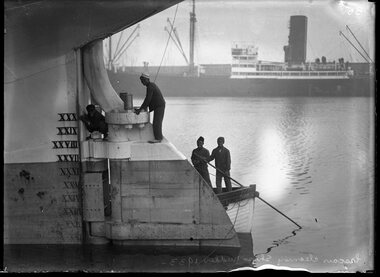
Photograph, Bull, Hugh Jones, 1897-1993, Lascars cleaning ship's rudder
... mills producing flour across the country. Flour exports were an important part of the wheat industry until around the 1930s. After the Second World War, many of Australia’s export partners (which were mainly in the developing nations of Asia) began setting up their own flour industries and the Australian product was no longer in demand. In 1942 MV Neptuna was being utilised for the war effort, and carrying depth charges and other armaments for Australia, when on 19 February it was sunk in a bombing...mills producing flour across the country. Flour exports were an important part of the wheat industry until around the 1930s. After the Second World War, many of Australia’s export partners (which were mainly in the developing nations of Asia) began setting up their own flour industries and the Australian product was no longer in demand. In 1942 MV Neptuna was being utilised for the war effort, and carrying depth charges and other armaments for Australia, when on 19 February it was sunk in a bombing ...Published: unknown, however, on 26 June 1935 a similar, but not the exact photo in the McKenzie Collection, was published in The Age: Published title: Shipping Victorian Flour to the East Published Caption: Flour and wheat figure prominently in all cargoes carried by ships trading to Chinese, Japanese and Eastern ports. Victorian millers are eager to extend lids outlet for their produce, and every opportunity is grasped. The pictures show Australian labourers unloading from railway trucks some of the 2300 tons of flour which will go into the hold of the Burns, Philp motor ship Neptuna for shipment to Hong Kong, while Chinese seamen are busy cleaning and painting the rudder post of the ship. Hard by the Neptuna, other ships are taking on flour for the East. Research by Project Volunteer, Louise McKenzie: The image was described by Hugh Bull on the rear of the glass plate as – “Lascars cleaning ships rudder 1933”. Basically, a “lascar” is a seaman. Image No. 032 in the McKenzie Collection shows two lascars perched on the rudder of a ship, with two others standing in a rowboat along side. They are dressed in baggy trousers and jackets and wearing caps. Across a very calm dock area is a single funnel ship with on-deck derricks. The rudder of the ship being cleaned is white, with large black roman numbering denoting the depth at which the ship is sitting, depending on whether it is loaded or empty. Whilst the exact photo in the McKenzie Collection has yet to be located in The Age in 1933, the date when it was taken, there is a photo published in The Age on 25 June 1935 which appears to be one of a series of photos taken on the same day, featuring lascars cleaning a ship’s rudder. It bears a striking resemblance to MCK 032, but it is taken from a slightly different angle. The 1935 published photo is a close up of a ship’s rudder being cleaned, with same style of roman numerals in black on the white of the rudder. One lascar is standing on the rudder, one is standing in a small clinker style rowboat, with its characteristic wooden overlapping hull planks, holding a broom; two more lascars are sitting in the bow and stern of the rowboat. The ship being cleaned is in a dock, as a wharf and warehouses can be seen in the background, the water is very calm, and there are two other ships moored nearby – one across the other side of the dock with a black and white hull and derricks on its deck, and one adjacent, with its mooring lines clearly visible. The lascars are wearing caps, baggy trousers and jackets. Compelling similarities therefore exist between the two images. Whilst it is difficult to positively identify the cultural background of these particular lascars in either photo, the newspaper article dated June 1935 advises they are “Chinese”. This is possibly because the ship they are associated with, the Neptuna, is reported to have sailed from Melbourne on this date, bound for Hong Kong. However, the men are probably from South East Asia. Wikipedia describes the term “Southeast Asia” as covering ” … the people of Southeast Asia from prehistory to the present in two distinct sub-regions: Mainland Southeast Asia (or Indochina) and Maritime Southeast Asia (or Insular Southeast Asia). Mainland Southeast Asia comprises Cambodia, Laos, Myanmar (or Burma), Peninsular Malaysia, Thailand and Vietnam whereas Maritime Southeast Asia comprises Brunei, Cocos (Keeling) Islands, Christmas Island, East Malaysia, East Timor, Indonesia, Philippines and Singapore. Additionally, Wikipedia “Lascars” states that “Lascars were sailors from the Indian subcontinent, South East Asia, the Arab world, British Somaliland and lands east of the Cape of Good Hope, who were employed to work on colonial merchant ships. The practice ran from the 16th century to the mid 20th century”. Indian seamen were used as early as the 16th century by Portuguese explorer Vasgo da Gama in his successful voyage to India, and subsequently by Portuguese ships in the 16th and 17th centuries. “Through the Portuguese and Spanish maritime world empires, some Indian lascars found their way onto English merchant ships, and were among the sailors on the first English East India Company (EIC) ships to sail to India.” In the 17th Century “When the English adopted the term "lascar", they initially used it for all Asian sailors on English-flagged ships, but after 1661 and the Portuguese ceded Bombay to England, the term was used mainly to describe Indian sailors specifically. The term "topaze" was used to describe Indo-Portuguese personnel, especially those from Bombay, Thana, Diu, Dammam and Cochin. The term "sepoy" was used to describe Indian soldiers in European service. The number of lascars employed on EIC East Indiamen was so great that the Parliament of England restricted their employment via the Navigation Acts (in force from 1660 onwards) which required that 75% of the crew onboard English-flagged ships importing goods from Asia be English subjects. The restriction arose due to the high rates of illnesses and death among European sailors on East Indiamen, and their frequent desertions in Asia, which left such ships short of crew for the return voyage. Another reason was the frequent impressment of European sailors from EIC East Indiamen by the Royal Navy in times of war“. The term “impressment” colloquially refers to “the “press gang” …”a type of conscription of people into a military force, especially a naval force, via intimidation and physical coercion, conducted by an organized group (hence “gang”). .. The large size of the British Royal Navy in the Age of Sail meant impressment was most commonly associated with Great Britain.”. (Wikipedia – Impressment). By the 20th century these sailors served on British ships under "lascar agreements", which allowed shipowners more control than was the case in ordinary articles of agreement. The sailors could be transferred from one ship to another and retained in service for up to three years at one time. “Lascars served all over the world in the period leading up to the First World War. Lascars were barred from landing at some ports, such as in British Columbia. At the beginning of World War I, there were 51,616 lascars working on British merchant ships in and around the British Empire. In World War II thousands of lascars served in the war and died on vessels throughout the world, especially those of the British India Steam Navigation Company, P&O and other British shipping companies. The lack of Canadian naval manpower led to the employment of a total of 121 Catholic Goans and 530 Muslim British Indians on the Empress vessels of the Canadian Pacific Railway, such as the Empress of Asia and Empress of Japan. These ships served in the Indian Ocean both as ANZAC convoy ships and in actions at Aden. The ships were placed under the British Admiralty as part of Canada's contribution to the war effort and all of the Indian men were awarded medals by the Admiralty, though none of them were delivered. In the 1950s the use of the term "lascar" declined with the ending of the British Empire. The Indian “Lascar Act” of 1832 was finally repealed in 1963. However, "traditional" Indian deck and Pakistani engine crews continued to be used in Australia until 1986 when the last crew was discharged from the P&O and replaced by a general-purpose crew of Pakistanis. The term lascar has been widely used to engender an element of exoticism in literature eg “Sir Arthur Conan Doyle created a Lascar foil to Sherlock Holmes in "The Man with the Twisted Lip" in 1891. Lascars aboard the ship Patna figure prominently in the early chapters of Joseph Conrad's novel Lord Jim. Frances Hodgson Burnett's novel A Little Princess features a lascar named Ram Dass. Also, Caleb Carr portrays two lascars as bodyguards for a Spanish diplomat near the end of The Angel of Darkness. In Wuthering Heights, it is speculated that Heathcliff, the main character, may be of lascar origin." (Wikipedia – Lascar) And what has become of these “forgotten heroes of the World Wars”? The South Asian Heritage Trust, which seeks to commemorate, mark and celebrate South Asian cultures, stories, and communities, published an article in July 2025 entitled – The Lascars: Seafaring Roots of Modern Britain. It particularly honours the role of the 80,000 lascars who served Britain in WWI, and the over 100,000 who served in the British Merchant Navy in WWII, and concludes: “The hardships faced by Lascars were profound. They were often assigned the most dangerous tasks, lived in substandard conditions aboard ships and, even after their immense contributions to the war efforts, many veterans found it difficult to secure the recognition, pensions and rights afforded to other veterans. Many were employed under ‘Asiatic Articles’, which offered less protection and lower pay than their European counterparts. Yet, their legacy endures. The multicultural fabric of areas like East London owes much to these early seafarers and settlers. The East London Mosque, established in 1910, became an important spiritual and community hub. Today, efforts to bring their stories out of the shadows are growing. The Museum of London Docklands features exhibits on their history. Memorials, such as the P&O headstone in Dover for the 22 Lascar crew members of the SS Maloja sunk in 1916 and the careful restoration of the Lascar War Memorial in Kolkata, serve as important reminders of the sacrifices. The journey of the Lascars – from their homelands, along dangerous wartime shipping routes, to the docklands of Britain – is a story of personal courage and of a rich contribution to Britain’s history and identity.” The ship MV Neptuna, mentioned in the 1935 article, had that year been purchased from a German company by Australian-owned Burns Philp, with Australian Government assistance, and it was instrumental in ensuring the shipment of rice from Vietnam to Papua New Guinea. Rice is still a household staple in PNG. Despite it being introduced into PNG more than 100 years ago, the crop has not been sufficiently integrated into the country’s traditional agricultural production system, and today PNG imports still account for nearly 98% of rice. (Spotlight Magazine Sept. 2016) The 1935 newspaper article states that the Neptuna is involved in moving flour for the East. Australian wheat exports began in 1845, but were not regular until the 1870s. New land clearing methods in Australia allowed large tracts of land to be cleared more efficiently – this included the invention of the iconic ‘stump jump’ plough. With the success of the wheat harvests, flour mills began to spring up around the country. By the 1870s, many large country towns had their own mills, with around 500 mills producing flour across the country. Flour exports were an important part of the wheat industry until around the 1930s. After the Second World War, many of Australia’s export partners (which were mainly in the developing nations of Asia) began setting up their own flour industries and the Australian product was no longer in demand. In 1942 MV Neptuna was being utilised for the war effort, and carrying depth charges and other armaments for Australia, when on 19 February it was sunk in a bombing raid on Darwin, and where part of her hull still lies. References: SHIPPING VICTORIAN FLOUR TO THE EAST. (1935, June 25). The Age (Melbourne, Vic. : 1854 - 1954), p. 11. Retrieved July 23, 2025, from http://nla.gov.au/nla.news-article204357218 Age (Melbourne, Vic. : 1854 - 1954), Tuesday 25 June 1935, page 11 Wikipedia, Clinker (boat building), https://en.wikipedia.org/wiki/Clinker_(boat_building) Wikipedia, Lascar, https://en.wikipedia.org/wiki/Lascar Wikipedia, History of Southeast Asia, https://en.wikipedia.org/wiki/History_of_Southeast_Asia Wikipedia, Impressment, https://en.wikipedia.org/wiki/Impressment NEPTUNA LEAVES FOR CHINA WITH TOURISTS (1935, June 25). The Herald (Melbourne, Vic. : 1861 - 1954), p. 5. Retrieved July 23, 2025, from http://nla.gov.au/nla.news-article244841163 National Research Institute SPOTLIGHT paper Vol 9, Issue 7, https://pngnri.org/images/Publications/Spotlight_No_9_Vol_7_-_201609_-_Sofe__Odhuno_-_Rice_Import_Quota1.pdf South Asian Heritage Trust, The Lascars: Seafaring Roots of Modern Britain, July 11,2025 : Royal British Legion. https://southasianheritage.org.uk/royal-british-legion/the-lascars-seafaring-roots-of-modern-britain/ Photographer notations on slide: "Lascars cleaning ships rudder 1933".lascars, ships, 1930-1939, employment, ethnic communities
