
Showing 18 items matching "minnie long"
-
 Port Melbourne Historical & Preservation Society
Document, Peter Libbis, Register of Common Lodging Houses and Noxious Trades
... ...Minnie LONG...Transcribed from handwritten Register by Peter LIBBIS 1997 Built Environment - Domestic Business and Traders Built Environment - Commercial Industry - Noxious Gerrit BLANKHART Spiro WILLIAMS John YAPP James John BARTLETT Henry LAUSSEN Susan LITCHFIELD Charles GROSSE William ABBOTT John WARNE Caroline SCHILLING Frederick BARKER Nina TAYLOR George Charles SCOTT John JAPP Frederick FREDRICHSEN Jane BRUNOT Betsy BACKER Eliza LEYDEN June McLELLAN Henry AITKENS Henry AITKEN Maria WILKINSON William ANTHONY Elizabeth TYRRELL Francis JOSE James FORRESTER Lois JORDAN John DENNIS Cassandra DAVIS Robert CAREY William Frederick BEVAN Sarah DUROSS Martina FREDERICKSON Lena SALFINGER Jeremiah TOHEY Henry D AITKEN James RILEY Catherine CAREY Eliza CONNOR Frederick JACOBITE Mary Ann PITTMAN Mary STEVENS Rose Clara LEE Eleanor SMITH Amy McPHEE Mary GIBBS Jane McLELLAN John DUNN George ROLLAND John LOLATO Peter CLEARY May Christian CHRISTIANSEN George ROLFE Antonia BRUNO John BENNETT David MacINTOSH Desera PARDON Antone BRUNO Henry HAMILTON Minnie LONG John FRIES Elizabeth POWELL Alice GREENOUGH Louis WARNER Hannah BLACK Salvadore ROBINSON Sarah TRACY Blue plastic folder with typed transcript from handwritten "Register of Common Lodging Houses and Noxious Trades". ...Transcribed from handwritten Register by Peter LIBBIS 1997Blue plastic folder with typed transcript from handwritten "Register of Common Lodging Houses and Noxious Trades". Contains details of rooming houses 1864 to 1892built environment - domestic, business and traders, built environment - commercial, industry - noxious, gerrit blankhart, spiro williams, john yapp, james john bartlett, henry laussen, susan litchfield, charles grosse, william abbott, john warne, caroline schilling, frederick barker, nina taylor, george charles scott, john japp, frederick fredrichsen, jane brunot, betsy backer, eliza leyden, june mclellan, henry aitkens, henry aitken, maria wilkinson, william anthony, elizabeth tyrrell, francis jose, james forrester, lois jordan, john dennis, cassandra davis, robert carey, william frederick bevan, sarah duross, martina frederickson, lena salfinger, jeremiah tohey, henry d aitken, james riley, catherine carey, eliza connor, frederick jacobite, mary ann pittman, mary stevens, rose clara lee, eleanor smith, amy mcphee, mary gibbs, jane mclellan, john dunn, george rolland, john lolato, peter cleary, may christian christiansen, george rolfe, antonia bruno, john bennett, david macintosh, desera pardon, antone bruno, henry hamilton, minnie long, john fries, elizabeth powell, alice greenough, louis warner, hannah black, salvadore robinson, sarah tracy -
 Ballarat Clarendon College
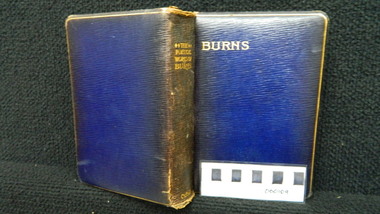
Book, The poetical works of Robert Burns, 1921
... Book plate inside front cover: Crest of the Melbourne Shakespeare Society / Examination 1922 / E Toynbee Stevens Memorial Prize / Awarded to / Minnie Monteith / Signed by President Long and Secretary Daley...Item provides intriguing detail to Minnie's academic pursuits following her years of schooling at Clarendon Presbyterian Ladies' College minnie-monteith melbourne-shakespeare-society e-toynbee-stevens book-prize 1922 Book plate inside front cover: Crest of the Melbourne Shakespeare Society / Examination 1922 / E Toynbee Stevens Memorial Prize / Awarded to / Minnie Monteith / Signed by President Long and Secretary Daley Dark blue padded and textured calf binding with gold printing and borders on front cover and spine; gold detail to inside edge of cover; marbled end-pages and gilt edge; hinges generally firm; book plate inside front cover; two pages of handwritten notes included in volume; The poetical works of Robert Burns Book Humphrey Milford ...Memorial Prize awarded to former CPLC student Minnie Monteith (Dux of school and Head Prefect 1921) by the Melbourne Shakespeare Society for excellence in the 1922 society examination. Item provides intriguing detail to Minnie's academic pursuits following her years of schooling at Clarendon Presbyterian Ladies' CollegeDark blue padded and textured calf binding with gold printing and borders on front cover and spine; gold detail to inside edge of cover; marbled end-pages and gilt edge; hinges generally firm; book plate inside front cover; two pages of handwritten notes included in volume;Book plate inside front cover: Crest of the Melbourne Shakespeare Society / Examination 1922 / E Toynbee Stevens Memorial Prize / Awarded to / Minnie Monteith / Signed by President Long and Secretary Daleyminnie-monteith, melbourne-shakespeare-society, e-toynbee-stevens, book-prize, 1922, -
 Ballarat Clarendon College
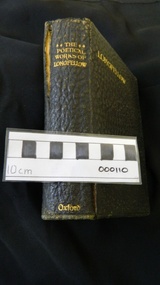
Book, The poetical works of Longfellow, 1921
... Item provides intriguing detail to Minnie's academic pursuits following her years of schooling at Clarendon Presbyterian Ladies' College minnie-monteith melbourne-shakespeare-society e-toynbee-stevens book-prize 1923 Book plate inside front cover: Crest of the Melbourne Shakespeare Society / Examination 1923 / The Toynbee Stevens Prize / Awarded to / Miss M Monteith / Signed by President Long and Secretary Daley Black, padded and textured calf binding with gold printing on front cover and spine; gold detail to inside edge of cover; marbled end-pages and gilt edge; hinges generally firm; book plate inside front cover; The poetical works of Longfellow Book Humphrey Milford ...Memorial Prize awarded to former CPLC student Minnie Monteith (Dux of school and Head Prefect 1921) by the Melbourne Shakespeare Society for excellence in the 1923 society examination. Item provides intriguing detail to Minnie's academic pursuits following her years of schooling at Clarendon Presbyterian Ladies' College Black, padded and textured calf binding with gold printing on front cover and spine; gold detail to inside edge of cover; marbled end-pages and gilt edge; hinges generally firm; book plate inside front cover; Book plate inside front cover: Crest of the Melbourne Shakespeare Society / Examination 1923 / The Toynbee Stevens Prize / Awarded to / Miss M Monteith / Signed by President Long and Secretary Daley minnie-monteith, melbourne-shakespeare-society, e-toynbee-stevens, book-prize, 1923, -
Glenelg Shire Council Cultural Collection
Drawing - Drawing, botanical, Collin Elwyn Woolcock, Ixiolaena leptolepis (Plover Daisy), Mallee & Wimmera. Minuria leptophylla (Minnie Daisy), 1985
... It is also found in the State Herbarium of South Australia and the National Herbariu Collin Woolcock botanical Woolcock Collection CEMA Front: CEW/85 (signature, lower left in image) (ink) Ixiolaena leptolepis (Plover Daisy) Mallee & Wimmera Minuria leptophylla (Minnie Daisy) (lower left) (pencil) Back: 32 (upper left) (pen) Framed ink drawing of cuttings and flower details of two plants. Five drawings include one cutting of multiple stemmed plant with long leaves and one flower per stem, one cutting of multiple stemmed plant with long narrow leaves and one flower (daisy-like) per stem and three flower details. ...Part of "Woolcock Gallery Collection". Exhibited CEMA 1989.Framed ink drawing of cuttings and flower details of two plants. Five drawings include one cutting of multiple stemmed plant with long leaves and one flower per stem, one cutting of multiple stemmed plant with long narrow leaves and one flower (daisy-like) per stem and three flower details. Mounted in a double matt (white on dark grey) under glass in a silver painted frame.Front: CEW/85 (signature, lower left in image) (ink) Ixiolaena leptolepis (Plover Daisy) Mallee & Wimmera Minuria leptophylla (Minnie Daisy) (lower left) (pencil) Back: 32 (upper left) (pen)collin woolcock, botanical, woolcock collection, cema -
 Halls Gap & Grampians Historical Society
Photograph - B/W, C 1934
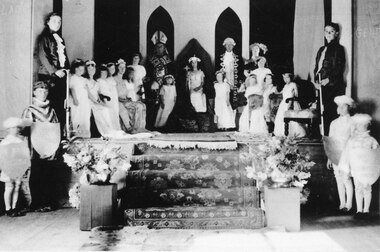
... When the long awaited evening came each Queen and her attendants paraded through the hall, the results were announced and the winner (who this year was Valerie Evans) took her place on a throne erected in the middle of the stage. The other Queens made their way to thrones on either side of her. The audience were treated to a right royal display as the "Bishop" placed a crown on the winner's head. Much merriment followed including a play, with students dressed as Minnie...When the long awaited evening came each Queen and her attendants paraded through the hall, the results were announced and the winner (who this year was Valerie Evans) took her place on a throne erected in the middle of the stage. The other Queens made their way to thrones on either side of her. The audience were treated to a right royal display as the "Bishop" placed a crown on the winner's head. Much merriment followed including a play, with students dressed as Minnie ...This is a photo of the "Queen Competition", probably the best remembered entertainment of the 1930's. Four local lasses were chosen to represent the following: Bellfield Hotel, Grampians House, The Cricket Club and the Grampians Mountains. When the long awaited evening came each Queen and her attendants paraded through the hall, the results were announced and the winner (who this year was Valerie Evans) took her place on a throne erected in the middle of the stage. The other Queens made their way to thrones on either side of her. The audience were treated to a right royal display as the "Bishop" placed a crown on the winner's head. Much merriment followed including a play, with students dressed as Minnie and Mickey Mouse and other Disney characters. For the names of the people in the photo refer to "Bridging the Gap" by Ida Stanton, p.88. A group of 23 people, all in costume, arranged on and below a stage. A woman dressed as royalty sits on a throne in the middle of the stage, flanked by a man dressed as a bishop on the left and a man dressed as a courtier on the right. There are two young girls in long white dresses wearing flowered bands in their hair standing in front of the men. There are more girls in white dresses and flower bands along both sides of the central throne. Two youths wearing ruffle fronted shirts and holding batons/walking sticks(?) at the front of each row of girls. Carpeted steps lead down from the stage and Flower arrangements flank the foot of the stairs. On either side of the stage at floor level are boys dressed as pages, two on the right and one on the left.recreation, entertainment -
 Halls Gap & Grampians Historical Society
Book - B/W
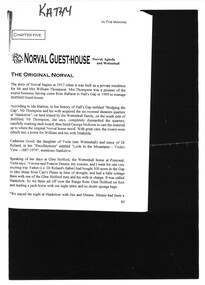
... Minnie gave us a lovely dinner with meringues, and cream, I remember, then early morning tea. After breakfast we were driven in the buggy to the foot of the Goat Rock (since renamed Mt Rosea) and off we went - walking in our long skirts and ankle boots. ...Minnie gave us a lovely dinner with meringues, and cream, I remember, then early morning tea. After breakfast we were driven in the buggy to the foot of the Goat Rock (since renamed Mt Rosea) and off we went - walking in our long skirts and ankle boots. ...Norval Guest-House Aginda and Wettenhall The original Norval The story of Norval begins in 1917 when it was built as a private residence for Mr and Mrs William Thompson. Mrs Thompson was a pioneer of the tourist business, having come from Ballarat to Hall's Gap in 1909 to manage Bellfield Guest-house According to Ida Stanton, in her history of Hall's Gap entitled "Bridging the Gap", Mr Thompson and his wife acquired the six roomed shearers quarters at "Hankelow", on land leased by the Wettenhall family, on the south side of Bellfield. Mr Thompson, she says, completely dismantled the quarters, carefully marking each board, then hired George McKeon to cart the material up to where the original Norval house stood. With great care, the rooms were rebuilt into a home for William and his wife Mathilda. Catherine Good, the daughter of Viola (nee Wettenhall) and niece of Dr Roland, in here "Recollections" entitled "Look to the Mountains - Viola's View 1887-1979", mentions Hankelow. Speaking of her days at Glen Holford, the Wettenhall home at Pomonal, Viola says "Verona and Francie Dennis, my cousins, and I went for one very exciting trip. Father (i.e Dr Roland's father) had bought 300 acres in the Gap to take sheep from Carr's Plains in time of drought, and had a little cottage there with one of the Glen Holford men and his wife in charge. It was called Hankelow. So we three set off over the Range from Glen Holford on foot and leading a pack horse with our night attire and no doubt sponge bags. "We stayed the night at Hankelow with Jim and Minnie. Minnie had been a housemaid at Glen Holford. I was very fond of her. It makes one laugh to think of the excitement of "roughing it"! Minnie gave us a lovely dinner with meringues, and cream, I remember, then early morning tea. After breakfast we were driven in the buggy to the foot of the Goat Rock (since renamed Mt Rosea) and off we went - walking in our long skirts and ankle boots. There was no track of any kind, nor blazed trail - we just made for the top. It was rather frightening at times because we couldn't see where the top was an it always seemed to get further and further away. The last mile was so terribly steep, with a lot of lose shale where you went up twelve inches and slipped back six. Now you motor to about a couple of miles from the top and then have a graded path. Anyway, we got there and back safely and were rewarded with a magnificent view" By a strange coincidence, Hankelow, the source of Norval Guest-house in times past (if the name can be applied to the property as a whole, which seems likely) is in fact also the source of our Wettenhall Campsite! Hankelow was named after a property owned by the Wettenhall family in England. In 1917 William and Mathilda retired to their newly built home (Norval) "to escape from the tourist business" However, so many people made requests to stay with them that they found it necessary to add several more rooms and sleepouts to their home. In this way, early in 1921, the guest-house began to take shape. Mr Thompson, a former librarian of the Mechanics Institute in Ballarat, named the house "Norval". The name "Norval" comes from a quotation from the play 'Douglas" by John Home. Written in the mid-16th century the play is set in the Grampian Mountains of Scotland. The story is of a boy who was parted from this mother during his early childhood, and was given to a shepherd who raised him. Some eighteen years later the mother by chance happens to meet here son, and not knowing his true identity, asks his name. He answers, "My name is Norval; and in the Grampian hills my father feeds his flocks." Perhaps it was simply because "Norval" was associated with the "Grampians" that it was chosen by Mr Thompson. He may also have been conscious of feeding "flocks" of tourists in his expanding, guest-house. Norval Guest-house prospered. It was known for its fine cooking and friendly atmosphere - a tradition which has carried through to the modern Norval! It closed between 1940 and 1949 because of the second world war. In 1949 it was decided to almost completely rebuild the house. Most of the old building (Hankelow plus) was demolished and rebuilt to a much larger and more modern plan. And then, on May 1, 1965, it was purchased by the Committee of Management of the Methodist and Presbyterian Conference Centres. At this time the guest-house was owned and operated by Marjorie and Lachland McLennan, Mrs McLennan being the daughter of William and Mathilda Thompson, the pioneers of the establishment. The McLennans had operated the Guest-house since about 1930.Photocopy 2 pages of article from book titled 'In the Making' title of article Norval guest House the original Norvalaccommodation, guesthouses, norval -
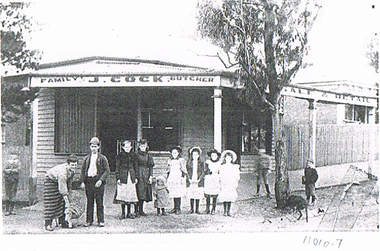 Bendigo Historical Society Inc.
Photograph - LONG GULLY HISTORY GROUP COLLECTION: J COCK - FAMILY BUTCHER
... Jooseph and Clara had Minnie 1906-1973; Flora 1908- ;William Thomas 1909- ; Clara Hilda 1912-1985 and Jean 1914-1920. BENDIGO History long gully history group The Long Gully History Group - J Cock - Family Butcher Copy of a black and white photo of J. ...Joseph Cock (1861-1922) was the son of John James Cock and his wife Amelia Tonkin. In 1893 he married Mary Elizabeth Tozer and they had the following children:- Henry John 1894-1956; Gertrude Mary 1896-1972; Joseph Alexander (Alec) 1897-1918; Arthur Leonard 1899- ;Samson George 1900-1900; Evie Eileen 1901- ; Mary Elizabeth 1903-1994. MAry Elizabeth Snr died 15/5/1903 leaving Joseph with 7 very young children. In 1906 he remarried to Clara Horell (1872-1948) They went on to have five more children and Clara became mother to them all. Jooseph and Clara had Minnie 1906-1973; Flora 1908- ;William Thomas 1909- ; Clara Hilda 1912-1985 and Jean 1914-1920.Copy of a black and white photo of J. Cock, Family Butcher Shop. Photo shows a weather board shop with the name J. Cock. Family Butcher Sale and Retail. In the front of the shop is a tree and a butcher wearing a striped apron and holding a sheep. A man is standing next to the sheep and there are seven girls of various ages. Three boys are also in the photo and a dog near the tree.bendigo, history, long gully history group, the long gully history group - j cock - family butcher -
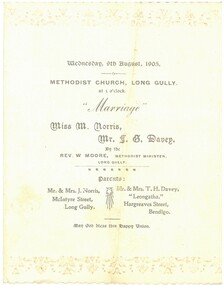 Bendigo Historical Society Inc.
Document - HAMILTON COLLECTION: ORDER OF SERVICE, 9 August 1905
... Order of Service for marriage of Minnie Morris and Mr F.G. Davey, Methodist Church, Long Gully, Wednesday 9th August 1905. ...Order of Service for marriage of Minnie Morris and Mr F.G. Davey, Methodist Church, Long Gully, Wednesday 9th August 1905. ...Document. Order of Service for marriage of Minnie Morris and Mr F.G. Davey, Methodist Church, Long Gully, Wednesday 9th August 1905. Program printed inside. Two copies. Mr A.J.Hamilton included on Evening Program.performing arts, elocution, order of service -
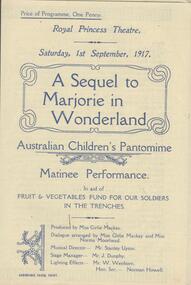 Bendigo Historical Society Inc.
Document - ROYAL PRINCESS THEATRE COLLECTION: A SEQUEL TO MARJORIE IN WONDERLAND
... _God Bless Our Splendid Men_ Cast of Characters: Jean Walker, Myrtle Glanville, Marie Hamilton, Thelma Thomas, Stella Coghlan, Jim Long, Jim Walker, Enid Webster, Lily Brown, Una Grelis, Biddie Bulley, Ellie Colcough, Dorothy Fullerton, Maud Clark, Una Leggo, Sheila Shannon, Ken Skewes, Jack Long, Bruce Barnier, Roger Horbury, Douglas Pain, Tom Henderson, Ruthie Murphy, Jim Nabbs, Tom Green, Douglas McQuie, Mel Wearne, Laurence Skewes, Sid Whitelaw, Ken Moore, Alma Jorgenson, Geoff Schultz, Doris Reed, Nancy Cahill, Hugh Long, Edna Spencer, Don Walker, Jack Schultz, Ken McQuie, Jack Weddell, Berni and Allan Monaghan, Reg Trevean, Stella Cook, Joyce Ross, Margaret Long, Olive Thomas, Margaret Macqie, Rose Murphy, Molly Robertson, Lorna Weddell, Minnie Harley, Jean Moran, Merle Nagel, Decima Hotorf, Myra Greasley, Vera Arundel, Joyce Long, Elma Jordan, Gwen Morley, Emmie Arthur, Lorna Parker, Ziska Ross, Ena Wright, Mary Rymer, Cecil Gleeson, Thelma Cairns, Dorothy Batchelder, Maudie Ferguson, Marion Henderson, Lorna Cattran, Alice Murphy, Essie Whitelaw, Eileen Coghlin, Thelma Ross, Jean Miller, Mavis Tozer, Monnie Fattorini, Vivian Reed, Lily O'Connor, Alice Evans, Jean Barlow (Names of parts were included). ..._God Bless Our Splendid Men_ Cast of Characters: Jean Walker, Myrtle Glanville, Marie Hamilton, Thelma Thomas, Stella Coghlan, Jim Long, Jim Walker, Enid Webster, Lily Brown, Una Grelis, Biddie Bulley, Ellie Colcough, Dorothy Fullerton, Maud Clark, Una Leggo, Sheila Shannon, Ken Skewes, Jack Long, Bruce Barnier, Roger Horbury, Douglas Pain, Tom Henderson, Ruthie Murphy, Jim Nabbs, Tom Green, Douglas McQuie, Mel Wearne, Laurence Skewes, Sid Whitelaw, Ken Moore, Alma Jorgenson, Geoff Schultz, Doris Reed, Nancy Cahill, Hugh Long, Edna Spencer, Don Walker, Jack Schultz, Ken McQuie, Jack Weddell, Berni and Allan Monaghan, Reg Trevean, Stella Cook, Joyce Ross, Margaret Long, Olive Thomas, Margaret Macqie, Rose Murphy, Molly Robertson, Lorna Weddell, Minnie Harley, Jean Moran, Merle Nagel, Decima Hotorf, Myra Greasley, Vera Arundel, Joyce Long, Elma Jordan, Gwen Morley, Emmie Arthur, Lorna Parker, Ziska Ross, Ena Wright, Mary Rymer, Cecil Gleeson, Thelma Cairns, Dorothy Batchelder, Maudie Ferguson, Marion Henderson, Lorna Cattran, Alice Murphy, Essie Whitelaw, Eileen Coghlin, Thelma Ross, Jean Miller, Mavis Tozer, Monnie Fattorini, Vivian Reed, Lily O'Connor, Alice Evans, Jean Barlow (Names of parts were included). ...Royal Princess Theatre - A Sequel to Marjorie in Wonderland. Saturday, 1st September 1917. Australian Children's Pantomime. Price of Programme, One Penny. Matinee Performance. In aid of 'Fruit & Vegetables Fund For Our Soldiers In The Trenches.' Produced by Miss Girlie Mackay and Miss Norma Moorhead. Musical Director: Mr. Stanley Upton. Stage Manager: Mr. J Dunphy. Lighting Effects: Mr. W Wenborn. Hon. Sec.: Mr. Norman Howell. Inside cover Synopsis of Pantomime. The First act is Marjorie's Dream of Fairyland. The curtain rises showing Marjorie asleep in cot from which Brownies entice her away. The curtain is. . . . Sale of Sweets supervised by Miss Nita E Weller and Assistants Rose by Mrs. A T Mackay. Dresses designed and made by Mrs. McQuie, Misses Lena Weller, Norma Moorhead, Girlie Mackay, assisted by Mrs. Ralph Ross, Mrs. Robert Mackay, and the Misses May Germann, Carola Iser and Hilda Meurer. Programme. Songs sung throughout Performance. Overture-'Marjorie in Wonderland; Specially arranged by Mr. Upton. Overture Synopsis-This is descriptive of Marjorie's Dream of Fairyland; at first mystic and subdued, tending to convey the impression of the mysterious movements of the Spirits of the Night intermingled with the occasional calls of birds, a vision of Elfland; from that the music develops in an expression of the coming of morn, and the stirring of forest nature into the active life of day, with the distant sounds of the anvil and of bells; and as the day wears on, the chiming of the hours again denote the approach of eventide, the melody throughout being that of the song 'Marjorie Sunbeam.' Instrumental Soloists are Messrs. J Collins & H M Hall. Act 1. 'Moonstruck' Myrtle Glanville. 2 Moonboat, by the Fairies. 3 'Fairy Revel' by the Bunnies. 4 'Bunnies Adventure' by the Bunnies.5 'Catching Birds' by the Goblins. 7 'Fairyland' Ruthie Murphy. Act 2. 1 'Fairy Song'. 2 'Kookaburra Mel Wearne. 3 'Marjorie Sunbeam' the Brownies. 4 'Kangaroo' the brownies. 5 'Autumn Winds' 6 'As I went o'er the Paddocks' Jean Walker. 7 'Sea Serpent' Jim Walker & Jim Long. 8 Swing Song, The Playmates. 9 'Belle Bird' Jean & Jim Walker. 10 'Baby Bear' Stella Coghlan. 11 'Coo-ee' Myrtle Glanville & Marie Hamilton. 12 Butterfly Dance Sheila Shannon.13 'The Mushroom Affair' Ruthie Murphy & Jim Nabbs. 14 'Corroboree' by the Aboriginals. 15 'The Boomerang' Ken McQuie. 16 Chorus-Wattle. 17 'In Two's & Three's' Brownies & Goblins. 18 'Bull Frog & Coon Stella Cook & Sid Whitelaw. 19 In a Fairy Boat' Rose Murphy. 20 Chorus-'Good Night'. _God Bless Our Splendid Men_ Cast of Characters: Jean Walker, Myrtle Glanville, Marie Hamilton, Thelma Thomas, Stella Coghlan, Jim Long, Jim Walker, Enid Webster, Lily Brown, Una Grelis, Biddie Bulley, Ellie Colcough, Dorothy Fullerton, Maud Clark, Una Leggo, Sheila Shannon, Ken Skewes, Jack Long, Bruce Barnier, Roger Horbury, Douglas Pain, Tom Henderson, Ruthie Murphy, Jim Nabbs, Tom Green, Douglas McQuie, Mel Wearne, Laurence Skewes, Sid Whitelaw, Ken Moore, Alma Jorgenson, Geoff Schultz, Doris Reed, Nancy Cahill, Hugh Long, Edna Spencer, Don Walker, Jack Schultz, Ken McQuie, Jack Weddell, Berni and Allan Monaghan, Reg Trevean, Stella Cook, Joyce Ross, Margaret Long, Olive Thomas, Margaret Macqie, Rose Murphy, Molly Robertson, Lorna Weddell, Minnie Harley, Jean Moran, Merle Nagel, Decima Hotorf, Myra Greasley, Vera Arundel, Joyce Long, Elma Jordan, Gwen Morley, Emmie Arthur, Lorna Parker, Ziska Ross, Ena Wright, Mary Rymer, Cecil Gleeson, Thelma Cairns, Dorothy Batchelder, Maudie Ferguson, Marion Henderson, Lorna Cattran, Alice Murphy, Essie Whitelaw, Eileen Coghlin, Thelma Ross, Jean Miller, Mavis Tozer, Monnie Fattorini, Vivian Reed, Lily O'Connor, Alice Evans, Jean Barlow (Names of parts were included). Columbine Ballet: Alma Day, Kathleen Smithwick, Margery Greaves, Wilma Martin, Roma Cook, Dot Cravino, Alma Reardon, Jean Cairns.Cambridge Press, Print.program, theatre, royal princess theatre -
Bendigo Historical Society Inc.
Document - ROYAL PRINCESS THEATRE COLLECTION: MAJORIE IN WONDERLAND, 12 Aug 1916
... Long... Dorothy Thomas... Margaret McQuie... Mollie Roberts... Rose Murphy. Pink Gums:-Lorna Weddell... Minnie...Orchids:- Joyce Ross, Margaret Long, Dorothy Thomas, Margaret McQuie, Mollie Roberts, Rose Murphy. Pink Gums:-Lorna Weddell, Minnie Hartley, Isola Woodward, Jean Moran, Decima Holtorf, Merle Nagel. ...Orchids:- Joyce Ross Margaret Long Dorothy Thomas Margaret McQuie Mollie Roberts Rose Murphy. Pink Gums:-Lorna Weddell Minnie Hartley Isola Woodward Jean Moran Decima Holtorf Merle Nagel. ...Royal Princess Theatre - Majorie in Wonderland. Saturday, 12 August, 1916. Price of Program, One Penny. Australian Children's Pantomime. Matinee Performance. In Aid of Fruit and Vegtable Fund For Our Soldiers in The Trenches. Produced by Miss Girlie Mackay. Children's Vocal Training by Madame Rossow. Dialogue by Miss Eileen O'Keefe. Musical Director, Mr Stanley Upton. Stage Manager, Mr J Dunphy. Lighting Effects Mr W Wenborn. Theatre kindly lent by W Crowley, Esq. Hon. Sec., Norman Howell. Prologue. The curtain rises showing the flowers asleep. The fairies, summoned by daylight, entre and sing, awakening the flowers, and leave. Then Puck entres, followed by the Blue Wrens, singing, and after them the Bunnies, who are all . . . Sale of Sweets supervised by Miss Nita Weller and Assistants. Novelties by Mrs Julius Cohn. Dresses designed and made by Mrs McQuie, Mrs Marc Cohn, Miss Lena Weller, and Miss Girlie Mackay, assisted by Mrs Balsillie, Mrs Ralph Ross. Mrs Robert Makayand the Misses Gladys McQuie, Norma Moorhead, Carola Iser, and Hilda Meurer. Program: Songs sung throught Performance. Act I. 1 Chorus-Fairy Song. 2 'Bunnies' Adventure' by the Bunnies. 3 Chorus-Holiday Song. 4 Bell Bird Duett-Jean & Jim Walker. 5 Sailor's Hornpipe-Crissie Cravino. 6 'Marjorie Sunbeam'-Myrtle Glanville. 7 'As I went o'er the Paddock'-Jean Walker. 8 Chorus'Billy Tea. 9 Song-'Possum'-Bertie Barkell. 10 'Bogie Man'-Stella Coghlan. 11 'Kookooburra'-Mel Wearne. 12 Chorus-'Winter Bells'. Act II. 1 Chorus-'Autumn Winds'. 2 'Stay Little Wave'-Jean Walker. 3 'Southern Cross'-Rose Murphy. 4 Song-'Kangaroo'-Brownies. 5 'Pixie Man'-Ruthie Murphy. 6 Chorus-'Wattle'. 7 'Grow Little Mushroom'-Stella Cook. 8 'Cooee'-Myrtle Glanville & Marie Hamilton. 9 Butterfly Dance-Sheila Shannon.10 'King Billy & Black Mary'-Ken McQuie. 11 Boomerang Song-Ken McQuie. 12 Final Chorus-'To the Fairies', 'Good Night'. God Bless Our Splendid Men. Cast of Characters:Marjorie & Jean Walker, Myrtle Glanville, Ruthie Murphy, Marie Hamilton, Thelma Thomas, Stella Coghlan, Jim Walker, Jim Long, Bertie Barkell. Fairies:-Mary Hunter, Lily Brown, Una Grelis, Biddie Bulley, Rosa Dyring, Ellie Colcough, Ida Collins. Puck:-Una Leggo. Butterfly:-Sheila Shannon. Brownies:-Tom Green, Douglas McQuie, Hunphrey, Gill, Mel Wearne, Laurence Skewes. Aboriginal:-Ken Mquie. Frog:-Sid Whitelaw. Native Bear:-Ken Moore. Blue Wrens:- Alma Jorgenson, Doris Reed, Geoff Schultz, Jean Cahill. Flowers. Orchids:- Joyce Ross, Margaret Long, Dorothy Thomas, Margaret McQuie, Mollie Roberts, Rose Murphy. Pink Gums:-Lorna Weddell, Minnie Hartley, Isola Woodward, Jean Moran, Decima Holtorf, Merle Nagel. Flannel Flowers: Gwen Hunter, Nancy Tatchell, Catherine Green, Mary Rymer, Thelma Cairns, Cecil Gleeson. Poppies:-Lorna Cattran, Alice Murphy, Maisie O'Grady, Eileen Coglan, Alma McWilliams, Jean Miller. Blue Bells:-Mavis Tozer, Vivian Reed, Monnie Fattorini, Gwennie Seely, Alice Evans, Lily O'Conner. Southern Cross:-Eileen Martin, Jean Murdoch, Effie Williams, Verna Mayne, Minnie Hartley, Mollie Martin.Cambridge Press, Print.program, theatre, royal princess theatre, royal princess theatre - majorie in wonderland. 12 august, 1916. program, one penny. australian children's pantomime. matinee performance. in aid of fruit and vegtable fund for our soldiers in the trenches. produced by miss girlie mackay. children's vocal training by madame rossow. dialogue by miss eileen o'keefe. musical director, mr stanley upton. stage manager, mr j dunphy. lighting effects mr w wenborn. theatre lent by w crowley, esq. hon. sec., norman howell. prologue. the curtain rises showing the flowers asleep. the fairies, summoned by daylight, entre and sing, awakening the flowers, and leave. then puck entres, followed by the blue. . . sale of sweets supervised by miss nita weller and assistants. novelties by mrs julius cohn. dresses designed and made by mrs mcquie, mrs marc cohn, miss lena weller, and miss girlie mackay, assisted by mrs balsillie, mrs ralph ross. mrs robert makayand the misses gladys mcquie, norma moorhead, carola iser, and hilda meurer. program: songs sung throught performance. act i. 1 chorus-fairy song. 2 'bunnies' adventure' by the bunnies. 3 chorus-holiday song. 4 bell bird duett-jean & jim walker. 5 sailor's hornpipe-crissie cravino. 6 'marjorie sunbeam'-myrtle glanville. 7 'as i went o'er the paddock'-jean walker. 8 chorus'billy tea. 9 song-'possum'-bertie barkell. 10 'bogie man'-stella coghlan. 11 'kookooburra'-mel wearne. 12 chorus-'winter bells'. act ii. 1 chorus-'autumn winds'. 2 'stay little wave'-jean walker. 3 'southern cross'-rose murphy. 4 song-'kangaroo'-brownies. 5 'pixie man'-ruthie murphy. 6 chorus-'wattle'. 7 'grow little mushroom'-stella cook. 8 'cooee'-myrtle glanville & marie hamilton. 9 butterfly dance-sheila shannon.10 'king billy & black mary'-ken mcquie. 11 boomerang song-ken mcquie. 12 final chorus-'to the fairies', 'good night'. god bless our splendid men. cast of characters:marjorie & jean walker, myrtle glanville, ruthie murphy, marie hamilton, thelma thomas, stella coghlan, jim walker, jim long, bertie barkell. fairies:-mary hunter, lily brown, una grelis, biddie bulley, rosa dyring, ellie colcough, ida collins. puck:-una leggo. butterfly:-sheila shannon. brownies:-tom green, douglas mcquie, hunphrey, gill, mel wearne, laurence skewes. aboriginal:-ken mquie. frog:-sid whitelaw. native bear:-ken moore. blue wrens:- alma jorgenson, doris reed, geoff schultz, jean cahill. flowers. orchids:- joyce ross, margaret long, dorothy thomas, margaret mcquie, mollie roberts, rose murphy. pink gums:-lorna weddell, minnie hartley, isola woodward, jean moran, decima holtorf, merle nagel. flannel flowers: gwen hunter, nancy tatchell, catherine green, mary rymer, thelma cairns, cecil gleeson. poppies:-lorna cattran, alice murphy, maisie o'grady, eileen coglan, alma mcwilliams, jean miller. blue bells:-mavis tozer, vivian reed, monnie fattorini, gwennie seely, alice evans, lily o'conner. southern cross:-eileen martin, jean murdoch, effie williams, verna mayne, minnie hartley, mollie martin. -
Clunes Museum
Clothing - NIGHT GOWN
... MINNIE HULL] MCLENNAN [GRANDDAUGHTER OF MRS. HULL, NIECE OF ERNEST HULL] FOUR GENERATIONS OF CHILDREN HAVE WORN THIS NIGHTGOWN. local history costume infant M H MCLENNAN INFANTS LONG WHITE COTTON NIGHTGOWN TRIMMED WITH COTTON LACE INSERTION, AND EMBROIDERED COTTON EDGING. ...ORIGINAL NIGHT GOWN WORN BY ERNEST HULL - SON OF WILHELMINA AND JOHN HULL, FORMER, RESIDENTS OF DUNACH VIA TALBOT. ORIGINAL NAME TAG AT NECK M H. [MINNIE HULL] MCLENNAN [GRANDDAUGHTER OF MRS. HULL, NIECE OF ERNEST HULL] FOUR GENERATIONS OF CHILDREN HAVE WORN THIS NIGHTGOWN.INFANTS LONG WHITE COTTON NIGHTGOWN TRIMMED WITH COTTON LACE INSERTION, AND EMBROIDERED COTTON EDGING.M H MCLENNANlocal history, costume, infant -
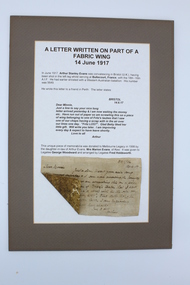 Melbourne Legacy
Document, Letter written on part of a fabric wing 14 June 1917, 1917
... The letter says 'Dear Minnie, Just a line to say your nice long letter arrived yesterday and I am now waiting the money etc. ...The letter says 'Dear Minnie, Just a line to say your nice long letter arrived yesterday and I am now waiting the money etc. ...A wartime letter written by Arthur Evans that was later mounted on card for display purposes. It was donated to Legacy in 1998. The letter was written on the fabric of an aircraft wing. The letter was written by Arthur Stanley Evans while convalescing in Briston in 1917. He had been injured at Bullecourt, France with the 18th-16th AIF. The letter says 'Dear Minnie, Just a line to say your nice long letter arrived yesterday and I am now waiting the money etc. Have run out of paper so am scrawling this on a piece of wing belonging to one of Fritz's tubes that I saw one of our chaps having a scrap with in the air over our lines one day. "Fritz LOST". Glad Betty liked her little gift. Will write you later. I am improving every day and expect to have leave shortly. Love to all, Arthur." Not to let war time shortages of paper get in Arthur Evans way, he improvised and his letter to Minnie, it arrived intact. The fabric would be quite durable and light. A great memento to show family and friends.Despite war time shortages a little ingenuity can overcome many difficulties.Backing, ply board. Letter and short story typed on white cardboard, cardboard fixed to ply backing. Original letter fixed to white cardboard. Lower left hand corner folded over showing the reverse side of the fabric. Original letter rectangular in shape. All of the above is surrounded by a brownish border.The letter, the story and how the letter came to Legacy is printed in brown ink. The original letter is hand written on a piece of wing fabric from a German aircraft shot down over Allied lines.souvenir, world war one -
 Southern Sherbrooke Historical Society Inc.
Photograph - Glen Park Homestead, Percy and Cissy Johns on verandah, early 1900s
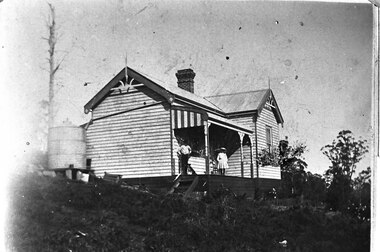
... B&W photo shows siblings Percy and Cissie (Minnie Agnes) Johns on the verandah of their home, Glen Park Farm, Selby. Percy looks in his early teens, making the photo around 1910 or later. He is wearing a long...B&W photo shows siblings Percy and Cissie (Minnie Agnes) Johns on the verandah of their home, Glen Park Farm, Selby. Percy looks in his early teens, making the photo around 1910 or later. He is wearing a long ...B&W photo shows siblings Percy and Cissie (Minnie Agnes) Johns on the verandah of their home, Glen Park Farm, Selby. Percy looks in his early teens, making the photo around 1910 or later. He is wearing a long-sleeved pale shirt, long dark trousers tucked into knee-high boots, and possibly a dark hat. Cissie is wearing a pale, knee-length dress, dark stockings, and a pale, wide-brimmed hat. She is aged about 10. A medium sized dark dog sits at Percy's feet. The house is an L-shaped weatherboard with two gables at right-angles and a verandah with a bullnosed roof, ornate support posts, and a striped end piece from the roof. Wooden steps lead down from side. There is a large brick chimney where the two wings meet, and a metal water tank to the side. There are large trees, both in leaf and dead, plus some flowers near the verandah. -
 Southern Sherbrooke Historical Society Inc.
Photograph - Cissie and Percy Johns
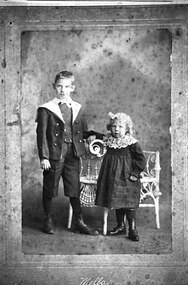
... Minnie Agnes (Cissy) Johns, children of Edwin Johns of Selby. Percy is about 10 years old. He is wearing what appears to be a sailor suit comprising a dark, double-breasted jacket with a deep, pale collar which is squared off at the back, a dark waistcoat buttoned to the neck, with a pale bow and collar showing, and dark knee-length pants over dark stockings and ankle boots. The jacket is undone. Cissy looks to be about 3 or 4. She is wearing a dark, knee-length dress with a yoke, long...Minnie Agnes (Cissy) Johns, children of Edwin Johns of Selby. Percy is about 10 years old. He is wearing what appears to be a sailor suit comprising a dark, double-breasted jacket with a deep, pale collar which is squared off at the back, a dark waistcoat buttoned to the neck, with a pale bow and collar showing, and dark knee-length pants over dark stockings and ankle boots. The jacket is undone. Cissy looks to be about 3 or 4. She is wearing a dark, knee-length dress with a yoke, long ...B&W studio portrait of Percy and Minnie Agnes (Cissy) Johns, children of Edwin Johns of Selby. Percy is about 10 years old. He is wearing what appears to be a sailor suit comprising a dark, double-breasted jacket with a deep, pale collar which is squared off at the back, a dark waistcoat buttoned to the neck, with a pale bow and collar showing, and dark knee-length pants over dark stockings and ankle boots. The jacket is undone. Cissy looks to be about 3 or 4. She is wearing a dark, knee-length dress with a yoke, long sleeves, and a light, wide lace collar. She has dark stockings and calf-length buttoned boots. She has a bow in her hair. The children are standing in front of an ornate wicker chair with one arm resting on the arm of the chair. The name 'Melba' is written on the cardboard frame around the photo, and 'Melba [illegible but presumably '& Co.'] Melbourne' is embossed on the bottom right corner of the photo. The original photo is badly foxed. Dated c.1905. -
 Linton and District Historical Society Inc
Photograph, Stewart and Co Melbourne, Minnie and Clair Simmond
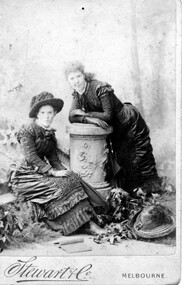
... Minnie Simmond Clair Simmond "S E Surman (14) Minnie and Clair Simmond" Sepia photograph of two young ladies one seated on low bench wearing hat and fancy long dress right hand on lap, the other wearing fancy long dress leaning on pillar with arms crossed, hat on floor. ...Identified by Mrs Stella Surman as Minnie and Clair Simmond.Sepia photograph of two young ladies one seated on low bench wearing hat and fancy long dress right hand on lap, the other wearing fancy long dress leaning on pillar with arms crossed, hat on floor."S E Surman (14) Minnie and Clair Simmond" minnie simmond, clair simmond -
 City of Melbourne Libraries
Photograph, Bull, Hugh Jones, 1897-1993, Seventh Day Adventists Camp at Hampton: W.J. Westerman, G.G. Stewart & C.H. Watson
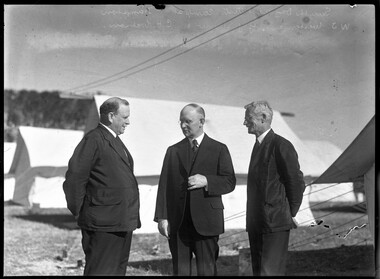
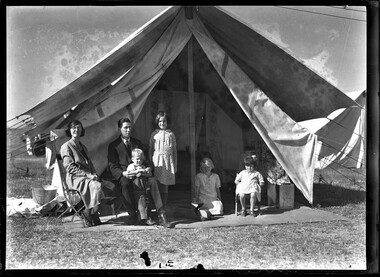
... With such rapid market saturation, expensive novel hazards, waning interest, long opening hours, often to midnight, and price cutting of game fees from one shilling to sixpence and then to threepence amongst some courses, the bubble was bound to burst. The Sporting Globe columnist J.M.Dillon on 20 May 1931 lamented- £100,000 LOST Failure of ‘Minnie’ Golf. ...With such rapid market saturation, expensive novel hazards, waning interest, long opening hours, often to midnight, and price cutting of game fees from one shilling to sixpence and then to threepence amongst some courses, the bubble was bound to burst. The Sporting Globe columnist J.M.Dillon on 20 May 1931 lamented- £100,000 LOST Failure of ‘Minnie’ Golf. ...Photographer notations on slide: Seventh Day Adventists Camp at Hampton W.J. Westerman, G.G. Stewart & C.H. Watson Published: 28 December 1933 Published title: SEVENTH DAY ADVENTISTS. Published caption: “I. — The Annual Camp of the Seventh Day Adventists in Highett-road, Hampton, comprising more than 250 tents and accommodating over a thousand persons. II. —W. J. Westerman (vice-president of Australasian) and Pastor G. G. Stewart (president of Victoria), conversing with Pastor C. H. Watson (world president of the Seventh Day Adventists).- III.— Evangelist E. R. Gane and family.” SEVENTH DAY ADVENTISTS. (1933, December 28). The Age (Melbourne, Vic. : 1854 - 1954), p. 9. Retrieved August 1, 2025, from http://nla.gov.au/nla.news-article203356427 Research by project volunteer, Fiona Collyer: In December 1933, the annual Seventh Day Adventists Conference of Victoria was held, with over a 1000 participants camping for ten days at Highett Road Hampton. Pastor Charles H. Watson, world president of the Seventh Day Adventists, Walter J. Westerman, vice-president of Australasian and Pastor George G. Stewart, president of Victoria attended. Interestingly, The Age newspaper modified the original photo in their publication, placing the three men close to each other. Description: Three middle aged men dressed in suits converse in front of tents. In December 1933, delegates from all over Victoria and beyond travelled to Melbourne for the annual Seventh Day Adventists Conference of Victoria, held over ten days on a vacant allotment at Highett Road Hampton. A canvas town of 250 tents for over 1000 campers was created along with large marquees for lectures, devotional services and kitchens. Many daily visitors also attended the lectures and services. The principal speaker was Victorian born world president of the Seventh Day Adventists, Pastor Charles H. Watson (1877-1962), who travelled from Washington DC for the event. The Highett Street campers attended a busy schedule of bible readings, devotional services and health lectures during the ten days of the camp. Lecture subjects included- “Among the Head Hunters of the Solomon Islands”, “ Looking Through the Prophetic Telescope into 1934”, “Soul Surgery”, “Viewing the Celestial Land Through the Prophetic Telescope”and “The Four Horsemen of the Apocalypse”. The Seventh Day Adventist religion was established in the USA in 1863. One of its co-founders was American Ellen G. White whose writings are regarded as divinely inspired and are still adhered to today. Ellen preached on the “Eight Laws of Health”- Nutrition, exercise, water, sunshine, temperance, air, rest and trust in God. Adventists regard their bodies as holy temples and avoid food deemed by the Bible as unclean. They eat a mainly plant based diet with no caffeinated beverages and abstain from alcohol and tobacco. They believe in the observance of Saturday, the seventh day of the week in the Christian (Gregorian) and Hebrew calendars as the sabbath and the literal and imminent second coming of Jesus Christ. New converts are baptised by immersion in water. The Adventists opened the Warburton Sanitarium in 1910 as a health retreat, integrating their holistic health philosophy of physical, mental and spiritual well being. It was a resort in the hills “among picturesque mountain scenery…surrounded by tall forests and deep fern gullies…” where highly strung Melburians could alleviate their digestive maladies, stress and jaded nerves as “…worn down nervous systems mend quickly in this peaceful environment…invigorating air and an abundance of home-grown fruit, vegetables, fresh eggs, milk, and cream help to build healthy bodies”. The resort also offered hydrotherapy, massage and electrical treatments. An advertisement in The Argus- 1 December 1947 assured readers- “EVERYTHING SUNNY AGAIN." “That's how you'll feel when you say farewell to Warburton Sanitarium and Hospital after spending a holiday here. Victoria's Hydro is famous far and wide for wonders worked with sufferers from nervous and digestive disorders. Wholesome food, perfectly cooked; splendid air, regulated exercise, sweet natural sleep; these quickly correct faulty digestion, restore vitality, bring back that sunny optimism natural to healthy people. Massage and curative baths under medical supervision…” Later, after further building work, it became the Warburton Hospital with medical, casualty and obstetrics wards as well as offering strategies to stop smoking, lose weight and for stress management. The hospital ceased operation in 2001. Ellen G. White wrote “God sent me to Australia” and in 1891, accompanied by her son William C. White she arrived in Australia to start a Bible school, spread her health philosophy and for missionary work. At first health food products were imported from America, but it soon became apparent that due to the expense and the food becoming stale over the long journey, that local manufacturing was necessary. In 1898 William secured the services of American Adventist baker Edward C. Halsey, who had worked at Dr Kellogg’s Battle Creek (“Cereal City”), Sanitarium, Michigan, USA. They rented the St George’s bakery in Northcote, Melbourne, producing the first ready to eat breakfast cereal Granola, Caramel Cereal, and peanut butter. The fledgling company relocated to larger premises in Cooranbong, NSW soon after. The Sanitarium Health Food Company opened a factory in Warburton in 1925, manufacturing Granose Biscuits, Cerix Puffed Wheat, San-Bran, Bixies malted wheat flakes, Betta peanut butter, Marmite, “Kwic-Bru - A delicious health “coffee” made from choicest cereals and free from drugs that affect the heart and nerves” In 1928, Sanitarium bought out Grain Products Limited who were manufacturing a sweet cereal biscuit called Weet-Bix which soon became Australia’s favourite breakfast cereal. The Warburton factory closed in 1997, with manufacturing shifting interstate. Sanitarium breakfast cereal boxes offered free collectable cards inside and children could buy albums from grocers for sixpence and mount the cards. Subjects of the albums included- “Aboriginal Tribes, Legends, Customs”, “Australia- Yesterday and Today”, “Marvels of the Great Barrier Reef”, “Advance Australia- a Pageant of the Years”. In 1902 the Adventist’s opened the “Pure Food Vegetarian Cafe” in Sydney (In 1907 the name was changed to “Sanitarium Health Food Cafe”), Eating vegetarian food was definitely a curiosity. “Cristina” reviewed the cafe for The Australasian-27 October 1906. Topics For The Block. “Feeling somewhat like a criminal, and hoping to escape detection, I stealthily made my way into a vegetarian restaurant the other day... If my friends happened to catch me walking in there, I should henceforth be considered a crank, a faddist, and little short of a lunatic! Whom did I find within, seated with the air of habitués at the small tables, but heaps of my friends. They had all this while been pursuing their vegetarian way, layin' low and sayin' nuffin'. Flesh-eaters, now that the Sydney summer has set in apparently in good earnest, are beginning to wonder if the vegetarians are not wiser in their day and generation. Roast beef, hot cornea beef, ragouts, and meat curries, the very thought of them makes one feel hot. Frosted lemon pudding, stewed fruits, wheatmeal rolls, and tomatoes sound nice when you look at their names on the vegetarian menu. Such weird messes are served, square, unintelligible blocks of some brown substance, a few bites of which form a full and satisfying meal. Cold nut foods, granose, nuttose, and jam protose, bromose, with jelly and various "ose" sandwiches, impossible for the unbeliever to diagnose, are put before you. You drink malted nut broth, you eat gluten sticks, stewed beans, lentil patties, with vegetable sauce, any or all of which are distinctly nourishing and filling at the price. A mock (decidedly mock) veal cutlet or a red lentil roast is sufficient lunch, it appears, for anyone. Thus, "you obtain the best working results from your machinery with the least possible expenditure..." In December 1906 the Adventists branched out to Melbourne, opening the Sanitarium Health Food Cafe at 289 Collins Street next to the Royal Bank building. (corner Collins and Elizabeth Streets, demolished in 1939). Their motto was “Quality and Purity”. “Cynthia” of The Leader “Social Circle” column reviewed the cafe in 9 March 1907- “Hundreds of people have a feeling of positive affection for a diet that will be satisfying, appetising and nourishing, without having meat for its backbone. It will come as news that we have in Melbourne a cafe where you can really enjoy yourself without eating anything in the way of meat. Cream, custard, cheese and the like are not cold shouldered out of the menu, and the housewife in search of new dishes will find here ever so much in the way of suggestions. Nuts figure conspicuously in the menu, and lentil and walnut cutlets may be instanced among the delicacies. Beans are cooked in quite alluring fashion, while creamed parsnips are excellent. For sandwiches you could hardly desire anything more appetising than granosi biscuits, and nut cheese. The combination is suggestive of school lunches, and nut meat might well be employed as a variant. A visit to the cafe itself — it is next the Royal Bank in Collins-street — will surprise anyone used to the average vegetarian restaurant. Every thing is fresh, fragrant, and thoroughly modern… It is run, in connection with that curious people the Seventh Day Adventists.” However, “Adele” writing for the Evelyn Observer and Bourke East Record -13 December 1907 had a different experience- CITY RESTAURANTS. “There is no glamour from the outside. We enter the dining room at six and secure a seat at a small table, for this night we are going to dine on vegetables. Some people pride themselves on being vegetarians, and devote a great deal of their spare cash and energy to disseminating vegetarian principles. I shall not in a hurry forget the dinner we tried to get through at this vegetarian restaurant. There was put before us plate after plate of vegetables not soaked, but sodden with water, not an atom of flavouring or dressing; no attempt was made to give the slightest piquancy to potato, cabbage, turnip or carrot. I beg pardon, I am unjust, there were two caterpillars in the cabbage. It is astonishing how persistently ordinary cooks spoil vegetables in the process of cooking and how little they understand the value of vegetables on a menu.” From the extensive menu of 1924, you could order cream of green pea soup, followed by nut meat with Yorkshire pudding, egg timbales, stewed brown lentils, savoury rissoles with piquant sauce. Among the dessert offerings were creamed sago, steamed figs and walnut drops. Washed down with fermented wine and to finish, “Frucerea”, a coffee substitute essence made from fruit and cereal. A four course meal of soup, entree, vegetables and sweets cost 1/6 in 1924. Proving that plant-based food was not just a novelty, 67,000 meals were served at the cafe in 1918, rising to 73,000 in 1921. Later the Sanitarium Cafe moved to 293 Little Collins Street, (opposite Royal Arcade) sharing the building with The Lilliput Golf Course, a miniature golf course of 18 holes. The course was a replica of the fashionable Lido Course in France and was open daily from 10am to midnight with a green fee of one shilling. It featured goldfish, waterfalls and dance music. Lilliput boasted that they were “Melbourne’s coolest indoor course” Miniature golf (mini, minnie, midget, miget, Tom Thumb, Wee golf, putt-putt, pigmy, peewee, crazy golf, obstacle golf) swept the globe in the 1930s, starting in the USA, then Europe. The courses provided affordable recreation during uncertainty at the start of the Great Depression. The craze arrived in Sydney September 1930 with the first mini golf course opening in the basement of the State Theatre. It featured a replica Sydney Harbour Bridge and attracted over 1000 players a day at one shilling per game. The miniature golf bug hit Melbourne hard in 1930-31 with nearly 200 courses springing up in the CBD and suburbs within a few months. The first miniature golf course to open in Melbourne was on 4 October 1930 in the basement of recently built art deco style Wentworth House at 203 Collins Street, designed by architect Cedric Heise Ballantyne, (also designed Regent Theatre, Plaza Ballroom, Athenaeum Club, National Theatre, St Kilda, built in 1930, demolished in 1974 for the City Square) It was managed by J. C. Williamson who advertised for a “Girl Spruiker” who “Must be Young, Attractive Personality, and Able to Talk to the Public” to work at the course. The Age 26 September 1930 reported - “The Wentworth House management have spared no expense in preparing the links. Water hazards, sand bunkers, running streams, ancestral castles, moats and a cunning drawbridge have each been devised to test the skill of players, while the walls and ceiling have been "atmospherically" treated to convey an exterior effect”. Even Melbourne City Council jumped on the bandwagon, leasing the lower hall of Melbourne Town Hall to colourful car dealer and racehorse owner Mr A. G. Barlow for £43 per week for the “Kit Kat Tiny Golf Course”, opening on 11 December 1930. (Turf identity, Mr Alexander George Barlow, (1880-1937) who raced under the nom de course “A. G. Vauxhall”, owned filly Frances Tressady, who in 1923 won the Victoria Derby and Oaks Stakes double and came fifth in the Melbourne Cup. The “Frances Tressady Stakes” is held each March at Flemington Racecourse in honour of the horse, the last filly to win the Derby. Barlow was the proprietor of Barlow Brothers Pty Ltd car dealership at 442 Elizabeth Street, Melbourne. He played 14 games for Carlton Football Club (VFL) on the half-forward line from 1901-1903). Patrons could vie for The Herald Miniature Golf Championship Cup, a gold cup worth £7/7, in an eight week long competition. Sports newspaper The Sporting Globe also offered a Cup and prize money. Many courses offered prizes of theatre tickets, cash and cigarettes. Myer’s department store, hoping to cash in on the fad, advertised in Melbourne’s newspapers that their Sports Department could design and equip complete miniature golf courses using “Fairway” imitation turf at 4/6 a yard. Newspaper cartoonists loved to lampoon the fad. Both Percy Leason, cartoonist for society magazine Table Talk and Syd Miller of Smith’s Weekly depicted “real” golfers causing havoc on a mini golf course, showing that being a “real” golf player was no advantage to playing miniature golf. But bust often follows boom. With such rapid market saturation, expensive novel hazards, waning interest, long opening hours, often to midnight, and price cutting of game fees from one shilling to sixpence and then to threepence amongst some courses, the bubble was bound to burst. The Sporting Globe columnist J.M.Dillon on 20 May 1931 lamented- £100,000 LOST Failure of ‘Minnie’ Golf. “Miniature golf might have provided fun and jokes for thousands of people in Australia, but there were many for whom it panned out a tragedy. It is likely that the dead losses of those who attempted to make money out of the game in Australia were in the vicinity of £100,000. …For a while there was hardly a spare block of land, or a possible “site” in the shape of a hall, or a showroom, in Sydney and Melbourne, that some one was not after to set upon it a “minnie links.” Big amusement firms and private individuals anxious to make money began to run courses. Practically every individual who touched the game had his finger’s financially burnt. …From the approximately £60,000 invested in Melbourne alone, there must have been £25,000 lost. …There are now dozens of courses going to ruin, and many more that the owners would be happy to give away if the takers would remove from them obligations of leases, &c…” The lease on the “Kit Kat Tiny Golf Club” at the Melbourne Town Hall expired on 30 April 1931, with Mr Barlow losing £798 on the venture. The hazards and fittings, which cost £400 and included a large replica of the Town Hall, now worthless. Due to declining patronage, the Little Collins Street cafe closed in 1938, although the adjacent shop continued to sell Sanitarium products. In New Zealand, the first Sanitarium factory opened in Christchurch in 1900, with the company later opening factories in Palmerston North and Auckland. The Adventists opened vegetarian cafes, firstly at 37 Taranaki Street Wellington in 1906, followed by cafes in Auckland, Christchurch and Dunedin. Weet-Bix is also New Zealand’s favourite cereal- there the jingle is “Kiwi kids are Weet-Bix kids.” In 1955, the Australian Women’s Weekly ran an illustrated, full colour advertisement featuring New Zealand born Edmund Hillary (later Sir) 1919-2008, who, along with Sherpa Tenzing Norgay, was the first climber to reach the summit of Mount Everest on 29 March 1953. The Australian Women’s Weekly, 30 March, 1955- “WEET-BIX carried by Hillary on Himalayan adventure! c/- N.Z. Alpine Club Inc., Dunedin, New Zealand. The Manager, Sanitarium Health Food Company, Christchurch, N.Z. Dear Sir. …Weet-Bix was chosen at my special request as I had always felt that some easily prepared form of breakfast was essential to the primitive conditions of high camps. Weet-Bix fulfilled its task very well indeed. We usually had them with hot milk (powdered) and sugar, and even when we were unable to eat anything else, we usually managed to have a little Weet-Bix . . . I regard them as a great success and expect they will be more widely used in the Himalayas in future. Yours faithfully, (Signed) E.P. Hillary. Sanitarium Marmite - motto- “Too much spoils the flavour”- is as beloved with Kiwis as Vegemite is with Australians. In 1966, a fire gutted the Christchurch Marmite factory causing a nation wide shortage. Once the factory was rebuilt, Sanitarium relaunched the yeasty extract in reusable glass tumblers with printed designs such as yachts, New Zealand birds and vintage cars. These popular collectibles can still be found in the kitchen cupboards of many New Zealand baches (holiday homes). After the devastating 2011 earthquake in Christchurch damaged the Marmite factory causing shortages and panic buying, a “Marmageddon” was declared with jars of the “black gold” advertised online for up to NZ$800. Consumers were advised to spread their Marmite sparingly until production resumed. (The Christchurch plant reportedly produces around 640,000kg of Marmite per year). Sanitarium Health and Wellbeing Company is exempt from paying company income tax on their profits due to their ownership by a religious organisation. Although not a compulsory rule for salvation, Adventists are encouraged to pay a tithe of 10% of their income to the church to support the ministry in God’s work. Nowadays, there are over 25 million members of the Seventh Day Adventists Church in 200 countries. ITEMS OF INTEREST (1933, December 22). The Argus (Melbourne, Vic. : 1848 - 1957), p. 8. Retrieved July 21, 2025, from http://nla.gov.au/nla.news-article11723188 SEVENTH DAY ADVENTISTS. (1933, December 28). The Age (Melbourne, Vic. : 1854 - 1954), p. 9. Retrieved July 1, 2025, from http://nla.gov.au/nla.news-article203356427 EVANGELISTS' CAMP (1933, December 20). The Herald (Melbourne, Vic. : 1861 - 1954), p. 30. Retrieved July 1, 2025, from http://nla.gov.au/nla.news-article243213209 Master Butchers Have A Time Pilots FOR School Air Race Charity Golf At Riversdale (1931, May 1). The Sun News-Pictorial (Melbourne, Vic. : 1922 - 1954; 1956), p. 14-15. Retrieved September 4, 2025, from http://nla.gov.au/nla.news-article276159136 2000 ADVENTISTS UNDER CANVAS (1933, December 27). The Herald (Melbourne, Vic. : 1861 - 1954), p. 17. Retrieved July 1, 2025, from http://nla.gov.au/nla.news-article243223698 TOPICS FOR THE BLOCK. (1906, October 27). The Australasian (Melbourne, Vic. : 1864 - 1946), p. 45. Retrieved August 30, 2025, from http://nla.gov.au/nla.news-article139178204 https://en.wikipedia.org/wiki/Seventh-day_Adventist_Church https://www.sanitarium.com/au/about/sanitarium-story/profits-for- ENTERTAINMENT AT MENZIES'. (1906, December 6). Punch (Melbourne, Vic. : 1900 - 1918; 1925), p. 26. Retrieved August 3, 2025, from http://nla.gov.au/nla.news-article175380296 https://encyclopedia.adventist.org/article?id=9HN0&highlight=Conference SOCIAL CIRCLE (1907, March 9). Leader (Melbourne, Vic. : 1862 - 1918, 1935), p. 41. Retrieved August 3, 2025, from http://nla.gov.au/nla.news-article196649677 CITY RESTAURANTS. (1907, December 13). Evelyn Observer and Bourke East Record (Vic. : 1902 - 1917), p. 1 (MORNING.). Retrieved August 3, 2025, from http://nla.gov.au/nla.news-article61133109 Advertising (1924, May 6). The Sun News-Pictorial (Melbourne, Vic. : 1922 - 1954; 1956), p. 9. Retrieved August 3, 2025, from http://nla.gov.au/nla.news-article274271406 1930, December 5). The Herald (Melbourne, Vic. : 1861 - 1954), p. 14. Retrieved August 5, 2025, from http://nla.gov.au/nla.news-page26374135 Thousands Are Still Playing Miniature Golf (1931, January 2). The Herald (Melbourne, Vic. : 1861 - 1954), p. 11. Retrieved August 8, 2025, from http://nla.gov.au/nla.news-article242880087 MINIATURE GOLF. (1930, October 16). The Argus (Melbourne, Vic. : 1848 - 1957), p. 10. Retrieved August 8, 2025, from http://nla.gov.au/nla.news-article4209280 THE REAL GOLFER WHO FORGOT HIMSELF ON THE MINIATURE GOLF COURSE (1930, November 13). Table Talk (Melbourne, Vic. : 1885 - 1939), p. 13. Retrieved August 8, 2025, from http://nla.gov.au/nla.news-article146706596 Advertising (1930, December 5). The Herald (Melbourne, Vic. : 1861 - 1954), p. 14. Retrieved August 8, 2025, from http://nla.gov.au/nla.news-article242761991 Advertising (1931, January 9). The Herald (Melbourne, Vic. : 1861 - 1954), p. 12. Retrieved August 8, 2025, from http://nla.gov.au/nla.news-article242887972 1955, March 30). The Australian Women's Weekly (1933 - 1982), p. 38. Retrieved August 9, 2025, from http://nla.gov.au/nla.news-page4812489 £100,000 LOST (1931, May 20). Sporting Globe (Melbourne, Vic. : 1922 - 1954), p. 1 (Edition1). Retrieved August 14, 2025, from http://nla.gov.au/nla.news-article183023946 1930, December 5). The Herald (Melbourne, Vic. : 1861 - 1954), p. 14. Retrieved August 15, 2025, from http://nla.gov.au/nla.news-page26374135 Advertising (1931, January 23). The Herald (Melbourne, Vic. : 1861 - 1954), p. 14. Retrieved August 15, 2025, from http://nla.gov.au/nla.news-article242887795 MINIATURE GOLF. (1931, February 5). The Dandenong Journal (Vic. : 1927 - 1954), p. 6. Retrieved August 16, 2025, from http://nla.gov.au/nla.news-article201082526 Still Time To Enter Midge (1931, January 16). The Herald (Melbourne, Vic. : 1861 - 1954), p. 12. Retrieved August 16, 2025, from http://nla.gov.au/nla.news-article242888830 WIT OF THE WEEK (1930, October 23). Table Talk (Melbourne, Vic. : 1885 - 1939), p. 23. Retrieved August 29, 2025, from http://nla.gov.au/nla.news-article146455050 Advertising (1930, October 2). Table Talk (Melbourne, Vic. : 1885 - 1939), p. 16. Retrieved August 18, 2025, from http://nla.gov.au/nla.news-article146454620 MIDGET GOLF LINKS. (1930, September 26). The Age (Melbourne, Vic. : 1854 - 1954), p. 6. Retrieved August 18, 2025, from http://nla.gov.au/nla.news-article202235074 https://www.smh.com.au/national/fairfax-archive-mini-golf-20131125-2y608.html TURF NOTES (1923, November 6). The Ballarat Star (Vic. : 1865 - 1924), p. 6. Retrieved September 3, 2025, from http://nla.gov.au/nla.news-article213855201 Advertising (1930, October 4). The Herald (Melbourne, Vic. : 1861 - 1954), p. 10. Retrieved October 14, 2025, from http://nla.gov.au/nla.news-article242937272 LAUGHTER AND TEARS. (1930, November 15). Smith's Weekly (Sydney, NSW : 1919 - 1950), p. 21. Retrieved September 9, 2025, from http://nla.gov.au/nla.news-article234426874 Advertising (1947, December 1). The Argus (Melbourne, Vic. : 1848 - 1957), p. 5. Retrieved September 15, 2025, from http://nla.gov.au/nla.news-article22523355Photographer notations on slide: "Seventh Day Adventists Camp at Hampton W.J. Westerman, G.G. Stewart & C.H. Watson".religion, health food, mini golf, 1930-1939, tents, churches, camps -
 City of Melbourne Libraries
Photograph, Bull, Hugh Jones, 1897-1993, Seventh Day Adventists Camp at Hampton: E. Gane + family
... With such rapid market saturation, expensive novel hazards, waning interest, long opening hours, often to midnight, and price cutting of game fees from one shilling to sixpence and then to threepence amongst some courses, the bubble was bound to burst. The Sporting Globe columnist J.M.Dillon on 20 May 1931 lamented- £100,000 LOST Failure of ‘Minnie’ Golf. ...With such rapid market saturation, expensive novel hazards, waning interest, long opening hours, often to midnight, and price cutting of game fees from one shilling to sixpence and then to threepence amongst some courses, the bubble was bound to burst. The Sporting Globe columnist J.M.Dillon on 20 May 1931 lamented- £100,000 LOST Failure of ‘Minnie’ Golf. ...Photographer notations on slide: Seventh Day Adventists Camp. E Gane + family Published: 28 December 1933 Published title: SEVENTH DAY ADVENTISTS. Published caption: “I. — The Annual Camp of the Seventh Day Adventists in Highett-road, Hampton, comprising more than 250 tents and accommodating over a thousand persons. II. —W. J. Westerman (vice-president of Australasian) and Pastor G. G. Stewart (president of Victoria), conversing with Pastor C. H. Watson (world president of the Seventh Day Adventists).- III.— Evangelist E. R. Gane and family.” SEVENTH DAY ADVENTISTS. (1933, December 28). The Age (Melbourne, Vic. : 1854 - 1954), p. 9. Retrieved August 1, 2025, from http://nla.gov.au/nla.news-article203356427 Research by project volunteer, Fiona Collyer: In December 1933, evangelist Mr E.R. Gane and his family gather outside their tent during the ten day Seventh Day Adventist Conference held in Highett Road, Hampton. Description: A woman, man and four small children sit and stand in front of a tent. One child plays with a toy train. In December 1933, delegates from all over Victoria and beyond travelled to Melbourne for the annual Seventh Day Adventists Conference of Victoria, held over ten days on a vacant allotment at Highett Road Hampton. A canvas town of 250 tents for over 1000 campers was created along with large marquees for lectures, devotional services and kitchens. Many daily visitors also attended the lectures and services. The principal speaker was Victorian born world president of the Seventh Day Adventists, Pastor Charles H. Watson (1877-1962), who travelled from Washington DC for the event. The Highett Street campers attended a busy schedule of bible readings, devotional services and health lectures during the ten days of the camp. Lecture subjects included- “Among the Head Hunters of the Solomon Islands”, “ Looking Through the Prophetic Telescope into 1934”, “Soul Surgery”, “Viewing the Celestial Land Through the Prophetic Telescope”and “The Four Horsemen of the Apocalypse”. The Seventh Day Adventist religion was established in the USA in 1863. One of its co-founders was American Ellen G. White whose writings are regarded as divinely inspired and are still adhered to today. Ellen preached on the “Eight Laws of Health”- Nutrition, exercise, water, sunshine, temperance, air, rest and trust in God. Adventists regard their bodies as holy temples and avoid food deemed by the Bible as unclean. They eat a mainly plant based diet with no caffeinated beverages and abstain from alcohol and tobacco. They believe in the observance of Saturday, the seventh day of the week in the Christian (Gregorian) and Hebrew calendars as the sabbath and the literal and imminent second coming of Jesus Christ. New converts are baptised by immersion in water. The Adventists opened the Warburton Sanitarium in 1910 as a health retreat, integrating their holistic health philosophy of physical, mental and spiritual well being. It was a resort in the hills “among picturesque mountain scenery…surrounded by tall forests and deep fern gullies…” where highly strung Melburians could alleviate their digestive maladies, stress and jaded nerves as “…worn down nervous systems mend quickly in this peaceful environment…invigorating air and an abundance of home-grown fruit, vegetables, fresh eggs, milk, and cream help to build healthy bodies”. The resort also offered hydrotherapy, massage and electrical treatments. An advertisement in The Argus- 1 December 1947 assured readers- “EVERYTHING SUNNY AGAIN." “That's how you'll feel when you say farewell to Warburton Sanitarium and Hospital after spending a holiday here. Victoria's Hydro is famous far and wide for wonders worked with sufferers from nervous and digestive disorders. Wholesome food, perfectly cooked; splendid air, regulated exercise, sweet natural sleep; these quickly correct faulty digestion, restore vitality, bring back that sunny optimism natural to healthy people. Massage and curative baths under medical supervision…” Later, after further building work, it became the Warburton Hospital with medical, casualty and obstetrics wards as well as offering strategies to stop smoking, lose weight and for stress management. The hospital ceased operation in 2001. Ellen G. White wrote “God sent me to Australia” and in 1891, accompanied by her son William C. White she arrived in Australia to start a Bible school, spread her health philosophy and for missionary work. At first health food products were imported from America, but it soon became apparent that due to the expense and the food becoming stale over the long journey, that local manufacturing was necessary. In 1898 William secured the services of American Adventist baker Edward C. Halsey, who had worked at Dr Kellogg’s Battle Creek (“Cereal City”), Sanitarium, Michigan, USA. They rented the St George’s bakery in Northcote, Melbourne, producing the first ready to eat breakfast cereal Granola, Caramel Cereal, and peanut butter. The fledgling company relocated to larger premises in Cooranbong, NSW soon after. The Sanitarium Health Food Company opened a factory in Warburton in 1925, manufacturing Granose Biscuits, Cerix Puffed Wheat, San-Bran, Bixies malted wheat flakes, Betta peanut butter, Marmite, “Kwic-Bru - A delicious health “coffee” made from choicest cereals and free from drugs that affect the heart and nerves” In 1928, Sanitarium bought out Grain Products Limited who were manufacturing a sweet cereal biscuit called Weet-Bix which soon became Australia’s favourite breakfast cereal. The Warburton factory closed in 1997, with manufacturing shifting interstate. Sanitarium breakfast cereal boxes offered free collectable cards inside and children could buy albums from grocers for sixpence and mount the cards. Subjects of the albums included- “Aboriginal Tribes, Legends, Customs”, “Australia- Yesterday and Today”, “Marvels of the Great Barrier Reef”, “Advance Australia- a Pageant of the Years”. In 1902 the Adventist’s opened the “Pure Food Vegetarian Cafe” in Sydney (In 1907 the name was changed to “Sanitarium Health Food Cafe”), Eating vegetarian food was definitely a curiosity. “Cristina” reviewed the cafe for The Australasian-27 October 1906. Topics For The Block. “Feeling somewhat like a criminal, and hoping to escape detection, I stealthily made my way into a vegetarian restaurant the other day... If my friends happened to catch me walking in there, I should henceforth be considered a crank, a faddist, and little short of a lunatic! Whom did I find within, seated with the air of habitués at the small tables, but heaps of my friends. They had all this while been pursuing their vegetarian way, layin' low and sayin' nuffin'. Flesh-eaters, now that the Sydney summer has set in apparently in good earnest, are beginning to wonder if the vegetarians are not wiser in their day and generation. Roast beef, hot cornea beef, ragouts, and meat curries, the very thought of them makes one feel hot. Frosted lemon pudding, stewed fruits, wheatmeal rolls, and tomatoes sound nice when you look at their names on the vegetarian menu. Such weird messes are served, square, unintelligible blocks of some brown substance, a few bites of which form a full and satisfying meal. Cold nut foods, granose, nuttose, and jam protose, bromose, with jelly and various "ose" sandwiches, impossible for the unbeliever to diagnose, are put before you. You drink malted nut broth, you eat gluten sticks, stewed beans, lentil patties, with vegetable sauce, any or all of which are distinctly nourishing and filling at the price. A mock (decidedly mock) veal cutlet or a red lentil roast is sufficient lunch, it appears, for anyone. Thus, "you obtain the best working results from your machinery with the least possible expenditure..." In December 1906 the Adventists branched out to Melbourne, opening the Sanitarium Health Food Cafe at 289 Collins Street next to the Royal Bank building. (corner Collins and Elizabeth Streets, demolished in 1939). Their motto was “Quality and Purity”. “Cynthia” of The Leader “Social Circle” column reviewed the cafe in 9 March 1907- “Hundreds of people have a feeling of positive affection for a diet that will be satisfying, appetising and nourishing, without having meat for its backbone. It will come as news that we have in Melbourne a cafe where you can really enjoy yourself without eating anything in the way of meat. Cream, custard, cheese and the like are not cold shouldered out of the menu, and the housewife in search of new dishes will find here ever so much in the way of suggestions. Nuts figure conspicuously in the menu, and lentil and walnut cutlets may be instanced among the delicacies. Beans are cooked in quite alluring fashion, while creamed parsnips are excellent. For sandwiches you could hardly desire anything more appetising than granosi biscuits, and nut cheese. The combination is suggestive of school lunches, and nut meat might well be employed as a variant. A visit to the cafe itself — it is next the Royal Bank in Collins-street — will surprise anyone used to the average vegetarian restaurant. Every thing is fresh, fragrant, and thoroughly modern… It is run, in connection with that curious people the Seventh Day Adventists.” However, “Adele” writing for the Evelyn Observer and Bourke East Record -13 December 1907 had a different experience- CITY RESTAURANTS. “There is no glamour from the outside. We enter the dining room at six and secure a seat at a small table, for this night we are going to dine on vegetables. Some people pride themselves on being vegetarians, and devote a great deal of their spare cash and energy to disseminating vegetarian principles. I shall not in a hurry forget the dinner we tried to get through at this vegetarian restaurant. There was put before us plate after plate of vegetables not soaked, but sodden with water, not an atom of flavouring or dressing; no attempt was made to give the slightest piquancy to potato, cabbage, turnip or carrot. I beg pardon, I am unjust, there were two caterpillars in the cabbage. It is astonishing how persistently ordinary cooks spoil vegetables in the process of cooking and how little they understand the value of vegetables on a menu.” From the extensive menu of 1924, you could order cream of green pea soup, followed by nut meat with Yorkshire pudding, egg timbales, stewed brown lentils, savoury rissoles with piquant sauce. Among the dessert offerings were creamed sago, steamed figs and walnut drops. Washed down with fermented wine and to finish, “Frucerea”, a coffee substitute essence made from fruit and cereal. A four course meal of soup, entree, vegetables and sweets cost 1/6 in 1924. Proving that plant-based food was not just a novelty, 67,000 meals were served at the cafe in 1918, rising to 73,000 in 1921. Later the Sanitarium Cafe moved to 293 Little Collins Street, (opposite Royal Arcade) sharing the building with The Lilliput Golf Course, a miniature golf course of 18 holes. The course was a replica of the fashionable Lido Course in France and was open daily from 10am to midnight with a green fee of one shilling. It featured goldfish, waterfalls and dance music. Lilliput boasted that they were “Melbourne’s coolest indoor course” Miniature golf (mini, minnie, midget, miget, Tom Thumb, Wee golf, putt-putt, pigmy, peewee, crazy golf, obstacle golf) swept the globe in the 1930s, starting in the USA, then Europe. The courses provided affordable recreation during uncertainty at the start of the Great Depression. The craze arrived in Sydney September 1930 with the first mini golf course opening in the basement of the State Theatre. It featured a replica Sydney Harbour Bridge and attracted over 1000 players a day at one shilling per game. The miniature golf bug hit Melbourne hard in 1930-31 with nearly 200 courses springing up in the CBD and suburbs within a few months. The first miniature golf course to open in Melbourne was on 4 October 1930 in the basement of recently built art deco style Wentworth House at 203 Collins Street, designed by architect Cedric Heise Ballantyne, (also designed Regent Theatre, Plaza Ballroom, Athenaeum Club, National Theatre, St Kilda, built in 1930, demolished in 1974 for the City Square) It was managed by J. C. Williamson who advertised for a “Girl Spruiker” who “Must be Young, Attractive Personality, and Able to Talk to the Public” to work at the course. The Age 26 September 1930 reported - “The Wentworth House management have spared no expense in preparing the links. Water hazards, sand bunkers, running streams, ancestral castles, moats and a cunning drawbridge have each been devised to test the skill of players, while the walls and ceiling have been "atmospherically" treated to convey an exterior effect”. Even Melbourne City Council jumped on the bandwagon, leasing the lower hall of Melbourne Town Hall to colourful car dealer and racehorse owner Mr A. G. Barlow for £43 per week for the “Kit Kat Tiny Golf Course”, opening on 11 December 1930. (Turf identity, Mr Alexander George Barlow, (1880-1937) who raced under the nom de course “A. G. Vauxhall”, owned filly Frances Tressady, who in 1923 won the Victoria Derby and Oaks Stakes double and came fifth in the Melbourne Cup. The “Frances Tressady Stakes” is held each March at Flemington Racecourse in honour of the horse, the last filly to win the Derby. Barlow was the proprietor of Barlow Brothers Pty Ltd car dealership at 442 Elizabeth Street, Melbourne. He played 14 games for Carlton Football Club (VFL) on the half-forward line from 1901-1903). Patrons could vie for The Herald Miniature Golf Championship Cup, a gold cup worth £7/7, in an eight week long competition. Sports newspaper The Sporting Globe also offered a Cup and prize money. Many courses offered prizes of theatre tickets, cash and cigarettes. Myer’s department store, hoping to cash in on the fad, advertised in Melbourne’s newspapers that their Sports Department could design and equip complete miniature golf courses using “Fairway” imitation turf at 4/6 a yard. Newspaper cartoonists loved to lampoon the fad. Both Percy Leason, cartoonist for society magazine Table Talk and Syd Miller of Smith’s Weekly depicted “real” golfers causing havoc on a mini golf course, showing that being a “real” golf player was no advantage to playing miniature golf. But bust often follows boom. With such rapid market saturation, expensive novel hazards, waning interest, long opening hours, often to midnight, and price cutting of game fees from one shilling to sixpence and then to threepence amongst some courses, the bubble was bound to burst. The Sporting Globe columnist J.M.Dillon on 20 May 1931 lamented- £100,000 LOST Failure of ‘Minnie’ Golf. “Miniature golf might have provided fun and jokes for thousands of people in Australia, but there were many for whom it panned out a tragedy. It is likely that the dead losses of those who attempted to make money out of the game in Australia were in the vicinity of £100,000. …For a while there was hardly a spare block of land, or a possible “site” in the shape of a hall, or a showroom, in Sydney and Melbourne, that some one was not after to set upon it a “minnie links.” Big amusement firms and private individuals anxious to make money began to run courses. Practically every individual who touched the game had his finger’s financially burnt. …From the approximately £60,000 invested in Melbourne alone, there must have been £25,000 lost. …There are now dozens of courses going to ruin, and many more that the owners would be happy to give away if the takers would remove from them obligations of leases, &c…” The lease on the “Kit Kat Tiny Golf Club” at the Melbourne Town Hall expired on 30 April 1931, with Mr Barlow losing £798 on the venture. The hazards and fittings, which cost £400 and included a large replica of the Town Hall, now worthless. Due to declining patronage, the Little Collins Street cafe closed in 1938, although the adjacent shop continued to sell Sanitarium products. In New Zealand, the first Sanitarium factory opened in Christchurch in 1900, with the company later opening factories in Palmerston North and Auckland. The Adventists opened vegetarian cafes, firstly at 37 Taranaki Street Wellington in 1906, followed by cafes in Auckland, Christchurch and Dunedin. Weet-Bix is also New Zealand’s favourite cereal- there the jingle is “Kiwi kids are Weet-Bix kids.” In 1955, the Australian Women’s Weekly ran an illustrated, full colour advertisement featuring New Zealand born Edmund Hillary (later Sir) 1919-2008, who, along with Sherpa Tenzing Norgay, was the first climber to reach the summit of Mount Everest on 29 March 1953. The Australian Women’s Weekly, 30 March, 1955- “WEET-BIX carried by Hillary on Himalayan adventure! c/- N.Z. Alpine Club Inc., Dunedin, New Zealand. The Manager, Sanitarium Health Food Company, Christchurch, N.Z. Dear Sir. …Weet-Bix was chosen at my special request as I had always felt that some easily prepared form of breakfast was essential to the primitive conditions of high camps. Weet-Bix fulfilled its task very well indeed. We usually had them with hot milk (powdered) and sugar, and even when we were unable to eat anything else, we usually managed to have a little Weet-Bix . . . I regard them as a great success and expect they will be more widely used in the Himalayas in future. Yours faithfully, (Signed) E.P. Hillary. Sanitarium Marmite - motto- “Too much spoils the flavour”- is as beloved with Kiwis as Vegemite is with Australians. In 1966, a fire gutted the Christchurch Marmite factory causing a nation wide shortage. Once the factory was rebuilt, Sanitarium relaunched the yeasty extract in reusable glass tumblers with printed designs such as yachts, New Zealand birds and vintage cars. These popular collectibles can still be found in the kitchen cupboards of many New Zealand baches (holiday homes). After the devastating 2011 earthquake in Christchurch damaged the Marmite factory causing shortages and panic buying, a “Marmageddon” was declared with jars of the “black gold” advertised online for up to NZ$800. Consumers were advised to spread their Marmite sparingly until production resumed. (The Christchurch plant reportedly produces around 640,000kg of Marmite per year). Sanitarium Health and Wellbeing Company is exempt from paying company income tax on their profits due to their ownership by a religious organisation. Although not a compulsory rule for salvation, Adventists are encouraged to pay a tithe of 10% of their income to the church to support the ministry in God’s work. Nowadays, there are over 25 million members of the Seventh Day Adventists Church in 200 countries. ITEMS OF INTEREST (1933, December 22). The Argus (Melbourne, Vic. : 1848 - 1957), p. 8. Retrieved July 21, 2025, from http://nla.gov.au/nla.news-article11723188 SEVENTH DAY ADVENTISTS. (1933, December 28). The Age (Melbourne, Vic. : 1854 - 1954), p. 9. Retrieved July 1, 2025, from http://nla.gov.au/nla.news-article203356427 EVANGELISTS' CAMP (1933, December 20). The Herald (Melbourne, Vic. : 1861 - 1954), p. 30. Retrieved July 1, 2025, from http://nla.gov.au/nla.news-article243213209 Master Butchers Have A Time Pilots FOR School Air Race Charity Golf At Riversdale (1931, May 1). The Sun News-Pictorial (Melbourne, Vic. : 1922 - 1954; 1956), p. 14-15. Retrieved September 4, 2025, from http://nla.gov.au/nla.news-article276159136 2000 ADVENTISTS UNDER CANVAS (1933, December 27). The Herald (Melbourne, Vic. : 1861 - 1954), p. 17. Retrieved July 1, 2025, from http://nla.gov.au/nla.news-article243223698 TOPICS FOR THE BLOCK. (1906, October 27). The Australasian (Melbourne, Vic. : 1864 - 1946), p. 45. Retrieved August 30, 2025, from http://nla.gov.au/nla.news-article139178204 https://en.wikipedia.org/wiki/Seventh-day_Adventist_Church https://www.sanitarium.com/au/about/sanitarium-story/profits-for- ENTERTAINMENT AT MENZIES'. (1906, December 6). Punch (Melbourne, Vic. : 1900 - 1918; 1925), p. 26. Retrieved August 3, 2025, from http://nla.gov.au/nla.news-article175380296 https://encyclopedia.adventist.org/article?id=9HN0&highlight=Conference SOCIAL CIRCLE (1907, March 9). Leader (Melbourne, Vic. : 1862 - 1918, 1935), p. 41. Retrieved August 3, 2025, from http://nla.gov.au/nla.news-article196649677 CITY RESTAURANTS. (1907, December 13). Evelyn Observer and Bourke East Record (Vic. : 1902 - 1917), p. 1 (MORNING.). Retrieved August 3, 2025, from http://nla.gov.au/nla.news-article61133109 Advertising (1924, May 6). The Sun News-Pictorial (Melbourne, Vic. : 1922 - 1954; 1956), p. 9. Retrieved August 3, 2025, from http://nla.gov.au/nla.news-article274271406 1930, December 5). The Herald (Melbourne, Vic. : 1861 - 1954), p. 14. Retrieved August 5, 2025, from http://nla.gov.au/nla.news-page26374135 Thousands Are Still Playing Miniature Golf (1931, January 2). The Herald (Melbourne, Vic. : 1861 - 1954), p. 11. Retrieved August 8, 2025, from http://nla.gov.au/nla.news-article242880087 MINIATURE GOLF. (1930, October 16). The Argus (Melbourne, Vic. : 1848 - 1957), p. 10. Retrieved August 8, 2025, from http://nla.gov.au/nla.news-article4209280 THE REAL GOLFER WHO FORGOT HIMSELF ON THE MINIATURE GOLF COURSE (1930, November 13). Table Talk (Melbourne, Vic. : 1885 - 1939), p. 13. Retrieved August 8, 2025, from http://nla.gov.au/nla.news-article146706596 Advertising (1930, December 5). The Herald (Melbourne, Vic. : 1861 - 1954), p. 14. Retrieved August 8, 2025, from http://nla.gov.au/nla.news-article242761991 Advertising (1931, January 9). The Herald (Melbourne, Vic. : 1861 - 1954), p. 12. Retrieved August 8, 2025, from http://nla.gov.au/nla.news-article242887972 1955, March 30). The Australian Women's Weekly (1933 - 1982), p. 38. Retrieved August 9, 2025, from http://nla.gov.au/nla.news-page4812489 £100,000 LOST (1931, May 20). Sporting Globe (Melbourne, Vic. : 1922 - 1954), p. 1 (Edition1). Retrieved August 14, 2025, from http://nla.gov.au/nla.news-article183023946 1930, December 5). The Herald (Melbourne, Vic. : 1861 - 1954), p. 14. Retrieved August 15, 2025, from http://nla.gov.au/nla.news-page26374135 Advertising (1931, January 23). The Herald (Melbourne, Vic. : 1861 - 1954), p. 14. Retrieved August 15, 2025, from http://nla.gov.au/nla.news-article242887795 MINIATURE GOLF. (1931, February 5). The Dandenong Journal (Vic. : 1927 - 1954), p. 6. Retrieved August 16, 2025, from http://nla.gov.au/nla.news-article201082526 Still Time To Enter Midge (1931, January 16). The Herald (Melbourne, Vic. : 1861 - 1954), p. 12. Retrieved August 16, 2025, from http://nla.gov.au/nla.news-article242888830 WIT OF THE WEEK (1930, October 23). Table Talk (Melbourne, Vic. : 1885 - 1939), p. 23. Retrieved August 29, 2025, from http://nla.gov.au/nla.news-article146455050 Advertising (1930, October 2). Table Talk (Melbourne, Vic. : 1885 - 1939), p. 16. Retrieved August 18, 2025, from http://nla.gov.au/nla.news-article146454620 MIDGET GOLF LINKS. (1930, September 26). The Age (Melbourne, Vic. : 1854 - 1954), p. 6. Retrieved August 18, 2025, from http://nla.gov.au/nla.news-article202235074 https://www.smh.com.au/national/fairfax-archive-mini-golf-20131125-2y608.html TURF NOTES (1923, November 6). The Ballarat Star (Vic. : 1865 - 1924), p. 6. Retrieved September 3, 2025, from http://nla.gov.au/nla.news-article213855201 Advertising (1930, October 4). The Herald (Melbourne, Vic. : 1861 - 1954), p. 10. Retrieved October 14, 2025, from http://nla.gov.au/nla.news-article242937272 LAUGHTER AND TEARS. (1930, November 15). Smith's Weekly (Sydney, NSW : 1919 - 1950), p. 21. Retrieved September 9, 2025, from http://nla.gov.au/nla.news-article234426874 Advertising (1947, December 1). The Argus (Melbourne, Vic. : 1848 - 1957), p. 5. Retrieved September 15, 2025, from http://nla.gov.au/nla.news-article22523355Photographer notations on slide: "Seventh Day Adventists Camp. E Gane + family".religion, health food, mini golf, 1930-1939, tents, churches, camps -
![Medal - Royal Red Cross Medal & miniature in box, Garrard & Co. Limited, [circa 1918]](/media/collectors/64a5077bc83bd7b7b94f4211/items/6a695a9b154863c24680e420/item-media/6a695b3e154863c24680fd40/item-fit-380x285.jpg?cb=6) Returned Nurses RSL Sub-branch
Returned Nurses RSL Sub-branchMedal - Royal Red Cross Medal & miniature in box, Garrard & Co. Limited, [circa 1918]
... long period, or who has performed an exceptional act of bravery and devotion at her or his post of duty. The decoration was conferred exclusively to women until 1976. Recipients of the Royal Red Cross are entitled to use the post-nominal letters “RRC” or “ARRC” for Members and Associates respectively." [https://collectionswa.net.au/items/25f38e85-6c15-429f-95b6-0a24c241e199] Minnie ...This Royal Red Cross was awarded to Minnie Maud McNab who served as a nurse then Sister in Queen Alexandria's Imperial Military Nursing Staff Reserve, Dr Bird's Unit during WWI. "Appointed to QAIMNSR 22 January 1915 Arrived in Egypt 22 January 1915 Embarked Bombay 18 April 1917 Disembarked Basrah 26 April 1917 Posted No 3 British General Hospital 26 April 1917 Admitted to hospital 03 May 1917 Discharged 07 May 1917 Joined for duty at Bagdad 23 May 1917 Appointed Assistant Matron to 31 BSH at Basrah 01 December 1917 Mentioned in Lieut General Sir F S Mande's despatch dated 02 November 1917 London Gazette No 30570 Joined for temporary duty Baghdad 24 May 1918 Admitted OCD 29 July 1918 Discharged 17 August 1918 and returned to Duty Left unit to proceed on leave to India 24 August 1918 Proceeded to India on leave per 'Kina' 01 September 1918 Returned from Leave 31 October 1918 Rejoined unit from leave Baghdad 10 November 1918 Awarded Royal Red Cross 1st Class in recognition of valuable services with the British Forces in Mesopotamia 26 August 1918 (Gazette No 30865) Mentioned in despatches by Lt. General W R Marshall in his despatch dated 15 April 1918 (Gazette No 30867) Admitted to Hospital 11 January 1919 Discharged from Hospital 10 February 1919 31 B S Hospital 'Sister Minnie Maud McNab QAIMNS Reserve has served under me for eighteen months as Sister and Assistant Matron, the duties of the latter she performed to my entire satisfaction. I consider her a thoroughly well trained Nurse, most kind and attentive to the patients, she is energetic, reliable, punctual, tactful and good tempered. Her powers of administration and initiative are excellent and she has great ability in instructing the orderlies. I recommend her for further service if required, promotion and for full gratuity.' Transferred to UK for duty 21 February 1919 Embarked 'Vasna' 21 February 1919 or UK Appointment terminated 21 July 1919 Departed from her unit 21 July 1919 After taking a holiday in Scotland asked for temporary duty if her passage home was not available. Posted to Royal Herbert Hospital, Woolwich 08 September 1919 Postal address whilst awaiting repatriation Berrington War Hospital, Shrewbury Returning to Australia per 'Northumberland' trans-shipped at Bombay ex 'Macedonia' embarked England 01 November 1919" (https://ausww1nurses.weebly.com/mca-mcn.html) "The Royal Red Cross is a military decoration awarded in the United Kingdom and Commonwealth for exceptional services in military nursing. It was established on 27 April 1883 by Queen Victoria... The Royal Red Cross was originally a single class of Member and it was first awarded to the founder of modern nursing, Florence Nightingale. A second class, Associate, was added during World War I in 1917. The award is awarded to a fully trained nurse of an officially recognized nursing service, military or civilian, who has shown exceptional devotion and competence in the performance of nursing duties, over a continuous and long period, or who has performed an exceptional act of bravery and devotion at her or his post of duty. The decoration was conferred exclusively to women until 1976. Recipients of the Royal Red Cross are entitled to use the post-nominal letters “RRC” or “ARRC” for Members and Associates respectively." [https://collectionswa.net.au/items/25f38e85-6c15-429f-95b6-0a24c241e199] A thin, black, textured leather coated box with gold lettering 'R R C' in the centre and '1st' in the bottom left corner. Has a white sticker attached to the top right hand corner with red handwritten 'M47'. The box has a small metal button on bottom section that when pushed opens the box. The leather is damaged and fraying around the edges and corners of the box and there are various scratch marks that have removed the black paint/dye from the leather in places. Inside, the box lid is lined with padded fabric (likely silk or satin), has the manufacturer details printed at the centre of lid. There is a small blue ink mark on the fabric in the top left of the inside of the lid and minor holes and wear in the upper portion of the lid. The bottom part of the box is a mount covered in blue velvet. The mount and velvet have a depression in the shape of the main Royal Red Cross (RRC) medal and ribbon. The velvet is dusty and has some fibres in the creases and across the whole area. "The badge for the RRC is in the shape of a golden cross, 1.375 inches (3.49 cm) wide, the obverse enamelled red, with a circular medallion, bearing an effigy of the reigning monarch at its centre. The words "Faith", "Hope" and "Charity" are inscribed on the upper limbs of the cross, with the year "1883" in the lower limb. The reverse is plain except a circular medallion bearing the royal cypher of the reigning monarch" [Wikipedia - see References], on this medal the initials are GRJ. The ribbon is a dark blue stripe between crimson edge stripes and forms a landscape oriented bow that the medal hangs from the middle. This box also contains a miniature medal, bearing the same description as above being of [approximately quarter size]. There is a white sticker on the underside of the box that has handwritten in black ink 'RNC / J McCarthy' 'M47' [red ink on white sticker attached to top of box] 'RNC / J McCarthy' [black ink on white sticker attached to underneath of box] 'M.M.McNAB / 1914-1919' [Engraved on bottom of the lower part of the full sized medal's cross]minnie maud mcnab, wwi, ww1, world war one, royal red cross 1st class, royal red cross, queen alexandra's imperial military nursing service reserve
