
Showing 3 items matching "mobile telephone exchanges"
-
 National Communication Museum
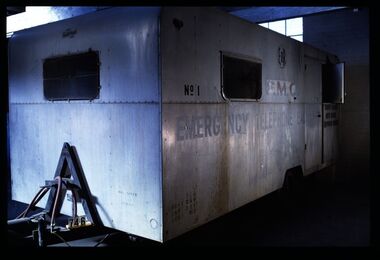
Vehicle - Mobile Telephone Exchange, c. 1965
... Mobile Telephone Exchange...mobile telephone exchanges...Manufactured in the 1960s, this mobile emergency telephone exchange was fitted into a caravan. ...Manufactured in the 1960s, this mobile emergency telephone exchange was fitted into a caravan. ...Manufactured in the 1960s, this mobile emergency telephone exchange was fitted into a caravan. Part of the Shepparton Division State Disaster Plan, the caravan could be towed to areas affected by disasters to enable communications to recommence. The caravan remained in service until approximately 1974. Mobile infrastructure plays an important role in Australian communications, owing to the often remote and hostile environments in which Australians live and work. Exchanges such as this facilitated phone calls in the aftermath of an emergency, particularly for hospitals, police and other emergency services. Today, Mobile Exchange on Wheels (MEOWs), Cell on Wheels (CoW) and Satellite Cell on Wheels (SatCOW) - which provide temporary landline and broadband services, mobile phone coverage and service in areas without communications infrastructure respectively - are a critical part of emergency response procedures for natural disasters such as fire and flood. Though technology has progressed, the need for rapid service in remote areas remains a present concern of the communications service providers in Australia. This mobile service infrastructure is historically significant as an early example of a service which has evolved over decades, yet is still needed today. The exchange, as a representative example of a vehicle which would provide early-response in a disaster, is socially significant as a facilitator of critical communications needs in devastated communities: access to emergency services and contact with family and friends. The exchange itself, intact from its period of use, provides an insight into technology of the 1970s. Mobile emergency exchange housed in a caravan trailer on 2 wheel base, duralin body, steel tow bar, Caravan divided into 3 sections; the exchange room; the relay room and the main frame room. The exchange room contains 3 switchboards, a folding table, cupboards, benches and switch rack (.1). table (.2), steel bar for attaching the table (.3), back boards of switchboards (.4-.6), switches (.7-.16), box of switches (.17). There is a wall phone magneto, 300 type handset on wall and 2 skylights with wire screens. .11? hat pegs and shelf; there are 2 fluorescent tubes for lighting, all in exchange section. The floor is covered with 2 tone grey tiles and there are wire mesh on outside of windows and a geometric curtain inside behind switch rack. There is a flywire screen door as well as exterior door. The relay room has a sectioned door so half can open at a time. Room contains a cupboard with folding bench top beneath a curtained window. The opposite wall has a bank of batteries and transmission condensers; there is a shelf above window, one fluorescent tube and fuse boxes. Tiles on floor also. The main frame room contains many metres of coiled black covered cable, a black covered magneto wall telephone with 300 type handset; grey plastic jumper cords, a rack of termination points and wire with wasp nests attached. There is a small iron step under door, a fluorescent tube on wall and 3 hat hooks. Roll of Paper Handtowels (.18), cord and handle (.19), red exchange cords and plugs (.20-.22), plastic aluminium runners (.23,.24), headset (.25,.26), logbook (.27), battery readings (.28), box containing papers circuit drawings etc (.29-.93), paper lists off wall (.94,.95). Books, record books etc (.96-.103). Manila folder (.104) containing circuit drawings (105-.124). Wooden drawer (.125), metal drawer containing subscribers master cards, record of faults cards, particular switchboards connected, Junction line cards (.126). Box of valves (.127), box of clamps (.128). Box of 2000 type rack fuses, red 1 1/2 AMPS, black 3 AMP, blue 1/2 AMP (.129). Box of sleeves for covering wire joints (.130), plastic beakers (.131,.132), soap (.133), box of white plastic squares (.134), time switch "Venner BF/43 time switch" Made in England (.135), box of bolts, knobs etc (.136), box of switchboard number indicators (.137), fuse (.138), fuse wire (.139), football card (.140). Box of cartridge fuse 6 AMP (.141). Envelope of drawing pins, rubber bands (.142), black plastic, paper tape centres (.143-.152), metal plug (.153), 2 signs "Beware of vehicles" (.154-.155). Paper listing Naringal East automatic conversion (.156). Green Commonwealth of Australia note pad (.157). Wiring plug for tail lights (.158). Black fuse plugs (.159,.160). Box of bolts (.161). 2 sections of blue plastic coated wires (.162,.163). Gloves used for working on batteries (.164-.167). Wasp nests (.168,.169). White fuse (.170). Photographs of van in use (.171,.172). .1 on front: "ANOTHER / MOBILETRAIL / PRODUCT" "MAX SPEED / 25MPH" "TRAILER BRAKES / --- / " On sides: "EMERGENCY TELEPHONE EXCHANGE" "NO 1" "PMG" "TCQ / GROSS 250 / TARE 182 / LOAD 162" "6" "COUNTRY BRANCH / NORTH REGION / [SHEPPARTON DIVISION]" "LAW'S SIGNS" "Telecom Australia" On back: "DANGER / LONG LOAD" "MQA 3787" .133: "FIR OIL" "AUSTRALIA" mobile telephone exchanges, mobile telecommunications trailers, trailers, transport, natural disaster, black saturday, bushfires, floods, emergency communications -
 Department of Energy, Environment and Climate Action
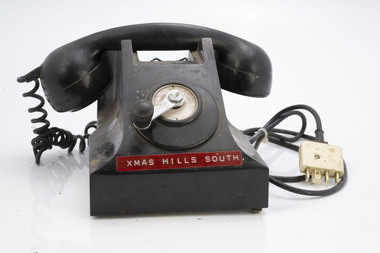
Instrument - Field telephone - Fire Tower, 400 series 'Bakelite' magneto table telephone
... But it was the convergence of separate technologies such as 5G mobile phones, high-capacity and light-weight lithium batteries, Wi-Fi, the ever-expanding internet, cloud data storage, digital cameras, GPS, personal organisers and hundreds of supporting Apps into powerful smartphones and tablets which revolutionised bushfire communications from the mid-2000s. Manufactured in both UK and Australia, the 400 series telephone was developed for the PMG in 1957 based on the British, prototype, no.700, Bakelite phone. They became obsolescent by the early 1960s but because some magneto exchanges...But it was the convergence of separate technologies such as 5G mobile phones, high-capacity and light-weight lithium batteries, Wi-Fi, the ever-expanding internet, cloud data storage, digital cameras, GPS, personal organisers and hundreds of supporting Apps into powerful smartphones and tablets which revolutionised bushfire communications from the mid-2000s. Manufactured in both UK and Australia, the 400 series telephone was developed for the PMG in 1957 based on the British, prototype, no.700, Bakelite phone. They became obsolescent by the early 1960s but because some magneto exchanges ...After the 1939 bushfires, the Forests Commission Victoria invested heavily in a radically new communications network. After suffering some inevitable delays due to the war, radio VL3AA switched into full operation in October 1945 proudly beaming out 200 watts across the State. But by today’s standards, the technology was primitive and the reception poor unless the user was on a high point somewhere. The radio signal was "line-of-sight" and bounced between fire towers and relay transmitters across the mountains back to the District offices. The advent of solid-state electronics in the 1960s replaced the more delicate valve sets which enabled greater use of vehicle mounted radios. The Commission continued to research, develop and build new radios at its many workshops around Victoria. The network was supported by a large team of skilled radio technicians. The more secure and versatile State Mobile Radio (SMR) digital trunk system came into operation in about 1995. Upgraded Tait Radios were purchased in 2014 after recommendations of the 2009 Bushfires Royal Commission. But it was the convergence of separate technologies such as 5G mobile phones, high-capacity and light-weight lithium batteries, Wi-Fi, the ever-expanding internet, cloud data storage, digital cameras, GPS, personal organisers and hundreds of supporting Apps into powerful smartphones and tablets which revolutionised bushfire communications from the mid-2000s. Manufactured in both UK and Australia, the 400 series telephone was developed for the PMG in 1957 based on the British, prototype, no.700, Bakelite phone. They became obsolescent by the early 1960s but because some magneto exchanges persisted in Australia for another quarter of a century and alternatives were not cost effective, PMG/Telecom regularly repaired or refurbished these obsolete phones until they were superseded by automatic exchanges. Used to communicate to remote fire towers Single wire (with earth return) often run through the bush from FCV district offices Magneto table telephone Christmas Hills South Instructions for use around winder bushfire, radios, forests commission victoria (fcv) -
 Sunshine and District Historical Society Incorporated
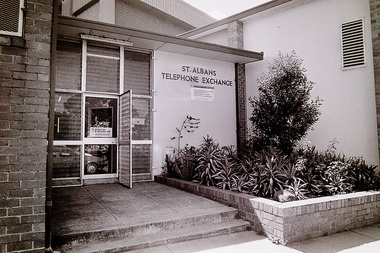
Photograph - St. Albans Telephone Exchanged Victoria Street St. Albans 1991 Photograph, Sharon Cavanagh, 22nd February 1991
... Telephone Exchange, located at 1 Victoria Crescent, St Albans. The images document an important piece of telecommunications infrastructure that played a vital role in providing telephone services to St Albans and the surrounding district. They provide a valuable record of the facility's appearance and its relationship to the local streetscape during the early 1990s. The photographs preserve evidence of a key public utility building and illustrate the infrastructure that supported communication networks prior to the widespread adoption of mobile ...These photographs, taken by The Advocate in 1991, feature the East Esplanade entrance of the St Albans Telephone Exchange, located at 1 Victoria Crescent, St Albans. The images document an important piece of telecommunications infrastructure that played a vital role in providing telephone services to St Albans and the surrounding district. They provide a valuable record of the facility's appearance and its relationship to the local streetscape during the early 1990s. The photographs preserve evidence of a key public utility building and illustrate the infrastructure that supported communication networks prior to the widespread adoption of mobile phones and internet-based technologies. 6774.01 - St. Albans Telephone Exchanged Victoria Street St. Albans 1991 Photograph (Advocate 79.2).JPG 6774.02 - St. Albans Telephone Exchanged Victoria Street St. Albans 1991 Photograph (Advocate 79.2).JPG st. albans telephone exchange, victoria crescent, east esplanade, st. albans
