
Showing 122 items matching "monkeys"
-
 Bayside Gallery - Bayside City Council Art & Heritage Collection
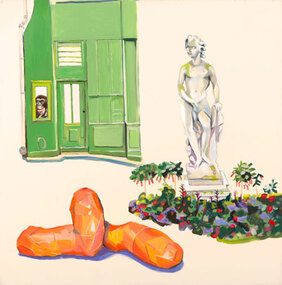
Painting - oil on linen, Rob McHaffie, Why did we go further than monkeys, monkeys know how to be monkeys, 2008
... Why did we go further than monkeys, monkeys know how to be monkeys...monkey...In this painting a monkey looks out from a green building onto an imagined scene abound with art historical references. ...McHaffie questions the so-called evolution of cultured humanity in comparison to the imagined contentedness of our pre-evolved species. monkey sculpture painting rob mchaffie paris flowers franz west oil on linen Why did we go further than monkeys, monkeys know how to be monkeys Painting oil on linen Rob McHaffie ...This work was painted following Rob McHaffie’s Australia Council Residency at Cité Internationale des Arts in Paris in 2007. Despite Paris being a beautiful city, McHaffie also found the experience challenging and felt that on a bad day, the city was no more than an ornately decorated concrete jungle. In this painting a monkey looks out from a green building onto an imagined scene abound with art historical references. A classical European figurative sculpture is surrounded by flowers from Monet’s gardens, while a contemporary sculpture by Franz West dominates the foreground of the work. McHaffie questions the so-called evolution of cultured humanity in comparison to the imagined contentedness of our pre-evolved species.oil on linenmonkey, sculpture, painting, rob mchaffie, paris, flowers, franz west -
 City of Stonnington
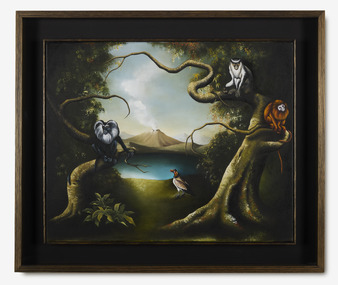
Judith Van Heeren, Monkeys in landscape, 2011
... Monkeys in landscape......Monkeys...Stonnington contemporary art collection Natural environment Zoo Museums Monkeys Judith Van Heeran Painting Monkeys in landscape Judith Van Heeren ...For over 20 years Judith Van Heeren has been making images from nature, and exploring the delicate relationship between humans and the natural environment. Van Heeren's work reflects her interest in the natural world and how we respond to it in both its original state and as mediated through museums and zoological collections. In 2010 she completed a residency in Paris and was engaged by the Menagerie du Jardin des Plantes, the world’s oldest civic zoo and the apparent shift in purpose of holding animals in captivity. Many of Van Heeren's compositions are based on museum tableaux and are presented as deliberately artificial arrangements; perhaps in homage to zoos’ living inhabitants. These tableaux are derived from 17th and 18th century natural illustration and the original display context of the artist's subjects, often painted from actual taxidermy specimens in museum and scientific collections.stonnington contemporary art collection, natural environment, zoo, museums, monkeys, judith van heeran, painting -
 Tatura Irrigation & Wartime Camps Museum
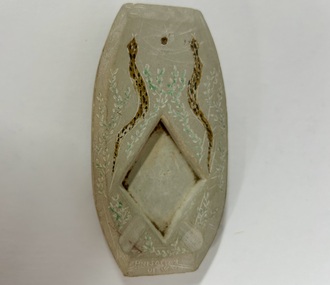
Decorative object - Monkey Ashtray
... ...Monkey...Sandstone hand-carved monkey and ashtray. Monkey has decorative markings. ...Ashtray: Prisoner of War on top Monkey: Ricordo on side and Ricordo POW on bottom...Tatura Irrigation & Wartime Camps Museum 49 Hogan Street Tatura the-murray Item made by an Italian POW held in Camp 13 Camp 13 murchison POW Italian Monkey Ashtray: Prisoner of War on top Monkey: Ricordo on side and Ricordo POW on bottom Sandstone hand-carved monkey and ashtray. ...Item made by an Italian POW held in Camp 13Sandstone hand-carved monkey and ashtray. Monkey has decorative markings. Ashtray has a diamond shaped recess carved into the top and decorated with two brown and black painted snakes and green and white leavesAshtray: Prisoner of War on top Monkey: Ricordo on side and Ricordo POW on bottomcamp 13, murchison, pow, italian, monkey -
 Emerald Museum & Nobelius Heritage Park
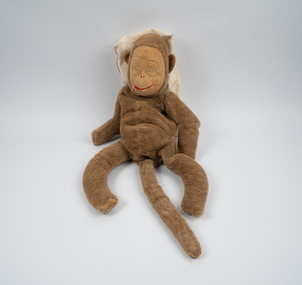
Container - Monkey Pyjama Case, Joy-Toys, c. 1937
... Some other models of Joy-Toys monkeys were based on the characters of British illustrator Lawson Wood, who used a wide cast of monkeys and other animals in his work. ...Outside of the face, the monkey is covered in synthetic brown 'fur'. ...Container Monkey Pyjama Case Joy-Toys Elaine Morris ...This pyjama case was produced in the 1930s by Joy-Toys, an Australian toy company founded in South Yarra in the early 1920s. It was gifted to Elaine Morris (then Nobelius - the granddaughter of Carl Axel Nobelius) at an early - perhaps 3rd - birthday. Elaine was born in 1934, so it would have been gifted around 1937. Several other Joy-Toys monkeys were made with hands and feet, which might either have fallen off or been removed over the past century or which may not have been included on this model. Some other models of Joy-Toys monkeys were based on the characters of British illustrator Lawson Wood, who used a wide cast of monkeys and other animals in his work. The zipper was made in Australia by Lightning, indicating that the monkey's components were also likely made locally.This pyjama case belonged to a member of the Nobelius family, and reflects a style of toymaking that today is far out of fashion from a distinctive company that is no longer in business.The monkey has a hollow body, with the interior lined with orange satin fabric and closed by a zipper. The shape of the monkey is filled out by the case's intended purpose - storing pyjamas. The head is stuffed, and features a face made of felt molded over buckram, with painted features in red (mouth and nostrils) and black (closed eyelids and eyelashes). Outside of the face, the monkey is covered in synthetic brown 'fur'. It is possible that the monkey once had hands and feet which have since been removed or lost. The monkey's limbs and tails are also stuffed and separated from the hollow body. The head and arms of the monkey are on joints allowing them to rotate 360 degrees. The monkey also has small furless fabric ears. There is damage separating fabric at the right shoulder and at several points in the interior.Zipper Obverse: "LIGHTNING" Zipper Reverse: "AUST MADE / PATENTED" Inside Tag: "JOY-TOYS / MADE IN AUSTRALIA"elaine morris, nobelius family, elaine nobelius, toys, children -
 Orbost & District Historical Society
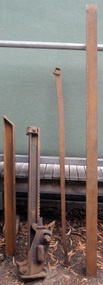
jack, 1908
... He had land at Marlo and used this jack to clear the property of trees and stumps in 1940's and 1950's. The Trewhella Monkey jack was invented by the Trewhella brothers to help land clearance in Australia during the 1880's. ...A 10 ton monkey jack. It has two extensions (spears) and two lifting claws. ...On extension - BRITISH STEEL On main section - 10 TON MONKEY JACK PATENTED 1411-50 AUGUST 04 1412-50 AUGUST -05 ?????? ...This item is an example of the machinery used by the early settlers to clear land. rural monkey-jack trewhella agriculture machinery On extension - BRITISH STEEL On main section - 10 TON MONKEY JACK PATENTED 1411-50 AUGUST 04 1412-50 AUGUST -05 ?????? ...Used by Ettore Alessandri who came to Australia in 1930's. He had land at Marlo and used this jack to clear the property of trees and stumps in 1940's and 1950's. The Trewhella Monkey jack was invented by the Trewhella brothers to help land clearance in Australia during the 1880's. Two jacks were made a 5 ton and a 10 ton. This item is a 10 ton model having two extension bars. The longer spear is used for larger tree work and the smaller spear for general work and small trees. Both models had two lifting claws at different heights. Th lower claw was useful for roots. The top claw was intended for going under loads and the bottom claw used for rolling timber. In 1929 the cost of the 10 ton model was thirteen pounds ten shillings.This item is an example of the machinery used by the early settlers to clear land. A 10 ton monkey jack. It has two extensions (spears) and two lifting claws. It has a detachable handle. 2033.1 is the main jack. 2033.2 is the handle. 2033.3 is the shorter extension and 2033.4 is the longer extension.On extension - BRITISH STEEL On main section - 10 TON MONKEY JACK PATENTED 1411-50 AUGUST 04 1412-50 AUGUST -05 ?????? JUL -06 12104-20 JUL-08 Trewalla Bros Trentham Vicrural monkey-jack trewhella agriculture machinery -
 Wangaratta RSL Sub Branch
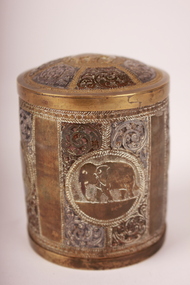
Container - Canister
... Decorative canister with image of a monkey imprinted on base...Round brass canister with separate lid embossed with elephants and monkey engraved on base Inside blue stamp Christmas 1968...Wangaratta RSL Sub Branch 2-4 Templeton Street Wangaratta high-country Decorative canister with image of a monkey imprinted on base brass canister souvenir Round brass canister with separate lid embossed with elephants and monkey engraved on base Inside blue stamp Christmas 1968 Container Canister ...Decorative canister with image of a monkey imprinted on baseRound brass canister with separate lid embossed with elephants and monkey engraved on base Inside blue stamp Christmas 1968brass, canister, souvenir -
 Orbost & District Historical Society
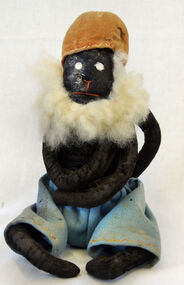
toy monkey, Kerr, Hilda (nee Temple) wife of Dr Kerr, W.W.1
... This toy monkey was handmade by Hilda Kerr (nee Temple), wife of Dr James Kerr. ...Small black handmade soft toy monkey. Light brown hat, white beard and blue pants....Orbost & District Historical Society Ruskin Street Orbost gippsland This toy monkey was handmade by Hilda Kerr (nee Temple), wife of Dr James Kerr. ...This toy monkey was handmade by Hilda Kerr (nee Temple), wife of Dr James Kerr. It was made to raise funds during World War 1.This WW1 item is a reminder of the part played by the families and friends of those who were involved in this conflict.Small black handmade soft toy monkey. Light brown hat, white beard and blue pants.handcrafts soft-toy w.w.1 kerr-hilda -
 Mission to Seafarers Victoria
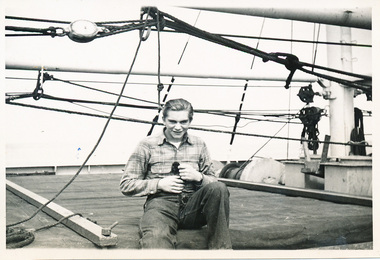
Photograph - Photograph, Black and white, Allan Charles Quinn, Yours Truly, 24 April 1949
... ...monkey...The photograph is part of a series of three involving a small monkey on board the Fenris, probably picked up in Tenerife, where they had recently docked. ...A black and white photograph of Allan Quinn sitting on the deck of a ship, holding a small monkey. The ship's rigging takes up the top half of the frame....A black and white photograph of Allan Quinn sitting on the deck of a ship, holding a small monkey. The ship's rigging takes up the top half of the frame. ...The photograph is part of a series of three involving a small monkey on board the Fenris, probably picked up in Tenerife, where they had recently docked. It is unknown who actually took this photograph.This is a photograph from the Allan Charles Quinn collection which is a collection of letters and photograph depicting aspects of life at sea for a young man in the era immediately following World War II.A black and white photograph of Allan Quinn sitting on the deck of a ship, holding a small monkey. The ship's rigging takes up the top half of the frame.On reverse: YOURS TRULY / 24.4.49 handwritten in blue ink.allan-quinn, photograph, monkey, fenris -
 Hand Tool Preservation Association of Australia Inc
Wrench, 1900-1950
... wrench, monkey, 10"...Hand Tool Preservation Association of Australia Inc No physical address melbourne This item is part of the Thomas Caine Tool Collection, owned by The National Trust of Australia (Victoria) and curated by the Hand Tools Preservation Association of Australia. wrench, monkey, 10" Wrench ...This item is part of the Thomas Caine Tool Collection, owned by The National Trust of Australia (Victoria) and curated by the Hand Tools Preservation Association of Australia.wrench, monkey, 10" -
 Federation University Art Collection
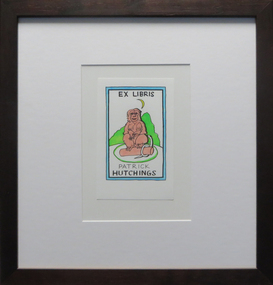
Bookplate, 'Ex Libris Patrick Hutchings'
... Framed bookplate featuring a monkey....Federation University Art Collection Artworks are displayed at Federation University Australia campuses at Ballarat, Gippsland (Churchill), Stawell and Horsham. goldfields patrick hutchings bookplate keith wingrove memorial trust australian bookplate design award framed bookplate available available bookplate Framed bookplate featuring a monkey. 'Ex Libris Patrick Hutchings' Bookplate ...Framed bookplate featuring a monkey.patrick hutchings, bookplate, keith wingrove memorial trust, australian bookplate design award, framed bookplate, available, available bookplate -
Hand Tool Preservation Association of Australia Inc
Wrench
... wrench, monkey, pocket, 6"...Hand Tool Preservation Association of Australia Inc No physical address melbourne This item is part of the Thomas Caine Tool Collection, owned by The National Trust of Australia (Victoria) and curated by the Hand Tools Preservation Association of Australia. wrench, monkey, pocket, 6" Wrench ...This item is part of the Thomas Caine Tool Collection, owned by The National Trust of Australia (Victoria) and curated by the Hand Tools Preservation Association of Australia.wrench, monkey, pocket, 6" -
 Whitehorse Historical Society Inc.
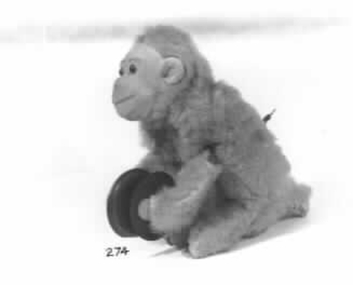
Leisure object - Toy Monkey
... Wind up stuffed monkey with cymbals....Whitehorse Historical Society Inc. 2-10 Deep Creek Road Mitcham melbourne toys soft toys Wind up stuffed monkey with cymbals. Leisure object Toy Monkey ...Wind up stuffed monkey with cymbals.toys, soft toys -
 Wangaratta RSL Sub Branch
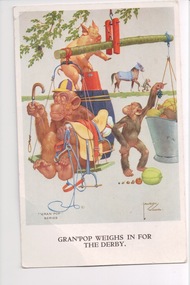
Postcard, 1917
... ...monkey...Colour postcard with a scene of two monkeys, a pig and set of scales. One monkey is wearing a jockey's cap and carrying a saddle and whip. ...Colour postcard with a scene of two monkeys, a pig and set of scales. One monkey is wearing a jockey's cap and carrying a saddle and whip. ...From the album of WWI soldier William West (1268) of the 29 Infantry Battalion, 5th Pioneers Battalion. This collection of postcards, photographs and clippings were sent between William and his family and loved ones during the years he was on active service. See also 207 and 220. Colour postcard with a scene of two monkeys, a pig and set of scales. One monkey is wearing a jockey's cap and carrying a saddle and whip. No message on back.Front: "Gran'pop weighs in for the derby."album, photo album, newspaper clippings, postcard, wwi, derby, monkey, jockey, horse racing -
 Bendigo Historical Society Inc.
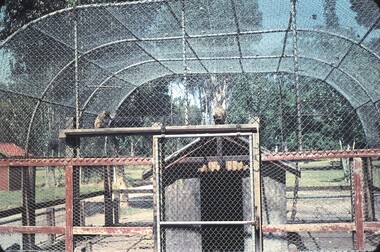
Slide - BENDIGO VIEWS, Dec 1960
... Slide. Bendigo Views. Monkey cage and residents....History House 11 Mackenzie Street Bendigo goldfields SLIDE Bendigo bendigo views Bendigo Views Slide. Bendigo Views. Monkey cage and residents. Slide BENDIGO VIEWS ...Slide. Bendigo Views. Monkey cage and residents.slide, bendigo, bendigo views, bendigo views -
 Bendigo Historical Society Inc.
Slide - BENDIGO VIEWS, Jun 1968
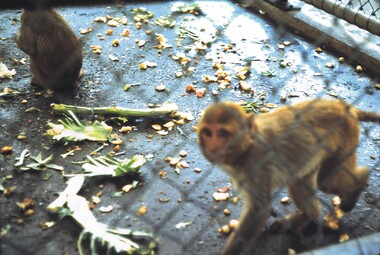
... Slide. Bendigo Views. Monkeys at the Botanical Gardens....History House 11 Mackenzie Street Bendigo goldfields SLIDE Bendigo bendigo views Bendigo Views Slide. Bendigo Views. Monkeys at the Botanical Gardens. Slide BENDIGO VIEWS ...Slide. Bendigo Views. Monkeys at the Botanical Gardens.slide, bendigo, bendigo views, bendigo views -
 Bendigo Historical Society Inc.
Slide - BENDIGO VIEWS, Dec 1960
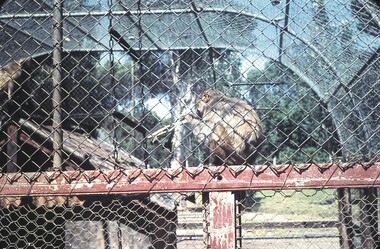
... Slide. Bendigo Views. Monkey in a cage at the Botanical Gardens....History House 11 Mackenzie Street Bendigo goldfields SLIDE Bendigo bendigo views Bendigo Views Slide. Bendigo Views. Monkey in a cage at the Botanical Gardens. Slide BENDIGO VIEWS ...Slide. Bendigo Views. Monkey in a cage at the Botanical Gardens.slide, bendigo, bendigo views, bendigo views -
 Anglesea and District Historical Society
Brass - Three Wise Monkeys, Late 19th Century/early 20th Century
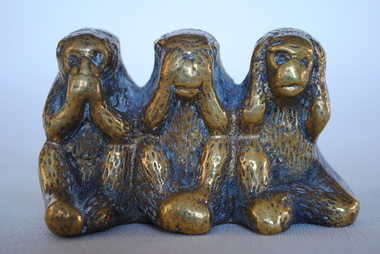
... Brass ornament of Three Wise Monkeys. Hollow base....Brass - Three Wise Monkeys ...Brass ornament of Three Wise Monkeys. Hollow base.Made in Belgiumbrass, three wise monkeys -
 Federation University Art Collection
Artwork- Ceramics, Barnett, Beatrix, (Untitled) Cup by Beatrix Barnett, 1994
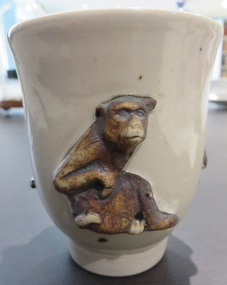
... Small ceramic vessel with three monkeys exterior decoration. ...The Art Collection features over 1000 works and was listed as a 'Ballarat Treasure' in 2007. art artwork beatrix barnett available ceramics tafe ceramics collection Small ceramic vessel with three monkeys exterior decoration. (Untitled) Cup by Beatrix Barnett Artwork- Ceramics Barnett, Beatrix ...This item is part of the Federation University Art Collection. The Art Collection features over 1000 works and was listed as a 'Ballarat Treasure' in 2007.Small ceramic vessel with three monkeys exterior decoration. art, artwork, beatrix barnett, available, ceramics, tafe ceramics collection -
 Bendigo Military Museum
Uniform - SHOULDER LANYARDS
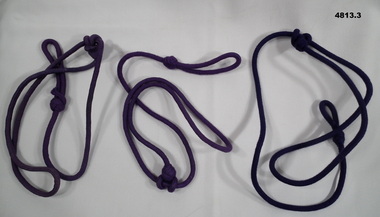
... Standard pattern purple ;lanyard with two monkey-fist knots....Williams Standard pattern purple ;lanyard with two monkey-fist knots. Uniform SHOULDER LANYARDS ...Part of the Reverend Chaplain Major Thomas B. Williams No. 556101 Collection.Standard pattern purple ;lanyard with two monkey-fist knots.army chaplain, uniform, major thomas b. williams -
 Bendigo Historical Society Inc.
Photograph - PETER ELLIS COLLECTION: PHOTO OF GROUP OF MEN AND WOMEN, 1920's
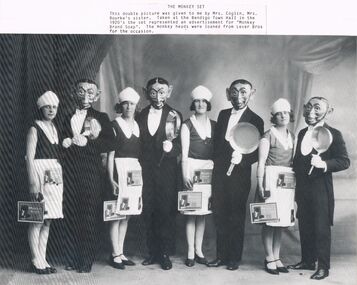
... It represented an advertisement for 'Monkey Brand Soap'. The Monkey heads were loaned from Lever Bros for the occasion. ...It represented an advertisement for 'Monkey Brand Soap'. The Monkey heads were loaned from Lever Bros for the occasion. ...Black and white photo of four couples, the men dressed in suits with tails, wearing monkey masks and holding a frying pan. The women wearing sleeveless dresses with large white collars, a white cap and aprons with the Monkey Brand logos and carrying a Monkey Brand placard. The photo was taken at the Bendigo Town Hall in the 1920's. It represented an advertisement for 'Monkey Brand Soap'. The Monkey heads were loaned from Lever Bros for the occasion. The names are: Jean Dean, Joe Borrell, John Borell, F. Donaldson, A. Hurst, Kathleen Dixon (Mrs. Coglin) (third from the left).photo, group, mixed group, peter ellis collection, the monkey set, mrs coglin, mrs bourke, bendigo town hall, monkey brand soap, lever bros, jean dean, joe borrell, john borell, f. donaldson, a. hurst, kathleen dixon (mrs. coglin) -
 Flagstaff Hill Maritime Museum and Village
Monkey, 19th Century
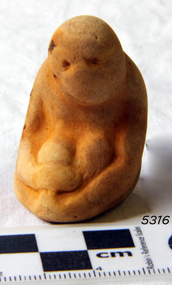
... Monkey......monkey...This toy monkey was part of the cargo from the Fiji and amongst the articles salvaged from the wreck. ...Ceramic toy monkey salvaged from the wreck of the Fiji. ...The surface is slightly pitted. Monkey ...This toy monkey was part of the cargo from the Fiji and amongst the articles salvaged from the wreck. The three-masted iron barque Fiji had been built in Belfast, Ireland, in 1875 by Harland and Wolfe for a Liverpool based shipping company. The ship departed Hamburg on 22nd May 1891 bound for Melbourne, under the command of Captain William Vickers with a crew of 25. The ship’s manifest shows that she was loaded with a cargo of 260 cases of dynamite, pig iron, steel goods, spirits (whisky, schnapps, gin, brandy), sailcloth, tobacco, coiled fencing wire, concrete, 400 German pianos (Sweet Hapsburg), concertinas and other musical instruments, artists supplies including brushes, porcelain, furniture, china, and general cargo including candles. There were also toys in anticipation for Christmas, including wooden rocking horses, miniature ships, dolls with china limbs and rubber balls. On September 5th, one hundred days out from Hamburg in squally and boisterous south west winds the Cape Otway light was sighted on a bearing differing from Captain Vickers’ calculation of his position. At about 2:30am, Sunday 6th September 1891 land was reported 4-5 miles off the port bow. The captain tried to put the ship on the other tack, but she would not respond. He then tried to turn her the other way but just as the manoeuvre was being completed the Fiji struck rock only 300 yards (274 metres) from shore. The place is known as Wreck Bay, Moonlight Head. Blue lights were burned and rockets fired whilst an effort was made to lower boats but all capsized or swamped and smashed to pieces. Two of the younger crewmen volunteered to swim for the shore, taking a line. One, a Russian named Daniel Carkland, drowned after he was swept away when the line broke. The other, 17 year old able seaman Julius Gebauhr, a German, reached shore safely on his second attempt but without the line, which he had cut lose with his sheath-knife when it become tangled in kelp. He rested on the beach a while then climbed the steep cliffs in search of help. At about 10am on the Sunday morning a party of land selectors - including F. J. Stansmore, Leslie Dickson (or Dixon) and Mott - found Gebauhr. They were near Ryans Den, on their travels on horseback from Princetown towards Moonlight Head, and about 5km from the wreck. Gebauhr was lying in the scrub in a poor state, bleeding and dressed only in singlet, socks and a belt with his sheath-knife, ready for all emergencies. At first they were concerned about his wild and shaggy looking state and what seemed to be gibberish speech, taking him to be an escaped lunatic. They were reassured after he threw his knife away and realised that he was speaking half-English, half-German. They gave him food and brandy and some clothing and were then able to gain information about the wreck. Some of the men took him to Rivernook, a nearby guest house owned by John Evans, where he was cared for. Stansmore and Dickson rode off to try and summon help. Others went down to the site of the wreck. Messages for rescuing the rest of the crew were sent both to Port Campbell for the rocket rescue crew and to Warrnambool for the lifeboat. The S.S. Casino sailed from Portland towards the scene. After travelling the 25 miles to the scene, half of the Port Campbell rocket crew and equipment arrived and set up the rocket tripod on the beach below the cliffs. By this time the crew of the Fiji had been clinging to the jib-boom for almost 15 hours, calling frantically for help. Mr Tregear from the Rocket Crew fired the line. The light line broke and the rocket was carried away. A second line was successfully fired across the ship and made fast. The anxious sailors then attempted to come ashore along the line but, with as many as five at a time, the line sagged considerably and some were washed off. Others, nearly exhausted, had to then make their way through masses of seaweed and were often smothered by waves. Only 14 of the 24 who had remained on the ship made it to shore. Many onlookers on the beach took it in turns to go into the surf and drag half-drowned seamen to safety. These rescuers included Bill (William James) Robe, Edwin Vinge, Hugh Cameron, Fenelon Mott, Arthur Wilkinson and Peter Carmody. (Peter Carmody was also involved in the rescue of men from the Newfield.) Arthur Wilkinson, a 29 year old land selector, swam out to the aid of one of the ship’s crewmen, a carpenter named John Plunken. Plunken was attempting to swim from the Fiji to the shore. Two or three times both men almost reached the shore but were washed back to the wreck. A line was thrown to them and they were both hauled aboard. It was thought that Wilkinson struck his head on the anchor before s they were brought up. He remained unconscious. The carpenter survived this ordeal but Wilkinson later died and his body was washed up the next day. It was 26 year old Bill Robe who hauled out the last man, the captain, who had become tangled in the kelp. The wreck of the Fiji was smashed apart within 20 minutes of the captain being brought ashore, and it settled in about 6m of water. Of the 26 men on the Fiji, 11 in total lost their lives. The remains of 7 bodies were washed onto the beach and their coffins were made from timbers from the wrecked Fiji. They were buried on the cliff top above the wreck. The survivors were warmed by fires on the beach then taken to Rivernook and cared for over the next few days. Funds were raised by local communities soon after the wreck in aid of the sufferers of the Fiji disaster. Captain Vickers was severely reprimanded for his mishandling of the ship. His Masters Certificate was suspended for 12 months. At the time there was also a great deal of public criticism at the slow and disorganised rescue attempt to save those on board. The important canvas ‘breech buoy’ or ‘bucket chair’ and the heavy line from the Rocket Rescue was in the half of the rocket outfit that didn’t make it in time for the rescue: they had been delayed at the Gellibrand River ferry. Communications to Warrnambool were down so the call for help didn’t get through on time and the two or three boats that had been notified of the wreck failed to reach it in time. Much looting occurred of the cargo that washed up on the shore, with nearly every visitor leaving the beach with bulky pockets. One looter was caught with a small load of red and white rubber balls, which were duly confiscated and he was ‘detained’ for 14 days. Essence of peppermint mysteriously turned up in many settlers homes. Sailcloth was salvaged and used for horse rugs and tent flies. Soon after the wreck “Fiji tobacco” was being advertised around Victoria. A Customs officer, trying to prevent some of the looting, was assaulted by looters and thrown over a steep cliff. He managed to cling to a bush lower down until rescued. In 1894 some coiled fencing wire was salvaged from the wreck. Hundreds of coils are still strewn over the site of the wreck, encrusted and solidified. The hull is broken but the vessel’s iron ribs can be seen along with some of the cargo of concrete and pig iron. Captain Vickers presented Bill Robe with his silver-cased pocket watch, the only possession that he still had, as a token for having saved his life and the lives of some of the crew. (The pocket watch came with 2 winding keys, one to wind it and one to change the hands.) Years later Bill passed the watch to his brother-in-law Gib (Gilbert) Hulands as payment of a debt and it has been passed down the family to Gilbert Hulands’ grandson, John Hulands. Seaman Julius Gebauhr later gave his knife, in its hand crafted leather sheath, to F. J. Stansmore for caring for him when he came ashore. The knife handle had a personal inscription on it. A marble headstone on the 200m high cliffs overlooking Wreck Beach, west of Moonlight Head, paying tribute to the men who lost their lives when Fiji ran aground. The scene of the wreck is marked by the anchor from the Fiji, erected by Warrnambool skin divers in 1967. Amongst the artefacts salvaged from the Fiji are bisque (or china) toys, (including miniature animals, limbs from small bisque dolls), rubber balls, a slate pencil, a glass bottle, sample of rope from the distress rocket and a candlestick holder. These items are now part of the Fiji collection at Flagstaff Hill Maritime Museum, along with Captain Vickers’ pocket watch and Julius Gebauhr’s sheath knife. This toy monkey is classified as Fiji 5 on the SWR Flagstaff Hill’s Fiji collection is of historical significance at a State level because of its association with the wreck Fiji, which is on the Victorian Heritage Register VHR S259. The Fiji is archaeologically significant as the wreck of a typical 19th century international sailing ship with cargo. It is educationally and recreationally significant as one of Victoria's most spectacular historic shipwreck dive sites with structural features and remains of the cargo evident. It also represents aspects of Victoria’s shipping history and its potential to interpret sub-theme 1.5 of Victoria’s Framework of Historical Themes (living with natural processes). The Fiji collection meets the following criteria for assessment: Criterion A: Importance to the course, or pattern, of Victoria’s cultural history. Criterion B: Possession of uncommon, rare or endangered aspects of Victoria’s cultural history Criterion C: Potential to yield information that will contribute to an understanding of Victoria’s cultural history. Ceramic toy monkey salvaged from the wreck of the Fiji. The monkey is in a seated pose with its arms around its knees. This solid, moulded toy is made of bisque (sometimes described as bisque or porcelain) and the material is an orange colour. The surface is slightly pitted.ceramic, china, flagstaff hill, warrnambool, shipwrecked coast, flagstaff hill maritime museum, maritime museum, shipwreck coast, flagstaff hill maritime village, great ocean road, porcelain, moonlight head, wreck bay, bisque, toys, miniature animals, monkey, ornament -
 Lorne Historical Society
Photograph, Powder monkey at work on Great Ocean Road at Devils Elbow near Eastern View 1920
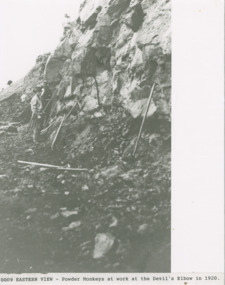
... Powder monkey at work on Great Ocean Road at Devils Elbow near Eastern View 1920...Photo showing Powder Monkey working at Devil's Elbow near Eastern View...Lorne Historical Society Lorne Community House Mountjoy Parade Lorne great-ocean-road g.o.r. devil's elbow eastern view powder monkey Photo showing Powder Monkey working at Devil's Elbow near Eastern View Powder monkey at work on Great Ocean Road at Devils Elbow near Eastern View 1920 Photograph photograph ...Photo showing Powder Monkey working at Devil's Elbow near Eastern Viewg.o.r., devil's elbow, eastern view, powder monkey -
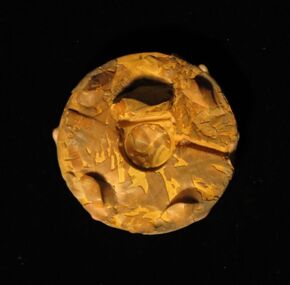 Montsalvat
Rubber Mould, Animal
... Round rubber mould containing an oval design depicting a monkey with long tail. ...Round rubber mould containing an oval design depicting a monkey with long tail. Animal Rubber Mould Matcham Skipper ...Round rubber mould containing an oval design depicting a monkey with long tail. Inscribed on reverse 'Animal' along with two sketches; a decorative design and oval.matcham skipper, mould, rubber, animal -
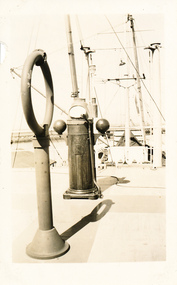 Mission to Seafarers Victoria
Photograph - Photograph, Sepia, Allan Charles Quinn, Goonawarra - looking forward, 13 January 1946
... Black ink on reverse: Monkey Island looking/ forward on Goonawarra/ at Melbourne/ 13 Jan 1946...This is a photograph from the Allan Charles Quinn collection which is a collection of photographs and letters that depict the life of a young man who has gone to sea to work in the era immediately following World War II. goonawarra sydney melbourne falmouth goteborg le havre france allan charles quinn panama canal los angeles san francisco palmyro island Black ink on reverse: Monkey Island looking/ forward on Goonawarra/ at Melbourne/ 13 Jan 1946 Black and white photograph looking forward from the deck of the Goonawarra Goonawarra - looking forward Photograph Photograph, Sepia Allan Charles Quinn ...This photograph is taken from the deck of the Goonawarra and belongs with the Allan Charles Quinn collection. Allan worked on the Goonawarra during 1946. The Goonawarra worked between Sydney, Melbourne, Palmyro Island, San Francisco, Los Angeles, Panama Canal, Le Havre and Goteborg.This is a photograph from the Allan Charles Quinn collection which is a collection of photographs and letters that depict the life of a young man who has gone to sea to work in the era immediately following World War II.Black and white photograph looking forward from the deck of the GoonawarraBlack ink on reverse: Monkey Island looking/ forward on Goonawarra/ at Melbourne/ 13 Jan 1946goonawarra, sydney, melbourne, falmouth, goteborg, le havre, france, allan charles quinn, panama canal, los angeles, san francisco, palmyro island -
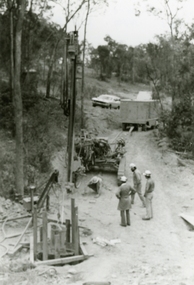 Ringwood and District Historical Society
Photographs, 1979-80 MMBW pipe line project at Hubbard Reserve, North Ringwood � Drill rig
... E561 N17 3 March 1980 A43 Powder-monkey marks out the spots for holes...Ringwood and District Historical Society 125A Warrandyte Road Ringwood North melbourne E561 N17 3 March 1980 A43 Powder-monkey marks out the spots for holes Part of a 43-photo record of the MMBW�s engineering feat in drilling a 12 inch pipe line up to 40 feet deep through rock hardened by volcanic action associated with geological fault that occurs along the line. ...Part of a 43-photo record of the MMBW�s engineering feat in drilling a 12 inch pipe line up to 40 feet deep through rock hardened by volcanic action associated with geological fault that occurs along the line. The work took place from October 1979 to May 1980 on the southern boundary of Hubbard Reserve, North Ringwood. The collection was presented to the Ringwood Historical Research Group by J Clarke on 9th June 1980.E561 N17 3 March 1980 A43 Powder-monkey marks out the spots for holes -
Federation University Art Collection
Bookplate, 'Ex Libris John Gartner'
... Two letters J and G with black background within their outline with white monkey pattern overlaid....(http://www3.slv.vic.gov.au/latrobejournal/issue/latrobe-84/t1-g-t7.html) bookplate australian bookplate design award keith wingrove memorial trust printmaking Two letters J and G with black background within their outline with white monkey pattern overlaid. 'Ex Libris John Gartner' Bookplate ...John Gartner was a fine printer and publisher, an author, a noted philatelist, and also collector of Australian banknotes and coins. He was born on 16 July 1914 and was largely self-educated, leaving school at fourteen for work following the death of his father. Gartner developed a strong interest in the history of typography and printing and was apprenticed at the Advocate where his father had been a linotype operator. Aged 17, Gartner bought a hand press and some fonts of type, and in 1937 acquired a platen press from which he set and printed his private press books, published under the imprint of The Hawthorn Press. Gartner had a strong collection of Australian bookplates. He also looked at the work of artists overseas and commissioned personal plates. He subsequently built an international collection with preference for artists who printed from wood. His initial searches were in Belgium and Holland.(http://www3.slv.vic.gov.au/latrobejournal/issue/latrobe-84/t1-g-t7.html) Two letters J and G with black background within their outline with white monkey pattern overlaid.bookplate, australian bookplate design award, keith wingrove memorial trust, printmaking -
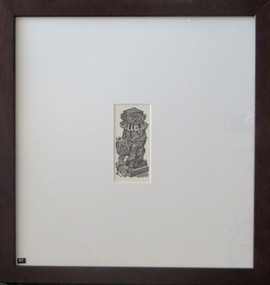 Federation University Art Collection
Bookplate, 'Ex Libris John Gartner'
... Framed black and white line drawing of a monkey dressed as a clown riding a crawling man with crown....(http://www3.slv.vic.gov.au/latrobejournal/issue/latrobe-84/t1-g-t7.html) bookplate keith wingrove memorial trust australian bookplate design award printmaking available available framed bookplate framed bookplate Framed black and white line drawing of a monkey dressed as a clown riding a crawling man with crown. ...John Gartner was a fine printer and publisher, an author, a noted philatelist, and also collector of Australian banknotes and coins. He was born on 16 July 1914 and was largely self-educated, leaving school at fourteen for work following the death of his father. Gartner developed a strong interest in the history of typography and printing and was apprenticed at the Advocate where his father had been a linotype operator. Aged 17, Gartner bought a hand press and some fonts of type, and in 1937 acquired a platen press from which he set and printed his private press books, published under the imprint of The Hawthorn Press. Gartner had a strong collection of Australian bookplates. He also looked at the work of artists overseas and commissioned personal plates. He subsequently built an international collection with preference for artists who printed from wood. His initial searches were in Belgium and Holland.(http://www3.slv.vic.gov.au/latrobejournal/issue/latrobe-84/t1-g-t7.html) Framed black and white line drawing of a monkey dressed as a clown riding a crawling man with crown.bookplate, keith wingrove memorial trust, australian bookplate design award, printmaking, available, available framed bookplate, framed bookplate -
 Flagstaff Hill Maritime Museum and Village
Monkey, 19th century
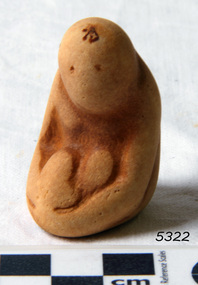
... Monkey......monkey...This toy monkey was part of the cargo from the Fiji and amongst the articles salvaged from the wreck. ...China toy monkey salvaged from the wreck of the Fiji. ...The surface is worn and slightly pitted. Monkey ...This toy monkey was part of the cargo from the Fiji and amongst the articles salvaged from the wreck. The three-masted iron barque Fiji had been built in Belfast, Ireland, in 1875 by Harland and Wolfe for a Liverpool based shipping company. The ship departed Hamburg on 22nd May 1891 bound for Melbourne, under the command of Captain William Vickers with a crew of 25. The ship’s manifest shows that she was loaded with a cargo of 260 cases of dynamite, pig iron, steel goods, spirits (whisky, schnapps, gin, brandy), sailcloth, tobacco, coiled fencing wire, concrete, 400 German pianos (Sweet Hapsburg), concertinas and other musical instruments, artists supplies including brushes, porcelain, furniture, china, and general cargo including candles. There were also toys in anticipation for Christmas, including wooden rocking horses, miniature ships, dolls with china limbs and rubber balls. On September 5th, one hundred days out from Hamburg in squally and boisterous south west winds the Cape Otway light was sighted on a bearing differing from Captain Vickers’ calculation of his position. At about 2:30am, Sunday 6th September 1891 land was reported 4-5 miles off the port bow. The captain tried to put the ship on the other tack, but she would not respond. He then tried to turn her the other way but just as the manoeuvre was being completed the Fiji struck rock only 300 yards (274 metres) from shore. The place is known as Wreck Bay, Moonlight Head. Blue lights were burned and rockets fired whilst an effort was made to lower boats but all capsized or swamped and smashed to pieces. Two of the younger crewmen volunteered to swim for the shore, taking a line. One, a Russian named Daniel Carkland, drowned after he was swept away when the line broke. The other, 17 year old able seaman Julius Gebauhr, a German, reached shore safely on his second attempt but without the line, which he had cut lose with his sheath-knife when it become tangled in kelp. He rested on the beach a while then climbed the steep cliffs in search of help. At about 10am on the Sunday morning a party of land selectors - including F. J. Stansmore, Leslie Dickson (or Dixon) and Mott - found Gebauhr. They were near Ryans Den, on their travels on horseback from Princetown towards Moonlight Head, and about 5km from the wreck. Gebauhr was lying in the scrub in a poor state, bleeding and dressed only in singlet, socks and a belt with his sheath-knife, ready for all emergencies. At first they were concerned about his wild and shaggy looking state and what seemed to be gibberish speech, taking him to be an escaped lunatic. They were reassured after he threw his knife away and realised that he was speaking half-English, half-German. They gave him food and brandy and some clothing and were then able to gain information about the wreck. Some of the men took him to Rivernook, a nearby guest house owned by John Evans, where he was cared for. Stansmore and Dickson rode off to try and summon help. Others went down to the site of the wreck. Messages for rescuing the rest of the crew were sent both to Port Campbell for the rocket rescue crew and to Warrnambool for the lifeboat. The S.S. Casino sailed from Portland towards the scene. After travelling the 25 miles to the scene, half of the Port Campbell rocket crew and equipment arrived and set up the rocket tripod on the beach below the cliffs. By this time the crew of the Fiji had been clinging to the jib-boom for almost 15 hours, calling frantically for help. Mr Tregear from the Rocket Crew fired the line. The light line broke and the rocket was carried away. A second line was successfully fired across the ship and made fast. The anxious sailors then attempted to come ashore along the line but, with as many as five at a time, the line sagged considerably and some were washed off. Others, nearly exhausted, had to then make their way through masses of seaweed and were often smothered by waves. Only 14 of the 24 who had remained on the ship made it to shore. Many onlookers on the beach took it in turns to go into the surf and drag half-drowned seamen to safety. These rescuers included Bill (William James) Robe, Edwin Vinge, Hugh Cameron, Fenelon Mott, Arthur Wilkinson and Peter Carmody. (Peter Carmody was also involved in the rescue of men from the Newfield.) Arthur Wilkinson, a 29 year old land selector, swam out to the aid of one of the ship’s crewmen, a carpenter named John Plunken. Plunken was attempting to swim from the Fiji to the shore. Two or three times both men almost reached the shore but were washed back to the wreck. A line was thrown to them and they were both hauled aboard. It was thought that Wilkinson struck his head on the anchor before s they were brought up. He remained unconscious. The carpenter survived this ordeal but Wilkinson later died and his body was washed up the next day. It was 26 year old Bill Robe who hauled out the last man, the captain, who had become tangled in the kelp. The wreck of the Fiji was smashed apart within 20 minutes of the captain being brought ashore, and it settled in about 6m of water. Of the 26 men on the Fiji, 11 in total lost their lives. The remains of 7 bodies were washed onto the beach and their coffins were made from timbers from the wrecked Fiji. They were buried on the cliff top above the wreck. The survivors were warmed by fires on the beach then taken to Rivernook and cared for over the next few days. Funds were raised by local communities soon after the wreck in aid of the sufferers of the Fiji disaster. Captain Vickers was severely reprimanded for his mishandling of the ship. His Masters Certificate was suspended for 12 months. At the time there was also a great deal of public criticism at the slow and disorganised rescue attempt to save those on board. The important canvas ‘breech buoy’ or ‘bucket chair’ and the heavy line from the Rocket Rescue was in the half of the rocket outfit that didn’t make it in time for the rescue: they had been delayed at the Gellibrand River ferry. Communications to Warrnambool were down so the call for help didn’t get through on time and the two or three boats that had been notified of the wreck failed to reach it in time. Much looting occurred of the cargo that washed up on the shore, with nearly every visitor leaving the beach with bulky pockets. One looter was caught with a small load of red and white rubber balls, which were duly confiscated and he was ‘detained’ for 14 days. Essence of peppermint mysteriously turned up in many settlers homes. Sailcloth was salvaged and used for horse rugs and tent flies. Soon after the wreck “Fiji tobacco” was being advertised around Victoria. A Customs officer, trying to prevent some of the looting, was assaulted by looters and thrown over a steep cliff. He managed to cling to a bush lower down until rescued. In 1894 some coiled fencing wire was salvaged from the wreck. Hundreds of coils are still strewn over the site of the wreck, encrusted and solidified. The hull is broken but the vessel’s iron ribs can be seen along with some of the cargo of concrete and pig iron. Captain Vickers presented Bill Robe with his silver-cased pocket watch, the only possession that he still had, as a token for having saved his life and the lives of some of the crew. (The pocket watch came with 2 winding keys, one to wind it and one to change the hands.) Years later Bill passed the watch to his brother-in-law Gib (Gilbert) Hulands as payment of a debt and it has been passed down the family to Gilbert Hulands’ grandson, John Hulands. Seaman Julius Gebauhr later gave his knife, in its hand crafted leather sheath, to F. J. Stansmore for caring for him when he came ashore. The knife handle had a personal inscription on it. A marble headstone on the 200m high cliffs overlooking Wreck Beach, west of Moonlight Head, paying tribute to the men who lost their lives when Fiji ran aground. The scene of the wreck is marked by the anchor from the Fiji, erected by Warrnambool skin divers in 1967. Amongst the artefacts salvaged from the Fiji are bisque (or china) toys, (including miniature animals, limbs from small bisque dolls), rubber balls, a slate pencil, a glass bottle, sample of rope from the distress rocket and a candlestick holder. These items are now part of the Fiji collection at Flagstaff Hill Maritime Museum, along with Captain Vickers’ pocket watch and Julius Gebauhr’s sheath knife. This toy monkey is classified as Fiji 5 on the SWR Flagstaff Hill’s Fiji collection is of historical significance at a State level because of its association with the wreck Fiji, which is on the Victorian Heritage Register VHR S259. The Fiji is archaeologically significant as the wreck of a typical 19th century international sailing ship with cargo. It is educationally and recreationally significant as one of Victoria's most spectacular historic shipwreck dive sites with structural features and remains of the cargo evident. It also represents aspects of Victoria’s shipping history and its potential to interpret sub-theme 1.5 of Victoria’s Framework of Historical Themes (living with natural processes). The Fiji collection meets the following criteria for assessment: Criterion A: Importance to the course, or pattern, of Victoria’s cultural history. Criterion B: Possession of uncommon, rare or endangered aspects of Victoria’s cultural history Criterion C: Potential to yield information that will contribute to an understanding of Victoria’s cultural history. China toy monkey salvaged from the wreck of the Fiji. The monkey is in a seated pose with its arms around its knees. This solid, moulded toy is made of bisque (sometimes described as bisque or porcelain) and the material is an pinkish brown colour with darker orange in its lap. The surface is worn and slightly pitted.1891, china, shipwrecked coast, flagstaff hill, flagstaff hill maritime museum, maritime museum, shipwrecked artefact, flagstaff hill maritime village, shipwreck coast, warrnambool, porcelain, moonlight head, wreck bay, cargo, bisque, toys, miniature animals, monkey -
 Working Heritage Crown Land Collection
Pamphlet - Wirth Bros show pamphlets, May 18 1898
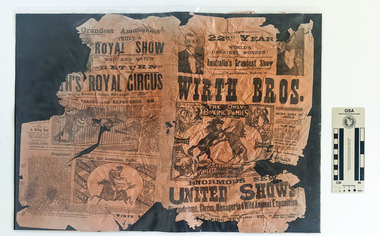
... Various text and illustrations depicting the activities of the show including horses, tigers and elephants and monkeys. 18th May 1898 ...Working Heritage Crown Land Collection 280 William Street Melbourne The pamphlet was found under the floorboards during works to the building Historic Newspaper 1898 Warracknabeal Court House Various text and illustrations depicting the activities of the show including horses, tigers and elephants and monkeys. 18th May 1898 Damaged and weathered pamphlets for a Circus and Show by the Wirth Bros Wirth Bros Show pamphlets Pamphlet Wirth Bros show pamphlets Serymgour and Sons, Theatrical Printers ...The pamphlet was found under the floorboards during works to the building Damaged and weathered pamphlets for a Circus and Show by the Wirth Bros Various text and illustrations depicting the activities of the show including horses, tigers and elephants and monkeys. 18th May 1898 historic newspaper, 1898, warracknabeal court house -
 Tatura Irrigation & Wartime Camps Museum
Decorative object - Monkey Ashtray
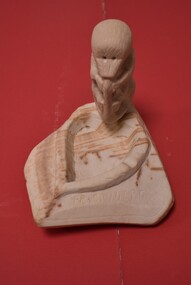
... Monkey attaches with a spike on it's bottom to the ashtray corner. ...Decorative object Monkey Ashtray ...Gifted to John / jack Yeoman who was a guard at Camp 13Camp 13Ashtray carved from sandstone, ( cream with dark pink stripes ), slightly triangle in shape, undulating surface. Heart shaped ashtray carved with a cigarette holder in one edge. Monkey is cream in colour, carved with holes to hold spare cigarettes. Monkey attaches with a spike on it's bottom to the ashtray corner. Ricordo Pirgionero = record of my imprisonment / memory of a prisoner is carved on the top and the bottom of the ashtray
