
Showing 15 items matching "mr trethowan"
-
 Ringwood and District Historical Society
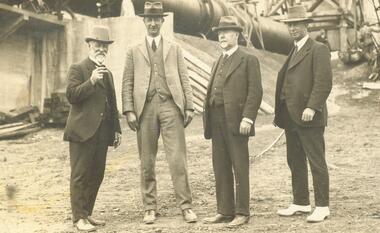
Photograph, Maroondah Dam construction 1923-24 - Capt E.T. Miles, Mr Trethowan, Mr W Everad and Mr A.T. Miles
... Maroondah Dam construction 1923-24 - Capt E.T. Miles, Mr Trethowan, Mr W Everad and Mr A.T. Miles...Left to right: Capt.. E.T. Miles, Mr. Trethowan (in charge of work), W. Everard, and A.T. ...Left to right: Capt.. E.T. Miles, Mr. Trethowan (in charge of work), W. Everard, and A.T. ...Catalogue card reads, "Maroondah Dam construction 1923-24. Left to right: Capt.. E.T. Miles, Mr. Trethowan (in charge of work), W. Everard, and A.T. Miles". -
 Ringwood and District Historical Society
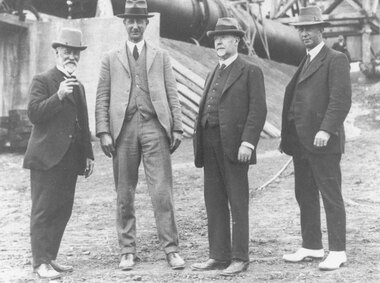
Photograph, Capt. E.T. Miles, Mr. Trethowan (Supervisor of Works), W. Everard, M.P., A.T. Miles - At Maroondah Dam construction 1923-1924
... Capt. E.T. Miles, Mr. Trethowan (Supervisor of Works), W. Everard, M.P., A.T. ...Typed below photograph, "Capt. E.T. Miles, Mr. Trethowan (Supervisor of Works), W. Everard, M.P., A.T. ...Typed below photograph, "Capt. E.T. Miles, Mr. Trethowan (Supervisor of Works), W. Everard, M.P., A.T. ...Black and white photographTyped below photograph, "Capt. E.T. Miles, Mr. Trethowan (Supervisor of Works), W. Everard, M.P., A.T. Miles - At Maroondah Dam construction 1923-1924". -
 Ballarat Tramway Museum
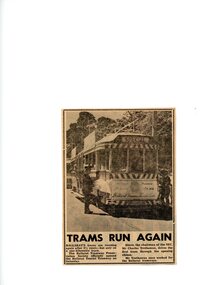
Newspaper - Newspaper - Clipping and Black & White Photograph, Trams run again, 1975
... ...mr trethowan...It was run over a one and a half kilometre track and driven by Mr Trethowan, chairman of the SEC and former tram driver at Ballarat tramways....It was run over a one and a half kilometre track and driven by Mr Trethowan, chairman of the SEC and former tram driver at Ballarat tramways. newspapaer photograph trams ballarat tramway preservation society ballarat tourist tramway trams run again sec 1975 ron bridger collection mr trethowan sec chairman AS Box 48A Newspaper clipping with balck and white photograph Trams run again, 1975 Newspaper Newspaper - Clipping and Black & White Photograph ...Ron Bridger was an avid collector of items related to Transport, predominantly Trams. These items include newspaper cuttings, pamphlets, reports, timetables, fares prices plus special items relating to events. Items from Melbourne and regional Victoria, Interstate - Sydney and Adelaide, plus overseas, make up this collection. Article shows photograph of the tram that ran again after three and a half years. It was run over a one and a half kilometre track and driven by Mr Trethowan, chairman of the SEC and former tram driver at Ballarat tramways.Newspaper clipping with balck and white photographnewspapaer photograph, trams, ballarat tramway preservation society, ballarat tourist tramway, trams run again, sec, 1975, ron bridger collection, mr trethowan, sec chairman, as box 48a -
 Ballarat Tramway Museum
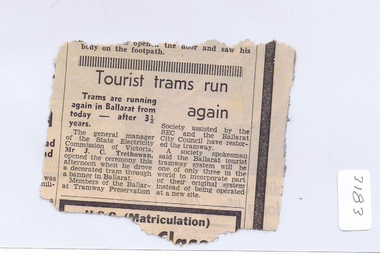
Newspaper, Herald Sun, "Tourist Trams run again", 1/02/1975 12:00:00 AM
... , 1/2/1975, titled "Tourist Trams run again", reporting on the opening of the Ballarat Tourist Tramway by the SEC Chairman, Mr. Trethowan. Notes the BTPS as one of only three to incorporate part of their original system in a museum...., 1/2/1975, titled "Tourist Trams run again", reporting on the opening of the Ballarat Tourist Tramway by the SEC Chairman, Mr. Trethowan. Notes the BTPS as one of only three to incorporate part of their original system in a museum. ...Newspaper clipping from The Melbourne Herald?, 1/2/1975, titled "Tourist Trams run again", reporting on the opening of the Ballarat Tourist Tramway by the SEC Chairman, Mr. Trethowan. Notes the BTPS as one of only three to incorporate part of their original system in a museum.opening, btps -
 Ballarat Tramway Museum
Photograph - Digital image Set of 5, Hugh Ballantyne, 1/02/1975
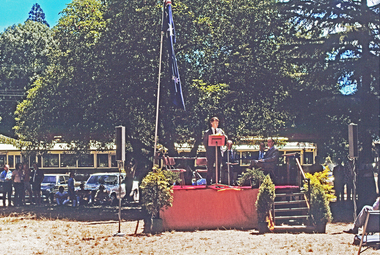
... Set of five images of the official opening ceremony for the BTPS- 1/2/1975 as the Ballarat Tourist Tramway. .1 - Clyde Croft - BTPS Secretary speaking .2 - ditto .3 - Chairman of the SEC Mr Trethowan speaking - see also Reg item 2272. .4 - ditto .5 - Maurice Calnin, President of the BTPS speaking. ...Trams tramways Opening First Tram BTPS Wendouree Parade Depot Sec Set of five images of the official opening ceremony for the BTPS- 1/2/1975 as the Ballarat Tourist Tramway. .1 - Clyde Croft - BTPS Secretary speaking .2 - ditto .3 - Chairman of the SEC Mr Trethowan speaking - see also Reg item 2272. .4 - ditto .5 - Maurice Calnin, President of the BTPS speaking. ...Yields information about the official opening by the BTPS of a tram service in Wendouree Parade. Has a strong association with those involved.Set of five images of the official opening ceremony for the BTPS- 1/2/1975 as the Ballarat Tourist Tramway. .1 - Clyde Croft - BTPS Secretary speaking .2 - ditto .3 - Chairman of the SEC Mr Trethowan speaking - see also Reg item 2272. .4 - ditto .5 - Maurice Calnin, President of the BTPS speaking. Images scanned and altered by Roderick Smith from the Hugh Ballantyne collection August to September 2017.trams, tramways, opening, first tram, btps, wendouree parade, depot, sec -
 Ballarat Tramway Museum
Photograph - Black & White Photograph/s, 1/02/1975 12:00:00 AM
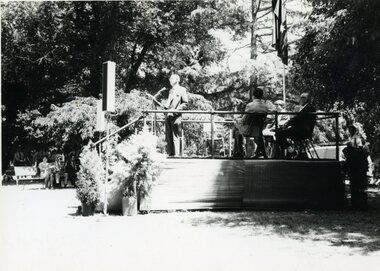
... Either the Mayor, Sir Arthur Nicholson or Mr Charles Trethowan SEC Chairman speaking. Also on stage Maurie Calnin and Clyde Croft....Either the Mayor, Sir Arthur Nicholson or Mr Charles Trethowan SEC Chairman speaking. Also on stage Maurie Calnin and Clyde Croft. ...Has strong association with the event of the official opening of the BTPS in 1975 and the people who spoke at that event.Black and white photograph of the opening ceremony of the Ballarat Tramway Museum's Ballarat Vintage Tramway on 1st Feb 1975. Either the Mayor, Sir Arthur Nicholson or Mr Charles Trethowan SEC Chairman speaking. Also on stage Maurie Calnin and Clyde Croft.tramways, trams, opening, btps, ballarat vintage tramway -
 Ballarat Tramway Museum
Newspaper, Ballarat News, "In Ballarat, Bendigo and Brazil ...\. Take a tram,\ - it's just the ticket", 29/01/1975 12:00:00 AM
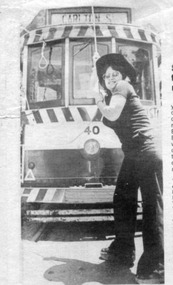
... Page 3 of the Ballarat's "The News" of Jan. 29, 1975, containing an article on the pending official opening of the BTPS tramway on Feb. 1, 1975 by Mr. J.C. Trethowan of the SEC. Notes the use of the former tramway system by Bendigo and a Brazilian tramway. ...Trams tramways BTPS Tramway Opening Wendouree Parade Opening Page 3 of the Ballarat's "The News" of Jan. 29, 1975, containing an article on the pending official opening of the BTPS tramway on Feb. 1, 1975 by Mr. J.C. Trethowan of the SEC. Notes the use of the former tramway system by Bendigo and a Brazilian tramway. ...Page 3 of the Ballarat's "The News" of Jan. 29, 1975, containing an article on the pending official opening of the BTPS tramway on Feb. 1, 1975 by Mr. J.C. Trethowan of the SEC. Notes the use of the former tramway system by Bendigo and a Brazilian tramway. Also refers to the collection of the BTPS. Has a continuation to Page 8,- not collected. Has as photograph of Maureen Holmes of Armadale holding onto the trolley rope of tram No. 40 at Carlton St.trams, tramways, btps, tramway opening, wendouree parade, opening -
 Ballarat Tramway Museum
Newspaper - Newspaper - Clipping and Black & White Photograph, Shake, rattle, and roll
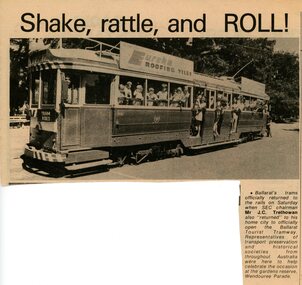
... SEC Chairman Mr J.C. Trethowan returned to Ballarat to officially open the Ballarat Tourist Tramway. ...SEC Chairman Mr J.C. Trethowan returned to Ballarat to officially open the Ballarat Tourist Tramway. ...Ron Bridger was an avid collector of items related to transport, predominately Trams. These items include newspaper cuttings, pamphlets, reports, timetables, fare prices plus special items relating to events. Items from Melbourne and regional Victoria, interstate - Adelaide and Sydney, plus overseas, make up this collection. The article shows the tram that ran when they officially returned to the rails in Ballarat. SEC Chairman Mr J.C. Trethowan returned to Ballarat to officially open the Ballarat Tourist Tramway. Representatives of transport preservation and Historical Societies Australia wide were present for this celebration.Newspaper article with black and white photographtrams, melbourne, victoria, sec, j c trethowan, official opening, celebration, shake rattle roll, ron bridger collection, as box 48a -
 Ballarat Tramway Museum
Document - Photocopy, Lloyd Jenkins, Oral History Transcripts, 1987
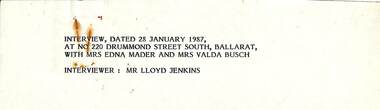
... K Dunstan who was the office manager in Ballarat, Mr. Charles Trethowan who commenced as the office boy in Ballarat and rose to be the Chairman of the SEC. ...K Dunstan who was the office manager in Ballarat, Mr. Charles Trethowan who commenced as the office boy in Ballarat and rose to be the Chairman of the SEC. ...Photocopy of a transcript prepared by Lloyd Jenkins and draft copy with corrections in blue and black ink of an interview with Mrs. Edna Mader and Mrs Valda Busch at 220 Drummond St. South Ballarat on 28 January 1987. Mrs. Busch was 79 at the time, and Mrs Mader 74. Both worked at the ESCo and SEC offices in the customer accounts section, preparing accounts and associated paperwork. Reviews the system of accounts, meter readers, working conditions. Mrs Mader left the SEC in 1945, (first child) then returned later on as a machine operator until retirement at age 62 in 1974. Mentions some tramway staff. Notes Mr. W. J. K Dunstan who was the office manager in Ballarat, Mr. Charles Trethowan who commenced as the office boy in Ballarat and rose to be the Chairman of the SEC. Also notes social activities, WWII and the take over of ESCo by the SEC. Interview comprises 11sheets of A4 paper. The draft copy comprises 23 pages.trams, tramways, oral history, audio tape transcripts, sec, esco, accounting -
 Federation University Historical Collection
Photograph, Visit of the Chinese Commissioner to the Ballarat School of Mines, 13 November 1906, 23/11/1906 (exact)
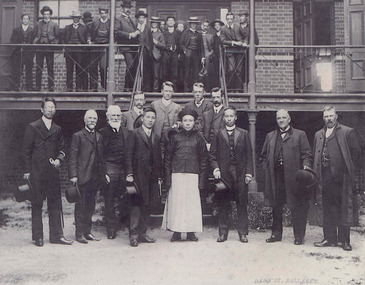
... Mr. J. Gent, Messrs. F. J. Martell (director of the School of Mines), A. W. Hager (president of the Orphan Asylum), A. Kenny (superintendent), R. G. Fitzgerald (clerk of courts at Ballarat East), J. Trethowan...Mr. J. Gent, Messrs. F. J. Martell (director of the School of Mines), A. W. Hager (president of the Orphan Asylum), A. Kenny (superintendent), R. G. Fitzgerald (clerk of courts at Ballarat East), J. Trethowan ...The Chinese Imperial Commissioner, Hwang How Cheng, visited Australia at the request of the Chinese Emperor for the purpose of establishing Chinese consulates in the Commonwealth. He visited Ballarat at the request of Ballarat’s Chinese community. The newspaper reported that it was hoped the Commissioner would visit the Ballarat School of Mines “where the knowledge he would get would probably be of the utmost usefulness in the development of the great resources of China.” The Commissioner was accompanied by interpreter Ah Ket (Melbourne barrister and solicitor), and met by members of Ballarat’s Chinese community, including Dr Wong Chock Son. Apparently the Chinese Commissioner wanted to visit SMB because of its international fame relating to education in mining. From the SMB Letter book (Cat. No. 436) comes the following which suggests the Commissioner was based in Adelaide) '17th November 1906 His Excellency, Hwang How Cheng Chinese Commission Adelaide May it please your Excellency By this post I have the pleasure in forwarding for your Excellency's kind acceptance (and one for Mr. When) copies of the photograph taken of your recent visit to the School of Mines. I trust they will serve a pleasing memento of what, I hope, was a pleasant visit to our Golden City. Yours Faithfully Fredk Martell Director' The visit was reported in the Ballarat Star in 14 November 1906:- The Chinese Imperial Commissioner, Hwang Hon Cheng, who recently arrived in Victoria on behalf of the Chinese Government, paid a visit to Ballarat last evening, and was entertained by his fellow countrymen at a dinner at the Bow Leong rooms, Main street. The commissioner, who came up by the express, was accompanied by his secretary and Mr Ah Ket, the well-known Chinese barrister, of Melbourne; but some disappointment was expressed by the fact that he did not wear his official robes, being attired in the more sombre European dress. Mr W. D. M’Kee presided at the dinner, on the invitation of the Bow Leong Society, and in addition to representative Chinese residents, three were also present the mayor of the city (Cr. J. J. Brokenshire), Crs. R. Pearse, G. Crocker (City), J. R. Elsworth, A. Mackenzie, J. A. M’Neil, A. Levy, G. Bunting, F. Penhalluriack (Town), Col. Williams, Mr. J. Gent, Messrs. F. J. Martell (director of the School of Mines), A. W. Hager (president of the Orphan Asylum), A. Kenny (superintendent), R. G. Fitzgerald (clerk of courts at Ballarat East), J. Trethowan, A. A. Buley, Serg Dalton, and others. Apologies were received from the mayor of the town Revs. J. West Lau, Dr Cairns, Hon. J. Y. M’Donald, L. Lederman, C. C. Shoppee and others. The gathering was a very cordial one, and the hospitality of the Chinese was greatly appreciated. After the loyal toasts, “The King” and “The Emperor of China,” had been honoured, the chairman extended a hearty welcome on behalf of the society and others to the commissioner. Mr M’Kee said he was privileged to speak in behalf of the Chinese. There was a warm feeling of friendship between them and himself, and his services were always at their command. If he were in China he would desire that a similar compliment would be extended to him. They were all pleased the Emperor of China had sent the commissioner to establish consulates in Australia with a view of the empire understanding the feelings of Australasia better than they did at present. He hoped the commissioner would have opportunity of visiting some of their industries, as they desired him to gain all the scientific and practical knowledge of those industries that he could. The toast of “The Commissioner” was proposed by Col. Williams who expressed pleasure at the visit of a gentleman of education and attainments to look into the condition of the scions of China in Australia. He hoped the commissioner would carry away a correct impression. In Australia they had nothing to conceal; they hoped to be understood. (Applause.) No intelligent man had the temerity to condescend to patronise China, one of the richest countries in the world, with a civilisation dating back thousands of years. In the matter of population alone it was equal to one-third of the world. They heard a lot about the “awakening of China.” They hoped it would be humane, just, and considerate if it had power. He hoped the commissioner would be satisfied with what he saw. The law of filial relation to the children was strictly observed in China, and he did not know whether it would not be a good thing if they had a little more of that religion here. It would be a fair thing to tell the commissioner that while he might inquire into the labour laws, the basis of these laws was not a desire to oppress but to enable every man to obtain the same conditions they expected from their own people. If he gained that impression he felt they would be fairly treated. (Applause.) Mayor Brokenshire supported the toast. They had, he said, in the Chinese a most law-abiding people. Their behaviour was an example to the British citizens. They were quiet, inoffensive men, and they toiled hard, even on Sundays. (Laughter.) Mr Ah Ket; That is what the government does with the railway employees. (Laughter.) The Commissioner replied through Mr Ah Ket, who in a graceful speech acknowledged the toast. The commissioner had, he said been delighted with what he had seen of the country – he believed it to be one of the finest in the world – and he greatly appreciated the hospitality extended to him. (Applause.) The Chairman proposed the toast of “The health of Mr Ah Ket,” and paid a tribute to his ability. It was satisfactory to see that he had risen to such a position, and it might be that in the future he would be asked to occupy a position on the bench. (Applause.) Mr Ah Ket, in response, said he had not come prepared to make a speech. He had come to Ballarat to have a quiet evening with his friends, and as soon as he arrived he had been whirled away in a motor car to a place where he found an aggregation of East and West. He was pleased to see them commingled at the festive board. That suggested the idea that East and West could meet together without friction. Misunderstandings arose only because men were superficial. If they threw off outer garments they would know each other better. He looked forward to the time when nations would understand each other. It was by an interchange of visits that such things could be accomplished, and nations would then live at peace with each other. (Applause.) Other toasts were also honored. Twelve men pose for a photograph on the stairs of a building at the Ballarat School of Mines. Back row left to right: A.D. Gilchrist (Prof. of Engineering), B. Whittington (Mathematics, Physics), Thomas S. Hart (Prof. of Geology and Mining), J.M. Sutherland (Electrical Engineering) Front row left to right: Dr Wong Chock Son (Ballarat), Fred. J. Martell, Alfred Mica Smith, Ah Ket esq (Melbourne Barrister), His Excellency Hwang How Cheng (Chinese Commissioner), Wen Esq (Secretary), Alderman Grase (mayor of Brisbane), Grase Esq (Ballarat).ballarat school of mines, alfred mica smith, fred martell, j m sutherland, a d gilchrist, b whittington, thomas hart, wong chock son, ah ket, hwang how cheng, chinese, chinese commissioner, international, new classrooms, administration building, a building -
 Federation University Historical Collection
Letter - Document, Woah Hawp Canton Mines correspondence, 1910, 1910
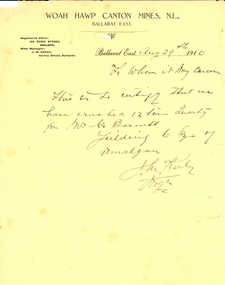
... Mr G. Barnett (signed J.M. Kerby) on Woah Hawp Canton Mines letterhead and dated 29 August 1910 .2) Certification of crushing yeilded 13 ounces of amalgam. (signed L.E. Trethowan...l.e. trethowan j.m. kerby woah hawp woah hawp no. one gold mining company woah hawp canton mines chinese Two pages with printed Woah Hawp Canton Mines N.L. letterhead, and handwritten section. .1) Certification of 12 tons of quartz crushed for Mr G. ...Two pages with printed Woah Hawp Canton Mines N.L. letterhead, and handwritten section. .1) Certification of 12 tons of quartz crushed for Mr G. Barnett (signed J.M. Kerby) on Woah Hawp Canton Mines letterhead and dated 29 August 1910 .2) Certification of crushing yeilded 13 ounces of amalgam. (signed L.E. Trethowan, mine manager) on Woah Hawp No. 1 Gold Mining Company and dated 21 September 1910l.e. trethowan, j.m. kerby, woah hawp, woah hawp no. one gold mining company, woah hawp canton mines, chinese -
 Federation University Historical Collection
Plan, Sulieman Pasha Co Plan Transverse Section
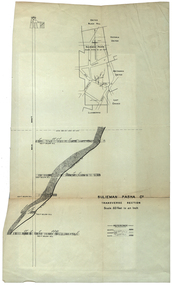
... Trethowan who built a house next to the shaft. In 1907, the shaft caved-in creating a sinkhole immediately at the back of the house. A Mr...Trethowan who built a house next to the shaft. In 1907, the shaft caved-in creating a sinkhole immediately at the back of the house. A Mr ...The Sulieman Pasha is possibly named after the most important Sultan of the Ottoman Empire, Suleiman One, or Suleiman the Magnificent, when the Ottoman Empire was at its peak. Or potentially a number of Ottoman governors, statesmen and military commanders with the same name after, however the spelling is slightly different to the mine name. No Turkish connection was found relating to the formation of the company, and remains unconfirmed. The mine operated from two shafts; No. 1 near the corner of Humffray and Mair streets, and also near where the Welcome Nugget (2217 ounces) was found years earlier; and the controversial No. 2 shaft several blocks south bordering the northern side of the main highway through Ballarat. The company produced 62 666 ounces of gold, the twelfth highest quartz reef gold production for any mine on the Ballarat goldfield. Some crushing figure examples are January-June 1881: 3674 tonnes 1085 ounces; January-June 1885: 2949 tonnes 1281 ounces; July-December 1885: 4459 tonnes 1119 ounces; January-June 1887: 1869 tonnes 730 ounces; July-December 1892: 1450 tonnes 771 ounces; July-December 1896: 4365 tonnes 1372 ounces. Like many mines in the area, gold grades were low. John Watson was noted as mine manager in the 1880s, and John Williams 1890s. The company was re-organised twice increasing the number of shares from 4000 to 24 000, and increasing the capital available. The Sulieman Pasha Company was formed in 1878. David Fitzpatrick was given the honour of turning the first sod of both the No.1 and later No. 2 shafts. The first dividend was given to shareholders in July 1881. The company obtained a prospecting vote (government grant) to start, and was very proud to be the first Victorian gold mining company to pay the funds back to the government. The event was marked by a lavish banquet laid out for ministers and government officials by the company. Leases were purchased to the south in 1885 to the Llanberris Mine boundary, after poor results began accumulating from the small No. 1 shaft. To take advantage of this new land the company planned to sink a second shaft. Initially this was to take place on government land, but the uproar from nearby residents caused the company to purchase land along the Main Road (now Western Highway), and the old Yarrowee Hotel which had occupied the site since the alluvial digger days of the 1850's was demolished. The area had since those days become heavily occupied with a number of shops, houses, a post office, church and two schools in the immediate area. The thought of an underground mine next door drew considerable opposition. The company (before the days of public relations departments) wrote 'most people would have thought that progress as vital as mining would be supported by tradesmen whose business rely on the mining industry. It seems when it comes to mining they are bereft of their senses, and considering the low ebb of mining in Ballarat East, the action of our opponents are unaccountable. (Sarcastically) There are certain engineering difficulties in moving the quartz reefs to a new location, but if we could to appease our opponents we would'. The company also wanted to take over 4 acres of the St Paul's school oval for machinery, but accused the St Paul's Church of wanting extortionate amounts of money upfront, and on a yearly basis for the privilege. It stated the church could not be opposed to mining when several years earlier it had formed its own company to mine the land, only for shareholders to lose their money. In 1886, the company approached the Minister for Mines, and attended heated public meetings on the matter. The local residents, shop owners, and church submitted a 60 person petition to the local council and government authorities. They stated the shaft contravened the mining statutes, which stating no mining could take place within 150 yards of a public building or church. A speech by a resident stated 'mining always comes with glorious pictures of the great benefits which would accrue all parties concerned if their request is granted, but if property is destroyed or depreciated in value, no-one then comes forward and compensates them'. The No. 2 shaft was approved including taking over part of the school oval. In 1888, workers at the company's No. 2 shaft went on strike to try and bring their wages in line with other mines in the district (the No. 1 shaft was operated by tributers). William Madden (26) was killed from a fall of earth underground the same year, while a year later his father John Madden (70) was similarly killed in the Madame Berry Mine elsewhere in the district. In 1897 as the amount of gold being found fell away, it came to light part of the deal to purchase the Yarrowee Hotel site was a 5% royalty on gold found. Shareholders could not understand why they were paying a royalty to the former owners of the property. The mine closed in 1898 due to a lack of gold. In 1902 a boy (age unknown) called Charles Lee was killed from a fractured skull while working to dismantle the Sulieman Pasha plant. The fuss over the No. 2 shaft had a sequel. On the company winding up, the land was purchased by J.S. Trethowan who built a house next to the shaft. In 1907, the shaft caved-in creating a sinkhole immediately at the back of the house. A Mr Chamberlain heard a deep rumbling sound at 5am, and looked out the window to see his fowl house and thirteen chickens disappear down an expanding hole. He then went back to bed, and called the police later in the day. The shaft was 1050 feet deep, and the hole at the surface that developed was 20 feet by 17 feet across, and 20 feet depth. In 1930 it is reported a syndicate had been formed to clean out the old shaft, and re-open the mine. It is assumed this was the No. 1 shaft but no more was found. (https://www.mindat.org/loc-304239.html, accessed 07/08/2019) A transverse section plan of the Sulieman Pasha Mine.sulieman pasha company, plan, mining, united black hill mine, victoria united mine, victoria street, britannia united mine, last chance mine, llanberris mine, ottoman empire, john watson, john williams, david fitzpatrick -
 Melton City Libraries
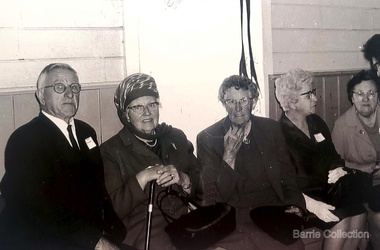
Photograph, Mrs Knox and Beryl Gillespie at the First Hundred Years Celebration of Melton State School 430, 1970
... Mr Lumsden was manager and later years Bernie Trethowan and Jack Butler were partners. ...Mr Lumsden was manager and later years Bernie Trethowan and Jack Butler were partners. ...Beryl Knox speaking about early life in Melton. Page 1 1949 – 64 years ago. We began our married life at Melton Sth. The house on the corner of the Exford Rd and Staughton St-- dusty gravel roads, box thorns and noxious weeds everywhere and a sprinkling of houses and vacant land. It was a friendly community consisting of old family names. McDonalds, Blacks, Dodemaide, Cahill, Coopers, Minns, Tinklers, Nesbitts, Cochranes, Wickhams, Exells. Mavis Butler. The home owned by Mr. Robinson and Miss Robinson had been shifted in two parts transported from Diggers Rest and it is still standing 2013. Bruce’s father purchased the house and two adjoining blocks, the Conways built on one and the Rawlinson family on the other block. Eileen still resides there, she was only a baby in a pram and the family had not long arrived from England. The railway line was close to the house and the contents would rattle when heavy steams trains went through, and on a clear frosty night the 1am paper train would echo roar through very loudly when labouring towards the Exford Bridge. Then the two carriage motor train was introduced, this was great for the workers and schoolies who travelled to Melbourne. The train pulled up at the crossing or riding to pick up or drop off. Melva Gillespie (nee Hirt) Bill Cahill delivered the milk by the billy and then in bottles. Len Kennedy (Paul Kennedy’s father, Norma Murrays son) delivered Jongebloeds bread, he always had a sweep going for the Melbourne Cup and raffles for the footy club. Mr. Woodgate owned an old bus and pick up point was the Post Office when there was a Saturday film on a Melton. There were no doctors or dentists in the district. If we need a Doctor we had to travel to Bacchus Marsh or discuss problems over the phone. In later years a Bacchus Marsh Doctor rented the Bluestone building in McKenzie St a couple of days a week. If we needed the Dentist we had to travel to West Footscray or Footscray. We did our banking at “State Savings” then the Miss Minns had the agency and then Bardsleys Store. We travelled to Bacchus Marsh to the National and Commercial banks. Station Rd to Western Highway, now (High Street) was a narrow stretch of bitumen and gravel farmland either side and a couple of farm houses and large gum trees on the properties. Page 2 North of the Railway line Mrs Bessie Jones, mother of Chas and Betty Jones managed the Post Office, next door to her Chas and Betty had the Shell Centre, and later moved the business to Melton. Hughie Nesbitt and mother owned the grocery and hardware store, and I bought my first set of saucepans there. On the opposite side of Station road Mr Coombe owned the fruit shop, and also provided soft drinks and lollies for children. The Chaff Mill was on the corner of Station Rd and Brooklyn Rd. Mr Lumsden was manager and later years Bernie Trethowan and Jack Butler were partners. It finally burnt down and is a Service Station now. Along Brooklyn Rd there were a few houses and Victoria Hall, not a very big hall, but catered for lots of functions, Balls, Fancy Dress, Bazaars, Square Dancing and meetings. The Bacchus Marsh Baptists held Sunday School in the hall. A group of shops were built south of the railway line Molly and Len Skinner managed the Post Office and handled a few essential groceries. Tom McDonald and Ron Lunsberg were the butchers. Mary and Syd Cooper lived next door to us and often in turn would run out of something when we had a baking spree we would borrow or exchange, sugar flour etc over the fence. Mavis and Jack Butler lived there before the Coopers. Bernie and Iris Trethowan lived two doors up. Neighbours were invited into their home to view the first black and white television in Melton Sth. Bill Exell was one of the first Melton Sth farmers to sell his land to developers, the land was idle for years before housing developed. I joined the Melton Valley Golf Club in 1960. The Gun Club as our Club House, an old tin shed consisting a water tank, trestle table and forms and dirt floor. It was a 9 hole course with sand scraps and landscape putting before greens. The Common or parkland was part of the Golf Course. It was open for every ones recreation. Roy Norton an old identity trained his trotters on the Common and wouldn’t clear the track for the golfers. The golfers had to avoid him to continue to play. We had to keep clear when the young youths came in their paddock cars and motorbikes. Over the years the Toolern Creek flooded its banks, water and debri covered the course on one year our first Club house was flooded out. It took several working bees to clean it up. We lived at Melton Sth for 15 years and moved to Melton on the farm “Croxton Park.” The Nixon family farm “Mowbray” adjoined the farm. Bruce worked the land cropping the farm when Mrs Nixon died. Page 3 (page 4 on the handwritten script) Bruce had the first offer to buy, in those days it wasn’t easy to get good bank loans. Part of the land is the Golf Course now and Mr O’Shea purchased the bulk. Moving to Melton was totally different – I became involved with Committees, Scouts, Guides, Mothers Clubs, CWA, Church Op shop (8 years). Melton Amateurs players produced and tutored by Mabel Rogers exerts from Pyjama Game, South Pacific, Carousel - later years a group of ladies did gentle water exercise at Essendon and Station Road swimming pool. I was 20 or so years in Probus. The local followed the football, there was always a Gymkhana on the long weekend in June. The tennis always created a lot of interest during the finals. It didn’t matter which team played the supporters were treated to a cup of tea and leftovers from their afternoon tea. In 1978 were the first residents to move into the Jennings Estate Kurunjang and lived there 31 years and retired 4 years ago into Unit. The amazing changes I have experienced. Merrimu supplied our water, after depending on tanks. The landscape changed completely when developers came in, no more dusty plains \ typed web Sept 2013 McFarlane, Mrs Knox and Beryl Gillespie at the First Hundred Years Celebration of Melton State School 430. The event was held at Mechanics Hall, Melton.local identities, local significant events, education -
 Melton City Libraries
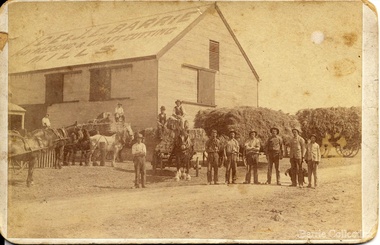
Photograph, 'Melton South Chaff Mill employees, Unknown
... Trethowan family when it burnt down. Melton South was small a community referred to as Melton Railway Station. Member of the community raised the idea to have a public hall. In 1909 Cr Barrie, Mr...Trethowan family when it burnt down. Melton South was small a community referred to as Melton Railway Station. Member of the community raised the idea to have a public hall. In 1909 Cr Barrie, Mr ...Charles E “Ernie” Barrie started constructing a Chaff mill on the corner of Brooklyn and Station road in 1900. It soon became a thriving business and was ideally located close to the railway line. Ernie and his father William and other Barrie brothers had been operated travelling chaff cutters in the district of Melton and Werribee. Within a short time the mill expanded into two big sheds in partnership with his brother James E known as “Ted”. The eldest brother William was in the Manager living in Melton South. In 1906 Ernie applied for a railway crossing on Brooklyn Road to have direct access for railway trucks to be shunted to the mill to be loaded. The Mill was also had the first phone to be connected, No 1, and No’s 2, 3 were the Golden Fleece and Macs Hotels. In 1906 Ernie married Jessie Lang daughter of the Head Teacher at Melton State School No 430 (1896 –1917). The Barrie house on the north side of the mill was completed in August 1906. It survived for almost 60 years until demolition. Chaff mills were very susceptible to fires and often burnt down and would be rebuilt again ready for the peak of the harvesting season. The final demise of the Mill occurred in a spectacular blaze on the night of Friday 2nd December 1977, just before the earth tremor as reported in the local paper. Brian Dobson the local photographer lived close by and captured the night blaze. A video was also taken of the action by the fire brigade. My parents Bon and Edna Barrie were living at 19 First Avenue, and took colour slides of the smouldering ruins in the half -light. Ironically Bon had spent the first year of his life (born in April 1909 and sister Mary born October 1907) at the house beside the mill. Trethowan’s Chaff mill in Brooklyn road was also destroyed by fire, which stated in the evening on Tuesday April 28th 1987. It was established in 1910 by Dixon Brothers, followed by, Ebbot & Kebby, Robinson, Trethowan and Butler and was with the Trethowan family when it burnt down. Melton South was small a community referred to as Melton Railway Station. Member of the community raised the idea to have a public hall. In 1909 Cr Barrie, Mr Nesbitt and Delany formed a committee to build a community hall. Cr Barrie donated the land and The Exford Hall was completed in September 1910 later to be named Victoria Hall. It was demolished in 1992. Colour slide in Barrie archive. In April 1910 the Ernie sold the Mill to Glover Onians (HSK Ward) family moved away to a property in Trundle NSW. Ernie had acquired 640 acres (a square mile) and leased a further 1920 acres of adjoining land. It was the practise of the farmers in the area at the time to buy up or lease the surrounding land from the 640 acre crown land blocks to make up acerage for a viable wheat farm. His wife Jessie found the climate to be very hot and when the Darlingsford property at Melton was put up for sale in the latter part of 1910 and was passed in at the auction. My grandfather saw this an opportunity to return to Melton. The negotiations to Darlingsford were finalised on May 11th 1911. Barrie bothers with connections to Chaff mills and farming in Melton from the 1900s William Henry, Charles Ernest, James Edwin, Samuel John, Robert, Arthur Roger, Albert Walter. Three grandsons and a great-grandson are in business earthmoving and farming in Melton today. (2013) Memoirs by Wendy BarrieEmployees at Chaff Mill, it was located on the corner of Brooklyn and Station Road, Melton South. local identities, agriculture -
 Bendigo Historical Society Inc.
Document - PHOTOGRAPHIC RECORD OF THE FORMER LYRIC THEATRE
... Trethowan, B.arch, FRAIA, dated June, 2005. A letter in the front of the document mentions as part of the Bendigo Bank Development, it was necessary to demolish the former Lyric Theatre. Before doing so, the Bank commissioned a heritage architect to produce a photographic record of the building. It is addressed to Mr...Trethowan, B.arch, FRAIA, dated June, 2005. A letter in the front of the document mentions as part of the Bendigo Bank Development, it was necessary to demolish the former Lyric Theatre. Before doing so, the Bank commissioned a heritage architect to produce a photographic record of the building. It is addressed to Mr ...Spring bound photographic record of the former Lyric Theatre, 19 High Street (Charing Cross), Bendigo, by Bruce Trethowan, B.arch, FRAIA, dated June, 2005. A letter in the front of the document mentions as part of the Bendigo Bank Development, it was necessary to demolish the former Lyric Theatre. Before doing so, the Bank commissioned a heritage architect to produce a photographic record of the building. It is addressed to Mr Jim Evans, President, Bendigo Historical Society and dated 10 August 2005. The beginning has the Historical Background, Building Description and three pages of Plans and Elevations. There are sixty colour photographs of the building depicting the front outside of the building, other outside photos and a number of the interior.buildings, commercial, former lyric theatre, photographic record of the former lyric theatre, bruce trethowan, gallagher jeffs consulting, gallagher jeffs pty ltd, jim evans, bendigo bank development, ted gallagher, richard hasseldine, city of greater bendigo planning department, keogh & austen, state savings banks, sydney smith and ogg, godfrey and spowers, colonial life building, johnson morley warehouse, j g austen, muioof building eaglehawk, george austen, backhaus building, allawah, william cowling, taylor, soilleux, overend, plaza theatre, backhaus trust, princess theatre, the annals of bendigo vol 8 p163, the annals vol 8 p180, fernwood women's health club, bendigo real estate
